EP0283438A2 - Pyridyl-diazabutadienyldisulfide - Google Patents
Pyridyl-diazabutadienyldisulfide Download PDFInfo
- Publication number
- EP0283438A2 EP0283438A2 EP88810157A EP88810157A EP0283438A2 EP 0283438 A2 EP0283438 A2 EP 0283438A2 EP 88810157 A EP88810157 A EP 88810157A EP 88810157 A EP88810157 A EP 88810157A EP 0283438 A2 EP0283438 A2 EP 0283438A2
- Authority
- EP
- European Patent Office
- Prior art keywords
- alkyl
- formula
- compounds
- compound
- unsubstituted
- Prior art date
- Legal status (The legal status is an assumption and is not a legal conclusion. Google has not performed a legal analysis and makes no representation as to the accuracy of the status listed.)
- Withdrawn
Links
Classifications
-
- C—CHEMISTRY; METALLURGY
- C07—ORGANIC CHEMISTRY
- C07D—HETEROCYCLIC COMPOUNDS
- C07D213/00—Heterocyclic compounds containing six-membered rings, not condensed with other rings, with one nitrogen atom as the only ring hetero atom and three or more double bonds between ring members or between ring members and non-ring members
- C07D213/02—Heterocyclic compounds containing six-membered rings, not condensed with other rings, with one nitrogen atom as the only ring hetero atom and three or more double bonds between ring members or between ring members and non-ring members having three double bonds between ring members or between ring members and non-ring members
- C07D213/04—Heterocyclic compounds containing six-membered rings, not condensed with other rings, with one nitrogen atom as the only ring hetero atom and three or more double bonds between ring members or between ring members and non-ring members having three double bonds between ring members or between ring members and non-ring members having no bond between the ring nitrogen atom and a non-ring member or having only hydrogen or carbon atoms directly attached to the ring nitrogen atom
- C07D213/24—Heterocyclic compounds containing six-membered rings, not condensed with other rings, with one nitrogen atom as the only ring hetero atom and three or more double bonds between ring members or between ring members and non-ring members having three double bonds between ring members or between ring members and non-ring members having no bond between the ring nitrogen atom and a non-ring member or having only hydrogen or carbon atoms directly attached to the ring nitrogen atom with substituted hydrocarbon radicals attached to ring carbon atoms
- C07D213/44—Radicals substituted by doubly-bound oxygen, sulfur, or nitrogen atoms, or by two such atoms singly-bound to the same carbon atom
-
- C—CHEMISTRY; METALLURGY
- C07—ORGANIC CHEMISTRY
- C07D—HETEROCYCLIC COMPOUNDS
- C07D213/00—Heterocyclic compounds containing six-membered rings, not condensed with other rings, with one nitrogen atom as the only ring hetero atom and three or more double bonds between ring members or between ring members and non-ring members
- C07D213/02—Heterocyclic compounds containing six-membered rings, not condensed with other rings, with one nitrogen atom as the only ring hetero atom and three or more double bonds between ring members or between ring members and non-ring members having three double bonds between ring members or between ring members and non-ring members
- C07D213/04—Heterocyclic compounds containing six-membered rings, not condensed with other rings, with one nitrogen atom as the only ring hetero atom and three or more double bonds between ring members or between ring members and non-ring members having three double bonds between ring members or between ring members and non-ring members having no bond between the ring nitrogen atom and a non-ring member or having only hydrogen or carbon atoms directly attached to the ring nitrogen atom
- C07D213/24—Heterocyclic compounds containing six-membered rings, not condensed with other rings, with one nitrogen atom as the only ring hetero atom and three or more double bonds between ring members or between ring members and non-ring members having three double bonds between ring members or between ring members and non-ring members having no bond between the ring nitrogen atom and a non-ring member or having only hydrogen or carbon atoms directly attached to the ring nitrogen atom with substituted hydrocarbon radicals attached to ring carbon atoms
- C07D213/44—Radicals substituted by doubly-bound oxygen, sulfur, or nitrogen atoms, or by two such atoms singly-bound to the same carbon atom
- C07D213/53—Nitrogen atoms
-
- A—HUMAN NECESSITIES
- A01—AGRICULTURE; FORESTRY; ANIMAL HUSBANDRY; HUNTING; TRAPPING; FISHING
- A01N—PRESERVATION OF BODIES OF HUMANS OR ANIMALS OR PLANTS OR PARTS THEREOF; BIOCIDES, e.g. AS DISINFECTANTS, AS PESTICIDES OR AS HERBICIDES; PEST REPELLANTS OR ATTRACTANTS; PLANT GROWTH REGULATORS
- A01N43/00—Biocides, pest repellants or attractants, or plant growth regulators containing heterocyclic compounds
- A01N43/34—Biocides, pest repellants or attractants, or plant growth regulators containing heterocyclic compounds having rings with one nitrogen atom as the only ring hetero atom
- A01N43/40—Biocides, pest repellants or attractants, or plant growth regulators containing heterocyclic compounds having rings with one nitrogen atom as the only ring hetero atom six-membered rings
-
- C—CHEMISTRY; METALLURGY
- C07—ORGANIC CHEMISTRY
- C07D—HETEROCYCLIC COMPOUNDS
- C07D213/00—Heterocyclic compounds containing six-membered rings, not condensed with other rings, with one nitrogen atom as the only ring hetero atom and three or more double bonds between ring members or between ring members and non-ring members
- C07D213/02—Heterocyclic compounds containing six-membered rings, not condensed with other rings, with one nitrogen atom as the only ring hetero atom and three or more double bonds between ring members or between ring members and non-ring members having three double bonds between ring members or between ring members and non-ring members
- C07D213/04—Heterocyclic compounds containing six-membered rings, not condensed with other rings, with one nitrogen atom as the only ring hetero atom and three or more double bonds between ring members or between ring members and non-ring members having three double bonds between ring members or between ring members and non-ring members having no bond between the ring nitrogen atom and a non-ring member or having only hydrogen or carbon atoms directly attached to the ring nitrogen atom
- C07D213/60—Heterocyclic compounds containing six-membered rings, not condensed with other rings, with one nitrogen atom as the only ring hetero atom and three or more double bonds between ring members or between ring members and non-ring members having three double bonds between ring members or between ring members and non-ring members having no bond between the ring nitrogen atom and a non-ring member or having only hydrogen or carbon atoms directly attached to the ring nitrogen atom with hetero atoms or with carbon atoms having three bonds to hetero atoms with at the most one bond to halogen, e.g. ester or nitrile radicals, directly attached to ring carbon atoms
- C07D213/78—Carbon atoms having three bonds to hetero atoms, with at the most one bond to halogen, e.g. ester or nitrile radicals
- C07D213/83—Thioacids; Thioesters; Thioamides; Thioimides
Definitions
- the present invention relates to new insecticidally active pyridyl-diazabutadienyl disulfides, processes for their preparation, agents which contain these pyridyl-diazabutadienyl disulfides and their use in pest control.
- pyridyl-diazabutadienyl disulfides according to the invention correspond to formula I. wherein B unsubstituted or substituted C1-C6 alkyl, unsubstituted or substituted phenyl, or the rest and Y is unsubstituted or substituted aromatic carbo- or heterocycle, and the salts of a compound of formula I.
- R2 and R3 are independently hydrogen, halogen, C1-C4-alkyl, trifluoromethyl, C1-C4-alkoxy or nitro, and B means cyano-C1-C4-alkyl.
- Y a rest means where R is hydrogen, C1-C4-alkyl, halogen, nitro, cyano, C1-C4-alkoxy, C1-C4-alkylthio, C1-C4-haloalkyl with 1 to 9 halogen atoms, C1-C4-haloalkoxy with 1 to 9 halogen atoms, C1 -C4-Haloalkylthio with 1 to 9 halogen atoms, phenyl-substituted phenyl, phenyl-C1-C3-alkyl, phenoxy, phenylthio or pyridyloxy means and n is preferably a number from 1 to 5, including the salts.
- R is hydrogen, C1-C4-alkyl, halogen, nitro, cyano, C1-C4-alkoxy, C1-C4-alkylthio, C1-C4-haloalkyl with 1 to 9 halogen atoms, C1-C4-haloalkoxy having 1 to 9 halogen atoms or C1-C4-haloalkylthio having 1 to 9 halogen atoms and n is a number from 1 to 3.
- n represents a number 1 or 2
- Y the rest means, wherein at least one radical R is in the 4-position.
- alkyl itself or as a constituent of another substituent is to be understood as meaning straight-chain or branched and, depending on the number of carbon atoms specified in the context of the present invention, for example the following groups: methyl, ethyl, propyl, butyl, and their isomers, such as isopropyl, isobutyl tert-butyl, sec-butyl.
- haloalkyl in the context of the present invention is to be understood as meaning alkyl radicals, such as methyl, ethyl, n-propyl, and isopropyl, butyl, etc., which are substituted by 1 to 9 different or similar halogen atoms, but are also perhalogenated alkyl radicals can be those whose hydrogen atoms are only partially substituted with halogen.
- halogen in the context of the present invention is to be understood as fluorine, chlorine and bromine, preferably fluorine and chlorine.
- the carbocyclic or heterocyclic arylenes which are suitable as substituents are unsubstituted or substituted phenyl, 1- or 2-naphthyl and pyridyl.
- the present subject matter of the invention also includes the salts, especially the physiologically acceptable salts, of the compounds of the formula I.
- salts with organic and inorganic acids include the following into consideration: chlorides, bromides, iodides, sulfates, hydrogen sulfates, chlorates, perchlorates, rhodanides, nitrates, phosphates, hydrogen phosphates, tetrafluoroborates, formates, acetates, trichloroacetates, trifluoroacetates, phenylsulfonates, oxalates, malonates, citrates, succinates, succinates .
- the compounds of formula 1a can be prepared by using a 5-pyridyl-4,5-dihydrothiadiazole of formula II first with a base, then with a sulfenyl chloride of formula III, Cl-SB (III), reacted, where Y and B have the meaning given initially and, if appropriate, the desired product is converted into one of its salts and isolated.
- This method is new and also forms the subject of the present invention.
- the sulfenyl chlorides of the formula III are known and commercially available compounds, the preparation of which is known from the literature by several methods. An overview of the production processes for sulfenyl chlorides has been published in the journal "Synthesis", 561-580 (1970).
- the dihydrothiadiazoles of the formula II used can be used both with inorganic bases, such as, for example, Potassium or sodium hydroxide, potassium or sodium carbonate, as well as with organic bases, e.g. Trialkylaminen be implemented.
- inorganic bases such as, for example, Potassium or sodium hydroxide, potassium or sodium carbonate
- organic bases e.g. Trialkylaminen be implemented.
- Suitable solvents are e.g. aromatic hydrocarbons such as benzene, toluene and xylene; Ketones such as acetone, cyclohexanone and methyl ethyl ketone; Ethers such as tetrahydrofuran, dioxane and diethyl ether; halogenated hydrocarbons such as chloroform, carbon tetrachloride and chlorobenzene; Alcohols such as ethanol and propanol; Esters of aliphatic acids such as ethyl acetate; aliphatic amides such as dimethylformamide and dimethylacetamide; Dimethyl sulfoxide and other solvents that do not affect the reaction. These solvents can also be used as mixtures.
- the reaction temperature can be in a wide range from -10 to + 200 ° C. A temperature range from room temperature to about 150 ° C.
- the compounds of formula Ib can be prepared by oxidizing a compound of formula II, preferably in the presence of a basic substance.
- suitable oxidizing agents are chlorine, iodine or oxygen.
- Basic substances that can be used in the process are, for example, alkali and alkaline earth metal hydroxides or carbonates, such as, for example, KOH, NaOH, K2CO3, Na2CO3 etc.
- the process leading to the compounds of formula Ib according to the invention is also preferably carried out in a solvent.
- the reaction temperature can be in a wide range from -10 to + 100 ° C. A temperature range of approximately 0 ° to 60 ° C. is preferred.
- Suitable solvents in the preparation of the compounds of formula I are e.g. aromatic hydrocarbons such as benzene, toluene and xylene; Ketones such as acetone, cyclohexanone and methyl ethyl ketone; Ethers such as tetrahydrofuran, dioxane and diethyl ether; halogenated hydrocarbons such as chloroform, carbon tetrachloride and chlorobenzene; Alcohols such as ethanol and propanol; Esters of aliphatic acids such as ethyl acetate; aliphatic amides such as dimethylformamide and dimethylacetamide; Dimethyl sulfoxide and other solvents that do not affect the reaction. These solvents can also be used as mixtures.
- aromatic hydrocarbons such as benzene, toluene and xylene
- Ketones such as acetone, cyclohexanone and methyl ethyl
- the starting compounds of the formula II can be prepared in a manner known per se (cf. DM Evans et al., J. Chem. Soc., Chem. Commun. 1982 , 188; KN Zelenin et al., Khim. Geterotsikl. Soedin, 1982 No. 7 , 904) are prepared by reacting a compound of the formula IV with a compound of formula V H2N-NH- ⁇ Y (V), wherein in the compounds IV and V R4 C1-C4-alkyl and Y have the meanings given above under formula Ib.
- the compounds of formula II can also be prepared in accordance with European patent application No. 0 207 004 in that a compound of formula VI wherein R4 and Y have the meanings given above, reacted with a sulfide.
- the compounds of the formula I according to the invention have excellent activity as pesticides with good plant tolerance and low toxicity to warm-blooded animals. They are particularly suitable for the control of pests affecting plants and animals.
- the compounds of the formula I are particularly suitable for controlling insects of the orders Lepidoptera, Coleoptera, Homoptera, Heteroptera, Diptera, Thysanoptera, Orthoptera, Anoplura, Siphonaptera, Mallophaga, Thysanura, Isoptera, Psocoptera and Hymenoptera and representatives of the order Akarina.
- the good pesticidal activity of the compounds according to the invention corresponds to a mortality rate of at least 50-60% of the pests mentioned.
- the compounds of the formula I are furthermore distinguished by a good action against larval insect stages and nymphs, in particular of eating insect pests.
- the compounds of the formula I can be used with excellent success against plant-damaging cicadas, especially in rice crops.
- the compounds are also suitable for controlling ectoparasites, e.g. Lucilia sericata, as well as ticks on domestic and farm animals, e.g. through animal, stable and pasture treatment.
- the action of the compounds according to the invention or of the compositions comprising them can be broadened considerably by adding other insecticides and / or acaricides and adapted to the given circumstances.
- the following additives for example Representatives of the following classes of active substance are considered: organic phosphorus compounds, nitrophenols and derivatives, formamidines, ureas, carbamates, pyrethroids, chlorinated hydrocarbons and Bacillus thuringiensis preparations.
- the compounds of the formula I are used in unchanged form or preferably together with the auxiliaries customary in formulation technology and are therefore used, for example, to emulsion concentrates, directly sprayable or dilutable solutions, diluted emulsions, wettable powders, soluble powders, dusts, granules, also encapsulations in e.g. polymeric materials processed in a known manner.
- the application methods such as spraying, atomizing, dusting, scattering or pouring, as well as the means, are chosen in accordance with the desired goals and the given conditions.
- compositions, preparations or compositions comprising a solid or liquid additive are prepared in a known manner, for example by intimately mixing and / or grinding the Active ingredients with extenders, such as solvents, solid carriers, and optionally surface-active compounds (surfactants).
- Aromatic hydrocarbons preferably fractions C8 to C12, such as Xylene mixtures or substituted naphthalenes, phthalic acid esters, such as dibutyl or dioctyl phthalate, aliphatic hydrocarbons, such as cyclohexane, paraffins, alcohols and glycols, and their ethers and esters, such as ethanol, ethylene glycol, ethylene glycol monomethyl or ethyl ether, ketones, strongly cyclohexanone, such as cyclohexanone such as N-methyl-2-pyrrolidone, dimethyl sulfoxide or dimethylformamide, and optionally epoxidized vegetable oils, such as epoxidized coconut oil or soybean oil, or water.
- Aromatic hydrocarbons preferably fractions C8 to C12, such as Xylene mixtures or substituted naphthalenes, phthalic acid esters, such as dibutyl or dioctyl phthalate
- solid carriers e.g. natural dust, such as calcite, talc, kaolin, montmorillonite or attapulgite
- natural dust such as calcite, talc, kaolin, montmorillonite or attapulgite
- highly disperse silicas or highly disperse absorbent polymers can also be added.
- Porous types such as e.g. Pumice stone, broken brick, sepiolite or bentonite, as non-sorptive carrier materials e.g. Calcite or sand in question.
- a large number of granulated materials of inorganic or organic nature such as in particular dolomite or comminuted plant residues, can be used.
- suitable surface-active compounds are nonionic, cationic and / or anionic surfactants with good emulsifying, dispersing and wetting properties.
- surfactants are also to be understood as mixtures of surfactants.
- Suitable anionic surfactants can be both so-called water-soluble soaps and water-soluble synthetic surface-active compounds.
- Suitable soaps are the alkali, alkaline earth or optionally substituted ammonium salts of higher fatty acids (C10-C22), e.g. the Na or K salts of oleic or stearic acid, or of natural fatty acid mixtures, e.g. can be obtained from coconut or tall oil.
- the fatty acid methyl taurine salts and modified and unmodified phospholipids should also be mentioned as surfactants.
- the fatty sulfonates or sulfates are usually present as alkali, alkaline earth or optionally substituted ammonium salts and generally have an alkyl radical with 8 to 22 carbon atoms, alkyl also including the alkyl part of acyl radicals, e.g. the Na or Ca salt of lignin sulfonic acid, dodecylsulfuric acid ester or a fatty alcohol sulfate mixture made from natural fatty acids.
- This subheading also includes the salts of sulfuric acid esters and sulfonic acids from fatty alcohol / ethylene oxide adducts.
- the sulfonated benzimidazole derivatives preferably contain 2 sulfonic acid groups and a fatty acid residue with about 8-22 carbon atoms.
- Alkylarylsulfonates are e.g. the sodium, calcium or triethanolamine salts of dodecylbenzenesulfonic acid, dibutylnaphthalenesulfonic acid or a naphthalenesulfonic acid-formaldehyde condensation product.
- Corresponding phosphates such as e.g. Salts of the phosphoric acid ester of a p-nonylphenol (4-14) ethylene oxide adduct, in question.
- the nonionic surfactants used are primarily polyglycol ether derivatives of aliphatic or cycloaliphatic alcohols, saturated or unsaturated fatty acids and alkylphenols Question that can contain 3 to 30 glycol ether groups and 8 to 20 carbon atoms in the (aliphatic) hydrocarbon radical and 6 to 18 carbon atoms in the alkyl radical of the alkylphenols.
- Further suitable nonionic surfactants are the water-soluble 20 to 250 ethylene glycol ether groups and 10 to 100 propylene glycol ether groups containing polyethylene oxide adducts with polypropylene glycol, ethylene diaminopolypropylene glycol and alkyl polypropylene glycol with 1 to 10 carbon atoms in the alkyl chain.
- the compounds mentioned usually contain 1 to 5 ethylene glycol units per propylene glycol unit.
- nonionic surfactants include nonylphenol polyethoxyethanols, castor oil polyglycol ethers, polypropylene-polyethylene oxide adducts, tributylphenoxypolyethoxyethanol, polyethylene glycol and octylphenoxypolyethoxyethanol.
- Fatty acid esters of polyoxyethylene sorbitan, such as polyoxyethylene sorbitan trioleate, are also suitable.
- the cationic surfactants are primarily quaternary ammonium salts which contain at least one alkyl radical having 8 to 22 carbon atoms as N substituents and have lower, optionally halogenated alkyl, benzyl or lower hydroxyalkyl radicals as further substituents.
- These salts are preferably in the form of halides, methyl sulfates or ethyl sulfates, e.g. the stearyl trimethyl ammonium chloride or the benzyl di (2-chloroethyl) ethyl ammonium bromide.
- the pesticidal preparations generally contain, based on weight, 0.1 to 99%, in particular 0.1 to 95%, of an active ingredient of the formula I or combinations thereof with other insecticides or acaricides, 1 to 99.9% of a solid or liquid additive and 0 to 25%, in particular 0.1 to 20%, of a surfactant. While concentrated products are preferred as a commercial product, the end user generally uses diluted preparations which have significantly lower active substance concentrations.
- the agents can also contain other additives such as stabilizers, defoamers, viscosity regulators, binders, adhesives and fertilizers or other active ingredients to achieve special effects.
- a solution of 8.7 g of potassium hydroxide in 100 ml of ethanol is saturated with hydrogen sulfide.
- 8.7 g of potassium hydroxide in 100 ml of ethanol are added dropwise to this solution.
- 22.4 g of 1-chloro-1- (3-nitrophenyl) -4- (3-pyridyl) -2,3-diazabutadiene are then added in portions to the resulting solution while cooling with ice.
- the reaction mixture is stirred for 1 hour at room temperature, then concentrated and the residue taken up in ethyl acetate.
- the ethyl acetate solution is washed twice with water and twice with saturated sodium chloride solution, dried over sodium sulfate, filtered and evaporated.
- the resulting reaction mixture was stirred at 20-25 ° C for 5 hours, filtered and the mother liquor evaporated in vacuo at 60 °.
- the evaporation residue is dissolved in 200 ml of ethyl acetate, the solution is washed with 20 ml of water and 20 ml of saturated sodium chloride solution, dried over sodium sulfate, filtered and evaporated in vacuo at 60 °.
- the residue consists of the desired 1- (4-chlorophenyl-4- (pyrid-3-yl) -2,3-diazabutadien-1-yl-1,1-dimethyl-1-cyanomethyl disulfide in purified form, with a melting point of 83-85 ° C.
- the active ingredient or combination of active ingredients is mixed with the additives and ground well in a suitable mill.
- Spray powder is obtained which can be diluted with water to form suspensions of any desired concentration.
- Active ingredient or combination of active ingredients 10% Octylphenol polyethylene glycol ether (4-5 mol AeO) 3% Ca-dodecylbenzenesulfonate 3% Castor oil polyglycol ether (36 mol AeO) 4% Cyclohexanone 30% Xylene mixture 50%
- Emulsions of any desired concentration can be prepared from this concentrate by dilution with water.
- Ready-to-use dusts are obtained by mixing the active ingredient with the carrier and grinding it in a suitable mill.
- Active ingredient or combination of active ingredients 10% Na lignin sulfonate 2% Carboxymethyl cellulose 1% Kaolin 87%
- the active ingredient is mixed with the additives, ground and moistened with water. This mixture is extruded, granulated and then dried in an air stream.
- Active ingredient or combination of active ingredients 3% Polyethylene glycol (MG 200) 3% Kaolin 94%
- the finely ground active ingredient or combination of active ingredients is evenly applied in a mixer to the kaolin moistened with polyethylene glycol. In this way, dust-free coating granules are obtained.
- Active ingredient or combination of active ingredients 40% Ethylene glycol 10% Nonylphenol polyethylene glycol ether (15 mol AeO) 6% Na lignin sulfonate 10% Carboxymethyl cellulose 1% 37% aqueous formaldehyde solution 0.2% Silicone oil in the form of a 75% aqueous emulsion 0.8% Water 32%
- the finely ground active ingredient or combination of active ingredients is intimately mixed with the additives. This gives a suspension concentrate from which suspensions of any desired concentration can be prepared by dilution with water.
- CSMA nutrient substrate for maggots 50 g freshly prepared CSMA nutrient substrate for maggots are weighed into beakers. From a 1 wt .-% acetone solution of the active ingredient, a certain amount is in the Pipette the nutrient substrate in the beaker so that there is an active ingredient concentration of 400 ppm. After mixing the substrate, the acetone is allowed to evaporate for at least 20 hours.
- the pupae washed out per batch are counted (toxic influence of the active ingredient on maggot development). Then after 10 days the number of flies hatched from the dolls is determined.
- Rooted bean plants are transplanted into pots that contain 600 cc of soil. Then pour 50 ml of a preparation of the compounds to be tested (obtained from a 25% wettable powder) in a concentration of 800 ppm directly onto the earth in the pots.
- aphis craccivora aphids are placed on the above-ground parts of the plants and the plants are placed over them with a plastic cylinder to protect the lice from any direct contact or gas effects of the test substance.
- the killing achieved is evaluated 48 and 72 hours after the start of the test. Two plants are used for each test substance, one in a separate pot. The test is carried out at 25 ° C and approx. 70% relative humidity.
- Pea seedlings (Vicia faba) about 4 to 5 days old, which are grown in water, are populated with approx. 200 individuals of the species Myzus persicae before the start of the experiment. The plants treated in this way are sprayed 24 hours later with an aqueous suspension containing up to 200 ppm of the compound to be tested to runoff. Two plants are used per test substance. The kill rate achieved is evaluated 24 and 72 hours after application. The test is carried out at 21-22 ° C and about 60% relative humidity.
- Rooted cabbages in the 4- to 5-leaf stage are transplanted into pots that contain 60 cc of soil.
- 50 ml of an aqueous formulation of the compound to be tested obtained from a 25% wettable powder
- aphids of the species Myzus persicae are placed on the aerial parts of the treated plants and the plants are covered with plastic cylinders in order to protect the aphids from any direct contact or gas effects of the test substance.
- The% kill achieved is evaluated 48 hours after the start of the test. Two plants, one in separate pots, are used per test substance. The test is carried out at approx. 25 ° C and 60% relative air humidity.
- a suitable small branch of Vicia faba which is severely infected with aphids from the species Aphis craccivora, is placed in a plastic cup of about 8 cm (diameter about 6 cm).
- the cup is covered with a plastic lid, which has a punched-out opening of 2 cm in the middle.
- a leaf of a Vicia faba plant is placed on the opening in the lid without separating this leaf from the potted plant.
- the sheet is then fixed with a second perforated lid on the cup over the opening of the first lid. From the bottom, i.e. through the opening of the first cover, the aphids in the cup now infect the top leaf of the forage plant.
- an aqueous preparation of the active ingredient to be tested is applied evenly in a concentration of 400 ppm using a brush. It is checked whether the test substance applied on one side to the top of the leaf of the forage plant diffuses in sufficient quantity through the leaf to its underside in order to kill sucking aphids there.
- the test is carried out at about 20 ° C and 60% relative humidity. Evaluation for% mortality is carried out 48 hours after drug application.
- the test is carried out on growing plants. For this purpose, 4 rice plants (stem thickness 8 mm) with a height of approx. 20 cm are planted in pots (diameter 8 cm).
- each plant is populated with 20 nymphs of the test animals in the third stage.
- a glass cylinder which is open on both sides, is placed over the populated plants and covered with a gauze cover. The nymphs are held on the treated plant for 10 days until the following developmental stage is reached. Evaluation for% mortality takes place 1, 4 and 8 days after the treatment.
- Example 5.10 Ovicidal action on Laodelphax striatellus and Nilaparavata lugens
- the test is carried out on growing plants. 4 rice plants (stem thickness 8 mm, height approx. 20 cm) are planted in pots (diameter 8 cm).
- each plant is sprayed on a turntable with 100 ml of an acetone solution containing 400 ppm of the respective active ingredient. After the spray coating has dried on, each plant is populated with 3 adult females. In order to prevent the animals from escaping, a glass cylinder is put over each populated plant and this is covered with a gauze cover. The females remain on the treated plant for 4 days to lay eggs and are then removed.
- the percentage mortality is determined by comparing the number of larvae hatched on the treated plants with the animals hatched on untreated control plants.
Landscapes
- Organic Chemistry (AREA)
- Chemical & Material Sciences (AREA)
- Life Sciences & Earth Sciences (AREA)
- Health & Medical Sciences (AREA)
- Plant Pathology (AREA)
- Engineering & Computer Science (AREA)
- Dentistry (AREA)
- General Health & Medical Sciences (AREA)
- Wood Science & Technology (AREA)
- Zoology (AREA)
- Environmental Sciences (AREA)
- Pest Control & Pesticides (AREA)
- Agronomy & Crop Science (AREA)
- Agricultural Chemicals And Associated Chemicals (AREA)
- Plural Heterocyclic Compounds (AREA)
- Pyridine Compounds (AREA)
Abstract
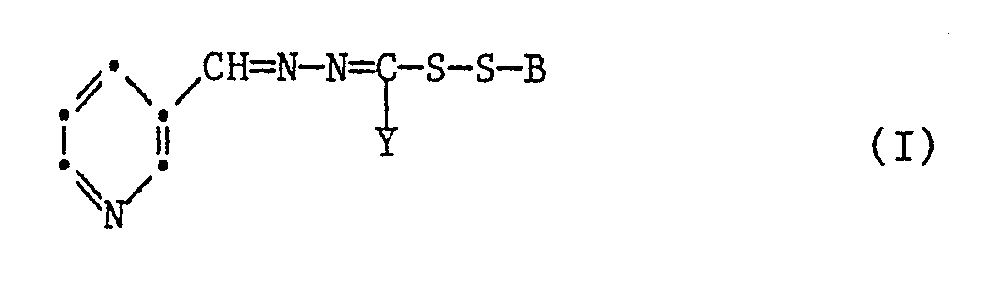
Neue gegebenenfalls substituierte Pyrid-3-yl-2,3-diazabutadien-1-yl]-disulfide der Formel
worin
B unsubstituiertes oder substituiertes C₁-C₆-Alkyl oder unsubstituiertes oder substituiertes Phenyl, dem Rest 
und
Y unsubstituierten oder substituierten aromatischen Carbo- oder Heterocyclus; sowie deren Salze und optischen Isomeren; Verfahren zur Herstellung dieser Verbindungen sowie diese enthaltende Mittel zur Verwendung in der Schädlingsbekämpfung, insbesondere zur Bekämpfung von Pflanzen und Tiere befallenden Insekten. Die neuen Verbindungen weisen insbesondere gute Wirksamkeit gegen pflanzenschädigende saugende Insekten auf.
B unsubstituiertes oder substituiertes C₁-C₆-Alkyl oder unsubstituiertes oder substituiertes Phenyl, dem Rest
Y unsubstituierten oder substituierten aromatischen Carbo- oder Heterocyclus; sowie deren Salze und optischen Isomeren; Verfahren zur Herstellung dieser Verbindungen sowie diese enthaltende Mittel zur Verwendung in der Schädlingsbekämpfung, insbesondere zur Bekämpfung von Pflanzen und Tiere befallenden Insekten. Die neuen Verbindungen weisen insbesondere gute Wirksamkeit gegen pflanzenschädigende saugende Insekten auf.
Description
- Die vorliegende Erfindung betrifft neue insektizid wirkame Pyridyl-diazabutadienyldisulfide, Verfahren zu ihrer Herstellung, Mittel, welche diese Pyridyl-diazabutadienyldisulfide enthalten und ihre Verwendung in der Schädlingsbekämpfung.
- Die erfindungsgemässen Pyridyl-diazabutadienyldisulfide entsprechen der Formel I

B unsubstituiertes oder substituiertes C₁-C₆-Alkyl, unsubstituiertes oder substituiertes Phenyl, oder den Rest
Y unsubstituierten oder substituierten aromatischen Carbo- oder Heterocyclus bedeuten,
sowie den Salzen einer Verbindung der Formel I. - Von den erfindungsgemässen Verbindungen werden jene der Formel Ia

Y einen unsubstituierten oder substituierten aromatischen Carbo- oder Heterocyclus, und
B unsubstituiertes oder substituiertes C₁-C₆-Alkyl oder unsubstituiertes oder substituiertes Phenyl bedeuten, bevorzugt. - Unter den Verbindungen der Formel Ia stehen wegen ihrer insektiziden Wirkung diejenigen im Vordergrund, bei welchen Y Pyridyl oder unsubstituiertes oder substituiertes Phenyl, B C₁-C₆-Alkyl, ein- oder mehrfach halogeniertes C₁-C₆-Alkyl, C₁-C₄-Alkoxy-C₁-C₄-alkyl, C₁-C₄-Alkylthio-C₁-C₆-alkyl, Cyano-C₁-C₆-alkyl, Nitro-C₁-C₄-alkyl oder den Rest

- Dabei sind diejenigen dieser Verbindungen bevorzugt, bei welchen Y Pyridyl oder den Rest

B Cyano-C₁-C₄-alkyl bedeutet. - Insbesondere bevorzugt ist davon das [1-(4-Chlorphenyl)-4-(pyrid-3-yl)-2,3-diazabutadien-1-yl]-(1,1-dimethyl-1-cyanomethyl) disulfid.
- Von den Verbindungen der Formel Ia stehen ausserdem jene im Vordergrund, bei welchen
Y Pyridyl oder den Rest
B Phenyl, Nitrophenyl, 4-Chlorphenyl oder 4-Tolyl bedeutet. - Besondere Erwähnung verdienen davon jene Verbindungen, bei welchen Y 4-Chlorphenyl bedeutet.
- Von den erfindungsgemässen Verbindungen werden auch jene der Formel Ib

Y einen Rest
R Wasserstoff, C₁-C₄-Alkyl, Halogen, Nitro, Cyano, C₁-C₄-Alkoxy, C₁-C₄-Alkylthio, C₁-C₄-Halogenalkyl mit 1 bis 9 Halogenatomen, C₁-C₄-Halogenalkoxy mit 1 bis 9 Halogenatomen, C₁-C₄-Halogenalkylthio mit 1 bis 9 Halogenatomen, Phenyl substituiertes Phenyl, Phenyl-C₁-C₃-alkyl, Phenoxy, Phenylthio oder Pyridyloxy bedeutet und
n für eine Zahl von 1 bis 5 steht, einschliesslich der Salze bevorzugt. - Bevorzugt werden erfindungsgemäss Verbindungen der Formel Ib, worin
R Wasserstoff, C₁-C₄-Alkyl, Halogen, Nitro, Cyano, C₁-C₄-Alkoxy, C₁-C₄-Alkylthio, C₁-C₄-Halogenalkyl mit 1 bis 9 Halogenatomen, C₁-C₄-Halogenalkoxy mit 1 bis 9 Halogenatomen oder C₁-C₄-Halogenalkylthio mit 1 bis 9 Halogenatomen bedeutet und n für eine Zahl von 1 bis 3 steht. - Weiterhin bevorzugt werden erfindungsgemäss Verbindungen der Formel Ib, worin
R Wasserstoff, C₁-C₄-Alkyl, Fluor, Chlor, Brom, Nitro, C₁-C₄-Alkoxy oder Trifluormethyl
bedeutet. - Von besonderem Interesse sind solche erfindungsgemässen Verbindungen der Formel Ib
worin
n für eine Zahl 1 oder 2 steht, sowie solche, worin
Y den Rest
- Unter dem Begriff Alkyl selbst oder als Bestandteil eines anderen Substituenten sind geradkettige oder verzweigte und je nach Zahl der angegebenen Kohlenstoffatome im Rahmen der vorliegenden Erfindung beispielsweise folgende Gruppen zu verstehen: Methyl, Ethyl, Propyl, Butyl, sowie ihre Isomeren, wie Isopropyl, Isobutyl, tert.-Butyl, sek.-Butyl.
- Unter dem Begriff Halogenalkyl im Rahmen der vorliegenden Erfindung sind Alkylreste, wie Methyl, Aethyl, n-Propyl, und Isopropyl, Butyl usw. zu verstehen, die mit 1 bis 9 unterschiedlichen oder gleichartigen Halogenatomen substituiert sind, wobei es sich um perhalogenierte Alkylreste aber auch um solche handeln kann, deren Wasserstoffatome nur teilweise mit Halogen substituiert sind.
- Unter dem Begriff Halogen im Rahmen der vorliegenden Erfindung ist Fluor, Chlor und Brom zu verstehen, vorzugsweise Fluor und Chlor.
- Bei den als Substituenten in Betracht kommenden carbocyclischen oder heterocyclischen Arylen handelt es sich um unsubstituiertes oder substituiertes Phenyl, 1- oder 2-Napthtyl und um Pyridyl.
- Der vorliegende Erfindungsgegenstand umfasst auch die Salze, insbesondere die pflanzenphysiologisch umbedenklichen Salze, der Verbindungen der Formel I. Als derartige Salze mit organischen und anorganischen Säuren kommen z.B. die folgenden in Betracht: Chloride, Bromide, Jodide, Sulfate, Hydrogensulfate, Chlorate, Perchlorate, Rhodanide, Nitrate, Phosphate, Hydrogenphosphate, Tetrafluorborate, Formiate, Acetate, Trichloracetate, Trifluoracetate, Phenylsulfonate, Oxalate, Malonate, Succinate, Malate, Tartrate oder Citrate.
- Die Verbindungen der Formel 1a können dadurch hergestellt werden, dass man ein 5-Pyridyl-4,5-dihydrothiadiazol der Formel II

Cl-S-B (III),
umsetzt, wobei Y und B die anfangs angegebene Bedeutung haben und das erwünschte Produkt gegebenenfalls in einer seiner Salze überführt und isoliert. - Dieses Verfahren ist neu und bildet ebenfalls den Gegenstand der vorliegenden Erfindung.
- Die Sulfenylchloride der Formel III sind bekannte und im Chemikalienhandel erhältliche Verbindungen, deren Herstellung nach mehreren Methoden aus der Literatur bekannt ist. Eine Uebersicht über die Herstellungsverfahren der Sulfenylchloride ist in der Zeitschrift "Synthesis", 561-580 (1970) veröffentlicht worden.
- Bei der erfindungsgemässen Herstellung der Pyridyl-diazabutadienylsulfide der Formel Ia können die eingesetzten Dihydrothiadiazole der Formel II sowohl mit anorganischen Basen, wie z.B. Kalium- oder Natriumhydroxyd, Kalium- oder Natriumcarbonat, als auch mit organischen Basen, wie z.B. Trialkylaminen, umgesetzt werden.
- Das erfindungsgemässe Verfahren zur Herstellung der Verbindungen der Formel Ia wird vorzugsweise in einem Lösungsmittel vorgenommen. Geeignete Lösungsmittel sind z.B. aromatische Kohlenwasserstoffe, wie Benzol, Toluol und Xylol; Ketone, wie Aceton, Cyclohexanon und Methyläthylketon; Aether, wie Tetrahydrofuran, Dioxan und Diäthyläther; halogenierte Kohlenwasserstoffe, wie Chloroform, Tetrachlorkohlenstoff und Chlorbenzol; Alkohole, wie Aethanol und Propanol; Ester aliphatischer Säuren, wie Aethylacetat; aliphatische Amide, wie Dimethylformamid und Dimethylacetamid; Dimethylsulfoxid und andere Lösungsmittel, die die Reaktion nicht beeinträchtigen. Diese Lösungsmittel können auch als Gemische verwendet werden. Die Reaktionstemperatur kann in einem weiten Bereich von -10 bis +200°C liegen. Bevorzugt wird ein Temperaturbereich von Raumtemperatur bis etwa 150°C.
- Die Verbindungen der Formel Ib können hergestellt werden, indem man eine Verbindung der Formel II, vorzugsweise in Gegenwart einer basischen Substanz oxydiert. Als Oxydationsmittel kommen z.B. Chlor, Jod oder Sauerstoff in Frage. Basische Substanzen, die bei dem Verfahren Verwendung finden können, sind z.B. Alkali- und Erdalkalihydroxide oder -carbonate, wie z.B. KOH, NaOH, K₂CO₃, Na₂CO₃ usw.
- Auch das zu den erfindungsgemässen Verbindungen der Formel Ib führende Verfahren wird vorzugsweise in einem Lösungsmittel vorgenommen. Die Reaktionstemperatur kann in einem weiten Bereich von -10 bis +100°C liegen. Bevorzugt wird ein Temperaturbereich von etwa 0° bis 60°C.
- Geeignete Lösungsmittel bei der Herstellung der Verbindungen der Formel I sind z.B. aromatische Kohlenwasserstoffe, wie Benzol, Toluol und Xylol; Ketone, wie Aceton, Cyclohexanon und Methyläthylketon; Aether, wie Tetrahydrofuran, Dioxan und Diäthyläther; halogenierte Kohlenwasserstoffe, wie Chloroform, Tetrachlorkohlenstoff und Chlorbenzol; Alkohole, wie Aethanol und Propanol; Ester aliphatischer Säuren, wie Aethylacetat; aliphatische Amide, wie Dimethylformamid und Dimethylacetamid; Dimethylsulfoxid und andere Lösungsmittel, die die Reaktion nicht beeinträchtigen. Diese Lösungsmittel können auch als Gemische verwendet werden.
- Die Ausgangsverbindungen der Formel II können in an sich bekannter Weise (vgl. D.M. Evans et al., J.Chem.Soc., Chem. commun. 1982, 188; K.N. Zelenin et al., Khim. Geterotsikl. Soedin, 1982 No. 7, 904) hergestellt werden durch Umsetzung einer Verbindung der Formel IV

H₂N-NH-―Y (V),
wobei in den Verbindungen IV und V R₄ C₁-C₄-Alkyl und Y die vorstehend unter Formel Ib angegebenen Bedeutungen haben. - Die Verbindungen der Formel II können weiterhin gemäss der europäischen Patentanmeldung Nr. 0 207 004 dadurch hergestellt werden, dass man eine Verbindung der Formel VI

- Es wurde überraschenderweise gefunden, dass die erfindungsgemässen Verbindungen der Formel I bei guter Pflanzenverträglichkeit und geringer Warmblütertoxizität ausgezeichnete Wirksamkeit als Schädlingsbekämpfungsmittel aufweisen. Sie eignen sich vor allem zur Bekämpfung von Pflanzen und Tieren befallenden Schädlingen.
- Insbesondere eignen sich die Verbindungen der Formel I zur Bekämpfung von Insekten der Ordnungen Lepidoptera, Coleoptera, Homoptera, Heteroptera, Diptera, Thysanoptera, Orthoptera, Anoplura, Siphonaptera, Mallophaga, Thysanura, Isoptera, Psocoptera und Hymenoptera sowie von Vertretern der Ordnung Akarina.
- Die gute pestizide Wirkung der erfindungsgemässen Verbindungen entspricht einer Abtötungsrate (Mortalität) von mindestens 50-60 % der erwähnten Schädlinge.
- Mit Hilfe der erfindungsgemässen Verbindungen der Formel I können vor allem pflanzenschädigende Insekten, speziell pflanzenschädigende Insekten in Zier- und Nutzpflanzungen, insbesondere in Baumwollkulturen, Gemüsekulturen, Reiskulturen und Obstkulturen bekämpft werden. In diesem Zusammenhang ist hervorzuheben, dass die genannten Verbindungen sich sowohl durch eine stark ausgeprägte systemische, vor allem aber durch Kontakt-Wirkung gegen saugende Insekten, insbesondere gegen Insekten der Familie Aphididae (wie z.B. Aphis fabae, Aphis craccivora und Myzus persicae), welche sich mit herkömmlichen Mitteln nur schwierig bekämpfen lassen, auszeichnen.
- Die Verbindungen der Formel I zeichnen sich weiterhin durch eine gute Wirkung gegen larvale Insektenstadien und Nymphen, speziell von fressenden Schadinsekten, aus. Insbesondere können die Verbindungen der Formel I mit ausgezeichnetem Erfolg gegen pflanzenschädigende Zikaden, speziell in Reis-Kulturen, eingesetzt werden.
- Die Verbindungen eignen sich ferner zur Bekämpfung von Ektoparasiten, z.B. Lucilia sericata, sowie von Zecken an Haus- und Nutztieren, z.B. durch Tier-, Stall- und Weidebehandlung.
- Die Wirkung der erfindungsgemässen Verbindungen bzw. der sie enthaltenden Mittel lässt sich durch Zusatz von anderen Insektiziden und/oder Akariziden wesentlich verbreitern und an gegebene Umstände anpassen. Als Zusätze kommen z.B. Vertreter der folgenden Wirkstoffklassen in Betracht: Organische Phosphorverbindungen, Nitrophenole und Derivate, Formamidine, Harnstoffe, Carbamate, Pyrethroide, chlorierte Kohlenwasserstoffe und Bacillus thuringiensis-Präparate.
- Die Verbindungen der Formel I werden in unveränderter Form oder vorzugsweise zusammen mit den in der Formulierungstechnik üblichen Hilfsmitteln eingesetzt und werden daher z.B. zu Emulsionskonzentraten, direkt versprühbaren oder verdünnbaren Lösungen, verdünnten Emulsionen, Spritzpulvern, löslichen Pulvern, Stäubemitteln, Granulaten, auch Verkapselungen in z.B. polymeren Stoffen in bekannter Weise verarbeitet. Die Anwendungsverfahren, wie Versprühen, Vernebeln, Verstäuben, Verstreuen oder Giessen, werden ebenso wie die Mittel den angestrebten Zielen und den gegebenen Verhältnissen entsprechend gewählt.
- Die Formulierung, d.h. die den Wirkstoff, bzw. Kombinationen dieser Wirkstoffe mit anderen Insektiziden oder Akariziden, und gegebenenfalls einen festen oder flüssigen Zusatzstoff enthaltenden Mittel, Zubereitungen oder Zusammensetzungen, werden in bekannter Weise hergestellt, z.B. durch inniges Vermischen und/oder Vermahlen der Wirkstoffe mit Streckmitteln, wie z.B. mit Lösungsmitteln, festen Trägerstoffen, und gegebenenfalls oberflächenaktiven Verbindungen (Tensiden).
- Als Lösungsmittel können in Frage kommen: Aromatische Kohlenwasserstoffe, bevorzugt die Fraktionen C₈ bis C₁₂, wie z.B. Xylolgemische oder substituierte Naphthaline, Phthalsäureester, wie Dibutyl- oder Dioctylphthalat, aliphatische Kohlenwasserstoffe, wie Cyclohexan, Paraffine, Alkohole und Glykole sowie deren Aether und Ester, wie Aethanol, Aethylenglykol, Aethylenglykolmonomethyl- oder -äthyläther, Ketone, wie Cyclohexanon, stark polare Lösungsmittel, wie N-Methyl-2-pyrrolidon, Dimethylsulfoxid oder Dimethylformamid, sowie gegebenenfalls epoxidierte Pflanzenöle, wie epoxidiertes Kokosnussöl oder Sojaöl, oder Wasser.
- Als feste Trägerstoffe, z.B. für Stäubemittel und dispergierbare Pulver, werden in der Regel natürliche Gesteinmehle verwendet, wie Calcit, Talkum, Kaolin, Montmorillonit oder Attapulgit. Zur Verbesserung der physikalischen Eigenschaften können auch hochdisperse Kieselsäuren oder hochdisperse saugfähige Polymerisate zugesetzt werden. Als gekörnte, adsorptive Granulatträger kommen poröse Typen, wie z.B. Bimsstein, Ziegelbruch, Sepiolit oder Bentonit, als nicht sorptive Trägermaterialien z.B. Calcit oder Sand in Frage. Darüberhinaus kann eine Vielzahl von granulierten Materialien anorganischer oder organischer Natur, wie insbesondere Dolomit oder zerkleinerte Pflanzenrückstände, verwendet werden.
- Als oberflächenaktive Verbindungen kommen je nach Art des zu formulierenden Wirkstoffes der Formel I oder der Kombinationen dieser Wirkstoffe mit andern Insektiziden oder Akariziden nichtionogene, kation- und/oder anionaktive Tenside mit guten Emulgier-, Dispergier- und Netzeigenschaften in Betracht. Unter Tensiden sind auch Tensidgemische zu verstehen.
- Geeignete anionische Tenside können sowohl sog. wasserlösliche Seifen als auch wasserlösliche synthetische oberflächenaktive Verbindungen sein.
- Als Seifen eignen sich die Alkali-, Erdalkali- oder gegebenenfalls substituierten Ammoniumsalze von höheren Fettsäuren (C₁₀-C₂₂), wie z.B. die Na- oder K-Salze der Oel- oder Stearinsäure, oder von natürlichen Fettsäuregemischen, die z.B. aus Kokonuss- oder Tallöl gewonnen werden können. Ferner sind als Tenside auch die Fettsäuremethyl-taurin-salze sowie modifizierte und nicht modifizierte Phospholipide zu erwähnen.
- Häufiger werden jedoch sogenannte synthetische Tenside verwendet, insbesondere Fettsulfonate, Fettsulfate, sulfonierte Benzimidazolderivate oder Alkylarylsulfonate.
- Die Fettsulfonate oder -sulfate liegen in der Regel als Alkali-, Erdalkali- oder gegebenenfalls substituierte Ammoniumsalze vor und weisen im allgemeinen einen Alkylrest mit 8 bis 22 C-Atomen auf, wobei Alkyl auch den Alkylteil von Acylresten einschliesst, z.B. das Na- oder Ca-Salz der Ligninsulfonsäure, des Dodecylschwefelsäureesters oder eines aus natürlichen Fettsäuren hergestellten Fettalkoholsulfatgemisches. Hierher gehören auch die Salze der Schwefelsäureester und Sulfonsäuren von Fettalkohol-Aethylenoxid-Addukten. Die sulfonierten Benzimidazolderivate enthaltend vorzugsweise 2 Sulfonsäuregruppen und einen Fettsäurerest mit etwa 8-22 C-Atomen. Alkylarylsulfonate sind z.B. die Na-, Ca- oder Triäthanolaminsalze der Dodecylbenzolsulfonsäure, der Dibutylnaphthalinsulfonsäure oder eines Naphthalinsulfonsäure-Formaldehydkondensationproduktes. Ferner kommen auch entsprechende Phosphate, wie z.B. Salze des Phosphorsäureesters eines p-Nonylphenol-(4-14)-Aethylenoxid-Adduktes, in Frage.
- Als nichtionische Tenside kommen in erster Linie Polyglykolätherderivate von aliphatischen oder cycloaliphatischen Alkoholen, gesättigten oder ungesättigten Fettsäuren und Alkylphenolen in Frage, die 3 bis 30 Glykoläthergruppen und 8 bis 20 Kohlenstoffatome im (aliphatischen) Kohlenwasserstoffrest und 6 bis 18 Kohlenstoffatome im Alkylrest der Alkylphenole enthalten können. Weiterhin geeignete nichtionische Tenside sind die wasserlöslichen 20 bis 250 Aethylenglykoläthergruppen und 10 bis 100 Propylenglykoläthergruppen enthaltenden Polyäthylenoxidaddukte an Polypropylenglykol, Aethylendiaminopolypropylenglykol und Alkylpolypropylenglykol mit 1 bis 10 Kohlenstoffatomen in der Alkylkette. Die genannten Verbindungen enthalten üblicherweise pro Propylenglykol-Einheit 1 bis 5 Aethylenglykoleinheiten.
- Als Beispiele nichtionischer Tenside seien Nonylphenolpolyäthoxyäthanole, Ricinusölpolyglykoläther, Polypropylen-Polyäthylenoxidaddukte, Tributylphenoxypolyäthoxyäthanol, Polyäthylenglykol und Octylphenoxypolyäthoxyäthanol ewähnt. Ferner kommen auch Fettsäureester von Polyoxyäthylensorbitan, wie das Polyoxyäthylensorbitantrioleat in Betracht.
- Bei den kationischen Tensiden handelt es sich vor allem um quaternäre Ammoniumsalze, welche als N-Substituenten mindestens einen Alkylrest mit 8 bis 22 C-Atomen enthalten und als weitere Substituenten niedrige, gegebenenfalls halogenierte Alkyl-, Benzyl- oder niedrige Hydroxyalkylreste aufweisen. Diese Salze liegen vorzugsweise als Halogenide, Methylsulfate oder Aethylsulfate vor, z.B. das Stearyltrimethylammoniumchlorid oder das Benzyl-di-(2-chloräthyl)-äthylammoniumbromid.
- Die in der Formulierungstechnik gebräuchlichen Tenside sind u.a. in folgenden Publikationen beschrieben:
"Mc Cutcheon's Detergents and Emulsifiers Annual" MC Publishing Corp., Ridgewood, New Jersey, 1979;
Dr. Helmut Stache "Tensid Taschenbuch", Carl Hanser Verlag Münschen/Wien 1981. - Die pestiziden Zubereitungen enthalten - auf das Gewicht bezogen -in der Regel 0,1 bis 99 %, insbesondere 0,1 bis 95 %, eines Wirkstoffes der Formel I oder Kombinationen davon mit andern Insektiziden oder Akariziden, 1 bis 99,9 % eines festen oder flüssigen Zusatzstoffes und 0 bis 25 %, insbesondere 0,1 bis 20 %, eines Tensides. Während als Handelsware eher konzentrierte Mittel bevorzugt werden, verwendet der Endverbraucher in der Regel verdünnte Zubereitungen, die wesentlich geringere Wirkstoffkonzentrationen aufweisen.
- Die Mittel können auch weitere Zusätze wie Stabilisatoren, Entschäumer, Viskositätsregulatoren, Bindemittel, Haftmittel sowie Dünger oder andere Wirkstoffe zur Erzielung spezieller Effekte enthalten.
- Es werden 39,2 g p-Chlorthiobenzoesäure-hydrazid in 350 ml Aethanol gelöst. Zu dieser Lösung werden unter Stickstoff 21,4 g Pyridin-3-aldehyd (gelöst in 20 ml Aethanol) zugetropft. Die Reaktionstemperatur wird durch Kühlung auf 20°C gehalten. Nach Beendigung der Zugabe wird während 1 Stunde bei Rückflusstemperatur nachgerührt und anschliessend das Reaktionsgemisch durch feinteilige Diatomeenerde filtriert. Das Filtrat wird auf Dreiviertel seines Anfangsvolumens eingeengt und das ausgefallene Produkt abfiltriert, mit Hexan gewaschen und getrocknet. Man erhält die Titelverbindung der Formel

- Eine Lösung von 8,7 g Kaliumhydroxyd in 100 ml Aethanol wird mit Schwefelwasserstoff gesättigt. Zu dieser Lösung werden 8,7 g Kaliumhydroxyd in 100 ml Aethanol zugetropft. Anschliessend wird die erhaltene Lösung mit 22,4 g 1-Chlor-1-(3-nitrophenyl)-4-(3-pyridyl)-2,3-diazabutadien portionsweise unter Eiskühlung versetzt. Das Reaktionsgemisch wird während 1 Stunde bei Raumtemperatur nachgerührt, dann eingeengt und der Rückstand in Essigester aufgenommen. Die Essigester-Lösung wird zweimal mit Wasser und zweimal mit gesättigter Kochsalzlösung gewaschen, über Natriumsulfat getrocknet, filtriert und eingedampft.
- Man erhält auf diese Weise die Titelverbindung der Formel

- Zur vorgelegten Lösung von 13,8 g (0,05M) 2-(4-Chlorphenyl)-5-(pyrid-3-yl)-4,5-dihydrothiazol (EP-A 207 004) in 80 ml Tetrahydrofuran werden 6,1 g (0,06M) Triäthylamin gegeben und die Lösung wird auf 0 - 5°C abgekühlt. Hierzu wird während 10 Minuten 6,8 g (0,05M) α-(Chlorthio)-isobutyronitril, gelöst in 10 ml Tetrahydrofuran getropft. Das entstandene Reaktionsgemisch 5 Stunden lang bei 20-25°C gerührt, filtriert und die Mutterlauge in Vakuum bei 60° verdampft. Der Verdampfungsrückstand wird in 200 ml Aethylacetat gelöst, die Lösung mit je 20 ml Wasser und 20 ml gesättigter Kochsalzlösung gewaschen, über Natriumsulfat getrocknet, filtriert und im Vakuum bei 60° verdampft.
- Das als Rückstand erhältliche Rohprodukt wird in 200 ml Aethylacetat erneut aufgelöst, die kalte Lösung über Kieselgel filtriert und das Lösungsmittel erneut verdampft.
- Der Rückstand besteht aus dem erwünschten 1-(4-Chlorphenyl-4-(pyrid-3-yl)-2,3-diazabutadien-1-yl-1,1-dimethyl-1-cyanomethyldisulfid in gereinigter Form, mit einem Schmelzpunkt von 83-85°C.

- Auf analoge Weise werden die folgenden Verbindungen der Formel Ia hergestellt:

- Zu einer auf 0°C gekühlten Lösung von 15 g des nach Beispiel 1a) erhaltenen 2-(4-Chlorphenyl)-5-(pyrid-3-yl)-4,5-dihydro-1,3,4-thiadiazols in 80 ml Aceton werden 3,6 g Kaliumhydroxid-Pulver zugegeben. Nach ca. 5 Minuten Rühren bei 0° bis 5°C werden 6,9 g Jod portionsweise hinzugefügt und die exotherme Reaktion wird durch Eiskühlung bei etwa 0° bis 5°C gehalten. Anschliessend wird der Ansatz während 4 Stunden bei ca. 0°C gerührt. Das ausgefallene Rohprodukt wird abfiltriert und mit wenig Aceton nachgewaschen. Das Rohprodukt wird in Tetrahydrofuran:Essigester (1:3) aufgenommen, einmal mit Wasser und zweimal mit gesättigter Kochsalzlösung gewaschen, über Natriumsulfat getrocknet und dann eingedampft. Die so erhaltene Titelverbindung der Formel

- In analoger Weise wie oben angegeben ist auch die folgende Verbindung erhältlich:
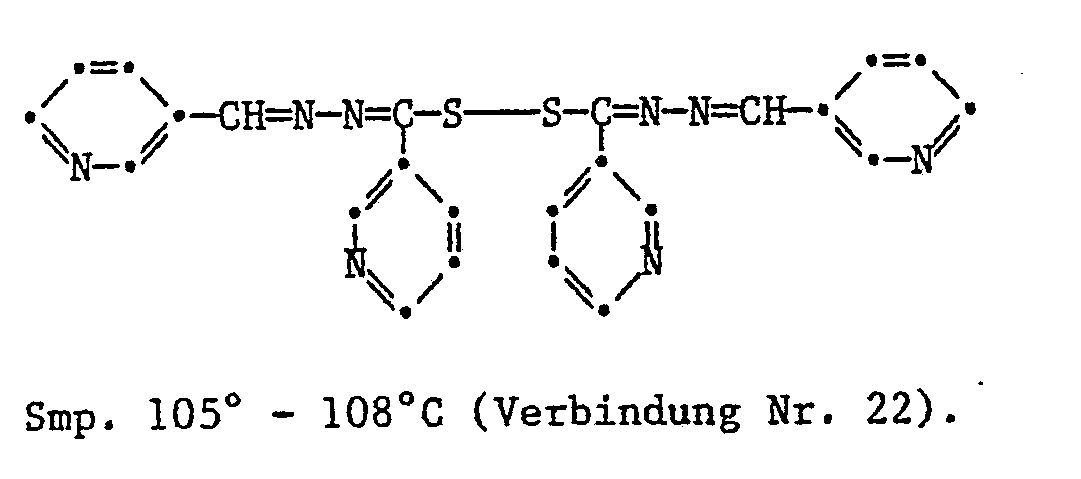
- Wie vorstehend beschrieben sind auch die folgenden Verbindungen der Formel Ib erhältlich, in denen Y die folgenden Bedeutungen hat:

-


- Der Wirkstoff oder die Wirkstoffkombination wird mit den Zusatzstoffen vermischt und in einer geeigneten Mühle gut vermahlen.
- Man erhält Spritzpulver, die sich mit Wasser zu Suspensionen jeder gewünschten Konzentrationen verdünnen lassen.
- Wirkstoff oder Wirkstoffkombination 10 %
Octylphenolpolyäthylenglykoläther (4-5 Mol AeO) 3 %
Ca-Dodecylbenzolsulfonat 3 %
Ricinusölpolyglykoläther (36 Mol AeO) 4 %
Cyclohexanon 30 %
Xylolgemisch 50 % - Aus diesem Konzentrat können durch Verdünnen mit Wasser Emulsionen jeder gewünschten Konzentration hergestellt werden.

- Man erhält anwendungsfertige Stäubemittel, indem der Wirkstoff mit dem Träger vermischt und auf einer geeigneten Mühle vermahlen wird.
- Wirkstoff oder Wirkstoffkombination 10 %
Na-Ligninsulfonat 2 %
Carboxymethylcellulose 1 %
Kaolin 87% - Der Wirkstoff wird mit dem Zusatzstoffen vermischt, vermahlen und mit Wasser angefeuchtet. Dieses Gemisch wird extrudiert, granuliert und anschliessend im Luftstrom getrocknet.
- Wirkstoff oder Wirkstoffkombination 3 %
Polyäthylenglykol (MG 200) 3 %
Kaolin 94 % - Der fein gemahlene Wirkstoff oder die Wirkstoffkombination wird in einem Mischer auf das mit Polyäthylenglykol angefeuchtete Kaolin gleichmässig aufgetragen. Auf diese Weise erhält man staubfreie Umhüllungs-Granulate.
- Wirkstoff oder Wirkstoffkombination 40 %
Aethylenglykol 10 %
Nonylphenolpolyäthylenglykoläther (15 Mol AeO) 6%
Na-Ligninsulfonat 10 %
Carboxymethylcellulose 1 %
37%ige wässrige Formaldehyd-Lösung 0,2 %
Silikonöl in Form einer 75%igen wässrigen Emulsion 0,8 %
Wasser 32 % - Der fein gemahlene Wirkstoff oder die Wirkstoffkombination wird mit den Zusatzstoffen innig vermischt. Man erhält so ein Suspensions-Konzentrat, aus welchem durch Verdünnen mit Wasser Suspensionen jeder gewünschten Konzentration hergestellt werden können.
- Je 50 g frisch zubereitetes CSMA-Nährsubstrat für Maden werden in Becher eingewogen. Von einer 1 Gew.-%igen acetonischen Lösung des betreffenden Wirkstoffes wird eine bestimmte Menge auf das in den Bechern befindliche Nährsubstrat pipettiert, so dass sich eine Wirkstoffkonzentration von 400 ppm ergibt. Nach dem Durchmischen des Substrates lässt man das Aceton mindestens 20 Stunden lang verdampfen.
- Dann werden pro Wirkstoff je 25 eintägige Maden von Musca domestica in die das so behandelte Nährsubstrat enthaltenden Becher gegeben. Nachdem sich die Maden verpuppt haben, werden die gebildeten Puppen durch Ausschwemmen mit Wasser von dem Substrat abgetrennt und in mit Siebdeckeln verschlossenen Gefässen deponiert.
- Die pro Ansatz ausgeschwemmten Puppen werden gezählt (toxischer Einfluss des Wirkstoffes auf die Madenentwicklung). Dann wird nach 10 Tagen die Anzahl der aus den Puppen geschlüpften Fliegen bestimmt.
- Verbindungen der Formel I gemäss den Beispielen 2 und 3 zeigen gute Wirkung im obigen Test.
- Zu 9 ml eines Zuchtmediums wird bei 50°C 1 ml einer 0,5 % Aktivsubstanz enthaltenden wässrigen Zubereitung gegeben. Nun werden ca. 30 frisch geschlüpfte Lucilia sericata-Larven zum Zuchtmedium gegeben. Nach 48 und 96 Stunden wird die insektizide Wirkung durch Ermittlung der Abtötungsrate festgestellt.
- Verbindungen der Formel I gemäss den Beispielen 2 und 3 zeigen in diesem Test gute Wirkung gegen Lucilia sericata.
- Auf die Oberfläche von 150 ml Wasser, das sich in einem Behälter befindet, wird so viel einer 0,1%igen acetonischen Lösung des Wirkstoffes pipettiert, dass eine Konzentration von 200 ppm erhalten wird. Nach Verdunsten des Acetons wird der Behälter mit 30 bis 40 2-tägigen Aedes-Larven beschickt. Nach 2 und 7 Tagen wird die Mortalität geprüft.
- Verbindungen der Formel I gemäss den Beispielen 2 und 3 zeigen gute Wirkung im obigen Test.
- In Töpfen angezogene 4-5 Tage alte Erbsenkeimlinge (Vicia faba) werden vor Versuchsbeginn mit je ca. 200 Individuen der Spezies Aphis craccivora besiedelt. Die so behandelten Pflanzen werden 24 Stunden später mit einer wässrigen Zubereitung enthaltend die zu prüfenden Verbindung bis zur Tropfnässe direkt besprüht. Man verwendet pro Test-Verbindung zwei Pflanzen. Eine Auswertung der erzielten Abtötungsrate erfolgt nach weiteren 24 und 72 Stunden. Der Versuch wird bei 21-22°C und einer rel. Luftfeuchtigkeit von etwa 55 % durchgeführt.
- Eine Mortalität von 80-100 % in diesem Test ergibt die Verbindung Nr. 1 gemäss Beispiel 2 bei 400 ppm.
- Auch die Verbindungen der Formel V gemäss Beispiel 3 zeigen gute Wirkung in diesem Test.
- Bewurzelte Bohnenpflanzen werden in Töpfe, welche 600 ccm Erde enthalten, verpflanzt. Anschliessend giesst man 50 ml einer Zubereitung der zu prüfenden Verbindungen (erhalten aus einem 25 %igen Spritzpulver) in einer Konzentration von 800 ppm direkt auf die Erde in den Töpfen.
- Nach 24 Stunden werden auf die oberirdischen Pflanzenteile Blattläuse der Spezies Aphis craccivora gesetzt und die Pflanzen mit einem Plastikzylinder überstülpt, um die Läuse vor einer eventuellen direkten Kontakt- oder Gaswirkung der Testsubstanz zu schützen.
- Die Auswertung der erzielten Abtötung erfolgt 48 und 72 Stunden nach Versuchsbeginn. Pro Testsubstanz werden zwei Pflanzen, je eine in einem separaten Topf, verwendet, Der Versuch wird bei 25°C und ca. 70 % relativer Luftfeuchtigkeit durchgeführt.
- Verbindungen der Formel I gemäss den Beispielen 2 und 3 zeigen gute Wirkung in diesem Test.
- Etwa 4 bis 5 Tage alte, in Wasser angezogene Erbsenkeimlinge (Vicia faba) werden vor Versuchsbeginn jeweils mit ca. 200 Individuen der Spezies Myzus persicae besiedelt. Die so behandelten Pflanzen werden 24 Stunden später mit einer wässrigen Suspension enthaltend bis zu 200 ppm der zu prüfenden Verbindung bis zur Tropfnässe direkt besprüht. Man verwendet pro Testsubstanz zwei Pflanzen. Eine Auswertung der erzielten Abtötungsrate erfolgt 24 und 72 Stunden nach Applikation. Der Versuch wird bei 21-22°C und etwa 60 % relativer Luftfeuchtigkeit durchgeführt.
- Verbindung Nr. 1 gemäss Beispiel 2 sowie die Verbindung Nr. 21 gemäss Beispiel 3 ergeben bei 12,5 ppm jeweils eine 80-100 %ige Mortalität in diesem Test.
- Bewurzelte Kohlpflanzen im 4- bis 5-Blatt-Stadium werden in Töpfe, welche 60 ccm Erde enthalten, verpflanzt. Ansschliessend werden 50 ml einer wässrigen Formulierung der zu prüfenden Verbindung (erhalten aus einem 25%igen Spritzpulver) jeweils in einer Konzentration von 800 ppm direkt auf die Erde aufgegossen.
- Nach 24 Stunden werden auf die oberirdischen Pflanzenteile der behandelten Pflanzen Blattläuse der Spezies Myzus persicae gesetzt und die Pflanzen mit Plastikzylindern überdeckt, um die Blattläuse vor einer eventuellen direkten Kontakt- oder Gaswirkung der Testsubstanz zu schützen.
- Die Auswertung der erzielten %-Abtötung erfolgt 48 Stunden nach Versuchsbeginn. Pro Testsubstanz werden zwei Pflanzen, je eine in separaten Töpfen, verwendet. Der Versuch wird bei ca. 25°C und 60% relativer Luftfeuchtigkeit durchgeführt.
- Verbindungen der Formel I gemäss den Beispielen 2 und 3 zeigen gute Wirkung in obigem Test.
- In etwa 8 cm hohe Kunststoffbecher (Durchmesser etwa 6 cm) wird ein passender kleiner Zweig von Vicia faba gelegt, der mit Blattläusen der Spezies Aphis craccivora stark infiziert ist. Der Becher wird mit einem Kunststoffdeckel, der in der Mitte eine ausgestanzte Oeffnung von 2 cm Durchmesser aufweist, bedeckt. Auf die in dem Deckel befindliche Oeffnung wird ein Blatt einer Vicia faba-Pflanze gelegt, ohne dieses Blatt von der eingetopften Pflanze abzutrennen. Das Blatt wird dann mit einem zweiten Lochdeckel auf dem Becher über der Oeffnung des ersten Deckels fixiert. Von der Unterseite her, d.h. durch die Oeffnung des ersten Deckels hindurch, infizieren nun die in dem Becher befindlichen Blattläuse das obenliegende Blatt der Futterpflanze. Auf der Oberseite wird auf das Blatt eine wässrige Zubereitung des zu prüfenden Wirkstoffes in einer Konzentration von 400 ppm mittels eines Pinsels gleichmässig aufgetragen. Es wird geprüft, ob die einseitig auf die Oberseite des Blattes der Futterpflanze aufgetragene Testsubstanz in genügender Menge durch das Blatt hindurch auf dessen Unterseite diffundiert, um dort saugende Blattläuse abzutöten.
- Der Versuch wird bei etwa 20°C und 60% relativer Luftfeuchtigkeit durchgeführt. Die Auswertung auf %-Mortalität erfolgt 48 Stunden nach Wirkstoffapplikation.
- Verbindungen der Formel I gemäss den Beispielen 2 und 3 zeigen gute Wirkung in obigem Test.
- Der Test wird an wachsenden Pflanzen durchgeführt. Dazu werden jeweils 4 Reispflanzen (Dicke des Stengels 8 mm) mit einer Höhe von ca. 20 cm in Töpfe (Durchmesser von 8 cm) eingepflanzt.
- Die Pflanzen werden auf einem Drehteller mit 100 ml einer acetonischen Lösung enthaltend 800 ppm des jeweiligen Wirkstoffes besprüht. Nach dem Antrocknen des Spritzbelages erfolgt die Besiedlung jeder Pflanze mit je 20 Nymphen der Testtiere im dritten Stadium. Um die Zikaden am Entweichen zu hindern, wird über die besiedelten Pflanzen jeweils ein beidseitig offener Glaszylinder gestülpt und dieser mit einem Gaze-Deckel abgedeckt. Die Nymphen werden bis zum Erreichen des folgenden Entwicklungsstadiums über 10 Tage an der behandelten Pflanze gehalten. Die Auswertung auf %-Mortalität erfolgt 1, 4 und 8 Tage nach der Behandlung.
- Verbindungen der Formel I gemäss den Beispielen 2 und 3 zeigen gute Wirkung in diesem Test.
- Der Test wird an wachsenden Pflanzen durchgeführt. Jeweils 4 Reispflanzen (Dicke des Stengels 8 mm, Höhe ca. 20 cm) werden in Töpfe (Durchmesser von 8 cm) eingepflanzt.
- Die Pflanzen werden auf einem Drehteller mit 100 ml einer acetonischen Lösung enthaltend 400 ppm des jeweiligen Wirkstoffes besprüht. Nach dem Antrocknen des Spritzbelages wird jede Pflanze mit 3 adulten Weibchen besiedelt. Um die Tiere am Entweichen zu hindern, wird über jede besiedelte Pflanze ein Glaszylinder gestülpt und dieser mit einem Gaze-Deckel abgedeckt. Die Weibchen bleiben 4 Tage zur Eiablage auf der behandelten Pflanze und werden dann entfernt.
- Etwa 8 Tage nach Besiedelung schlüpfen die jungen Zikaden, und es erfolgt die Auszählung. Aus dem Vergleich der Anzahl geschlüpfter Larven auf den behandelten Pflanzen zu den auf unbehandelten Kontrollpflanzen geschlüpften Tieren wird die prozentuale Mortalität bestimmt.
- Verbindungen der Formel I gemäss den Beispielen 2 und 3 zeigen in obigem Test gute ovizide Wirkung.
Claims (20)
1. Verbindungen der Formel I

worin
B unsubstituiertes oder substituiertes C₁-C₆-Alkyl oder unsubstituiertes oder substituiertes Phenyl, den Rest 
und
Y unsubstituierten oder substituierten aromatischen Carbo- oder Heterocyclus
sowie die Salze einer Verbindung der Formel I.
B unsubstituiertes oder substituiertes C₁-C₆-Alkyl oder unsubstituiertes oder substituiertes Phenyl, den Rest
Y unsubstituierten oder substituierten aromatischen Carbo- oder Heterocyclus
sowie die Salze einer Verbindung der Formel I.
2. Verbindungen der Formel Ia

gemäss Anspruch 1, dadurch gekennzeichnet, dass
Y einen unsubstituierten oder substituierten aromatischen Carbo- oder Heterocyclus, und
B unsubstituiertes oder substituiertes C₁-C₆-Alkyl oder unsubstituiertes oder substituiertes Phenyl bedeuten, sowie die Salze einer Verbindung der Formel Ia.
Y einen unsubstituierten oder substituierten aromatischen Carbo- oder Heterocyclus, und
B unsubstituiertes oder substituiertes C₁-C₆-Alkyl oder unsubstituiertes oder substituiertes Phenyl bedeuten, sowie die Salze einer Verbindung der Formel Ia.
3. Verbindungen gemäss Anspruch 2, dadurch gekennzeichnet, dass
Y Pyridyl oder unsubstituiertes oder substituiertes Phenyl
B C₁-C₆-Alkyl, ein- oder mehrfach halogeniertes C₁-C₆-Alkyl, C₁-C₄-Alkoxy-C₁-C₆-alkyl, C₁-C₄-Alkylthio-C₁-C₆-alkyl, Cyano-C₁-C₆-alkyl, Nitro-C₁-C₆-alkyl oder den Rest 
worin R₂ und R₃ voneinander unabhängig für Wasserstoff, Halogen, C₁-C₄-Alkyl, Trifluormethyl, C₁-C₄-Alkoxy oder Nitro steht, bedeuten.
Y Pyridyl oder unsubstituiertes oder substituiertes Phenyl
B C₁-C₆-Alkyl, ein- oder mehrfach halogeniertes C₁-C₆-Alkyl, C₁-C₄-Alkoxy-C₁-C₆-alkyl, C₁-C₄-Alkylthio-C₁-C₆-alkyl, Cyano-C₁-C₆-alkyl, Nitro-C₁-C₆-alkyl oder den Rest
4. Verbindungen gemäss Anspruch 3, dadurch gekennzeichnet, dass Y Pyridyl oder den Rest

worin R₂ und R₃ voneinander unabhängig für Wasserstoff, Halogen, C₁-C₄-Alkyl, Trifluormethyl, C₁-C₄-Alkoxy oder Nitro steht, bedeutet und B Cyano-C₁-C₄-alkyl bedeutet.
5. [1-(4-Chlorphenyl)-4-(pyrid-3-yl)-2,3-diazabutadien-1-yl]-(1,1-dimethyl-1-cyanomethyl) disulfid gemäss Anspruch 4.
6. Verbindungen gemäss Anspruch 3, dadurch gekennzeichnet, dass Y Pyridyl oder den Rest

worin R₂ und R₃ voneinander unabhängig für Wasserstoff, Halogen, C₁-C₄-Alkyl, Trifluormethyl, C₁-C₄-Alkoxy oder Nitro steht, bedeutet und B Phenyl, Nitrophenyl, 4-Chlorphenyl oder 4-Tolyl bedeutet.
7. Verbindungen gemäss Anspruch 6, dadurch gekennzeichnet, dass Y 4-Chlorphenyl bedeutet.
8. Verbindungen der Formel Ib

gemäss Anspruch 1, dadurch gekennzeichnet, dass Y einen Rest

bedeutet, wobei
R Wasserstoff, C₁-C₄-Alkyl, Halogen, Nitro, Cyano, C₁-C₄-Alkoxy, C₁-C₄-Alkylthio, C₁-C₄-Halogenalkyl mit 1 bis 9 Halogenatomen, C₁-C₄-Halogenalkoxy mit 1 bis 9 Halogenatomen, C₁-C₄-Halogenalkylthio mit 1 bis 9 Halogenatomen, Phenyl, substituiertes Phenyl, Phenyl-C₁-C₃-alkyl, Phenoxy, Phenylthio oder Pyridyloxy bedeutet und
n für eine Zahl von 1 bis 5 steht; sowie die Salze und optischen Isomeren einer Verbindung der Formel V.
R Wasserstoff, C₁-C₄-Alkyl, Halogen, Nitro, Cyano, C₁-C₄-Alkoxy, C₁-C₄-Alkylthio, C₁-C₄-Halogenalkyl mit 1 bis 9 Halogenatomen, C₁-C₄-Halogenalkoxy mit 1 bis 9 Halogenatomen, C₁-C₄-Halogenalkylthio mit 1 bis 9 Halogenatomen, Phenyl, substituiertes Phenyl, Phenyl-C₁-C₃-alkyl, Phenoxy, Phenylthio oder Pyridyloxy bedeutet und
n für eine Zahl von 1 bis 5 steht; sowie die Salze und optischen Isomeren einer Verbindung der Formel V.
9. Verbindungen gemäss Anspruch 8, dadurch gekennzeichnet, dass
R Wasserstoff, C₁-C₄-Alkyl, Halogen, Nitro, Cyano, C₁-C₄-Alkoxy, C₁-C₄-Alkylthio, C₁-C₄-Halogenalkyl mit 1 bis 9 Halogenatomen, C₁-C₄-Halogenalkoxy mit 1 bis 9 Halogenatomen oder C₁-C₄-Halogenalkylthio mit 1 bis 9 Halogenatomen bedeutet und n für eine Zahl von 1 bis 3 steht.
R Wasserstoff, C₁-C₄-Alkyl, Halogen, Nitro, Cyano, C₁-C₄-Alkoxy, C₁-C₄-Alkylthio, C₁-C₄-Halogenalkyl mit 1 bis 9 Halogenatomen, C₁-C₄-Halogenalkoxy mit 1 bis 9 Halogenatomen oder C₁-C₄-Halogenalkylthio mit 1 bis 9 Halogenatomen bedeutet und n für eine Zahl von 1 bis 3 steht.
10. Verbindungen gemäss Anspruch 8 oder 9, dadurch gekennzeichnet, dass
R Wasserstoff, C₁-C₄-Alkyl, Fluor, Chlor, Brom, Nitro, C₁-C₄-Alkoxy oder Trifluormethyl
bedeutet.
R Wasserstoff, C₁-C₄-Alkyl, Fluor, Chlor, Brom, Nitro, C₁-C₄-Alkoxy oder Trifluormethyl
bedeutet.
11. Verbindungen gemäss einem der Ansprüche 8 bis 10, dadurch gekennzeichnet, dass n für eine Zahl 1 oder 2 steht.
12. Verbindungen gemäss einem der Ansprüche 8 bis 11, dadurch gekennzeichnet, dass Y den Rest

bedeuten, wobei sich mindestens ein R in 4-Stellung befindet.
13. Verbindungen gemäss Anspruch 12 der Formel

14. Verfahren zur Herstellung einer Verbindung der Formel Ia gemäss einem der Ansprüche 2-7, dadurch gekennzeichnet, dass man ein 5-Pyridyl-4,5-dihyrothiadiazol der Formel II

worin Y die unter einem der Ansprüche 2 bis 7 angegebenen Bedeutungen hat, zunächst mit einer Base, dann mit einem Sulfenylchlorid der Formel III,
Cl-S-B (III),
umsetzt, wobei Y und B die im Anspruch 1 angegebenen Bedeutungen haben, das erwünschte Produkt gegebenenfalls in eines seiner Salze überführt und isoliert.
Cl-S-B (III),
umsetzt, wobei Y und B die im Anspruch 1 angegebenen Bedeutungen haben, das erwünschte Produkt gegebenenfalls in eines seiner Salze überführt und isoliert.
15. Verfahren zur Herstellung einer Verbindung der Formel Ib gemäss einem der Ansprüchen 8 bis 13, dadurch gekennzeichnet, dass man eine Verbindung der Formel II, Anspruch 14,
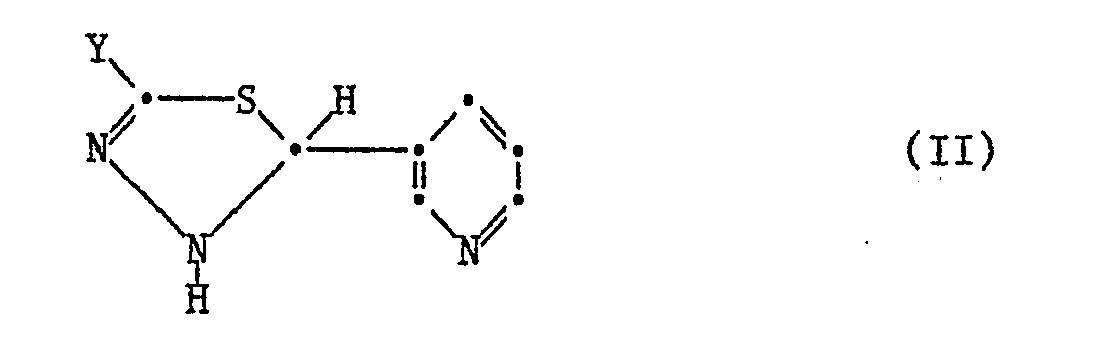
worin Y die unter einem der Ansprüche 8 bis 12 angegebenen Bedeutungen hat, oxidiert.
16. Schädlingsbekämpfungsmittel, welches als aktive Komponente eine Verbindung gemäss einem der Ansprüche 1 bis 13 zusammen mit geeigneten Trägern und/oder anderen Zuschlagstoffen enthält.
17. Verwendung einer Verbindung gemäss einem der Ansprüche 1 bis 13 zur Bekämpfung von Insekten und Vertretern der Ordnung Akarina an Tieren und Pflanzen.
18. Verwendung gemäss Anspruch 17 zur Bekämpfung von pflanzenschädigenden Insekten.
19. Verwendung gemäss Anspruch 18 zur Bekämpfung von pflanzenschädigenden saugenden Insekten.
20. Verfahren zur Bekämpfung von Insekten und Vertretern der Ordnung Akarina, dadurch gekennzeichnet, dass man die Schädlinge bzw. deren verschiedene Entwicklungsstadien und/oder ihren Aufenthaltsort mit einer pestizid wirksamen Menge einer Verbindung der Formel I gemäss einem der Ansprüche 1 bis 13 oder mit einem Mittel enthaltend neben Zusatz- und Trägerstoffen eine pestizid wirksame Menge dieser Verbindung, in Kontakt bringt oder behandelt.
Applications Claiming Priority (4)
| Application Number | Priority Date | Filing Date | Title |
|---|---|---|---|
| CH1028/87 | 1987-03-18 | ||
| CH102887 | 1987-03-18 | ||
| CH1361/87 | 1987-04-09 | ||
| CH136187 | 1987-04-09 |
Publications (2)
| Publication Number | Publication Date |
|---|---|
| EP0283438A2 true EP0283438A2 (de) | 1988-09-21 |
| EP0283438A3 EP0283438A3 (de) | 1989-12-27 |
Family
ID=25686423
Family Applications (1)
| Application Number | Title | Priority Date | Filing Date |
|---|---|---|---|
| EP88810157A Withdrawn EP0283438A3 (de) | 1987-03-18 | 1988-03-14 | Pyridyl-diazabutadienyldisulfide |
Country Status (5)
| Country | Link |
|---|---|
| US (1) | US4897485A (de) |
| EP (1) | EP0283438A3 (de) |
| JP (1) | JPS63264570A (de) |
| KR (1) | KR880011101A (de) |
| IL (1) | IL85721A0 (de) |
Families Citing this family (1)
| Publication number | Priority date | Publication date | Assignee | Title |
|---|---|---|---|---|
| US5446163A (en) * | 1992-10-02 | 1995-08-29 | Reilly Industries, Inc. | Preparation of hydrazones, dihydrothiadiazoles and triazinones |
Family Cites Families (6)
| Publication number | Priority date | Publication date | Assignee | Title |
|---|---|---|---|---|
| FR1055796A (fr) * | 1950-08-17 | 1954-02-22 | Chimiotherapie Lab Franc | Thiosemicarbazone de l'aldéhyde nicotinique et son procédé de préparation |
| US2719161A (en) * | 1952-05-07 | 1955-09-27 | Schenley Ind Inc | Pyridine thiosemicarbazone |
| US2729644A (en) * | 1952-09-08 | 1956-01-03 | Du Pont | Inner salts of substituted 2-dithiocarbazic acids and process |
| DE1598133B2 (de) * | 1966-09-01 | 1974-05-22 | Boehringer Mannheim Gmbh, 6800 Mannheim | Verfahren und diagnostisches Mittel zur Bestimmung von Hydroperoxiden bzw. peroxidatisch wirksamen Substanzen |
| US4233302A (en) * | 1977-12-23 | 1980-11-11 | Glaxo Group Limited | Amine derivatives and pharmaceutical compositions containing them |
| US4699913A (en) * | 1985-06-28 | 1987-10-13 | Ciba-Geigy Corporation | Substituted 4,5-dihydro-1,3,4-thiadiazoles useful as insecticides |
-
1988
- 1988-03-11 US US07/166,945 patent/US4897485A/en not_active Expired - Fee Related
- 1988-03-14 IL IL85721A patent/IL85721A0/xx unknown
- 1988-03-14 EP EP88810157A patent/EP0283438A3/de not_active Withdrawn
- 1988-03-18 KR KR1019880002975A patent/KR880011101A/ko not_active Withdrawn
- 1988-03-18 JP JP63065596A patent/JPS63264570A/ja active Pending
Also Published As
| Publication number | Publication date |
|---|---|
| EP0283438A3 (de) | 1989-12-27 |
| KR880011101A (ko) | 1988-10-26 |
| JPS63264570A (ja) | 1988-11-01 |
| US4897485A (en) | 1990-01-30 |
| IL85721A0 (en) | 1988-08-31 |
Similar Documents
| Publication | Publication Date | Title |
|---|---|---|
| EP0306696B1 (de) | Substituierte Guanidine | |
| EP0303570A2 (de) | Substituierte Isothioharnstoffe | |
| CH673557A5 (de) | ||
| EP0175649B1 (de) | Substituierte Carbodiimide | |
| EP0239535A2 (de) | N-Pyridyloxyphenyl-isothioharnstoffe, ihre Herstellung und Verwendung bei der Kontrolle von Schädlingen | |
| EP0110829B1 (de) | Schädlingsbekämpfungsmittel | |
| EP0207004A2 (de) | Substituierte 4,5-Dihydro-1,3,4-thiadiazole | |
| EP0191734B1 (de) | Schädlingsbekämpfungsmittel | |
| EP0116515A1 (de) | Schädlingsbekämpfungsmittel | |
| EP0183650B1 (de) | Phenylhydrazine, Verfahren zu ihrer Herstellung und ihre Verwendung in der Schädlingsbekämpfung | |
| EP0231152A2 (de) | Phenylbenzoylharnstoffe | |
| DE3544436A1 (de) | Neue dioxide | |
| EP0098800B1 (de) | Carbaminsäureester | |
| EP0221847A2 (de) | Salze von Benzoylharnstoffen | |
| EP0256985A2 (de) | Substituierte Thioharnstoffe, Isothioharnstoffe und Carbodiimide | |
| EP0288432A1 (de) | Schädlingsbekämpfungsmittel | |
| EP0138756A1 (de) | Neue Oxadiazine | |
| EP0135105B1 (de) | Mittel zur Bekämpfung von Insekten und Vertretern der Ordnung Akarina, welche als aktive Komponente 2-(1-Indolinyl-methyl)-imidazoline oder deren Salzen enthalten | |
| EP0274988A2 (de) | Neue Dihydrothiadiazole | |
| EP0145662A2 (de) | Isothioharnstoffe | |
| EP0138757B1 (de) | Oxalsäureanilide | |
| EP0138772A1 (de) | Phenylcarboximidsäureester | |
| DE3320534A1 (de) | Carbaminsaeureester | |
| EP0283438A2 (de) | Pyridyl-diazabutadienyldisulfide | |
| EP0165903B1 (de) | Phenylbenzoylharnstoffe |
Legal Events
| Date | Code | Title | Description |
|---|---|---|---|
| PUAI | Public reference made under article 153(3) epc to a published international application that has entered the european phase |
Free format text: ORIGINAL CODE: 0009012 |
|
| AK | Designated contracting states |
Kind code of ref document: A2 Designated state(s): AT BE CH DE FR GB IT LI NL |
|
| 17P | Request for examination filed |
Effective date: 19880316 |
|
| PUAL | Search report despatched |
Free format text: ORIGINAL CODE: 0009013 |
|
| AK | Designated contracting states |
Kind code of ref document: A3 Designated state(s): AT BE CH DE FR GB IT LI NL |
|
| STAA | Information on the status of an ep patent application or granted ep patent |
Free format text: STATUS: THE APPLICATION IS DEEMED TO BE WITHDRAWN |
|
| 18D | Application deemed to be withdrawn |
Effective date: 19911003 |