EP0283902A1 - Système pour la comparaison de formes - Google Patents
Système pour la comparaison de formes Download PDFInfo
- Publication number
- EP0283902A1 EP0283902A1 EP88104087A EP88104087A EP0283902A1 EP 0283902 A1 EP0283902 A1 EP 0283902A1 EP 88104087 A EP88104087 A EP 88104087A EP 88104087 A EP88104087 A EP 88104087A EP 0283902 A1 EP0283902 A1 EP 0283902A1
- Authority
- EP
- European Patent Office
- Prior art keywords
- time point
- time
- distance
- matching system
- pattern matching
- Prior art date
- Legal status (The legal status is an assumption and is not a legal conclusion. Google has not performed a legal analysis and makes no representation as to the accuracy of the status listed.)
- Granted
Links
- 230000001186 cumulative effect Effects 0.000 claims abstract description 51
- 230000015654 memory Effects 0.000 claims abstract description 36
- 238000000034 method Methods 0.000 claims abstract description 30
- 239000013598 vector Substances 0.000 claims description 33
- 238000004364 calculation method Methods 0.000 claims description 29
- 238000012545 processing Methods 0.000 description 9
- 230000004044 response Effects 0.000 description 6
- 238000013139 quantization Methods 0.000 description 3
- 230000001419 dependent effect Effects 0.000 description 1
- 238000001514 detection method Methods 0.000 description 1
- 230000002542 deteriorative effect Effects 0.000 description 1
- 238000010586 diagram Methods 0.000 description 1
- 238000005516 engineering process Methods 0.000 description 1
- 230000006870 function Effects 0.000 description 1
- 238000004519 manufacturing process Methods 0.000 description 1
- 238000012986 modification Methods 0.000 description 1
- 230000004048 modification Effects 0.000 description 1
- 230000000306 recurrent effect Effects 0.000 description 1
- 230000000717 retained effect Effects 0.000 description 1
- 230000002123 temporal effect Effects 0.000 description 1
Images






Classifications
-
- G—PHYSICS
- G10—MUSICAL INSTRUMENTS; ACOUSTICS
- G10L—SPEECH ANALYSIS TECHNIQUES OR SPEECH SYNTHESIS; SPEECH RECOGNITION; SPEECH OR VOICE PROCESSING TECHNIQUES; SPEECH OR AUDIO CODING OR DECODING
- G10L15/00—Speech recognition
- G10L15/08—Speech classification or search
- G10L15/12—Speech classification or search using dynamic programming techniques, e.g. dynamic time warping [DTW]
Definitions
- the present invention relates to a pattern matching system available for various systems such as speech recognition systems.
- a reference pattern is prepared for each word as below: wherein denotes a time point, and b j n a feature of the reference pattern B" at the time point j.
- Speech recognition is performed by calculating the distance between the input pattern A and the reference pattern B", and determining the word n giving the minimum cumulative distance as the recognition result.
- the above cumulative distance is calculated by the dynamic programming (DP) as follows:
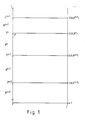
- the DP matching process is initially executed for each word, but is improved later in the clockwise DP method so as to be executed in parallel for plural words respectively. More particularly, in the clockwise DP method the optimal cumulative value g"(i, j) is calculated for n and j specified by all the combinations of n and j for each time i of the input pattern in a space defined by i,j, and n as shown in FIG. I with increasing the time to complete the process.
- the features a and b j " are generally vectors of ten or higher dimension order, and it is an extremely heavy load for an ordinary hardware to conduct the distance calculations of times within one clock (usually about 10 ms).
- the distance D(k) between the feature a i of the input pattern and each code vector is calculated and stored in a table during the time of DP matching processing.
- the formula (2) is calculated with reference to the equation (4).
- d"(i, j) D(k(n, j)) (4)
- the distance calculation amount can be reduced by employing the vector quantization method, but not to a satisfactory extent.
- the required number of code vectors is more than 256 for maintaining the good recognition rate. If it is assumed that one calculation of D(i, k) requires 40 ⁇ s, the calculation for 256 vectors would take 10 ms. In other words, one clock for i (10 ms) is almost completely consumed by the calculation of vector distance to leave no time for recurrence formula calculation. For this reason, a high speed hardware specially designed for the purpose has heretofore been used executing DP matching.
- An object of this invention is to provide a pattern matching system which can remarkably reduce the amount of calculation for DP matching.
- Another object of this invention is to provide a pattern matching system which enables the high speed DP matching operation.
- Still another object of this invention is to provide a pattern matching system which enables the high speed operation for a large vocabularly speech recognition.
- Still another object of this invention is to provide a speech recognition system which enables recognition with a shorter response time.
- Still another object of this invention is to provide a pattern matching system with smaller work areas.
- a pattern matching system wherein at each time in the time series of the features of input patterns, an optimal cumulative value indicating the minimum value of the cumulative distance between the input patterns and the reference pattern for all combinations of n and j is successively determined with increasing i, the n and designating each reference pattern B" and the time in the time series of the features of each reference pattern, the system determines the optimal cumulative distance only for the combinations of n and j which are related to the optimal cumulative values smaller than a predetermined threshold value at the time i, and making a memory area dynamically for the optimal cumulative value g"(i, j) for the combination (n, j).
- a pattern matching system comprising: means for storing a reference pattern of each word n as a feature time series b j n for a time point j; means for temporarily storing an input speech patterns as a feature time series b j n for a time point i; means for calculating a distance d"(i, j) between the features a i and b j n for a time point (i, j) and determining the minimum cumulative distance of the distances obtained previous to the time point (i, j) as an optimal cumulative value g"(i, j) in accordance with the recurrence formula of a dynamic programming method; restriction means for restricting a range of combinations (n, j) of the words n and the time points j for new optimal cumulative values g"(i, j) which are to be calculated based on the previous optimal cumulative value for each time point i; and means for producing memory area exclusively for the optimal cumulative values of the combinations (j
- the memory area generation is controlled by mutual relation between the combination (n, j) at the time point and the combination (n', j') of a word n' and a time point j' processed at a time point (i - I) one time point previous to the time point i.
- DP matching seeks an optimal path giving the minimum total sum of the distance d"(i, j) from the point (I, I) to the point (I, J) or the minimum cumulative value of the distance D(A, B n ) for each word. Since the optimal cumulative value g"(i, j) represents a cumulative value of the distance d"(i, j) from the point (I, 1) to the point (i, j), the point (i, j) having large g"(i, j) is less likely to be on the optimal path.
- This invention system may increase the operation speed by omitting the recurrence formula calculation in DP matching when the value g"(i, j) is estimated to be large.
- the optimal cumulative value g"(i, j) calculated at the previous clock (time point) (i - I) is estimated by a specified standard, and a set w (illustrated with a mark o in Fig. 2) of points (n, j) having the small cumulative value is determined so that the recurrent formula is calculated for points in proximity of these points.
- FIGs. 3A and 3B show embodiments of the structure of such work areas.
- g"(i, j) is stored in G 1 (k), and the corresponding n and j are stored in n 1 (k) and j 1 (k), respectively.
- the information at the time point (i - I) is stored.
- G 2 (k) is stored g"(i - I, j) and the corresponding n and j are stored in n 2 (k) and j 2 (k), respectively.
- the recurrence formula calculation and the work area production for g"(i, j) are controlled on the basis of the mutual relation between the (n, j) which is to be executed and the (n', j') which were processed immediately before.
- threshold ⁇ (i) is determined at respective time point i to omit the processing which involves the optimal cumulative value of: g n (i- i,j) > ⁇ (i) (5)
- G 2 (k) g n (i- I, j) is read out by the resistor R0, from which is calculated g"(i, j) as follows.
- g n (i, j) d"(i, j) + min (R0, RI, R2) (6)
- This value is written in G 1 (k'), and n and j are also written in n 1 (k') and j 1 (k'), respectively.
- the operation is switched depending on the mutual relation between (n, j) and (n', j').
- G 1 (k), n 1 (k) and j 1 (k) are switched to G2(k), n 2 (k) and j 2 (k) respectively, and the operation proceeds to the next time as i + I - i.
- FIG. 5 shows an embodiment structure of the speech recognizer operable by the above pattern matching principle.
- a speech waveform inputted from a microphone 10 is analyzed in frequency by an analyzer 20, and the result is inputted to a microprocessor 30 as a time series of the feature a
- the microprocessor 30 incorporates registers R0, RI, R2, k, k' and n, and is connected to three types of memories 40, 50 and 60.
- the work memory 50 stores the data G 2 (k), n 2 (k) and j 2 (k) which were calculated.
- the work memory 60 provides the memory area for G 1 (k), n l (k) and j 1 (k) which are to be calculated newly.
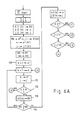
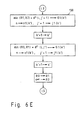
- FiGs. 6A through 6E show the flow chart of the operation when a i ; is given at the time i.
- the G 2 -(k) is transferred from the work memory 50 to the register R0, and is compared with the threshold e(i) in the judgement block 114.
- RO e(i) this operation for k is omitted.
- the step corresponds to the operation under condition (D), and the steps , , to (A), (B), and (C) respectively.
- the step returns to after all the steps are completed, and k is increased by one.
- the steps proceeds as n ⁇ n', j - j' in the block III, and the steps after the block 113 are repeated.
- the distance calculation between vectors such as d"(i, j' + I) of the block 130 in the process is conducted by feeding n and (j' + I) (not shown) to the reference pattern memory 40 and reading out (b n j , + I).
- the operation of the block 112 judges whether all the data in the work memory 50 have already been processed, then the step goes to (FIG. 6B).
- the blocks 120 and 121 are the steps to execute the remaining operation for the last (n', j').
- the data of G 1 , n 1 and j 1 are transferred to G 2 , n 2 and j 1 in the block 122. This is conducted not by the transfer of the data but by switching of the work memory from 50 to 60.
- the process in the block 123 all the processes at the time is completed, and the step proceeds to the next time point (i + I).
- e(i) which can be used for the judgement block 114 shown in FIG. 6A other than those stated before.
- FIG. 7 shows an embodiment of an isolated word speech recognizer according to this invention.
- a speech waveform inputted via a microphone 110 is analyzed in frequency by an analyzer 20, converted into a time series of the feature vector a1 and inputted to a microprocessor 130.
- Code vectors CK are stored in a code book 140, and reference pattern B n of each word n is stored in a reference memory 160 as a time series of the number k(n, j) which designate the code vector number.
- D memory 150 temporarily stores the distance D(k) between the code vector CK and the input vector ai .
- the g memory 170 is the work memory for the recurrence formula calculation (2) and stores g n (i, j) and g"(i - I, j) for required n and j. These memories 140, 150, 160 and 170 may be areas on the main memory of the microprocessor 30.
- the microprocessor 30 performs an initial setting as below for the area g n (i - I, j) of the memory 170.
- g n (I, I) D(k(n, l))
- k k(n, I) is read out from the reference pattern memory 160 for each word
- the code vector CK corresponding thereto is read out from the code book 140 for calculating the distance from the feature vector a1 and setting the distance as the initial value g"(I, I).
- a numerical value sufficiently large is set.
- the area g"(i, j) is exchanged to the area g"(i - I, j) to provide the optimal cumulative value obtained at the time i as a past (previous) data, and the step proceeds to the next time point (i + 1).
- the pattern distance D(A, B") is stored in the g memory 170 for each word n.
- code vectors for which distance calculation is to be required at the time point are defined by the past optimal cumulative values, thereby the number of distance calculations can be reduced.
- the distance calculation between a i and C K may be conducted in advance outside the loop of j and n.
Landscapes
- Engineering & Computer Science (AREA)
- Computational Linguistics (AREA)
- Health & Medical Sciences (AREA)
- Audiology, Speech & Language Pathology (AREA)
- Human Computer Interaction (AREA)
- Physics & Mathematics (AREA)
- Acoustics & Sound (AREA)
- Multimedia (AREA)
- Image Analysis (AREA)
Applications Claiming Priority (4)
| Application Number | Priority Date | Filing Date | Title |
|---|---|---|---|
| JP62061736A JPS63226697A (ja) | 1987-03-16 | 1987-03-16 | 高効率パタ−ンマッチング方式 |
| JP61736/87 | 1987-03-16 | ||
| JP62061734A JPS63226695A (ja) | 1987-03-16 | 1987-03-16 | 高速パタ−ンマッチング方式 |
| JP61734/87 | 1987-03-16 |
Publications (2)
| Publication Number | Publication Date |
|---|---|
| EP0283902A1 true EP0283902A1 (fr) | 1988-09-28 |
| EP0283902B1 EP0283902B1 (fr) | 1993-06-30 |
Family
ID=26402795
Family Applications (1)
| Application Number | Title | Priority Date | Filing Date |
|---|---|---|---|
| EP88104087A Expired - Lifetime EP0283902B1 (fr) | 1987-03-16 | 1988-03-15 | Système pour la comparaison de formes |
Country Status (4)
| Country | Link |
|---|---|
| US (1) | US5121465A (fr) |
| EP (1) | EP0283902B1 (fr) |
| CA (1) | CA1335001C (fr) |
| DE (1) | DE3882062T2 (fr) |
Families Citing this family (11)
| Publication number | Priority date | Publication date | Assignee | Title |
|---|---|---|---|---|
| JPH04194999A (ja) * | 1990-11-27 | 1992-07-14 | Sharp Corp | 学習を用いた動的計画法 |
| JP2980420B2 (ja) * | 1991-07-26 | 1999-11-22 | 富士通株式会社 | 動的計画法照合装置 |
| US5189709A (en) * | 1991-08-26 | 1993-02-23 | The United States Of America As Represented By The United States National Aeronautics And Space Administration | Dynamic pattern matcher using incomplete data |
| US5388183A (en) * | 1991-09-30 | 1995-02-07 | Kurzwell Applied Intelligence, Inc. | Speech recognition providing multiple outputs |
| JP2964881B2 (ja) * | 1994-09-20 | 1999-10-18 | 日本電気株式会社 | 音声認識装置 |
| US6195638B1 (en) * | 1995-03-30 | 2001-02-27 | Art-Advanced Recognition Technologies Inc. | Pattern recognition system |
| IL113204A (en) * | 1995-03-30 | 1999-03-12 | Advanced Recognition Tech | Pattern recognition system |
| JP3576272B2 (ja) * | 1995-06-22 | 2004-10-13 | シャープ株式会社 | 音声認識装置および方法 |
| JP2980026B2 (ja) * | 1996-05-30 | 1999-11-22 | 日本電気株式会社 | 音声認識装置 |
| US6122757A (en) * | 1997-06-27 | 2000-09-19 | Agilent Technologies, Inc | Code generating system for improved pattern matching in a protocol analyzer |
| JP2007047575A (ja) * | 2005-08-11 | 2007-02-22 | Canon Inc | パターンマッチング方法およびその装置、および音声情報検索システム |
Citations (1)
| Publication number | Priority date | Publication date | Assignee | Title |
|---|---|---|---|---|
| US4624008A (en) * | 1983-03-09 | 1986-11-18 | International Telephone And Telegraph Corporation | Apparatus for automatic speech recognition |
Family Cites Families (3)
| Publication number | Priority date | Publication date | Assignee | Title |
|---|---|---|---|---|
| JPS5529803A (en) * | 1978-07-18 | 1980-03-03 | Nippon Electric Co | Continuous voice discriminating device |
| JPS55157799A (en) * | 1979-05-29 | 1980-12-08 | Nippon Electric Co | High efficiency pattern matching unit |
| US4277644A (en) * | 1979-07-16 | 1981-07-07 | Bell Telephone Laboratories, Incorporated | Syntactic continuous speech recognizer |
-
1988
- 1988-03-15 DE DE88104087T patent/DE3882062T2/de not_active Expired - Fee Related
- 1988-03-15 CA CA000561475A patent/CA1335001C/fr not_active Expired - Fee Related
- 1988-03-15 EP EP88104087A patent/EP0283902B1/fr not_active Expired - Lifetime
-
1990
- 1990-04-11 US US07/508,503 patent/US5121465A/en not_active Expired - Fee Related
Patent Citations (1)
| Publication number | Priority date | Publication date | Assignee | Title |
|---|---|---|---|---|
| US4624008A (en) * | 1983-03-09 | 1986-11-18 | International Telephone And Telegraph Corporation | Apparatus for automatic speech recognition |
Non-Patent Citations (1)
| Title |
|---|
| IEEE TRANSACTIONS ON ACOUSTICS, SPEECH, AND SIGNAL PROCESSING, vol. ASSP-33, no. 3, June 1985, pages 546-560, IEEE, New York, US; K.-C. PAN et al.: "A vector-quantization-based preprocessor for speaker-independent isolated word recognition" * |
Also Published As
| Publication number | Publication date |
|---|---|
| EP0283902B1 (fr) | 1993-06-30 |
| DE3882062T2 (de) | 1994-01-05 |
| CA1335001C (fr) | 1995-03-28 |
| US5121465A (en) | 1992-06-09 |
| DE3882062D1 (de) | 1993-08-05 |
Similar Documents
| Publication | Publication Date | Title |
|---|---|---|
| CA1167967A (fr) | Dispositif de reconnaissance de paroles continues | |
| US4829575A (en) | Apparatus and methods for analyzing transitions in finite state machines | |
| EP0283902B1 (fr) | Système pour la comparaison de formes | |
| US5369728A (en) | Method and apparatus for detecting words in input speech data | |
| EP0086081B1 (fr) | Dispositif de reconnaissance de parole continue | |
| EP0144689B1 (fr) | Dispositif de comparaison de formes | |
| CA1226945A (fr) | Methode et appareil de verification de concordance | |
| US4618983A (en) | Speech recognition with preliminary matching | |
| EP0525640B1 (fr) | Système pour adapter une programmation dynamique en vue de reconnaítre une langue | |
| EP0810583A2 (fr) | Système de reconnaissance de la parole | |
| EP0103258B1 (fr) | Dispositif de comparaison de formes | |
| EP0215573B1 (fr) | Dispositif et procédés pour la reconnaissance de la parole | |
| EP0139875B1 (fr) | Dispositif pour la comparaison de motifs | |
| JP2964881B2 (ja) | 音声認識装置 | |
| US4872201A (en) | Pattern matching apparatus employing compensation for pattern deformation | |
| GB2179483A (en) | Speech recognition | |
| US4794645A (en) | Continuous speech recognition apparatus | |
| GB2209418A (en) | Analysing transitions in finite state machines | |
| JP3094473B2 (ja) | 動的計画法照合装置 | |
| JPS638797A (ja) | パタン認識方法 | |
| JPH0465395B2 (fr) | ||
| EP0631273B1 (fr) | Procédé de détermination du chemin optimal à travers un réseau stochastique en particulier pour la reconnaissance de la parole ou d'images | |
| JPH067353B2 (ja) | 音声認識装置 | |
| JPH0634234B2 (ja) | パターン認識装置 | |
| JPS61137197A (ja) | 連続単語音声認識装置 |
Legal Events
| Date | Code | Title | Description |
|---|---|---|---|
| PUAI | Public reference made under article 153(3) epc to a published international application that has entered the european phase |
Free format text: ORIGINAL CODE: 0009012 |
|
| 17P | Request for examination filed |
Effective date: 19880315 |
|
| AK | Designated contracting states |
Kind code of ref document: A1 Designated state(s): DE FR GB NL |
|
| 17Q | First examination report despatched |
Effective date: 19910625 |
|
| GRAA | (expected) grant |
Free format text: ORIGINAL CODE: 0009210 |
|
| AK | Designated contracting states |
Kind code of ref document: B1 Designated state(s): DE FR GB NL |
|
| REF | Corresponds to: |
Ref document number: 3882062 Country of ref document: DE Date of ref document: 19930805 |
|
| ET | Fr: translation filed | ||
| PLBE | No opposition filed within time limit |
Free format text: ORIGINAL CODE: 0009261 |
|
| STAA | Information on the status of an ep patent application or granted ep patent |
Free format text: STATUS: NO OPPOSITION FILED WITHIN TIME LIMIT |
|
| 26N | No opposition filed | ||
| REG | Reference to a national code |
Ref country code: GB Ref legal event code: IF02 |
|
| PGFP | Annual fee paid to national office [announced via postgrant information from national office to epo] |
Ref country code: FR Payment date: 20030310 Year of fee payment: 16 |
|
| PGFP | Annual fee paid to national office [announced via postgrant information from national office to epo] |
Ref country code: GB Payment date: 20030312 Year of fee payment: 16 |
|
| PGFP | Annual fee paid to national office [announced via postgrant information from national office to epo] |
Ref country code: NL Payment date: 20030327 Year of fee payment: 16 Ref country code: DE Payment date: 20030327 Year of fee payment: 16 |
|
| PG25 | Lapsed in a contracting state [announced via postgrant information from national office to epo] |
Ref country code: GB Free format text: LAPSE BECAUSE OF NON-PAYMENT OF DUE FEES Effective date: 20040315 |
|
| PG25 | Lapsed in a contracting state [announced via postgrant information from national office to epo] |
Ref country code: NL Free format text: LAPSE BECAUSE OF NON-PAYMENT OF DUE FEES Effective date: 20041001 Ref country code: DE Free format text: LAPSE BECAUSE OF NON-PAYMENT OF DUE FEES Effective date: 20041001 |
|
| GBPC | Gb: european patent ceased through non-payment of renewal fee |
Effective date: 20040315 |
|
| PG25 | Lapsed in a contracting state [announced via postgrant information from national office to epo] |
Ref country code: FR Free format text: LAPSE BECAUSE OF NON-PAYMENT OF DUE FEES Effective date: 20041130 |
|
| NLV4 | Nl: lapsed or anulled due to non-payment of the annual fee |
Effective date: 20041001 |
|
| REG | Reference to a national code |
Ref country code: FR Ref legal event code: ST |