EP0284525A1 - Verfahren zur Gewinnung von Molkeproteinen durch Adsorption und Eluierung - Google Patents
Verfahren zur Gewinnung von Molkeproteinen durch Adsorption und Eluierung Download PDFInfo
- Publication number
- EP0284525A1 EP0284525A1 EP88420085A EP88420085A EP0284525A1 EP 0284525 A1 EP0284525 A1 EP 0284525A1 EP 88420085 A EP88420085 A EP 88420085A EP 88420085 A EP88420085 A EP 88420085A EP 0284525 A1 EP0284525 A1 EP 0284525A1
- Authority
- EP
- European Patent Office
- Prior art keywords
- whey
- proteins
- adsorption
- solution
- acid
- Prior art date
- Legal status (The legal status is an assumption and is not a legal conclusion. Google has not performed a legal analysis and makes no representation as to the accuracy of the status listed.)
- Withdrawn
Links
Images
Classifications
-
- A—HUMAN NECESSITIES
- A23—FOODS OR FOODSTUFFS; TREATMENT THEREOF, NOT COVERED BY OTHER CLASSES
- A23J—PROTEIN COMPOSITIONS FOR FOODSTUFFS; WORKING-UP PROTEINS FOR FOODSTUFFS; PHOSPHATIDE COMPOSITIONS FOR FOODSTUFFS
- A23J1/00—Obtaining protein compositions for foodstuffs; Bulk opening of eggs and separation of yolks from whites
- A23J1/20—Obtaining protein compositions for foodstuffs; Bulk opening of eggs and separation of yolks from whites from milk, e.g. casein; from whey
- A23J1/205—Obtaining protein compositions for foodstuffs; Bulk opening of eggs and separation of yolks from whites from milk, e.g. casein; from whey from whey, e.g. lactalbumine
-
- A—HUMAN NECESSITIES
- A23—FOODS OR FOODSTUFFS; TREATMENT THEREOF, NOT COVERED BY OTHER CLASSES
- A23V—INDEXING SCHEME RELATING TO FOODS, FOODSTUFFS OR NON-ALCOHOLIC BEVERAGES AND LACTIC OR PROPIONIC ACID BACTERIA USED IN FOODSTUFFS OR FOOD PREPARATION
- A23V2002/00—Food compositions, function of food ingredients or processes for food or foodstuffs
Definitions
- the invention relates to a method for extracting certain proteins from whey, in particular those which bind iron, such as lactoferrin, transferrin, lactoperoxidase and also immunoglobulins.
- the invention overcomes these drawbacks. It relates to a process for the extraction of certain proteins from whey, including those which bind iron, by adsorption on a solid support and then elution of the adsorbed proteins, which is selective, economical and easy to implement, and above all makes it possible to recover the whey treated without modifying it, that is to say that leaves it usable, especially in animal feed, which we did not know how to do until then.
- This process for extracting proteins from whey, by adsorption on a solid support and then elution of the proteins adsorbed by means of an acid solution is characterized : - firstly, in that the adsorption is carried out with an acid medium whose pH is close to that of the whey to be treated; - Then, in that the proteins thus adsorbed are known in a known manner by means of an acid solution; - And finally, in that an aqueous solution of alkaline earth halide at slightly basic pH is added to the acid solution used to elute the adsorption column to precipitate the undesirable proteins and recover the proteins sought in the supernatant.
- the method of the invention consists, on the one hand, in replacing the basic adsorption treatment claimed in the prior art with a treatment in a weakly acid medium, namely in pH conditions close to those of whey treating, and on the other hand, subjecting the solution from the elution to an additional treatment by adding an alkaline earth halide, in particular calcium chloride allowing separation by precipitation.
- This new route has an economic advantage considerable and decisive, because the whey treated in this way is practically not modified or altered, but simply depleted of the desired proteins, the concentration of which is only of the order of a few tens of milligrams per liter. In this way, this whey remains fully usable such as for its usual applications, in particular in animal feed. Thus, this new path makes it possible to pass from economic failure to success, which proves well that it was not obvious.
- the process is applicable to whey from various origins: - when the whey is a mild cheese whey and the adsorption is carried out at a pH close to 6.4 pH of this whey; if the whey comes from a case factory, the adsorption treatment is then carried out at a pH close to 4.5, since the pH of this whey is close to this value; - adsorption in weakly acidic medium is carried out: .
- the very slightly acidic aqueous washing solution with a pH close to 6.4 is based on sodium chloride and is heated to 40-45 ° C.
- the products adsorbed on the column are then eluted at room temperature by passing a slightly acidic aqueous solution at pH generally between 1 and 4 based on NaCl and an acid chosen from the group comprising hydrochloric acid, phosphoric acid and acetic acid.
- an aqueous solution of an alkaline earth halide preferably of calcium chloride, at slightly basic pH, is added to the acid solution used to elute the adsorption column. causes spontaneous precipitation of undesirable proteins, as well as lipids, and makes it possible to recover from the supernatant liquid the desired proteins, such as lactoferrin, lactoperoxidase or immunoglobulins.
- the supernatant liquid containing the desired proteins is then clarified, then concentrated by ultrafiltration and simultaneous dialysis, and the retentate obtained containing the desired proteins can be subjected to conventional ion exchange chromatography to separate the lactoferrin from the lactoperoxidase and immunoglobulins, then to a lyophilization or drying operation.
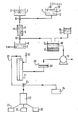
- sweet dairy whey (2) (pH 6.4) are introduced, which is stirred slowly to keep it homogeneous. In known manner, this whey is cooled to a temperature between 3 and 8 ° C.
- This whey (2) contains approximately 98 mg of lactoferrin and 41.5 mg of lactoperoxidase per liter.
- the whey (2) is first allowed to flow at a temperature of 8 ° C. in ten hours and twenty minutes from the reservoir (1) on the silica (6).
- the treated whey (7) is collected in a tank (8), then sent to (9) to be concentrated and dried in the usual way, so that it can be used in animal feed.
- valve (10) is rocked to send the forty liters of the first washing solution (4) at pH 6 to the adsorbed column designated by the reference (11) , 4.
- Silica (6) therefore adsorbs the desired proteins of whey (2) under pH conditions close to those of this whey (2) which is 6.4.
- H3PO4 phosphoric acid
- the proteins sought namely lactoferrin, lactoperoxidase, immunoglobulins, remain in the supernatant (18).
- This supernatant liquid (18) is sent to a clarifier (19) to remove the last traces of precipitate.
- the clarified product is sent to a tank (20), then from there to an ultrafiltration device (21) into which dialysis water (31) is injected to reduce the mineral content.
- the retentate (22) is recovered at the head of the column (21) to be, thanks to the valve (23), either lyophilized in a block (24) or, after fractionation by chromatography (25), separated into each of the proteins sought, namely lactoferrein (26), lactoperoxidase (27), immunoglobulins (28), or dried by any suitable process.
- silica (6) is then regenerated in (30) by percolating twenty liters of a sodium acetate solution at pH 5.5
- (31) is injected with a solution of iron salts. This allows to saturate the desired proteins with iron, thus increasing their nutritional efficiency.
- Example 1 is repeated with the same installation but using a solution of 100 liters of casein acid whey of pH 4.5.
- This whey contains 52 mg / l of lactoferrin and 23 mg / l of lactorperoxidase.
- a total volume of eluate of 13 liters is recovered, containing: . 3.7 g of lactoferrin, . 0.4 g of lactoperoxidase, . and 2.6 g of purified immunoglobulin.
- the method according to the invention makes it possible to recover in (24,26,27,28) purified sought proteins with high added value and on the other hand, does not affect the essential qualities of the whey treated in full. recovered in (9) which remains fully suitable for animal consumption.
- the process according to the invention is essentially characterized by two original stages: - first and foremost, by the adsorption step on a solid support, namely silica, which is no longer carried out at basic pH, but at a slightly acid pH close to that of the whey to be treated, this which allows this whey to be fully recovered for direct use in animal feed, which translates into substantial and decisive savings; - Then, by the precipitation step with the calcium salt at a slightly basic pH, which facilitates the separation of recoverable products which float, while the little sought after products have completely precipitated.
- the method of the invention has the following advantages: - the possibility of adding an iron salt at the end of the cycle to increase the nutritional activity of lactoferrin; - the treatment, which takes place at room temperature, does not significantly affect the properties of lactoferrin.
- Proteins recovered in this way namely in particular those which fix iron, such as lactoferrin as well as lactoperoxidase and immunoglobulins, can be used with success in the applications known to date, such as for example: - in animal nutrition for the protection of the digestive tract and the role of growth factor; - in the veterinary field for intestinal anti-infectious activity and at breast level; - in the field of dietetics and human nutrition, in particular as an iron vector; - in the pharmaceutical field: ophthalmology, gastroenterology, paradontology, dermatology, gynecology ...
Landscapes
- Life Sciences & Earth Sciences (AREA)
- Chemical & Material Sciences (AREA)
- Biochemistry (AREA)
- Engineering & Computer Science (AREA)
- Food Science & Technology (AREA)
- Polymers & Plastics (AREA)
- Peptides Or Proteins (AREA)
- Dairy Products (AREA)
Applications Claiming Priority (2)
| Application Number | Priority Date | Filing Date | Title |
|---|---|---|---|
| FR8703517A FR2613368B1 (fr) | 1987-03-10 | 1987-03-10 | Procede pour extraire des proteines du lactoserum, par adsorption et elution |
| FR8703517 | 1987-03-10 |
Publications (1)
| Publication Number | Publication Date |
|---|---|
| EP0284525A1 true EP0284525A1 (de) | 1988-09-28 |
Family
ID=9348973
Family Applications (1)
| Application Number | Title | Priority Date | Filing Date |
|---|---|---|---|
| EP88420085A Withdrawn EP0284525A1 (de) | 1987-03-10 | 1988-03-08 | Verfahren zur Gewinnung von Molkeproteinen durch Adsorption und Eluierung |
Country Status (2)
| Country | Link |
|---|---|
| EP (1) | EP0284525A1 (de) |
| FR (1) | FR2613368B1 (de) |
Cited By (5)
| Publication number | Priority date | Publication date | Assignee | Title |
|---|---|---|---|---|
| WO1993013676A1 (en) * | 1992-01-15 | 1993-07-22 | Campina Melkunie B.V. | Process for isolating lactoferrin and lactoperoxidase from milk and milk products, and products obtained by such process |
| EP0556083A1 (de) * | 1992-01-29 | 1993-08-18 | Snow Brand Milk Products Co., Ltd. | Verfahren zur Herstellung von biologisch aktiven Substanzen aus Milch und ähnlichen Rohstoffen |
| ES2089970A1 (es) * | 1994-03-08 | 1996-10-01 | Univ Zaragoza | Metodo de aislamiento de lactoferrina y otras proteinas lacteas. |
| US6866879B1 (en) | 1998-09-30 | 2005-03-15 | Valio Ltd. | Method of processing a proteinous material, a product so obtained, and use thereof |
| CZ305371B6 (cs) * | 2013-11-15 | 2015-08-19 | Univerzita PalackĂ©ho | Způsob separace syrovátkových proteinů z mléčného média a zařízení k provádění tohoto způsobu |
Citations (3)
| Publication number | Priority date | Publication date | Assignee | Title |
|---|---|---|---|---|
| FR2088367A1 (en) * | 1970-05-06 | 1972-01-07 | Dumont Wilfrid | High protein food from skimmed milk |
| FR2399214A2 (fr) * | 1977-08-05 | 1979-03-02 | Rhone Poulenc Ind | Procede d'extraction des proteines du lait |
| GB2098998A (en) * | 1981-05-15 | 1982-12-01 | Elf Aquitaine | Process of extraction of lactoferrine and ummunoglobulins of milk |
-
1987
- 1987-03-10 FR FR8703517A patent/FR2613368B1/fr not_active Expired
-
1988
- 1988-03-08 EP EP88420085A patent/EP0284525A1/de not_active Withdrawn
Patent Citations (3)
| Publication number | Priority date | Publication date | Assignee | Title |
|---|---|---|---|---|
| FR2088367A1 (en) * | 1970-05-06 | 1972-01-07 | Dumont Wilfrid | High protein food from skimmed milk |
| FR2399214A2 (fr) * | 1977-08-05 | 1979-03-02 | Rhone Poulenc Ind | Procede d'extraction des proteines du lait |
| GB2098998A (en) * | 1981-05-15 | 1982-12-01 | Elf Aquitaine | Process of extraction of lactoferrine and ummunoglobulins of milk |
Non-Patent Citations (1)
| Title |
|---|
| NETHERLANDS MILK AND DAIRY JOURNAL, vol. 40, no. 1, 1986, pags 41-56, Meppel, NL; J.N. DE WIT et al.: "Evaluation of functional properties of whey protein concentrates and whey protein isolates. 2. Effects of processing history and composition" * |
Cited By (7)
| Publication number | Priority date | Publication date | Assignee | Title |
|---|---|---|---|---|
| WO1993013676A1 (en) * | 1992-01-15 | 1993-07-22 | Campina Melkunie B.V. | Process for isolating lactoferrin and lactoperoxidase from milk and milk products, and products obtained by such process |
| US5596082A (en) * | 1992-01-15 | 1997-01-21 | Campina Melkunie Bv | Process for isolating lactoferrin and lactoperoxidase from milk and milk products, and products obtained by such process |
| EP0556083A1 (de) * | 1992-01-29 | 1993-08-18 | Snow Brand Milk Products Co., Ltd. | Verfahren zur Herstellung von biologisch aktiven Substanzen aus Milch und ähnlichen Rohstoffen |
| US5516675A (en) * | 1992-01-29 | 1996-05-14 | Snow Brand Milk Products, Co., Ltd. | Separation of lactoperoxidase, secretory component and lactoferrin from milk or whey with a cation exchange resin |
| ES2089970A1 (es) * | 1994-03-08 | 1996-10-01 | Univ Zaragoza | Metodo de aislamiento de lactoferrina y otras proteinas lacteas. |
| US6866879B1 (en) | 1998-09-30 | 2005-03-15 | Valio Ltd. | Method of processing a proteinous material, a product so obtained, and use thereof |
| CZ305371B6 (cs) * | 2013-11-15 | 2015-08-19 | Univerzita PalackĂ©ho | Způsob separace syrovátkových proteinů z mléčného média a zařízení k provádění tohoto způsobu |
Also Published As
| Publication number | Publication date |
|---|---|
| FR2613368B1 (fr) | 1989-06-23 |
| FR2613368A1 (fr) | 1988-10-07 |
Similar Documents
| Publication | Publication Date | Title |
|---|---|---|
| FR2616628A1 (fr) | Procede pour extraire des proteines du lactoserum par adsorption et elution | |
| CA1171723A (fr) | Procede d'extraction de lactoferrine et d'immunoglobulines du lait | |
| WO1998053702A1 (fr) | Procede de traitement d'une matiere premiere lactique contenant du gmp | |
| FR2576752A1 (fr) | Procede de purification de proteines du lait et de ses derives | |
| US20230111991A1 (en) | Methods for isolating compounds | |
| EP1540020B1 (de) | Verfahren zur trennung von kristallisiertem zucker aus einer süssen wässrigen lösung enthaltend einwertigen und mehrwertigen anionen und kationen | |
| CH668428A5 (fr) | Procede d'extraction de proteines du lait, produits, application du procede et compositions pharmaceutiques. | |
| FR2634104A1 (fr) | Hydrolysat partiel de proteines de lactoserum, procede enzymatique de preparation de cet hydrolysat, et aliment lacte dietetique hypoallergenique le contenant | |
| EP0022696A1 (de) | Mit Alpha-Laktalbumin angereichertes Produkt, seine Erzeugung aus Laktoserum und Verwendungen dieses Produktes | |
| EP2183269A2 (de) | Verfahren zur reinigung des faktor viii und des von-willebrand-faktors | |
| JPH10513437A (ja) | チーズ加工廃棄物の処理方法 | |
| CH635491A5 (fr) | Procede de desamerisation d'un hydrolysat de proteines et hydrolysat desamerise obtenu. | |
| JP2688509B2 (ja) | ヘミセルロースの抽出・精製法 | |
| FR2478434A1 (de) | ||
| EP0402205A1 (de) | Verfahren zur Herstellung von gereinigten Albuminlösungen | |
| EP1297116B1 (de) | Verfahren zur isolierung eines proteins | |
| FR2613368A1 (fr) | Procede pour extraire des proteines du lactoserum, par adsorption et elution | |
| EP0178957B1 (de) | Verfahren zur Gewinnung von Lysozym durch Mikrofiltration aus Eiweissenthaltendem Material | |
| EP2451825A1 (de) | Verwendung eines co-produkts aus einem verfahren zum auszug von lysozym aus ei-weiss zum erhalten von mindestens einem basischen ei-weissprotein | |
| EP0518448B1 (de) | Verfahren zur Isolierung von Proteinen aus Milch und Verfahren zur Behandlung von Milch | |
| CH631327A5 (en) | Processes for the extraction of proteins from milk and whey | |
| FR2613725A1 (fr) | Procede pour l'obtention de lactoperoxydase active et de lactoferrine a partir de lactoserum et les substances obtenues par ce procede | |
| EP2785841A2 (de) | Anti-fh aptamere, herstellungsverfahren dafür und verwendungen davon | |
| CN1579598A (zh) | 水溶性亲和超滤载体的制备方法 | |
| JP2003535028A (ja) | 天然L−β−3−インドリルアラニンの単離と天然L−β−3−インドリルアラニンに関する天然脂肪族アミノ酸混合物の濃縮 |
Legal Events
| Date | Code | Title | Description |
|---|---|---|---|
| PUAI | Public reference made under article 153(3) epc to a published international application that has entered the european phase |
Free format text: ORIGINAL CODE: 0009012 |
|
| AK | Designated contracting states |
Kind code of ref document: A1 Designated state(s): BE CH DE ES GB IT LI NL |
|
| 17P | Request for examination filed |
Effective date: 19881217 |
|
| 17Q | First examination report despatched |
Effective date: 19900723 |
|
| STAA | Information on the status of an ep patent application or granted ep patent |
Free format text: STATUS: THE APPLICATION IS DEEMED TO BE WITHDRAWN |
|
| 18D | Application deemed to be withdrawn |
Effective date: 19901204 |