EP0284742A2 - Verfahren und Vorrichtung für Tastenanschlagsverarbeitung - Google Patents
Verfahren und Vorrichtung für Tastenanschlagsverarbeitung Download PDFInfo
- Publication number
- EP0284742A2 EP0284742A2 EP88101853A EP88101853A EP0284742A2 EP 0284742 A2 EP0284742 A2 EP 0284742A2 EP 88101853 A EP88101853 A EP 88101853A EP 88101853 A EP88101853 A EP 88101853A EP 0284742 A2 EP0284742 A2 EP 0284742A2
- Authority
- EP
- European Patent Office
- Prior art keywords
- printer
- buffer
- keystroke
- keystroke information
- keystrokes
- Prior art date
- Legal status (The legal status is an assumption and is not a legal conclusion. Google has not performed a legal analysis and makes no representation as to the accuracy of the status listed.)
- Withdrawn
Links
Images
Classifications
-
- G—PHYSICS
- G06—COMPUTING OR CALCULATING; COUNTING
- G06F—ELECTRIC DIGITAL DATA PROCESSING
- G06F3/00—Input arrangements for transferring data to be processed into a form capable of being handled by the computer; Output arrangements for transferring data from processing unit to output unit, e.g. interface arrangements
- G06F3/01—Input arrangements or combined input and output arrangements for interaction between user and computer
- G06F3/02—Input arrangements using manually operated switches, e.g. using keyboards or dials
- G06F3/0227—Cooperation and interconnection of the input arrangement with other functional units of a computer
-
- G—PHYSICS
- G06—COMPUTING OR CALCULATING; COUNTING
- G06F—ELECTRIC DIGITAL DATA PROCESSING
- G06F3/00—Input arrangements for transferring data to be processed into a form capable of being handled by the computer; Output arrangements for transferring data from processing unit to output unit, e.g. interface arrangements
- G06F3/01—Input arrangements or combined input and output arrangements for interaction between user and computer
- G06F3/02—Input arrangements using manually operated switches, e.g. using keyboards or dials
- G06F3/023—Arrangements for converting discrete items of information into a coded form, e.g. arrangements for interpreting keyboard generated codes as alphanumeric codes, operand codes or instruction codes
Definitions
- This invention relates generally to systems for processing keystrokes to provide keystroke information to a printer, and more particularly concerns such a system which also supplies keystroke information to a display.
- a keyboard for example, there are typically provided a keyboard, a single line display, a printer portion, and an operating system to interface among the keyboard, the display, and the printer.
- the display, the printer assembly, and the operating system circuitry are contained in a single unit.
- a personal computer system may be operated under software control to function as an electronic typewriter.
- One such system includes a microcomputer system unit, a keyboard, a display, and a printer.
- an operator depresses keys on the keyboard, and keystrokes are coupled to a microprocessor-based operating system in the typewriter.
- the operating system operates under program control to provide information to the display and to the printer assembly and has associated memory for storage and retrieval of keystroke information developed from the keystrokes.
- keystrokes are processed to place suitable keystroke information in a storage location known as a correction buffer, which contains, for example, keystroke information related to a single line of alphanumeric text.
- the keystroke information remains in the correction buffer so that the operator can enter, via the keyboard, modifications to the stored line of text such as deletions of characters or changes to characters.
- a keystroke is processed, if it is a suitable character or other indicium which is to be displayed on the display, appropriate keystroke information is not only placed in the correction buffer but (perhaps different) keystroke information is also placed in a display storage location.
- the operating system sends appropriate keystroke information to the printer portion of the electronic typewriter.
- the keystroke is processed to place the "A" in the correction buffer and in the display, and the keystroke is also processed to be placed on paper by sending the appropriate keystroke information to the printer portion of the typewriter.
- a cursor on the display indicates the current position at which the next character entered by the operator through the keyboard will be displayed, printed, and stored in the correction buffer.
- keystrokes result in the display and printing of characters, while other keystrokes are only processed to provide keystroke information for the printer assembly.
- Such a "printer" keystroke is a paper movement command of some type, for example.
- each keystroke is processed by the electronic typewriter, and in most cases keystroke information is supplied to the printer, as well as the display memory and the correction buffer.
- An operator is typically capable of keying in information at the keyboard at a faster rate than the keystrokes can be processed by the operating system in the electronic typewriter. Therefore, if no provision were made to accommodate this keying speed, keystrokes would be lost because the operating system would not be able to receive and process subsequent keystrokes until a first keystroke was processed.
- prior systems have incorporated a keystroke buffer in a portion of the operating system memory.
- the keystrokes from the keyboard are received in the keystroke buffer substantially instantaneously, and then processed from the keystroke buffer as quickly as possible.
- the operator is allowed to type ahead of both the display and the printer, which will then catch up to the operator when the operator pauses.
- this objective has been accomplished by utilizing an additional keystroke information storage location which is accessible to the operating system.
- the additional keystroke information storage location takes the form of a system printer buffer in which keystroke information, for ultimate transmission to a printer, is temporarily stored.
- keystroke information is not only stored in a correction buffer and a display memory, but also in the system printer buffer. This avoids printer-associated delays in the processing of each keystroke so that keystrokes can be processed substantially as quickly as an operator can enter the keystrokes.
- the display accurately reflects the keystrokes entered by the operator.
- Keystroke information for the printer is coupled from the system printer buffer to the printer as time permits, as a subsidiary function to the processing of keystrokes.
- the operator is permitted to key in keystrokes as quickly as desired, with the display maintaining the proper keystroke information, and permitting virtual instantaneous erasure and replacement of characters from the keyboard (from the standpoint of what is on the display).
- the requisite erasure or replacement keystroke information is, of course, entered in the correction buffer,as appropriate, and in the system printer buffer as required.
- printer keystroke information stored in the system printer buffer prior to its transmission to the printer apparatus, operations may also be performed on this information by the operating system. For example, a series of printer movement commands could be consolidated to effect more efficient printer movement.
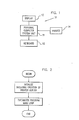
- a personal computer system 10 includes a system unit 11 coupled to a keyboard 12, a display 13, and a printer 14.
- the personal computer system 10 comprises a personal computer having a system unit based upon the Intel 8086 family of microprocessors.
- the system unit 11 includes a disk drive for loading application software and operating system software and suitable interfaces to the display 13 and the printer 14.
- the system unit 11 is coupled to the keyboard by a standard bidirectional serial interface and to the printer 14 by a standard parallel printer interface.
- the system unit 11 is under the control of a disk operating system (DOS) and basic input/output system (BIOS), which define a video RAM memory segment for display information.
- DOS disk operating system
- BIOS basic input/output system
- the system unit 11 is operated under the control of an application program which simulates the operation of an electronic typewriter.
- This software defines memory locations comprising a correction buffer for storing a current line of text.
- a "key-to-print” mode as keystrokes are entered at the keyboard 12, the keystrokes are coupled to the system unit 11 and processed. As keystrokes from the keyboard 12 are processed, appropriate characters are displayed on the display 13 and printed on paper by the printer 14.
- the system is also operable in a "delay print" mode in which characters are displayed in response to keystrokes as the keystrokes are entered at the keyboard, but printing is performed on a line-by-line basis.
- the application program sets aside a system printer buffer storage location for use in processing keystrokes.
- keystroke information for the printer is stored in the system printer buffer during keystroke processing for subsequent transmission to the printer.
- a printer buffer memory space is set aside.
- the typewriter program then executes in its main loop until the operator exits from the program.
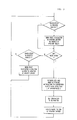
- a predominant activity in the "key-to-print" mode is an idle loop in which keystrokes from the keyboard are processed and keystroke information placed in the system printer buffer for subsequent transmission to the printer.
- the processor determines if there are characters (or other keystroke information) in the printer buffer. If there are one or more characters or other items of keystroke information, the first character in the printer buffer is sent to the printer, if the printer is ready to receive an item of keystroke information (hereinafter, referred to simply as a character). If the printer is busy (for example, processing a previously-sent character), no keystroke information is sent to the printer.
- characters or other keystroke information
- the processor next determines if any keys have been typed. If a key has not been typed, the processor again checks for characters in the printer buffer and sends the first character (if any) to the printer if the printer is ready to receive a character. In either event, the processor then returns to the beginning of the idle loop.
- the processor processes the keystroke and sends the appropriate keystroke information to the correction buffer and the display memory.
- An alphanumeric character to be displayed and printed, for example, is sent to both the correction buffer and the video RAM by the processor in this step.
- the processor next gets a character to be printed (or a printer command to be sent to the printer) and adds this character or command to the end of the printer buffer.
- keystroke information for the printer is stored in a system printer buffer and subsequently supplied from the buffer to the printer in a manner that supplying the keystroke information from the buffer does not significantly impede the processing of keystrokes.
- keystrokes are relatively quickly displayed in the display, regardless of the activity level of the printer.
- the contents of the system printer buffer are also accessible for further processing, if appropriate.
- One implementation of further processing of keystroke information in the system printer buffer is the adjustment of printhead carrier movement commands which are sequentially supplied to the buffer.
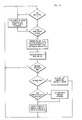
- FIG. 4 An example of such further processing, as illustrated in Fig. 4, occurs within the "delay print" mode of operation.
- characters and the like entered by keystrokes are stored in the correction buffer and the video RAM as a line of text is typed.
- a recognized end-of-line character is keyed (such as a "carrier return")
- the contents of the correction buffer are sent to the printer, and the contents of the video RAM are removed.
- Such a capability is of value in filling in printed forms, for example.
- the idle loop within the typewriter program main loop is generally as illustrated in Fig. 4.
- the program sequence illustrated in Fig. 4 provides for the modification of keystroke information already stored in the system printer buffer for the shadowing operation.
- the processor In executing the idle loop for "delay print" mode including shadowing, the processor first checks to determine if a key has been typed. If not, the processor returns and continues to loop. If a key has been typed, the processor determines if the key is a carrier return. If so, the correction buffer contents are processed, to form a printer command sequence, and sent to the printer. The printer also receives a printhead carrier position signal, typically to position the carrier at the left margin for the next line of print.
- the key is processed and appropriate keystroke information (if any) is sent to the correction buffer and the video RAM.
- the system printer buffer is now used to store carrier movement commands for each keystroke having an associated carrier movement.
- the distance for the carrier to move depends upon such factors as the character pitch, or in the case of proportional spacing, the particular character selected.
- carrier movement commands include those resulting from tabs, spaces, backspaces, etc.
- the processor After the processor has determined the distance that the printhead carrier must be moved, based upon the processed keystroke, the processor then determines if the absolute value of the distance for the carrier to move is greater than zero. If not, the processor returns to check for another key. If a non-zero movement is called for, the processor determines if the distance is a movement to the right (on the paper). In the present instance, a distance to the right is a positive number, and a distance to the left is a negative number.
- a "move left" command and the appropriate associated distance amount are placed in the system printer buffer, and the processor returns to the beginning of the loop.
- movement to the left occurs infrequently enough that the system printer buffer information is not further processed in implementing leftward movements of the printhead carrier.
- the processor checks to see if the last command stored in the system printer buffer was also a "move right” command. If not, the processor inserts a "move right” command at the end of the system printer buffer.
- the processor then adjusts the distance associated with the "move right" command (either just inserted or previously present) at the end of the buffer to include the new distance just-calculated for the most recent keystroke. If, in the preceding step, the processor has just put a "move right” command in the buffer, then the distance amount will merely be equal to the most recently calculated distance. If, however, a previous "move right" command is present in the buffer, the distance just-calculated is added to the previously stored distance. The processor then returns to the beginning of the loop.
- the typewriter application software effects the reading of keystrokes from the keyboard and the writing of keystroke information to the video RAM, for example, by interfacing with the system disk operating system (DOS), including BIOS (Basic Input/Output System).
- DOS system disk operating system
- BIOS Basic Input/Output System
- the invention has been described in connection with a particular personal computer system which utilizes DOS and BIOS in a certain manner, it should be understood that the principles of the invention are applicable without regard to the specific hardware and operating system software implementation. For example, the implementation details of making keystrokes available to the application software, providing keystroke information to the display, and the form of the correction buffer do not affect the practice of the invention.
Landscapes
- Engineering & Computer Science (AREA)
- General Engineering & Computer Science (AREA)
- Theoretical Computer Science (AREA)
- Human Computer Interaction (AREA)
- Physics & Mathematics (AREA)
- General Physics & Mathematics (AREA)
- Input From Keyboards Or The Like (AREA)
- Accessory Devices And Overall Control Thereof (AREA)
- Record Information Processing For Printing (AREA)
- Character Spaces And Line Spaces In Printers (AREA)
Applications Claiming Priority (2)
| Application Number | Priority Date | Filing Date | Title |
|---|---|---|---|
| US3279387A | 1987-03-31 | 1987-03-31 | |
| US32793 | 1987-03-31 |
Publications (2)
| Publication Number | Publication Date |
|---|---|
| EP0284742A2 true EP0284742A2 (de) | 1988-10-05 |
| EP0284742A3 EP0284742A3 (de) | 1990-02-07 |
Family
ID=21866834
Family Applications (1)
| Application Number | Title | Priority Date | Filing Date |
|---|---|---|---|
| EP88101853A Withdrawn EP0284742A3 (de) | 1987-03-31 | 1988-02-09 | Verfahren und Vorrichtung für Tastenanschlagsverarbeitung |
Country Status (3)
| Country | Link |
|---|---|
| EP (1) | EP0284742A3 (de) |
| JP (1) | JPH01210367A (de) |
| CA (1) | CA1308201C (de) |
Cited By (1)
| Publication number | Priority date | Publication date | Assignee | Title |
|---|---|---|---|---|
| EP0426945A3 (en) * | 1989-11-09 | 1992-05-27 | Eiichi Maki | Input device for computer |
Family Cites Families (7)
| Publication number | Priority date | Publication date | Assignee | Title |
|---|---|---|---|---|
| JPS55134488A (en) * | 1979-04-04 | 1980-10-20 | Brother Ind Ltd | Electronic typewriter for editing |
| JPS56101264A (en) * | 1980-01-16 | 1981-08-13 | Omron Tateisi Electronics Co | Electronic cash register for restaurant |
| EP0043392A1 (de) * | 1980-06-30 | 1982-01-13 | International Business Machines Corporation | Textverarbeitungsvorrichtung mit direkter Formatbildung eines Textes |
| GB2082814A (en) * | 1980-07-23 | 1982-03-10 | Branning Lester William | Portable Computing-printing Device |
| JPS5747680A (en) * | 1980-09-05 | 1982-03-18 | Canon Inc | Electronic type writer |
| DE3312401C2 (de) * | 1982-04-06 | 1985-06-27 | Sharp K.K., Osaka | Tragbares Dateneingabe- und Datenübertragungsgerät |
| AU590278B2 (en) * | 1985-06-03 | 1989-11-02 | Honeywell Information Systems Inc. | Word processing composite character processing method |
-
1988
- 1988-01-23 CA CA000557620A patent/CA1308201C/en not_active Expired - Lifetime
- 1988-02-09 EP EP88101853A patent/EP0284742A3/de not_active Withdrawn
- 1988-02-17 JP JP63032996A patent/JPH01210367A/ja active Pending
Cited By (1)
| Publication number | Priority date | Publication date | Assignee | Title |
|---|---|---|---|---|
| EP0426945A3 (en) * | 1989-11-09 | 1992-05-27 | Eiichi Maki | Input device for computer |
Also Published As
| Publication number | Publication date |
|---|---|
| JPH01210367A (ja) | 1989-08-23 |
| CA1308201C (en) | 1992-09-29 |
| EP0284742A3 (de) | 1990-02-07 |
Similar Documents
| Publication | Publication Date | Title |
|---|---|---|
| US4464070A (en) | Multi-character display controller for text recorder | |
| US4503515A (en) | Footnote assembly management | |
| EP0075732B1 (de) | Verfahren und Vorrichtung zur Mischverarbeitung in einem Textverarbeitungssystem | |
| US4225249A (en) | Variable character spacing matrix for proportional spacing printing systems | |
| EP0205082B1 (de) | Testverarbeitungsrandausgleichsverfahren | |
| CA1172377A (en) | Text processor having an interactive display terminal which alternately functions as a data processing terminal | |
| JPS61101832A (ja) | ワ−ド・プロセツサ・システム | |
| US4812832A (en) | Input control device | |
| US4889439A (en) | Automatic page end feature for an electronic typewriter | |
| GB2029614A (en) | Data entry apparatus | |
| JPS647595B2 (de) | ||
| CA1172384A (en) | Method of controlling a printer in an interactive text processing system to print records from stored files of spatially related data | |
| EP0077892B1 (de) | Wortverarbeitendes System mit einem formatierenden bidirektionalen Drucker | |
| EP0333614A2 (de) | Regelungsfunktion eines Tabulators für eine elektronische Schreibmaschine | |
| JPS646475B2 (de) | ||
| EP0267769B1 (de) | Elektronische Schreibmaschine mit Rechtschreibungsprüffunktion | |
| CA1308201C (en) | Method and apparatus for processing keystrokes | |
| EP0292726B1 (de) | Korrekturpufferspeicher | |
| EP0200222A2 (de) | Wortprozessor mit automatischem Schreibmaschinenmodus | |
| EP0026302A2 (de) | Verfahren zur Definition von Tabellierstops für textspeichernde Schreibmaschinen | |
| AU619778B2 (en) | Bounded word replace function for an electronic typewriter | |
| US4799811A (en) | Automatic relocate on continuation of document playout | |
| EP0031446A2 (de) | Überwachungsvorrichtung mit Anzeige mehrerer Schreibzeichen für ein Textregistriergerät | |
| US4729678A (en) | Method and apparatus for producing characters in bold form | |
| JP2997558B2 (ja) | プリンタ |
Legal Events
| Date | Code | Title | Description |
|---|---|---|---|
| PUAI | Public reference made under article 153(3) epc to a published international application that has entered the european phase |
Free format text: ORIGINAL CODE: 0009012 |
|
| AK | Designated contracting states |
Kind code of ref document: A2 Designated state(s): DE FR GB IT |
|
| 17P | Request for examination filed |
Effective date: 19890117 |
|
| PUAL | Search report despatched |
Free format text: ORIGINAL CODE: 0009013 |
|
| AK | Designated contracting states |
Kind code of ref document: A3 Designated state(s): DE FR GB IT |
|
| RAP1 | Party data changed (applicant data changed or rights of an application transferred) |
Owner name: LEXMARK INTERNATIONAL, INC. |
|
| 17Q | First examination report despatched |
Effective date: 19920302 |
|
| 111Z | Information provided on other rights and legal means of execution |
Free format text: DE FR GB IT |
|
| STAA | Information on the status of an ep patent application or granted ep patent |
Free format text: STATUS: THE APPLICATION IS DEEMED TO BE WITHDRAWN |
|
| 18D | Application deemed to be withdrawn |
Effective date: 19920714 |