EP0333614A2 - Regelungsfunktion eines Tabulators für eine elektronische Schreibmaschine - Google Patents
Regelungsfunktion eines Tabulators für eine elektronische Schreibmaschine Download PDFInfo
- Publication number
- EP0333614A2 EP0333614A2 EP89480012A EP89480012A EP0333614A2 EP 0333614 A2 EP0333614 A2 EP 0333614A2 EP 89480012 A EP89480012 A EP 89480012A EP 89480012 A EP89480012 A EP 89480012A EP 0333614 A2 EP0333614 A2 EP 0333614A2
- Authority
- EP
- European Patent Office
- Prior art keywords
- tab
- typewriter
- memory
- distance
- Prior art date
- Legal status (The legal status is an assumption and is not a legal conclusion. Google has not performed a legal analysis and makes no representation as to the accuracy of the status listed.)
- Withdrawn
Links
Images


Classifications
-
- G—PHYSICS
- G06—COMPUTING OR CALCULATING; COUNTING
- G06F—ELECTRIC DIGITAL DATA PROCESSING
- G06F40/00—Handling natural language data
- G06F40/10—Text processing
- G06F40/166—Editing, e.g. inserting or deleting
- G06F40/183—Tabulation, i.e. one-dimensional [1D] positioning
-
- G—PHYSICS
- G06—COMPUTING OR CALCULATING; COUNTING
- G06F—ELECTRIC DIGITAL DATA PROCESSING
- G06F40/00—Handling natural language data
- G06F40/10—Text processing
- G06F40/12—Use of codes for handling textual entities
- G06F40/151—Transformation
Definitions
- the invention relates to the field of electronic typewriter features and more particularly to the function of adjusting the tab stop locations of a document from that format in which the document was entered or keyed to a second format where the tabs are placed differently from the original format.
- Electronic typewriters have always had the capability of storing operator designated tab stops to provide fixed locations relative to the page which the operator may quickly access through the use of the tabulation key on the keyboard.
- This storage of the tab stop location is typically in a segment of the memory which is designated the electronic tab rack or the electronic tab storage.
- the storing of the tab stop location in the electronic tab storage may take the form of a value which represents the distance onto the page to the desired position. This distance is measurable from a base point.
- One such typical base point is the left limit of travel of the print point, usually defined by the left frame of the typewriter or other fixed obstruction to further leftward movement of the print carrier and the print point.
- An alternative approach is to store in the text memory a tab code and a value representative of the distance from the left margin to the tab stop.
- This value is derived from the print point position, the tab stop position in the electronic tab storage and the left margin position.
- Both of these approaches are embodied in typewriters in the market presently, and each has advantages and disadvantages.
- the shortcoming of typewriters is that the typewriter is designed to use only one of the approaches, and the advantages of both systems cannot be had in the same typewriter.
- a document which is entered or keyed and stored using one of these approaches cannot be played from storage using the other approach, without getting results that are either undesirable or unpredictable.
- the ability to reformat a document is limited. For example, in a document created using one approach, margins cannot be easily changed since changing the margins will shift all tab stops that are based on the margin position.
- This invention overcomes the problems of entering the document in a first format and then subsequently changing the tab stop layout.
- the typewriter When text is keyed into the typewriter, the typewriter operates in a mode where the depression of the tab key initiates a tab routine and the tab code is stored in the text data stream along with a numerical value.
- the numerical value is the distance from the left margin to the tab stop location. This then gives a destination value of the location. If the margins of the document are changed, then the tab stop location will shift relative to the page with the shift in the left margin location. However, if the tab adjust function is turned on, the destination value of the stored tab command is ignored and the next rightmost tab position as stored in the electronic tab rack is determined and the tab command is executed using the tab location stored in the electronic tab rack as the control of the distance the print point is moved in the execution of the tab move.
- the electronic typewriter 10 is illustrated with the electronic controls 12 shown as a block exterior to the typewriter 10.
- the electronic controls 12 receive electronic signals from the keyboard 14 and send electronic control signals to the typewriter 10 to cause it to perform the functions that have been designated at the keyboard 14, such as print a character, carriage return, tabulate, correct a character or line feed.
- Platen 13 supports record sheet 11 for movement in the line feed direction.
- Electronic controls 12 are displayed as four blocks, a microprocessor 16, a Read Only Store 18, a random access memory 36 which includes text storage memory 37, a bank of status registers 44, 48 and an electronic tab memory 46 shown in Fig. 3 and a system ASIC or Application Specific Integrated Circuit 20.
- the microprocessor 16 may be any of a number of commercially available microprocessors.
- the preferred microprocessor, chosen for this description, is the Intel 8088. One skilled in the art will recognize that this is a general purpose microprocessor for which other processors may be substituted.
- the microprocessor 16 is controlled by supplying to it software instructions in the form specified by the manufacturer. These instructions constitute a control program which is stored in a suitable memory such as the Read Only Store 18.
- the Read Only Store memory 18 is loaded with the instructions at the time of its manufacture and contains the set of instructions necessary to make the typewriter 10 function as desired.
- the system ASIC 20 is a set of standard AND, OR and other logic elements which may be customized as the manufacturer of the typewriter desires, specifically in this device to scan the keyboard 14 and control the signals from the keyboard 14.
- the ASIC 20 also controls the interrupts to the processor 16 and captures the keyboard signals until they are used by the processor 16. Also the ASIC 20 controls the signals from the processor 16 and directs the processor output signals to a set of driver circuits 26 which convert the processor signals into signals that can be used to drive motors 22 and magnet 24. One of the motors drives the escapement while another is used to select the character for printing.
- the specific combination of the discrete logic elements in the ASIC 20 is designed to provide a number of functions and signals. Some of the signals and functions provided are the keyboard scan to detect any newly depressed keys, interrupts of the processor 16 to cause the processor to accept a signal and the timing of signals sent to the drivers 26 so that the motors 22 and magnet 24 of the typewriter 10 operate in the proper time frame and sequence.
- the keyboard scan function, timer operation, interrupt operation and other functions of the ASIC 20 are all found essentially in commercially available keyboards or discrete components and perform the same operation.
- the ASIC 20 only serves to consolidate all such operations on a single chip and thus economize in space as well as cost.
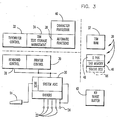
- Fig. 3 illustrates an expanded functional representation of the microprocessor 16 and its associated software.
- the software may be prepared by any programmer of ordinary skill in the art and may take any number of forms, any of which will adequately perform the functions of controlling the typewriter 10.
- the ASIC 20 of Fig. 2 is connected to the processor 16 and is responsive to the keyboard control segment 28 which is software interacting with the processor 16.
- the ASIC 20 scans the keyboard 14 and interrupts the microprocessor 16 when the ASIC 20 detects a key state change.
- the keyboard control 28 causes the storage of the keystrokes from the keyboard in the keyboard surge buffer 42 until the typewriter control segment 32 is ready to work on the keyboard scan data.
- the printer control segment 30 generates and sends the signals that are needed to operate the printer to the ASIC 20 so that the signals may be properly sequenced and timer controlled.
- the typewriter control 32 serves to accept the keyboard data from the keyboard control 28 whenever the processor 16 is available to process textual data and acts to determine whether the keyboard data is representative of the alphanumeric symbols that are to be printed or representative of the functions that may be keyboard controlled.
- the typewriter control 32 utilizes the capabilities of the Keyboard Control segment 28 to retrieve the stored scan codes from the keyboard surge buffer 42.
- the Text Storage Management segment 34 controls the storage of text and the necessary other codes that facilitate the efficient operation of the Random Access Memory 36.
- the Random Access Memory 36 is the repository of the stored codes containing the text.
- the Automatic Functions segment 38 is responsible for the controlling of those functions which are performed by the typewriter 10, and which are not character processing operations.
- the output signals of the Automatic Functions segment 38 pass to the printer control segment 30 where the signals are processed to generate the precise control signals necessary to control the motors 22 of the typewriter 10.
- the Character Processor segment 40 has the dedicated purpose of receiving those codes from the typewriter control segment 32 that represent the characters or other symbols that are to be printed on the record sheet 11.
- the Character Processor segment 40 receives a decoded scan output of the keyboard 14 and determines if it is printable in the desired location.
- the Character Processor segment 40 is also responsible for storing the character codes in a correction buffer which is part of the TSM Random Access Memory 36.
- the Character Processor 40 passes the printable character code to the Printer Control segment 30 which then, based on the data received, determines the specific motors 22, numbers of pulses, direction, and current levels to the motors 22 and magnet 24 that are required to properly print the symbol on the record sheet 11.
- a keyboard surge buffer 42 is provided so that in the event that keyboard scan data is received by the system ASIC 20 at a higher rate than the system can or does utilize the key stroke scan data will not be lost to the keyboard control 28.
- Fig. 3 is a functional diagram expressed in both hardware and a combination of hardware and software.
- the tab adjust feature may be implemented on any electronic typewriter which has memory sufficient to accept for storage, quantities of text that may be subsequently played out of the memory, to produce a printed copy.
- the typewriter 10 is commanded to execute the tabulation command.
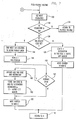
- the result is the microprocessor 16 searches thru the electronic tab rack 46 to determine the next rightmost tab stop setting within the active format area or working area between the left and right margins. This search for the next tab stop is in operation 102.
- the operator may store the text as keyed in the TSM 37 by commanding the processor 16 to open storage and place the keyed codes in the TSM 37.
- the value stored in the electronic tab rack 46 is a distance measured along the writing line of the typewriter 10 to the point at which the print point will reside after the tab operation is complete.
- the next tab location is designated as the new X or the new X location, in operation 104.
- the new X location is stored in the status register 44, and used by the microprocessor to control, through the printer control segment 30, the movement of the print point to the new tab position.
- the tab code is stored in the TSM 37 in the form of a tab command code and immediately followed by a destination value.
- the destination value is the numerical representation of the distance along the print line of the tab stop location less the position of the left margin along the writing line from. In other words, the destination value is relative to the left margin. This calculation and storage of the destination value is accomplished in operation 106.
- the carrier and the print point are moved to the new X location on the writing line, by the printer control segment action through the ASIC 20 and the motors 22.
- This movement and how it is accomplished is well known and conventional in electronic typewriters and does not form a part of the novelty of the invention.
- the tab adjust function is an operator invokable function and is not operable at all times.
- the keyboard is provided with a tab adjust key 21 which is used to turn the function on and off.
- Alternative controls may be used such as a switch, a code key and alphanumeric key combination, or other technique.
- the type of input control device is not critical to the invention.
- Figs. 5 and 6 illustrate the flow of the control in turning on and off the function.
- the operator invokes the function in operation 110. This is done by the depression of tab adjust key 21 or similar input, and the tab adjust indicator is turned on by the microprocessor 12, in operation 112, to indicate to the operator that the tab adjust function is active.
- This indicator may be a light 23 or other device visible or audible to the operator.
- the typewriter control then sets a tab adjust flag in one of the status registers 44 so that when the microprocessor 12 detects a tab command stored in the text data stream in TSM 37, the appropriate function will be performed.
- the operator may activate the tab adjust key 21 to turn off the function, in operation 120.
- the typewriter control segment 32 of the microprocessor 12 then turns off the tab adjust indicator in operation 122, and the previously set flag in the status register 44 is cleared so that the microprocessor will be able to determine that the function is deactivated.
- Electronic typewriters that have a storage memory for text have a playout routine in the software which permits the operator to retrieve text from the memory and to print the text out on the typewriter. Playout routines are well known and conventional in electronic typewriters.
- Fig. 7 is a routine which accommodates the operator selection during playout and is a routine that may be inserted into a playout routine, such as that found in typewriters such as the IBM WHEELWRITER 6 Typewriter manufactured by the International Business Machines Corporation, Armonk, New York.
- typewriters such as the IBM WHEELWRITER 6 Typewriter manufactured by the International Business Machines Corporation, Armonk, New York.
- the next sequential character code in the TSM 37 is retrieved by the Text Storage Management segment 34.
- the typewriter control segment 32 then decodes the retrieved data code to determine if the code represents a tab command.
- the flow branches at operation 132 through the negative path to operation 134 which represents the return of the operational control to the typewriter's playout routine, and the typewriter 10 will continue processing and retrieving codes from the TSM to playout the text.
- the new X or the tab stop location on the writing line is determined from the destination value stored with the tab code.
- the destination value is added to the position value of the active left margin.
- Active left margin means the left margin or if an indented left margin is being used at the time, the indented margin is the basis for the tab stop position on the writing line. Future reference to the left margin is understood to mean the active left margin.
- the X location is used to control the movement of the print point to the tab stop position, in a known conventional manner by issuing commands to the motors 22 to effect escapement of the print point to the tab stop location.
- the typewriter control 32 causes the carrier and the print point of the typewriter 10 to translate to the tab stop location which is the same distance from the left margin as the tab stop was at the time the text was initially keyed. There is no movement of the tab stop positions relative to the left margin.
- the flow branches along the affirmative branch to operation 144 where in response to the code being a tab command, the next rightmost tab location is determined and retrieved from the tab rack 46, and the retrieved tab position becomes the new X location, and in operation 146 it is stored in the X position register 48.
- Some electronic typewriters store text in the memory only when the storage is opened or enabled and if the typewriter is of that type, then there are two modes of operation.
- the first mode of operation is with storage closed. In a closed storage mode, the flow from operation 147 is to operation 152, thus operations 148 and 150 are either branched around or they are ineffective since the memory is not alterable and the old tab code may not be deleted or overwritten with a new tab code including a new destination value. In this mode, no alterations to the stored text occurs.
- the second mode is with storage open, and in this mode, the text stored in the TSM 37 may be altered to reflect changes that occur during playout.
- the old tab code in the data stream retrieved from the TSM 37 is discarded in operation 148.
- the new tab code with the new destination value is stored in the TSM 37 as a replacement for the old tab code, thus updating the TSM 37 contents to reflect the latest format for the document.
- the new destination value is determined by subtracting the left margin value from the new X location value.
- the carrier is moved to the new X location, using the printer control segment 30, in a known and conventional manner.
- the operator keys and stores text without regard to whether the tab adjust function is activated or not.
- the tab codes are stored in the text code stream and include a destination value which is relative to the left margin.
- the operator may activate or deactivate the tab adjust function by depressing tab adjust key 21. Also the operator may change the location of the left margin and tab stops. In fact, such changes may occur during the playout by stopping the playout and making changes in the middle of the text.
- the tab adjust function If the operator turns off the tab adjust function, as text is played out of TSM 37 and a tab command is encountered, the destination value which was stored with the tab command code controls and since it is relative to the left margin, the tab stops are shifted relative to the print line five spaces to the left but retains the relative spatial relationship to the left margin.
- the tab adjust function is activated, the text is played out until a tab stop is encountered in the text data stream. At this time, the tab code is recognized and the destination value is effectively ignored and the location of the tab stop is determined by the value of the tab stop location as stored in the electronic tab rack 46. If storage is opened, the new tab position in the form of a new destination value is stored, replacing the discarded old destination value. Thus the stored document is updated in memory 37. If the storage is not open, then the destination value is unaffected in storage. The playout will be the adjusted tab positions, but the original format is retained in memory, for future use.
- the tab positions will be shifted to print line positions 20, 30 and 45 and the destination values used to position the tab stop positions will be computed, utilized and stored, if storage is open, relative to the left margin value of 10.
- This function allows a document that is keyed and stored using one set of format positions to be played out and have the tab stop positions shifted to new specified positions relative to the page and not relative to the left margin, effectively reformatting the text to the new layout on the page.
- the typewriter 10 is capable of producing a typed or printed copy of the text with the format as entered, with a lateral shift of the copy only relative to the positioning of the left margin.
- the best mode for this invention as well as the preferred embodiment is to implement the invention in an electronic typewriter using a series of program instructions and utilizing the microprocessor of the typewriter.
- the foregoing description, flow diagrams and block diagrams provide an embodiment of the invention which teaches one of skill in the art how to implement the invention using program instructions on any suitable electronic typewriter.
Landscapes
- Engineering & Computer Science (AREA)
- Theoretical Computer Science (AREA)
- Health & Medical Sciences (AREA)
- Artificial Intelligence (AREA)
- Audiology, Speech & Language Pathology (AREA)
- Computational Linguistics (AREA)
- General Health & Medical Sciences (AREA)
- Physics & Mathematics (AREA)
- General Engineering & Computer Science (AREA)
- General Physics & Mathematics (AREA)
- Accessory Devices And Overall Control Thereof (AREA)
- Record Information Processing For Printing (AREA)
Applications Claiming Priority (2)
| Application Number | Priority Date | Filing Date | Title |
|---|---|---|---|
| US07/167,810 US4957380A (en) | 1988-03-14 | 1988-03-14 | Tab adjust function for an electronic typewriter to permit the shifting of tabs from a first to a second format |
| US167810 | 1988-03-14 |
Publications (2)
| Publication Number | Publication Date |
|---|---|
| EP0333614A2 true EP0333614A2 (de) | 1989-09-20 |
| EP0333614A3 EP0333614A3 (de) | 1991-03-13 |
Family
ID=22608927
Family Applications (1)
| Application Number | Title | Priority Date | Filing Date |
|---|---|---|---|
| EP19890480012 Withdrawn EP0333614A3 (de) | 1988-03-14 | 1989-01-31 | Regelungsfunktion eines Tabulators für eine elektronische Schreibmaschine |
Country Status (5)
| Country | Link |
|---|---|
| US (1) | US4957380A (de) |
| EP (1) | EP0333614A3 (de) |
| JP (1) | JPH01235680A (de) |
| BR (1) | BR8901160A (de) |
| CA (1) | CA1323594C (de) |
Families Citing this family (11)
| Publication number | Priority date | Publication date | Assignee | Title |
|---|---|---|---|---|
| JPH02185475A (ja) * | 1989-01-13 | 1990-07-19 | Casio Electron Mfg Co Ltd | 印字装置 |
| US5137494A (en) | 1989-11-13 | 1992-08-11 | Schubert Keith E | Two-sided forms and methods of laying out, printing and filling out same |
| US5127879A (en) | 1989-04-06 | 1992-07-07 | Schubert Keith E | Apparatus for recordkeeping |
| US5395288A (en) | 1989-04-06 | 1995-03-07 | Linden; Gerald E. | Two-way-write type, single sheet, self-replicating forms |
| US5135437A (en) | 1989-11-13 | 1992-08-04 | Schubert Keith E | Form for making two-sided carbonless copies of information entered on both sides of an original sheet and methods of making and using same |
| US5224897A (en) | 1989-04-06 | 1993-07-06 | Linden Gerald E | Self-replicating duplex forms |
| US5154668A (en) | 1989-04-06 | 1992-10-13 | Schubert Keith E | Single paper sheet forming a two-sided copy of information entered on both sides thereof |
| US5248279A (en) | 1989-04-06 | 1993-09-28 | Linden Gerald E | Two-sided, self-replicating forms |
| US6280322B1 (en) | 1989-11-13 | 2001-08-28 | Gerald E. Linden | Single sheet of paper for duplicating information entered on both surfaces thereof |
| US5974402A (en) * | 1993-12-09 | 1999-10-26 | Pitney Bowes Inc. | Address decoder with memory wait state circuit |
| US8650482B2 (en) * | 2005-12-14 | 2014-02-11 | Microsoft Corporation | Dynamic positioning and aligning tabs relative to margins indent and column width |
Family Cites Families (14)
| Publication number | Priority date | Publication date | Assignee | Title |
|---|---|---|---|---|
| US3330398A (en) * | 1965-09-13 | 1967-07-11 | Burroughs Corp | Printing head control allowing head to strike in free flight and be positively retracted |
| US3493090A (en) * | 1968-02-26 | 1970-02-03 | Burroughs Corp | Mechanism for connecting a rotatable printing head to a character selection device |
| US4131949A (en) * | 1975-09-10 | 1978-12-26 | Sperry Rand Corporation | Word processor apparatus having means for recording a tab function as a signal indicative of the number of spaces tabbed |
| US4031996A (en) * | 1975-12-31 | 1977-06-28 | International Business Machines Corporation | Tab repositioning system |
| US4086660A (en) * | 1976-04-27 | 1978-04-25 | International Business Machines Corporation | Automatic format control for text printing system |
| US4169685A (en) * | 1977-12-22 | 1979-10-02 | International Business Machines Corporation | Tab layout display for a typewriter |
| US4240758A (en) * | 1978-03-06 | 1980-12-23 | International Business Machines Corporation | Method and apparatus for establishing tab settings and indexing parameters, and printouts representing same, for a word processing system |
| US4212553A (en) * | 1978-03-06 | 1980-07-15 | International Business Machines Corporation | Tabulation control system having two electronic tab racks |
| US4334792A (en) * | 1979-09-27 | 1982-06-15 | International Business Machines Corporation | Destination-referenced tab, operations for typewriters that store text |
| US4350455A (en) * | 1979-12-26 | 1982-09-21 | International Business Machines Corp. | High speed basic and condensed tab racks |
| JPS5738178A (en) * | 1980-08-19 | 1982-03-02 | Canon Inc | Printer |
| JPS61197271A (ja) * | 1985-02-28 | 1986-09-01 | Canon Inc | 出力装置 |
| JPS61211073A (ja) * | 1985-03-15 | 1986-09-19 | Ricoh Co Ltd | 電子タイプライタ− |
| JPS62160254A (ja) * | 1986-01-08 | 1987-07-16 | Brother Ind Ltd | タイプライタ |
-
1988
- 1988-03-14 US US07/167,810 patent/US4957380A/en not_active Expired - Fee Related
- 1988-12-06 JP JP63307074A patent/JPH01235680A/ja active Pending
-
1989
- 1989-01-17 CA CA000588451A patent/CA1323594C/en not_active Expired - Fee Related
- 1989-01-31 EP EP19890480012 patent/EP0333614A3/de not_active Withdrawn
- 1989-03-13 BR BR898901160A patent/BR8901160A/pt unknown
Also Published As
| Publication number | Publication date |
|---|---|
| CA1323594C (en) | 1993-10-26 |
| US4957380A (en) | 1990-09-18 |
| EP0333614A3 (de) | 1991-03-13 |
| JPH01235680A (ja) | 1989-09-20 |
| BR8901160A (pt) | 1989-10-31 |
Similar Documents
| Publication | Publication Date | Title |
|---|---|---|
| US4957380A (en) | Tab adjust function for an electronic typewriter to permit the shifting of tabs from a first to a second format | |
| US4889439A (en) | Automatic page end feature for an electronic typewriter | |
| SE439899B (sv) | Textredigeringsanordning vid elektroniska skrivmaskiner | |
| EP0249497B1 (de) | Druckvorrichtung für Sonderzeichen | |
| EP0249794B1 (de) | Automatisches Einsetzen von Stopkoden in einem Textverarbeitungssystem | |
| EP0327780B1 (de) | Funktion zur Ersetzung eines eingegrenzten Wortes für eine elektronische Schreibmaschine | |
| EP0260383B1 (de) | Wortverarbeitungsgerät mit einer automatischen Verschiebung des Druckpunktes bei der Weiterführung des Dokumentausdruckes | |
| US4971461A (en) | Printing device for exchanging printing elements by use of character and identification code data | |
| EP0031446B1 (de) | Überwachungsvorrichtung mit Anzeige mehrerer Schreibzeichen für ein Textregistriergerät | |
| EP0032997B1 (de) | Mit einer automatischen Auswahlanordnung für das automatische oder manuelle Löschen versehene Schreibmaschine mit Löschvorrichtung | |
| JPH0442997B2 (de) | ||
| AU607258B2 (en) | Automatic function control for an electronic typewriter | |
| KR950007750B1 (ko) | 전자식타자기의 우마진설정방법 | |
| US4636937A (en) | Data input/output unit | |
| JPH01101175A (ja) | 電子タイプライタ | |
| US5248206A (en) | Printer carriage positioning apparatus for character deletion | |
| EP0284742A2 (de) | Verfahren und Vorrichtung für Tastenanschlagsverarbeitung | |
| EP0121574A1 (de) | Dateneingang-/ausgangvorrichtung | |
| EP0345088A2 (de) | Zeichenverarbeitungsvorrichtung | |
| JPS62218166A (ja) | 語消去可能な印字装置 | |
| JPH0832473B2 (ja) | 電子タイプライター | |
| JPS61233573A (ja) | 印字装置 | |
| JPS6184774A (ja) | 電子タイプライタ | |
| JPS63170061A (ja) | 電子タイプライタ |
Legal Events
| Date | Code | Title | Description |
|---|---|---|---|
| PUAI | Public reference made under article 153(3) epc to a published international application that has entered the european phase |
Free format text: ORIGINAL CODE: 0009012 |
|
| AK | Designated contracting states |
Kind code of ref document: A2 Designated state(s): DE ES FR GB IT |
|
| 17P | Request for examination filed |
Effective date: 19900120 |
|
| PUAL | Search report despatched |
Free format text: ORIGINAL CODE: 0009013 |
|
| AK | Designated contracting states |
Kind code of ref document: A3 Designated state(s): DE ES FR GB IT |
|
| RAP1 | Party data changed (applicant data changed or rights of an application transferred) |
Owner name: LEXMARK INTERNATIONAL, INC. |
|
| 111Z | Information provided on other rights and legal means of execution |
Free format text: DE ES FR GB IT |
|
| 17Q | First examination report despatched |
Effective date: 19931130 |
|
| STAA | Information on the status of an ep patent application or granted ep patent |
Free format text: STATUS: THE APPLICATION IS DEEMED TO BE WITHDRAWN |
|
| 18D | Application deemed to be withdrawn |
Effective date: 19940412 |