EP0284779A1 - Mit einem Alarm ausgestattete Frankiermaschine - Google Patents
Mit einem Alarm ausgestattete Frankiermaschine Download PDFInfo
- Publication number
- EP0284779A1 EP0284779A1 EP88102792A EP88102792A EP0284779A1 EP 0284779 A1 EP0284779 A1 EP 0284779A1 EP 88102792 A EP88102792 A EP 88102792A EP 88102792 A EP88102792 A EP 88102792A EP 0284779 A1 EP0284779 A1 EP 0284779A1
- Authority
- EP
- European Patent Office
- Prior art keywords
- message
- program
- display
- screen
- byte
- Prior art date
- Legal status (The legal status is an assumption and is not a legal conclusion. Google has not performed a legal analysis and makes no representation as to the accuracy of the status listed.)
- Ceased
Links
- 230000015654 memory Effects 0.000 claims abstract description 53
- 230000003936 working memory Effects 0.000 claims abstract description 39
- 230000005540 biological transmission Effects 0.000 claims description 2
- 230000009849 deactivation Effects 0.000 claims 2
- 230000004913 activation Effects 0.000 claims 1
- 125000004122 cyclic group Chemical group 0.000 claims 1
- 230000009471 action Effects 0.000 description 67
- 238000010200 validation analysis Methods 0.000 description 31
- 230000008859 change Effects 0.000 description 15
- 238000012546 transfer Methods 0.000 description 13
- 230000006870 function Effects 0.000 description 11
- 238000003825 pressing Methods 0.000 description 10
- 238000012790 confirmation Methods 0.000 description 8
- 238000010586 diagram Methods 0.000 description 8
- 238000000034 method Methods 0.000 description 7
- 239000000203 mixture Substances 0.000 description 6
- 239000010432 diamond Substances 0.000 description 4
- 102100030310 5,6-dihydroxyindole-2-carboxylic acid oxidase Human genes 0.000 description 3
- 101000773083 Homo sapiens 5,6-dihydroxyindole-2-carboxylic acid oxidase Proteins 0.000 description 3
- 241000287107 Passer Species 0.000 description 3
- 101000761220 Streptomyces clavuligerus Clavaminate synthase 2 Proteins 0.000 description 3
- 101100278884 Arabidopsis thaliana E2FD gene Proteins 0.000 description 2
- 101100233693 Saccharomyces cerevisiae (strain ATCC 204508 / S288c) ITC1 gene Proteins 0.000 description 2
- 101000898746 Streptomyces clavuligerus Clavaminate synthase 1 Proteins 0.000 description 2
- 239000002131 composite material Substances 0.000 description 2
- 230000008569 process Effects 0.000 description 2
- 238000012800 visualization Methods 0.000 description 2
- 101100278886 Arabidopsis thaliana E2FF gene Proteins 0.000 description 1
- 230000002159 abnormal effect Effects 0.000 description 1
- 230000002730 additional effect Effects 0.000 description 1
- 230000002457 bidirectional effect Effects 0.000 description 1
- 230000000903 blocking effect Effects 0.000 description 1
- 150000001875 compounds Chemical class 0.000 description 1
- 238000012986 modification Methods 0.000 description 1
- 230000004048 modification Effects 0.000 description 1
- 238000011022 operating instruction Methods 0.000 description 1
- 230000003071 parasitic effect Effects 0.000 description 1
- 230000033764 rhythmic process Effects 0.000 description 1
- 230000011664 signaling Effects 0.000 description 1
- 238000012549 training Methods 0.000 description 1
Images






Classifications
-
- G—PHYSICS
- G07—CHECKING-DEVICES
- G07B—TICKET-ISSUING APPARATUS; FARE-REGISTERING APPARATUS; FRANKING APPARATUS
- G07B17/00—Franking apparatus
- G07B17/00185—Details internally of apparatus in a franking system, e.g. franking machine at customer or apparatus at post office
- G07B17/00362—Calculation or computing within apparatus, e.g. calculation of postage value
-
- G—PHYSICS
- G07—CHECKING-DEVICES
- G07B—TICKET-ISSUING APPARATUS; FARE-REGISTERING APPARATUS; FRANKING APPARATUS
- G07B17/00—Franking apparatus
- G07B17/00185—Details internally of apparatus in a franking system, e.g. franking machine at customer or apparatus at post office
- G07B17/00193—Constructional details of apparatus in a franking system
-
- G—PHYSICS
- G07—CHECKING-DEVICES
- G07B—TICKET-ISSUING APPARATUS; FARE-REGISTERING APPARATUS; FRANKING APPARATUS
- G07B17/00—Franking apparatus
- G07B17/00185—Details internally of apparatus in a franking system, e.g. franking machine at customer or apparatus at post office
- G07B17/00193—Constructional details of apparatus in a franking system
- G07B2017/00266—Man-machine interface on the apparatus
- G07B2017/00306—Acoustic, e.g. voice control or speech prompting
-
- G—PHYSICS
- G07—CHECKING-DEVICES
- G07B—TICKET-ISSUING APPARATUS; FARE-REGISTERING APPARATUS; FRANKING APPARATUS
- G07B17/00—Franking apparatus
- G07B17/00185—Details internally of apparatus in a franking system, e.g. franking machine at customer or apparatus at post office
- G07B17/00362—Calculation or computing within apparatus, e.g. calculation of postage value
- G07B2017/00395—Memory organization
-
- G—PHYSICS
- G07—CHECKING-DEVICES
- G07B—TICKET-ISSUING APPARATUS; FARE-REGISTERING APPARATUS; FRANKING APPARATUS
- G07B17/00—Franking apparatus
- G07B17/00185—Details internally of apparatus in a franking system, e.g. franking machine at customer or apparatus at post office
- G07B17/00362—Calculation or computing within apparatus, e.g. calculation of postage value
- G07B2017/00427—Special accounting procedures, e.g. storing special information
Definitions
- the invention relates to the operation of a franking machine.
- a franking machine is equipped with a data input means generally constituted by a keyboard and a display means commonly called display.
- a data input means generally constituted by a keyboard and a display means commonly called display.
- the user composes the postage value of the stamp to be produced, and the numbers struck appear successively on the display so that the user can control his typing.
- the display performs two other functions which are: - An alarm function, signaling faults consisting, for example, to indicate to the user the exhaustion of his credit (case of machines used in prepayment) or the blocking of the machine following an observation default. Generally, these functions are performed using indicator lights.
- a machine counter display function which accumulates the total value of postage paid since the machine was put into service. In normal operation, the display of the state of this counter is permanent so that simple consumption checks can be carried out. In particular in the so-called post-payment mode, the state of this counter is reported daily on the monthly deposit sheet.
- auxiliary counters make it possible to accumulate in a given period of time the number or the total value of postage made.
- the user To manage the auxiliary meters, the user must be able to, for each meter taken individually, name it, turn it on, off, at zero, and view it.
- auxiliary counters instead of 2 auxiliary counters, we want to offer the user several auxiliary counters, then he either multiplies the number of keys, or generalizes the technique of double or triple presses but, in this case, a lexicon accompanying the machine becomes necessary. The user must then constantly refer to the lexicon contained in the machine operating instructions to select, at a given time, one of the many auxiliary counters. On the other hand, it is necessary to provide for an increase in the display capacities, for example, an additional indicator which lights up if the state of an auxiliary counter is displayed, plus, at least, 2 digits specifying the number of the counter.
- Franking machines are generally equipped with indicators to alert the operator when a franking operation cannot be carried out, the machine being blocked, as is the case when the credit is exhausted.
- the warning lights are advantageously replaced by alert messages which, like all messages, are displayed on the display.
- the messages serve to guide the operator in the execution of an operation.
- the alert messages that appear during the execution of an operation are intended to inform the operator and are linked to an impossibility, an abnormal procedure, a wait. When an alert message appears, there is generally a blockage of the machine.
- Overshoot messages are alert messages.
- An object of the invention is to draw the operator's attention to the presence of an alert message on the display, by means of an audible alarm accompanying each alert message.
- Another object of the invention is to vary the characteristics of the audible alarm as a function of the alert messages, so as to create a hearing guide for the operator.
- the subject of the invention is a franking machine comprising a keyboard, an alphanumeric display, a calendar clock, a microprocessor, program memory, text memory, and working memory connected by a bus, the text memory comprising a first set of messages for normal franking operations and a second set of messages for particular operations accessible by a menu key on the keyboard, the program memory containing programs, each program relating to a message from the first and second set of messages, each message being divided into screens each having as many lines as the display can visualize, the screens of a message being successively displayed on the display, characterized in that it includes an audible alarm connected to said bus and controlled by indications, said message is an alert message for an operator.
- the invention also relates to a franking machine, characterized in that the audible alarm emits audible beeps during the display of a screen of an alert message, and that said alarm indications are constituted by a number of beeps to be emitted, a time to emit a beep, and a time of silence between two beeps.
- the invention applies to an electronic franking machine equipped with a calendar clock and a printing means which can be mechanical, inkjet, thermal transfer, or any other known printing means. , the machine for making impressions on envelopes or labels.
- the machine is equipped with 20 double counters each comprising a franc counter and a ply counter, which are made available to the operator; it is also equipped with a keyboard comprising 16 keys, including 10 numeric keys, which allows the operator of the franking machine to carry out either normal franking operations, or particular operations accessible by a particular key of the keyboard.
- the machine is also equipped with a display allowing to visualize a text constituted by a number limited lines each line having a limited number of characters; by character is meant a number, a letter, a sign, or even a space, the display being of the alphanumeric type or of the graphic type.
- the normal franking operations and the particular operations consist of messages divided into screens, each screen comprising as many characters as the maximum capacity of the display which is equal to the product of the number of lines by the number of characters of a line.
- the screens of a message are displayed successively, until the operator chooses, using the keyboard, a proposal from those delivered by the message, the action on the keyboard showing another message, and so immediately until the desired result is obtained by the operator.
- FIG. 1 represents a block diagram of part of the electronic circuit of a franking machine of the invention, which comprises a keyboard 1, a display 2, a calendar clock 3, a microprocessor 4 with its program memory 5, and a bidirectional bus B, connected to these various devices.
- a franking machine of the invention also comprises a text memory 6, which is a ROM type ROM, and a working memory 7 of the RAM type, said text and working memories being connected to bus B.
- the keyboard is equipped with sixteen keys
- the display is, for example, of the alphanumeric type and the warning lights are replaced by alert messages appearing on the display, possibly accompanied by an audible alarm 8 connected to bus B.
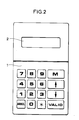
- FIG. 2 represents a display-keyboard assembly equipping the machine; keyboard 1 has 16 keys and display 2 provides an alphanumeric display.
- the alphanumeric displays currently available allow you to view one or more lines of 16, 20, 40 alphanumeric characters each, such alphanumeric displays are marketed for example by the companies EPSON or DENSITRON CORPORATION, and allow you to view all the characters appearing in the ASCII code (CCITT code No. 5).
- the franking machine clearly shows messages on this display; the operator, using the keyboard keys, executes the proposals of the displayed message. Thanks to the messages the operator is constantly guided.
- the display makes it possible to display at a given instant for example two lines of 16 alphanumeric characters, and is used to transmit messages to the operator.
- a message is usually in the form of text.
- the message to be viewed requires more than 32 characters, it is divided into as many 32-character screens as necessary.
- a message can be composed of one or more screens, each screen corresponding to a text using the full capacity of the display, ie 32 characters in the example chosen. All messages are stored in text memory 6, Figure 1.
- Each screen appears on the display for a certain time, then it is replaced by the following screen so that the rest of the screens reconstructs the entire message to be displayed.
- the first screen of the same message appears.
- the text is therefore completed and it is repeated indefinitely until the operator intervenes.
- the scrolling of the successive screens is therefore automatic; it can be suspended by using the keyboard.
- the display time of each screen is a parameter specific to each screen in the same way as the text to be displayed. For example, a screen may appear 2 seconds, the next 1 second and the third 3 seconds.
- the time of appearance of the text of a screen depends on the qualitative importance of this text; this time is fixed by a program relating to each message.
- the messages are controlled by the microprocessor 4, which runs for each message a program relating to said message, the program memory 5 containing all the message related programs.
- the program memory also contains five specific programs which are: a keyboard acquisition program, a display program, a date and time acquisition program, a screen timeout program, and a control program for the audible alarm if the machine is equipped with such an alarm, each specific program taking place cyclically automatically.
- the keyboard acquisition program consists in creating in the working memory 7 an electronic image of the 16 keys of the keyboard.
- each key is represented by a bit whose state 1 corresponds to the idle key and state 0 corresponds to the key pressed.
- the set of 16 keys therefore requires 16 bits, or 2 bytes.
- the image of the keyboard in the working memory therefore occupies a memory space of 2 bytes; the content of this memory space is called "keyboard image”.
- the microprocessor controlled by the keyboard acquisition program, takes the state of the first eight keys and stores it in the working memory, then it operates in the same way with the last eight keys.
- the acquisition program effectively refreshes the keyboard image only after ensuring that the state of the keys is perfectly stable.
- the microprocessor creates a temporary image of the keyboard in the working memory and then, each time the keyboard contacts are removed, compares the state of these contacts with the temporary image.
- the microprocessor then loads the new state of the contacts into the temporary image; if the state of the contacts is identical to the state of the contacts of the temporary image, and if this identity has taken place for at least 50 milliseconds, the microprocessor then transfers the temporary image to the keyboard image.
- the keyboard acquisition program runs automatically every 20 milliseconds.
- the storage of the state of the keys in the working memory is shown in FIG. 4, the temporary image ITC and the keyboard image IC each occupying 2 bytes of the working memory.
- the display program takes place cyclically every 100 milliseconds.
- the display shows the character it receives at a position given by its cursor, whether it is visible or invisible, then the cursor moves from one position to the right.
- the cursor operating commands are part of the display program stored in the program memory of the franking machine while the 2 x 16 characters to be displayed are stored in a manner in the working memory where they occupy a space of 32 bytes. This space is reserved for the screens to be displayed, as will be explained below, and constitutes an electronic image of the display.
- the display program therefore consists of taking from work memory each byte of the display image and sending it to the display by interposing the cursor positioning commands. To be visible, the characters contained in the display image must be represented in ASCII code. The space reserved in the working memory for the display image IA is shown in FIG. 4.
- the date and time acquisition program runs automatically every 100 milliseconds.
- the calendar clock of the franking machine has a series of six counters respectively incremented at the rate of the second, the minute, the hour, the day, the month and the year.
- the date and time acquisition program consists, for the microprocessor, of taking the content of each of the six counters and writing them in the working memory in a space of six consecutive bytes, ie one byte per counter ; this space constitutes the image of the calendar clock, said image being refreshed every 100 miles seconds by the date and time acquisition program.
- the space reserved in the working memory for the IHC calendar clock image is shown in FIG. 4.
- the audible alarm control program runs automatically every 20 milliseconds.
- Franking machines generally include alarms which consist of LEDs; among the operations that the operator has the possibility of carrying out certain operations may, under certain conditions, be prohibited: for example, impossibility of franking if the value of the stamp requested is greater than a certain value, or even if the credit is exhausted.
- the LEDs are deleted and replaced by alert messages appearing on the display, possibly accompanied by an audible alarm to attract the attention of the operator.
- the audible alarm which is constituted for example by a piezoelectric vibrator, is modulated according to the events which trigger it; the audible alarm may consist of a simple beep, or a series of beeps whose rhythm is more or less rapid.
- the second and third bytes do not contain a time expressed in seconds, but a number, the corresponding time being equal to this number multiplied by 20 milliseconds. If the content of the first byte is zero, there is no beep sound; on the other hand, the value FF, in hexadecimal code, corresponds to a permanent transmission.
- the timer program is used to display each screen of a message for a certain time, which can vary from one screen to another.
- This timer called screen time
- This timer is stored in a TE0 byte of the working memory shown in Figure 4.
- the timer program runs automatically every 20 milliseconds. To use a time delay, simply initialize it by loading the time delay byte with a number, the time delay being equal to this number multiplied by 20 milliseconds; for a time delay of 1 second, load the number 50 into the time delay byte, which gives a screen time of 1 second.
- the timer program consists of doing -1 in the timer byte, if the content of this byte is not zero; the screen time has elapsed when the content of the timer byte is zero.
- the five specific programs mentioned above allow a simplification of the programs relating to messages and their execution.
- the texts displayed on the display have a fixed part, the source of which is the text memory, and a variable part such as: date, type of operation, value of the stamp, the ceiling, the limit, the credit, etc.
- the fixed texts of the messages contained in the text memory take account of the subsequent introduction of the variable texts in the display image IA of the working memory.
- FIG. 3 represents part of the content of the text memory, and in particular a message M1 divided into two screens E1 and E2 of two lines of 16 characters each, in the case of a display unit making it possible to display two lines of 16 characters each.
- Message M1 occupies 64 bytes of text memory numbered 0 to 63; for screen E1 the first line E1L1 occupies bytes 0 to 15 and the second line E1L2 occupies bytes 16 to 31.
- the first line E2L1 occupies bytes 32 to 47 and the second line E2L2 occupies bytes 48 to 63.
- the text memory also contains all the other messages, each message itself being divided into a certain number of screens. Each message must be formatted according to the display capacity of the display.
- FIG. 4 represents part of the content of the working memory, this part comprising: - 2 bytes ITC0 and ITC1 for the temporary image of the ITC keyboard, - 2 bytes IC0 and IC1 for the keyboard image IC.
- the numbers, letters and signs are those of the 16 keys on the keyboard, M denoting the menu, V confirming and Canceling, each key corresponding to one bit of the bytes.
- - 32 bytes IA0 to IA31 for the display image IA bytes IA0 to IA15 being reserved for the first line EiL1 of a screen Ei, the bytes IA16 to IA31 being reserved for the second line EiL2 of the screen Ei; each byte is relative to a character.
- This memory space of 32 bytes corresponds to a display of two lines of sixteen characters. In general, the memory space constituting the display image is a function of the capacity of the display used.
- the memory space required for the display image uses NL bytes, numbered from IA0 to IA (NL-1). - 6 bytes IHC0 to IHC5 for the image of the IHC calendar clock; the IHC0 byte is reserved for the year, from 0 to 99; the IHC1 byte is reserved for the month, from 1 to 12; the IHC2 byte is reserved for the day, from 1 to 31; the IHC3 byte is reserved for the hour, from 0 to 23; the IHC4 byte is reserved per minute, from 0 to 59; the IHC5 byte is reserved for the second, from 0 to 59.
- the display image IA is a memory space reserved for the text of a screen which is transferred from the text memory into the working memory, where it is possibly supplemented by a variable text, to be viewed on the display; this memory space is read by the display program.
- the IHC calendar clock image is reserved for indication of the date and time from the six calendar clock counters; this calendar clock image is refreshed every 100 milliseconds by the time date acquisition program described above.
- the memory space of the 3 bytes of the CAS audible alarm control is read by the audible alarm control program described above.
- the TE0 byte of the screen timeout is read by the timer program described above.
- This working memory additionally contains information which will be detailed later and which must be maintained when the machine is switched off; it is therefore saved by a battery, as is well known.
- the messages available to the operator allow either normal franking operations or specific operations accessible by the menu key on the keyboard, as indicated above.
- the messages relating to normal franking operations constitute a first set of messages designated below by MN1, MN2, ...
- the messages MN1, MN6, MN7 and MN8 are alert messages possibly accompanied by an audible alarm.
- this message appears only at the first power-up of the day, of the franking machine.
- This message consists of the following two screens which appear successively on the display:
- Screen 1 is displayed for 1 second, and screen 2 for 2 seconds; the alarm consists of 2 beeps.
- the day, DD, the month, MM, and the year, AA, are provided by the calendar clock of the postage meter. This message prompts the operator to set the "date” dials to today's date. This action being completed, the operator presses the validation key. Following this validation, the machine notes that the "date change” operation is carried out, and, for the rest of the day, each time power is restored, the message MN1 no longer appears, it is replaced by the message MN2.
- the message MN2 follows validation of the message MN1, or after switching on without changing the date, or again following a cancellation, the message MN2 appears.
- This message consists of the following 3 screens which appear successively: Screens 1, 2, 3 are displayed for 2, 1, 1 seconds respectively.
- the numeric keys allow the operator to compose the value of the stamp, and the MENU key gives access to the specific operations by showing a message with different options, as will be explained below. As soon as a number key is hit, the Menu key becomes inactive.
- the message MN2 represents the initial state of normal franking operations, since the first message MN1 does not appear until the first power-up of the day.
- the stamp value is set to zero for security, and the remaining credit appears in clear.
- the operator must not dial a stamp value greater than the remaining credit. As soon as the operator presses a numeric key to compose a stamp value, the message MN3 appears.
- This message consists of the following two screens: Screens 1 and 2 are displayed for 3 and 1 seconds, respectively.
- the first zero to the right of the stamp value is replaced by the first digit hit on the keyboard; a second press on a numeric key shifts the preceding digit on screen 1 by one position on the left and the second struck digit occupies the position on the right.
- a third and fourth digit can be entered by the operator; they appear on the right of screen 1 after a shift to the left of the value of the stamp.
- Each keystroke automatically returns screen 1 to the display, so that if the time between two keystrokes is less than 3 seconds, only screen 1 appears; screen 2 does not appear until 3 seconds after entering the last digit.
- Known franking machines generally have only one mode of operation allowing the franking of an unlimited number of folds as soon as the operator has composed and validated a stamp value, as long as the credit is not exhausted .
- the invention allows three operating modes, the choice of operating mode being made by the operator. These operating modes are: - single shot mode: after each franking, the stamp value is brought back to zero. In this case, you must recompose the stamp value of the next postage. This operating mode is an additional security which prohibits the realization of successive frankings whose value is not rigorously controlled, - burst mode: after each franking, the stamp value is not reset to zero as in the previous mode.
- the franking machine If the franking machine is not equipped to change operation, it operates in burst mode.
- the message MN4 appears, in single-shot mode, or in burst mode; if the machine is in limited burst mode, the message MN5 appears.
- This message consists of the following two screens which appear successively: Screens 1 and 2 are displayed for 3 and 1 seconds, respectively. Stamp and credit values appear in clear.
- This message consists of the following two screens which appear successively:
- Screens 1 and 2 are displayed for 3 and 1 seconds, respectively.
- the value of the stamp and the number of folds in limited burst appear in clear.
- the message MN4 is replaced by the message MN2.
- burst mode the credit in screen 1 of message MN4 is decremented by the value of the stamp after each franking and screen 1 remains displayed if the franking rate is less than 3 seconds, screen 2 then being displayed only 3 seconds after the last envelope has passed.
- burst mode or in limited burst mode, if the credit is used up during franking, the machine stops and the message MN6 appears on the display.
- This message only exists for prepayment franking machines. This message consists of the following two screens which appear successively.
- the invention also provides for allowing the operator to fix a limit value and a ceiling value, to change them if desired, and to make a postage of value greater than the ceiling value.
- the operator To make a stamp whose value exceeds the franking limit, the operator must change this limit using a message accessible by the menu key and which will be described later. If this limit is zero the machine is blocked; on the other hand, if this limit is equal to the maximum capacity of the machine, for example 9999 for a four-digit machine, the postage limit no longer exists.
- the MN7 message consists of the following three screens which appear successively:
- Screens 1, 2, 3 are displayed for 3, 2, 1 seconds, respectively; four alarm beeps are emitted during the display time of screen 1.
- the values of the timbre and of the limit appear clear. Cancellation returns to message MN2.
- the operator is the master of the safety ceiling and the way to load and change the safety ceiling will be explained later when describing the messages accessible by the menu key.
- the message MN8 consists of the following three screens which appear successively.
- Screens 1, 2 and 3 are displayed for 2, 2 and 1 seconds, respectively; moreover, alarm beeps are emitted during the display of screen 1.
- the values of the timbre and the ceiling appear in clear.
- a cancellation displays the message MN2, but if the operator confirms the value of the stamp by pressing the validation key, the value of the stamp is accepted despite exceeding the ceiling.
- the messages MN4 or MN5 appear, depending on the operating mode of the franking machine.
- the safety ceiling loaded by the operator, is equal to the maximum capacity of the machine, for example 9999 for a four-digit machine, the safety ceiling no longer exists; on the other hand if the operator has loaded the value 0000, then the composition of the value of each stamp requires a double validation, one for the message MN3 and one for message MN8.
- the postage limit will generally be higher than the security ceiling, since it prohibits all postage, but of course the operator remains free to choose, as well as the security ceiling and postage limit values.
- the message MP5 selection of the operating mode does not exist; if in addition a fixed limit value is imposed on the commissioning of the machine, the message MP9 change of the franking limit does not exist, but the machine can however be or not equipped with a safety ceiling, lower at the limit value, and the message MP8 change of the safety ceiling exists or not.
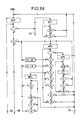
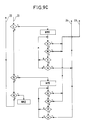
- FIGS. 9A, 9B and 9C representing the sequence of these messages.
- This message consists of the following seven screens Screens 4, 5, 6 exist if the machine is equipped with the corresponding options.
- Screens 1 and 7 are displayed for 1 second, screens 2, 3, 4, 5 and 6 being displayed for 2 seconds each.
- This message consists of the following seven screens: Each screen is displayed for 2 seconds.
- This message informs the operator about the states of the machine.
- screens 1, 2 and 3 the values of the credit, the index counter and the cycle counter are indicated in clear.
- screen 4 the date, the hour, and the minutes are indicated in clear; if screen 4 is permanently displayed, by pressing one or both scroll keys, the point separating the hour, HH, and the minutes, MM, flashes at the rate of the second.
- the second line of screen 5 consists of one of the following three texts: blow by blow, burst, burst of XXX, the number of folds (postage) being indicated in clear.
- the franking machine is equipped with a number of auxiliary counters, for example 20, numbered from 1 to 20, each auxiliary counter being assigned to a budgetary item; each auxiliary counter comprises a counter of francs which totals the values of the franking carried out and a counter of folds which counts the number of folds (franking), that is to say the number of envelopes or labels franked.
- the operator can set the franc counter and the ply counter of an auxiliary counter to zero, either on or off, independently of the other auxiliary counters.
- the MP2 message is used with the MP3 and MP4 messages, as shown below, following the presentation of the MP2, MP3 and MP4 messages.
- the MP2 message, the auxiliary counters, consists of the following seven screens: Screens 1 to 7 are displayed for 2, 3, 1, 2, 2, 2, 2 seconds respectively. In screen 1 the counter number (from 1 to 20) appears and the text of the second line is completed by: "stopped” or "running”. In screen 2 the number of francs and the number of folds appear, and in screen 3, the date and time of the last reset are displayed.
- the auxiliary counter displayed is the first (number 1).
- the numbers 1 to 6 appearing in screens 4 to 7 of the message MP2 allow the operator to choose from the various options offered, using the keys on the keyboard corresponding to the numbers.
- screen 1 of the message MP2 appears with the number of the next counter or with counter N ° 1 if before this action counter N ° 20 was displayed. If the operator acts on key 3, the previous counter is selected, or counter N ° 20 if counter N ° 1 was displayed before this action. To choose any counter the operator has the possibility of using the key 1 whose action brings up the MP3 selection message. To change the state of an auxiliary counter previously selected, the operator has keys 4, 5 and 6. Pressing one of these keys brings up the message MP4, the validation of which returns to message MP2 with the selected state.
- the MP3 message selection of an auxiliary counter, consists of the following 2 screens: As long as the operator has not entered a number from 1 to 20, the XX indication flashes. Screens 1 and 2 are displayed for 2 and 1 seconds respectively. A cancellation brings back the message MP2.
- Screens 1, 2, 3 are displayed for 2, 2, 1 seconds, respectively.
- the text of the second line of screen 1 is, depending on whether the operator presses the 4 or 5 or 6 key when viewing the MP2 message: a reset (key 4) a stop (key 5) starting (key 6) In screen 2, the counter number is indicated.
- Validation is obtained by pressing the validation and star keys simultaneously, and returns to the MP2 message with execution of the order. The cancellation returns to the MP2 message without execution of the order.
- Message MP7 Choice of number of folds in limited burst mode The franking machine can operate according to one of the following three modes: Stroke, burst, burst limited to XX postage, which can be selected using the messages MP5, MP6 and MP7.
- the message MP5 is displayed when in the message MP0 the operator presses the key 3 of the keyboard. It is made up of the following five screens: Screens 1 and 5 are displayed for 1 second, and screens 2, 3, 4 for 2 seconds each.
- the MP6 message consists of the following screens: Screens 1, 2, 3 are displayed for 1, 2, 1 seconds, respectively.
- the MP7 message consists of the following screens: Screens 1 and 2 are displayed for 1 and 2 seconds respectively.
- the first line of screen 2 is constituted by: blow by blow, burst, burst of XXX, the number of folds XXX being given in clear, to indicate the current operating mode of the machine. If the operator does not wish to change the mode, he presses the validation key, which brings back the message MP0. If he wishes to change the mode, he selects this mode using one of the keys 1, 2, 3 on the keyboard, as indicated in screens 3 and 4 of the message MP5. As soon as he has made his choice, the message MP6 appears, and screen 2 comprises, on the first line, the indication of the mode: blow by blow, burst, limited burst.
- the validation using the V and star keys, returns the message MP5, in single-shot mode and in burst mode, the first line of screen 2 of MP5 indicating the validated operating mode; on the other hand, validation brings up the message MP7 if the operator has validated the limited burst mode. The operator must then indicate the number of folds, then validate, which brings back the message MP5 with the burst indication of XXX on the first line of screen 2, the number of folds XXX being that composed.
- validation brings back the MP5 message which allows the operator to verify that the machine is operating properly according to the desired mode; validation of the MP5 message then brings the message MP0.
- the MP8 message consists of the following 3 screens: Screens 1, 2, 3 are displayed for 1, 2, 1 seconds respectively.
- This message appears when in the MP0 message the operator presses the key 5, and consists of the following three screens.
- FIG. 4 shows part of the content of the working memory, the part described being used by the specific programs.
- the working memory also contains the machine states, the - auxiliary counters, the ceiling, the franking limit, the credit in reserved spaces.
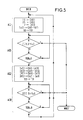
- the first example is the message MN1, checking the date
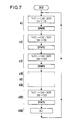
- the second example is the message MP0, start of the menu.
- FIG. 5 shows the flowchart of this message.
- Each message corresponds to a specific program in the program memory, so there is a date verification program which allows the successive execution of the following actions:
- a SPMP0 sub-program is used, the flow diagram of which is shown in FIG. 6. This sub-program performs the following functions: - If key 1 of the keyboard is pressed, bit 1 of byte IC0 of the keyboard image has the value "0": end of program, go to message MP1. - If key 2 is pressed, bit 2 of byte IC0 has the value "0": end of program, go to message MP2. - If key 3 is pressed, bit 3 of byte IC0 has the value "0": end of program, go to message MP5.
- each message MN2, MN3, ... and MP1, MP2, ... corresponds to a particular program, the two programs described above being given as an example for the messages MN1 and MP0.
- the machine operates by scrolling the screen, one screen replacing another screen.
- the message MN1 is not modified in the text memory, but the program relating to this message is modified so as to constitute 3 screens instead of 2; these 3 screens are:
- line-by-line scrolling requires the creation of an additional screen between two successive screens, here screen 1bis, the first line contains the text of the last line of the previous screen, and the second line of which takes the text of the first line of the next screen.
- the corresponding program takes actions 1, 3 and 4 from the program described above, without modification, and action 2 whose only end is modified, and it includes two additional actions 2bis and 2ter.
- the end of action 2 is modified as follows: - If the time delay of 1 second has elapsed, the content of the time delay TE0 byte is zero, then go to action 2bis, otherwise repeat action 2.
- Actions 2bis and 2ter are:
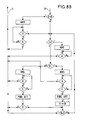
- FIGS 5, 6, 7, 8A, 8B, 9A, 9B, 9C are flow charts as indicated above.
- the numbers 1, 2 ..., the letters V, A, M and the sign * which appear in the diamonds designate the numeric keys; validation (V), cancellation (A), the menu key (M) and the star key (*) on the keyboard.
- the number 1 means yes, and the number 0 means no.
- references AI, AII, AIII ... designate the actions, described above during the presentation of the operation of the machine using two examples: the message MN1, the flow diagram of which is shown in FIG. 5, and the message MP0, the flow diagram of which is shown in FIG. 7.
- the reference MST in the upper rectangle means “power up”
- the reference CC in the rectangle following the message MN3 means “load the number”
- the indication T> L in the rhombus means "value of the composite stamp above the limit (L) ".
- the indications T> P and T> C in the diamonds mean value of the stamp greater than the ceiling (P), and value of the stamp greater than the credit (C); the letter E signifies the presence of an envelope.
- the references R and RL in the diamonds refer to "burst (R)” and “limited burst (RL)”. In the rectangles, the mention “Prog AFF” means "franking program”.
- the various programs relating to the messages are in the program memory, and it is possible to have all these programs provided for scrolling screen by screen, or for scrolling line by line, or even to have certain message programs for scrolling screen by screen and other message programs for line-by-line scrolling.
- the texts of the messages in the text memory are the same, the creation of the additional screens for a scrolling line by line being made by the program relating to the message, said program being provided for such scrolling.
- the first line of each screen, from the second takes up the second line of the previous screen, in the case of two line screens.
- each screen from the second takes the last L-1 lines from the previous screen; the program is then provided for screens of L lines and scrolling line by line, the program controlling the picking of the first L lines of the message, then picking of L lines by shifting each picking by one line compared to the previous picking.
- the last screen includes the L last lines of the message.
- the display was of the alphanumeric type. If a graphic type display is used, this not only allows scrolling by screens or line by line scrolling as indicated above, but it also allows continuous, slow scrolling in the vertical direction, in which the line of text at the top of the display gradually disappears while a new line of text gradually appears at the bottom of the display. Such a graphic display also makes it possible to modulate the dimensions of the characters displayed.
- the screen display times are given as examples, these times being fixed when the programs are loaded into the program memory; it is the same with regard to the different times relating to the audible beeps; the screens for which an audible alarm is provided may also be more numerous than those mentioned in the description.
- the invention applies to any franking machine, including automatic franking machines in which the envelopes are not presented one by one by the operator, but presented automatically to the machine.
Landscapes
- Physics & Mathematics (AREA)
- General Physics & Mathematics (AREA)
- Engineering & Computer Science (AREA)
- Mathematical Physics (AREA)
- Theoretical Computer Science (AREA)
- Input From Keyboards Or The Like (AREA)
- Digital Computer Display Output (AREA)
- Management, Administration, Business Operations System, And Electronic Commerce (AREA)
Applications Claiming Priority (2)
| Application Number | Priority Date | Filing Date | Title |
|---|---|---|---|
| FR8702670 | 1987-02-27 | ||
| FR8702670A FR2611947B1 (fr) | 1987-02-27 | 1987-02-27 | Machine a affranchir comportant une alarme |
Publications (1)
| Publication Number | Publication Date |
|---|---|
| EP0284779A1 true EP0284779A1 (de) | 1988-10-05 |
Family
ID=9348428
Family Applications (1)
| Application Number | Title | Priority Date | Filing Date |
|---|---|---|---|
| EP88102792A Ceased EP0284779A1 (de) | 1987-02-27 | 1988-02-25 | Mit einem Alarm ausgestattete Frankiermaschine |
Country Status (3)
| Country | Link |
|---|---|
| US (1) | US4905156A (de) |
| EP (1) | EP0284779A1 (de) |
| FR (1) | FR2611947B1 (de) |
Families Citing this family (6)
| Publication number | Priority date | Publication date | Assignee | Title |
|---|---|---|---|---|
| US5371845A (en) * | 1990-04-27 | 1994-12-06 | Ashlar, Inc. | Technique for providing improved user feedback in an interactive drawing system |
| GB9020596D0 (en) * | 1990-09-21 | 1990-10-31 | Alcatel Business Systems | Data transmission method and apparatus |
| US5524995A (en) * | 1994-11-14 | 1996-06-11 | Pitney Bowes, Inc. | Apparatus and method for detecting the position of envelopes in a mailing machine |
| US5689424A (en) * | 1996-08-23 | 1997-11-18 | Pitney Bowes Inc. | Encoded screen records for international postage meters |
| US8069416B2 (en) * | 2004-05-14 | 2011-11-29 | International Business Machines Corporation | Learning computer-generated screens based on user key selections |
| US20080086423A1 (en) * | 2006-10-06 | 2008-04-10 | Nigel Waites | Media player with license expiration warning |
Citations (6)
| Publication number | Priority date | Publication date | Assignee | Title |
|---|---|---|---|---|
| FR2389185A1 (fr) * | 1977-04-25 | 1978-11-24 | Transaction Technology Inc | Terminal pour transactions |
| US4301507A (en) * | 1979-10-30 | 1981-11-17 | Pitney Bowes Inc. | Electronic postage meter having plural computing systems |
| EP0133344A2 (de) * | 1983-08-05 | 1985-02-20 | The Arthur G. Russell Company, Incorporated | Anzeigesystem für alphanumerische Nachrichten |
| EP0147936A2 (de) * | 1983-11-14 | 1985-07-10 | Fuji Xerox Co., Ltd. | Nachrichtenanzeigegerät |
| US4577283A (en) * | 1982-12-08 | 1986-03-18 | Pitney Bowes Inc. | Postage meter with keyboard keys for causing meter operations to be performed |
| US4622651A (en) * | 1983-04-18 | 1986-11-11 | Pitney Bowes Inc. | Electronic postage meter having piezoelectric audio transducer energized by stepping motor driver circuit |
Family Cites Families (12)
| Publication number | Priority date | Publication date | Assignee | Title |
|---|---|---|---|---|
| JPS5819100B2 (ja) * | 1979-03-07 | 1983-04-16 | 東芝テック株式会社 | 郵便物の輸送料金処理システム |
| US4377214A (en) * | 1981-02-10 | 1983-03-22 | Pitney Bowes, Inc. | Method and apparatus for interfacing an electronic scale system with a storage medium |
| US4516209A (en) * | 1983-02-09 | 1985-05-07 | Pitney Bowes Inc. | Postage metering system having weight checking capability |
| US4544146A (en) * | 1983-08-23 | 1985-10-01 | Bell & Howell Company | Insertion machine with control signals stored on searchable medium |
| US4527468A (en) * | 1984-10-29 | 1985-07-09 | Pitney Bowes Inc. | Apparatus for separating multiple webs of documents into discrete documents and forming the discrete documents into predetermined batches |
| US4527790A (en) * | 1984-10-29 | 1985-07-09 | Pitney Bowes Inc. | Apparatus and method for separating multiple webs of documents having the capability for orderly shut-down and re-start of operation |
| US4568072A (en) * | 1984-10-29 | 1986-02-04 | Pitney Bowes Inc. | Interactive system for defining initial configurations for an inserter system |
| US4527791A (en) * | 1984-10-29 | 1985-07-09 | Pitney Bowes Inc. | Inserter system for forming predetermined batches of documents and inserting the batches into envelopes |
| JPS62105202A (ja) * | 1985-10-31 | 1987-05-15 | Fanuc Ltd | Ncデ−タ作成方法 |
| US4787046A (en) * | 1985-11-12 | 1988-11-22 | Pitney Bowes Inc. | Mailing system having a capability for one-step postage metering |
| US4823283A (en) * | 1986-10-14 | 1989-04-18 | Tektronix, Inc. | Status driven menu system |
| US4800506A (en) * | 1987-03-13 | 1989-01-24 | Pitney Bowes Inc. | Apparatus for preparing mail pieces |
-
1987
- 1987-02-27 FR FR8702670A patent/FR2611947B1/fr not_active Expired - Lifetime
-
1988
- 1988-02-25 EP EP88102792A patent/EP0284779A1/de not_active Ceased
- 1988-02-29 US US07/161,947 patent/US4905156A/en not_active Expired - Lifetime
Patent Citations (6)
| Publication number | Priority date | Publication date | Assignee | Title |
|---|---|---|---|---|
| FR2389185A1 (fr) * | 1977-04-25 | 1978-11-24 | Transaction Technology Inc | Terminal pour transactions |
| US4301507A (en) * | 1979-10-30 | 1981-11-17 | Pitney Bowes Inc. | Electronic postage meter having plural computing systems |
| US4577283A (en) * | 1982-12-08 | 1986-03-18 | Pitney Bowes Inc. | Postage meter with keyboard keys for causing meter operations to be performed |
| US4622651A (en) * | 1983-04-18 | 1986-11-11 | Pitney Bowes Inc. | Electronic postage meter having piezoelectric audio transducer energized by stepping motor driver circuit |
| EP0133344A2 (de) * | 1983-08-05 | 1985-02-20 | The Arthur G. Russell Company, Incorporated | Anzeigesystem für alphanumerische Nachrichten |
| EP0147936A2 (de) * | 1983-11-14 | 1985-07-10 | Fuji Xerox Co., Ltd. | Nachrichtenanzeigegerät |
Also Published As
| Publication number | Publication date |
|---|---|
| FR2611947A1 (fr) | 1988-09-09 |
| FR2611947B1 (fr) | 1991-05-10 |
| US4905156A (en) | 1990-02-27 |
Similar Documents
| Publication | Publication Date | Title |
|---|---|---|
| EP0281862B1 (de) | Betriebssystem für eine elektronische Frankiermaschine | |
| EP0281861B1 (de) | Elektronische Frankiermaschine mit Grenzwerten für die Frankierung | |
| EP0281860A1 (de) | Elektronische Frankiermaschine mit Auswahl der Betriebsart | |
| EP0208231B1 (de) | Fernsteuerungssystem für Frankiermaschinen | |
| FR2626994A1 (fr) | Systeme pour comptabiliser des couts postaux | |
| FR2620249A1 (fr) | Machine a affranchir a gestion de traces periodiques | |
| CA1280212C (fr) | Systeme de pesee d'un objet et d'edition d'une etiquette valant bon de transport | |
| US20060173796A1 (en) | System and method for printing multiple postage indicia | |
| FR2628870A1 (fr) | Systeme de rangement a casiers adjacents commandes par un dispositif a microprocesseur | |
| FR2485233A1 (fr) | Systeme de consigne automatique | |
| FR2490365A1 (fr) | Dispositif de visualisation de donnees en des ecritures de natures differentes telles que les ecritures arabe et latine | |
| EP0284779A1 (de) | Mit einem Alarm ausgestattete Frankiermaschine | |
| CZ313791A3 (en) | Device for issuing franking strips | |
| EP0031077B1 (de) | Interaktive Vorrichtung zum Einführen von Daten in kleine Instrumente, insbesondere in Uhren | |
| FR2641633A1 (fr) | Imprimante permettant une saisie de donnees perfectionnee et son procede de fonctionnement | |
| EP0605313A1 (de) | Frankiermaschine mit Geschichtsabspeicherung | |
| EP0285997A1 (de) | Elektronische Frankiermaschine mit einer grossen Anzahl von Hilfszählern | |
| EP0612038B1 (de) | Verfahren zum Kontrollieren des täglichen Postgebührenverbrauchs einer Frankiermaschine und Frankiermaschine zur Durchführung dieses Verfahrens | |
| EP0662649A1 (de) | Analoguhr mit Mitteln zur Verarbeitung von Dezimalzahlen | |
| CA1305864C (en) | World timepiece | |
| JPS5927367A (ja) | 予め定めた値への重要勘定レジスタの設定を可能にする1回作動可能な動作プログラムを有する電子式郵便料金メータ | |
| US20080021849A1 (en) | System and method for printing multiple postage indicia | |
| FR2553549A1 (fr) | Machine de parking automatique | |
| JPS5936793B2 (ja) | 印紙税現金納付表示器 | |
| FR2783337A1 (fr) | Procede de controle des consommations de machines a affranchir |
Legal Events
| Date | Code | Title | Description |
|---|---|---|---|
| PUAI | Public reference made under article 153(3) epc to a published international application that has entered the european phase |
Free format text: ORIGINAL CODE: 0009012 |
|
| AK | Designated contracting states |
Kind code of ref document: A1 Designated state(s): DE FR GB |
|
| 17P | Request for examination filed |
Effective date: 19890403 |
|
| RAP1 | Party data changed (applicant data changed or rights of an application transferred) |
Owner name: ALCATEL SATMAM |
|
| 17Q | First examination report despatched |
Effective date: 19911128 |
|
| STAA | Information on the status of an ep patent application or granted ep patent |
Free format text: STATUS: THE APPLICATION HAS BEEN REFUSED |
|
| 18R | Application refused |
Effective date: 19920503 |