EP0284803B1 - Polyimidesiloxanes solubles et procédés pour leur fabrication et utilisation - Google Patents
Polyimidesiloxanes solubles et procédés pour leur fabrication et utilisation Download PDFInfo
- Publication number
- EP0284803B1 EP0284803B1 EP88103175A EP88103175A EP0284803B1 EP 0284803 B1 EP0284803 B1 EP 0284803B1 EP 88103175 A EP88103175 A EP 88103175A EP 88103175 A EP88103175 A EP 88103175A EP 0284803 B1 EP0284803 B1 EP 0284803B1
- Authority
- EP
- European Patent Office
- Prior art keywords
- polyimidesiloxane
- diamine
- radical
- siloxane
- organic
- Prior art date
- Legal status (The legal status is an assumption and is not a legal conclusion. Google has not performed a legal analysis and makes no representation as to the accuracy of the status listed.)
- Expired - Lifetime
Links
Classifications
-
- C—CHEMISTRY; METALLURGY
- C08—ORGANIC MACROMOLECULAR COMPOUNDS; THEIR PREPARATION OR CHEMICAL WORKING-UP; COMPOSITIONS BASED THEREON
- C08G—MACROMOLECULAR COMPOUNDS OBTAINED OTHERWISE THAN BY REACTIONS ONLY INVOLVING UNSATURATED CARBON-TO-CARBON BONDS
- C08G73/00—Macromolecular compounds obtained by reactions forming a linkage containing nitrogen with or without oxygen or carbon in the main chain of the macromolecule, not provided for in groups C08G12/00 - C08G71/00
- C08G73/06—Polycondensates having nitrogen-containing heterocyclic rings in the main chain of the macromolecule
- C08G73/10—Polyimides; Polyester-imides; Polyamide-imides; Polyamide acids or similar polyimide precursors
- C08G73/1057—Polyimides containing other atoms than carbon, hydrogen, nitrogen or oxygen in the main chain
- C08G73/106—Polyimides containing other atoms than carbon, hydrogen, nitrogen or oxygen in the main chain containing silicon
-
- C—CHEMISTRY; METALLURGY
- C08—ORGANIC MACROMOLECULAR COMPOUNDS; THEIR PREPARATION OR CHEMICAL WORKING-UP; COMPOSITIONS BASED THEREON
- C08G—MACROMOLECULAR COMPOUNDS OBTAINED OTHERWISE THAN BY REACTIONS ONLY INVOLVING UNSATURATED CARBON-TO-CARBON BONDS
- C08G77/00—Macromolecular compounds obtained by reactions forming a linkage containing silicon with or without sulfur, nitrogen, oxygen or carbon in the main chain of the macromolecule
- C08G77/42—Block-or graft-polymers containing polysiloxane sequences
- C08G77/452—Block-or graft-polymers containing polysiloxane sequences containing nitrogen-containing sequences
- C08G77/455—Block-or graft-polymers containing polysiloxane sequences containing nitrogen-containing sequences containing polyamide, polyesteramide or polyimide sequences
Definitions
- polyimides A class of polymers known as polyimides has become known for its combination of good heat stability and high upper use temperatures, as measured by glass transition temperature.
- a particularly useful type of such polyimides is known as polyimidesiloxanes.
- polyimidesiloxanes Because of their combination of properties, polyimidesiloxanes have been used in electronic applications, particularly in micro-electronic components in the computer industry.
- polyimidesiloxanes are insoluble or difficultly soluble in solvents, when used in the micro-electronics industry, there is a great need for polyimidesiloxanes having improved solubility characteristics, as well as a better balance of heat resistance and upper use temperature.
- a structurally simple polyimide can be prepared by reacting a diamine with a dianhydride.
- the first step or the polycondensation reaction, generates polyamide acids which are hydrolytically unstable even at room temperature.
- the second step, or the imidization reaction produces the stable polyimides desired for various applications.
- Polyimidesiloxanes can be prepared by reactions employing siloxane diamines or siloxane dianhydrides with organic comonomers. Polyimidesiloxanes can also be prepared from siloxane diamines and siloxane dianhydrides without an organic comonomer.
- the polyamide acids solution has to be stored at refrigeration temperature ( ⁇ 4°C) and it still has a very short shelf life (about 3 months).
- the fully imidized polyimides are thermally stable for melt processing such as extrusion and injection molding.
- a soluble polyimidesiloxane can be fully imidized at temperatures of about 160 to 170°C in a solvent, whereas imidization for insoluble polyimides in the solid state may require temperatures 50°C above their glass transition temperatures which can be as high as 200 to 250°C. Shaping not fully imidized polyimides by the melt processing method produces voids in the products and often is not desirable.
- one object of the present invention is to prepare fully imidized polyimides.
- the first polyimidesiloxane was prepared by reacting pyromellitic dianhydride (PMDA) with 1,3-bis-(aminopropyl)-1,1,3,3-tetramethyl disiloxane in 1966 (see V. H. Kuckertz, Macromol. Chem. 98 , 1966, pp. 101-108).
- This polyimidesiloxane is a crystalline material and cannot be cast into flexible films from solvent.
- Polyimidesiloxanes derived from reactions of benzophenone tetracarboxylic dianhydride (BTDA) and ⁇ ,w-diamino organo-polysiloxanes were disclosed by General Electric in 1967 in U.S. Patent No. 3,325,450.
- Polyimidesiloxanes containing an ⁇ ,w-diamino organo-polysiloxane and a diether dianhydride (DEDA) have also been disclosed in U.S. Patent No. 3,847,867
- All these BTDA and DEDA containing polyimides are amorphous materials. They have a glass transition temperature of no more than 100°C and, therefore, have very limited upper use temperatures, despite the excellent thermal stability of these polymers up to about 200°C.
- the diether dianhydride containing polyimidesiloxane are also soluble in chlorinated solvents such as dichlorobenzene and dichloromethane. Since these phenol and chlorinated compounds are both corrosive and highly toxic, the polyimides have limited application in coating applications, especially in heat sensitive electronic devices. This is also due to the fact that a NMP soluble polyimidesiloxane normally has to be heated to 350°C for at least half an hour to remove all the residual solvent in a film having a micron-thickness film.
- U.S. Patent No. 4,586,997 teaches the utility of making polyimides based on diether dianhydrides, diamines and ⁇ ,w-diaminosiloxanes.
- Cross-linked polymers are also disclosed.
- oxydiphthalic anhydride which is a monoether dianhydride, as the sole essential organic dianhydride in the polymer produces a polymer with exceptional properties.
- Another object of the invention is to provide fully imidized polyimides which are soluble not only in high boiling solvents, such as NMP, but also in low boiling, low toxic, less polar solvents such as diglyme, tetrahydrofuran (THF) or methyl ethyl ketone (MEK).
- a further object of the invention is to provide polyimides that have a good balance of heat resistance and high upper use temperatures, as measured by glass transition temperatures.
- Another object of this invention is to produce curable and cross-linked polyimides.
- Fully imidized polyimides which are based on oxydiphthalic anhydride are soluble in diglyme which gives them particular utility in the micro-electronics industry.
- the polymers are prepared from oxydiphthalic anhydride, a difunctional siloxane monomer which is an ⁇ , ⁇ -siloxane diamine and an organic diamine as defined in claim 1 that provides an assymetrical structure in the polyimidesiloxane polymer chain.
- the polyimidesiloxane can be prepared with functional groups which render them directly curable.
- the polyimides can also be prepared with functional groups which when reacted with an unsaturated compound renders the polymers curable.
- the products of the invention can be used in the form of solutions in the micro-electronic industry.
- the polymers can also be used in wire and cable coating and to prepare films, fibers, and molded and extruded articles.
- the present invention is based on the discovery that the use of oxydiphthalic anhydrides (ODPA), particularly 4,4'-oxydiphthalic anhydride (4,4'-ODPA), provides polyiminesiloxanes which have a unique combination of properties.
- ODPA oxydiphthalic anhydrides
- 4,4'-ODPA 4,4'-oxydiphthalic anhydride
- Other oxydiphthalic anhydrides that can be used in the practice of the invention are 3,3'-oxydiphthalic anhydride and 3,4'-oxydiphthalic anhydride.
- organic dianhydrides can be employed in small proportions, up to 5 to 20 weight percent of the oxydiphthalic anhydride.
- Specific examples are diether dianhydrides which have the formulas:
- Other examples of such other dianhydrides are disclosed in U.S. Patents Nos. 4,395,527 and 4,586,997.
- these modified polyimides may become insoluble in solvents, such as MEK or THF.
- the incorporation of the diether dianhydrides (DEDA) also reduces the glass transition temperature and thermal stability of ODPA-containing polyimides and limit their upper use temperatures. Thus only up to about 5 weight percent of PMDA, and only up to about 20 weight percent of BTDA or the diether dianhydrides (DEDA) can be employed in the composition of the invention.
- diamines that provide assymetrical structure in the polyimidesiloxane chains are especially useful in combination with the oxydiphthalic anhydrides in making polyimides with the desirable and superior properties of this invention.
- the diamines that provide assymetrical structure in the polyimidesiloxane chain either have the following formula: where x, y and z are independently selected from hydrogen, halogen, alkyl or halogenated alkyl of 1 to 12 carbon atoms or aryl or halogenated aryl of 6 to 12 carbon atoms.
- the other diamine compounds that are assymetrical in the polymer chain are compounds with the formula: wherein x' is -CH 2 -,
- Another suitable diamine that is assymetrical in the polyimidesiloxane is diaminoanthraquinone.
- An especially preferred diamine is a mixture of 80 weight percent 2,4-tolyldiamine and 20 weight percent 2,6-tolyldiamine.
- auxiliary diamines have the formula wherein x 2 is preferably for retaining solubility in diglyme, THF or MEK.
- the x 2 can also be -O-, -S- and -CH 2 - for achieving only solubility in NMP.
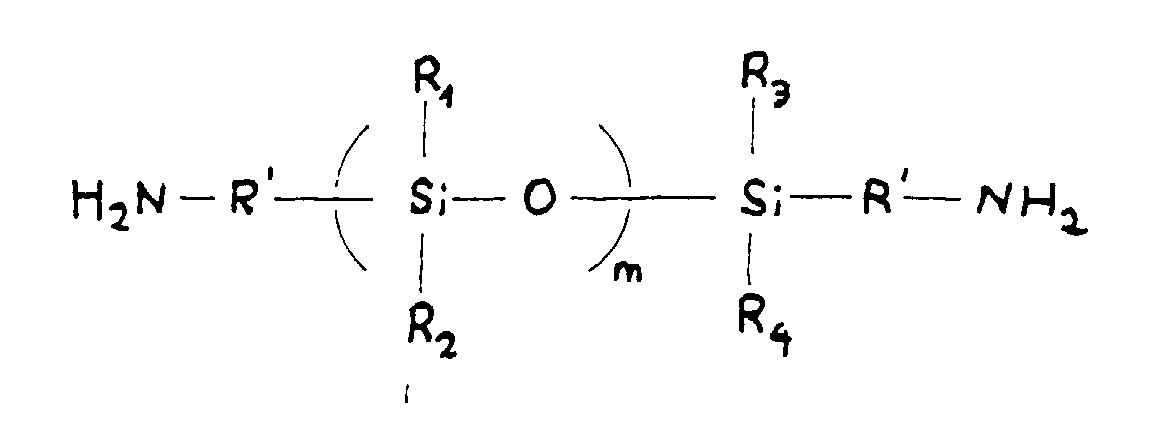
- Siloxane diamino compounds that can be used for the present invention have the following formula: wherein R 1 , R 2 , R 3 , and R 4 are independently selected from a substituted or unsubstituted aliphatic mono-radical of 1 to 12 carbon atoms or substituted or unsubstituted aromatic mono-radical of 6 to 10 carbon atoms.
- Suitable radicals include -CH 3 , -CF 3 , -(CH 2 ) n CF 3 , -C 6 H 5 , -CF 2 -CHF-CF 3 and
- R' is independently selected from substituted or unsubstituted aliphatic difunctional radicals of 1 to 12 carbon atoms or substituted or unsubstituted aromatic difunctional radicals of 6 to 10 carbon atoms, m is an integer of from 5 to 200.
- the employment of an ⁇ ,w-diaminosiloxane is important for achieving the desired solubility in diglyme, THF or MEK in the present invention when the essential dianhydride employed in the invention is ODPA.
- the siloxane diamine also provides the flexibility or resilience of the polyimidedisiloxanes at low temperatures, especially when the m is an integer of more than 5, or preferably more than 7.
- the m is more than 50, the incorporation of diaminosiloxane into the polyimidesiloxane becomes difficult even though it is not impossible; and a dual solvent system (one polar and one non-polar solvent) for copolymerization may have to be employed.
- the employment of the ⁇ ,w-diaminosiloxane and ⁇ ,w-dianhydride siloxane are interchangeable in the present invention.
- the mole percent of the ODPA in the total dianhydride should be maximized; and therefore, it is more desirable to employ the combination of an ODPA with an organic diamine and an ⁇ ,w-diaminosiloxane.
- Siloxane dianhydrides which can be incorporated in addition to the siloxane diamines for the practice of the present invention can have the formula: wherein R 1 , R 2 , R 3 and R 4 are independently selected from a substituted or unsubstituted aliphatic mono-radical of 1 to 12 carbon atoms substituted or unsubstituted aromatic mono-radical of 6 to 10 carbon atoms and m is 5 to 50. Suitable radicals include -CH 3 , -CF 3 , -(CH 2 ) n CF 3 , -CF 2 -CHF-CF 3 , and -C 6 H 5 .
- R is a tri-radical of the foregoing type. Suitable tri-radicals include -CH ,
- a dianhydride other than the ODPA When a dianhydride other than the ODPA is employed, their solubility in various solvents, glass transition temperatures and thermal stability changes depending on the chemical nature of these co-monomers. For instance, when a siloxane dianhydride is incorporated in the presence of ODPA, the solubility of the polymer increases, while the glass transition temperature and thermal stability will be lowered. Therefore, depending on the requirements for applications, the incorporation of siloxane dianhydride may become unfavorable. On the other hand, when an organic dianhydride such as PMDA is added in small proportions of less than 5 mole percent, the resulting ODPA-containing polyimides still has the desirable solubility in, for instance, NMP.
- an organic dianhydride such as PMDA
- the incorporation of PMDA can increase the glass transition temperature and thermal stability of the resulting ODPA-containing polyimides, and, therefore, can provide more favorable products for extrusion or injection molding applications.
- PMDA can increase the glass transition temperature and thermal stability of the resulting ODPA-containing polyimides, and, therefore, can provide more favorable products for extrusion or injection molding applications.
- solvents such as diglyme, THF or MEK, and their applications as coating materials will be limited, for instance, in heat sensitive electronic devices or substrates.
- the polyimides of the invention which utilize fluorine substituted substituents have improved thermal stability and chemical resistance. They also have a lower dielectric constant.
- the preparation of polyimides in the presence of the siloxane comonomers may sometimes require special techniques.
- a dual solvent system i.e., a solvent system consisting not only of a polar solvent, but also a less polar solvent.
- soluble polyimides if a polyimide is soluble in a given solvent, in which the polyamide acid is not soluble, one can prepare the polyimide directly in a one step polymerization process, that is, by a simultaneous imidization and polycondensation process, referred to as the one-step process.
- This procedure can be advantageous, especially when a desirable polymer solution for coating applications has to be made out of a given solvent in which the polyamide acids are not soluble.
- the problem with the simultaneous imidization and polycondensation is that the depolymerization of the polyamide acid in the presence of the water which is produced during the imidization step, can be very severe.
- the depolymerization can become an irreversible process, since it produces a dicarboxylic acid and an amino compound.
- the carboxylic acid reacts with amino compounds at much higher temperatures as compared to the almost instantaneous reaction of the dianhydrides with the amino compounds at room temperature.
- the depolymerization of polyamide acids can become very severe at high temperatures.
- This one-step process often produces polyimides with much lower molecular weight as compared to those produced in a good solvent, in which the polyamide acid and the imidized polymers are both soluble, and one employs a two-step process.
- the two-step process employs a low temperature polycondensation step which generates very high molecular weight polyamide acid and then a very fast heating step to imidize and remove water generated from imidization.
- the two-step process produces higher molecular weight materials which have higher thermal stability and mechanical strength, especially higher elongation at break.
- the polycondensation temperature for the two-step process should be below 60°C, preferably below room temperature.
- the imidization can be carried out at temperatures from 90°C to 180°C, or the refluxing temperature of the solvents. When the boiling temperature of the desirable solvent for imidization is below 160°C, the use of dehydrating agents and/or a base catalyst is desirable.
- a suitable dehydrating agent is acetic anhydride.
- the catalyst is a tertiary amine, such as pyridine. When the acetic anhydride is employed, lower imidization temperatures can be employed to complete the imidization.
- an azeotropic agent with water can also be added to the reactor.
- the use of an azeotropic agent such as toluene can facilitate the removal of water presented in the reactor and minimize the depolymerization of the polyamide acids.
- an azeotropic agent is employed, a continuous recovery of fresh azeotropic agent can be achieved by using also a Dean Stark trap under the condenser.
- the degree of polycondensation is important for obtaining good thermal and mechanical properties in making polyimides.
- the reaction time for making high molecular weight polyimides is normally several times longer than that required for making polyimides due to the fact that the reactivity of the ⁇ ,w-diamino or dianhydride siloxanes is normally lower than organic monomers.
- the high molecular weight siloxane monomers react much slower than the organic monomers in a polar solvent. Accordingly, one can also expect that the microstructure of the polyimidesiloxane depends not only on the molar ratio of the organic to siloxane monomers (or the composition of the monomers), but also on the additional sequence of these monomers during polycondensation.
- the solvents that can be used for the polymerization of the present invention are the phenol solvents; N,N-dialkylated carboxylamide solvents and monoalkylated or dialkylated ether type solvents.
- the examples of phenol solvents are phenol, o-cresol, m-cresol, o-chlorophenol, m-chlorophenol, p-fluorophenol, 2,4,6-tribromophenol
- examples of N,N-dialkylated carboxylamide solvents are N,N-dimethylformamide, N,N-dimethylacetamide, NMP
- ether type solvents are tetrahydrofuran (THF), diglyme or triglyme .
- Polyimidesiloxane can also be prepared in a melt polymerization process; especially when the glass transition temperature of the imide block is lower than say about 200°C; or a large proportion (>25%) of the siloxane comonomers is employed.
- the melt polycondensation can be done in an extruder in which imidization can be achieved using a vented zone situated close to the outlet nozzle.
- the total moles of dianhydride component(s) should equal the total moles of diamine component(s).
- diamine components or small amounts of monofunctional compounds can be employed.
- siloxane monomer is a diamine
- siloxane diamine for every 1 mole of siloxane diamine employed, assume that n moles of organic diamine is employed. Then n + 1 moles of organic dianhydride is employed.
- siloxane monomer is a dianhydride
- siloxane dianhydride for every 1 mole of siloxane dianhydride employed, assume that n moles of organic dianhydride is employed. Then n + 1 moles of organic diamine must be employed.
- n has a value of greater than 0.01 but no more than 40, preferably 20.
- the polyimidesiloxane When 0.01 ⁇ n ⁇ 0.1, the polyimidesiloxane exhibit elastomeric or rubber properties and are useful for potting, encapsulation, and sealing applications. Especially, a cross-linking elastomeric polyimidesiloxane will have great value in the above-mentioned applications.
- 0.1 ⁇ n ⁇ 10 polyimides with thermoplastic elastomeric properties are obtained. These materials are useful for wire, cable, injection molding and protective coating applications.
- 10 ⁇ n ⁇ 40 very high strength and rigid thermoplastics are produced which are useful for molding and coating applications.
- the soluble polyimides described above have many valuable properties and uses. However, limitations are found in their applications, especially in areas where higher chemical or creep resistance are desirable or even critical. For instance, most of the polyimides show limited hydraulic fluid or jet fuel resistance when their siloxane content is over 30 to 40%. Even though this weakness can be largely reduced by incorporating fluorinated compound into their backbone structure, in particular, into their siloxane blocks, it is still more desirable to convert these fluorinated polyimides into thermosets in order to achieve higher solvent and creep resistance. In general, when a cross-linkable polyimidesiloxane carries an acrylic functionally, it can be cured by either thermal or photo-method.
- a photosensitive or photocurable polyimidesiloxane is especially valuable for patterning applications in microchips or integrated circuit industries. Furthermore, these novel curable polyimides, as well as the soluble polyimidesiloxanes, can also find applications in passivation layer, alpha particle barrier, electron beam patterning, ion implant mask or interlayer dielectric in electronics and micro-electronic industries.
- the polyimidesiloxanes of the invention can be made curable by the inclusion of reactants that have functionalities that are capable of being cross-linked, or that have intermediate functionalities that can be suitably modified with cross-linkable moieties after formation of the polymer.
- the required functionalities can be incorporated into the polymer of the invention by use of suitable diamines and/or siloxane compounds.
- the diamine compounds have the characteristic described for the soluble polymers of a diamine that provide assymetrical structure in the polyimidesiloxane chains.
- the diamines further have the following general formula: wherein Ar is aromatic, R" is a hydroxyl, hydrothiol or carboxylic radical, preferably a hydroxyl or carboxylic radical.
- Ar is aromatic
- R" is a hydroxyl, hydrothiol or carboxylic radical, preferably a hydroxyl or carboxylic radical.
- the typical examples of these compounds are, for instance, 3,5-diaminobenzoic acid and 3,5-di-aminophenol.
- the functionalized siloxane diamines or dianhydrides have the following general structure: wherein D is either an amino or anhydride group and the R 1 is a diradical R' or a triradical R, such as described hereinbefore. Radicals R 1 , R 2 , R 3 and R 4 are described hereinbefore, except that one or more of R 1 , R 2 , R 3 and R 4 can be a halogen, hydride (H), vinyl or a hydroxyl group, when D is an anhydride group; or vinyl or hydroxyl when D is an amino group.
- R 1 , R 2 , R 3 and R 4 can be a halogen, hydride (H), vinyl or a hydroxyl group, when D is an anhydride group; or vinyl or hydroxyl when D is an amino group.
- the examples of the functionalized dianhydride are: where R 1 is and R"" is selected from hydride (H), hydroxyl, halogen and vinyl groups, preferably the H and vinyl groups.
- R 1 is and R"" is selected from hydride (H), hydroxyl, halogen and vinyl groups, preferably the H and vinyl groups.
- the x and y have the same meanings as above.
- the comonomers are generally copolymerized in an appropriate solvent such as NMP or diglyme.
- the fully imidized, polyimidesiloxane which carries at least one kind of the functionalities described above, can then be further reacted or grafted with an acetylinic, ethylenic or acrylic-bearing compound to provide the final products desired for this invention.
- the grafting reaction is preferably conducted in a non-reactive solvent, preferably in diglyme, THF or MEK. Since there are many different functional groups that can be selected for the functionalized polyimidesiloxane, the grafting reaction desired for this invention has to be varied accordingly.
- the grafting of an acrylic group can be achieved by using either an epoxy-bearing acrylate such as the or an isocyanate-bearing acrylate such as
- the grafting reaction can be achieved using either an hydrosilylation reaction or a condensation reaction.
- the grafting can be achieved via hydrosilylation: i.e., reaction of a vinyl group with a Si-H group in the presence of a catalyst, such as a Pt catalyst. Therefore grafting of a compound results in an acrylate-bearing polyimidesiloxane.
- a -OH or epoxy group is present in the polyimidesiloxane, on the other hand, the grafting can be achieved via a condensation reaction.
- the reactions of an isocyanate-bearing acrylate or an acrylic acid or methylacrylic acid with the hydroxyl or epoxy group on the polyimidesiloxane can result in an acrylic- bearing polyimidesiloxane desired for the present invention.
- an acetylenic-bearing compound also bears a carboxylic, an epoxy or isocyanato functionality
- the compounds can be grafted onto a polyimidesiloxane which carries an -OH or, a carboxylic group, respectively.
- an ethylenic group When an ethylenic group is present in the siloxane block of the polyimidesiloxane, it can be used as such, and further be cured thermally via free radical cross-linking reactions or can be further changed into polyimides which carry either an acrylic or an acetylinic group.
- the grafting reaction of this kind is difficult to achieve, however, due to the lack of appropriate chemicals.
- graft the acrylic or ethylenic or acetylenic group rather than using an acrylic, ethylenic or acetylenic diamino or dianhydride compound for making the desired polyimidesiloxane.
- This is to avoid thermally cross-linking reactions of these functionalities during imidization of the polyimidesiloxane at high temperatures (about 160 to 170°C/2 hrs in solvent).
- a grafting reaction of a fully imidized polyimidesiloxane with the above described functionalities can be, in general, carried out at much lower temperatures. For instance, the hydrosilylation can be carried out at temperatures as low as 25°C in the presence of a platinum catalyst.
- the condensation between the -OH or carboxylic group with the epoxy group can be achieved at temperatures of no more than 120°C, within hours with the presence of a tertiary amine as a catalyst, while the reaction of an OH or carboxylic group with an isocyanate group needs even lower temperatures (RT to 80°C).
- the desirable solvents of these kinds are solvents with low flammability and/or toxicity, such as diglyme or MEK. The latter has been widely employed in coating industries due to its low boiling temperature.
- halogen shall refer to fluorine, chlorine, bromine and iodine, but preferably to fluorine and chlorine.
- Aromatic generally refers to hydrocarbon aromatic.
- the glass transition temperatures were measured by both differential scanning Calorimeter (DSC) and also by dynamic mechanical analysis (DMA) methods.
- Example 1 was repeated by reacting 1.55 g of 4,4'-ODPA with 0.54 g of p-diaminobenzene.
- the product was a powder-like material which is designated as [(OA p )].
- Example 1 was repeated by reacting 1.55 g of 4,4'-ODPA with 1.00 g of 4,4'-oxydianiline.
- the product was a flexible film with its structure being designated as [(OO p )].
- Example 1 was repeated except for reactants, amounts of reactants and reaction times.
- the nature of the polymer product was as indicated in Table 1.
- the products were tested for solubility in various solvents and the results are also shown in Table 1.
- the glass transition temperatures for some of the products were tested and the results are shown in Table 1.
- G m has the formula: where m indicates the number of repeating units, as shown in Table 1, for example, G 1 , G 7.5 , G 9 , G 11 and G 12 .
- the solubility of the polyimidesiloxanes of the invention in low boiling, non-polar solvents, such as THF or diglyme is a function of the proportions of siloxane and block size of the siloxane.
- the results of Examples 1 to 21, would form a phase diagram to show the effect of structural differences in the siloxane monomer.
- polyimidesiloxane consisting of 25% of siloxane with one repeating unit is soluble in both THF and diglyme.
- a polyimidesiloxane consisting of a similar 25% siloxane, but with 3 repeating units is only soluble in THF but not soluble in diglyme.
- a polyimidesiloxane consisting of a similar 25% siloxane but with 8 repeating units will neither solubilize in THF nor in diglyme. Therefore the solubility of a given polyimidesiloxane is dependent on both the proportion of the siloxane component in the polyimidesiloxane and also the siloxane block size.
- Example 1 was repeated by reacting 4.02 g of 1,4-(3,4-dicarboxyphenoxy)benzene dianhydride with 1.22 g of TDA.
- the product is designated as (HT).
- Example 6 was repeated by reacting 4.02 g of 1,4-(3,4-dicarboxyphenoxy)benzene dianhydride with 0.81 g of TDA and 2.80 g of G 9 .
- the product is flexible films with a designated structure as (HT) 2 G 9 .
- Example 1 was repeated by reacting 3.22 g BTDA with 1.22 g TDA.
- the product is flexible film designated as (BT).
- Example 10 was repeated by reacting 4.83 g of BTDA, 1.22 g TDA and 4.20 g of G 9 .
- the product is flexible film designated as (BT) 2 G 9 .
- Example No. 8 Polymer Structure (OT) 2.5 G 9 [(UT) 2 G 9 ]
- the polyimides of the invention are useful in a variety of applications in the micro-electronic industry. Such applications include use in the form of coatings as dielectrics and/or for passivations for semiconductors and thin film hybrids. Coatings of the polyimides can be used in the fabrication of semiconductor devices in the following areas: a) as a protective overcoat, b) as an interlayer dielectric for multi-level devices, c) as an alpha particle barrier, and d) as a non-implant mask. These uses are described in detail by Lee and Craig in Polymer Materials for Electronic Applications, ACS Symposium, Ser. 184, page 108.
- polyimides of the invention include wire and cable coatings, in fibers and films, and molded and extruded articles.
Landscapes
- Chemical & Material Sciences (AREA)
- Health & Medical Sciences (AREA)
- Chemical Kinetics & Catalysis (AREA)
- Medicinal Chemistry (AREA)
- Polymers & Plastics (AREA)
- Organic Chemistry (AREA)
- Macromolecular Compounds Obtained By Forming Nitrogen-Containing Linkages In General (AREA)
- Polymers With Sulfur, Phosphorus Or Metals In The Main Chain (AREA)
Claims (30)
- Un polyimidesiloxane complètement imidisé soluble dans le diglyme utilisable dans l'industrie de la microélectronique, qui comprend le produit de réaction d'un dianhydride organique, d'une diamine organique et d'un monomère siloxane difonctionnel, où(a) le dianhydride organique est un anhydride oxydiphtalique contenant jusqu'à 20 pour cent en poids d'autres dianhydrides organiques,(b) la diamine organique est une diamine fournissant une structure asymétrique dans la chaíne du polyimidesiloxane choisie parmi(b1) une diamine ayant la formule suivanteoù x, y et z sont choisis indépendamment parmi l'hydrogène, les halogènes, des groupes alcoyle ou alcoyle halogéné de 1 à 12 atomes de carbone et des groupes aryle ou aryle halogéné de 6 à 12 atomes de carbone,
 (b2) une diamine ayant la formule suivanteoù X1 est -CH2-,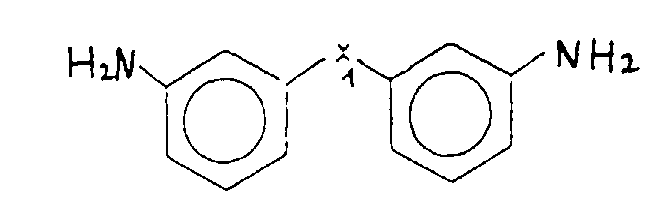
 (b3) une diaminoanthraquinone et(b4) une diamine ayant la formule suivanteoù Ar est un radical aromatique et R" est un radical hydroxyle, hydrothiol ou acide carboxylique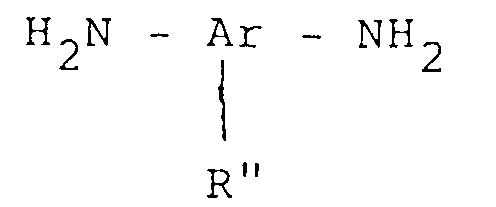
et peut contenir jusqu'à 25 pour cent en poids d'une diamine organique ayant la formule suivante qui n'est pas asymétrique dans la chaíne du polymèreoù X2 est -CH2-, et
et (c) le monomère siloxane difonctionnel est une alpha,oméga-siloxane diamine.
 - Le polyimidesiloxane de la revendication 1 dans lequel l'anhydride oxydiphtalique est l'anhydride 4,4'-oxydiphtalique, l'anhydride 3,3'-oxydiphtalique ou l'anhydride 3,4'-oxydiphtalique.
- Le polyimidesiloxane de la revendication 1 comprenant au moins un radical choisi parmi les radicaux hydrure (H), hydroxyle, halogéno, carboxyle, hydrothiol et vinyle, ce radical étant situé dans les blocs de siloxane et /ou dans les blocs d'imide.
- Le polyimidesiloxane de la revendication 1 comprenant un radical carboxyle.
- Le polyimidesiloxane de la revendication 1 comprenant au moins un radical choisi parmi un radical acrylique, un radical éthylénique et un radical acétylénique, ce radical étant situé dans les blocs de siloxane et/ou dans les blocs d'imide.
- Le polyimidesiloxane de la revendication 5 comprenant un radical acrylique.
- Un polyimidesiloxane selon la revendication 1 comprenant le produit de réaction de l'anhydride 4,4'-oxydiphtalique, du monomère siloxane difonctionnel et d'une diamine organique choisie parmi la 2,4-tolyldiamine, la 2,5-tolyldiamine, la 2,6-tolyldiamine et un mélange de 2,4-tolyldiamine et de 2,6-tolyldiamine.
- Un polyimidesiloxane selon la revendication 1 comprenant le produit de réaction de l'anhydride 4,4'-oxydiphtalique, d'un monomère siloxane difonctionnel et d'une diamine organique choisie parmi la m-xylyldiamine, le 2,4-diamino-5-chloro toluène, le 2,4-diamino-6-chloro toluène, le 2,4,6-triméthyl-1,3-diaminobenzène, la m,m-méthylène dianiline, la m,m-sulfone dianiline, l'o,m-sulfone dianiline et la diaminoanthroquinone.
- Le polyimidesiloxane de la revendication 1 dans lequel la siloxane diamine (a) a la formuleoù R' est choisi indépendamment parmi des radicaux difonctionnels aliphatiques substitués ou non de 1 à 12 atomes de carbone ou des radicaux difonctionnels aromatiques substitués ou non de 6 à 10 atomes de carbone, R1, R2, R3 et R4 sont choisis indépendamment parmi un radical monofonctionnel alphatique substitué ou non de 1 à 12 atomes de carbone ou un radical monofonctionnel aromatique substitué ou non de 6 à 10 atomes de carbone, et m est un nombre de 5 à 200.

- Le polyimidesiloxane selon la revendication 9 dans lequel R1, R2, R3 et R4 sont des groupes méthyle.
- Le polyimidesiloxane de la revendication 9 dans lequel au moins une portion de la siloxane diamine de la formule comprend une diamine dans laquelle au moins un de R1, R2, R3 et R4 est un radical choisi parmi les radicaux hydroxyle et vinyle.
- Le polyimidesiloxane selon la revendication 9 dans lequel au moins un de R1, R2, R3 et R4 est un groupe vinyle et les autres sont des groupes méthyle.
- Le polyimidesiloxane selon la revendication 10 ou 12 dans lequel le R' est (CH2)3.
- Le polyimidesiloxane de la revendication 9 dans lequel au moins une partie de la siloxane diamine de la formule comprend un constituant siloxane diamine dans lequel au moins un de R1, R2, R3 et R4 est un radical choisi parmi des radicaux portant des groupes acryliques, éthyléniques ou acétyléniques.
- Le polyimidesiloxane de la revendication 14 comprenant un radical portant un groupe acrylique.
- Un procédé pour la préparation d'un polyimidesiloxane complètement imidisé soluble dans le diglyme utilisable dans l'industrie de la micro-électronique, qui comprend la réaction d'un dianhydride organique, d'une diamine organique et d'un monomère siloxane difonctionnel, où(a) le dianhydride organique est un anhydride oxydiphtalique contenant jusqu'à 20 pour cent en poids d'autres dianhydrides organiques,(b) la diamine organique est une diamine fournissant une structure asymétrique dans la chaíne du polyimidesiloxane choisie parmi(b1) une diamine ayant la formule suivanteoù x, y et z sont choisis indépendamment parmi l'hydrogène, les halogènes et des groupes alcoyle ou alcoyle halogéné de 1 à 12 atomes de carbone et aryle ou aryle halogéné de 6 à 12 atomes de carbone,
 (b2) une diamine ayant la formule suivanteoù X1 est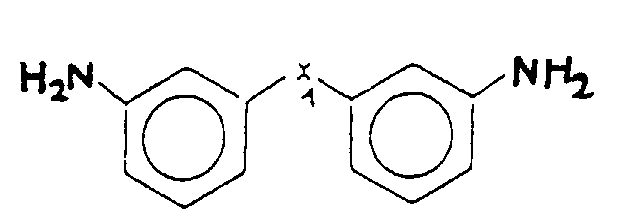
 (b3) une diaminoanthraquinone et(b4) une diamine ayant la formule suivanteoù Ar est un radical aromatique et R" est un radical hydroxyle, hydrothiol ou acide carboxylique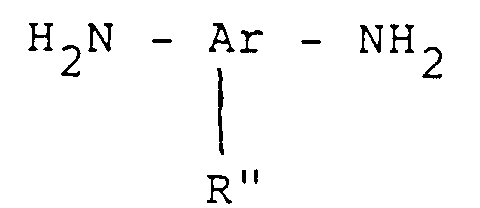
et peut contenir jusqu'à 25 pour cent en poids d'une diamine organique ayant la formule suivante qui n'est pas asymétrique dans la chaíne du polymèreoù X2 est -CH2-,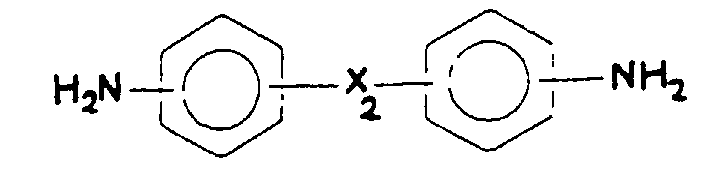 et
et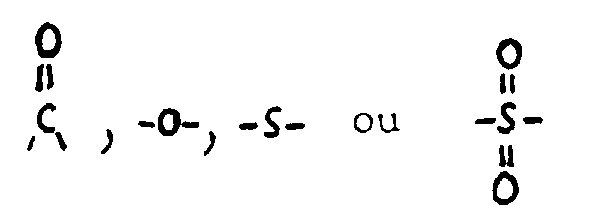 (c) le monomère siloxane difonctionnel est une alpha,oméga-siloxane diamine.
 - Le procédé selon la revendication 16 dans lequel la réaction est conduite dans un solvant pour le polyimidesiloxane.
- Le procédé selon la revendication 16 dans lequel le solvant est choisi parmi le diglyme, le triglyme, la 1-méthyl-2-pyrrolidinone, le tétrahydrofuranne, la méthyl éthyl cétone, des phénols ou leurs mélanges.
- Le procédé selon la revendication 16 dans lequel le monomère siloxane est une siloxane diamine (a) ayant la formuleoù R' est choisi indépendamment parmi des radicaux difonctionnels aliphatiques substitués ou non de 1 à 12 atomes de carbone ou des radicaux difonctionnels aromatiques substitués ou non de 6 à 10 atomes de carbone, R1, R2, R3 et R4 sont choisis indépendamment parmi un radical monofonctionnel aliphatique substitué ou non de 1 à 12 atomes de carbone ou des radicaux monofonctionnels aromatiques substitués ou non de 6 à 10 atomes de carbone et m est un nombre entier de 5 à 200.
- Le procédé selon la revendication 19 dans lequel R1, R2, R3 et R4 sont des groupes méthyle.
- Le procédé selon la revendication 19 dans lequel au moins une portion de la siloxane diamine de la formule comprend une diamine dans laquelle au moins un de R1, R2, R3 et R4 est un radical choisi parmi les radicaux hydroxyle et vinyle.
- Le procédé selon la revendication 21 dans lequel au moins un de R1, R2, R3 et R4 est un radical vinyle et les autres sont des groupes méthyle.
- Le procédé selon la revendication 20 ou 22 dans lequel le R' est (CH2)3.
- Le procédé selon la revendication 21 dans lequel le produit du procédé est mis à réagir avec un composé comprenant au moins un radical acrylique, éthylénique ou acétylénique.
- Une solution comprenant le polyimidesiloxane de la revendication 1 dissous dans un solvant pour le polyimidesiloxane.
- La solution de la revendication 25 dans laquelle le solvant est choisi parmi le diglyme, le triglyme, la 1-méthyl-2-pyrrolidinone, le tétrahydrofuranne, la méthyl éthyl cétone, des phénols et des solvants chlorés.
- Un article comprenant un substrat revêtu d'un polyimidesiloxane selon la revendication 1.
- L'article selon la revendication 27 dans lequel le substrat est un fil métallique ou un câble.
- Un article préparé à partir du polyimidesiloxane selon la revendication 1, cet article étant un film, une fibre, un article moulé ou un article extrudé.
- Une composition durcie de la revendication 5 ou de la revendication 15.
Applications Claiming Priority (2)
| Application Number | Priority Date | Filing Date | Title |
|---|---|---|---|
| US3227287A | 1987-03-31 | 1987-03-31 | |
| US32272 | 2001-12-22 |
Publications (3)
| Publication Number | Publication Date |
|---|---|
| EP0284803A2 EP0284803A2 (fr) | 1988-10-05 |
| EP0284803A3 EP0284803A3 (fr) | 1989-10-11 |
| EP0284803B1 true EP0284803B1 (fr) | 1998-07-15 |
Family
ID=21864043
Family Applications (1)
| Application Number | Title | Priority Date | Filing Date |
|---|---|---|---|
| EP88103175A Expired - Lifetime EP0284803B1 (fr) | 1987-03-31 | 1988-03-02 | Polyimidesiloxanes solubles et procédés pour leur fabrication et utilisation |
Country Status (7)
| Country | Link |
|---|---|
| US (2) | US4956437A (fr) |
| EP (1) | EP0284803B1 (fr) |
| JP (1) | JP2980321B2 (fr) |
| BR (1) | BR8801001A (fr) |
| CA (1) | CA1299801C (fr) |
| DE (1) | DE3856218T2 (fr) |
| IL (1) | IL85598A (fr) |
Families Citing this family (26)
| Publication number | Priority date | Publication date | Assignee | Title |
|---|---|---|---|---|
| US4957993A (en) * | 1987-03-31 | 1990-09-18 | Occidental Chemical Corporation | Novel polyimidesiloxanes and methods for their preparation and use |
| US4853452A (en) * | 1988-02-09 | 1989-08-01 | Occidental Chemical Corporation | Novel soluble polyimidesiloxanes and methods for their preparation using a flourine containing anhydride |
| US4948400A (en) * | 1988-06-30 | 1990-08-14 | Nippon Steel Chemical Co., Ltd. | Separation membranes and process for preparing the same |
| US5077370A (en) * | 1988-11-14 | 1991-12-31 | Occidental Chemical Corporation | Novel polyimidesiloxanes and methods for their preparation and use |
| US5073607A (en) * | 1989-09-15 | 1991-12-17 | E. I. Du Pont De Nemours And Company | Polyimide compositions containing polyorganosiloxane for improving atomic oxygen resistance |
| JP2898674B2 (ja) * | 1989-12-25 | 1999-06-02 | 日立化成工業株式会社 | シロキサン変性ポリイミド及びその前駆体の製造法 |
| US5104946A (en) * | 1989-12-26 | 1992-04-14 | Occidental Chemical Corporation | Solutions of polyimidesiloxanes in butyrolactone |
| US4960846A (en) * | 1990-03-09 | 1990-10-02 | Amoco Corporation | Polyimide copolymers containing 4,4'-bis(p-aminophenoxy)biphenyl and siloxane diamine moieties |
| US5252703A (en) * | 1990-06-01 | 1993-10-12 | Ube Industries, Ltd. | Polyimidosiloxane resin and composition thereof and method of applying same |
| JPH0821691B2 (ja) * | 1990-11-26 | 1996-03-04 | 三菱電機株式会社 | 半導体メモリセル |
| US5180627A (en) * | 1990-11-30 | 1993-01-19 | Ube Industries, Ltd. | Heat resistant adhesive composition |
| US5153385A (en) * | 1991-03-18 | 1992-10-06 | Motorola, Inc. | Transfer molded semiconductor package with improved adhesion |
| JPH072852B2 (ja) * | 1991-04-23 | 1995-01-18 | チッソ株式会社 | シリコン変性ポリイミドフィルムおよびその製造法 |
| US5241041A (en) * | 1991-12-16 | 1993-08-31 | Occidental Chemical Corporation | Photocrosslinkable polyimide ammonium salts |
| US5296568A (en) * | 1992-05-29 | 1994-03-22 | Eastman Kodak Company | Addition-cured silicone elastomers and coated fusing rolls using such elastomers |
| SG49197A1 (en) * | 1993-03-16 | 1998-05-18 | Occidental Chem Co | Three-layer polyimidesiloxane adhesive tape |
| US5317049A (en) * | 1993-06-21 | 1994-05-31 | Occidental Chemical Corporation | Polyimidesiloxane solution and method of coating substrates |
| JPH08218034A (ja) * | 1995-02-15 | 1996-08-27 | Nippon Steel Chem Co Ltd | ポリイミド系耐熱性コーティング剤組成物 |
| JP3968886B2 (ja) | 1998-05-14 | 2007-08-29 | 日本メクトロン株式会社 | 感光性組成物 |
| US6451955B1 (en) * | 2000-09-28 | 2002-09-17 | Sumitomo Bakelite Company Limited | Method of making a polyimide in a low-boiling solvent |
| JP5293496B2 (ja) * | 2000-11-28 | 2013-09-18 | 日立化成株式会社 | 接着剤組成物、接着フィルム及び半導体装置 |
| US7264637B2 (en) * | 2004-08-31 | 2007-09-04 | The United States Of America, As Represented By The Secretary Of Agriculture | Method of inhibiting the burning of natural fibers, synthetic fibers, or mixtures thereof, or fabric or yarn composed of natural fibers, synthetic fibers, or mixtures thereof, and products produced by such methods |
| WO2009035601A2 (fr) | 2007-09-10 | 2009-03-19 | University Of Massachusetts Lowell | Polymères organiques et inorganiques mélangés |
| JP5206977B2 (ja) * | 2009-03-12 | 2013-06-12 | 信越化学工業株式会社 | 新規ポリイミドシリコーン及びこれを含有する感光性樹脂組成物並びにパターン形成方法 |
| DE102010001071A1 (de) | 2010-01-21 | 2011-07-28 | Robert Bosch GmbH, 70469 | Tetraaminodisiloxane und damit hergestellte Polyamide |
| US11667757B2 (en) * | 2020-12-31 | 2023-06-06 | Industrial Technology Research Institute | Polymer, composition, and polysiloxane-polyimide material thereof |
Family Cites Families (40)
| Publication number | Priority date | Publication date | Assignee | Title |
|---|---|---|---|---|
| US3424718A (en) * | 1964-09-23 | 1969-01-28 | Du Pont | Copolymers of aromatic tetracarboxylic acids with at least two organic diamines |
| US3325450A (en) * | 1965-05-12 | 1967-06-13 | Gen Electric | Polysiloxaneimides and their production |
| US3553282A (en) * | 1969-09-08 | 1971-01-05 | Gen Electric | Siloxane containing polyamide acid blends |
| US3847867A (en) * | 1971-01-20 | 1974-11-12 | Gen Electric | Polyetherimides |
| US4048142A (en) * | 1974-10-11 | 1977-09-13 | General Electric Company | Polyetherimides |
| US3983093A (en) * | 1975-05-19 | 1976-09-28 | General Electric Company | Novel polyetherimides |
| US4395527A (en) * | 1978-05-17 | 1983-07-26 | M & T Chemicals Inc. | Siloxane-containing polymers |
| CH661933A5 (en) * | 1978-09-18 | 1987-08-31 | Gen Electric | Process for the preparation of a coating composition for the surface of a semiconductor component, this composition, and the use thereof for preventing surface breakdown |
| DE2945139C2 (de) * | 1978-11-09 | 1986-04-10 | Ube Industries, Ltd., Ube, Yamaguchi | Verfahren zur Herstellung einer homogenen Polyimidlösung |
| US4281100A (en) * | 1979-05-09 | 1981-07-28 | General Electric Company | Injection moldable polyetherimide oligomers and method for making |
| US4302575A (en) * | 1979-12-26 | 1981-11-24 | General Electric Company | Heat curable polyimides |
| US4480009A (en) * | 1980-12-15 | 1984-10-30 | M&T Chemicals Inc. | Siloxane-containing polymers |
| JPS5813087B2 (ja) * | 1981-02-27 | 1983-03-11 | 日東電工株式会社 | シロキサン変性ポリイミド前駆体の製造方法 |
| JPS5844712B2 (ja) * | 1981-07-07 | 1983-10-05 | 日立化成工業株式会社 | 接着剤組成物 |
| JPS5813631A (ja) * | 1981-07-16 | 1983-01-26 | Hitachi Chem Co Ltd | シロキサン結合含有ポリヒドラジド酸−アミド酸及びポリヒドラジイミド−シロキサン型共重合体樹脂の製造法 |
| US4404350A (en) * | 1982-07-07 | 1983-09-13 | General Electric Company | Silicone-imide copolymers and method for making |
| US4472565A (en) * | 1982-11-18 | 1984-09-18 | General Electric Company | Silicone-polyimide copolymers, condensation vulcanizable compositions obtained therefrom, and methods for making |
| US4629777A (en) * | 1983-05-18 | 1986-12-16 | Ciba-Geigy Corporation | Polyimides, a process for their preparation and their use |
| US4520075A (en) * | 1983-09-02 | 1985-05-28 | Nitto Electric Industrial Co., Ltd. | Siloxane-modified polyimide precursor and polyimide |
| JPS59107523A (ja) * | 1983-12-05 | 1984-06-21 | Nitto Electric Ind Co Ltd | 半導体素子の保護膜形成方法 |
| US4690997A (en) * | 1984-01-26 | 1987-09-01 | General Electric Company | Flame retardant wire coating compositions |
| US4625037A (en) * | 1984-02-02 | 1986-11-25 | General Electric Company | Method for making thioether(bisphthalimide)s |
| JPS60166325A (ja) * | 1984-02-09 | 1985-08-29 | Sumitomo Bakelite Co Ltd | 耐熱性樹脂の製造方法 |
| US4522985A (en) * | 1984-04-27 | 1985-06-11 | General Electric Company | Heat curable silicone-polyimide block copolymers |
| US4595732A (en) * | 1984-04-27 | 1986-06-17 | General Electric Company | Siloxane imide diols and siloxane imide organic block polymers obtained therefrom |
| US4588804A (en) * | 1984-05-04 | 1986-05-13 | E. I. Du Pont De Nemours And Company | Polyimide compositions |
| US4668755A (en) * | 1984-08-10 | 1987-05-26 | General Electric Company | High molecular weight siloxane polyimides, intermediates therefor, and methods for their preparation and use |
| JPS6164730A (ja) * | 1984-09-06 | 1986-04-03 | Sumitomo Bakelite Co Ltd | 耐熱性樹脂の製造方法 |
| US4586997A (en) * | 1984-10-19 | 1986-05-06 | General Electric Company | Soluble silicone-imide copolymers |
| US4701511A (en) * | 1984-10-19 | 1987-10-20 | General Electric Company | Method of making diglyme soluble siloxane-imide copolymers |
| US4670497A (en) * | 1984-10-19 | 1987-06-02 | General Electric Company | Soluble silicone-imide copolymers |
| US4689391A (en) * | 1984-12-21 | 1987-08-25 | General Electric Company | Process for making polyetherimides |
| JPS61166053A (ja) * | 1985-01-17 | 1986-07-26 | Nitto Electric Ind Co Ltd | 半導体装置の製法 |
| US4558110A (en) * | 1985-02-01 | 1985-12-10 | General Electric Company | Crystalline silicone-imide copolymers |
| US4609569A (en) * | 1985-03-01 | 1986-09-02 | M&T Chemicals Inc. | Method of preparing modified polysiloxane containing polymers |
| US4612361A (en) * | 1985-09-23 | 1986-09-16 | General Electric Company | Poly(etherimides) and compositions containing the same |
| US4598135A (en) * | 1985-10-31 | 1986-07-01 | General Electric Company | Method for making norbornane anhydride substituted polyorganosiloxane |
| US4634760A (en) * | 1985-11-14 | 1987-01-06 | General Electric Company | Novel copolyimides and polyamic acid precursors therefor |
| EP0273150A3 (fr) * | 1986-12-30 | 1990-08-16 | General Electric Company | Bloc-copolymères polyimide-polysiloxane |
| US4829131A (en) * | 1988-02-09 | 1989-05-09 | Occidental Chemical Corporation | Novel soluble polymidesiloxanes and methods for their preparation and use |
-
1988
- 1988-02-29 CA CA000560117A patent/CA1299801C/fr not_active Expired - Fee Related
- 1988-03-01 IL IL85598A patent/IL85598A/xx not_active IP Right Cessation
- 1988-03-02 DE DE3856218T patent/DE3856218T2/de not_active Expired - Fee Related
- 1988-03-02 EP EP88103175A patent/EP0284803B1/fr not_active Expired - Lifetime
- 1988-03-08 BR BR8801001A patent/BR8801001A/pt not_active IP Right Cessation
- 1988-03-30 JP JP63077950A patent/JP2980321B2/ja not_active Expired - Fee Related
- 1988-06-10 US US07/205,412 patent/US4956437A/en not_active Expired - Lifetime
- 1988-09-01 US US07/239,372 patent/US4973645A/en not_active Expired - Lifetime
Also Published As
| Publication number | Publication date |
|---|---|
| EP0284803A2 (fr) | 1988-10-05 |
| EP0284803A3 (fr) | 1989-10-11 |
| IL85598A (en) | 1991-09-16 |
| JPS63260924A (ja) | 1988-10-27 |
| DE3856218T2 (de) | 1998-11-19 |
| US4973645A (en) | 1990-11-27 |
| DE3856218D1 (de) | 1998-08-20 |
| IL85598A0 (en) | 1988-08-31 |
| JP2980321B2 (ja) | 1999-11-22 |
| US4956437A (en) | 1990-09-11 |
| BR8801001A (pt) | 1988-10-11 |
| CA1299801C (fr) | 1992-04-28 |
Similar Documents
| Publication | Publication Date | Title |
|---|---|---|
| EP0284803B1 (fr) | Polyimidesiloxanes solubles et procédés pour leur fabrication et utilisation | |
| EP0328027B1 (fr) | Polyimidesiloxanes, leurs méthodes de préparation et leur utilisation | |
| US4829131A (en) | Novel soluble polymidesiloxanes and methods for their preparation and use | |
| US4996278A (en) | Novel polyimidesiloxanes and methods for their preparation and use based on diamines with pendant fluorine groups | |
| JP4498382B2 (ja) | アミン酸エステルオリゴマー、それを含有するポリイミド樹脂のための前駆体組成物、及び使用 | |
| US4826916A (en) | Silicone polymides, and method for making | |
| WO1996034033A1 (fr) | Precurseurs d'acide polyamique et procede de preparation de polyimidebenzoxazole | |
| Meyer et al. | New high-performance thermosetting polymer matrix material systems | |
| EP0349010A1 (fr) | Copolymères de polyimide | |
| EP0371313B1 (fr) | Polyimide siloxanes, leur procédé de préparation et leur emploi | |
| US5077370A (en) | Novel polyimidesiloxanes and methods for their preparation and use | |
| US5008361A (en) | Crystalline polyimidesiloxanes | |
| USRE33797E (en) | Novel polyimidesiloxanes and methods for their preparation and use | |
| JP3646947B2 (ja) | ポリイミド樹脂 | |
| CA1331387C (fr) | Les polyimidesiloxanes et methodes pour leur preparation et leur utilisation | |
| JPH08120040A (ja) | 耐熱性電気絶縁材料およびそれを用いた耐熱性電気絶縁膜の製造方法 | |
| JP2983828B2 (ja) | 高温時の物性が改良された樹脂組成物 | |
| KR0177736B1 (ko) | 유기용매 가용성 폴리이미드 실록산 전구체 및 그의 제조방법 | |
| JPH0243221A (ja) | 新規可溶性ポリイミドシロキサン及びその製法及び用途 | |
| JP3446561B2 (ja) | ブロックポリイミド樹脂及び樹脂溶液並びにその製造方法 | |
| JP2996859B2 (ja) | 耐熱性樹脂組成物 | |
| TW202319446A (zh) | 寡聚物與組成物 | |
| JP2996858B2 (ja) | 低温加工性の優れた耐熱性樹脂組成物 | |
| JPH09272738A (ja) | ポリイミド樹脂 |
Legal Events
| Date | Code | Title | Description |
|---|---|---|---|
| PUAI | Public reference made under article 153(3) epc to a published international application that has entered the european phase |
Free format text: ORIGINAL CODE: 0009012 |
|
| AK | Designated contracting states |
Kind code of ref document: A2 Designated state(s): BE CH DE FR GB IT LI NL SE |
|
| PUAL | Search report despatched |
Free format text: ORIGINAL CODE: 0009013 |
|
| AK | Designated contracting states |
Kind code of ref document: A3 Designated state(s): BE CH DE FR GB IT LI NL SE |
|
| 17P | Request for examination filed |
Effective date: 19900125 |
|
| 17Q | First examination report despatched |
Effective date: 19911118 |
|
| APAB | Appeal dossier modified |
Free format text: ORIGINAL CODE: EPIDOS NOAPE |
|
| GRAG | Despatch of communication of intention to grant |
Free format text: ORIGINAL CODE: EPIDOS AGRA |
|
| GRAG | Despatch of communication of intention to grant |
Free format text: ORIGINAL CODE: EPIDOS AGRA |
|
| GRAH | Despatch of communication of intention to grant a patent |
Free format text: ORIGINAL CODE: EPIDOS IGRA |
|
| GRAH | Despatch of communication of intention to grant a patent |
Free format text: ORIGINAL CODE: EPIDOS IGRA |
|
| GRAA | (expected) grant |
Free format text: ORIGINAL CODE: 0009210 |
|
| AK | Designated contracting states |
Kind code of ref document: B1 Designated state(s): BE CH DE FR GB IT LI NL SE |
|
| PG25 | Lapsed in a contracting state [announced via postgrant information from national office to epo] |
Ref country code: IT Free format text: LAPSE BECAUSE OF FAILURE TO SUBMIT A TRANSLATION OF THE DESCRIPTION OR TO PAY THE FEE WITHIN THE PRESCRIBED TIME-LIMIT;WARNING: LAPSES OF ITALIAN PATENTS WITH EFFECTIVE DATE BEFORE 2007 MAY HAVE OCCURRED AT ANY TIME BEFORE 2007. THE CORRECT EFFECTIVE DATE MAY BE DIFFERENT FROM THE ONE RECORDED. Effective date: 19980715 |
|
| REG | Reference to a national code |
Ref country code: CH Ref legal event code: EP |
|
| REG | Reference to a national code |
Ref country code: CH Ref legal event code: NV Representative=s name: BOVARD AG PATENTANWAELTE |
|
| REF | Corresponds to: |
Ref document number: 3856218 Country of ref document: DE Date of ref document: 19980820 |
|
| ET | Fr: translation filed | ||
| PG25 | Lapsed in a contracting state [announced via postgrant information from national office to epo] |
Ref country code: SE Free format text: LAPSE BECAUSE OF FAILURE TO SUBMIT A TRANSLATION OF THE DESCRIPTION OR TO PAY THE FEE WITHIN THE PRESCRIBED TIME-LIMIT Effective date: 19981015 |
|
| PLBE | No opposition filed within time limit |
Free format text: ORIGINAL CODE: 0009261 |
|
| STAA | Information on the status of an ep patent application or granted ep patent |
Free format text: STATUS: NO OPPOSITION FILED WITHIN TIME LIMIT |
|
| 26N | No opposition filed | ||
| PGFP | Annual fee paid to national office [announced via postgrant information from national office to epo] |
Ref country code: NL Payment date: 20001222 Year of fee payment: 14 |
|
| PGFP | Annual fee paid to national office [announced via postgrant information from national office to epo] |
Ref country code: GB Payment date: 20010202 Year of fee payment: 14 |
|
| PGFP | Annual fee paid to national office [announced via postgrant information from national office to epo] |
Ref country code: FR Payment date: 20010301 Year of fee payment: 14 |
|
| PGFP | Annual fee paid to national office [announced via postgrant information from national office to epo] |
Ref country code: CH Payment date: 20010327 Year of fee payment: 14 |
|
| PGFP | Annual fee paid to national office [announced via postgrant information from national office to epo] |
Ref country code: BE Payment date: 20010417 Year of fee payment: 14 |
|
| REG | Reference to a national code |
Ref country code: GB Ref legal event code: 732E |
|
| REG | Reference to a national code |
Ref country code: GB Ref legal event code: IF02 |
|
| NLS | Nl: assignments of ep-patents |
Owner name: SUMITOMO BAKELITE COMPANY LIMITED |
|
| PG25 | Lapsed in a contracting state [announced via postgrant information from national office to epo] |
Ref country code: GB Free format text: LAPSE BECAUSE OF NON-PAYMENT OF DUE FEES Effective date: 20020302 |
|
| PGFP | Annual fee paid to national office [announced via postgrant information from national office to epo] |
Ref country code: DE Payment date: 20020319 Year of fee payment: 15 |
|
| PG25 | Lapsed in a contracting state [announced via postgrant information from national office to epo] |
Ref country code: CH Free format text: LAPSE BECAUSE OF NON-PAYMENT OF DUE FEES Effective date: 20020331 Ref country code: BE Free format text: LAPSE BECAUSE OF NON-PAYMENT OF DUE FEES Effective date: 20020331 Ref country code: LI Free format text: LAPSE BECAUSE OF NON-PAYMENT OF DUE FEES Effective date: 20020331 |
|
| REG | Reference to a national code |
Ref country code: FR Ref legal event code: TP |
|
| BERE | Be: lapsed |
Owner name: *SUMITOMO BAKELITE CY LTD Effective date: 20020331 |
|
| PG25 | Lapsed in a contracting state [announced via postgrant information from national office to epo] |
Ref country code: NL Free format text: LAPSE BECAUSE OF NON-PAYMENT OF DUE FEES Effective date: 20021001 |
|
| GBPC | Gb: european patent ceased through non-payment of renewal fee |
Effective date: 20020302 |
|
| REG | Reference to a national code |
Ref country code: CH Ref legal event code: PL |
|
| PG25 | Lapsed in a contracting state [announced via postgrant information from national office to epo] |
Ref country code: FR Free format text: LAPSE BECAUSE OF NON-PAYMENT OF DUE FEES Effective date: 20021129 |
|
| NLV4 | Nl: lapsed or anulled due to non-payment of the annual fee |
Effective date: 20021001 |
|
| BECA | Be: change of holder's address |
Free format text: 20020226 *SUMITOMO BAKELITE CY LTD:5-8, HIGASHI-SHINAGAWA, 2-CHOME, SHINAGAWA-KU, TOKYO 140-002 |
|
| REG | Reference to a national code |
Ref country code: FR Ref legal event code: ST |
|
| PG25 | Lapsed in a contracting state [announced via postgrant information from national office to epo] |
Ref country code: DE Free format text: LAPSE BECAUSE OF NON-PAYMENT OF DUE FEES Effective date: 20031001 |
|
| APAH | Appeal reference modified |
Free format text: ORIGINAL CODE: EPIDOSCREFNO |