EP0284899B1 - Uhrengehäuse, Einheit zu dessen Herstellung und Verfahren zum Bauen dieser Einheit - Google Patents
Uhrengehäuse, Einheit zu dessen Herstellung und Verfahren zum Bauen dieser Einheit Download PDFInfo
- Publication number
- EP0284899B1 EP0284899B1 EP88104208A EP88104208A EP0284899B1 EP 0284899 B1 EP0284899 B1 EP 0284899B1 EP 88104208 A EP88104208 A EP 88104208A EP 88104208 A EP88104208 A EP 88104208A EP 0284899 B1 EP0284899 B1 EP 0284899B1
- Authority
- EP
- European Patent Office
- Prior art keywords
- bezel
- caseband
- seat
- assembly
- fact
- Prior art date
- Legal status (The legal status is an assumption and is not a legal conclusion. Google has not performed a legal analysis and makes no representation as to the accuracy of the status listed.)
- Expired - Lifetime
Links
- 238000000034 method Methods 0.000 title claims description 10
- 239000004033 plastic Substances 0.000 claims description 24
- 239000000463 material Substances 0.000 claims description 15
- 230000002093 peripheral effect Effects 0.000 claims description 4
- 230000001154 acute effect Effects 0.000 claims description 3
- 230000000694 effects Effects 0.000 claims description 2
- 238000012856 packing Methods 0.000 claims 3
- 230000001747 exhibiting effect Effects 0.000 claims 1
- 230000004927 fusion Effects 0.000 claims 1
- 239000002184 metal Substances 0.000 description 10
- 239000011521 glass Substances 0.000 description 9
- 238000002347 injection Methods 0.000 description 7
- 239000007924 injection Substances 0.000 description 7
- 229910000831 Steel Inorganic materials 0.000 description 4
- 239000010959 steel Substances 0.000 description 4
- 238000002604 ultrasonography Methods 0.000 description 3
- 239000013078 crystal Substances 0.000 description 2
- ZZUFCTLCJUWOSV-UHFFFAOYSA-N furosemide Chemical compound C1=C(Cl)C(S(=O)(=O)N)=CC(C(O)=O)=C1NCC1=CC=CO1 ZZUFCTLCJUWOSV-UHFFFAOYSA-N 0.000 description 2
- 238000010348 incorporation Methods 0.000 description 2
- 238000007789 sealing Methods 0.000 description 2
- 230000035882 stress Effects 0.000 description 2
- XDRLAGOBLZATBG-UHFFFAOYSA-N 1-phenylpenta-1,4-dien-3-one Chemical compound C=CC(=O)C=CC1=CC=CC=C1 XDRLAGOBLZATBG-UHFFFAOYSA-N 0.000 description 1
- 206010020751 Hypersensitivity Diseases 0.000 description 1
- 239000004952 Polyamide Substances 0.000 description 1
- ATJFFYVFTNAWJD-UHFFFAOYSA-N Tin Chemical compound [Sn] ATJFFYVFTNAWJD-UHFFFAOYSA-N 0.000 description 1
- 230000032683 aging Effects 0.000 description 1
- 208000026935 allergic disease Diseases 0.000 description 1
- 230000007815 allergy Effects 0.000 description 1
- 238000004873 anchoring Methods 0.000 description 1
- 239000011324 bead Substances 0.000 description 1
- 230000015556 catabolic process Effects 0.000 description 1
- 238000004140 cleaning Methods 0.000 description 1
- 239000011248 coating agent Substances 0.000 description 1
- 238000000576 coating method Methods 0.000 description 1
- 239000000470 constituent Substances 0.000 description 1
- 238000010276 construction Methods 0.000 description 1
- 238000005520 cutting process Methods 0.000 description 1
- 238000006731 degradation reaction Methods 0.000 description 1
- 238000006073 displacement reaction Methods 0.000 description 1
- 239000012467 final product Substances 0.000 description 1
- 239000003365 glass fiber Substances 0.000 description 1
- 239000003292 glue Substances 0.000 description 1
- GDVWDDRKKYMHKS-UHFFFAOYSA-N hepta-1,4,6-trien-3-one;styrene Chemical compound C=CC=CC(=O)C=C.C=CC1=CC=CC=C1 GDVWDDRKKYMHKS-UHFFFAOYSA-N 0.000 description 1
- 238000001746 injection moulding Methods 0.000 description 1
- 230000001788 irregular Effects 0.000 description 1
- 230000007794 irritation Effects 0.000 description 1
- 239000007788 liquid Substances 0.000 description 1
- 239000011344 liquid material Substances 0.000 description 1
- 238000003754 machining Methods 0.000 description 1
- 238000004519 manufacturing process Methods 0.000 description 1
- 238000002844 melting Methods 0.000 description 1
- 230000008018 melting Effects 0.000 description 1
- 239000012768 molten material Substances 0.000 description 1
- 229920002647 polyamide Polymers 0.000 description 1
- SCUZVMOVTVSBLE-UHFFFAOYSA-N prop-2-enenitrile;styrene Chemical compound C=CC#N.C=CC1=CC=CC=C1 SCUZVMOVTVSBLE-UHFFFAOYSA-N 0.000 description 1
- 238000011084 recovery Methods 0.000 description 1
- 230000000284 resting effect Effects 0.000 description 1
- 230000035939 shock Effects 0.000 description 1
- 239000000243 solution Substances 0.000 description 1
- 239000012815 thermoplastic material Substances 0.000 description 1
- 238000004804 winding Methods 0.000 description 1
Images

Classifications
-
- B—PERFORMING OPERATIONS; TRANSPORTING
- B29—WORKING OF PLASTICS; WORKING OF SUBSTANCES IN A PLASTIC STATE IN GENERAL
- B29C—SHAPING OR JOINING OF PLASTICS; SHAPING OF MATERIAL IN A PLASTIC STATE, NOT OTHERWISE PROVIDED FOR; AFTER-TREATMENT OF THE SHAPED PRODUCTS, e.g. REPAIRING
- B29C65/00—Joining or sealing of preformed parts, e.g. welding of plastics materials; Apparatus therefor
- B29C65/56—Joining or sealing of preformed parts, e.g. welding of plastics materials; Apparatus therefor using mechanical means or mechanical connections, e.g. form-fits
- B29C65/64—Joining a non-plastics element to a plastics element, e.g. by force
- B29C65/645—Joining a non-plastics element to a plastics element, e.g. by force using friction or ultrasonic vibrations
-
- B—PERFORMING OPERATIONS; TRANSPORTING
- B29—WORKING OF PLASTICS; WORKING OF SUBSTANCES IN A PLASTIC STATE IN GENERAL
- B29C—SHAPING OR JOINING OF PLASTICS; SHAPING OF MATERIAL IN A PLASTIC STATE, NOT OTHERWISE PROVIDED FOR; AFTER-TREATMENT OF THE SHAPED PRODUCTS, e.g. REPAIRING
- B29C66/00—General aspects of processes or apparatus for joining preformed parts
- B29C66/01—General aspects dealing with the joint area or with the area to be joined
- B29C66/05—Particular design of joint configurations
- B29C66/10—Particular design of joint configurations particular design of the joint cross-sections
- B29C66/13—Single flanged joints; Fin-type joints; Single hem joints; Edge joints; Interpenetrating fingered joints; Other specific particular designs of joint cross-sections not provided for in groups B29C66/11 - B29C66/12
- B29C66/131—Single flanged joints, i.e. one of the parts to be joined being rigid and flanged in the joint area
-
- B—PERFORMING OPERATIONS; TRANSPORTING
- B29—WORKING OF PLASTICS; WORKING OF SUBSTANCES IN A PLASTIC STATE IN GENERAL
- B29C—SHAPING OR JOINING OF PLASTICS; SHAPING OF MATERIAL IN A PLASTIC STATE, NOT OTHERWISE PROVIDED FOR; AFTER-TREATMENT OF THE SHAPED PRODUCTS, e.g. REPAIRING
- B29C66/00—General aspects of processes or apparatus for joining preformed parts
- B29C66/01—General aspects dealing with the joint area or with the area to be joined
- B29C66/05—Particular design of joint configurations
- B29C66/10—Particular design of joint configurations particular design of the joint cross-sections
- B29C66/13—Single flanged joints; Fin-type joints; Single hem joints; Edge joints; Interpenetrating fingered joints; Other specific particular designs of joint cross-sections not provided for in groups B29C66/11 - B29C66/12
- B29C66/135—Single hemmed joints, i.e. one of the parts to be joined being hemmed in the joint area
-
- B—PERFORMING OPERATIONS; TRANSPORTING
- B29—WORKING OF PLASTICS; WORKING OF SUBSTANCES IN A PLASTIC STATE IN GENERAL
- B29C—SHAPING OR JOINING OF PLASTICS; SHAPING OF MATERIAL IN A PLASTIC STATE, NOT OTHERWISE PROVIDED FOR; AFTER-TREATMENT OF THE SHAPED PRODUCTS, e.g. REPAIRING
- B29C66/00—General aspects of processes or apparatus for joining preformed parts
- B29C66/01—General aspects dealing with the joint area or with the area to be joined
- B29C66/05—Particular design of joint configurations
- B29C66/302—Particular design of joint configurations the area to be joined comprising melt initiators
- B29C66/3022—Particular design of joint configurations the area to be joined comprising melt initiators said melt initiators being integral with at least one of the parts to be joined
- B29C66/30223—Particular design of joint configurations the area to be joined comprising melt initiators said melt initiators being integral with at least one of the parts to be joined said melt initiators being rib-like
-
- B—PERFORMING OPERATIONS; TRANSPORTING
- B29—WORKING OF PLASTICS; WORKING OF SUBSTANCES IN A PLASTIC STATE IN GENERAL
- B29C—SHAPING OR JOINING OF PLASTICS; SHAPING OF MATERIAL IN A PLASTIC STATE, NOT OTHERWISE PROVIDED FOR; AFTER-TREATMENT OF THE SHAPED PRODUCTS, e.g. REPAIRING
- B29C66/00—General aspects of processes or apparatus for joining preformed parts
- B29C66/50—General aspects of joining tubular articles; General aspects of joining long products, i.e. bars or profiled elements; General aspects of joining single elements to tubular articles, hollow articles or bars; General aspects of joining several hollow-preforms to form hollow or tubular articles
- B29C66/51—Joining tubular articles, profiled elements or bars; Joining single elements to tubular articles, hollow articles or bars; Joining several hollow-preforms to form hollow or tubular articles
- B29C66/53—Joining single elements to tubular articles, hollow articles or bars
- B29C66/534—Joining single elements to open ends of tubular or hollow articles or to the ends of bars
- B29C66/5344—Joining single elements to open ends of tubular or hollow articles or to the ends of bars said single elements being substantially annular, i.e. of finite length, e.g. joining flanges to tube ends
-
- B—PERFORMING OPERATIONS; TRANSPORTING
- B29—WORKING OF PLASTICS; WORKING OF SUBSTANCES IN A PLASTIC STATE IN GENERAL
- B29C—SHAPING OR JOINING OF PLASTICS; SHAPING OF MATERIAL IN A PLASTIC STATE, NOT OTHERWISE PROVIDED FOR; AFTER-TREATMENT OF THE SHAPED PRODUCTS, e.g. REPAIRING
- B29C66/00—General aspects of processes or apparatus for joining preformed parts
- B29C66/50—General aspects of joining tubular articles; General aspects of joining long products, i.e. bars or profiled elements; General aspects of joining single elements to tubular articles, hollow articles or bars; General aspects of joining several hollow-preforms to form hollow or tubular articles
- B29C66/51—Joining tubular articles, profiled elements or bars; Joining single elements to tubular articles, hollow articles or bars; Joining several hollow-preforms to form hollow or tubular articles
- B29C66/54—Joining several hollow-preforms, e.g. half-shells, to form hollow articles, e.g. for making balls, containers; Joining several hollow-preforms, e.g. half-cylinders, to form tubular articles
-
- B—PERFORMING OPERATIONS; TRANSPORTING
- B29—WORKING OF PLASTICS; WORKING OF SUBSTANCES IN A PLASTIC STATE IN GENERAL
- B29C—SHAPING OR JOINING OF PLASTICS; SHAPING OF MATERIAL IN A PLASTIC STATE, NOT OTHERWISE PROVIDED FOR; AFTER-TREATMENT OF THE SHAPED PRODUCTS, e.g. REPAIRING
- B29C66/00—General aspects of processes or apparatus for joining preformed parts
- B29C66/50—General aspects of joining tubular articles; General aspects of joining long products, i.e. bars or profiled elements; General aspects of joining single elements to tubular articles, hollow articles or bars; General aspects of joining several hollow-preforms to form hollow or tubular articles
- B29C66/51—Joining tubular articles, profiled elements or bars; Joining single elements to tubular articles, hollow articles or bars; Joining several hollow-preforms to form hollow or tubular articles
- B29C66/55—Joining tubular articles, profiled elements or bars; Joining single elements to tubular articles, hollow articles or bars; Joining several hollow-preforms to form hollow or tubular articles sealing elements being incorporated into the joints, e.g. gaskets
-
- B—PERFORMING OPERATIONS; TRANSPORTING
- B29—WORKING OF PLASTICS; WORKING OF SUBSTANCES IN A PLASTIC STATE IN GENERAL
- B29C—SHAPING OR JOINING OF PLASTICS; SHAPING OF MATERIAL IN A PLASTIC STATE, NOT OTHERWISE PROVIDED FOR; AFTER-TREATMENT OF THE SHAPED PRODUCTS, e.g. REPAIRING
- B29C66/00—General aspects of processes or apparatus for joining preformed parts
- B29C66/70—General aspects of processes or apparatus for joining preformed parts characterised by the composition, physical properties or the structure of the material of the parts to be joined; Joining with non-plastics material
- B29C66/73—General aspects of processes or apparatus for joining preformed parts characterised by the composition, physical properties or the structure of the material of the parts to be joined; Joining with non-plastics material characterised by the intensive physical properties of the material of the parts to be joined, by the optical properties of the material of the parts to be joined, by the extensive physical properties of the parts to be joined, by the state of the material of the parts to be joined or by the material of the parts to be joined being a thermoplastic or a thermoset
- B29C66/739—General aspects of processes or apparatus for joining preformed parts characterised by the composition, physical properties or the structure of the material of the parts to be joined; Joining with non-plastics material characterised by the intensive physical properties of the material of the parts to be joined, by the optical properties of the material of the parts to be joined, by the extensive physical properties of the parts to be joined, by the state of the material of the parts to be joined or by the material of the parts to be joined being a thermoplastic or a thermoset characterised by the material of the parts to be joined being a thermoplastic or a thermoset
- B29C66/7392—General aspects of processes or apparatus for joining preformed parts characterised by the composition, physical properties or the structure of the material of the parts to be joined; Joining with non-plastics material characterised by the intensive physical properties of the material of the parts to be joined, by the optical properties of the material of the parts to be joined, by the extensive physical properties of the parts to be joined, by the state of the material of the parts to be joined or by the material of the parts to be joined being a thermoplastic or a thermoset characterised by the material of the parts to be joined being a thermoplastic or a thermoset characterised by the material of at least one of the parts being a thermoplastic
-
- B—PERFORMING OPERATIONS; TRANSPORTING
- B29—WORKING OF PLASTICS; WORKING OF SUBSTANCES IN A PLASTIC STATE IN GENERAL
- B29C—SHAPING OR JOINING OF PLASTICS; SHAPING OF MATERIAL IN A PLASTIC STATE, NOT OTHERWISE PROVIDED FOR; AFTER-TREATMENT OF THE SHAPED PRODUCTS, e.g. REPAIRING
- B29C66/00—General aspects of processes or apparatus for joining preformed parts
- B29C66/70—General aspects of processes or apparatus for joining preformed parts characterised by the composition, physical properties or the structure of the material of the parts to be joined; Joining with non-plastics material
- B29C66/74—Joining plastics material to non-plastics material
- B29C66/742—Joining plastics material to non-plastics material to metals or their alloys
-
- G—PHYSICS
- G04—HOROLOGY
- G04B—MECHANICALLY-DRIVEN CLOCKS OR WATCHES; MECHANICAL PARTS OF CLOCKS OR WATCHES IN GENERAL; TIME PIECES USING THE POSITION OF THE SUN, MOON OR STARS
- G04B37/00—Cases
- G04B37/08—Hermetic sealing of openings, joints, passages or slits
- G04B37/084—Complete encasings for wrist or pocket watches without means for hermetic sealing of winding stem or crown
-
- G—PHYSICS
- G04—HOROLOGY
- G04B—MECHANICALLY-DRIVEN CLOCKS OR WATCHES; MECHANICAL PARTS OF CLOCKS OR WATCHES IN GENERAL; TIME PIECES USING THE POSITION OF THE SUN, MOON OR STARS
- G04B37/00—Cases
- G04B37/22—Materials or processes of manufacturing pocket watch or wrist watch cases
- G04B37/225—Non-metallic cases
-
- B—PERFORMING OPERATIONS; TRANSPORTING
- B29—WORKING OF PLASTICS; WORKING OF SUBSTANCES IN A PLASTIC STATE IN GENERAL
- B29C—SHAPING OR JOINING OF PLASTICS; SHAPING OF MATERIAL IN A PLASTIC STATE, NOT OTHERWISE PROVIDED FOR; AFTER-TREATMENT OF THE SHAPED PRODUCTS, e.g. REPAIRING
- B29C66/00—General aspects of processes or apparatus for joining preformed parts
- B29C66/01—General aspects dealing with the joint area or with the area to be joined
- B29C66/05—Particular design of joint configurations
- B29C66/303—Particular design of joint configurations the joint involving an anchoring effect
- B29C66/3032—Particular design of joint configurations the joint involving an anchoring effect making use of protrusions or cavities belonging to at least one of the parts to be joined
- B29C66/30325—Particular design of joint configurations the joint involving an anchoring effect making use of protrusions or cavities belonging to at least one of the parts to be joined making use of cavities belonging to at least one of the parts to be joined
-
- B—PERFORMING OPERATIONS; TRANSPORTING
- B29—WORKING OF PLASTICS; WORKING OF SUBSTANCES IN A PLASTIC STATE IN GENERAL
- B29C—SHAPING OR JOINING OF PLASTICS; SHAPING OF MATERIAL IN A PLASTIC STATE, NOT OTHERWISE PROVIDED FOR; AFTER-TREATMENT OF THE SHAPED PRODUCTS, e.g. REPAIRING
- B29C66/00—General aspects of processes or apparatus for joining preformed parts
- B29C66/50—General aspects of joining tubular articles; General aspects of joining long products, i.e. bars or profiled elements; General aspects of joining single elements to tubular articles, hollow articles or bars; General aspects of joining several hollow-preforms to form hollow or tubular articles
- B29C66/51—Joining tubular articles, profiled elements or bars; Joining single elements to tubular articles, hollow articles or bars; Joining several hollow-preforms to form hollow or tubular articles
- B29C66/53—Joining single elements to tubular articles, hollow articles or bars
- B29C66/534—Joining single elements to open ends of tubular or hollow articles or to the ends of bars
- B29C66/5346—Joining single elements to open ends of tubular or hollow articles or to the ends of bars said single elements being substantially flat
- B29C66/53461—Joining single elements to open ends of tubular or hollow articles or to the ends of bars said single elements being substantially flat joining substantially flat covers and/or substantially flat bottoms to open ends of container bodies
-
- B—PERFORMING OPERATIONS; TRANSPORTING
- B29—WORKING OF PLASTICS; WORKING OF SUBSTANCES IN A PLASTIC STATE IN GENERAL
- B29C—SHAPING OR JOINING OF PLASTICS; SHAPING OF MATERIAL IN A PLASTIC STATE, NOT OTHERWISE PROVIDED FOR; AFTER-TREATMENT OF THE SHAPED PRODUCTS, e.g. REPAIRING
- B29C66/00—General aspects of processes or apparatus for joining preformed parts
- B29C66/50—General aspects of joining tubular articles; General aspects of joining long products, i.e. bars or profiled elements; General aspects of joining single elements to tubular articles, hollow articles or bars; General aspects of joining several hollow-preforms to form hollow or tubular articles
- B29C66/51—Joining tubular articles, profiled elements or bars; Joining single elements to tubular articles, hollow articles or bars; Joining several hollow-preforms to form hollow or tubular articles
- B29C66/54—Joining several hollow-preforms, e.g. half-shells, to form hollow articles, e.g. for making balls, containers; Joining several hollow-preforms, e.g. half-cylinders, to form tubular articles
- B29C66/542—Joining several hollow-preforms, e.g. half-shells, to form hollow articles, e.g. for making balls, containers; Joining several hollow-preforms, e.g. half-cylinders, to form tubular articles joining hollow covers or hollow bottoms to open ends of container bodies
-
- B—PERFORMING OPERATIONS; TRANSPORTING
- B29—WORKING OF PLASTICS; WORKING OF SUBSTANCES IN A PLASTIC STATE IN GENERAL
- B29C—SHAPING OR JOINING OF PLASTICS; SHAPING OF MATERIAL IN A PLASTIC STATE, NOT OTHERWISE PROVIDED FOR; AFTER-TREATMENT OF THE SHAPED PRODUCTS, e.g. REPAIRING
- B29C66/00—General aspects of processes or apparatus for joining preformed parts
- B29C66/70—General aspects of processes or apparatus for joining preformed parts characterised by the composition, physical properties or the structure of the material of the parts to be joined; Joining with non-plastics material
- B29C66/71—General aspects of processes or apparatus for joining preformed parts characterised by the composition, physical properties or the structure of the material of the parts to be joined; Joining with non-plastics material characterised by the composition of the plastics material of the parts to be joined
-
- B—PERFORMING OPERATIONS; TRANSPORTING
- B29—WORKING OF PLASTICS; WORKING OF SUBSTANCES IN A PLASTIC STATE IN GENERAL
- B29C—SHAPING OR JOINING OF PLASTICS; SHAPING OF MATERIAL IN A PLASTIC STATE, NOT OTHERWISE PROVIDED FOR; AFTER-TREATMENT OF THE SHAPED PRODUCTS, e.g. REPAIRING
- B29C66/00—General aspects of processes or apparatus for joining preformed parts
- B29C66/70—General aspects of processes or apparatus for joining preformed parts characterised by the composition, physical properties or the structure of the material of the parts to be joined; Joining with non-plastics material
- B29C66/72—General aspects of processes or apparatus for joining preformed parts characterised by the composition, physical properties or the structure of the material of the parts to be joined; Joining with non-plastics material characterised by the structure of the material of the parts to be joined
- B29C66/721—Fibre-reinforced materials
- B29C66/7212—Fibre-reinforced materials characterised by the composition of the fibres
-
- B—PERFORMING OPERATIONS; TRANSPORTING
- B29—WORKING OF PLASTICS; WORKING OF SUBSTANCES IN A PLASTIC STATE IN GENERAL
- B29C—SHAPING OR JOINING OF PLASTICS; SHAPING OF MATERIAL IN A PLASTIC STATE, NOT OTHERWISE PROVIDED FOR; AFTER-TREATMENT OF THE SHAPED PRODUCTS, e.g. REPAIRING
- B29C66/00—General aspects of processes or apparatus for joining preformed parts
- B29C66/80—General aspects of machine operations or constructions and parts thereof
- B29C66/83—General aspects of machine operations or constructions and parts thereof characterised by the movement of the joining or pressing tools
- B29C66/832—Reciprocating joining or pressing tools
- B29C66/8322—Joining or pressing tools reciprocating along one axis
-
- B—PERFORMING OPERATIONS; TRANSPORTING
- B29—WORKING OF PLASTICS; WORKING OF SUBSTANCES IN A PLASTIC STATE IN GENERAL
- B29K—INDEXING SCHEME ASSOCIATED WITH SUBCLASSES B29B, B29C OR B29D, RELATING TO MOULDING MATERIALS OR TO MATERIALS FOR MOULDS, REINFORCEMENTS, FILLERS OR PREFORMED PARTS, e.g. INSERTS
- B29K2105/00—Condition, form or state of moulded material or of the material to be shaped
- B29K2105/06—Condition, form or state of moulded material or of the material to be shaped containing reinforcements, fillers or inserts
- B29K2105/16—Fillers
-
- Y—GENERAL TAGGING OF NEW TECHNOLOGICAL DEVELOPMENTS; GENERAL TAGGING OF CROSS-SECTIONAL TECHNOLOGIES SPANNING OVER SEVERAL SECTIONS OF THE IPC; TECHNICAL SUBJECTS COVERED BY FORMER USPC CROSS-REFERENCE ART COLLECTIONS [XRACs] AND DIGESTS
- Y10—TECHNICAL SUBJECTS COVERED BY FORMER USPC
- Y10T—TECHNICAL SUBJECTS COVERED BY FORMER US CLASSIFICATION
- Y10T29/00—Metal working
- Y10T29/49—Method of mechanical manufacture
- Y10T29/49579—Watch or clock making
- Y10T29/49584—Watch or clock making having case, cover, or back
Definitions
- the present invention relates to an assembly intended to form a watch case comprising a middle part of which at least one peripheral portion is made of plastic, a bezel and a seal.
- the seal may be damaged by the high temperature of the liquid material which compresses it.
- the proposed seal, surrounding only two internal shoulders of the telescope, is not sufficiently localized or guided which can cause its displacement, or even its tearing, at the time of the injection of the plastic material.
- the overmolding process as precise as the mold is made, leaves flows on the parts which must not be covered here the visible part of the telescope which requires subsequent cleaning or deburring, as many operations as can be considered expensive.
- Patent FR-A-1 363 424 describes a housing made of thermoplastic material reinforced by incorporation of a rigid frame, incorporation which is carried out during an injection molding operation. To this end, a bezel-shaped hoop is introduced into the injection mold. This hoop is provided with a central recess in which the plastic material penetrates.
- a bezel-shaped hoop is introduced into the injection mold. This hoop is provided with a central recess in which the plastic material penetrates.
- nothing in the cited description suggests an assembly by ultrasound of the bezel on the housing, nor describes an assembly prepared for this purpose, as is the case in the present invention.
- An object of the invention is to provide an assembly intended to form a waterproof watch case which is reliable and inexpensive, this object being achieved by the assembly defined in claim 1.
- Another object of the invention is to provide a method of assembling the assembly defined above, method which is the subject of claim 4.
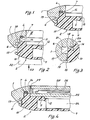
- Figure 1 shows a watch case assembled according to a first embodiment of the invention. It essentially comprises a case back 2 made of plastic, a metal bezel 1 and a seal 4.
- the backband made in one piece, comprises a first part, discoid, forming the bottom part 9 and a second annular part, forming the middle part 10.
- This backband is of the monocoque type where the movement is mounted by the top of the middle 10.
- This middle is equipped with an enlargement circle 11 and supports 12 to support the movement.
- An opening (not shown in the drawing) can be made in the bottom 9 to change the battery. This opening will then be closed by a cover.
- the monocoque bottom-middle has the advantage of sim plan the mounting of the watch on automatic transfer machines. Indeed, all the loading operations take place on the same side, the top of the watch, and it is not necessary to turn the part over to equip it with its constituent components.
- This embodiment also has the advantage of offering a bottom which takes up little space in thickness.
- the watch proposed here comprises a metal bezel 1 covering the middle part 10 and extending over at least part of the outer edge of said middle part.
- This bezel can be made of steel, whether or not covered with a decorative coating (hard materials, browning, etc.).
- the seal is not guaranteed, because the anchoring can present irregular forces on the joint which leads to a pinching of this joint which is not constant over its entire periphery.
- the grooves carried by the metal middle may have cutting edges capable of damaging the hooking strips made of plastic.
- the sealed assembly means of the caseband 2 and the bezel 1 comprises a first annular housing 6 extending radially in the bezel 1 and inside which finds an annular protuberance 13 made in one piece with the case-back 2. Thanks to the shape given to the housing 6 and to the protuberance 13 which is housed there, the case-back 2 is inseparable from the bezel 1.
- the assembly means also comprise a second annular housing 7 which is defined jointly by the caseband and the bezel and a seal 4 occupying this second housing. This seal seals the case against liquids which could be introduced between the middle part 10 and the bezel 2, then penetrate inside the watch into the region of the dial.
- Figure 1 shows in particular that the second annular housing 7 is located between the bezel 2 and the top 14 of the middle part 10 and is formed by a groove formed in the bezel 2, throat closed from the top 14 of the middle part 10 Without it being necessary to represent it by a figure, it will be easily understood that it is at the top 14 of the middle part 10 that the groove could be, the latter then being closed by a flat upper edge presented by the glasses.
- ABS acryl butadiene styrene
- ASA acryl styrene acryl-ester
- SAN styrene acryl nitrile
- the box which has just been described is perfectly waterproof and has excellent reliability.
- the attachment of the case back to the bezel cannot be dismantled, the seal remains compressed in its housing in a constant manner whatever the stresses which could be exerted on the case such as shocks or variations in temperature for example.
- it is inexpensive, while ensuring tight dimensional tolerances which are well reproducible as already mentioned above.
- the watch case which is the subject of the invention is produced from an assembly comprising a case-back 2, a bezel 1 and a seal 4 which, before assembly, are presented in the manner which will now be described, the various components appearing as illustrated in FIGS. 2 and 3, FIG. 3 being an enlargement of what is shown in circle III of FIG. 2.
- the outer periphery of the middle part 10 of the back middle 2 has a staircase structure which comprises a first lower wall 15, a second upper wall 16 and a bevelled step 17 forming an acute angle a with the second wall 16, this step thus having a point-shaped edge 18.
- the bezel 1 has first 19 and second 20 inner sides respectively adapted to match the shape of the first and second walls of the middle part.
- the first housing 6 formed in the bezel 1, already described above, is located between the sides 19 and 20. against a horizontal face 21 of the housing 6 is supported the edge 18 in the form of a point presented by the edge of the middle part 10, when the middle part 2 is introduced into the bezel 1.
- the assembly defined by FIGS. 2 and 3 also includes the gasket 4 disposed in the second housing 7 of the bezel 1.
- the bevelled step 17 can be arranged all around the middle part 10. If the movement introduced into the watch has a time-setting rod, the beveled step 17 can be interrupted in the vicinity of this rod to let a barrel pass through. integral part of the case back 2, said barrel receiving said rod. Similarly the beveled step 17 could be discontinuous and have several segments arranged annularly around the edge of the middle.
- the first housing is not continuous, but arranged in several grooves made in the telescope, each of the grooves receiving a beveled segment 17. This way of doing things could serve to angularly position the caseback 2 relative to the bezel 1.
- Figure 4 is a partial sectional representation at 12 o'clock of the fully assembled watch using the box which is the subject of the invention. This figure repeats what is shown in Figure 1 for the single box. Having said box, we start by mounting the movement 24, an outer edge of which rests on the shoulder 12 of the backband 2. We then place the dial 25 and the hands 26. We introduce the flange 27 into the inner periphery of the bezel 1. Finally, the ice 28 is chased, made watertight pan the sealing band 29, on the flange 27. This gives a watch with a plastic monocoque case-back and dressed with a metallic bezel, a watch having a very neat appearance and a very good seal. It will be noted that a metal strap will be attached to a bracelet according to a conventional embodiment and which has not been shown in the drawing.
- Figure 5 shows a watch case assembled according to a second embodiment of the invention. It essentially comprises a middle part 30 of which at least one peripheral portion is made of plastic. Here the middle is no longer made entirely of plastic but is composed of a metal ring 32 surrounded by a bandage 31 made of plastic. In this construction we also see that the bottom 33 of the case is independent of the middle part and that it is assembled there by a notch device for example.
- FIG. 5 shows, however, that here, too, we are dealing with assembly means similar to those described in connection with the first embodiment.
- first annular housing 6 extending radially in the bezel 1, the same annular protuberance 13 made in one piece with the portion 31 of the middle part made of plastic and the same second annular housing 7 in which is housed a seal 4.
- the bandage 31 is shown alone in FIGS. 6 and 7. Here it is a split ring at 35 and which has three zones or bevelled steps 17. The ring is pierced with a hole 36 through which the winding stem will pass. .
- FIG. 7 which is a section along the line VII-VII of FIG. 6, the bandage also has an external circumference in the form of a staircase with its first lower wall 15, its second upper wall 16 and its bevelled step 17 forming an acute angle (a) with the second wall and having a point-shaped edge 18.
- the first and second walls 15 and 16 are adapted respectively to match the shape of the first 19 and second 20 inner sides of the telescope 1, as shown in Figure 5.
- the assembly is therefore carried out in the same way as that described in connection Figures 1 to 4 and according to the same method which uses ultrasound. There is therefore no reason to return to it here.
- Figures 5 to 7 show that the bandage 31 is simply tightened around the year level 32 by the fact of its elasticity.
- a trapezoidal boss 37, disposed inside the bandage 31, cooperates with a housing of the same shape made in the ring 32.
- the slot 35 of the bandage allows the latter to open slightly and to put it in place on the ring. This bandage could however be molded directly on the ring.
- this second embodiment has a more conventional embodiment in the sense that the movement is introduced from below and that the case is closed by a screwed or notched bottom.
- the glass rests on a flange which is made in one piece with the ring 32.
- This second embodiment is particularly advantageous when it comes to assembling two metal parts of different natures, for example steel for the middle and hard metal for the bezel.
- the hard metal TiN, WC, for example
- the bandage proposed by the invention is used since it is this bandage which will accommodate these tolerances, the middle part being itself sufficiently precise (by bar turning for example) to receive movement and background.
Landscapes
- Engineering & Computer Science (AREA)
- Mechanical Engineering (AREA)
- Physics & Mathematics (AREA)
- General Physics & Mathematics (AREA)
- Manufacturing & Machinery (AREA)
- Electric Clocks (AREA)
- Gasket Seals (AREA)
- Joining Of Glass To Other Materials (AREA)
Claims (4)
Applications Claiming Priority (4)
| Application Number | Priority Date | Filing Date | Title |
|---|---|---|---|
| CH1097/87 | 1987-03-23 | ||
| CH109787A CH668159GA3 (en) | 1987-03-23 | 1987-03-23 | Watch case |
| CH4035/87 | 1987-10-15 | ||
| CH403587A CH671495GA3 (en) | 1987-10-15 | 1987-10-15 | Watch case |
Publications (2)
| Publication Number | Publication Date |
|---|---|
| EP0284899A1 EP0284899A1 (de) | 1988-10-05 |
| EP0284899B1 true EP0284899B1 (de) | 1991-01-16 |
Family
ID=25686638
Family Applications (1)
| Application Number | Title | Priority Date | Filing Date |
|---|---|---|---|
| EP88104208A Expired - Lifetime EP0284899B1 (de) | 1987-03-23 | 1988-03-17 | Uhrengehäuse, Einheit zu dessen Herstellung und Verfahren zum Bauen dieser Einheit |
Country Status (4)
| Country | Link |
|---|---|
| US (1) | US4993007A (de) |
| EP (1) | EP0284899B1 (de) |
| DE (1) | DE3861531D1 (de) |
| HK (1) | HK61194A (de) |
Families Citing this family (26)
| Publication number | Priority date | Publication date | Assignee | Title |
|---|---|---|---|---|
| CH671671B5 (de) * | 1988-03-23 | 1990-03-30 | Ebauchesfabrik Eta Ag | |
| CH676312B5 (de) * | 1988-12-21 | 1991-07-15 | Ebauchesfabrik Eta Ag | |
| CH675811B5 (de) * | 1989-04-12 | 1991-05-15 | Ebauchesfabrik Eta Ag | |
| EP0432088B1 (de) * | 1989-12-08 | 1995-01-11 | Fabrique D'ebauches De Sonceboz S.A. | Zusammensetzungsverfahren |
| CH684142B5 (fr) * | 1992-07-10 | 1995-01-31 | Finger H Fa | Boîte de montre pour verre galbé. |
| US6053631A (en) * | 1992-11-19 | 2000-04-25 | Createc Patent Holding S.A. | Plastic case with a support body for an electronic device |
| CH689136B5 (de) * | 1992-11-19 | 1999-04-30 | Createc Patent Holding | Armband- oder Taschenuhr und Verfahren zu ihrer Herstellung |
| EP0722620B1 (de) * | 1993-10-04 | 1999-05-06 | Eveready Battery Company, Inc. | Ultraschallversiegelungsverfahren einer anodekappe in eine dichtung für elektrochemische zellen |
| US5397408A (en) * | 1994-05-23 | 1995-03-14 | Motorola, Inc. | Ultrasonic welding of metallized plastic |
| US5645666A (en) * | 1995-06-21 | 1997-07-08 | Delco Electronics Corporation | Method of manufacture of lens and retainer assembly for instrument cluster |
| US6239925B1 (en) | 1999-09-03 | 2001-05-29 | Key Plastics, Inc. | Instrument cluster lens assembly and method of making |
| JP3733896B2 (ja) * | 2001-01-30 | 2006-01-11 | 株式会社デンソー | 振動溶着方法 |
| JP2005098975A (ja) * | 2003-09-01 | 2005-04-14 | Casio Comput Co Ltd | 時計ケース |
| DE102005018064A1 (de) * | 2005-04-19 | 2006-10-26 | Honeywell Gmbh | Kunstsstoffbauteil mit Metalleinsatz und Verfahren zu dessen Herstellung |
| US20080310260A1 (en) * | 2007-06-07 | 2008-12-18 | Ofer Segal | Modular watch and device for securing a watch strap to a watch casing |
| US7682070B2 (en) * | 2007-08-31 | 2010-03-23 | Nike, Inc. | Timepiece with stabilizing bezel |
| EP2447790A1 (de) * | 2010-10-27 | 2012-05-02 | The Swatch Group Research and Development Ltd. | Glas für die obere Abdeckung des Gehäuses eines tragbaren Gegenstands |
| EP2485100A1 (de) * | 2011-02-08 | 2012-08-08 | ETA SA Manufacture Horlogère Suisse | Armband mit einem Glasdeckel, und Befestigungsverfahren dieses Glasdeckels |
| TW201341093A (zh) * | 2012-04-06 | 2013-10-16 | Askey Technology Jiangsu Ltd | 超音波熔接結構及超音波熔接方法 |
| JP6126495B2 (ja) * | 2012-12-28 | 2017-05-10 | セイコーインスツル株式会社 | てんぷ、時計用ムーブメント、時計、およびてんぷの製造方法 |
| US9188956B2 (en) * | 2012-12-28 | 2015-11-17 | Seiko Instruments Inc. | Balance, timepiece movement, timepiece and manufacturing method of balance |
| JP6166623B2 (ja) * | 2012-12-28 | 2017-07-19 | セイコーインスツル株式会社 | てんぷ、時計用ムーブメント、時計、及びてんぷの製造方法 |
| DE102014111265A1 (de) * | 2014-08-07 | 2016-02-11 | Endress + Hauser Conducta Gesellschaft für Mess- und Regeltechnik mbH + Co. KG | Verfahren zur Herstellung eines induktiven Leitfähigkeitssensors und induktiver Leitfähigkeitssensor |
| EP3319783B1 (de) | 2015-07-06 | 2021-02-24 | WoodWelding AG | Verbinden von objekten |
| CN107426935B (zh) * | 2017-09-11 | 2023-05-16 | 北京小米移动软件有限公司 | 边框结构件、电子设备壳体及电子设备 |
| WO2021058213A1 (fr) * | 2019-09-24 | 2021-04-01 | Eta Sa Manufacture Horlogère Suisse | Dispositif de connexion carrure-corne pour une montre |
Family Cites Families (17)
| Publication number | Priority date | Publication date | Assignee | Title |
|---|---|---|---|---|
| CH348117A (de) * | 1957-06-12 | 1960-07-31 | Bulova Watch Co Inc | Wasserdichtes Uhrgehäuse mit eingesetztem Glas |
| FR1363424A (fr) * | 1963-05-03 | 1964-06-12 | Lip Sa | Procédé de fabrication de boîtier de montre en matière plastique renforcé |
| CH443158A (fr) * | 1964-10-29 | 1968-01-31 | Emir S A | Montre de plongée |
| US4023347A (en) * | 1975-10-17 | 1977-05-17 | Haber Terry M | Wristwatch casing and band construction |
| IT1053192B (it) * | 1975-12-31 | 1981-08-31 | Fip Formatura Inienzione Poli | Procedimento perfezionato per la realizzazione di un anello di graffaggio composito ed anello di graffaggio composito in talmodo ottenuto |
| US4059294A (en) * | 1976-05-10 | 1977-11-22 | Syracuse Plastics, Inc. | Annular metal fitting for rigid plastic part |
| US4136515A (en) * | 1977-01-03 | 1979-01-30 | Timex Corporation | Sealed watch case and method of making |
| CH623976B5 (fr) * | 1977-12-30 | 1982-01-15 | Finger H Fa | Boite de montre etanche. |
| JPS5837030Y2 (ja) * | 1979-05-25 | 1983-08-20 | シチズン時計株式会社 | 合成樹脂製時計ケ−スの構造 |
| JPS55160880A (en) * | 1979-06-01 | 1980-12-15 | Seiko Epson Corp | Construction of watch |
| US4259419A (en) * | 1979-08-17 | 1981-03-31 | The Gates Rubber Company | Vibratory welding of battery components |
| JPS5791232A (en) * | 1980-10-08 | 1982-06-07 | Timex Corp | Sealing connecting structure of transparent body consisting of thermoplastic substance and holder and its manufacture |
| CH646577GA3 (fr) * | 1981-06-24 | 1984-12-14 | Ebauchesfabrik Eta Ag | Procédé d'usinage du fond d'une boîte de montre moyens pour la mise en oeuvre du procédé et boîte de montre résultant de la mise en oeuvre du procédé. |
| JPS5880586A (ja) * | 1981-11-10 | 1983-05-14 | Seiko Epson Corp | 時計用プラスチツクケ−スの製造方法 |
| CH650894GA3 (de) * | 1982-08-12 | 1985-08-30 | Ebauchesfabrik Eta Ag | |
| CH650121GA3 (de) * | 1983-02-21 | 1985-07-15 | ||
| FR2544407B1 (fr) * | 1983-04-18 | 1986-08-08 | Legris | Procede et dispositif d'assemblage de plusieurs organes, notamment d'organes de liaison pour raccords de fluide |
-
1988
- 1988-03-17 EP EP88104208A patent/EP0284899B1/de not_active Expired - Lifetime
- 1988-03-17 DE DE8888104208T patent/DE3861531D1/de not_active Expired - Lifetime
-
1989
- 1989-06-22 US US07/370,112 patent/US4993007A/en not_active Expired - Fee Related
-
1994
- 1994-06-30 HK HK61194A patent/HK61194A/xx unknown
Also Published As
| Publication number | Publication date |
|---|---|
| JPS64487A (en) | 1989-01-05 |
| DE3861531D1 (de) | 1991-02-21 |
| US4993007A (en) | 1991-02-12 |
| EP0284899A1 (de) | 1988-10-05 |
| HK61194A (en) | 1994-07-01 |
Similar Documents
| Publication | Publication Date | Title |
|---|---|---|
| EP0284899B1 (de) | Uhrengehäuse, Einheit zu dessen Herstellung und Verfahren zum Bauen dieser Einheit | |
| EP0101663B1 (de) | Uhr und Verfahren zu ihrer Herstellung | |
| EP0015242B1 (de) | Mit einer Verkleidung aus hartem Metall geschütztes Schmuckstück | |
| EP3736642B1 (de) | Wasserdichtes armbanduhrgehäuse | |
| EP1098233B1 (de) | Metallelement für Gehäuse mit aus synthetischem Material hergestellten Vorsprüngen | |
| EP0873543A1 (de) | Uhrengehäuse mit einer schale und einer haltevorrichtung | |
| EP0351705A1 (de) | Uhrengehäuse mit einer auf dem Mittelteil aufgesetzten Kappe | |
| EP3123252B1 (de) | Mit einem zifferblatt ausgestattete uhr, und entsprechende befestigungsmethode | |
| EP1065576B1 (de) | Chronographuhr aus Edelmetall mit einem ausgehöhlten Glasreif-Mittelteil | |
| EP0691595B1 (de) | Kunststoffarmbanduhr mit einer als Werkplatte benutzten Verstärkungsmetallarmatur | |
| EP0549978B1 (de) | Verfahren zum Anbringen eines Glases auf einem Uhrengehäuse sowie Uhr mit Mitteln zum Ausrichten eines Glases auf einem Gehäuse | |
| EP1975747B1 (de) | Armbanduhrgehäuse | |
| EP0762240A1 (de) | Uhrengehäuse mit ausgehöhltem Gehäuseteil und Gehäuseanpassungsmittel sowie eine mit einem solchen Gehäuse ausgerüstete Uhr | |
| EP0097393B1 (de) | Armbanduhrgehäuse | |
| CH671495B5 (de) | ||
| EP0334182B1 (de) | Uhrengehäuse mit einem Mantel | |
| EP1102136B1 (de) | Vorrichtung zum Aufsetzen einer Schutzkappe aus hartem Material auf den Mittelteil einer Uhr | |
| EP0716360B1 (de) | Uhrengehäuse mit ausgehöhltem Gehäuseteil und Gehäuseanpassungsmittel sowie eine mit einem solchen Gehäuse ausgerüstete Uhr | |
| EP0113641A1 (de) | Uhrengehäuse und Verfahren zu dessen Herstellung | |
| CH351545A (fr) | Procédé de fabrication d'une pièce de boîte de montre | |
| CH345609A (fr) | Boîte de montre étanche | |
| EP1321833B1 (de) | Uhr mit Einschalungsring, der in einem durch die Lunette oder den Boden fixierten Gehäuse montiert ist | |
| CH709401A2 (fr) | Pièce d'horlogerie pourvue d'un cadran et méthode de fixation associée. | |
| CH717569A2 (fr) | Organe de conrôle, tel qu'une tige-couronne d'une boîte de montre étanche, et boîte de montre le comprenant. | |
| EP0277510B1 (de) | Uhrengehäuse mit einem Mittelteil, einem Glas und Mittel zur Befestigung des Glases an dem Mittelteil |
Legal Events
| Date | Code | Title | Description |
|---|---|---|---|
| PUAI | Public reference made under article 153(3) epc to a published international application that has entered the european phase |
Free format text: ORIGINAL CODE: 0009012 |
|
| AK | Designated contracting states |
Kind code of ref document: A1 Designated state(s): DE FR GB |
|
| 17P | Request for examination filed |
Effective date: 19881017 |
|
| 17Q | First examination report despatched |
Effective date: 19900404 |
|
| GRAA | (expected) grant |
Free format text: ORIGINAL CODE: 0009210 |
|
| AK | Designated contracting states |
Kind code of ref document: B1 Designated state(s): DE FR GB |
|
| REF | Corresponds to: |
Ref document number: 3861531 Country of ref document: DE Date of ref document: 19910221 |
|
| GBT | Gb: translation of ep patent filed (gb section 77(6)(a)/1977) | ||
| PLBE | No opposition filed within time limit |
Free format text: ORIGINAL CODE: 0009261 |
|
| STAA | Information on the status of an ep patent application or granted ep patent |
Free format text: STATUS: NO OPPOSITION FILED WITHIN TIME LIMIT |
|
| 26N | No opposition filed | ||
| PGFP | Annual fee paid to national office [announced via postgrant information from national office to epo] |
Ref country code: GB Payment date: 19950220 Year of fee payment: 8 |
|
| PGFP | Annual fee paid to national office [announced via postgrant information from national office to epo] |
Ref country code: FR Payment date: 19950314 Year of fee payment: 8 |
|
| PGFP | Annual fee paid to national office [announced via postgrant information from national office to epo] |
Ref country code: DE Payment date: 19950321 Year of fee payment: 8 |
|
| PG25 | Lapsed in a contracting state [announced via postgrant information from national office to epo] |
Ref country code: GB Effective date: 19960317 |
|
| GBPC | Gb: european patent ceased through non-payment of renewal fee |
Effective date: 19960317 |
|
| PG25 | Lapsed in a contracting state [announced via postgrant information from national office to epo] |
Ref country code: FR Effective date: 19961129 |
|
| PG25 | Lapsed in a contracting state [announced via postgrant information from national office to epo] |
Ref country code: DE Effective date: 19961203 |
|
| REG | Reference to a national code |
Ref country code: FR Ref legal event code: ST |