EP0285233A2 - Méthode d'hydrocraquage d'une huile lourde - Google Patents
Méthode d'hydrocraquage d'une huile lourde Download PDFInfo
- Publication number
- EP0285233A2 EP0285233A2 EP88300554A EP88300554A EP0285233A2 EP 0285233 A2 EP0285233 A2 EP 0285233A2 EP 88300554 A EP88300554 A EP 88300554A EP 88300554 A EP88300554 A EP 88300554A EP 0285233 A2 EP0285233 A2 EP 0285233A2
- Authority
- EP
- European Patent Office
- Prior art keywords
- cracking
- solvent
- catalyst
- oil
- reactor
- Prior art date
- Legal status (The legal status is an assumption and is not a legal conclusion. Google has not performed a legal analysis and makes no representation as to the accuracy of the status listed.)
- Granted
Links
- 0 CC(*CC*)C(*)C*O*[N+](NC)[O-] Chemical compound CC(*CC*)C(*)C*O*[N+](NC)[O-] 0.000 description 1
Images

Classifications
-
- C—CHEMISTRY; METALLURGY
- C10—PETROLEUM, GAS OR COKE INDUSTRIES; TECHNICAL GASES CONTAINING CARBON MONOXIDE; FUELS; LUBRICANTS; PEAT
- C10G—CRACKING HYDROCARBON OILS; PRODUCTION OF LIQUID HYDROCARBON MIXTURES, e.g. BY DESTRUCTIVE HYDROGENATION, OLIGOMERISATION, POLYMERISATION; RECOVERY OF HYDROCARBON OILS FROM OIL-SHALE, OIL-SAND, OR GASES; REFINING MIXTURES MAINLY CONSISTING OF HYDROCARBONS; REFORMING OF NAPHTHA; MINERAL WAXES
- C10G65/00—Treatment of hydrocarbon oils by two or more hydrotreatment processes only
- C10G65/02—Treatment of hydrocarbon oils by two or more hydrotreatment processes only plural serial stages only
- C10G65/12—Treatment of hydrocarbon oils by two or more hydrotreatment processes only plural serial stages only including cracking steps and other hydrotreatment steps
Definitions
- the present invention relates to a method for hydrocracking a heavy fraction oil, particularly that containing at least 1.0 wt.% of asphaltene, using a hydrogen donating solvent.
- cracking used herein is intended to obtain light fraction oils including naphtha, gasoline, kerosene and gas oil fractions by hydrocracking the heavy fraction oil.
- the most serious and troublesome problems raised by the cracking of a heavy fraction oil are, in general, the formation of carbonaceous substances and the clogging of various parts of an apparatus for the cracking with the carbonaceous substances. Further, the serious problem caused by the catalytic cracking of the heavy fraction oil is a decrease in catalytic activity of a catalyst used. Still further, the cracking of the heavy fraction oil raises an economic problem as to an increase in amount of hydrogen consumed. These problems are rendered more serious as the fraction oil to be cracked is heavier and the cracking proceeds farther.
- a heavy fraction oil contains asphaltene in which are contained heavy metals such as vanadium and nickel.
- heavy metals such as vanadium and nickel.
- tetralin a hydrogen donating solvent
- the catalyst used is highly capable of adhesion of heavy metals thereto at this point, the effects of the hydrogen donating solvent will be further remarkable.
- the cracking reaction may be carried out at lower pressures.
- a high hydrogen pressure generally 100 atm. to 200 atm., in order to mainly prevent the catalyst from lowering in catalytic activity when cracking a heavy fraction oil in the presence of a suitable catalyst only. It is unnecessary, however, to use a high hydrogen pressure since hydrogen is supplied from a hydrogen donating solvent if the hydrogen donating solvent, such as tetralin, coexists in the system; in this case, 30 atm. to 150 atm. is sufficient as the hydrogen pressure.
- the amount of hydrogen consumed may be decreased.
- An object of the present invention is to provide a method for a cracking heavy fraction oil containing at least 1.0 wt.% of asphaltene in the presence of a hydrogen donating solvent, characterized in that the formation of carbonaceous substances is greatly inhibited and problems as to the circulation of the hydrogen donating solvent are solved.
- the heavy fraction oil is cracked using a catalyst capable of hydrogenation in the presence of a hydrogen donating solvent and hydrogen gas and a fraction having a specific boiling range is circulated whereby the formation of carbonaceous substances is greatly inhibited, the supply of a makeup hydrogen donating solvent can be dispensed with and the concentration of tetralin in the circulating solvent is maintained at a fixed or higher level.
- the method for hydrocracking heavy fraction oils of the present invention is based on the above finding or discovery.
- the method of the present invention comprises cracking (a) a starting heavy fraction oil in the coexistence of (b) a hydrogen donating solvent and (c) hydrogen gas using a catalyst capable of hydrogenation in a cracking reactor, hydrogenating the fractions obtained by the cracking in a hydrogenating reactor, separating the thus hydrogenated fractions into a liquid and gases, fractionating the thus separated liquid in a distillation apparatus to obtain fractions including a specific fraction in which at least 90 wt.% is boiling in the range of 150-250°C, at least 60 wt.% is boiling in the range of 190-230°C and at least 30 wt.% is tetralin, circulating said specific fraction as the circulating solvent through said cracking reactor with or without replenishment of any hydrogen donating solvent in an amount by weight of 0.7% of the starting oil thereby to obtain a hydrocracked oil.
- the starting heavy fraction oils used in the present invention are those containing at least 1.0 wt.%, preferably 5-30 wt.% of asphaltene and at least 50 wt.% of a fraction boiling at 350°C or higher, and they include residual oils obtained by the distillation of crude oils at atmospheric or reduced pressure, oils obtained from coal, oil sand, oil shale, bitumen or the like, and mixtures of said various heavy fraction oils.
- the hydrogen donating solvents used in the present invention may be hydrides of polycyclic aromatic hydrocarbons.
- the polycyclic aromatic hydrocarbons include bicyclic to hexacyclic, preferably bicyclic to tetracyclic, aromatic hydrocarbons and derivatives thereof such as naphthalene, anthracene, phenanthren, pyrene, naphthacene, chrysene, benzopyrene, perylene, picene and derivatives thereof, which may be used individually or jointly.
- hydrocarbon oils boiling in the range of 150-500°C and containing at least 20 wt.% of said polycyclic aromatic hydrocarbons, may also be used as a hydrogen donating solvent
- the hydrocarbon oils include cycle oils in an apparatus for catalytic cracking (FCC), bottom oils in a catalytic reforming apparatus, bottom oils in a thermocracking apparatus and other oil products obtained from petroleum refining plants as well as coal-derived products such as tar oil, anthracene oil, creosote oil, coal liquefied oil, and products obtained from tar sand, oil shale, bitumen and the like.
- FCC catalytic cracking
- bottom oils in a catalytic reforming apparatus bottom oils in a thermocracking apparatus and other oil products obtained from petroleum refining plants as well as coal-derived products such as tar oil, anthracene oil, creosote oil, coal liquefied oil, and products obtained from tar sand, oil shale, bitumen and
- hydrocarbon oils preferably used in the present invention include FCC cycle oils containing naphthalene, anthracene and the like, and bottoms obtained by thermocracking and reforming naphtha.
- polycyclic aromatic hydrocarbons and hydrocarbon oils may be hydrogenated prior to being charged into the reactor, this is not necessarily required since said hydrocarbons and oils are otherwise hydrogenated to produce hydrogen donating solvents because of the coexistence of hydrogen gas and catalysts in the reactor.
- the circulating solvent may be used as the hydrogen donating solvent.
- the catalysts in the cracking reactor used in the present invention are not particularly limited, but they are desired to have a demetallizing function and should preferably be such that they will be comparatively little degraded in catalytic activity due to the accumulation of heavy metals such as vanadium and nickel.
- These catalysts include the oxides and sulfides of Group VIII metals of the Periodic Table such as nickel and cobalt as well as of Group VIB metals of the Periodic Table such as molybdenum and tungsten, each carried on alumina, silica, silica-alumina, alumina-boria, silica-alumina-magnesia, silica-alumina-titania and inorganic substances such as natural and synthetic zeolites.
- the solid catalyst particles are required to have such a shape that they will not accompany the flow of the liquid discharged from the cracking reactor. They may be spherical or extrudate in shape and may be formed by extrusion molding or compression molding. It is desirable that these catalysts have a particle size of 0.1-10 mm, preferably 0.2-5 mm.
- the cracking reactor 3 holds therein a solid catalyst in the form of a catalyst-filled layer and is maintained at a reaction temperature of 380-470°C, preferably 390-440°C, and a reaction pressure of 30-150 Kg/cm2 ⁇ g, preferably 40-100 Kg/cm2 ⁇ g.
- the heavy fraction oil 1 is cracked in the cracking reactor 3, during which at least 50 wt.% of heavy metals such as vanadium and nickel contained in the heavy fraction oil is removed therefrom by attaching the metals to the solid catalyst in the cracking reactor.
- the hydrocracked oil obtained from the heavy fraction oil, the hydrogen-containing gas and the circulating solvent containing the hydrogen donating solvent, are introduced from the cracking reactor 3, without any separation treatment, via a pipe 4 into a hydrogenating reactor 5.
- the hydrogenating reactor 5 holds therein a solid catalyst in the form of a filled layer and is maintained at a reaction temperature of 320-440°C and a reaction pressure of 30-150 Kg/cm2 ⁇ g.
- the cracking reaction still proceeds, but the main reactions include the hydrogenation, desulfurization and denitrification of the cracked oils from the cracking reactor 3, the hydrogenation of the used hydrogen donating solvents, and the hydrogenation of carbon precursors produced in the cracking reactor 3.
- the carbon precursor is hydrogenated in the hydrogenating reactor 5 to be converted to a toluene-soluble substance, resulting in the production of substantially no carbonaceous substances.
- the liquid and gases from the hydrogenating reactor 5 are separated into the liquid and the gases in a liquid-gas separator 6.
- the gases so separated contain hydrogen sulfide, ammonium sulfide and the like are subjected to appropriate washing or scrubbing treatment, after which a part of the washed gases is discharged from the system while another part thereof is reused as the circulating gases.
- the liquid 8 which has been separated from the gases 7 in the liquid-gas separator 6, is introduced into a fractionating apparatus 9 where a circulating solvent fraction 12 is separated from a light fraction oil 10 and a heavy fraction oil 11 and then circulated again to the cracking reactor 3.
- a solvent storage tank may be provided at the passage of said circulating solvent fraction.
- This circulating solvent fraction is required to be such that at least 90 wt.% of the solvent fraction is a hydrocarbon fraction boiling in the range of 150-250°C, at least 60 wt.% of the solvent fraction is a hydrocarbon fraction boiling in the range of 190-230°C and at least 30 wt.% of the solvent fraction is tetralin.
- the amount of circulating solvent fraction circulated is that expressed by a ratio of 0.1-2.0 (wt./wt. starting oil), particularly preferably 0.1-1.2 (wt./wt. starting oil).
- the amount of circulating solvent fraction circulated is smaller than that so expressed, the formation of carbonaceous substances will be remarkable whereby are caused troubles such as the clogging of the hydrocracking apparatus with the carbonaceous substances and the increased lowering in catalytic activity of the catalyst. If, on the other hand, the amount of liquid circulated is too much, the apparatus will be required to be a large-scale one and the amount of heat required for heating will be large, this being economically undesirable.
- a starting heavy fraction oil is cracked in the presence of a hydrogen donating solvent, a hydrogen-containing gas and a catalyst capable of hydrogenation according to the present invention, whereby tetralin, naphthalene and the like are produced from the starting oil in a total amount of at least 0.5 wt.% thereof.
- the amount of these hydrogen donating solvents produced from the starting oil may be adjusted by changing the cracking reaction conditions and fractionator conditions, and it will also vary depending on the kind of starting oil used.
- the starting oil may be incorporated with hydrogen donating solvents in an amount of not higher than 0.7 wt.%, preferably not higher than 0.5 wt.%, of the starting oil.
- the tetralin evolves hydrogen therefrom and is partly converted to naphthalene while converting part of the tetralin to decalin, methylindane, methylnaphthalene and the like as by-products.
- These by-products may be inhibited from forming by using appropriate cracking reaction conditions and, therefore, they will not accumulate in the circulating solvents.
- the naphthalene in the circulating solvents may be limited to 5 wt.% or lower in concentration since it is hydrogenated under the action of the catalysts and converted to tetralin in the cracking reactor and hydrogenating reactor.
- the catalyst may usually be a solid one.
- the fixed or moving bed it is effective to maintain a liquid linear velocity of at least 2 cm/sec.
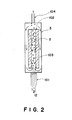
- a starting oil 1, a hydrogen donating solvent and a hydrogen-containing gas 2 are introduced through an introduction pipe 101 provided on the lower part of the cracking reactor 3.
- the interior of the cracking reactor 3 is vertically divided into two parts by the cylindrical partition 102 including a solid catalyst 103 housed therein, and the aforesaid two parts are communicated with each other on the upper and lower parts of the partition 102.
- the foamy hydrogen-containing gas 2 ascends the interior of the partition 102.
- the fluid in the cracking reactor 3 is circulated in the direction of an arrow shown in the figure due to the intra-reactor pressure unbalance caused by the small specific gravity of a region in which the hydrogen-containing gas 2 exists.
- a part of the above-described circulating fluid is capable of passing through the solid catalyst-housed partition 102 from the outside of the partition 102 (the outer side of the partition in which the hydrogen-containing gas 2 is substantially not existent) to the inside thereof (the inner side of the partition in which the gas 2 is existent) in the direction shown by an arrow (dotted line).
- the amount of the fluid passed changes depending on the void ratio of the catalyst-filled partition or the pressure difference between the outside and inside of the partition 102.
- the void ratio of the partition 102 preferably ranges from 5 to 95 % in general.
- the void ratio used herein is the proportion of the space existing in unit volume to the unit volume.
- the hydrogen-containing gas 2 ascends in the cylindrical partition 2 and is discharged from the outlet pipe 104, while the fluid circulates in the cracking reactor 3 and, after a prescribed residence time, is discharged from the outlet pipe 104. Accordingly, the fluid which resides for a prescribed period of time under prescribed temperature and pressure conditions can be cracked and made lighter fractions.
- the partition for housing a solid catalyst according to the present invention is porous as a whole, a part or the whole of the porous portion being composed of the solid catalyst having a hydrogenation function, while it is generally porous plain plate- or curved plate-shaped as a whole.
- a part or the whole of the plate is formed by an assembly of solid catalyst particles having a hydrogenation function.
- the partition may be illustrated by those prepared by housing at least one kind of particulate catalyst selected from extrusion molded catalyst, spherical catalyst and compression molded catalyst, in a container made of a metal mesh, punching metal or the like, and may also be illustrated by an assembly of catalyst particles bonded to each other with a binder.
- the thickness of the partition for housing a solid catalyst is 1/100 to 2/5, preferably 1/10 to 1/3, of the inner diameter of the reaction reactor.
- the sizes of openings of the metal mesh and punching metal for housing a solid catalyst are such that solid catalyst particles do not pass through the openings and the fluid may sufficiently contact with the catalyst particles.
- the amount of catalyst used in the present invention ranges from 1/100 to 1/1.5, preferably 1/50 to 1/2, of the internal volume of the cracking reactor.
- the solid catalyst is not particularly limited only if it is one having a hydrogenation function such for example as hydrocracking, hydrodemetallization, hydrodesulfurization or hydrodenitrification. But, from the viewpoint of long-term operation, the preferable catalyst is one which will not remarkably decrease in activity due to vanadium, nickel and the like contained in starting oils even if it has originally low activity.
- catalysts there can be used the same catalysts as employed in a heavy fraction oil treating process such as hydrocracking, hydrodemetallization or hydrodesulfurization for heavy fraction oils, or there can also be employed used catalysts.
- the solid catalysts include the oxides or sulfides of a Group VIII metal such as nickel or cobalt or of a Group VI B metal such as molybdenum or tungsten, the metal oxides or sulfides being carried on an inorganic substance such as alumina, silica, silica-alumina, alumina-boria, silica-alumina-magnesia, silica-alumina-titania, or natural or synthetic zeolite.
- alumina silica, silica-alumina, alumina-boria, silica-alumina-magnesia, silica-alumina-titania, or natural or synthetic zeolite.
- the solid catalyst is not particularly limited in shape, for example an extrusion molded catalyst, a spherical catalyst or a compression molded catalyst may be used.
- the diameter of the catalyst particle ranges from 0.1 to 10 mm, preferably 0.2 to 5 mm.
- reaction temperature 380 to 470°C
- reaction pressure 30 to 150 kg/cm2 ⁇ g varying depending on the kind of a hydrogen-containing gas used
- residence time of starting heavy fraction oil in the cracking reactor preferably 0.2 to 10 hours
- circulating flow speed of the fluid in the cracking reactor at least 1 cm/sec., preferably 5 to 100 cm/sec.
- the hydrogenating reactor according to the present invention is used in the form of a general fixed bed, and the flow of the fluid in said reactor may be either an ascending one or a descending one.
- the cracking reaction still proceeds, but the main reactions include reactions of hydrogenation, desulfurization and denitrification of the cracked oils as well as reactions of hydrogenation of the hydrogen donating solvents and carbon precursors (expressed as toluene-insolubles) to solubilize the precursors.
- the catalysts used in the hydrogenating reactor are required to have a hydrogenation function and may have the same shape as generally used in fixed-bed reactors. In addition, they may generally have the same composition as those used in hydrogenating treatments such as hydrolysis and hydrodesulfurization.
- a usual fractionator may be used.
- the fractionation may be carried out using two (first and second) fractionators, the first fractionator being used for separation of lighter fraction oils and the second one for separation of heavy fraction oils, or may be carried out using a single fractionator, a circulating solvent fraction being withdrawn from the halfway of the single fractionator.
- the catalyst used in the cracking reactor was such that cobalt (4.0 wt.%) and molybdenum (11.5 wt.%) were supported on a silica-alumina carrier (porosity 53 c.c./g, surface area 190 m2/g, average pore radius 58 ⁇ ) and extrusion molded to form 1/16 inch extrusion molded catalyst particles which were housed in an annular cylindrical punching metal.
- the catalyst used in the hydrogenating reactor was 1/32 inch extrusion molded catalyst particles in which cobalt (4.1 wt.%) and molybdenum (13.0 wt.%) were supported on a silica-alumina carrier (porosity 49 c.c./g, surface area 212 m2/g, average pore radius 58 ⁇ ).
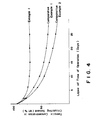
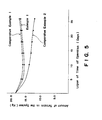
- the operation was continued at a cracking rate of 85 wt.% for 25 days to find changes in composition of the circulating solvent (Fig. 4) and changes in amount of the tetralin in the system (Fig. 5).
- Example 1 The procedure of Example 1 was followed except that the circulating solvent herein used had a boiling range which was different from that of the circulating solvent used in Example 1.
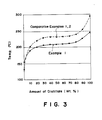
- Fig. 3 indicates the changes in tetralin concentration with the lapse of time of operation in the circulating solvents
- Fig. 5 shows the changes in tetralin concentration with the lapse of time of operation in the system in comparison with those exhibited in Example 1.
- Example 1 The procedure of Example 1 was followed except that the circulating solvent used herein had the same boiling range as that used in Comparative Example 1 and the cracking reactor contained no catalyst. The test results are shown, in comparison with those in Example 1 and Comparative Example 1, in Tables 1 and 2.
- the equilibrium concentration of tetralin in the circulating (or recycle) solvent is about 70 wt.% in Example 1.
- the tetralin concentration in the circulating solvent will continue to decrease since the equilibrium concentration is kept at a low level (Fig. 4).
- Example 1 and Comparative Example 1 tetralin and naphthalene are produced from the starting oil in an amount enough to make up for the amount of tetralin and naphthalene discharged as the loss from the system since the starting oil is cracked in the presence of both the hydrogen donating solvent and the catalyst, resulting in that the amount of tetralin in the system decrease during a short time just after the start of the cracking operation and does not decrease after the lapse of said short time.
- Comparative Example 2 on the other hand, tetralin and naphthalene are produced in a less amount than in Example 1 and Comparative Example 1 since the crack is carried out in the presence of the hydrogen donating solvent only.
Landscapes
- Chemical & Material Sciences (AREA)
- Oil, Petroleum & Natural Gas (AREA)
- Engineering & Computer Science (AREA)
- Chemical Kinetics & Catalysis (AREA)
- General Chemical & Material Sciences (AREA)
- Organic Chemistry (AREA)
- Production Of Liquid Hydrocarbon Mixture For Refining Petroleum (AREA)
- Catalysts (AREA)
- Vaporization, Distillation, Condensation, Sublimation, And Cold Traps (AREA)
Applications Claiming Priority (2)
| Application Number | Priority Date | Filing Date | Title |
|---|---|---|---|
| JP74273/87 | 1987-03-30 | ||
| JP62074273A JPS63243196A (ja) | 1987-03-30 | 1987-03-30 | 重質油の軽質化法 |
Publications (3)
| Publication Number | Publication Date |
|---|---|
| EP0285233A2 true EP0285233A2 (fr) | 1988-10-05 |
| EP0285233A3 EP0285233A3 (en) | 1990-08-08 |
| EP0285233B1 EP0285233B1 (fr) | 1993-04-14 |
Family
ID=13542345
Family Applications (1)
| Application Number | Title | Priority Date | Filing Date |
|---|---|---|---|
| EP88300554A Expired - Lifetime EP0285233B1 (fr) | 1987-03-30 | 1988-01-22 | Méthode d'hydrocraquage d'une huile lourde |
Country Status (6)
| Country | Link |
|---|---|
| US (1) | US4857168A (fr) |
| EP (1) | EP0285233B1 (fr) |
| JP (1) | JPS63243196A (fr) |
| AU (1) | AU600421B2 (fr) |
| CA (1) | CA1304034C (fr) |
| DE (1) | DE3880186T2 (fr) |
Families Citing this family (22)
| Publication number | Priority date | Publication date | Assignee | Title |
|---|---|---|---|---|
| US5215649A (en) * | 1990-05-02 | 1993-06-01 | Exxon Chemical Patents Inc. | Method for upgrading steam cracker tars |
| FR2689137B1 (fr) * | 1992-03-26 | 1994-05-27 | Inst Francais Du Petrole | Procede d'hydro conversion de fractions lourds en phase liquide en presence d'un catalyseur disperse et d'additif polyaromatique. |
| EP0576982A1 (fr) * | 1992-06-30 | 1994-01-05 | Nippon Oil Co. Ltd. | Procédé de conversion d'huile lourde hydrocarbonée en carburant hydrocarboné léger |
| US7569136B2 (en) | 1997-06-24 | 2009-08-04 | Ackerson Michael D | Control system method and apparatus for two phase hydroprocessing |
| WO1998059019A1 (fr) | 1997-06-24 | 1998-12-30 | Process Dynamics, Inc. | Hydrotraitement en deux phases |
| US7291257B2 (en) * | 1997-06-24 | 2007-11-06 | Process Dynamics, Inc. | Two phase hydroprocessing |
| RU2158623C1 (ru) * | 1999-06-16 | 2000-11-10 | Цегельский Валерий Григорьевич | Способ сжатия и подачи под давлением углеводородосодержащих газообразных сред (варианты) |
| US7371906B2 (en) * | 2004-08-24 | 2008-05-13 | Eastman Kodak Company | Process for photo-oxidative stability improvements |
| US7626063B2 (en) * | 2007-05-11 | 2009-12-01 | Conocophillips Company | Propane utilization in direct hydrotreating of oils and/or fats |
| WO2012100068A2 (fr) | 2011-01-19 | 2012-07-26 | Process Dynamics, Inc. | Procédé d'hydrotraitement de matières premières non-pétrole |
| US12421459B2 (en) | 2011-01-19 | 2025-09-23 | Duke Technologies, Llc | Process for hydroprocessing of non-petroleum feedstocks with hydrogen production |
| US8932451B2 (en) | 2011-08-31 | 2015-01-13 | Exxonmobil Research And Engineering Company | Integrated crude refining with reduced coke formation |
| JP6176645B2 (ja) * | 2012-05-25 | 2017-08-09 | 国立研究開発法人産業技術総合研究所 | 重質油の吸着脱硫方法 |
| US9243193B2 (en) * | 2013-03-14 | 2016-01-26 | Exxonmobil Research And Engineering Company | Fixed bed hydrovisbreaking of heavy hydrocarbon oils |
| CN104927902B (zh) * | 2014-03-21 | 2017-11-21 | 中国石油化工股份有限公司 | 一种蜡油加氢处理方法 |
| CN104927899B (zh) * | 2014-03-21 | 2016-12-07 | 中国石油化工股份有限公司 | 催化裂化重循环油加氢处理方法和用于生产针状焦的原料的处理方法和生产针状焦的方法 |
| CN104927898B (zh) * | 2014-03-21 | 2017-02-08 | 中国石油化工股份有限公司 | 一种烃油加氢处理方法 |
| CN104927903B (zh) * | 2014-03-21 | 2017-11-21 | 中国石油化工股份有限公司 | 一种渣油加氢处理方法 |
| CA2912768C (fr) | 2014-11-24 | 2018-11-20 | Rodger Francesco Bernar | Systeme d'actualisation partielle et procede destine aux hydrocarbures lourds |
| MX375006B (es) | 2015-08-06 | 2025-03-06 | Mexicano Inst Petrol | Uso de polímeros como donadores de hidrógeno heterogéneos en el mejoramiento de crudos pesados y extrapesados. |
| US9738839B1 (en) | 2016-04-29 | 2017-08-22 | IFP Energies Nouvelles | Generation ebullated-bed reactor system |
| MX2017009054A (es) | 2017-07-10 | 2019-02-08 | Mexicano Inst Petrol | Procedimiento de preparacion de agentes de transferencia de hidrogeno solidos mejorados para el procesamieno de crudos pesados, extrapesados y residuos, y producto resultante. |
Family Cites Families (12)
| Publication number | Priority date | Publication date | Assignee | Title |
|---|---|---|---|---|
| US4293404A (en) * | 1980-07-21 | 1981-10-06 | Mobil Oil Corporation | Dehydroxylation and/or demercaptolation of heavy petroleum oils |
| US4376037A (en) * | 1981-10-16 | 1983-03-08 | Chevron Research Company | Hydroprocessing of heavy hydrocarbonaceous oils |
| US4485004A (en) * | 1982-09-07 | 1984-11-27 | Gulf Canada Limited | Catalytic hydrocracking in the presence of hydrogen donor |
| US4465587A (en) * | 1983-02-28 | 1984-08-14 | Air Products And Chemicals, Inc. | Process for the hydroliquefaction of heavy hydrocarbon oils and residua |
| JPS60170695A (ja) * | 1984-02-14 | 1985-09-04 | Nippon Oil Co Ltd | 改良された重質油水素化処理方法 |
| US4640765A (en) * | 1984-09-04 | 1987-02-03 | Nippon Oil Co., Ltd. | Method for cracking heavy hydrocarbon oils |
| JPS6162591A (ja) * | 1984-09-04 | 1986-03-31 | Nippon Oil Co Ltd | 重質油の軽質化方法 |
| JPS61130394A (ja) * | 1984-11-29 | 1986-06-18 | Nippon Oil Co Ltd | 重質油の軽質化方法 |
| JPS61136591A (ja) * | 1984-12-06 | 1986-06-24 | Nippon Oil Co Ltd | 重質炭化水素油の軽質化方法 |
| US4592830A (en) * | 1985-03-22 | 1986-06-03 | Phillips Petroleum Company | Hydrovisbreaking process for hydrocarbon containing feed streams |
| US4661241A (en) * | 1985-04-01 | 1987-04-28 | Mobil Oil Corporation | Delayed coking process |
| CA1222471A (fr) * | 1985-06-28 | 1987-06-02 | H. John Woods | Methode pour ameliorer le rendement des produits distillables dans le craquage a diluant donneur d'hydrogene |
-
1987
- 1987-03-30 JP JP62074273A patent/JPS63243196A/ja active Pending
-
1988
- 1988-01-20 US US07/146,234 patent/US4857168A/en not_active Expired - Fee Related
- 1988-01-20 CA CA000556926A patent/CA1304034C/fr not_active Expired - Lifetime
- 1988-01-22 EP EP88300554A patent/EP0285233B1/fr not_active Expired - Lifetime
- 1988-01-22 DE DE88300554T patent/DE3880186T2/de not_active Expired - Fee Related
- 1988-01-27 AU AU10953/88A patent/AU600421B2/en not_active Ceased
Also Published As
| Publication number | Publication date |
|---|---|
| JPS63243196A (ja) | 1988-10-11 |
| US4857168A (en) | 1989-08-15 |
| EP0285233B1 (fr) | 1993-04-14 |
| DE3880186D1 (de) | 1993-05-19 |
| DE3880186T2 (de) | 1994-01-20 |
| CA1304034C (fr) | 1992-06-23 |
| AU1095388A (en) | 1988-09-29 |
| EP0285233A3 (en) | 1990-08-08 |
| AU600421B2 (en) | 1990-08-09 |
Similar Documents
| Publication | Publication Date | Title |
|---|---|---|
| US4857168A (en) | Method for hydrocracking heavy fraction oil | |
| EP0272038B1 (fr) | Procédé d'hydrocraquage d'huiles lourdes | |
| US9708554B2 (en) | System and process for the hydroconversion of heavy oils | |
| US6436279B1 (en) | Simplified ebullated-bed process with enhanced reactor kinetics | |
| US5779992A (en) | Process for hydrotreating heavy oil and hydrotreating apparatus | |
| US4969988A (en) | Antifoam to achieve high conversion in hydroconversion of heavy oils | |
| US4564439A (en) | Two-stage, close-coupled thermal catalytic hydroconversion process | |
| US5286371A (en) | Process for producing needle coke | |
| US5080777A (en) | Refining of heavy slurry oil fractions | |
| US5209840A (en) | Separation of active catalyst particles from spent catalyst particles by air elutriation | |
| US3779897A (en) | Hydrotreating-hydrocracking process for manufacturing gasoline range hydrocarbons | |
| US20110094938A1 (en) | Process for the conversion of residue integrating moving-bed technology and ebullating-bed technology | |
| US20090127161A1 (en) | Process and Apparatus for Integrated Heavy Oil Upgrading | |
| US20090129998A1 (en) | Apparatus for Integrated Heavy Oil Upgrading | |
| GB1602640A (en) | Process for hydrotreating heavy hydrocarbon oil | |
| JPH11189777A5 (fr) | ||
| US2801208A (en) | Process for hydrogen treatment of hydrocarbons | |
| US4640765A (en) | Method for cracking heavy hydrocarbon oils | |
| US3671420A (en) | Conversion of heavy petroleum oils | |
| JP2001500561A (ja) | 水素添加転化法 | |
| US4048057A (en) | Integrated heavy oil cracking process utilizing catalyst separated from cracking in pretreating zone | |
| US4659452A (en) | Multi-stage hydrofining process | |
| US3843508A (en) | Split flow hydrodesulfurization and catalytic cracking of residue-containing petroleum fraction | |
| US3291721A (en) | Combined hydrocracking and hydrofining process | |
| US4073721A (en) | Catalyst regeneration by circulating catalyst in a hydrotreating oil process |
Legal Events
| Date | Code | Title | Description |
|---|---|---|---|
| PUAI | Public reference made under article 153(3) epc to a published international application that has entered the european phase |
Free format text: ORIGINAL CODE: 0009012 |
|
| AK | Designated contracting states |
Kind code of ref document: A2 Designated state(s): DE FR GB |
|
| PUAL | Search report despatched |
Free format text: ORIGINAL CODE: 0009013 |
|
| AK | Designated contracting states |
Kind code of ref document: A3 Designated state(s): DE FR GB |
|
| 17P | Request for examination filed |
Effective date: 19901122 |
|
| 17Q | First examination report despatched |
Effective date: 19910711 |
|
| GRAA | (expected) grant |
Free format text: ORIGINAL CODE: 0009210 |
|
| AK | Designated contracting states |
Kind code of ref document: B1 Designated state(s): DE FR GB |
|
| REF | Corresponds to: |
Ref document number: 3880186 Country of ref document: DE Date of ref document: 19930519 |
|
| ET | Fr: translation filed | ||
| PGFP | Annual fee paid to national office [announced via postgrant information from national office to epo] |
Ref country code: GB Payment date: 19931230 Year of fee payment: 7 |
|
| PGFP | Annual fee paid to national office [announced via postgrant information from national office to epo] |
Ref country code: DE Payment date: 19940121 Year of fee payment: 7 |
|
| PGFP | Annual fee paid to national office [announced via postgrant information from national office to epo] |
Ref country code: FR Payment date: 19940124 Year of fee payment: 7 |
|
| PLBE | No opposition filed within time limit |
Free format text: ORIGINAL CODE: 0009261 |
|
| STAA | Information on the status of an ep patent application or granted ep patent |
Free format text: STATUS: NO OPPOSITION FILED WITHIN TIME LIMIT |
|
| 26N | No opposition filed | ||
| PG25 | Lapsed in a contracting state [announced via postgrant information from national office to epo] |
Ref country code: GB Effective date: 19950122 |
|
| GBPC | Gb: european patent ceased through non-payment of renewal fee |
Effective date: 19950122 |
|
| PG25 | Lapsed in a contracting state [announced via postgrant information from national office to epo] |
Ref country code: FR Effective date: 19950929 |
|
| PG25 | Lapsed in a contracting state [announced via postgrant information from national office to epo] |
Ref country code: DE Effective date: 19951003 |
|
| REG | Reference to a national code |
Ref country code: FR Ref legal event code: ST |