EP0285351A1 - Optische Wellenleitervorrichtung - Google Patents
Optische Wellenleitervorrichtung Download PDFInfo
- Publication number
- EP0285351A1 EP0285351A1 EP88302728A EP88302728A EP0285351A1 EP 0285351 A1 EP0285351 A1 EP 0285351A1 EP 88302728 A EP88302728 A EP 88302728A EP 88302728 A EP88302728 A EP 88302728A EP 0285351 A1 EP0285351 A1 EP 0285351A1
- Authority
- EP
- European Patent Office
- Prior art keywords
- waveguide
- optical
- groove
- optical material
- optical energy
- Prior art date
- Legal status (The legal status is an assumption and is not a legal conclusion. Google has not performed a legal analysis and makes no representation as to the accuracy of the status listed.)
- Granted
Links
- 230000003287 optical effect Effects 0.000 title claims abstract description 108
- 239000013307 optical fiber Substances 0.000 claims abstract description 17
- 230000001902 propagating effect Effects 0.000 claims abstract description 15
- 239000000463 material Substances 0.000 claims description 21
- 238000009826 distribution Methods 0.000 claims description 13
- 238000005452 bending Methods 0.000 claims description 3
- 239000000758 substrate Substances 0.000 abstract description 37
- 230000008878 coupling Effects 0.000 abstract description 11
- 238000010168 coupling process Methods 0.000 abstract description 11
- 238000005859 coupling reaction Methods 0.000 abstract description 11
- 230000005540 biological transmission Effects 0.000 abstract description 4
- 238000000034 method Methods 0.000 description 18
- 230000005855 radiation Effects 0.000 description 9
- 230000009467 reduction Effects 0.000 description 6
- 239000010936 titanium Substances 0.000 description 5
- 229910003327 LiNbO3 Inorganic materials 0.000 description 4
- RTAQQCXQSZGOHL-UHFFFAOYSA-N Titanium Chemical compound [Ti] RTAQQCXQSZGOHL-UHFFFAOYSA-N 0.000 description 3
- 230000015572 biosynthetic process Effects 0.000 description 3
- 238000009792 diffusion process Methods 0.000 description 3
- GQYHUHYESMUTHG-UHFFFAOYSA-N lithium niobate Chemical compound [Li+].[O-][Nb](=O)=O GQYHUHYESMUTHG-UHFFFAOYSA-N 0.000 description 3
- 229910052719 titanium Inorganic materials 0.000 description 3
- PXHVJJICTQNCMI-UHFFFAOYSA-N Nickel Chemical compound [Ni] PXHVJJICTQNCMI-UHFFFAOYSA-N 0.000 description 2
- 230000000694 effects Effects 0.000 description 2
- 239000011521 glass Substances 0.000 description 2
- 230000007246 mechanism Effects 0.000 description 2
- 230000007704 transition Effects 0.000 description 2
- WSMQKESQZFQMFW-UHFFFAOYSA-N 5-methyl-pyrazole-3-carboxylic acid Chemical compound CC1=CC(C(O)=O)=NN1 WSMQKESQZFQMFW-UHFFFAOYSA-N 0.000 description 1
- WOIHABYNKOEWFG-UHFFFAOYSA-N [Sr].[Ba] Chemical compound [Sr].[Ba] WOIHABYNKOEWFG-UHFFFAOYSA-N 0.000 description 1
- 230000008901 benefit Effects 0.000 description 1
- 230000008859 change Effects 0.000 description 1
- 238000006243 chemical reaction Methods 0.000 description 1
- 238000005253 cladding Methods 0.000 description 1
- 238000004891 communication Methods 0.000 description 1
- 239000013078 crystal Substances 0.000 description 1
- 230000001419 dependent effect Effects 0.000 description 1
- 238000010586 diagram Methods 0.000 description 1
- 239000000835 fiber Substances 0.000 description 1
- 238000010329 laser etching Methods 0.000 description 1
- 238000004519 manufacturing process Methods 0.000 description 1
- 229910052759 nickel Inorganic materials 0.000 description 1
- 238000001020 plasma etching Methods 0.000 description 1
- 239000011343 solid material Substances 0.000 description 1
- 229910052720 vanadium Inorganic materials 0.000 description 1
- LEONUFNNVUYDNQ-UHFFFAOYSA-N vanadium atom Chemical compound [V] LEONUFNNVUYDNQ-UHFFFAOYSA-N 0.000 description 1
Images

Classifications
-
- G—PHYSICS
- G02—OPTICS
- G02B—OPTICAL ELEMENTS, SYSTEMS OR APPARATUS
- G02B6/00—Light guides; Structural details of arrangements comprising light guides and other optical elements, e.g. couplings
- G02B6/10—Light guides; Structural details of arrangements comprising light guides and other optical elements, e.g. couplings of the optical waveguide type
- G02B6/12—Light guides; Structural details of arrangements comprising light guides and other optical elements, e.g. couplings of the optical waveguide type of the integrated circuit kind
- G02B6/122—Basic optical elements, e.g. light-guiding paths
- G02B6/125—Bends, branchings or intersections
Definitions
- This invention relates generally to integrated optics, and more particularly, to reducing bend loss in integrated optical waveguides and coupling loss between the integrated optical waveguide and an external optical waveguide or optical fiber.
- optical devices such as modulators, directional couplers, polarizers, etc.
- a suitable layer of optical material typically has a transmission loss of less than 10 db per centimeter (db/cm) at a desired optical wavelength. More typically, the loss is less than a few tenths of a db/cm.
- the material is usually chosen to have electro-optic properties when integrating electro-optical devices such as modulators. For example, lithium niobate (LiNbO3) is widely used for this purpose. However, where electro-optical devices are not necessary, other materials, including glass, may be used.
- Each type of optical device employs integrated optical waveguides for both fabrication and interconnection of the optical devices on a common substrate.
- a common technique involves selectively diffusing titanium into the substrate where a waveguide is desired.
- These waveguides typically have very low transmission loss (typically tenths of a db per cm.) along straight sections of waveguide. However, should the direction of the waveguide change (a bend), the loss increases significantly in relation with the radius of curvature of the bend. Such losses are discussed in "Improved Relations Describing Directional Control in Electromagnetic Wave Guidance", by Marcatili and Miller, Bell System Technical Journal, Vol 48, No. 7 (Sept. 1969), pp. 2161-2188.
- the losses are caused by two mechanisms: radiation loss caused by the energy distribution (Gaussian) of the light in the waveguide, being non-zero outside of the waveguide, into a region capable of supporting a radiating wave, and mode conversion loss by the light coupling to lossy higher order modes as it changes direction.
- Such losses limit the radius of curvature of a bend in an integrated optical waveguide for a predetermined amount of loss, resulting in optical devices and interconnections of which are physically large on the substrate. This places a limit on the number of such devices that can be constructed on a given substrate size.
- One technique which may be used in reducing bend loss is disclosed in an article titled "Dielectric Optical Waveguide Tilts With Reduced Losses", by E.G.
- the technique involves modifying the refractive index of the substrate surrounding the curve (tilt) of a waveguide therein to refract the energy propagating in the waveguide around the turn. As shown in Fig. 1d, the index of refraction of the substrate in contact with the outside of a turn of the waveguide is modified to be lower than that of the substrate to speed up the propagation of energy outside of the waveguide.
- Another technique for reducing bend loss is disclosed in "Greatly Reduced Losses for Small-Radius Bends in Ti:LiNbO3 Waveguide", by S.K.
- a common technique uses optical fibers to couple optical energy to and from the integrated optical devices.
- an optical fiber couples light from an external laser to the substrate for modulation by a modulator formed in the substrate and a second optical fiber couples the so modulated light to a distant optical receiver.
- the mode of propagating optical energy is typically oval in shape.
- the mode of optical energy propagating in the fiber light-guide is typically circular. Because the modes in each type of waveguide (integrated optical waveguide and optical fiber) are not substantially the same at the interface between the two waveguides, full optical energy transfer between the waveguides does not occur. The inefficiency of optical energy transfer between the optical fiber and the integrated optical waveguide due to the mode mismatch is included in the coupling loss.
- the waveguide is typically formed in a substrate of lithium niobate (LiNbO3) and having titanium selectively diffused therein. Further, each end of the groove may bend away from the optical waveguide to further reduce loss.
- LiNbO3 lithium niobate
- the integrated optical waveguide disposed in a substrate has at least one groove disposed longitudinally along a side of the optical waveguide to constrain the mode of the optical energy propagating therein to approximate the mode in the external optical waveguide.
- waveguide we mean a selectively formed region of optical material for propagating optical energy therein.
- the waveguide has a typical transmission loss of less than 10 db per centimeter (db/cm) at a desired optical wavelength.
- the shape of the waveguide 11 is used as a benchmark in the comparison of different bend loss reduction techniques; our bend loss reduction technique may be applied to any waveguide bend geometry.
- the waveguide 11 is formed in or on the substrate by a variety of techniques, an exemplary one is the selective diffusion of titanium (or nickel or vanadium) into a single crystal substrate of lithium niobate (Ti:LiNbO3), a birefringent and electro-optical material, using photo-lithographic techniques to selectively increase the index of refraction therein.
- exemplary other substrates having electro-optic properties, include strontium barium niobate (SrO.64BaO.36Nb2O6) and lithium tantalate (LITaO3). Should electro-optic properties not be desired, other substrates, including glass, may be used.
- Optical energy is shown propagating through the waveguide 11 in the direction indicated by arrows 14. However, it is understood that the direction of propagation of the optical energy is shown for illustrative purposes and may alternatively be in the opposite direction.
- Two constraining means such as grooves 16, formed along the outside radii of the S-curved waveguide 11 reduces the loss due to radiation at the bends in the waveguide 11.
- the depth of grooves 16 in the substrate need only be as deep as the optical energy field that is to be constrained outside of the waveguide 11. In practice, however, the depth of the grooves 16 typically exceeds that of the waveguide 11.
- the grooves 16 may be formed using laser etching of the substrate, such as disclosed in our U.S.patent 4,598,039, issued July 1, 1986, titled “Formation of Features in Optical Material", and assigned to AT&T Bell Laboratories. It is understood that other groove formation techniques, including reactive ion etching, may be used to form the grooves 16.
- An exemplary curved waveguide 21 is formed into a substrate 20 having a radius R and optical energy is shown propagating in the direction indicated by arrows 22. It is understood that the direction is shown for illustrative purposes and may alternatively be in the opposite direction. Distribution of the optical energy in the wavelength 21 is illustrated by curve 24, having essentially a Gaussian distribution with the transverse field decaying exponentially outside of the waveguide 21.
- a groove 26 is disposed adjacent to, and along the outside radius of, the waveguide 21 with a depth typically greater than the depth of the optical energy field outside of waveguide 21 in the substrate 20 and an index of refraction lower than that of the substrate 20.
- optical energy distribution curve 28 This technique confines the distribution of the optical energy beyond the waveguide 21 to reduce the bend loss, as illustrated by optical energy distribution curve 28.
- the outer tail of the distribution curve 28 is shortened from that in curve 24, confining optical energy that was in region 23 to the waveguide 21, thereby essentially eliminating the radiation loss of the curved waveguide 21.
- Placement of the groove 26 dictates the amount of radiation loss eliminated. The further the groove 26 is displaced from the waveguide 21 beyond the distance X r , the more of the optical energy lost to radiation.
- the present technique in one embodiment includes bending the ends of the grooves 16 away from the waveguide 11, an example of which is shown in region 18.
- the bend in groove 16 reduces the effect of discontinuities in the optical energy distribution 24 (FIG. 2) in the vicinity of the groove 16. Such discontinuities increase the amount of bend loss by scattering the optical energy in region 23 of distribution curve 24 (FIG. 2) when the optical energy strikes the grooves 26 (FIG. 2).
- the bend is shown here to have an exponential shape; however other bend shapes may be used, such as quadratic.
- FIG. 3 a cross-sectional illustration of the optical waveguide 11 and groove 16 taken along the line 3-3 in FIG. 1 is shown.
- groove 16 is shown adjacent to waveguide 11 in substrate 10.
- the groove 16 is shown to have a depth exceeding that of the waveguide 11 and the end of groove 16 bends away from the the waveguide 11.
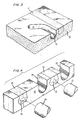
- FIG. 4 A second embodiment of the present invention is illustrated in FIG. 4, wherein two integrated waveguides at the edge of a substrate are shown with three-dimensional plots of the optical energy distribution (modes) from the waveguides.
- the integrated optical waveguides 30 and 32 couple to external optical waveguides, such as optical fibers 36 and 37 (each shown here as a core without cladding), for coupling optical energy to and from the optical fibers 36 and 37 and optical devices (not shown) on substrate 35.
- the two waveguides 30 and 32 are formed into substrate 35 using the materials and methods described above. A consequence of the diffusion process to make the waveguides 30 and 32 in substrate 35 is the semicircular shape of the resulting waveguides 30 and 32.
- the mode 31 of the optical energy from waveguide 30 is oval due to the semicircular shape of the waveguide 30.
- the mode of optical energy in the external optical fiber 36 is typically circular, coupling optical energy to or from the integrated optical waveguide 30 and the optical fiber 36 introduces coupling losses due to the different mode shapes.
- waveguide 32 having the same geometry as waveguide 30, the mode 33 of optical energy is more nearly circular.
- two grooves 34 disposed longitudinally along each side of the waveguide 32 and placed a predetermined distance therefrom, constrains the optical energy distribution 33 in waveguide 32 to be more circular.
- the mode 33 and the mode in the optical fiber are more similar, allowing lower coupling loss between them.
- optical fibers 36 and 37 need not have circular modes.
- other external waveguides such as integrated optical waveguides having a different geometry and mode from that of waveguides 30 and 32, may couple to waveguides 30 and 32.
- the grooves 34 are placed to constrain the mode 33 to approximate the mode in the external waveguide.
- the groove need not be filled with air.
- the groove may be at least partially filled with a solid material; however it is desirable that the index of refraction of the material be less than that of the substrate.
- the depth of the grooves in the substrate is desirably at least equal to the depth of the peak of the optical energy field to be constrained outside of the corresponding waveguide.
- forming the groove to a lesser depth is alternatively possible, with a corresponding reduction in the benefit obtained.
- the groove depth is at least 25% of the depth of the corresponding waveguide, and is usually greater than the depth of the waveguide.
Landscapes
- Physics & Mathematics (AREA)
- Engineering & Computer Science (AREA)
- Microelectronics & Electronic Packaging (AREA)
- General Physics & Mathematics (AREA)
- Optics & Photonics (AREA)
- Optical Integrated Circuits (AREA)
- Optical Couplings Of Light Guides (AREA)
Applications Claiming Priority (2)
| Application Number | Priority Date | Filing Date | Title |
|---|---|---|---|
| US34128 | 1987-04-02 | ||
| US07/034,128 US4810049A (en) | 1987-04-02 | 1987-04-02 | Reducing bend and coupling losses in integrated optical waveguides |
Publications (2)
| Publication Number | Publication Date |
|---|---|
| EP0285351A1 true EP0285351A1 (de) | 1988-10-05 |
| EP0285351B1 EP0285351B1 (de) | 1995-06-28 |
Family
ID=21874484
Family Applications (1)
| Application Number | Title | Priority Date | Filing Date |
|---|---|---|---|
| EP88302728A Expired - Lifetime EP0285351B1 (de) | 1987-04-02 | 1988-03-28 | Optische Wellenleitervorrichtung |
Country Status (4)
| Country | Link |
|---|---|
| US (1) | US4810049A (de) |
| EP (1) | EP0285351B1 (de) |
| JP (1) | JP2537800Y2 (de) |
| DE (1) | DE3854059T2 (de) |
Cited By (13)
| Publication number | Priority date | Publication date | Assignee | Title |
|---|---|---|---|---|
| EP0365724A1 (de) * | 1988-10-26 | 1990-05-02 | THE GENERAL ELECTRIC COMPANY, p.l.c. | Integrierte optische Wellenleiterkrümmung |
| GB2219871B (en) * | 1988-06-16 | 1992-05-27 | Marconi Gec Ltd | Integrated optic devices |
| EP0645649A3 (de) * | 1993-09-23 | 1995-05-17 | Siemens Ag | Gekrümmter streifenförmiger integriert optischer Wellenleiter. |
| EP0831343A3 (de) * | 1996-09-19 | 1998-04-01 | Siemens Aktiengesellschaft | Optischer Wellenleiter und Verfahren zu seiner Herstellung |
| EP0753958A3 (de) * | 1995-07-13 | 1998-11-04 | Sharp Kabushiki Kaisha | Kompakter optischer Abtaster vom Wellenleitertyp und Verfahren zur Herstellung desselben |
| EP0777138A3 (de) * | 1995-11-28 | 1998-11-11 | Mitsubishi Gas Chemical Company, Inc. | Gekrümmter optischer Wellenleiter und Verfahren zu dessen Herstellung |
| US6028973A (en) * | 1996-09-20 | 2000-02-22 | Siemens Aktiengesellschaft | Arrangement of two integrated optical waveguides on the surface of a substrate |
| EP0880037A3 (de) * | 1997-05-21 | 2000-08-02 | Nec Corporation | Wellenleiterelement, Wellenleiterverzweigung oder Kopplerelement und integrierter Wellenleiterschaltkreis |
| EP1054272A1 (de) * | 1999-05-21 | 2000-11-22 | BRITISH TELECOMMUNICATIONS public limited company | Wellenleiter- Array -Gitter mit Nuten |
| WO2000072062A1 (en) * | 1999-05-21 | 2000-11-30 | British Telecommunications Public Limited Company | Planar optical waveguides with grooves |
| EP1058135A1 (de) * | 1999-05-21 | 2000-12-06 | BRITISH TELECOMMUNICATIONS public limited company | Planarer optischer Siliziumdioxid Wellenleiter zwischen zwei Nuten |
| EP1058136A1 (de) * | 1999-05-21 | 2000-12-06 | BRITISH TELECOMMUNICATIONS public limited company | Planarer optischer Siliziumdioxid-Wellenleiter mit Nuten |
| US6512860B2 (en) | 2000-08-18 | 2003-01-28 | Danmarks Tekniske Universitet | Bent electro-absorption modulator |
Families Citing this family (18)
| Publication number | Priority date | Publication date | Assignee | Title |
|---|---|---|---|---|
| EP0347233A3 (de) * | 1988-06-16 | 1991-02-13 | Gec-Marconi Limited | Anordnung integrierter Optik |
| DE69031968T2 (de) * | 1989-10-26 | 1998-06-10 | Oki Electric Ind Co Ltd | Optischer Wellenleiterschalter |
| FR2663435B1 (fr) * | 1990-06-13 | 1992-09-11 | Commissariat Energie Atomique | Filtre optique spatial monomode integre et son procede de fabrication. |
| US5018811A (en) * | 1990-07-18 | 1991-05-28 | Northrop Corporation | Asymmetric optical waveguides for minimizing bending losses and techniques for fabricating same |
| US5685995A (en) * | 1994-11-22 | 1997-11-11 | Electro Scientific Industries, Inc. | Method for laser functional trimming of films and devices |
| US5471552A (en) * | 1995-02-22 | 1995-11-28 | Industrial Technology Research Institute | Fabrication of static-alignment fiber-guiding grooves for planar lightwave circuits |
| US6057180A (en) * | 1998-06-05 | 2000-05-02 | Electro Scientific Industries, Inc. | Method of severing electrically conductive links with ultraviolet laser output |
| KR100401203B1 (ko) * | 2001-11-13 | 2003-10-10 | 삼성전자주식회사 | 다항 곡선 광도파로를 구비한 평면 도파로 소자 |
| JP2004287093A (ja) * | 2003-03-20 | 2004-10-14 | Fujitsu Ltd | 光導波路、光デバイスおよび光導波路の製造方法 |
| US7609931B2 (en) * | 2003-04-18 | 2009-10-27 | Enablence, Inc. | Planar waveguide structure with tightly curved waveguides |
| US20040208465A1 (en) * | 2003-04-18 | 2004-10-21 | Yury Logvin | Planar waveguide structure with tightly curved waveguides |
| US7776236B2 (en) * | 2003-07-25 | 2010-08-17 | General Electric Company | Index contrast enhanced optical waveguides and fabrication methods |
| US7171085B2 (en) * | 2003-07-29 | 2007-01-30 | Jds Uniphase Corporation | Polarization compensated optical tap |
| US7653281B2 (en) * | 2004-09-02 | 2010-01-26 | Ramot At Tel-Aviv University Ltd. | Embedded channels, embedded waveguides and methods of manufacturing and using the same |
| JP2007328257A (ja) * | 2006-06-09 | 2007-12-20 | Fujitsu Ltd | 光導波路、光デバイスおよび光導波路の製造方法 |
| JP2008026374A (ja) * | 2006-07-18 | 2008-02-07 | Fujitsu Ltd | 光導波路、光デバイスおよび光導波路の製造方法 |
| JP5176150B2 (ja) * | 2009-01-13 | 2013-04-03 | 富士通株式会社 | 光デバイスおよび光送信器 |
| US10989872B1 (en) * | 2019-10-18 | 2021-04-27 | Globalfoundries U.S. Inc. | Waveguide bends with mode confinement |
Family Cites Families (2)
| Publication number | Priority date | Publication date | Assignee | Title |
|---|---|---|---|---|
| US4598039A (en) * | 1984-07-02 | 1986-07-01 | At&T Bell Laboratories | Formation of features in optical material |
| JPS61117513A (ja) * | 1984-11-13 | 1986-06-04 | Nippon Telegr & Teleph Corp <Ntt> | フアイバ.ガイド付光回路およびその製造方法 |
-
1987
- 1987-04-02 US US07/034,128 patent/US4810049A/en not_active Expired - Lifetime
-
1988
- 1988-03-28 EP EP88302728A patent/EP0285351B1/de not_active Expired - Lifetime
- 1988-03-28 DE DE3854059T patent/DE3854059T2/de not_active Expired - Fee Related
- 1988-03-30 JP JP1988041229U patent/JP2537800Y2/ja not_active Expired - Lifetime
Non-Patent Citations (3)
| Title |
|---|
| ELECTRONICS LETTERS, vol. 20, no. 25/26, December 1984, pages 1047-1048, Stevenage, Herts, GB; J. BRISTOW et al.: "Novel integrated optical polarisers using surface plasma waves and ion milled grooves in lithium niobate" * |
| FREQUENZ, vol. 35, no. 9, September 1981, pages 247-252, Berlin; K.-H. TIETGEN: "Probleme der Topographie integriert optischer Schaltungen" * |
| IEE PROCEEDINGS SECTION A à I, vol. 132, no. 22, part J, April 1985, pages 140-145, Old-Woking, Surrey, GB; P.C. KENDALL et al.: "Rib waveguide curvature loss: the scalar problem" * |
Cited By (19)
| Publication number | Priority date | Publication date | Assignee | Title |
|---|---|---|---|---|
| GB2219871B (en) * | 1988-06-16 | 1992-05-27 | Marconi Gec Ltd | Integrated optic devices |
| EP0365724A1 (de) * | 1988-10-26 | 1990-05-02 | THE GENERAL ELECTRIC COMPANY, p.l.c. | Integrierte optische Wellenleiterkrümmung |
| EP0645649A3 (de) * | 1993-09-23 | 1995-05-17 | Siemens Ag | Gekrümmter streifenförmiger integriert optischer Wellenleiter. |
| EP0753958A3 (de) * | 1995-07-13 | 1998-11-04 | Sharp Kabushiki Kaisha | Kompakter optischer Abtaster vom Wellenleitertyp und Verfahren zur Herstellung desselben |
| EP0777138A3 (de) * | 1995-11-28 | 1998-11-11 | Mitsubishi Gas Chemical Company, Inc. | Gekrümmter optischer Wellenleiter und Verfahren zu dessen Herstellung |
| EP0831343A3 (de) * | 1996-09-19 | 1998-04-01 | Siemens Aktiengesellschaft | Optischer Wellenleiter und Verfahren zu seiner Herstellung |
| US5982970A (en) * | 1996-09-19 | 1999-11-09 | Siemens Aktiengesellschaft | Planar optical waveguide having a core with a coating having a hollow space in the coating and a method for forming the waveguide |
| US6028973A (en) * | 1996-09-20 | 2000-02-22 | Siemens Aktiengesellschaft | Arrangement of two integrated optical waveguides on the surface of a substrate |
| EP0880037A3 (de) * | 1997-05-21 | 2000-08-02 | Nec Corporation | Wellenleiterelement, Wellenleiterverzweigung oder Kopplerelement und integrierter Wellenleiterschaltkreis |
| EP1054272A1 (de) * | 1999-05-21 | 2000-11-22 | BRITISH TELECOMMUNICATIONS public limited company | Wellenleiter- Array -Gitter mit Nuten |
| WO2000072062A1 (en) * | 1999-05-21 | 2000-11-30 | British Telecommunications Public Limited Company | Planar optical waveguides with grooves |
| WO2000072061A1 (en) * | 1999-05-21 | 2000-11-30 | British Telecommunications Public Limited Company | Planar optical waveguides with double grooves |
| WO2000072060A1 (en) * | 1999-05-21 | 2000-11-30 | British Telecommunications Public Limited Company | Making grooves in planar silica optical waveguides |
| EP1058135A1 (de) * | 1999-05-21 | 2000-12-06 | BRITISH TELECOMMUNICATIONS public limited company | Planarer optischer Siliziumdioxid Wellenleiter zwischen zwei Nuten |
| EP1058136A1 (de) * | 1999-05-21 | 2000-12-06 | BRITISH TELECOMMUNICATIONS public limited company | Planarer optischer Siliziumdioxid-Wellenleiter mit Nuten |
| US6571037B1 (en) | 1999-05-21 | 2003-05-27 | British Telecommunications Public Limited Company | Arrayed waveguide gratings |
| US6625371B1 (en) | 1999-05-21 | 2003-09-23 | British Telecommunications Public Limited Company | Planar optical waveguides with double grooves |
| US6773615B1 (en) | 1999-05-21 | 2004-08-10 | British Telecommunications Public Limited Company | Making grooves in planar waveguides |
| US6512860B2 (en) | 2000-08-18 | 2003-01-28 | Danmarks Tekniske Universitet | Bent electro-absorption modulator |
Also Published As
| Publication number | Publication date |
|---|---|
| DE3854059T2 (de) | 1996-02-01 |
| US4810049A (en) | 1989-03-07 |
| JP2537800Y2 (ja) | 1997-06-04 |
| EP0285351B1 (de) | 1995-06-28 |
| JPS6413010U (de) | 1989-01-24 |
| DE3854059D1 (de) | 1995-08-03 |
Similar Documents
| Publication | Publication Date | Title |
|---|---|---|
| US4810049A (en) | Reducing bend and coupling losses in integrated optical waveguides | |
| US6571039B1 (en) | Optical waveguide having a weakly-confining waveguide section and a strongly-confining waveguide section optically coupled by a tapered neck | |
| US6253015B1 (en) | Planar waveguides with high refractive index | |
| US3785718A (en) | Low dispersion optical fiber | |
| US6697551B2 (en) | Mode transformer between low index difference waveguide and high index difference waveguide | |
| US3912363A (en) | Optical fiber to planar waveguide coupler | |
| EP0078140B1 (de) | Fiberoptischer Registerspeicher ohne Klebestellen | |
| EP1705515A2 (de) | Gebogener Steglichtwellenleiter, Optisches-Gerät, und Herstellungsmethode | |
| US7693355B2 (en) | Hybrid electro-optic polymer/sol-gel modulator | |
| US3923373A (en) | Coupling to graded index waveguide | |
| US4787689A (en) | Devices having low loss curved or tapered optical waveguides | |
| US4988156A (en) | Bent waveguide for an optical integrated circuit | |
| US6501886B1 (en) | Compact optical splitter and combiner | |
| EP0880048B1 (de) | Akustooptische Modulatoren mit planaren Wellenleitern | |
| WO2003067291A1 (en) | Dielectric slab waveguides for input and output coupling | |
| US3887264A (en) | Optical fiber with asymmetric index profile | |
| Yoshimura et al. | Coupling ratio control of polymeric waveguide couplers by bending | |
| Zinke et al. | Theoretical and experimental investigation of optical couplers in SOI | |
| JP2788762B2 (ja) | 光回路 | |
| JP3013010B2 (ja) | 光ファイバ型偏光素子 | |
| Sheem et al. | High efficiency single-mode fiber/channel waveguide flip-chip coupling | |
| JPH05215937A (ja) | 光結合部品 | |
| Chen et al. | Vertical tapered mode size transformer in polymer waveguides for efficient fiber coupling | |
| Seki et al. | Two-step thermal ion exchange process for single-mode waveguides embedded in glass | |
| Laybourn | Monomode Optical Waveguide Connectors |
Legal Events
| Date | Code | Title | Description |
|---|---|---|---|
| PUAI | Public reference made under article 153(3) epc to a published international application that has entered the european phase |
Free format text: ORIGINAL CODE: 0009012 |
|
| AK | Designated contracting states |
Kind code of ref document: A1 Designated state(s): DE FR GB |
|
| 17P | Request for examination filed |
Effective date: 19890328 |
|
| 17Q | First examination report despatched |
Effective date: 19920221 |
|
| RAP3 | Party data changed (applicant data changed or rights of an application transferred) |
Owner name: AT&T CORP. |
|
| GRAA | (expected) grant |
Free format text: ORIGINAL CODE: 0009210 |
|
| AK | Designated contracting states |
Kind code of ref document: B1 Designated state(s): DE FR GB |
|
| REF | Corresponds to: |
Ref document number: 3854059 Country of ref document: DE Date of ref document: 19950803 |
|
| ET | Fr: translation filed | ||
| PLBE | No opposition filed within time limit |
Free format text: ORIGINAL CODE: 0009261 |
|
| STAA | Information on the status of an ep patent application or granted ep patent |
Free format text: STATUS: NO OPPOSITION FILED WITHIN TIME LIMIT |
|
| 26N | No opposition filed | ||
| PGFP | Annual fee paid to national office [announced via postgrant information from national office to epo] |
Ref country code: FR Payment date: 20010222 Year of fee payment: 14 |
|
| PGFP | Annual fee paid to national office [announced via postgrant information from national office to epo] |
Ref country code: DE Payment date: 20010330 Year of fee payment: 14 |
|
| REG | Reference to a national code |
Ref country code: GB Ref legal event code: IF02 |
|
| PG25 | Lapsed in a contracting state [announced via postgrant information from national office to epo] |
Ref country code: DE Free format text: LAPSE BECAUSE OF NON-PAYMENT OF DUE FEES Effective date: 20021001 |
|
| PG25 | Lapsed in a contracting state [announced via postgrant information from national office to epo] |
Ref country code: FR Free format text: LAPSE BECAUSE OF NON-PAYMENT OF DUE FEES Effective date: 20021129 |
|
| REG | Reference to a national code |
Ref country code: FR Ref legal event code: ST |
|
| PGFP | Annual fee paid to national office [announced via postgrant information from national office to epo] |
Ref country code: GB Payment date: 20070322 Year of fee payment: 20 |
|
| PG25 | Lapsed in a contracting state [announced via postgrant information from national office to epo] |
Ref country code: GB Free format text: LAPSE BECAUSE OF EXPIRATION OF PROTECTION Effective date: 20080327 |