EP0365724A1 - Integrierte optische Wellenleiterkrümmung - Google Patents
Integrierte optische Wellenleiterkrümmung Download PDFInfo
- Publication number
- EP0365724A1 EP0365724A1 EP88310044A EP88310044A EP0365724A1 EP 0365724 A1 EP0365724 A1 EP 0365724A1 EP 88310044 A EP88310044 A EP 88310044A EP 88310044 A EP88310044 A EP 88310044A EP 0365724 A1 EP0365724 A1 EP 0365724A1
- Authority
- EP
- European Patent Office
- Prior art keywords
- waveguide
- optic device
- integrated optic
- edge guide
- guide region
- Prior art date
- Legal status (The legal status is an assumption and is not a legal conclusion. Google has not performed a legal analysis and makes no representation as to the accuracy of the status listed.)
- Withdrawn
Links
- 230000003287 optical effect Effects 0.000 title description 4
- 239000000463 material Substances 0.000 claims abstract description 21
- 239000000758 substrate Substances 0.000 claims description 10
- 230000005540 biological transmission Effects 0.000 claims description 3
- 238000004519 manufacturing process Methods 0.000 claims description 3
- 230000001419 dependent effect Effects 0.000 claims 1
- 238000009826 distribution Methods 0.000 description 10
- GPXJNWSHGFTCBW-UHFFFAOYSA-N Indium phosphide Chemical compound [In]#P GPXJNWSHGFTCBW-UHFFFAOYSA-N 0.000 description 8
- 238000005253 cladding Methods 0.000 description 2
- 230000008878 coupling Effects 0.000 description 2
- 238000010168 coupling process Methods 0.000 description 2
- 238000005859 coupling reaction Methods 0.000 description 2
- GQYHUHYESMUTHG-UHFFFAOYSA-N lithium niobate Chemical compound [Li+].[O-][Nb](=O)=O GQYHUHYESMUTHG-UHFFFAOYSA-N 0.000 description 2
- 238000000034 method Methods 0.000 description 2
- 229910000530 Gallium indium arsenide Inorganic materials 0.000 description 1
- RTAQQCXQSZGOHL-UHFFFAOYSA-N Titanium Chemical compound [Ti] RTAQQCXQSZGOHL-UHFFFAOYSA-N 0.000 description 1
- KXNLCSXBJCPWGL-UHFFFAOYSA-N [Ga].[As].[In] Chemical compound [Ga].[As].[In] KXNLCSXBJCPWGL-UHFFFAOYSA-N 0.000 description 1
- 238000000151 deposition Methods 0.000 description 1
- 230000008021 deposition Effects 0.000 description 1
- 238000010586 diagram Methods 0.000 description 1
- 230000000694 effects Effects 0.000 description 1
- 238000005530 etching Methods 0.000 description 1
- 239000007943 implant Substances 0.000 description 1
- 230000010354 integration Effects 0.000 description 1
- 238000002488 metal-organic chemical vapour deposition Methods 0.000 description 1
- 238000012856 packing Methods 0.000 description 1
- 229910052719 titanium Inorganic materials 0.000 description 1
- 239000010936 titanium Substances 0.000 description 1
Images



Classifications
-
- G—PHYSICS
- G02—OPTICS
- G02B—OPTICAL ELEMENTS, SYSTEMS OR APPARATUS
- G02B6/00—Light guides; Structural details of arrangements comprising light guides and other optical elements, e.g. couplings
- G02B6/10—Light guides; Structural details of arrangements comprising light guides and other optical elements, e.g. couplings of the optical waveguide type
- G02B6/12—Light guides; Structural details of arrangements comprising light guides and other optical elements, e.g. couplings of the optical waveguide type of the integrated circuit kind
- G02B6/122—Basic optical elements, e.g. light-guiding paths
- G02B6/125—Bends, branchings or intersections
Definitions
- This invention relates to an integrated optic device comprising a strip-like waveguide having a bend in its own plane.
- Waveguides must be able to corner in order to accommodate offsets in practical structures; the optimum packing of devices onto a substrate often requires the various devices to lie at differing angles relative to one another, and since such structures are typically long and thin it is necessary to provide large offsets or angular deviations over relatively short distances.
- Waveguide structures vary in the degree to which they confine the light.
- smooth curves have been used to reduce light power loss at bends
- proton exchange (PE) implants along the inner edges of the curves have been used to reduce bend radii considerably.
- PE proton exchange
- the increased refractive index on the inside of the curves slows the wave down in these regions and re-orientates the phase front as the wave progresses around the bend.
- simple S-shaped curves can be as lossy as discrete bends.
- the invention provides an integrated optic device comprising an integrated optic waveguide of a first effective refractive index greater than that of a material or materials in which it is embedded to provide for the guiding of light along the waveguide, the waveguide having a bend in a principal plane, and an edge guide region, of a second effective refractive index also greater than that of the surrounding material or materials, positioned in the principal plane adjacent the outside of the bend such as to decrease the light loss from the waveguide which would otherwise occur at the bend without the edge guide region.
- the term "effective refractive index" has the meaning defined in: "Integrated Circuits for the Millimetre Wave through Optical Frequency Range", R.M. Knox and P.P. Toulios, Proc. Symp. on Submillimetre Waves, Brooklyn, New York, Polytechnic Press, pages 497-516 (1970). Briefly, the effective refractive index is that of a two-dimensional complex structure when viewed in one dimension only; in this case, the effective refractive index of parts of the device is that obtained when the device is viewed in a direction normal to the principal plane.
- the effectiveness of the edge guide region at reducing power loss at the bend is greatest if the said second effective refractive index is greater than the first effective refractive index.
- the surprising ability of the edge guide region to resist the coupling of light and thus to confine the light to the bend (and possibly also to a gap between the bend and the edge guide region) appears to derive from some form of directional coupling under extreme ⁇ ; because of the phase mismatch, very little light couples into the edge guide region.
- the light-confining effect appears to be largely destroyed when the edge guide region is made too wide in the said plane, and accordingly the edge guide region is preferably of such a narrow width that it cannot support multimode transmission of light at the wavelengths for which the waveguide is appropriate.
- the edge guide region is preferably strip-like, and preferably of a width less than but of the order of the waveguide width.
- the waveguides illustrated comprise two opposite bends sufficient to provide an offset, transverse to the lengthwise direction, of 70 microns over a length of 2000 microns.
- the waveguides are 7 microns wide and each bend, or pair of coupled bends, subtends an angle of 2°.
- the overall integrated optic device comprises a substrate (20, Fig. 2) of indium phosphide of n+ doping superimposed with a cladding layer (21, Fig. 2) of indium phosphide with n- doping.
- a thin guiding layer 22 of quaternary material such as indium gallium arsenide phosphide, overlies the n- cladding layer, and a substrate 23 of the indium phosphide with n- doping is superimposed on the quaternary guiding layer.
- the quaternary layer whose refractive index may for example be 3.38, is sandwiched between the layers of indium phosphide with n- doping whose refractive index may be for example 3.17. This provides a relatively strong confinement of optical waves in the quaternary layer.
- corresponding strips 24 of quaternary material are formed over the main quaternary layer 22 in place of the indium phosphide n- superstrate material.
- the thickness t of the strips of quaternary material and the narrow "etch stop" spacing e between the strips 24 and the main quaternary layer 22 determine the effective refractive index n ew of the waveguide: thicker overlying layers of quaternary material give rise to higher effective refractive indices.
- a 2-tier pattern (24,26;25 (Fig. 2)) of quaternary material overlies the main quaternary layer.
- a conventional waveguide with two abrupt bends 10,20 comprises two parallel portions 1,3 joined by an intermediate portion 2 inclined at 2°.
- a light beam of the power distribution shown in Figure 1c is applied across the device across the line c-c of Figure 1a, and the measured output power along the line b-b of Figure 1a is shown in Figure 1b.
- a crude indication, obtained in two dimensions only (using the beam propagation method), of the power distribution in the illustrated portion of the device is illustrated in the form of shading in Figure 1a, in which heavier-shaded regions represent regions of greater light intensity. It will be appreciated from Figure 1a that substantial power loss occurs at both bends.
- the power distribution is integrated in the transverse section b-b over the region close to the waveguide labelled "INT" in Figures 1a and 1b.
- the value of the integration is represented as the shaded area under the graph of Figure 1b.
- This integrated value, representative of the total power loss, is expressed as a fraction of the input power in terms of decibels (dB) in Table 1 below.
- dB decibels
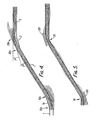
- FIG. 5 The invention is first illustrated in Figure 5, in which two edge guide regions 100, 200 are positioned in the plane of the waveguide adjacent to the outside of each bend.
- the cross-section through the waveguide at a bend is shown diagrammatically in Fig. 2.
- the waveguide of Figures 2 and 5 is otherwise identical to that of Figure 3, each bend being provided with a 400 micron chamfer.
- Table 1 a dramatic improvement is found in limiting the power loss, which can only be attributed to the presence of the edge guide regions.
- Each edge guide region 100,200 22c, Fig.
- a space 22b is provided in the quaternary layer between the waveguide and the edge guide region.
- the edge guide region is a rectangular strip 2 microns wide with a space of 3 microns from the waveguide.
- the edge guide region extends lengthwise of the waveguide over a distance of the order of the length of the chamfer, parallel to the chamfer.
- Figure 6a illustrates the use of edge guide regions 100,200 on the waveguide of Figure 4, with two pairs of coupled bends 10a,10b and 20a,20b.
- This configuration as shown in Table 1, provides the best performance, giving rise to the power distribution shown in Figure 6b.
- edge guide region may take many forms other than a simple rectangle. Further, it may not be essential to provide a space between the edge guide region and the waveguide. Examples of alternative configurations are shown in Figures 7 and 8. Figure 8 shows one example of an edge guide region which follows the contour of the bend.
- edge guide regions 100,200 etc. for the various waveguides will not necessitate any extra fabrication steps.
- One particular example is the 2-mode interferometer in which the pairs of input and output channels have lower effective refractive indexes than the common central channel.
- Such devices are formed by the selective removal of one or both tiers of the 2-tier structure, using conventional etching techniques, and/or by the selective deposition of such layers.
- the waveguides and any other portions of the quaternary layer which are overlain by only one further layer of quaternary material have an effective refractive index which is 0.00164 greater than that of the remainder of the quaternary layer, and the edge guide regions, and any other portions of the quaternary layer which are overlain by both extra layers of quaternary material, have an effective refractive index which is 0.016 greater.
- the refractive index difference is approximately ten times greater for the edge guide regions than it is for the waveguides.
- ratios other than 1:10 are envisaged, for example ratios of from 1:2 to 1:20: edge guide regions could even be effective if they have the same effective refractive index as that of the waveguide, i.e. with a ratio of 1 to 1.
- the invention has been illustrated with strip-like waveguides in which light propagates in a very thin, flat channel, the invention is applicable to integrated optic waveguides of other configurations, such as channels formed in Lithium Niobate.
Landscapes
- Physics & Mathematics (AREA)
- Engineering & Computer Science (AREA)
- Microelectronics & Electronic Packaging (AREA)
- General Physics & Mathematics (AREA)
- Optics & Photonics (AREA)
- Optical Integrated Circuits (AREA)
Priority Applications (2)
| Application Number | Priority Date | Filing Date | Title |
|---|---|---|---|
| EP88310044A EP0365724A1 (de) | 1988-10-26 | 1988-10-26 | Integrierte optische Wellenleiterkrümmung |
| US07/264,349 US4906062A (en) | 1988-10-26 | 1988-10-31 | Integrated optical waveguide bend |
Applications Claiming Priority (1)
| Application Number | Priority Date | Filing Date | Title |
|---|---|---|---|
| EP88310044A EP0365724A1 (de) | 1988-10-26 | 1988-10-26 | Integrierte optische Wellenleiterkrümmung |
Publications (1)
| Publication Number | Publication Date |
|---|---|
| EP0365724A1 true EP0365724A1 (de) | 1990-05-02 |
Family
ID=8200261
Family Applications (1)
| Application Number | Title | Priority Date | Filing Date |
|---|---|---|---|
| EP88310044A Withdrawn EP0365724A1 (de) | 1988-10-26 | 1988-10-26 | Integrierte optische Wellenleiterkrümmung |
Country Status (2)
| Country | Link |
|---|---|
| US (1) | US4906062A (de) |
| EP (1) | EP0365724A1 (de) |
Cited By (4)
| Publication number | Priority date | Publication date | Assignee | Title |
|---|---|---|---|---|
| WO1993013729A1 (de) * | 1992-01-15 | 1993-07-22 | MAX-PLANCK-Gesellschaft zur Förderung der Wissenschaften e.V. | Vorrichtung zur erhöhung der lichtintensität am ende von lichtwellenleitern |
| EP0777138A3 (de) * | 1995-11-28 | 1998-11-11 | Mitsubishi Gas Chemical Company, Inc. | Gekrümmter optischer Wellenleiter und Verfahren zu dessen Herstellung |
| EP0880037A3 (de) * | 1997-05-21 | 2000-08-02 | Nec Corporation | Wellenleiterelement, Wellenleiterverzweigung oder Kopplerelement und integrierter Wellenleiterschaltkreis |
| US6243525B1 (en) | 1998-02-13 | 2001-06-05 | Jds Uniphase Photonics C.V. | Optical waveguide device comprising at least one bent waveguide channel |
Families Citing this family (21)
| Publication number | Priority date | Publication date | Assignee | Title |
|---|---|---|---|---|
| EP0347233A3 (de) * | 1988-06-16 | 1991-02-13 | Gec-Marconi Limited | Anordnung integrierter Optik |
| DE69031968T2 (de) * | 1989-10-26 | 1998-06-10 | Oki Electric Ind Co Ltd | Optischer Wellenleiterschalter |
| US5018811A (en) * | 1990-07-18 | 1991-05-28 | Northrop Corporation | Asymmetric optical waveguides for minimizing bending losses and techniques for fabricating same |
| US8272758B2 (en) * | 2005-06-07 | 2012-09-25 | Oree, Inc. | Illumination apparatus and methods of forming the same |
| US8215815B2 (en) * | 2005-06-07 | 2012-07-10 | Oree, Inc. | Illumination apparatus and methods of forming the same |
| US8128272B2 (en) | 2005-06-07 | 2012-03-06 | Oree, Inc. | Illumination apparatus |
| US20090001397A1 (en) * | 2007-05-29 | 2009-01-01 | Oree, Advanced Illumiation Solutions Inc. | Method and device for providing circumferential illumination |
| US8550684B2 (en) * | 2007-12-19 | 2013-10-08 | Oree, Inc. | Waveguide-based packaging structures and methods for discrete lighting elements |
| US7929816B2 (en) | 2007-12-19 | 2011-04-19 | Oree, Inc. | Waveguide sheet containing in-coupling, propagation, and out-coupling regions |
| US8231237B2 (en) * | 2008-03-05 | 2012-07-31 | Oree, Inc. | Sub-assembly and methods for forming the same |
| US8301002B2 (en) * | 2008-07-10 | 2012-10-30 | Oree, Inc. | Slim waveguide coupling apparatus and method |
| US8297786B2 (en) | 2008-07-10 | 2012-10-30 | Oree, Inc. | Slim waveguide coupling apparatus and method |
| US20100098377A1 (en) * | 2008-10-16 | 2010-04-22 | Noam Meir | Light confinement using diffusers |
| US20100208470A1 (en) * | 2009-02-10 | 2010-08-19 | Yosi Shani | Overlapping illumination surfaces with reduced linear artifacts |
| US8624527B1 (en) | 2009-03-27 | 2014-01-07 | Oree, Inc. | Independently controllable illumination device |
| US20100320904A1 (en) * | 2009-05-13 | 2010-12-23 | Oree Inc. | LED-Based Replacement Lamps for Incandescent Fixtures |
| WO2010150202A2 (en) | 2009-06-24 | 2010-12-29 | Oree, Advanced Illumination Solutions Inc. | Illumination apparatus with high conversion efficiency and methods of forming the same |
| US8591072B2 (en) | 2011-11-16 | 2013-11-26 | Oree, Inc. | Illumination apparatus confining light by total internal reflection and methods of forming the same |
| WO2014006501A1 (en) | 2012-07-03 | 2014-01-09 | Yosi Shani | Planar remote phosphor illumination apparatus |
| CN108371535A (zh) * | 2018-01-26 | 2018-08-07 | 重庆金山医疗器械有限公司 | 内窥镜多色照明系统 |
| US10989872B1 (en) * | 2019-10-18 | 2021-04-27 | Globalfoundries U.S. Inc. | Waveguide bends with mode confinement |
Citations (1)
| Publication number | Priority date | Publication date | Assignee | Title |
|---|---|---|---|---|
| EP0285351A1 (de) * | 1987-04-02 | 1988-10-05 | AT&T Corp. | Optische Wellenleitervorrichtung |
-
1988
- 1988-10-26 EP EP88310044A patent/EP0365724A1/de not_active Withdrawn
- 1988-10-31 US US07/264,349 patent/US4906062A/en not_active Expired - Fee Related
Patent Citations (1)
| Publication number | Priority date | Publication date | Assignee | Title |
|---|---|---|---|---|
| EP0285351A1 (de) * | 1987-04-02 | 1988-10-05 | AT&T Corp. | Optische Wellenleitervorrichtung |
Non-Patent Citations (3)
| Title |
|---|
| 7TH EUROPEAN CONFERENCE ON OPTICAL COMMUNICATIONS, Copenhagen, 8th-11th September 1981, Conference Proceedeings, paper 9.3, pages 1-4; E.-G. NEUMANN: "Dielectric optical waveguide tilts with reduced losses" * |
| ELECTRONICS LETTERS, vol. 23, no. 15, 16th July 1987, pages 797-798, Stevenage, Herts, GB; B. SCHÜPPERT: "Reduction of bend losses in Ti: LiNbO3 waveguides through MgO double diffusion" * |
| OPTICS LETTERS, vol. 11, no. 11, November 1986, pages 736-738, Optical Society of America, New York, US; T. SHIINA et al.: "Waveguide-bend configuration with low-loss characteristics" * |
Cited By (4)
| Publication number | Priority date | Publication date | Assignee | Title |
|---|---|---|---|---|
| WO1993013729A1 (de) * | 1992-01-15 | 1993-07-22 | MAX-PLANCK-Gesellschaft zur Förderung der Wissenschaften e.V. | Vorrichtung zur erhöhung der lichtintensität am ende von lichtwellenleitern |
| EP0777138A3 (de) * | 1995-11-28 | 1998-11-11 | Mitsubishi Gas Chemical Company, Inc. | Gekrümmter optischer Wellenleiter und Verfahren zu dessen Herstellung |
| EP0880037A3 (de) * | 1997-05-21 | 2000-08-02 | Nec Corporation | Wellenleiterelement, Wellenleiterverzweigung oder Kopplerelement und integrierter Wellenleiterschaltkreis |
| US6243525B1 (en) | 1998-02-13 | 2001-06-05 | Jds Uniphase Photonics C.V. | Optical waveguide device comprising at least one bent waveguide channel |
Also Published As
| Publication number | Publication date |
|---|---|
| US4906062A (en) | 1990-03-06 |
Similar Documents
| Publication | Publication Date | Title |
|---|---|---|
| US4906062A (en) | Integrated optical waveguide bend | |
| US5078516A (en) | Tapered rib waveguides | |
| DE69228422T2 (de) | Optischer Isolator für Wellenleiter | |
| US4999686A (en) | Semiconductor device comprising an integrated optical guide, which has at least one rectilinear part and one curved part | |
| US6069729A (en) | High speed electro-optic modulator | |
| US9874692B2 (en) | Substrate-type optical waveguide element and method for producing substrate-type optical waveguide element | |
| EP0782020A2 (de) | Optischer Wellenlängen-Filterkreis und sein Herstellungsverfahren | |
| EP1207409A1 (de) | Polarisations- und wellenlängenunabhängiger optischer Leistungsteilerschaltkreis | |
| US9075192B2 (en) | Optical waveguide splitter | |
| US6181848B1 (en) | Temperature-independent optical multiplexer and/or demultiplexer | |
| EP0256388B1 (de) | Optischer Multi/Demultiplexer | |
| CA2177203A1 (en) | Integrated waveguide having an internal optical grating | |
| US6480640B1 (en) | Integrated optical circuit device and method for producing the same | |
| Korotky et al. | Greatly reduced losses for small‐radius bends in Ti: LiNbO3 waveguides | |
| KR940003738B1 (ko) | 광학 도파관을 갖는 광소자와 그 제조방법 | |
| EP0218381B1 (de) | Optische Wellenleitergeräte | |
| JPH05196826A (ja) | 光カプラおよびその製造方法 | |
| JPH07253515A (ja) | 光学導波路の変換器とその製造方法 | |
| EP0753769A2 (de) | Integrierter optischer Modenwandler | |
| JP3877973B2 (ja) | 接続型光導波路 | |
| Winick | Design of grating-assisted waveguide couplers with weighted coupling | |
| CA2253563C (en) | Optical power divider and fabrication method thereof | |
| GB2209844A (en) | Integrated optical waveguide bend having an edge guide | |
| JPH07168146A (ja) | スポット変換光導波路 | |
| US20230341637A1 (en) | Waveguides and edge couplers with multiple-thickness waveguide cores |
Legal Events
| Date | Code | Title | Description |
|---|---|---|---|
| PUAI | Public reference made under article 153(3) epc to a published international application that has entered the european phase |
Free format text: ORIGINAL CODE: 0009012 |
|
| 17P | Request for examination filed |
Effective date: 19890825 |
|
| AK | Designated contracting states |
Kind code of ref document: A1 Designated state(s): AT BE CH DE ES FR GR IT LI LU NL SE |
|
| STAA | Information on the status of an ep patent application or granted ep patent |
Free format text: STATUS: THE APPLICATION IS DEEMED TO BE WITHDRAWN |
|
| 18D | Application deemed to be withdrawn |
Effective date: 19920501 |