EP0286200A2 - Vecteur de clonage d'ADN avec des plasmides excisables in vivo - Google Patents
Vecteur de clonage d'ADN avec des plasmides excisables in vivo Download PDFInfo
- Publication number
- EP0286200A2 EP0286200A2 EP88300224A EP88300224A EP0286200A2 EP 0286200 A2 EP0286200 A2 EP 0286200A2 EP 88300224 A EP88300224 A EP 88300224A EP 88300224 A EP88300224 A EP 88300224A EP 0286200 A2 EP0286200 A2 EP 0286200A2
- Authority
- EP
- European Patent Office
- Prior art keywords
- dna
- sequences
- initiator
- vector
- terminator
- Prior art date
- Legal status (The legal status is an assumption and is not a legal conclusion. Google has not performed a legal analysis and makes no representation as to the accuracy of the status listed.)
- Granted
Links
- 239000013612 plasmid Substances 0.000 title claims description 68
- 238000001727 in vivo Methods 0.000 title abstract description 3
- 239000013599 cloning vector Substances 0.000 title description 13
- 108020004414 DNA Proteins 0.000 claims abstract description 205
- 239000013598 vector Substances 0.000 claims abstract description 130
- 238000000034 method Methods 0.000 claims abstract description 79
- 108091028043 Nucleic acid sequence Proteins 0.000 claims abstract description 57
- 238000010367 cloning Methods 0.000 claims abstract description 46
- 230000003362 replicative effect Effects 0.000 claims abstract description 6
- 239000003999 initiator Substances 0.000 claims description 122
- 239000012634 fragment Substances 0.000 claims description 105
- 108700007698 Genetic Terminator Regions Proteins 0.000 claims description 60
- 108090000623 proteins and genes Proteins 0.000 claims description 52
- 210000004027 cell Anatomy 0.000 claims description 47
- 230000010076 replication Effects 0.000 claims description 34
- 239000000523 sample Substances 0.000 claims description 29
- 230000009191 jumping Effects 0.000 claims description 24
- 241001515965 unidentified phage Species 0.000 claims description 22
- 108091008146 restriction endonucleases Proteins 0.000 claims description 18
- 102000004169 proteins and genes Human genes 0.000 claims description 14
- 230000006820 DNA synthesis Effects 0.000 claims description 13
- 102000004190 Enzymes Human genes 0.000 claims description 12
- 108090000790 Enzymes Proteins 0.000 claims description 12
- 108091034117 Oligonucleotide Proteins 0.000 claims description 11
- 241000700605 Viruses Species 0.000 claims description 6
- 241000894006 Bacteria Species 0.000 claims description 5
- 210000000349 chromosome Anatomy 0.000 claims description 5
- 238000005520 cutting process Methods 0.000 claims description 5
- 238000013507 mapping Methods 0.000 claims description 5
- 108090000626 DNA-directed RNA polymerases Proteins 0.000 claims description 4
- 102000004163 DNA-directed RNA polymerases Human genes 0.000 claims description 4
- 241000702371 Enterobacteria phage f1 Species 0.000 claims description 3
- JLCPHMBAVCMARE-UHFFFAOYSA-N [3-[[3-[[3-[[3-[[3-[[3-[[3-[[3-[[3-[[3-[[3-[[5-(2-amino-6-oxo-1H-purin-9-yl)-3-[[3-[[3-[[3-[[3-[[3-[[5-(2-amino-6-oxo-1H-purin-9-yl)-3-[[5-(2-amino-6-oxo-1H-purin-9-yl)-3-hydroxyoxolan-2-yl]methoxy-hydroxyphosphoryl]oxyoxolan-2-yl]methoxy-hydroxyphosphoryl]oxy-5-(5-methyl-2,4-dioxopyrimidin-1-yl)oxolan-2-yl]methoxy-hydroxyphosphoryl]oxy-5-(6-aminopurin-9-yl)oxolan-2-yl]methoxy-hydroxyphosphoryl]oxy-5-(6-aminopurin-9-yl)oxolan-2-yl]methoxy-hydroxyphosphoryl]oxy-5-(6-aminopurin-9-yl)oxolan-2-yl]methoxy-hydroxyphosphoryl]oxy-5-(6-aminopurin-9-yl)oxolan-2-yl]methoxy-hydroxyphosphoryl]oxyoxolan-2-yl]methoxy-hydroxyphosphoryl]oxy-5-(5-methyl-2,4-dioxopyrimidin-1-yl)oxolan-2-yl]methoxy-hydroxyphosphoryl]oxy-5-(4-amino-2-oxopyrimidin-1-yl)oxolan-2-yl]methoxy-hydroxyphosphoryl]oxy-5-(5-methyl-2,4-dioxopyrimidin-1-yl)oxolan-2-yl]methoxy-hydroxyphosphoryl]oxy-5-(5-methyl-2,4-dioxopyrimidin-1-yl)oxolan-2-yl]methoxy-hydroxyphosphoryl]oxy-5-(6-aminopurin-9-yl)oxolan-2-yl]methoxy-hydroxyphosphoryl]oxy-5-(6-aminopurin-9-yl)oxolan-2-yl]methoxy-hydroxyphosphoryl]oxy-5-(4-amino-2-oxopyrimidin-1-yl)oxolan-2-yl]methoxy-hydroxyphosphoryl]oxy-5-(4-amino-2-oxopyrimidin-1-yl)oxolan-2-yl]methoxy-hydroxyphosphoryl]oxy-5-(4-amino-2-oxopyrimidin-1-yl)oxolan-2-yl]methoxy-hydroxyphosphoryl]oxy-5-(6-aminopurin-9-yl)oxolan-2-yl]methoxy-hydroxyphosphoryl]oxy-5-(4-amino-2-oxopyrimidin-1-yl)oxolan-2-yl]methyl [5-(6-aminopurin-9-yl)-2-(hydroxymethyl)oxolan-3-yl] hydrogen phosphate Polymers Cc1cn(C2CC(OP(O)(=O)OCC3OC(CC3OP(O)(=O)OCC3OC(CC3O)n3cnc4c3nc(N)[nH]c4=O)n3cnc4c3nc(N)[nH]c4=O)C(COP(O)(=O)OC3CC(OC3COP(O)(=O)OC3CC(OC3COP(O)(=O)OC3CC(OC3COP(O)(=O)OC3CC(OC3COP(O)(=O)OC3CC(OC3COP(O)(=O)OC3CC(OC3COP(O)(=O)OC3CC(OC3COP(O)(=O)OC3CC(OC3COP(O)(=O)OC3CC(OC3COP(O)(=O)OC3CC(OC3COP(O)(=O)OC3CC(OC3COP(O)(=O)OC3CC(OC3COP(O)(=O)OC3CC(OC3COP(O)(=O)OC3CC(OC3COP(O)(=O)OC3CC(OC3COP(O)(=O)OC3CC(OC3COP(O)(=O)OC3CC(OC3CO)n3cnc4c(N)ncnc34)n3ccc(N)nc3=O)n3cnc4c(N)ncnc34)n3ccc(N)nc3=O)n3ccc(N)nc3=O)n3ccc(N)nc3=O)n3cnc4c(N)ncnc34)n3cnc4c(N)ncnc34)n3cc(C)c(=O)[nH]c3=O)n3cc(C)c(=O)[nH]c3=O)n3ccc(N)nc3=O)n3cc(C)c(=O)[nH]c3=O)n3cnc4c3nc(N)[nH]c4=O)n3cnc4c(N)ncnc34)n3cnc4c(N)ncnc34)n3cnc4c(N)ncnc34)n3cnc4c(N)ncnc34)O2)c(=O)[nH]c1=O JLCPHMBAVCMARE-UHFFFAOYSA-N 0.000 claims description 3
- 206010059866 Drug resistance Diseases 0.000 claims description 2
- 241000206602 Eukaryota Species 0.000 claims description 2
- 108091092195 Intron Proteins 0.000 claims 1
- 108020005202 Viral DNA Proteins 0.000 claims 1
- 108020004707 nucleic acids Proteins 0.000 claims 1
- 102000039446 nucleic acids Human genes 0.000 claims 1
- 150000007523 nucleic acids Chemical class 0.000 claims 1
- 239000013605 shuttle vector Substances 0.000 claims 1
- 241000701959 Escherichia virus Lambda Species 0.000 abstract description 14
- 238000003780 insertion Methods 0.000 description 13
- 230000037431 insertion Effects 0.000 description 13
- 230000000694 effects Effects 0.000 description 12
- 102000053602 DNA Human genes 0.000 description 11
- 229960000723 ampicillin Drugs 0.000 description 11
- AVKUERGKIZMTKX-NJBDSQKTSA-N ampicillin Chemical compound C1([C@@H](N)C(=O)N[C@H]2[C@H]3SC([C@@H](N3C2=O)C(O)=O)(C)C)=CC=CC=C1 AVKUERGKIZMTKX-NJBDSQKTSA-N 0.000 description 11
- 239000002773 nucleotide Substances 0.000 description 11
- 125000003729 nucleotide group Chemical group 0.000 description 11
- 230000000875 corresponding effect Effects 0.000 description 10
- 241000588724 Escherichia coli Species 0.000 description 9
- 238000006243 chemical reaction Methods 0.000 description 9
- 239000002299 complementary DNA Substances 0.000 description 9
- CSNNHWWHGAXBCP-UHFFFAOYSA-L Magnesium sulfate Chemical compound [Mg+2].[O-][S+2]([O-])([O-])[O-] CSNNHWWHGAXBCP-UHFFFAOYSA-L 0.000 description 8
- 230000000977 initiatory effect Effects 0.000 description 8
- 238000002955 isolation Methods 0.000 description 8
- 238000004806 packaging method and process Methods 0.000 description 8
- 108091032973 (ribonucleotides)n+m Proteins 0.000 description 6
- 102000003960 Ligases Human genes 0.000 description 6
- 108090000364 Ligases Proteins 0.000 description 6
- 238000003776 cleavage reaction Methods 0.000 description 6
- 230000029087 digestion Effects 0.000 description 6
- 238000004519 manufacturing process Methods 0.000 description 6
- 239000003550 marker Substances 0.000 description 6
- 239000000203 mixture Substances 0.000 description 6
- 230000008569 process Effects 0.000 description 6
- 230000007017 scission Effects 0.000 description 6
- 229920001817 Agar Polymers 0.000 description 5
- 108020004682 Single-Stranded DNA Proteins 0.000 description 5
- 239000008272 agar Substances 0.000 description 5
- 230000003466 anti-cipated effect Effects 0.000 description 5
- 239000000463 material Substances 0.000 description 5
- 230000000644 propagated effect Effects 0.000 description 5
- QKNYBSVHEMOAJP-UHFFFAOYSA-N 2-amino-2-(hydroxymethyl)propane-1,3-diol;hydron;chloride Chemical compound Cl.OCC(N)(CO)CO QKNYBSVHEMOAJP-UHFFFAOYSA-N 0.000 description 4
- 102000002260 Alkaline Phosphatase Human genes 0.000 description 4
- 108020004774 Alkaline Phosphatase Proteins 0.000 description 4
- HEDRZPFGACZZDS-UHFFFAOYSA-N Chloroform Chemical compound ClC(Cl)Cl HEDRZPFGACZZDS-UHFFFAOYSA-N 0.000 description 4
- TWRXJAOTZQYOKJ-UHFFFAOYSA-L Magnesium chloride Chemical compound [Mg+2].[Cl-].[Cl-] TWRXJAOTZQYOKJ-UHFFFAOYSA-L 0.000 description 4
- 239000000872 buffer Substances 0.000 description 4
- 244000309466 calf Species 0.000 description 4
- 238000010276 construction Methods 0.000 description 4
- 238000001514 detection method Methods 0.000 description 4
- 238000005516 engineering process Methods 0.000 description 4
- 239000000499 gel Substances 0.000 description 4
- 229930027917 kanamycin Natural products 0.000 description 4
- 229960000318 kanamycin Drugs 0.000 description 4
- SBUJHOSQTJFQJX-NOAMYHISSA-N kanamycin Chemical compound O[C@@H]1[C@@H](O)[C@H](O)[C@@H](CN)O[C@@H]1O[C@H]1[C@H](O)[C@@H](O[C@@H]2[C@@H]([C@@H](N)[C@H](O)[C@@H](CO)O2)O)[C@H](N)C[C@@H]1N SBUJHOSQTJFQJX-NOAMYHISSA-N 0.000 description 4
- 229930182823 kanamycin A Natural products 0.000 description 4
- 229910052943 magnesium sulfate Inorganic materials 0.000 description 4
- 235000019341 magnesium sulphate Nutrition 0.000 description 4
- 239000000047 product Substances 0.000 description 4
- 108020004638 Circular DNA Proteins 0.000 description 3
- LFQSCWFLJHTTHZ-UHFFFAOYSA-N Ethanol Chemical compound CCO LFQSCWFLJHTTHZ-UHFFFAOYSA-N 0.000 description 3
- 241000724791 Filamentous phage Species 0.000 description 3
- 239000003391 RNA probe Substances 0.000 description 3
- 101710137500 T7 RNA polymerase Proteins 0.000 description 3
- 238000013459 approach Methods 0.000 description 3
- 230000001580 bacterial effect Effects 0.000 description 3
- 108010028263 bacteriophage T3 RNA polymerase Proteins 0.000 description 3
- 230000015572 biosynthetic process Effects 0.000 description 3
- 239000013611 chromosomal DNA Substances 0.000 description 3
- 238000010586 diagram Methods 0.000 description 3
- 229940079593 drug Drugs 0.000 description 3
- 239000003814 drug Substances 0.000 description 3
- 238000011049 filling Methods 0.000 description 3
- 238000010561 standard procedure Methods 0.000 description 3
- 239000006228 supernatant Substances 0.000 description 3
- 230000003612 virological effect Effects 0.000 description 3
- OWEGMIWEEQEYGQ-UHFFFAOYSA-N 100676-05-9 Natural products OC1C(O)C(O)C(CO)OC1OCC1C(O)C(O)C(O)C(OC2C(OC(O)C(O)C2O)CO)O1 OWEGMIWEEQEYGQ-UHFFFAOYSA-N 0.000 description 2
- 102000012410 DNA Ligases Human genes 0.000 description 2
- 108010061982 DNA Ligases Proteins 0.000 description 2
- 102000004594 DNA Polymerase I Human genes 0.000 description 2
- 108010017826 DNA Polymerase I Proteins 0.000 description 2
- 239000003298 DNA probe Substances 0.000 description 2
- 230000004543 DNA replication Effects 0.000 description 2
- 241000450599 DNA viruses Species 0.000 description 2
- KCXVZYZYPLLWCC-UHFFFAOYSA-N EDTA Chemical compound OC(=O)CN(CC(O)=O)CCN(CC(O)=O)CC(O)=O KCXVZYZYPLLWCC-UHFFFAOYSA-N 0.000 description 2
- GUBGYTABKSRVRQ-PICCSMPSSA-N Maltose Natural products O[C@@H]1[C@@H](O)[C@H](O)[C@@H](CO)O[C@@H]1O[C@@H]1[C@@H](CO)OC(O)[C@H](O)[C@H]1O GUBGYTABKSRVRQ-PICCSMPSSA-N 0.000 description 2
- 101500006448 Mycobacterium bovis (strain ATCC BAA-935 / AF2122/97) Endonuclease PI-MboI Proteins 0.000 description 2
- ISWSIDIOOBJBQZ-UHFFFAOYSA-N Phenol Chemical compound OC1=CC=CC=C1 ISWSIDIOOBJBQZ-UHFFFAOYSA-N 0.000 description 2
- 108091034057 RNA (poly(A)) Proteins 0.000 description 2
- 108020004518 RNA Probes Proteins 0.000 description 2
- 101000702488 Rattus norvegicus High affinity cationic amino acid transporter 1 Proteins 0.000 description 2
- FAPWRFPIFSIZLT-UHFFFAOYSA-M Sodium chloride Chemical compound [Na+].[Cl-] FAPWRFPIFSIZLT-UHFFFAOYSA-M 0.000 description 2
- -1 Vol. 18 Proteins 0.000 description 2
- 238000005119 centrifugation Methods 0.000 description 2
- 238000012217 deletion Methods 0.000 description 2
- 230000037430 deletion Effects 0.000 description 2
- 238000009795 derivation Methods 0.000 description 2
- 238000000502 dialysis Methods 0.000 description 2
- 108010030074 endodeoxyribonuclease MluI Proteins 0.000 description 2
- ZMMJGEGLRURXTF-UHFFFAOYSA-N ethidium bromide Chemical compound [Br-].C12=CC(N)=CC=C2C2=CC=C(N)C=C2[N+](CC)=C1C1=CC=CC=C1 ZMMJGEGLRURXTF-UHFFFAOYSA-N 0.000 description 2
- 229960005542 ethidium bromide Drugs 0.000 description 2
- 230000002068 genetic effect Effects 0.000 description 2
- ZXEKIIBDNHEJCQ-UHFFFAOYSA-N isobutanol Chemical compound CC(C)CO ZXEKIIBDNHEJCQ-UHFFFAOYSA-N 0.000 description 2
- 238000005304 joining Methods 0.000 description 2
- 229910001629 magnesium chloride Inorganic materials 0.000 description 2
- 230000000813 microbial effect Effects 0.000 description 2
- 238000001556 precipitation Methods 0.000 description 2
- 238000011160 research Methods 0.000 description 2
- 238000012163 sequencing technique Methods 0.000 description 2
- 239000007858 starting material Substances 0.000 description 2
- 230000009466 transformation Effects 0.000 description 2
- XLYOFNOQVPJJNP-UHFFFAOYSA-N water Substances O XLYOFNOQVPJJNP-UHFFFAOYSA-N 0.000 description 2
- QTBSBXVTEAMEQO-UHFFFAOYSA-M Acetate Chemical compound CC([O-])=O QTBSBXVTEAMEQO-UHFFFAOYSA-M 0.000 description 1
- 229920000936 Agarose Polymers 0.000 description 1
- 108020000946 Bacterial DNA Proteins 0.000 description 1
- 101710132601 Capsid protein Proteins 0.000 description 1
- 101710094648 Coat protein Proteins 0.000 description 1
- 108020003215 DNA Probes Proteins 0.000 description 1
- 102000016928 DNA-directed DNA polymerase Human genes 0.000 description 1
- 108010014303 DNA-directed DNA polymerase Proteins 0.000 description 1
- 241001524679 Escherichia virus M13 Species 0.000 description 1
- QTANTQQOYSUMLC-UHFFFAOYSA-O Ethidium cation Chemical compound C12=CC(N)=CC=C2C2=CC=C(N)C=C2[N+](CC)=C1C1=CC=CC=C1 QTANTQQOYSUMLC-UHFFFAOYSA-O 0.000 description 1
- 108010010803 Gelatin Proteins 0.000 description 1
- 108700039691 Genetic Promoter Regions Proteins 0.000 description 1
- 102100021181 Golgi phosphoprotein 3 Human genes 0.000 description 1
- 108091029795 Intergenic region Proteins 0.000 description 1
- 102100024319 Intestinal-type alkaline phosphatase Human genes 0.000 description 1
- 101710184243 Intestinal-type alkaline phosphatase Proteins 0.000 description 1
- 101710125418 Major capsid protein Proteins 0.000 description 1
- 101710141454 Nucleoprotein Proteins 0.000 description 1
- 239000002202 Polyethylene glycol Substances 0.000 description 1
- 101710083689 Probable capsid protein Proteins 0.000 description 1
- 240000004808 Saccharomyces cerevisiae Species 0.000 description 1
- 206010042618 Surgical procedure repeated Diseases 0.000 description 1
- 239000007983 Tris buffer Substances 0.000 description 1
- 239000011543 agarose gel Substances 0.000 description 1
- 238000004458 analytical method Methods 0.000 description 1
- 238000003556 assay Methods 0.000 description 1
- 239000013602 bacteriophage vector Substances 0.000 description 1
- 102000005936 beta-Galactosidase Human genes 0.000 description 1
- 108010005774 beta-Galactosidase Proteins 0.000 description 1
- AIYUHDOJVYHVIT-UHFFFAOYSA-M caesium chloride Chemical compound [Cl-].[Cs+] AIYUHDOJVYHVIT-UHFFFAOYSA-M 0.000 description 1
- 239000006285 cell suspension Substances 0.000 description 1
- 239000001913 cellulose Substances 0.000 description 1
- 229920002678 cellulose Polymers 0.000 description 1
- 230000002759 chromosomal effect Effects 0.000 description 1
- 238000012411 cloning technique Methods 0.000 description 1
- SUYVUBYJARFZHO-RRKCRQDMSA-N dATP Chemical compound C1=NC=2C(N)=NC=NC=2N1[C@H]1C[C@H](O)[C@@H](COP(O)(=O)OP(O)(=O)OP(O)(O)=O)O1 SUYVUBYJARFZHO-RRKCRQDMSA-N 0.000 description 1
- SUYVUBYJARFZHO-UHFFFAOYSA-N dATP Natural products C1=NC=2C(N)=NC=NC=2N1C1CC(O)C(COP(O)(=O)OP(O)(=O)OP(O)(O)=O)O1 SUYVUBYJARFZHO-UHFFFAOYSA-N 0.000 description 1
- RGWHQCVHVJXOKC-SHYZEUOFSA-J dCTP(4-) Chemical compound O=C1N=C(N)C=CN1[C@@H]1O[C@H](COP([O-])(=O)OP([O-])(=O)OP([O-])([O-])=O)[C@@H](O)C1 RGWHQCVHVJXOKC-SHYZEUOFSA-J 0.000 description 1
- HAAZLUGHYHWQIW-KVQBGUIXSA-N dGTP Chemical compound C1=NC=2C(=O)NC(N)=NC=2N1[C@H]1C[C@H](O)[C@@H](COP(O)(=O)OP(O)(=O)OP(O)(O)=O)O1 HAAZLUGHYHWQIW-KVQBGUIXSA-N 0.000 description 1
- NHVNXKFIZYSCEB-XLPZGREQSA-N dTTP Chemical compound O=C1NC(=O)C(C)=CN1[C@@H]1O[C@H](COP(O)(=O)OP(O)(=O)OP(O)(O)=O)[C@@H](O)C1 NHVNXKFIZYSCEB-XLPZGREQSA-N 0.000 description 1
- 230000030609 dephosphorylation Effects 0.000 description 1
- 238000006209 dephosphorylation reaction Methods 0.000 description 1
- 238000011161 development Methods 0.000 description 1
- 238000010790 dilution Methods 0.000 description 1
- 239000012895 dilution Substances 0.000 description 1
- 238000006073 displacement reaction Methods 0.000 description 1
- 238000001962 electrophoresis Methods 0.000 description 1
- 238000004520 electroporation Methods 0.000 description 1
- 230000006862 enzymatic digestion Effects 0.000 description 1
- 230000002255 enzymatic effect Effects 0.000 description 1
- 238000001976 enzyme digestion Methods 0.000 description 1
- 230000001747 exhibiting effect Effects 0.000 description 1
- 239000013604 expression vector Substances 0.000 description 1
- 238000000605 extraction Methods 0.000 description 1
- 239000008273 gelatin Substances 0.000 description 1
- 229920000159 gelatin Polymers 0.000 description 1
- 235000019322 gelatine Nutrition 0.000 description 1
- 235000011852 gelatine desserts Nutrition 0.000 description 1
- 239000001963 growth medium Substances 0.000 description 1
- 238000010438 heat treatment Methods 0.000 description 1
- 238000009396 hybridization Methods 0.000 description 1
- 230000000984 immunochemical effect Effects 0.000 description 1
- 238000011534 incubation Methods 0.000 description 1
- 208000015181 infectious disease Diseases 0.000 description 1
- 230000010354 integration Effects 0.000 description 1
- 108020004999 messenger RNA Proteins 0.000 description 1
- 238000002156 mixing Methods 0.000 description 1
- 238000012986 modification Methods 0.000 description 1
- 230000004048 modification Effects 0.000 description 1
- 238000010369 molecular cloning Methods 0.000 description 1
- 238000002703 mutagenesis Methods 0.000 description 1
- 231100000350 mutagenesis Toxicity 0.000 description 1
- 238000007899 nucleic acid hybridization Methods 0.000 description 1
- 238000007747 plating Methods 0.000 description 1
- 229920001223 polyethylene glycol Polymers 0.000 description 1
- 230000001902 propagating effect Effects 0.000 description 1
- 239000000376 reactant Substances 0.000 description 1
- 238000010188 recombinant method Methods 0.000 description 1
- 230000028327 secretion Effects 0.000 description 1
- 239000011780 sodium chloride Substances 0.000 description 1
- 238000001228 spectrum Methods 0.000 description 1
- 238000010186 staining Methods 0.000 description 1
- 238000003786 synthesis reaction Methods 0.000 description 1
- 238000012546 transfer Methods 0.000 description 1
- LENZDBCJOHFCAS-UHFFFAOYSA-N tris Chemical compound OCC(N)(CO)CO LENZDBCJOHFCAS-UHFFFAOYSA-N 0.000 description 1
- 230000035899 viability Effects 0.000 description 1
- 108700026220 vif Genes Proteins 0.000 description 1
- 239000013603 viral vector Substances 0.000 description 1
- 101150069452 z gene Proteins 0.000 description 1
Images






Classifications
-
- C—CHEMISTRY; METALLURGY
- C12—BIOCHEMISTRY; BEER; SPIRITS; WINE; VINEGAR; MICROBIOLOGY; ENZYMOLOGY; MUTATION OR GENETIC ENGINEERING
- C12N—MICROORGANISMS OR ENZYMES; COMPOSITIONS THEREOF; PROPAGATING, PRESERVING, OR MAINTAINING MICROORGANISMS; MUTATION OR GENETIC ENGINEERING; CULTURE MEDIA
- C12N15/00—Mutation or genetic engineering; DNA or RNA concerning genetic engineering, vectors, e.g. plasmids, or their isolation, preparation or purification; Use of hosts therefor
- C12N15/09—Recombinant DNA-technology
- C12N15/10—Processes for the isolation, preparation or purification of DNA or RNA
-
- C—CHEMISTRY; METALLURGY
- C12—BIOCHEMISTRY; BEER; SPIRITS; WINE; VINEGAR; MICROBIOLOGY; ENZYMOLOGY; MUTATION OR GENETIC ENGINEERING
- C12N—MICROORGANISMS OR ENZYMES; COMPOSITIONS THEREOF; PROPAGATING, PRESERVING, OR MAINTAINING MICROORGANISMS; MUTATION OR GENETIC ENGINEERING; CULTURE MEDIA
- C12N15/00—Mutation or genetic engineering; DNA or RNA concerning genetic engineering, vectors, e.g. plasmids, or their isolation, preparation or purification; Use of hosts therefor
- C12N15/09—Recombinant DNA-technology
- C12N15/63—Introduction of foreign genetic material using vectors; Vectors; Use of hosts therefor; Regulation of expression
- C12N15/64—General methods for preparing the vector, for introducing it into the cell or for selecting the vector-containing host
-
- C—CHEMISTRY; METALLURGY
- C12—BIOCHEMISTRY; BEER; SPIRITS; WINE; VINEGAR; MICROBIOLOGY; ENZYMOLOGY; MUTATION OR GENETIC ENGINEERING
- C12N—MICROORGANISMS OR ENZYMES; COMPOSITIONS THEREOF; PROPAGATING, PRESERVING, OR MAINTAINING MICROORGANISMS; MUTATION OR GENETIC ENGINEERING; CULTURE MEDIA
- C12N15/00—Mutation or genetic engineering; DNA or RNA concerning genetic engineering, vectors, e.g. plasmids, or their isolation, preparation or purification; Use of hosts therefor
- C12N15/09—Recombinant DNA-technology
- C12N15/63—Introduction of foreign genetic material using vectors; Vectors; Use of hosts therefor; Regulation of expression
- C12N15/70—Vectors or expression systems specially adapted for E. coli
Definitions
- the cloning step involves the creation of a gene library by fragmenting or restricting, using suitable restriction enzymes, the genome of an organism which comprises the starting material for the sought-after gene. These DNA fragments are then inserted into a suitable cloning vector, and the vector introduced into a host call such as bacteria, yeast or like organism. Using appropriate detection and isolation techniques, host cells harbouring vectors with a gene of interest can be identified, separated, and grown up in large amounts.
- cloning vectors are designed to facilitate creation of gene libraries by receiving large DNA fragments, and to be compatible with suitable host cells, as well as the materials and methods for growing up, isolating and detecting the vector in the host cells.
- suitable host cells as well as the materials and methods for growing up, isolating and detecting the vector in the host cells.
- particular cloning vectors generally have associated with them ancilliary biochemical materials and methods that are suited to the cloning process.
- a good example of this type of vector is bacteriophage lambda. Over the years its molecular biology has been elucidated, and consequently a number of vectors based on lambda, as well as support systems for isolating and propagating these vectors have been established.
- Cloning a particular gene is generally just the initial step in isolating the gene in order to carry out specific biotechnical procedures utilizing the gene. Hence, it is often necessary to "subclone" the gene into a more functionally specific second vector.
- the latter are generally plasmids or derivatives or hybrids thereof.
- the process of subcloning consists of removing the DNA sequence from the initial cloning vector (i.e. lambda) with suitable restriction enzymes, and then inserting the DNA into a plasmid. Since the process of subcloning is time consuming, and technically arduous, the construction of high efficiency cloning vectors that would eliminate the subcloning step is a much sought after goal in biotechnology.
- the ideal cloning vector would be transferable into bacteria and higher cells, and have the properties of both cloning and subcloning vectors. It can be imagined that this type of vector might consist of a subcloning vector integrated into the cloning vector, and that could be exised from the cloning vector to yield a plasmid. DNA could then be cloned directly into the subcloning vector, and the latter propagated and selected along with the cloning vector.
- the end result would be a vector that could be propagated, detected, and isolated using standard cloning vector techniques, yet bypass having to transfer DNA in a separate step into a subcloning vector, by excising and circularizing the subcloning vector.
- cloning vectors it may be possible to generate the ideal cloning vector by manipulating particular DNA origins of replication.
- a common feature generally shared by cloning vectors is the presence of one or more DNA origins of replication. The latter allows for replication of the vector either autonomously, or concomitantly with host cell chromosomal DNA.
- Research efforts over the past serveral years have yielded information concerning nucleotide sequences that comprise origins of replication of different organisms. Further, work aimed at establishing which nucleotides in the origin are necessary for DNA synthesis has led to the realization that origins of replication, in at least some organisms, have distinct functional nucleotide domains. For instance, Dotto, et al in Journal of Molecular Biology (1984) Vol. 172, p.
- the DNA origin of replication in filamentous single-stranded DNA bacteriophages comprises nucleotide sequences responsible for both initiating and terminating DNA synthesis.
- a cloning vector such as lambda
- the intervening DNA could have numerous functions, including acting as a region into which to clone DNA. If conditions could be established whereby the initiator - terminator regions with accompanying intervening DNA could be excised from lambda with rejoining of the initiator - terminator regions, the end result would be a vector having the properties of a cloning vector (i.e. lambda), and an excisable plasmid (initiator - terminator regions and intervening DNA).
- the technique relies on isolating a probe that can be used to identify a segment of DNA that is common to both a first and a second recombinant vector wherein the second recombinant contains additional and overlapping genetic information.
- the second recombinant can then be used to screen for a third recombinant containing information common to the second and third recombinants, and this procedure repeated to yield overlapping cloned gene segments.
- "chromosome walking" is extremely time consuming and technically very demanding. In part, this is because present cloning systems do not facilitate cloning large segments of DNA. Thus a cloning vehicle that permits a determination of the relative positions of DNA sequences along large stretches of DNA is sorely needed.
- Vectors are described, as well as methods of producing them, that are useful for circumventing standard DNA cloning and subcloning procedures, and that can be advantageously employed to map large stretches of DNA.
- the vectors consist of basically three classes of DNA; cloning vehicle DNA; initiator and terminator DNA derived from a DNA origin of replication; and DNA that is situated between the initiator and terminator DNAs.
- cloning vehicle DNA is bacteriophage lambda DNA modified so as to receive initiator and terminator DNA regions from a second bateriophage, particularly filamentous Escherichia coli single-strand bacteriophages such as OX174, and IKE G phase fd, f1, and M13.
- the DNA situated between the initiator and terminator regions can consist of a variety of functional sequences, particularly restriction sites suitable for cloning DNA between the initiator and terminator regions, as well as other functional sequences such as cell or colony selectable markers, RNA polymerase promoters, etc.
- the procedures for constructing the vectors described herein consist of isolating a DNA origin of replication and separating it into its component initiator and terminator regions using suitable DNA recombinant techniques.
- the initiator and terminator regions are manipulated to yield a vector having the regions separated by a stretch of intervening DNA, and bounded by unique restriction sites that allow for the excision of the terminator and initiator regions with intervening DNA.
- the presence of unique restriction sites bounding the initiator and terminator regions permits the ready excision of the initiator and terminator DNA with associated intervening DNA, thereby producing a vector transferable DNA cartridge.
- the latter can be ligated into various cloning vectors, and particularly into bacteriophage lambda. Lambda vectors can be constructed to accommodate the DNA cartridge, and about 10 kilobases of cloned DNA.
- the DNA sequence By cloning a DNA sequence into a restriction site located between the initiator and terminator regions, it is possible to avoid the procedure of subcloning by supplying suitable proteins that realize nicking, circularizing and cutting of displaced DNA comprising the initiator and terminator regions and intervening DNA.
- the resulting circularizing DNA is the replicative equivalent of functional subcloning plasmids.
- the terminator region enables the circularized DNA to be "packaged" and secreted from the host cell, the DNA can be recovered from infected cells using standard techniques, and processed for a variety of purposes and/or used to transform new host cells.
- the present invention describes materials and methods that considerably facilitate cloning and subcloning of DNA by essentially eliminating the traditional methods for performing these procedures. Moreover, as will become apparent below, the instant invention greatly facilitates mapping large stretches of DNA. While the invention described herein will be elucidated as applied to a particular cloning vehicle, bacteriophage lambda, it will be understood by those skilled in the art that the materials and methods described herein can be applied to other cloning vehicles with similar results. This is so because a significant aspect of the instant invention is a DNA cartridge that is readily employed with many types of cloning vehicles including plasmids, cosmids, viruses, and genetic combinations of these. A number of such cloning vehicles are shown by Colowick S.P.
- plasmid is being used to refer to autonomously replicating structures as is presently understood in the art, but which may contain DNA from viruses, or other organisms, as well as bacterial DNA.
- phagemid may also be used to connote these structures.
- the invention described herein is premised on the phenomena that the origin of DNA replication in bacteriophages, particularly filamentous phage known to infect the bacterium Escherichia coli, such as the bacteriophages OX174, fd, f1, M13, and IKE G phage is responsible for both initiating and terminating DNA synthesis.
- bacteriophages particularly filamentous phage known to infect the bacterium Escherichia coli, such as the bacteriophages OX174, fd, f1, M13, and IKE G phage is responsible for both initiating and terminating DNA synthesis.
- a DNA cartridge was constructed consisting of initiation and termination regions separated by an intervening region of DNA having DNA sequences desirable for performing various biotechnical manipulations.
- suitable "helper" proteins circular DNA is produced that encompasses the parts of the original initiator - terminator regions and intervening DNA.
- the instant invention is understood by separately considering its component procedural aspects.
- the origin of replication of filamentous single-stranded DNA bacteriophages was separated into the two functional DNA sequences corresponding to the initiator and terminator sequences, respectively. In order to separate the initiator and terminator regions, it is, of course, necessary to identify those DNA regions that exhibit the corresponding activities.
- a number of origins of replication are known to those skilled in the art, and many have already been isolated and cloned. For certain origins of replication the initiation and termination regions overlap, while for others they do not. (Stanley Cohen plasmids). Using deletion and insertion analysis techniques, also well known to those skilled in the art (Dotto, et al., above), it is possible to identify the sequences reponsible for initiation and termination.
- These regions can be fragmented using suitable molecular methods, and the initiator and terminator regions isolated using standard techniques, and then cloned and propagated in a suitable vector. These procedures enable one to derive a vector carrying both the initiator and terminator regions but which are no longer contiguous.
- DNA initiator and terminator regions are not discrete, but exhibit overlapping DNA sequences necessary for their respective functions, it is possible to seperately identify and isolate part of either one or both regions so as to yield DNA fragments having discrete initiator or terminator activities, thereby reducing the possibility of isolating fragments having a mixture of activities.
- overlapping regions of DNA can be identified and removed with suitable restriction enzymes.
- Particularly desirable for the latter procedure will be oligonucleotides with one or more restriction sites whereby they can be matched with a vector having similar restriction sites thereby facilitating ligation.
- the DNA fragments containing the initiator and terminator regions After the DNA fragments containing the initiator and terminator regions have been independently isolated, they are cloned into a suitable vector having restriction sites that permit their removal and subcloning, so as to permit the association of desirable DNA sequences between the initiator and terminator regions.
- a suitable vector having restriction sites that permit their removal and subcloning, so as to permit the association of desirable DNA sequences between the initiator and terminator regions.
- a variety of procedures will be apparent to those skilled in the art whereby this can be achieved. To a large extent, however, determinative of whether a particular approach is taken, will be the nature of the DNA sequences that are sought to be positioned between the initiator and terminator regions.
- the initiator and terminator fragments can be cloned either directly or indirectly into a vector having the desirable intervening DNA sequences thereby producing a vector having the initiator and terminator fragments bounded by restriction sites and separated by an intervening stretch of DNA exhibiting polylinkers, etc.
- the restriction sites that bound the fragments should be infrequently present in the intervening DNA regions. If such sites are, however, present they should not be enzymatically digested under well defined reaction conditions, such that partial digestion occurs, thereby causing cleavage of the sites bounding the initiator and terminator fragments, but without cleaving the intervening DNA.
- an restriction sites present in the intervening stretch of DNA such as those present in the poly-linker, etc., should be different, or functionally enzymatically distinguishable from those sites that bound the initiator and terminator fragments. This, of course, permits cloning of foreign DNA into a poly-linker site without possibly removing the initiator and terminator fragments.
- the unit comprising the initiator and terminator sequences bounded by unique enzyme restriction sites, and enclosing technically useful DNA sequences, will hereinafter be referred to as the initiator-terminator cartridge. It will be appreciated that the size of the cartridge can vary considerably depending on the size of the intervening DNA, as well as the nature of the cloning vehicle into which it is inserted.
- the instant invention describes the isolation of initiator and terminator regions from filamentous single stranded DNA viruses. However, this should not be construed as limiting the invention to such viruses as a source of the regions. It is particularly important to realize that since the DNA sequences of the regions are known,, that each could be synthesized using known DNA synthesis techniques. Moreover, synthetic initiator-terminator regions having nucleotide sequences distinct from those found in the filamentous single stranded DNA viruses can be produced, and these regions can be expected to have significantly better initiator and/or terminator activity.
- the initiator-terminator cartridge has many uses. For instance, it can be inserted into a variety of vectors and employed to construct gene libraries from either cDNA, or genomic DNA, whereby foreign DNA is cloned in between the initiator - terminator regions at a suitable restriction site.
- the vector is inserted into a suitable microbial host cell by one of many techniques well known to those familiar with the field of molecular biology (i.e. transformation, infection, electroporation, etc.) cells harboring vectors with particular cloned genes can be identified using immunochemical, or DNA or RNA probe technology, or combinations of these technologies.
- the cell can be isolated and propagated to provide a source of vector containing the initiator-terminator cartridge.
- the latter can be excised, the DNA propagated in an appropriate manner (Maniatis et al above), and then isolated and subsequently used for expressing, sequencing, mapping, generating RNA or DNA probes, or in other ways utilizing the cloned DNA.
- subcloning is generally necessary to realize well defined hybridization probes, or to perform sequencing, mutagenesis, etc.
- Subcloning has traditionally required removing the genomic or cDNA inserts from the vector that they were initially cloned into, and then transferring the DNA inserts into another, second vector, usually a plasmid that has the requisite desirable properties.
- An appealing feature of the initiator - terminator cartridge is that under certain conditions DNA molecules comprising the initiator - terminator and intervening DNA sequences are circularizable. Circularization essentially equates to "subcloning", as the result is a plasmid-like structure. Thus the need to subclone DNA is an independent step is eliminated.
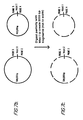
- Circularization can be readily achieved for initiator-terminator cartridges having initiator and terminator fragments derived from filamentous bacteriophages such as OX174, f1, fd, M13 and IKE by providing the gene II product or functional equivalents produced by the appropriate phages.
- the latter has a twofold function: first, it nicks one of the two DNA strands of the initiator DNA, thereby commencing DNA synthesis of DNA "down stream", or 3 ⁇ of the nick site, and continuing through any DNA situated between the initiator and terminator regions displaying the old DNA strand, and terminates in the terminator sequences.
- Second, the displaced single-stranded cartridge DNA produced is both cleaved and circularized by the gene II product.
- circularization results whenever the gene II product is present and reacts with the initiator-terminator cartridge.
- This can be achieved by co-infecting a microbial cell with one of the above-described bacteriophages and a cloning vehicle with the initiator-terminator cartridge.
- the bacteriophage produces the gene II product which recognizes and reacts with the initiator - terminator sequences causing DNA synthesis and circularization of the the strand displaced by DNA synthesis.
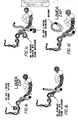
- Figure 1 While this is the preferred method of circularization, it is anticipated that a variety of other methods will also perform satisfactorily.
- gene II can be cloned directly into the cloning vehicle that carries the initiator - terminator cartridge. In this way a single vector will carry the initiator - terminator cartridge and supply the proteins necessary to circularize DNA molecules.
- the preferred embodiment of the invention is the insertion of the cartridge into a bacteriophage lambda vector.
- Bacteriophage lambda is known to contain about 50 genes, although only about 60% of these are necessary for lambda's growth and plaque forming ability. It will be appreciated that any means whereby lambda is reduced in size without affecting its growth cycle or packaging functions permits large stretches of intervening DNA to be situated between the initiator and terminator regions.
- Lambda phage vectors are generally throught of as comprising three parts; a left arm, a stuffer fragment, and a right arm.
- the left arm consists of approximately 20 kilobases of DNA and includes the head and tail genes.
- the right arm comprises the nucleotides ranging from p r through the cosR site.
- the "stuffer" portion of the virus comprises the middle one-third of the genome, and is nonessential for viral growth, and thus it is most often replaced with foreign DNA. Since the viability of lambda is known to drop off significantly when DNA longer than about 105% or shorter than abut 78% of the wild-type genome is packaged, if one wishes to use a initiator - terminator cartridge having short stretches of intervening DNA, or to clone short sections of DNA into a poly-linker site, then it is anticipated that less of the viral genome will be deleted, whereas the opposite is true for larger DNA sequences.
- the left and right arms can be reduced in size without affecting lambdas growth or packaging functions. This permits cloning of large DNA inserts into initiator - terminator cartridges having poly-linker sites.
- lambda vectors can be generated that incorporate a initiator - terminator cartridge capable of receiving DNA inserts about 10 kilobases or longer in length in a poly-linker region of the cartridge.
- One particularly useful lambda vector, termed ZAP has DNA sequences corresponding to T7 and T3 RNA polymerase promoters, a polylinker, ColE1 origin of replication, the LAC-Z and ampicillin genes.
- the initiator - terminator cartridge can be inserted into a number of cloning vectors, including plasmids, cosmids, viral vectors or hybrids thereof.
- the general requirement is that the initiator - terminator cartridge have ligatable termini thereby enabling it to be inserted into a non-essential region of the vector.
- An example of a useful hybrid is a "shuttle" vector.
- the latter vectors are capable of replicating in both procaryotes and eucaryotes, as described by Struhl, Stinchcomb, Scherer, and Davis in Proceedings of the National Academy of Sciences , page 1035, Vol. 76, 1979.
- a general description of expression vectors and methods of using and isolating the same are taught by Grover in DNA Cloning, Vol. 2, A Practical Approach (1985), IRL Press, Oxford, Washington, D.C.).
- vectors particularly bacteriophage lambda vectors, that carry the initiator - terminator cartridge.
- vectors particularly bacteriophage lambda vectors, that carry the initiator - terminator cartridge.
- they can be favorably employed in the construction of clones useful in locating or mapping the position of DNA sequences along chromosomes relative to one another. This can be achieved by establishing what will hereinafter be referred to as "jumping" and "junction" DNA libraries.
- the diagram illustrates a stretch DNA.
- A refers to an identifiable DNA sequence, for which there is a preexisting method for detection. 1:2, 3:4, 5:6, etc., refer to DNA sequences separated by the same restriction site, the latter is denoted by "I”. "II” denotes one or more restriction sites that separate the DNA sequences 2:3, 4:5, etc. The goal is to identify the linear positions of the sequences relative to "A". Because the distance from 2 to 3, 4 to 5, etc. is large (about 500 kilobases), it has hithertofor not been possible to order the positions of such widely separated sequences by current technology.
- a jumping library is constructed which involves cleavage at the I site to yield fragments, termed I fragments having sequences 2:3, 4:5, etc., at the remote ends of the fragments.
- the fragments are circularized under suitable conditions that favor circularization over multimer formation. It is important to note that circularization occurs at and thereby effects the joining of remote sequences 2:3, 4:5, etc.
- the circular DNA molecules are then reacted with one or more enzymes that cleave at the II sites thereby producing an array of fragments. Since cleavage does not occur between sequences 2:3, 4:5, etc., some of these fragments, termed II fragments, will consist of DNA sequences (i.e., 2:3, 4:5) that were initially located at opposite ends of the I fragments.
- the II fragments are inserted into a lambda ZAP-like vector and the latter is generated as described in the preceding examples.
- This vector does not contain the T3 or T7 promoters, but does exhibit at least one selectable marker.
- the gene encoding ampicillin resistance will perform satisfactorily.
- the vector is cleaved between the initiator and terminator regions at a site remote from the ampicillin gene, a particular usable site is BAM I.
- the vector is treated with alkaline phosphatase as described by Maniatis et al, above, followed by ligation of the II fragments into the vector at a concentration of about 200 micrograms/per milliliter.
- the vectors are cleaved with the same enzyme, or one having the same nucleotide specificity, used to cleave at the I sites, and a DNA cartridge is then inserted and ligated between the sequences 2:3, 4:5. It is important to note that only those vectors containing II fragments with these sequences will be cleaved, and thus capable of receiving the cartridge.
- the cartridge consists of RNA promoter regions, two such suitable promoters are the bacteriophage promoters T3 and T7. It also has a selectable marker distinct from that already present in the vector.
- Amphicillin is an example of a suitable selectable marker.
- the promoters are oriented to yield RNA transcripts of the sequences 2 or 3 in a vector with these sequences, or 4 or 5 in a second vector, and so on for other vectors with other sequences. Because the cartridge contains a selectable marker, vectors containing sequences 2:3, 4:5, etc., have two selectable markers, and can be isolated in double drug selection media after transformation of the vector into a suitable host cell. In contrast vectors that lack the 2:3, 4:5, etc., DNA sequences are not susceptible to cleavage, and therefore do not receive the DNA cartridge. While these vectors have a single drug selectable marker, cell transformants that contain these vectors do not survive in double selection media.
- the identification of cells harboring lambda ZAP-like derived plasmids containing those DNA sequences initially located at the opposite ends of the I fragments, and containing bacteriophage promoters for generating probes to these sequences, represents the completion of the production of the jumping library.
- junction library is constructed similarly to the jumping library with the exception that the initial cleavage even of the DNA shown in the above diagram involves producing II fragments. It is important to be aware that cleavage at II sites occurs between DNA sequences 3:4, 5:6, etc., but not between sequences 2:3, 4:5, etc. Thus, the initial step yields what are termed junction fragments.
- the latter are inserted in the same or similar lambda-ZAP like vectors used for making the jumping library.
- the remaining steps for producing the junction library are generally the same or similar to those producing the jumping library.
- the end result are cells harboring lambda-ZAP like vectors derived plasmids containing junction sequences separated by a selectable marker and bacteriophage promoters.
- jumping and junction libraries it is possible to order DNA sequences that are separated over large distances along a stretch of DNA. For instance, it will be apparent that by using conventional "walking" techniques it is possible to identify sequences and to generate probes to sequences 1 and 2, The availability to a probe to sequence 2 permits plasmids to be identified from the jumping library that carry sequence 2, and additionally sequence 3. In this manner, it is possible to identify DNA sequences located at opposite ends of large molecular weight DNA fragments (I fragments). However, it is further apparent that the existence of a jumping library alone does not permit the continued detection of other plasmids with additional sequences located at the ends of other I fragments so as to decipher their relative order.
- sequences corresponding to sequences 4 and 5 occupy the same fragment nor their position relative to sequences 2 or 3.
- This can be achieved, however, by probing the junction library using the 3 sequence probes. The latter will identify cells harboring vectors with the sequences 3 and 4.
- the jumping library can again be probed to identify cells with vectors harboring sequences 4 and 5.
- the relative order of the sequences can be determined.
- Terminator and Initiator Fragments from the Filamentous Single-stranded DNA Bacteriophage, f1.
- the first step in the construction of a initiator - terminator DNA cartridge is the isolation of initiator and terminator fragments from a suitable bacteriophage. This was realized using the bateriophage f1.
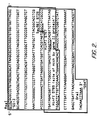
- Figure 2 shows the f1 origin of replication, specifically, that it is contained within a 434 base pair region of DNA. The sequence is bounded by two naturally occurring restriction sites, Rsa I (position 5513) and Dra I (position 5947). Moreover, Figure 2 shows that the initiator and terminator nucleotides overlap.
- the f1 intergenic region has previously been isolated by Dotto, above, and cloned into a vector, pEMBL8. The latter is thus useful for isolating initiator - terminator sequences, and is obtainable from the American Type Culture Collection.
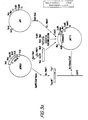
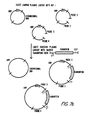
- Figure 3 shows in schematic form the isolation procedure.
- the initiator fragment was isolated from pRMBL8 by treating the plasmide with the restriction enzymes Sau 96I and Dra I. These enzymes recognize the naturally occurring restriction sites at positions 5725 and 5947, respectively.
- 10 to 50 ⁇ g of restriction digested plasmid DNA was electrophoresed on a 0.8 to 1.4% agarose gel in 1x E Buffer [50mM Tris (Acetate) pH8; 2mM EDTA, pH8] until the DNA fragments were completely separated. DNA bands were visualized by ethidium bromide staining of the gel 0.5 ⁇ g ethidium bromide/ml), and the fragments identified by comparison to DNA size markers loaded in adjacent lanes of the gel.
- the appropriate DNA band was cut from the gel, eluted by electrophoresis in autoclaved dialysis bags (MW cut off 10,000). The fragment was removed from the dialysis bag, pipetted into a 50ml conical tube, and the DNA concentrated by extraction with isobutanol. It was then transferred to an eppendorf tube and twice extracted with distilled phenol and chloroform equilibrated with water followed by precipitation by adding two volumes of absolute ethanol and incubating overnight at -20 degrees Centigrade. DNA was pelleted by centrifugation at 12,000xg for 15 minutes.
- the pelleted sample was resuspended in T10E1 buffer (10mM Tris-HCl, pH7.5, 1mM EDTA) and assayed by the ethidium spot assay as described by Maniatis et al above.
- Restriction enzymes were purchased from New England Biolabs, and the reaction conditions under which they were employed were those suggested by either the manufacturer, or as described by Maniatis, et al., above.
- Figure 3 also shows that the terminator fragment was isolated from pEMBL8 using the restriction enzymes Rsa I and Hinf I. The resulting fragment was purified, as described above, and corresponds to nucleotides 5513 - 5767 shown in Figure 2.
- a synthetic oligonucleotide was ligated at the naturally occurring Hinf I site at position 5767 and extends to position 5809 within the f1 sequence.
- Figure 4 shows the oligonucleotide base sequence where position 5809 marks the end of the termination site. Eight nucleotide bases were added at this position to incorporate restriction sites for EcoRV and NdeI. This yielded an oligonucleotide of about 50 base pairs in length.
- the oligonucleotide was synthesized using an Applied Biosystems DNA synthesizer following the manufacturer's instructions.
- a plasmid, pBSITO #12, having the initiator and terminator fragments as inserts was constructed as shown in Figure 3.
- the initial step involved the insertion of the terminator fragment, encompassing the Rsa I/Hinf I fragment, ligated to the synthetic oligonucleotide, hereinafter referred to as the terminator fragment, into a plasmid, pBS, or PBluescribe, shown in Figure 3.
- the synthetic oligonucleotide is shown in Figure 4.
- a description of pBluescribe can be found in Stratagene Cloning Systems Manual, Stratagene Corporation, San Diego, CA. Of particular significance are the Dra II and Nde I restriction sites.
- the terminator fragment was ligated with gel purified Dra II/Nde I - cut Bluescribe, thereby giving the plasmid pBST-B.
- ligation conditions were those described by Maniatis et al above, and consist of combining 100 ng of the vector pBluescribe, and 1-20 fold molar excess of the terminator fragment over vector DNA, ligation buffer [200mM Tris-HCl, pH7.5] and 100mM MgCl2; 20mM dithiotheritol (DTT); 10 mM ATP, pH7.0; and T4 DNA Ligase (1 Weiss Unit/ ⁇ l) in 20.0 ⁇ l total reaction Volume
- pBluescribe was obtained commercially from Stratagene Cloning Systems and the procedures for growing it in bacteria, as well as isolating it using DNA by polyethylene glycol precipitation and cesium chloride centrifugation is described by Maniatis et al. above. Generally, about 10-50 ng of plasmid ligation mixture was transformed into Stratagene's JM109 competent E.coli cells according to the manufacturers specifications. The cells were plated onto LB ampicillin agar plates (40 ⁇ g/ml) and incubated overnight at 37° to select for cells harboring the plasmid.
- the initiator Sau 96I/DraI fragment isolated from pEMBL8 was inserted into the plasmid, pBST-B, containing the terminator fragment. This was accomplished by treating the latter plasmid with the restriction enzyme NarI followed by Klenow filling to effect blunt ends.
- the conditions for this reaction are also described by Maniatis and generally consisted of; 10 ⁇ g linearized plasmid DNAS; 5 ⁇ l of 10x klenow buffer (200 mM Tris-HCl, pH7.5, 100mM MgCl2, 20mM DTT); 5 ⁇ l 10mM dATP, dCTP, dGTP, and dTTP; 2 ⁇ l Klenow enzyme (1 Unit/ ⁇ l); in a total Reaction Volume of 50 ⁇ l.
- 10x klenow buffer 200 mM Tris-HCl, pH7.5, 100mM MgCl2, 20mM DTT
- 5 ⁇ l 10mM dATP, dCTP, dGTP, and dTTP 2 ⁇ l Klenow enzyme (1 Unit/ ⁇ l
- Klenow enzyme 1 Unit/ ⁇ l
- the reaction was conducted at room temperature for 20 min, after which it was stopped by extracting twice with distilled phenol/chloroform equilibrated with water.
- DNA was precipitated with 2.5 volumes of ethanol and ligation achieved with T4 ligase as described by Maniatis et al, above.
- the plasmid was then reacted with calf intestinal alkaline phosphatase to dephosphorylate blunt ends and the Sau 96I/Dra I fragment ligated into the NarI site with T4 ligase as described above.
- T4 liagase was purchased from New England Biolabs. The Klenow fragment was obtained from Stratagene Cloning Systems, and calf alkaline phosphatase from Boehringer Manheim.
- pBSITO #12 can be used as a source of the initiator - terminator fragment in cartridge form which is suitable for insertion into a variety of vectors, including plasmids, viruses, cosmids, etc. In the instance where it is desired that there be disposed poly-linker sites between the initiator and terminator fragements, this is readily accomplished as described below.
- the plasmid pBSITO #12 was grown up and isolated using the procedures described in the preceding examples, and treated with the restriction enzymes NaeI and PvuI to remove the initiator and terminator fragment at the restriction sites shown in Figure 3.
- the fragment was purified as described by Maniatis, et al above, and then ligated into a plasmid, pBluescript (f1-).
- the latter plasmid is useful for this procedure as it contains the intact f1 origin of replication, as well as the sought after poly-linker sites.
- plasmid pPreB
- it can be linearized with the enzyme EcoRV under partial digestion conditions.
- the initiator and terminator regions enclose the viral promoters, T7 and T3, and the poly-linker region associated with pBluescript (f1-).
- the gene encoding ampicillin resistance, and the plasmid origin of replication, ColE1 are present, as is the gene encoding beta-galactosidase.
- the left arm was obtained from the lambda phage, lambda L47.1, which is available from the American Type Culture Collection. A modification of Long D was used for the right arm. The left arm was generated by restriction digesting lambda L47.1 with EcoRI and HindIII, followed by SmaI treatment. This protocol is shown in Figure 3.
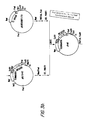
- Figure 5 shows the protocol for generating lambda Long D.
- Wild type lambda (cI857 Sam 7) was treated with EcoRI, and the EcoRI left arm fragment was ligated to a EcORI/HindIII fragment generated by EcoRI/Hind III treatment, of the plasmid, pUC 19, Both wild type lambda and pUC 19 were obtained from Bethesda Research Labs.
- the wild type lambda EcoR I fragment, and the fragment containing the ECORI/Hind III sites were ligated to another lambda fragment obtained from lambda CI857 Nin4 S100 by partial digestion with Hind III followed by digestion with MluI. Ligation of these three DNA fragments results in the fragment termed lambda Long C shown in Figure 5.
- HindIII junction site retains the lambda attachment site from lambda Long C.
- Long C contains an XhoI, followed by Klenow filling and subsequent ligation with T ligase, the desired lambda Long D is generated.
- Lambda Long C and D are available from Stratagene, San Diego.
- the vector termed lambda ZAP was constructed by ligating the lambda L47.1 EcoR I/Hind III/Sma I generated left arm fragment to the initiator - terminator DNA cartridge, obtained from pPreB by linearizing the plasmid with EcoRv, and, Long D. The latter was first treated with XbaI followed by Klenow filling and MluI treatment to generate a right arm fragment that is considerably shorter in length than lambda Long D, and which can be ligated to the initiator - terminator cartridge as shown in Figure 3 to yield lambda ZAP.
- the concentrations of reactants for ligating the lambda arms was generally as follows:
- Figure 6 details the protocol wherein lambda ZAP is utilized to subclone DNA.
- the initial step is to construct a gene library of cDNA or genomic DNA. While a variety of procedures are available for producing either type of library, a cDNA library can be realized by isolating mRNA, particularly poly (A)+RNA by techniques well-known to those skilled in the art, for example by chromagraphy on oligo[dT]-cellulose as described by Aviv and Leder in Proceedings of the National Academy of Sciences , U.S.A. (1972, Vol. 69, No. 6: page 1408), and reverse transcribing the poly(A)+RNA into cDNA.
- mRNA particularly poly (A)+RNA
- the cDNA can then be introduced into a suitable site associated with the poly-linker present between the initiator and terminator regions, and lambda ZAP packaged using a suitable commercial phage packaging kit, or as described by Barbara Hohn, Methods in Enzymology, 7 and then infected into a suitable bacterial strain, for example DP50.
- a suitable bacterial strain for example DP50.
- the latter are grown up overnight in standard growth media supplemented with 0.2% maltose and 10 millimolar magnesium sulfate, and then resuspended in 10 millimolar magnesium sulfate.
- the cells are incubated with lambda ZAP for approximately 15 minutes at 37 degrees Centigrade, after which three milliliters of melted top Agar (50 degrees Centigrade, 7 grams per liter agarose) was added and the mixture plated onto NZY Agar plates (NZY media with 15 grams/liter of bacto-agar).
- the sought-after lambda phage plaque was removed from the agar plate and resuspended in one milliliter of SM media [100 millimolar sodium chloride, 8 millimolar magnesium sulfate, 50 millimolar Tris-HCl(pH 7.5), 0.01% gelatin]. The mixture was vortexed for one minute, and contained approximately 1 x 10⁷phage/ per milliliter. Next, approximately 200 microliters of the lambda phage stock was added to 200 microliters of host E. coli cells (for example, NM522, JM109) that were grown to a density of 1 OD600 in media containing 0.2% maltose, and 10 millimolar magnesium sulfate.
- SM media 100 millimolar sodium chloride, 8 millimolar magnesium sulfate, 50 millimolar Tris-HCl(pH 7.5), 0.01% gelatin.
- the mixture was vortexed for one minute, and contained approximately 1 x 10⁷phage/ per milliliter.
- the phage were incubated with an aliquot (200 ⁇ l) of the cells for approximately 15 minutes at 32 ? degrees Centigrade, after which 1.6 milliliters of NZY media was added and agitated at 37 degrees Centigrade till the cells had grown up to a density of 0.3 OD600.
- the M13 helper infects bacteria and phage supplies the gene II proteins necessary for nicking, excising, and circularization of the initiator and terminator regions with intervening DNA. Because this process results in the rejoining the initiator/terminating regions it essentially produces the plasmid, pBluescript (FI-), (shown in Figure 3)
- the helper phage also supplies the necessary packaging functions thereby enabling the secretion of the circularized initiator - terminator plasmid.
- the latter is obtainable by heating the supernatant to approximately 70 degrees Centigrade for 20-30 minutes to kill the bacterial cells, and then centrifuged 5 minutes at 2500 revolutions per minute. The supernatant was harvested which contains the circularized initiator - terminator molecule or pBluescript (FI-) in a phage coat protein.
- a lambda ZAP-like Vector is used to determine, or map, the relative positions of DNA sequences remote from an identifiable DNA sequence. As part of this process, the location of neighboring adjacent DNA sequences is also revealed.
- the vector used in this process is similar to lambda ZAP less the Lac Z gene and the T3 and T7 RNA polymerase promoters.
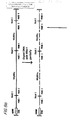
- Figures 7 A-E shows the general scheme whereby remote DNA sequences are identified and therefore positioned relative to a known DNA sequence.
- the procedure consists of cutting an organism's genome, for example the human genome, into fragments that can be ligatable into circles (7B).
- a variety of restriction enzymes are available for this purpose.
- Figure 7A shows digestion of DNA with the enzyme, NOT I.
- NOT I sites are shown separating DNA sequences (probe 1,2 etc) whose position relative to the "known gene" is to be determined.
- NOT I cuts DNA infrequently and generally yields fragments of a mean size of about 400-500 kilobases. The latter size range is desirable but a prerequisite to successfully apply the instant method.
- the DNA sequences adjoining the NOT I sites are ligated to yield circular DNA wherein two sequences that were remote are now located adjacent one another ( Figure 7B). It is important that the ligation reaction be conducted at low concentrations of DNA (less than about 10 ⁇ g/ml) that favor circularization over formation of larger linear DNA's resulting from the ligation of the NOT I fragments.
- the circularized DNA is treated with a second restriction enzyme with distinct and reduced cutting specificity than the first (i.e. NOT I), to yield fragments with two remote sequences separated by NOT I sites (7C).
- the latter should preferably, but not necessarily, be chosen to yield DNA fragments of approximately 5 kilobases in length.
- Figure 7C diagrammatically represents this step with the enzyme MboI.
- fragments smaller than 5 kilobases can also be satisfactorily employed but that fragments much larger than 10 kilobases will not be because of the approximate 10 kilobase limitation on the amount of DNA that can be inserted into lambda ZAP's polylinker region (discussed above).
- the lambda ZAP-like vector is subsequently treated with the enzyme BAM H1, causing a cut between the initiator and terminator fragments, ( Figure 7D) but not within the ampicillin gene region plasmid origin of replication.
- the initiator and terminator regions are depicted as a triangle and square respectively.
- the 5,000 base pair MboI generated fragments are ligated at the BAM H1 sites following dephosphorylation with calf alkaline phosphatase, as described by Maniatis et al, above.
- the ligated 5,000 base pair DNA fragments are then packaged with a suitable lambda packaging extract, and Escherichia coli is then infected with the resulting bacteriophage infect to amplify the gene library.
- Escherichia coli containing the lambda ZAP-like vector and accompanying 5000 base pair fragments are co-infected with M13 helper phage.
- the latter produce the necessary proteins that allow for nicking, circularizing , and cleaving of the initiator and terminator regions that bracket the intervening DNA.
- the plasmids can be isolated (see Maniatis et al above) using standard techniques, and then subjected to NOt I treatment that cleave between the adjacent sequences, and permits the insertion of a stretch of DNA containing the T3 and T7 RNA polymerase promoters separated by a gene that codes for kanamycin resistance.
- This DNA construct can be generated by ligating synthetic oligonucleotides containing T3 or T7 promoter sequences to the ends of a drug resistance gene, and then ligated to yield plasmids shown in Figure 7E.
- the plasmids are then transformed into a suitable strain of Escherichia coli as described by Maniatis et al above.
- RNA transcripts RNA transcripts, the latter useful as probes to detect DNA sequences that were initially at opposite ends of the large NOT I site separated DNA fragments.
- probes 3 and 4 sequences would permit the identification of plasmids in the jumping library that have at least one sequence (i.e. probe 4 and 5 sequences) in common with a junction sequence.
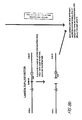
- Figure 8A shows that, to prepare a junction library, the same used for the jumping libraries digested with an enzyme that generates DNA fragments having an average length of about 5 kilobases.
- Mbo I can be used for this purpose.
- the latter are inserted into the bacteriophage lambda ZAP-like vector after the vector is cleaved at the BAM HI site situated between the initiator and terminator regions.
- the BAM HI sites contained within the vector are dephosphorylated with calf alkaline phosphatase ( Figure 8B).
- Ligation is achieved by mixing the restricted lambda ZAP-like vector with Mbo I digested chromosomal DNA at a concentration of about 200 micrograms per milliliter, followed by ligation with T ligase. This results in lambda ZAP-like vectors as shown in Figure 8C. It will be understood, of course, that what is shown in the figures are merely illustrative of the types of fragments that can be inserted into the vector, and by no means represents the entire spectrum of available fragments produced by enzymatic digestion.
- the lambda ZAP-like vector containing the 5 kilobase fragments is packaged using a suitable commercial packaging kit, and infected into a compatible strain of Escherichia coli.
- the latter is used to amplify the library, which is subsequently coinfected with M13 phage that effects the nicking, circularization and cleavaging of a DNA molecule copied off of the initiator/terminator regions and intervening DNA.
- NOT I treatment of these plasmids after isolation using standard isolation techniques, permits a stretch of DNA containing the bacteriophage promoters, T3 and T7, and the gene encoding kanamycin resistance,to be inserted.
- plasmids of the type shown in Figure 8F can be selected in media supplemented with both ampicillin and kanamycin. It is immediately apparent that one now has available the means, using the T3 and T7 promoters, by which to obtain RNA probes that can be used to ascertain the DNA sequences that adjoin the NOT 1 sites. In this way it is thus possible to "step across" naturally occurring NOT 1 sites (i.e. identify sequences corresponding to probes 3 and 4 etc.) thereby allowing the continued identification of plasmids having remote sequences in the jumping library.
Landscapes
- Health & Medical Sciences (AREA)
- Genetics & Genomics (AREA)
- Life Sciences & Earth Sciences (AREA)
- Engineering & Computer Science (AREA)
- Chemical & Material Sciences (AREA)
- Organic Chemistry (AREA)
- Zoology (AREA)
- Biomedical Technology (AREA)
- Wood Science & Technology (AREA)
- Biotechnology (AREA)
- General Engineering & Computer Science (AREA)
- Bioinformatics & Cheminformatics (AREA)
- Plant Pathology (AREA)
- Molecular Biology (AREA)
- Microbiology (AREA)
- Biophysics (AREA)
- Physics & Mathematics (AREA)
- Biochemistry (AREA)
- General Health & Medical Sciences (AREA)
- Crystallography & Structural Chemistry (AREA)
- Cell Biology (AREA)
- Saccharide Compounds (AREA)
- Micro-Organisms Or Cultivation Processes Thereof (AREA)
- Measuring Or Testing Involving Enzymes Or Micro-Organisms (AREA)
Applications Claiming Priority (2)
| Application Number | Priority Date | Filing Date | Title |
|---|---|---|---|
| US244187A | 1987-01-12 | 1987-01-12 | |
| US2441 | 2001-11-15 |
Publications (3)
| Publication Number | Publication Date |
|---|---|
| EP0286200A2 true EP0286200A2 (fr) | 1988-10-12 |
| EP0286200A3 EP0286200A3 (en) | 1990-03-21 |
| EP0286200B1 EP0286200B1 (fr) | 1994-10-12 |
Family
ID=21700777
Family Applications (1)
| Application Number | Title | Priority Date | Filing Date |
|---|---|---|---|
| EP88300224A Expired - Lifetime EP0286200B1 (fr) | 1987-01-12 | 1988-01-12 | Vecteur de clonage d'ADN avec des plasmides excisables in vivo |
Country Status (5)
| Country | Link |
|---|---|
| EP (1) | EP0286200B1 (fr) |
| AT (1) | ATE112803T1 (fr) |
| DE (1) | DE3851770T2 (fr) |
| ES (1) | ES2065333T3 (fr) |
| WO (1) | WO1988005085A1 (fr) |
Cited By (1)
| Publication number | Priority date | Publication date | Assignee | Title |
|---|---|---|---|---|
| EP0860447A4 (fr) * | 1996-08-27 | 2002-08-21 | Kyowa Hakko Kogyo Kk | Facteur de croissance des cellules souches hematopoietiques (scgf) |
Families Citing this family (5)
| Publication number | Priority date | Publication date | Assignee | Title |
|---|---|---|---|---|
| US5427908A (en) * | 1990-05-01 | 1995-06-27 | Affymax Technologies N.V. | Recombinant library screening methods |
| US5723286A (en) * | 1990-06-20 | 1998-03-03 | Affymax Technologies N.V. | Peptide library and screening systems |
| US5270170A (en) * | 1991-10-16 | 1993-12-14 | Affymax Technologies N.V. | Peptide library and screening method |
| US5733731A (en) * | 1991-10-16 | 1998-03-31 | Affymax Technologies N.V. | Peptide library and screening method |
| FR2831185A1 (fr) * | 2001-10-19 | 2003-04-25 | Genoplante Valor | Procede et kit de conversion de vecteurs hybrides de clonage en phase solide et procede de clonage de sequences nucleotidiques d'interet en faisant application |
-
1988
- 1988-01-12 ES ES88300224T patent/ES2065333T3/es not_active Expired - Lifetime
- 1988-01-12 WO PCT/US1988/000020 patent/WO1988005085A1/fr not_active Ceased
- 1988-01-12 AT AT88300224T patent/ATE112803T1/de not_active IP Right Cessation
- 1988-01-12 DE DE3851770T patent/DE3851770T2/de not_active Expired - Lifetime
- 1988-01-12 EP EP88300224A patent/EP0286200B1/fr not_active Expired - Lifetime
Non-Patent Citations (6)
| Title |
|---|
| CHEMICAL ABSTRACTS, vol. 107, no. 19, 9th November 1987, page 141, abstract no. 169556z, Columbus, Ohio, US; A. POUSTKA et al.: "Jumping libraries and linking libraries: the next generation of molecular tools in mammalian genetics", & TRENDS GENET. 1986, 2(7), 174-9 * |
| JOURNAL MOL. BIOL., vol. 172, 1984, pages 507-521, Academic Press Inc. (London) Ltd, GB; G.P. DOTTO et al.: "The functional origin of bacteriophage f1 DNA repliction" * |
| NUCLEIC ACIDS RESEARCH, vol. 11, no. 21, 1983, pages 7435-7452, IRL Press Ltd, Oxford, GB; J.D. ROBERTS et al.: "The bacteriophage lambda O replication protein: isolation and characterizaton of the initiator" * |
| NUCLEIC ACIDS RESEARCH, vol. 16, no. 15, 1988, pages 7583-7600, IRL Press Ltd, Oxford, GB; J.M. SHORT et al.: "Lambda ZAP: a bacteriophage lambda expression vector with vivo in excision properties" * |
| PROC. NATL. ACAD. SCI. USA, vol. 81, November 1984, pages 6812-6816; F.S. COLLINS et al.: "Directional cloning of DNA fragments at a large distance from an initial probe: a circularization method" * |
| THE JOURNAL OF BIOLOGICAL CHEMISTRY, vol 254, no. 13, 10th July 1983, pages 8402-8412, US; D.R. BROWN et al.: "DNA sequences which support activities of the bacteriophage phiX174 gene A protein" * |
Cited By (2)
| Publication number | Priority date | Publication date | Assignee | Title |
|---|---|---|---|---|
| EP0860447A4 (fr) * | 1996-08-27 | 2002-08-21 | Kyowa Hakko Kogyo Kk | Facteur de croissance des cellules souches hematopoietiques (scgf) |
| US6541217B2 (en) | 1996-08-27 | 2003-04-01 | Kyowa Hakko Kogyo Co., Ltd. | Hematopoietic stem cell growth factor (SCGF) |
Also Published As
| Publication number | Publication date |
|---|---|
| EP0286200B1 (fr) | 1994-10-12 |
| WO1988005085A1 (fr) | 1988-07-14 |
| ATE112803T1 (de) | 1994-10-15 |
| DE3851770D1 (de) | 1994-11-17 |
| ES2065333T3 (es) | 1995-02-16 |
| DE3851770T2 (de) | 1995-02-16 |
| EP0286200A3 (en) | 1990-03-21 |
Similar Documents
| Publication | Publication Date | Title |
|---|---|---|
| US5128256A (en) | DNA cloning vectors with in vivo excisable plasmids | |
| US5286632A (en) | Method for in vivo recombination and mutagenesis | |
| Morinaga et al. | Improvement of oligonucleotide-directed site-specific mutagenesis using double-stranded plasmid DNA | |
| US5595895A (en) | Efficient directional genetic cloning system | |
| EP1487982B1 (fr) | MISE AU POINT DE NOUVELLES SOUCHES A GENOME REDUIT A L'AIDE D'UN SYSTEME D'EXCISION Cre/loxp A COUPLAGE PAR Tn5 | |
| US5300431A (en) | Positive selection vector for the bacteriophage P1 cloning system | |
| US5316922A (en) | Method for indentifying and expressing proteins that recognize and adhere to specific probes | |
| Lagerström et al. | Capture PCR: efficient amplification of DNA fragments adjacent to a known sequence in human and YAC DNA. | |
| Jones et al. | Recombination between short direct repeats in a rec A host | |
| Carninci et al. | Balanced-size and long-size cloning of full-length, cap-trapped cDNAs into vectors of the novel λ-FLC family allows enhanced gene discovery rate and functional analysis | |
| US20090176281A1 (en) | Modular vector systems | |
| EP0286200B1 (fr) | Vecteur de clonage d'ADN avec des plasmides excisables in vivo | |
| US5478731A (en) | Polycos vectors | |
| US6248569B1 (en) | Method for introducing unidirectional nested deletions | |
| Enger-Valk et al. | Construction of new cloning vehicles with genes of the tryptophan operon of Escherichia coli as genetic markers | |
| EP0278706B1 (fr) | Plasmide recombinant pour l'expression de l'ammonia-lyase de la L-phénylalanine et souche transformée le contenant | |
| WO2001029059A1 (fr) | Procedes relatifs a l'analyse des capacites d'insertion d'introns modifies du groupe ii | |
| CN116438302A (zh) | 用于对货物核苷酸序列转位的系统和方法 | |
| US5827704A (en) | Vectors for cloning and modification of DNA fragments | |
| JP3549210B2 (ja) | プラスミド | |
| Casna et al. | Bacteriophage T4 as a generalized DNA-cloning vehicle | |
| MXPA01012406A (es) | Vectores novedosos para mejorar la clonacion y expresion en plasmidos con bajo numero de copias. | |
| AU631360B2 (en) | A p1 bacteriophage cloning system for dna fragments as large as 95 kb | |
| Case | Selective deletion of large segments of Balbiani ring DNA during molecular cloning | |
| US5238834A (en) | CDNA cloning vectors |
Legal Events
| Date | Code | Title | Description |
|---|---|---|---|
| PUAI | Public reference made under article 153(3) epc to a published international application that has entered the european phase |
Free format text: ORIGINAL CODE: 0009012 |
|
| AK | Designated contracting states |
Kind code of ref document: A2 Designated state(s): AT BE CH DE ES FR GB GR IT LI LU NL SE |
|
| PUAL | Search report despatched |
Free format text: ORIGINAL CODE: 0009013 |
|
| AK | Designated contracting states |
Kind code of ref document: A3 Designated state(s): AT BE CH DE ES FR GB GR IT LI LU NL SE |
|
| 17P | Request for examination filed |
Effective date: 19900802 |
|
| 17Q | First examination report despatched |
Effective date: 19920331 |
|
| GRAA | (expected) grant |
Free format text: ORIGINAL CODE: 0009210 |
|
| AK | Designated contracting states |
Kind code of ref document: B1 Designated state(s): AT BE CH DE ES FR GB GR IT LI LU NL SE |
|
| PG25 | Lapsed in a contracting state [announced via postgrant information from national office to epo] |
Ref country code: GR Free format text: LAPSE BECAUSE OF FAILURE TO SUBMIT A TRANSLATION OF THE DESCRIPTION OR TO PAY THE FEE WITHIN THE PRESCRIBED TIME-LIMIT Effective date: 19941012 |
|
| REF | Corresponds to: |
Ref document number: 112803 Country of ref document: AT Date of ref document: 19941015 Kind code of ref document: T |
|
| REF | Corresponds to: |
Ref document number: 3851770 Country of ref document: DE Date of ref document: 19941117 |
|
| ITF | It: translation for a ep patent filed | ||
| ET | Fr: translation filed | ||
| PG25 | Lapsed in a contracting state [announced via postgrant information from national office to epo] |
Ref country code: SE Effective date: 19950113 Ref country code: ES Free format text: LAPSE BECAUSE OF NON-PAYMENT OF DUE FEES Effective date: 19950113 |
|
| EAL | Se: european patent in force in sweden |
Ref document number: 88300224.8 |
|
| PG25 | Lapsed in a contracting state [announced via postgrant information from national office to epo] |
Ref country code: BE Effective date: 19950131 Ref country code: LU Free format text: LAPSE BECAUSE OF NON-PAYMENT OF DUE FEES Effective date: 19950131 |
|
| REG | Reference to a national code |
Ref country code: ES Ref legal event code: FG2A Ref document number: 2065333 Country of ref document: ES Kind code of ref document: T3 |
|
| REG | Reference to a national code |
Ref country code: GR Ref legal event code: FG4A Free format text: 3014668 |
|
| BERE | Be: lapsed |
Owner name: STRATAGENE Effective date: 19950131 |
|
| PG25 | Lapsed in a contracting state [announced via postgrant information from national office to epo] |
Ref country code: NL Effective date: 19950801 |
|
| PLBE | No opposition filed within time limit |
Free format text: ORIGINAL CODE: 0009261 |
|
| STAA | Information on the status of an ep patent application or granted ep patent |
Free format text: STATUS: NO OPPOSITION FILED WITHIN TIME LIMIT |
|
| REG | Reference to a national code |
Ref country code: GR Ref legal event code: MM2A Free format text: 3014668 |
|
| NLV4 | Nl: lapsed or anulled due to non-payment of the annual fee |
Effective date: 19950801 |
|
| 26N | No opposition filed | ||
| EUG | Se: european patent has lapsed |
Ref document number: 88300224.8 |
|
| REG | Reference to a national code |
Ref country code: ES Ref legal event code: FD2A Effective date: 19990503 |
|
| REG | Reference to a national code |
Ref country code: GB Ref legal event code: IF02 |
|
| PGFP | Annual fee paid to national office [announced via postgrant information from national office to epo] |
Ref country code: AT Payment date: 20061221 Year of fee payment: 20 |
|
| PGFP | Annual fee paid to national office [announced via postgrant information from national office to epo] |
Ref country code: GB Payment date: 20070125 Year of fee payment: 20 |
|
| PGFP | Annual fee paid to national office [announced via postgrant information from national office to epo] |
Ref country code: CH Payment date: 20070129 Year of fee payment: 20 |
|
| PGFP | Annual fee paid to national office [announced via postgrant information from national office to epo] |
Ref country code: DE Payment date: 20070228 Year of fee payment: 20 |
|
| PGFP | Annual fee paid to national office [announced via postgrant information from national office to epo] |
Ref country code: IT Payment date: 20070526 Year of fee payment: 20 |
|
| REG | Reference to a national code |
Ref country code: GB Ref legal event code: PE20 |
|
| REG | Reference to a national code |
Ref country code: CH Ref legal event code: PL |
|
| PGFP | Annual fee paid to national office [announced via postgrant information from national office to epo] |
Ref country code: FR Payment date: 20070117 Year of fee payment: 20 |
|
| PG25 | Lapsed in a contracting state [announced via postgrant information from national office to epo] |
Ref country code: GB Free format text: LAPSE BECAUSE OF EXPIRATION OF PROTECTION Effective date: 20080111 |