EP0286558A1 - Verfahren und Vorrichtung zum Füllen von Löchern - Google Patents
Verfahren und Vorrichtung zum Füllen von Löchern Download PDFInfo
- Publication number
- EP0286558A1 EP0286558A1 EP88440027A EP88440027A EP0286558A1 EP 0286558 A1 EP0286558 A1 EP 0286558A1 EP 88440027 A EP88440027 A EP 88440027A EP 88440027 A EP88440027 A EP 88440027A EP 0286558 A1 EP0286558 A1 EP 0286558A1
- Authority
- EP
- European Patent Office
- Prior art keywords
- cavity
- resin
- mass
- resins
- light
- Prior art date
- Legal status (The legal status is an assumption and is not a legal conclusion. Google has not performed a legal analysis and makes no representation as to the accuracy of the status listed.)
- Ceased
Links
Images

Classifications
-
- A—HUMAN NECESSITIES
- A61—MEDICAL OR VETERINARY SCIENCE; HYGIENE
- A61C—DENTISTRY; APPARATUS OR METHODS FOR ORAL OR DENTAL HYGIENE
- A61C19/00—Dental auxiliary appliances
- A61C19/003—Apparatus for curing resins by radiation
- A61C19/004—Hand-held apparatus, e.g. guns
-
- A—HUMAN NECESSITIES
- A61—MEDICAL OR VETERINARY SCIENCE; HYGIENE
- A61C—DENTISTRY; APPARATUS OR METHODS FOR ORAL OR DENTAL HYGIENE
- A61C1/00—Dental machines for boring or cutting ; General features of dental machines or apparatus, e.g. hand-piece design
- A61C1/02—Dental machines for boring or cutting ; General features of dental machines or apparatus, e.g. hand-piece design characterised by the drive of the dental tools
- A61C1/07—Dental machines for boring or cutting ; General features of dental machines or apparatus, e.g. hand-piece design characterised by the drive of the dental tools with vibratory drive, e.g. ultrasonic waves
Definitions
- the present invention relates to a process for differential photopolymerization with shrinkage compensation using photosensitive resins.
- It relates more particularly but not exclusively to a method for closing a dental cavity, as well as a general hand tool intended for the implementation of the method.
- the invention will be described below specifically in the field of application which relates to the establishment and then the solidification of an initially pasty product in a dental cavity.
- the treatment in particular of dental caries in direct method is frequently carried out by the addition of a composite resin or an amalgam which the practitioner deposits in the cavity.
- the amalgam joining is obtained by crimping and / or by micro-retentions located on the walls of the cavity.
- the hardening is obtained by polymerization using a chemical means or by electromagnetic radiation.
- the method currently used consists, after having sanitized the walls of the dental cavity to be treated, then to deposit, in several successive layers, a mass of resin photosensitive composite intended to close said cavity, then to effect curing, layer by layer, by photopolymerization of the resin using electromagnetic radiation, such as, for example, light radiation from a light source, the wavelength corresponds to the initiation and solidification reaction of the resin.
- the object of the present invention is to remedy these drawbacks and relates to a process of differential photopolymerization with compensated shrinkage for precision molding and filling of a dental cavity all at once from photopolymerizable resins, a method which avoids, during the hardening of the resin, that the walls of the tooth are stressed and which ensures a complete photopolymerization of the resin.
- the method of molding or filling a dental cavity of the type in which a photosensitive resin intended to be solidified by photopolymerization is deposited in a cavity or in a mold is remarkable, according to the invention, in that : - A layer of a first photosensitive resin is deposited on the walls of said cavity or mold; - Then deposited on said layer of the first photosensitive resin, a mass of a second photosensitive resin sealing the rest of said cavity; - Hardening is carried out by photopolymerization of said mass; and - Then, after the hardening of said mass, the hardening of said layer of the first photosensitive resin is carried out.
- the shrinkage during hardening of the mass of the second photosensitive resin occupying most of the volume defined by the cavity or the mold does not act directly on the very walls of said cavity or said mold, since the layer of the first resin, deposited between these walls and the resin mass, is still viscous and therefore acts as a buffer layer. Is carried out, only after the hardening of said mass, the hardening of said layer of first resin whose thin thickness deposited on the walls of said cavity does not exert, during its solidification, sufficient traction on the walls to cause pain or dimensional variations in shape or surface.
- each of the first and second resins reacting to electromagnetic radiation from photopolymerization of optimum and specific wavelength preferably, the two resins are chosen so that the radiation intended to photopolymerize the mass of second resin does not act on the layer of first resin; - The electromagnetic radiation corresponding to the optimal photopolymerization wavelength of the second resin is then applied to all of said resins deposited in said cavity; then, - After hardening of said second resin, electromagnetic radiation of optimum wavelength suitable for photopolymerizing said first resin is applied.
- the method according to the invention consists in carrying out a differential photopolymerization of said resins making it possible to obtain a significant reduction in shrinkage.
- the walls of said cavity or of the mold are coated with a bonding agent allowing the attachment of the resin to said walls.
- the present invention also relates to a hand tool intended for implementing the method.
- the hand tool of the type comprising a substantially tubular body having a head at one end is characterized in that it comprises, in said body, means for the transmission of light electromagnetic radiation. emitted by a light source capable of being connected to the other end of the body, the transmission means emerging from the head to penetrate the resins deposited in the cavity so that, depending on the adjustable wavelength of the radiations emitted, or obtained the curing by photopolymerization of each of the photosensitive resins.
- said means for transmitting radiation consists of an optical fiber housed in said tubular body and coupled at one end to said light source, and by a single-use photodistributor stick maintained in the head, partly emerging therefrom, the rod, which receives and transmits the radiation emitted by the optical fiber, being capable of being introduced into the resins deposited in said cavity.
- the light source controlled by the practitioner emits electromagnetic radiation whose wavelength corresponds to the reaction photopolymerization of the second resin, but which does not act on the layer consisting of the first resin which then remains viscous thus compensating for the decrease in volume of the mass of second resin.
- electromagnetic radiation emitted by the light source and the wavelength of which then corresponds to the photopolymerization reaction of the first resin allows it to solidify, the emerging part of the stick being trapped in the solidified mass of second resin.
- the stick is detached from the tool, then sectioned at the level of the upper face of the tooth or of the mold.
- a polishing operation then completes the treatment or molding.
- a photoelectric cell is provided on the head, being arranged opposite said resins.
- the cell connected to the light source, makes it possible, via an electronic control device, to change the wavelength of the electromagnetic radiation emitted, when the opacity of the second resin, which changes during solidification passing from the pasty state to the solid state corresponds to the complete hardening of this resin.
- the stick is inserted by force into a hole made in said head.
- part of the stick remaining integral with said resins it is preferably made of a translucent resin whose characteristics are compatible with those of the resins deposited in said cavity.
- an optic for focusing electromagnetic radiation is arranged between the outlet of the optical fiber and the rod, the latter, the latter arranged transversely to the direction of the optical fiber, coming into contact with a reflector fixed to said head.
- An element formed in the head and surrounding the rod is advantageously provided, the piezoelectric element generating vibrations which have the effect of packing the resins by means of the rod.
- the air inlet and air inlet pipes respectively. water can be attached to said body.
- FIGS. 1 to 5 consists in closing a cavity formed in a tooth or in a mold but other different applications or analogs are covered by the present invention.
- the schematic form shown in the figures illustrates both a tooth seen in section and a precision mold.
- a tooth 1 implanted in the gum 2 has a cavity 3 which opens, for this example, into the occlusal face 4 of the tooth and is defined by its side walls 5 and its bottom 6.
- the practitioner proceeds beforehand in particular to the cleaning of the walls 5 and of the bottom 6 of the cavity 3 in a known manner.
- After treating the enamel of the cavity with an acid gel it then coats, in Figure 2, the side walls 5 and the bottom 6 of a bonding agent 7 or adhesive intended to secure, as will be seen later, the resins at the walls and at the bottom of the cavity 3 of the tooth or of the mold, the binding agent possibly being an amelodentinocene.
- FIG. 3 He then deposits, in FIG. 3, on said bonding agent 7, a layer of a first photosensitive resin 8 of a type known per se.
- the layer 8 extends beyond the cavity 3 of the tooth or of the mold, as shown in an accentuated manner in FIG. 3, so that a lateral border 9 of the layer 8 rests on the masticatory face 4 of the tooth.
- a mass of a second photosensitive resin 10 substantially closing the rest of the cavity 3 of the tooth or of the mold.
- the volume of the mass of second resin deposited 10 corresponds approximately to the volume of the cavity 3 of the tooth or mold to be closed.
- Each of said first and second photosensitive resins constituting respectively the layer 8 and the mass 10 is chosen to react to electromagnetic radiation of photopolymerization of specific or delayed optimal wavelength.
- the first photosensitive resin will react under the action of electromagnetic radiation whose wavelength corresponds to the curing by photopolymerization of this first resin, while the second resin will react under the action of electromagnetic radiation whose wavelength, different from that initiating the first resin, corresponds to the curing by photopolymerization of this second resin.
- the practitioner then performs the curing by photopolymerization of the mass of second photosensitive resin 10, which under the action of electromagnetic radiation, for example of the light type, passes from a viscous state to a solid state.
- the first photosensitive resin is always in a viscous state since it does not react to electromagnetic rays of specific wavelength corresponding to the photopolymerization of the second resin.
- Layer 8 then acts as a buffer intermediate layer.
- the decrease in volume of the mass 10 of second resin is compensated by the layer of first resin 8 thus achieving a differentiated shrinkage since the excess thereof corresponding to the lateral border 9 deposited on the face 4 of the tooth or of the mold then flows between the solidified mass 10 and the connecting coating 7. Consequently, the mass 10 is completely isolated from the walls and from the bottom of the cavity 3, in particular from the pulp chamber in the case of a tooth, this which does not affect the nerves located in the room.
- the practitioner uses electromagnetic rays of specific wavelength (different of that corresponding to the initiation of the second resin), the curing by photopolymerization of the layer 8 of the first resin. Due to the small thickness of the layer 8 deposited on the walls 5 and the bottom 6 of the dental cavity 3 via the connecting coating 7, this thin layer 8 does not exert, during its solidification under the action light rays, sufficient traction on the walls of the tooth or mold, especially the pulp chamber, to then cause possible pain. In fact, the volume of the cavity 3 of the tooth or of the mold is almost entirely closed by the mass 10 already solidified.
- the practitioner performs deburring, polishing and cleaning operations on the face of said hardened resins so as to to bring this surface into conformity with that defined by the masticating face 4 (FIG. 5).
- the invention also relates to a hand tool intended for implementing the method described above.
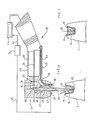
- the hand tool 15, shown in FIG. 6, comprises a body 16 substantially of tubular shape having a head 17 at one end 19, the other end of the body 16 not being illustrated.
- the tubular body has an internal passage 20 opening into a bore 21 formed in said head 17 and of direction perpendicular to the passage 20.
- Means 23 for the transmission of light electromagnetic radiation emitted by a light source 24 are arranged in the body 16. These means 23 are connected, by the end not shown of said body 16, to the light source 24, coherent or not, such , by example, an argon laser. These means protrude beyond the head 17 to penetrate, as will be seen later, in the differentially activated photosensitive resins deposited in the dental cavity 3 or in the mold.
- the means 23 are constituted by an optical fiber 26 and by a photodistributor rod 27 made of a translucent material.
- the end of this rod has a shape such that it allows a uniform distribution of the light energy throughout the volume occupied by the second resin, that is to say the mass 10.
- this form of end must make it possible to avoid the formation of bubbles during its penetration into the mass 10.
- the optical fiber 26 is housed and maintained in the internal passage 20 of the body 16, and is coupled by its input, not shown, to the light source 24, while the output 28 of the optical fiber is located opposite the bore 21, the optical fiber being disposed in a direction substantially perpendicular thereto.
- the rod 27 is, for its part, disposed in the bore 21 while being, in this particular embodiment, forcibly inserted therein.
- the rod 27 has an end 33 of cylindrical-conical shape, for example, which emerges from the head 17.
- a focusing optic such as a lens 34 arranged between the outlet 28 of the optical fiber 826 and the rod 27 and, on the other hand, a reflector 35 disposed opposite the lens 34 while being inclined by 45 °.
- the rod 27 comes to bear by an end cut in an inclined pan 30 against the reflector 35, so that, when a light radiation comes from the outlet 28 of the fiber, the latter is focused by the lens 34, then reflected by the reflector 35 in the axial direction of the rod 27.
- a photoelectric cell 37 is fixed on the face 38 of the head 17, so as to be oriented opposite the resins deposited in the cavity 3.
- This cell 37 is connected by a link 39 to an electronic control device 36, itself connected by a link 42 to the light source 24.
- the practitioner places the stick 27 for single use in the bore 21 made in the head, so that the inclined face 30 comes to bear correctly against the reflector 35.
- the stick, force-fitted is made of a compatible translucent resin with those previously deposited in the cavity 3, or, in another embodiment, the stick can be made of cast glass.
- the tool 15 is connected via the optical fiber 26 to the light source 24.
- the practitioner immerses in the mass 10 the emerging cylindro-conical part 33 of the rod 27 so that its end face 45, perfectly polished, is located in the vicinity of the bottom 6 of the cavity 3 containing the mass 10 of second resin and the layer 8 of first resin.
- the light source 24, controlled by the practitioner then emits, after selection, filtering or other, electromagnetic radiation corresponding to one of the colors of the visible spectrum.
- the wavelength of the radiation luminous corresponds to the photopolymerization reaction of the mass 10 of second resin.
- This light radiation then passes through the means 23, that is to say the optical fiber 26, the focusing lens 34 and is then reflected by the reflector 35 in the direction of the rod 27 to open through the end face 45 of the emerging end 33 of the rod 27 in the photosensitive resins.
- the photopolymerization reaction of the mass 10 of second photosensitive resin then begins.
- the piezoelectric element 41 generates vibrations transmitted by the rod 27 to the mass of resins, which have the effect of compacting in particular the mass of second resin.
- the opacity of the mass of second resin varies. This variation in opacity is detected by the photoelectric cell 37.
- the photoelectric cell 37 emits a signal, transmitted by the link 39, to the electronic control device 36 connected to the source 24. This control device automatically initiates the change or modifies the wavelength selection of the light radiation emitted.
- the new specific wavelength, in service or selected then corresponds to the photopolymerization reaction of the layer 8 of first photosensitive resin, changes color.
- the first resin insulating the mass of second resin from the walls and the bottom of the cavity, hardens until it reaches its total solidification.
- the activation energy intended to photopolymerize the mass of second resin is less than the activation energy intended to photopolymerize the layer of first resin.
- the emerging end 33 is then partially trapped and secured to the mass 10 of second resin.
Landscapes
- Health & Medical Sciences (AREA)
- Oral & Maxillofacial Surgery (AREA)
- Dentistry (AREA)
- Epidemiology (AREA)
- Life Sciences & Earth Sciences (AREA)
- Animal Behavior & Ethology (AREA)
- General Health & Medical Sciences (AREA)
- Public Health (AREA)
- Veterinary Medicine (AREA)
- Dental Tools And Instruments Or Auxiliary Dental Instruments (AREA)
- Casting Or Compression Moulding Of Plastics Or The Like (AREA)
Applications Claiming Priority (2)
| Application Number | Priority Date | Filing Date | Title |
|---|---|---|---|
| FR8704230A FR2612764B1 (fr) | 1987-03-26 | 1987-03-26 | Procede pour obturer une cavite dentaire et outil destine a la mise en oeuvre du procede |
| FR8704230 | 1987-03-26 |
Publications (1)
| Publication Number | Publication Date |
|---|---|
| EP0286558A1 true EP0286558A1 (de) | 1988-10-12 |
Family
ID=9349460
Family Applications (1)
| Application Number | Title | Priority Date | Filing Date |
|---|---|---|---|
| EP88440027A Ceased EP0286558A1 (de) | 1987-03-26 | 1988-03-25 | Verfahren und Vorrichtung zum Füllen von Löchern |
Country Status (4)
| Country | Link |
|---|---|
| US (1) | US5007837A (de) |
| EP (1) | EP0286558A1 (de) |
| JP (1) | JPS6415037A (de) |
| FR (1) | FR2612764B1 (de) |
Cited By (3)
| Publication number | Priority date | Publication date | Assignee | Title |
|---|---|---|---|---|
| US4957441A (en) * | 1988-12-20 | 1990-09-18 | Minnesota Mining And Manufacturing Company | Method of enhancing the curing of a photocurable dental restorative material |
| WO1997037611A1 (de) * | 1996-04-04 | 1997-10-16 | Peter Rechmann | Vorrichtung und verfahren zum aushärten eines lichthärtenden kunststoff-füllungsmaterials |
| EP0830850A1 (de) * | 1996-09-20 | 1998-03-25 | Kuraray Co., Ltd. | Verfahren zur Polymerisation lichthärtender Kunststoffe, sowie dabei anwendbares zahnärztliches Lichtbestrahlungsgerät |
Families Citing this family (48)
| Publication number | Priority date | Publication date | Assignee | Title |
|---|---|---|---|---|
| US5115307A (en) * | 1987-03-05 | 1992-05-19 | Fuji Optical Systems | Electronic video dental camera |
| EP0431046B1 (de) | 1988-08-24 | 1995-05-03 | SLEPIAN, Marvin J. | Endoluminale dichtung mit bisdegradierbaren polymeren |
| FR2640537B1 (fr) * | 1988-12-21 | 1992-02-21 | Levy Guy | Installation et procede utilisant l'effet laser, pour la coupe ou la vaporisation de materiaux et tissus divers |
| US5147203A (en) * | 1991-07-30 | 1992-09-15 | Seidenberg Jack W | Air/water delivery system for use with dental illumination devices |
| DE4133109C1 (en) * | 1991-10-05 | 1993-02-25 | Peter Prof. Dr. 5300 Bonn De Thiel | Dental hand instrument for light-hardening fillings - has narrowed end with light transparent section for insertion into filling material |
| ATE159661T1 (de) * | 1992-04-30 | 1997-11-15 | Eastman Dental Inst | Medikament zur desinfektion der mundhöhle |
| US5284443A (en) * | 1992-08-28 | 1994-02-08 | Coltene/Whaledent, Inc. | Method of forming dental restorations |
| GB9309397D0 (en) * | 1993-05-07 | 1993-06-23 | Patel Bipin C M | Laser treatment |
| US5420768A (en) * | 1993-09-13 | 1995-05-30 | Kennedy; John | Portable led photocuring device |
| US6371763B1 (en) * | 1997-11-28 | 2002-04-16 | Robert J. Sicurelli, Jr. | Flexible post in a dental post and core system |
| US5741139A (en) * | 1993-09-27 | 1998-04-21 | Tru-Flex Post Systems, Inc. | Flexible post in a dental post and core system |
| US5503559A (en) * | 1993-09-30 | 1996-04-02 | Cedars-Sinai Medical Center | Fiber-optic endodontic apparatus and method |
| FR2730627B1 (fr) * | 1995-02-17 | 1997-07-25 | Marc Reynaud | Renfort dentaire autobloquant |
| US5807101A (en) * | 1996-01-17 | 1998-09-15 | Scalzo; Josephine | Universal occlusal matrix |
| US5927983A (en) * | 1996-07-29 | 1999-07-27 | Hughes; Michael F. | Intracoronal bristle brush |
| JPH1097166A (ja) * | 1996-09-20 | 1998-04-14 | Fuji Xerox Co Ltd | クリーニング装置 |
| US6201880B1 (en) | 1996-12-31 | 2001-03-13 | Electro-Optical Sciences | Method and apparatus for electronically imaging a tooth through transillumination by light |
| US6008264A (en) * | 1997-04-30 | 1999-12-28 | Laser Med, Inc. | Method for curing polymeric materials, such as those used in dentistry, and for tailoring the post-cure properties of polymeric materials through the use of light source power modulation |
| US6282013B1 (en) | 1997-04-30 | 2001-08-28 | Lasermed, Inc. | System for curing polymeric materials, such as those used in dentistry, and for tailoring the post-cure properties of polymeric materials through the use of light source power modulation |
| US5791898A (en) * | 1997-06-23 | 1998-08-11 | Denbur, Inc. | Light prism for apparatus dental filling |
| GB2329756A (en) * | 1997-09-25 | 1999-03-31 | Univ Bristol | Assemblies of light emitting diodes |
| US6602074B1 (en) | 1997-10-29 | 2003-08-05 | Bisco, Inc. | Dental composite light curing system |
| US6116900A (en) * | 1997-11-17 | 2000-09-12 | Lumachem, Inc. | Binary energizer and peroxide delivery system for dental bleaching |
| US6200134B1 (en) * | 1998-01-20 | 2001-03-13 | Kerr Corporation | Apparatus and method for curing materials with radiation |
| US6157661A (en) * | 1999-05-12 | 2000-12-05 | Laserphysics, Inc. | System for producing a pulsed, varied and modulated laser output |
| EP1210025B1 (de) * | 1999-09-09 | 2004-07-28 | Rainer Tilse | Handgerät zum einfüllen einer zahnfüllmasse auf kunstharzbasis in eine kavität eines zahnes |
| US7320593B2 (en) | 2000-03-08 | 2008-01-22 | Tir Systems Ltd. | Light emitting diode light source for curing dental composites |
| WO2002033312A2 (en) * | 2000-10-19 | 2002-04-25 | Reipur Technology A/S | A light-emitting assembly |
| US7134875B2 (en) * | 2002-06-28 | 2006-11-14 | 3M Innovative Properties Company | Processes for forming dental materials and device |
| WO2004011848A2 (en) | 2002-07-25 | 2004-02-05 | Dahm Jonathan S | Method and apparatus for using light emitting diodes for curing |
| US7182597B2 (en) | 2002-08-08 | 2007-02-27 | Kerr Corporation | Curing light instrument |
| WO2004038759A2 (en) * | 2002-08-23 | 2004-05-06 | Dahm Jonathan S | Method and apparatus for using light emitting diodes |
| EP1596752B1 (de) * | 2003-02-13 | 2013-04-24 | DENTSPLY International Inc. | Verwendung von dentalmasse in der mundhöhle |
| CN100594327C (zh) * | 2004-06-15 | 2010-03-17 | 汉高公司 | 大功率led电-光学器件组件 |
| US20090057697A1 (en) * | 2004-10-28 | 2009-03-05 | Henkel Corporation | Led assembly with led-reflector interconnect |
| DE102005019386B4 (de) * | 2005-04-26 | 2010-07-29 | Ivoclar Vivadent Ag | Gerät zum Polymerisieren von polymerisierbarem Dentalmaterial sowie Verfahren zur Bestimmung des Polymerisationsgrades |
| US8113830B2 (en) * | 2005-05-27 | 2012-02-14 | Kerr Corporation | Curing light instrument |
| WO2007045249A1 (en) * | 2005-10-19 | 2007-04-26 | Dentofit A/S | A dental handpiece |
| US8047686B2 (en) * | 2006-09-01 | 2011-11-01 | Dahm Jonathan S | Multiple light-emitting element heat pipe assembly |
| DE102007022205A1 (de) * | 2007-05-11 | 2008-11-13 | Kaltenbach & Voigt Gmbh | Handgerät zur Abgabe eines pastösen Füllungsmaterials |
| GB0810384D0 (en) * | 2008-06-06 | 2008-07-09 | 3M Innovative Properties Co | Powder jet device for applying dental material |
| US9066777B2 (en) | 2009-04-02 | 2015-06-30 | Kerr Corporation | Curing light device |
| US9072572B2 (en) | 2009-04-02 | 2015-07-07 | Kerr Corporation | Dental light device |
| EP2550928B1 (de) | 2011-07-25 | 2017-03-01 | Ivoclar Vivadent AG | Dentalofen mit einemTrocknungssensor |
| US10111282B2 (en) * | 2011-07-25 | 2018-10-23 | Ivoclar Vivadent Ag | Dental furnace |
| US8992224B2 (en) * | 2012-08-15 | 2015-03-31 | Kerrhawe Sa | Scanning polymerization of dental material |
| JP2020529873A (ja) * | 2017-02-22 | 2020-10-15 | インター—メッド インク | 倍音特徴を利用した歯科材料の加熱、染料の吸収、および材料特性 |
| US20240139077A1 (en) * | 2021-03-12 | 2024-05-02 | Solcarry Ltd. | Treating dental caries |
Citations (5)
| Publication number | Priority date | Publication date | Assignee | Title |
|---|---|---|---|---|
| US3254411A (en) * | 1962-11-05 | 1966-06-07 | Johnson & Johnson | Tooth cavity filling and method of filling teeth |
| FR2182092A1 (de) * | 1972-04-25 | 1973-12-07 | Amalgamated Dental Co Ltd | |
| GB2016994A (en) * | 1978-03-15 | 1979-10-03 | Sankin Ind Co | Manufacture of denture base |
| EP0046939A2 (de) * | 1980-08-29 | 1982-03-10 | Dentsply International, Inc. | Einrichtung zum Aushärten härtbarer Massen mittels sichtbaren Lichtes |
| WO1986005085A1 (fr) * | 1985-02-28 | 1986-09-12 | Bernard Touati | Fixation de pieces rigides telle qu'une prothese dentaire |
Family Cites Families (8)
| Publication number | Priority date | Publication date | Assignee | Title |
|---|---|---|---|---|
| US4064629A (en) * | 1976-01-26 | 1977-12-27 | The University Of Virginia | Cavity liner for dental restorations |
| SE435447B (sv) * | 1983-02-21 | 1984-10-01 | Dan Ericson | Sett och anordning for framstellning av en tandfyllning av ljusherdande material |
| US4666406A (en) * | 1984-01-13 | 1987-05-19 | Kanca Iii John | Photocuring device and method |
| CH659184A5 (it) * | 1984-07-09 | 1987-01-15 | Weissenfluh Hawe Neos | Attrezzatura per la posa di otturazioni approssimali con resine polimerizzabili per illuminazione. |
| US4726770A (en) * | 1985-01-12 | 1988-02-23 | Kurer Hans G | Tooth restoration and means for use therein |
| US4608021A (en) * | 1985-08-19 | 1986-08-26 | Barrett Ronald A | Method and apparatus for dental restoration using light curable restoratives |
| US4696646A (en) * | 1985-12-23 | 1987-09-29 | Maitland Ronald I | Dental wedge and method of using same |
| US4673353A (en) * | 1986-05-30 | 1987-06-16 | Nevin Donald M | Apparatus for applying a light-curable dental composition |
-
1987
- 1987-03-26 FR FR8704230A patent/FR2612764B1/fr not_active Expired
-
1988
- 1988-03-24 US US07/172,562 patent/US5007837A/en not_active Expired - Fee Related
- 1988-03-25 EP EP88440027A patent/EP0286558A1/de not_active Ceased
- 1988-03-26 JP JP63073070A patent/JPS6415037A/ja active Pending
Patent Citations (5)
| Publication number | Priority date | Publication date | Assignee | Title |
|---|---|---|---|---|
| US3254411A (en) * | 1962-11-05 | 1966-06-07 | Johnson & Johnson | Tooth cavity filling and method of filling teeth |
| FR2182092A1 (de) * | 1972-04-25 | 1973-12-07 | Amalgamated Dental Co Ltd | |
| GB2016994A (en) * | 1978-03-15 | 1979-10-03 | Sankin Ind Co | Manufacture of denture base |
| EP0046939A2 (de) * | 1980-08-29 | 1982-03-10 | Dentsply International, Inc. | Einrichtung zum Aushärten härtbarer Massen mittels sichtbaren Lichtes |
| WO1986005085A1 (fr) * | 1985-02-28 | 1986-09-12 | Bernard Touati | Fixation de pieces rigides telle qu'une prothese dentaire |
Cited By (4)
| Publication number | Priority date | Publication date | Assignee | Title |
|---|---|---|---|---|
| US4957441A (en) * | 1988-12-20 | 1990-09-18 | Minnesota Mining And Manufacturing Company | Method of enhancing the curing of a photocurable dental restorative material |
| WO1997037611A1 (de) * | 1996-04-04 | 1997-10-16 | Peter Rechmann | Vorrichtung und verfahren zum aushärten eines lichthärtenden kunststoff-füllungsmaterials |
| EP0830850A1 (de) * | 1996-09-20 | 1998-03-25 | Kuraray Co., Ltd. | Verfahren zur Polymerisation lichthärtender Kunststoffe, sowie dabei anwendbares zahnärztliches Lichtbestrahlungsgerät |
| US6033223A (en) * | 1996-09-20 | 2000-03-07 | Kuraray Co., Ltd. | Method of polymerizing photo-polymerizable composition for dental use and dental light-curing apparatus for use therewith |
Also Published As
| Publication number | Publication date |
|---|---|
| FR2612764B1 (fr) | 1989-06-30 |
| US5007837A (en) | 1991-04-16 |
| FR2612764A1 (fr) | 1988-09-30 |
| JPS6415037A (en) | 1989-01-19 |
Similar Documents
| Publication | Publication Date | Title |
|---|---|---|
| FR2612764A1 (fr) | Procede pour obturer une cavite dentaire et outil destine a la mise en oeuvre du procede | |
| CA2212953A1 (fr) | Renfort dentaire autobloquant | |
| EP0385892B1 (de) | Prothese für die Wiederherstellung eines toten Zahnes | |
| EP3478222B1 (de) | Verfahren zur herstellung eines herausnehmbaren partiellen zahnersatzes durch formung mithilfe einer durch generative fertigung hergestellten form | |
| EP0230078B1 (de) | Verfahren zur Einkapselung eines elektronischen Bauelementes mit einem Kunstharz | |
| FR2482082A1 (fr) | Masses ceramiques pour prothese et implants | |
| EP0618548A1 (de) | Verfahren und Vorrichtung zum Herstellen einer Speicherkarte | |
| FR2588181A1 (fr) | Nouvelles protheses endobuccales en matieres composites | |
| WO1996011792A1 (fr) | Procede de realisation d'un implant intraoculaire a optique souple | |
| EP0063068A1 (de) | Verfahren zur konzentrischen Montage einer optischen Faser in einem Anschlussstück | |
| EP0214211B1 (de) | Befestigung von unverformbaren teilen, wie zum beispiel zahnprothesen | |
| EP0307322B1 (de) | Verfahren zum Herstellen eines Harzgegenstandes durch Fotopolymerisation und Anwendung dieses Verfahrens | |
| JP4121706B2 (ja) | 半透明歯科修復材の製造方法 | |
| FR2669211A2 (fr) | Prothese de reconstitution d'une dent devitalisee et appareil pour son implantation. | |
| EP0129531A2 (de) | Verfahren und Mittel zur Ausführung einer Prothese | |
| LU87465A1 (fr) | Procedes et appareils de fabrication d'objets coules ou moules,notamment des verres correcteurs | |
| EP3967263B1 (de) | Maschinell bearbeitbarer cfao-block für die herstellung von zahnprothetischen elementen | |
| EP1874220A1 (de) | Keramik-zahnprothese, verfahren und vorrichtung zu ihrer herstellung | |
| CH716192A2 (fr) | Composant en céramique destiné à être rapporté sur un cadran de montre et procédé de fabrication d'un tel composant. | |
| FR2758697A1 (fr) | Procedes et dispositifs de reconstitution prothetique pour la restauration ou la modification d'un ongle naturel | |
| FR2638348A1 (fr) | Procede pour realiser un element de prothese dentaire en ceramique ou en verre, et preforme pour la mise en oeuvre de ce procede | |
| EP3205307B1 (de) | Herstellungsverfahren eines abutments durch spritzguss | |
| FR2593058A1 (fr) | Technique de realisation d'une prothese adjointe ou hybride utilisant au moins un attachement articule du type rotulien. | |
| FR2494580A1 (fr) | Appareil pour la prise d'empreintes dentaires | |
| FR2670665A1 (fr) | Moyen d'ancrage radiculaire pour prothese dentaire. |
Legal Events
| Date | Code | Title | Description |
|---|---|---|---|
| PUAI | Public reference made under article 153(3) epc to a published international application that has entered the european phase |
Free format text: ORIGINAL CODE: 0009012 |
|
| AK | Designated contracting states |
Kind code of ref document: A1 Designated state(s): AT BE CH DE ES GB GR IT LI LU NL SE |
|
| 17P | Request for examination filed |
Effective date: 19890116 |
|
| 17Q | First examination report despatched |
Effective date: 19900713 |
|
| RAP1 | Party data changed (applicant data changed or rights of an application transferred) |
Owner name: FRAMATOME |
|
| STAA | Information on the status of an ep patent application or granted ep patent |
Free format text: STATUS: THE APPLICATION HAS BEEN REFUSED |
|
| 18R | Application refused |
Effective date: 19921029 |
|
| APAF | Appeal reference modified |
Free format text: ORIGINAL CODE: EPIDOSCREFNE |