EP0286848A2 - Herstellverfahren für den Leuchtschirm einer Bildwiedergabevorrichtung - Google Patents
Herstellverfahren für den Leuchtschirm einer Bildwiedergabevorrichtung Download PDFInfo
- Publication number
- EP0286848A2 EP0286848A2 EP88104045A EP88104045A EP0286848A2 EP 0286848 A2 EP0286848 A2 EP 0286848A2 EP 88104045 A EP88104045 A EP 88104045A EP 88104045 A EP88104045 A EP 88104045A EP 0286848 A2 EP0286848 A2 EP 0286848A2
- Authority
- EP
- European Patent Office
- Prior art keywords
- clichés
- printing
- transmitter
- screen
- printing pastes
- Prior art date
- Legal status (The legal status is an assumption and is not a legal conclusion. Google has not performed a legal analysis and makes no representation as to the accuracy of the status listed.)
- Granted
Links
Images
Classifications
-
- H—ELECTRICITY
- H01—ELECTRIC ELEMENTS
- H01J—ELECTRIC DISCHARGE TUBES OR DISCHARGE LAMPS
- H01J9/00—Apparatus or processes specially adapted for the manufacture, installation, removal, maintenance of electric discharge tubes, discharge lamps, or parts thereof; Recovery of material from discharge tubes or lamps
- H01J9/20—Manufacture of screens on or from which an image or pattern is formed, picked up, converted or stored; Applying coatings to the vessel
- H01J9/22—Applying luminescent coatings
- H01J9/227—Applying luminescent coatings with luminescent material discontinuously arranged, e.g. in dots or lines
- H01J9/2277—Applying luminescent coatings with luminescent material discontinuously arranged, e.g. in dots or lines by other processes, e.g. serigraphy, decalcomania
-
- B—PERFORMING OPERATIONS; TRANSPORTING
- B41—PRINTING; LINING MACHINES; TYPEWRITERS; STAMPS
- B41M—PRINTING, DUPLICATING, MARKING, OR COPYING PROCESSES; COLOUR PRINTING
- B41M1/00—Inking and printing with a printer's forme
- B41M1/26—Printing on other surfaces than ordinary paper
- B41M1/34—Printing on other surfaces than ordinary paper on glass or ceramic surfaces
Definitions
- the invention relates to a method for producing the fluorescent screen according to the preamble of claim 1.
- a color picture tube is known from EP-A1-0 104 834, in which a black matrix and the phosphors of the fluorescent screen are applied to the windshield by a printing process.
- a mixture of a hot melt adhesive and graphite or the phosphors is used as printing paste.
- the printing pastes are transferred from a heated vessel, in which they are in the liquid state, to engraved printing cylinders, which are also heated.
- the print images in the engraved printing cylinders are applied to a flexible intermediate carrier by means of transfer rollers. First the printing paste with the graphite and then the printing pastes with the phosphors are placed one after the other on the intermediate carrier.
- the intermediate carrier held by a frame is then positioned in the screen trough of the color picture tube.
- a flexible piston presses the flexible intermediate support against the screen pan.
- the black matrix and the phosphors now stick to the screen trough and the bulb and thus the intermediate carrier can be removed.
- the usual treatment of the screen trough is carried out by first applying a lacquer and then an aluminum layer on the screen and then heating the organic components.
- the invention is based on the object of specifying a simpler method for producing a fluorescent screen.
- conventional screen troughs of color picture tubes can be provided with fluorescent screens.
- the fluorescent screens can consist of fluorescent spots or strips. It is also possible to manufacture fluorescent screens with a black matrix.
- the method is also suitable for the production of fluorescent screens from novel image display devices with flat windscreens.
- the method is independent of whether or not a shadow mask is used in the image display device.
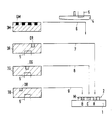
- the method is described below using the example of a colored image display device with a flat front screen 1 and a luminescent screen 2 made of a black matrix M and the three usual phosphors red R, green G and blue B.
- clichés 3M, 3R, 3B, 3G of the printing device Only four clichés 3M, 3R, 3B, 3G of the printing device are shown in section and a transmitter 4 in the form of a hemispherical tampon.
- the clichés 3R, 3G and 3B are heated, which is indicated by a heating winding 5 in the clichés.
- the printed image in the cliché 3M is filled in the usual way with a black ceramic glass ink Gm, which is removed from the transmitter 4 and printed on the front screen 1 (arrow 6).
- the glass paint is then burned in, melting into the glass of the front pane and forming the black matrix M, which can no longer be removed.
- Glass color No. 392016/64/5211 from Blythe Colors, Maastricht / Holland can be used as the ceramic glass color.
- the printing pastes DR, DG and DB corresponding to the printing images in the clichés 3R, 3G and 3B are then printed one after the other into the spaces between the black matrix M.
- printing pastes consist of a mixture of a thermoplastic hot-melt adhesive which is liquid at 60 to 80 ° C and evaporates without residue at more than 300 ° and the phosphors red, green and blue.
- the hot melt adhesive belongs to the acrylate group, in particular compounds of the copolymeric acrylate styrenes can be used.
- Such a hot melt adhesive is available from Blythe Colors, Maastricht / Holland.
- the phosphor content is around 80%.
- the printed images in the clichés 3R, 3G and 3B are filled with the heated and therefore liquid printing pastes, DR, DG and DB in the usual way. Since the clichés are heated, the printing pastes remain liquid and can be picked up in succession by the transmitter 4 and printed directly on the windscreen 1 which is at room temperature. This process takes place successively for each printing paste and is indicated by the arrows 7, 8 and 9.
- the transfer device 4 can also be heated, which is caused by the heating winding 5.
- One transmitter can also be used for printing the black matrix on the one hand and for printing the phosphors on the other hand. It is also possible to assign a transmitter to each cliché.
- the surface of the transmitter or transmitters should have a hardness in the range from 2 to 20 Shore.
- completely flat windscreens can also cylindrical tampons are used, which roll over the clichés and the windscreen. It is then possible to mount the clichés and the front screen on a temperature-compensated unit in order to absorb changes in length resulting from temperature differences. In particular, such a unit can be used to print the black matrix M.
- the black matrix and the phosphor grid After the production of the black matrix and the phosphor grid, the usual painting and the application of an aluminum layer to the fluorescent screen. The organic substances of the fluorescent screen are then heated and the front screen with the fluorescent screen is ready for installation in the image display device.
- the procedure can be such that a fluorescent screen is produced with uncorrected clichés and installed in an image display device.
- this image display device is operated with a uniform pattern, the landing errors of the electron beams exciting the phosphors are measured in terms of direction and amount.
- clichés are created in which the printed images are distorted according to the measured amount and against the measured direction.
- the fluorescent screens produced with it then show a color-pure image.
Landscapes
- Engineering & Computer Science (AREA)
- Ceramic Engineering (AREA)
- Manufacturing & Machinery (AREA)
- Formation Of Various Coating Films On Cathode Ray Tubes And Lamps (AREA)
- Printing Methods (AREA)
Abstract
Description
- Die Erfindung bezieht sich auf ein Verfahren zum Herstellen des Leuchtschirmes gemäß dem Oberbegriff des Patentanspruchs 1.
- Aus der EP-A1-0 104 834 ist eine Farbbildröhre bekannt, bei der eine Schwarzmatrix und die Leuchtstoffe des Leuchtschirmes durch ein Druckverfahren auf die Frontscheibe aufgebracht sind. Als Druckpaste wird ein Gemisch aus einem Heißschmelzkleber und Graphit bzw. den Leuchtstoffen verwendet. Die Druckpasten gelangen aus einem geheizten Gefäß, in dem sie im flüssigen Zustand sind, auf gravierte Druckzylinder, die ebenfalls beheizt sind. Mittels übertragerrollen werden die Druckbilder in den gravierten Druckzylindern auf einen flexiblen Zwischenträger aufgebracht. Es wird zuerst die Druckpaste mit dem Graphit und dann nacheinander die Druckpasten mit den Leuchtstoffen auf den Zwischenträger gebracht. Der von einem Rahmen gehaltene Zwischenträger wird danach in der Schirmwanne der Farbbildröhre positioniert. Ein flexibler Kolben drückt den flexiblen Zwischenträger gegen die Schirmwanne. Die Schwarzmatrix und die Leuchtstoffe kleben nun an der Schirmwanne und der Kolben und damit der Zwischenträger können entfernt werden. Anschließend erfolgt die übliche Behandlung der Schirmwanne, indem erst eine Lack- und dann eine Aluminiumschicht auf den Leuchtschirm gebracht und danach die organischen Bestandteile ausgeheizt werden.
- Bei diesem Verfahren zum Herstellen eines Leuchtschirmes wird zwar erreicht, daß der Leuchtschirm in einem Zug auf die innere Fläche der Schirmwanne gedruckt wird, aber dazu sind aufwendige Vorrichtungen notwendig, die viele sich bewegende Teile aufweisen.
- Der Erfindung liegt die Aufgabe zugrunde, ein einfacheres Verfahren zum Herstellen eines Leuchtschirmes anzugeben.
- Die Lösung dieser Aufgabe erfolgt mit den im Anspruch 1 angegebenen Mitteln. Vorteilhafte Ausgestaltungen der Erfindung sind in den Unteransprüchen 2 bis 10 enthalten.
- Mit dem erfindungsgemäßen Verfahren ist eine schnelle Herstellung von Leuchtschirmen für farbige Bildwiedergabevorrichtungen möglich. Dabei können beim Drucken auftretende Verzerrungen und andere Fehler durch eine Vorverzerrung der Druckbilder in den verwendeten Klischee kompensiert werden. Die benötigte Druckvorrichtung ist gegenüber den bekannten Druckvorrichtungen vereinfacht.
- Die Erfindung wird nun anhand eines in der einzigen Figur schematisch dargestellten Ablaufs des Verfahrens beispielsweise näher erläutert.
- Mit diesem Verfahren können übliche Schirmwannen von Farbbildröhren mit Leuchtschirmen versehen werden. Die Leuchtschirme können aus Leuchtstoffpunkten oder -streifen bestehen. Ebenso ist es möglich, Leuchtschirme mit einer Schwarzmatrix herzustellen. Das Verfahren eigent sich aber auch für die Herstellung von Leuchtschirmen von neuartigen Bildwiedergabevorrichtungen mit ebenen Frontscheiben. Darüberhinaus ist das Verfahren unabhängig davon, ob eine Schattenmaske in der Bildwiedergabevorrichtung verwendet wird oder nicht.
- Am Beispiel einer farbigen Bildwiedergabevorrichtung mit einer ebenen Frontscheibe 1 und einem Leuchtschirm 2 aus einer Schwarzmatrix M und den drei üblichen Leuchtstoffen Rot R, Grün G, und Blau B wird nachstehend das Verfahren beschrieben.
- Von der Druckvorrichtung sind nur vier Klischees 3M, 3R, 3B, 3G im Schnitt und ein Übertrager 4 in Form eines halbkugeligen Tampons dargestellt. Die Klischees 3R, 3G und 3B sind beheizt, was durch je eine Heizwicklung 5 in den Klischees angedeutet ist.
- Das Druckbild im Klischee 3M wird in üblicher Weise mit einer schwarzen keramischen Glasfarbe Gm gefüllt, die vom Übertrager 4 abgenommen und auf die Frontscheibe 1 gedruckt wird (Pfeil 6). Anschließend erfolgt ein Einbrennen der Glasfarbe, wobei diese mit dem Glas der Frontscheibe verschmilzt und die nicht mehr lösbare Schwarzmatrix M bildet. Als keramische Glasfarbe kann die Glasfarbe Nr. 392016/64/5211 der Firma Blythe Colours, Maastricht/Holland verwendet werden.
- In die Zwischenräume der Schwarzmatrix M werden dann nacheinander die Druckpasten DR, DG und DB entsprechend den Druckbildern in den Klischees 3R, 3G bzw. 3B gedruckt. Dazu werden Druckpasten verwendet, die aus einem Gemisch aus einem bei 60 bis 80°C flüssigen und bei über 300° rückstandslos verdampfenden thermoplastischen Heißschmelzkleber und den Leuchtstoffen Rot, Grün bzw. Blau bestehen. Der Heißschmelzkleber gehört zur Acrylatgruppe, insbesondere können Verbindungen der copolymeren Acrylat-Styrole eingesetzt werden. Ein derartiger Heißschmelzkleber ist von der Fa. Blythe Colours, Maastricht/Holland, beziehbar. Der Leuchtstoffanteil liegt bei etwa 80%.
- Die Druckbilder in den Klischees 3R, 3G und 3B werden mit den erwärmten und dadurch flüssigen Druckpasten, DR, DG bzw. DB in üblicher Art gefüllt. Da die Klischees geheizt sind, bleiben die Druckpasten flüssig und können nacheinander vom Übertrager 4 aufgenommen und direkt auf die auf Raumtemperatur befindliche Frontscheibe 1 gedruckt werden. Dieser Vorgang läuft nacheinander für jede Druckpaste ab und ist durch die Pfeile 7, 8 bzw. 9 angedeutet.
- Sollte es erforderlich sein, so kann auch der Übertager 4 beheizt werden, was durch die Heizwicklung 5 bewirkt wird. Es kann auch für das Drucken der Schwarzmatrix einerseits und das Drucken der Leuchtstoffe andererseits je ein übertrager eingesetzt werden. Es ist auch möglich, jedem Klischee ein Übertrager zuzuordnen. Die Oberfläche des oder der übertrager soll eine Härte im Bereich von 2 bis 20 Shore aufweisen. Neben halbkugeligen Tampons als Übertrager können bei völlig ebenen Frontscheiben auch zylinderförmige Tampons eingesetzt werden, die über den Klischees und der Frontscheibe abrollen. Hierbei ist es dann möglich, die Klischees und die Frontscheibe auf einer temperaturkompensierten Einheit zu montieren, um aus Temperaturunterschieden resultierende Längenveränderungen aufzufangen. Insbesondere kann zum Drucken der Schwarzmatrix M eine solche Einheit verwendet werden.
- Nach der Herstellung der Schwarzmatrix und des Leuchtstoffrasters erfolgt die übliche Lackierung und das Aufbringen einer Aluminiumschicht auf den Leuchtschirm. Anschließend werden die organischen Stoffe des Leuchtschirmes ausgeheizt und die Frontscheibe mit dem Leuchtschirm ist fertig zum Einbau in die Bildwiedergabevorrichtung.
- Beim Druckvorgang treten Verzerrungen auf, die Abweichungen vom äquidistanten Raster des Leuchtschirmes ergeben. Um diese Fehler auszugleichen, werden die Druckbilder in den Klischees derart verzerrt, daß die fertige Bildwiedergabevorrichtung ein farbreines Bild zeigt. Hierzu kann so vorgegangen werden, daß mit nichtkorrigierten Klischees ein Leuchtschirm hergestellt und in eine Bildwiedergabevorrichtung eingebaut wird. Bei Betrieb dieser Bildwiedergabevorrichtung mit einem gleichmäßigen Muster werden die Landungsfehler der die Leuchtstoffe anregenden Elektronenstrahlen nach Richtung und Betrag ausgemessen. Dann werden Klischees erstellt, in denen die Druckbilder entsprechend dem gemessenen Betrag und entgegen der gemessenen Richtung verzerrt sind. Die damit hergestellten Leuchtschirme zeigen dann ein farbreines Bild.
Claims (10)
dadurch gekennzeichnet, daß die Druckpasten (DR, DG, DB) von den Klischees (3R, 3G, 3B) nacheinander direkt mittels mindestens einem Übertrager (4) auf die Frontscheibe (1) gedruckt werden.
Applications Claiming Priority (2)
| Application Number | Priority Date | Filing Date | Title |
|---|---|---|---|
| DE3709206 | 1987-03-20 | ||
| DE19873709206 DE3709206A1 (de) | 1987-03-20 | 1987-03-20 | Herstellverfahren fuer den leuchtschirm einer bildwiedergabevorrichtung |
Publications (3)
| Publication Number | Publication Date |
|---|---|
| EP0286848A2 true EP0286848A2 (de) | 1988-10-19 |
| EP0286848A3 EP0286848A3 (en) | 1988-10-26 |
| EP0286848B1 EP0286848B1 (de) | 1991-01-16 |
Family
ID=6323600
Family Applications (1)
| Application Number | Title | Priority Date | Filing Date |
|---|---|---|---|
| EP88104045A Expired - Lifetime EP0286848B1 (de) | 1987-03-20 | 1988-03-15 | Herstellverfahren für den Leuchtschirm einer Bildwiedergabevorrichtung |
Country Status (4)
| Country | Link |
|---|---|
| US (1) | US5069733A (de) |
| EP (1) | EP0286848B1 (de) |
| JP (1) | JPH0664992B2 (de) |
| DE (2) | DE3709206A1 (de) |
Cited By (3)
| Publication number | Priority date | Publication date | Assignee | Title |
|---|---|---|---|---|
| US5544582A (en) * | 1993-11-03 | 1996-08-13 | Corning Incorporated | Method for printing a color filter |
| US5701815A (en) * | 1993-11-03 | 1997-12-30 | Corning Incorporated | Method of printing a color filter |
| EP0816112A3 (de) * | 1996-07-02 | 1998-10-07 | Corning Incorporated | Verfahren und Vorrichtung zum Drucken von Farbfiltern |
Families Citing this family (6)
| Publication number | Priority date | Publication date | Assignee | Title |
|---|---|---|---|---|
| US5225240A (en) * | 1989-11-15 | 1993-07-06 | Nokia (Deutschland) Gmbh | Method of printing the pattern carrier of a display |
| DE3937942A1 (de) * | 1989-11-15 | 1991-05-16 | Nokia Unterhaltungselektronik | Verfahren zum bedrucken eines display-druckmustertraegers und druckwalze fuer ein derartiges verfahren |
| GB9810407D0 (en) * | 1998-05-15 | 1998-07-15 | Triplex Safety Glass Co | Vehicle glazings |
| US6893103B2 (en) * | 2000-10-17 | 2005-05-17 | Seiko Epson Corporation | Ink jet recording apparatus and manufacturing method for functional liquid applied substrate |
| KR20040095767A (ko) * | 2003-04-28 | 2004-11-16 | 엘지전자 주식회사 | 전면 필터를 갖는 표시 패널 모듈 및 그 제조 방법 |
| JP2007256334A (ja) * | 2006-03-20 | 2007-10-04 | Nec Lcd Technologies Ltd | カラーフィルタ印刷方法、カラーフィルタ印刷装置、及びカラーフィルタ基板 |
Family Cites Families (10)
| Publication number | Priority date | Publication date | Assignee | Title |
|---|---|---|---|---|
| JPS5381065A (en) * | 1976-12-27 | 1978-07-18 | Toppan Printing Co Ltd | Method of producing fluorescent surface for color tv picture tube |
| DE2758228C2 (de) * | 1976-12-27 | 1985-10-24 | Toppan Printing Co. Ltd., Tokio/Tokyo | Verfahren zur Herstellung eines Leuchtstoffrasters auf der Frontscheibe einer Farbfernsehbildröhre |
| US4423676A (en) * | 1981-05-08 | 1984-01-03 | Cannon Mills Company | Method and apparatus for printing composite designs on fabric |
| DE3145585A1 (de) * | 1981-11-17 | 1983-05-26 | Robert Bosch Gmbh, 7000 Stuttgart | Verfahren zur herstellung elektrisch leitfaehiger bereiche |
| US4557798A (en) * | 1982-09-29 | 1985-12-10 | Corning Glass Works | Television tube with optional shadow mask and method of manufacture |
| CA1222790A (en) * | 1982-09-29 | 1987-06-09 | Wendell S. Blanding | Television tube with optional shadow mask and method of manufacture |
| US4511425A (en) * | 1983-06-13 | 1985-04-16 | Dennison Manufacturing Company | Heated pad decorator |
| JPS6020425A (ja) * | 1983-07-14 | 1985-02-01 | Matsushita Electric Ind Co Ltd | 螢光面製作方法 |
| US4595400A (en) * | 1984-10-18 | 1986-06-17 | Stauffer Chemical Company | Herbicidal esters of 2-bromo-4-methylimidazole-5-carboxylic acid |
| US4584039A (en) * | 1984-12-26 | 1986-04-22 | Hughes Aircraft Co. | Fine line flexible cable fabrication process |
-
1987
- 1987-03-20 DE DE19873709206 patent/DE3709206A1/de not_active Withdrawn
-
1988
- 1988-03-15 DE DE8888104045T patent/DE3861539D1/de not_active Expired - Lifetime
- 1988-03-15 EP EP88104045A patent/EP0286848B1/de not_active Expired - Lifetime
- 1988-03-17 JP JP63062064A patent/JPH0664992B2/ja not_active Expired - Fee Related
-
1989
- 1989-06-29 US US07/374,619 patent/US5069733A/en not_active Expired - Lifetime
Cited By (3)
| Publication number | Priority date | Publication date | Assignee | Title |
|---|---|---|---|---|
| US5544582A (en) * | 1993-11-03 | 1996-08-13 | Corning Incorporated | Method for printing a color filter |
| US5701815A (en) * | 1993-11-03 | 1997-12-30 | Corning Incorporated | Method of printing a color filter |
| EP0816112A3 (de) * | 1996-07-02 | 1998-10-07 | Corning Incorporated | Verfahren und Vorrichtung zum Drucken von Farbfiltern |
Also Published As
| Publication number | Publication date |
|---|---|
| DE3709206A1 (de) | 1988-09-29 |
| JPH0664992B2 (ja) | 1994-08-22 |
| EP0286848A3 (en) | 1988-10-26 |
| EP0286848B1 (de) | 1991-01-16 |
| JPS6448346A (en) | 1989-02-22 |
| US5069733A (en) | 1991-12-03 |
| DE3861539D1 (de) | 1991-02-21 |
Similar Documents
| Publication | Publication Date | Title |
|---|---|---|
| DE862914C (de) | Verfahren zur Herstellung von Mehrfarben-Bildwiedergaberoehren fuer Fernsehzwecke | |
| EP0286848B1 (de) | Herstellverfahren für den Leuchtschirm einer Bildwiedergabevorrichtung | |
| DE69835587T2 (de) | Verfahren zur erzeugung einer farbfilterschicht auf einer flachen schirmanzeigestruktur | |
| DE69622770T2 (de) | Farbfilter, Verfahren zur dessen Herstellung und dieses Farbfilter enthaltendes Flüssigkristallanzeigegerät | |
| DE10201578A1 (de) | Kombinationsdruckverfahren für In-Mold-Warmpreß- und Spritzgieß-Anwendung | |
| EP0836951B1 (de) | Druckform für ein Rotations-Hochdruckverfahren | |
| DE4243750C5 (de) | Verfahren zur Herstellung einer Druckform für den Tiefdruck, Siebdruck, Flexodruck oder Offsetdruck | |
| DE2540132C3 (de) | Verfahren zur Herstellung der Leuchtstoffpunkte mehrfarbiger flacher Anzeigeplatten | |
| DE60034624T2 (de) | Verfahren zur Herstellung einer Plasmaanzeigetafel | |
| DE3004648C2 (de) | Vakuum-Anzeigevorrichtung | |
| DE2221692B2 (de) | Photographisches Bildschrimdruckverfahren für eine Kathodenßtrahl-Farbfernsehröhre | |
| DE2854573C3 (de) | Verfahren zur Herstellung eines Bildmusters auf einer Fläche eines die Frontplatte eines Bildanzeigeschirms bildenden transparenten Trägers | |
| DE2145798C3 (de) | Verfahren zum Herstellen eines Leuchtschirms einer Farbfernsehröhre | |
| EP0428069B1 (de) | Verfahren zum Bedrucken eines Display-Druckmusterträgers und Druckwalze für ein derartiges Verfahren | |
| EP0223096B1 (de) | Verfahren zum Aufbringen einer Matrix | |
| DE1437618C3 (de) | Verfahren zur Herstellung von Leuchtschirmen für Farbfernsehröhren und Vorrichtung zur Durchführung des Verfahrens | |
| DE2758228C2 (de) | Verfahren zur Herstellung eines Leuchtstoffrasters auf der Frontscheibe einer Farbfernsehbildröhre | |
| DE2308178C3 (de) | Verfahren zur elektrophotographischen Herstellung eines Bildschirmes einer Farbfernsehbildröhre | |
| DE2324516A1 (de) | Siebdruckverfahren und -vorrichtung | |
| DE2932030A1 (de) | Verfahren zur herstellung eines leuchtschirms einer farbbildroehre | |
| DE3600630A1 (de) | Verfahren zum herstellen eines leuchtschirms | |
| DE1646150C3 (de) | Verfahren zum Aufbringen von Leuchtstoff schichten auf eine Trägerfläche unter Verwendung einer dünnen Haftschicht | |
| AT235362B (de) | Verfahren zur Herstellung von Bildwiedergabeschirmen für Kathodenstrahlröhren | |
| DE10310407A1 (de) | Verfahren und Vorrichtung zur Bedruckung von Glasflächen oder Keramikflächen | |
| DE3016808A1 (de) | Gasentladungsanzeigebildschirm |
Legal Events
| Date | Code | Title | Description |
|---|---|---|---|
| PUAI | Public reference made under article 153(3) epc to a published international application that has entered the european phase |
Free format text: ORIGINAL CODE: 0009012 |
|
| PUAL | Search report despatched |
Free format text: ORIGINAL CODE: 0009013 |
|
| AK | Designated contracting states |
Kind code of ref document: A2 Designated state(s): DE FR GB IT NL |
|
| AK | Designated contracting states |
Kind code of ref document: A3 Designated state(s): DE FR GB IT NL |
|
| 17P | Request for examination filed |
Effective date: 19881205 |
|
| RAP3 | Party data changed (applicant data changed or rights of an application transferred) |
Owner name: NOKIA GRAETZ GESELLSCHAFT MIT BESCHRAENKTER HAFTUN |
|
| RAP1 | Party data changed (applicant data changed or rights of an application transferred) |
Owner name: NOKIA UNTERHALTUNGSELEKTRONIK (DEUTSCHLAND) GMBH |
|
| 17Q | First examination report despatched |
Effective date: 19900227 |
|
| GRAA | (expected) grant |
Free format text: ORIGINAL CODE: 0009210 |
|
| AK | Designated contracting states |
Kind code of ref document: B1 Designated state(s): DE FR GB IT NL |
|
| ITF | It: translation for a ep patent filed | ||
| REF | Corresponds to: |
Ref document number: 3861539 Country of ref document: DE Date of ref document: 19910221 |
|
| GBT | Gb: translation of ep patent filed (gb section 77(6)(a)/1977) | ||
| ET | Fr: translation filed | ||
| PLBE | No opposition filed within time limit |
Free format text: ORIGINAL CODE: 0009261 |
|
| STAA | Information on the status of an ep patent application or granted ep patent |
Free format text: STATUS: NO OPPOSITION FILED WITHIN TIME LIMIT |
|
| 26N | No opposition filed | ||
| ITPR | It: changes in ownership of a european patent |
Owner name: CAMBIO RAGIONE SOCIALE;NOKIA (DEUTSCHLAND) GMBH |
|
| REG | Reference to a national code |
Ref country code: FR Ref legal event code: CD |
|
| NLT1 | Nl: modifications of names registered in virtue of documents presented to the patent office pursuant to art. 16 a, paragraph 1 |
Owner name: NOKIA (DEUTSCHLAND) GMBH TE PFORZHEIM, BONDSREPUBL |
|
| REG | Reference to a national code |
Ref country code: GB Ref legal event code: 732E |
|
| REG | Reference to a national code |
Ref country code: FR Ref legal event code: TP |
|
| REG | Reference to a national code |
Ref country code: GB Ref legal event code: IF02 |
|
| NLS | Nl: assignments of ep-patents |
Owner name: MATSUSHITA ELECTRIC INDUSTRIAL CO., LTD. |
|
| REG | Reference to a national code |
Ref country code: GB Ref legal event code: 732E |
|
| REG | Reference to a national code |
Ref country code: FR Ref legal event code: TP |
|
| PGFP | Annual fee paid to national office [announced via postgrant information from national office to epo] |
Ref country code: FR Payment date: 20040309 Year of fee payment: 17 |
|
| PGFP | Annual fee paid to national office [announced via postgrant information from national office to epo] |
Ref country code: NL Payment date: 20040310 Year of fee payment: 17 Ref country code: GB Payment date: 20040310 Year of fee payment: 17 |
|
| PGFP | Annual fee paid to national office [announced via postgrant information from national office to epo] |
Ref country code: DE Payment date: 20040430 Year of fee payment: 17 |
|
| PG25 | Lapsed in a contracting state [announced via postgrant information from national office to epo] |
Ref country code: IT Free format text: LAPSE BECAUSE OF NON-PAYMENT OF DUE FEES;WARNING: LAPSES OF ITALIAN PATENTS WITH EFFECTIVE DATE BEFORE 2007 MAY HAVE OCCURRED AT ANY TIME BEFORE 2007. THE CORRECT EFFECTIVE DATE MAY BE DIFFERENT FROM THE ONE RECORDED. Effective date: 20050315 Ref country code: GB Free format text: LAPSE BECAUSE OF NON-PAYMENT OF DUE FEES Effective date: 20050315 |
|
| PG25 | Lapsed in a contracting state [announced via postgrant information from national office to epo] |
Ref country code: NL Free format text: LAPSE BECAUSE OF NON-PAYMENT OF DUE FEES Effective date: 20051001 Ref country code: DE Free format text: LAPSE BECAUSE OF NON-PAYMENT OF DUE FEES Effective date: 20051001 |
|
| GBPC | Gb: european patent ceased through non-payment of renewal fee |
Effective date: 20050315 |
|
| PG25 | Lapsed in a contracting state [announced via postgrant information from national office to epo] |
Ref country code: FR Free format text: LAPSE BECAUSE OF NON-PAYMENT OF DUE FEES Effective date: 20051130 |
|
| NLV4 | Nl: lapsed or anulled due to non-payment of the annual fee |
Effective date: 20051001 |
|
| REG | Reference to a national code |
Ref country code: FR Ref legal event code: ST Effective date: 20051130 |