EP0287079B1 - Dérivés de 2-phénoxypyrimidine et compositions herbicides - Google Patents
Dérivés de 2-phénoxypyrimidine et compositions herbicides Download PDFInfo
- Publication number
- EP0287079B1 EP0287079B1 EP88105901A EP88105901A EP0287079B1 EP 0287079 B1 EP0287079 B1 EP 0287079B1 EP 88105901 A EP88105901 A EP 88105901A EP 88105901 A EP88105901 A EP 88105901A EP 0287079 B1 EP0287079 B1 EP 0287079B1
- Authority
- EP
- European Patent Office
- Prior art keywords
- group
- alkoxy
- alkyl
- halo
- alkyl group
- Prior art date
- Legal status (The legal status is an assumption and is not a legal conclusion. Google has not performed a legal analysis and makes no representation as to the accuracy of the status listed.)
- Expired - Lifetime
Links
- XDTMQSROBMDMFD-UHFFFAOYSA-N C1CCCCC1 Chemical compound C1CCCCC1 XDTMQSROBMDMFD-UHFFFAOYSA-N 0.000 description 1
- YUDYIGCCMNPJLI-UHFFFAOYSA-N CC(C1=CN(C)CC=C1)=O Chemical compound CC(C1=CN(C)CC=C1)=O YUDYIGCCMNPJLI-UHFFFAOYSA-N 0.000 description 1
Classifications
-
- C—CHEMISTRY; METALLURGY
- C07—ORGANIC CHEMISTRY
- C07D—HETEROCYCLIC COMPOUNDS
- C07D405/00—Heterocyclic compounds containing both one or more hetero rings having oxygen atoms as the only ring hetero atoms, and one or more rings having nitrogen as the only ring hetero atom
- C07D405/02—Heterocyclic compounds containing both one or more hetero rings having oxygen atoms as the only ring hetero atoms, and one or more rings having nitrogen as the only ring hetero atom containing two hetero rings
- C07D405/12—Heterocyclic compounds containing both one or more hetero rings having oxygen atoms as the only ring hetero atoms, and one or more rings having nitrogen as the only ring hetero atom containing two hetero rings linked by a chain containing hetero atoms as chain links
-
- A—HUMAN NECESSITIES
- A01—AGRICULTURE; FORESTRY; ANIMAL HUSBANDRY; HUNTING; TRAPPING; FISHING
- A01N—PRESERVATION OF BODIES OF HUMANS OR ANIMALS OR PLANTS OR PARTS THEREOF; BIOCIDES, e.g. AS DISINFECTANTS, AS PESTICIDES OR AS HERBICIDES; PEST REPELLANTS OR ATTRACTANTS; PLANT GROWTH REGULATORS
- A01N43/00—Biocides, pest repellants or attractants, or plant growth regulators containing heterocyclic compounds
- A01N43/48—Biocides, pest repellants or attractants, or plant growth regulators containing heterocyclic compounds having rings with two nitrogen atoms as the only ring hetero atoms
- A01N43/54—1,3-Diazines; Hydrogenated 1,3-diazines
-
- C—CHEMISTRY; METALLURGY
- C07—ORGANIC CHEMISTRY
- C07D—HETEROCYCLIC COMPOUNDS
- C07D239/00—Heterocyclic compounds containing 1,3-diazine or hydrogenated 1,3-diazine rings
- C07D239/02—Heterocyclic compounds containing 1,3-diazine or hydrogenated 1,3-diazine rings not condensed with other rings
- C07D239/24—Heterocyclic compounds containing 1,3-diazine or hydrogenated 1,3-diazine rings not condensed with other rings having three or more double bonds between ring members or between ring members and non-ring members
- C07D239/28—Heterocyclic compounds containing 1,3-diazine or hydrogenated 1,3-diazine rings not condensed with other rings having three or more double bonds between ring members or between ring members and non-ring members with hetero atoms or with carbon atoms having three bonds to hetero atoms with at the most one bond to halogen, directly attached to ring carbon atoms
- C07D239/46—Two or more oxygen, sulphur or nitrogen atoms
- C07D239/60—Three or more oxygen or sulfur atoms
Definitions
- the present invention relates to novel 2-phenoxypyrimidine derivatives and herbicidal compositions containing them as active ingredients, which are applicable to paddy rice fields, upland fields and non-agricultural fields.
- the present inventors have conducted extensive research on 2-phenoxypyrimidine compounds with an aim to develop a compound having excellent herbicidal activities and have previously reported some compounds in E.P. 223,406A, 249,707A and 249,708A.
- the present inventors have now found that the compounds of the present invention with substituents introduced to certain specific positions on the pyrimidine and benzene rings exhibit excellent herbicidal effects not only against annual weeds but also against perennial weeds, particularly against purple nutsedge ( Cyperus rotundus ) and Johnsongrass ( Sorghun halepense ), and at the same time they have a high level of safety against crop plants.
- the present invention has been accomplished on the basis of these discoveries.
- the present invention provides a 2-phenoxypyrimidine derivative having the formula: wherein R is a formyl group or -COOR1 wherein R1 is a hydrogen atom, a C1-C10 alkyl group , a 2-methylsulfonylethyl group, a diethoxypropyl group, a C3-C8 alkenyl group , a C3-C8 alkynyl group , a C2-C8 haloalkyl group , a C3-C8 haloalkenyl group , a C1 ⁇ C5 alkoxy-C1-C8 alkyl group , a C2-C8 hydroxyalkyl group, a C3-C6 cycloalkyl group, a phenyl group or wherein Y is a halogen atom, a methyl group or a methoxy group and n is 0, 1 or 2; and X is a halogen atom, a C3-C6
- the present invention also provides a herbicidal composition which comprises a herbicidally effective amount of a 2-phenoxypyrimidine derivative of the formula III and an agricultural adjuvant or carrier.
- a preferred group of the compounds of the present invention may be represented by the formula: wherein R4 is a formyl group or -COOR5 wherein R5 is a hydrogen atom, a C1-C10 alkyl group, a benzyl group which may be substituted by a methoxy group, a 2-methylsulfonylethyl group or a diethoxypropyl group; and X1 is a C3-C6 alkynyloxy group, a C3-C6 alkenyloxy group, a C1-C5 alkylthio group, a C1-C6 alkoxy-C2-C6 alkoxy group, a C1-C6 haloalkoxy group, an acetyloxy group, a benzoyloxy group, a formyl group, a trifluoromethyl group, a carboxyl group, a C1-C6 alkoxycarbonyl group, wherein R6 is a hydrogen atom or a
- R4 is preferably a formyl group or -COOR5 wherein R5 is a hydrogen atom, a C1-C10 alkyl group or a benzyl group, particularly preferably a hydrogen atom or a benzyl group.
- X1 is preferably a formyl group, an C3-C6 alkynyloxy group, an C3-C6 alkenyloxy group, an C1-C6 alkoxy C2-C6 alkoxy group, a C1-C6 haloalkoxy group, a benzoyloxy group, a trifluoromethyl group, an C1-C6 alkoxycarbonyl group, a di C1-C5 alkylamino group or wherein R6 is a hydrogen atom or a methyl group, Z1 is an alkyl group and m' is 0 or 1, or X1 forms a methylenedioxy group attached to the adjacent carbon atoms.
- X1 is an C3-C6 alkynyloxy group, an C3-C6 alkenyloxy group, an C1-C6 alkoxy C2-C6 alkoxy group, a C1-C6 haloalkoxy group, a trifluoromethyl group, an C1-C6 alkoxycarbonyl group or a benzyloxy group, or X1 forms a methylenedioxy group attached to the two adjacent carbon atoms.
- R4 is a formyl group or -COOR5 wherein R5 is a hydrogen atom or a benzyl group, and X1 is a propynyloxy group, a propenyloxy group, an ethoxyethoxy group, a trifluoromethyl group, a difluoromethoxy group, a methoxycarbonyl group or a benzyloxy group, or X1 forms a methylenedioxy group attached to the two adjacent carbon atoms.
- R8 is a C3-C8 alkenyl group, a C3-C8 alkynyl group, a C2-C8 haloalkyl group, a C3-C8 haloalkenyl group, a C1-C5 alkoxy-C1-C8 alkyl group, a C2-C8 hydroxyalkyl group, a a C3-C6 cycloalkyl group, a phenyl group or wherein Y1 is a halogen atom, a methyl group or a methoxy group and n' is 1 or 2; and X2 is a halogen atom.
- R8 is preferably a C3-C8 alkenyl group, a C3-C8 alkynyl group, a C2-C8 haloalkyl group, a C3-C8 haloalkenyl group, a C1-C5 alkoxy C1-C8 alkyl group, a phenyl group or wherein Y1 is a halogen atom or a methoxy group and n' is 1.
- R8 is an C1-C5 alkoxy C1-C8 alkyl group, a phenyl group or wherein Y1 is a halogen atom or a methoxy group and n' is 1.
- X2 is a chlorine atom
- R8 is a methoxymethyl group, a phenyl group, a 3-fluorobenzyl group or a 4-methoxybenzyl group.
- R and X are as defined above, R9 is a halogen atom, an alkylsulfonyl group or a benzylsulfonyl group which may be substituted.
- the compound of the formula I of the present invention can be prepared by reacting the compound of the formula II and a pyrimidine compound of the formula III in the presence of a base, preferably in a solvent, within a temperature range from room temperature to the boiling point of the solvent for from 1 to 24 hours. In the absence of a solvent, the reaction can be conducted within a temperature range from 120 to 160°C by using a carbonate of an alkali metal, such as anhydrous potassium carbonate.
- a hydrocarbon solvent such as benzene, toluene or xylene, a halogenated hydrocarbon solvent such as dichloromethane or chloroform, an alcohol solvent such as methanol, ethanol or 2-propanol, an ether solvent such as ethyl ether, isopropyl ether, tetrahydrofuran or 1,4-dioxane, a ketone solvent such as acetone or ethyl methyl ketone, an ester solvent such as methyl acetate or ethyl acetate, an aprotic polar solvent such as N,N-dimethylformamide, N,N-dimethylacetamide or dimethylsulfoxide, and others such as acetonitrile or water.
- a hydrocarbon solvent such as benzene, toluene or xylene
- a halogenated hydrocarbon solvent such as dichloromethane or chloroform
- an alcohol solvent such as methanol
- an alkali metal such as sodium metal or potassium metal
- an alkali metal or alkaline earth metal hydride such as sodium hydride, potassium hydride or calcium hydride
- a carbonate such as sodium carbonate or potassium carbonate
- a metal hydroxide such as sodium hydroxide or potassium hydroxide.
- X1 is as defined above
- R10 is a lower alkyl group, a 2-(trimethylsilyl)ethyl group or a benzyl group
- M is an alkali metal or an alkaline earth metal.
- those represented by the formula VI can be prepared by reacting the compound of the formula IV in the presence of a base in a polar solvent, in water or in a solvent mixture of a polar solvent and water within a temperature range from room temperature to the boiling point of the solvent for from 0.5 to 36 hours to obtain a compound of the formula V, which is then treated with an acid for precipitation to obtain a compound of the formula VI.
- the solvent may be an alcohol solvent such as methanol, ethanol or 2-propanol, or a ketone solvent such as acetone or ethyl methyl ketone.
- a carbonate such as sodium carbonate, potassium carbonate or calcium carbonate, or a metal hydroxide such as sodium hydroxide or potassium hydroxide may be employed.
- R10 in the formula IV is a benzyl group
- a compound of the formula VI can be obtained by the catalytic reduction by means of hydrogenation.
- a compound of the formula VI can be obtained by the reaction with tetra-n-butylammonium fluoride.
- X1 is as defined above.
- the compound of the formula VI can be prepared by reacting the compound of the formula VII in the presence of an oxdizing agent in a polar solvent, in water or in a solvent mixture of a polar solvent and water within a temperature range of from cooling with ice to the boiling point of the solvent for from 0.5 to 24 hours.
- the solvent may be a polar solvent such as water, acetone, t-butyl alcohol, acetic acid, pyridine or dioxane, or a solvent mixture of water and such a polar solvent.
- a polar solvent such as water, acetone, t-butyl alcohol, acetic acid, pyridine or dioxane, or a solvent mixture of water and such a polar solvent.
- oxygen, an aqueous hydrogen peroxide solution, chromic acid, silver oxide and a permanganate such as potassium permanganate, barium permanganate, calcium permanganate or magnesium permanganate may be used.
- R4 is as defined above, and R11 is an alkenyl group, an alkynyl group, an alkoxyalkyl group, wherein R6, Z1 and m' are as defined above, or -COR7, wherein R7 is an alkyl group or a phenyl group, and Z is a halogen atom.
- the compound of the formula X can be prepared by reacting the compound of the formula VIII with the compound of the formula of the IX and the base in the presence of a solvent within a temperature range of from room temperature to the boiling point of the solvent for from 1 to 24 hours.
- the solvent to be used here may be a hydrocarbon solvent such as benzene, toluene or xylene, a halogenated hydrocarbon solvent such as dichloromethane or chloroform, an ether solovent such as ethyl ether, isopropyl ether, tetrahydrofuran or 1,4-dioxane, a ketone solvent such as acetone or ethyl methyl ketone, an ester solvent such as methyl acetate or ethyl acetate, an aprotic polar solvent such as N,N-dimethylformamide, N,N-dimethylacetamide or dimethylsulfoxide, acetonitrile or water.
- a hydrocarbon solvent such as benzene, toluene or xylene
- a halogenated hydrocarbon solvent such as dichloromethane or chloroform
- an ether solovent such as ethyl ether, isopropyl
- the base may be an alkali metal such as sodium metal or potassium metal, an alkali metal hydride or an alkaline earth metal hydride such as sodium hydride, potassium hydride or calcium hydride, a carbonate such as sodium carbonate, potassium carbonate, sodium hydrogencarbonate or potassium hydrogencarbonate, a metal hydroxide such as sodium hydroxide or potassium hydroxide, or an organic base such as triethylamine (tertiary amine) or pyridine.
- X2 is as defined above, R 8 ⁇ is R8 less a phenyl group, and Y is a halogen atom.
- the compound of the formula XIII can be prepared by reacting the compound of the formula XI with the compound of the formula XII in the presence of a base preferably in a solvent within a temperature range of from room temperature to the boiling point of the solvent for from 1 to 24 hours.
- the solvent may be a hydrocarbon solvent such as benzene, toluene or xylene, a halogenated hydrocarbon solvent such as dichloromethane or chloroform, an ether solvent such as ethyl ether, isopropyl ether, tetrahydrofuran or 1,4-dioxane, a ketone solvent such as acetone or ethyl methyl ketone, an ester solvent such as methyl acetate or ethyl acetate, an aprotic polar solvent such as N,N-dimethylformamide, N,N-dimethylacetamide or dimethylsulfoxide, acetonitrile or water.
- a hydrocarbon solvent such as benzene, toluene or xylene
- a halogenated hydrocarbon solvent such as dichloromethane or chloroform
- an ether solvent such as ethyl ether, isopropyl ether, tetra
- the base may be an alkali metal such as sodium metal or potassium metal, an alkali metal hydride or an alkaline earth metal hydride such as sodium hydride, potassium hydride or calcium hydride, a carbonate such as sodium carbonate, potassium carbonate, sodium hydrogencarbonate or potassium hydrogencarbonate, a metal hydroxide such as sodium hydroxide or potassium hydroxide or an organic base such as triethylamine (tertiary amine) or pyridine.
- R8 and X2 are as defined above, and R12 is an imidazolyl group or a chlorine atom.
- the compound of the formula XIV can be obtained by reacting the compound of the formula XI with a compound G in a solvent within a temperature range of from room temperature to the boiling point of the solvent for from 1 to 12 hours.
- the compound G may be, for example, carbonyldiimidazole, thionyl chloride, oxalic acid dichloride or phosgene.
- the solvent may be a hydrocarbon solvent such as benzene, toluene or xylene, a halogenated hydrocarbon solvent such as dichloromethane or chloroform, an ether solvent such as ethyl ether, isopropyl ether, tetrahydrofuran or 1,4-dioxane, a ketone solvent such as acetone, ethyl methyl ketone, and an ester solvent such as methyl acetate or ethyl acetate.
- a hydrocarbon solvent such as benzene, toluene or xylene
- a halogenated hydrocarbon solvent such as dichloromethane or chloroform
- an ether solvent such as ethyl ether, isopropyl ether, tetrahydrofuran or 1,4-dioxane
- a ketone solvent such as acetone, ethyl methyl ketone
- an ester solvent such as
- the compound of the formula XIV is reacted in a solvent, if necessary, by an addition of a base within a temperature range of from cooling with ice to room temperature, in some cases, at the boiling point of the solvent for from 0.5 to 12 hours to obtain the compound of the formula XIII' of the present invention.
- the solvent may be as mentioned above, and the base may also suitably be selected from organic amines and inorganic bases.
- 6-difluoromethoxy-2-(4,6-dimethoxypyrimidin-2-yl)oxybenzaldehyde (3 g) was dissolved in acetone (30 ml). Then, an equimolar amount of an aqueous potassium permanganate solution (10 ml) was dropwise added thereto. The mixture was stirred at room temperature for 3 hours. Then, the precipitate was filtered. A large amount of water was added to the filtrate, and unreacted material was removed by extraction with ethyl ether. The aqueous phase was acidified with a 5% hydrochloric acid aqueous solution, and extracted with ethyl ether. The extract was washed with water and dried. Then, ethyl ether was distilled off under reduced pressure to obtain the above identified compound as white crystals (1.9 g). Melting point: 113-115°C.
- 6-(4,6-dimethoxypyridin-2-yl)oxy-2-(2,2-dimethylpropanoyl)amino benzaldehyde (1.1 g) was dissolved in acetone (30 ml). Then, equimolar amount of an aqueous potassium permanganate solution (10 ml) was dropwise added thereto. The mixture was stirred at room temperature of from 40 to 45°C for 6 hours. Then, the precipitate was filtered. A large amount of water was added to the filtrate, and unreacted material was removed by extraction with ethyl ether. The aqueous phase was acidified with a 5% hydrochloric acid aqueous solution and extracted with ethyl ether. The extract was washed with water and dried. Then, ethyl ether was distilled off under reduced pressure to obtain the above identified compound as a slightly pink powder (1.0 g). Melting point: 192-195°C.
- the herbicidal composition of the present invention comprises a herbicidally effective amount of a 2-phenoxypyrimidine derivative of the present invention and an agricultural carrier or adjuvant.
- the compound of the present invention when used as a herbicide, the compound may be used as it is or as formulated in various formulations such as a wettable powder, a granule, an emulsifiable concentrate or a dust by blending it with a carrier, a surfactant, a dispersing agent or an adjuvant which is commonly employed for the formulation of agricultural chemicals.
- the carrier to be used for the formulation there may be mentioned a solid carrier such as jeeklite, talc, bentonite, clay, kaolin, diatomaceous earth, white carbon, vermiculite, slaked lime, silica sand, ammonium sulfate or urea, or a liquid carrier such as isopropyl alcohol, xylene, cyclohexane or methyl naphthalene.
- a solid carrier such as jeeklite, talc, bentonite, clay, kaolin, diatomaceous earth, white carbon, vermiculite, slaked lime, silica sand, ammonium sulfate or urea
- a liquid carrier such as isopropyl alcohol, xylene, cyclohexane or methyl naphthalene.
- the surfactant and dispersing agent there may be mentioned, for example, an alcohol-sulfuric acid ester, an alkyl aryl sulfonate, lignin sulfonate, a polyoxyethylene glycol ether, a polyoxyethylene alkyl aryl ether or a polyoxyethylene sorbitol mono-alkylate.
- the adjuvant for example, carboxymethyl cellulose, polyethylene glycol or gum arabic may be mentioned. In practical use, such a herbicide may be diluted to a suitable concentration before application, or may directly be applied.
- the herbicide of the present invention may be used in combination with other herbicides. Examples of such other herbicides will be given below.
- the herbicide of the present invention is capable of controlling various weeds in a paddy field by irrigated soil treatment before or after the emergence of weeds or by foliage treatment. Further, the herbicide is capable of controlling various weeds in an upland field by soil treatment before or after the emergence of weeds or by foliage treatment.
- the dose of the active ingredient varies depending upon the field to be treated i.e. whether it is an agricultural field or non-agricultural field, the type of treatment, i.e. whether it is soil treatment or foliage treatment, the crop plants to be protected and the weeds to be killed. However, it is usually within a range of from 0.1 to 1,000 g/10 a, preferably from 0.5 to 500 g/10 a.
- the dose of the active ingredient is usually from 0.5 to 500 g/10 a, although it depends on the crop plant and weeds to be killed.
- the dose is usually from 0.1 to 500 g/10 a. In the case of a non-agricultural field, the dose is usually from 1 to 1,000 g/10 a for soil or foliage treatment.
- the compounds and the herbicidal compositions of the present invention are capable of effectively controlling annual weeds such as barnyardgrass ( Echinochloa crus-galli ), flatsedge ( Cyperus difformis ), monochoria ( Monochoria varinalis ), bulrush ( Scirpul hotarui ) and Alisma canaliculatum , and perennial weeds such as Cyperus serotinus , Sagittaria pygmaea and Eleocharis kuroguwai , grown in paddy fields.
- annual weeds such as barnyardgrass ( Echinochloa crus-galli ), flatsedge ( Cyperus difformis ), monochoria ( Monochoria varinalis ), bulrush ( Scirpul hotarui ) and Alisma canaliculatum
- perennial weeds such as Cyperus serotinus , Sagittaria pygmaea and Eleocharis
- the compounds of the present invention have a feature that as compared with the known compounds disclosed in the afore-mentioned publications and literature, the effects against perennial weeds such as purple nutsedge and johnsongrass are superior.
- tubers of purple nutsedge and rhizomes of johnsongrass were planted and covered with soil of a thickness of from 0.5 to 1 cm.
- soil treatment a predetermined amount of a wettable powder prepared in accordance with Formulation Example 1 was diluted with water and applied to the soil surface at a rate of 100 liters per 10 ares one day after the plantation.
- the pot was cultured in a glass chamber at a temperature of from 20 to 25°C for 2 weeks, and then a predetermined amount of a wettable powder prepared in accordance with Formulation Example 1 was diluted with water containing 2,000 ppm of surfactant wk as an extender and applied to the foliage at a rate of 100 liters per 10 ares.
- the evaluation was conducted on the 30th day after the treatment with the herbicide in the case of the soil treatment, and on the 21st day in the case of the foliage treatment. The results were evaluated in accordance with the standards as identified in Table 2 and shown by the index numbers in Table 5.
Landscapes
- Chemical & Material Sciences (AREA)
- Organic Chemistry (AREA)
- Life Sciences & Earth Sciences (AREA)
- Health & Medical Sciences (AREA)
- Pest Control & Pesticides (AREA)
- Plant Pathology (AREA)
- Agronomy & Crop Science (AREA)
- Engineering & Computer Science (AREA)
- Dentistry (AREA)
- General Health & Medical Sciences (AREA)
- Wood Science & Technology (AREA)
- Zoology (AREA)
- Environmental Sciences (AREA)
- Agricultural Chemicals And Associated Chemicals (AREA)
- Plural Heterocyclic Compounds (AREA)
Claims (13)
- Dérivé de la 2-phénoxypyrimidine ayant pour formule :
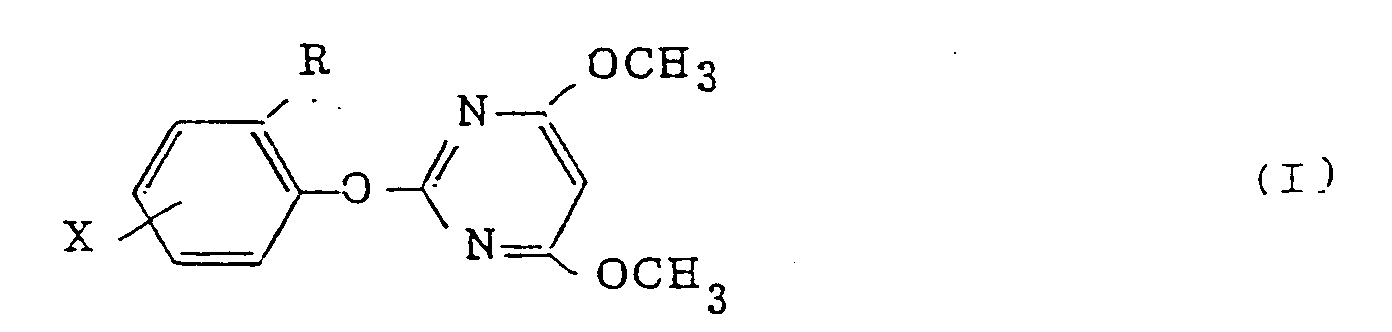


- Dérivé de la 2-phénoxypyrimidine selon la revendication 1 ayant pour formule


- Dérivé de la 2-phénoxypyrimidine selon la revendication 1, ayant pour formule


- Dérivé de la 2-phénoxypyrimidine selon la revendication 2, dans lequel R⁴ est un groupe formyle ou - COOR⁵, où R⁵ est un atome d'hydrogène, un groupe alkyle en C₁-C₁₀ ou un groupe benzyle.
- Dérivé de la 2-phénoxypyrimidine selon la revendication 2, dans lequel X¹ est un groupe formyle, un groupe alcynyloxy en C₃-C₆, un groupe alcényloxy en C₃-C₆, un groupe C₁-C₆-alcoxy-C₂-C₆-alcoxy, un groupe haloalcoxy en C₁-C₆, , un groupe benzoyloxy, un groupe trifluorométhyle, un groupe C₁-C₆-alcoxycarbonyle, un groupe di-C₁-C₅-alkylamino ou

- Dérivé de la 2-phénoxypyrimidine selon la revendication 2, dans lequel R⁴ est un groupe formyle ou - COOR⁵, où R⁵ est un atome d'hydrogène ou un groupe benzyle.
- Dérivé de la 2-phénoxypyrimidine selon la revendication 2, dans lequel X¹ est un groupe alcynyloxy en C₃-C₆, un groupe alcényloxy en C₃-C₆, un groupe C₁-C₆-alcoxy-C₂-C₆-alcoxy, un groupe haloalcoxy en C₁-C₆, un groupe trifluorométhyle, un groupe C₁-C₆-alcoxycarbonyle, un groupe benzyloxy, ou X¹ est un méthylènedioxy lié aux deux atomes de carbone adjacents.
- Dérivé de la 2-phénoxypyrimidine selon la revendication 2, dans lequel R⁴ est un groupe formyle ou - COOR⁵ , où R⁵ est un atome d'hydrogène ou un groupe benzyle et X¹ est un groupe alcynyloxy en C₃-C₆, un groupe alcényloxy en C₃-C₆, un groupe C₁-C₆-alcoxy-C₂-C₆-alcoxy, un groupe haloalcoxy en C₁-C₆, un groupe trifluorométhyle, un groupe C₁-C₆-alcoxycarbonyle ou un groupe benzyloxy, ou X¹ est un méthylènedioxy lié aux deux atomes de carbone adjacents.
- Dérivé de la 2-phénoxypyrimidine selon la revendication 2, dans lequel R⁴ est un groupe formyle ou - COOR⁵ , où R⁵ représente un atome d'hydrogène ou un groupe benzyle et X¹ est un groupe propynyloxy, un groupe propényloxy, un groupe éthoxyéthoxy, un groupe trifluorométhyle, un groupe difluorométhoxy, un groupe méthoxycarbonyle ou un groupe benzyloxy, ou X¹ forme un groupe méthylènedioxy lié aux deux atomes de carbone adjacents.
- Dérivé de la 2-phénoxypyrimidine selon la revendication 3, dans lequel R⁸ est un groupe alcényle en C₃-C₈, un groupe alcynyle en C₃-C₈, un groupe halo-alkyle en C₂-C₈, un groupe halo alcényle en C₃-C₈, un groupe C₁-C₅-alcoxy-C₁-C₈-alkyle, un groupe phényle ou

- Dérivé de la 2-phénoxypyrimidine selon la revendication 3, dans lequel R⁸ est un groupe C₁-C₅-alcoxy-C₁-C₈ alkyle, un groupe phényle ou

ou un groupe méthoxy et n' est égal à 1. - Dérivé de la 2-phénoxypyrimidine selon la revendication 3, dans lequel X² est un atome de chlore et R⁸ est un groupe méthoxyméthyle, un groupe phényle, un groupe 3-fluorobenzyle ou un groupe 4-méthoxybenzyle.
- Composition herbicide comprenant une quantité à efficacité herbicide d'un dérivé de la 2-phénoxypyrimidine tel que défini par la revendication 1 et un adjuvant agricole.
Applications Claiming Priority (4)
| Application Number | Priority Date | Filing Date | Title |
|---|---|---|---|
| JP62091788A JP2530156B2 (ja) | 1987-04-14 | 1987-04-14 | 2−フエノキシピリミジン誘導体及び除草剤 |
| JP62091787A JP2530155B2 (ja) | 1987-04-14 | 1987-04-14 | 2−フエノキシピリミジン誘導体および除草剤 |
| JP91787/87 | 1987-04-14 | ||
| JP91788/87 | 1987-04-14 |
Publications (3)
| Publication Number | Publication Date |
|---|---|
| EP0287079A2 EP0287079A2 (fr) | 1988-10-19 |
| EP0287079A3 EP0287079A3 (fr) | 1991-04-10 |
| EP0287079B1 true EP0287079B1 (fr) | 1994-10-12 |
Family
ID=26433226
Family Applications (1)
| Application Number | Title | Priority Date | Filing Date |
|---|---|---|---|
| EP88105901A Expired - Lifetime EP0287079B1 (fr) | 1987-04-14 | 1988-04-13 | Dérivés de 2-phénoxypyrimidine et compositions herbicides |
Country Status (3)
| Country | Link |
|---|---|
| US (1) | US4889552A (fr) |
| EP (1) | EP0287079B1 (fr) |
| DE (1) | DE3851773T2 (fr) |
Families Citing this family (35)
| Publication number | Priority date | Publication date | Assignee | Title |
|---|---|---|---|---|
| US4923501A (en) * | 1987-11-04 | 1990-05-08 | Kumiai Chemical Industry Co., Ltd. | Pyrimidine derivatives, processes for their production, and herbicidal method and compositions |
| GB8912700D0 (en) * | 1989-06-02 | 1989-07-19 | Shell Int Research | Herbicidal compounds |
| DE58907484D1 (de) * | 1988-06-16 | 1994-05-26 | Basf Ag | Salicylsäurederivate und deren Schwefelanaloge. |
| EP0347811B1 (fr) * | 1988-06-20 | 1994-03-30 | Kumiai Chemical Industry Co., Ltd. | Dérivés d'acides alcanoiques et compositions herbicides |
| JPH02262565A (ja) * | 1988-12-19 | 1990-10-25 | Mitsui Toatsu Chem Inc | ピリミジン誘導体、その製造法およびこれらを含有する除草剤ならびに除草剤組成物 |
| DE3919435A1 (de) * | 1989-06-14 | 1990-12-20 | Basf Ag | Salicylaldehyd- und salicylsaeurederivate sowie deren schwefelanaloge, verfahren zu ihrer herstellung als herbizide und bioregulatoren |
| US5270289A (en) * | 1989-07-19 | 1993-12-14 | Schering Aktiengesellschaft | Herbicidal dimethoxy pyrimidinyloxy-fluorinated acids and salts |
| DE3927382A1 (de) * | 1989-08-19 | 1991-02-21 | Basf Ag | Carbonsaeurederivate |
| BR9006950A (pt) * | 1989-10-12 | 1991-12-10 | Maag Ag R | Compostos heterociclicos |
| US5125957A (en) * | 1989-11-01 | 1992-06-30 | Sumitomo Chemical Company, Limited | Pyrimidine derivatives |
| DE3942476A1 (de) * | 1989-12-22 | 1991-06-27 | Basf Ag | Salicylsaeurederivate, verfahren zu ihrer herstellung und ihre verwendung als herbizide und bioregulatoren |
| US5129937A (en) * | 1989-12-26 | 1992-07-14 | Mitsui Toatsu Chemicals Incorporated | Pyridyloxypyrimidine derivatives, preparation process thereof, and herbicidal compositions containing the same as active ingredients |
| PH27460A (en) * | 1989-12-28 | 1993-07-09 | Kumiai Chemical Industry Co | Pyrimidine derivatives and herbicidal composition containing the same |
| CA2041615A1 (fr) * | 1990-05-15 | 1991-11-16 | Mitsunori Hiratsuka | Derives de la pyrimidine |
| US5232897A (en) * | 1990-05-15 | 1993-08-03 | Sumitomo Chemical Company, Limited | Herbicidal pyrimidine compounds, compositions containing the same and method of use |
| US5298632A (en) * | 1990-05-15 | 1994-03-29 | Sumitomo Chemical Company, Limited | Herbicidal pyrimidine compounds, compositions containing the same and method of use |
| JPH04235171A (ja) * | 1990-07-26 | 1992-08-24 | Sumitomo Chem Co Ltd | スルホヒドロキサム酸誘導体、その製造法およびそれを有効成分とする除草剤 |
| US5149357A (en) * | 1990-06-19 | 1992-09-22 | Fmc Corporation | Herbicidal substituted benzoylsulfonamides |
| AU638840B2 (en) * | 1990-07-05 | 1993-07-08 | Sumitomo Chemical Company, Limited | Pyrimidine derivative |
| US5262385A (en) * | 1990-07-24 | 1993-11-16 | Mitsubishi Petrochemical Co., Ltd. | Halogen-containing compounds, herbicidal composition containing the same as an active ingredient, and intermediary compounds therefor |
| JPH04103574A (ja) * | 1990-08-22 | 1992-04-06 | Kumiai Chem Ind Co Ltd | ピリミジン誘導体及び除草剤 |
| DE4030929A1 (de) * | 1990-09-29 | 1992-04-02 | Basf Ag | Benzaldoximetherderivate |
| CA2053603A1 (fr) * | 1990-10-19 | 1992-04-20 | Katsumasa Harada | Derive d'acide 3-alkoxyalcanoique, procede d'obtention et herbicide qui en contient. |
| DE4034045A1 (de) * | 1990-10-26 | 1992-04-30 | Basf Ag | Salicylsaeurederivate |
| EP0490224B1 (fr) * | 1990-12-14 | 1996-03-13 | BASF Aktiengesellschaft | Dérivés d'aldéhyde salicylique et d'acide salicylique et leurs analogues à base de soufre, procédé et intermédiaires pour leur préparation |
| AU635453B2 (en) * | 1990-12-17 | 1993-03-18 | Mitsui Toatsu Chemicals Inc. | Benzaldehyde acetal compounds, preparation process thereof, and herbicidal compositions containing the same as active ingredients |
| GB9102423D0 (en) * | 1991-02-05 | 1991-03-20 | Ciba Geigy Ag | Pryimidinyl-and triazinylsalicyl-and-picolinylaldehyde derivatives |
| DE4211610A1 (de) * | 1992-04-07 | 1993-10-14 | Bayer Ag | Substituierte Azine |
| DE4217928A1 (de) * | 1992-05-30 | 1993-12-02 | Hoechst Ag | Neue Mischungen aus Herbiziden und Antidots, neue (Hetero-)Aryloxy-Verbindungen, Verfahren zu deren Herstellung, diese enthaltenden Mittel und deren Verwendung |
| US5246914A (en) * | 1992-08-07 | 1993-09-21 | Basf Aktiengesellschaft | Salicyloyl (thio)ether derivatives, their preparation and intermediates for their preparation |
| US5494888A (en) * | 1993-01-27 | 1996-02-27 | Lucky Ltd. | 6-chloro-2-(4,6-dimethoxypyrimidin-2-yl)oxybenzoic acid imino ester derivatives, processes for their production and a method for their application as herbicides |
| DE4337321A1 (de) * | 1993-11-02 | 1995-05-04 | Basf Ag | Cyclische Acetale, Verfahren zu deren Herstellung und deren Umsetzung zu Pflanzenschutzmitteln |
| DE10303883A1 (de) * | 2003-01-31 | 2004-08-12 | Bayer Cropscience Ag | Substituierte Pyrimidine |
| UA124329C2 (uk) | 2014-01-16 | 2021-09-01 | ЕфЕмСі КОРПОРЕЙШН | Піримідинілоксибензольні похідні як гербіциди |
| TWI828952B (zh) | 2015-06-05 | 2024-01-11 | 美商艾佛艾姆希公司 | 作為除草劑之嘧啶氧基苯衍生物 |
Citations (1)
| Publication number | Priority date | Publication date | Assignee | Title |
|---|---|---|---|---|
| EP0001187A1 (fr) * | 1977-09-13 | 1979-03-21 | Ici Australia Limited | 2-Phénoxy-pyrimidines et leur utilisation comme pesticides |
Family Cites Families (8)
| Publication number | Priority date | Publication date | Assignee | Title |
|---|---|---|---|---|
| JPS519474A (en) * | 1974-07-15 | 1976-01-26 | Hitachi Ltd | Suichu hoi shiji sochi |
| JPS54117486A (en) * | 1978-03-03 | 1979-09-12 | Sankyo Co Ltd | 2-phenoxypyrimidine derivative |
| NZ192708A (en) * | 1979-02-16 | 1984-12-14 | Ici Australia Ltd | Substituted pyrimidines and compositions |
| JPS5746968A (en) * | 1980-09-04 | 1982-03-17 | Mitsubishi Chem Ind Ltd | Carboxylic ester |
| EP0223406B1 (fr) * | 1985-10-15 | 1990-08-29 | Kumiai Chemical Industry Co., Ltd. | Dérivés de pyrimidine et leurs applications comme herbicide |
| DE3602016A1 (de) * | 1985-12-05 | 1987-06-11 | Bayer Ag | Pyri(mi)dyl-oxy- und thio-benzoesaeure-derivate |
| JPH082883B2 (ja) * | 1986-06-06 | 1996-01-17 | クミアイ化学工業株式会社 | 2−フエノキシピリミジン誘導体および除草剤 |
| EP0256985A3 (fr) * | 1986-08-15 | 1989-11-15 | Ciba-Geigy Ag | Thiourées, isothiourées et carbodiimides substituées |
-
1988
- 1988-04-13 US US07/181,366 patent/US4889552A/en not_active Expired - Lifetime
- 1988-04-13 EP EP88105901A patent/EP0287079B1/fr not_active Expired - Lifetime
- 1988-04-13 DE DE3851773T patent/DE3851773T2/de not_active Expired - Fee Related
Patent Citations (1)
| Publication number | Priority date | Publication date | Assignee | Title |
|---|---|---|---|---|
| EP0001187A1 (fr) * | 1977-09-13 | 1979-03-21 | Ici Australia Limited | 2-Phénoxy-pyrimidines et leur utilisation comme pesticides |
Non-Patent Citations (1)
| Title |
|---|
| Agr. Biol. Chem. (1966) 30, 896-905 * |
Also Published As
| Publication number | Publication date |
|---|---|
| DE3851773T2 (de) | 1995-04-20 |
| DE3851773D1 (de) | 1994-11-17 |
| EP0287079A3 (fr) | 1991-04-10 |
| US4889552A (en) | 1989-12-26 |
| EP0287079A2 (fr) | 1988-10-19 |
Similar Documents
| Publication | Publication Date | Title |
|---|---|---|
| EP0287079B1 (fr) | Dérivés de 2-phénoxypyrimidine et compositions herbicides | |
| EP0249708B1 (fr) | Dérivé de 2-phénoxypyrimidine et compositions herbicides | |
| EP0287072B1 (fr) | Dérivés de 2-phénoxypyrimidine et composition herbicide | |
| EP0249707B1 (fr) | Dérivés de l'acide picolinique et compositions herbicides | |
| EP0321846B1 (fr) | Dérivés de pyrimidine, procédé pour leur préparation et méthode herbicide et compositions | |
| US4932999A (en) | Pyrimidine compounds, and herbicidal method and compositions | |
| EP0347811B1 (fr) | Dérivés d'acides alcanoiques et compositions herbicides | |
| EP0472113B1 (fr) | Dérivés de pyrimidine et compositions herbicides les contenant | |
| US4770691A (en) | 2-(4',6'-di-substituted pyrimidine-2'-yl)oxy- or thio-benzoic acid | |
| EP0435170A2 (fr) | Dérivés de pyrimidine ou de triazine et composition herbicide les contenant | |
| KR100846649B1 (ko) | 피리딘 화합물의 제조 방법 | |
| EP0468690B1 (fr) | Dérivés de pyrimidine | |
| EP0335409B1 (fr) | Dérivés de pyrimidine, procédés pour leur production et compositions herbicides les contenant | |
| EP0507962B1 (fr) | Derive d'acide picolinique, sa production, et herbicide | |
| AU659701B2 (en) | Triazine derivative, a method for producing the same and herbicidal composition containing the same as an active ingredient | |
| EP0579469A2 (fr) | Dérivés N-acyldihydroquinoléines comme herbicides | |
| EP0593252A1 (fr) | Dérivés d'acide 6-phényle benzoique substitués en position 2, leur préparation et leur utilisation comme herbicides |
Legal Events
| Date | Code | Title | Description |
|---|---|---|---|
| PUAI | Public reference made under article 153(3) epc to a published international application that has entered the european phase |
Free format text: ORIGINAL CODE: 0009012 |
|
| AK | Designated contracting states |
Kind code of ref document: A2 Designated state(s): CH DE FR GB IT LI |
|
| PUAL | Search report despatched |
Free format text: ORIGINAL CODE: 0009013 |
|
| AK | Designated contracting states |
Kind code of ref document: A3 Designated state(s): CH DE FR GB IT LI |
|
| 17P | Request for examination filed |
Effective date: 19910731 |
|
| 17Q | First examination report despatched |
Effective date: 19920925 |
|
| GRAA | (expected) grant |
Free format text: ORIGINAL CODE: 0009210 |
|
| AK | Designated contracting states |
Kind code of ref document: B1 Designated state(s): CH DE FR GB IT LI |
|
| ITF | It: translation for a ep patent filed | ||
| REF | Corresponds to: |
Ref document number: 3851773 Country of ref document: DE Date of ref document: 19941117 |
|
| ET | Fr: translation filed | ||
| PLBE | No opposition filed within time limit |
Free format text: ORIGINAL CODE: 0009261 |
|
| STAA | Information on the status of an ep patent application or granted ep patent |
Free format text: STATUS: NO OPPOSITION FILED WITHIN TIME LIMIT |
|
| 26N | No opposition filed | ||
| REG | Reference to a national code |
Ref country code: GB Ref legal event code: IF02 |
|
| PGFP | Annual fee paid to national office [announced via postgrant information from national office to epo] |
Ref country code: FR Payment date: 20030408 Year of fee payment: 16 |
|
| PGFP | Annual fee paid to national office [announced via postgrant information from national office to epo] |
Ref country code: GB Payment date: 20030409 Year of fee payment: 16 |
|
| PGFP | Annual fee paid to national office [announced via postgrant information from national office to epo] |
Ref country code: CH Payment date: 20030416 Year of fee payment: 16 |
|
| PGFP | Annual fee paid to national office [announced via postgrant information from national office to epo] |
Ref country code: DE Payment date: 20030417 Year of fee payment: 16 |
|
| PG25 | Lapsed in a contracting state [announced via postgrant information from national office to epo] |
Ref country code: GB Free format text: LAPSE BECAUSE OF NON-PAYMENT OF DUE FEES Effective date: 20040413 |
|
| PG25 | Lapsed in a contracting state [announced via postgrant information from national office to epo] |
Ref country code: LI Free format text: LAPSE BECAUSE OF NON-PAYMENT OF DUE FEES Effective date: 20040430 Ref country code: CH Free format text: LAPSE BECAUSE OF NON-PAYMENT OF DUE FEES Effective date: 20040430 |
|
| PG25 | Lapsed in a contracting state [announced via postgrant information from national office to epo] |
Ref country code: DE Free format text: LAPSE BECAUSE OF NON-PAYMENT OF DUE FEES Effective date: 20041103 |
|
| GBPC | Gb: european patent ceased through non-payment of renewal fee |
Effective date: 20040413 |
|
| REG | Reference to a national code |
Ref country code: CH Ref legal event code: PL |
|
| PG25 | Lapsed in a contracting state [announced via postgrant information from national office to epo] |
Ref country code: FR Free format text: LAPSE BECAUSE OF NON-PAYMENT OF DUE FEES Effective date: 20041231 |
|
| REG | Reference to a national code |
Ref country code: FR Ref legal event code: ST |
|
| PG25 | Lapsed in a contracting state [announced via postgrant information from national office to epo] |
Ref country code: IT Free format text: LAPSE BECAUSE OF NON-PAYMENT OF DUE FEES;WARNING: LAPSES OF ITALIAN PATENTS WITH EFFECTIVE DATE BEFORE 2007 MAY HAVE OCCURRED AT ANY TIME BEFORE 2007. THE CORRECT EFFECTIVE DATE MAY BE DIFFERENT FROM THE ONE RECORDED. Effective date: 20050413 |