EP0287214A2 - Système de surveillance d'un arbre - Google Patents
Système de surveillance d'un arbre Download PDFInfo
- Publication number
- EP0287214A2 EP0287214A2 EP88302213A EP88302213A EP0287214A2 EP 0287214 A2 EP0287214 A2 EP 0287214A2 EP 88302213 A EP88302213 A EP 88302213A EP 88302213 A EP88302213 A EP 88302213A EP 0287214 A2 EP0287214 A2 EP 0287214A2
- Authority
- EP
- European Patent Office
- Prior art keywords
- shaft
- monitoring system
- teeth
- tooth
- toothed
- Prior art date
- Legal status (The legal status is an assumption and is not a legal conclusion. Google has not performed a legal analysis and makes no representation as to the accuracy of the status listed.)
- Withdrawn
Links
Images


Classifications
-
- G—PHYSICS
- G01—MEASURING; TESTING
- G01D—MEASURING NOT SPECIALLY ADAPTED FOR A SPECIFIC VARIABLE; ARRANGEMENTS FOR MEASURING TWO OR MORE VARIABLES NOT COVERED IN A SINGLE OTHER SUBCLASS; TARIFF METERING APPARATUS; MEASURING OR TESTING NOT OTHERWISE PROVIDED FOR
- G01D5/00—Mechanical means for transferring the output of a sensing member; Means for converting the output of a sensing member to another variable where the form or nature of the sensing member does not constrain the means for converting; Transducers not specially adapted for a specific variable
- G01D5/12—Mechanical means for transferring the output of a sensing member; Means for converting the output of a sensing member to another variable where the form or nature of the sensing member does not constrain the means for converting; Transducers not specially adapted for a specific variable using electric or magnetic means
- G01D5/243—Mechanical means for transferring the output of a sensing member; Means for converting the output of a sensing member to another variable where the form or nature of the sensing member does not constrain the means for converting; Transducers not specially adapted for a specific variable using electric or magnetic means influencing the phase or frequency of AC
-
- G—PHYSICS
- G01—MEASURING; TESTING
- G01B—MEASURING LENGTH, THICKNESS OR SIMILAR LINEAR DIMENSIONS; MEASURING ANGLES; MEASURING AREAS; MEASURING IRREGULARITIES OF SURFACES OR CONTOURS
- G01B7/00—Measuring arrangements characterised by the use of electric or magnetic techniques
- G01B7/02—Measuring arrangements characterised by the use of electric or magnetic techniques for measuring length, width or thickness
Definitions
- This invention relates to shaft monitoring systems, and is more particularly but not exclusively concerned with shaft monitoring systems for use in gas turbine engines.
- Imminent or actual failure of a shaft in a gas turbine engine is sometimes accompanied by axial movement of the shaft. It has previously been proposed to detect this axial movement by arranging that it causes a projecting member rotating with the shaft to move into contact with, and thus break, a fixed conductor disposed axially adjacent to the radial plane in which the projecting member normally rotates.
- this proposal suffers from the disadvantages that it provides only an on/off type of output signal, rather than a progressively changing one, and that the conductor occasionally smears, instead of breaking, and so remains conducting. It is an object of the present invention in the first two of its aspects to provide a shaft monitoring system in which these disadvantages are eliminated.
- a shaft monitoring system comprising: first and second toothed members coaxially secured to the shaft for rotation therewith, said members being axially adjacent and each having at least one tooth which extends generally axially of the shaft at an angle to the axis of the shaft different from that of the tooth or teeth of the other member; first and second sensors mounted adjacent said first and second toothed members respectively so as to produce respective alternating signals representative of the passage of the respective teeth therepast during rotation of the shaft, the disposition of the sensors with respect to their respective toothed members being such that axial movement of the shaft causes a change in phase between said alternating signals; and a circuit for producing an output signal representative of the phase difference between said alternating signals, and therefore representative of the axial position of the shaft.
- both toothed members have a plurality of equiangularly spaced apart teeth, with the same number of teeth on both members.
- the teeth on one of the toothed members extend parallel to the axis of the shaft, while those on the other toothed member are inclined to the axis of the shaft.
- the toothed members are integral with or abut each other.
- a shaft monitoring system comprising: a toothed member coaxially secured to the shaft, said member having at least one tooth extending generally axially of the shaft; a first sensor mounted adjacent one axial end of said tooth and arranged to produce an alternating signal representative of the passage of the tooth therepast during rotation of the shaft, the disposition of the sensor with respect to the toothed member being such that axial movement of the shaft causes the amplitude of said alternating signal to change; a second sensor mounted adjacent the other axial end of said tooth so as to produce an alternating signal representative of the passage of the tooth therepast during rotation of the shaft, the disposition of said second sensor with respect to the toothed member being such that axial movement of the shaft causes the amplitude of the alternating signal produced by the second sensor to change in a sense opposite to the change caused by said movement to the alternating signal produced by the first sensor; and a circuit responsive to said alternating signals to produce an output signal representative of the axial position of the shaft.
- the toothed member has a plurality of equiangularly spaced apart teeth extending generally parallel to the axis of the shaft.
- the teeth are preferably made from or include a magnetic material, and the or each sensor is an inductive sensor.
- the system further comprises a power supply circuit for deriving a DC power supply for said system from at least one of said alternating signals.
- the system of both aspects of the invention preferably also includes an overspeed circuit for deriving from at least one of the alternating signals a signal indicating that the rotational speed of the shaft has exceeded a predetermined speed, and may advantageously further include a circuit for deriving from at least one of the alternating signals an output signal indicative of epicyclic movement of said shaft.
- the shaft monitoring systems of the drawings are all intended for incorporation in aircraft gas turbine engines, and are all based on toothed wheels or discs, sometimes known as “phonic wheels", which are secured to or formed integrally with the shaft to be monitored so as to be coaxial with the shaft.
- the systems all involve measurement of both rotational speed and axial movement of the shaft by magnetic detection of the teeth of such a phonic wheel by an inductive speed-type probe. This has several advantages:
- the phase shift method of measurement produces a more accurate measure of the axial movement but involves a more complex phonic wheel structure.
- the voltage comparison method can possibly use existing phonic wheels, but requires a more complex probe structure, is not as accurate, and cannot measure over the same range.
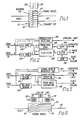
- Figure 1 shows the probe and phonic wheel arrangement used in this proposed measurement technique.
- the phonic wheel is indicated at 10, and is shown secured to and rotatable with a shaft 12 whose axial movement is to be monitored.
- the phonic wheel 10 has a first set of teeth 14 which are straight cut, ie extend parallel to the axis of the wheel, and a second set of teeth 16 which are disposed at one axial end of the teeth 14 and are diagonal cut, ie extend parallel to each other but in a direction inclined to the axis of the wheel.
- Two axially-spaced inductive probes 18,20 are positioned to sense the passage of the teeth 14 and the teeth 16 respectively.
- the signals induced in each of the probes 18,20 are compared in phase, and a voltage output proportional to their phase difference is produced.
- Probe 18 pick-up off the straight cut teeth 14
- Probe 20 pick-up off the diagonal cut teeth 16
- the phase signal produces the phase signal, the phase of which relative to the shaft revolutions (and therefore to the probe 18 signal) varies with the axial position of the shaft 12.
- the initial phase measured will be representative of the initial axial position of the shaft 12, any variation from this initial phase measurement will represent an axial movement of the shaft.
- Calibration of the initial phase offset can be performed on engine by means of a signature type input of the kind described in our United Kingdom Patents Nos. 2 082 859 and 2 132 802.
- the system will then provide an accurate output of shaft position (relative to the starting point), and may thus provide an indication of onsetting shaft failure.
- An overspeed trip facility can also be provided from the reference probe, and a method of detection of episoidal (epicyclic) shaft revolution (e.g. due to loss of a blade) is possible within the same system by measurement of modulation transients, as will hereinafter become apparent.
- the circuitry needed for axial measurement of this type is relatively simple, as can be seen in Figure 2.
- the input signals from the probes 18,20 go through conditioning circuits 22,24 respectively, which convert each signal into a square wave. Then these two square waves are used to set and reset a flip-flop 26, which therefore produces an output signal whose mark/space ratio is proportional to the phase difference between the signals from the probes 18,20. Passing this output signal through a filter 28 provides a voltage proportional to phase, which is then applied to a comparator circuit 30 to detect excess shaft movement. Overspeed trip is performed by a simple precision frequency-to-voltage converter 32 and maximum comparator 34.
- the final function (detecting episoidal transients) is realised by a detector 36, which monitors the modulation of the mean rectified probe waveform and produces an output signal if a predetermined maximum allowable modulation for the shaft is exceeded.
- Figure 3 shows the resulting waveforms at various points, indicated at A to E, in the circuitry of Figure 2.
- the output of the filter 28 can be made linear relative to the axial position of the shaft 12.
- the block diagram of Figure 2 shows that the circuits 32 and 34, associated with overspeed and episoidal transient detection respectively, are both configured to use the outputs of both probes 18, 20, an thus provide a system involving a degree of redundancy.
- Figure 4 shows the configurations of the probe/phonic wheel when using an amplitude comparison method to detect axial shaft position.
- Figure 4A shows the two probes 40,42 symmetrically positioned at each axial end of a phonic wheel 44 secured to and rotatable with a shaft 46, the wheel having a set of straight cut teeth 48: because of the symmetrical positioning, the probes produce output signals of substantially equal amplitude.
- Figure 4B shows the shaft 46 and phonic wheel 44 after they have moved axially to the right (as viewed in the Figure) with respect to the probes 40, 42, thus increasing the amplitude of the probe 40 (rightmost probe) output signal and decreasing the amplitude of the probe 42 output signal.
- Figure 4C merely shows an alternative way of arranging the initial, symmetrical position of the probes with respect to two axially spaced phonic wheels 50,52 (or a single one with a central circumferential channel), again with straight cut teeth.
- the detection circuitry for use with the probe 1 phonic wheel configurations of Figure 4 is shown in Figure 5, and comprises respective mean value sensing circuits 54,56 for converting each probe signal to a mean value of its sinusoidal input: this value is controlled by the axial and vertical position of the respective probe 40,42 relative to the phonic wheel 44 because of the amount of magnetic coupling between probe and wheel as the shaft 46 moves relative to the probe.
- this value is controlled by the axial and vertical position of the respective probe 40,42 relative to the phonic wheel 44 because of the amount of magnetic coupling between probe and wheel as the shaft 46 moves relative to the probe.
- episoidal motion of the shaft 46 affects the amplitude of the probe waveform and may therefore affect axial displacement measurement by this method, as the method relies on measuring and comparing waveform amplitudes from the two probes 40,42.
- overspeed trip and episoidal limit circuits are included in the system, at 60 and 62 respectively: the circuit 60 corresponds to the circuits 22,24,32 and 34 of Figure 2, while the circuit 62 corresponds to the circuit 36 of Figure 2.
- both the episoidal limit and the overspeed trip circuits are configured to use both probes to provide inputs, producing a system having a degree of redundancy.
- each of the probes 18,20,40,42 involves a coil in which the probe output is induced.
- each structure involves two coils 70,72, one associated with each probe, two permanent magnets 74,76, one associated with each probe, and various magnetic circuit members indicated at 78,80,82,84,86.
- Rare earth magnets can be used if required by the power considerations, and the probes should then have an operating temperature range of -55°C to approximately +180°C.
- the axes of the coils 70 and 72 extend radially of the shaft and phonic wheel.
- the first method is described in relation to Figure 2, and uses a precision frequency-to-voltage converter whose DC output is compared with a preset limit.
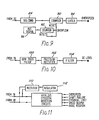
- Circuitry for implementing the second method is shown in Figure 9, and comprises a counter 90 that compares a probe frequency count with a reference frequency count accumulated in a counter 92 to determine an overspeed threshold: basically, if counter 90 overflows before counter 92 produces a reset pulse, an overspeed condition exists and is recorded in latch 94.
- This second method relies on the accuracy and stability of the reference frequency, produced by a source 96, to produce a low tolerance output.
- a precision R-C dependent reference oscillator whose frequency, accuracy and stability depends on the R-C components selected is used as source 96, as although a crystal oscillator meets the accuracy and stability requirements, it requires considerable current to drive.
- Using an R-C dependent oscillator also makes selection of different trip frequencies easier to perform by simply altering the reference frequency. This second method provides for a more accurate and stable overfrequency trip operation.
- episoidal transients are detected in both systems described hereinbefore, in order to facilitate the detection of turbine blade loss etc. that is the usual cause of an unbalanced and therefore episoidally rotating shaft.
- Speed probe detection of a phonic wheel mounted on the shaft behaving in this manner will produce a sinusoidal output of tooth frequency with a modulation at or below shaft frequency superimposed on the waveform due to the distance variance between probe and wheel caused by episoidal motion of the shaft.
- Detection of this phenomenon requires a method of separating the two frequencies (which can be regarded as a modulation wave and carrier wave).
- the frequency of the modulation will be at or below the shaft speed as it is possible that the episoidal rotation will occur at a lower speed than the shaft rotational speed.
- the episoidal transient detection circuitry of Figure 10 uses a low pass filter 100 with a sharp cut-off at maximum shaft frequency to remove tooth frequency oscillations and isolate all frequencies that may contain modulation due to episoidal motion.
- This isolated signal is passed through a precision absolute value circuit 102 and then through a filter 104, to give a DC output proportional to the episoidal oscillations.
- the systems described are suitable for gas turbine engines such as the Rolls-Royce/Turbomeca RTM322, the preferred system being that of phase measurement to determine axial positon.
- This preferred system has the advantage of accuracy and relative simplicity without the added complication of having to separate any episoidal modulating waveform to obtain axial data as the axial processing uses a square wave technique. It is possible that further processing of the data provided by such a system could be used for engine health monitoring and may lead to early detection of on-coming shaft and blade failures.
- the system also includes the function of overspeed, which has often previously been designated to the main control unit; in this way, better fail-safe operation is produced, by using a separate system with a self-contained power source.
- both halves of the phonic wheel of Figure 1 can be diagonal cut, in opposite directions, if desired.
- suitable probes other than inductive probes to sense the passage of the teeth of the phonic wheels e.g. electro-optical probes, capacitative probes or the like.
Landscapes
- Physics & Mathematics (AREA)
- General Physics & Mathematics (AREA)
- Measurement Of Length, Angles, Or The Like Using Electric Or Magnetic Means (AREA)
- Control Of Turbines (AREA)
- Testing Of Devices, Machine Parts, Or Other Structures Thereof (AREA)
Applications Claiming Priority (2)
| Application Number | Priority Date | Filing Date | Title |
|---|---|---|---|
| GB8706905 | 1987-03-24 | ||
| GB878706905A GB8706905D0 (en) | 1987-03-24 | 1987-03-24 | Shaft monitoring system |
Publications (2)
| Publication Number | Publication Date |
|---|---|
| EP0287214A2 true EP0287214A2 (fr) | 1988-10-19 |
| EP0287214A3 EP0287214A3 (fr) | 1991-01-16 |
Family
ID=10614484
Family Applications (1)
| Application Number | Title | Priority Date | Filing Date |
|---|---|---|---|
| EP19880302213 Withdrawn EP0287214A3 (fr) | 1987-03-24 | 1988-03-14 | Système de surveillance d'un arbre |
Country Status (3)
| Country | Link |
|---|---|
| US (1) | US4833405A (fr) |
| EP (1) | EP0287214A3 (fr) |
| GB (2) | GB8706905D0 (fr) |
Cited By (8)
| Publication number | Priority date | Publication date | Assignee | Title |
|---|---|---|---|---|
| EP0353076A3 (fr) * | 1988-07-29 | 1991-08-28 | Dowty Rotol Ltd. | Dispositif de détermination du déplacement linéaire d'un arbre en rotation |
| EP0632250A1 (fr) * | 1993-06-30 | 1995-01-04 | Simmonds Precision Products Inc. | Appareil pour la surveillance de la dynamique des équipements tournants |
| US5514952A (en) * | 1993-06-30 | 1996-05-07 | Simmonds Precision Products Inc. | Monitoring apparatus for rotating equipment dynamics for slow checking of alignment using plural angled elements |
| WO2001053774A1 (fr) * | 2000-01-20 | 2001-07-26 | High Speed Tech Oy Ltd | Procede pour determiner la position du rotor d'une machine electrique, et detecteur de position |
| WO2004011884A3 (fr) * | 2002-07-29 | 2004-06-10 | Honeywell Int Inc | Detection de positions lineaires au moyen de deux detecteurs a dents, d'un engrenage helicoidal et d'un engrenage droit |
| EP1724548A3 (fr) * | 2005-05-20 | 2006-12-27 | Dr. Johannes Heidenhain GmbH | Appareil de mesure de position |
| US11313245B2 (en) | 2019-01-28 | 2022-04-26 | Rolls-Royce Plc | Shaft monitoring system |
| US11371381B2 (en) | 2019-01-28 | 2022-06-28 | Rolls-Royce Plc | Shaft monitoring system |
Families Citing this family (44)
| Publication number | Priority date | Publication date | Assignee | Title |
|---|---|---|---|---|
| US5198763A (en) * | 1990-02-20 | 1993-03-30 | Nikkiso Co., Ltd. | Apparatus for monitoring the axial and radial wear on a bearing of a rotary shaft |
| US5218295A (en) * | 1991-04-15 | 1993-06-08 | Kayaba Kogyo Kabushiki Kaisha | System for processing position signals to improve resolution of the position of an object |
| US5444370A (en) * | 1993-03-18 | 1995-08-22 | Honeywell Inc. | Magnetic angular position sensor with two magnetically sensitive components arranged proximate two target tracks having complimentary magnetic and nonmagnetic segments |
| US5456123A (en) * | 1994-01-26 | 1995-10-10 | Simmonds Precision Products, Inc. | Static torque measurement for rotatable shaft |
| US5570016A (en) * | 1994-06-01 | 1996-10-29 | General Motors Corporation | Method and apparatus for detecting crankshaft angular position |
| US5955880A (en) * | 1996-12-05 | 1999-09-21 | Beam; Palmer H. | Sealless pump rotor position and bearing monitor |
| US5965806A (en) * | 1997-09-30 | 1999-10-12 | Cummins Engine Company, Inc. | Engine crankshaft sensing system |
| US6131547A (en) * | 1998-02-27 | 2000-10-17 | Cummins Engine Company, Inc. | Electronic engine speed and position apparatus for camshaft gear applications |
| US5925951A (en) * | 1998-06-19 | 1999-07-20 | Sundstrand Fluid Handling Corporation | Electromagnetic shield for an electric motor |
| US6346807B1 (en) * | 1999-10-22 | 2002-02-12 | Bently Nevada Corporation | Digital eddy current proximity system: apparatus and method |
| US6607349B2 (en) | 2001-11-14 | 2003-08-19 | Honeywell International, Inc. | Gas turbine engine broken shaft detection system |
| KR100505929B1 (ko) * | 2003-03-31 | 2005-08-04 | 삼성광주전자 주식회사 | 압축기 및 압축기의 배관연결방법 |
| EP1676097B1 (fr) * | 2003-09-19 | 2009-06-03 | Nxp B.V. | Circuit de detection electronique |
| US6917896B2 (en) * | 2003-11-26 | 2005-07-12 | General Electric Company | Method and apparatus for using eddy current transducers in magnetic fields |
| JP3987498B2 (ja) * | 2004-02-03 | 2007-10-10 | ファナック株式会社 | モニター装置 |
| JP4085074B2 (ja) * | 2004-06-24 | 2008-04-30 | ファナック株式会社 | 磁気式角度検出器における回転体の製造方法 |
| DE102004033266A1 (de) * | 2004-07-09 | 2006-02-02 | Dr. Johannes Heidenhain Gmbh | Positionsmesseinrichtung und Verfahren zur Positionsmessung |
| DE102004045618A1 (de) * | 2004-09-17 | 2006-04-13 | Siemens Ag | Abgasturbolader |
| DE102006003599A1 (de) * | 2006-01-25 | 2007-08-16 | Siemens Ag | Kompressorgehäuse für einen Abgasturbolader |
| FR2921974B1 (fr) * | 2007-10-08 | 2011-05-06 | Hispano Suiza Sa | Dispositif de detection de rupture d'arbre de turbine de turbocompresseur |
| DE102007049977B3 (de) * | 2007-10-18 | 2009-04-02 | Knorr-Bremse Systeme für Nutzfahrzeuge GmbH | Inkrementale Messeinrichtung zur Erfassung von Drehzahl, Drehrichtung und der Axialposition von axial verschieblichen Zahnrädern |
| ES2349816B1 (es) | 2009-05-13 | 2011-11-14 | Industria De Turbo Propulsores, S.A. | Sistema de medida de la posicion axial de ejes. |
| US9169742B2 (en) * | 2010-02-26 | 2015-10-27 | Pratt & Whitney Canada Corp. | Electronic shaft shear detection conditioning circuit |
| US8222760B2 (en) * | 2010-06-29 | 2012-07-17 | General Electric Company | Method for controlling a proximity sensor of a wind turbine |
| GB201011349D0 (en) | 2010-07-06 | 2010-08-18 | Rolls Royce Plc | Axial displacement and rotational speed monitoring |
| US10167784B2 (en) | 2012-10-26 | 2019-01-01 | Pratt & Whitney Canada Corp. | System for detecting shaft shear event |
| US10125682B2 (en) | 2013-02-26 | 2018-11-13 | Rolls-Royce Corporation | Methods and apparatus for measuring axial shaft displacement within gas turbine engines |
| US10428690B2 (en) | 2014-02-03 | 2019-10-01 | United Technologies Corporation | Variable positioner |
| US10228304B2 (en) | 2016-01-18 | 2019-03-12 | Pratt & Whitney Canada Corp. | Shaft shear detection through shaft oscillation |
| US10228305B2 (en) | 2016-01-18 | 2019-03-12 | Pratt & Whitney Canada Corp. | Shaft shear detection through shaft oscillation |
| GB201611524D0 (en) * | 2016-07-01 | 2016-08-17 | Rolls Royce Plc | Rotor blade damage |
| US10989063B2 (en) | 2016-08-16 | 2021-04-27 | Honeywell International Inc. | Turbofan gas turbine engine shaft break detection system and method |
| EP3354561A1 (fr) | 2017-01-30 | 2018-08-01 | Ge Avio S.r.l. | Système et procédé de localisation de position angulaire de mise en drapeau de pales d'hélice |
| JP6926502B2 (ja) * | 2017-02-10 | 2021-08-25 | 日立金属株式会社 | ターボ用回転センサ及びターボチャージャ |
| EP3612801B1 (fr) * | 2017-04-17 | 2020-12-30 | Lord Corporation | Procédés et systèmes de mesure de paramètres d'arbres rotatifs et de raccords |
| US10683810B2 (en) | 2017-12-01 | 2020-06-16 | Pratt & Whitney Canada Corp. | Shaft shear detection for gas turbine engines |
| US20190292936A1 (en) * | 2018-03-26 | 2019-09-26 | Pratt & Whitney Canada Corp. | Method and system for detecting shear of a rotating shaft |
| US10801360B2 (en) * | 2018-06-29 | 2020-10-13 | Pratt & Whitney Canada Corp. | Phonic wheel with output voltage tuning |
| GB201820826D0 (en) * | 2018-12-20 | 2019-02-06 | Rolls Royce Deutschland Ltd & Co Kg | Shaft monitoring system |
| GB201820822D0 (en) * | 2018-12-20 | 2019-02-06 | Rolls Royce Plc | Shaft monitoring system |
| US11505307B2 (en) * | 2019-10-21 | 2022-11-22 | Pratt & Whitney Canada Corp. | Phonic wheel and related system and method |
| US11428116B2 (en) | 2019-11-29 | 2022-08-30 | Pratt & Whitney Canada Corp. | System and method for measuring an axial position of a rotating component of an engine |
| US11420772B2 (en) | 2019-12-17 | 2022-08-23 | Pratt & Whitney Canada Corp. | System and method for determining an axial position of a feedback device |
| US12297782B2 (en) | 2020-04-27 | 2025-05-13 | Hamilton Sundstrand Corporation | Detecting condition of a shaft of a gas turbofan aircraft engine |
Family Cites Families (13)
| Publication number | Priority date | Publication date | Assignee | Title |
|---|---|---|---|---|
| FR1281292A (fr) * | 1960-11-07 | 1962-01-12 | Snecma | Procédé et dispositif de mesure du déplacement axial relatif d'un rotor et d'un stator |
| GB1303994A (fr) * | 1969-04-01 | 1973-01-24 | ||
| US3641535A (en) * | 1969-05-13 | 1972-02-08 | Bendix Corp | Positioning apparatus employing a magnetized screw thread |
| US3863235A (en) * | 1973-02-20 | 1975-01-28 | Rockwell International Corp | Phase sensitive position pickoff device |
| DE2928155A1 (de) * | 1979-07-12 | 1981-01-29 | Licentia Gmbh | Messanordnung |
| GB2062875B (en) * | 1979-11-03 | 1983-08-10 | Lucas Industries Ltd | Rotation and axial displacemetn transducers |
| GB2067763B (en) * | 1980-01-19 | 1984-07-11 | Lucas Industries Ltd | Position transducers |
| DE3102655C2 (de) * | 1981-01-24 | 1985-01-31 | Licentia Patent-Verwaltungs-Gmbh, 6000 Frankfurt | Verfahren zur Erfassung maschineninterner Größen bei Asynchron-Käfigläufermotoren |
| US4518917A (en) * | 1982-08-31 | 1985-05-21 | Westinghouse Electric Corp. | Plural sensor apparatus for monitoring turbine blading with undesired component elimination |
| JPH0665967B2 (ja) * | 1985-08-27 | 1994-08-24 | 株式会社エスジー | アブソリュート回転位置検出装置 |
| GB2181246B (en) * | 1985-10-02 | 1989-09-27 | Rolls Royce | Apparatus for measuring axial movement of a rotating member |
| US4746859A (en) * | 1986-12-22 | 1988-05-24 | Sundstrand Corporation | Power and temperature independent magnetic position sensor for a rotor |
| JPH111719A (ja) * | 1997-06-10 | 1999-01-06 | Nippon Steel Corp | 溶鋼鍋ライニングの変更方法 |
-
1987
- 1987-03-24 GB GB878706905A patent/GB8706905D0/en active Pending
-
1988
- 1988-03-14 GB GB8806001A patent/GB2202949B/en not_active Expired - Lifetime
- 1988-03-14 EP EP19880302213 patent/EP0287214A3/fr not_active Withdrawn
- 1988-03-23 US US07/172,015 patent/US4833405A/en not_active Expired - Fee Related
Cited By (10)
| Publication number | Priority date | Publication date | Assignee | Title |
|---|---|---|---|---|
| EP0353076A3 (fr) * | 1988-07-29 | 1991-08-28 | Dowty Rotol Ltd. | Dispositif de détermination du déplacement linéaire d'un arbre en rotation |
| EP0632250A1 (fr) * | 1993-06-30 | 1995-01-04 | Simmonds Precision Products Inc. | Appareil pour la surveillance de la dynamique des équipements tournants |
| US5508609A (en) * | 1993-06-30 | 1996-04-16 | Simmonds Precision Product Inc. | Monitoring apparatus for detecting axial position and axial alignment of a rotating shaft |
| US5514952A (en) * | 1993-06-30 | 1996-05-07 | Simmonds Precision Products Inc. | Monitoring apparatus for rotating equipment dynamics for slow checking of alignment using plural angled elements |
| WO2001053774A1 (fr) * | 2000-01-20 | 2001-07-26 | High Speed Tech Oy Ltd | Procede pour determiner la position du rotor d'une machine electrique, et detecteur de position |
| US6737861B2 (en) | 2000-01-20 | 2004-05-18 | High Speed Tech Oy Ltd. | Method for determining the position of the rotor of an electric machine, and a position sensor |
| WO2004011884A3 (fr) * | 2002-07-29 | 2004-06-10 | Honeywell Int Inc | Detection de positions lineaires au moyen de deux detecteurs a dents, d'un engrenage helicoidal et d'un engrenage droit |
| EP1724548A3 (fr) * | 2005-05-20 | 2006-12-27 | Dr. Johannes Heidenhain GmbH | Appareil de mesure de position |
| US11313245B2 (en) | 2019-01-28 | 2022-04-26 | Rolls-Royce Plc | Shaft monitoring system |
| US11371381B2 (en) | 2019-01-28 | 2022-06-28 | Rolls-Royce Plc | Shaft monitoring system |
Also Published As
| Publication number | Publication date |
|---|---|
| US4833405A (en) | 1989-05-23 |
| EP0287214A3 (fr) | 1991-01-16 |
| GB2202949A (en) | 1988-10-05 |
| GB8806001D0 (en) | 1988-04-13 |
| GB8706905D0 (en) | 1987-04-29 |
| GB2202949B (en) | 1990-11-21 |
Similar Documents
| Publication | Publication Date | Title |
|---|---|---|
| US4833405A (en) | Shaft failure monitoring system using angled rotating teeth and phase detection | |
| KR0139643B1 (ko) | 비동기터빈 블레이드 진동 모니터링 시스템 | |
| US4196629A (en) | Fiber optic machinery performance monitor | |
| US5438882A (en) | Rotating shaft vibration monitor | |
| EP2162698B1 (fr) | Capteurs à courants de foucault | |
| US4924180A (en) | Apparatus for detecting bearing shaft wear utilizing rotatable magnet means | |
| US5097711A (en) | Shrouded turbine blade vibration monitor and target therefor | |
| KR0139213B1 (ko) | 슈라우드 터빈블레이드 진동 감시기 | |
| US20050122095A1 (en) | Rotation sensor and method | |
| US7034522B2 (en) | Method and apparatus for measuring movement, displacement and/or deformation | |
| EP3128332A2 (fr) | Système et procédé de détection magnétique destinés à détecter la vitesse de l'arbre | |
| US4995257A (en) | Monitor for shaft vibration in an operating turbine | |
| KR20150090103A (ko) | 압축기 휠의 회전을 모니터링하기 위한 방법 | |
| GB2455797A (en) | Monitoring the rotational speed of a turbine shaft | |
| JPH02306898A (ja) | 飛行機エンジン推進機のブレードピッチ角の検出機構 | |
| RU2138012C1 (ru) | Способ измерения параметров движения лопаток ротора турбомашины | |
| Heath | A new technique for identifying synchronous resonances using tip-timing | |
| EP2058628A2 (fr) | Procédé et appareil pour contrôler la position d'un arbre rotatif | |
| EP0571886A1 (fr) | Dispositif de mesure de l'accélération angulaire | |
| RU2805375C1 (ru) | Способ определения исправной работы гиромоторов блока демпфирующих гироскопов | |
| JP2008151700A (ja) | トルク測定方法および装置 | |
| EP0802414A2 (fr) | Dispositif d'étanchéité d'arbre et capteur pour arbre | |
| SU993125A2 (ru) | Датчик угловой скорости вращени вала | |
| SU607144A1 (ru) | Датчик угловой скорости вращени вала | |
| US4509367A (en) | Tachometer generator indexing device |
Legal Events
| Date | Code | Title | Description |
|---|---|---|---|
| PUAI | Public reference made under article 153(3) epc to a published international application that has entered the european phase |
Free format text: ORIGINAL CODE: 0009012 |
|
| AK | Designated contracting states |
Kind code of ref document: A2 Designated state(s): DE FR IT |
|
| RAP1 | Party data changed (applicant data changed or rights of an application transferred) |
Owner name: SCHLUMBERGER INDUSTRIES LIMITED |
|
| PUAL | Search report despatched |
Free format text: ORIGINAL CODE: 0009013 |
|
| AK | Designated contracting states |
Kind code of ref document: A3 Designated state(s): DE FR IT |
|
| STAA | Information on the status of an ep patent application or granted ep patent |
Free format text: STATUS: THE APPLICATION IS DEEMED TO BE WITHDRAWN |
|
| 18D | Application deemed to be withdrawn |
Effective date: 19910717 |