EP0287337A2 - Circuit pour programmer la cellule d'entrée/de sortie d'un réseau logique programmable - Google Patents
Circuit pour programmer la cellule d'entrée/de sortie d'un réseau logique programmable Download PDFInfo
- Publication number
- EP0287337A2 EP0287337A2 EP88303292A EP88303292A EP0287337A2 EP 0287337 A2 EP0287337 A2 EP 0287337A2 EP 88303292 A EP88303292 A EP 88303292A EP 88303292 A EP88303292 A EP 88303292A EP 0287337 A2 EP0287337 A2 EP 0287337A2
- Authority
- EP
- European Patent Office
- Prior art keywords
- array
- output
- architecture
- programming
- programmable
- Prior art date
- Legal status (The legal status is an assumption and is not a legal conclusion. Google has not performed a legal analysis and makes no representation as to the accuracy of the status listed.)
- Granted
Links
Images
Classifications
-
- H—ELECTRICITY
- H03—ELECTRONIC CIRCUITRY
- H03K—PULSE TECHNIQUE
- H03K19/00—Logic circuits, i.e. having at least two inputs acting on one output; Inverting circuits
-
- H—ELECTRICITY
- H03—ELECTRONIC CIRCUITRY
- H03K—PULSE TECHNIQUE
- H03K19/00—Logic circuits, i.e. having at least two inputs acting on one output; Inverting circuits
- H03K19/02—Logic circuits, i.e. having at least two inputs acting on one output; Inverting circuits using specified components
- H03K19/173—Logic circuits, i.e. having at least two inputs acting on one output; Inverting circuits using specified components using elementary logic circuits as components
- H03K19/177—Logic circuits, i.e. having at least two inputs acting on one output; Inverting circuits using specified components using elementary logic circuits as components arranged in matrix form
- H03K19/17748—Structural details of configuration resources
- H03K19/17772—Structural details of configuration resources for powering on or off
-
- H—ELECTRICITY
- H03—ELECTRONIC CIRCUITRY
- H03K—PULSE TECHNIQUE
- H03K17/00—Electronic switching or gating, i.e. not by contact-making and –breaking
- H03K17/22—Modifications for ensuring a predetermined initial state when the supply voltage has been applied
-
- H—ELECTRICITY
- H03—ELECTRONIC CIRCUITRY
- H03K—PULSE TECHNIQUE
- H03K19/00—Logic circuits, i.e. having at least two inputs acting on one output; Inverting circuits
- H03K19/02—Logic circuits, i.e. having at least two inputs acting on one output; Inverting circuits using specified components
- H03K19/173—Logic circuits, i.e. having at least two inputs acting on one output; Inverting circuits using specified components using elementary logic circuits as components
- H03K19/177—Logic circuits, i.e. having at least two inputs acting on one output; Inverting circuits using specified components using elementary logic circuits as components arranged in matrix form
- H03K19/17704—Logic circuits, i.e. having at least two inputs acting on one output; Inverting circuits using specified components using elementary logic circuits as components arranged in matrix form the logic functions being realised by the interconnection of rows and columns
-
- H—ELECTRICITY
- H03—ELECTRONIC CIRCUITRY
- H03K—PULSE TECHNIQUE
- H03K19/00—Logic circuits, i.e. having at least two inputs acting on one output; Inverting circuits
- H03K19/02—Logic circuits, i.e. having at least two inputs acting on one output; Inverting circuits using specified components
- H03K19/173—Logic circuits, i.e. having at least two inputs acting on one output; Inverting circuits using specified components using elementary logic circuits as components
- H03K19/177—Logic circuits, i.e. having at least two inputs acting on one output; Inverting circuits using specified components using elementary logic circuits as components arranged in matrix form
- H03K19/17736—Structural details of routing resources
- H03K19/17744—Structural details of routing resources for input/output signals
-
- H—ELECTRICITY
- H03—ELECTRONIC CIRCUITRY
- H03K—PULSE TECHNIQUE
- H03K19/00—Logic circuits, i.e. having at least two inputs acting on one output; Inverting circuits
- H03K19/02—Logic circuits, i.e. having at least two inputs acting on one output; Inverting circuits using specified components
- H03K19/173—Logic circuits, i.e. having at least two inputs acting on one output; Inverting circuits using specified components using elementary logic circuits as components
- H03K19/177—Logic circuits, i.e. having at least two inputs acting on one output; Inverting circuits using specified components using elementary logic circuits as components arranged in matrix form
- H03K19/17748—Structural details of configuration resources
- H03K19/1776—Structural details of configuration resources for memories
Definitions
- the present invention relates to circuits for programming an output cell in a programmable logic device (PLD) circuit.
- PLD programmable logic device
- a typical PLD has an array of fuses or memory cells which can be programmed to configure the array to provide a number of desired logic functions. Often, this array will be used in conjunction with output cells which may include multiplexers, inverters or other circuitry for handling the outputs of the main fuse or memory array. One or more array outputs may be provided to each output cell. These output cells can have programmable elements in them, such as a multiplexer which can be programmed to select one or the other of its inputs. The programming data for the output cell is typically stored in separate fuses or memory cells. Because the output cells need to be programmed or configured properly prior to readout from the main array, these fuses or memory cells are physically located outside of the main array and next to the other logic elements of the output cell. This complicates the layout of a PLD chip and requires the duplication of sense amplifiers and addressing circuits which are used for the main array.
- the present invention is an improved architecture for programming an output cell (macro cell) in a PLD.
- the memory cells for the macro cell are stored in the main array itself.
- a power-on sense circuit senses the presence of power and enables an architecture portion of the main array while disabling the rest of the main array.
- the power-on sense signal also enables a path from the output of the array to the macro cell elements to be programmed. When the power-on sense signal is removed a short time after power-up, this path is blocked so that the array outputs continue on their normal path and the architecture portion of the array is disabled while the rest of the array is enabled for normal operation.
- the layout of the circuit is simplified and less circuitry is required for sense amplifiers and other circuits which are used commonly by elements of the array.
- the invention allows the placement of these memory cells in the main array by providing a power-on sense circuit which enables this portion of the array while disabling the logic portion of the array during a programming of the output cell architecture. The invention thus insures the architecture will be programmed upon each power-up of the circuit.
- the output cell has six programmable elements which include three multiplexers.
- Six programming inputs are provided from a logic circuit which decodes the signals of three output lines from the main memory array. These output lines are coupled to this logic circuit by transistors which have their gates connected to a power-on sense circuit. When the power-on sense signal is applied, these transistor switches couple the outputs to the logic circuit for programming.
- the power-on sense signal itself is a pulse which is provided when the power applied reaches a predetermined level.
- the power-on sense (POS) pulse is provided to a memory array logic circuit which provides four signals to the memory array. Two of those signals go to the architecture portion of the array and two go to the logic portion of the array. A first signal enables a transistor in each column line to activate that column line. A second signal disables a deactivating transistor which couples each column line to ground when not in use.
- POS power-on sense
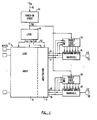
- Fig. 1 shows a memory array 10 having a logic portion 12 and an architecture portion 14. The outputs of this array are provided along output lines 16 to macro cells 18. The output of each macro cell is coupled to an I/O pin 20.
- Memory array 10 typically contains a crisscrossing pattern of lines which can be connected via programmable "fuses" to produce a variety of logic functions.
- the fuse is often an actual metal fuse which can be blown or a transistor which is controlled by a programmable memory cell to either provide a connection or not provide a connection.
- An example of such an array is shown in co-pending application Serial No. 856,539 entitled “Single Function Programmable Logic Array Circuit", filed April 25, 1986, and incorporated herein by reference.
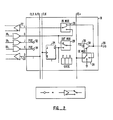
- each macro cell 18 has the elements shown in Fig. 2.
- Macro cell 18 is provided with three outputs 16 from the array and also provides two feedback lines 22 to the array.
- macro cell 18 contains a J-K latch 24, multiplexers 26, 28 and 30, polarity control elements (PCE) 32, 34 and 36 and a tri-state buffer 38.
- PCE polarity control elements
- Each PCE either inverts the signal or leaves the signal unchanged, and can be constructed with a multiplexer having one input inverted and the other not inverted.
- output cell can perform several different functions.
- one of the output lines 16 can simply be provided to output pad 20.
- output pad 20 can be used as an input pad.
- the output of latch 24 can be provided to output pad 20.
- Other configurations are available as well.
- a power-on sense circuit 40 which determines when power line 42 reaches a predetermined level and sends out a power-on sense (POS) pulse.
- the POS pulse is provided to a logic circuit 44 which provides a pair of control signals 46, 48 to the architecture portion 14 of memory array 10. Another pair of control signals 50, 52 are provided to logic portion 12 of memory array 10.
- signal lines 46 and 48 enable portion 14 while lines 50 and 52 disable portion 12.
- the outputs of architecture portion 14 are then provided on output lines 16 to macro cells 18.
- These signals are also provided to logic circuits 54 which are enabled by the POS signal.
- Logic circuits 54 provide the programming inputs to macro cells 18. After programming, the POS pulse disappears, logic circuits 54 are disabled, architecture portion 14 of array 10 is disabled and logic portion 12 of array 10 is enabled. Thereafter, operation of the circuit continues in a normal manner.
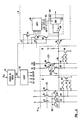
- Fig. 3 shows the enabling and disabling lines of Fig. 1 in more detail.
- a single output line 16 is shown which is provided from a term line 56 through a sense amplifier 58.
- Term line 56 is programmed from a number of column lines as discussed in co-pending application Serial No. 856,539.
- a single such connection is shown in Fig. 3 being made through a transistor 60 which is coupled to column lines 62, 64 and 66 through programming transistors. This type of connection is shown in detail in co-pending application Serial No. 856,623 entitled “Programmable Matrix Circuit", filed April 25, 1986, and incorporated herein by reference.
- the three column lines 62, 64 and 66 are enabled by a signal CS1 from logic circuit 44 which is provided to three transistors 68, 70 and 72.
- CS1 when CS1 is a logic high, these transistors are enabled, and signals A, A and X are allowed to propagate to nodes 66, 64 and 62, respectively.
- CS2 is held at zero, turning off transistors 78, 76 and 74.
- CS1 must equal 1 and CS2 must equal 0.
- these column lines will be disabled by being pulled to ground potential by transistors 74, 76 and 78.
- a pair of column lines 80, 82 are coupled via a transistor 84 to term line 56.
- signals CS3 and CS4 enabled transistors 86, 88 and 90, 92, respectively.
- D0 and D1 are preset to ground and +V, respectively.
- the transistors coupled to transistor 84 are then programmed to connect node 56 (through transistor 84) to either line 80 (ground) or line 82 (+V) to give a logic 0 or 1.
- Signals CS1-CS4 are decoded by logic circuit 44 from the POS signal from power-on sense circuit 40.
- the POS signal is a logic pulse, which when high enables array portion 14 and disables array portion 12.
- the POS signal is similarly provided to transistors 94, 96 and 98 in output cell 18. These transistors enable output lines 16 to be coupled to a logic circuit 100.
- Logic circuit 100 provides seven outputs 102, 103 to the various programmable elements of output cell 18. Six output lines 16 are coupled to logic circuit 100, which has seven outputs, three outputs 102 and four outputs 103.
- Logic circuit 100 includes a 3 to 4 encoder for providing four outputs 103 from three of inputs 16. Outputs 103 control multiplexers 26, 28 and 30 of Fig. 2. Multiplexer 30 requires two control signals because it is a 3 position multiplexer.
- the outputs 102 of logic circuit 100 are each coupled to a polarity control element 104 of Fig. 3. Polarity control element 104 shown in Fig. 3 consists of a multiplexer 106 and an inverter 108. The output of polarity control element 104 will either be the non-inverted or inverted signal on line 16 depending upon the state of the signal provided to the select input
- the remaining lines 102 are similarly provided to the other programmable elements of output cell 18.
- the layout of the circuit is simplified since this memory cell is simply another cell in the array.
- the need for a separate sense amplifier 58 and separate addressing circuitry is eliminated. If memory cell 84 were contained in output cell 18, such a separate sense amplifier and addressing circuit would be necessary.
Landscapes
- Physics & Mathematics (AREA)
- Mathematical Physics (AREA)
- Engineering & Computer Science (AREA)
- Computer Hardware Design (AREA)
- Computing Systems (AREA)
- General Engineering & Computer Science (AREA)
- Computer Networks & Wireless Communication (AREA)
- Logic Circuits (AREA)
- Design And Manufacture Of Integrated Circuits (AREA)
Priority Applications (1)
| Application Number | Priority Date | Filing Date | Title |
|---|---|---|---|
| AT88303292T ATE94705T1 (de) | 1987-04-14 | 1988-04-13 | Programmierungsschaltung fuer eingabe/ausgabezelle eines programmierbaren logikarrays. |
Applications Claiming Priority (2)
| Application Number | Priority Date | Filing Date | Title |
|---|---|---|---|
| US38101 | 1979-05-11 | ||
| US07/038,101 US4783606A (en) | 1987-04-14 | 1987-04-14 | Programming circuit for programmable logic array I/O cell |
Publications (3)
| Publication Number | Publication Date |
|---|---|
| EP0287337A2 true EP0287337A2 (fr) | 1988-10-19 |
| EP0287337A3 EP0287337A3 (en) | 1989-07-26 |
| EP0287337B1 EP0287337B1 (fr) | 1993-09-15 |
Family
ID=21898099
Family Applications (1)
| Application Number | Title | Priority Date | Filing Date |
|---|---|---|---|
| EP88303292A Expired - Lifetime EP0287337B1 (fr) | 1987-04-14 | 1988-04-13 | Circuit pour programmer la cellule d'entrée/de sortie d'un réseau logique programmable |
Country Status (6)
| Country | Link |
|---|---|
| US (1) | US4783606A (fr) |
| EP (1) | EP0287337B1 (fr) |
| JP (1) | JP2571257B2 (fr) |
| KR (1) | KR910001381B1 (fr) |
| AT (1) | ATE94705T1 (fr) |
| DE (1) | DE3884037T2 (fr) |
Cited By (4)
| Publication number | Priority date | Publication date | Assignee | Title |
|---|---|---|---|---|
| EP0307912A3 (en) * | 1987-09-18 | 1989-07-12 | Fujitsu Limited | Programmable logic device |
| EP0406996A1 (fr) * | 1989-06-21 | 1991-01-09 | Kawasaki Steel Corporation | Circuit intÀ©gré comprenant un circuit programmable |
| EP0420390A3 (en) * | 1989-09-29 | 1991-09-04 | Sgs-Thomson Microelectronics, Inc. (A Delaware Corp.) | Configuration memory for programmable logic device |
| EP0536756B1 (fr) * | 1991-10-09 | 1998-05-27 | Rohm Co., Ltd. | Micro-ordinateur et son circuit d'établissement d'options |
Families Citing this family (36)
| Publication number | Priority date | Publication date | Assignee | Title |
|---|---|---|---|---|
| JP2582250B2 (ja) * | 1986-10-03 | 1997-02-19 | 日本電信電話株式会社 | タイミング信号遅延回路装置 |
| US5046035A (en) * | 1987-08-26 | 1991-09-03 | Ict International Cmos Tech., Inc. | High-performance user programmable logic device (PLD) |
| US4918641A (en) * | 1987-08-26 | 1990-04-17 | Ict International Cmos Technology, Inc. | High-performance programmable logic device |
| JPH0197016A (ja) * | 1987-10-09 | 1989-04-14 | Fujitsu Ltd | 半導体集積回路装置 |
| KR910003593B1 (ko) * | 1987-12-30 | 1991-06-07 | 삼성전자 주식회사 | 고집적도 메모리용 모드 선택회로 |
| JPH01208012A (ja) * | 1988-02-15 | 1989-08-22 | Nec Corp | フリップフロップ回路 |
| US4879481A (en) * | 1988-09-02 | 1989-11-07 | Cypress Semiconductor Corporation | Dual I/O macrocell for high speed synchronous state machine |
| US5023484A (en) * | 1988-09-02 | 1991-06-11 | Cypress Semiconductor Corporation | Architecture of high speed synchronous state machine |
| US4914322A (en) * | 1988-12-16 | 1990-04-03 | Advanced Micro Devices, Inc. | Polarity option control logic for use with a register of a programmable logic array macrocell |
| EP0373831A3 (fr) * | 1988-12-16 | 1991-09-04 | Advanced Micro Devices, Inc. | Porte logique à autoverrouillage |
| US4963769A (en) * | 1989-05-08 | 1990-10-16 | Cypress Semiconductor | Circuit for selective power-down of unused circuitry |
| US4940909A (en) * | 1989-05-12 | 1990-07-10 | Plus Logic, Inc. | Configuration control circuit for programmable logic devices |
| US5051622A (en) * | 1989-11-08 | 1991-09-24 | Chips And Technologies, Inc. | Power-on strap inputs |
| US5264742A (en) * | 1990-01-09 | 1993-11-23 | Sgs-Thomson Microelectronics, S.A. | Security locks for integrated circuit |
| FR2656939B1 (fr) * | 1990-01-09 | 1992-04-03 | Sgs Thomson Microelectronics | Verrous de securite pour circuit integre. |
| JP2544020B2 (ja) * | 1990-11-19 | 1996-10-16 | 川崎製鉄株式会社 | プログラマブル論理素子 |
| JPH04192350A (ja) * | 1990-11-24 | 1992-07-10 | Nec Corp | 半導体集積回路装置 |
| US5138198A (en) * | 1991-05-03 | 1992-08-11 | Lattice Semiconductor Corporation | Integrated programmable logic device with control circuit to power down unused sense amplifiers |
| US6759870B2 (en) | 1991-09-03 | 2004-07-06 | Altera Corporation | Programmable logic array integrated circuits |
| US20020130681A1 (en) * | 1991-09-03 | 2002-09-19 | Cliff Richard G. | Programmable logic array integrated circuits |
| JP2965802B2 (ja) * | 1991-12-19 | 1999-10-18 | 株式会社東芝 | 半導体集積回路 |
| JPH06176175A (ja) * | 1992-12-10 | 1994-06-24 | Rohm Co Ltd | オプション設定回路及び電子機器 |
| US5332929A (en) * | 1993-04-08 | 1994-07-26 | Xilinx, Inc. | Power management for programmable logic devices |
| US5414380A (en) * | 1993-04-19 | 1995-05-09 | Motorola, Inc. | Integrated circuit with an active-level configurable and method therefor |
| US5453706A (en) * | 1994-04-01 | 1995-09-26 | Xilinx, Inc. | Field programmable gate array providing contention free configuration and reconfiguration |
| US5543730A (en) | 1995-05-17 | 1996-08-06 | Altera Corporation | Techniques for programming programmable logic array devices |
| US5625301A (en) * | 1995-05-18 | 1997-04-29 | Actel Corporation | Flexible FPGA input/output architecture |
| US5629635A (en) * | 1995-09-26 | 1997-05-13 | Ics Technologies, Inc. | Address programming via LED pin |
| US5650734A (en) * | 1995-12-11 | 1997-07-22 | Altera Corporation | Programming programmable transistor devices using state machines |
| US6384630B2 (en) | 1996-06-05 | 2002-05-07 | Altera Corporation | Techniques for programming programmable logic array devices |
| US5959466A (en) * | 1997-01-31 | 1999-09-28 | Actel Corporation | Field programmable gate array with mask programmed input and output buffers |
| US6150837A (en) * | 1997-02-28 | 2000-11-21 | Actel Corporation | Enhanced field programmable gate array |
| US6720796B1 (en) | 2001-05-06 | 2004-04-13 | Altera Corporation | Multiple size memories in a programmable logic device |
| US7111110B1 (en) * | 2002-12-10 | 2006-09-19 | Altera Corporation | Versatile RAM for programmable logic device |
| US7249213B2 (en) * | 2003-08-18 | 2007-07-24 | Silicon Storage Technology, Inc. | Memory device operable with a plurality of protocols with configuration data stored in non-volatile storage elements |
| US7893772B1 (en) | 2007-12-03 | 2011-02-22 | Cypress Semiconductor Corporation | System and method of loading a programmable counter |
Family Cites Families (10)
| Publication number | Priority date | Publication date | Assignee | Title |
|---|---|---|---|---|
| US4458163A (en) * | 1981-07-20 | 1984-07-03 | Texas Instruments Incorporated | Programmable architecture logic |
| JPS5961046A (ja) * | 1982-09-30 | 1984-04-07 | Fujitsu Ltd | 集積回路装置 |
| US4609838A (en) * | 1984-05-30 | 1986-09-02 | Vlsi Technology, Inc. | Programmable array combinatorial (PAC) circuitry |
| DE3582990D1 (de) * | 1984-09-28 | 1991-07-04 | Advanced Micro Devices Inc | Logikschaltung mit dynamisch steuerbarem ausgang. |
| US4684830A (en) * | 1985-03-22 | 1987-08-04 | Monolithic Memories, Inc. | Output circuit for a programmable logic array |
| US4634904A (en) * | 1985-04-03 | 1987-01-06 | Lsi Logic Corporation | CMOS power-on reset circuit |
| US4677318A (en) * | 1985-04-12 | 1987-06-30 | Altera Corporation | Programmable logic storage element for programmable logic devices |
| GB8518692D0 (en) * | 1985-07-24 | 1985-08-29 | Gen Electric Co Plc | Power-on reset circuit arrangements |
| US4771285A (en) * | 1985-11-05 | 1988-09-13 | Advanced Micro Devices, Inc. | Programmable logic cell with flexible clocking and flexible feedback |
| US4697097A (en) * | 1986-04-12 | 1987-09-29 | Motorola, Inc. | CMOS power-on detection circuit |
-
1987
- 1987-04-14 US US07/038,101 patent/US4783606A/en not_active Expired - Lifetime
-
1988
- 1988-04-13 EP EP88303292A patent/EP0287337B1/fr not_active Expired - Lifetime
- 1988-04-13 DE DE88303292T patent/DE3884037T2/de not_active Expired - Lifetime
- 1988-04-13 KR KR1019880004162A patent/KR910001381B1/ko not_active Expired
- 1988-04-13 AT AT88303292T patent/ATE94705T1/de not_active IP Right Cessation
- 1988-04-14 JP JP63090426A patent/JP2571257B2/ja not_active Expired - Lifetime
Cited By (5)
| Publication number | Priority date | Publication date | Assignee | Title |
|---|---|---|---|---|
| EP0307912A3 (en) * | 1987-09-18 | 1989-07-12 | Fujitsu Limited | Programmable logic device |
| EP0406996A1 (fr) * | 1989-06-21 | 1991-01-09 | Kawasaki Steel Corporation | Circuit intÀ©gré comprenant un circuit programmable |
| US5058074A (en) * | 1989-06-21 | 1991-10-15 | Kawasaki Steel Corporation | Integrated circuit including programmable circuit |
| EP0420390A3 (en) * | 1989-09-29 | 1991-09-04 | Sgs-Thomson Microelectronics, Inc. (A Delaware Corp.) | Configuration memory for programmable logic device |
| EP0536756B1 (fr) * | 1991-10-09 | 1998-05-27 | Rohm Co., Ltd. | Micro-ordinateur et son circuit d'établissement d'options |
Also Published As
| Publication number | Publication date |
|---|---|
| EP0287337B1 (fr) | 1993-09-15 |
| ATE94705T1 (de) | 1993-10-15 |
| JP2571257B2 (ja) | 1997-01-16 |
| EP0287337A3 (en) | 1989-07-26 |
| JPS6447126A (en) | 1989-02-21 |
| DE3884037T2 (de) | 1994-04-14 |
| KR910001381B1 (ko) | 1991-03-04 |
| KR880013322A (ko) | 1988-11-30 |
| DE3884037D1 (de) | 1993-10-21 |
| US4783606A (en) | 1988-11-08 |
Similar Documents
| Publication | Publication Date | Title |
|---|---|---|
| EP0287337B1 (fr) | Circuit pour programmer la cellule d'entrée/de sortie d'un réseau logique programmable | |
| US5128559A (en) | Logic block for programmable logic devices | |
| US4975601A (en) | User-writable random access memory logic block for programmable logic devices | |
| USRE37195E1 (en) | Programmable switch for FPGA input/output signals | |
| US4684830A (en) | Output circuit for a programmable logic array | |
| EP0448879B1 (fr) | Cellule pour un circuit logique programmable, à base de RAM statique | |
| US5450022A (en) | Structure and method for configuration of a field programmable gate array | |
| US4933577A (en) | Output circuit for a programmable logic array | |
| EP0582660B1 (fr) | Dispositif et procede de multiplexage de broches permettant de programmer des unites logiques a l'interieur d'un systeme | |
| EP0840455B1 (fr) | Macrocellule accessible par microprocesseur | |
| EP0351984B1 (fr) | Interface programmable pour carte de circuit périphérique de système d'ordinateur | |
| US5121359A (en) | Configuration memory for programmable logic device | |
| US4538245A (en) | Enabling circuit for redundant word lines in a semiconductor memory array | |
| US4959564A (en) | Sense amplifier power down circuitry for programmable logic device | |
| JPH05276007A (ja) | 集積回路装置 | |
| EP0898281B1 (fr) | Circuits de mémoire statiques à accès aléatoire | |
| US4930107A (en) | Method and apparatus for programming and verifying programmable elements in programmable devices | |
| JPH0197016A (ja) | 半導体集積回路装置 | |
| US4796229A (en) | Writable logic array | |
| EP0420388B1 (fr) | Circuit de bascule de test | |
| JPH06303128A (ja) | スイッチよりも少ない記憶セルを使用するリプログラマブル接続アーキテクチャ | |
| US4458163A (en) | Programmable architecture logic | |
| US5099453A (en) | Configuration memory for programmable logic device | |
| US5003202A (en) | Coincidence extendable programmable logic device | |
| EP0419760A2 (fr) | Circuit de redondance de mémoire à consommation au repos nulle et résistant aux effets de rayonnement |
Legal Events
| Date | Code | Title | Description |
|---|---|---|---|
| PUAI | Public reference made under article 153(3) epc to a published international application that has entered the european phase |
Free format text: ORIGINAL CODE: 0009012 |
|
| AK | Designated contracting states |
Kind code of ref document: A2 Designated state(s): AT DE FR GB IT NL |
|
| PUAL | Search report despatched |
Free format text: ORIGINAL CODE: 0009013 |
|
| AK | Designated contracting states |
Kind code of ref document: A3 Designated state(s): AT DE FR GB IT NL |
|
| 17P | Request for examination filed |
Effective date: 19900124 |
|
| RAP1 | Party data changed (applicant data changed or rights of an application transferred) |
Owner name: ROHM CORPORATION |
|
| 17Q | First examination report despatched |
Effective date: 19911018 |
|
| GRAA | (expected) grant |
Free format text: ORIGINAL CODE: 0009210 |
|
| AK | Designated contracting states |
Kind code of ref document: B1 Designated state(s): AT DE FR GB IT NL |
|
| REF | Corresponds to: |
Ref document number: 94705 Country of ref document: AT Date of ref document: 19931015 Kind code of ref document: T |
|
| ITF | It: translation for a ep patent filed | ||
| REF | Corresponds to: |
Ref document number: 3884037 Country of ref document: DE Date of ref document: 19931021 |
|
| ET | Fr: translation filed | ||
| PG25 | Lapsed in a contracting state [announced via postgrant information from national office to epo] |
Ref country code: AT Effective date: 19940413 |
|
| PLBE | No opposition filed within time limit |
Free format text: ORIGINAL CODE: 0009261 |
|
| STAA | Information on the status of an ep patent application or granted ep patent |
Free format text: STATUS: NO OPPOSITION FILED WITHIN TIME LIMIT |
|
| 26N | No opposition filed | ||
| PG25 | Lapsed in a contracting state [announced via postgrant information from national office to epo] |
Ref country code: NL Effective date: 19941101 |
|
| NLV4 | Nl: lapsed or anulled due to non-payment of the annual fee | ||
| PGFP | Annual fee paid to national office [announced via postgrant information from national office to epo] |
Ref country code: FR Payment date: 20010409 Year of fee payment: 14 |
|
| PGFP | Annual fee paid to national office [announced via postgrant information from national office to epo] |
Ref country code: GB Payment date: 20010411 Year of fee payment: 14 |
|
| REG | Reference to a national code |
Ref country code: GB Ref legal event code: IF02 |
|
| PG25 | Lapsed in a contracting state [announced via postgrant information from national office to epo] |
Ref country code: GB Free format text: LAPSE BECAUSE OF NON-PAYMENT OF DUE FEES Effective date: 20020413 |
|
| GBPC | Gb: european patent ceased through non-payment of renewal fee |
Effective date: 20020413 |
|
| PG25 | Lapsed in a contracting state [announced via postgrant information from national office to epo] |
Ref country code: FR Free format text: LAPSE BECAUSE OF NON-PAYMENT OF DUE FEES Effective date: 20021231 |
|
| REG | Reference to a national code |
Ref country code: FR Ref legal event code: ST |
|
| PG25 | Lapsed in a contracting state [announced via postgrant information from national office to epo] |
Ref country code: IT Free format text: LAPSE BECAUSE OF NON-PAYMENT OF DUE FEES;WARNING: LAPSES OF ITALIAN PATENTS WITH EFFECTIVE DATE BEFORE 2007 MAY HAVE OCCURRED AT ANY TIME BEFORE 2007. THE CORRECT EFFECTIVE DATE MAY BE DIFFERENT FROM THE ONE RECORDED. Effective date: 20050413 |
|
| PGFP | Annual fee paid to national office [announced via postgrant information from national office to epo] |
Ref country code: DE Payment date: 20070405 Year of fee payment: 20 |