EP0287549A1 - Dispositif pour chauffer des objets et des organismes - Google Patents
Dispositif pour chauffer des objets et des organismes Download PDFInfo
- Publication number
- EP0287549A1 EP0287549A1 EP88890047A EP88890047A EP0287549A1 EP 0287549 A1 EP0287549 A1 EP 0287549A1 EP 88890047 A EP88890047 A EP 88890047A EP 88890047 A EP88890047 A EP 88890047A EP 0287549 A1 EP0287549 A1 EP 0287549A1
- Authority
- EP
- European Patent Office
- Prior art keywords
- resonator
- magnetrons
- interior
- room
- hollow
- Prior art date
- Legal status (The legal status is an assumption and is not a legal conclusion. Google has not performed a legal analysis and makes no representation as to the accuracy of the status listed.)
- Granted
Links
Images


Classifications
-
- A—HUMAN NECESSITIES
- A61—MEDICAL OR VETERINARY SCIENCE; HYGIENE
- A61L—METHODS OR APPARATUS FOR STERILISING MATERIALS OR OBJECTS IN GENERAL; DISINFECTION, STERILISATION OR DEODORISATION OF AIR; CHEMICAL ASPECTS OF BANDAGES, DRESSINGS, ABSORBENT PADS OR SURGICAL ARTICLES; MATERIALS FOR BANDAGES, DRESSINGS, ABSORBENT PADS OR SURGICAL ARTICLES
- A61L2/00—Disinfection or sterilisation of materials or objects, in general; Accessories therefor
- A61L2/02—Disinfection or sterilisation of materials or objects, in general; Accessories therefor using physical processes
- A61L2/08—Radiation
- A61L2/12—Microwaves
-
- H—ELECTRICITY
- H05—ELECTRIC TECHNIQUES NOT OTHERWISE PROVIDED FOR
- H05B—ELECTRIC HEATING; ELECTRIC LIGHT SOURCES NOT OTHERWISE PROVIDED FOR; CIRCUIT ARRANGEMENTS FOR ELECTRIC LIGHT SOURCES, IN GENERAL
- H05B6/00—Heating by electric, magnetic or electromagnetic fields
- H05B6/64—Heating using microwaves
- H05B6/80—Apparatus for specific applications
-
- A—HUMAN NECESSITIES
- A61—MEDICAL OR VETERINARY SCIENCE; HYGIENE
- A61L—METHODS OR APPARATUS FOR STERILISING MATERIALS OR OBJECTS IN GENERAL; DISINFECTION, STERILISATION OR DEODORISATION OF AIR; CHEMICAL ASPECTS OF BANDAGES, DRESSINGS, ABSORBENT PADS OR SURGICAL ARTICLES; MATERIALS FOR BANDAGES, DRESSINGS, ABSORBENT PADS OR SURGICAL ARTICLES
- A61L11/00—Methods specially adapted for refuse
-
- A—HUMAN NECESSITIES
- A61—MEDICAL OR VETERINARY SCIENCE; HYGIENE
- A61L—METHODS OR APPARATUS FOR STERILISING MATERIALS OR OBJECTS IN GENERAL; DISINFECTION, STERILISATION OR DEODORISATION OF AIR; CHEMICAL ASPECTS OF BANDAGES, DRESSINGS, ABSORBENT PADS OR SURGICAL ARTICLES; MATERIALS FOR BANDAGES, DRESSINGS, ABSORBENT PADS OR SURGICAL ARTICLES
- A61L2103/00—Materials or objects being the target of disinfection or sterilisation
- A61L2103/15—Laboratory, medical or dentistry appliances, e.g. catheters or sharps
-
- H—ELECTRICITY
- H05—ELECTRIC TECHNIQUES NOT OTHERWISE PROVIDED FOR
- H05B—ELECTRIC HEATING; ELECTRIC LIGHT SOURCES NOT OTHERWISE PROVIDED FOR; CIRCUIT ARRANGEMENTS FOR ELECTRIC LIGHT SOURCES, IN GENERAL
- H05B2206/00—Aspects relating to heating by electric, magnetic, or electromagnetic fields covered by group H05B6/00
- H05B2206/04—Heating using microwaves
- H05B2206/045—Microwave disinfection, sterilization, destruction of waste...
Definitions
- the invention relates to a device for heating objects and organisms, in particular for killing or inactivating organisms containing protein or nucleic acids, by the action of microwaves generated by means of magnetrons in a room into which the objects or the organisms together with their carriers can be introduced .
- living cells and microorganisms like the even smaller viruses and other protein and nucleic acid-containing organisms, act can be killed or inactivated by chemical and physical pollutants, causing them to lose their pathogenicity.
- the disinfection of infected material can be done by physical methods such as thermal inactivation, inactivation by exposure to radiation (ß, X-ray, ⁇ -, UV rays) and by special filtration, in which the germs are retained.
- thermal inactivation protein bodies or nucleic acid sequences, which contain living organisms in the broadest sense, are irreversibly damaged under the influence of heat, as a result of which all growth and multiplication functions of the organism concerned are reliably switched off.
- the devices used either work according to the hot air sterilization process or autoclaving. In both methods, heat or the tense steam must be brought from the outside to the items to be sterilized, which is why targeted sterilization results can only be achieved if exact loading instructions are observed.
- chemical methods for disinfection can also be used.
- Chemical methods in which disinfectant chemicals are used are particularly suitable for surface disinfection and for the disinfection of inner walls of cavities into which disinfectants can be introduced in a targeted manner.
- microwave energy to kill germs. All living structures exposed to microwave energy experience a heating of the body water from the inside to above the boiling point ("contactless” heat supply), whereby denaturation - cell death is achieved. It is essential for microwave sterilization that all the germs present in the sterilization room are exposed to the microwave energy. With conventional devices, no precautions are taken to avoid so-called "cold” spots. Avoiding such cold spots is also essential if objects are placed in the resonance room that are to be heated uniformly. Since the microwave energy only acts for a short time, heating by heat conduction in the object itself is practically meaningless.
- the object of the invention is now to avoid the occurrence of so-called cold spots in a device of the type mentioned at the outset, which is particularly important for the safe sterilization of the entire goods located in the sterilization room.
- This object is achieved if, according to the invention, the space, which is designed as a hollow resonator, is supplied by a plurality of magnetrons, one of the magnetrons in each of the the waves of the other magnetron (s) radiate free space. This can ensure that no cold spots form in the hollow resonator.
- the device is therefore particularly suitable for the sterilization of medical devices, for the disposal of medical (infectious) waste, for the sterilization of surgical linen or dressing materials, but liquids and gases, which are continuously passed through the hollow resonator, for example in tubes, can also be used. be sterilized.
- the vectors of the electric field strength of the waves coupled into the hollow resonator, in particular via waveguides can then be arranged orthogonally or approximately orthogonally to one another to further increase the effect, the direction of each of the three vectors of the coupled waves being different from the direction one of the axes of the spatial coordinate system formed by the resonator (hollow resonator) deviates, the coordinate directions of which are given by the three mutually perpendicular edges of the rectangular prism surrounding the resonator.
- a thermal relay connected to the interior of the room is provided for protection against overheating.
- the magnetrons are arranged outside the resonator in a room which can be ventilated by fans which suck in particular room air.
- the fans are therefore very easily accessible for inspection.
- the fans can also be used for air circulation in the interior of the hollow resonator, for which purpose an arrangement is expediently made in which the spaces in which the magnetrons are arranged with the interior of the resonator above, in particular in the region of the bottom of the resonator Openings are connected.
- a further embodiment of the device according to the invention provides that the interior of the resonator can be connected to an exhaust air duct via a damper located in an outlet duct of the resonator, which preferably opens into the duct network.
- a damper located in an outlet duct of the resonator, which preferably opens into the duct network.
- a measuring channel connected to the interior of the resonator can also be provided, which can be supplied with air from the interior of the resonator, in particular via a suction fan, and which supplies the air to a moisture sensor via a heating device, where appropriate the heating device and the moisture sensor are arranged in the measuring channel.
- This configuration of the device makes it possible to continuously measure the air humidity in the resonance room during disinfection (sterilization). This allows the disinfectability (sterilizability) and disinfection (sterilization) to be monitored and the functional sequence to be controlled. Do not disinfect using microwaves separable (sterilizable), eg dry goods, can be recognized as such.
- the disinfectant sterilization material
- the heating device and moisture sensor are arranged in the measuring channel, this results in a compact design and the possibility of determining the moisture after the point of origin, namely as close as possible to the interior.
- the measuring duct opens into the exhaust air duct. This ensures that even the small amount of air required for determining the respective moisture content from the interior does not get into the air surrounding the sterilization device.
- the moisture sensor can be coupled to a shutdown device for the energy supply of the magnetrons. This makes it possible to switch off the device if the material therein cannot be sterilized by microwave energy.
- the presence of sterilizable goods in the hollow resonator should report an increase in humidity after the device has been commissioned. If such an increase is not reported, the system is switched off.
- the device can then preferably be made to indicate automatically that non-disinfectable (sterilizable) material is located in the resonance room.
- a self-sufficient liquid source that is independent of an external connection, for example in the form of a bag filled with water and optionally also with disinfectant and / or fragrances, can be arranged in the interior of the resonator.
- the bag or the container for the liquid must not be sealed vapor-tight to the outside.
- Microwave devices - not only those for sterilization - generally have scattered radiation, i.e. A part of the high-frequency energy generated in the device leaves the system via radio frequency, which is not completely sealed. Most of the energy is released through door gaps and door seals.
- the object of the invention is to ensure continuous monitoring of the high-frequency tightness of a microwave device, so that steps can be derived for the safety of the operator in the event of a leak.
- a protective or monitoring device in the area of the final organ, e.g. a door, for opening a room in which microwaves act if, according to the invention, the room opening is completely covered by an antenna adapted to the room opening.
- This arrangement allows the opening to be monitored continuously for the emergence of dangerous microwave energy.
- the arrangement can be used with any microwave devices, regardless of the number of magnetrons, for example also with the so-called microwave ovens that have found wide exposure in the household and in the catering trade.
- the signals of the antenna can be fed to a threshold value element of an electronic circuit which is equipped with a switch-off device for supplying the magnetron (s) and / or with a signal transmitter, e.g. an encoder for an optical signal or with a horn, coupled to indicate that the threshold value has been exceeded.
- a switch-off device for supplying the magnetron (s) and / or with a signal transmitter, e.g. an encoder for an optical signal or with a horn, coupled to indicate that the threshold value has been exceeded.
- the antenna is preferably attached to the frame surrounding the opening in such a way that it comes to lie in the region of the scattered radiation passing through the door gap.
- a demodulator diode is connected between the ends of the frames (antenna), with a subsequent electronic circuit evaluating the voltage generated at the rectifier diode so that when over if specified threshold values are triggered, an alarm or a shutdown of the device is initiated.
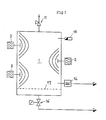
- 1 denotes a hollow resonator, which is supplied with microwave energy by means of several magnetrons 2.
- One of the magnetrons 2 radiates into the space free from the waves of the other magnetron (s) 2.
- the energetic waves of the magnetrons 2 sweep evenly in the chamber enclosed by the hollow resonator 1 while avoiding energy shadows. Cold spots are avoided in this way in the hollow resonator 1, so that the like in the hollow resonator through a door. Closure organ closable opening is fully exposed to the action of microwaves.
- cold water vapor generated by an external ultrasound nebulizer 14
- an external ultrasound nebulizer 14 can be introduced into the charged chamber of the resonator, which then heats up by the action of the microwave, and its external effect on the item to be treated (to be sterilized). Material can unfold.
- An adjustable drain valve 16 is located at the bottom of the chamber. The entire Sterilisa program sequence tion process can be controlled via an electronic control unit (not shown).
- a grate 17 On which a container which contains the material to be sterilized can be placed.
- three magnetrons 2 are provided, two of which lie on a side wall of the hollow resonator 1 and the third magnetron 2 lies on the wall of the hollow resonator opposite this wall.
- the waveguide 2 are arranged at an angle ⁇ of approximately 45 ° on the side wall and in front view at an angle ⁇ of approximately 65 ° in plan view.
- the vectors of the electric field strength of the waves, particularly via waveguide 2 are arranged orthogonally or approximately orthogonally to one another, the direction of each of the three vectors of the injected waves being different from the direction of one of the axes of the resonator ( Hollow resonator) 1 formed spatial coordinate system whose coordinate axis directions are given by the three mutually perpendicular edges of the rectangular prism surrounding the resonator 1.
- the three magnetrons ensure a power density which is uniformly distributed over the interior of the hollow resonator 1, and the disinfection material (sterilization material) thus achieves uniform heating.
- the three magnetrons mounted on waveguides are cooled by two fans 3.
- the fans 3 also perform the task of flowing air through the interior of the hollow resonator 1 in the manner shown in FIG. 2 so that the water vapor generated in the interior can be blown out again at a suitable time.
- the fans 3 promote in rooms 8 in which the magnetrons 2 are located.
- the connection of rooms 8 with the interior of the Re Sonators 1 takes place via openings located in the area of the bottom 9 of the resonator 1.
- the interior of the resonator 1 can be connected to an exhaust air duct via an air dam 7 located in an outlet duct 10 of the resonator 1 and which opens into the duct network. If the storage flap 7 is open, the air conveyed into the resonator 1 by the fans 3 can be supplied to the duct network via the exhaust duct 11 via the outlet duct 10.
- a measuring channel 12 connected to the interior of the resonator 1 is provided.
- This measuring channel 12 can be supplied with air from the interior of the resonator 1 via a small suction fan 4.
- the measuring channel 12 feeds the air from the interior of the resonator 1 to a moisture sensor 6 via a heating device 5.
- the heating device 5 and the moisture sensor 6 are arranged in the measuring channel 12 in the exemplary embodiment shown (FIG. 2).
- the air in the measuring channel 12 is preheated to a constant temperature by the heating device 5.
- the measuring channel 12 opens into the exhaust air channel 11, so that the air extracted from the interior 1 of the resonator for measuring purposes also reaches the exhaust air channel 11.
- the moisture sensor 6 can be coupled to a switch-off device for the energy supply of the magnetrons 2 in a manner not shown.
- a liquid source which is independent of an external connection, for example a bag which is infested with water, optionally also with disinfectant and / or fragrances.
- the material to be disinfected or sterilized is introduced into the interior 1 of the resonator with the door open in a container which cannot be impaired in its function by the action of microwaves and which is not sealed in a vapor-tight manner to the outside.
- the fans 3 are switched on and the damper 7 is open.
- About the small fan 4 is Air sucked in from the interior of the resonator 1, brought to the selected constant temperature by the heating device 5 and the moisture content determined at this temperature by a sensor 6.
- the stowage flap 7 is closed and then the magnetrons 2 are switched on. Via the small fan 4, a certain amount of air is constantly withdrawn from the interior of the resonator 1 and its moisture content is measured at a constant temperature.
- the material to be disinfected has reached at least the boiling temperature of water. This allows a statement to be made as to whether there is any disinfectable material in the interior of the resonator 1.
- the microwave energy is then allowed to act for a fixed period of time, so that the essential germs are killed off in the sense of disinfection.
- the damper 7 is opened again so that the moisture generated in the interior 1 can be blown out.
- the magnetrons 2 are switched off, the two fans 3 remaining in operation for some time in order to blow out the residual moisture from the interior of the resonator 1.
- the door of the resonator 1 can be opened and the disinfected material together with the container in which it is located can be removed from the resonator 1. If no significant increase in moisture can be observed during the action of the microwaves, the magnetrons 2 are switched off after a predetermined time.
- FIG. 4 shows a protective or monitoring device which is arranged in the region of the closure element, which can be a door, for example, for opening the room in which microwaves act.
- a protective or monitoring device can generally be provided for microwave devices, and is therefore not limited to microwave devices which are used for disinfection and which, as shown in FIGS. 1 to 3, are equipped with three magnetrons.
- the room opening shown in FIG. 4 is completely spanned by an antenna 18 adapted to the room opening.
- the antenna 18 is firmly connected to a frame 19 enclosing the opening.
- the antenna lies in the area of the scattered radiation passing through the door column.
- the antenna is connected to a demodulator diode 20.
- the voltage U arising at the rectifier diode (demodulator diode) 20 is evaluated in an electronic circuit (not shown).
- This electronic circuit has a threshold element and is equipped with a switch-off device for supplying the magnetron (s) 2 and / or with a signal transmitter, e.g. connected to an encoder for an optical or acoustic signal. This optical or acoustic signal indicates that the threshold value has been exceeded.
- the protection or monitoring device is used to monitor the high-frequency tightness of the door and can be used with all microwave devices in households, canteen kitchens and for special applications.
Landscapes
- Health & Medical Sciences (AREA)
- Epidemiology (AREA)
- Life Sciences & Earth Sciences (AREA)
- Animal Behavior & Ethology (AREA)
- General Health & Medical Sciences (AREA)
- Public Health (AREA)
- Veterinary Medicine (AREA)
- Physics & Mathematics (AREA)
- Electromagnetism (AREA)
- Apparatus For Disinfection Or Sterilisation (AREA)
- Electric Ovens (AREA)
- General Preparation And Processing Of Foods (AREA)
- Catching Or Destruction (AREA)
- Meat, Egg Or Seafood Products (AREA)
- Food Preservation Except Freezing, Refrigeration, And Drying (AREA)
- Agricultural Chemicals And Associated Chemicals (AREA)
Applications Claiming Priority (2)
| Application Number | Priority Date | Filing Date | Title |
|---|---|---|---|
| AT932/87 | 1987-04-14 | ||
| AT0093287A AT390734B (de) | 1987-04-14 | 1987-04-14 | Vorrichtung zum abtoeten bzw. inaktivieren von eiweiss- bzw. nukleinsaeurehaeltigen organismen |
Publications (2)
| Publication Number | Publication Date |
|---|---|
| EP0287549A1 true EP0287549A1 (fr) | 1988-10-19 |
| EP0287549B1 EP0287549B1 (fr) | 1991-12-18 |
Family
ID=3503163
Family Applications (1)
| Application Number | Title | Priority Date | Filing Date |
|---|---|---|---|
| EP88890047A Expired - Lifetime EP0287549B1 (fr) | 1987-04-14 | 1988-03-09 | Dispositif pour chauffer des objets et des organismes |
Country Status (5)
| Country | Link |
|---|---|
| US (1) | US5098665A (fr) |
| EP (1) | EP0287549B1 (fr) |
| AT (2) | AT390734B (fr) |
| DE (1) | DE3866927D1 (fr) |
| ES (1) | ES2029080T3 (fr) |
Cited By (12)
| Publication number | Priority date | Publication date | Assignee | Title |
|---|---|---|---|---|
| DE3913472A1 (de) * | 1989-04-24 | 1990-10-25 | Pilema S R L | Verfahren zur sterilisation von medizinalabfaellen |
| DE3926363A1 (de) * | 1989-08-10 | 1991-02-14 | Reinhard Schulze | Verfahren und einrichtung zur waermebehandlung von gemischen organischer substanzen und zugehoerige anwendung |
| WO1991011084A1 (fr) * | 1990-01-17 | 1991-07-25 | Reinhard Schulze | Chambre a micro-ondes avec magnetron |
| EP0483104A2 (fr) | 1990-10-25 | 1992-04-29 | Helmut Dr. Katschnig | Installation pour le chauffage, la désinfection ou la stérilisation de produits |
| US5122633A (en) * | 1989-06-07 | 1992-06-16 | Wolfgang Moshammer | Method and apparatus for radiation microwave energy into material containing water or mixed with water |
| EP0470749A3 (en) * | 1990-08-10 | 1992-07-29 | Naraseiki Kabushiki Kaisha | Electronic combustion furnace |
| EP0441771B1 (fr) * | 1990-02-06 | 1995-04-26 | Katschnig, Helmut, Dr. | Procédé pour la détection de la présence de vapeur ou de fumée dans l'air d'échappement d'un appareil pour le chauffage de matériaux et dispositif pour exécuter ce procédé |
| US6524539B1 (en) | 1999-07-07 | 2003-02-25 | Helmut Katschnig | Microwave sterilization device |
| EP2025841A3 (fr) * | 2007-04-13 | 2009-04-15 | bulthaup GmbH & Co KG | Agencement destiné à sécuriser des appareils de chauffage électriques |
| ITBO20080609A1 (it) * | 2008-10-07 | 2010-04-08 | Cms Spa | Procedimento ed apparato per neutralizzare la carica batterica nei rifiuti ospedalieri od altri rifiuti speciali, allo scopo di poterli smaltire come rifiuti ordinari. |
| WO2021186002A1 (fr) * | 2020-03-18 | 2021-09-23 | Emblation Limited | Procédé et appareil électromagnétique |
| AT524695A1 (de) * | 2021-02-02 | 2022-08-15 | Christof Global Impact Ltd | Vorrichtung zum Desinfizieren oder Sterilisieren von medizinischem Abfall |
Families Citing this family (18)
| Publication number | Priority date | Publication date | Assignee | Title |
|---|---|---|---|---|
| JPH0634143A (ja) * | 1992-07-21 | 1994-02-08 | Toshiba Corp | 加熱調理器 |
| US20020068011A1 (en) * | 1996-05-17 | 2002-06-06 | R.I.M.M. Technologies N.V. | Method and apparatus for sterilizing infectious wastes on site |
| US6537493B1 (en) | 2000-09-06 | 2003-03-25 | Microlizer Ltd. | Sterilization apparatus |
| US6638475B1 (en) | 2000-11-08 | 2003-10-28 | The Regents Of The University Of California | Method for inhibiting pathogenic and spoilage activity in products |
| US6623733B1 (en) * | 2001-06-27 | 2003-09-23 | Advanced Cardiovascular Systems, Inc. | Methods for treatment of vascular disease and device for preparation of an autologous composition for treating vascular disease |
| US20040151617A1 (en) * | 2003-01-31 | 2004-08-05 | Zanakis Michael F. | Methods and apparatus for air sterilization |
| US20050260096A1 (en) * | 2004-05-18 | 2005-11-24 | Steris Inc. | Method and apparatus for vaporizing a sterilant fluid using microwave energy |
| US7119312B2 (en) * | 2004-07-09 | 2006-10-10 | Sedlmayr Steven R | Microwave fluid heating and distillation method |
| US7432482B2 (en) * | 2004-07-09 | 2008-10-07 | Sedlmayr Steven R | Distillation and distillate method by microwaves |
| US20060024195A1 (en) * | 2004-07-27 | 2006-02-02 | The Regents Of The University Of California | Non-thermal disinfestation of biological pests with pulsed radio frequency power systems |
| US20060045797A1 (en) * | 2004-08-27 | 2006-03-02 | Don Frazier | System for treating bio-hazardous medical waste |
| US20090134152A1 (en) * | 2005-10-27 | 2009-05-28 | Sedlmayr Steven R | Microwave nucleon-electron-bonding spin alignment and alteration of materials |
| US9642195B2 (en) | 2012-03-14 | 2017-05-02 | Microwave Materials Technologies, Inc. | Enhanced microwave system utilizing tilted launchers |
| AU2018235948B2 (en) | 2017-03-15 | 2023-05-18 | 915 Labs, Inc. | Energy control elements for improved microwave heating of packaged articles |
| JP2020511755A (ja) | 2017-03-15 | 2020-04-16 | 915 ラボ、エルエルシー | マルチパスマイクロ波加熱システム |
| KR102541079B1 (ko) | 2017-04-17 | 2023-06-08 | 915 랩스, 엘엘씨 | 상승 작용의 패키징, 캐리어 및 런처 구성을 사용하는 마이크로파 지원 멸균 및 저온 살균 시스템 |
| NO348254B1 (en) * | 2017-12-06 | 2024-10-28 | Plastservice As | Disinfection method for plastic devices |
| US12005163B2 (en) * | 2020-06-10 | 2024-06-11 | Rockwell Collins, Inc. | Phased array microwave sanitizer for pathogens |
Citations (11)
| Publication number | Priority date | Publication date | Assignee | Title |
|---|---|---|---|---|
| DE1183615B (de) * | 1959-04-15 | 1964-12-17 | Litton Industries Inc | Hoechstfrequenz-Heizvorrichtung |
| FR1471131A (fr) * | 1966-03-15 | 1967-02-24 | Elliott Brothers London Ltd | Appareil de chauffage à haute fréquence pour traitement thermique |
| US3402277A (en) * | 1965-10-25 | 1968-09-17 | Patelhold Patentverwertung | Microwave treating device |
| US3436508A (en) * | 1965-08-26 | 1969-04-01 | Karl Fritz | Cabinet and door construction for microwave heating appliances |
| DE1947712A1 (de) * | 1969-09-20 | 1971-04-01 | Emag Eislinger Maschinenfabrik | Vorrichtung zum Anwenden von Mikrowellenenergie bei der dielektrischen Erwaermung von Behandlungsgut |
| US3651300A (en) * | 1971-01-25 | 1972-03-21 | Matsushita Electric Industrial Co Ltd | Microwave heating apparatus with radiation control and monitoring |
| FR2250254A1 (en) * | 1973-11-06 | 1975-05-30 | Materiel Telephonique | Heat treating sensitive substances esp. photographic emulsions - by ultra high frequency microwaves giving complete isolation from outside substances |
| EP0069105A1 (fr) * | 1981-06-29 | 1983-01-05 | De Belgische Staat L'Etat Belge représenté par le Secrétaire général des Services de Programmation | Four industriel modulaire à micro-ondes |
| US4417116A (en) * | 1981-09-02 | 1983-11-22 | Black Jerimiah B | Microwave water heating method and apparatus |
| WO1986004206A1 (fr) * | 1985-01-08 | 1986-07-17 | Patentsmith Ii, Inc. | Methode et appareillage de regulation de la vapeur d'eau dans les fours a convection |
| EP0198430A2 (fr) * | 1985-04-11 | 1986-10-22 | Matsushita Electric Industrial Co., Ltd. | Appareil de chauffage à détecteur piézoélectrique |
Family Cites Families (23)
| Publication number | Priority date | Publication date | Assignee | Title |
|---|---|---|---|---|
| US2593067A (en) * | 1947-02-13 | 1952-04-15 | Raytheon Mfg Co | High-frequency apparatus |
| US2550584A (en) * | 1949-02-03 | 1951-04-24 | Mittelmann Eugene | Milk pasteurization method and apparatus |
| NO121008B (fr) * | 1969-11-11 | 1971-01-04 | Nycotron As | |
| US3753651A (en) * | 1970-08-27 | 1973-08-21 | Wave Energy Systems | Method and apparatus for surface sterilization |
| US4004122A (en) * | 1973-11-06 | 1977-01-18 | International Standard Electric Corporation | Multi-zone microwave heating apparatus |
| US3916137A (en) * | 1974-05-20 | 1975-10-28 | Gerling Moore Inc | Multi-mode microwave cavity feed system |
| CA1038035A (fr) * | 1974-08-05 | 1978-09-05 | David L. Hollway | Alarme microonde |
| US4144436A (en) * | 1976-06-17 | 1979-03-13 | General Electric Company | Microwave oven excitation system for promoting uniformity of energy distribution |
| JPS55129067A (en) * | 1979-03-28 | 1980-10-06 | Terumo Corp | Device for moving hollow thread type substance |
| US4253092A (en) * | 1979-04-19 | 1981-02-24 | Connah John F Jun | Microwave leakage detector |
| US4321577A (en) * | 1980-02-25 | 1982-03-23 | General Electric Company | Integral humidity sensor/heater configurations |
| ATE8335T1 (de) * | 1980-09-09 | 1984-07-15 | Siemens Aktiengesellschaft | Vorrichtung zum sterilisieren von medizinischen, insbesondere zahnmedizinischen gegenstaenden. |
| DE3033855A1 (de) * | 1980-09-09 | 1982-04-22 | Siemens AG, 1000 Berlin und 8000 München | Vorrichtung zum sterilisieren von medizinischen, insbesondere zahnmedizinischen gegenstaenden |
| IT1133371B (it) * | 1980-11-04 | 1986-07-09 | Elettronica Liarre Snc Di Zamb | Dispositivo per la sterilizzazione di attrezzi e strumenti chirurgici |
| US4475900A (en) * | 1981-06-05 | 1984-10-09 | Popovich Robert P | Method of peritoneal dialysis involving ultraviolet radiation of dialysis apparatus |
| US4507119A (en) * | 1982-07-06 | 1985-03-26 | E. I. Du Pont De Nemours And Company | Sterile docking process, apparatus and system |
| US4614514A (en) * | 1983-02-16 | 1986-09-30 | M/A Com, Inc. | Microwave sterilizer |
| US4599216A (en) * | 1983-11-21 | 1986-07-08 | Board Of Regents For The University Of Oklahoma | Apparatus for exposure to microwaves |
| DE3430673C2 (de) * | 1984-08-21 | 1987-01-08 | Hermann Berstorff Maschinenbau Gmbh, 3000 Hannover | Einrichtung zum Pasteurisieren und Sterilisieren von rieselfähigen oder stückigen Materialien |
| GB8428470D0 (en) * | 1984-11-10 | 1984-12-19 | Wales College Of Medicine Univ | Sterilising procedures and equipment |
| DE3505571C2 (de) * | 1985-02-18 | 1991-03-07 | GVB SANIMED Hygiene- und Medizintechnik GmbH, 3070 Nienburg | Vorrichtung zur Desinfektion und Sterilisation von Matratzen mit Hilfe von Mikrowellen |
| US4771156A (en) * | 1986-10-20 | 1988-09-13 | Micro Dry Incorporated | Method and apparatus for heating and drying moist articles |
| US4896010A (en) * | 1987-12-07 | 1990-01-23 | Micro Dry, Incorporated | Microwave drying & sanitizing of fabric |
-
1987
- 1987-04-14 AT AT0093287A patent/AT390734B/de not_active IP Right Cessation
-
1988
- 1988-03-09 ES ES198888890047T patent/ES2029080T3/es not_active Expired - Lifetime
- 1988-03-09 EP EP88890047A patent/EP0287549B1/fr not_active Expired - Lifetime
- 1988-03-09 AT AT88890047T patent/ATE70689T1/de not_active IP Right Cessation
- 1988-03-09 DE DE8888890047T patent/DE3866927D1/de not_active Expired - Lifetime
- 1988-04-12 US US07/180,422 patent/US5098665A/en not_active Expired - Lifetime
Patent Citations (11)
| Publication number | Priority date | Publication date | Assignee | Title |
|---|---|---|---|---|
| DE1183615B (de) * | 1959-04-15 | 1964-12-17 | Litton Industries Inc | Hoechstfrequenz-Heizvorrichtung |
| US3436508A (en) * | 1965-08-26 | 1969-04-01 | Karl Fritz | Cabinet and door construction for microwave heating appliances |
| US3402277A (en) * | 1965-10-25 | 1968-09-17 | Patelhold Patentverwertung | Microwave treating device |
| FR1471131A (fr) * | 1966-03-15 | 1967-02-24 | Elliott Brothers London Ltd | Appareil de chauffage à haute fréquence pour traitement thermique |
| DE1947712A1 (de) * | 1969-09-20 | 1971-04-01 | Emag Eislinger Maschinenfabrik | Vorrichtung zum Anwenden von Mikrowellenenergie bei der dielektrischen Erwaermung von Behandlungsgut |
| US3651300A (en) * | 1971-01-25 | 1972-03-21 | Matsushita Electric Industrial Co Ltd | Microwave heating apparatus with radiation control and monitoring |
| FR2250254A1 (en) * | 1973-11-06 | 1975-05-30 | Materiel Telephonique | Heat treating sensitive substances esp. photographic emulsions - by ultra high frequency microwaves giving complete isolation from outside substances |
| EP0069105A1 (fr) * | 1981-06-29 | 1983-01-05 | De Belgische Staat L'Etat Belge représenté par le Secrétaire général des Services de Programmation | Four industriel modulaire à micro-ondes |
| US4417116A (en) * | 1981-09-02 | 1983-11-22 | Black Jerimiah B | Microwave water heating method and apparatus |
| WO1986004206A1 (fr) * | 1985-01-08 | 1986-07-17 | Patentsmith Ii, Inc. | Methode et appareillage de regulation de la vapeur d'eau dans les fours a convection |
| EP0198430A2 (fr) * | 1985-04-11 | 1986-10-22 | Matsushita Electric Industrial Co., Ltd. | Appareil de chauffage à détecteur piézoélectrique |
Cited By (16)
| Publication number | Priority date | Publication date | Assignee | Title |
|---|---|---|---|---|
| DE3913472A1 (de) * | 1989-04-24 | 1990-10-25 | Pilema S R L | Verfahren zur sterilisation von medizinalabfaellen |
| US5122633A (en) * | 1989-06-07 | 1992-06-16 | Wolfgang Moshammer | Method and apparatus for radiation microwave energy into material containing water or mixed with water |
| DE3926363A1 (de) * | 1989-08-10 | 1991-02-14 | Reinhard Schulze | Verfahren und einrichtung zur waermebehandlung von gemischen organischer substanzen und zugehoerige anwendung |
| WO1991002439A1 (fr) * | 1989-08-10 | 1991-02-21 | Reinhard Schulze | Procede et dispositif pour le traitement thermique de melanges de substances organiques et application s'y rapportant |
| WO1991011084A1 (fr) * | 1990-01-17 | 1991-07-25 | Reinhard Schulze | Chambre a micro-ondes avec magnetron |
| EP0441771B1 (fr) * | 1990-02-06 | 1995-04-26 | Katschnig, Helmut, Dr. | Procédé pour la détection de la présence de vapeur ou de fumée dans l'air d'échappement d'un appareil pour le chauffage de matériaux et dispositif pour exécuter ce procédé |
| EP0470749A3 (en) * | 1990-08-10 | 1992-07-29 | Naraseiki Kabushiki Kaisha | Electronic combustion furnace |
| US5254822A (en) * | 1990-08-10 | 1993-10-19 | Naraseiki Kabushiki Kaisha | Electronic combustion furnace |
| EP0483104A2 (fr) | 1990-10-25 | 1992-04-29 | Helmut Dr. Katschnig | Installation pour le chauffage, la désinfection ou la stérilisation de produits |
| US6524539B1 (en) | 1999-07-07 | 2003-02-25 | Helmut Katschnig | Microwave sterilization device |
| EP2025841A3 (fr) * | 2007-04-13 | 2009-04-15 | bulthaup GmbH & Co KG | Agencement destiné à sécuriser des appareils de chauffage électriques |
| ITBO20080609A1 (it) * | 2008-10-07 | 2010-04-08 | Cms Spa | Procedimento ed apparato per neutralizzare la carica batterica nei rifiuti ospedalieri od altri rifiuti speciali, allo scopo di poterli smaltire come rifiuti ordinari. |
| WO2010040690A1 (fr) * | 2008-10-07 | 2010-04-15 | C.M.S. S.P.A. | Procédé et appareil destinés à neutraliser le contenu bactérien de déchets hospitaliers ou autres déchets spéciaux, de sorte à pouvoir jeter lesdits déchets comme déchets ordinaires |
| WO2021186002A1 (fr) * | 2020-03-18 | 2021-09-23 | Emblation Limited | Procédé et appareil électromagnétique |
| AT524695A1 (de) * | 2021-02-02 | 2022-08-15 | Christof Global Impact Ltd | Vorrichtung zum Desinfizieren oder Sterilisieren von medizinischem Abfall |
| AT524695B1 (de) * | 2021-02-02 | 2022-11-15 | Christof Global Impact Ltd | Vorrichtung zum Desinfizieren oder Sterilisieren von medizinischem Abfall |
Also Published As
| Publication number | Publication date |
|---|---|
| US5098665A (en) | 1992-03-24 |
| DE3866927D1 (de) | 1992-01-30 |
| ATE70689T1 (de) | 1992-01-15 |
| ATA93287A (de) | 1989-12-15 |
| AT390734B (de) | 1990-06-25 |
| ES2029080T3 (es) | 1992-07-16 |
| EP0287549B1 (fr) | 1991-12-18 |
Similar Documents
| Publication | Publication Date | Title |
|---|---|---|
| EP0287549B1 (fr) | Dispositif pour chauffer des objets et des organismes | |
| AT407959B (de) | Mikrowellensterilisationseinrichtung | |
| DE69228668T2 (de) | Verfahren und Vorrichtung zur Entsorgung von medizinischen Abfallmaterialien | |
| DE4227830C1 (de) | Verfahren und Einrichtung zum Desinfizieren eines Knochentransplantats, insbesondere eines humanen Spongiosa-Transplantats | |
| US5223231A (en) | Apparatus for sterilizing medical waste by microwave autoclaving | |
| CA2027392C (fr) | Methode de desinfection des materiaux medicaux | |
| EP0410306B1 (fr) | Procédé et dispositif pour la stérilisation de déchets, notamment de déchets d'hôpitaux | |
| DE3317300A1 (de) | Behaelter zur aufnahme von infektionsmuell | |
| Aljamali et al. | Review on types of automatic sterilization systems in Hospitals | |
| DE3913472A1 (de) | Verfahren zur sterilisation von medizinalabfaellen | |
| US6262405B1 (en) | Medical waste treatment and decontamination system | |
| EP0734734A1 (fr) | Procédé et appareil pour la désinfection ou la stérilisation de déchets contaminés | |
| DE3627367C1 (de) | Vorrichtung zum Sterilisieren von Muell,insbesondere Infektionsmuell | |
| DE102010031393B4 (de) | Vorrichtung und Verfahren zur Kühlung von Nahrungsmittelmaschinen | |
| WO2018007557A1 (fr) | Dispositif de désinfection et procédé de désinfection | |
| DE69303177T2 (de) | Behandlungseinrichtung insbesondere für die dekontaminierung von feststoffen wie müll | |
| DE4303034C2 (de) | Mobile Desinfektionsanlage, insbesondere für Klinikabfälle | |
| Veronesi et al. | Non-incineration microwave assisted sterilization of medical waste | |
| DE4235512C2 (de) | Verfahren und Kraftfahrzeug zum Desinfizieren von, insbesondere medizinischem oder dergleichen, Abfall | |
| JP2003175094A (ja) | マイクロ波による廃棄物の滅菌処理装置 | |
| DE4221487C2 (de) | Verfahren zur Entkeimung mittels Druck und Ultraschall | |
| AT407609B (de) | Desinfektionsapparat und instrumentenbehälter hiefür | |
| Zimmermann et al. | Medical Waste Management in Poland the Legal Issues. | |
| WO1994007545A1 (fr) | Appareil de desinfection et de sterilisation de dechets medicaux et son procede d'utilisation | |
| WO1998001165A1 (fr) | Procede et dispositif pour la sterilisation de matieres contaminees |
Legal Events
| Date | Code | Title | Description |
|---|---|---|---|
| PUAI | Public reference made under article 153(3) epc to a published international application that has entered the european phase |
Free format text: ORIGINAL CODE: 0009012 |
|
| AK | Designated contracting states |
Kind code of ref document: A1 Designated state(s): AT BE CH DE ES FR GB GR IT LI LU NL SE |
|
| 17P | Request for examination filed |
Effective date: 19890111 |
|
| 17Q | First examination report despatched |
Effective date: 19890724 |
|
| GRAA | (expected) grant |
Free format text: ORIGINAL CODE: 0009210 |
|
| AK | Designated contracting states |
Kind code of ref document: B1 Designated state(s): AT BE CH DE ES FR GB GR IT LI LU NL SE |
|
| PG25 | Lapsed in a contracting state [announced via postgrant information from national office to epo] |
Ref country code: GR Free format text: LAPSE BECAUSE OF FAILURE TO SUBMIT A TRANSLATION OF THE DESCRIPTION OR TO PAY THE FEE WITHIN THE PRESCRIBED TIME-LIMIT Effective date: 19911218 |
|
| REF | Corresponds to: |
Ref document number: 70689 Country of ref document: AT Date of ref document: 19920115 Kind code of ref document: T |
|
| REF | Corresponds to: |
Ref document number: 3866927 Country of ref document: DE Date of ref document: 19920130 |
|
| ITF | It: translation for a ep patent filed | ||
| PG25 | Lapsed in a contracting state [announced via postgrant information from national office to epo] |
Ref country code: LU Free format text: LAPSE BECAUSE OF NON-PAYMENT OF DUE FEES Effective date: 19920331 |
|
| ET | Fr: translation filed | ||
| GBT | Gb: translation of ep patent filed (gb section 77(6)(a)/1977) | ||
| REG | Reference to a national code |
Ref country code: ES Ref legal event code: FG2A Ref document number: 2029080 Country of ref document: ES Kind code of ref document: T3 |
|
| PLBE | No opposition filed within time limit |
Free format text: ORIGINAL CODE: 0009261 |
|
| STAA | Information on the status of an ep patent application or granted ep patent |
Free format text: STATUS: NO OPPOSITION FILED WITHIN TIME LIMIT |
|
| 26N | No opposition filed | ||
| EAL | Se: european patent in force in sweden |
Ref document number: 88890047.9 |
|
| REG | Reference to a national code |
Ref country code: CH Ref legal event code: NV Representative=s name: SCHMAUDER & WANN PATENTANWALTSBUERO, INHABER KLAUS |
|
| PGFP | Annual fee paid to national office [announced via postgrant information from national office to epo] |
Ref country code: SE Payment date: 19990215 Year of fee payment: 12 |
|
| PGFP | Annual fee paid to national office [announced via postgrant information from national office to epo] |
Ref country code: CH Payment date: 19990326 Year of fee payment: 12 |
|
| PGFP | Annual fee paid to national office [announced via postgrant information from national office to epo] |
Ref country code: NL Payment date: 19990331 Year of fee payment: 12 |
|
| PGFP | Annual fee paid to national office [announced via postgrant information from national office to epo] |
Ref country code: BE Payment date: 19990407 Year of fee payment: 12 |
|
| PG25 | Lapsed in a contracting state [announced via postgrant information from national office to epo] |
Ref country code: SE Free format text: LAPSE BECAUSE OF NON-PAYMENT OF DUE FEES Effective date: 20000310 |
|
| PG25 | Lapsed in a contracting state [announced via postgrant information from national office to epo] |
Ref country code: BE Free format text: LAPSE BECAUSE OF NON-PAYMENT OF DUE FEES Effective date: 20000331 Ref country code: CH Free format text: LAPSE BECAUSE OF NON-PAYMENT OF DUE FEES Effective date: 20000331 Ref country code: LI Free format text: LAPSE BECAUSE OF NON-PAYMENT OF DUE FEES Effective date: 20000331 |
|
| BERE | Be: lapsed |
Owner name: KATSCHNIG HELMUT Effective date: 20000331 |
|
| PG25 | Lapsed in a contracting state [announced via postgrant information from national office to epo] |
Ref country code: NL Free format text: LAPSE BECAUSE OF NON-PAYMENT OF DUE FEES Effective date: 20001001 |
|
| EUG | Se: european patent has lapsed |
Ref document number: 88890047.9 |
|
| REG | Reference to a national code |
Ref country code: CH Ref legal event code: PL |
|
| NLV4 | Nl: lapsed or anulled due to non-payment of the annual fee |
Effective date: 20001001 |
|
| REG | Reference to a national code |
Ref country code: GB Ref legal event code: IF02 |
|
| PG25 | Lapsed in a contracting state [announced via postgrant information from national office to epo] |
Ref country code: IT Free format text: LAPSE BECAUSE OF NON-PAYMENT OF DUE FEES;WARNING: LAPSES OF ITALIAN PATENTS WITH EFFECTIVE DATE BEFORE 2007 MAY HAVE OCCURRED AT ANY TIME BEFORE 2007. THE CORRECT EFFECTIVE DATE MAY BE DIFFERENT FROM THE ONE RECORDED. Effective date: 20050309 |
|
| PGFP | Annual fee paid to national office [announced via postgrant information from national office to epo] |
Ref country code: AT Payment date: 20070313 Year of fee payment: 20 |
|
| PGFP | Annual fee paid to national office [announced via postgrant information from national office to epo] |
Ref country code: DE Payment date: 20070316 Year of fee payment: 20 |
|
| PGFP | Annual fee paid to national office [announced via postgrant information from national office to epo] |
Ref country code: GB Payment date: 20070322 Year of fee payment: 20 |
|
| PGFP | Annual fee paid to national office [announced via postgrant information from national office to epo] |
Ref country code: ES Payment date: 20070329 Year of fee payment: 20 |
|
| REG | Reference to a national code |
Ref country code: GB Ref legal event code: PE20 Expiry date: 20080308 |
|
| PGFP | Annual fee paid to national office [announced via postgrant information from national office to epo] |
Ref country code: FR Payment date: 20070319 Year of fee payment: 20 |
|
| PG25 | Lapsed in a contracting state [announced via postgrant information from national office to epo] |
Ref country code: GB Free format text: LAPSE BECAUSE OF EXPIRATION OF PROTECTION Effective date: 20080308 |
|
| REG | Reference to a national code |
Ref country code: ES Ref legal event code: FD2A Effective date: 20080310 |
|
| PG25 | Lapsed in a contracting state [announced via postgrant information from national office to epo] |
Ref country code: ES Free format text: LAPSE BECAUSE OF EXPIRATION OF PROTECTION Effective date: 20080310 |