EP0288325B1 - Für A.Nidulans-Isopenicillin-N-Synthetase codierende DNS, deren Verwendung und dafür codierende Vektoren - Google Patents
Für A.Nidulans-Isopenicillin-N-Synthetase codierende DNS, deren Verwendung und dafür codierende Vektoren Download PDFInfo
- Publication number
- EP0288325B1 EP0288325B1 EP88303717A EP88303717A EP0288325B1 EP 0288325 B1 EP0288325 B1 EP 0288325B1 EP 88303717 A EP88303717 A EP 88303717A EP 88303717 A EP88303717 A EP 88303717A EP 0288325 B1 EP0288325 B1 EP 0288325B1
- Authority
- EP
- European Patent Office
- Prior art keywords
- sequence
- nidulans
- plasmid
- dna
- ipns
- Prior art date
- Legal status (The legal status is an assumption and is not a legal conclusion. Google has not performed a legal analysis and makes no representation as to the accuracy of the status listed.)
- Expired - Lifetime
Links
- 239000013598 vector Substances 0.000 title claims abstract description 14
- 108010012172 isopenicillin N synthetase Proteins 0.000 title claims abstract description 11
- 241000192589 Synechococcus elongatus PCC 7942 Species 0.000 title 1
- 241000351920 Aspergillus nidulans Species 0.000 claims abstract description 30
- 239000013612 plasmid Substances 0.000 claims abstract description 26
- 238000000034 method Methods 0.000 claims abstract description 11
- 241000588724 Escherichia coli Species 0.000 claims description 19
- 101710107944 Isopenicillin N synthase Proteins 0.000 claims description 19
- 239000012634 fragment Substances 0.000 claims description 18
- 241000228150 Penicillium chrysogenum Species 0.000 claims description 8
- 108091026890 Coding region Proteins 0.000 claims description 6
- 108091028043 Nucleic acid sequence Proteins 0.000 claims description 6
- 108090001030 Lipoproteins Proteins 0.000 claims description 5
- 230000015572 biosynthetic process Effects 0.000 claims description 5
- 230000009466 transformation Effects 0.000 claims description 5
- 102000004190 Enzymes Human genes 0.000 claims description 4
- 108090000790 Enzymes Proteins 0.000 claims description 4
- 102000004895 Lipoproteins Human genes 0.000 claims description 4
- 241000228417 Sarocladium strictum Species 0.000 claims description 4
- 230000029087 digestion Effects 0.000 claims description 4
- 241001302584 Escherichia coli str. K-12 substr. W3110 Species 0.000 claims description 3
- 150000001413 amino acids Chemical group 0.000 claims description 3
- 238000004519 manufacturing process Methods 0.000 claims description 3
- 238000003786 synthesis reaction Methods 0.000 claims description 3
- 108091081024 Start codon Proteins 0.000 claims description 2
- 239000003550 marker Substances 0.000 claims description 2
- 230000022532 regulation of transcription, DNA-dependent Effects 0.000 claims description 2
- 101100328086 Caenorhabditis elegans cla-1 gene Proteins 0.000 claims 2
- 102000010911 Enzyme Precursors Human genes 0.000 claims 1
- 108010062466 Enzyme Precursors Proteins 0.000 claims 1
- 238000012258 culturing Methods 0.000 claims 1
- 238000002955 isolation Methods 0.000 claims 1
- 125000003275 alpha amino acid group Chemical group 0.000 abstract 1
- 108020004414 DNA Proteins 0.000 description 42
- 108090000623 proteins and genes Proteins 0.000 description 26
- 150000001875 compounds Chemical class 0.000 description 23
- 102000004169 proteins and genes Human genes 0.000 description 10
- 229930182555 Penicillin Natural products 0.000 description 8
- 239000002773 nucleotide Substances 0.000 description 8
- 125000003729 nucleotide group Chemical group 0.000 description 8
- QKNYBSVHEMOAJP-UHFFFAOYSA-N 2-amino-2-(hydroxymethyl)propane-1,3-diol;hydron;chloride Chemical compound Cl.OCC(N)(CO)CO QKNYBSVHEMOAJP-UHFFFAOYSA-N 0.000 description 7
- KCXVZYZYPLLWCC-UHFFFAOYSA-N EDTA Chemical compound OC(=O)CN(CC(O)=O)CCN(CC(O)=O)CC(O)=O KCXVZYZYPLLWCC-UHFFFAOYSA-N 0.000 description 7
- 230000000694 effects Effects 0.000 description 7
- 239000000284 extract Substances 0.000 description 7
- 239000000047 product Substances 0.000 description 7
- XLYOFNOQVPJJNP-UHFFFAOYSA-N water Chemical compound O XLYOFNOQVPJJNP-UHFFFAOYSA-N 0.000 description 7
- PEDCQBHIVMGVHV-UHFFFAOYSA-N Glycerine Chemical compound OCC(O)CO PEDCQBHIVMGVHV-UHFFFAOYSA-N 0.000 description 6
- 108020004511 Recombinant DNA Proteins 0.000 description 6
- 238000006243 chemical reaction Methods 0.000 description 6
- 239000000499 gel Substances 0.000 description 6
- 229920001184 polypeptide Polymers 0.000 description 6
- 108090000765 processed proteins & peptides Proteins 0.000 description 6
- 102000004196 processed proteins & peptides Human genes 0.000 description 6
- 239000000243 solution Substances 0.000 description 6
- JGSARLDLIJGVTE-MBNYWOFBSA-N Penicillin G Chemical compound N([C@H]1[C@H]2SC([C@@H](N2C1=O)C(O)=O)(C)C)C(=O)CC1=CC=CC=C1 JGSARLDLIJGVTE-MBNYWOFBSA-N 0.000 description 5
- 238000010276 construction Methods 0.000 description 5
- BPHPUYQFMNQIOC-NXRLNHOXSA-N isopropyl beta-D-thiogalactopyranoside Chemical compound CC(C)S[C@@H]1O[C@H](CO)[C@H](O)[C@H](O)[C@H]1O BPHPUYQFMNQIOC-NXRLNHOXSA-N 0.000 description 5
- 229940049954 penicillin Drugs 0.000 description 5
- CIWBSHSKHKDKBQ-JLAZNSOCSA-N Ascorbic acid Chemical compound OC[C@H](O)[C@H]1OC(=O)C(O)=C1O CIWBSHSKHKDKBQ-JLAZNSOCSA-N 0.000 description 4
- RTZKZFJDLAIYFH-UHFFFAOYSA-N Diethyl ether Chemical compound CCOCC RTZKZFJDLAIYFH-UHFFFAOYSA-N 0.000 description 4
- CSNNHWWHGAXBCP-UHFFFAOYSA-L Magnesium sulfate Chemical compound [Mg+2].[O-][S+2]([O-])([O-])[O-] CSNNHWWHGAXBCP-UHFFFAOYSA-L 0.000 description 4
- ISWSIDIOOBJBQZ-UHFFFAOYSA-N Phenol Chemical compound OC1=CC=CC=C1 ISWSIDIOOBJBQZ-UHFFFAOYSA-N 0.000 description 4
- AVKUERGKIZMTKX-NJBDSQKTSA-N ampicillin Chemical compound C1([C@@H](N)C(=O)N[C@H]2[C@H]3SC([C@@H](N3C2=O)C(O)=O)(C)C)=CC=CC=C1 AVKUERGKIZMTKX-NJBDSQKTSA-N 0.000 description 4
- 229960000723 ampicillin Drugs 0.000 description 4
- 238000000855 fermentation Methods 0.000 description 4
- 230000004151 fermentation Effects 0.000 description 4
- 230000014509 gene expression Effects 0.000 description 4
- 230000002068 genetic effect Effects 0.000 description 4
- 230000010354 integration Effects 0.000 description 4
- SCVFZCLFOSHCOH-UHFFFAOYSA-M potassium acetate Chemical compound [K+].CC([O-])=O SCVFZCLFOSHCOH-UHFFFAOYSA-M 0.000 description 4
- 239000000758 substrate Substances 0.000 description 4
- QTBSBXVTEAMEQO-UHFFFAOYSA-N Acetic acid Chemical compound CC(O)=O QTBSBXVTEAMEQO-UHFFFAOYSA-N 0.000 description 3
- LFQSCWFLJHTTHZ-UHFFFAOYSA-N Ethanol Chemical compound CCO LFQSCWFLJHTTHZ-UHFFFAOYSA-N 0.000 description 3
- GUBGYTABKSRVRQ-QKKXKWKRSA-N Lactose Natural products OC[C@H]1O[C@@H](O[C@H]2[C@H](O)[C@@H](O)C(O)O[C@@H]2CO)[C@H](O)[C@@H](O)[C@H]1O GUBGYTABKSRVRQ-QKKXKWKRSA-N 0.000 description 3
- OKKJLVBELUTLKV-UHFFFAOYSA-N Methanol Chemical compound OC OKKJLVBELUTLKV-UHFFFAOYSA-N 0.000 description 3
- 108091034117 Oligonucleotide Proteins 0.000 description 3
- HEMHJVSKTPXQMS-UHFFFAOYSA-M Sodium hydroxide Chemical compound [OH-].[Na+] HEMHJVSKTPXQMS-UHFFFAOYSA-M 0.000 description 3
- JLCPHMBAVCMARE-UHFFFAOYSA-N [3-[[3-[[3-[[3-[[3-[[3-[[3-[[3-[[3-[[3-[[3-[[5-(2-amino-6-oxo-1H-purin-9-yl)-3-[[3-[[3-[[3-[[3-[[3-[[5-(2-amino-6-oxo-1H-purin-9-yl)-3-[[5-(2-amino-6-oxo-1H-purin-9-yl)-3-hydroxyoxolan-2-yl]methoxy-hydroxyphosphoryl]oxyoxolan-2-yl]methoxy-hydroxyphosphoryl]oxy-5-(5-methyl-2,4-dioxopyrimidin-1-yl)oxolan-2-yl]methoxy-hydroxyphosphoryl]oxy-5-(6-aminopurin-9-yl)oxolan-2-yl]methoxy-hydroxyphosphoryl]oxy-5-(6-aminopurin-9-yl)oxolan-2-yl]methoxy-hydroxyphosphoryl]oxy-5-(6-aminopurin-9-yl)oxolan-2-yl]methoxy-hydroxyphosphoryl]oxy-5-(6-aminopurin-9-yl)oxolan-2-yl]methoxy-hydroxyphosphoryl]oxyoxolan-2-yl]methoxy-hydroxyphosphoryl]oxy-5-(5-methyl-2,4-dioxopyrimidin-1-yl)oxolan-2-yl]methoxy-hydroxyphosphoryl]oxy-5-(4-amino-2-oxopyrimidin-1-yl)oxolan-2-yl]methoxy-hydroxyphosphoryl]oxy-5-(5-methyl-2,4-dioxopyrimidin-1-yl)oxolan-2-yl]methoxy-hydroxyphosphoryl]oxy-5-(5-methyl-2,4-dioxopyrimidin-1-yl)oxolan-2-yl]methoxy-hydroxyphosphoryl]oxy-5-(6-aminopurin-9-yl)oxolan-2-yl]methoxy-hydroxyphosphoryl]oxy-5-(6-aminopurin-9-yl)oxolan-2-yl]methoxy-hydroxyphosphoryl]oxy-5-(4-amino-2-oxopyrimidin-1-yl)oxolan-2-yl]methoxy-hydroxyphosphoryl]oxy-5-(4-amino-2-oxopyrimidin-1-yl)oxolan-2-yl]methoxy-hydroxyphosphoryl]oxy-5-(4-amino-2-oxopyrimidin-1-yl)oxolan-2-yl]methoxy-hydroxyphosphoryl]oxy-5-(6-aminopurin-9-yl)oxolan-2-yl]methoxy-hydroxyphosphoryl]oxy-5-(4-amino-2-oxopyrimidin-1-yl)oxolan-2-yl]methyl [5-(6-aminopurin-9-yl)-2-(hydroxymethyl)oxolan-3-yl] hydrogen phosphate Polymers Cc1cn(C2CC(OP(O)(=O)OCC3OC(CC3OP(O)(=O)OCC3OC(CC3O)n3cnc4c3nc(N)[nH]c4=O)n3cnc4c3nc(N)[nH]c4=O)C(COP(O)(=O)OC3CC(OC3COP(O)(=O)OC3CC(OC3COP(O)(=O)OC3CC(OC3COP(O)(=O)OC3CC(OC3COP(O)(=O)OC3CC(OC3COP(O)(=O)OC3CC(OC3COP(O)(=O)OC3CC(OC3COP(O)(=O)OC3CC(OC3COP(O)(=O)OC3CC(OC3COP(O)(=O)OC3CC(OC3COP(O)(=O)OC3CC(OC3COP(O)(=O)OC3CC(OC3COP(O)(=O)OC3CC(OC3COP(O)(=O)OC3CC(OC3COP(O)(=O)OC3CC(OC3COP(O)(=O)OC3CC(OC3COP(O)(=O)OC3CC(OC3CO)n3cnc4c(N)ncnc34)n3ccc(N)nc3=O)n3cnc4c(N)ncnc34)n3ccc(N)nc3=O)n3ccc(N)nc3=O)n3ccc(N)nc3=O)n3cnc4c(N)ncnc34)n3cnc4c(N)ncnc34)n3cc(C)c(=O)[nH]c3=O)n3cc(C)c(=O)[nH]c3=O)n3ccc(N)nc3=O)n3cc(C)c(=O)[nH]c3=O)n3cnc4c3nc(N)[nH]c4=O)n3cnc4c(N)ncnc34)n3cnc4c(N)ncnc34)n3cnc4c(N)ncnc34)n3cnc4c(N)ncnc34)O2)c(=O)[nH]c1=O JLCPHMBAVCMARE-UHFFFAOYSA-N 0.000 description 3
- 230000000845 anti-microbial effect Effects 0.000 description 3
- 230000006696 biosynthetic metabolic pathway Effects 0.000 description 3
- 238000005119 centrifugation Methods 0.000 description 3
- 229940088598 enzyme Drugs 0.000 description 3
- 239000013604 expression vector Substances 0.000 description 3
- 239000008101 lactose Substances 0.000 description 3
- 239000000203 mixture Substances 0.000 description 3
- 230000037361 pathway Effects 0.000 description 3
- 150000002960 penicillins Chemical class 0.000 description 3
- 230000001105 regulatory effect Effects 0.000 description 3
- 230000001131 transforming effect Effects 0.000 description 3
- 150000003952 β-lactams Chemical class 0.000 description 3
- IJGRMHOSHXDMSA-UHFFFAOYSA-N Atomic nitrogen Chemical compound N#N IJGRMHOSHXDMSA-UHFFFAOYSA-N 0.000 description 2
- 241000894006 Bacteria Species 0.000 description 2
- UXVMQQNJUSDDNG-UHFFFAOYSA-L Calcium chloride Chemical compound [Cl-].[Cl-].[Ca+2] UXVMQQNJUSDDNG-UHFFFAOYSA-L 0.000 description 2
- 241001452028 Escherichia coli DH1 Species 0.000 description 2
- MIFYHUACUWQUKT-UHFFFAOYSA-N Isopenicillin N Natural products OC(=O)C1C(C)(C)SC2C(NC(=O)CCCC(N)C(O)=O)C(=O)N21 MIFYHUACUWQUKT-UHFFFAOYSA-N 0.000 description 2
- KFZMGEQAYNKOFK-UHFFFAOYSA-N Isopropanol Chemical compound CC(C)O KFZMGEQAYNKOFK-UHFFFAOYSA-N 0.000 description 2
- FFEARJCKVFRZRR-BYPYZUCNSA-N L-methionine Chemical compound CSCC[C@H](N)C(O)=O FFEARJCKVFRZRR-BYPYZUCNSA-N 0.000 description 2
- XSQUKJJJFZCRTK-UHFFFAOYSA-N Urea Chemical compound NC(N)=O XSQUKJJJFZCRTK-UHFFFAOYSA-N 0.000 description 2
- 235000010323 ascorbic acid Nutrition 0.000 description 2
- 239000011668 ascorbic acid Substances 0.000 description 2
- 230000008901 benefit Effects 0.000 description 2
- 239000003782 beta lactam antibiotic agent Substances 0.000 description 2
- 239000000872 buffer Substances 0.000 description 2
- AIYUHDOJVYHVIT-UHFFFAOYSA-M caesium chloride Chemical compound [Cl-].[Cs+] AIYUHDOJVYHVIT-UHFFFAOYSA-M 0.000 description 2
- 239000001110 calcium chloride Substances 0.000 description 2
- 235000011148 calcium chloride Nutrition 0.000 description 2
- 229910001628 calcium chloride Inorganic materials 0.000 description 2
- 238000012512 characterization method Methods 0.000 description 2
- 238000010367 cloning Methods 0.000 description 2
- 238000001514 detection method Methods 0.000 description 2
- ZMMJGEGLRURXTF-UHFFFAOYSA-N ethidium bromide Chemical compound [Br-].C12=CC(N)=CC=C2C2=CC=C(N)C=C2[N+](CC)=C1C1=CC=CC=C1 ZMMJGEGLRURXTF-UHFFFAOYSA-N 0.000 description 2
- 229960005542 ethidium bromide Drugs 0.000 description 2
- 238000001502 gel electrophoresis Methods 0.000 description 2
- 230000006872 improvement Effects 0.000 description 2
- 239000003999 initiator Substances 0.000 description 2
- MIFYHUACUWQUKT-GTQWGBSQSA-N isopenicillin N Chemical group OC(=O)[C@H]1C(C)(C)S[C@@H]2[C@H](NC(=O)CCC[C@H](N)C(O)=O)C(=O)N21 MIFYHUACUWQUKT-GTQWGBSQSA-N 0.000 description 2
- 229910052943 magnesium sulfate Inorganic materials 0.000 description 2
- 235000019341 magnesium sulphate Nutrition 0.000 description 2
- 229930182817 methionine Natural products 0.000 description 2
- 244000005700 microbiome Species 0.000 description 2
- 230000035772 mutation Effects 0.000 description 2
- 239000008188 pellet Substances 0.000 description 2
- 235000011056 potassium acetate Nutrition 0.000 description 2
- 239000002244 precipitate Substances 0.000 description 2
- 238000000746 purification Methods 0.000 description 2
- 238000011160 research Methods 0.000 description 2
- 108091008146 restriction endonucleases Proteins 0.000 description 2
- 229920006395 saturated elastomer Polymers 0.000 description 2
- 239000006228 supernatant Substances 0.000 description 2
- 238000013518 transcription Methods 0.000 description 2
- 230000035897 transcription Effects 0.000 description 2
- 230000002103 transcriptional effect Effects 0.000 description 2
- 239000002132 β-lactam antibiotic Substances 0.000 description 2
- 229940124586 β-lactam antibiotics Drugs 0.000 description 2
- BYEIJZFKOAXBBV-QXEWZRGKSA-N (2s)-2-amino-6-[[(2r)-1-[[(1s)-1-carboxy-2-methylpropyl]amino]-1-oxo-3-sulfanylpropan-2-yl]amino]-6-oxohexanoic acid Chemical compound CC(C)[C@@H](C(O)=O)NC(=O)[C@H](CS)NC(=O)CCC[C@H](N)C(O)=O BYEIJZFKOAXBBV-QXEWZRGKSA-N 0.000 description 1
- RBTBFTRPCNLSDE-UHFFFAOYSA-N 3,7-bis(dimethylamino)phenothiazin-5-ium Chemical compound C1=CC(N(C)C)=CC2=[S+]C3=CC(N(C)C)=CC=C3N=C21 RBTBFTRPCNLSDE-UHFFFAOYSA-N 0.000 description 1
- QFVHZQCOUORWEI-UHFFFAOYSA-N 4-[(4-anilino-5-sulfonaphthalen-1-yl)diazenyl]-5-hydroxynaphthalene-2,7-disulfonic acid Chemical compound C=12C(O)=CC(S(O)(=O)=O)=CC2=CC(S(O)(=O)=O)=CC=1N=NC(C1=CC=CC(=C11)S(O)(=O)=O)=CC=C1NC1=CC=CC=C1 QFVHZQCOUORWEI-UHFFFAOYSA-N 0.000 description 1
- 108010030248 5-(2-aminoadipyl)cysteinylvaline Proteins 0.000 description 1
- 229920001817 Agar Polymers 0.000 description 1
- USFZMSVCRYTOJT-UHFFFAOYSA-N Ammonium acetate Chemical compound N.CC(O)=O USFZMSVCRYTOJT-UHFFFAOYSA-N 0.000 description 1
- 239000005695 Ammonium acetate Substances 0.000 description 1
- 108091003079 Bovine Serum Albumin Proteins 0.000 description 1
- 229930186147 Cephalosporin Natural products 0.000 description 1
- 108091033380 Coding strand Proteins 0.000 description 1
- 108020004705 Codon Proteins 0.000 description 1
- 102000053602 DNA Human genes 0.000 description 1
- 102000012410 DNA Ligases Human genes 0.000 description 1
- 108010061982 DNA Ligases Proteins 0.000 description 1
- 238000001712 DNA sequencing Methods 0.000 description 1
- 241000701959 Escherichia virus Lambda Species 0.000 description 1
- 241000206602 Eukaryota Species 0.000 description 1
- CWYNVVGOOAEACU-UHFFFAOYSA-N Fe2+ Chemical compound [Fe+2] CWYNVVGOOAEACU-UHFFFAOYSA-N 0.000 description 1
- 241000233866 Fungi Species 0.000 description 1
- WQZGKKKJIJFFOK-GASJEMHNSA-N Glucose Natural products OC[C@H]1OC(O)[C@H](O)[C@@H](O)[C@@H]1O WQZGKKKJIJFFOK-GASJEMHNSA-N 0.000 description 1
- 239000007993 MOPS buffer Substances 0.000 description 1
- 229910021380 Manganese Chloride Inorganic materials 0.000 description 1
- GLFNIEUTAYBVOC-UHFFFAOYSA-L Manganese chloride Chemical compound Cl[Mn]Cl GLFNIEUTAYBVOC-UHFFFAOYSA-L 0.000 description 1
- 241000191938 Micrococcus luteus Species 0.000 description 1
- 102000016943 Muramidase Human genes 0.000 description 1
- 108010014251 Muramidase Proteins 0.000 description 1
- 108010062010 N-Acetylmuramoyl-L-alanine Amidase Proteins 0.000 description 1
- 108010087702 Penicillinase Proteins 0.000 description 1
- 241000187747 Streptomyces Species 0.000 description 1
- 241000187433 Streptomyces clavuligerus Species 0.000 description 1
- 239000007984 Tris EDTA buffer Substances 0.000 description 1
- 239000007983 Tris buffer Substances 0.000 description 1
- 239000008272 agar Substances 0.000 description 1
- 239000011543 agarose gel Substances 0.000 description 1
- 101150069003 amdS gene Proteins 0.000 description 1
- 235000019257 ammonium acetate Nutrition 0.000 description 1
- 229940043376 ammonium acetate Drugs 0.000 description 1
- 239000003242 anti bacterial agent Substances 0.000 description 1
- 229940088710 antibiotic agent Drugs 0.000 description 1
- 229940072107 ascorbate Drugs 0.000 description 1
- 229960005070 ascorbic acid Drugs 0.000 description 1
- 238000003556 assay Methods 0.000 description 1
- QVGXLLKOCUKJST-UHFFFAOYSA-N atomic oxygen Chemical compound [O] QVGXLLKOCUKJST-UHFFFAOYSA-N 0.000 description 1
- 229940098773 bovine serum albumin Drugs 0.000 description 1
- UDSAIICHUKSCKT-UHFFFAOYSA-N bromophenol blue Chemical compound C1=C(Br)C(O)=C(Br)C=C1C1(C=2C=C(Br)C(O)=C(Br)C=2)C2=CC=CC=C2S(=O)(=O)O1 UDSAIICHUKSCKT-UHFFFAOYSA-N 0.000 description 1
- 229940041514 candida albicans extract Drugs 0.000 description 1
- 239000004202 carbamide Substances 0.000 description 1
- 229940124587 cephalosporin Drugs 0.000 description 1
- 150000001780 cephalosporins Chemical class 0.000 description 1
- 230000000295 complement effect Effects 0.000 description 1
- 238000001816 cooling Methods 0.000 description 1
- 239000012895 dilution Substances 0.000 description 1
- 238000010790 dilution Methods 0.000 description 1
- VHJLVAABSRFDPM-QWWZWVQMSA-N dithiothreitol Chemical compound SC[C@@H](O)[C@H](O)CS VHJLVAABSRFDPM-QWWZWVQMSA-N 0.000 description 1
- 238000005516 engineering process Methods 0.000 description 1
- 230000002255 enzymatic effect Effects 0.000 description 1
- 238000001976 enzyme digestion Methods 0.000 description 1
- 238000002474 experimental method Methods 0.000 description 1
- 238000001400 expression cloning Methods 0.000 description 1
- 239000013613 expression plasmid Substances 0.000 description 1
- 238000012252 genetic analysis Methods 0.000 description 1
- 239000011491 glass wool Substances 0.000 description 1
- 239000008103 glucose Substances 0.000 description 1
- 125000001475 halogen functional group Chemical group 0.000 description 1
- 238000000338 in vitro Methods 0.000 description 1
- 230000006698 induction Effects 0.000 description 1
- 238000009776 industrial production Methods 0.000 description 1
- BAUYGSIQEAFULO-UHFFFAOYSA-L iron(2+) sulfate (anhydrous) Chemical compound [Fe+2].[O-]S([O-])(=O)=O BAUYGSIQEAFULO-UHFFFAOYSA-L 0.000 description 1
- 229910000359 iron(II) sulfate Inorganic materials 0.000 description 1
- 229960000318 kanamycin Drugs 0.000 description 1
- 229930027917 kanamycin Natural products 0.000 description 1
- SBUJHOSQTJFQJX-NOAMYHISSA-N kanamycin Chemical compound O[C@@H]1[C@@H](O)[C@H](O)[C@@H](CN)O[C@@H]1O[C@H]1[C@H](O)[C@@H](O[C@@H]2[C@@H]([C@@H](N)[C@H](O)[C@@H](CO)O2)O)[C@H](N)C[C@@H]1N SBUJHOSQTJFQJX-NOAMYHISSA-N 0.000 description 1
- 229930182823 kanamycin A Natural products 0.000 description 1
- 101150109249 lacI gene Proteins 0.000 description 1
- 239000007788 liquid Substances 0.000 description 1
- 239000006166 lysate Substances 0.000 description 1
- 239000012139 lysis buffer Substances 0.000 description 1
- 235000010335 lysozyme Nutrition 0.000 description 1
- 239000004325 lysozyme Substances 0.000 description 1
- 229960000274 lysozyme Drugs 0.000 description 1
- 239000011565 manganese chloride Substances 0.000 description 1
- 235000002867 manganese chloride Nutrition 0.000 description 1
- 230000007246 mechanism Effects 0.000 description 1
- 239000002609 medium Substances 0.000 description 1
- 230000002503 metabolic effect Effects 0.000 description 1
- 239000002207 metabolite Substances 0.000 description 1
- 229960000907 methylthioninium chloride Drugs 0.000 description 1
- 230000000813 microbial effect Effects 0.000 description 1
- 239000013586 microbial product Substances 0.000 description 1
- 230000000394 mitotic effect Effects 0.000 description 1
- 238000002703 mutagenesis Methods 0.000 description 1
- 231100000350 mutagenesis Toxicity 0.000 description 1
- 239000006225 natural substrate Substances 0.000 description 1
- 229910052757 nitrogen Inorganic materials 0.000 description 1
- 108020004707 nucleic acids Proteins 0.000 description 1
- 102000039446 nucleic acids Human genes 0.000 description 1
- 150000007523 nucleic acids Chemical class 0.000 description 1
- 230000002018 overexpression Effects 0.000 description 1
- 238000012261 overproduction Methods 0.000 description 1
- 239000001301 oxygen Substances 0.000 description 1
- 229910052760 oxygen Inorganic materials 0.000 description 1
- 229950009506 penicillinase Drugs 0.000 description 1
- 238000002360 preparation method Methods 0.000 description 1
- 239000011541 reaction mixture Substances 0.000 description 1
- 230000006798 recombination Effects 0.000 description 1
- 239000012723 sample buffer Substances 0.000 description 1
- 238000012163 sequencing technique Methods 0.000 description 1
- 230000001568 sexual effect Effects 0.000 description 1
- 238000000527 sonication Methods 0.000 description 1
- 241000894007 species Species 0.000 description 1
- 238000010561 standard procedure Methods 0.000 description 1
- 230000002194 synthesizing effect Effects 0.000 description 1
- 125000002480 thymidyl group Chemical group 0.000 description 1
- LENZDBCJOHFCAS-UHFFFAOYSA-N tris Chemical compound OCC(N)(CO)CO LENZDBCJOHFCAS-UHFFFAOYSA-N 0.000 description 1
- PIEPQKCYPFFYMG-UHFFFAOYSA-N tris acetate Chemical compound CC(O)=O.OCC(N)(CO)CO PIEPQKCYPFFYMG-UHFFFAOYSA-N 0.000 description 1
- 239000006150 trypticase soy agar Substances 0.000 description 1
- 239000012137 tryptone Substances 0.000 description 1
- 108700026220 vif Genes Proteins 0.000 description 1
- 239000012138 yeast extract Substances 0.000 description 1
- -1 β-lactam compound Chemical class 0.000 description 1
- DGVVWUTYPXICAM-UHFFFAOYSA-N β‐Mercaptoethanol Chemical compound OCCS DGVVWUTYPXICAM-UHFFFAOYSA-N 0.000 description 1
Images

Classifications
-
- C—CHEMISTRY; METALLURGY
- C12—BIOCHEMISTRY; BEER; SPIRITS; WINE; VINEGAR; MICROBIOLOGY; ENZYMOLOGY; MUTATION OR GENETIC ENGINEERING
- C12N—MICROORGANISMS OR ENZYMES; COMPOSITIONS THEREOF; PROPAGATING, PRESERVING, OR MAINTAINING MICROORGANISMS; MUTATION OR GENETIC ENGINEERING; CULTURE MEDIA
- C12N9/00—Enzymes; Proenzymes; Compositions thereof; Processes for preparing, activating, inhibiting, separating or purifying enzymes
- C12N9/93—Ligases (6)
Definitions
- the present invention is related to the discovery of a novel DNA compound isolated from the genome of the filamentous fungus Aspergillus nidulans .
- This DNA compund has been cloned in E. coli expression vectors and the protein product encoded by this DNA compound has been identified and shown to have activity of isopenicillin N synthetase, a key enzyme of the biosynthetic pathway of ⁇ -lactam antibiotics.
- A. nidulans is known to produce penicillins but so far no DNA compounds encoding any of the activities of the pathway had been isolated.
- no activity of isopenicillin N-synthetase had been found in extracts of A. nidulans cells, so novelty of the invention is clear.
- the novel DNA compound encoding isopenicillin N synthetase has been completely sequenced and the amino acid sequence of the protein product deduced.
- This DNA compound, as well as recombinant DNA vectors containing it, are the object of the
- P. chrysogenum Although the imperfect fungus P. chrysogenum is used on industrial scale production, other moulds are capable of synthesizing penicillin.
- One of these moulds is the ascomycete Aspergillus nidulans .
- This fungus presents several advantages over P. chrysogenum at culture conditions and manipulation level. For instance, it grows at a much higher rate than P. chrysogenum in a wide range of temperatures from 28°C to 37°C.
- An Other important advantage that will be recognized by those skilled in the art of genetic improvement of strains for overproduction of microbial products is that A. nidulans has a sexual cycle that can be used for genetic improvement as well as a very efficient parasexual cycle. Genetic recombination can thus easily be achieved.
- A. nidulans is not used for penicillin production due to the very low penicillin titres that synthesizes, even in overproducing strains, that are several orders of magnitude under the titres
- A. nidulans is one of the best-known eukaryotic organisms and has become a model system for studying mechanisms of control of gene expression in eukaryotes, mainly due to the possibility of sophisticated genetic analysis, as well as to the metabolic versatility of this organism. Furthermore, many genes of this organism have been cloned, and those skilled in the art of fermentation technology will easily recognize how some of them would notably decrease the cost of the fermentation process by using cheaper substrates when de-regulated in the proper way by recombinant DNA techniques.
- Transformation occurs by integration in the host genome and can be manipulated in such a way that the transforming DNA is directed to specific regions of the genome, allowing thus precise gene replacements.
- strong regulated promoters have been described, as well as strong transcriptional termination signals. These regulatory signals could be used to overproduce certain gene products like those of the ⁇ -lactam biosynthetic pathway, that could lead to a dramatic increase in penicillin titres.
- integration of transforming DNA can occur in tandem and that these types of integration events can easily be identified by standard techniques.
- the DNA compound of the present invention encodes a protein product which has one of the activities of the ⁇ -lactam biosynthetic pathway.
- it can be introduced in one of the many available A. nidulans vectors and its expression can be increased in some of the ways above described.
- it can be used to manipulate A. nidulans by recombinant DNA techniques in such a way that penicillin titres produced by this mould would be interesting from an industrial point of view.
- it can be used to convert A. nidulans into a microorganism suitable for industrial production of penicillins.
- a second aspect that has to be taken in mind about the DNA compound of the present invention is that it can be overexpressed in E. coli up to a level that the protein product that it encodes constitutes the major protein synthesized in the genetically engineered bacteria.
- IPNS does accept the natural substrate LLD-ACV
- other tripeptides can be accepted (Antibióticos, S.A., European Patent Appplication 86305447.4) and availability of pure protein product in substantial amounts can be easily achieved. Determination of the three-dimensional structure of the active site is thus feasible and could allow us to modify the active site by mutagenesis in such way that the efficiency of the reaction with a particular substrate is increased several-fold.
- the present invention comprises DNA compounds and recombinant DNA cloning and expression vectors which encode the novel isopenicillin N synthetase gene, a DNA compound so far undescribed in Aspergillus nidulans .
- the sequence of this novel DNA compound is shown in Annex 1. Only the coding strand of the double-stranded DNA molecule is shown for clarifying in the 5′ -- 3′ orientation.
- the first nucleotide corresponds to the A of the ATG triplet that encodes the initiator methionine.
- the last nucleotide corresponds to the third nucleotide of the stop codon TAG that is used in the DNA compound of the present invention.
- A means deoxyadenyl
- G is deoxyguanyl
- C deoxycytidyl
- T is thymidyl.
- the novel DNA compound whose structure is described in detail in Appendix 1 encodes a polypeptide whose amino acid sequence is depicted in Appendix 2.
- this novel DNA compound isolated from a natural microorganism can be synthesized totally using automated DNA synthesizers, such as the Applied Biosystems, Inc. Model 380A.
- the protein encoded by the novel DNA compound could be encoded by alternative DNA sequences. These are included in the present invention.
- any natural genetic variant arising from the novel DNA compound described in the present invention is considered to be equivalent of it.
- the novel IPNS activity encoding DNA compound was isolated from a genomic bank constructed in bacteriophage lambda EMBL4 of Aspergillus nidulans strain bioA 1, that can be obtained from Culture Collections. Once the recombinant phages which contained the gene were identified, a 4.2 Kb Hin dIII DNA fragment containing the compound of the present invention was cloned in the Hin dIII site of plasmid pUC13 to yield pCiAnH2. E.
- coli DH1 containing recombinant plasmid pCiAnH2 has been deposited under the Budapest Treaty in The National Collection of Industrial and Marine Bacteria, address: Torry Research Station, P.O. Box 31, 135 Abbey Road, Aberdeen, AB9 8DG, Scotland; under accesion number: NC1B 12450.
- the gene was contained in two adjacent Bam HI fragments that were completely sequenced by the well known Sanger's method (Sanger, F., Nickens, S. and Coulson, A.R. (1977) Proc. Natl. Acad. Sci. USA 78 , 3128).
- the DNA compound of the present invention encodes a polypeptide, as deduced from the nucleotide sequence with a molecular mass of 37.480 g.mol ⁇ 1.
- the novel DNA sequence was then cloned in an E. coli expression vector pIMIII-A1 to yield plasmid pIM-Cic.
- the protein encoded by the DNA compound is the major polypeptide found in lysate of these E. coli cells (see Examples). Further, IPNS activity can be easily detected in these E. coli cells (see Examples).
- Plasmid pCiAnH2 is interesting because it contains single restriction enzyme sites which can be used to introduce appropriate A.
- nidulans transformation markers and the resulting chuimaeric molecules used to transform suitable A. nidulans strains. It has not escaped to our notice that the mentioned marker could be one that easily allows detection of multicopy tamdem transformants, for instance, the amd S gene.
- a 4.2 Kb DNA fragment containing the novel DNA compound (i.e., the gene coding for the isopenicillin N synthetase from A. nidulans) was isolated by digestion with Hin dIII of the DNA of a lambda EMBL4 vector which contained an insert of ⁇ 15 Kb of A. nidulans DNA with Hin dIII.
- the mentioned fragment was separated from other DNA fragments by gel electrophoresis in a 1% agarose gel prepared in 40 mM Tris-acetate, 2 mM EDTA, pH 8.0.
- the desired DNA fragment was isolated from the gel by electroeluction.
- the 4.2 Kb DNA fragment (100 ng) was mixed with 100 ng of plasmid pUC13 which had previously been digested with Hin dIII and incubated in a final volume of 10 »l in a buffer that contained 50 mM Tris-HCl pH 7.4, 10 mM Cl2Mg, 10 mM DTT, 1 mM ATP, and 100 »g/ml of bovine serum albumin in the presence of 0.3 units of DNA ligase (New England Biolabs, Inc.) for 15 hours at 15 o C. All restriction enzyme digestions were made in the conditions recommended by the manufacturer.
- the cells were spun down again in the same conditions and resuspended in 4 ml (per 100 ml of starting culture) of ice-cold TfBII: 10 mM MOPS (Sigma) pH 7.0, 10 mM RbCl2, 75 mM CaCl2, 15% (v/v) glycerol and dispensed in 0.2 ml aliquots into 3 ml sterile plastic tubes which were stored at -80 o C until use.
- the precipitate was sedimented in the Sorval GSA rotor at 4°C and the supernatant containing the plasmid DNA was mixed with 0.6 V of isopropanol to precipitate nucleic acids.
- the precipitate was collected at 8000 rpm for 5 minutes in the GSA rotor at room temperature.
- the pellet was drained and resuspended in 7 ml of 10 mM Tris-HCl, 1 mM EDTA.
- the solution was neutralized with 2 M Tris-base and made up the volume to 8 ml with TE buffer. Then 8 g of cesium chloride were dissolved and when this was achieved, the solution was mixed with 1 ml of an ethidium bromide solution (10 mg/ml in water).
- the solution was centrifuged for 48 hours at 45000 rpm and 20 o C in a Beckman Ti65 rotor.
- the band containing the covalently closed circular plasmid DNA was identified under long wave U.V. light and collected by side puncture of the tube using a 21 gauge needle.
- Ethidium bromide was extracted several times with an equal volume of ispropanol saturated with cesium chloride nd the DNA solution was dialyzed against several changes of TE at 4 o C.
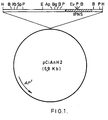
- This purified plasmid was used to construct a restriction map by classical techniques and the result of such a map is represented in fig. 1. Dashed area in the figure indicates the position and direction of transcription of the novel DNA compound, i.e: the A. nidulans IPNS genes structural characterization of the DNA compound.
- the genomic region comprising the IPNS gene was sequenced by the method of Sanger using subcloning in M13 mp8 or M13 mp9 for obtaining single-stranded templates necessary for the sequencing reaction. All the restriction sites used for subcloning were sequenced through.
- This plasmid (Masui, Y., Coleman, J. and Inouye, M. Multipurpose expression cloning vehicles in E. coli . In experimental Manipulation of gene expression. Ed. M. Inouye. Academic Press N.Y., 1983, pp. 15-32), 12.6 Kb long, encodes a kanamicin-resistance gene and contains a ts mutation that affects its copy number in such a way that the number of molecules of plasmid per cell is increased from about 15 at 30 o C up to 2000 molecules per cell at the restrictive temperature (37 o C).
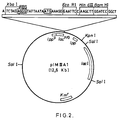
- the cloning region of PIM-IIIA1 (see fig. 2) contains the strong E.
- transcription can be controlled by the lactose repressor. Downstream of these transcriptional control units is the ATG corresponding to the initiator methionine of the lipoprotein followed by the first nucleotides of the structural gene. Fourteen base pairs before the ATG there is a single XbaI site and five nucleotides downstream the ATG a synthetic DNA sequence which contains targets for Bam HI, Eco RI and Hin dIII that are unique throughout the plasmid. This four single restriction targets can be used to clone the foreign DNA in this vector.
- the vector also includes the gene that codifies for the lactose repressor and after the partial sequence of the lipoprotein structural gene, the transcriptional terminator of the mentioned gene.
- Fig. 3 summarizes construction of pIM-Cic.
- Digestion of pCiANH2 (example 1, fig. 1) with Cla I and Bgl II yields a 1.7 Kb fragment containing all but the 33 first nucletoides of the A. nidulans IPNS coding region and around 700 bp downstream the translational terminator.
- plasmid pCiANH2 was digested with Cla I and Bgl II and the resulting DNA fragments were electrophoresed through a 3.5% poliacrilamide gel in 90 mM Tris-borate, 2 mM EDTA pH 8.0.
- the fragments were stained with methylene blue and the 1.7 Kb Cla I- Bgl II was identified, sliced from the gel and eluted overnight in a buffer containing 0.5 M ammonium acetate, 1 mM EDTA.
- the solution containing the fragment was filtered through glass-wool and extracted twice with phenol saturated with 10 mM Tris-HCl, 1 mM EDTA ph 8.0.
- the residual phenol was extracted with ether and the residual ether eliminated under a nitrogen stream.
- the fragment was finally ethanol precipitated, and taken up in a small volume of Tris-HCl 10 mM pH 8.0, 1 mM EDTA and stored until use.
- oligonucleotides Two oligonucleotides were then synthesized in an Applied Biosystems, Inc. 380A DNA synthesizer. The oligonucleotides were complementary and after purification in the conditions described by the manufacturer of the DNA Synthesizer were hybridized in 0.1xSSG at 65 o C overnight. After reannealing, they formed an adapter which reconstructed the precise sequence between the Xba I site of pIM-IIIA1 and the ATG corresponding to the lipoprotein coding region. This ATG was followed by the 33 first nucleotides of the ORF present between the initiation codon of IPNS gene and the Cla I site. Both oligonucleotides were designed in such a way that they left overhanging Cla I and Xba I cohesive ends.
- plasmid pIM-IIIA1 was digested with Xba I and Bam HI (compatible overhanging ends with Bgl II) and with Hind III and Eco RI (to prevent self-ligation of the vector). The three fragments were mixed in a 1:1:1 molar proportion and the mixture used to transform E. coli DH1 as described in example 1. An scheme of the construction is shown in fig. 3. Most of the transformants contained the expected recombinant plasmid, that was named pIM-Cic (see fig. 3).
- One of the clones chosen for further experiments was purified as described in example 1 (except that the selective pressure was maintained for kanamicin-resistance during growth) and was sequenced from the Xba I site to verify that the construction was correct at the nucleotide level.
- a polypeptide with a molecular mass of 40 Kd was present in E. coli W3110 cells transformed with pIM-Cic and induced with IPTG and temperature, and absent in control cells transformed with pIM-IIIA1 or in untransformed cells.
- the protein was synthesized at low levels in cells not induced with IPTG, showing that this polypeptide is under the control of the lac operator region from pIM-Cic and this should correspond to the IPNS gene product.
- Discrepancy between the observed molecular mass in an SDS-polyacrilamide gels and the real molecular weight has been observed for many proteins.
- IPNS activity is detectable in E. coli cells transformed with pIM-Cic and induced with IPTG and termperature.
- W3110 cells transformed either with pIM-IIIA1 or with pIM-Cic, were induced with IPTG and temperatures as described in example 3. 3 hours after induction, 1-ml samples were centrifuged in the microfuge at 4 o C and each pellet was resuspended in 0.5 ml of 50 mM Tris-HCl pH 8.0, 10 mM KCl, 10 mM MgSO4 and lysed by sonication. Cell debries were pelleted by centrifugation at 20.000xg for 20 minutes at 4 o C.
- the reaction mixture contained 10 »l of 2 mM LLD-ACV, 4 »l of 0.1 M dithiothreitol, 2.5 »l of FeSO4 4 mM, 2.5 »l of ascorbic acid, 75 »l of cell-free extract and H2O to complete the final volume. Controls were made with no extract or with no substrate. Reactions were carried out for 30 minutes at 25 o C and stoped by addition of an equal volume of methanol. 100 »l samples were placed in wells of 7 mm diameter made in plates of Tryptic Soy Agar (Difco) seeded with Micrococcus luteus .
Landscapes
- Life Sciences & Earth Sciences (AREA)
- Chemical & Material Sciences (AREA)
- Health & Medical Sciences (AREA)
- Genetics & Genomics (AREA)
- Organic Chemistry (AREA)
- Zoology (AREA)
- Engineering & Computer Science (AREA)
- Bioinformatics & Cheminformatics (AREA)
- Wood Science & Technology (AREA)
- Microbiology (AREA)
- Biotechnology (AREA)
- Biomedical Technology (AREA)
- Molecular Biology (AREA)
- Biochemistry (AREA)
- General Engineering & Computer Science (AREA)
- General Health & Medical Sciences (AREA)
- Medicinal Chemistry (AREA)
- Micro-Organisms Or Cultivation Processes Thereof (AREA)
- Enzymes And Modification Thereof (AREA)
- Preparation Of Compounds By Using Micro-Organisms (AREA)
Claims (13)
- DNA-Sequenz, welche im wesentlichen für die Funktion der Isopenicillin-N- Synthetase aus Aspergillus nidulans codiert und die Aminosäuresequenz des Anhangs 2 besitzt.
- DNA-Sequenz nach Anspruch 1, worin die Funktion der IPNS aus A. nidulans im relevanten Teil des Plasmids pCiAnH2, welches in dem unter NCIB 12450 hinterlegten E. coli-Stamm enthalten ist, codiert ist.
- DNA-Sequenz nach Anspruch 1 oder Anspruch 2, enthaltend eine codierende Sequenz, welche derjenigen des Anhangs 1 entspricht, oder das degenerierte Äquivalent davon.
- Sequenz nach einem der vorstehenden Ansprüche, welche im wesentlichen für die IPNS aus A. nidulans codiert.
- Vektor, umfassend eine Sequenz nach jedem vorstehenden Anspruch.
- Vektor nach Anspruch 5, umfassend das als pCiAnH2 bezeichnete Plasmid, welches in dem unter NCIB 12450 hinterlegten E. coli- Stamm enthalten ist.
- Vektor nach Anspruch 5, welcher als pIM-Cic bezeichnet und gem. dem folgenden Verfahren konstruiert ist:(a) Spaltung des Plasmids pCiAnH2, welches in dem unter NCIB 12450 hinterlegten E. coli-Stamm enthalten ist, mit ClaI und BglII und Isolierung eines 1,7 Kb-Fragments, welches der Region, die für IPNS aus A. nidulans codiert, entspricht;(b) Synthese eines Adaptor-Fragments, welches eine Sequenz besitzt, die der Sequenz zwischen der XbaI-Stelle des Plasmids pIM-IIIA1 und dem ATG, welches zu der für Lipoprotein codierenden Region gehört, gefolgt von der Sequenz zwischen dem Initiationscodon der für IPNS codierenden Region und deren ClaI-Stelle, wobei der Adaptor überhängende ClaI- und XbaI-Kohäsivenden besitzt;(c) Spaltung des Plasmids pIM-IIIA1 mit XbaI, BamHI, HindIII und EcoRI;(d) Ligierung des in (a) hergestellten Fragments, des in (c) hergestellten Plasmid-Fragments und des in (b) hergestellten Adaptor-Fragments.
- Vektor, herleitbar vom Plasmid pCiAnH2, welches in dem unter NCIB 12450 hinterlegten E. coli-Stamm nach Anspruch 6 enthalten ist, weiterhin umfassend mindestens einen A. nidulans-Transformationsmarker.
- Vektor, herleitbar vom Vektor pIM-Cic nach Anspruch 7, weiterhin umfassend mindestens ein weiteres E. coli-Translations- und/oder Transcriptionskontrollsignal.
- Wirtzelle, enthaltend mindestens eine Sequenz nach jedem vorstehenden Anspruch in integrierter oder extrachromosomaler Form.
- Wirtszelle nach Anspruch 10, worin die diese Sequenz enthaltende Wirtszelle A. nidulans, E. coli, Penicillium chrysogenum oder Cephalosporium acremonium ist.
- Wirtszelle nach Anspruch 10, worin die diese Sequenz enthaltende Wirtszelle E. coli W3110 ist.
- Verfahren zur Herstellung eines IPNS-Enzyms/Proenzyms/Präproenzyms, umfassend das Kultivieren einer Zelle oder von Zellen gem. einem der Ansprüche 10 bis 12 und Isolieren des hergestellten Produkts.
Applications Claiming Priority (2)
| Application Number | Priority Date | Filing Date | Title |
|---|---|---|---|
| GB8709708 | 1987-04-24 | ||
| GB8709708A GB2208077A (en) | 1987-04-24 | 1987-04-24 | Isopenicillin n synthetase gene derived from aspergillus nidulans |
Publications (3)
| Publication Number | Publication Date |
|---|---|
| EP0288325A2 EP0288325A2 (de) | 1988-10-26 |
| EP0288325A3 EP0288325A3 (en) | 1989-04-26 |
| EP0288325B1 true EP0288325B1 (de) | 1994-06-22 |
Family
ID=10616271
Family Applications (1)
| Application Number | Title | Priority Date | Filing Date |
|---|---|---|---|
| EP88303717A Expired - Lifetime EP0288325B1 (de) | 1987-04-24 | 1988-04-25 | Für A.Nidulans-Isopenicillin-N-Synthetase codierende DNS, deren Verwendung und dafür codierende Vektoren |
Country Status (5)
| Country | Link |
|---|---|
| EP (1) | EP0288325B1 (de) |
| AT (1) | ATE107694T1 (de) |
| DE (1) | DE3850294T2 (de) |
| ES (1) | ES2008391A6 (de) |
| GB (1) | GB2208077A (de) |
Families Citing this family (2)
| Publication number | Priority date | Publication date | Assignee | Title |
|---|---|---|---|---|
| GB8728811D0 (en) * | 1987-12-09 | 1988-01-27 | Beecham Group Plc | Novel substance |
| US6258555B1 (en) | 1987-12-09 | 2001-07-10 | Beecham Group P.L.C. | DNA encoding ACV synthetase |
Family Cites Families (2)
| Publication number | Priority date | Publication date | Assignee | Title |
|---|---|---|---|---|
| DE3683080D1 (de) * | 1985-04-22 | 1992-02-06 | Lilly Co Eli | Rekombinante dns-expressionsvektoren und dns-verbindungen. |
| US4892819A (en) * | 1985-11-25 | 1990-01-09 | Eli Lilly And Company | Recombinant DNA expression vectors and DNA compounds that encode isopenicillin N synthetase from penicillium chrysogenum |
-
1987
- 1987-04-24 GB GB8709708A patent/GB2208077A/en not_active Withdrawn
- 1987-12-15 ES ES8703592A patent/ES2008391A6/es not_active Expired
-
1988
- 1988-04-25 AT AT88303717T patent/ATE107694T1/de active
- 1988-04-25 EP EP88303717A patent/EP0288325B1/de not_active Expired - Lifetime
- 1988-04-25 DE DE3850294T patent/DE3850294T2/de not_active Expired - Fee Related
Non-Patent Citations (1)
| Title |
|---|
| Proc. Royal Society London B (1990), vol. 241, pp. 164-169, M. Penalva et al. * |
Also Published As
| Publication number | Publication date |
|---|---|
| ATE107694T1 (de) | 1994-07-15 |
| ES2008391A6 (es) | 1989-07-16 |
| EP0288325A3 (en) | 1989-04-26 |
| DE3850294T2 (de) | 1995-01-19 |
| EP0288325A2 (de) | 1988-10-26 |
| GB2208077A (en) | 1989-02-22 |
| GB8709708D0 (en) | 1987-05-28 |
| DE3850294D1 (de) | 1994-07-28 |
Similar Documents
| Publication | Publication Date | Title |
|---|---|---|
| Ramón et al. | Cloning and characterization of the isopenicillin N synthetase gene mediating the formation of the β-lactam ring in Aspergillus nidulans | |
| KR100648480B1 (ko) | 세팔로스포린의 개선된 생체내 생산 | |
| AU599343B2 (en) | Recombinant DNA expression vectors and DNA compounds that encode isopenicillin N synthetase from penicillium chrysogenum | |
| RU1838413C (ru) | Способ экспрессии DACS/DAOCS активности в клетках ЕSснеRIснIа coLI | |
| AU619596B2 (en) | Recombinant dna expression vectors and dna compounds which encode isopenicillin n synthetase | |
| US4950603A (en) | Recombinant DNA expression vectors and DNA compounds that encode isopenicillin N synthetase from Streptomyces lipmanii | |
| JP2954601B2 (ja) | 二次代謝産物生産増加のための生合成遺伝子又は制御遺伝子の単離法及び使用法 | |
| JP2546979B2 (ja) | 組換えd−ヒダントイナーゼ、その生産方法および使用 | |
| EP0444775B1 (de) | Rekombinante DNA-Expressionsvektoren und DNA-Zusammensetzungen, die Isopenizillin N-Epimerase-Aktivität kodieren | |
| EP0288325A2 (de) | Für A.Nidulans-Isopenicillin-N-Synthetase codierende DNS, deren Verwendung und dafür codierende Vektoren | |
| AU614988B2 (en) | Recombinant dna expression vectors and dna compounds that encode isopenicillin n synthetase from aspergillus nidulans | |
| JP4437170B2 (ja) | 微生物、該微生物より得られるラクタマーゼ酵素、およびその使用 | |
| EP0462674A1 (de) | Ein von P. chrysogenum erhältliches Oxidreduktasesystem, Gene die dafür kodieren und deren Verwendung zur Steigerung der Antibiotikaproduktion | |
| EP0775748B1 (de) | Herstellung von D-alpha-Aminosäuren, unter Verwendung von mit dem Carbamoylase-Hydantoinase-Operon-transformierten Bakterien | |
| JP3889438B2 (ja) | 工業用酵素 | |
| JPH07108225B2 (ja) | D−アミノ酸オキシダ−ゼ遺伝子 | |
| EP0190252A1 (de) | Rekombinante dns-moleküle, transformierte mikroorganismen und verfahren zur herstellung von penicillin v-amidase | |
| HU215231B (hu) | Géntechnológiai eljárás S-(+)-2,2-dimetil-ciklopropán-karboxamid előállítására mikroorganizmusok segítségével | |
| US4987069A (en) | Nucleotide sequence capable of inducing high levels of translation of a heterologous gene in Bacillus subtilis and Escherichia coli | |
| US5660999A (en) | P0438, a new calcium-regulated promoter | |
| US5766881A (en) | Induction-free process for the recombinant preparation of glutarylamidase | |
| SU1532585A1 (ru) | Рекомбинантна плазмидна ДНК @ 33, кодирующа метилазу S @ 11, и штамм бактерий ЕSснеRIснIа coLI - продуцент метилазы S @ 11 | |
| JP2002112783A (ja) | 酸化還元酵素遺伝子、同遺伝子のクローニングおよび同酵素の製造方法 |
Legal Events
| Date | Code | Title | Description |
|---|---|---|---|
| PUAI | Public reference made under article 153(3) epc to a published international application that has entered the european phase |
Free format text: ORIGINAL CODE: 0009012 |
|
| AK | Designated contracting states |
Kind code of ref document: A2 Designated state(s): AT BE CH DE FR GB GR IT LI NL SE |
|
| PUAL | Search report despatched |
Free format text: ORIGINAL CODE: 0009013 |
|
| AK | Designated contracting states |
Kind code of ref document: A3 Designated state(s): AT BE CH DE FR GB GR IT LI NL SE |
|
| 17P | Request for examination filed |
Effective date: 19890721 |
|
| 17Q | First examination report despatched |
Effective date: 19920114 |
|
| GRAA | (expected) grant |
Free format text: ORIGINAL CODE: 0009210 |
|
| AK | Designated contracting states |
Kind code of ref document: B1 Designated state(s): AT BE CH DE FR GB GR IT LI NL SE |
|
| PG25 | Lapsed in a contracting state [announced via postgrant information from national office to epo] |
Ref country code: LI Effective date: 19940622 Ref country code: GR Free format text: LAPSE BECAUSE OF FAILURE TO SUBMIT A TRANSLATION OF THE DESCRIPTION OR TO PAY THE FEE WITHIN THE PRESCRIBED TIME-LIMIT Effective date: 19940622 Ref country code: FR Effective date: 19940622 Ref country code: CH Effective date: 19940622 Ref country code: BE Effective date: 19940622 |
|
| REF | Corresponds to: |
Ref document number: 107694 Country of ref document: AT Date of ref document: 19940715 Kind code of ref document: T |
|
| REF | Corresponds to: |
Ref document number: 3850294 Country of ref document: DE Date of ref document: 19940728 |
|
| ITF | It: translation for a ep patent filed | ||
| PG25 | Lapsed in a contracting state [announced via postgrant information from national office to epo] |
Ref country code: SE Effective date: 19940922 |
|
| REG | Reference to a national code |
Ref country code: CH Ref legal event code: PL |
|
| EN | Fr: translation not filed | ||
| PLBE | No opposition filed within time limit |
Free format text: ORIGINAL CODE: 0009261 |
|
| STAA | Information on the status of an ep patent application or granted ep patent |
Free format text: STATUS: NO OPPOSITION FILED WITHIN TIME LIMIT |
|
| 26N | No opposition filed | ||
| PGFP | Annual fee paid to national office [announced via postgrant information from national office to epo] |
Ref country code: AT Payment date: 20000412 Year of fee payment: 13 |
|
| PGFP | Annual fee paid to national office [announced via postgrant information from national office to epo] |
Ref country code: GB Payment date: 20000419 Year of fee payment: 13 |
|
| PGFP | Annual fee paid to national office [announced via postgrant information from national office to epo] |
Ref country code: DE Payment date: 20000427 Year of fee payment: 13 |
|
| PGFP | Annual fee paid to national office [announced via postgrant information from national office to epo] |
Ref country code: NL Payment date: 20000428 Year of fee payment: 13 |
|
| PG25 | Lapsed in a contracting state [announced via postgrant information from national office to epo] |
Ref country code: GB Free format text: LAPSE BECAUSE OF NON-PAYMENT OF DUE FEES Effective date: 20010425 Ref country code: AT Free format text: LAPSE BECAUSE OF NON-PAYMENT OF DUE FEES Effective date: 20010425 |
|
| PG25 | Lapsed in a contracting state [announced via postgrant information from national office to epo] |
Ref country code: NL Free format text: LAPSE BECAUSE OF NON-PAYMENT OF DUE FEES Effective date: 20011101 |
|
| GBPC | Gb: european patent ceased through non-payment of renewal fee |
Effective date: 20010425 |
|
| NLV4 | Nl: lapsed or anulled due to non-payment of the annual fee |
Effective date: 20011101 |
|
| PG25 | Lapsed in a contracting state [announced via postgrant information from national office to epo] |
Ref country code: DE Free format text: LAPSE BECAUSE OF NON-PAYMENT OF DUE FEES Effective date: 20020201 |
|
| PG25 | Lapsed in a contracting state [announced via postgrant information from national office to epo] |
Ref country code: IT Free format text: LAPSE BECAUSE OF NON-PAYMENT OF DUE FEES;WARNING: LAPSES OF ITALIAN PATENTS WITH EFFECTIVE DATE BEFORE 2007 MAY HAVE OCCURRED AT ANY TIME BEFORE 2007. THE CORRECT EFFECTIVE DATE MAY BE DIFFERENT FROM THE ONE RECORDED. Effective date: 20050425 |