EP0288811A2 - Träger für Verriegelungsschalter - Google Patents
Träger für Verriegelungsschalter Download PDFInfo
- Publication number
- EP0288811A2 EP0288811A2 EP88105746A EP88105746A EP0288811A2 EP 0288811 A2 EP0288811 A2 EP 0288811A2 EP 88105746 A EP88105746 A EP 88105746A EP 88105746 A EP88105746 A EP 88105746A EP 0288811 A2 EP0288811 A2 EP 0288811A2
- Authority
- EP
- European Patent Office
- Prior art keywords
- actuator
- switch
- operator
- baseplate
- motion
- Prior art date
- Legal status (The legal status is an assumption and is not a legal conclusion. Google has not performed a legal analysis and makes no representation as to the accuracy of the status listed.)
- Withdrawn
Links
Images



Classifications
-
- H—ELECTRICITY
- H01—ELECTRIC ELEMENTS
- H01H—ELECTRIC SWITCHES; RELAYS; SELECTORS; EMERGENCY PROTECTIVE DEVICES
- H01H3/00—Mechanisms for operating contacts
- H01H3/02—Operating parts, i.e. for operating driving mechanism by a mechanical force external to the switch
- H01H3/16—Operating parts, i.e. for operating driving mechanism by a mechanical force external to the switch adapted for actuation at a limit or other predetermined position in the path of a body, the relative movement of switch and body being primarily for a purpose other than the actuation of the switch, e.g. for a door switch, a limit switch, a floor-levelling switch of a lift
-
- H—ELECTRICITY
- H05—ELECTRIC TECHNIQUES NOT OTHERWISE PROVIDED FOR
- H05B—ELECTRIC HEATING; ELECTRIC LIGHT SOURCES NOT OTHERWISE PROVIDED FOR; CIRCUIT ARRANGEMENTS FOR ELECTRIC LIGHT SOURCES, IN GENERAL
- H05B6/00—Heating by electric, magnetic or electromagnetic fields
- H05B6/64—Heating using microwaves
- H05B6/6414—Aspects relating to the door of the microwave heating apparatus
- H05B6/6417—Door interlocks of the microwave heating apparatus and related circuits
-
- H—ELECTRICITY
- H01—ELECTRIC ELEMENTS
- H01H—ELECTRIC SWITCHES; RELAYS; SELECTORS; EMERGENCY PROTECTIVE DEVICES
- H01H3/00—Mechanisms for operating contacts
- H01H3/02—Operating parts, i.e. for operating driving mechanism by a mechanical force external to the switch
- H01H3/16—Operating parts, i.e. for operating driving mechanism by a mechanical force external to the switch adapted for actuation at a limit or other predetermined position in the path of a body, the relative movement of switch and body being primarily for a purpose other than the actuation of the switch, e.g. for a door switch, a limit switch, a floor-levelling switch of a lift
- H01H3/161—Operating parts, i.e. for operating driving mechanism by a mechanical force external to the switch adapted for actuation at a limit or other predetermined position in the path of a body, the relative movement of switch and body being primarily for a purpose other than the actuation of the switch, e.g. for a door switch, a limit switch, a floor-levelling switch of a lift for actuation by moving a closing member, e.g. door, cover or lid
- H01H3/163—Operating parts, i.e. for operating driving mechanism by a mechanical force external to the switch adapted for actuation at a limit or other predetermined position in the path of a body, the relative movement of switch and body being primarily for a purpose other than the actuation of the switch, e.g. for a door switch, a limit switch, a floor-levelling switch of a lift for actuation by moving a closing member, e.g. door, cover or lid associated with locking or manipulating means of the closing member
-
- Y—GENERAL TAGGING OF NEW TECHNOLOGICAL DEVELOPMENTS; GENERAL TAGGING OF CROSS-SECTIONAL TECHNOLOGIES SPANNING OVER SEVERAL SECTIONS OF THE IPC; TECHNICAL SUBJECTS COVERED BY FORMER USPC CROSS-REFERENCE ART COLLECTIONS [XRACs] AND DIGESTS
- Y10—TECHNICAL SUBJECTS COVERED BY FORMER USPC
- Y10S—TECHNICAL SUBJECTS COVERED BY FORMER USPC CROSS-REFERENCE ART COLLECTIONS [XRACs] AND DIGESTS
- Y10S292/00—Closure fasteners
- Y10S292/69—Washing machine or stove closure latch
Definitions
- the present invention provides for an improvement in a unitary switch module by providing an additional actuator which is designed to receive door operator motion to actuate an interlock switch.
- the actuator is designed to be tamper-proof in that it is relatively inaccessible even through the door operator apertures in the front wall of the unitary switch module and is held in the deactuated state until the other actuators move to their respective enabling positions.
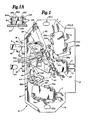
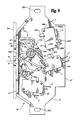
- an interlock switch assembly 10 having a unitary baseplate or frame 12.
- Frame 12 has a front wall or panel 14 containing first and second apertures 16, 18, respectively adapted to receive first and second operators 19, 20 in a direction parallel to axis A.
- Operators 19 and 20 are preferably hook-type and bayonet-type operators respectively, and are secured to the door of a microwave oven.
- Operator 19 preferably has an enlarged distal portion 23 and retains the door in a closed position while the switch assembly is actuated.
- switch assembly 10 is shown in the deactuated state which corresponds to a door-open state of the microwave oven with the operators withdrawn from apertures 16, 18.
- Frame 12 also has a generally planar wall or mounting surface 21 preferably at a right angle to front wall 14.
- Surface or base 21 has elongated apertures 22a,b adapted for mounting assembly 10 to a microwave oven and for allowing adjustment only along a direction parallel to axis A.
- Apertures 22a,b are preferably, but not necessarily, used in cooperation with bosses or studs 33a,b which are to be received in mating slots in the mounting surface to which base 12 is secured.
- Surface 21 has a pair of rectangular fingers 24a, 24b to positively retain a pair of miniature switches 26a, 26b.
- Switches 26a, 26b are positively located to assembly 10 at a pair of cylindrical posts 28a, 28b. Fingers 24a, 24b and posts 28a, 28b are preferably integrally molded to base 21.
- FIG 1A shows mounting details and the stacked arrangement of switches 26a, 26b. Similar arrangements are provided for individual switches 30 and 32.
- switches 26a, 26b, 30 and 32 has an external actuating button B, and means for external electrical connection C. Although three electrical connections are shown for each switch, in the preferred embodiment switch 26a has a normally-open contact and functions as a logic monitor switch 26b is a normally-open and functions as a secondary interlock, switch 30 is a normally-open and functions as primary interlock switch, and switch 32 has a normally-closed contact and functions as an interlock monitor switch.
- a first actuator 34 receives and converts the motion of operator 19 from a linear motion into a rotary motion and sequentially actuates switches 26a and 26b.
- a second actuator 36 receives and translates the linear motion of operator 20 into a rotary motion to actuate second actuator switch 32.
- Actuators 34 and 36 are designed to mechanically interlock with each other to prevent any switch actuation in the event that only one of operators 19, 20 is received through apertures 16, 18.
- a third actuator 100 receives a portion of the motion of operator 19 to operate switch 30.
- Actuators 34 and 100 have interengaging surfaces 102, 104 preventing actuation of switch 30 while actuator 34 is in either a deactuated or intermediate position.
- inner cam 102 provides a clearance region 118 which permits movement of actuator 100. Clearance region 118 is obscured from view through aperture 16 when actuator 34 is in the actuated state.
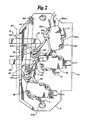
- FIG. 1 corresponds to an open door condition while FIG. 2 corresponds to a closed-door condition of a microwave oven.
- door 96 has operators 19 and 20 preferably rigidly affixed thereto and switch assembly 10 is located behind the front panel 94 (shown in phantom in FIG. 2) of the microwave oven. Phantom panel 94 corresponds a section view of front parallel 94 of FIG. 6.
- a spring 42 provides an over-center action to retain actuator 34 in either the actuated or the deactuated state.
- actuator 34 progresses to position 44, shown in phantom in FIG. 1. At this point, surfaces 46, 48 on actuators 34, 36 respectively, engage each other, prohibiting further travel of actuator 34.
- interengaging surfaces 50a, 50b prevent motion of actuator 36.
- FIG 3 shows interlock switch assembly 10 in an intermediate position with interengaging surfaces 50a, 50b and 46, 48 displaced and free to travel past each other. This action permits actuators 34, 36 to continue to progress to the actuated position as shown in FIG 2.
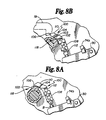
- actuator 100 With operators 19, 20 in positions as shown in FIGS. 1 and 3 (and in positions intermediate thereto) actuator 100 is prevented from actuating switch 30 by the interference between an inner cam or surface 102 on actuator 34 and surface 104 on actuator 100. As operators 19, 20 progress to the closed-door position of FIG. 2, cam surface 102 rotates away to provide clearance 118 for movement of third actuator 100. At the same time (as may be seen more clearly in FIG. 8B) operator 19 urges driving surface 106 on actuator 100 to move actuator 100 towards button B on switch 30, actuating switch 30.
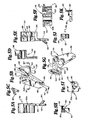
- FIGS 4A-4F shows various details of baseplate 12. More particularly, FIG. 4A shows a front view of the front wall or panel 14 indicating the relative position of apertures 16 and 18. Preferably, apertures 16 and 18 are surrounded by frames 56, 58 respectively which have a beveled interior surface 60 to assist in receiving operators 19 and 20.
- FIG. 4B shows a partial section view of frame 12 and further shows an exploded view of the partial assembly including actuators 34 and 36. More particularly, actuators 34 is received on a first shaft 62 and actuator 36 is received on a second shaft 64. Actuators 34 and 36 are retained on their respective shafts by means such as retaining rings 66a, 66b (shown in FIG 1). Alternatively, other fastening means may be used which restrain axial movement of the actuators while permitting rotational movement.
- a projection 68 shown in top, front and side views is designed to receive and retain one end of spring 42.
- a track 108 is adapted to retain actuator 100 on baseplate 12 while permitting sliding movement of actuator 100 with respect to baseplate 12.
- Rectangular fingers 74a, 74b and cylindrical post 78a are similar to fingers 24a, 24b and post 28a, except that they are shorter by the width W of one miniature switch 26.
- Fingers 76a, 76b and posts 77a, 77b are preferably the same as fingers 74 and post 78.
- FIG. 4F shows the detail of mounting track 108 which is preferably formed integrally with planar surface 21 of frame 12.
- Track 108 has parallel opposing sides 114a, 114b and overlapping edges 116a, 116b to retain actuator 100 in a sliding relationship to baseplate 12.
- actuators 34 and 36 may be seen.
- Interengaging surface 50b may be seen in FIGS 5A, 5B and 5F.
- a cross-section of a spring retaining projection 80 on actuator 34 is shown in FIG 5C.
- FIG 5D shows surface 38 which is adapted to retain the hook of operator 19.
- FIGS 5B and 5E shows first and second initial cam surfaces 82, 84 and a common final cam surface 86.
- First initial cam surface 82 engages and actuates switch 26b prior to second initial cam surface engaging and actuating switch 26a.
- common final cam surface 86 maintains both switches 26a, 26b actuated.
- FIGS. 5B, 5F and 5G show views of the inner cam surface 102 of actuator 34.
- FIG. 5G shows the details of the back of actuator 34, including clearance region 118 adjacent inner cam 102.
- FIGS. 5H-5I the various views and details of actuator 36 may be seen.
- FIG. 5H shows a cross-section through projection 52.
- FIGS. 5I, 5J and 5K show the details of interengaging surfaces 48 and 50a which prevent actuation of any switch unless both operators 19 and 20 are received through apertures 16, 18 to operate actuators 34 and 36 in the proper timing sequence.
- actuator 36 has a switch contacting surface 90 which actuates switch 32 when actuator 36 is driven to the actuated position by operator 20.
- interlock switch assembly 10 is shown in a microwave oven 92 having a front panel 94 and a pivoting microwave oven door 96, which carries first and second operators 19, 20.
- Assembly 10 is mounted in oven 92 such that first and second apertures 16, 18 located in the front wall 14 of assembly 10 are positioned to align with corresponding apertures in the front panel 94 of oven 92.
- Actuator 100 has driving surface 106 and engaging surface 104 on a head portion 110.
- Head portion 110 is preferably formed integrally with guide portion 112.
- Guide portion 112 is retained in track 108 of baseplate 12 for sliding movement therein to actuate and deactuate switch 30 in response to translational motion of the distal portion 23 of operator 19.
- Guide portion 112 preferably has barbs 120 or other retaining means for retaining actuator 100 in track 108.
- the third actuator 100 receives a portion of the motion of operator 19 to operate switch 30.
- Actuators 34 and 100 have interengaging surfaces 102, 104 preventing actuation of switch 30 while actuator 34 is in either a deactuated or intermediate position.
- a blocking surface 103 moves away from its rest position and provides a clearance 118 permitting movement of actuator 100.
- blocking surface 103 rotates sufficiently to permit third actuator 100 to engage and actuate switch 30.
- operator 19 progresses to the closed door position, it urges driving surface 106 on actuator 100 to move actuator 100 towards button B on switch 30, actuating switch 30.
- the switch assembly 10 deactuation sequence is as follows. When the microwave oven door starts to open, operators 19, 20 begin to withdraw. Actuator 100 releases button B on switch 30, opening or deactuating switch 30.
- switch 26a is the first switch deactuated, followed by deactuation of switches 30 and 26b (in optional order). Finally switch 32 is deactuated, completing the sequence corresponding to door opening motion.
- switch 30 is the first switch deactuated and is preferably designed to be capable of interrupting power to the microwave energy source when the door is opened before the cooking cycle is completed. In this embodiment the next switch to be deactuated is the switch 26a whose button B is released by the second cam surface 84.
- cam surface 82 releases button B on the secondary interlock switch 26b, acting as a backup to switch 30.
- actuator 36 moves sufficiently far to release button B on the interlock monitor switch 32, thus deactuating switch 32 which preferably places a short circuit across the load side of the power circuit of switch assembly 10 to blow a fuse in the event of a "failed-closed" condition of both switches 26a, 26b in the deactuated state.
- switch 30 has been moved, and parts 24a, 24b, 34, 74a, 74b, 76a, 76b, 100 and 108 have been reproportioned.
Landscapes
- Physics & Mathematics (AREA)
- Electromagnetism (AREA)
- Engineering & Computer Science (AREA)
- Computer Security & Cryptography (AREA)
- Electric Ovens (AREA)
- Push-Button Switches (AREA)
- Constitution Of High-Frequency Heating (AREA)
- Control Of High-Frequency Heating Circuits (AREA)
- Rotary Switch, Piano Key Switch, And Lever Switch (AREA)
Applications Claiming Priority (2)
| Application Number | Priority Date | Filing Date | Title |
|---|---|---|---|
| US07/043,216 US4745250A (en) | 1987-04-27 | 1987-04-27 | Interlock switch baseplate assembly |
| US43216 | 1987-04-27 |
Publications (2)
| Publication Number | Publication Date |
|---|---|
| EP0288811A2 true EP0288811A2 (de) | 1988-11-02 |
| EP0288811A3 EP0288811A3 (de) | 1989-10-18 |
Family
ID=21926088
Family Applications (1)
| Application Number | Title | Priority Date | Filing Date |
|---|---|---|---|
| EP88105746A Withdrawn EP0288811A3 (de) | 1987-04-27 | 1988-04-11 | Träger für Verriegelungsschalter |
Country Status (10)
| Country | Link |
|---|---|
| US (1) | US4745250A (de) |
| EP (1) | EP0288811A3 (de) |
| JP (1) | JPS63281393A (de) |
| KR (1) | KR970000108B1 (de) |
| CN (1) | CN88102377A (de) |
| AR (1) | AR246635A1 (de) |
| AU (1) | AU1519888A (de) |
| BR (1) | BR8802002A (de) |
| CA (1) | CA1295691C (de) |
| ZA (1) | ZA881005B (de) |
Cited By (4)
| Publication number | Priority date | Publication date | Assignee | Title |
|---|---|---|---|---|
| EP1469257A3 (de) * | 2003-03-19 | 2012-02-22 | LG Electronics, Inc. | Türaufbau für einen Mikrowellenofen |
| EP3560288A4 (de) * | 2017-01-26 | 2019-12-18 | Samsung Electronics Co., Ltd. | Kochvorrichtung |
| EP4001771B1 (de) * | 2020-11-11 | 2025-01-08 | ELBI International S.p.A. | Modulares türverriegelungssystem |
| WO2025132188A1 (de) | 2023-12-19 | 2025-06-26 | BSH Hausgeräte GmbH | Türverriegelung für ein haushaltsgerät sowie haushaltsgerät und verfahren |
Families Citing this family (30)
| Publication number | Priority date | Publication date | Assignee | Title |
|---|---|---|---|---|
| JP2512920Y2 (ja) * | 1990-04-09 | 1996-10-02 | シャープ株式会社 | 高周波加熱装置の安全スイッチ機構 |
| JP2510915Y2 (ja) * | 1990-04-27 | 1996-09-18 | シャープ株式会社 | 高周波加熱装置の安全スイッチ機構 |
| FR2672111B1 (fr) * | 1991-01-25 | 1993-10-15 | Moulinex Sa | Dispositif de mise en position attente de demarrage d'un four a micro-ondes. |
| US5174618A (en) * | 1991-12-09 | 1992-12-29 | Maytag Corporation | Door latch assembly |
| US6109667A (en) * | 1995-10-10 | 2000-08-29 | Collins; Matthew J. | Over-center toggle latch with integral switch |
| US6203077B1 (en) | 1997-10-03 | 2001-03-20 | Southco, Inc. | Over-center toggle latch with integral safety switch |
| US6111331A (en) * | 1999-03-22 | 2000-08-29 | General Electric Company | Air switch assembly for an electric motor |
| JP3655135B2 (ja) * | 1999-08-23 | 2005-06-02 | 株式会社東芝 | スイッチ装置 |
| DE10062458B4 (de) * | 2000-12-14 | 2004-06-17 | Whirlpool Corp., Benton Harbor | Schließvorrichtung für eine Waschmaschine oder einen Waschtrockner |
| US6761381B2 (en) * | 2001-08-09 | 2004-07-13 | General Electric Company | Methods and apparatus for securing a dishwasher door |
| US6709029B2 (en) * | 2001-12-21 | 2004-03-23 | Emerson Electric Co. | Door latch mechanism and associated components for a self-cleaning oven |
| US6863316B2 (en) | 2001-12-21 | 2005-03-08 | Emerson Electric Co. | Door latch mechanism and associated components for a self-cleaning oven |
| JP2004198082A (ja) * | 2002-12-20 | 2004-07-15 | Matsushita Electric Ind Co Ltd | 高周波加熱装置 |
| EP1632722B1 (de) * | 2003-05-15 | 2019-09-04 | Panasonic Corporation | Hochfrequenzheizvorrichtung |
| KR100546902B1 (ko) | 2003-10-16 | 2006-01-26 | 엘지전자 주식회사 | 전자레인지의 래치보드구조 |
| US20050284460A1 (en) * | 2004-06-28 | 2005-12-29 | The Stanley Works | Oven door latch lock |
| AU2012200199B2 (en) * | 2004-12-14 | 2014-06-19 | Enodis Corporation | Impingement/convection/microwave oven and method |
| MX2007007104A (es) * | 2004-12-14 | 2007-11-16 | Enodis Corp | Horno de microondas de impacto externo/conveccion y metodo. |
| EP1952412A1 (de) * | 2005-11-09 | 2008-08-06 | TurboChef Technologies, Inc. | Kombinationsschalter |
| US7498530B2 (en) * | 2005-11-28 | 2009-03-03 | General Electric Company | Sensor assembly for tank cars |
| US8449006B2 (en) * | 2008-07-31 | 2013-05-28 | Electrolux Home Products, Inc. | Appliance access door strike assemblies for addressing latch operation issues arising from dimensional variances |
| JP5403790B2 (ja) * | 2009-02-06 | 2014-01-29 | パナソニック株式会社 | 高周波加熱装置 |
| US9399879B2 (en) * | 2011-04-29 | 2016-07-26 | Trimark Corporation | Vehicle compartment door handle assembly |
| US20140197161A1 (en) * | 2013-01-16 | 2014-07-17 | Standex International Corporation | Door switch apparatus for microwave ovens |
| CN103956277B (zh) * | 2014-04-08 | 2015-10-28 | 温州兴机电器有限公司 | 负荷开关熔断器组合电器操作机构 |
| CN105826097B (zh) * | 2016-05-12 | 2017-12-12 | 泰兴市盛源电器有限公司 | 一种负荷开关卡合闸操作机构 |
| CN105788941B (zh) * | 2016-05-12 | 2017-12-12 | 泰兴市盛源电器有限公司 | 一种负荷开关操作机构 |
| KR102459278B1 (ko) * | 2016-06-20 | 2022-10-26 | 엘지전자 주식회사 | 잠금장치 및 이를 포함하는 가전기기 |
| CN111947192B (zh) * | 2019-05-15 | 2021-12-03 | 宁波方太厨具有限公司 | 一种联锁机构及应用有该联锁机构的烹饪电器 |
| DE102019115157B4 (de) * | 2019-06-05 | 2021-03-18 | Miele & Cie. Kg | Schaltervorrichtung für ein Gargerät mit einem durch eine Tür verschließbaren Garraum und Gargerät |
Family Cites Families (1)
| Publication number | Priority date | Publication date | Assignee | Title |
|---|---|---|---|---|
| US4663505A (en) * | 1986-05-22 | 1987-05-05 | Litton Systems, Inc. | Interlock switch base plate assembly |
-
1987
- 1987-04-27 US US07/043,216 patent/US4745250A/en not_active Expired - Fee Related
-
1988
- 1988-02-12 ZA ZA881005A patent/ZA881005B/xx unknown
- 1988-03-24 CA CA000562366A patent/CA1295691C/en not_active Expired - Fee Related
- 1988-03-24 KR KR1019880003199A patent/KR970000108B1/ko not_active Expired - Lifetime
- 1988-04-11 EP EP88105746A patent/EP0288811A3/de not_active Withdrawn
- 1988-04-19 CN CN198888102377A patent/CN88102377A/zh active Pending
- 1988-04-25 JP JP63100426A patent/JPS63281393A/ja active Pending
- 1988-04-26 BR BR8802002A patent/BR8802002A/pt unknown
- 1988-04-27 AR AR88310695A patent/AR246635A1/es active
- 1988-04-27 AU AU15198/88A patent/AU1519888A/en not_active Abandoned
Cited By (4)
| Publication number | Priority date | Publication date | Assignee | Title |
|---|---|---|---|---|
| EP1469257A3 (de) * | 2003-03-19 | 2012-02-22 | LG Electronics, Inc. | Türaufbau für einen Mikrowellenofen |
| EP3560288A4 (de) * | 2017-01-26 | 2019-12-18 | Samsung Electronics Co., Ltd. | Kochvorrichtung |
| EP4001771B1 (de) * | 2020-11-11 | 2025-01-08 | ELBI International S.p.A. | Modulares türverriegelungssystem |
| WO2025132188A1 (de) | 2023-12-19 | 2025-06-26 | BSH Hausgeräte GmbH | Türverriegelung für ein haushaltsgerät sowie haushaltsgerät und verfahren |
Also Published As
| Publication number | Publication date |
|---|---|
| ZA881005B (en) | 1988-09-28 |
| KR970000108B1 (ko) | 1997-01-04 |
| EP0288811A3 (de) | 1989-10-18 |
| JPS63281393A (ja) | 1988-11-17 |
| AU1519888A (en) | 1988-10-27 |
| BR8802002A (pt) | 1988-11-29 |
| KR880012956A (ko) | 1988-11-29 |
| CA1295691C (en) | 1992-02-11 |
| CN88102377A (zh) | 1988-11-16 |
| AR246635A1 (es) | 1994-08-31 |
| US4745250A (en) | 1988-05-17 |
Similar Documents
| Publication | Publication Date | Title |
|---|---|---|
| US4745250A (en) | Interlock switch baseplate assembly | |
| US4663505A (en) | Interlock switch base plate assembly | |
| US5033282A (en) | Self-locking electronic lock | |
| EP0553885B2 (de) | Sicherheitsschalter | |
| KR102618475B1 (ko) | 가전제품 및 가전제품용 도어 래치 | |
| US4717794A (en) | Interlock switch | |
| EP0101983B1 (de) | Verriegelungsschaltermodul für einen Mikrowellenofen | |
| US5672857A (en) | Switch actuating mechanism for two sequentially activated switches | |
| CN114961445B (zh) | 微波炉的联锁装置和微波炉 | |
| AU8024098A (en) | Device for coupling two attached modular electrical elements | |
| EP0075309A2 (de) | Verriegelungsvorrichtung für eine Backofentür | |
| US4529852A (en) | Electrical appliance interlock switch | |
| KR100458026B1 (ko) | 캠작동식타이머 | |
| EP0894920A1 (de) | Kraftfahrzeugtürschloss | |
| JPH08111145A (ja) | キー付き安全スイッチ | |
| US4687889A (en) | Electrical appliance interlock switch with improved isolation means | |
| EP1053553B1 (de) | Fernauslöser für eine schaltvorrichtung | |
| CN112332257B (zh) | 互锁式智能配电柜 | |
| CN112332259B (zh) | 防误入式智能开关柜 | |
| US4547634A (en) | Electrical appliance interlock switch with improved buss | |
| CN112332258B (zh) | 防误操作式智能型开关柜 | |
| WO2025195603A1 (en) | Device for operating a door of a household appliance for treating food, household appliance for treating food and method for operating a device for operating a door of a household appliance for treating food | |
| UA156784U (uk) | Електромеханічний замок з підвищеним захистом від злому | |
| CN115117774B (zh) | 一种抽屉电操双工位联锁机构及其使用方法 | |
| CN102820618A (zh) | 具有五防联锁装置的开关柜 |
Legal Events
| Date | Code | Title | Description |
|---|---|---|---|
| PUAI | Public reference made under article 153(3) epc to a published international application that has entered the european phase |
Free format text: ORIGINAL CODE: 0009012 |
|
| AK | Designated contracting states |
Kind code of ref document: A2 Designated state(s): AT BE DE FR GB IT NL SE |
|
| PUAL | Search report despatched |
Free format text: ORIGINAL CODE: 0009013 |
|
| AK | Designated contracting states |
Kind code of ref document: A3 Designated state(s): AT BE DE FR GB IT NL SE |
|
| STAA | Information on the status of an ep patent application or granted ep patent |
Free format text: STATUS: THE APPLICATION IS DEEMED TO BE WITHDRAWN |
|
| 18D | Application deemed to be withdrawn |
Effective date: 19900220 |