EP0289029A2 - Procédé de préparation de particules de polymères monodispersées - Google Patents
Procédé de préparation de particules de polymères monodispersées Download PDFInfo
- Publication number
- EP0289029A2 EP0289029A2 EP88106853A EP88106853A EP0289029A2 EP 0289029 A2 EP0289029 A2 EP 0289029A2 EP 88106853 A EP88106853 A EP 88106853A EP 88106853 A EP88106853 A EP 88106853A EP 0289029 A2 EP0289029 A2 EP 0289029A2
- Authority
- EP
- European Patent Office
- Prior art keywords
- group
- stage
- polymer
- monodisperse
- seed
- Prior art date
- Legal status (The legal status is an assumption and is not a legal conclusion. Google has not performed a legal analysis and makes no representation as to the accuracy of the status listed.)
- Granted
Links
Images


Classifications
-
- B—PERFORMING OPERATIONS; TRANSPORTING
- B01—PHYSICAL OR CHEMICAL PROCESSES OR APPARATUS IN GENERAL
- B01J—CHEMICAL OR PHYSICAL PROCESSES, e.g. CATALYSIS OR COLLOID CHEMISTRY; THEIR RELEVANT APPARATUS
- B01J20/00—Solid sorbent compositions or filter aid compositions; Sorbents for chromatography; Processes for preparing, regenerating or reactivating thereof
- B01J20/22—Solid sorbent compositions or filter aid compositions; Sorbents for chromatography; Processes for preparing, regenerating or reactivating thereof comprising organic material
- B01J20/26—Synthetic macromolecular compounds
-
- C—CHEMISTRY; METALLURGY
- C08—ORGANIC MACROMOLECULAR COMPOUNDS; THEIR PREPARATION OR CHEMICAL WORKING-UP; COMPOSITIONS BASED THEREON
- C08F—MACROMOLECULAR COMPOUNDS OBTAINED BY REACTIONS ONLY INVOLVING CARBON-TO-CARBON UNSATURATED BONDS
- C08F257/00—Macromolecular compounds obtained by polymerising monomers on to polymers of aromatic monomers as defined in group C08F12/00
- C08F257/02—Macromolecular compounds obtained by polymerising monomers on to polymers of aromatic monomers as defined in group C08F12/00 on to polymers of styrene or alkyl-substituted styrenes
-
- C—CHEMISTRY; METALLURGY
- C12—BIOCHEMISTRY; BEER; SPIRITS; WINE; VINEGAR; MICROBIOLOGY; ENZYMOLOGY; MUTATION OR GENETIC ENGINEERING
- C12N—MICROORGANISMS OR ENZYMES; COMPOSITIONS THEREOF; PROPAGATING, PRESERVING, OR MAINTAINING MICROORGANISMS; MUTATION OR GENETIC ENGINEERING; CULTURE MEDIA
- C12N11/00—Carrier-bound or immobilised enzymes; Carrier-bound or immobilised microbial cells; Preparation thereof
- C12N11/02—Enzymes or microbial cells immobilised on or in an organic carrier
- C12N11/08—Enzymes or microbial cells immobilised on or in an organic carrier the carrier being a synthetic polymer
- C12N11/082—Enzymes or microbial cells immobilised on or in an organic carrier the carrier being a synthetic polymer obtained by reactions only involving carbon-to-carbon unsaturated bonds
-
- C—CHEMISTRY; METALLURGY
- C12—BIOCHEMISTRY; BEER; SPIRITS; WINE; VINEGAR; MICROBIOLOGY; ENZYMOLOGY; MUTATION OR GENETIC ENGINEERING
- C12N—MICROORGANISMS OR ENZYMES; COMPOSITIONS THEREOF; PROPAGATING, PRESERVING, OR MAINTAINING MICROORGANISMS; MUTATION OR GENETIC ENGINEERING; CULTURE MEDIA
- C12N11/00—Carrier-bound or immobilised enzymes; Carrier-bound or immobilised microbial cells; Preparation thereof
- C12N11/02—Enzymes or microbial cells immobilised on or in an organic carrier
- C12N11/08—Enzymes or microbial cells immobilised on or in an organic carrier the carrier being a synthetic polymer
- C12N11/082—Enzymes or microbial cells immobilised on or in an organic carrier the carrier being a synthetic polymer obtained by reactions only involving carbon-to-carbon unsaturated bonds
- C12N11/084—Polymers containing vinyl alcohol units
Definitions
- the invention relates to a method for producing monodisperse polymer beads.
- organic polymeric carriers are being used ever more extensively.
- modified organic carriers are primarily used.
- the typical grain size range is between 5 and 40 ⁇ m.
- organic syntheses such as nucleotide and peptide synthesis
- support materials with a diameter of 30-100 ⁇ m are used.
- ion exchangers are sometimes even larger in diameter.
- Carriers with a high surface area, i.e. small grain sizes, advantageous e.g. latices with 50-500 nm).
- All of these carriers are generally polydisperse materials, ie materials with a broad grain size distribution.
- the particle size of the carrier plays an important role. The larger the radius, the slower the diffusion processes in the polymer and thus the lower Separation efficiency in applications in chromatography.
- Carriers with a grain size distribution of 50-1000 ⁇ m are technically easily accessible by emulsion polymerization.
- Carriers with a grain size of 50-500 ⁇ m, so-called latices can be obtained by a wide variety of processes.
- EP-A-003 905 also describes a method for producing monodisperse carrier material.
- a dispersion of polymer particles in water is first prepared by polymerizing a monomer in the presence of a very poorly water-soluble compound or by allowing this very poorly water-soluble compound to diffuse in water into the polymer obtained from the monomer. For this it is necessary to introduce the very sparingly water-soluble substance into the reaction mixture in as fine a distribution as possible.
- the invention is therefore based on the object of providing a process for producing monodisperse polymer beads which allows the production of polymer beads with a diameter in the range from 0.5 to 50 ⁇ m in a simple and reliable manner.
- the process is also intended to make it possible to produce polymer beads with variable properties.
- the invention therefore relates to a method for producing monodisperse polymer beads with a diameter in the range from 0.5 to 50 ⁇ m, which is characterized in that in a first step, producing a polymer seed by placing a monomer in an organic solvent or a solvent mixture which gives a monodisperse seed in the presence of triphenylmethane or a compound of the formula R - X, wherein R is a saturated or unsaturated, straight-chain or branched alkyl radical having more than 6 carbon atoms and X is a hydrogen or halogen atom or a hydroxyl group, C1-C6-alkoxy group, amino group, C1-C6-alkylamino group, Di -C1-C6-alkylamino group, phenyl group or a phenyl group, which is substituted by a C1-C4-alkyl group, a hydroxy group which is optionally polyoxyethylenated, a C1-C4-al
- the polymer seed is produced in the first stage in an organic solvent which produces a monodisperse seed.
- organic solvent which produces a monodisperse seed.
- These are preferably alcohols, in particular straight-chain or branched C1-C6 alcohols, most preferably C1-C4 alcohols, such as methanol, ethanol and t-butanol.
- the organic solvent can be a single solvent or a mixture of several solvents.
- the organic solvent can also be used in admixture with another solvent which does not lead to the formation of a monodisperse seed. This other solvent is used to modify the behavior of the solution.
- the particle size of the polymer seed formed can be controlled by adding such other solvents. Using Such a different solvent gives a polymer seed with a larger particle diameter.
- the proportion of the other solvent is generally up to 20 percent by volume, preferably 5 to 15 percent by volume.
- Suitable solvents which can be added to the solvent producing a monodisperse seed are, in particular, hydrocarbons, such as pentane and hexane; aromatic hydrocarbons such as toluene, o-, m- and p-xylene; chlorinated hydrocarbons such as methylene chloride and chloroform; Ketones such as acetone and methyl ethyl ketone; Esters, such as ethyl acetate; and ethers such as tetrahydrofuran and dioxane.
- Water can also be added, especially when using alcohols, as long as the mixture remains homogeneous. In general, a maximum of 10 percent by volume of water can be added, depending on the type of organic solvent, the compound R - X and the monomer.
- R stands for a saturated or unsaturated, straight-chain or branched alkyl radical having more than 6 carbon atoms and X represents a hydrogen or halogen atom (in particular a chlorine or bromine atom), a hydroxy or C1-C6 alkoxy group, an amino-C1- C6-alkylamino or di-C1-C6-alkylamino group, a phenyl group or a phenyl group which is substituted by a C1-C4-alkyl group, a hydroxyl group which is optionally polyoxyethylene, a C1-C4-alkoxy group, an amino group or a sulfonic acid group .
- X represents a hydrogen or halogen atom (in particular a chlorine or bromine atom), a hydroxy or C1-C6 alkoxy group, an amino-C1- C6-alkylamino or di-C1-C6-alkylamino group, a phenyl group or
- R-X A compound of the formula R-X is preferably used, in which R denotes a saturated, preferably straight-chain alkyl radical having 7 to 20 carbon atoms, in particular 9 to 18 carbon atoms.
- R denotes a saturated, preferably straight-chain alkyl radical having 7 to 20 carbon atoms, in particular 9 to 18 carbon atoms.
- R are the straight-chain C9-, C10-, C12-, C , C16 and C18 alkyl radicals. However, mixtures of these residues can also be present.
- the radical X preferably represents a halogen atom (in particular a chlorine atom) or a hydroxyl, amino, phenyl or substituted phenyl group.
- X particularly preferably denotes a halogen atom or a phenyl group.
- Examples of particularly preferred compounds R - X are nonylbenzene or dodecyl chloride.
- the use of triphenylmethane is also preferred because the polymer seed is particularly easy to use when using this compound.
- the monomers used in the first stage for the preparation of the polymer seed can generally be vinyl monomers. However, two or more monomers can also be used, so that a copolymer is obtained. Styrene or functionalized styrene, for example styrene functionalized by chloromethyl, sulfonic acid or amino groups, is preferably used. Other suitable monomers are acrylic acid derivatives, such as acrylic acid, acrylamide, acrylonitrile, and the corresponding methacrylic acid derivatives and the like.
- the polymer seed is produced in the presence of a polymerization initiator, which is a compound which is customarily used on this crop. Suitable examples are azoisobutyronitrile (AIBN) and peroxides, such as benzoyl hydroperoxides and benzoyl peroxide.
- AIBN azoisobutyronitrile
- peroxides such as benzoyl hydroperoxides and benzoyl peroxide.
- auxiliaries for the preparation of the polymer seeds, for example protective colloids, such as polyvinylpyrrolidone (molecular weight about 1,000,000) and polyvinyl alcohol.
- the proportion of monomer and the compound R - X depends on the type of these components and on the solvent used. In general, however, the ratio of monomer: compound R - X is in the range from 1: 0.1 to 1: 3.
- the amount of solvent is generally chosen so that the solvent contains about 10 to 20% by weight of monomer.
- the temperature for the preparation of the polymer seed is generally chosen as a function of solvents. It is generally in the range from 50 to 100 ° C., preferably 60-90 ° C.
- the reaction time can be up to 48 hours, preferably in the range from 24 to 48 hours.
- the particle size can also be controlled by the amount of compound of the formula R - X. The larger the proportion of this compound, the larger the particle size of the polymer seed.
- the polymer seed obtained in this way is then separated and isolated in the usual way, for example by centrifugation.
- emulsion polymerization is carried out using the polymer seeds obtained.
- the polymerization is carried out in an aqueous medium with the addition of an emulsifier and a polymerization initiator.
- the emulsifier used is one of the emulsifiers customary in this field, for example an alkyl sulfonic acid, such as hexadecane sulfonic acid or the product with the trade name K-30 (C12-C14 sulfonic acid) from BASF.
- a compound which is customary in this field for example one of the compounds mentioned above in connection with the first step, is also used as the polymerisation initiator, which must be oil-soluble.
- the monomer used here is generally a polymerizable vinyl compound, which can also be bifunctional (for crosslinking). These are preferably the monomers described above in connection with the first stage.
- the monomer used in the first and second stages can be the same or different.
- a crosslinking agent is also used in the second stage to produce crosslinked polymer beads.
- Conventional crosslinking agents such as divinylbenzene, bifunctional acrylic compounds and the like can be used for this purpose, but crosslinking can also be carried out by using functionalized monomers.
- a preferred functionalized monomer is chloromethylated styrene.
- Crosslinking then takes place by adding a Friedel-Crafts catalyst, such as aluminum chloride.
- an inert component which cannot be polymerized can also be used in the second stage.
- This inert component must be such that it diffuses into the polymer seed and can be removed again after the end of the polymerization by suitable measures, such as washing out, evaporation by heating or in vacuo and the like.
- the porosity of the polymer beads in particular can be controlled. If you as Inert component z. B. uses a solvent for the polymer (polymer seed), you get microporous polymer beads. If, on the other hand, B. uses an inert component that is not a solvent for the polymer, macroporous polymer beads are obtained.
- Suitable inert components are higher aliphatic, cyclic or aromatic hydrocarbons, such as heptane, octane, cyclohexane, benzene, toluene, o-, m-, p-xylene, ethylbenzene and the like; higher alcohols such as hexanol, heptanol, octanol, decanol and the like; cyclic alcohols such as cyclohexanol and the like; chlorinated hydrocarbons, such as dichloromethane and chloroform and the like.
- the inert component can be added individually or as a mixture. The choice of a suitable solvent depends on the particular polymer.
- the polymer seeds are used in an amount of 1 to 20% by weight, preferably 1-15% by weight, based on the amount of monomer.
- crosslinking agents 0.1 to 60% by weight, based on the amount of monomer, and depending on the desired degree of crosslinking are used as crosslinking agents.
- 60% divinylbenzene in ethylvinylbenzene is used.
- the components introduced into the aqueous medium diffuse into the polymer seed.
- the polymer seed particles are therefore swollen in the monomer.
- the polymerization then takes place in the polymer seed particles.
- the polymerization is carried out at a temperature up to a maximum of 100 ° C., preferably at 60 to 90 ° C.
- the polymerization time is generally up to 48 hours, preferably in the range from 24 to 48 hours.
- the process according to the invention thus easily produces monodisperse polymer beads with a particle diameter in the range from 0.5 to 50 ⁇ m, preferably in the range from 1 to 20 ⁇ m and particularly preferably in the range from 1 to 10 ⁇ m.
- the polymer beads can be cross-linked or uncross-linked.
- the porosity can be selected depending on the process conditions.
- the polymer beads obtainable according to the invention therefore have a wide range of applications. They can be used in particular for immobilizing proteins (enzymes) and cells (for whole cells), as carriers for catalysts (biocatalysts, organic or inorganic catalysts) or as carriers for peptide synthesis.
- Polymer pellets which form a gel that is to say low-crosslinked polymer pellets having a degree of crosslinking of 1 to 5%, preferably 1 to 2%, are used in particular for peptide synthesis.
- the monodisperse polymer beads according to the invention are particularly suitable for use in chromatography. They are used in particular in high pressure liquid chromatography (HPLC), gel permeation chromatography, affinity chromatography, ion exchange chromatography and exclusion chromatography.
- HPLC high pressure liquid chromatography
- gel permeation chromatography gel permeation chromatography
- affinity chromatography affinity chromatography
- ion exchange chromatography exclusion chromatography
- emulsifier alkyl sulfonic acid
- emulsifier alkyl sulfonic acid
- emulsifier alkyl sulfonic acid
- the solid is isolated from 30 ml of the latex produced in Example 1, as in Example 3, and the aqueous emulsion of the monomers is added.
- the grain size is 4.2 ⁇ m.
- the polymer portion is obtained by centrifuging from 10 ml of the seed solution prepared in Example 5.
- An emulsion is produced, consisting of 16 ml of water, 110 mg of alkylsulfonic acid, 8.5 ml of styrene, 2.6 ml of divinylbenzene / ethylvinylbenzene, 2.2 ml of chloromethylstyrene and 160 mg of BPO.
- the polymer seed is triturated with the monomer emulsion, stirred for 24 h at room temperature and then heated to 75 ° C. under an inert gas. After a reaction time of 48 hours, a monodisperse support with a grain size of 5.9 ⁇ m is obtained.
- Chlorine content 1.25 meq / g.
- a monomer emulsion is formed, consisting of 83 mg of BPO, 1.1 ml of chloromethylstyrene, 1.3 ml of divinylbenzene / ethylvinylbenzene, 4.2 ml of styrene, 8.3 ml of water and 83 mg of alkylsulfonic acid.
- the further reaction is carried out analogously to Example 6.
- a monodisperse carrier with a grain size of 4.5 ⁇ m is obtained. Chlorine content: 1.26 meq / g.
- the latex is isolated by centrifugation and mixed with a monomer emulsion composed of 940 mg of emulsifier K-30, 62.5 ml of water, 10.8 ml of divinylbenzene / ethylvinylbenzene (60/40), 48.2 ml of styrene and 800 mg of benzoyl peroxide.
- the emulsion is homogenized in an ultrasonic bath. The mixture is allowed to diffuse in at room temperature for two hours, the temperature is raised to 80 ° C. and this temperature is maintained for 48 hours. In this way, polystyrene beads with a grain size of 8.5 ⁇ are obtained.
- the latex has a particle size of 1 ⁇ m.
- the latex is then treated as described in Example 8 and polystyrene beads with a grain size of 2.5 ⁇ are obtained.
- the latex is then treated as described in Example 9 and polystyrene beads with a grain size of 4.8 ⁇ are obtained.
- the latex is treated as described in Example 9 and polystyrene beads with a grain size of 9.2 ⁇ m are obtained.
- the latex is then treated as described in Example 9 and polystyrene beads with a grain size of 2.2 ⁇ m are obtained.
- the polystyrene latex is isolated by centrifugation from 120 ml of the latex suspension described in Example 14 (9.9 g of latex).
- the seed latex is mixed with a finely divided emulsion consisting of 160 ml water, 2.2 g alkysulfonic acid (K-30), 16 ml divinylbenzene / ethylvinylbenzene (60/40, 64 ml styrene, 80 ml heptane and 1 g BPO.
- the emulsion is generated by ultrasound treatment.
- the mixture is allowed to diffuse in for 30 minutes at room temperature with stirring, 600 ml of water are then added, the mixture is flushed with argon and the mixture is heated at 80 ° C. for 45 hours.
- a macro-porous crosslinked polymer having a particle size of 5.5 ⁇ m is obtained in this way.
- a seed latex is produced as described in Example 15.
- the seed latex is mixed with a finely divided emulsion consisting of 160 ml of water, 2 g of alkylsulfonic acid (K-30), 128 ml of divinylbenzene / ethylvinylbenzene (60/40), 32 ml of styrene and 2.0 g of benzoyl peroxide.
- the emulsion is created by ultrasound treatment.
- the mixture is allowed to diffuse in for 45 minutes at room temperature with stirring, 600 ml of water are then added, the mixture is flushed with argon and the mixture is heated at 80 ° C. for 45 hours. This gives a homogeneously crosslinked polymer with a grain size of 4.5 ⁇ m.
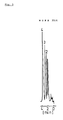
- polymer beads obtained according to the invention (MOPS 33/4; polystyrene / 40% divinylbenzene; obtained according to Example 16) were used as the stationary phase in HPLC chromatography.
- two commercial products were used as the stationary phase, namely ACT-1 (commercial product from Interaction; polystyrene, modified with C18-alkyl) and PRP (commercial polystyrene reverse phase).
- the phases were used under the following conditions:
- the detection was carried out at 254 nm in all cases.
- FIGS. 1 and 2 The chromatograms obtained are shown in FIGS. 1 and 2. It can be seen that the phases according to the invention (see FIG. 1) have a significantly higher separation efficiency, since they give good separation despite a considerably shorter column. In addition, the peak symmetry is significantly improved when using the phases according to the invention, while the phases of the prior art show a pronounced tailing.
Landscapes
- Chemical & Material Sciences (AREA)
- Organic Chemistry (AREA)
- Health & Medical Sciences (AREA)
- Zoology (AREA)
- Life Sciences & Earth Sciences (AREA)
- Engineering & Computer Science (AREA)
- Bioinformatics & Cheminformatics (AREA)
- Genetics & Genomics (AREA)
- Wood Science & Technology (AREA)
- Biotechnology (AREA)
- Microbiology (AREA)
- Biochemistry (AREA)
- General Engineering & Computer Science (AREA)
- General Health & Medical Sciences (AREA)
- Biomedical Technology (AREA)
- Chemical Kinetics & Catalysis (AREA)
- Analytical Chemistry (AREA)
- Medicinal Chemistry (AREA)
- Polymers & Plastics (AREA)
- Addition Polymer Or Copolymer, Post-Treatments, Or Chemical Modifications (AREA)
- Polymerisation Methods In General (AREA)
- Processes Of Treating Macromolecular Substances (AREA)
- Peptides Or Proteins (AREA)
Applications Claiming Priority (2)
| Application Number | Priority Date | Filing Date | Title |
|---|---|---|---|
| DE19873714258 DE3714258A1 (de) | 1987-04-29 | 1987-04-29 | Verfahren zur darstellung monodisperser, vernetzter polymerkuegelchen |
| DE3714258 | 1987-04-29 |
Publications (3)
| Publication Number | Publication Date |
|---|---|
| EP0289029A2 true EP0289029A2 (fr) | 1988-11-02 |
| EP0289029A3 EP0289029A3 (fr) | 1991-04-24 |
| EP0289029B1 EP0289029B1 (fr) | 1996-07-10 |
Family
ID=6326503
Family Applications (1)
| Application Number | Title | Priority Date | Filing Date |
|---|---|---|---|
| EP88106853A Expired - Lifetime EP0289029B1 (fr) | 1987-04-29 | 1988-04-28 | Procédé de préparation de particules de polymères monodispersées |
Country Status (5)
| Country | Link |
|---|---|
| EP (1) | EP0289029B1 (fr) |
| JP (1) | JPS6479201A (fr) |
| AT (1) | ATE140239T1 (fr) |
| CA (1) | CA1325310C (fr) |
| DE (2) | DE3714258A1 (fr) |
Cited By (5)
| Publication number | Priority date | Publication date | Assignee | Title |
|---|---|---|---|---|
| EP0334126A3 (fr) * | 1988-03-21 | 1991-03-13 | EASTMAN KODAK COMPANY (a New Jersey corporation) | Particules polymériques, préparation par un procédé en suspension à stabilisation colloidale, particules de toner encapsulées les contenant. |
| WO1993012167A1 (fr) * | 1991-12-19 | 1993-06-24 | The Dow Chemical Company | Copolymeres poreux germes et resines echangeuses d'ions prepares a partir de ces copolymeres |
| US5391667A (en) * | 1993-03-04 | 1995-02-21 | Isis Pharmaceuticals | Copolymers of N-vinyl-lactams suitable for oligomer solid phase synthesis |
| WO1998037108A1 (fr) * | 1997-02-19 | 1998-08-27 | Buna Sow Leuna Olefinverbund Gmbh | Proceed et catalyseur pour preparer des polyolefines de poids moleculaire moyen a ultra eleve |
| WO2006029023A3 (fr) * | 2004-09-02 | 2006-06-01 | Isis Pharmaceuticals Inc | Billes polymeres pour synthese d'oligomeres |
-
1987
- 1987-04-29 DE DE19873714258 patent/DE3714258A1/de not_active Withdrawn
-
1988
- 1988-04-25 JP JP63102341A patent/JPS6479201A/ja active Pending
- 1988-04-28 CA CA000565319A patent/CA1325310C/fr not_active Expired - Lifetime
- 1988-04-28 DE DE3855409T patent/DE3855409D1/de not_active Expired - Lifetime
- 1988-04-28 EP EP88106853A patent/EP0289029B1/fr not_active Expired - Lifetime
- 1988-04-28 AT AT88106853T patent/ATE140239T1/de not_active IP Right Cessation
Cited By (6)
| Publication number | Priority date | Publication date | Assignee | Title |
|---|---|---|---|---|
| EP0334126A3 (fr) * | 1988-03-21 | 1991-03-13 | EASTMAN KODAK COMPANY (a New Jersey corporation) | Particules polymériques, préparation par un procédé en suspension à stabilisation colloidale, particules de toner encapsulées les contenant. |
| WO1993012167A1 (fr) * | 1991-12-19 | 1993-06-24 | The Dow Chemical Company | Copolymeres poreux germes et resines echangeuses d'ions prepares a partir de ces copolymeres |
| US5391667A (en) * | 1993-03-04 | 1995-02-21 | Isis Pharmaceuticals | Copolymers of N-vinyl-lactams suitable for oligomer solid phase synthesis |
| WO1998037108A1 (fr) * | 1997-02-19 | 1998-08-27 | Buna Sow Leuna Olefinverbund Gmbh | Proceed et catalyseur pour preparer des polyolefines de poids moleculaire moyen a ultra eleve |
| WO2006029023A3 (fr) * | 2004-09-02 | 2006-06-01 | Isis Pharmaceuticals Inc | Billes polymeres pour synthese d'oligomeres |
| US7700706B2 (en) | 2004-09-02 | 2010-04-20 | Isis Pharmaceuticals, Inc. | Polymeric beads for oligomer synthesis |
Also Published As
| Publication number | Publication date |
|---|---|
| CA1325310C (fr) | 1993-12-14 |
| EP0289029B1 (fr) | 1996-07-10 |
| DE3855409D1 (de) | 1996-08-14 |
| JPS6479201A (en) | 1989-03-24 |
| ATE140239T1 (de) | 1996-07-15 |
| EP0289029A3 (fr) | 1991-04-24 |
| DE3714258A1 (de) | 1988-11-10 |
Similar Documents
| Publication | Publication Date | Title |
|---|---|---|
| US5292814A (en) | Process for the preparation of monodispersed polymer beads | |
| DE69027803T2 (de) | Polymerträger | |
| DE69303602T2 (de) | Herstellung von oberflächenfunktionalisierten polymer-teilchen | |
| DE69118418T2 (de) | Verfahren zur Herstellung von Olefin-Pfropfcopolymeren | |
| DE3888564T2 (de) | Verfahren zur Herstellung von vernetzten Polymerteilchen. | |
| AT398973B (de) | Verfahren zur trennung von nukleinsäuren | |
| DE68916048T2 (de) | Verfahren zur Herstellung von monodispersen Polymerteilchen mit erhöhter Teilchengrösse. | |
| DE69616606T2 (de) | Polymerstabilisation durch einen stabilen freien Radikal | |
| US4948739A (en) | Compact polymer/metal composite particles, aqueous dispersions thereof, preparation and use in biological applications | |
| DE60124686T2 (de) | Verfahren zur herstellung von oberflächenfunktionalisierten polymerteilchen | |
| DE60025475T2 (de) | Herstellung von polymerteilchen | |
| EP1910433A1 (fr) | Polymere reticule hydrophile | |
| EP0448391A2 (fr) | Procédé pour la fabrication de particules polymériques à taille uniforme contrôlée | |
| WO1997008231A1 (fr) | Procede de production en continu de perles expansibles en polymeres de styrene | |
| DE3236776A1 (de) | Substrat fuer die fluessigkeits-chromatographie und verfahren zur reinigung einer fettloeslichen substanz unter dessen verwendung | |
| DE69828426T2 (de) | Verfahren zur herstellung von polymerteilchen | |
| EP0289029B1 (fr) | Procédé de préparation de particules de polymères monodispersées | |
| DE2400517B2 (de) | Thermoplastische Formmassen | |
| DE2162508A1 (de) | Verfahren zur Herstellung vernetzter poröser Mischpolymerisate | |
| DE10061544A1 (de) | Weiche, momodisperse, kugelförmige Perlpolymerisate | |
| DE3147130A1 (de) | Verfahren zur reinigung und abtrennung von vitamin b12 | |
| WO2005075078A2 (fr) | Procede de fabrication de polymerisats en perles monodisperses contenant des acryliques | |
| DE2215604A1 (de) | Pfropfpolymerisate | |
| DE69012159T2 (de) | Verfahren zur Herstellung von stabilen interpenetrierenden Polymermischungen mit einer Phase von vinylaromatischem Polymer und einer anderen Phase von alkylenischem Polymer. | |
| DE10105289A1 (de) | Poröser polymerer Formkörper |
Legal Events
| Date | Code | Title | Description |
|---|---|---|---|
| PUAI | Public reference made under article 153(3) epc to a published international application that has entered the european phase |
Free format text: ORIGINAL CODE: 0009012 |
|
| AK | Designated contracting states |
Kind code of ref document: A2 Designated state(s): AT BE CH DE ES FR GB GR IT LI LU NL SE |
|
| RBV | Designated contracting states (corrected) |
Designated state(s): AT BE CH DE FR GB IT LI NL SE |
|
| PUAL | Search report despatched |
Free format text: ORIGINAL CODE: 0009013 |
|
| AK | Designated contracting states |
Kind code of ref document: A3 Designated state(s): AT BE CH DE ES FR GB GR IT LI LU NL SE |
|
| 17P | Request for examination filed |
Effective date: 19910821 |
|
| 17Q | First examination report despatched |
Effective date: 19921021 |
|
| GRAH | Despatch of communication of intention to grant a patent |
Free format text: ORIGINAL CODE: EPIDOS IGRA |
|
| GRAA | (expected) grant |
Free format text: ORIGINAL CODE: 0009210 |
|
| AK | Designated contracting states |
Kind code of ref document: B1 Designated state(s): AT BE CH DE FR GB IT LI NL SE |
|
| PG25 | Lapsed in a contracting state [announced via postgrant information from national office to epo] |
Ref country code: NL Free format text: LAPSE BECAUSE OF FAILURE TO SUBMIT A TRANSLATION OF THE DESCRIPTION OR TO PAY THE FEE WITHIN THE PRESCRIBED TIME-LIMIT Effective date: 19960710 Ref country code: IT Free format text: LAPSE BECAUSE OF FAILURE TO SUBMIT A TRANSLATION OF THE DESCRIPTION OR TO PAY THE FEE WITHIN THE PRESCRIBED TIME-LIMIT;WARNING: LAPSES OF ITALIAN PATENTS WITH EFFECTIVE DATE BEFORE 2007 MAY HAVE OCCURRED AT ANY TIME BEFORE 2007. THE CORRECT EFFECTIVE DATE MAY BE DIFFERENT FROM THE ONE RECORDED. Effective date: 19960710 |
|
| REF | Corresponds to: |
Ref document number: 140239 Country of ref document: AT Date of ref document: 19960715 Kind code of ref document: T |
|
| REG | Reference to a national code |
Ref country code: CH Ref legal event code: NV Representative=s name: BOVARD AG PATENTANWAELTE |
|
| REF | Corresponds to: |
Ref document number: 3855409 Country of ref document: DE Date of ref document: 19960814 |
|
| ET | Fr: translation filed | ||
| GBT | Gb: translation of ep patent filed (gb section 77(6)(a)/1977) |
Effective date: 19961010 |
|
| NLV1 | Nl: lapsed or annulled due to failure to fulfill the requirements of art. 29p and 29m of the patents act | ||
| PG25 | Lapsed in a contracting state [announced via postgrant information from national office to epo] |
Ref country code: BE Effective date: 19970430 |
|
| PLBE | No opposition filed within time limit |
Free format text: ORIGINAL CODE: 0009261 |
|
| STAA | Information on the status of an ep patent application or granted ep patent |
Free format text: STATUS: NO OPPOSITION FILED WITHIN TIME LIMIT |
|
| 26N | No opposition filed | ||
| REG | Reference to a national code |
Ref country code: CH Ref legal event code: PUE Owner name: BAYER, ERNST, PROF. DR. TRANSFER- DR. WOLFGANG RAP |
|
| REG | Reference to a national code |
Ref country code: FR Ref legal event code: TP |
|
| REG | Reference to a national code |
Ref country code: GB Ref legal event code: 732E |
|
| REG | Reference to a national code |
Ref country code: GB Ref legal event code: IF02 |
|
| PGFP | Annual fee paid to national office [announced via postgrant information from national office to epo] |
Ref country code: SE Payment date: 20070404 Year of fee payment: 20 |
|
| PGFP | Annual fee paid to national office [announced via postgrant information from national office to epo] |
Ref country code: AT Payment date: 20070412 Year of fee payment: 20 |
|
| PGFP | Annual fee paid to national office [announced via postgrant information from national office to epo] |
Ref country code: DE Payment date: 20070426 Year of fee payment: 20 |
|
| PGFP | Annual fee paid to national office [announced via postgrant information from national office to epo] |
Ref country code: CH Payment date: 20070427 Year of fee payment: 20 |
|
| PGFP | Annual fee paid to national office [announced via postgrant information from national office to epo] |
Ref country code: GB Payment date: 20070425 Year of fee payment: 20 |
|
| PGFP | Annual fee paid to national office [announced via postgrant information from national office to epo] |
Ref country code: FR Payment date: 20070411 Year of fee payment: 20 |
|
| REG | Reference to a national code |
Ref country code: GB Ref legal event code: PE20 Expiry date: 20080427 |
|
| REG | Reference to a national code |
Ref country code: CH Ref legal event code: PL |
|
| EUG | Se: european patent has lapsed | ||
| PG25 | Lapsed in a contracting state [announced via postgrant information from national office to epo] |
Ref country code: GB Free format text: LAPSE BECAUSE OF EXPIRATION OF PROTECTION Effective date: 20080427 |