EP0289626A1 - Systeme de commande de position - Google Patents
Systeme de commande de position Download PDFInfo
- Publication number
- EP0289626A1 EP0289626A1 EP87907523A EP87907523A EP0289626A1 EP 0289626 A1 EP0289626 A1 EP 0289626A1 EP 87907523 A EP87907523 A EP 87907523A EP 87907523 A EP87907523 A EP 87907523A EP 0289626 A1 EP0289626 A1 EP 0289626A1
- Authority
- EP
- European Patent Office
- Prior art keywords
- command
- speed
- speed deviation
- integrating means
- torque
- Prior art date
- Legal status (The legal status is an assumption and is not a legal conclusion. Google has not performed a legal analysis and makes no representation as to the accuracy of the status listed.)
- Withdrawn
Links
Images


Classifications
-
- G—PHYSICS
- G05—CONTROLLING; REGULATING
- G05D—SYSTEMS FOR CONTROLLING OR REGULATING NON-ELECTRIC VARIABLES
- G05D3/00—Control of position or direction
- G05D3/12—Control of position or direction using feedback
-
- G—PHYSICS
- G05—CONTROLLING; REGULATING
- G05B—CONTROL OR REGULATING SYSTEMS IN GENERAL; FUNCTIONAL ELEMENTS OF SUCH SYSTEMS; MONITORING OR TESTING ARRANGEMENTS FOR SUCH SYSTEMS OR ELEMENTS
- G05B19/00—Program-control systems
- G05B19/02—Program-control systems electric
- G05B19/18—Numerical control [NC], i.e. automatically operating machines, in particular machine tools, e.g. in a manufacturing environment, so as to execute positioning, movement or co-ordinated operations by means of program data in numerical form
- G05B19/19—Numerical control [NC], i.e. automatically operating machines, in particular machine tools, e.g. in a manufacturing environment, so as to execute positioning, movement or co-ordinated operations by means of program data in numerical form characterised by positioning or contouring control systems, e.g. to control position from one programmed point to another or to control movement along a programmed continuous path
-
- H—ELECTRICITY
- H02—GENERATION; CONVERSION OR DISTRIBUTION OF ELECTRIC POWER
- H02P—CONTROL OR REGULATION OF ELECTRIC MOTORS, ELECTRIC GENERATORS OR DYNAMO-ELECTRIC CONVERTERS; CONTROLLING TRANSFORMERS, REACTORS OR CHOKE COILS
- H02P23/00—Arrangements or methods for the control of AC motors characterised by a control method other than vector control
- H02P23/16—Controlling the angular speed of one shaft
-
- G—PHYSICS
- G05—CONTROLLING; REGULATING
- G05B—CONTROL OR REGULATING SYSTEMS IN GENERAL; FUNCTIONAL ELEMENTS OF SUCH SYSTEMS; MONITORING OR TESTING ARRANGEMENTS FOR SUCH SYSTEMS OR ELEMENTS
- G05B2219/00—Program-control systems
- G05B2219/30—Nc systems
- G05B2219/41—Servomotor, servo controller till figures
- G05B2219/41029—Adjust gain as function of position error and position
-
- G—PHYSICS
- G05—CONTROLLING; REGULATING
- G05B—CONTROL OR REGULATING SYSTEMS IN GENERAL; FUNCTIONAL ELEMENTS OF SUCH SYSTEMS; MONITORING OR TESTING ARRANGEMENTS FOR SUCH SYSTEMS OR ELEMENTS
- G05B2219/00—Program-control systems
- G05B2219/30—Nc systems
- G05B2219/41—Servomotor, servo controller till figures
- G05B2219/41156—Injection of vibration anti-stick, against static friction, dither, stiction
-
- G—PHYSICS
- G05—CONTROLLING; REGULATING
- G05B—CONTROL OR REGULATING SYSTEMS IN GENERAL; FUNCTIONAL ELEMENTS OF SUCH SYSTEMS; MONITORING OR TESTING ARRANGEMENTS FOR SUCH SYSTEMS OR ELEMENTS
- G05B2219/00—Program-control systems
- G05B2219/30—Nc systems
- G05B2219/41—Servomotor, servo controller till figures
- G05B2219/41424—Select a controller as function of large or small error
-
- G—PHYSICS
- G05—CONTROLLING; REGULATING
- G05B—CONTROL OR REGULATING SYSTEMS IN GENERAL; FUNCTIONAL ELEMENTS OF SUCH SYSTEMS; MONITORING OR TESTING ARRANGEMENTS FOR SUCH SYSTEMS OR ELEMENTS
- G05B2219/00—Program-control systems
- G05B2219/30—Nc systems
- G05B2219/42—Servomotor, servo controller kind till VSS
- G05B2219/42093—Position and current, torque control loop
Definitions
- the present invention relates to a position control system for a servomotor or the like, and more particularly to a position control system for precisely controlling fine positioning operation without lowering a speed gain.
- Positioning operation in a numerical control apparatus or the like requires that a movable member be precisely responsive to a fine positioning command.
- a control system for a servomotor to effect such positioning operation is illustrated in FIG. 5.
- Denoted at 11 is an arithmetic unit for adding a position command 2 1 and subtracting a position feedback signal 22.
- a converter 12 with a position gain K converts a position command issued from the arithmetic unit 11 to a speed command (u(s)) 23.
- An arithmetic unit 13 issues a signal indicating the difference between the speed command 23 and a speed feedback signal.
- An integrator 14 with an integration constant kl integrates the speed command.
- Designated at 15 is an arithmetic unit for issuing a signal representing the difference between a torque command from the integrator 1 4 and a torque feedback command which is produced by multiplying a speed feedback signal 24 by a proportional gain.
- a current control circuit 16 issues a current dependent on the torque command.
- the reference numeral 17 represents a servomotor.
- Kt indicates a torque constant
- Jm the inertia of the servomotor
- 24 a speed output from the servomotor
- 25 a position output from the servomotor.
- the speed output 24 is fed back directly to the arithmetic unit 13 and also fed back to the arithmetic unit 11 after being multiplied by a proportional gain k2.
- the position output 25 of the servomotor is fed back to the arithmetic unit 11.
- FIG. 6 Operation of the servo system thus constructed is shown in FIG. 6.
- the graph of FIG. 6 has a horizontal axis indicating a movement command in a unit of 1 ⁇ m and a vertical axis representing actual movement of a mechanical movable member in a unit of 1 ⁇ m.
- a mechanical movable member would move precisely 1 ⁇ m each time a command for 1 ⁇ m is applied, as indicated by the straight line M1.
- a mechanical movable member moves 0.2 ⁇ m at a time in response to a command for 1 ⁇ m and moves 1.8 ⁇ m at a time in response to a command for 1 ⁇ m, for example, and hence does not move in exact response to applied commands, thus resulting in a so-called stick/slip phenomenon.
- This phenomenon is responsible for a reduction in the accuracy of actual operation of the mechanical movable member and for a poor finishing surface.
- FIG. 7 shows the torque command illustrated in F IG. 5.
- the graph of FIG. 7 has a horizontal axis indicative of time (t) and a vertical axis of torque (T).
- t time
- T vertical axis of torque
- the integration constant k1 of the integrator 14 shown in FIG. 5 may be made small to cause the torque to increase along a curve C2 as shown in FIG. 7, so that the torque increases more gradually.
- a solution is still problematic in that when the position command is large, the response of the entire system is slow.
- a position control system having a speed control loop for generating a torque command signal for a motor from the speed deviation between a speed command and an actual speed, said position control system comprising:
- the torque curve varies according to the command value.
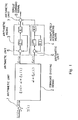
- FIG. 1 is a block diagram of an embodiment according to the present invention. Since digital processing is carried out in this embodiment, the block diagram is shown as a discrete system.
- FIG. 1 corresponds to the integrator 14 shown in FIG. 5 (which is indicated by A in FIG. 5).
- the integrator 14 of FIG. 5 may be expressed as a discrete system as shown in FIG. 2.
- Denoted at 1 in FIG. 1 is an arithmetic unit for calculating and issuing the difference between a speed command u(i) from a converter (not shown) and a speed feedback signal Y(-i) from a servomotor.
- a command dividing means 2 serves to divide a difference output signal ⁇ (i) from the arithmetic unit 1 into:
- An output signal from the command dividing means 2 is applied to an integrating means 3 and an incompletely integrating means 4.
- the remaining amount ⁇ 1 (i) is generated when the command value is large, and is subjected to conventional integration.
- the integrating means 3 comprises an arithmetic unit 5, a Z function Z -1 , and a gain kl, and has the same function as that of the integrator 14 shown in FIG. 5. Since the integrating means 3 actually processes the signal as a discrete system, it effects the same processing as that of the block A in FIG . 2. Therefore, when the command value is large, the processing is the same as the conventional process.
- the gain kl is of the same value as that shown in FIG. 5.
- the minute amount ⁇ 2 (i) is applied to the incompletely integrating means 4.
- the incompletely integrating means 4 is composed of an arithmetic unit 6, a Z function Z - 1 , a gain k2, and a feedback gain k3 for the Z function Z- 1 .
- the output from the integrating means 3 is held even if a position feed signal is fed back to reduce a speed deviation signal to zero, whereas the output of the incompletely integrating means 4 is exponentially reduced when the speed deviation signal is reduced to zero.
- the output signal from the integrating means 3 and the output signal from the incompletely integrating means 4 are added by an arithmetic unit 7 , which issues the sum as a torque command signal.
- the speed deviation signal is divided by the signal dividing means 2 and processed by the incompletely integrating means 4. Therefore, when the speed deviation signal is fed back to eliminate or reduce the speed deviation, the torque command signal is reduced, and excessive movement of the servomotor is suppressed, so that the accuracy of actual movement with respect to the minute command is increased.
- the position command is large, the remaining amount of the speed deviation is large and processed by the conventional integrating means 3 without lowering a speed gain.
- FIG. 3 shows a flowchart of processing operation of the command dividing means 2.
- This step determines whether or not the absolute value
- the speed deviation input ⁇ (i) is issued as it is as a minute amount ⁇ 2 (i).
- the speed deviation is larger than a minute amount, and it is first determined whether the speed deviation is positive or negative, because the speed deviation is either positive or negative dependent on whether the position command is positive or negative. If the speed deviation e(i) is positive, then control proceeds to a step 4 (S 4 ), and if the speed deviation ⁇ (i) is negative, then control goes to a step 5 (S5).
- the speed deviation ⁇ (i) can thus be divided into a minute amount and a remaining amount by the above steps.
- the hardware of the present embodiment can easily be implemented by a known microcomputer.
- FIG. 4 Results of an experiment conducted on the present embodiment are shown in FIG. 4, which is similar to FIG. 6.
- the straight line M1 represents ideal movement of a mechanical movable member
- the polygonal line M3 indicates movement of the mechanical movable member controlled by the embodiment of the present invention.
- Comparison between the polygonal line M3 and the polygonal line M2 shown in FIG. 6 indicates that movement of the mechanical movable member according to the present invention is improved.
- the speed deviation is divided into a minute amount and a remaining amount as defined in advance, and the minute amount is incompletely integrated whereas the remaining amount is integrated.
- the amounts thus integrated are added, and the sum is used as a torque command signal. Therefore, positioning control can be effected without reducing a speed gain in response to a large position command, and precise movement can be achieved in response to a minute position command.
Landscapes
- Engineering & Computer Science (AREA)
- Physics & Mathematics (AREA)
- General Physics & Mathematics (AREA)
- Automation & Control Theory (AREA)
- Human Computer Interaction (AREA)
- Manufacturing & Machinery (AREA)
- Power Engineering (AREA)
- Control Of Position Or Direction (AREA)
- Control Of Electric Motors In General (AREA)
Abstract
Système de commande de position possédant une boucle de commande de vitesse qui trouve un écart de vitesse entre une vitesse commandée et la vitesse réelle et produit un signal de commande de couple du moteur à partir de la valeur de l'écart de vitesse. Le système possède un organe diviseur de commande (2) qui divise l'écart de vitesse (epsilon(i)) en une quantité très faible prédéterminée (epsilonz(i) = alpha) et une quantité résiduelle (epsilonl(i) = epsilon(i) - alpha), un organe intégrateur (3) qui reçoit et intègre la quantité résiduelle (epsilonl(i)), et un organe d'intégration incomplète (4) qui reçoit et intègre de manière incomplète la quantité très faible (epsilonz(i)). La somme des signaux de sortie de l'organe intégrateur (3) et de l'organe d'intégration incomplète (4) est utilisée comme signal de commande de couple.
Applications Claiming Priority (2)
| Application Number | Priority Date | Filing Date | Title |
|---|---|---|---|
| JP61269445A JPS63123107A (ja) | 1986-11-12 | 1986-11-12 | 位置制御方式 |
| JP269445/86 | 1986-11-12 |
Publications (2)
| Publication Number | Publication Date |
|---|---|
| EP0289626A1 true EP0289626A1 (fr) | 1988-11-09 |
| EP0289626A4 EP0289626A4 (fr) | 1990-04-10 |
Family
ID=17472532
Family Applications (1)
| Application Number | Title | Priority Date | Filing Date |
|---|---|---|---|
| EP19870907523 Withdrawn EP0289626A4 (fr) | 1986-11-12 | 1987-11-11 | Systeme de commande de position. |
Country Status (5)
| Country | Link |
|---|---|
| US (1) | US4887015A (fr) |
| EP (1) | EP0289626A4 (fr) |
| JP (1) | JPS63123107A (fr) |
| KR (1) | KR910006498B1 (fr) |
| WO (1) | WO1988003678A1 (fr) |
Cited By (4)
| Publication number | Priority date | Publication date | Assignee | Title |
|---|---|---|---|---|
| FR2642866A1 (fr) * | 1989-01-11 | 1990-08-10 | Inst Mash Im | Procede de commande d'un bras mecanique a resonance |
| WO1991005297A1 (fr) * | 1989-09-26 | 1991-04-18 | Robert Bosch Gmbh | Procede de regulation d'un systeme de reglage sujet a la friction |
| DE4411390A1 (de) * | 1993-04-01 | 1994-10-06 | Mitsubishi Electric Corp | Positionsbefehlsverfahren und -vorrichtung für ein gesteuertes Objekt |
| US5694016A (en) * | 1989-09-26 | 1997-12-02 | Robert Bosch Gmbh | Method for controlling a servo system having friction |
Families Citing this family (12)
| Publication number | Priority date | Publication date | Assignee | Title |
|---|---|---|---|---|
| JPH02297602A (ja) * | 1989-05-12 | 1990-12-10 | Fanuc Ltd | 非線形項補償を含むスライディングモード制御方式 |
| JP2566665B2 (ja) * | 1990-06-27 | 1996-12-25 | 川崎重工業株式会社 | 慣性系におけるロボットの制御装置 |
| JP3230831B2 (ja) * | 1992-01-28 | 2001-11-19 | オークマ株式会社 | モータ駆動制御装置 |
| JP2833730B2 (ja) * | 1993-03-10 | 1998-12-09 | 三菱電機株式会社 | 位置制御装置 |
| JP3285681B2 (ja) * | 1993-04-28 | 2002-05-27 | ファナック株式会社 | サーボモータの制御方法 |
| JP3129173B2 (ja) * | 1995-11-20 | 2001-01-29 | 富士電機株式会社 | 交流電動機の制御装置 |
| JP3628119B2 (ja) * | 1996-07-24 | 2005-03-09 | ファナック株式会社 | サーボモータの制御方法 |
| WO2000070739A1 (fr) * | 1999-05-14 | 2000-11-23 | Mitsubishi Denki Kabushiki Kaisha | Servocommande |
| JP4459674B2 (ja) * | 2004-03-23 | 2010-04-28 | 本田技研工業株式会社 | 変調アルゴリズムを用いたプラントの制御装置 |
| DE102004016733B4 (de) * | 2004-04-05 | 2006-06-08 | Siemens Ag | Motorregelungsvorrichtung und entsprechendes Regelungsverfahren |
| JP4397868B2 (ja) * | 2005-09-13 | 2010-01-13 | 本田技研工業株式会社 | Pwmアルゴリズムを用いたプラントの制御装置 |
| US8775003B2 (en) * | 2012-11-28 | 2014-07-08 | GM Global Technology Operations LLC | Methods and systems for controlling a proportional integrator |
Family Cites Families (4)
| Publication number | Priority date | Publication date | Assignee | Title |
|---|---|---|---|---|
| US3958109A (en) * | 1975-01-20 | 1976-05-18 | The United States Of America As Represented By The Secretary Of The Navy | Universal modularized digital controller |
| JPS55160871A (en) * | 1979-04-27 | 1980-12-15 | Nissan Motor Co Ltd | Ground speed radar for vehicle equipped with radio wave interference avoiding apparatus |
| JPS59191621A (ja) * | 1983-04-15 | 1984-10-30 | Mitsubishi Electric Corp | サ−ボ装置 |
| JP2638594B2 (ja) * | 1986-11-08 | 1997-08-06 | フアナツク株式会社 | デイジタルサーボシステム |
-
1986
- 1986-11-12 JP JP61269445A patent/JPS63123107A/ja active Pending
-
1987
- 1987-11-11 WO PCT/JP1987/000875 patent/WO1988003678A1/fr not_active Ceased
- 1987-11-11 EP EP19870907523 patent/EP0289626A4/fr not_active Withdrawn
- 1987-11-11 US US07/221,243 patent/US4887015A/en not_active Expired - Fee Related
- 1987-11-11 KR KR1019880700811A patent/KR910006498B1/ko not_active Expired
Cited By (5)
| Publication number | Priority date | Publication date | Assignee | Title |
|---|---|---|---|---|
| FR2642866A1 (fr) * | 1989-01-11 | 1990-08-10 | Inst Mash Im | Procede de commande d'un bras mecanique a resonance |
| WO1991005297A1 (fr) * | 1989-09-26 | 1991-04-18 | Robert Bosch Gmbh | Procede de regulation d'un systeme de reglage sujet a la friction |
| US5694016A (en) * | 1989-09-26 | 1997-12-02 | Robert Bosch Gmbh | Method for controlling a servo system having friction |
| DE4411390A1 (de) * | 1993-04-01 | 1994-10-06 | Mitsubishi Electric Corp | Positionsbefehlsverfahren und -vorrichtung für ein gesteuertes Objekt |
| DE4411390C2 (de) * | 1993-04-01 | 2003-06-18 | Mitsubishi Electric Corp | Positionierverfahren und -vorrichtung für ein zu steuerndes Objekt |
Also Published As
| Publication number | Publication date |
|---|---|
| KR910006498B1 (ko) | 1991-08-27 |
| KR890700240A (ko) | 1989-03-10 |
| JPS63123107A (ja) | 1988-05-26 |
| US4887015A (en) | 1989-12-12 |
| WO1988003678A1 (fr) | 1988-05-19 |
| EP0289626A4 (fr) | 1990-04-10 |
Similar Documents
| Publication | Publication Date | Title |
|---|---|---|
| EP0289626A1 (fr) | Systeme de commande de position | |
| EP0362801B1 (fr) | Dispositif de régulation numérique | |
| EP0384437B1 (fr) | Procédé et dispositif pour changer les paramètres de régulation en fonction de l'état du processus dans le domaine de la commande de processus | |
| JP3129622B2 (ja) | フルクローズド・ループ方式における象限突起補正方法 | |
| EP0089156B1 (fr) | Méthode et dispositif pour la commande de l'accélération et de la décélération | |
| US4330832A (en) | Cutter feed rate control system | |
| EP0396749B1 (fr) | Systeme de commande d'un servomoteur | |
| US4609988A (en) | Automatic prediction and capture of a preselected altitude for aircraft | |
| US7190140B2 (en) | Sliding mode controller position control device | |
| KR970003827B1 (ko) | 외란추정 업저어버를 사용한 제로잉 방법 | |
| US4701686A (en) | Line tracking control method | |
| US3700379A (en) | Motor drive position movement profile calibration | |
| EP0444541B1 (fr) | Méthode et appareillage pour la transition sans secousses d'une commande de vitesse par rapport à l'air à une commande de nombre de Mach d'un avion | |
| EP0566747A1 (fr) | Procede pour commander des servomoteurs | |
| US6122998A (en) | Force control method for a bar feeder of a lathe | |
| EP0428742A1 (fr) | Procede de commande de mode de glissement | |
| KR0160997B1 (ko) | 로보트위치제어장치에서의 써보의 웜업드리프트 보상방법 | |
| EP0604663A1 (fr) | Procede d'estimation d'une inertie et d'un couple perturbateur et procede de detection d'une charge anormale | |
| GB2095868A (en) | Dual response aircraft reference synchronization | |
| JP2770184B2 (ja) | 放電加工機の制御装置 | |
| JP3285069B2 (ja) | 張力制御方法 | |
| JPS62150409A (ja) | デジタルサ−ボ制御における速度制御方法 | |
| JP2682060B2 (ja) | コントローラ、及びコントローラの出力範囲の決定方法 | |
| JPH0229420B2 (ja) | Renchukiniokeruigatanaiyumenreberuseigyohoho | |
| JPS6426902A (en) | Pid controller |
Legal Events
| Date | Code | Title | Description |
|---|---|---|---|
| PUAI | Public reference made under article 153(3) epc to a published international application that has entered the european phase |
Free format text: ORIGINAL CODE: 0009012 |
|
| 17P | Request for examination filed |
Effective date: 19880728 |
|
| AK | Designated contracting states |
Kind code of ref document: A1 Designated state(s): DE FR GB |
|
| A4 | Supplementary search report drawn up and despatched |
Effective date: 19900410 |
|
| RHK1 | Main classification (correction) |
Ipc: G05B 19/19 |
|
| 17Q | First examination report despatched |
Effective date: 19920124 |
|
| STAA | Information on the status of an ep patent application or granted ep patent |
Free format text: STATUS: THE APPLICATION IS DEEMED TO BE WITHDRAWN |
|
| 18D | Application deemed to be withdrawn |
Effective date: 19920604 |