EP0289904B1 - Procédé de production de peroxyde d'hydrogène par photoréduction chimique d'oxygène, et peroxyde d'hydrogène obtenu par ce procédé - Google Patents
Procédé de production de peroxyde d'hydrogène par photoréduction chimique d'oxygène, et peroxyde d'hydrogène obtenu par ce procédé Download PDFInfo
- Publication number
- EP0289904B1 EP0289904B1 EP88106610A EP88106610A EP0289904B1 EP 0289904 B1 EP0289904 B1 EP 0289904B1 EP 88106610 A EP88106610 A EP 88106610A EP 88106610 A EP88106610 A EP 88106610A EP 0289904 B1 EP0289904 B1 EP 0289904B1
- Authority
- EP
- European Patent Office
- Prior art keywords
- process according
- hydrogen peroxide
- oxygen
- reaction medium
- complex
- Prior art date
- Legal status (The legal status is an assumption and is not a legal conclusion. Google has not performed a legal analysis and makes no representation as to the accuracy of the status listed.)
- Expired - Lifetime
Links
- 238000000034 method Methods 0.000 title claims abstract description 21
- 230000008569 process Effects 0.000 title claims abstract description 15
- 238000007540 photo-reduction reaction Methods 0.000 title claims abstract description 5
- 239000001301 oxygen Substances 0.000 title claims description 15
- 229910052760 oxygen Inorganic materials 0.000 title claims description 15
- QVGXLLKOCUKJST-UHFFFAOYSA-N atomic oxygen Chemical compound [O] QVGXLLKOCUKJST-UHFFFAOYSA-N 0.000 title claims 2
- MHAJPDPJQMAIIY-UHFFFAOYSA-N Hydrogen peroxide Chemical compound OO MHAJPDPJQMAIIY-UHFFFAOYSA-N 0.000 title abstract description 35
- 239000000126 substance Substances 0.000 title description 3
- MYMOFIZGZYHOMD-UHFFFAOYSA-N Dioxygen Chemical compound O=O MYMOFIZGZYHOMD-UHFFFAOYSA-N 0.000 claims abstract description 28
- DUIOPKIIICUYRZ-UHFFFAOYSA-N semicarbazide Chemical compound NNC(N)=O DUIOPKIIICUYRZ-UHFFFAOYSA-N 0.000 claims abstract description 22
- 239000003504 photosensitizing agent Substances 0.000 claims abstract description 16
- 239000012429 reaction media Substances 0.000 claims abstract description 14
- 229910001882 dioxygen Inorganic materials 0.000 claims abstract description 11
- 238000004519 manufacturing process Methods 0.000 claims abstract description 11
- HEMHJVSKTPXQMS-UHFFFAOYSA-M Sodium hydroxide Chemical compound [OH-].[Na+] HEMHJVSKTPXQMS-UHFFFAOYSA-M 0.000 claims description 25
- AZJPTIGZZTZIDR-UHFFFAOYSA-L rose bengal Chemical compound [K+].[K+].[O-]C(=O)C1=C(Cl)C(Cl)=C(Cl)C(Cl)=C1C1=C2C=C(I)C(=O)C(I)=C2OC2=C(I)C([O-])=C(I)C=C21 AZJPTIGZZTZIDR-UHFFFAOYSA-L 0.000 claims description 10
- KJTLSVCANCCWHF-UHFFFAOYSA-N Ruthenium Chemical compound [Ru] KJTLSVCANCCWHF-UHFFFAOYSA-N 0.000 claims description 5
- 230000005855 radiation Effects 0.000 claims description 5
- STRXNPAVPKGJQR-UHFFFAOYSA-N rose bengal A Natural products O1C(=O)C(C(=CC=C2Cl)Cl)=C2C21C1=CC(I)=C(O)C(I)=C1OC1=C(I)C(O)=C(I)C=C21 STRXNPAVPKGJQR-UHFFFAOYSA-N 0.000 claims description 5
- 229910052707 ruthenium Inorganic materials 0.000 claims description 5
- 239000001257 hydrogen Substances 0.000 claims description 3
- 229910052739 hydrogen Inorganic materials 0.000 claims description 3
- UQSQSQZYBQSBJZ-UHFFFAOYSA-N fluorosulfonic acid Chemical class OS(F)(=O)=O UQSQSQZYBQSBJZ-UHFFFAOYSA-N 0.000 claims description 2
- 238000005342 ion exchange Methods 0.000 claims description 2
- 239000011159 matrix material Substances 0.000 claims description 2
- 125000004435 hydrogen atom Chemical class [H]* 0.000 claims 1
- 229920000642 polymer Polymers 0.000 claims 1
- 239000012736 aqueous medium Substances 0.000 abstract description 5
- CHEANNSDVJOIBS-MHZLTWQESA-N (3s)-3-cyclopropyl-3-[3-[[3-(5,5-dimethylcyclopenten-1-yl)-4-(2-fluoro-5-methoxyphenyl)phenyl]methoxy]phenyl]propanoic acid Chemical compound COC1=CC=C(F)C(C=2C(=CC(COC=3C=C(C=CC=3)[C@@H](CC(O)=O)C3CC3)=CC=2)C=2C(CCC=2)(C)C)=C1 CHEANNSDVJOIBS-MHZLTWQESA-N 0.000 abstract 1
- ROFVEXUMMXZLPA-UHFFFAOYSA-N Bipyridyl Chemical compound N1=CC=CC=C1C1=CC=CC=N1 ROFVEXUMMXZLPA-UHFFFAOYSA-N 0.000 description 20
- 230000015572 biosynthetic process Effects 0.000 description 10
- 238000006243 chemical reaction Methods 0.000 description 10
- 239000000243 solution Substances 0.000 description 9
- 240000008254 Rosa chinensis Species 0.000 description 7
- 235000000664 Rosa chinensis Nutrition 0.000 description 7
- 230000004907 flux Effects 0.000 description 6
- 230000007246 mechanism Effects 0.000 description 6
- 239000007864 aqueous solution Substances 0.000 description 4
- 230000005540 biological transmission Effects 0.000 description 4
- 239000003638 chemical reducing agent Substances 0.000 description 4
- 239000003795 chemical substances by application Substances 0.000 description 4
- 239000007789 gas Substances 0.000 description 4
- 239000000203 mixture Substances 0.000 description 4
- 238000006552 photochemical reaction Methods 0.000 description 4
- 230000009467 reduction Effects 0.000 description 4
- 238000006722 reduction reaction Methods 0.000 description 4
- 241000894007 species Species 0.000 description 4
- IICCLYANAQEHCI-UHFFFAOYSA-N 4,5,6,7-tetrachloro-3',6'-dihydroxy-2',4',5',7'-tetraiodospiro[2-benzofuran-3,9'-xanthene]-1-one Chemical compound O1C(=O)C(C(=C(Cl)C(Cl)=C2Cl)Cl)=C2C21C1=CC(I)=C(O)C(I)=C1OC1=C(I)C(O)=C(I)C=C21 IICCLYANAQEHCI-UHFFFAOYSA-N 0.000 description 3
- VEXZGXHMUGYJMC-UHFFFAOYSA-N Hydrochloric acid Chemical compound Cl VEXZGXHMUGYJMC-UHFFFAOYSA-N 0.000 description 3
- OUUQCZGPVNCOIJ-UHFFFAOYSA-M Superoxide Chemical compound [O-][O] OUUQCZGPVNCOIJ-UHFFFAOYSA-M 0.000 description 3
- 230000008901 benefit Effects 0.000 description 3
- 239000003054 catalyst Substances 0.000 description 3
- 238000005259 measurement Methods 0.000 description 3
- 150000002978 peroxides Chemical class 0.000 description 3
- 238000010791 quenching Methods 0.000 description 3
- 230000000171 quenching effect Effects 0.000 description 3
- 239000011541 reaction mixture Substances 0.000 description 3
- 238000006479 redox reaction Methods 0.000 description 3
- 230000001052 transient effect Effects 0.000 description 3
- IJGRMHOSHXDMSA-UHFFFAOYSA-N Atomic nitrogen Chemical compound N#N IJGRMHOSHXDMSA-UHFFFAOYSA-N 0.000 description 2
- UFHFLCQGNIYNRP-UHFFFAOYSA-N Hydrogen Chemical compound [H][H] UFHFLCQGNIYNRP-UHFFFAOYSA-N 0.000 description 2
- 235000011449 Rosa Nutrition 0.000 description 2
- 238000004458 analytical method Methods 0.000 description 2
- SESFRYSPDFLNCH-UHFFFAOYSA-N benzyl benzoate Chemical compound C=1C=CC=CC=1C(=O)OCC1=CC=CC=C1 SESFRYSPDFLNCH-UHFFFAOYSA-N 0.000 description 2
- 230000005587 bubbling Effects 0.000 description 2
- 238000006555 catalytic reaction Methods 0.000 description 2
- 238000010586 diagram Methods 0.000 description 2
- 229910001873 dinitrogen Inorganic materials 0.000 description 2
- JMWHLOJMXZVRMC-UHFFFAOYSA-L disodium;4,7-dichloro-2',4',5',7'-tetraiodo-3-oxospiro[2-benzofuran-1,9'-xanthene]-3',6'-diolate Chemical compound [Na+].[Na+].O1C(=O)C(C(=CC=C2Cl)Cl)=C2C21C1=CC(I)=C([O-])C(I)=C1OC1=C(I)C([O-])=C(I)C=C21 JMWHLOJMXZVRMC-UHFFFAOYSA-L 0.000 description 2
- 239000000975 dye Substances 0.000 description 2
- 150000002211 flavins Chemical class 0.000 description 2
- 230000006870 function Effects 0.000 description 2
- 229910052736 halogen Inorganic materials 0.000 description 2
- 150000002367 halogens Chemical class 0.000 description 2
- 239000011261 inert gas Substances 0.000 description 2
- 239000007788 liquid Substances 0.000 description 2
- 239000002609 medium Substances 0.000 description 2
- 229910052751 metal Inorganic materials 0.000 description 2
- 230000001590 oxidative effect Effects 0.000 description 2
- 238000001782 photodegradation Methods 0.000 description 2
- 238000006303 photolysis reaction Methods 0.000 description 2
- 230000002165 photosensitisation Effects 0.000 description 2
- 230000015843 photosynthesis, light reaction Effects 0.000 description 2
- 229930187593 rose bengal Natural products 0.000 description 2
- 229940081623 rose bengal Drugs 0.000 description 2
- 238000001228 spectrum Methods 0.000 description 2
- 230000002123 temporal effect Effects 0.000 description 2
- 238000002834 transmittance Methods 0.000 description 2
- JRBJSXQPQWSCCF-UHFFFAOYSA-N 3,3'-Dimethoxybenzidine Chemical compound C1=C(N)C(OC)=CC(C=2C=C(OC)C(N)=CC=2)=C1 JRBJSXQPQWSCCF-UHFFFAOYSA-N 0.000 description 1
- OKTJSMMVPCPJKN-UHFFFAOYSA-N Carbon Chemical group [C] OKTJSMMVPCPJKN-UHFFFAOYSA-N 0.000 description 1
- DGAQECJNVWCQMB-PUAWFVPOSA-M Ilexoside XXIX Chemical compound C[C@@H]1CC[C@@]2(CC[C@@]3(C(=CC[C@H]4[C@]3(CC[C@@H]5[C@@]4(CC[C@@H](C5(C)C)OS(=O)(=O)[O-])C)C)[C@@H]2[C@]1(C)O)C)C(=O)O[C@H]6[C@@H]([C@H]([C@@H]([C@H](O6)CO)O)O)O.[Na+] DGAQECJNVWCQMB-PUAWFVPOSA-M 0.000 description 1
- 229920005479 Lucite® Polymers 0.000 description 1
- 229920000557 Nafion® Polymers 0.000 description 1
- AUNGANRZJHBGPY-SCRDCRAPSA-N Riboflavin Chemical compound OC[C@@H](O)[C@@H](O)[C@@H](O)CN1C=2C=C(C)C(C)=CC=2N=C2C1=NC(=O)NC2=O AUNGANRZJHBGPY-SCRDCRAPSA-N 0.000 description 1
- 239000012327 Ruthenium complex Substances 0.000 description 1
- 240000008042 Zea mays Species 0.000 description 1
- 239000012670 alkaline solution Substances 0.000 description 1
- 150000001450 anions Chemical class 0.000 description 1
- 238000013459 approach Methods 0.000 description 1
- 230000004888 barrier function Effects 0.000 description 1
- 229910052799 carbon Inorganic materials 0.000 description 1
- 230000015556 catabolic process Effects 0.000 description 1
- 150000001768 cations Chemical class 0.000 description 1
- 238000002485 combustion reaction Methods 0.000 description 1
- 238000006731 degradation reaction Methods 0.000 description 1
- 230000008034 disappearance Effects 0.000 description 1
- 238000002845 discoloration Methods 0.000 description 1
- 230000002255 enzymatic effect Effects 0.000 description 1
- 230000005284 excitation Effects 0.000 description 1
- 238000013213 extrapolation Methods 0.000 description 1
- GNBHRKFJIUUOQI-UHFFFAOYSA-N fluorescein Chemical compound O1C(=O)C2=CC=CC=C2C21C1=CC=C(O)C=C1OC1=CC(O)=CC=C21 GNBHRKFJIUUOQI-UHFFFAOYSA-N 0.000 description 1
- 239000003456 ion exchange resin Substances 0.000 description 1
- 229920003303 ion-exchange polymer Polymers 0.000 description 1
- 239000003446 ligand Substances 0.000 description 1
- 238000004020 luminiscence type Methods 0.000 description 1
- 239000000463 material Substances 0.000 description 1
- 239000002184 metal Substances 0.000 description 1
- 230000007935 neutral effect Effects 0.000 description 1
- 239000007800 oxidant agent Substances 0.000 description 1
- 230000003647 oxidation Effects 0.000 description 1
- 238000007254 oxidation reaction Methods 0.000 description 1
- 229920003023 plastic Polymers 0.000 description 1
- 239000004926 polymethyl methacrylate Substances 0.000 description 1
- 238000004321 preservation Methods 0.000 description 1
- 230000001172 regenerating effect Effects 0.000 description 1
- 239000011347 resin Substances 0.000 description 1
- 229920005989 resin Polymers 0.000 description 1
- 230000027756 respiratory electron transport chain Effects 0.000 description 1
- 239000010979 ruby Substances 0.000 description 1
- 229910001750 ruby Inorganic materials 0.000 description 1
- -1 singlet oxygen anion Chemical class 0.000 description 1
- 229910052708 sodium Inorganic materials 0.000 description 1
- 239000011734 sodium Substances 0.000 description 1
- 159000000000 sodium salts Chemical class 0.000 description 1
- 230000003595 spectral effect Effects 0.000 description 1
- 230000006641 stabilisation Effects 0.000 description 1
- 238000011105 stabilization Methods 0.000 description 1
- 239000011550 stock solution Substances 0.000 description 1
- 230000001360 synchronised effect Effects 0.000 description 1
- 238000012360 testing method Methods 0.000 description 1
- 238000009834 vaporization Methods 0.000 description 1
- 230000008016 vaporization Effects 0.000 description 1
- 238000001429 visible spectrum Methods 0.000 description 1
- XLYOFNOQVPJJNP-UHFFFAOYSA-N water Substances O XLYOFNOQVPJJNP-UHFFFAOYSA-N 0.000 description 1
Images


Classifications
-
- C—CHEMISTRY; METALLURGY
- C01—INORGANIC CHEMISTRY
- C01B—NON-METALLIC ELEMENTS; COMPOUNDS THEREOF; METALLOIDS OR COMPOUNDS THEREOF NOT COVERED BY SUBCLASS C01C
- C01B15/00—Peroxides; Peroxyhydrates; Peroxyacids or salts thereof; Superoxides; Ozonides
- C01B15/01—Hydrogen peroxide
Definitions
- the present invention relates to a process for the production of hydrogen peroxide by photochemical catalysis of the reduction of molecular oxygen in an aqueous medium by means of a reducing agent.
- Hydrogen peroxide has already been produced by reduction of molecular oxygen by means of semicarbazide in an aqueous medium and in the presence of visible light and a photochemical catalyst (photosensitizer) belonging to the class of flavins (PHOTOBIOCHEMISTRY AND PHOTOBIOPHY-SICS, 1983, Amsterdam, MA DE LA ROSA, JA NAVARRO, FF DE LA ROSA and M. LOSADA "Stabilization by high pH of hydrogen peroxide production with flavin photosystems" pages 93 to 103, * pages 101 and 102 * ).
- a photochemical catalyst photosensitizer
- flavins as photosensitizers has the disadvantage that they are quickly destroyed by light when the pH of the medium is not carefully adjusted to avoid the zone between 10 and 12 ( * page 97 * ).
- the invention remedies this disadvantage of the known process by providing a new process for the production of hydrogen peroxide by photochemical catalysis of the reduction of molecular oxygen in an aqueous medium using semicarbazide as a reducing agent in which the photosensitizer does not undergo degradation important photochemical before the reducer has been completely consumed in an alkaline medium.
- the invention relates to a process for manufacturing hydrogen peroxide by photoreduction of molecular oxygen in aqueous media in the presence of visible light of semicarbazide acting as electron donor and of a photosensitizer, according to which the photosensitizing among rose bengal and the ruthenium 11-tris (2,2'-bipyridyl) complex and the pH of the reaction medium is maintained at a value greater than 9.
- photoreduction is intended to denote an oxidation-reduction reaction which requires, in order to take place, an energy supply in the form of photons (light energy).
- the molecular oxygen used as oxidant is oxygen in the gaseous state as it occurs under normal conditions of temperature and pressure.
- Pure oxygen or mixed with other inert gases can be used.
- inert gases gases which do not interfere, either in the mechanism of the photochemical reaction itself, or in the stability of the hydrogen peroxide produced.
- An example of a suitable mixture is carbon dioxide-free air. Pure oxygen is preferred, however.
- Molecular oxygen can be introduced into the reaction medium by any technique known per se making it possible to disperse a gas in a liquid. It is possible, for example, to pass the liquid reaction medium through a stream of gaseous oxygen, in particular by bubbling bubbles of pure oxygen by means of tubes distributing the gas which is immersed in the reaction medium.
- the visible light used is monochromatic or polychromatic radiation whose frequency or wavelength range is inside or coincides with the spectral range visible by the human eye (400 to 800 nm).
- this radiation may contain radiation located in the infrared or ultraviolet, provided that this non-visible radiation constitutes less than 50% of the amount of total light energy used.
- Examples of such lights are natural sunlight as it reaches us through the Earth's atmosphere and those emitted by various sources such as lasers, electric discharge tubes in a gas commonly known as fluorescent tubes, incandescent metallic filament, halogen lamps, metallic vapor lamps such as sodium vapor lamps, arcs of light produced by the vaporization of metallic elements and the combustion of flammable or incandescent materials.
- Semicarbazide is a reducing agent which has the function of yielding one or more electrons in a redox reaction.
- Semicarbazide is used in the reaction medium in concentrations such that solutions of richness of between 2 and 50 mM are obtained. Most often, the wealth of solutions is chosen within the limits of 5 and 30 mM.
- photosensitizer designates a photochemical catalyst, that is to say a product capable of absorbing light energy in order to reach an excited unstable state capable of overcoming the energy barrier in a chemical reaction which is difficult to catalyze purely thermally.
- Photosensitizers are generally dyes or products containing chromophoric groups.
- the photosensitizer is selected from bengal rose and the ruthenium II-tris (2,2'-bipyridyle) complex.
- Rose Bengal is a dye derived from fluorescein which is a sodium salt of 4,5,6,7-tetrachloro-2 ', 4', 5 ', 7'-tetraiodofluorescein.
- the ruthenium II-tris (2,2'-bipyridyl) complex which will be designated below by the abbreviation Ru (bpy) 3 + , is the tri-chelated complex of the metal cation Ru + with the ligand 2, 2'-bipyridyle, of formula
- the quantities of photosensitizer used are generally between 2 and 50 ⁇ mol / l. Amounts between 4 and 30 ⁇ moles / l are suitable.
- the pH of the reaction medium is maintained at an alkaline value greater than 9.
- the pH is fixed in the range from 10 to 14 and, preferably, to a value between 12 and 14.
- a controlled amount of an alkaline agent is incorporated into the reaction medium which does not interfere in the mechanism of the photochemical reaction.
- An example of a suitable alkaline agent is sodium hydroxide in aqueous solution. The addition of the alkaline agent must be continued during the course of the reaction so as to maintain the pH of the reaction medium at the imposed value.
- This mechanism is based on the phenomenon of trapping ("quenching" in the Anglo-Saxon literature) rapid of the photoexcited complex with short lifespan by molecular oxygen (reaction (2)).
- This trapping reaction is here of the oxidative trapping type where there is a redox electron transfer of the photoexcited complex * Ru (bpy) towards the oxygen molecule which is reduced to a superoxide radical while the photoexcited complex oxidizes on passing to the upper oxidation stage.
- Ru bpy
- the singlet oxygen anion gives rise to hydrogen peroxide (reaction (3)).
- reaction (4) semicarbazide participates in a second redox reaction (reaction (4)) to reduce the Ru complex (bpy) on its lower stage by donating an electron and thus regenerating the photosensitizing catalyst Ru (bpy) who can then take part in a new cycle.
- the Ru (bpy) 3 + complex can be immobilized in a polymeric ion-exchange matrix in order to limit the photodegradation of the ruthenium complex to the greatest extent possible.
- the polymeric ion exchange resins which are very suitable are, for example, resins belonging to the class of perfluorosulfonates, in particular those known under the trademark NAFION (Du Pont).
- a concentration of bengal rose close to a saturation value above which the rate of peroxide production of hydrogen no longer increases. More particularly, it is preferred to use a concentration of bengal rose of between 6 and 10 ⁇ mol / l.
- the unit E used here signifies the Einstein, that is to say the energy, expressed in ergs, of N photons at the chosen wavelength, N being the Avogadro number.
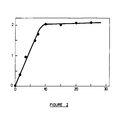
- the density of the photon flux will be maintained between 100 and 500 ⁇ E.m -2 .s -1 .
- the invention also relates, as an industrial product, the aqueous hydrogen peroxide solution obtained by the photochemical process according to the invention.
- the invention constitutes an interesting application for converting solar light energy into chemical energy.
- Example 1 (according to the invention).
- Example 5R a stream of nitrogen gas was bubbled through the bowl beforehand so as to obtain a solution free of dissolved oxygen.
- Example 1 was reproduced with the difference that in Examples 11 R and 12 to 18, the amount of NaOH was adjusted to fix the pH at values between 9 and 14, than in Examples 6R to 9R, the addition of NaOH was replaced by a controlled amount of hydrochloric acid to fix the pH at values between 0 and 6.
- Example 10R was carried out without addition of NaOH or HCl.
- This example was carried out in order to study the mechanism of the photochemical reaction, and in particular the phenomenon of trapping ("quenching") of photoexcited species.
- a light source was used as a ruby laser emitting short pulses (20 to 30 ns) of approximately 100 mJ of energy at a wavelength of 347 nm.
- a pulsed Xe lamp produced for 500 us a white light of constant intensity and served as an analysis light source for the light transmission measurements of the photochemical system.
- the evolution of the transmission was examined for a short period of time after each excitation flash from the laser. This evolution was recorded by means of a memory oscilloscope, the triggering of which was coupled with that of the pulses of the examination light supplied by the lamp to the Xe.
- the temporal transmission curves at characteristic wavelengths made it possible to calculate the kinetic constants of the trapping reactions of the excited species.
- Example 1 was reproduced by substituting pink bengal for the Ru complex (bpy) .
- Example 2 Was used in a cuvette similar to that used in Example 1, 1 ml of a 20 mM aqueous solution of semicarbazide, 0.1 mM in bengal rose and 1 M in NaOH. Gaseous oxygen was bubbled with a flow rate of 25 ml / min and the solution was simultaneously irradiated with monochromatic light at an energy rate of 20 ⁇ E.m -2 .s -1 by means of a lamp with Xe of 150 W and an ORIEL brand monochromator.
- the mixture was simultaneously irradiated with a 150W Xe lamp equipped with a green filter ensuring 85% transmittance in the wavelength range extending from 510 to 548 nm so as to achieve a photon flux density of 1500 ⁇ E.m -2 .s -1 .
- Example 22 was reproduced by fixing the concentration of bengal rose at 8 ⁇ M and that of semicarbazide at 20 mM and by varying the photon flux densities.
Landscapes
- Chemical & Material Sciences (AREA)
- Organic Chemistry (AREA)
- Inorganic Chemistry (AREA)
- Catalysts (AREA)
- Organic Low-Molecular-Weight Compounds And Preparation Thereof (AREA)
- Oxygen, Ozone, And Oxides In General (AREA)
Priority Applications (1)
| Application Number | Priority Date | Filing Date | Title |
|---|---|---|---|
| AT88106610T ATE78793T1 (de) | 1987-05-05 | 1988-04-25 | Verfahren zur erzeugung von wasserstoffperoxyd durch chemische photoreduktion von sauerstoff und erhaltenes wasserstoffperoxyd. |
Applications Claiming Priority (2)
| Application Number | Priority Date | Filing Date | Title |
|---|---|---|---|
| ES8701334A ES2003294A6 (es) | 1987-05-05 | 1987-05-05 | Procedimiento para fabricar peroxido de hidrogeno |
| ES8701334 | 1987-05-05 |
Publications (2)
| Publication Number | Publication Date |
|---|---|
| EP0289904A1 EP0289904A1 (fr) | 1988-11-09 |
| EP0289904B1 true EP0289904B1 (fr) | 1992-07-29 |
Family
ID=8250782
Family Applications (1)
| Application Number | Title | Priority Date | Filing Date |
|---|---|---|---|
| EP88106610A Expired - Lifetime EP0289904B1 (fr) | 1987-05-05 | 1988-04-25 | Procédé de production de peroxyde d'hydrogène par photoréduction chimique d'oxygène, et peroxyde d'hydrogène obtenu par ce procédé |
Country Status (6)
| Country | Link |
|---|---|
| US (1) | US4927512A (es) |
| EP (1) | EP0289904B1 (es) |
| JP (1) | JPS6414102A (es) |
| AT (1) | ATE78793T1 (es) |
| DE (1) | DE3873156T2 (es) |
| ES (1) | ES2003294A6 (es) |
Families Citing this family (3)
| Publication number | Priority date | Publication date | Assignee | Title |
|---|---|---|---|---|
| JP5655465B2 (ja) * | 2010-09-27 | 2015-01-21 | 東ソー株式会社 | 過酸化水素の製造法 |
| US20140141346A1 (en) * | 2011-06-25 | 2014-05-22 | Osaka University | Method for producing hydrogen peroxide, kit for producing hydrogen peroxide, and fuel battery |
| CN117569014B (zh) * | 2023-11-16 | 2024-06-18 | 齐鲁工业大学(山东省科学院) | 一种h2o2气体薄膜传感材料的制备方法 |
Family Cites Families (2)
| Publication number | Priority date | Publication date | Assignee | Title |
|---|---|---|---|---|
| US1659382A (en) * | 1926-02-01 | 1928-02-14 | Du Pont | Process of making hydrogen peroxide |
| US4576687A (en) * | 1984-07-26 | 1986-03-18 | Corning Glass Works | Hydrogen peroxide production using a non-aqueous system |
-
1987
- 1987-05-05 ES ES8701334A patent/ES2003294A6/es not_active Expired
-
1988
- 1988-04-25 EP EP88106610A patent/EP0289904B1/fr not_active Expired - Lifetime
- 1988-04-25 AT AT88106610T patent/ATE78793T1/de not_active IP Right Cessation
- 1988-04-25 DE DE8888106610T patent/DE3873156T2/de not_active Expired - Fee Related
- 1988-05-02 JP JP63109813A patent/JPS6414102A/ja active Pending
- 1988-05-05 US US07/190,552 patent/US4927512A/en not_active Expired - Fee Related
Also Published As
| Publication number | Publication date |
|---|---|
| US4927512A (en) | 1990-05-22 |
| ES2003294A6 (es) | 1988-10-16 |
| EP0289904A1 (fr) | 1988-11-09 |
| ATE78793T1 (de) | 1992-08-15 |
| DE3873156T2 (de) | 1993-01-14 |
| JPS6414102A (en) | 1989-01-18 |
| DE3873156D1 (de) | 1992-09-03 |
Similar Documents
| Publication | Publication Date | Title |
|---|---|---|
| De Caro et al. | Inter-and intraband energy transfer in LH2-antenna complexes of purple bacteria. A fluorescence line-narrowing and hole-burning study | |
| Jung et al. | The chromophores as endogenous sensitizers involved in the photogeneration of singlet oxygen in spinach thylakoids | |
| FR2464746A1 (fr) | Catalyseur pour la production photolytique d'hydrogene a partir de l'eau et procede pour sa preparation | |
| EP0289904B1 (fr) | Procédé de production de peroxyde d'hydrogène par photoréduction chimique d'oxygène, et peroxyde d'hydrogène obtenu par ce procédé | |
| FR2921056A1 (fr) | Procede de synthese de nanoparticules de ticon et tion par pyrolyse laser. | |
| Davidson et al. | A study of the photobleaching and photoyellowing of paper containing lignin using fluorescence spectroscopy | |
| Krasnovsky Jr et al. | Biophotonics of molecular oxygen: activation efficiencies upon direct and photosensitized excitation | |
| WO1989001977A1 (fr) | Procede de production de carotenoides et notamment d'astaxanthine par culture de microalgues et dispositif pour la mise en oeuvre du procede | |
| EP1470078B1 (fr) | Polymere sol-gel a base d oxyde de titane | |
| WO2015036496A1 (fr) | Procede de dissociation de l'eau a base du photosysteme ii (psii) | |
| FR2809420A1 (fr) | Procede et dispositif pour la degradation de composes organiques en solution aqueuse par photolyse vuv de l'eau et production electrochimique de dioxygene | |
| EP3546064B1 (fr) | Procede de degradation par voie photochimique d'ethylene | |
| Olmsted III et al. | Iodine-sensitized photoformation of singlet oxygen | |
| Sadighian et al. | Rapid sampling during synthesis of lead halide perovskite nanocrystals for spectroscopic measurement | |
| Melø et al. | Photodestruction of endogenous porphyrins in relation to cellular inactivation of Propionibacterium acnes | |
| JP2023020953A (ja) | 活性酸素による処理装置及び活性酸素による処理方法 | |
| Pfleger et al. | Preparation of Ag nanoparticles by two-wavelength laser ablation and fragmentation | |
| KR102325854B1 (ko) | 다이뉴클레오타이드를 포함하는 광촉매 및 이의 용도 | |
| Jung et al. | Involvement of thylakoid membrane‐dependent photosensitization in photoinhibition of the Calvin cycle activity in spinach chloroplasts | |
| Słota et al. | Effect of air-absorbed oxygen and moisture on the chemical stability of photoexcited Mg, Zn and Eu phthalocyanines in dimethylformamide | |
| Byrom et al. | Excited states of flavine coenzymes‐TV. Kinetics of the photoreduction of lumiflavine by methionine | |
| Hoffman et al. | Studies of Photochemical Action Spectra on N, N, N′, N′‐Tetramethyl‐p‐phenylenediamine‐Oxidase‐Negative Mutants of Azotobacter vinelandii | |
| FR2756554A1 (fr) | Procede de decoloration et detoxication d'effluents aqueux | |
| Pogranichniy | Understanding Hole Scavenging Activity in CdS Semiconductor Nanocrystal Photochemistry | |
| WO2010072951A1 (fr) | Procede de production d'hydrogene par dissociation de l'eau |
Legal Events
| Date | Code | Title | Description |
|---|---|---|---|
| PUAI | Public reference made under article 153(3) epc to a published international application that has entered the european phase |
Free format text: ORIGINAL CODE: 0009012 |
|
| AK | Designated contracting states |
Kind code of ref document: A1 Designated state(s): AT BE DE ES FR GB IT NL |
|
| 17P | Request for examination filed |
Effective date: 19890428 |
|
| 17Q | First examination report despatched |
Effective date: 19910214 |
|
| GRAA | (expected) grant |
Free format text: ORIGINAL CODE: 0009210 |
|
| AK | Designated contracting states |
Kind code of ref document: B1 Designated state(s): AT BE DE ES FR GB IT NL |
|
| PG25 | Lapsed in a contracting state [announced via postgrant information from national office to epo] |
Ref country code: IT Free format text: LAPSE BECAUSE OF FAILURE TO SUBMIT A TRANSLATION OF THE DESCRIPTION OR TO PAY THE FEE WITHIN THE PRE;WARNING: LAPSES OF ITALIAN PATENTS WITH EFFECTIVE DATE BEFORE 2007 MAY HAVE OCCURRED AT ANY TIME BEFORE 2007. THE CORRECT EFFECTIVE DATE MAY BE DIFFERENT FROM THE ONE RECORDED.SCRIBED TIME-LIMIT Effective date: 19920729 Ref country code: NL Effective date: 19920729 Ref country code: GB Effective date: 19920729 Ref country code: AT Effective date: 19920729 Ref country code: ES Free format text: THE PATENT HAS BEEN ANNULLED BY A DECISION OF A NATIONAL AUTHORITY Effective date: 19920729 |
|
| REF | Corresponds to: |
Ref document number: 78793 Country of ref document: AT Date of ref document: 19920815 Kind code of ref document: T |
|
| REF | Corresponds to: |
Ref document number: 3873156 Country of ref document: DE Date of ref document: 19920903 |
|
| NLV1 | Nl: lapsed or annulled due to failure to fulfill the requirements of art. 29p and 29m of the patents act | ||
| GBV | Gb: ep patent (uk) treated as always having been void in accordance with gb section 77(7)/1977 [no translation filed] |
Effective date: 19920729 |
|
| PGFP | Annual fee paid to national office [announced via postgrant information from national office to epo] |
Ref country code: BE Payment date: 19930309 Year of fee payment: 6 |
|
| PGFP | Annual fee paid to national office [announced via postgrant information from national office to epo] |
Ref country code: FR Payment date: 19930315 Year of fee payment: 6 |
|
| PLBE | No opposition filed within time limit |
Free format text: ORIGINAL CODE: 0009261 |
|
| STAA | Information on the status of an ep patent application or granted ep patent |
Free format text: STATUS: NO OPPOSITION FILED WITHIN TIME LIMIT |
|
| 26N | No opposition filed | ||
| BECA | Be: change of holder's address |
Free format text: 930603 *SOLVAY INTEROX:RUE DU PRINCE ALBERT 33, B-1050 BRUXELLES |
|
| BECN | Be: change of holder's name |
Effective date: 19930603 |
|
| PG25 | Lapsed in a contracting state [announced via postgrant information from national office to epo] |
Ref country code: DE Effective date: 19940101 |
|
| PG25 | Lapsed in a contracting state [announced via postgrant information from national office to epo] |
Ref country code: BE Effective date: 19940430 |
|
| BERE | Be: lapsed |
Owner name: SOLVAY INTEROX Effective date: 19940430 |
|
| PG25 | Lapsed in a contracting state [announced via postgrant information from national office to epo] |
Ref country code: FR Effective date: 19941229 |
|
| REG | Reference to a national code |
Ref country code: FR Ref legal event code: ST |