EP1470078B1 - Polymere sol-gel a base d oxyde de titane - Google Patents
Polymere sol-gel a base d oxyde de titane Download PDFInfo
- Publication number
- EP1470078B1 EP1470078B1 EP03734737A EP03734737A EP1470078B1 EP 1470078 B1 EP1470078 B1 EP 1470078B1 EP 03734737 A EP03734737 A EP 03734737A EP 03734737 A EP03734737 A EP 03734737A EP 1470078 B1 EP1470078 B1 EP 1470078B1
- Authority
- EP
- European Patent Office
- Prior art keywords
- solution
- polymer
- tiocl
- temperature
- composition according
- Prior art date
- Legal status (The legal status is an assumption and is not a legal conclusion. Google has not performed a legal analysis and makes no representation as to the accuracy of the status listed.)
- Expired - Lifetime
Links
- 229920000642 polymer Polymers 0.000 title claims abstract description 42
- OGIDPMRJRNCKJF-UHFFFAOYSA-N titanium oxide Inorganic materials [Ti]=O OGIDPMRJRNCKJF-UHFFFAOYSA-N 0.000 title claims abstract description 34
- GWEVSGVZZGPLCZ-UHFFFAOYSA-N Titan oxide Chemical compound O=[Ti]=O GWEVSGVZZGPLCZ-UHFFFAOYSA-N 0.000 title claims abstract description 13
- 239000000203 mixture Substances 0.000 claims abstract description 40
- 239000000835 fiber Substances 0.000 claims abstract description 16
- 229910003087 TiOx Inorganic materials 0.000 claims abstract 2
- HLLICFJUWSZHRJ-UHFFFAOYSA-N tioxidazole Chemical compound CCCOC1=CC=C2N=C(NC(=O)OC)SC2=C1 HLLICFJUWSZHRJ-UHFFFAOYSA-N 0.000 claims abstract 2
- ZMXDDKWLCZADIW-UHFFFAOYSA-N N,N-Dimethylformamide Chemical compound CN(C)C=O ZMXDDKWLCZADIW-UHFFFAOYSA-N 0.000 claims description 66
- 239000010936 titanium Substances 0.000 claims description 44
- 238000000034 method Methods 0.000 claims description 19
- VEXZGXHMUGYJMC-UHFFFAOYSA-N Hydrochloric acid Chemical compound Cl VEXZGXHMUGYJMC-UHFFFAOYSA-N 0.000 claims description 13
- 229910052719 titanium Inorganic materials 0.000 claims description 13
- RTAQQCXQSZGOHL-UHFFFAOYSA-N Titanium Chemical compound [Ti] RTAQQCXQSZGOHL-UHFFFAOYSA-N 0.000 claims description 11
- 229910010270 TiOCl2 Inorganic materials 0.000 claims description 10
- 230000003647 oxidation Effects 0.000 claims description 8
- 238000007254 oxidation reaction Methods 0.000 claims description 8
- 238000002360 preparation method Methods 0.000 claims description 8
- 238000009281 ultraviolet germicidal irradiation Methods 0.000 claims description 7
- 150000008040 ionic compounds Chemical class 0.000 claims description 5
- 229910003083 TiO6 Inorganic materials 0.000 claims description 4
- 239000011521 glass Substances 0.000 claims description 4
- 229910052751 metal Inorganic materials 0.000 claims description 4
- 239000002184 metal Substances 0.000 claims description 4
- HCHKCACWOHOZIP-UHFFFAOYSA-N Zinc Chemical compound [Zn] HCHKCACWOHOZIP-UHFFFAOYSA-N 0.000 claims description 3
- 229910052725 zinc Inorganic materials 0.000 claims description 3
- 239000011701 zinc Substances 0.000 claims description 3
- 229910052684 Cerium Inorganic materials 0.000 claims description 2
- UFHFLCQGNIYNRP-UHFFFAOYSA-N Hydrogen Chemical compound [H][H] UFHFLCQGNIYNRP-UHFFFAOYSA-N 0.000 claims description 2
- 150000001450 anions Chemical class 0.000 claims description 2
- 229910052792 caesium Inorganic materials 0.000 claims description 2
- 150000001768 cations Chemical class 0.000 claims description 2
- 229910052804 chromium Inorganic materials 0.000 claims description 2
- 238000001914 filtration Methods 0.000 claims description 2
- 239000001257 hydrogen Substances 0.000 claims description 2
- 229910052739 hydrogen Inorganic materials 0.000 claims description 2
- 229910052742 iron Inorganic materials 0.000 claims description 2
- 229910052746 lanthanum Inorganic materials 0.000 claims description 2
- 229910052744 lithium Inorganic materials 0.000 claims description 2
- 150000002739 metals Chemical class 0.000 claims description 2
- 229910052759 nickel Inorganic materials 0.000 claims description 2
- 229910052758 niobium Inorganic materials 0.000 claims description 2
- 229910052700 potassium Inorganic materials 0.000 claims description 2
- 239000011541 reaction mixture Substances 0.000 claims description 2
- 229910052701 rubidium Inorganic materials 0.000 claims description 2
- 229910052708 sodium Inorganic materials 0.000 claims description 2
- 229910052726 zirconium Inorganic materials 0.000 claims description 2
- 238000012505 colouration Methods 0.000 claims 1
- 239000003792 electrolyte Substances 0.000 claims 1
- 229960005196 titanium dioxide Drugs 0.000 claims 1
- 230000000475 sunscreen effect Effects 0.000 abstract 1
- 239000000516 sunscreening agent Substances 0.000 abstract 1
- 239000000243 solution Substances 0.000 description 39
- 238000010521 absorption reaction Methods 0.000 description 15
- 238000001228 spectrum Methods 0.000 description 10
- 239000004065 semiconductor Substances 0.000 description 8
- 238000000862 absorption spectrum Methods 0.000 description 6
- 230000003287 optical effect Effects 0.000 description 6
- 241000894007 species Species 0.000 description 6
- 125000004429 atom Chemical group 0.000 description 5
- 238000010438 heat treatment Methods 0.000 description 4
- BDAGIHXWWSANSR-UHFFFAOYSA-N methanoic acid Natural products OC=O BDAGIHXWWSANSR-UHFFFAOYSA-N 0.000 description 4
- XUIMIQQOPSSXEZ-UHFFFAOYSA-N Silicon Chemical compound [Si] XUIMIQQOPSSXEZ-UHFFFAOYSA-N 0.000 description 3
- 238000004458 analytical method Methods 0.000 description 3
- 239000003504 photosensitizing agent Substances 0.000 description 3
- 229910052710 silicon Inorganic materials 0.000 description 3
- 239000010703 silicon Substances 0.000 description 3
- OSWFIVFLDKOXQC-UHFFFAOYSA-N 4-(3-methoxyphenyl)aniline Chemical compound COC1=CC=CC(C=2C=CC(N)=CC=2)=C1 OSWFIVFLDKOXQC-UHFFFAOYSA-N 0.000 description 2
- IJGRMHOSHXDMSA-UHFFFAOYSA-N Atomic nitrogen Chemical compound N#N IJGRMHOSHXDMSA-UHFFFAOYSA-N 0.000 description 2
- IQDGSYLLQPDQDV-UHFFFAOYSA-N dimethylazanium;chloride Chemical compound Cl.CNC IQDGSYLLQPDQDV-UHFFFAOYSA-N 0.000 description 2
- 238000006073 displacement reaction Methods 0.000 description 2
- 230000000694 effects Effects 0.000 description 2
- 238000000192 extended X-ray absorption fine structure spectroscopy Methods 0.000 description 2
- 235000019253 formic acid Nutrition 0.000 description 2
- 239000007788 liquid Substances 0.000 description 2
- 238000011176 pooling Methods 0.000 description 2
- 239000002244 precipitate Substances 0.000 description 2
- 230000002441 reversible effect Effects 0.000 description 2
- 238000004627 transmission electron microscopy Methods 0.000 description 2
- 235000009161 Espostoa lanata Nutrition 0.000 description 1
- 240000001624 Espostoa lanata Species 0.000 description 1
- 238000005481 NMR spectroscopy Methods 0.000 description 1
- 238000001069 Raman spectroscopy Methods 0.000 description 1
- 239000012327 Ruthenium complex Substances 0.000 description 1
- 241001080024 Telles Species 0.000 description 1
- 229910010413 TiO 2 Inorganic materials 0.000 description 1
- 238000002056 X-ray absorption spectroscopy Methods 0.000 description 1
- 239000004480 active ingredient Substances 0.000 description 1
- 239000011149 active material Substances 0.000 description 1
- 229910052782 aluminium Inorganic materials 0.000 description 1
- 239000007864 aqueous solution Substances 0.000 description 1
- QVGXLLKOCUKJST-UHFFFAOYSA-N atomic oxygen Chemical compound [O] QVGXLLKOCUKJST-UHFFFAOYSA-N 0.000 description 1
- 230000015572 biosynthetic process Effects 0.000 description 1
- 238000004040 coloring Methods 0.000 description 1
- 150000001875 compounds Chemical class 0.000 description 1
- 230000003750 conditioning effect Effects 0.000 description 1
- 239000000470 constituent Substances 0.000 description 1
- 229920006037 cross link polymer Polymers 0.000 description 1
- 230000005611 electricity Effects 0.000 description 1
- 230000002349 favourable effect Effects 0.000 description 1
- 239000007789 gas Substances 0.000 description 1
- 150000002500 ions Chemical class 0.000 description 1
- DCYOBGZUOMKFPA-UHFFFAOYSA-N iron(2+);iron(3+);octadecacyanide Chemical compound [Fe+2].[Fe+2].[Fe+2].[Fe+3].[Fe+3].[Fe+3].[Fe+3].N#[C-].N#[C-].N#[C-].N#[C-].N#[C-].N#[C-].N#[C-].N#[C-].N#[C-].N#[C-].N#[C-].N#[C-].N#[C-].N#[C-].N#[C-].N#[C-].N#[C-].N#[C-] DCYOBGZUOMKFPA-UHFFFAOYSA-N 0.000 description 1
- 238000012423 maintenance Methods 0.000 description 1
- 238000004519 manufacturing process Methods 0.000 description 1
- 229910052757 nitrogen Inorganic materials 0.000 description 1
- 239000001301 oxygen Substances 0.000 description 1
- 229910052760 oxygen Inorganic materials 0.000 description 1
- 230000001699 photocatalysis Effects 0.000 description 1
- 235000020004 porter Nutrition 0.000 description 1
- 239000000843 powder Substances 0.000 description 1
- 239000000047 product Substances 0.000 description 1
- 238000000425 proton nuclear magnetic resonance spectrum Methods 0.000 description 1
- 230000005855 radiation Effects 0.000 description 1
- 239000002994 raw material Substances 0.000 description 1
- 239000012429 reaction media Substances 0.000 description 1
- 239000002689 soil Substances 0.000 description 1
- 238000011282 treatment Methods 0.000 description 1
- XLYOFNOQVPJJNP-UHFFFAOYSA-N water Substances O XLYOFNOQVPJJNP-UHFFFAOYSA-N 0.000 description 1
Images



Classifications
-
- C—CHEMISTRY; METALLURGY
- C01—INORGANIC CHEMISTRY
- C01G—COMPOUNDS CONTAINING METALS NOT COVERED BY SUBCLASSES C01D OR C01F
- C01G23/00—Compounds of titanium
- C01G23/04—Oxides; Hydroxides
- C01G23/047—Titanium dioxide
- C01G23/053—Producing by wet processes, e.g. hydrolysing titanium salts
- C01G23/0536—Producing by wet processes, e.g. hydrolysing titanium salts by hydrolysing chloride-containing salts
-
- B—PERFORMING OPERATIONS; TRANSPORTING
- B82—NANOTECHNOLOGY
- B82Y—SPECIFIC USES OR APPLICATIONS OF NANOSTRUCTURES; MEASUREMENT OR ANALYSIS OF NANOSTRUCTURES; MANUFACTURE OR TREATMENT OF NANOSTRUCTURES
- B82Y30/00—Nanotechnology for materials or surface science, e.g. nanocomposites
-
- C—CHEMISTRY; METALLURGY
- C01—INORGANIC CHEMISTRY
- C01P—INDEXING SCHEME RELATING TO STRUCTURAL AND PHYSICAL ASPECTS OF SOLID INORGANIC COMPOUNDS
- C01P2002/00—Crystal-structural characteristics
- C01P2002/70—Crystal-structural characteristics defined by measured X-ray, neutron or electron diffraction data
- C01P2002/76—Crystal-structural characteristics defined by measured X-ray, neutron or electron diffraction data by a space-group or by other symmetry indications
-
- C—CHEMISTRY; METALLURGY
- C01—INORGANIC CHEMISTRY
- C01P—INDEXING SCHEME RELATING TO STRUCTURAL AND PHYSICAL ASPECTS OF SOLID INORGANIC COMPOUNDS
- C01P2004/00—Particle morphology
- C01P2004/10—Particle morphology extending in one dimension, e.g. needle-like
-
- C—CHEMISTRY; METALLURGY
- C01—INORGANIC CHEMISTRY
- C01P—INDEXING SCHEME RELATING TO STRUCTURAL AND PHYSICAL ASPECTS OF SOLID INORGANIC COMPOUNDS
- C01P2004/00—Particle morphology
- C01P2004/60—Particles characterised by their size
- C01P2004/64—Nanometer sized, i.e. from 1-100 nanometer
-
- C—CHEMISTRY; METALLURGY
- C01—INORGANIC CHEMISTRY
- C01P—INDEXING SCHEME RELATING TO STRUCTURAL AND PHYSICAL ASPECTS OF SOLID INORGANIC COMPOUNDS
- C01P2006/00—Physical properties of inorganic compounds
- C01P2006/60—Optical properties, e.g. expressed in CIELAB-values
Definitions
- the present invention relates to a titanium oxide-based polymer composition, its use as a semiconductor element in a photovoltaic cell, and a process for its preparation.
- Photovoltaic cells convert solar energy into electricity by exploiting the photovoltaic effect that exists at the interface of a pn junction between two semiconductors.
- Silicon-based semiconductors have been used, but the high cost of the raw material is not favorable to the industrial development of such cells.
- the silicon was then replaced by titanium oxide TiO 2, which is a cheap semiconductor and has stable photo catalytic properties.
- TiO 2 titanium oxide
- its applications in the photovoltaic field are limited because it absorbs only in a narrow range of the solar spectrum, due to a high band gap. This area corresponds to the UV part and covers less than 10% of the total solar spectrum.
- One solution has been to cover the surface of the titanium oxide with a photo-sensitizing agent to extend its field of photoactivity in the region of the solar spectrum.
- the inventors have now found that the performance of a titanium oxide used as a semiconductor in a photovoltaic cell could be optimized by a microstructural or mesostructural control of the morphology.
- the object of the present invention is therefore to provide a particular titanium oxide having improved performance when used as a semiconductor element of a photovoltaic cell.
- TiO polymer The one-dimensional structure of the TiO x (OH) y (H 2 O) 2 polymer (hereinafter referred to as TiO polymer) is detected by transmission electron microscopy. Chain structure is evidenced by EXAFS analysis (Extented X rays Absorption Fine Structure, or X-ray Absorption Spectroscopy).
- a polymer composition according to the invention can be translucent or stain.
- the composition is translucent when it is protected from light and the titanium is essentially in the form Ti 4+ , the polymer then corresponding to the formula TiO (OH) 2 .
- TiO polymer composition When the titanium is essentially in the form Ti 3+ in the TiO polymer, there is a broad absorption band in the visible range (between 400 and 850 nm), which results in a violet, blue, midnight blue, or green of the composition. The color changes with the proportion of Ti 3+ . It goes green for low concentrations of Ti 3+ purple for high concentrations.
- the TiO polymer corresponds to the formula TiO (OH) (H 2 O).
- a TiO polymer composition according to the invention can be obtained from TiOCl 2 .
- the TiOCl 2 compound being very hygroscopic, it is used in TiOCl 2 • yHCl form, that is to say in solution in a concentrated hydrochloric acid solution.
- the concentrated HCl solution is advantageously an aqueous solution of about 2 M.
- the concentration of TiOCl 2 in this solution is preferably between 4 M and 5 M.
- the duration of temperature maintenance that depends on the temperature. For example, when the solution is maintained at 65 ° C, a period of 24 hours is sufficient.
- the TiO polymer composition is obtained in the form of a colloidal solution or sol in DMF when C Ti is less than 1M, and in gel form when C Ti is greater than 1M.
- the TiO polymer composition of the invention is obtained directly in reduced form in which at least a portion of the titanium is at the Ti + 3 oxidation state , by a process which consists in reducing TiOCl 2 with a species which is oxidizable at a potential lower than -0.05 V relative to the normal hydrogen electrode.
- oxidation state metals such as Ni, Fe, Al, Cr, Zr, Ti, Nb, Cs, Rb, Na, K, Li, La, Ce, and ionic compounds. in which the cation is selected from V 2+, Ti 2+ and Cr 2+, and ionic compounds in which the anion is selected from S 2 O 3 2-, H - and S 2 2-.
- Zinc is particularly preferred.
- the TiO polymer composition according to the invention is obtained with a coloring. If it is then irradiated with UV radiation, the Ti 3+ content increases, and its color changes from green to purple, then blue, as the Ti 3+ ion content increases.
- a first variant of the preparation method using a reduction with an oxidizable species consists in preparing a solution of TiOCl 2 in dimethylformamide (DMF) from TiOCl 2 • yHCl, such as the concentration of Ti atoms (C Ti ). less than 2 M, adding the oxidizable species, bringing the solution to a temperature between room temperature and 90 ° C, and maintaining the solution at this temperature for a certain time, which depends on the temperature.
- DMF dimethylformamide
- the metal is preferably introduced in the form of chips.
- the ionic compound can be introduced in the form of powder, liquid or gas.
- composition according to the invention When a composition according to the invention is prepared by a process using DMF, it contains dimethylammonium chloride and formic acid. These constituents may be detected in particular by proton NMR analysis ( 1 H), which also makes it possible to determine the amount thereof.
- concentration C Ti in the initial reaction mixture is less than 1 M, the composition is a solution colloidal polymer uncrosslinked in DMF.
- the initial concentration C Ti is greater than 1 M, the polymer is crosslinked and the composition is in gel form.
- composition according to the invention is prepared according to the second variant of the process implementing a reduction by an oxidizable species, that is to say in the absence of DMF, said composition is a colloidal solution of non-crosslinked polymer in water when C Ti is less than 1 M. When C Ti is greater than 1 M, the polymer is crosslinked and the composition is in gel form.
- the oxidized form can be obtained by subjecting the polymer composition to air oxidation, so that it resumes its translucent appearance.
- the high-resolution image obtained by transmission electron microscopy, shows that the structure of the TiO (OH) 2 polymer obtained has a one-dimensional 1D character.
- the fibers of the polymer are wound concentrically in the manner of a cotton ball.
- the presence of a major disorder in the direction perpendicular to the stack of fibers is manifested on the diffraction pattern by the presence of diffuse lenticular spots.
- the periodicity, deduced from the spacing between the fibers, can be estimated at 3.5-4 ⁇ .
- Example 1 The procedure described in Example 1 was repeated for several preparations, varying only the concentration C Ti in the test tube. Each test tube, filled in air or under N 2 , was subjected to a heat treatment similar to that of Example 1.
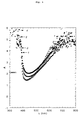
- the Figures 1 to 4 represent the optical absorption spectra of the solutions after different treatments.
- the absorption A is indicated on the ordinate, in arbitrary units.
- the wavelength ⁇ in nanometers, is given as abscissa.
- the spectra of a solution are represented by the following signs: Solution 1 Solution 2 Solution 3 Solution 4 ⁇ ⁇ ⁇ ⁇ ⁇
- the figure 1 represents the optical absorption spectrum of the untreated fraction of each of solutions 1 to 4.
- the four spectra are almost identical and show that there is no absorption in the visible range, and that the influence of the concentration and conditioning atmosphere is negligible.
- the figure 2 represents the optical absorption spectrum of the fraction of each of the solutions 1 to 4 subjected to UV irradiation for 180 hours. Spectra indicate the presence of a strong absorption that extends over a wide range of the visible, as well as a small displacement of the absorption front towards shorter wavelengths.
- the figure 3 represents the optical absorption spectrum of the fraction of each of solutions 1 to 4 subjected to heating at 65 ° C for 15 hours.
- the spectra indicate a small displacement of the absorption front at shorter wavelengths, compared to the spectra of the untreated initial solutions.
- the figure 4 represents the optical absorption spectrum of the fraction of each of solutions 1 to 4 subjected to heating at 65 ° C for 15 hours, then to UV irradiation for 15 hours.
- the spectra indicate a broad band of absorption in the visible range. Absorption is more important for the gel and its maximum shifts to longer wavelengths than in the case of the corresponding initial solutions.
- TiO (OH) 2 polymer gel was characterized by EXAFS analysis at the K threshold of titanium.
- the results of the refinement give the number N of neighboring atoms, the distance R between an absorbing atom and its neighbors, the Debye-Waller factor ⁇ the energy shift ⁇ E o and the residue ⁇ .
- the results are given in the table below.
- TiO (OH 2 ) NOT R ( ⁇ ) ⁇ .10 2 ( ⁇ ) ⁇ E o (eV) ⁇ (%) Ti - O 3.91 1.89 1.3 0.48 Ti - O 2, 08 1.98 2.8 0.00 2.32 Ti - Ti 2, 28 2.92 6, 3 2, 84 Ti - Ti 1.71 3.27 1.7 6.85
- the idealized structure of the TiO (OH) 2 polymer ribbon which has an ID character is represented on the Figure 5 (B) . It is comparable to the structure observed for Hollandite. Each TiO 6 octahedron shares two opposite edges with two adjacent octahedra (2.92 ⁇ ) to form infinite chains developing along the axis of the fiber. Two adjacent chains form double queues by pooling edges (2 x 3.27 ⁇ ). Due to the difference in the number neighbors and the ideal value "2", the polymer obtained can be crosslinked as shown in FIG. Figure 5 (A) .
- the change in color over time was monitored by measuring the absorption of the samples using the W-Vis-NIR Cary absorption spectrometer between 300 and 1200 nm.
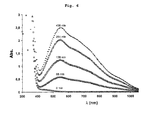
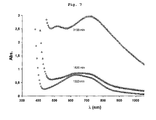
- the absorption spectra are represented on the figures 6 and 7 .
- the ABS absorption is indicated on the ordinate (arbitrary units).
- the wavelength ⁇ is indicated on the abscissa (nm).
- this peak tends to disappear and gives way to a broad absorption band between 630 and 740 nm. After 3150 min, ie more than 2 days, the absorption is important regardless of the wavelength in the visible range. Two peaks, however, stand out at 550 nm and at 710 nm.
Landscapes
- Chemical & Material Sciences (AREA)
- Engineering & Computer Science (AREA)
- Nanotechnology (AREA)
- Organic Chemistry (AREA)
- Geology (AREA)
- Inorganic Chemistry (AREA)
- Materials Engineering (AREA)
- Crystallography & Structural Chemistry (AREA)
- Condensed Matter Physics & Semiconductors (AREA)
- Life Sciences & Earth Sciences (AREA)
- Environmental & Geological Engineering (AREA)
- General Life Sciences & Earth Sciences (AREA)
- Physics & Mathematics (AREA)
- General Physics & Mathematics (AREA)
- Composite Materials (AREA)
- Inorganic Compounds Of Heavy Metals (AREA)
- Compositions Of Macromolecular Compounds (AREA)
- Hybrid Cells (AREA)
- Colloid Chemistry (AREA)
- Photovoltaic Devices (AREA)
- Physical Or Chemical Processes And Apparatus (AREA)
- Artificial Filaments (AREA)
- Materials For Medical Uses (AREA)
- Dental Preparations (AREA)
Description
- La présente invention concerne une composition de polymère à base d'oxyde de titane, son utilisation comme élément semi-conducteur dans une cellule photovoltaïque, ainsi qu'un procédé pour sa préparation.
- Les cellules photovoltaïques convertissent l'énergie solaire en électricité en exploitant l'effet photovoltaïque qui existe à l'interface d'une jonction p-n entre deux semi-conducteurs. On a utilisé des semi-conducteurs à base de silicium, mais le coût élevé de la matière première n'est pas favorable au développement industriel de telles cellules. On a alors remplacé le silicium par l'oxyde de titane TiO2 qui est un semi-conducteur bon marché et qui a des propriétés photo catalytiques stables. Ses applications dans le domaine photovoltaïque sont cependant limitées car il n'absorbe que dans un domaine étroit du spectre solaire, en raison d'une largeur de bande interdite élevée. Ce domaine correspond à la partie UV et couvre moins de 10% de la totalité du spectre solaire. Une solution a consisté à recouvrir la surface de l'oxyde de titane par un agent photo-sensibilisateur pour étendre son domaine de photo-activité dans la région du spectre solaire. Cette technique a été mise en oeuvre notamment à l'aide de complexe de ruthénium polypyridinique comme agent photo-sensibilisateur (
US-5,084,365 ) et elle a permis d'atteindre des efficacités de l'ordre de 12%. Les cellules contenant comme semi-conducteur l'oxyde de titane activé par un agent photo-sensibilisateur ont un prix de revient inférieur à celui des cellules photovoltaïque de la technique antérieure. Mais leur durée de fonctionnement qui est d'environ 10 ans est nettement plus faible que celle des cellules au silicium monocristallin (qui est de l'ordre de 20 ans), et leur efficacité est moindre. - Les inventeurs ont maintenant trouvé que les performances d'un oxyde de titane utilisé comme semi-conducteur dans une cellule photovoltaïque pouvaient être optimisées par un contrôle à l'échelle microstructurale ou mésostructurale de la morphologie. Le but de la présente invention est donc de fournir un oxyde de titane particulier présentant des performances améliorées lorsqu'il est utilisé comme élément semi-conducteur d'une cellule photovoltaïque.
- C'est pourquoi la présente invention a pour objet une composition à base d'oxyde de titane, un procédé pour sa préparation, ainsi qu'une cellule photovoltaïque qui le contient comme élément semi-conducteur.
- La composition selon la présente invention est constituée essentiellement par un polymère à base d'oxyde de titane qui peut être représenté par la formule TiOx(OH)y(H2O)z dans laquelle x+y+z=3, sous forme d'un gel ou sous forme d'un sol. Elle est caractérisée en ce que :
- le polymère a une structure à caractère unidimensionnel 1D et il est constitué de fibres enroulées concentriquement, avec une périodicité, déduite de l'espacement entre les fibres, entre 3,5 Å et 4 Å;
- chaque fibre est constituée par des octaèdres TiO6
- chaque octaèdre TiO6 partage deux arêtes opposées avec deux octaèdres adjacents (2 x 2,92 Å) pour former des chaînes infinies qui se développent selon l'axe d'une fibre,
- deux chaînes adjacentes forment des doubles files par mise en commun d'arêtes (2 x 3,27 Å).
- La structure à caractère unidimensionnel du polymère TiOx(OH)y(H2O)2 (désigné ci-après par polymère TiO) est détectée par microscopie électronique à transmission. La structure des chaînes est mise en évidence par une analyse EXAFS (Extented X rays Absorptions Fine Structure, ou spectroscopie d'absorption de rayons X).
- Une composition de polymère selon l'invention (désignée ci-après par composition de polymère TiO) peut être translucide ou présenter une coloration. La composition est translucide lorsqu'elle est à l'abri de la lumière et que le titane est essentiellement sous la forme Ti4+, le polymère correspondant alors à la formule TiO(OH)2. Lorsque le titane se trouve essentiellement sous la forme Ti3+ dans le polymère TiO, il existe une large bande d'absorption dans le domaine visible (entre 400 et 850 nm), qui se traduit par une coloration violette, bleue, bleu nuit, ou verte de la composition. La coloration évolue avec la proportion en Ti3+. Elle passe du vert pour les faibles concentrations en Ti3+ au violet pour les fortes concentrations. Lorsque tout le titane est sous forme Ti3+, le polymère TiO correspond à la formule TiO(OH) (H2O).
- Une composition de polymère TiO selon l'invention peut être obtenue à partir de TiOCl2. Le composé TiOCl2 étant très hygroscopique, il est utilisé sous forme TiOCl2•yHCl, c'est-à-dire en solution dans une solution d'acide chlorhydrique concentrée. La solution d'HCl concentrée est avantageusement une solution aqueuse environ 2 M. La concentration en TiOCl2 dans cette solution est de préférence entre 4 M et 5 M.
- Selon un premier mode de réalisation, la composition de polymère TiO selon l'invention peut être obtenue sous forme oxydée dans laquelle le titane est au degré d'oxydation Ti4+, par un procédé qui consiste à :
- préparer une solution de TiOCl2 dans du diméthylformamide (DMF) en introduisant TiOCl2•yHCl dans le DMF, dans des proportions telles que la concentration en atomes de Ti (CTi) soit inférieure à 2 M,
- porter la solution ainsi obtenue à une température entre la température ambiante et 90°C, et
- maintenir la solution à cette température pendant une certaine durée.
- La durée du maintien en température qui dépend de la température. Par exemple, lorsque la solution est maintenue à 65°C, une durée de 24 h est suffisante.
- Le polymère TiO(OH)2 ainsi obtenu peut être transformé dans sa forme réduite dans laquelle au moins une partie du titane est au degré d'oxydation Ti3+, par une irradiation UV (par exemple à λ = 360 nm) de la composition sous atmosphère inerte, qui provoque une coloration (violette, bleue ou verte suivant la concentration en Ti3+), cette coloration étant maintenue lorsque l'irradiation cesse.
- La composition de polymère TiO est obtenue sous forme d'une solution colloïdale ou sol dans DMF lorsque CTi est inférieur à 1 M, et sous forme de gel lorsque CTi est supérieur à 1 M.
- Dans un deuxième mode de réalisation, la composition de polymère TiO de l'invention est obtenue directement sous forme réduite dans laquelle au moins une partie du titane est au degré d'oxydation Ti+3, par un procédé qui consiste à réduire TiOCl2 à l'aide d'une espèce qui est oxydable à un potentiel inférieur à -0,05 V par rapport à l'électrode normale à hydrogène. A titre d'exemple, on peut citer les métaux au degré d'oxydation 0 tels que Ni, Fe, Al, Cr, Zr, Ti, Nb, Cs, Rb, Na, K, Li, La, Ce, les composés ioniques dans lesquels le cation est choisi parmi V2+, Ti2+ et Cr2+, et les composés ioniques dans lesquels l'anion est choisi parmi S2O3 2-, H-, et S2 2-. Le zinc est particulièrement préféré. Dans ce cas, la composition de polymère TiO selon l'invention est obtenue avec une coloration. Si elle est ensuite soumise à une irradiation par un rayonnement UV, la teneur en espèce Ti3+ augmente, et sa coloration évolue du vert au violet, puis au bleu, à mesure que la teneur en ions Ti3+ augmente.
- Une première variante du procédé de préparation mettant en oeuvre une réduction par une espèce oxydable consiste à préparer une solution de TiOCl2 dans du diméthylformamide (DMF) à partir de TiOCl2•yHCl, telle que la concentration en atomes de Ti (CTi) soit inférieure à 2 M, à ajouter l'espèce oxydable, à porter la solution à une température entre la température ambiante et 90°C, et à maintenir la solution à cette température pendant une certaine durée, qui dépend de la température.
- Une seconde variante du procédé de préparation mettant en oeuvre une réduction par une espèce oxydable consiste à introduire l'espèce oxydable dans une solution TiOCl2•yHCl dans laquelle CTi est inférieure à 2 M, et à maintenir le milieu réactionnel à une température entre la température ambiante et 90°C.
- Dans les deux variantes, le métal est introduit de préférence sous forme de copeaux. Le composé ionique peut être introduit sous forme de poudre, de liquide ou de gaz.
- Lorsqu'une composition selon l'invention est préparée par un procédé utilisant le DMF, elle contient du chlorure de diméthylammonium et de l'acide formique. Ces constituants peuvent être détectés notamment par une analyse RMN du proton (1H), qui permet également d'en déterminer la quantité. Lorsqu'elle la concentration CTi dans le mélange réactionnel initial est inférieur à 1 M, la composition est une solution colloïdale de polymère non réticulé dans le DMF. Lorsque la concentration initiale CTi est supérieure à 1 M, le polymère est réticulé et la composition est sous forme de gel.
- Lorsqu'une composition selon l'invention est préparée selon la seconde variante du procédé mettant en oeuvre une réduction par une espèce oxydable, c'est-à-dire en l'absence de DMF, ladite composition est une solution colloïdale de polymère non réticulé dans l'eau lorsque CTi est inférieure à 1 M. Lorsque CTi est supérieure à 1 M, le polymère est réticulé et la composition est sous forme de gel.
- Quel que soit le procédé mis en oeuvre pour obtenir la forme réduite du polymère présentant une coloration, la forme oxydée peut être obtenue en soumettant la composition de polymère à une oxydation à l'air, de sorte qu'il reprend son aspect translucide.
- Une composition de polymère TiO selon l'invention présente un caractère photochrome. Lorsqu'elle est obtenue sous forme de gel, elle peut être utilisée avantageusement dans une cellule photovoltaïque dans laquelle la matière active de la photo-anode est la composition contenant la forme réduite Ti3+, et la matière active de la photo-cathode est une composition contenant la forme oxydée Ti4+.
- Une composition de l'invention peut en outre être utilisée pour la production de vitrages filtrant le soleil. Une vitre recouverte d'une composition de l'invention sous forme d'un gel reste translucide lorsqu'elle est à l'abri du soleil. Sous l'effet de l'irradiation par la lumière visible, la vitre prend une coloration bleu nuit. Ce phénomène peut être rendu réversible par application d'un potentiel permettant une oxydation.
- La présente invention est décrite plus en détail par les exemples suivants qui sont donnés pour illustration et auxquels elle n'est cependant pas limitée.
- On a introduit dans un tube à essais 10 ml de DMF et 4 ml d'une solution de TiOCl2 4,3 M dans l'acide chlorhydrique 2M, sous atmosphère inerte de N2. Après avoir fermé le tube, on l'a placé dans une étuve à 65°C et on l'a maintenu à cette température pendant 24 heures. Ensuite, on a laissé refroidir et on a constaté l'apparition d'un gel transparent à température ambiante.
- La présence de chlorure de diméthylammonium et d'acide formique est détectée par RMN du 1H et du 13C, par IR et par Raman.
- Après avoir été exposé à la lumière visible, le gel a pris une coloration bleu intense, qui résulte de la réduction de Ti4+ en Ti3+. Ce phénomène est réversible et par ouverture du tube, il se produit une oxydation en présence de l'oxygène de l'air, et le gel redevient transparent après quelques minutes.
- L'image de haute résolution, obtenue par microscopie électronique à transmission, montre que la structure du polymère TiO(OH)2 obtenu présente un caractère unidimensionnel 1D. Les fibres du polymère sont enroulées concentriquement à la manière d'une boule de coton. La présence d'un désordre important dans la direction perpendiculaire à l'empilement des fibres se manifeste sur le cliché de diffraction par la présence de taches lenticulaires diffuses. La périodicité, déduite de l'espacement entre les fibres, peut être estimée à 3,5-4 Å.
- On a reproduit le mode opératoire décrit dans l'exemple 1, pour plusieurs préparations, en faisant varier uniquement la concentration CTi dans le tube à essais. Chaque tube à essai, rempli sous air ou sous N2, a été soumis à un traitement thermique analogue à celui de l'exemple 1.
- La formation d'un gel a été constatée uniquement pour des concentrations CTi entre 1 M et 2 M. Pour des concentrations CTi < 1 M, le mélange reste liquide et il est constitué par une solution colloïdale du polymère. Pour des concentrations CTi > 2 M, il se forme un produit blanc opaque contenant une phase polymérique transparente et un précipité blanc amorphe, ou un précipité blanc d'anatase pour les concentrations très élevées.
- Les propriétés optiques de divers échantillons ont été mesurées pour divers états d'irradiation. A cet effet, on a préparé quatre échantillons sous air ou sous azote, à partir d'une solution de TiOCl2 identique à celle utilisée dans l'exemple 1 :
N° CTi (mol/l) Vol. "TiOCl2" Vol. DMF O2 N2 1 1,6 M 1,3 ml 2,15 ml X 2 1,6 M 1,3 ml 2,15 ml X 3 1,45 M 1,1 ml 2,15 ml X 4 1,45 M 1,1 ml 2,15 ml X - Dans une première série d'essais, on a soumis une fraction de chacune des solutions 1 à 4 à une irradiation UV (λ = 360 nm) pendant 180 heures.
- Dans une seconde série d'essais, on a soumis une fraction de chacune des solutions 1 à 4 à un traitement thermique à 65°C pendant 15 heures, et l'on a ensuite soumis chaque fraction à une irradiation UV (λ = 360 nm) pendant 180 heures.
- Les
figures 1 à 4 représentent les spectres d'absorption optique des solutions après différents traitements. L'absorption A est indiquée en ordonnée, en unités arbitraires. La longueurs d'onde λ, en nanomètres, est donnée en abscisse. Sur chacune des figures, les spectres d'une solution sont représentés par les signes suivants :Solution 1 Solution 2 Solution 3 Solution 4 ● ▲ ○ Δ - La
figure 1 représente le spectre d'absorption optique de la fraction non traitée de chacune des solutions 1 à 4. Les quatre spectres sont quasiment identiques et montrent qu'il n'y a pas d'absorption dans le domaine visible, et que l'influence de la concentration et de l'atmosphère de conditionnement est négligeable. - La
figure 2 représente le spectre d'absorption optique de la fraction de chacune des solutions 1 à 4 soumise à irradiation UV pendant 180 heures. Les spectres indiquent la présence d'une forte absorption qui s'étend sur un large domaine du visible, ainsi qu'un faible déplacement du front d'absorption vers des longueurs d'onde plus courtes. - La
figure 3 représente le spectre d'absorption optique de la fraction de chacune des solutions 1 à 4 soumise à un chauffage à 65°C pendant 15 heures. Les spectres indiquent un faible déplacement du front d'absorption vers des longueurs d'onde plus courtes, par rapport aux spectres des solutions initiales non traitées. - La
figure 4 représente le spectre d'absorption optique de la fraction de chacune des solutions 1 à 4 soumise à un chauffage à 65°C pendant 15 heures, puis à une irradiation UV pendant 15 heures. Les spectres indiquent une large bande d'absorption dans le domaine visible. L'absorption est plus importante pour le gel et son maximum se déplace vers des longueurs d'ondes plus grandes que dans le cas des solutions initiales correspondantes. - La structure du gel de polymère TiO(OH)2 a été caractérisée par une analyse EXAFS au seuil K du titane. Les résultats de l'affinement donnent le nombre N d'atomes voisins, la distance R entre un atome absorbant et ses voisins, le facteur de Debye-Waller σ le décalage en énergie ΔEo et le résidu ρ. Les résultats sont donnés dans le tableau ci-dessous.
TiO (OH2) N R(Å) σ.102(Å) ΔEo(eV) ρ(%) Ti - O 3,91 1,89 1,3 0,48 Ti - O 2 ,08 1,98 2,8 0,00 2,32 Ti - Ti 2, 28 2,92 6, 3 2, 84 Ti - Ti 1,71 3,27 1,7 6,85 - La structure idéalisée du ruban de polymère de TiO(OH)2 qui présente un caractère ID, est représentée sur la
figure 5 (B) . Elle est comparable à la structure observée pour la Hollandite. Chaque octaèdre TiO6 partage deux arêtes opposées avec deux octaèdres adjacents (2,92 Å) pour former des chaînes infinies se développant selon l'axe de la fibre. Deux chaînes adjacentes forment des doubles files par mise en commun d'arêtes (2 x 3,27 Å). En raison de l'écart du nombre réel de voisins et la valeur idéale "2", le polymère obtenu peut être réticulé tel que représenté sur lafigure 5 (A) . - On a préparé 4 solutions en introduisant dans le DMF une solution de TiOCl2 dans HCl concentré, en quantités telles que les concentrations CTi soient respectivement de 0,03 M, 0,04 M, 0,05 M et 0,06 M. A 3 ml de chacune de ces solutions, on a ajouté 100 mg de copeaux de zinc.
- On a suivi le changement de coloration dans le temps en mesurant l'absorption des échantillons à l'aide du spectromètre d'absorption W-Vis-NIR Cary entre 300 et 1200 nm. Les spectres d'absorption sont représentés sur les
figures 6 et7 . L'absorption ABS est indiquée en ordonnée (unités arbitraires). La longueur d'onde λ, est indiquée en abscisse (nm). Les spectres montrent qu'il se forme, entre t = 0 min et t = 500 min (fig. 6 ), un pic d'absorption à 550 nm qui augmente au cours du temps, et qui est accompagné de trois épaulements, à 630 nm, à 740 nm et aux environs de 900 nm. Au delà de 500 min (fig. 7 ), ce pic tend à disparaître et laisse place à une large bande d'absorption comprise entre 630 et 740 nm. Au bout de 3150 min, soit plus de 2 jours, l'absorption est importante quelque soit la longueur d'onde dans le domaine du visible. Deux pics ressortent cependant à 550 nm et à 710 nm.
Claims (15)
- Composition de polymère constituée essentiellement par un polymère à base d'oxyde de titane qui peut être représenté par la formule TiOx(OH)y(H2O)z dans laquelle x+y+z=3, sous forme d'un gel ou sous forme d'un sol, caractérisée en ce que :- le polymère a une structure à caractère unidimensionnel 1D et il est constitué de fibres enroulées concentriquement, avec une périodicité, déduite de l'espacement entre les fibres, entre 3,5 Å et 4 Å;- chaque fibre est constituée par des octaèdres TiO6,- chaque octaèdre TiO6 partage deux arêtes opposées avec deux octaèdres adjacents (2 x 2,92 Å) pour former des chaînes infinies qui se développent selon l'axe d'une fibre,- deux chaînes adjacentes forment des doubles files par mise en commun d'arêtes (2 x 3,27 Å).
- Composition de polymère selon la revendication 1, caractérisée en ce qu'elle est translucide et qu'elle contient le titane du polymère sous forme oxydée Ti4+.
- Composition de polymère selon la revendication 1, caractérisée en ce qu'elle a une coloration violette, bleue ou verte et au moins une partie du titane du polymère est sous forme Ti3+.
- Procédé de préparation d'une composition selon la revendication 2, caractérisé en ce qu'il consiste à :- préparer une solution de TiOCl2 dans du diméthylformamide (DMF) en introduisant dans le DMF, du TiOCl2 dissous dans une solution aqueuse concentrée en HCl, dans des proportions telles que la concentration en atomes de Ti (CTi) soit inférieure à 2 M,- porter la solution ainsi obtenue à une température entre la température ambiante et 90°C, et- maintenir la solution à cette température pendant une certaine durée.
- Procédé de préparation d'une composition selon la revendication 3, caractérisé en ce qu'il consiste à :- préparer une solution de TiOCl2 dans du diméthylformamide (DMF) en introduisant dans le DMF, du TiOCl2 dissous dans une solution aqueuse concentrée en HCl, dans des proportions telles que la concentration en atomes de Ti (CTi) soit inférieure à 2 M,- porter la solution ainsi obtenue à une température entre la température ambiante et 90°C, et- maintenir la solution à cette température pendant une certaine durée,- soumettre la composition obtenue à une irradiation UV sous atmosphère inerte.
- Procédé de préparation d'une composition selon la revendication 3, caractérisé en ce qu'il consiste à réduire TiOCl2 dans de l'acide chlorhydrique concentré, à l'aide d'une espèce qui est oxydable à un potentiel inférieur à - 0,05 V par rapport à l'électrode normale à hydrogène.
- Procédé selon la revendication 6, caractérisé en ce que l'espèce oxydable est choisie parmi les métaux au degré d'oxydation 0 tels que Ni, Fe, Al, Cr, Zr, Ti, Nb, Cs, Rb, Na, K, Li, La, Ce, les composés ioniques dans lesquels le cation est choisi parmi V2+, Ti2+ et Cr2+, et les composés ioniques dans lesquels l'anion est choisi parmi S2O3 2- , H-, et S2 2-.
- Procédé selon la revendication 7, caractérisé en ce que le métal est le zinc.
- Procédé selon la revendication 6, caractérisé en ce qu'il comprend en outre une étape d'irradiation UV sous atmosphère inerte.
- Procédé selon la revendication 6, caractérisé en ce qu'il consiste à préparer une solution de TiOCl2 dans du diméthylformamide (DMF) à partir d'une solution de TiOCl2 dans HCl concentré, la concentration en atomes de Ti (CTi) de la solution étant inférieure à 2 M, à ajouter l'espèce oxydable, à porter la solution à une température entre la température ambiante et 90°C, et à maintenir la solution à cette température.
- Procédé selon la revendication 6, caractérisé en ce qu'il consiste à introduire l'espèce oxydable dans une solution de TiOCl2 dans l'acide chlorhydrique concentré dans laquelle CTi est inférieure à 2 M, et à maintenir le milieu réactionnel à une température entre la température ambiante et 90°C.
- Procédé selon l'une des revendications 4 ou 6, caractérisé en ce que CTi est inférieur à 1 M pour l'obtention d'une composition sous forme de sol.
- Procédé selon l'une des revendications 4 ou 6, caractérisé en ce que CTi est supérieur à 1 M pour l'obtention d'une composition sous forme de gel.
- Cellule photovoltaïque comprenant une photo-anode et une photo-cathode dans un électrolyte, caractérisée en ce que la photo-anode comprend une plaque de verre conducteur revêtue d'une couche d'une composition selon la revendication 1 sous forme de gel contenant le titane du polymère sous forme Ti3+ et la photo-cathode est une plaque de verre conducteur revêtue d'une couche de composition selon la revendication 1 sous forme de gel contenant le titane sous forme Ti4+.
- Vitrage filtrant le soleil, caractérisé en ce qu'il comprend une plaque de verre recouverte d'une couche de composition selon l'invention sous forme d'un gel.
Applications Claiming Priority (3)
| Application Number | Priority Date | Filing Date | Title |
|---|---|---|---|
| FR0201055 | 2002-01-29 | ||
| FR0201055A FR2835246B1 (fr) | 2002-01-29 | 2002-01-29 | Polymere a base d'oxyde de titane |
| PCT/FR2003/000106 WO2003064324A2 (fr) | 2002-01-29 | 2003-01-14 | Polymere sol-gel a base d'oxyde de titane |
Publications (2)
| Publication Number | Publication Date |
|---|---|
| EP1470078A2 EP1470078A2 (fr) | 2004-10-27 |
| EP1470078B1 true EP1470078B1 (fr) | 2008-05-21 |
Family
ID=27619725
Family Applications (1)
| Application Number | Title | Priority Date | Filing Date |
|---|---|---|---|
| EP03734737A Expired - Lifetime EP1470078B1 (fr) | 2002-01-29 | 2003-01-14 | Polymere sol-gel a base d oxyde de titane |
Country Status (8)
| Country | Link |
|---|---|
| US (2) | US7524482B2 (fr) |
| EP (1) | EP1470078B1 (fr) |
| JP (1) | JP4583758B2 (fr) |
| AT (1) | ATE396149T1 (fr) |
| AU (1) | AU2003215702A1 (fr) |
| DE (1) | DE60321134D1 (fr) |
| FR (1) | FR2835246B1 (fr) |
| WO (1) | WO2003064324A2 (fr) |
Families Citing this family (7)
| Publication number | Priority date | Publication date | Assignee | Title |
|---|---|---|---|---|
| FR2854623B1 (fr) * | 2003-05-09 | 2006-07-07 | Centre Nat Rech Scient | Aquo-oxo chlorure de titane, procede pour sa preparation |
| JP2010140812A (ja) * | 2008-12-12 | 2010-06-24 | Sekisui Chem Co Ltd | 機能素子及びその製造方法並びに色素増感太陽電池 |
| CN102254986B (zh) * | 2011-05-20 | 2012-11-21 | 南开大学 | 一种新型太阳能电池荧光增效薄膜材料的制备 |
| FR2980187B1 (fr) | 2011-09-16 | 2013-10-18 | Centre Nat Rech Scient | Formulation de solutions colloidales a base d'oxyde de titane pour procedes d'enduction et d'impression : amelioration du rendement et de la duree de vie des cellules photovoltaiques organiques pin-nip |
| MX339086B (es) | 2013-06-20 | 2016-05-09 | Inmolecule Internat Ltd | Nanomaterial de dioxido de titanio nanoparticulado modificado con grupos funcionales y con extractos citricos adsorbidos en la superficie para la eliminacion de amplio espectro de microorganismos. |
| CN105274560A (zh) * | 2015-09-30 | 2016-01-27 | 淮南师范学院 | 一种新型Ce-La共掺杂的高催化活性Ti/Ce-Lanano-TiO2修饰电极的制备及其电催化还原L-胱氨酸的方法 |
| CN110683575A (zh) * | 2019-08-05 | 2020-01-14 | 四川科尔瑞环保科技有限责任公司 | 一种偏钛酸料浆漂白的改进方法以及偏钛酸 |
Family Cites Families (7)
| Publication number | Priority date | Publication date | Assignee | Title |
|---|---|---|---|---|
| JPS6026122B2 (ja) * | 1977-01-20 | 1985-06-21 | 富士写真フイルム株式会社 | 光重合性組成物 |
| JPS57190645A (en) | 1981-05-20 | 1982-11-24 | Toyobo Co Ltd | Preparation of porous gel product |
| US5403513A (en) * | 1987-10-07 | 1995-04-04 | Catalyst & Chemical Industries, Co., Ltd. | Titanium oxide sol and process for preparation thereof |
| CH674596A5 (fr) | 1988-02-12 | 1990-06-15 | Sulzer Ag | |
| ES2080313T3 (es) * | 1990-04-17 | 1996-02-01 | Ecole Polytech | Celulas fotovoltaicas. |
| US5316854A (en) * | 1991-12-06 | 1994-05-31 | Ppg Industries, Inc. | Glass or quartz articles having high temperature UV absorbing coatings containing ceria |
| WO2000001618A1 (fr) * | 1998-07-01 | 2000-01-13 | Cabot Corporation | Procede hydrothermique de fabrication de poudres de titanate de baryum |
-
2002
- 2002-01-29 FR FR0201055A patent/FR2835246B1/fr not_active Expired - Fee Related
-
2003
- 2003-01-14 JP JP2003563956A patent/JP4583758B2/ja not_active Expired - Fee Related
- 2003-01-14 AU AU2003215702A patent/AU2003215702A1/en not_active Abandoned
- 2003-01-14 WO PCT/FR2003/000106 patent/WO2003064324A2/fr not_active Ceased
- 2003-01-14 AT AT03734737T patent/ATE396149T1/de not_active IP Right Cessation
- 2003-01-14 DE DE60321134T patent/DE60321134D1/de not_active Expired - Lifetime
- 2003-01-14 EP EP03734737A patent/EP1470078B1/fr not_active Expired - Lifetime
- 2003-01-14 US US10/502,399 patent/US7524482B2/en not_active Expired - Fee Related
-
2009
- 2009-03-18 US US12/406,760 patent/US7723610B2/en not_active Expired - Fee Related
Also Published As
| Publication number | Publication date |
|---|---|
| ATE396149T1 (de) | 2008-06-15 |
| US20050163702A1 (en) | 2005-07-28 |
| US7524482B2 (en) | 2009-04-28 |
| WO2003064324A3 (fr) | 2003-11-13 |
| DE60321134D1 (de) | 2008-07-03 |
| US7723610B2 (en) | 2010-05-25 |
| FR2835246B1 (fr) | 2004-03-19 |
| WO2003064324A2 (fr) | 2003-08-07 |
| EP1470078A2 (fr) | 2004-10-27 |
| JP2005526679A (ja) | 2005-09-08 |
| AU2003215702A1 (en) | 2003-09-02 |
| US20090173383A1 (en) | 2009-07-09 |
| FR2835246A1 (fr) | 2003-08-01 |
| JP4583758B2 (ja) | 2010-11-17 |
Similar Documents
| Publication | Publication Date | Title |
|---|---|---|
| Cuadra et al. | Multifunctional silver-coated transparent TiO2 thin films for photocatalytic and antimicrobial applications | |
| Ajito et al. | Study of the photochromic properties of amorphous MoO3 films using Raman microscopy | |
| Tubbs | MoO3 layers—optical properties, colour centres, and holographic recording | |
| Andron et al. | Photochromic behavior of ZnO/MoO3 interfaces | |
| Zidan et al. | Photodegradation of methylene blue with PVA/PVP blend under UV light irradiation | |
| Lee et al. | Plasmonic behaviour and plasmon-induced charge separation of nanostructured MoO 3− x under near infrared irradiation | |
| Sasaki et al. | Preparation of Pt/TiO2 nanocomposite thin films by pulsed laser deposition and their photoelectrochemical behaviors | |
| Rouhani et al. | The influence of initial stoichiometry on the mechanism of photochromism of molybdenum oxide amorphous films | |
| EP1470078B1 (fr) | Polymere sol-gel a base d oxyde de titane | |
| Karuppasamy | Electrochromism and photocatalysis in dendrite structured Ti: WO3 thin films grown by sputtering | |
| Marinova et al. | Light-induced properties of Ru-doped Bi12TiO20 crystals | |
| Talebi | Investigating multicolour photochromic behaviour of AgCl and AgI thin films loaded with silver nanoparticles | |
| Asuo et al. | Tunable thiocyanate-doped perovskite microstructure via water-ethanol additives for stable solar cells at ambient conditions | |
| Barranco et al. | Fluorescent plasma nanocomposite thin films containing nonaggregated rhodamine 6G laser dye molecules | |
| TWI692879B (zh) | 鈣鈦礦太陽能電池及其製造方法 | |
| Ruan et al. | Self-Passivation of CsPbBr3 Nanocrystals through Introducing Bromide Vacancies and Ultraviolet Irradiation | |
| CN109346110B (zh) | 应用于彩色全息存储的碳基纳米复合薄膜及其制造方法 | |
| Pandian et al. | Types of nitrogen incorporation in reactively sputtered titania thin films: Influence on UV–visible, photocatalytic and photoconduction properties | |
| Nagai et al. | An important factor for controlling the photoreactivity of titania: O-deficiency of anatase thin films | |
| Lin et al. | Investigation of two photon absorption of ligand-modified CsPbBr3 quantum dots | |
| Ardekani et al. | Optimization of optical properties of boron-doped graphene quantum dots for development of deep UV photodetector | |
| Khrapko et al. | Oxide Films Produced by the Extraction–Pyrolytic Method with Different Transmission and Absorption Characteristics in the UV Range | |
| RU2627371C2 (ru) | Оптический композиционный материал и способ его обработки | |
| Sourisseau et al. | In-situ Raman investigation of photo-corrosion processes at p-and n-type WS2 electrodes in acid solutions | |
| Mangrulkar et al. | Influence of hydrazinium iodide on the intrinsic photostability of MAPbI3 thin films and solar cells |
Legal Events
| Date | Code | Title | Description |
|---|---|---|---|
| PUAI | Public reference made under article 153(3) epc to a published international application that has entered the european phase |
Free format text: ORIGINAL CODE: 0009012 |
|
| 17P | Request for examination filed |
Effective date: 20040707 |
|
| AK | Designated contracting states |
Kind code of ref document: A2 Designated state(s): AT BE BG CH CY CZ DE DK EE ES FI FR GB GR HU IE IT LI LU MC NL PT SE SI SK TR |
|
| AX | Request for extension of the european patent |
Extension state: AL LT LV MK RO |
|
| GRAP | Despatch of communication of intention to grant a patent |
Free format text: ORIGINAL CODE: EPIDOSNIGR1 |
|
| GRAS | Grant fee paid |
Free format text: ORIGINAL CODE: EPIDOSNIGR3 |
|
| GRAA | (expected) grant |
Free format text: ORIGINAL CODE: 0009210 |
|
| AK | Designated contracting states |
Kind code of ref document: B1 Designated state(s): AT BE BG CH CY CZ DE DK EE ES FI FR GB GR HU IE IT LI LU MC NL PT SE SI SK TR |
|
| REG | Reference to a national code |
Ref country code: GB Ref legal event code: FG4D Free format text: NOT ENGLISH |
|
| RIN1 | Information on inventor provided before grant (corrected) |
Inventor name: PIFFARD, YVES Inventor name: ROUET, A. Inventor name: JOUBERT, OLIVIER Inventor name: BROHAN, LUC Inventor name: SUTRISNO, HARI Inventor name: CALDES-ROUILLON, MARIA TERESA Inventor name: PUZENAT, ERIC |
|
| REG | Reference to a national code |
Ref country code: CH Ref legal event code: EP |
|
| REF | Corresponds to: |
Ref document number: 60321134 Country of ref document: DE Date of ref document: 20080703 Kind code of ref document: P |
|
| REG | Reference to a national code |
Ref country code: IE Ref legal event code: FG4D Free format text: LANGUAGE OF EP DOCUMENT: FRENCH |
|
| PG25 | Lapsed in a contracting state [announced via postgrant information from national office to epo] |
Ref country code: SI Free format text: LAPSE BECAUSE OF FAILURE TO SUBMIT A TRANSLATION OF THE DESCRIPTION OR TO PAY THE FEE WITHIN THE PRESCRIBED TIME-LIMIT Effective date: 20080521 |
|
| PG25 | Lapsed in a contracting state [announced via postgrant information from national office to epo] |
Ref country code: ES Free format text: LAPSE BECAUSE OF FAILURE TO SUBMIT A TRANSLATION OF THE DESCRIPTION OR TO PAY THE FEE WITHIN THE PRESCRIBED TIME-LIMIT Effective date: 20080901 |
|
| PG25 | Lapsed in a contracting state [announced via postgrant information from national office to epo] |
Ref country code: AT Free format text: LAPSE BECAUSE OF FAILURE TO SUBMIT A TRANSLATION OF THE DESCRIPTION OR TO PAY THE FEE WITHIN THE PRESCRIBED TIME-LIMIT Effective date: 20080521 |
|
| REG | Reference to a national code |
Ref country code: IE Ref legal event code: FD4D |
|
| PG25 | Lapsed in a contracting state [announced via postgrant information from national office to epo] |
Ref country code: SE Free format text: LAPSE BECAUSE OF FAILURE TO SUBMIT A TRANSLATION OF THE DESCRIPTION OR TO PAY THE FEE WITHIN THE PRESCRIBED TIME-LIMIT Effective date: 20080821 Ref country code: PT Free format text: LAPSE BECAUSE OF FAILURE TO SUBMIT A TRANSLATION OF THE DESCRIPTION OR TO PAY THE FEE WITHIN THE PRESCRIBED TIME-LIMIT Effective date: 20081021 Ref country code: IE Free format text: LAPSE BECAUSE OF FAILURE TO SUBMIT A TRANSLATION OF THE DESCRIPTION OR TO PAY THE FEE WITHIN THE PRESCRIBED TIME-LIMIT Effective date: 20080521 Ref country code: CZ Free format text: LAPSE BECAUSE OF FAILURE TO SUBMIT A TRANSLATION OF THE DESCRIPTION OR TO PAY THE FEE WITHIN THE PRESCRIBED TIME-LIMIT Effective date: 20080521 Ref country code: DK Free format text: LAPSE BECAUSE OF FAILURE TO SUBMIT A TRANSLATION OF THE DESCRIPTION OR TO PAY THE FEE WITHIN THE PRESCRIBED TIME-LIMIT Effective date: 20080521 |
|
| PG25 | Lapsed in a contracting state [announced via postgrant information from national office to epo] |
Ref country code: SK Free format text: LAPSE BECAUSE OF FAILURE TO SUBMIT A TRANSLATION OF THE DESCRIPTION OR TO PAY THE FEE WITHIN THE PRESCRIBED TIME-LIMIT Effective date: 20080521 |
|
| PLBE | No opposition filed within time limit |
Free format text: ORIGINAL CODE: 0009261 |
|
| STAA | Information on the status of an ep patent application or granted ep patent |
Free format text: STATUS: NO OPPOSITION FILED WITHIN TIME LIMIT |
|
| 26N | No opposition filed |
Effective date: 20090224 |
|
| PG25 | Lapsed in a contracting state [announced via postgrant information from national office to epo] |
Ref country code: EE Free format text: LAPSE BECAUSE OF FAILURE TO SUBMIT A TRANSLATION OF THE DESCRIPTION OR TO PAY THE FEE WITHIN THE PRESCRIBED TIME-LIMIT Effective date: 20080521 Ref country code: BG Free format text: LAPSE BECAUSE OF FAILURE TO SUBMIT A TRANSLATION OF THE DESCRIPTION OR TO PAY THE FEE WITHIN THE PRESCRIBED TIME-LIMIT Effective date: 20080821 |
|
| PG25 | Lapsed in a contracting state [announced via postgrant information from national office to epo] |
Ref country code: MC Free format text: LAPSE BECAUSE OF NON-PAYMENT OF DUE FEES Effective date: 20090131 |
|
| PG25 | Lapsed in a contracting state [announced via postgrant information from national office to epo] |
Ref country code: BE Free format text: LAPSE BECAUSE OF NON-PAYMENT OF DUE FEES Effective date: 20090131 |
|
| PG25 | Lapsed in a contracting state [announced via postgrant information from national office to epo] |
Ref country code: GR Free format text: LAPSE BECAUSE OF FAILURE TO SUBMIT A TRANSLATION OF THE DESCRIPTION OR TO PAY THE FEE WITHIN THE PRESCRIBED TIME-LIMIT Effective date: 20080822 |
|
| PG25 | Lapsed in a contracting state [announced via postgrant information from national office to epo] |
Ref country code: LU Free format text: LAPSE BECAUSE OF NON-PAYMENT OF DUE FEES Effective date: 20090114 |
|
| PG25 | Lapsed in a contracting state [announced via postgrant information from national office to epo] |
Ref country code: HU Free format text: LAPSE BECAUSE OF FAILURE TO SUBMIT A TRANSLATION OF THE DESCRIPTION OR TO PAY THE FEE WITHIN THE PRESCRIBED TIME-LIMIT Effective date: 20081122 |
|
| PG25 | Lapsed in a contracting state [announced via postgrant information from national office to epo] |
Ref country code: TR Free format text: LAPSE BECAUSE OF FAILURE TO SUBMIT A TRANSLATION OF THE DESCRIPTION OR TO PAY THE FEE WITHIN THE PRESCRIBED TIME-LIMIT Effective date: 20080521 |
|
| PG25 | Lapsed in a contracting state [announced via postgrant information from national office to epo] |
Ref country code: CY Free format text: LAPSE BECAUSE OF FAILURE TO SUBMIT A TRANSLATION OF THE DESCRIPTION OR TO PAY THE FEE WITHIN THE PRESCRIBED TIME-LIMIT Effective date: 20080521 |
|
| REG | Reference to a national code |
Ref country code: FR Ref legal event code: PLFP Year of fee payment: 14 |
|
| REG | Reference to a national code |
Ref country code: FR Ref legal event code: PLFP Year of fee payment: 15 |
|
| REG | Reference to a national code |
Ref country code: FR Ref legal event code: PLFP Year of fee payment: 16 |
|
| PGFP | Annual fee paid to national office [announced via postgrant information from national office to epo] |
Ref country code: FI Payment date: 20181219 Year of fee payment: 17 |
|
| PGFP | Annual fee paid to national office [announced via postgrant information from national office to epo] |
Ref country code: CH Payment date: 20190118 Year of fee payment: 17 Ref country code: IT Payment date: 20190110 Year of fee payment: 17 Ref country code: NL Payment date: 20181212 Year of fee payment: 17 Ref country code: DE Payment date: 20190114 Year of fee payment: 17 Ref country code: GB Payment date: 20190118 Year of fee payment: 17 Ref country code: FR Payment date: 20190130 Year of fee payment: 17 |
|
| REG | Reference to a national code |
Ref country code: DE Ref legal event code: R119 Ref document number: 60321134 Country of ref document: DE |
|
| REG | Reference to a national code |
Ref country code: FI Ref legal event code: MAE |
|
| REG | Reference to a national code |
Ref country code: CH Ref legal event code: PL |
|
| REG | Reference to a national code |
Ref country code: NL Ref legal event code: MM Effective date: 20200201 |
|
| GBPC | Gb: european patent ceased through non-payment of renewal fee |
Effective date: 20200114 |
|
| PG25 | Lapsed in a contracting state [announced via postgrant information from national office to epo] |
Ref country code: DE Free format text: LAPSE BECAUSE OF NON-PAYMENT OF DUE FEES Effective date: 20200801 Ref country code: NL Free format text: LAPSE BECAUSE OF NON-PAYMENT OF DUE FEES Effective date: 20200201 Ref country code: FI Free format text: LAPSE BECAUSE OF NON-PAYMENT OF DUE FEES Effective date: 20200114 Ref country code: GB Free format text: LAPSE BECAUSE OF NON-PAYMENT OF DUE FEES Effective date: 20200114 Ref country code: FR Free format text: LAPSE BECAUSE OF NON-PAYMENT OF DUE FEES Effective date: 20200131 |
|
| PG25 | Lapsed in a contracting state [announced via postgrant information from national office to epo] |
Ref country code: LI Free format text: LAPSE BECAUSE OF NON-PAYMENT OF DUE FEES Effective date: 20200131 Ref country code: CH Free format text: LAPSE BECAUSE OF NON-PAYMENT OF DUE FEES Effective date: 20200131 |
|
| PG25 | Lapsed in a contracting state [announced via postgrant information from national office to epo] |
Ref country code: IT Free format text: LAPSE BECAUSE OF NON-PAYMENT OF DUE FEES Effective date: 20200114 |