EP0292189A2 - Aufbesserung von kanonischen, mit Vorzeichenziffern behafteten Filterkoeffizienten - Google Patents
Aufbesserung von kanonischen, mit Vorzeichenziffern behafteten Filterkoeffizienten Download PDFInfo
- Publication number
- EP0292189A2 EP0292189A2 EP88304271A EP88304271A EP0292189A2 EP 0292189 A2 EP0292189 A2 EP 0292189A2 EP 88304271 A EP88304271 A EP 88304271A EP 88304271 A EP88304271 A EP 88304271A EP 0292189 A2 EP0292189 A2 EP 0292189A2
- Authority
- EP
- European Patent Office
- Prior art keywords
- coefficient
- bit
- values
- block
- sign
- Prior art date
- Legal status (The legal status is an assumption and is not a legal conclusion. Google has not performed a legal analysis and makes no representation as to the accuracy of the status listed.)
- Granted
Links
- 238000000034 method Methods 0.000 claims abstract description 33
- 230000003247 decreasing effect Effects 0.000 claims description 6
- 230000007717 exclusion Effects 0.000 claims 1
- 230000006870 function Effects 0.000 description 9
- 230000004044 response Effects 0.000 description 7
- 230000008859 change Effects 0.000 description 5
- 102100036822 Ankyrin repeat and KH domain-containing protein 1 Human genes 0.000 description 3
- 101000928335 Homo sapiens Ankyrin repeat and KH domain-containing protein 1 Proteins 0.000 description 3
- 230000003044 adaptive effect Effects 0.000 description 3
- 230000003111 delayed effect Effects 0.000 description 3
- 238000010586 diagram Methods 0.000 description 2
- 230000008569 process Effects 0.000 description 2
- 230000035508 accumulation Effects 0.000 description 1
- 238000009825 accumulation Methods 0.000 description 1
- 230000009471 action Effects 0.000 description 1
- 239000000654 additive Substances 0.000 description 1
- 230000000996 additive effect Effects 0.000 description 1
- 230000000295 complement effect Effects 0.000 description 1
- 238000004590 computer program Methods 0.000 description 1
- 238000009795 derivation Methods 0.000 description 1
- 238000001514 detection method Methods 0.000 description 1
- 230000000694 effects Effects 0.000 description 1
- 230000000737 periodic effect Effects 0.000 description 1
Images




Classifications
-
- H—ELECTRICITY
- H03—ELECTRONIC CIRCUITRY
- H03H—IMPEDANCE NETWORKS, e.g. RESONANT CIRCUITS; RESONATORS
- H03H17/00—Networks using digital techniques
- H03H17/02—Frequency selective networks
- H03H17/0223—Computation saving measures; Accelerating measures
- H03H17/0238—Measures concerning the arithmetic used
- H03H17/0239—Signed digit arithmetic
-
- H—ELECTRICITY
- H03—ELECTRONIC CIRCUITRY
- H03H—IMPEDANCE NETWORKS, e.g. RESONANT CIRCUITS; RESONATORS
- H03H17/00—Networks using digital techniques
- H03H17/02—Frequency selective networks
-
- H—ELECTRICITY
- H03—ELECTRONIC CIRCUITRY
- H03H—IMPEDANCE NETWORKS, e.g. RESONANT CIRCUITS; RESONATORS
- H03H17/00—Networks using digital techniques
- H03H17/02—Frequency selective networks
- H03H17/0223—Computation saving measures; Accelerating measures
- H03H17/0227—Measures concerning the coefficients
- H03H17/023—Measures concerning the coefficients reducing the wordlength, the possible values of coefficients
- H03H2017/0232—Canonical signed digit [CSD] or power of 2 coefficients
Definitions
- the present invention relates to digital filters and, more particularly, to a method of incrementation and decrementation of Cannonic Signed Digit (CSD) filter coefficients.
- CSD Cannonic Signed Digit
- Digital filters are used in adaptive circuits, such as adaptive subscriber line audio-processing circuits (SLACs), which require periodic updating of the filter coefficients.
- SLACs adaptive subscriber line audio-processing circuits
- a SLAC filter should be able to automatically adjust to the subscriber line impedance and the filter coefficients need to be continuously updated to balance the time-varying line impedance.
- Updating the coefficients is typically done by the use of counters which increment or decrement their value periodically.
- the coefficients are typically represented by a sign and shift code. It is therefore required that their coded representation be of a decimal sequence which is a monotone strictly increasing or decreasing.
- Coefficient updating algorithms are known to be complex; requiring lengthy mathematical processes. Because it is desired that SLACs, and the like, operate in real time, simplifications of the update algorithms used is necessary.
- Each tap coefficient is represented as a number of multi-bit coefficients portions arranged in a most-to-least significant manner.
- Each multi-bit coefficient portion is represented in a cannonic signed digit (CSD) code having a sign portion and a shift code portion. Because the combined CSD-coded values of the individual multi-bit coefficients bears no direct relationship to the decimal value of the coefficient, the method restricts the range of each multi-bit coefficient.
- CSD signed digit
- the CSD-coded value may be "adjusted" (i.e., incremented, decremented or placed at an endpoint of its range and direction reversed) and the resulting decimal value will be incremented or decremented, accordingly.
- the method provides for the sign portion and direction to be readily calculated by an exclusive-OR function of the present signs of the multi-bit coefficients.
- Fig. 1 schematically illustrates an 8 tap digital filter, commonly known as a finite impulse response (FIR) filter 10.
- FIR finite impulse response
- Such a filter is commonly known as a transversal or non-recursive filter and includes seven storage or delay units 12, eight multipliers 14 and seven adder units 16.
- IIR filters infinite impulse response filters
- SLAC subscriber line audio-processing circuit
- a particular response Y(nT) will be generated for an input X(nT).
- the difference between Y(nT) generated by filter 10 and that of an ideal filter or a desired filter 18 is determined by a summation node 20 at which the input X(nT) is applied to actual filter 10 and desired filter 18; their respective outputs applied to a subtractive and additive input, respectively, of node 20.
- the sum generated by node 20 is an error(nT) signal.
- Coefficient updating algorithms are known to be complex; requiring lengthy mathematical processes. Because it is desired that SLACs, and the like, operate in real time, simplifications of the update algorithms used is necessary.
- the filter function is performed by a series of multiplications and accumulations.
- a multiplication node 14 is implemented by shifting the multiplicand and summing the result with the previous value at a summation node 16.
- a one-bit multiplication is a shift of M bits, where M is related to the position of the binary ONE in the multiplier (hi) as expressed by the equation:
- the coefficient updating method of the present invention employs a cannonic signed digit (CSD) binary encoding to represent the filter tap coefficients.
- the CSD encoding will use n binary coefficients C1, C2, ..., Cn, each called a coefficient "nibble".
- Each binary coefficient having a shift portion Mi so that the decimal value of a filter tap coefficient A is related to its CSD encoding according to the formula A [C1*2 -M1 [1+C2*2 -M2 [1+C3*2 -M3 [1+... [1+Cn*2 -Mn ]...] (3)
- the tap coefficient A takes on values from +n to -n.
- Each nibble therefore is respresentable as a decimal number having a hexadecimal value 0, 1, ..., 8, 9, A, B, C, D, E, F.
- hexadecimal values 0, 1, 9 and 8 are initially to be excluded from coefficient nibbles. Accordingly, there are (12) n possible combinations to form a tap coefficient A when using n nibbles. Added to this are “end sequences” employing 0, 1, 9 and 8, as will be explained hereinafter, producing 4*(12) n-1 possible end combinations. In addition, there are “tail sequences” employing 0 and 8, producing possible tail combinations.
- each tap of which has three 4-bit hexadecimal "nibble" coefficients C1, C2 and C3, the most-significant being C1 and the least-significant being C3.
- the coefficient update method of the present invention mandates the following conditions on the 4-bit coefficients C1, C2 and C3:
- FIG. 3A A typical incrementation or decrementation sequence is illustrated in Fig. 3A for 3 nibble CSD format.
- the diagram shows the movement through the coded tap coefficient values for a particular value of C1 and variable value of C2 and C3 in terms of the shift codes M1, M2 and M3.
- M1 the representative values of M2 equal to 3, 4 and 5 are shown.
- the pattern shown repeats for all values of M2.
- the value of M1 is shown in Fig. 2 as "x" which stands for any hexadecimal value that M1 can take on, i.e., "don't care".
- Figure 3B diagrammatically illustrates how the sign S1 and S2 of the coefficients C1 and C2 determines the direction of movement through the coded tap values C2 and C3.
- a ⁇ pattern in Fig. 3 indicates movement in the direction from most positive decimal value to most negative decimal value while a ⁇ pattern indicates movement in the direction from most negative to most positive. Selection of the direction of movement is therefore given by the exclusive-OR (exor) function; for example for C3:
- the coefficient update method described in terms of three nibble coefficients C1, C2 and C3 can be extended to n nibble coefficients C1, C2, ..., Cn in the following manner: the restrictions imposed on coefficient C3 in condition III, supra, also are imposed on coefficients C4, ..., Cn.
- Condition IV is generalized to: when Cn-1 changes sign, sequence Cn changes direction
- condition V is generalized to: when C1 changes sign, the C2, C3, ..., Cn sequences change direction.
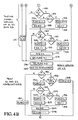
- Fig. 4 a unitary drawing illustrating in flowchart form the coefficient update method of the instant invention, the method begins with the current values of the coefficients C1, C2, C3 and the current direction (DIR) of movement through the coded tap values. These values are set at block 100 of Fig. 4A.
- a variable MASK1 is set to 7 in a block 101 preceding block 100.
- MASK1 is used in a subroutine COMMON described hereinafter.
- Block 102 is next entered which calls for splitting the coefficients into their sign and shift code portions and the setting of various flags used later in the method.
- a FLAG 1 and FLAG2 are initially used to indicate detection of tailend sequence in C3; later FLAG2 and a FLAG 3 are set to ZERO if no coefficient updating is to be performed, set to ONE if coefficient incrementation is to be performed, and set to minus ONE if coefficient decrementation is to be performed.
- a block 104 is next entered which begins the method by the updating of C3 and accordingly a S3FLAG is set to ZERO in block 104; S3FLAG indicates reversal of direction of movement through the C3 coefficient values.
- a decision block 106 is next entered which tests whether S1 exor S2 is a ONE. This block implements the exclusive-OR function described above and determines the proper direction of movement through the C3 coefficient values.
- Block 108 invokes a subroutine called "COMMON” which is illustrated in flowchart form as Fig. 4D.
- COMMON a subroutine which is illustrated in flowchart form as Fig. 4D.
- a description of the COMMON subroutine will be given below in connection with Fig. 4D.
- Block 118 leads to a decision block 120 which tests whether M1 is less than ZERO. If not, the N exit is taken which completes the update of C3 portion; if so, Y-exit is taken and M1 is set to ZERO in a block 122 which then completes the update of C3 portion.
- a decision block 124 is first entered which tests whether S1 equals ZERO AND S2 equals ZERO. If so, a Y-exit leads to a decision block 126 which tests whether S3 equals ZERO. If so, a Y-exit leads to block 128 which sets FLAG3 to ONE and then to a block 130 which sets S3 to ONE. If S3 does not equal ZERO, a N-exit of block 126 leads to a block 132 which sets FLAG3 to minus one and then to a block 134 which sets S3 to ZERO.
- a decision block 136 is executed which performs analogous tests of S1 equals ZERO and S2 equals ONE.
- a decision block 148 is executed which performs analogous tests if S1 equals ONE and S2 equals ONE.
- a complete descripton of this portion of the flowchart of Fig. 4B, comprising a decision block 150 and blocks 152, 154, 156 and 158 is omitted in the interest of brevity.
- a decision block 160 is executed which performs analogous tests if S1 equals ONE and S2 equals ZERO.
- a complete description of this portion of the flowchart of Fig. 4B, comprising a decision block 162 and blocks 164, 166, 168 and 170 is likewise omitted.
- a block 172 is entered which sets M3 to 2 and then a block 174 is entered which sets S3FLAG to 1.
- the C3 update portion of the method of the preent invention is completed and a block 178 is entered which begins the update of C2.
- the sign of C3 (S3) has been set and the shift code of C3(M3) has been set to 2.
- Block 178 sets S2FLAG to ZERO and thereupon a block 180 is entered which invokes the subroutine "COMMON".
- COMMON Upon return from COMMON a decision block 182 is entered which tests whether M2 is less than 2. The N-exit of block 182 leads to a block 184 which sets FLAG2 to ZERO.
- the Y-exit of block 182 leads to a decision block 186 which tests whether FLAG1 equals ZERO AND S2 equals ZERO. This test determines whether the end of region for M1 has been reached with C2 positive. If so, the Y-exit leads to a block 188 which sets FLAG2 to ZERO. The N-exit leads to a block 190 which sets FLAG2 to minus ONE and then on to a decision block 192.
- Block 192, a decision block 194 and blocks 196, 198, 200 and 202 perform an analogous ex-or function to that performed by blocks 136, 138, 140, 142, 144 and 146 described herein above and will not be described in further detail.
- a block 204 is entered which sets M2 to 2 and then a block 206 is entered which sets S2FLAG to 1.
- a decision block 208 (Fig. 4C) is entered which begins the update of C1.
- the sign of C2(S2) has been set and the shift code of C2 (M2) has been set to 2.
- decision block 208 tests whether DX equals ONE and S1 equals ONE. This determines a Y-exit of block 208 leads to a block 210 which sets FLAG2 to its opposite value -FLAG2. Upon execution of block 210 or the N-exit of block 208, a block 212 is executed which invokes the COMMON subroutine.
- a decision block 214 Upon return from COMMON, a decision block 214 is executed which implements the ex-or functions described hereinabove. These ex-or functions set S2 and S3 by portions of the flowchart of Fig. 4C comprising decision blocks 216, 218, 224, 226 and 228 and blocks 220, 222, 230 and 232. In the interests of brevity their descriptions will be omitted.
- Block 234 sets S3 to the sign portion of S3, a block 236 is next entered which sets S2 to the sign portion of S2 and a block 238 is next entered which sets S1 to the sign portion of S1.
- a block 240 is next entered which sets C3 to the sign plus shift code portions of M3.
- a block 242 is next entered which sets C2 to the sign plus shift code portions of M2 and a block 244 is next entered which sets C1 to the sign plus shift code portions of M1.
- a block 246 is entered which calls for reporting the updated values of C1, C2 and C3.
- a flowchart of the COMMON subroutine is shown. Entry to COMMON is by the way of a block 248 which leads to a decision block 250 which tests the S parameter, which will be S3, S2 or S1 depending on whether the subroutine is invoked at block 110, block 180 or block 212, respectively, equals ONE. If so, the Y-exit leads to a block 252 which sets the M parameter, which will be M3 M2 or M1, respectively, to 15-M.
- a block 254 executed which sets the M parameter to M-DIR.
- the DIR parameter will be DIR, FLAG 3 or FLAG2, respectively, depending on whether the subroutine is invoked at block 110, block 180 or block 212, respectively. This parameter determines whether incrementation, decrementation or no change will be effected in this invokation of COMMON.
- a block 256 is entered which sets the S parameter to the M parameter.
- a block 258 is entered which sets the S parameter to the sign portion of S.
- a block 260 is next entered which forms the logical AND of the M parameter with the MASK1 value and sets M to the result.
- a decision block 262 is entered from block 260 which tests whether the S parameter equals ONE, if so the Y-exit leads to a block 264 which sets M to MASK1-M. Following execution of block 264 or the N exit of block 262 the COMMON routine exists via a block 266 to return to the envoking block 110, 150 or 212 and the parameters S3 and M3, S2 and M2 or S1 and M1 will have been accordingly modified.
Landscapes
- Engineering & Computer Science (AREA)
- Physics & Mathematics (AREA)
- Computer Hardware Design (AREA)
- Mathematical Physics (AREA)
- Computing Systems (AREA)
- Theoretical Computer Science (AREA)
- Complex Calculations (AREA)
- Error Detection And Correction (AREA)
- Optical Recording Or Reproduction (AREA)
- Emergency Protection Circuit Devices (AREA)
- Electrophonic Musical Instruments (AREA)
- Filters That Use Time-Delay Elements (AREA)
Priority Applications (1)
| Application Number | Priority Date | Filing Date | Title |
|---|---|---|---|
| AT88304271T ATE91831T1 (de) | 1987-05-18 | 1988-05-11 | Aufbesserung von kanonischen, mit vorzeichenziffern behafteten filterkoeffizienten. |
Applications Claiming Priority (2)
| Application Number | Priority Date | Filing Date | Title |
|---|---|---|---|
| US5209187A | 1987-05-18 | 1987-05-18 | |
| US52091 | 1987-05-18 |
Publications (3)
| Publication Number | Publication Date |
|---|---|
| EP0292189A2 true EP0292189A2 (de) | 1988-11-23 |
| EP0292189A3 EP0292189A3 (en) | 1989-03-29 |
| EP0292189B1 EP0292189B1 (de) | 1993-07-21 |
Family
ID=21975415
Family Applications (1)
| Application Number | Title | Priority Date | Filing Date |
|---|---|---|---|
| EP88304271A Expired - Lifetime EP0292189B1 (de) | 1987-05-18 | 1988-05-11 | Aufbesserung von kanonischen, mit Vorzeichenziffern behafteten Filterkoeffizienten |
Country Status (4)
| Country | Link |
|---|---|
| EP (1) | EP0292189B1 (de) |
| JP (1) | JPS6471210A (de) |
| AT (1) | ATE91831T1 (de) |
| DE (1) | DE3882435T2 (de) |
Cited By (5)
| Publication number | Priority date | Publication date | Assignee | Title |
|---|---|---|---|---|
| EP0766388A3 (de) * | 1995-09-30 | 1998-01-07 | Samsung Electronics Co., Ltd. | Signalverarbeitungsverfahren in CSD-Filter und Schaltung dafür |
| WO1999044286A3 (en) * | 1998-02-27 | 1999-12-02 | Koninkl Philips Electronics Nv | Sharing resources in a digital filter |
| CN1059993C (zh) * | 1994-03-07 | 2000-12-27 | 现代电子产业株式会社 | 有限脉冲响应自适应数字滤波器的波带系数更新装置 |
| US7164712B2 (en) * | 1999-12-09 | 2007-01-16 | Koninklijke Philips Electronics N.V. | Reconfigurable FIR filter using CSD coefficient representation |
| CN102314215A (zh) * | 2011-09-27 | 2012-01-11 | 西安电子科技大学 | 集成电路系统中小数乘法器的低功耗优化方法 |
Families Citing this family (5)
| Publication number | Priority date | Publication date | Assignee | Title |
|---|---|---|---|---|
| US5012245A (en) * | 1989-10-04 | 1991-04-30 | At&T Bell Laboratories | Integral switched capacitor FIR filter/digital-to-analog converter for sigma-delta encoded digital audio |
| KR0139157B1 (ko) * | 1994-09-07 | 1998-05-15 | 김광호 | 정준표시된 필터계수를 이용하는 고스트 제거장치 |
| ES2164836T3 (es) * | 1995-09-19 | 2002-03-01 | Daiwa Kasei Kogyo Kk | Patas de retencion de un componente. |
| DE19624382C1 (de) * | 1996-06-19 | 1998-01-02 | Bosch Gmbh Robert | Klemmvorrichtung |
| JP2003042112A (ja) * | 2001-07-26 | 2003-02-13 | Okamura Corp | 止め具 |
-
1988
- 1988-05-11 AT AT88304271T patent/ATE91831T1/de not_active IP Right Cessation
- 1988-05-11 EP EP88304271A patent/EP0292189B1/de not_active Expired - Lifetime
- 1988-05-11 DE DE88304271T patent/DE3882435T2/de not_active Expired - Fee Related
- 1988-05-17 JP JP63120396A patent/JPS6471210A/ja active Pending
Non-Patent Citations (3)
| Title |
|---|
| ELECTRONIC DESIGN, vol. 35, no. 10, 30th April 1987, pages 68,70,72; D. BURSKY: "Three CMOS DSP chips rev up FIR filtering" * |
| IEEE TRANSACTIONS ON ACOUSTICS, SPEECH, AND SIGNAL PROCESSING, vol. ASSP-28, no. 5, October 1980, pages 590-592, IEEE, New York, US; R.H. SEEGAL: "The canonical signed digit code structure for FIR filters" * |
| IRE TRANSACTIONS ON ELECTRONIC COMPUTERS, vol. EC-10, no. 3, 1961, pages 389-400; A. AVIZIENIS: "Signed-digit numbe representations for fast parallel arithmetic" * |
Cited By (7)
| Publication number | Priority date | Publication date | Assignee | Title |
|---|---|---|---|---|
| CN1059993C (zh) * | 1994-03-07 | 2000-12-27 | 现代电子产业株式会社 | 有限脉冲响应自适应数字滤波器的波带系数更新装置 |
| EP0766388A3 (de) * | 1995-09-30 | 1998-01-07 | Samsung Electronics Co., Ltd. | Signalverarbeitungsverfahren in CSD-Filter und Schaltung dafür |
| CN1084965C (zh) * | 1995-09-30 | 2002-05-15 | 三星电子株式会社 | 在csd滤波器中处理信号的方法及适用于该方法的电路 |
| WO1999044286A3 (en) * | 1998-02-27 | 1999-12-02 | Koninkl Philips Electronics Nv | Sharing resources in a digital filter |
| US7164712B2 (en) * | 1999-12-09 | 2007-01-16 | Koninklijke Philips Electronics N.V. | Reconfigurable FIR filter using CSD coefficient representation |
| CN102314215A (zh) * | 2011-09-27 | 2012-01-11 | 西安电子科技大学 | 集成电路系统中小数乘法器的低功耗优化方法 |
| CN102314215B (zh) * | 2011-09-27 | 2014-03-12 | 西安电子科技大学 | 集成电路系统中小数乘法器的低功耗优化方法 |
Also Published As
| Publication number | Publication date |
|---|---|
| EP0292189B1 (de) | 1993-07-21 |
| EP0292189A3 (en) | 1989-03-29 |
| DE3882435T2 (de) | 1994-01-27 |
| JPS6471210A (en) | 1989-03-16 |
| ATE91831T1 (de) | 1993-08-15 |
| DE3882435D1 (de) | 1993-08-26 |
Similar Documents
| Publication | Publication Date | Title |
|---|---|---|
| SU1313362A3 (ru) | Цифровой фильтр | |
| US5726924A (en) | Exponentiation circuit utilizing shift means and method of using same | |
| US6131105A (en) | Calculation of a scalar product in a direct-type FIR filter | |
| EP0292189A2 (de) | Aufbesserung von kanonischen, mit Vorzeichenziffern behafteten Filterkoeffizienten | |
| JP2779617B2 (ja) | 有限インパルス応答フィルタ | |
| EP0182602A2 (de) | Digitales Filter | |
| US5838725A (en) | Floating point digital transversal filter | |
| US4185325A (en) | Recursive digital filter having coefficients equal to sums of few powers of few powers of two terms | |
| US5191547A (en) | Decimating digital finite impulse response filter | |
| EP0034241B1 (de) | Nichtrekursives digitales Filter | |
| US5862068A (en) | Arithmetic circuit for calculating a square-root of a sum of squares | |
| US4623872A (en) | Circuit for CSD-coding of a binary number represented in two's complement | |
| US5189634A (en) | Digital signal processing apparatus for detecting a frequency component of digital signals | |
| US5798954A (en) | Digital filter device having a bit shifter unit | |
| US5381356A (en) | Cascade digital filters for realizing a transfer function obtained by cascade-connecting moving average filters | |
| JPH02281811A (ja) | ディジタルフィルタ処理装置 | |
| US4931973A (en) | Method of generating updated transversal filter coefficients | |
| US5912827A (en) | Digital filter with low rolloff factor | |
| JPH10509011A (ja) | 改良されたディジタルフィルタ | |
| EP0261848B1 (de) | Klangfarbenregelung für bemusterte Daten | |
| EP0156648A2 (de) | Arithmetische Konvolutionsschaltung für digitale Signalverarbeitung | |
| JPS6116110B2 (de) | ||
| JPH07109975B2 (ja) | ディジタルフィルタ | |
| US5463575A (en) | Reduced quantization noise from single-precision multiplier | |
| JP3008842B2 (ja) | ディジタルフィルタ |
Legal Events
| Date | Code | Title | Description |
|---|---|---|---|
| PUAI | Public reference made under article 153(3) epc to a published international application that has entered the european phase |
Free format text: ORIGINAL CODE: 0009012 |
|
| AK | Designated contracting states |
Kind code of ref document: A2 Designated state(s): AT BE CH DE ES FR GB GR IT LI LU NL SE |
|
| PUAL | Search report despatched |
Free format text: ORIGINAL CODE: 0009013 |
|
| AK | Designated contracting states |
Kind code of ref document: A3 Designated state(s): AT BE CH DE ES FR GB GR IT LI LU NL SE |
|
| 17P | Request for examination filed |
Effective date: 19890619 |
|
| 17Q | First examination report despatched |
Effective date: 19920210 |
|
| GRAA | (expected) grant |
Free format text: ORIGINAL CODE: 0009210 |
|
| AK | Designated contracting states |
Kind code of ref document: B1 Designated state(s): AT BE CH DE ES FR GB GR IT LI LU NL SE |
|
| PG25 | Lapsed in a contracting state [announced via postgrant information from national office to epo] |
Ref country code: IT Free format text: LAPSE BECAUSE OF FAILURE TO SUBMIT A TRANSLATION OF THE DESCRIPTION OR TO PAY THE FEE WITHIN THE PRE;WARNING: LAPSES OF ITALIAN PATENTS WITH EFFECTIVE DATE BEFORE 2007 MAY HAVE OCCURRED AT ANY TIME BEFORE 2007. THE CORRECT EFFECTIVE DATE MAY BE DIFFERENT FROM THE ONE RECORDED.SCRIBED TIME-LIMIT Effective date: 19930721 Ref country code: CH Effective date: 19930721 Ref country code: ES Free format text: THE PATENT HAS BEEN ANNULLED BY A DECISION OF A NATIONAL AUTHORITY Effective date: 19930721 Ref country code: GR Free format text: LAPSE BECAUSE OF FAILURE TO SUBMIT A TRANSLATION OF THE DESCRIPTION OR TO PAY THE FEE WITHIN THE PRESCRIBED TIME-LIMIT Effective date: 19930721 Ref country code: AT Effective date: 19930721 Ref country code: BE Effective date: 19930721 Ref country code: NL Effective date: 19930721 Ref country code: LI Effective date: 19930721 Ref country code: SE Effective date: 19930721 |
|
| REF | Corresponds to: |
Ref document number: 91831 Country of ref document: AT Date of ref document: 19930815 Kind code of ref document: T |
|
| REF | Corresponds to: |
Ref document number: 3882435 Country of ref document: DE Date of ref document: 19930826 |
|
| REG | Reference to a national code |
Ref country code: CH Ref legal event code: PL |
|
| ET | Fr: translation filed | ||
| NLV1 | Nl: lapsed or annulled due to failure to fulfill the requirements of art. 29p and 29m of the patents act | ||
| PLBE | No opposition filed within time limit |
Free format text: ORIGINAL CODE: 0009261 |
|
| STAA | Information on the status of an ep patent application or granted ep patent |
Free format text: STATUS: NO OPPOSITION FILED WITHIN TIME LIMIT |
|
| PG25 | Lapsed in a contracting state [announced via postgrant information from national office to epo] |
Ref country code: LU Free format text: LAPSE BECAUSE OF NON-PAYMENT OF DUE FEES Effective date: 19940531 |
|
| 26N | No opposition filed | ||
| PGFP | Annual fee paid to national office [announced via postgrant information from national office to epo] |
Ref country code: GB Payment date: 19980403 Year of fee payment: 11 |
|
| PGFP | Annual fee paid to national office [announced via postgrant information from national office to epo] |
Ref country code: FR Payment date: 19980508 Year of fee payment: 11 |
|
| PGFP | Annual fee paid to national office [announced via postgrant information from national office to epo] |
Ref country code: DE Payment date: 19980529 Year of fee payment: 11 |
|
| PG25 | Lapsed in a contracting state [announced via postgrant information from national office to epo] |
Ref country code: GB Free format text: LAPSE BECAUSE OF NON-PAYMENT OF DUE FEES Effective date: 19990511 |
|
| GBPC | Gb: european patent ceased through non-payment of renewal fee |
Effective date: 19990511 |
|
| PG25 | Lapsed in a contracting state [announced via postgrant information from national office to epo] |
Ref country code: FR Free format text: LAPSE BECAUSE OF NON-PAYMENT OF DUE FEES Effective date: 20000131 |
|
| PG25 | Lapsed in a contracting state [announced via postgrant information from national office to epo] |
Ref country code: DE Free format text: LAPSE BECAUSE OF NON-PAYMENT OF DUE FEES Effective date: 20000301 |
|
| REG | Reference to a national code |
Ref country code: FR Ref legal event code: ST |