EP0292348A1 - Dérivés hétérocycliques polycycliques , leur procédé de préparation et leur utilisation en médecine humaine et vétérinaire - Google Patents
Dérivés hétérocycliques polycycliques , leur procédé de préparation et leur utilisation en médecine humaine et vétérinaire Download PDFInfo
- Publication number
- EP0292348A1 EP0292348A1 EP88401062A EP88401062A EP0292348A1 EP 0292348 A1 EP0292348 A1 EP 0292348A1 EP 88401062 A EP88401062 A EP 88401062A EP 88401062 A EP88401062 A EP 88401062A EP 0292348 A1 EP0292348 A1 EP 0292348A1
- Authority
- EP
- European Patent Office
- Prior art keywords
- tetrahydro
- tetramethyl
- radical
- benzoic acid
- naphth
- Prior art date
- Legal status (The legal status is an assumption and is not a legal conclusion. Google has not performed a legal analysis and makes no representation as to the accuracy of the status listed.)
- Granted
Links
- 239000003814 drug Substances 0.000 title claims abstract description 5
- 238000002360 preparation method Methods 0.000 title claims description 5
- 229940079593 drug Drugs 0.000 title description 2
- -1 Polycyclic heterocyclic compounds Chemical class 0.000 claims abstract description 71
- 150000001875 compounds Chemical class 0.000 claims abstract description 54
- 150000003254 radicals Chemical class 0.000 claims abstract description 37
- 125000004435 hydrogen atom Chemical group [H]* 0.000 claims abstract description 19
- 229910052717 sulfur Inorganic materials 0.000 claims abstract description 9
- 230000000699 topical effect Effects 0.000 claims abstract description 8
- 229910052757 nitrogen Inorganic materials 0.000 claims abstract description 7
- 125000004430 oxygen atom Chemical group O* 0.000 claims abstract description 7
- 125000004434 sulfur atom Chemical group 0.000 claims abstract description 7
- 125000000623 heterocyclic group Chemical group 0.000 claims abstract description 6
- 125000004433 nitrogen atom Chemical group N* 0.000 claims abstract description 6
- 125000003107 substituted aryl group Chemical group 0.000 claims abstract description 5
- 150000001413 amino acids Chemical class 0.000 claims abstract description 3
- 125000003118 aryl group Chemical group 0.000 claims abstract description 3
- 125000003712 glycosamine group Chemical group 0.000 claims abstract 2
- 239000000203 mixture Substances 0.000 claims description 76
- WPYMKLBDIGXBTP-UHFFFAOYSA-N benzoic acid Chemical compound OC(=O)C1=CC=CC=C1 WPYMKLBDIGXBTP-UHFFFAOYSA-N 0.000 claims description 51
- 150000004702 methyl esters Chemical class 0.000 claims description 43
- UCSCEMCBOBWMKF-UHFFFAOYSA-N 4-(5,5,8,8-tetramethyl-6,7-dihydrobenzo[f][1,3]benzoxazol-2-yl)benzoic acid Chemical compound N=1C=2C=C3C(C)(C)CCC(C)(C)C3=CC=2OC=1C1=CC=C(C(O)=O)C=C1 UCSCEMCBOBWMKF-UHFFFAOYSA-N 0.000 claims description 19
- 239000005711 Benzoic acid Substances 0.000 claims description 18
- 235000010233 benzoic acid Nutrition 0.000 claims description 18
- 238000000034 method Methods 0.000 claims description 12
- VZGDMQKNWNREIO-UHFFFAOYSA-N tetrachloromethane Chemical compound ClC(Cl)(Cl)Cl VZGDMQKNWNREIO-UHFFFAOYSA-N 0.000 claims description 12
- 125000001544 thienyl group Chemical group 0.000 claims description 11
- 150000003839 salts Chemical class 0.000 claims description 10
- PCLIMKBDDGJMGD-UHFFFAOYSA-N N-bromosuccinimide Chemical compound BrN1C(=O)CCC1=O PCLIMKBDDGJMGD-UHFFFAOYSA-N 0.000 claims description 9
- CTQNGGLPUBDAKN-UHFFFAOYSA-N O-Xylene Chemical compound CC1=CC=CC=C1C CTQNGGLPUBDAKN-UHFFFAOYSA-N 0.000 claims description 9
- YXFVVABEGXRONW-UHFFFAOYSA-N Toluene Chemical compound CC1=CC=CC=C1 YXFVVABEGXRONW-UHFFFAOYSA-N 0.000 claims description 9
- 125000004432 carbon atom Chemical group C* 0.000 claims description 9
- 239000008096 xylene Substances 0.000 claims description 9
- 239000002537 cosmetic Substances 0.000 claims description 8
- UHOVQNZJYSORNB-UHFFFAOYSA-N Benzene Chemical compound C1=CC=CC=C1 UHOVQNZJYSORNB-UHFFFAOYSA-N 0.000 claims description 6
- WVDDGKGOMKODPV-UHFFFAOYSA-N hydroxymethyl benzene Natural products OCC1=CC=CC=C1 WVDDGKGOMKODPV-UHFFFAOYSA-N 0.000 claims description 6
- JOXIMZWYDAKGHI-UHFFFAOYSA-N toluene-4-sulfonic acid Chemical compound CC1=CC=C(S(O)(=O)=O)C=C1 JOXIMZWYDAKGHI-UHFFFAOYSA-N 0.000 claims description 6
- FWTYUXRUIWOXIW-UHFFFAOYSA-N 4-(5,5,8,8-tetramethyl-6,7-dihydro-1h-benzo[f]benzimidazol-2-yl)benzoic acid Chemical compound N=1C=2C=C3C(C)(C)CCC(C)(C)C3=CC=2NC=1C1=CC=C(C(O)=O)C=C1 FWTYUXRUIWOXIW-UHFFFAOYSA-N 0.000 claims description 5
- DVFFLLLQQVHGHJ-UHFFFAOYSA-N 4-(5,5,8,8-tetramethyl-6,7-dihydro-1h-benzo[f]indol-2-yl)benzoic acid Chemical compound C=1C=2C=C3C(C)(C)CCC(C)(C)C3=CC=2NC=1C1=CC=C(C(O)=O)C=C1 DVFFLLLQQVHGHJ-UHFFFAOYSA-N 0.000 claims description 5
- 238000007363 ring formation reaction Methods 0.000 claims description 5
- 125000002541 furyl group Chemical group 0.000 claims description 4
- 125000002887 hydroxy group Chemical group [H]O* 0.000 claims description 4
- 125000002496 methyl group Chemical group [H]C([H])([H])* 0.000 claims description 4
- 235000019445 benzyl alcohol Nutrition 0.000 claims description 3
- 238000005893 bromination reaction Methods 0.000 claims description 3
- 125000001495 ethyl group Chemical group [H]C([H])([H])C([H])([H])* 0.000 claims description 3
- 239000012442 inert solvent Substances 0.000 claims description 3
- 239000008194 pharmaceutical composition Substances 0.000 claims description 3
- 230000000241 respiratory effect Effects 0.000 claims description 3
- 125000000954 2-hydroxyethyl group Chemical group [H]C([*])([H])C([H])([H])O[H] 0.000 claims description 2
- KBOPQHHLZCRQAS-UHFFFAOYSA-N 4-(1,5,5,8,8-pentamethyl-6,7-dihydrobenzo[f]indol-2-yl)benzoic acid Chemical compound C=1C2=CC(C(CCC3(C)C)(C)C)=C3C=C2N(C)C=1C1=CC=C(C(O)=O)C=C1 KBOPQHHLZCRQAS-UHFFFAOYSA-N 0.000 claims description 2
- LSNNMFCWUKXFEE-UHFFFAOYSA-M Bisulfite Chemical compound OS([O-])=O LSNNMFCWUKXFEE-UHFFFAOYSA-M 0.000 claims description 2
- 238000006546 Horner-Wadsworth-Emmons reaction Methods 0.000 claims description 2
- 208000025747 Rheumatic disease Diseases 0.000 claims description 2
- 238000007239 Wittig reaction Methods 0.000 claims description 2
- CIUQDSCDWFSTQR-UHFFFAOYSA-N [C]1=CC=CC=C1 Chemical compound [C]1=CC=CC=C1 CIUQDSCDWFSTQR-UHFFFAOYSA-N 0.000 claims description 2
- 239000003377 acid catalyst Substances 0.000 claims description 2
- 150000005840 aryl radicals Chemical class 0.000 claims description 2
- 230000037396 body weight Effects 0.000 claims description 2
- 125000000484 butyl group Chemical group [H]C([*])([H])C([H])([H])C([H])([H])C([H])([H])[H] 0.000 claims description 2
- 125000002349 hydroxyamino group Chemical group [H]ON([H])[*] 0.000 claims description 2
- 125000001449 isopropyl group Chemical group [H]C([H])([H])C([H])(*)C([H])([H])[H] 0.000 claims description 2
- WCYWZMWISLQXQU-UHFFFAOYSA-N methyl Chemical compound [CH3] WCYWZMWISLQXQU-UHFFFAOYSA-N 0.000 claims description 2
- 125000000449 nitro group Chemical group [O-][N+](*)=O 0.000 claims description 2
- WXZMFSXDPGVJKK-UHFFFAOYSA-N pentaerythritol Chemical compound OCC(CO)(CO)CO WXZMFSXDPGVJKK-UHFFFAOYSA-N 0.000 claims description 2
- 125000005328 phosphinyl group Chemical group [PH2](=O)* 0.000 claims description 2
- XYFCBTPGUUZFHI-UHFFFAOYSA-O phosphonium Chemical compound [PH4+] XYFCBTPGUUZFHI-UHFFFAOYSA-O 0.000 claims description 2
- 230000000552 rheumatic effect Effects 0.000 claims description 2
- 229910052760 oxygen Inorganic materials 0.000 claims 2
- 230000031709 bromination Effects 0.000 claims 1
- 229910052736 halogen Inorganic materials 0.000 claims 1
- 150000002367 halogens Chemical class 0.000 claims 1
- 238000004519 manufacturing process Methods 0.000 claims 1
- 230000009885 systemic effect Effects 0.000 abstract description 2
- YMWUJEATGCHHMB-UHFFFAOYSA-N Dichloromethane Chemical compound ClCCl YMWUJEATGCHHMB-UHFFFAOYSA-N 0.000 description 131
- RTZKZFJDLAIYFH-UHFFFAOYSA-N Diethyl ether Chemical compound CCOCC RTZKZFJDLAIYFH-UHFFFAOYSA-N 0.000 description 70
- VLKZOEOYAKHREP-UHFFFAOYSA-N n-Hexane Chemical compound CCCCCC VLKZOEOYAKHREP-UHFFFAOYSA-N 0.000 description 69
- XLYOFNOQVPJJNP-UHFFFAOYSA-N water Substances O XLYOFNOQVPJJNP-UHFFFAOYSA-N 0.000 description 47
- WYURNTSHIVDZCO-UHFFFAOYSA-N Tetrahydrofuran Chemical compound C1CCOC1 WYURNTSHIVDZCO-UHFFFAOYSA-N 0.000 description 46
- 239000012074 organic phase Substances 0.000 description 36
- CSNNHWWHGAXBCP-UHFFFAOYSA-L Magnesium sulfate Chemical compound [Mg+2].[O-][S+2]([O-])([O-])[O-] CSNNHWWHGAXBCP-UHFFFAOYSA-L 0.000 description 35
- 239000002904 solvent Substances 0.000 description 35
- 239000000155 melt Substances 0.000 description 34
- OKKJLVBELUTLKV-UHFFFAOYSA-N Methanol Chemical compound OC OKKJLVBELUTLKV-UHFFFAOYSA-N 0.000 description 30
- VYPSYNLAJGMNEJ-UHFFFAOYSA-N Silicium dioxide Chemical compound O=[Si]=O VYPSYNLAJGMNEJ-UHFFFAOYSA-N 0.000 description 28
- VEXZGXHMUGYJMC-UHFFFAOYSA-N Hydrochloric acid Chemical compound Cl VEXZGXHMUGYJMC-UHFFFAOYSA-N 0.000 description 24
- FAPWRFPIFSIZLT-UHFFFAOYSA-M Sodium chloride Chemical compound [Na+].[Cl-] FAPWRFPIFSIZLT-UHFFFAOYSA-M 0.000 description 24
- ZMANZCXQSJIPKH-UHFFFAOYSA-N Triethylamine Chemical compound CCN(CC)CC ZMANZCXQSJIPKH-UHFFFAOYSA-N 0.000 description 24
- 239000000243 solution Substances 0.000 description 24
- YLQBMQCUIZJEEH-UHFFFAOYSA-N tetrahydrofuran Natural products C=1C=COC=1 YLQBMQCUIZJEEH-UHFFFAOYSA-N 0.000 description 23
- 238000010992 reflux Methods 0.000 description 20
- 239000007787 solid Substances 0.000 description 18
- 229910052943 magnesium sulfate Inorganic materials 0.000 description 17
- 235000019341 magnesium sulphate Nutrition 0.000 description 17
- 239000011777 magnesium Substances 0.000 description 16
- 239000000047 product Substances 0.000 description 16
- 150000002148 esters Chemical class 0.000 description 15
- 239000012047 saturated solution Substances 0.000 description 15
- ZMXDDKWLCZADIW-UHFFFAOYSA-N N,N-Dimethylformamide Chemical compound CN(C)C=O ZMXDDKWLCZADIW-UHFFFAOYSA-N 0.000 description 14
- 239000012429 reaction media Substances 0.000 description 14
- 239000000377 silicon dioxide Substances 0.000 description 14
- WFDIJRYMOXRFFG-UHFFFAOYSA-N Acetic anhydride Chemical compound CC(=O)OC(C)=O WFDIJRYMOXRFFG-UHFFFAOYSA-N 0.000 description 12
- HEMHJVSKTPXQMS-UHFFFAOYSA-M Sodium hydroxide Chemical compound [OH-].[Na+] HEMHJVSKTPXQMS-UHFFFAOYSA-M 0.000 description 12
- 239000011780 sodium chloride Substances 0.000 description 12
- 239000002253 acid Substances 0.000 description 10
- 238000004587 chromatography analysis Methods 0.000 description 10
- 239000006196 drop Substances 0.000 description 10
- RIOQSEWOXXDEQQ-UHFFFAOYSA-N triphenylphosphine Chemical compound C1=CC=CC=C1P(C=1C=CC=CC=1)C1=CC=CC=C1 RIOQSEWOXXDEQQ-UHFFFAOYSA-N 0.000 description 10
- QTBSBXVTEAMEQO-UHFFFAOYSA-N Acetic acid Chemical compound CC(O)=O QTBSBXVTEAMEQO-UHFFFAOYSA-N 0.000 description 9
- UIIMBOGNXHQVGW-UHFFFAOYSA-M Sodium bicarbonate Chemical class [Na+].OC([O-])=O UIIMBOGNXHQVGW-UHFFFAOYSA-M 0.000 description 9
- 239000008346 aqueous phase Substances 0.000 description 8
- 239000003480 eluent Substances 0.000 description 8
- QPJVMBTYPHYUOC-UHFFFAOYSA-N methyl benzoate Chemical compound COC(=O)C1=CC=CC=C1 QPJVMBTYPHYUOC-UHFFFAOYSA-N 0.000 description 8
- LFQSCWFLJHTTHZ-UHFFFAOYSA-N Ethanol Chemical compound CCO LFQSCWFLJHTTHZ-UHFFFAOYSA-N 0.000 description 7
- 239000003795 chemical substances by application Substances 0.000 description 7
- 238000004440 column chromatography Methods 0.000 description 7
- WADSJYLPJPTMLN-UHFFFAOYSA-N 3-(cycloundecen-1-yl)-1,2-diazacycloundec-2-ene Chemical compound C1CCCCCCCCC=C1C1=NNCCCCCCCC1 WADSJYLPJPTMLN-UHFFFAOYSA-N 0.000 description 6
- VSCWAEJMTAWNJL-UHFFFAOYSA-K aluminium trichloride Chemical compound Cl[Al](Cl)Cl VSCWAEJMTAWNJL-UHFFFAOYSA-K 0.000 description 6
- 239000004342 Benzoyl peroxide Substances 0.000 description 5
- OMPJBNCRMGITSC-UHFFFAOYSA-N Benzoylperoxide Chemical compound C=1C=CC=CC=1C(=O)OOC(=O)C1=CC=CC=C1 OMPJBNCRMGITSC-UHFFFAOYSA-N 0.000 description 5
- 150000001408 amides Chemical class 0.000 description 5
- 150000001412 amines Chemical class 0.000 description 5
- 235000019400 benzoyl peroxide Nutrition 0.000 description 5
- 239000002775 capsule Substances 0.000 description 5
- 125000003917 carbamoyl group Chemical group [H]N([H])C(*)=O 0.000 description 5
- 239000007789 gas Substances 0.000 description 5
- 239000000543 intermediate Substances 0.000 description 5
- 238000003756 stirring Methods 0.000 description 5
- NGNBDVOYPDDBFK-UHFFFAOYSA-N 2-[2,4-di(pentan-2-yl)phenoxy]acetyl chloride Chemical compound CCCC(C)C1=CC=C(OCC(Cl)=O)C(C(C)CCC)=C1 NGNBDVOYPDDBFK-UHFFFAOYSA-N 0.000 description 4
- PEDCQBHIVMGVHV-UHFFFAOYSA-N Glycerine Chemical compound OCC(O)CO PEDCQBHIVMGVHV-UHFFFAOYSA-N 0.000 description 4
- KEAYESYHFKHZAL-UHFFFAOYSA-N Sodium Chemical compound [Na] KEAYESYHFKHZAL-UHFFFAOYSA-N 0.000 description 4
- UIIMBOGNXHQVGW-DEQYMQKBSA-M Sodium bicarbonate-14C Chemical compound [Na+].O[14C]([O-])=O UIIMBOGNXHQVGW-DEQYMQKBSA-M 0.000 description 4
- GWEVSGVZZGPLCZ-UHFFFAOYSA-N Titan oxide Chemical compound O=[Ti]=O GWEVSGVZZGPLCZ-UHFFFAOYSA-N 0.000 description 4
- HUMNYLRZRPPJDN-UHFFFAOYSA-N benzaldehyde Chemical compound O=CC1=CC=CC=C1 HUMNYLRZRPPJDN-UHFFFAOYSA-N 0.000 description 4
- 230000015572 biosynthetic process Effects 0.000 description 4
- PFKFTWBEEFSNDU-UHFFFAOYSA-N carbonyldiimidazole Chemical compound C1=CN=CN1C(=O)N1C=CN=C1 PFKFTWBEEFSNDU-UHFFFAOYSA-N 0.000 description 4
- HQKMJHAJHXVSDF-UHFFFAOYSA-L magnesium stearate Chemical compound [Mg+2].CCCCCCCCCCCCCCCCCC([O-])=O.CCCCCCCCCCCCCCCCCC([O-])=O HQKMJHAJHXVSDF-UHFFFAOYSA-L 0.000 description 4
- GLDOVTGHNKAZLK-UHFFFAOYSA-N octadecan-1-ol Chemical compound CCCCCCCCCCCCCCCCCCO GLDOVTGHNKAZLK-UHFFFAOYSA-N 0.000 description 4
- 125000002971 oxazolyl group Chemical group 0.000 description 4
- 229910000104 sodium hydride Inorganic materials 0.000 description 4
- 239000012312 sodium hydride Substances 0.000 description 4
- 238000003786 synthesis reaction Methods 0.000 description 4
- AISXBZVAYNUAKB-UHFFFAOYSA-N 1,1,4,4,6-pentamethyl-2,3-dihydronaphthalene Chemical compound CC1(C)CCC(C)(C)C=2C1=CC(C)=CC=2 AISXBZVAYNUAKB-UHFFFAOYSA-N 0.000 description 3
- XVZPKKJRSGUSNP-UHFFFAOYSA-N 1,1,4,4-tetramethyl-6,7-dinitro-2,3-dihydronaphthalene Chemical compound [O-][N+](=O)C1=C([N+]([O-])=O)C=C2C(C)(C)CCC(C)(C)C2=C1 XVZPKKJRSGUSNP-UHFFFAOYSA-N 0.000 description 3
- LBLYYCQCTBFVLH-UHFFFAOYSA-N 2-Methylbenzenesulfonic acid Chemical compound CC1=CC=CC=C1S(O)(=O)=O LBLYYCQCTBFVLH-UHFFFAOYSA-N 0.000 description 3
- DKYWLVQIIIGFIB-UHFFFAOYSA-N 3,5,5,8,8-pentamethyl-6,7-dihydronaphthalen-2-ol Chemical compound CC1(C)CCC(C)(C)C2=C1C=C(O)C(C)=C2 DKYWLVQIIIGFIB-UHFFFAOYSA-N 0.000 description 3
- DBKAXDCYUJSYFZ-UHFFFAOYSA-N 3-amino-5,5,8,8-tetramethyl-6,7-dihydronaphthalen-2-ol Chemical compound OC1=C(N)C=C2C(C)(C)CCC(C)(C)C2=C1 DBKAXDCYUJSYFZ-UHFFFAOYSA-N 0.000 description 3
- FNDPAUHMSYDDTI-UHFFFAOYSA-N 5,5,8,8-tetramethyl-3-nitro-6,7-dihydronaphthalen-2-ol Chemical compound [O-][N+](=O)C1=C(O)C=C2C(C)(C)CCC(C)(C)C2=C1 FNDPAUHMSYDDTI-UHFFFAOYSA-N 0.000 description 3
- UZHCJGSIRIFQTO-UHFFFAOYSA-N 5,5,8,8-tetramethyl-6,7-dihydronaphthalen-2-ol Chemical compound OC1=CC=C2C(C)(C)CCC(C)(C)C2=C1 UZHCJGSIRIFQTO-UHFFFAOYSA-N 0.000 description 3
- PZMRGRMXDSKLIG-UHFFFAOYSA-N 5,5,8,8-tetramethyl-6,7-dihydronaphthalene-2,3-diamine Chemical compound NC1=C(N)C=C2C(C)(C)CCC(C)(C)C2=C1 PZMRGRMXDSKLIG-UHFFFAOYSA-N 0.000 description 3
- WEVYAHXRMPXWCK-UHFFFAOYSA-N Acetonitrile Chemical compound CC#N WEVYAHXRMPXWCK-UHFFFAOYSA-N 0.000 description 3
- 208000020154 Acnes Diseases 0.000 description 3
- XEKOWRVHYACXOJ-UHFFFAOYSA-N Ethyl acetate Chemical compound CCOC(C)=O XEKOWRVHYACXOJ-UHFFFAOYSA-N 0.000 description 3
- LYCAIKOWRPUZTN-UHFFFAOYSA-N Ethylene glycol Chemical compound OCCO LYCAIKOWRPUZTN-UHFFFAOYSA-N 0.000 description 3
- GRYLNZFGIOXLOG-UHFFFAOYSA-N Nitric acid Chemical compound O[N+]([O-])=O GRYLNZFGIOXLOG-UHFFFAOYSA-N 0.000 description 3
- 201000004681 Psoriasis Diseases 0.000 description 3
- 230000009471 action Effects 0.000 description 3
- 238000006243 chemical reaction Methods 0.000 description 3
- 239000000499 gel Substances 0.000 description 3
- CVXXHXPNTZBZEL-UHFFFAOYSA-N methyl 4-carbonochloridoylbenzoate Chemical compound COC(=O)C1=CC=C(C(Cl)=O)C=C1 CVXXHXPNTZBZEL-UHFFFAOYSA-N 0.000 description 3
- IJSFFPRMYMHRDR-UHFFFAOYSA-N n-(3-amino-5,5,8,8-tetramethyl-6,7-dihydronaphthalen-2-yl)-4-methylbenzamide Chemical compound C1=CC(C)=CC=C1C(=O)NC1=CC(C(CCC2(C)C)(C)C)=C2C=C1N IJSFFPRMYMHRDR-UHFFFAOYSA-N 0.000 description 3
- 239000002674 ointment Substances 0.000 description 3
- 239000000843 powder Substances 0.000 description 3
- UIIMBOGNXHQVGW-UHFFFAOYSA-N sodium;hydron;carbonate Chemical compound [Na+].OC(O)=O UIIMBOGNXHQVGW-UHFFFAOYSA-N 0.000 description 3
- 239000000725 suspension Substances 0.000 description 3
- KUXVNYLIMHYPOE-UHFFFAOYSA-N 1,1,4,4,6-pentamethyl-7-nitro-2,3-dihydronaphthalene Chemical compound CC1(C)CCC(C)(C)C2=C1C=C([N+]([O-])=O)C(C)=C2 KUXVNYLIMHYPOE-UHFFFAOYSA-N 0.000 description 2
- CCQKWSZYTOCEIB-UHFFFAOYSA-N 1,1,4,4-tetramethyl-2,3-dihydronaphthalene Chemical compound C1=CC=C2C(C)(C)CCC(C)(C)C2=C1 CCQKWSZYTOCEIB-UHFFFAOYSA-N 0.000 description 2
- HSTAGCWQAIXJQM-UHFFFAOYSA-N 2,5-dichloro-2,5-dimethylhexane Chemical compound CC(C)(Cl)CCC(C)(C)Cl HSTAGCWQAIXJQM-UHFFFAOYSA-N 0.000 description 2
- NDQSUCPZRPRYLX-UHFFFAOYSA-N 3,5,5,8,8-pentamethyl-6,7-dihydronaphthalen-2-amine Chemical compound CC1(C)CCC(C)(C)C2=C1C=C(N)C(C)=C2 NDQSUCPZRPRYLX-UHFFFAOYSA-N 0.000 description 2
- PTFKILLFILDZNQ-UHFFFAOYSA-N 4-(5,5,8,8-tetramethyl-6,7-dihydrobenzo[f][1]benzofuran-2-yl)benzoic acid Chemical compound C=1C=2C=C3C(C)(C)CCC(C)(C)C3=CC=2OC=1C1=CC=C(C(O)=O)C=C1 PTFKILLFILDZNQ-UHFFFAOYSA-N 0.000 description 2
- SAALIURQBAPIKI-UHFFFAOYSA-N 4-[(3,5,5,8,8-pentamethyl-6,7-dihydronaphthalen-2-yl)oxycarbonyl]benzoic acid Chemical compound CC1=CC(C(CCC2(C)C)(C)C)=C2C=C1OC(=O)C1=CC=C(C(O)=O)C=C1 SAALIURQBAPIKI-UHFFFAOYSA-N 0.000 description 2
- MXVLLLKGRDUAQD-UHFFFAOYSA-N 4-[(3-hydroxy-5,5,8,8-tetramethyl-6,7-dihydronaphthalen-2-yl)carbamoyl]benzoic acid Chemical compound OC=1C=C2C(C)(C)CCC(C)(C)C2=CC=1NC(=O)C1=CC=C(C(O)=O)C=C1 MXVLLLKGRDUAQD-UHFFFAOYSA-N 0.000 description 2
- JLLYLQLDYORLBB-UHFFFAOYSA-N 5-bromo-n-methylthiophene-2-sulfonamide Chemical compound CNS(=O)(=O)C1=CC=C(Br)S1 JLLYLQLDYORLBB-UHFFFAOYSA-N 0.000 description 2
- IJGRMHOSHXDMSA-UHFFFAOYSA-N Atomic nitrogen Chemical compound N#N IJGRMHOSHXDMSA-UHFFFAOYSA-N 0.000 description 2
- VEXZGXHMUGYJMC-UHFFFAOYSA-M Chloride anion Chemical compound [Cl-] VEXZGXHMUGYJMC-UHFFFAOYSA-M 0.000 description 2
- XBPCUCUWBYBCDP-UHFFFAOYSA-N Dicyclohexylamine Chemical compound C1CCCCC1NC1CCCCC1 XBPCUCUWBYBCDP-UHFFFAOYSA-N 0.000 description 2
- ZAFNJMIOTHYJRJ-UHFFFAOYSA-N Diisopropyl ether Chemical compound CC(C)OC(C)C ZAFNJMIOTHYJRJ-UHFFFAOYSA-N 0.000 description 2
- IAZDPXIOMUYVGZ-UHFFFAOYSA-N Dimethylsulphoxide Chemical compound CS(C)=O IAZDPXIOMUYVGZ-UHFFFAOYSA-N 0.000 description 2
- ULGZDMOVFRHVEP-RWJQBGPGSA-N Erythromycin Chemical compound O([C@@H]1[C@@H](C)C(=O)O[C@@H]([C@@]([C@H](O)[C@@H](C)C(=O)[C@H](C)C[C@@](C)(O)[C@H](O[C@H]2[C@@H]([C@H](C[C@@H](C)O2)N(C)C)O)[C@H]1C)(C)O)CC)[C@H]1C[C@@](C)(OC)[C@@H](O)[C@H](C)O1 ULGZDMOVFRHVEP-RWJQBGPGSA-N 0.000 description 2
- QUSNBJAOOMFDIB-UHFFFAOYSA-N Ethylamine Chemical compound CCN QUSNBJAOOMFDIB-UHFFFAOYSA-N 0.000 description 2
- 108010010803 Gelatin Proteins 0.000 description 2
- UFHFLCQGNIYNRP-UHFFFAOYSA-N Hydrogen Chemical compound [H][H] UFHFLCQGNIYNRP-UHFFFAOYSA-N 0.000 description 2
- NHTMVDHEPJAVLT-UHFFFAOYSA-N Isooctane Chemical compound CC(C)CC(C)(C)C NHTMVDHEPJAVLT-UHFFFAOYSA-N 0.000 description 2
- 239000004166 Lanolin Substances 0.000 description 2
- WMFOQBRAJBCJND-UHFFFAOYSA-M Lithium hydroxide Chemical compound [Li+].[OH-] WMFOQBRAJBCJND-UHFFFAOYSA-M 0.000 description 2
- YNAVUWVOSKDBBP-UHFFFAOYSA-N Morpholine Chemical compound C1COCCN1 YNAVUWVOSKDBBP-UHFFFAOYSA-N 0.000 description 2
- ISWSIDIOOBJBQZ-UHFFFAOYSA-N Phenol Chemical compound OC1=CC=CC=C1 ISWSIDIOOBJBQZ-UHFFFAOYSA-N 0.000 description 2
- CXOFVDLJLONNDW-UHFFFAOYSA-N Phenytoin Chemical compound N1C(=O)NC(=O)C1(C=1C=CC=CC=1)C1=CC=CC=C1 CXOFVDLJLONNDW-UHFFFAOYSA-N 0.000 description 2
- JUJWROOIHBZHMG-UHFFFAOYSA-N Pyridine Chemical compound C1=CC=NC=C1 JUJWROOIHBZHMG-UHFFFAOYSA-N 0.000 description 2
- 239000007868 Raney catalyst Substances 0.000 description 2
- NPXOKRUENSOPAO-UHFFFAOYSA-N Raney nickel Chemical compound [Al].[Ni] NPXOKRUENSOPAO-UHFFFAOYSA-N 0.000 description 2
- 229910000564 Raney nickel Inorganic materials 0.000 description 2
- WQDUMFSSJAZKTM-UHFFFAOYSA-N Sodium methoxide Chemical compound [Na+].[O-]C WQDUMFSSJAZKTM-UHFFFAOYSA-N 0.000 description 2
- 229930006000 Sucrose Natural products 0.000 description 2
- CZMRCDWAGMRECN-UGDNZRGBSA-N Sucrose Chemical compound O[C@H]1[C@H](O)[C@@H](CO)O[C@@]1(CO)O[C@@H]1[C@H](O)[C@@H](O)[C@H](O)[C@@H](CO)O1 CZMRCDWAGMRECN-UGDNZRGBSA-N 0.000 description 2
- KKEYFWRCBNTPAC-UHFFFAOYSA-N Terephthalic acid Chemical compound OC(=O)C1=CC=C(C(O)=O)C=C1 KKEYFWRCBNTPAC-UHFFFAOYSA-N 0.000 description 2
- XSQUKJJJFZCRTK-UHFFFAOYSA-N Urea Chemical compound NC(N)=O XSQUKJJJFZCRTK-UHFFFAOYSA-N 0.000 description 2
- 238000010521 absorption reaction Methods 0.000 description 2
- 150000007513 acids Chemical class 0.000 description 2
- 150000001299 aldehydes Chemical class 0.000 description 2
- 239000003513 alkali Substances 0.000 description 2
- 229910052784 alkaline earth metal Inorganic materials 0.000 description 2
- 239000002585 base Substances 0.000 description 2
- MSWZFWKMSRAUBD-UHFFFAOYSA-N beta-D-galactosamine Natural products NC1C(O)OC(CO)C(O)C1O MSWZFWKMSRAUBD-UHFFFAOYSA-N 0.000 description 2
- 239000003054 catalyst Substances 0.000 description 2
- 238000000354 decomposition reaction Methods 0.000 description 2
- 238000010586 diagram Methods 0.000 description 2
- SPWVRYZQLGQKGK-UHFFFAOYSA-N dichloromethane;hexane Chemical compound ClCCl.CCCCCC SPWVRYZQLGQKGK-UHFFFAOYSA-N 0.000 description 2
- JVSWJIKNEAIKJW-UHFFFAOYSA-N dimethyl-hexane Natural products CCCCCC(C)C JVSWJIKNEAIKJW-UHFFFAOYSA-N 0.000 description 2
- 208000037265 diseases, disorders, signs and symptoms Diseases 0.000 description 2
- 239000012153 distilled water Substances 0.000 description 2
- 230000000694 effects Effects 0.000 description 2
- 238000001704 evaporation Methods 0.000 description 2
- 230000008020 evaporation Effects 0.000 description 2
- 239000008273 gelatin Substances 0.000 description 2
- 229920000159 gelatin Polymers 0.000 description 2
- 235000019322 gelatine Nutrition 0.000 description 2
- 235000011852 gelatine desserts Nutrition 0.000 description 2
- 235000011187 glycerol Nutrition 0.000 description 2
- 150000002337 glycosamines Chemical group 0.000 description 2
- 230000003659 hair regrowth Effects 0.000 description 2
- 239000001257 hydrogen Substances 0.000 description 2
- 229910052739 hydrogen Inorganic materials 0.000 description 2
- 125000001041 indolyl group Chemical group 0.000 description 2
- 230000002757 inflammatory effect Effects 0.000 description 2
- 208000029443 keratinization disease Diseases 0.000 description 2
- 229940039717 lanolin Drugs 0.000 description 2
- 235000019388 lanolin Nutrition 0.000 description 2
- 239000012280 lithium aluminium hydride Substances 0.000 description 2
- 239000006210 lotion Substances 0.000 description 2
- 235000019359 magnesium stearate Nutrition 0.000 description 2
- GOQYKNQRPGWPLP-UHFFFAOYSA-N n-heptadecyl alcohol Natural products CCCCCCCCCCCCCCCCCO GOQYKNQRPGWPLP-UHFFFAOYSA-N 0.000 description 2
- OOFVYMLQQFCRHA-UHFFFAOYSA-N o-[(3,5,5,8,8-pentamethyl-6,7-dihydronaphthalen-2-yl)] n,n-dimethylcarbamothioate Chemical compound CC1(C)CCC(C)(C)C2=C1C=C(C)C(OC(=S)N(C)C)=C2 OOFVYMLQQFCRHA-UHFFFAOYSA-N 0.000 description 2
- QWVGKYWNOKOFNN-UHFFFAOYSA-N o-cresol Chemical compound CC1=CC=CC=C1O QWVGKYWNOKOFNN-UHFFFAOYSA-N 0.000 description 2
- BWHMMNNQKKPAPP-UHFFFAOYSA-L potassium carbonate Chemical compound [K+].[K+].[O-]C([O-])=O BWHMMNNQKKPAPP-UHFFFAOYSA-L 0.000 description 2
- 239000002244 precipitate Substances 0.000 description 2
- 230000008569 process Effects 0.000 description 2
- 230000035755 proliferation Effects 0.000 description 2
- LEHBURLTIWGHEM-UHFFFAOYSA-N pyridinium chlorochromate Chemical compound [O-][Cr](Cl)(=O)=O.C1=CC=[NH+]C=C1 LEHBURLTIWGHEM-UHFFFAOYSA-N 0.000 description 2
- WSLLQYMUGRHQLF-UHFFFAOYSA-N s-[(3,5,5,8,8-pentamethyl-6,7-dihydronaphthalen-2-yl)] n,n-dimethylcarbamothioate Chemical compound CC1(C)CCC(C)(C)C2=C1C=C(C)C(SC(=O)N(C)C)=C2 WSLLQYMUGRHQLF-UHFFFAOYSA-N 0.000 description 2
- 235000017557 sodium bicarbonate Nutrition 0.000 description 2
- 229910000030 sodium bicarbonate Inorganic materials 0.000 description 2
- 239000005720 sucrose Substances 0.000 description 2
- QAOWNCQODCNURD-UHFFFAOYSA-N sulfuric acid Substances OS(O)(=O)=O QAOWNCQODCNURD-UHFFFAOYSA-N 0.000 description 2
- DYHSDKLCOJIUFX-UHFFFAOYSA-N tert-butoxycarbonyl anhydride Chemical compound CC(C)(C)OC(=O)OC(=O)OC(C)(C)C DYHSDKLCOJIUFX-UHFFFAOYSA-N 0.000 description 2
- 150000003512 tertiary amines Chemical class 0.000 description 2
- FYSNRJHAOHDILO-UHFFFAOYSA-N thionyl chloride Chemical compound ClS(Cl)=O FYSNRJHAOHDILO-UHFFFAOYSA-N 0.000 description 2
- 235000010215 titanium dioxide Nutrition 0.000 description 2
- 229940099259 vaseline Drugs 0.000 description 2
- JWZZKOKVBUJMES-UHFFFAOYSA-N (+-)-Isoprenaline Chemical compound CC(C)NCC(O)C1=CC=C(O)C(O)=C1 JWZZKOKVBUJMES-UHFFFAOYSA-N 0.000 description 1
- GVJHHUAWPYXKBD-IEOSBIPESA-N (R)-alpha-Tocopherol Natural products OC1=C(C)C(C)=C2O[C@@](CCC[C@H](C)CCC[C@H](C)CCCC(C)C)(C)CCC2=C1C GVJHHUAWPYXKBD-IEOSBIPESA-N 0.000 description 1
- RYHBNJHYFVUHQT-UHFFFAOYSA-N 1,4-Dioxane Chemical compound C1COCCO1 RYHBNJHYFVUHQT-UHFFFAOYSA-N 0.000 description 1
- KJCVRFUGPWSIIH-UHFFFAOYSA-N 1-naphthol Chemical compound C1=CC=C2C(O)=CC=CC2=C1 KJCVRFUGPWSIIH-UHFFFAOYSA-N 0.000 description 1
- GQHTUMJGOHRCHB-UHFFFAOYSA-N 2,3,4,6,7,8,9,10-octahydropyrimido[1,2-a]azepine Chemical compound C1CCCCN2CCCN=C21 GQHTUMJGOHRCHB-UHFFFAOYSA-N 0.000 description 1
- WDXIVHZNWVSBQF-UHFFFAOYSA-N 2,4-dichloro-2,4-dimethylhexane Chemical compound CCC(C)(Cl)CC(C)(C)Cl WDXIVHZNWVSBQF-UHFFFAOYSA-N 0.000 description 1
- MSWZFWKMSRAUBD-GASJEMHNSA-N 2-amino-2-deoxy-D-galactopyranose Chemical compound N[C@H]1C(O)O[C@H](CO)[C@H](O)[C@@H]1O MSWZFWKMSRAUBD-GASJEMHNSA-N 0.000 description 1
- MSWZFWKMSRAUBD-IVMDWMLBSA-N 2-amino-2-deoxy-D-glucopyranose Chemical compound N[C@H]1C(O)O[C@H](CO)[C@@H](O)[C@@H]1O MSWZFWKMSRAUBD-IVMDWMLBSA-N 0.000 description 1
- MSWZFWKMSRAUBD-CBPJZXOFSA-N 2-amino-2-deoxy-D-mannopyranose Chemical compound N[C@@H]1C(O)O[C@H](CO)[C@@H](O)[C@@H]1O MSWZFWKMSRAUBD-CBPJZXOFSA-N 0.000 description 1
- PNCWHIAZZSDHPU-UHFFFAOYSA-N 2-benzylsulfanylethanamine Chemical compound NCCSCC1=CC=CC=C1 PNCWHIAZZSDHPU-UHFFFAOYSA-N 0.000 description 1
- KRTGJZMJJVEKRX-UHFFFAOYSA-N 2-phenylethan-1-yl Chemical compound [CH2]CC1=CC=CC=C1 KRTGJZMJJVEKRX-UHFFFAOYSA-N 0.000 description 1
- SLRMQYXOBQWXCR-UHFFFAOYSA-N 2154-56-5 Chemical compound [CH2]C1=CC=CC=C1 SLRMQYXOBQWXCR-UHFFFAOYSA-N 0.000 description 1
- KOIZAXDTUZKZQD-UHFFFAOYSA-N 4-(5,5,8,8-tetramethyl-6,7-dihydrobenzo[f][1,3]benzoxazol-2-yl)benzoyl chloride Chemical compound N=1C=2C=C3C(C)(C)CCC(C)(C)C3=CC=2OC=1C1=CC=C(C(Cl)=O)C=C1 KOIZAXDTUZKZQD-UHFFFAOYSA-N 0.000 description 1
- KWYRNKWBILARPL-UHFFFAOYSA-N 4-[(2-methylpropan-2-yl)oxycarbonyl-(3,5,5,8,8-pentamethyl-6,7-dihydronaphthalen-2-yl)carbamoyl]benzoic acid Chemical compound CC1=CC(C(CCC2(C)C)(C)C)=C2C=C1N(C(=O)OC(C)(C)C)C(=O)C1=CC=C(C(O)=O)C=C1 KWYRNKWBILARPL-UHFFFAOYSA-N 0.000 description 1
- PMVPBNHYUQQVEK-UHFFFAOYSA-N 4-[(3,5,5,8,8-pentamethyl-6,7-dihydronaphthalen-2-yl)carbamoyl]benzoic acid Chemical compound CC1=CC(C(CCC2(C)C)(C)C)=C2C=C1NC(=O)C1=CC=C(C(O)=O)C=C1 PMVPBNHYUQQVEK-UHFFFAOYSA-N 0.000 description 1
- KCEMRTQFRLHBAX-UHFFFAOYSA-N 4-[(3,5,5,8,8-pentamethyl-6,7-dihydronaphthalen-2-yl)sulfanylcarbonyl]benzoic acid Chemical compound CC1=CC(C(CCC2(C)C)(C)C)=C2C=C1SC(=O)C1=CC=C(C(O)=O)C=C1 KCEMRTQFRLHBAX-UHFFFAOYSA-N 0.000 description 1
- XFEOTHDSVZNCOF-UHFFFAOYSA-N 4-[5,5,8,8-tetramethyl-1-[(2-methylpropan-2-yl)oxycarbonyl]-6,7-dihydrobenzo[f]indol-2-yl]benzoic acid Chemical compound C=1C2=CC(C(CCC3(C)C)(C)C)=C3C=C2N(C(=O)OC(C)(C)C)C=1C1=CC=C(C(O)=O)C=C1 XFEOTHDSVZNCOF-UHFFFAOYSA-N 0.000 description 1
- VYPVIZYSBYRUGT-UHFFFAOYSA-N 4-[[3-(bromomethyl)-5,5,8,8-tetramethyl-6,7-dihydronaphthalen-2-yl]-[(2-methylpropan-2-yl)oxycarbonyl]carbamoyl]benzoic acid Chemical compound C=1C(C(CCC2(C)C)(C)C)=C2C=C(CBr)C=1N(C(=O)OC(C)(C)C)C(=O)C1=CC=C(C(O)=O)C=C1 VYPVIZYSBYRUGT-UHFFFAOYSA-N 0.000 description 1
- ASYISIUKLMUIIK-UHFFFAOYSA-N 4-[[3-(bromomethyl)-5,5,8,8-tetramethyl-6,7-dihydronaphthalen-2-yl]oxycarbonyl]benzoic acid Chemical compound BrCC=1C=C2C(C)(C)CCC(C)(C)C2=CC=1OC(=O)C1=CC=C(C(O)=O)C=C1 ASYISIUKLMUIIK-UHFFFAOYSA-N 0.000 description 1
- REIDAMBAPLIATC-UHFFFAOYSA-N 4-methoxycarbonylbenzoic acid Chemical compound COC(=O)C1=CC=C(C(O)=O)C=C1 REIDAMBAPLIATC-UHFFFAOYSA-N 0.000 description 1
- NQUVCRCCRXRJCK-UHFFFAOYSA-N 4-methylbenzoyl chloride Chemical compound CC1=CC=C(C(Cl)=O)C=C1 NQUVCRCCRXRJCK-UHFFFAOYSA-N 0.000 description 1
- WDYVUKGVKRZQNM-UHFFFAOYSA-N 6-phosphonohexylphosphonic acid Chemical compound OP(O)(=O)CCCCCCP(O)(O)=O WDYVUKGVKRZQNM-UHFFFAOYSA-N 0.000 description 1
- 208000002874 Acne Vulgaris Diseases 0.000 description 1
- 206010003645 Atopy Diseases 0.000 description 1
- NLZUEZXRPGMBCV-UHFFFAOYSA-N Butylhydroxytoluene Chemical compound CC1=CC(C(C)(C)C)=C(O)C(C(C)(C)C)=C1 NLZUEZXRPGMBCV-UHFFFAOYSA-N 0.000 description 1
- BVKZGUZCCUSVTD-UHFFFAOYSA-L Carbonate Chemical compound [O-]C([O-])=O BVKZGUZCCUSVTD-UHFFFAOYSA-L 0.000 description 1
- 229920002261 Corn starch Polymers 0.000 description 1
- XDTMQSROBMDMFD-UHFFFAOYSA-N Cyclohexane Chemical compound C1CCCCC1 XDTMQSROBMDMFD-UHFFFAOYSA-N 0.000 description 1
- WQZGKKKJIJFFOK-QTVWNMPRSA-N D-mannopyranose Chemical compound OC[C@H]1OC(O)[C@@H](O)[C@@H](O)[C@@H]1O WQZGKKKJIJFFOK-QTVWNMPRSA-N 0.000 description 1
- 208000002506 Darier Disease Diseases 0.000 description 1
- 235000019739 Dicalciumphosphate Nutrition 0.000 description 1
- QOSSAOTZNIDXMA-UHFFFAOYSA-N Dicylcohexylcarbodiimide Chemical compound C1CCCCC1N=C=NC1CCCCC1 QOSSAOTZNIDXMA-UHFFFAOYSA-N 0.000 description 1
- SNRUBQQJIBEYMU-UHFFFAOYSA-N Dodecane Natural products CCCCCCCCCCCC SNRUBQQJIBEYMU-UHFFFAOYSA-N 0.000 description 1
- 206010013786 Dry skin Diseases 0.000 description 1
- 206010056474 Erythrosis Diseases 0.000 description 1
- WQZGKKKJIJFFOK-GASJEMHNSA-N Glucose Natural products OC[C@H]1OC(O)[C@H](O)[C@@H](O)[C@@H]1O WQZGKKKJIJFFOK-GASJEMHNSA-N 0.000 description 1
- CPELXLSAUQHCOX-UHFFFAOYSA-N Hydrogen bromide Chemical class Br CPELXLSAUQHCOX-UHFFFAOYSA-N 0.000 description 1
- 229920002153 Hydroxypropyl cellulose Polymers 0.000 description 1
- 206010023369 Keratosis follicular Diseases 0.000 description 1
- GUBGYTABKSRVRQ-QKKXKWKRSA-N Lactose Natural products OC[C@H]1O[C@@H](O[C@H]2[C@H](O)[C@@H](O)C(O)O[C@@H]2CO)[C@H](O)[C@@H](O)[C@H]1O GUBGYTABKSRVRQ-QKKXKWKRSA-N 0.000 description 1
- ZFMITUMMTDLWHR-UHFFFAOYSA-N Minoxidil Chemical compound NC1=[N+]([O-])C(N)=CC(N2CCCCC2)=N1 ZFMITUMMTDLWHR-UHFFFAOYSA-N 0.000 description 1
- JGFZNNIVVJXRND-UHFFFAOYSA-N N,N-Diisopropylethylamine (DIPEA) Chemical compound CCN(C(C)C)C(C)C JGFZNNIVVJXRND-UHFFFAOYSA-N 0.000 description 1
- 229930193140 Neomycin Natural products 0.000 description 1
- 206010028980 Neoplasm Diseases 0.000 description 1
- 102000052812 Ornithine decarboxylases Human genes 0.000 description 1
- 108700005126 Ornithine decarboxylases Proteins 0.000 description 1
- 206010033554 Palmoplantar keratoderma Diseases 0.000 description 1
- ZLMJMSJWJFRBEC-UHFFFAOYSA-N Potassium Chemical compound [K] ZLMJMSJWJFRBEC-UHFFFAOYSA-N 0.000 description 1
- CZPWVGJYEJSRLH-UHFFFAOYSA-N Pyrimidine Chemical compound C1=CN=CN=C1 CZPWVGJYEJSRLH-UHFFFAOYSA-N 0.000 description 1
- GBFLZEXEOZUWRN-VKHMYHEASA-N S-carboxymethyl-L-cysteine Chemical compound OC(=O)[C@@H](N)CSCC(O)=O GBFLZEXEOZUWRN-VKHMYHEASA-N 0.000 description 1
- 229920002472 Starch Polymers 0.000 description 1
- 239000004098 Tetracycline Substances 0.000 description 1
- HCHKCACWOHOZIP-UHFFFAOYSA-N Zinc Chemical compound [Zn] HCHKCACWOHOZIP-UHFFFAOYSA-N 0.000 description 1
- 238000010306 acid treatment Methods 0.000 description 1
- 206010000496 acne Diseases 0.000 description 1
- 238000005917 acylation reaction Methods 0.000 description 1
- 239000000654 additive Substances 0.000 description 1
- 230000032683 aging Effects 0.000 description 1
- 150000001298 alcohols Chemical class 0.000 description 1
- 229910052783 alkali metal Inorganic materials 0.000 description 1
- 229910000102 alkali metal hydride Inorganic materials 0.000 description 1
- 150000008046 alkali metal hydrides Chemical class 0.000 description 1
- 150000008044 alkali metal hydroxides Chemical class 0.000 description 1
- 150000001340 alkali metals Chemical class 0.000 description 1
- 150000001342 alkaline earth metals Chemical class 0.000 description 1
- OENHQHLEOONYIE-UKMVMLAPSA-N all-trans beta-carotene Natural products CC=1CCCC(C)(C)C=1/C=C/C(/C)=C/C=C/C(/C)=C/C=C/C=C(C)C=CC=C(C)C=CC1=C(C)CCCC1(C)C OENHQHLEOONYIE-UKMVMLAPSA-N 0.000 description 1
- 229940087168 alpha tocopherol Drugs 0.000 description 1
- NUZWLKWWNNJHPT-UHFFFAOYSA-N anthralin Chemical compound C1C2=CC=CC(O)=C2C(=O)C2=C1C=CC=C2O NUZWLKWWNNJHPT-UHFFFAOYSA-N 0.000 description 1
- 239000000058 anti acne agent Substances 0.000 description 1
- 239000003242 anti bacterial agent Substances 0.000 description 1
- 230000003656 anti-hair-loss Effects 0.000 description 1
- 230000002682 anti-psoriatic effect Effects 0.000 description 1
- 230000000259 anti-tumor effect Effects 0.000 description 1
- 229940124340 antiacne agent Drugs 0.000 description 1
- 229940088710 antibiotic agent Drugs 0.000 description 1
- 239000003963 antioxidant agent Substances 0.000 description 1
- 235000006708 antioxidants Nutrition 0.000 description 1
- 239000000010 aprotic solvent Substances 0.000 description 1
- WQZGKKKJIJFFOK-VFUOTHLCSA-N beta-D-glucose Chemical compound OC[C@H]1O[C@@H](O)[C@H](O)[C@@H](O)[C@@H]1O WQZGKKKJIJFFOK-VFUOTHLCSA-N 0.000 description 1
- 235000013734 beta-carotene Nutrition 0.000 description 1
- 239000011648 beta-carotene Substances 0.000 description 1
- TUPZEYHYWIEDIH-WAIFQNFQSA-N beta-carotene Natural products CC(=C/C=C/C=C(C)/C=C/C=C(C)/C=C/C1=C(C)CCCC1(C)C)C=CC=C(/C)C=CC2=CCCCC2(C)C TUPZEYHYWIEDIH-WAIFQNFQSA-N 0.000 description 1
- 229960002747 betacarotene Drugs 0.000 description 1
- 125000005997 bromomethyl group Chemical group 0.000 description 1
- CZBZUDVBLSSABA-UHFFFAOYSA-N butylated hydroxyanisole Chemical compound COC1=CC=C(O)C(C(C)(C)C)=C1.COC1=CC=C(O)C=C1C(C)(C)C CZBZUDVBLSSABA-UHFFFAOYSA-N 0.000 description 1
- 239000001506 calcium phosphate Substances 0.000 description 1
- 239000004202 carbamide Substances 0.000 description 1
- 235000021466 carotenoid Nutrition 0.000 description 1
- 150000001747 carotenoids Chemical class 0.000 description 1
- 230000004663 cell proliferation Effects 0.000 description 1
- 239000003638 chemical reducing agent Substances 0.000 description 1
- 150000001805 chlorine compounds Chemical class 0.000 description 1
- 150000001860 citric acid derivatives Chemical class 0.000 description 1
- 210000002808 connective tissue Anatomy 0.000 description 1
- 238000001816 cooling Methods 0.000 description 1
- 239000008120 corn starch Substances 0.000 description 1
- 230000008878 coupling Effects 0.000 description 1
- 238000010168 coupling process Methods 0.000 description 1
- 238000005859 coupling reaction Methods 0.000 description 1
- 239000006071 cream Substances 0.000 description 1
- 239000013078 crystal Substances 0.000 description 1
- 230000007850 degeneration Effects 0.000 description 1
- 229960004042 diazoxide Drugs 0.000 description 1
- NEFBYIFKOOEVPA-UHFFFAOYSA-K dicalcium phosphate Chemical compound [Ca+2].[Ca+2].[O-]P([O-])([O-])=O NEFBYIFKOOEVPA-UHFFFAOYSA-K 0.000 description 1
- 229940038472 dicalcium phosphate Drugs 0.000 description 1
- 229910000390 dicalcium phosphate Inorganic materials 0.000 description 1
- MNNMTFSPSVOWSF-UHFFFAOYSA-N dicyclohexylazanium;chloride Chemical compound Cl.C1CCCCC1NC1CCCCC1 MNNMTFSPSVOWSF-UHFFFAOYSA-N 0.000 description 1
- FAMRKDQNMBBFBR-BQYQJAHWSA-N diethyl azodicarboxylate Substances CCOC(=O)\N=N\C(=O)OCC FAMRKDQNMBBFBR-BQYQJAHWSA-N 0.000 description 1
- 230000004069 differentiation Effects 0.000 description 1
- 201000010099 disease Diseases 0.000 description 1
- 208000035475 disorder Diseases 0.000 description 1
- 238000004821 distillation Methods 0.000 description 1
- 229960002311 dithranol Drugs 0.000 description 1
- 125000003438 dodecyl group Chemical group [H]C([H])([H])C([H])([H])C([H])([H])C([H])([H])C([H])([H])C([H])([H])C([H])([H])C([H])([H])C([H])([H])C([H])([H])C([H])([H])C([H])([H])* 0.000 description 1
- 239000008298 dragée Substances 0.000 description 1
- 239000003937 drug carrier Substances 0.000 description 1
- 230000037336 dry skin Effects 0.000 description 1
- 239000003995 emulsifying agent Substances 0.000 description 1
- 239000000839 emulsion Substances 0.000 description 1
- 229960003276 erythromycin Drugs 0.000 description 1
- WDCDAAMJNUHOIY-UHFFFAOYSA-N ethyl acetate;2-propan-2-yloxypropane Chemical compound CCOC(C)=O.CC(C)OC(C)C WDCDAAMJNUHOIY-UHFFFAOYSA-N 0.000 description 1
- FAMRKDQNMBBFBR-UHFFFAOYSA-N ethyl n-ethoxycarbonyliminocarbamate Chemical compound CCOC(=O)N=NC(=O)OCC FAMRKDQNMBBFBR-UHFFFAOYSA-N 0.000 description 1
- 238000000605 extraction Methods 0.000 description 1
- 239000003889 eye drop Substances 0.000 description 1
- 229940012356 eye drops Drugs 0.000 description 1
- 239000000706 filtrate Substances 0.000 description 1
- 229930182830 galactose Natural products 0.000 description 1
- 229960002442 glucosamine Drugs 0.000 description 1
- 239000008103 glucose Substances 0.000 description 1
- 239000008187 granular material Substances 0.000 description 1
- 125000005843 halogen group Chemical group 0.000 description 1
- 230000009931 harmful effect Effects 0.000 description 1
- 238000010438 heat treatment Methods 0.000 description 1
- 230000000887 hydrating effect Effects 0.000 description 1
- 150000003840 hydrochlorides Chemical class 0.000 description 1
- 239000001863 hydroxypropyl cellulose Substances 0.000 description 1
- 235000010977 hydroxypropyl cellulose Nutrition 0.000 description 1
- 239000005457 ice water Substances 0.000 description 1
- 206010021198 ichthyosis Diseases 0.000 description 1
- 125000002883 imidazolyl group Chemical group 0.000 description 1
- 230000006698 induction Effects 0.000 description 1
- 238000001802 infusion Methods 0.000 description 1
- 230000005764 inhibitory process Effects 0.000 description 1
- 239000003999 initiator Substances 0.000 description 1
- 239000007924 injection Substances 0.000 description 1
- 238000002347 injection Methods 0.000 description 1
- 229910052500 inorganic mineral Inorganic materials 0.000 description 1
- 230000010354 integration Effects 0.000 description 1
- INQOMBQAUSQDDS-UHFFFAOYSA-N iodomethane Chemical compound IC INQOMBQAUSQDDS-UHFFFAOYSA-N 0.000 description 1
- 230000003780 keratinization Effects 0.000 description 1
- 201000004607 keratosis follicularis Diseases 0.000 description 1
- 239000008101 lactose Substances 0.000 description 1
- 208000002741 leukoplakia Diseases 0.000 description 1
- 201000011486 lichen planus Diseases 0.000 description 1
- ZCSHNCUQKCANBX-UHFFFAOYSA-N lithium diisopropylamide Chemical compound [Li+].CC(C)[N-]C(C)C ZCSHNCUQKCANBX-UHFFFAOYSA-N 0.000 description 1
- 230000003211 malignant effect Effects 0.000 description 1
- 238000010907 mechanical stirring Methods 0.000 description 1
- 238000002844 melting Methods 0.000 description 1
- 230000008018 melting Effects 0.000 description 1
- QSHDDOUJBYECFT-UHFFFAOYSA-N mercury Chemical compound [Hg] QSHDDOUJBYECFT-UHFFFAOYSA-N 0.000 description 1
- 229910052753 mercury Inorganic materials 0.000 description 1
- QMERMWDLHOZDPP-UHFFFAOYSA-N methyl 4-(5,5,8,8-tetramethyl-6,7-dihydrobenzo[f][1,3]benzoxazol-2-yl)benzoate Chemical compound C1=CC(C(=O)OC)=CC=C1C1=NC2=CC(C(CCC3(C)C)(C)C)=C3C=C2O1 QMERMWDLHOZDPP-UHFFFAOYSA-N 0.000 description 1
- VRDTWCIFPFPIBZ-UHFFFAOYSA-N methyl 4-(5,5,8,8-tetramethyl-6,7-dihydrobenzo[f][1]benzofuran-2-yl)benzoate Chemical compound C1=CC(C(=O)OC)=CC=C1C1=CC2=CC(C(CCC3(C)C)(C)C)=C3C=C2O1 VRDTWCIFPFPIBZ-UHFFFAOYSA-N 0.000 description 1
- YZTDSTGWXZNSPU-UHFFFAOYSA-N methyl 4-[[3-(bromomethyl)-5,5,8,8-tetramethyl-6,7-dihydronaphthalen-2-yl]sulfanylcarbonyl]benzoate Chemical compound COC(C1=CC=C(C=C1)C(=O)SC1=CC=2C(CCC(C2C=C1CBr)(C)C)(C)C)=O YZTDSTGWXZNSPU-UHFFFAOYSA-N 0.000 description 1
- 235000010755 mineral Nutrition 0.000 description 1
- 239000011707 mineral Substances 0.000 description 1
- 150000007522 mineralic acids Chemical class 0.000 description 1
- 229960003632 minoxidil Drugs 0.000 description 1
- 150000004682 monohydrates Chemical class 0.000 description 1
- PHWISQNXPLXQRU-UHFFFAOYSA-N n,n-dimethylcarbamothioyl chloride Chemical compound CN(C)C(Cl)=S PHWISQNXPLXQRU-UHFFFAOYSA-N 0.000 description 1
- NJDDITLAVSYFTM-UHFFFAOYSA-N n-ethyl-4-(5,5,8,8-tetramethyl-6,7-dihydrobenzo[f][1,3]benzoxazol-2-yl)benzamide Chemical compound C1=CC(C(=O)NCC)=CC=C1C1=NC2=CC(C(CCC3(C)C)(C)C)=C3C=C2O1 NJDDITLAVSYFTM-UHFFFAOYSA-N 0.000 description 1
- 229960004927 neomycin Drugs 0.000 description 1
- 229910017604 nitric acid Inorganic materials 0.000 description 1
- 150000002828 nitro derivatives Chemical class 0.000 description 1
- 239000000041 non-steroidal anti-inflammatory agent Substances 0.000 description 1
- 229940021182 non-steroidal anti-inflammatory drug Drugs 0.000 description 1
- 125000002347 octyl group Chemical group [H]C([*])([H])C([H])([H])C([H])([H])C([H])([H])C([H])([H])C([H])([H])C([H])([H])C([H])([H])[H] 0.000 description 1
- 150000007524 organic acids Chemical class 0.000 description 1
- 230000003204 osmotic effect Effects 0.000 description 1
- 125000000913 palmityl group Chemical group [H]C([*])([H])C([H])([H])C([H])([H])C([H])([H])C([H])([H])C([H])([H])C([H])([H])C([H])([H])C([H])([H])C([H])([H])C([H])([H])C([H])([H])C([H])([H])C([H])([H])C([H])([H])C([H])([H])[H] 0.000 description 1
- 201000008743 palmoplantar keratosis Diseases 0.000 description 1
- 229960002036 phenytoin Drugs 0.000 description 1
- 229940068918 polyethylene glycol 400 Drugs 0.000 description 1
- 229910052700 potassium Inorganic materials 0.000 description 1
- 239000011591 potassium Substances 0.000 description 1
- 229910000027 potassium carbonate Inorganic materials 0.000 description 1
- LPNYRYFBWFDTMA-UHFFFAOYSA-N potassium tert-butoxide Chemical compound [K+].CC(C)(C)[O-] LPNYRYFBWFDTMA-UHFFFAOYSA-N 0.000 description 1
- 239000012256 powdered iron Substances 0.000 description 1
- 239000003755 preservative agent Substances 0.000 description 1
- 230000001737 promoting effect Effects 0.000 description 1
- 125000001436 propyl group Chemical group [H]C([*])([H])C([H])([H])C([H])([H])[H] 0.000 description 1
- 239000008213 purified water Substances 0.000 description 1
- UMJSCPRVCHMLSP-UHFFFAOYSA-N pyridine Natural products COC1=CC=CN=C1 UMJSCPRVCHMLSP-UHFFFAOYSA-N 0.000 description 1
- 230000009467 reduction Effects 0.000 description 1
- 238000007127 saponification reaction Methods 0.000 description 1
- 239000002453 shampoo Substances 0.000 description 1
- 239000000344 soap Substances 0.000 description 1
- HELHAJAZNSDZJO-OLXYHTOASA-L sodium L-tartrate Chemical compound [Na+].[Na+].[O-]C(=O)[C@H](O)[C@@H](O)C([O-])=O HELHAJAZNSDZJO-OLXYHTOASA-L 0.000 description 1
- ODZPKZBBUMBTMG-UHFFFAOYSA-N sodium amide Chemical compound [NH2-].[Na+] ODZPKZBBUMBTMG-UHFFFAOYSA-N 0.000 description 1
- 239000001433 sodium tartrate Substances 0.000 description 1
- 229960002167 sodium tartrate Drugs 0.000 description 1
- 235000011004 sodium tartrates Nutrition 0.000 description 1
- 239000007921 spray Substances 0.000 description 1
- 239000003381 stabilizer Substances 0.000 description 1
- 239000008107 starch Substances 0.000 description 1
- 235000019698 starch Nutrition 0.000 description 1
- 239000002294 steroidal antiinflammatory agent Substances 0.000 description 1
- 230000003637 steroidlike Effects 0.000 description 1
- 239000000829 suppository Substances 0.000 description 1
- 239000006188 syrup Substances 0.000 description 1
- 235000020357 syrup Nutrition 0.000 description 1
- 239000003826 tablet Substances 0.000 description 1
- 239000000454 talc Substances 0.000 description 1
- 229910052623 talc Inorganic materials 0.000 description 1
- 235000019364 tetracycline Nutrition 0.000 description 1
- 229940040944 tetracyclines Drugs 0.000 description 1
- 150000003522 tetracyclines Chemical class 0.000 description 1
- SLYPOVJCSQHITR-UHFFFAOYSA-N tioxolone Chemical compound OC1=CC=C2SC(=O)OC2=C1 SLYPOVJCSQHITR-UHFFFAOYSA-N 0.000 description 1
- 229960003070 tioxolone Drugs 0.000 description 1
- 239000004408 titanium dioxide Substances 0.000 description 1
- AOBORMOPSGHCAX-DGHZZKTQSA-N tocofersolan Chemical compound OCCOC(=O)CCC(=O)OC1=C(C)C(C)=C2O[C@](CCC[C@H](C)CCC[C@H](C)CCCC(C)C)(C)CCC2=C1C AOBORMOPSGHCAX-DGHZZKTQSA-N 0.000 description 1
- 229960000984 tocofersolan Drugs 0.000 description 1
- 239000003981 vehicle Substances 0.000 description 1
- 229910052725 zinc Inorganic materials 0.000 description 1
- 239000011701 zinc Substances 0.000 description 1
- 239000002076 α-tocopherol Substances 0.000 description 1
- 235000004835 α-tocopherol Nutrition 0.000 description 1
- OENHQHLEOONYIE-JLTXGRSLSA-N β-Carotene Chemical compound CC=1CCCC(C)(C)C=1\C=C\C(\C)=C\C=C\C(\C)=C\C=C\C=C(/C)\C=C\C=C(/C)\C=C\C1=C(C)CCCC1(C)C OENHQHLEOONYIE-JLTXGRSLSA-N 0.000 description 1
Classifications
-
- A—HUMAN NECESSITIES
- A61—MEDICAL OR VETERINARY SCIENCE; HYGIENE
- A61K—PREPARATIONS FOR MEDICAL, DENTAL OR TOILETRY PURPOSES
- A61K8/00—Cosmetics or similar toiletry preparations
- A61K8/18—Cosmetics or similar toiletry preparations characterised by the composition
- A61K8/30—Cosmetics or similar toiletry preparations characterised by the composition containing organic compounds
- A61K8/49—Cosmetics or similar toiletry preparations characterised by the composition containing organic compounds containing heterocyclic compounds
-
- A—HUMAN NECESSITIES
- A61—MEDICAL OR VETERINARY SCIENCE; HYGIENE
- A61K—PREPARATIONS FOR MEDICAL, DENTAL OR TOILETRY PURPOSES
- A61K8/00—Cosmetics or similar toiletry preparations
- A61K8/18—Cosmetics or similar toiletry preparations characterised by the composition
- A61K8/30—Cosmetics or similar toiletry preparations characterised by the composition containing organic compounds
- A61K8/49—Cosmetics or similar toiletry preparations characterised by the composition containing organic compounds containing heterocyclic compounds
- A61K8/494—Cosmetics or similar toiletry preparations characterised by the composition containing organic compounds containing heterocyclic compounds with more than one nitrogen as the only hetero atom
- A61K8/4946—Imidazoles or their condensed derivatives, e.g. benzimidazoles
-
- A—HUMAN NECESSITIES
- A61—MEDICAL OR VETERINARY SCIENCE; HYGIENE
- A61K—PREPARATIONS FOR MEDICAL, DENTAL OR TOILETRY PURPOSES
- A61K8/00—Cosmetics or similar toiletry preparations
- A61K8/18—Cosmetics or similar toiletry preparations characterised by the composition
- A61K8/30—Cosmetics or similar toiletry preparations characterised by the composition containing organic compounds
- A61K8/49—Cosmetics or similar toiletry preparations characterised by the composition containing organic compounds containing heterocyclic compounds
- A61K8/4973—Cosmetics or similar toiletry preparations characterised by the composition containing organic compounds containing heterocyclic compounds with oxygen as the only hetero atom
-
- A—HUMAN NECESSITIES
- A61—MEDICAL OR VETERINARY SCIENCE; HYGIENE
- A61K—PREPARATIONS FOR MEDICAL, DENTAL OR TOILETRY PURPOSES
- A61K8/00—Cosmetics or similar toiletry preparations
- A61K8/18—Cosmetics or similar toiletry preparations characterised by the composition
- A61K8/30—Cosmetics or similar toiletry preparations characterised by the composition containing organic compounds
- A61K8/49—Cosmetics or similar toiletry preparations characterised by the composition containing organic compounds containing heterocyclic compounds
- A61K8/4986—Cosmetics or similar toiletry preparations characterised by the composition containing organic compounds containing heterocyclic compounds with sulfur as the only hetero atom
-
- A—HUMAN NECESSITIES
- A61—MEDICAL OR VETERINARY SCIENCE; HYGIENE
- A61P—SPECIFIC THERAPEUTIC ACTIVITY OF CHEMICAL COMPOUNDS OR MEDICINAL PREPARATIONS
- A61P11/00—Drugs for disorders of the respiratory system
-
- A—HUMAN NECESSITIES
- A61—MEDICAL OR VETERINARY SCIENCE; HYGIENE
- A61P—SPECIFIC THERAPEUTIC ACTIVITY OF CHEMICAL COMPOUNDS OR MEDICINAL PREPARATIONS
- A61P17/00—Drugs for dermatological disorders
-
- A—HUMAN NECESSITIES
- A61—MEDICAL OR VETERINARY SCIENCE; HYGIENE
- A61P—SPECIFIC THERAPEUTIC ACTIVITY OF CHEMICAL COMPOUNDS OR MEDICINAL PREPARATIONS
- A61P29/00—Non-central analgesic, antipyretic or antiinflammatory agents, e.g. antirheumatic agents; Non-steroidal antiinflammatory drugs [NSAID]
-
- A—HUMAN NECESSITIES
- A61—MEDICAL OR VETERINARY SCIENCE; HYGIENE
- A61P—SPECIFIC THERAPEUTIC ACTIVITY OF CHEMICAL COMPOUNDS OR MEDICINAL PREPARATIONS
- A61P35/00—Antineoplastic agents
-
- A—HUMAN NECESSITIES
- A61—MEDICAL OR VETERINARY SCIENCE; HYGIENE
- A61Q—SPECIFIC USE OF COSMETICS OR SIMILAR TOILETRY PREPARATIONS
- A61Q19/00—Preparations for care of the skin
-
- A—HUMAN NECESSITIES
- A61—MEDICAL OR VETERINARY SCIENCE; HYGIENE
- A61Q—SPECIFIC USE OF COSMETICS OR SIMILAR TOILETRY PREPARATIONS
- A61Q5/00—Preparations for care of the hair
- A61Q5/008—Preparations for oily hair
-
- C—CHEMISTRY; METALLURGY
- C07—ORGANIC CHEMISTRY
- C07C—ACYCLIC OR CARBOCYCLIC COMPOUNDS
- C07C205/00—Compounds containing nitro groups bound to a carbon skeleton
- C07C205/06—Compounds containing nitro groups bound to a carbon skeleton having nitro groups bound to carbon atoms of six-membered aromatic rings
-
- C—CHEMISTRY; METALLURGY
- C07—ORGANIC CHEMISTRY
- C07C—ACYCLIC OR CARBOCYCLIC COMPOUNDS
- C07C205/00—Compounds containing nitro groups bound to a carbon skeleton
- C07C205/13—Compounds containing nitro groups bound to a carbon skeleton the carbon skeleton being further substituted by hydroxy groups
- C07C205/20—Compounds containing nitro groups bound to a carbon skeleton the carbon skeleton being further substituted by hydroxy groups having nitro groups and hydroxy groups bound to carbon atoms of six-membered aromatic rings
- C07C205/25—Compounds containing nitro groups bound to a carbon skeleton the carbon skeleton being further substituted by hydroxy groups having nitro groups and hydroxy groups bound to carbon atoms of six-membered aromatic rings having nitro groups bound to carbon atoms of six-membered aromatic rings being part of a condensed ring system
-
- C—CHEMISTRY; METALLURGY
- C07—ORGANIC CHEMISTRY
- C07D—HETEROCYCLIC COMPOUNDS
- C07D209/00—Heterocyclic compounds containing five-membered rings, condensed with other rings, with one nitrogen atom as the only ring hetero atom
- C07D209/56—Ring systems containing three or more rings
- C07D209/58—[b]- or [c]-condensed
- C07D209/60—Naphtho [b] pyrroles; Hydrogenated naphtho [b] pyrroles
-
- C—CHEMISTRY; METALLURGY
- C07—ORGANIC CHEMISTRY
- C07D—HETEROCYCLIC COMPOUNDS
- C07D235/00—Heterocyclic compounds containing 1,3-diazole or hydrogenated 1,3-diazole rings, condensed with other rings
- C07D235/02—Heterocyclic compounds containing 1,3-diazole or hydrogenated 1,3-diazole rings, condensed with other rings condensed with carbocyclic rings or ring systems
-
- C—CHEMISTRY; METALLURGY
- C07—ORGANIC CHEMISTRY
- C07D—HETEROCYCLIC COMPOUNDS
- C07D263/00—Heterocyclic compounds containing 1,3-oxazole or hydrogenated 1,3-oxazole rings
- C07D263/52—Heterocyclic compounds containing 1,3-oxazole or hydrogenated 1,3-oxazole rings condensed with carbocyclic rings or ring systems
- C07D263/60—Naphthoxazoles; Hydrogenated naphthoxazoles
-
- C—CHEMISTRY; METALLURGY
- C07—ORGANIC CHEMISTRY
- C07D—HETEROCYCLIC COMPOUNDS
- C07D307/00—Heterocyclic compounds containing five-membered rings having one oxygen atom as the only ring hetero atom
- C07D307/77—Heterocyclic compounds containing five-membered rings having one oxygen atom as the only ring hetero atom ortho- or peri-condensed with carbocyclic rings or ring systems
- C07D307/92—Naphthofurans; Hydrogenated naphthofurans
-
- C—CHEMISTRY; METALLURGY
- C07—ORGANIC CHEMISTRY
- C07D—HETEROCYCLIC COMPOUNDS
- C07D333/00—Heterocyclic compounds containing five-membered rings having one sulfur atom as the only ring hetero atom
- C07D333/50—Heterocyclic compounds containing five-membered rings having one sulfur atom as the only ring hetero atom condensed with carbocyclic rings or ring systems
- C07D333/74—Naphthothiophenes
-
- A—HUMAN NECESSITIES
- A61—MEDICAL OR VETERINARY SCIENCE; HYGIENE
- A61Q—SPECIFIC USE OF COSMETICS OR SIMILAR TOILETRY PREPARATIONS
- A61Q19/00—Preparations for care of the skin
- A61Q19/007—Preparations for dry skin
-
- A—HUMAN NECESSITIES
- A61—MEDICAL OR VETERINARY SCIENCE; HYGIENE
- A61Q—SPECIFIC USE OF COSMETICS OR SIMILAR TOILETRY PREPARATIONS
- A61Q19/00—Preparations for care of the skin
- A61Q19/008—Preparations for oily skin
-
- A—HUMAN NECESSITIES
- A61—MEDICAL OR VETERINARY SCIENCE; HYGIENE
- A61Q—SPECIFIC USE OF COSMETICS OR SIMILAR TOILETRY PREPARATIONS
- A61Q7/00—Preparations for affecting hair growth
Definitions
- the present invention relates to polycyclic heterocyclic derivatives, their preparation process and their use in human and veterinary medicine and in cosmetics.
- heterocyclic derivatives find application in the topical and systemic treatment of dermatological affections linked to a disorder of keratinization (differentiation-proliferation) and of dermatological or other affections, with an inflammatory and / or immunoallergic component and in the treatment of diseases of degeneration of connective tissue and exhibit anti-tumor activity.
- these derivatives can be used in the treatment of atopy, whether cutaneous or respiratory, and rheumatoid psoriasis.
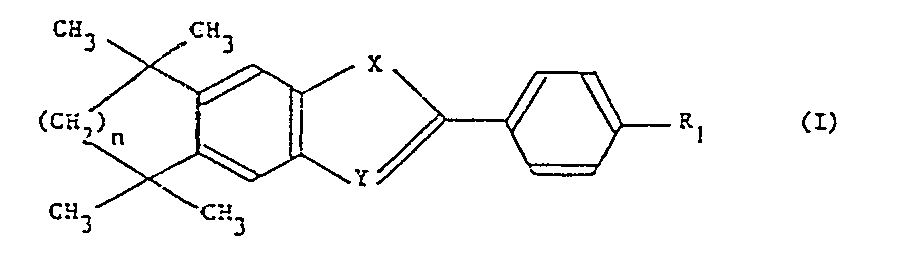
- the polycyclic heterocyclic derivatives according to the invention can be represented by the following general formula: in which: n is 1 or 2 R1 represents: (i) a lower alkyl radical, (ii) -CH2OH or (iii) - -R2 R2 representative: (a) a hydrogen atom, (b) the radical or (c) the radical -OR3, R3 representing a hydrogen atom, an alkyl radical having from 1 to 20 carbon atoms, a mono or polyhydroxyalkyl radical, an optionally substituted aryl or aralkyl radical or a residue of a sugar or also represents the radical: p being 1, 2 or 3, r ′ and r ⁇ representing a hydrogen atom, a lower alkyl radical, a monohdroxyalkyl or polyhydroxyalkyl radical, an optionally substituted aryl radical, an amino acid or amino sugar residue or taken together form a heterocycle, X represents an oxygen atom, a sulfur atom, SO, SO2 or the
- alkyl radical having from 1 to 20 carbon atoms should be understood in particular to mean the methyl, ethyl, propyl, 2-ethylhexyl, octyl, dodecyl, hexadecyl and octadecyl radicals.
- lower alkyl radical should be understood to mean a radical having from 1 to 4 carbon atoms, in particular the methyl, ethyl, isopropyl, butyl and tert-butyl radicals.
- monohydroxyalkyl radical is meant a radical having from 2 to 4 carbon atoms, in particular a 2-hydroxyethyl, 2-hydroxy-propyl and 2′-hydroxy 2-ethoxy ethyl radical.
- polyhydroxyalkyl radical should be understood to mean a radical containing from 3 to 6 carbon atoms and from 2 to 5 hydroxyl groups such as the 2,3-dihydroxypropyl, 2,3,4-trihydroxybutyl, 2,3,4,5- radicals. tetrahydroxypentyle or the rest of pentaerythritol.
- the remainder of a sugar should be understood to mean a residue derived for example from glucose, mannose, erythrosis or galactose.
- amino sugar residues mention may be made of those derived from glucosamine, galactosamine or mannosamine.
- aryl radical should be understood to mean a phenyl radical optionally substituted by a halogen atom, a hydroxy, a nitro function or a lower alkyl radical.
- aralkyl radicals mention may in particular be made of the benzyl radical as well as the phenethyl radical.
- radicals r ′ and r ⁇ taken together form a heterocycle this can be a piperidino, piperazino, morpholino, pyrrolidino or 4- (2′-hydroxyethyl) piperazino radical.
- the compounds according to the invention when they are in the form of salts, they may be either salts of an alkali or alkaline-earth metal or else of zinc, or of an organic amine when they contain at least one function free acid, either salts of a mineral or organic acid in particular hydrochlorides, hydrobromides or citrates when they contain at least one amine function.
- the following may be mentioned in particular: the methyl ester of p- (5,6,7,8-tetrahydro-5,5,8,8-tetramethyl-2-naphtho [2,3-b] furyl) benzoic acid, - p- (5,6,7,8-tetrahydro-5,5,8,8-tetramethyl-2- naphtho [2,3-b] furyl) benzoic acid, the methyl ester of p- (5,6,7,8-tetrahydro-5,5,8,8-tetramethyl-2-naphtho [2,3-b] thienyl) benzoic acid, - p- (5,6,7,8-tetrahydro-5,5,8,8-tetramethyl-2-naphtho [2,3-b] thienyl) benzoic acid, - p- (5,6,7,8-tetrahydro-5,5,8,8-tetramethyl-2-naphtho [2,3
- R3 represents a hydrogen atom or a lower alkyl radical
- X represents an oxygen atom, a sulfur atom or the NR4 radical
- Y represents CR4 or a nitrogen atom
- R4 representing a hydrogen atom or the methyl radical.
- the present invention also relates to the process for the preparation of the compounds of formula (I).
- This method consists in reacting an aromatic carboxylic acid derivative of formula ( 1 ) with a diamino, hydroxyamino or thioamino aromatic derivative of formula ( 2 ).
- This intermediate compound ( 3 ′ ) is then cyclized by acid treatment to yield the compounds of formula (3).
- a sulfonic acid such as p-toluene sulfonic acid can be used for this cyclization in an inert solvent such as toluene or xylene.
- the cyclization temperature is preferably close to the reflux temperature of the solvent used.
- the cyclization reaction that is to say the passage of the derivative ( 7 ) carrying a phosphonium or phosphinyl group, to the compound ( 8 ) is carried out according to the conditions of the Wittig or Wittig-Horner reaction, that is to say in the presence of a base which may be an alkali metal hydroxide or carbonate, for example lithine or potassium carbonate, an alkali metal hydride, for example sodium hydride, an alkali metal alcoholate for example sodium methylate or potassium tert-butoxide, a tertiary amine for example triethylamine, di-isopropylethylamine or diazabicycloundecene (DBU) or an alkali amide for example sodium amide or lithium di-isopropylamide.
- a base which may be an alkali metal hydroxide or carbonate, for example lithine or potassium carbonate, an alkali metal hydride, for example sodium hydride, an alkal
- the reaction temperature is between -78 ° C to + 150 ° C and can be used as solvent, a dipolar aprotic solvent (dimethylsulfoxide or dimethylformamide), an alcohol, an ether (dioxane or tetrahydrofuran).
- a dipolar aprotic solvent dimethylsulfoxide or dimethylformamide
- an alcohol an ether
- tetrahydrofuran THF
- the bromination reaction that is to say the obtaining of the compound of formula ( 6 ) is carried out in the presence of N-bromosuccinimide in benzene or carbon tetrachloride previously dried, the temperature preferably being between 70 ° C. and 90 ° C, the radical initiator preferably being benzoyl peroxide.
- the acylation reaction that is to say obtaining the compound of formula ( 5 ), is carried out in a conventional manner.
- X represents an NH group
- esters give the corresponding acids. These can be transformed into acid chlorides which are then easily converted into amides. These amides can also be obtained by direct action of amines on the esters obtained previously.
- a suitable reducing agent for example lithium aluminum hydride
- the subject of the present invention is also, as new industrial products, the synthesis intermediates corresponding to the following general formula: in which: n is 1 or 2 and X represents an oxygen atom, a sulfur atom or the radical NR radical, R4 representing a hydrogen atom or a lower alkyl radical.
- the compounds according to the invention exhibit good to excellent activity in the test for inhibition of ornithine decarboxylase, in the naked rat after induction by "tape stripping". (M. BOUCLIER et al., DERMATOLOGICA 169 n ° 4 1984). This test is accepted as a measure of the action of retinoids on cell proliferation phenomena.
- These compounds are particularly suitable for treating dermatological conditions linked to a disorder of keratinization (differentiation, proliferation) as well as dermatological conditions with an inflammatory and / or immunoallergic component, in particular: - vulgar, comedonian or polymorphic acnes, senile, solar acnes, and medicinal or professional acnes, - solar keratites - widespread and / or severe forms of psoriasis, and other keratinization disorders, and in particular ichthyosis and ichthyosiform states, - Darier's disease, - palmoplantar keratoderma, - leukoplakias and leukoplasiform states, lichen planus, - any benign or malignant, severe or extensive dermatological proliferation.
- an inflammatory and / or immunoallergic component in particular: - vulgar, comedonian or polymorphic acnes, senile, solar acnes, and medicinal or professional acnes, - solar keratites - widespread and / or
- These compounds can also be used to combat aging of the skin, in particular under the effect of the sun.
- the present invention therefore also relates to medicinal compositions containing at least one compound of formula (I) as defined above or one of its salts.
- the present invention therefore also relates to a new medicinal composition, intended in particular for the treatment of the aforementioned conditions, characterized in that it comprises, in an acceptable pharmaceutical carrier, at least one compound of formula (I) or the one of its salts.
- the compounds according to the invention are generally administered at a daily dose of approximately 0.01 ⁇ g / kg to 1 mg / kg of body weight.
- any conventional support can be used, the active compound being either in the dissolved state or in the dispersed state in the vehicle.
- Administration can be by enteral, parenteral, rectal, topical or ocular route.
- the drugs can be in the form of tablets, capsules, dragees, syrups, suspensions, solutions, powders, granules, emulsions.
- the compositions may be in the form of solutions or suspensions for infusion or for injection. Rectally, the compositions are in the form of suppositories.
- the pharmaceutical compositions based on the compounds according to the invention are in the form of ointments, tinctures, creams, ointments, powders, patches, soaked pads, solutions, lotions, gels, sprays or suspensions.
- the topical compositions preferably contain from 0.00001 to about 0.01% by weight of compound (s) of formula (I). These topical compositions can be presented either in anhydrous form or in aqueous form according to the clinical indication. By eye, these are mainly eye drops.
- the compounds of formula (I) according to the invention also find application in the cosmetic field, in particular in body and hair hygiene and in particular for the treatment of acne prone skin, for hair regrowth, anti-hair loss, to fight against the oily appearance of the skin or hair, in protection against the harmful effects of the sun or in the treatment of physiologically dry skin.
- the present invention therefore also relates to a cosmetic composition containing, in a cosmetically acceptable carrier, at least one compound of formula (I) or one of its salts, this composition being in particular in the form of a lotion, gel, soap or shampoo.
- the concentration of compound of formula (I) in the cosmetic compositions is between 0.00001 and 0.01% by weight.
- the medicinal and cosmetic compositions according to the invention may contain inert additives or even pharmacodynamically or cosmetically active and in particular: hydrating agents such as thiamorpholinone and its derivatives or urea; antiseborrhoeic or anti-acne agents such as S-carboxymethylcysteine, S-benzylcysteamine, their salts and their derivatives, tioxolone or benzoyl peroxide; antibiotics such as erythromycin and its esters, neomycin, tetracyclines or polymethylene-4-isothiazoline-4 ones-3, agents promoting hair regrowth, such as "Minoxidil” (2,4-diamino piperidino-6 pyrimidine oxide-3) and its derivatives, Diazoxide (chloro-7-methyl-3 benzothiadiazine-1,2,4 dioxide-1,1) and Phenytoin (5,5-diphenylimidazolidine-2,4 dione); steroidal and
- compositions according to the invention can also contain flavor-enhancing agents, preserving agents, stabilizing agents, humidity-regulating agents, pH-regulating agents, agents for modifying osmotic pressure, emulsifying agents, antioxidants such as ⁇ -tocopherol, butylhydroxy-anisole or butylhydroxytoluene.
- NBS N-bromo succinimide
- reaction medium is poured into water (1 liter) + ice.
- the precipitate formed is filtered, washed with water, taken up in dichloromethane (3x200ml); the organic phase is washed with saturated sodium bicarbonate solution, then with water. It is dried over magnesium sulfate, filtered, and the solvent evaporated.
- the solid obtained is purified by chromatography on silica, eluted with a mixture of dichloromethane (50%) and hexane (50%).
- the precipitate formed is dissolved by the addition of dichloromethane (1 liter).
- the catalyst is filtered and the solvents evaporated.
- the mixture is stirred for 2 h at room temperature, then the reaction medium is poured into a mixture of water (500 ml) and dichloromethane (300 ml).
- aqueous phase is extracted with dichloromethane (2 times 300 ml) and the organic phase is washed with a saturated solution of sodium chloride, then dried over magnesium sulfate, filtered and the solvent evaporated.
- the solid obtained is purified by column chromatography, eluted with dichloromethane.
- the methyl ester of p- [(3-hydroxy-5,6,7,8-tetrahydro-5,5,8,8-tetramethyl-2-naphthyl) carbamoyl] benzoic acid 23.25 g (61 mmol)
- xylene 600ml
- 11.6 g (61 mmol) of p.toluene sulfonic acid are added and the mixture is heated to reflux, with stirring for 3 h.
- the xylene is evaporated, and water (500ml) and dichloromethane are added.
- About 300 ml of a saturated sodium bicarbonate solution are added to the aqueous phase and it is extracted with dichloromethane (3 times 300 ml). The organic phase is then washed with a saturated sodium bicarbonate solution, then with water.
- the solid obtained is purified by column chromatography, eluting with a mixture of 80% dichloromethane and 20% hexane.
- reaction medium is heated at reflux for 5 h, cooled to 0 ° C., then hydrolyzed by dropwise addition of 30 ml of a solution of double sodium tartrate and potassium.
- the product is purified by column chromatography, eluted with a mixture of ether (80%) and hexane (20%). The solvents are evaporated and the solid obtained is taken up in hexane, filtered and dried. 920 mg is thus obtained; (75%) p- (5,6,7,8-tetrahydro-5,5,8,8-tetramethyl-2-naphth [2,3-d] oxazolyl) benzoic aldehyde, which melts at 179 ° C .
- the solid obtained is taken up in ether (500 ml), filtered and then dried.
- the dicyclohexylamine salt of p- (5,6,7,8-tetrahydro-5,5,8,8-tetramethyl-2-naphth [2,3-d] oxazolyl) benzoic acid is thus obtained (6, 94g; 100%.
- the reaction medium is stirred for 2 h at room temperature.
- the dicyclohexylamine hydrochloride formed is filtered and the dichloromethane is evaporated.
- reaction medium is stirred for one hour at room temperature and then poured into 2N hydrochloric acid (200ml).
- the product is extracted with ether (3x100ml), then the organic phase is washed with water (3 times), with a saturated solution of sodium chloride, and dried over magnesium sulfate.
- the solid obtained is taken up in hexane (300ml) filtered and dried.
- Morpholide of p- (5,6,7,8-tetrahydro-5,5,8,8-tetramethyl-2-naphth [2,3-d] oxazolyl) benzoic acid is p- (5,6,7,8-tetrahydro-5,5,8,8-tetramethyl-2-naphth [2,3-d] oxazolyl) benzoic acid.
- Morpholine (417 mg; 4.8 mmol) is dissolved in dry tetrahydrofuran (25 ml). Triethylamine (485 mg; 4.8 mmol) is successively added, then drop by drop, the chloride of p- (5,6,7,8-tetrahydro-5,5,8,8-tetramethyl-2- naphth [2,3-d] oxazolyl) benzoic (1.6 g; 4.4 mmoles) dissolved in dry tetrahydrofuran (25 ml).
- reaction medium is stirred for two hours at room temperature, then poured into 4N hydrochloric acid (200 ml).
- the product is extracted with ether (3x200ml), the organic phase is washed with water (3 times), then with a saturated solution of sodium chloride and dried over magnesium sulfate.
- Ethylene glycol (298 mg; 4.8 mmol) is dissolved in dry dichloromethane (25 ml). Pyridine is successively added: 380 mg (4.8 mmol), then drop by drop the chloride of p- (5,6,7,8-tetrahydro-5,5,8,8-tetramethyl-2-napht) acid [2,3-d] oxazolyl) benzoic (1.6 g; 4.4 mmoles), in solution in dry dichloromethane (25 ml).
- reaction medium is stirred for two hours at room temperature, then poured into 200 ml of 4N hydrochloric acid.
- the product is extracted with ether (3x200ml).
- the organic phase is washed with water (3 times), then with a saturated solution of sodium chloride, and dried over magnesium sulfate.
- the product is purified by chromatography on silica, eluted with a mixture of dichloromethane (70%) and ether (30%).
- the medium is stirred for 2 h at room temperature, then it is poured onto ice.
- the product is extracted with ethyl ether (3x1 liter).
- the organic phase is neutralized by adding solid sodium bicarbonate (+ 300ml of water), then decanted and dried over magnesium sulfate.
- 2,3-diamino- (5,6,7,8-tetrahydro-5,5,8,8-tetramethyl naphthalene (6.55g; 30mmol) is mixed with ethyl ether (170ml); triethylamine (4.2ml, 30mmol), then, drop by drop, methyl p-chloroformylbenzoate (5.96g; 30mmol) dissolved in ether (70ml).
- the solid obtained is purified by column chromatography, eluted with a system composed of ethyl ether (10%) and dichloromethane (90%).
- aqueous phase is extracted with dichloromethane (3x300ml), and the organic phase is washed with a saturated solution of sodium chloride. It is dried over magnesium sulphate, filtered, the solvents are evaporated, and the solid obtained is purified by column chromatography, eluted with a mixture of dichloromethane (95%) and ethyl ether (5%).
- a 5N sodium hydroxide solution (8.4 ml) is added and the mixture is heated at reflux for 24 hours.
- the methanol is evaporated, then the pH adjusted to 5 by addition of 1N hydrochloric acid.
- the solid obtained is taken up in hexane (300ml), filtered and dried in an oven.
- the organic phase is dried over magnesium sulfate, filtered and the solvents are evaporated.
- the product is purified by column chromatography, eluted with a mixture of ether (10%) and dichloromethane (90%).
- aqueous phase is extracted with dichloromethane, the organic phase washed with a saturated solution of sodium chloride, dried over magnesium sulfate, filtered, and the solvents evaporated.
- the product is purified by column chromatography, eluted with a mixture of ether (10%) and hexane (90%).
- the active compound can be replaced by its methyl ester.
- the capsule is made up of gelatin, glycerin, titanium dioxide and water.
- the powder is packaged in a capsule composed of gelatin and TiO2.
Landscapes
- Organic Chemistry (AREA)
- Chemical & Material Sciences (AREA)
- Health & Medical Sciences (AREA)
- Life Sciences & Earth Sciences (AREA)
- Veterinary Medicine (AREA)
- Animal Behavior & Ethology (AREA)
- General Health & Medical Sciences (AREA)
- Public Health (AREA)
- Epidemiology (AREA)
- Birds (AREA)
- Nuclear Medicine, Radiotherapy & Molecular Imaging (AREA)
- Medicinal Chemistry (AREA)
- Pharmacology & Pharmacy (AREA)
- General Chemical & Material Sciences (AREA)
- Chemical Kinetics & Catalysis (AREA)
- Dermatology (AREA)
- Bioinformatics & Cheminformatics (AREA)
- Engineering & Computer Science (AREA)
- Rheumatology (AREA)
- Pain & Pain Management (AREA)
- Pulmonology (AREA)
- Pharmaceuticals Containing Other Organic And Inorganic Compounds (AREA)
- Heterocyclic Carbon Compounds Containing A Hetero Ring Having Nitrogen And Oxygen As The Only Ring Hetero Atoms (AREA)
- Nitrogen Condensed Heterocyclic Rings (AREA)
- Cosmetics (AREA)
- Indole Compounds (AREA)
- Cephalosporin Compounds (AREA)
- Saccharide Compounds (AREA)
- Nitrogen And Oxygen Or Sulfur-Condensed Heterocyclic Ring Systems (AREA)
- Furan Compounds (AREA)
- Steroid Compounds (AREA)
- Acyclic And Carbocyclic Compounds In Medicinal Compositions (AREA)
- Thiazole And Isothizaole Compounds (AREA)
Abstract
R₁ représente: (i) un radical alkyle inférieur, (ii) -CH₂OH , ou (iii) -

R₂ représente : (a) un atome d'hydrogène, (b) le radical
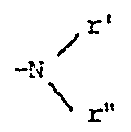
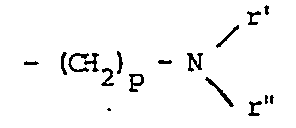
r′ et r˝ représentant un atome d'hydrogène, un radical alkyle inférieur, un radical monohydroxyalkyle ou polyhydroxyalkyle, un radical aryle éventuellement substitué, un reste d'aminoacide ou de sucre aminé ou encore pris ensemble forment un hétérocycle,
X représente un atome d'oxygène, un atome de soufre, SO, SO₂ ou le radical -NR₄ ,
et Y représente CR₄ ou un atome d'azote
R₄ représentant un atome d'hydrogène ou un radical alkyle inférieur.
Description
- La présente invention a pour objet des dérivés hétérocycliques polycycliques, leur procédé de préparation et leur utilisation en médecine humaine et vétérinaire et en cosmétique.
- Ces dérivés hétérocycliques trouvent une application dans le traitement topique et systémique des affections dermatologiques liées à un désordre de la kératinisation (différenciation-prolifération) et d'affections dermatologiques, ou autres, à composante inflammatoire et/ou immunoallergique et dans le traitement des maladies de dégénérescence du tissu conjonctif et présentent une activité antitumorale. En outre ces dérivés peuvent être utilisés dans le traitement de l'atopie, quelle soit cutanée ou respiratoire et du psoriasis rhumatoïde.
- Enfin, ils trouvent une application dans le domaine ophtalmologique notamment dans le traitement des cornéopathies.
- Les dérivés hétérocycliques polycycliques selon l'invention peuvent être représentés par la formule générale suivante:

n est 1 ou 2
R₁ représente:
(i) un radical alkyle inférieur,
(ii) -CH₂OH
ou (iii) --R₂
R₂ représentant:
(a) un atome d'hydrogène,
(b) le radical
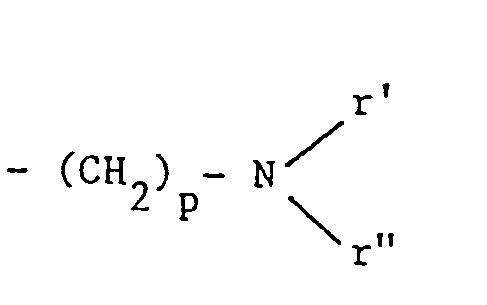
r′ et r˝ représentant un atome d'hydrogène, un radical alkyle inférieur, un radical monohdroxyalkyle ou polyhydroxyalkyle, un radical aryle éventuellement substitué, un reste d'aminoacide ou de sucre aminé ou encore pris ensemble forment un hétérocycle,
X représente un atome d'oxygène, un atome de soufre, SO, SO₂ ou le radical -NR₄,
et Y représente CR₄ ou un atome d'azote
R₄ représentant un atome d'hydrogène ou un radical alkyle inférieur,
et les sels desdits dérivés hétérocycliques polycycliques de formule (I). - Par radical alkyle ayant de 1 à 20 atomes de carbone, on doit entendre notamment les radicaux méthyle, éthyle, propyle, 2-éthyl-hexyle, octyle, dodécyle, hexadécyle et octadécyle.
- Par radical alkyle inférieur, on doit entendre un radical ayant de 1 à 4 atomes de carbone notamment les radicaux méthyle, éthyle, isopropyle, butyle et tertiobutyle.
- Par radical monohydroxyalkyle, on doit entendre un radical ayant de 2 à 4 atomes de carbone, notamment un radical 2-hydroxyéthyle, 2-hydroxy-propyle et 2′-hydroxy 2-éthoxy éthyle.
- Par radical polyhydroxyalkyle, on doit entendre un radical contenant de 3 à 6 atomes de carbone et de 2 à 5 groupes hydroxyles tels que les radicaux 2,3-dihydroxypropyle, 2,3,4-trihydroxybutyle, 2,3,4,5-tétrahydroxypentyle ou le reste du pentaérythritol.
- Par reste d'un sucre, on doit entendre un reste dérivant par exemple du glucose, du mannose, de l'érythrose ou du galactose.
- Parmi les restes de sucre aminé, on peut citer ceux dérivant de glucosamine, de galactosamine ou de mannosamine.
- Par radical aryle, on doit entendre un radical phényle éventuellement substitué par un atome d'halogène, un hydroxy, une fonction nitro ou un radical alkyle inférieur.
- Parmi les radicaux aralkyles préférés, on peut notamment citer le radical benzyle ainsi que le radical phénéthyle.
- Lorsque les radicaux r′ et r˝ pris ensemble forment un hétérocycle, celui-ci peut être un radical pipéridino, pipérazino, morpholino, pyrrolidino ou 4-(2′-hydroxyéthyl) pipérazino.
- Lorsque les composés selon l'invention se présentent sous forme de sels, il peut s'agir soit de sels d'un métal alcalin ou alcalino-terreux ou encore de zinc, ou d'une amine organique lorsqu'ils comportent au moins une fonction acide libre, soit de sels d'un acide minéral ou organique notamment de chlorhydrates, de bromydrates ou de citrates lorsqu'ils comportent au moins une fonction amine.
- Parmi les composés de formule (I), on peut notamment citer les suivants:
- l'ester méthylique de l'acide p-(5,6,7,8-tétrahydro-5,5,8,8-tétraméthyl-2-naphto[ 2,3-b ]furyl) benzoïque,
- l'acide p-(5,6,7,8-tétrahydro-5,5,8,8-tétraméthyl-2- naphto [ 2,3-b ]furyl ) benzoïque,
- l'ester méthylique de l'acide p-(5,6,7,8-tétrahydro-5,5,8,8-tétraméthyl-2-naphto[ 2,3-b ]thiényl) benzoïque,
- l'acide p-(5,6,7,8-tétrahydro-5,5,8,8-tétraméthyl-2-naphto [ 2,3-b ]thiényl) benzoïque,
- l'acide p-(5,6,7,8-tétrahydro-5,5,8,8-tétraméthyl-2-1H-benz [ f ]indolyl) benzoïque,
- l'ester méthylique de l'acide p-(5,6,7,8-tétrahydro-5,5,8,8-tétraméthyl-2-1H-benz[ f ]indolyl) benzoïque,
- l'ester méthylique de l'acide p-(1-méthyl-5,6,7,8-tétrahydro-5,5,8,8-tétraméthyl-2-benz[ f ]indolyl) benzoïque,
- l'acide p-(1-méthyl 5,6,7,8-tétrahydro-5,5,8,8-tétraméthyl-2-benz[ f ]indolyl) benzoïque,
- l'ester méthylique de l'acide p-(5,6,7,8-tétrahydro-5,5,8,8-tétraméthyl-2 napht[ 2,3-d ]oxazolyl) benzoïque,
- l'acide p-(5,6,7,8-tétrahydro-5,5,8,8-tétraméthyl-2-napht [ 2,3-d ]oxazolyl) benzoïque,
- l'alcool p-(5,6,7,8-tétrahydro-5,5,8,8-tétraméthyl-2-napht [ 2,3-d ]oxazolyl) benzylique,
- l'aldéhyde p-(5,6,7,8-tétrahydro-5,5,8,8-tétraméthyl-2-napht [ 2,3-d ]oxazolyl) benzoïque,
- l'éthylamide de l'acide p-(5,6,7,8-tétrahydro-5,5,8,8-tétraméthyl-2-napht[ 2,3-d ]oxazolyl benzoïque,
- le morpholide de l'acide p-(5,6,7,8-tétrahydro-5,5,8,8-tétraméthyl-2-napht[ 2,3-d ]oxazolyl) benzoïque,
- l'ester 2-hydroxyéthylique de l'acide p-(5,6,7,8-tétrahydro-5,5,8,8-tétraméthyl-2-napht[ 2,3-d ]oxazolyl) benzoïque,
- l'ester méthylique de l'acide p-(5,6,7,8-tétrahydro-5,5,8,8-tétraméthyl-2-napht[ 2,3-d ]imidazolyl) benzoïque,
- l'acide p-(5,6,7,8-tétrahydro-5,5,8,8-tétraméthyl-2-napht [ 2,3-d ]imidazolyl) benzoïque,
- le 2-(4-méthyl) phényl-5,6,7,8-tétrahydro-5,5,8,8-tétraméthylnapht[ 2,3-d ]imidazole. - Parmi les composés de formule (I) particulièrement préférés selon l'invention, on peut mentionner ceux correspondant à la formule générale suivante:

R₃ représente un atome d'hydrogène ou un radical alkyle inférieur,
X représente un atome d'oxygène, un atome de soufre ou le radical NR₄, et Y représente CR₄ ou un atome d'azote, R₄ représentant un atome d'hydrogène ou le radical méthyle. - Parmi les composés correspondant à la formule (II) ci-dessus, on peut notamment citer :
- l'acide p-(5,6,7,8-tétrahydro-5,5,8,8-tétraméthyl-2-naphto [ 2,3-b ]thiényl) benzoïque et son ester méthylique,
- l'acide p-(5,6,7,8-tétrahydro-5,5,8,8-tétraméthyl-2-1H-benz [ f ]indolyl) benzoïque et son ester méthylique,
- l'acide p-(5,6,7,8-tétrahydro-5,5,8,8-tétraméthyl-2-napht [ 2,3-d ]oxazolyl) benzoïque et son ester méthylique,
- l'acide p-(5,6,7,8-tétrahydro-5,5,8,8-tétraméthyl-2-napht [ 2,3-d ]imidazolyl benzoïque et son ester méthylique, et
- l'acide p-(1-méthyl 5,6,7,8-tétrahydro-5,5,8,8-tétraméthyl-2-benz[ f ]indolyl) benzoïque et son ester méthylique. - La présente invention a également pour objet le procédé de préparation des composés de formule (I).
- Ces composés peuvent être obtenus selon deux voies de synthèse:
- Cette méthode est tout particulièrement préférée lorsque dans les composés de formule (I) le radical Y représente un atome d'azote.
- Cette méthode consiste à faire réagir un dérivé d'acide carboxylique aromatique de formule (1) sur un dérivé aromatique diamino, hydroxyamino ou thioamino de formule (2).

- L'action du chlorure d'acide (1) (Q=Cl) sur le composé amino aromatique (2) conduit à l'intermédiaire (3′) que l'on isole. De même le couplage de l'acide (1) (Q=OH) avec le composé (2), en présence de triphénylphosphine et de dicyclohexylcarbodiimide, ou de diéthylazodicarboxylate et de triphénylphosphine, de manière connue, conduit aux composés intermédiaires (3′).
- Ce composé intermédiaire (3′) est ensuite cyclisé par traitement acide pour conduire aux composés de formule (3). On peut utiliser pour cette cyclisation un acide sulfonique tel que l'acide p-toluène sulfonique dans un solvant inerte tel que le toluène ou le xylène. La température de cyclisation est de préférence voisine de la température de reflux du solvant utilisé.
- Selon une variante de ce procédé, il est possible d'accéder directement aux composés de formule (3) par chauffage direct de l'acide de formule (1) (Q=OH) et du composé amino aromatique (2) dans un solvant inerte tel que le xylène en présence d'un catalyseur acide par exemple l'acide p-toluène sulfonique et ceci au reflux du solvant.
- Cette méthode est tout particulièrement préférée lorsque dans les composés de formule (I) Y représente le radical CR₄.

- Selon cette deuxième méthode, la réaction de cyclisation c'est-à-dire le passage du dérivé (7) porteur d'un groupement phosphonium ou phosphinyle, au composé (8), est effectuée selon les conditions de la réaction de Wittig ou Wittig-Horner c'est-à-dire en présence d'une base qui peut être un hydroxyde ou un carbonate de métal alcalin par exemple la lithine ou le carbonate de potassium, un hydrure de métal alcalin par exemple l'hydrure de sodium, un alcoolate de métal alcalin par exemple le méthylate de sodium ou le tert-butoxyde de potassium, une amine tertiaire par exemple la triéthylamine, la di-isopropyléthylamine ou le diazabicycloundécène (DBU) ou encore un amidure alcalin par exemple l'amidure de sodium ou le di-isopropylamidure de lithium. La température de la réaction est comprise entre -78°C à +150°C et on peut utiliser comme solvant, un solvant aprotique dipolaire (diméthylsulfoxyde ou diméthylformamide), un alcool, un éther (dioxanne ou tétrahydrofuranne). La réaction est avantageusement effectuée dans le tétrahydrofuranne (THF) entre 0°C et 80°C en utilisant la triéthylamine ou le DBU comme base.
- La réaction de bromation c'est-à-dire l'obtention du composé de formule (6) est effectuée en présence de N-bromosuccinimide dans le benzène ou le tétrachlorure de carbone préalablement séché, la température étant de préférence comprise entre 70°C et 90°C, l'initiateur radicalaire étant de préférence le peroxyde de benzoyle.
- La réaction d'acylation c'est-à-dire l'obtention du composé de formule (5) est effectuée de manière classique. Lorsque X représente un groupement NH, la réaction est avantageusement effectuée en utilisant le composé de formule (1) sous forme de chlorure d'acide (Q=Cl) en présence d'une amine tertiaire.
- Les composés obtenus selon les deux méthodes décrites ci-dessus peuvent être convertis de manière classique en vue d'obtenir l'une quelconque des autres significations de R₁.
- Ainsi la saponification des esters donne les acides correspondants. Ceux-ci peuvent être transformés en chlorures d'acides qui sont alors facilement convertis en amides. Ces amides peuvent également être obtenus par action directe d'amines sur les esters obtenus précédemment. La réduction des esters, aldéhyde ou amide par un agent réducteur convenable (par exemple l'aluminohydrure de lithium) permet l'accès aux alcools et amines correspondants.
- La présente invention a également pour objet à titre de produits industriels nouveaux les intermédiaires de synthèse correspondant à la formule générale suivante:

n est 1 ou 2
et X représente un atome d'oxygène, un atome de soufre ou le radical NR₄, R₄ représentant un atome d'hydrogène ou un radical alkyle inférieur. - Parmi les composés intermédiaires de formule (III) ci-dessus on peut notamment citer les suivants:
- le 2,3-diamino-5,6,7,8-tétrahydro-5,5,8,8-tétraméthyl naphtalène,
- le 3-amino-5,6,7,8-tétrahydro-5,5,8,8-tétraméthyl-2-naphtol. - Les composés selon l'invention présentent une bonne à excellente activité dans le test d'inhibition de l'ornithine décarboxylase, chez le rat nu après induction par le "tape stripping". (M. BOUCLIER et coll., DERMATOLOGICA 169 n° 4 1984). Ce test est admis comme mesure de l'action des rétinoïdes sur les phénomènes de prolifération cellulaire.
- Ces composés conviennent particulièrement bien pour traiter les affections dermatologiques liées à un désordre de la kératinisation (différenciation, prolifération) ainsi que les affections dermatologiques à composante inflammatoire et/ou immunoallergique notamment:
- les acnés vulgaires, comédoniennes ou polymorphes, les acnés séniles, solaires, et les acnés médicamenteuses ou professionnelles,
- les kératites solaires
- les formes étendues et/ou sévères de psoriasis, et les autres troubles de la kératinisation, et notamment les ichtyoses et états ichtyosiformes,
- la maladie de Darier,
- les kératodermies palmo-plantaires,
- les leucoplasies et états leucoplasiformes, le lichen plan,
- toutes proliférations dermatologiques bénignes ou malignes, sévères ou étendues. - Ils sont également actifs pour certaines affections rhumatismales dans le traitement des tumeurs, du psoriasis rhumatoide, des atopies cutanées ou respiratoires ainsi que dans le traitement de certains problèmes ophtalmologiques relatifs aux cornéopathies.
- Ces composés peuvent être utilisés également pour lutter contre le vieillissement de la peau en particulier sous l'effet du soleil.
- La présente invention a donc également pour objet des compositions médicamenteuses contenant au moins un composé de formule (I) tel que défini ci-dessus ou l'un de ses sels.
- La présente invention a donc aussi pour objet une nouvelle composition médicamenteuse, destinée notamment au traitement des affections sus-mentionnées, caractérisée par le fait qu'elle comporte, dans un support pharmaceutique acceptable, au moins un composé de formule (I) ou l'un de ses sels.
- Les composés selon l'invention sont généralement administrés à une dose journalière d'environ 0,01µg/Kg à 1mg/Kg de poids corporel.
- Comme support des compositions, on peut utiliser tout support conventionnel, le composé actif se trouvant soit à l'état dissous soit à l'état dispersé dans le véhicule.
- L'administration peut être effectuée par voie entérale, parentérale, rectale, topique ou oculaire. Par voie entérale, les médicaments peuvent se présenter sous forme de comprimés, de gélules, de dragées, de sirops, de suspensions, de solutions, de poudres, de granulés, d'émulsions. Par voie parentérale, les compositions peuvent se présenter sous forme de solutions ou suspensions pour perfusion ou pour injection. Par voie rectale, les compositions se présentent sous forme de suppositoires. Par voie topique, les compositions pharmaceutiques à base des composés selon l'invention, se présentent sous forme d'onguents, de teintures, de crèmes, de pommades, de poudres, de timbres, de tampons imbibés, de solutions, de lotions, de gels, de sprays ou encore de suspensions. Les compositions par voie topique contiennent de préférence de 0,00001 à environ 0,01% en poids de composé(s) de formule (I). Ces compositions par voie topique peuvent se présenter soit sous forme anhydre soit sous forme aqueuse selon l'indication clinique. Par voie oculaire, ce sont principalement des collyres.
- Les composés de formule (I), selon l'invention, trouvent également une application dans le domaine cosmétique, en particulier dans l'hygiène corporelle et capillaire et notamment pour le traitement des peaux à tendance acnéique, pour la repousse des cheveux, l'anti-chute, pour lutter contre l'aspect gras de la peau ou des cheveux, dans la protection contre les effets néfastes du soleil ou dans le traitement des peaux physiologiquement sèches.
- La présente invention vise donc également une composition cosmétique contenant, dans un support cosmétiquement acceptable, au moins un composé de formule (I) ou un de ses sels, cette composition se présentant notamment sous forme de lotion, gel, savon ou shampooing.
- La concentration en composé de formule (I), dans les compositions cosmétiques est comprise entre 0,00001 et 0,01 % en poids.
- Les compositions médicamenteuses et cosmétiques selon l'invention, peuvent contenir des additifs inertes ou même pharmacodynamiquement ou cosmétiquement actifs et notamment: des agents hydratants comme la thiamorpholinone et ses dérivés ou l'urée; des agents antiséborrhéiques ou antiacnéiques tels que la S-carboxyméthylcystéine, la S-benzylcystéamine, leurs sels et leurs dérivés,la tioxolone ou le peroxyde de benzoyle; des antibiotiques comme l'érythromycine et ses esters, la néomycine, les tétracyclines ou les polyméthylène-4-isothiazoline-4 ones-3 ;des agents favorisant la repousse des cheveux, comme le "Minoxidil" (diamino-2,4 pipéridino-6 pyrimidine oxyde-3) et ses dérivés, le Diazoxide (chloro-7 méthyl-3 benzothiadiazine-1,2,4 dioxyde-1,1) et le Phénytoïn (5,5-diphénylimidazolidine-2,4 dione) ; des agents anti-inflammatoires stéroïdiens et non stéroïdiens; des caroténoïdes et notamment le β-carotène; des agents anti-psoriasiques tels que l'anthraline et ses dérivés, les acides eicosatétraynoïque 5,8,11,14 et eicosatriynoïque-5,8,11, leurs esters et amides.
- Les compositions selon l'invention peuvent également contenir des agents d'amélioration de la saveur, des agents conservateurs, des agents stabilisants, des agents régulateurs d'humidité, des agents régulateurs de pH, des agents modificateurs de pression osmotique, des agents émulsionnants, des anti-oxydants tels que l'α -tocophérol, le butylhydroxy-anisole ou le butylhydroxytoluène.
- On donne ci-après à titre d'illustration et sans aucun caractère limitatif, plusieurs exemples de préparation des composés actifs de formule (I) selon l'invention ainsi que des exemples de compositions les contenant.
- Dans un ballon, on introduit 10,8g (100mmoles) d'ortho crésol, 100ml de dichlorométhane (CH₂Cl₂) et 18,3g (100mmoles) de 2,4-dichloro-2,4-diméthylhexane. On refroidit à 5°C et ajoute par petites quantités 6,6g (50mmoles) de chlorure d'aluminium. On laisse remonter à 20°C. On agite 2h puis verse le milieu réactionnel dans 200ml d'eau. On décante la phase organique, sèche sur sulfate de magnésium (Mg SO₄), et évapore les solvants. Le résidu est recristallisé dans 100ml d'hexane. On obtient ainsi 20,3g (93%) de 3-méthyl-5,6,7,8-tétrahydro-5,5,8,8-tétraméthyl-2-naphtol qui fond à 122-123°C.
- Dans 100ml de tétrahydrofuranne (THF), on dissout 8,7g (40mmoles) de naphtol obtenu en 1 a) et 6,2ml (44mmoles) de triéthylamine. On ajoute goutte à goutte une solution de chlorure de p-(méthoxycarbonyl) benzoyle (8,8g = 44mmoles) dans du THF (50ml), et agite 4h à température ambiante. On verse le milieu réactionnel dans 200ml d'eau et extrait avec 300ml de CH₂Cl₂). On décante la phase organique, sèche sur Mg SO₄, et évapore les solvants. Le résidu est recristallisé dans l'isooctane. On obtient ainsi 11g (72%) d'ester méthylique de l'acide p-(3-méthyl-5,6,7,8-tétrahydro-5,5,8,8-tétraméthyl-2-naphtyloxy carbonyl) benzoïque, qui fond à 111-112°C.
- Un mélange de l'ester obtenu en 1 b) (10,60g; 27,8mmoles), de peroxyde de benzoyle (50mg) et de tétrachlorure de carbone (CCl₄), (150ml) est porté au reflux. On ajoute par petites quantités 4,96g (27,8mmoles), de N-bromo succinimide (NBS).
- On maintient le reflux pendant 24h et évapore le solvant. Le résidu est purifié par passage sur une colonne de silice (éluant: mélange hexane/CH₂Cl₂ : 1/1). On recueille ainsi 12g d'un mélange contenant 80% de l'ester attendu et 20% de l'ester de départ.
- Dans un ballon, on introduit 11,8g du mélange obtenu en 1 c), 100ml de THF, et 6,50g (24,6mmoles) de triphénylphosphine. On chauffe à reflux durant 4h, refroidit à 10°C, et ajoute goutte à goutte 3,70ml (24,6mmoles) de 1,8-diazabicyclo (5.4.0) undec-7-ène (DBU). On laisse revenir à température ambiante et agite pendant 5h. On verse le milieu réactionnel dans l'eau, extrait à l'éther, sèche sur Mg SO₄ et évapore les solvants.
- Le résidu est purifié par passage sur colonne de silice (éluant: hexane/CH₂Cl₂ : 1/1). On obtient ainsi 4,20g d'ester méthylique de l'acide p-(5,6,7,8-tétrahydro-5,5,8,8-tétraméthyl-2-naphto[ 2,3-b ]furanyl) benzoïque qui fond à 184-185°C.
- 3,80g (10,4mmoles) de l'ester obtenu en 1 d) sont traités au reflux pendant 4h par 200ml de soude méthanolique 2N. On évapore le méthanol, reprend par l'eau et acidifie avec de l'acide chlorhydrique (HCl) concentré. On extrait à l'éther, décante la phase organique, sèche sur Mg SO₄, évapore les solvants. Le résidu est recristallisé dans un mélange d'éther diisopropylique et d'acétate d'éthyle 2/1. On obtient ainsi 3,50g (97%) d'acide p-(5,6,7,8-tétrahydro-5,5,8,8-tétraméthyl-2-naphto[ 2,3-b ]furanyl) benzoïque qui fond à 307-312°C.
- Dans un ballon, on introduit 1,7g (57mmoles) d'hydrure de sodium (80% dans l'huile) et 50ml de diméthylformamide. On ajoute goutte à goutte une solution de 10,3g (47mmoles) de 3-méthyl-5,6,7,8-tétrahydro-5,5,8,8-tétraméthyl-2-naphtol dans 100ml de DMF et agite jusqu'à cessation du dégagement gazeux. On ajoute 8,1g (66mmoles) de chlorure de diméthylthio-carbamoyle dans 100ml de DMF et agite 4h à température ambiante. On verse dans l'eau, extrait à l'éther éthylique, décante la phase organique, lave à l'eau, sèche sur Mg SO₄, et évapore. Le résidu est purifié par chromatographie sur colonne de silice (éluant: CH₂Cl₂/hexane: 20/80). On obtient ainsi 13,2g (92%) de 2-(N,N-diméthylthiocarbamoyloxy)-3-méthyl-5,6,7,8-tétrahydro-5,5,8,8-tétraméthyl-naphtalène, qui fond à 102-103°C.
- 13g (42,5mmoles) du composé obtenu en 3 a) sont chauffés sous azote à 280°C. Après refroidissement, le résidu est passé sur colonne de silice (éluant: hexane/CH₂Cl₂ 70/30).
- On obtient ainsi 10,2g (79%) de 2-(N,N-diméthylcarbamoylthio)-3-méthyl-5,6,7,8-tétrahydro-5,5,8,8-tétraméthyl-naphtalène qui fond à 142-143°C.
- 9,2g (30mmoles) du produit obtenu en 3 b) sont traités au reflux par 200ml de soude méthanolique 2N, pendant 2h. On évapore les solvants, reprend par l'eau, acidifie à pH 0 (HCl concentré), extrait à l'éther, décante la phase organique, sèche sur sulfate de magnésium et évapore les solvants. On obtient ainsi 6,9g (98%) de 3-méthyl-5,6,7,8-tétrahydro-5,5,8,8-tétraméthyl-2-thionaphtol, qui fond à 91-92°C.
- Dans un ballon, on introduit 5,9g (33mmoles) de l'ester monométhylique de l'acide téréphtalique et 50ml de THF. On ajoute par petites portions 5,3g (33mmoles) de 1,1′-carbonyldiimidazole et agite jusqu'à cessation du dégagement gazeux. On ajoute ensuite 7g (30mmoles) du composé obtenu en 3 c) dans 50ml de THF et agite pendant 4h à température ambiante.
- On verse dans l'eau, extrait à l'éther, lave avec une solution saturée de bicarbonate de sodium, décante la phase organique, sèche sur Mg SO₄, et évapore. Le résidu est recristallisé dans l'isooctane pour donner 9,5g (81%) d'ester méthylique de l'acide p- (3-méthyl-5,6,7,8-tétrahydro-5,5,8,8-tétraméthyl-2-naphtylthio) carbonyl benzoïque qui fond à 105-106°C.
- 9,26g (23mmoles) du composé préparé en 3 d) sont chauffés à reflux dans 150ml de tétrachlorure de carbone contenant 50mg de peroxyde de benzoyle. On ajoute par petites quantités 4,16g (23mmoles) de N-bromo-succinimide et, une fois l'addition terminée, on maintient le reflux pendant 12h. On évapore le solvant et purifie le résidu par chromatographie sur colonne de silice (éluant: CH₂Cl₂/hexane 1/1). On obtient ainsi 10,8g d'un mélange du dérivé monobromé attendu (85%) et des dérivés non bromé et dibromé (15%). (Dosage effectué en comparant les intégrations de signaux en RMN du proton des groupes méthyle, bromométhyle et dibromométhyle dans les composants du mélange). Ce mélange est utilisé tel quel pour la suite de la synthèse.
- Dans un ballon, on introduit 10,5g du mélange précédent, 6g (23mmoles) de triphénylphosphine, et 100ml de THF. On chauffe à reflux durant 4h, refroidit à 10°C, et rajoute 3,5ml (23mmoles) de DBU. On agite 4h à température ambiante, verse dans l'eau, extrait à l'éther, décante la phase organique, sèche sur Mg SO₄ et évapore. Le résidu est purifié par chromatographie sur colonne de silice (éluant: hexane/dichlorométhane 80/20). On obtient ainsi 6,6g d'ester méthylique de l'acide p-(5,6,7,8-tétrahydro-5,5,8,8-tétraméthyl-2-naphto[ 2,3,-b ]thiényl) benzoïque qui fond à 186-187°C.
- 5g (13mmoles) de l'ester obtenu en 3 f) sont traités par 200ml de soude méthanolique 2N. On chauffe à reflux 2h, évapore à sec, reprend par l'eau, acidifie à pH=1 avec HCl concentré, extrait à l'éther, décante la phase organique, sèche sur Mg SO₄, et évapore. Le résidu est recristallisé dans un mélange éther isopropylique-acétate d'éthyle (2/1). On obtient ainsi 4,6g (96%) d'acide p-(5,6,7,8-tétrahydro-5,5,8,8-tétraméthyl-2-naphto [ 2,3,-b ]thiényl) benzoïque qui fond à 291-292°C.
- Dans un ballon, on introduit 64ml (600mmoles) de toluène et 36,6g (200mmoles) de 2,5-dichloro-2,5-diméthyl-hexane. On refroidit à 0°C et ajoute par petites quantités 4,1g (30mmoles) de chlorure d'aluminium, agite 1h à température ambiante, verse le milieu réactionnel dans l'eau, extrait au CH₂Cl₂, décante la phase organique, sèche sur sulfate de magnésium et évapore. L'huile obtenue est purifiée par distillation. On obtient ainsi 39,4g (98%) de 2-méthyl-5,6,7,8-tétrahydro-5,5,8,8-tétraméthyl-naphtalène qui bout à 68°C (sous 1mm de mercure).
- 50g (250mmoles) de 2-méthyl-5,6,7,8-tétrahydro-5,5,8,8-tétraméthyl-naphtalène sont dissous dans 200ml d'anhydride acétique. On refroidit à 0°C et ajoute goutte à goutte une solution de 10,5ml (250mmoles) d'acide nitrique, 20ml d'acide acétique et 20ml d'anhydride acétique, en maintenant la température entre 0 et 5°C. On agite ensuite 1h à température ambiante, verse dans l'eau glacée, filtre le solide obtenu et lave à l'eau. On dissout le solide dans du chlorure de méthylène, lave à l'eau, puis avec une solution saturée de bicarbonate de sodium, sèche sur Mg SO₄ et évapore. On obtient ainsi 45,8g (74%) de 2-méthyl-3-nitro-5,6,7,8-tétrahydro-5,5,8,8-tétraméthyl-naphtalène qui fond à 143-144°C.
- 24,7g (100mmoles) du dérivé nitré obtenu en 5 b) sont dissous dans 400ml d'éthanol. On ajoute 33,6g (600mmoles) de fer en poudre, puis, goutte à goutte, 38ml d'acide chlorhydrique concentré. On chauffe à reflux pendant 1h, évapore à sec, reprend le résidu par l'eau, ajoute avec précaution un excès de bicarbonate de sodium, puis extrait à l'éther. On filtre, récupère le filtrat, sèche sur Mg SO₄, et évapore. On obtient ainsi 21,2g (98%) de 3-méthyl-5,6,7,8-tétrahydro-5,5,8,8-tétraméthyl-2-naphtylamine, qui fond à 94-95°C.
- 8,1g (45mmoles) de monotéréphtalate de méthyle sont dissous dans 100ml de THF. On ajoute par petites quantités 8g (45mmoles) de 1,1′carbonyldiimidazole. On agite jusqu'à ce que le dégagement gazeux ait cessé, puis, on ajoute goutte à goutte une solution de 9,8g (45mmoles) de l'amine obtenue en 5 c) dans 50ml de THF. On agite 2h à température ambiante, verse dans l'eau, extrait avec CH₂Cl₂, décante la phase organique, sèche sur Mg SO₄ , et évapore.
- Le résidu est recristallisé dans l'éther isopropylique pour donner 14,6g (86%) de l'ester méthylique de l'acide p-[ (3-méthyl-5,6,7,8-tétrahydro-5,5,8,8-tétraméthyl-2-naphtyl)carbamoyl] benzoïque, qui fond à 169-170°C.
- Dans un ballon, on introduit 1,2g (40,5mmoles) d'hydrure de sodium (80% dans l'huile), 20ml de DMF, et 30ml de THF. On ajoute goutte à goutte une solution de 13,9g (37mmoles) de l'ester obtenu en 5 d) dans 60ml de THF, et agite jusqu'à ce que le dégagement gazeux ait cessé. On ajoute ensuite 8,8g (40,5mmoles) de di-tert-butyl-dicarbonate dans 100ml de THF et agite à température ambiante pendant 4h. On verse dans l'eau, extrait à l'éther éthylique, décante la phase organique, lave à l'eau, sèche sur Mg SO₄ , et évapore. Le résidu est purifié par chromatographie sur colonne de silice (éluant: mélange dichlorométhane-hexane 7/3). On obtient ainsi 14,1g (82%) de l'ester méthylique de l'acide p-[(N-tert-butoxycarbonyl-3-méthyl-5,6,7,8-tétrahydro-5,5,8,8-tétraméthyl-2-naphtylcarbamoyl)]benzoïque, qui fond à 176-177°C.
- 13,25g (27,6mmoles) de l'ester obtenu en 5 e) sont placés dans un ballon. On ajoute 150ml de tétrachlorure de carbone et 50mg de peroxyde de benzoyle. On chauffe à reflux et introduit par petites quantités, 4,9g (27,6mmoles) de N-bromosuccinimide. Le reflux est maintenu pendant 12h. On évapore le solvant et purifie le résidu par chromatographie sur silice, en éluant avec un mélange de dichlorométhane et d'hexane : 1/1. On obtient ainsi 14,2g d'un mélange contenant environ 85% du dérivé monbromé attendu et 15% d'un mélange de produit dibromé et de produit de départ (ces proportions sont estimées par RMN, de manière analogue à celle de l'exemple 3 e). Le mélange est utilisé tel quel pour la suite de la synthèse.
- Dans un ballon, on introduit 13,9g du mélange obtenu en 5 f), 6,7g (25,5mmoles) de triphényl phosphine, et 100ml de THF. On chauffe à reflux durant 8h, refroidit, à 5°C, et ajoute goutte à goutte 3,8ml (25,5mmoles) de DBU. On agite à température ambiante pendant 2h, verse le milieu réactionnel dans l'eau, extrait à l'éther, décante la phase organique, sèche sur Mg SO₄ et évapore. Le résidu est purifié par chromatographie sur colonne de silice (éluant: mélange CH₂ Cl₂-hexane 20.80). On obtient ainsi 6,7g (69%) d'ester méthylique de l'acide p-(N-tert-butoxycarbonyl-5,6,7,8- tétrahydro-5,5,8,8-tétraméthyl-2-1H-benz f indolyl) benzoïque, qui fond à 145-146°C.
- 6,4g (14mmoles) de l'ester obtenu en 5 g) sont traités au reflux pendant 4h par 100ml de soude méthanolique 2N. On évapore le solvant, reprend par l'eau, acidifie la phase aqueuse jusqu'à pH 5 avec de l'acide chlorhydrique, extrait à l'éther éthylique, décante la phase organique, sèche sur Mg SO₄, et évapore. Le résidu est trituré dans 100ml d'hexane. On obtient ainsi 4,3g (90%) d'acide p-(5,6,7,8-tétrahydro-5,5,8,8-tétraméthyl-2-1H-benz[ f ]indolyl) benzoïque, qui fond à 294-296°C.
- 2,3g (6,6mmoles) d'acide p-(5,6,7,8-tétrahydro-5,5,8,8-tétraméthyl-2-1H-benz[ f ]indolyl) benzoïque sont placés dans un ballon contenant 150ml de méthanol. On ajoute goutte à goutte 2ml d'acide sulfurique concentré et chauffe à reflux pendant 4h. On évapore à sec, reprend par l'eau et alcalinise au bicarbonate de sodium. On extrait au chlorure de méthylène, décante la phase organique, sèche sur Mg SO₄, et évapore. On obtient ainsi 2,3g (96%) d'ester méthylique de l'acide p-(5,6,7,8-tétrahydro-5,5,8,8-tétraméthyl-2-1H-benz[ f ]indolyl) benzoïque, qui fond à 212-213°C.
- 180mg (5,1mmoles) d'hydrure de sodium (80% dans l'huile), sont mis en suspension dans 20ml de DMF. On ajoute goutte à goutte 1,8g (5mmoles) de l'ester préparé à l'exemple 6, dissous dans 5ml de THF et agite jusqu'à ce que le dégagement gazeux ait cessé. On ajoute ensuite 0,4ml (6,4mmoles) d'iodure de méthyle et agite 2h à température ambiante. On verse dans l'eau, extrait au CH₂Cl₂, décante la phase organique, sèche sur Mg SO₄ et évapore. Le résidu est purifié par chromatographie sur colonne de silice en éluant avec un mélange de dichlorométhane et d'hexane (4/1). Après évaporation des solvants, on obtient 1,4g (78%) d'ester méthylique de l'acide p-(1-méthyl 5,6,7,8-tétrahydro-5,5,8,8-tétraméthyl-2-benz[ f ]indolyl) benzoïque, qui fond à 147-148°C.
- 1,2g (3,2mmoles) de l'ester obtenu à l'exemple 7 sont traités au reflux pendant 2h par 100ml de soude méthanolique 2N. On chauffe 2h à reflux, évapore à sec, reprend par l'eau, acidifie la phase aqueuse à pH 5 avec de l'acide chlorhydrique, extrait à l'éther, décante la phase organique, sèche sur Mg SO₄ et évapore. Le résidu est trituré dans 100ml d'hexane, puis filtré pour donner 1,13g (97%) d'acide p-(1-méthyl 5,6,7,8-tétrahydro-5,5,8,8-tétraméthyl-2-benz[ f ]indolyl) benzoïque, qui fond à 288-289°C.
- 54,9g (300mmoles) de 2,5-dichloro-2,5-diméthyl hexane sont dissous dans du dichlorométhane (500ml). On ajoute du phénol (28,2g : 300mmoles) puis du chlorure d'aluminium (8,0g : 60mmoles). On agite énergiquement pendant 16h. On ajoute de l'eau (200ml), et extrait par du dichlorométhane (3x200ml). La phase organique est ensuite lavée avec une solution saturée de bicarbonate de sodium, puis une solution saturée de chlorure de sodium. On sèche sur sulfate de magnésium, filtre, évapore les solvants.
- Le solide obtenu est lavé avec un mélange composé d'hexane (80%) et de dichlorométhane (20%) (300ml). On obtient ainsi le 5,6,7,8-tétrahydro-5,5,8,8-tétraméthyl-2-naphtol.: 43,5g (71%), qui fond à 142°C.
- Le 5,6,7,8-tétrahydro-5,5,8,8-tétraméthyl-2-naphtol (42,86g; 210mmoles), est solubilisé dans de l'anhydride acétique (420ml).
- On refroidit à -10°C, et ajoute de l'acide acétique (40ml). On ajoute de l'acide nitrique fumant (8,7ml; 210mmoles) en solution dans un mélange d'anhydride acétique (40ml) et d'acide acétique (40ml). On agite une heure à température ambiante.
- Le milieu réactionnel est versé dans de l'eau (1 litre) + de la glace. Le précipité formé est filtré, lavé à l'eau, repris par du dichlorométhane (3x200ml); la phase organique est lavée avec une solution saturée de bicarbonate de sodium, puis à l'eau. Elle est séchée sur sulfate de magnésium, filtrée, et le solvant évaporé.
- Le solide obtenu est purifié par chromatographie sur silice, élué par un mélange de dichlorométhane (50%) et d'hexane (50%).
- On obtient ainsi 19,6g (37%) de 3-nitro-5,6,7,8-tétrahydro-5,5,8,8 tétraméthyl-2-naphtol qui fond à 139°C.
- Le 3-nitro-5,6,7,8-tétrahydro-5,5,8,8-tétraméthyl-2-naphtol: 35,3g; (14mmoles) est mélangé avec du méthanol (1 litre).
- On ajoute environ deux spatules de Nickel de Raney lavé au méthanol, et hydrogène jusqu'à fin d'absorption.
- Le précipité formé, est solubilisé par addition de dichlorométhane (1 litre).
- Le catalyseur est filtré et les solvants évaporés.
- Les cristaux obtenus sont lavés par de l'hexane (2 litres), puis filtrés. On obtient ainsi 30,9g (99%) de 3-amino-5,6,7,8-tétrahydro-5,5,8,8 tétraméthyl-2-naphtol qui fond à 225°C.
- 17,5g (80mmoles) de 3-amino-5,6,7,8-tétrahydro-5,5,8,8-tétraméthyl-2-naphtol sont mélangés avec de l'éther éthylique (400ml). On ajoute de la triéthylamine (11,1ml; 80mmoles) puis, goutte à goutte, 15,81g; (80mmoles) de chlorure de p-méthoxy carbonyl benzoyle en solution dans de l'éther (200ml).
- On agite 2h à température ambiante, puis verse le milieu réactionnel dans un mélange d'eau (500ml) et de dichlorométhane (300ml).
- On extrait la phase aqueuse par du dichlorométhane (2 fois 300ml) et lave la phase organique avec une solution saturée de chlorure de sodium, puis on sèche sur sulfate de magnésium, filtre et évapore le solvant.
- Le solide obtenu est purifié par chromatographie sur colonne, élué par du dichlorométhane.
- On obtient ainsi: 24,38g (80%) de l'ester méthylique de l'acide p-[ (3-hydroxy-5,6,7,8-tétrahydro-5,5,8,8-tétraméthyl-2-naphtyl)carbamoyl] benzoïque, qui fond à 200-210°C.
- L'ester méthylique de l'acide p-[ (3-hydroxy-5,6,7,8-tétrahydro-5,5,8,8-tétraméthyl-2-naphtyl)carbamoyl] benzoïque : 23,25g (61mmoles), est mélangé avec du xylène (600ml). On ajoute 11,6g (61mmoles) d'acide p.toluène sulfonique et chauffe à reflux, sous agitation pendant 3h. Le xylène est évaporé, et on ajoute de l'eau (500ml) et du dichlorométhane. On ajoute à la phase aqueuse environ 300ml d'une solution saturée de bicar-bonate de sodium et on l'extrait par du dichlorométhane (3 fois 300ml). La phase organique est ensuite lavée avec une solution saturée de bicarbonate de sodium, puis à l'eau.
- La phase organique est séchée sur sulfate de magnésium, filtrée et les solvants évaporés.
- On purifie le solide obtenu par chromatographie sur colonne, éluée par un mélange de 80% de dichlorométhane et 20% d'hexane.
- On obtient ainsi l'ester méthylique de l'acide p-(5,6,7,8-tétrahydro-5,5,8,8-tétraméthyl-2-napht[ 2,3-d ]oxazolyl) benzoïque : 12,25g (54%), qui fond à 174°C.
- L'ester méthylique de l'acide p-(5,6,7,8-tétrahydro-5,5,8,8-tétraméthyl-2-napht[ 2,3-d ]oxazolyl) benzoïque (7,27g; 20mmoles) est mélangé à du méthanol (400ml). On ajoute de la soude 5N (40ml), et chauffe à reflux pendant 1h.
- Le méthanol est évaporé, et on ajoute de l'éther éthylique (300ml) et de l'acide chlorhydrique 4N (200ml). La phase aqueuse est extraite par de l'éther (2x300ml), et la phase organique est lavée deux fois par de l'eau et une fois par une solution saturée de chlorure de sodium.
- La phase organique est séchée sur sulfate de magnésium, filtrée, et le solvant évaporé.
- Le solide obtenu est repris avec de l'hexane (300ml) filtré et séché. On obtient ainsi: 7,00g (100%) d'acide p-(5,6,7,8-tétrahydro-5,5,8,8-tétraméthyl-2-naphto[ 2,3-d ]oxazolyl) benzoïque, qui fond à 290°C.
- L'ester méthylique de l'acide p-(5,6,7,8-tétrahydro-5,5,8,8-tétraméthyl-2-napht[ 2,3-d ]oxazolyl) benzoïque (2,64g ; 7,26mmoles) est solubilisé dans du tétrahydrofuranne sec (50ml), puis additionné goutte à goutte sur de l'hydrure de lithium et d'aluminium (474mg; 11,9mmoles) en suspension dans du tétrahydrofuranne sec (50ml).
- Le milieu réactionnel est chauffé à reflux pendant 5h, refroidi à 0°C, puis hydrolysé par addition goutte à goutte de 30ml d'une solution de tartrate double de sodium et de pottassium.
- Le solvant est évaporé, et on ajoute 300ml d'eau et extrait le produit par de l'éther (6x200ml). La phase organique est lavée avec une solution saturée de chlorure de sodium puis séchée sur sulfate de magnésium. Après évaporation du solvant le produit est recristallisé dans l'acétonitrile. On obtient ainsi : 2,16g (89%) d'alcool p-(5,6,7,8-tétrahydro-5,5,8,8-tétraméthyl-2-napht[ 2,3-d ]oxazolyl) benzylique, qui fond à 200°C.
- L'alcool p-(5,6,7,8-tétrahydro-5,5,8,8-tétraméthyl-2-napht [ 2,3-d ]oxazolyl) benzylique (1,24g; 3,7mmoles) est solubilisé dans du dichlorométhane (30ml). On ajoute du pyridinium chlorochromate (1,20g; 5,54mmoles)en solution dans 8ml de dichlorométhane. Le milieu réactionnel est agité pendant deux heures à température ambiante, puis le solvant évaporé.
- Le produit est purifié par chromatographie sur colonne, élué par un mélange composé d'éther (80%) et d'hexane (20%). Les solvants sont évaporés et le solide obtenu est repris dans de l'hexane, filtré et séché. On obtient ainsi 920mg; (75%) d'aldéhyde p-(5,6,7,8-tétrahydro-5,5,8,8-tétraméthyl-2-napht[ 2,3-d ]oxazolyl) benzoïque, qui fond à 179°C.
- L'acide p-(5,6,7,8-tétrahydro-5,5,8,8-tétraméthyl-2-napht [ 2,3-d ]oxazolyl) benzoïque (4,57g; 13,1mmoles) est mis en suspension dans du dichlorométhane (200ml). On ajoute goutte à goutte de la dicyclohexylamine (2,37g; 13,1mmoles), puis évapore le dichlorométhane.
- Le solide obtenu est repris dans de l'éther (500ml), filtré puis séché. On obtient ainsi le sel de dicyclohexylamine de l'acide p-(5,6,7,8-tétrahydro-5,5,8,8-tétraméthyl-2-napht[ 2,3-d ]oxazolyl) benzoïque (6,94g; 100%.
- Le sel précédent est solubilisé dans du dichlorométhane (100ml). La solution obtenue est refroidie à 0°C, puis on ajoute goutte à goutte du chlorure de thionyle (1,55g; 13,1mmoles).
- Le milieu réactionnel est agité pendant 2h à température ambiante. On filtre le chlorhydrate de dicyclohexylamine formé et évapore le dichlorométhane.
- Le chlorure d'acide brut ainsi obtenu est utilisé tel quel pour la suite de la synthèse.
- De l'éthylamine (216mg; 4,8mmoles) est solubilisée dans du tétrahydrofuranne sec (25ml). On ajoute successivement de la triéthylamine (485mg; 4,8mmoles), puis goutte à goutte le chlorure d'acide obtenu en 13 a) (1,6g; 4,4mmoles) en solution dans du tétrahydrofuranne sec (25ml).
- Le milieu réactionnel est agité pendant une heure à température ambiante puis versé dans de l'acide chlorhydrique 2N (200ml). Le produit est extrait par de l'éther (3x100ml), puis la phase organique est lavée à l'eau (3 fois), par une solution saturée de chlorure de sodium, et séchée sur sulfate de magnésium.
- La solution est filtrée et les solvants évaporés.
- Le solide obtenu est repris par de l'hexane (300ml) filtré et séché.
- On obtient ainsi l'éthylamide de l'acide p-(5,6,7,8-tétrahydro-5,5,8,8-tétraméthyl-2-napht[ 2,3-d ]oxazolyl) benzoïque: 1,07g (65%), qui fond à 174°C.
- De la morpholine (417mg; 4,8mmoles) est solubilisée dans du tétrahydrofuranne sec (25ml). On ajoute successivement de la triéthylamine (485mg; 4,8mmoles), puis goutte à goutte, le chlorure de l'acide p-(5,6,7,8-tétrahydro-5,5,8,8-tétraméthyl-2-napht[ 2,3-d ]oxazolyl) benzoïque (1,6g; 4,4mmoles) en solution dans du tétrahydrofuranne sec (25ml).
- Le milieu réactionnel est agité pendant deux heures à température ambiante, puis versé dans de l'acide chlorhydrique 4N (200ml).
- Le produit est extrait par de l'éther (3x200ml), la phase organique est lavée par de l'eau (3 fois), puis par une solution saturée de chlorure de sodium et séchée sur sulfate de magnésium.
- La solution est filtrée, les solvants évaporés et le produit purifié par chromatographie sur silice, élué par un mélange de dichloromé-thane (50%), d'éther (20%) et d'hexane (30%).
- Les solvants sont évaporés, et le solide obtenu est repris par de l'hexane (300ml).
- On obtient ainsi le morpholide de l'acide p-(5,6,7,8-tétrahydro-5,5,8,8-tétraméthyl-2-napht[ 2,3-d ]oxazolyl) benzoïque : 1,13g (62%), qui fond à 193°C.
- De l'éthylène glycol (298mg; 4,8mmoles) est solubilisé dans du dichlorométhane sec (25ml). On ajoute successivement de la pyridine: 380mg (4,8mmoles), puis goutte à goutte le chlorure de l'acide p-(5,6,7,8-tétrahydro-5,5,8,8-tétraméthyl-2-napht[ 2,3-d ]oxazolyl) benzoïque (1,6g; 4,4mmoles), en solution dans du dichlorométhane sec (25ml).
- Le milieu réactionnel est agité pendant deux heures à température ambiante, puis versé dans 200ml d'acide chlorhydrique 4N.
- Le produit est extrait par de l'éther (3x200ml). La phase organique est lavée par de l'eau (3 fois), puis par une solution saturée de chlorure de sodium, et séchée sur sulfate de magnésium.
- La solution est filtrée et les solvants évaporés.
- Le produit est purifié par chromatographie sur silice, élué par un mélange de dichlorométhane (70%) et d'éther (30%).
- On obtient ainsi 875mg (51%) d'ester 2-hydroxyéthylique de l'acide p-(5,6,7,8-tétrahydro-5,5,8,8-tétraméthyl-2-napht[ 2,3-d ]oxazolyl) benzoïque, qui fond à 144°C.
- 91.5g: (490mmoles) de 5,6,7,8-tétrahydro-5,5,8,8-tétraméthyl naphtalène sont solubilisés dans de l'acide sulfurique concentré (365ml). On refroidit le milieu à 0°C et ajoute, sous agitation mécanique, de l'acide nitrique fumant (365ml).
- On agite le milieu pendant 2h à température ambiante, puis on le verse sur de la glace.
- On extrait le produit par de l'éther éthylique (3x1 litre). La phase organique est neutralisée par addition de bicarbonate de sodium solide (+300ml d'eau), puis décantée et séchée sur sulfate de magnésium.
- La phase organique est filtrée, le solvant évaporé, et le solide obtenu, recristallisé dans le cyclohexane.
- On obtient ainsi 80,19g (59%) de 2,3-dinitro-5,6,7,8-tétrahydro-5,5,8,8-tétraméthyl naphtalène, qui fond à 200°C.
- (36,12g; 130mmoles) de 2,3-dinitro-5,6,7,8-tétrahydro-5,5,8,8-tétraméthyl naphtalène sont solubilisés dans du méthanol (1 1). On ajoute environ deux spatules de Nickel de Raney, lavé au méthanol, et hydrogène jusqu'à fin d'absorption. Le catalyseur est filtré. Les solvants évaporés et le solide obtenu, lavé par environ 300ml d'hexane.
- On obtient ainsi: 14,49g (51%) de 2,3-diamino-5,6,7,8-tétrahydro-5,5,8,8-tétraméthyl naphtalène, qui fond à 185°C.
- Le 2,3-diamino-(5,6,7,8-tétrahydro-5,5,8,8-tétraméthyl naphtalène (6,55g; 30mmoles) est mélangé à de l'éther éthylique (170ml); on ajoute de la triéthylamine (4,2ml, 30mmoles), puis, goutte à goutte, du p-chloroformylbenzoate de méthyle (5,96g; 30mmoles) en solution dans de l'éther (70ml).
- On agite 2h à température ambiante, puis verse le milieu réactionnel dans un mélange d'eau (400ml), et de dichlorométhane (400ml).
- La phase organique est lavée par une solution saturée de bicarbonate de sodium, puis par une solution saturée de chlorure de sodium, séchée sur sulfate de magnésium, filtrée et les solvants évaporés.
- Le solide obtenu est purifié par chromatographie sur colonne, élué par un système composé d'éther éthylique (10%) et de dichlorométhane (90%).
- On obtient ainsi: 3,73g (33%) d'ester méthylique de l'acide p-[ (3-amino-(5,6,7,8-tétrahydro-5,5,8,8-tétraméthyl-2-naphtyl)carbamoyl] benzoïque, sous forme d'un solide blanc.
- 3,65g; (9,6mmoles) d'ester méthylique de l'acide p[(-3-amino-(5,6,7,8-tétrahydro-5,5,8,8-tétraméthyl-2-naphtyl)carbamoyl] benzoïque sont solubilisés dans du xylène (200ml). On ajoute de l'acide p.toluène sulfonique, monohydrate (1,82g; 9,6mmoles), et chauffe à reflux, sous agitation, pendant une heure. Le xylène est évaporé, on ajoute de l'eau (300ml), et 300ml d'une solution saturée de bicarbonate de sodium. La phase aqueuse est extraite par du dichlorométhane (3x300ml), et la phase organique est lavée par une solution saturée de chlorure de sodium. On sèche sur sulfate de magnésium, filtre, évapore les solvants, et purifie le solide obtenu par chromatographie sur colonne, éluée par un mélange composé de dichlorométhane (95%) et d'éther éthylique (5%).
- On obtient ainsi: 2,7g (78%) d'ester méthylique de l'acide p-(5,6,7,8-tétrahydro-5,5,8,8-tétraméthyl-2-napht[ 2,3-d ]imidazolyl) benzoïque, qui fond à 270-275°C (décomposition).
- 1,52g; (4,2mmoles) d'ester méthylique de l'acide p-(5,6,7,8-tétrahydro-5,5,8,8-tétraméthyl-2-napht[ 2,3-d ]imidazolyl) benzoïque est mélangé avec du méthanol (300ml).
- On ajoute une solution de soude 5N (8,4ml), et chauffe à reflux pendant 24h.
- Le méthanol est évaporé, puis le pH ajusté à 5 par addition d'acide chlorhydrique 1 N.
- On extrait le produit par de l'éther (5x400ml), lave la phase organique à l'eau (2x500ml), puis par une solution saturée de chlorure de sodium (2x300ml).
- La phase organique est séchée sur sulfate de magnésium, filtrée, et les solvants évaporés.
- On reprend le solide obtenu dans de l'hexane (300ml), filtre et sèche à l'étuve.
- On obtient ainsi 920mg; (63%) d'acide p-(5,6,7,8-tétrahydro-5,5,8,8-tétraméthyl-2-napht[ 2,3-d ]imidazolyl) benzoïque, qui fond à 250°C (décomposition).
- 4g (18mmoles) de 2,3-diamino-5,6,7,8-tétrahydro-5,5,8,8-tétraméthyl naphtalène sont mis en suspension dans de l'éther (100ml). On ajoute de la triéthylamine (2,55ml, 18,3mmoles), puis 2,83g; (18,3mmoles) de chlorure de méthyl-4 benzoyle en solution dans de l'éther (50ml).
- On agite pendant 1h, ajoute de l'eau (300ml) et du dichloromé-thane (300ml). La phase aqueuse est extraite par du dichlorométhane (2x300ml), et la phase organique lavée avec une solution saturée de chlorure de sodium.
- On sèche la phase organique sur sulfate de magnésium, filtre et évapore les solvants.
- Le produit est purifié par chromatographie sur colonne, élué par un mélange d'éther (10%) et de dichlorométhane (90%).
- On obtient ainsi (2,75g; 45%) de N-(3-amino-5,6,7,8-tétrahydro-5,5,8,8-tétraméthyl-2-naphtyl)-4-méthylbenzamide, qui fond à 180°C.
- (2,72g; 8,1mmoles) de N-(3-amino-5,6,7,8-tétrahydro-5,5,8,8-tétraméthyl-2-naphtyl)-4-méthylbenzamide sont mélangés avec du xylène (150ml). On ajoute de l'acide p.toluène sulfonique (1,54g; 8,1mmoles), et chauffe à reflux pendant 2h. Le xylène est évaporé, et on ajoute de l'eau (300ml), et du dichlorométhane (300ml).
- La phase aqueuse est extraite par du dichlorométhane, la phase organique lavée par une solution saturée de chlorure de sodium, séchée sur du sulfate de magnésium, filtrée, et les solvants évaporés.
- Le produit est purifié par chromatographie sur colonne, élué par un mélange d'éther (10%) et d'hexane (90%).
- On obtient ainsi (1,78g; 69%) de 2-(4-méthyl)phényl-5,6,7,8-tétrahydro-5,5,8,8-tétraméthyl-napht[ 2,3-d ]imidazole.
- Acide p-(5,6,7,8-tétrahydro-5,5,8,8-tétraméthyl-2-naphto[ 2,3-b ]thiényl) benzoïque 0,0001g
Phosphate bicalcique 0,020g
Silice 0,020g
Lactose 0,030g
Talc 0,010g
Stéarate de magnésium 0,005g
Amidon q.s.p. 0,200g - Dans cet exemple, on peut remplacer le composé actif par son ester méthylique.
- Acide p-(5,6,7,8-tétrahydro-5,5,8,8-tétraméthyl-naphto [ 2,3-b ]furan-2-yl) benzoïque 0,0002g
Glycérine 0,200g
Saccharose 0,050g
Polyéthylène glycol 400 0,050g
Eau purifiée q.s.p. 0,400g - La capsule est composée de gélatine, glycérine, dioxyde de titane et eau.
- Morpholide de l'acide p-(5,6,7,8-tétrahydro-5,5,8,8-tétraméthyl-2-napht[ 2,3-d ]oxazolyl) benzoïque 0,0005g
Amidon de maïs 0,150g
Stéarate de magnésium 0,250g
Saccharose q.s.p. 0,500g - La poudre est conditionnée dans une gélule composée de gélatine et de TiO₂.
- a) Acide p-(5,6,7,8-tétrahydro-5,5,8,8-tétraméthyl-2-napht [ 2,3-d ]oxazolyl) benzoïque 0,0001g
Alcool stéarylique 3,000g
Lanoline 5,000g
Vaseline 15,000g
Eau distillée q.s.p. 100,000g
b) Acide p-(5,6,7,8-tétrahydro-5,5,8,8-tétraméthyl-2-1H-benz[ f ]indolyl) benzoïque 0,0005g
Alcool stéarylique 3,000g
Lanoline 5,000g
Vaseline 15,000g
Eaux distillée q.s.p. 100,000g - Ester méthylique de l'acide p-(5,6,7,8-tétrahydro-5,5,8,8-tétraméthyl-naphto[ 2,3-b ]furan-2-yl) benzoïque 0,0005g
Hydroxypropyl cellulose, vendue par la Société Hercules sous le nom de "Klucel HF" 2,000g
Eau/éthanol (50:50) q.s.p. 100,000g
Claims (20)

n est 1 ou 2
R₁ représente:
(i) un radical alkyle inférieur,
(ii) -CH₂OH
ou (iii) -

R₂ représentant:
(a) un atome d'hydrogène,
(b) le radical


r′ et r˝ représentant un atome d'hydrogène, un radical alkyle inférieur, un radical monohydroxyalkyle ou polyhydroxyalkyle, un radical aryle éventuellement substitué, un reste d'aminoacide ou de sucre aminé ou encore pris ensemble forment un hétérocycle,
X représente un atome d'oxygène, un atome de soufre, SO, SO₂ ou le radical -NR₄,
et Y représente CR₄ ou un atome d'azote
R₄ représentant un atome d'hydrogène ou un radical alkyle inférieur,
et les sels desdits dérivés hétérocycliques polycycliques de formule (I).

R₃ représente un atome d'hydrogène ou un radical alkyle inférieur,
X représente un atome d'oxygène, un atome de soufre ou le radical NR₄, et Y représente CR₄ ou un atome d'azote, R₄ représentant un atome d'hydrogène ou le radical méthyle.
- l'ester méthylique de l'acide p-(5,6,7,8-tétrahydro-5,5,8,8-tétraméthyl-2-naphto[ 2,3-b ]furyl) benzoïque,
- l'acide p-(5,6,7,8-tétrahydro-5,5,8,8-tétraméthyl-2-naphto [ 2,3-b ]furyl) benzoïque,
- l'ester méthylique de l'acide p-(5,6,7,8-tétrahydro-5,5,8,8-tétraméthyl-2-naphto[ 2,3-b ]thiényl) benzoïque,
- l'acide p-(5,6,7,8-tétrahydro-5,5,8,8-tétraméthyl-2-naphto [ 2,3-b ]thiényl) benzoïque,
- l'acide p-(5,6,7,8-tétrahydro-5,5,8,8-tétraméthyl-2-1H-benz[ f ]indolyl) benzoïque,
- l'ester méthylique de l'acide p-(5,6,7,8-tétrahydro-5,5,8,8-tétraméthyl-2-1H-benz[ f ]indolyl) benzoïque,
- l'ester méthylique de l'acide p-(1-méthyl 5,6,7,8-tétrahydro-5,5,8,8-tétraméthyl-2-benz[ f ]indolyl) benzoïque,
- l'acide p-(1-méthyl 5,6,7,8-tétrahydro-5,5,8,8-tétraméthyl-2-benz[ f ]indolyl) benzoïque,
- l'ester méthylique de l'acide p-(5,6,7,8-tétrahydro-5,5,8,8-tétraméthyl-2 napht[ 2,3-d ]oxazolyl) benzoïque,
- l'acide p-(5,6,7,8-tétrahydro-5,5,8,8-tétraméthyl-2-napht [ 2,3-d ]oxazolyl) benzoïque,
- l'alcool p-(5,6,7,8-tétrahydro-5,5,8,8-tétraméthyl-2-napht [ 2,3-d ]oxazolyl) benzylique,
- l'aldéhyde p-(5,6,7,8-tétrahydro-5,5,8,8-tétraméthyl-2-napht [ 2,3-d ]oxazolyl benzoïque,
- l'éthylamide de l'acide p-(5,6,7,8-tétrahydro-5,5,8,8-tétraméthyl-2-napht[ 2,3-d ]oxazolyl) benzoïque,
- le morpholide de l'acide p-(5,6,7,8-tétrahydro-5,5,8,8-tétraméthyl-2-napht[ 2,3-d ]oxazolyl) benzoïque,
- l'ester 2-hydroxyéthylique de l'acide p-(5,6,7,8-tétrahydro-5,5,8,8-tétraméthyl-2-napht[ 2,3-d ]oxazolyl) benzoïque,
- l'ester méthylique de l'acide p-(5,6,7,8-tétrahydro-5,5,8,8-tétraméthyl-2-napht[ 2,3-d ]imidazolyl) benzoïque,
- l'acide p-(5,6,7,8-tétrahydro-5,5,8,8-tétraméthyl-2-napht [ 2,3-d ]imidazolyl) benzoïque, et
- le 2-(4-méthyl) phényl-5,6,7,8-tétrahydro-5,5,8,8-tétraméthyl-napht[ 2,3-d ]imidazole.

Q représente OH ou Cl et R₃ est tel que défini à la revendication 1 à l'exception d'un atome d'hydrogène,
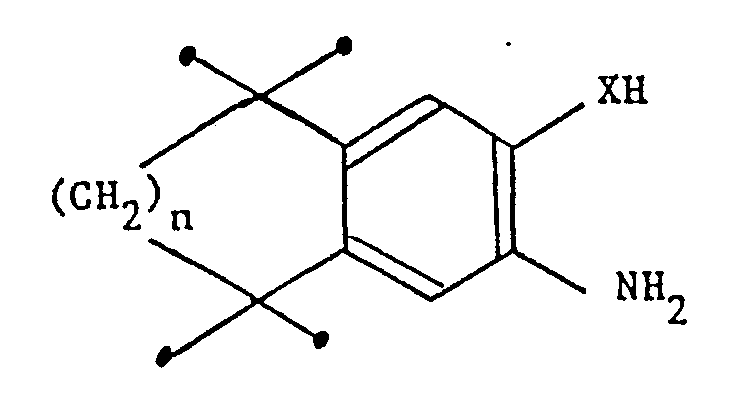
n est 1 ou 2 et X représente NH, O ou S
et à procéder à une réaction de cyclisation déshydratante en présence d'un catalyseur acide,

n est 1 ou 2, R₄ est tel que défini à la revendication 1 et X représente NH, O ou S,
et à procéder à une bromation du composé obtenu et ensuite à cycliser selon les conditions de la réaction de Wittig ou Wittig-Horner le dérivé intermédiaire porteur d'un groupement phosphonium ou phosphinyle,et éventuellement à transformer selon les méthodes connues, lesdits composés obtenus en vue d'obtenir l'une quelconque des autres significations du radical R₁.

n est 1 ou 2,
et X représente un atome d'oxygène, un atome de soufre ou le radical NR₄ , R₄ représentant un atome d'hydrogène ou un radical alkyle inférieur.
- le 2,3-diamino-5,6,7,8-tétrahydro-5,5,8,8-tétraméthyl naphtalène,
- le 3-amino-5,6,7,8-tétrahydro-5,5,8,8-tétraméthyl-2-naphtol.
Priority Applications (1)
| Application Number | Priority Date | Filing Date | Title |
|---|---|---|---|
| AT88401062T ATE56714T1 (de) | 1987-04-30 | 1988-04-29 | Polycyclische, heterocyclische derivate, verfahren zu deren herstellung sowie deren verwendung in der human- und tiermedizin. |
Applications Claiming Priority (2)
| Application Number | Priority Date | Filing Date | Title |
|---|---|---|---|
| FR8706152A FR2614618B1 (fr) | 1987-04-30 | 1987-04-30 | Derives heterocycliques polycycliques, leur procede de preparation et leur utilisation en medecine humaine et veterinaire |
| FR8706152 | 1987-04-30 |
Publications (2)
| Publication Number | Publication Date |
|---|---|
| EP0292348A1 true EP0292348A1 (fr) | 1988-11-23 |
| EP0292348B1 EP0292348B1 (fr) | 1990-09-19 |
Family
ID=9350670
Family Applications (1)
| Application Number | Title | Priority Date | Filing Date |
|---|---|---|---|
| EP88401062A Expired - Lifetime EP0292348B1 (fr) | 1987-04-30 | 1988-04-29 | Dérivés hétérocycliques polycycliques , leur procédé de préparation et leur utilisation en médecine humaine et vétérinaire |
Country Status (17)
| Country | Link |
|---|---|
| US (2) | US4874747A (fr) |
| EP (1) | EP0292348B1 (fr) |
| JP (1) | JP2579339B2 (fr) |
| AT (1) | ATE56714T1 (fr) |
| AU (1) | AU613618B2 (fr) |
| CA (1) | CA1313372C (fr) |
| DE (2) | DE3860640D1 (fr) |
| DK (1) | DK175098B1 (fr) |
| ES (1) | ES2009747T3 (fr) |
| FI (1) | FI92930C (fr) |
| FR (1) | FR2614618B1 (fr) |
| GR (2) | GR890300124T1 (fr) |
| IE (1) | IE61903B1 (fr) |
| NO (1) | NO171159C (fr) |
| NZ (1) | NZ224428A (fr) |
| PT (1) | PT87358B (fr) |
| ZA (1) | ZA883079B (fr) |
Cited By (7)
| Publication number | Priority date | Publication date | Assignee | Title |
|---|---|---|---|---|
| EP0406734A3 (en) * | 1989-07-03 | 1991-12-27 | Hoechst-Roussel Pharmaceuticals Incorporated | 2-(aminoaryl)indoles and indolines, a process for their preparation and their use as medicaments |
| FR2750426A1 (fr) * | 1996-06-28 | 1998-01-02 | Cird Galderma | Nouveaux composes biaryles heterocycliques et leur utilisation en medecine humaine ou veterinaire ainsi qu'en cosmetique |
| CN1036920C (zh) * | 1992-12-28 | 1998-01-07 | 卫材株式会社 | 含杂环碳酸衍生物 |
| FR2804323A1 (fr) * | 2000-01-31 | 2001-08-03 | Galderma Res & Dev | Utilisation de composes de type retinoides en tant qu'agents anti-bacteriens |
| WO2009156675A2 (fr) | 2008-05-30 | 2009-12-30 | Galderma Research & Development | Nouvelles compositions dépigmentantes sous forme d'une composition anhydre sans vaseline et sans élastomère comprenant un dérivé phénolique solubilisé et un rétinoïde |
| EP2460561A1 (fr) | 2006-12-21 | 2012-06-06 | Galderma Research & Development | Emulsion comprenant au moins un retinoide et du péroxyde de benzoyle |
| EP2460562A1 (fr) | 2006-12-21 | 2012-06-06 | Galderma Research & Development | Gel creme comprenant au moins un retinoide et du péroxyde de benzoyle |
Families Citing this family (12)
| Publication number | Priority date | Publication date | Assignee | Title |
|---|---|---|---|---|
| US5770382A (en) * | 1994-12-30 | 1998-06-23 | Ligand Pharmaceuticals, Inc. | Tricyclic retinoids, methods for their production and use |
| US5770383A (en) * | 1994-12-30 | 1998-06-23 | Ligand Pharmaceuticals, Inc. | Tricyclic retinoids, methods for their production and use |
| US5770378A (en) * | 1994-12-30 | 1998-06-23 | Ligand Pharmaceuticals, Inc. | Tricyclic retinoids, methods for their production and use |
| BR9610875A (pt) | 1995-10-06 | 1999-07-13 | Ligand Pharm Inc | Modulares rxr seletivos - dimeros e processos para seu uso |
| AU4676999A (en) * | 1998-06-12 | 1999-12-30 | Ligand Pharmaceuticals, Inc. | Treatment of anti-estrogen resistant breast cancer using rxr modulators |
| US6566372B1 (en) * | 1999-08-27 | 2003-05-20 | Ligand Pharmaceuticals Incorporated | Bicyclic androgen and progesterone receptor modulator compounds and methods |
| US6667313B1 (en) | 1999-08-27 | 2003-12-23 | Ligand Pharmaceuticals Inc. | 8-substituted-6-triflouromethyl-9-pyrido [3,2-G] quinoline compounds as androgen receptor modulators |
| PL353792A1 (en) | 1999-08-27 | 2003-12-01 | Ligand Pharmaceuticals Incorporatedligand Pharmaceuticals Incorporated | Androgen receptor modulator compounds and methods |
| WO2001019770A2 (fr) | 1999-09-14 | 2001-03-22 | Ligand Pharmaceuticals Incorporated | Modulateurs rxr a profil pharmacologique ameliore |
| US9050310B2 (en) * | 2004-06-25 | 2015-06-09 | Minas Theodore Coroneo | Treatment of ocular lesions |
| US20060204474A1 (en) * | 2005-02-25 | 2006-09-14 | Coroneo Minas T | Treatment of epithelial layer lesions |
| US11045441B2 (en) | 2015-10-13 | 2021-06-29 | Wisconsin Alumni Research Foundation | Use of retinoic acid and analogs thereof to treat central neural apneas |
Citations (3)
| Publication number | Priority date | Publication date | Assignee | Title |
|---|---|---|---|---|
| FR2488890A1 (fr) * | 1980-08-21 | 1982-02-26 | Hoffmann La Roche | Derives tricycliques de l'imidazole, leur preparation et leurs utilisations therapeutiques |
| EP0070531A2 (fr) * | 1981-07-20 | 1983-01-26 | Rorer International (Overseas) Inc. | Tétrahydronaphthoxazoles |
| GB2164648A (en) * | 1984-09-19 | 1986-03-26 | Cird | Heterocyclic retinoids |
Family Cites Families (4)
| Publication number | Priority date | Publication date | Assignee | Title |
|---|---|---|---|---|
| DE1545880A1 (de) * | 1965-12-27 | 1969-12-11 | Hoechst Ag | Verfahren zur Herstellung von Derivaten der 4-[Benzoxazolyl-(2')]-naphthoesaeure-(1) |
| DE3047043A1 (de) * | 1980-12-13 | 1982-07-22 | Bayer Ag, 5090 Leverkusen | Verfahren zur herstellung von 2-amino-benzimidazolen |
| US4659360A (en) * | 1984-11-30 | 1987-04-21 | Fmc Corporation | Plant growth and development modification using benzoxazole derivatives |
| LU87040A1 (fr) * | 1987-11-04 | 1989-06-14 | Oreal | Esters aromatiques polycycliques d'antibiotiques macrolidiques et lincosamidiques,leur procede de preparation et compositions pharmaceutiques et cosmetiques les contenant |
-
1987
- 1987-04-30 FR FR8706152A patent/FR2614618B1/fr not_active Expired
-
1988
- 1988-04-28 JP JP63107440A patent/JP2579339B2/ja not_active Expired - Fee Related
- 1988-04-28 DK DK198802326A patent/DK175098B1/da not_active IP Right Cessation
- 1988-04-29 EP EP88401062A patent/EP0292348B1/fr not_active Expired - Lifetime
- 1988-04-29 DE DE8888401062T patent/DE3860640D1/de not_active Expired - Lifetime
- 1988-04-29 AT AT88401062T patent/ATE56714T1/de not_active IP Right Cessation
- 1988-04-29 DE DE198888401062T patent/DE292348T1/de active Pending
- 1988-04-29 NZ NZ224428A patent/NZ224428A/xx unknown
- 1988-04-29 IE IE127988A patent/IE61903B1/en not_active IP Right Cessation
- 1988-04-29 FI FI882030A patent/FI92930C/fi not_active IP Right Cessation
- 1988-04-29 US US07/188,547 patent/US4874747A/en not_active Ceased
- 1988-04-29 ZA ZA883079A patent/ZA883079B/xx unknown
- 1988-04-29 AU AU15350/88A patent/AU613618B2/en not_active Ceased
- 1988-04-29 NO NO881896A patent/NO171159C/no not_active IP Right Cessation
- 1988-04-29 PT PT87358A patent/PT87358B/pt not_active IP Right Cessation
- 1988-04-29 ES ES198888401062T patent/ES2009747T3/es not_active Expired - Lifetime
- 1988-04-29 CA CA000565554A patent/CA1313372C/fr not_active Expired - Fee Related
-
1990
- 1990-01-31 GR GR89300124T patent/GR890300124T1/el unknown
- 1990-04-24 US US07/513,970 patent/USRE33533E/en not_active Expired - Lifetime
- 1990-11-20 GR GR90400945T patent/GR3001088T3/el unknown
Patent Citations (3)
| Publication number | Priority date | Publication date | Assignee | Title |
|---|---|---|---|---|
| FR2488890A1 (fr) * | 1980-08-21 | 1982-02-26 | Hoffmann La Roche | Derives tricycliques de l'imidazole, leur preparation et leurs utilisations therapeutiques |
| EP0070531A2 (fr) * | 1981-07-20 | 1983-01-26 | Rorer International (Overseas) Inc. | Tétrahydronaphthoxazoles |
| GB2164648A (en) * | 1984-09-19 | 1986-03-26 | Cird | Heterocyclic retinoids |
Non-Patent Citations (1)
| Title |
|---|
| CHEMICAL ABSTRACTS, vol. 52, no. 16, 25 aôut 1958, colonne 13694, résumé no. 13694f, Columbus, Ohio, US; M.J. SCHLATTER: "Abnormal products from the Tert-butylation of P-cymene", & AM. CHEM. SOC., DIV. PETROL. CHEM., PREPRINTS-SYMPOSIA 1, No. 2 (CHEMICALS FROM PETROL.), 77-82 (1956) * |
Cited By (12)
| Publication number | Priority date | Publication date | Assignee | Title |
|---|---|---|---|---|
| EP0406734A3 (en) * | 1989-07-03 | 1991-12-27 | Hoechst-Roussel Pharmaceuticals Incorporated | 2-(aminoaryl)indoles and indolines, a process for their preparation and their use as medicaments |
| CN1036920C (zh) * | 1992-12-28 | 1998-01-07 | 卫材株式会社 | 含杂环碳酸衍生物 |
| FR2750426A1 (fr) * | 1996-06-28 | 1998-01-02 | Cird Galderma | Nouveaux composes biaryles heterocycliques et leur utilisation en medecine humaine ou veterinaire ainsi qu'en cosmetique |
| EP0816352A1 (fr) * | 1996-06-28 | 1998-01-07 | Centre International De Recherches Dermatologiques Galderma (C.I.R.D. Galderma) | Nouveaux composés biaryles hétérocycliques et leur utilisation en médecine humaine ou vétérinaire ainsi qu'en cosmétique |
| US5905088A (en) * | 1996-06-28 | 1999-05-18 | Centre International De Recherches Dermatologiques Galderma | Heterocyclic biaryl compounds and pharmaceutical/cosmetic compositions comprised thereof |
| FR2804323A1 (fr) * | 2000-01-31 | 2001-08-03 | Galderma Res & Dev | Utilisation de composes de type retinoides en tant qu'agents anti-bacteriens |
| WO2001056554A3 (fr) * | 2000-01-31 | 2001-12-20 | Galderma Res & Dev | Utilisation de composes de type retinoides en tant qu'agents anti-bacteriens |
| US6858647B2 (en) | 2000-01-31 | 2005-02-22 | Galderma Research & Development S.N.C. | Retinoid compounds suited for antibacterial applications |
| EP2460561A1 (fr) | 2006-12-21 | 2012-06-06 | Galderma Research & Development | Emulsion comprenant au moins un retinoide et du péroxyde de benzoyle |
| EP2460562A1 (fr) | 2006-12-21 | 2012-06-06 | Galderma Research & Development | Gel creme comprenant au moins un retinoide et du péroxyde de benzoyle |
| EP3025763A1 (fr) | 2006-12-21 | 2016-06-01 | Galderma Research & Development | Gel creme comprenant au moins un retinoide et du peroxyde de benzoyle |
| WO2009156675A2 (fr) | 2008-05-30 | 2009-12-30 | Galderma Research & Development | Nouvelles compositions dépigmentantes sous forme d'une composition anhydre sans vaseline et sans élastomère comprenant un dérivé phénolique solubilisé et un rétinoïde |
Also Published As
| Publication number | Publication date |
|---|---|
| FI882030A0 (fi) | 1988-04-29 |
| IE881279L (en) | 1988-10-30 |
| NO881896D0 (no) | 1988-04-29 |
| EP0292348B1 (fr) | 1990-09-19 |
| FI882030A7 (fi) | 1988-10-31 |
| DK175098B1 (da) | 2004-06-01 |
| GR890300124T1 (en) | 1990-01-31 |
| IE61903B1 (en) | 1994-11-30 |
| DE292348T1 (de) | 1990-02-08 |
| ES2009747A4 (es) | 1989-10-16 |
| NO171159B (no) | 1992-10-26 |
| AU613618B2 (en) | 1991-08-08 |
| CA1313372C (fr) | 1993-02-02 |
| FI92930C (fi) | 1995-01-25 |
| DK232688D0 (da) | 1988-04-28 |
| PT87358B (pt) | 1992-08-31 |
| JPS63295556A (ja) | 1988-12-01 |
| NO171159C (no) | 1993-02-03 |
| US4874747A (en) | 1989-10-17 |
| AU1535088A (en) | 1988-11-03 |
| FR2614618A1 (fr) | 1988-11-04 |
| PT87358A (pt) | 1988-05-01 |
| NO881896L (no) | 1988-10-31 |
| DK232688A (da) | 1988-10-31 |
| ATE56714T1 (de) | 1990-10-15 |
| FI92930B (fi) | 1994-10-14 |
| ES2009747T3 (es) | 1993-05-16 |
| ZA883079B (en) | 1989-01-25 |
| NZ224428A (en) | 1990-05-28 |
| USRE33533E (en) | 1991-02-05 |
| JP2579339B2 (ja) | 1997-02-05 |
| FR2614618B1 (fr) | 1989-07-07 |
| GR3001088T3 (en) | 1992-04-17 |
| DE3860640D1 (de) | 1990-10-25 |
Similar Documents
| Publication | Publication Date | Title |
|---|---|---|
| EP0232199B1 (fr) | Composés benzamido aromatiques, leur procédé de préparation et leur utilisation en médecine humaine ou vétérinaire et en cosmétique | |
| EP0325540B1 (fr) | Esters et thioesters aromatiques, leur procédé de préparation et leur utilisation en médecine humaine ou vétérinaire et en cosmétique | |
| EP0292348B1 (fr) | Dérivés hétérocycliques polycycliques , leur procédé de préparation et leur utilisation en médecine humaine et vétérinaire | |
| EP0220118B1 (fr) | Dérivés bicycliques naphtaléniques, leur procédé de préparation et leur utilisation en médecine humaine et vétérinaire et en cosmétique | |
| EP0552282B1 (fr) | Composes bi-aromatiques et leur utilisation en medecine humaine et veterinaire et en cosmetique | |
| EP0260162B1 (fr) | Dérivés bicycliques aromatiques, leur procédé de préparation et leur utilisation en médecine humaine et vétérinaire et en cosmétique | |
| EP0210929B1 (fr) | Dérivés aromatiques polycycliques, leur procédé de préparation et leur application dans les domaines pharmaceutique et cosmetique | |
| EP0514269B1 (fr) | Nouveaux composés aromatiques dérivés d'imine, leur procédé de préparation et leur utilisation en médecine humaine et vétérinaire ainsi qu'en cosmétique | |
| FR2600064A1 (fr) | Composes benzopyrannyl et benzothiopyrannyl benzoiques, leur procede de preparation et leur utilisation en cosmetique et en medecine humaine et veterinaire | |
| LU85544A1 (fr) | Derives heterocycliques aromatiques,leur procede de preparation et leur application dans les domaines therapeutique et cosmetique | |
| EP0199636A1 (fr) | Dérivés benzonaphtaléniques, leur procédé de préparation et leur application dans les domaines pharmaceutique et cosmétique | |
| CH666679A5 (fr) | Derives naphtaleniques a action retinoique, leurs procedes de preparation et compositions medicamenteuse et cosmetique les contenant. | |
| CH662559A5 (fr) | Derives 2,6-disubstitues du naphtalene, leur procede de preparation et composition pharmaceutique ou cosmetique les contenant. | |
| EP0514264B1 (fr) | Composés bi-aromatiques dérivés d'un motif salicylique, leur procédé de préparation et leur utilisation en médecine humaine et vétérinaire ainsi qu'en cosmétique | |
| CA1294971C (fr) | Derives benzofuranniques, leurs procedes de preparation et compositions medicamenteuse et cosmetique les contenant | |
| EP0409728B1 (fr) | Esters bi-aromatiques, leur procédé de préparation et leur utilisation en médecine humaine ou vétérinaire et en cosmétique | |
| CH672784A5 (fr) | ||
| EP0342115B1 (fr) | Nouveaux eicosanoides sulfurés et leur application en pharmacie et en cosmétique | |
| EP0297995B1 (fr) | Nouveaux dérivés polycycliques aromatiques, leur procédé de préparation et leur utilisation en médecine humaine et vétérinaire et en cosmétique | |
| EP0286523B1 (fr) | Nouveaux dérivés aromatiques d'acide butyrique, leur procédé de préparation et leur utilisation en cosmétique ainsi qu'en médecine humaine et vétérinaire | |
| CH673278A5 (fr) | ||
| EP0360637B1 (fr) | Nouveaux composés benzofuranniques, leur procédé de préparation, compositions pharmaceutique et cosmétique les contenant et utilisation de ces compositions | |
| EP0404640B1 (fr) | Nouveaux dérivés de tétrahydro-5,6,7,8 naphtalénol-1, leur procédé de préparation et leur utilisation en tant qu'agents antioxydants dans des compositions cosmétiques et pharmaceutiques les contenant | |
| EP0409729B1 (fr) | Thioesters bi-aromatiques, leur procédé de préparation et leur utilisation en médecine humaine ou vétérinaire et en cosmétique | |
| LU86259A1 (fr) | Amides aromatiques,leur procede de preparation et leur utilisation en medecine humaine ou veterinaire et en cosmetique |
Legal Events
| Date | Code | Title | Description |
|---|---|---|---|
| PUAI | Public reference made under article 153(3) epc to a published international application that has entered the european phase |
Free format text: ORIGINAL CODE: 0009012 |
|
| AK | Designated contracting states |
Kind code of ref document: A1 Designated state(s): AT BE CH DE ES FR GB GR IT LI NL SE |
|
| 17P | Request for examination filed |
Effective date: 19890516 |
|
| ITCL | It: translation for ep claims filed |
Representative=s name: MODIANO & ASSOCIATI S.R.L. |
|
| TCNL | Nl: translation of patent claims filed | ||
| GBC | Gb: translation of claims filed (gb section 78(7)/1977) | ||
| TCAT | At: translation of patent claims filed | ||
| 17Q | First examination report despatched |
Effective date: 19890907 |
|
| DET | De: translation of patent claims | ||
| GRAA | (expected) grant |
Free format text: ORIGINAL CODE: 0009210 |
|
| AK | Designated contracting states |
Kind code of ref document: B1 Designated state(s): AT BE CH DE ES FR GB GR IT LI NL SE |
|
| REF | Corresponds to: |
Ref document number: 56714 Country of ref document: AT Date of ref document: 19901015 Kind code of ref document: T |
|
| REF | Corresponds to: |
Ref document number: 3860640 Country of ref document: DE Date of ref document: 19901025 |
|
| RAP2 | Party data changed (patent owner data changed or rights of a patent transferred) |
Owner name: CENTRE INTERNATIONAL DE RECHERCHES DERMATOLOGIQUES |
|
| REG | Reference to a national code |
Ref country code: CH Ref legal event code: PFA Free format text: CENTRE INTERNATIONAL DE RECHERCHES DERMATOLOGIQUES GALDERMA-C.I.R.D. GALDERMA |
|
| ITF | It: translation for a ep patent filed | ||
| BECN | Be: change of holder's name |
Effective date: 19900919 |
|
| GBT | Gb: translation of ep patent filed (gb section 77(6)(a)/1977) | ||
| REG | Reference to a national code |
Ref country code: GR Ref legal event code: FG4A Free format text: 3001088 |
|
| PLBE | No opposition filed within time limit |
Free format text: ORIGINAL CODE: 0009261 |
|
| STAA | Information on the status of an ep patent application or granted ep patent |
Free format text: STATUS: NO OPPOSITION FILED WITHIN TIME LIMIT |
|
| 26N | No opposition filed | ||
| ITTA | It: last paid annual fee | ||
| REG | Reference to a national code |
Ref country code: ES Ref legal event code: FG2A Ref document number: 2009747 Country of ref document: ES Kind code of ref document: T3 |
|
| EAL | Se: european patent in force in sweden |
Ref document number: 88401062.0 |
|
| REG | Reference to a national code |
Ref country code: GB Ref legal event code: IF02 |
|
| PGFP | Annual fee paid to national office [announced via postgrant information from national office to epo] |
Ref country code: SE Payment date: 20040406 Year of fee payment: 17 Ref country code: NL Payment date: 20040406 Year of fee payment: 17 |
|
| PGFP | Annual fee paid to national office [announced via postgrant information from national office to epo] |
Ref country code: FR Payment date: 20040408 Year of fee payment: 17 |
|
| PGFP | Annual fee paid to national office [announced via postgrant information from national office to epo] |
Ref country code: AT Payment date: 20040415 Year of fee payment: 17 |
|
| PGFP | Annual fee paid to national office [announced via postgrant information from national office to epo] |
Ref country code: ES Payment date: 20040416 Year of fee payment: 17 |
|
| PGFP | Annual fee paid to national office [announced via postgrant information from national office to epo] |
Ref country code: GB Payment date: 20040428 Year of fee payment: 17 Ref country code: CH Payment date: 20040428 Year of fee payment: 17 |
|
| PGFP | Annual fee paid to national office [announced via postgrant information from national office to epo] |
Ref country code: GR Payment date: 20040430 Year of fee payment: 17 |
|
| PGFP | Annual fee paid to national office [announced via postgrant information from national office to epo] |
Ref country code: DE Payment date: 20040506 Year of fee payment: 17 |
|
| PGFP | Annual fee paid to national office [announced via postgrant information from national office to epo] |
Ref country code: BE Payment date: 20040611 Year of fee payment: 17 |
|
| PG25 | Lapsed in a contracting state [announced via postgrant information from national office to epo] |
Ref country code: IT Free format text: LAPSE BECAUSE OF NON-PAYMENT OF DUE FEES;WARNING: LAPSES OF ITALIAN PATENTS WITH EFFECTIVE DATE BEFORE 2007 MAY HAVE OCCURRED AT ANY TIME BEFORE 2007. THE CORRECT EFFECTIVE DATE MAY BE DIFFERENT FROM THE ONE RECORDED. Effective date: 20050429 Ref country code: GB Free format text: LAPSE BECAUSE OF NON-PAYMENT OF DUE FEES Effective date: 20050429 Ref country code: AT Free format text: LAPSE BECAUSE OF NON-PAYMENT OF DUE FEES Effective date: 20050429 |
|
| PG25 | Lapsed in a contracting state [announced via postgrant information from national office to epo] |
Ref country code: SE Free format text: LAPSE BECAUSE OF NON-PAYMENT OF DUE FEES Effective date: 20050430 Ref country code: LI Free format text: LAPSE BECAUSE OF NON-PAYMENT OF DUE FEES Effective date: 20050430 Ref country code: ES Free format text: LAPSE BECAUSE OF NON-PAYMENT OF DUE FEES Effective date: 20050430 Ref country code: CH Free format text: LAPSE BECAUSE OF NON-PAYMENT OF DUE FEES Effective date: 20050430 Ref country code: BE Free format text: LAPSE BECAUSE OF NON-PAYMENT OF DUE FEES Effective date: 20050430 |
|
| BERE | Be: lapsed |
Owner name: CENTRE INTERNATIONAL DE RECHERCHES DERMATOLOGIQUES Effective date: 20050430 |
|
| PG25 | Lapsed in a contracting state [announced via postgrant information from national office to epo] |
Ref country code: NL Free format text: LAPSE BECAUSE OF NON-PAYMENT OF DUE FEES Effective date: 20051101 Ref country code: DE Free format text: LAPSE BECAUSE OF NON-PAYMENT OF DUE FEES Effective date: 20051101 |
|
| PG25 | Lapsed in a contracting state [announced via postgrant information from national office to epo] |
Ref country code: GR Free format text: LAPSE BECAUSE OF NON-PAYMENT OF DUE FEES Effective date: 20051103 |
|
| EUG | Se: european patent has lapsed | ||
| REG | Reference to a national code |
Ref country code: CH Ref legal event code: PL |
|
| GBPC | Gb: european patent ceased through non-payment of renewal fee |
Effective date: 20050429 |
|
| PG25 | Lapsed in a contracting state [announced via postgrant information from national office to epo] |
Ref country code: FR Free format text: LAPSE BECAUSE OF NON-PAYMENT OF DUE FEES Effective date: 20051230 |
|
| NLV4 | Nl: lapsed or anulled due to non-payment of the annual fee |
Effective date: 20051101 |
|
| REG | Reference to a national code |
Ref country code: FR Ref legal event code: ST Effective date: 20051230 |
|
| REG | Reference to a national code |
Ref country code: ES Ref legal event code: FD2A Effective date: 20050430 |
|
| BERE | Be: lapsed |
Owner name: CENTRE INTERNATIONAL DE RECHERCHES DERMATOLOGIQUES Effective date: 20050430 |