EP0295146B1 - Überwachtes wechselwirkendes Alarmmeldersystem - Google Patents
Überwachtes wechselwirkendes Alarmmeldersystem Download PDFInfo
- Publication number
- EP0295146B1 EP0295146B1 EP88305368A EP88305368A EP0295146B1 EP 0295146 B1 EP0295146 B1 EP 0295146B1 EP 88305368 A EP88305368 A EP 88305368A EP 88305368 A EP88305368 A EP 88305368A EP 0295146 B1 EP0295146 B1 EP 0295146B1
- Authority
- EP
- European Patent Office
- Prior art keywords
- premises
- central facility
- derived channel
- supervised
- channel unit
- Prior art date
- Legal status (The legal status is an assumption and is not a legal conclusion. Google has not performed a legal analysis and makes no representation as to the accuracy of the status listed.)
- Expired - Lifetime
Links
Images


Classifications
-
- G—PHYSICS
- G08—SIGNALLING
- G08B—SIGNALLING SYSTEMS, e.g. PERSONAL CALLING SYSTEMS; ORDER TELEGRAPHS; ALARM SYSTEMS
- G08B25/00—Alarm systems in which the location of the alarm condition is signalled to a central station, e.g. fire or police telegraphic systems
-
- G—PHYSICS
- G08—SIGNALLING
- G08B—SIGNALLING SYSTEMS, e.g. PERSONAL CALLING SYSTEMS; ORDER TELEGRAPHS; ALARM SYSTEMS
- G08B25/00—Alarm systems in which the location of the alarm condition is signalled to a central station, e.g. fire or police telegraphic systems
- G08B25/01—Alarm systems in which the location of the alarm condition is signalled to a central station, e.g. fire or police telegraphic systems characterised by the transmission medium
- G08B25/10—Alarm systems in which the location of the alarm condition is signalled to a central station, e.g. fire or police telegraphic systems characterised by the transmission medium using wireless transmission systems
-
- G—PHYSICS
- G08—SIGNALLING
- G08B—SIGNALLING SYSTEMS, e.g. PERSONAL CALLING SYSTEMS; ORDER TELEGRAPHS; ALARM SYSTEMS
- G08B25/00—Alarm systems in which the location of the alarm condition is signalled to a central station, e.g. fire or police telegraphic systems
- G08B25/01—Alarm systems in which the location of the alarm condition is signalled to a central station, e.g. fire or police telegraphic systems characterised by the transmission medium
- G08B25/08—Alarm systems in which the location of the alarm condition is signalled to a central station, e.g. fire or police telegraphic systems characterised by the transmission medium using communication transmission lines
-
- G—PHYSICS
- G08—SIGNALLING
- G08B—SIGNALLING SYSTEMS, e.g. PERSONAL CALLING SYSTEMS; ORDER TELEGRAPHS; ALARM SYSTEMS
- G08B29/00—Checking or monitoring of signalling or alarm systems; Prevention or correction of operating errors, e.g. preventing unauthorised operation
- G08B29/16—Security signalling or alarm systems, e.g. redundant systems
Definitions
- the present invention relates generally to remote alarm reporting systems, and in particular, to a supervised alarm reporting system which is capable of providing enhanced security.
- a variety of security systems have been developed to satisfy the ever-increasing need for the remote monitoring of various premises, including both business and home applications. Generally, this is accomplished by providing the premises with a local terminal, or reporting unit, which is capable of receiving signals from various sensors placed throughout the premises, interpreting such signals, and interacting with a central office or station to advise the central facility of potential alarm conditions.
- the sensors communicating with the local terminal may be used to provide any of a variety of functions, including smoke and fire detection, the detection of intruders (i.e., possible break-ins), or to monitor local conditions such as temperature, pressure or other desired parameters.
- the corresponding central facility might constitute any of a number of private companies which have been established for security or other monitoring purposes. The key to the effectiveness and integrity of the system provided often depends upon the means which are used to establish communications between the local terminal provided at the premises and the monitoring equipment provided at the central facility. A number of systems have therefore been advised to provide such communications.
- the local terminal provided at the remote premises is connected to the switched telephone line network associated with the premises, to establish remote communications.
- communications are initiated by the local terminal, which automatically dials the central facility when a potential alarm event has been detected (one-way communications). While such communications may be accomplished by voice (a recorded message), the current trend is for such communications to be accomplished through digital communications, which are capable of providing more detailed information regarding the potential alarm condition.
- Communications via the switched telephone line network are popular because they are inexpensive, well proven and reliable.
- the switched telephone line network is already in place, readily accessible, and serviced by a third party. A cost effective security system results.
- the central facility is permitted to periodically interrogate the local terminal at the remote premises, to determine its status. In addition to indicating whether or not there are any alarm conditions, this also has the benefit of verifying that the communication lines are intact.
- a tone having a frequency below the audible range, which is transmitted by the local terminal at specified times. Again, in addition to the reporting function of this tone, this additionally provides a means for verifying the integrity of the communicating telephone lines.
- Such derived channel systems therefore have the advantage of indicating whether or not the system is operational, and is properly reporting its condition. This avoids the potential "blackouts" inherent in one-way communicating systems, thereby serving to significantly enhance security.
- Yet another system involves the replacement of wired lines with radio communications. While it is significantly more difficult to "cut" radio communications between the local terminal and the central facility, such jamming techniques do exist. Consequently, a one-way radio system, although more reliable than a wired one-way system, will still suffer from the disadvantage that the central facility is not made aware of whether or not the system is in operation. A two-way radio system would enable a supervisory function to be added. However, this requires continuous two-way communications by way of radio. Such systems are therefore subject to significant limitations in view of the regulatory constraints which are in place regarding the use of radio waves, and in terms of the number of frequencies which are available for use in a particular system (limiting the number of possible installations). Yet another factor to consider is the significant cost of installation and maintenance which such a system necessarily entails.
- EP-A-11444 discloses an alarm reporting system (Figs 1, 2) for providing communication between one or more event sensors associated with a mobile site (motor vehicle) and a facility for monitoring the event sensors at said mobile site, comprising a terminal unit for receiving signals from said event sensors, and means for establishing communication between said terminal unit and said monitoring facility.
- FR-A-2295506 discloses an alarm reporting system having a local terminal comprising a supervised derived channel communicator, and a one-way radio communicator, which are connected by a control unit which provides for interactive operation of the derived channel unit and the radio transmitter according to the alarm conditions which may arise at the premises, and the existing condition of the equipment comprising the local terminal unit.
- a supervised, interactive alarm reporting system for providing communication between one or more event sensors associated with a premises, and a central facility for monitoring the sensors at said premises, comprising: first means for establishing communication between said sensors and said central facility using wired communicating lines; second means for establishing communication between said sensors and said central facility using radio transmissions; and means connecting said first means and said second means for controlling operation of the first means and the second means according to the condition of the event sensors associated with said premises, and the condition of said first means and said second means, wherein said first means is a derived channel unit and said second means is a radio transmitter, and wherein said connecting means operates to establish communication with said central facility using said derived channel unit during normal operating conditions, the system characterised in that said connecting means includes means for periodically testing said radio transmitter responsive to periodic testing associated with said derived channel unit.
- the supervised derived channel unit operates to advise the associated central station of the conditions at the monitored premises.
- the radio transmitter is activated to advise the central station of the current status of the system. This alerts the central station to the failure, and also indicates the existing condition of the premises. If the premises are in proper condition, an equipment failure is indicated and steps are taken to repair the fault in due course. If there is an alarm condition at the premises, the central station will be advised of this by the radio transmitter, allowing appropriate measures to be taken.
- the central station is made aware of the simultaneous failure since the supervised, derived channel unit will cease to operate and the radio transmitter will not follow this cessation of activity with an appropriate report. This will result in a declared break-in. However, since the probability against both units failing simultaneously is extremely high, a declared break-in is justified.
- the one-way radio communications which are used are preferably accomplished by means of the cellular telephone network.
- This not only provides the above-discussed operational functions, but also makes use of an existing network which is installed and serviced by third parties. Since actual use of the cellular telephone network is kept to a minimum as a result of the manner of operation of the system, the marginal costs of using the cellular telephone network are kept to a minimum.
- use of the cellular telephone network has the added advantage of permitting simultaneous communications with both the central station which is monitoring the premises, as well as mobile units associated with the central station. Such mobile units may include mobile patrol vehicles, or mobile service vehicles, which can share in the responsibility of servicing a significant number of installations.
- Fig. 1 is a schematic representation of the supervised, interactive alarm reporting system of the present invention.
- Fig. 2 is a schematic view showing the construction of the controlling interface.
- Fig. 3 is a timing diagram illustrating the interactive operation of the foregoing components.
- Fig. 4 is a flow diagram illustrating the steps taken at the central station to interpret the signals received from the local terminal unit.
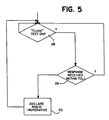
- Fig. 5 is a flow diagram illustrating steps which may be taken at the central station to periodically test the integrity of the system.
- Fig. 1 generally illustrates the supervised, interactive alarm reporting system 1 of the present invention.
- Those portions of the system 1 which are located at the premises 2 to be monitored generally include one or more sensors 3 which are capable of providing signals to a local terminal unit 4.
- sensors 3 Any of a variety of different types of sensors 3 may be used in connection with such a system, including smoke detectors, fire detectors, various detectors for determining intrusions such as contact switches, light sensitive circuits and ultrasonic circuits, as well as any of a number of parameter sensors such as temperature sensors, pressure sensors, timing devices or the like.
- any of a number of parameter sensors such as temperature sensors, pressure sensors, timing devices or the like.
- a single sensor may be provided, or any number of plural sensors may be utilized in operative combination. In any event, such sensors would be operatively connected to the local terminal unit 4 for ultimate (serial) processing as will be described more fully below.
- the terminal unit 4 is essentially comprised of three interactive units.
- the first of these units is a derived channel unit 5 which is capable of communicating with a central station 10 via the switched telephone line network 8. Any of a variety of derived channel units 5 could be used for this purpose. However, in accordance with the present invention it is preferred that the derived channel unit 5 constitute a "Subscriber Terminal Unit" of the type manufactured by Base 10 Systems, Inc., Trenton, New Jersey. This unit is preferred in view of the supervisory capabilities which it provides. These supervisory capabilities are described with reference to U.S. Patent No. 4,442,320, the subject matter of which is incorporated by reference as if fully set forth herein.
- the local terminal unit 4 also includes a radio transmitter 6 which is capable of communicating with the central station 10 by wireless communications.
- the radio transmitter 6 operate to transmit signals via the cellular telephone network 9 for reasons which will become apparent from the description which is provided below.
- the local terminal unit 4 incorporates a controlling interface 7 which operatively connects the derived channel unit 5 and the radio transmitter 6 to provide a supervised, interactive alarm signal processor, the operation of which will now be more fully discussed.
- the derived channel unit 5 is preferably a supervised unit, while the radio transmitter 6 is preferably configured as a non-supervised, one-way transmitter.
- the reason for this is that in the normal course of operations, the cost effective, supervised reporting capabilities of a derived channel unit 5 will be sufficient, and the relatively expensive cost of operating the radio transmitter 6 will be unnecessary.
- the supervised, derived channel unit 5 will therefore normally operate to keep the central station 10 advised as to the status of the premises 2, in cost effective fashion.
- the radio transmitter 6 will essentially remain dormant, keeping the impact (load) on the radio transmission network, in this case preferably the cellular telephone network, to a minimum. In addition to reducing costs, this allows a maximum number of local terminal units to be operatively associated with a particular central station without compromising the capabilities of such wireless communications.
- the derived channel unit 5 ceases to report. This may be the result of an equipment failure of the derived channel unit 5, an interruption or break in the switched telephone line network 8 due to servicing, accident or the like, or a potential break-in.
- the derived channel unit 5 In the event that the cessation of activity is the result of an equipment failure in the derived channel unit 5, the derived channel unit 5 will be unable to complete its supervisory interrogation sequence. As a result, the internal verification systems of the derived channel unit 5 (in this case the "Subscriber Terminal Unit” distributed by Base 10 Systems, Inc.) will provide an output indicating the occurrence of a fault. This output may then be used to develop a fault signal, which is applied at 11 in Fig. 2 of the drawings. The fault signal 11 is simultaneously applied to the input of an enabling circuit 12 and to the input of a programmable trigger generator 13.
- the internal verification systems of the derived channel unit 5 in this case the "Subscriber Terminal Unit" distributed by Base 10 Systems, Inc.
- This output may then be used to develop a fault signal, which is applied at 11 in Fig. 2 of the drawings.
- the fault signal 11 is simultaneously applied to the input of an enabling circuit 12 and to the input of a programmable trigger generator 13.
- the enabling circuit and the programmable trigger generator are, in essence, monostable circuits which are capable of developing appropriate pulses responsive to the fault signal 11, as will be described more fully below, which are in turn applied to the first and second inputs of an AND circuit 14.
- Coincidence between the signals produced by the enabling circuit 12 and the programmable trigger generator 13 will cause an output to be developed at the AND circuit 14, which is then introduced to the first input of an OR circuit 15. This signal will in turn be passed through the OR circuit 15, for output at 16.
- the output 16 is in turn applied to the radio transmitter 6, activating the radio transmitter 6.
- Activation of the radio transmitter 6 causes (preferably immediately) the status of the premises 2 to be transmitted to the central station 10 via the cellular telephone network 9.
- the central station 10 is made aware of the fault in the derived channel unit 5 of the terminal unit 4, and of the existing status of the sensors 3 associated with the premises 2. With this information, the central station 10 is able to make a decision as to whether or not there is an alarm condition which requires a response, or if there is simply a fault which requires eventual servicing.
- the radio transmitter 6 remains available to advise the central station 10 of any changes in the status of the local sensors 3 (i.e., alarm events).
- the radio transmitter 6 is preferably a non-supervised, one-way unit. Accordingly, after the initial transmission of information as previously described, the radio transmitter 6 could then be subjected to tampering, without the central station 10 becoming aware of such triggering. However, by properly programming the programmable trigger generator 13, this problem can be overcome as follows.
- Fig. 3 of the drawings various timing sequences associated with the controlling interface 7 are illustrated.
- the fault signal 11 is produced upon discontinuance of the operation of the derived channel unit 5.
- the enabling circuit 12 operates to develop an enabling signal 17 for application to the first input of the AND circuit 14, while the programmable trigger generator 13 operates to develop its own programmed sequence for application to the second input of the AND circuit 14, as follows.
- the output of the programmable trigger generator 13 could be established in accordance with the sequence 11 illustrated in Fig. 3. This would provide an initial indication of the fault, and maintain radio communications, but would not provide any supervisory capabilities.
- the output of the programmable trigger generator 13 could be modified to establish the sequence 18 shown in Fig. 3. This would be accomplished by programming the programmable trigger generator 13 with a specified duration (T), frequency (f), and pulse width which are preferably variable (by the subscriber) to suit the user's specific requirements. Increasing the duration and/or frequency would increase the security provided, with an attendant increase in costs associated with the periodic excercise of the radio transmitter 6. Decreasing the duration and/or frequency would have the opposite effect. Nevertheless, a supervisory function would result as follows.
- the central station 10 will begin to receive communications from the radio transmitter 6. As will be discussed more fully below, the central station 10 is made aware of (programmed to expect) the periodic re-transmissions which are to occur in accordance with the selected sequence developed within the programmable trigger generator 13. The central station 10 will therefore be looking for these periodic transmissions to verify that the radio transmitter 6 has not been tampered with. This will also serve to periodically advise the central station 10 of the status of the premises 2. Failure to receive a scheduled transmission (or if desired, a contiguous pair of transmissions) will signify that the radio transmitter 6 is no longer operational.
- the periodic transmissions of the programmable trigger generator 13 could be continued for a significant period of time, if desired. Indeed, the periodic transmissions could be maintained indefinitely, provided the enabling signal 17 (which is provided to allow the installer of the system to limit radio supervision) is also correspondingly maintained, until such time as the derived channel unit 5 could be repaired.
- Such periodic transmissions are accomplished as a result of the coincidence of the enabling signal 17 and one of the pulses developed by the programmable trigger generator 13, within the AND circuit 14. This provides a signal to the OR circuit 15, which will in turn be passed to the radio transmitter 6 as previously described.
- a restore signal such as is represented by the sequence 19 shown in Fig. 3 is provided to reset the programmable trigger generator 13, at 20 in Fig. 2. This operates to terminate the output and the AND circuit 14, restoring the terminal unit 4 to its normal operating condition.
- Fig. 4 illustrates the nature of these operations.
- activity at the central station 10 commences when it is determined that one of the derived channel units 5 is no longer responding, at 21.
- the central station 10 would then search for the corresponding radio transmission which is to result from the identified failure of the derived channel unit 5, if the particular subscriber is provided with such a capability, as determined at 22 (some subscribers may only be provided with supervised derived channel units, without the enhancement of a radio backup).
- a test is then made at 23 to determine whether or not the anticipated transmission has been received (within a defined tolerance). It will be understood that the timing of this test must therefore be programmed to correspond to the timing of the sequence entered into the programmable trigger generator 13, according to the requirement of the subscriber.
- a message 25 is displayed to alert the central station 10 of the failure of the derived channel unit 5 so that appropriate steps may be taken to repair the problem in due course.
- the derived channel unit 5 may also cease to report due to an interruption or break in the switched telephone line network 8, or due to tampering in the course of a break-in.
- the first of these possibilities will result in a non-responding derived channel unit 5, causing further operations to proceed as previously described, until the fault with the communicating line is repaired.
- the radio transmitter 6 will operate to keep the central station 10 advised of the status of the premises 2.
- re-established communications with the derived channel unit 5 will reset the terminal unit 4 (at the reset 20), returning the local terminal unit 4 to its normal operating condition.
- the second of these possibilities will cause an alarm condition to occur, which will be transmitted to the central station 10 by the radio transmitter 6, enabling appropriate personnel to be dispatched to the premises 2.
- the local terminal unit 4 need take no further action in such case since the derived channel unit 5 is fully supervised.
- the central station 10 remains in continuous contact with the premises 2, and is advised of its status.
- the central station 10 will not be able to proceed through the sequence previously described, since the initial radio transmission will not be received at the prescribed time. Again, since the probability of a simultaneous failure of the radio transmitter 6 and the derived channel unit 5 is quite low, a declared break-in is justified, and appropriate personnel are dispatched.
- the reliability, and therefore the predictability of this sequence can be further enhanced if the radio transmitter 6 is periodically tested to verify that it is operational. This may be accomplished by the testing procedure which is described with reference to Fig. 5. As previously indicated, the derived channel unit 5 is supervised, and is therefore periodically tested to verify its integrity. A test which is conventionally provided in connection with the earlier identified "Subscriber Terminal Unit” of Base 10 Systems, Inc. involves the periodic (usually each 24 hour period) transmission of a "close" signal to the "Subscriber Terminal Unit", which in turn provides an acknowledgment of this signal. This acknowledgment signal is also advantageously applied to the controlling interface 7, at 27, to provide a periodic check of the radio transmitter 6 by coupling the signal provided at 27 through the OR circuit 15 and to the radio transmitter 6. With reference to Fig.
- this test is initiated at 28, followed by a check to verify receipt of the radio transmission (within a prescribed tolerance), at 29. If so, the test is complete until the next testing period. If not, the radio transmitter 6 is declared inoperative, at 30, and steps are taken to dispatch appropriate personnel to repair the unit. Other available signals may be used, as desired, to perform similar testing of this nature.
- the derived channel unit 5 and the radio transmitter 6 cease to function, a presumption is made that a significant problem exists at the premises 2, and a break-in is immediately declared. Appropriate personnel are then dispatched to the premises 2 to deal with the situation.
- the derived channel unit 5 and the radio transmitter 6 are preferably provided with a battery back-up to account for power failures and the like, so that the probability of a simultaneous equipment failure will be extremely low. This allows the break-in to be declared with a high degree of reliability, avoiding false alarms.
- the central station 10 is kept fully advised of the status of the premises 2, even during equipment failures. Conditions are maintained which allow the premises to be monitored, even if there has been significant tampering. Due to the redundancy of the system, significant tampering can practically speaking be the only cause of a system failure (other than a failure of one of the sensors 3 or at the central station 10), allowing a break-in to be declared with confidence. To be noted is that this is accomplished with only minimal use of the wireless system, keeping costs to a minimum and avoiding possible overtaxing of the wireless transmission system.
- the use of wireless communication as previously described, particularly making use of the cellular telephone network provides yet another enhancement to security as follows.
- equipment failures other than those involving the radio transmitter 6 will cause a radio transmission to be made.
- the signal which is transmitted to the central station 10 is also potentially receivable at other places.
- the supervised, interactive alarm reporting system 1 of the present invention is preferably further provided with mobile units 35 which are capable of supplementing the above described functions. Faults in equipment encountered at the premises 2 can therefore immediately be conveyed to a mobile unit 35, which is in a position to even more promptly respond to the potential problem.
- the mobile units 35 can include service vehicles for correcting faults in the system and/or security vehicles for responding to alarms or declared break-ins. This capability is provided without additionally taxing the cellular telephone network 9 or the remaining components of the alarm reporting system 1.
- voice communications are possible, the foregoing capabilities are advantageously achieved by providing the mobile units 35 with an appropriate computer/transceiver.
- a computer/transceiver may be developed by combining a suitable portable computer with a mobile converter such as is presently marketed by the Motorola Corporation. In either case, the mobile units 35 are immediately advised of the situation at the premises 2, whether to take immediate action in accordance with the received message, or to get in contact with the central station 10 to determine a proper course of action.
- the above described supervised, interactive alarm reporting system serves to satisfy each of the objectives previously set forth. Moreover, the described system can be implemented without having to modify the existing alarm reporting system of the premises (i.e., the derived channel unit 5). It will further be understood that the supervised, interactive alarm reporting system of the present invention is capable of being modified without departing from the spirit and scope of the present invention.
- the mobile site may be provided with a desired security system (theft, fire, etc.), the local terminal of which is then placed in communication with a central station or mobile security units via the cellular telephone network.
- a desired security system such as theft, fire, etc.
Landscapes
- Physics & Mathematics (AREA)
- General Physics & Mathematics (AREA)
- Engineering & Computer Science (AREA)
- Business, Economics & Management (AREA)
- Emergency Management (AREA)
- Computer Security & Cryptography (AREA)
- Computer Networks & Wireless Communication (AREA)
- Alarm Systems (AREA)
- Two-Way Televisions, Distribution Of Moving Picture Or The Like (AREA)
- Debugging And Monitoring (AREA)
- Selective Calling Equipment (AREA)
- Mobile Radio Communication Systems (AREA)
- Traffic Control Systems (AREA)
Claims (11)
- Interaktives Überwachungsalarmberichtssystem (1) zum Bereitstellen einer Kommunikation zwischen einem oder mehreren Ereignissensoren (3), die einer Prämisse (2) zugeordnet sind, und einer zentralen Einrichtung (10) zum Beobachten der Sensoren unter der Prämisse mit:
einer ersten Einrichtung (5) zum Einrichten einer Kommunikation zwischen den Sensoren und der zentralen Einrichtung mittels verdrahteten Kommunikationsleitungen;
einer zweiten Einrichtung (6) zum Einrichten einer Kommunikation Zwischen den Sensoren und der zentralen Einrichtung mittels Funkübertragungen; und
einer Einrichtung (7), die die erste Einrichtung und die zweite Einrichtung für eine Steuerungsoperation der ersten Einrichtung und der zweiten Einrichtung entsprechend des Zustandes der Ereignissensoren, die den Prämissen zugeordnet sind, und des Zustandes der ersten Einrichtung (5) und der zweiten Einrichtung (6), verbindet, worin die erste Einrichtung (5) eine abgeleitete Kanaleinheit ist und die zweite Einrichtung (6) ein Funksender ist, und worin die Verbindungseinrichtung (7) arbeitet, um eine Kommunikation mit der zentralen Einrichtung (10) mittels der abgeleiteten Kanaleinheit (5) während normaler Operationsbedingungen zu errichten, und worin die abgeleitete Kanaleinheit periodisch getestet wird, wobei das System (1) dadurch gekennzeichnet ist, daß die Verbindungseinrichtung (7) eine Einrichtung (27, 28, 29, 30) zum periodischen Testen des Funksenders (6) abhängig vom periodischen Testen, welches der abgeleiteten Kanaleinheit (5) zugeordnet ist, beinhaltet. - System nach Anspruch 1, bei dem eine erste Einrichtung über ein geschaltetes Telefonleitungsnetz (8) arbeitet.
- System nach irgendeinem der vorhergehenden Ansprüche, bei dem die zweite Einrichtung nur ein Sender ist.
- System nach irgendeinem der vorhergehenden Ansprüche, bei dem die zweite Einrichtung über ein zellenförmiges Telefonnetz arbeitet.
- System nach irgendeinem der vorhergehenden Ansprüche, bei dem die Kommunikation durch die zentrale Einrichtung (10) überwacht wird.
- System nach irgendeinem der vorhergehenden Ansprüche, bei dem die Verbindungseinheit (7) arbeitet, um eine Kommunikation mit der zentralen Einrichtung (10) mittels der zweiten Einrichtung (6) während einem sensierten Alarmereignis einzurichten.
- System nach irgendeinem der vorhergehenden Ansprüche, bei dem die erste Einrichtung (5) eine Einrichtung zum Bestimmen eines Fehlers in der Kommunikation mit der zentralen Einrichtung beinhaltet, bei dem die Fehlerbestimmungseinrichtung arbeitet, um die Verbindungseinrichtung mit einem Fehlersignal auszustatten, und bei dem die Verbindungseinrichtung die zweite Einrichtung (6) dazu veranlaßt, in Abhängigkeit von dem Fehlersignal zu arbeiten.
- System nach Anspruch 7, bei dem die Verbindungseinrichtung (7) beim Vorhandensein des Fehlersignals damit fortfährt, die zweite Einrichtung (6) zu bedienen, und bei dem die fortgesetzte Operation eine Funkübertragung, die abhängig von dem sensierten Alarmereignis auftritt, und/oder eine periodische Funkübertragung, die abhängig von einer vorausgewählten Zeitverlaufsequenz auftritt, beinhaltet.
- System nach Anspruch 8, bei dem die Sequenz bezüglich Frequenz und Zeitdauer variabel ist.
- System nach Anspruch 8, bei dem die zentrale Einrichtung eine Einrichtung zum Suchen nach irgendeiner periodischen Funkübertragung abhängig von der Detektion eines Fehlers in der ersten Einrichtung beinhaltet.
- System nach irgendeinem der vorhergehenden Ansprüche, bei dem die zentrale Einrichtung (10) örtlich fixiert ist, und wobei das System ferner eine mobile Einheit in Kommunikation mit dem Rest des Alarmberichtssystems beinhaltet.
Priority Applications (1)
| Application Number | Priority Date | Filing Date | Title |
|---|---|---|---|
| AT88305368T ATE96929T1 (de) | 1987-06-12 | 1988-06-13 | Ueberwachtes wechselwirkendes alarmmeldersystem. |
Applications Claiming Priority (2)
| Application Number | Priority Date | Filing Date | Title |
|---|---|---|---|
| US62174 | 1987-06-12 | ||
| US07/062,174 US4868859A (en) | 1987-06-12 | 1987-06-12 | Supervised, interactive alarm reporting system |
Publications (3)
| Publication Number | Publication Date |
|---|---|
| EP0295146A2 EP0295146A2 (de) | 1988-12-14 |
| EP0295146A3 EP0295146A3 (en) | 1989-08-30 |
| EP0295146B1 true EP0295146B1 (de) | 1993-11-03 |
Family
ID=22040687
Family Applications (1)
| Application Number | Title | Priority Date | Filing Date |
|---|---|---|---|
| EP88305368A Expired - Lifetime EP0295146B1 (de) | 1987-06-12 | 1988-06-13 | Überwachtes wechselwirkendes Alarmmeldersystem |
Country Status (11)
| Country | Link |
|---|---|
| US (1) | US4868859A (de) |
| EP (1) | EP0295146B1 (de) |
| JP (1) | JPS6470898A (de) |
| KR (1) | KR890001009A (de) |
| AT (1) | ATE96929T1 (de) |
| AU (1) | AU611913B2 (de) |
| CA (1) | CA1296790C (de) |
| DE (1) | DE3885350T2 (de) |
| ES (1) | ES2049249T3 (de) |
| IL (1) | IL86609A (de) |
| NZ (1) | NZ224866A (de) |
Cited By (1)
| Publication number | Priority date | Publication date | Assignee | Title |
|---|---|---|---|---|
| RU2279138C2 (ru) * | 2000-09-28 | 2006-06-27 | Маркус ЦИЗИНГ | Система персонального наблюдения |
Families Citing this family (172)
| Publication number | Priority date | Publication date | Assignee | Title |
|---|---|---|---|---|
| USRE37141E1 (en) | 1984-09-10 | 2001-04-17 | Spectrum Information Technologies, Inc. | Cellular telephone data communication system and method |
| US4697281A (en) | 1986-03-14 | 1987-09-29 | Spectrum Cellular Communications Corporation, Inc. | Cellular telephone data communication system and method |
| US5027383A (en) * | 1987-06-12 | 1991-06-25 | Versus Technology, Inc. | Supervised, interactive alarm reporting system |
| US5185779A (en) * | 1987-08-05 | 1993-02-09 | Norbert Zawacki | Cellular alarm backup system |
| US4887290A (en) * | 1987-08-05 | 1989-12-12 | Norbert W. Zawacki | Cellular alarm backup system |
| AU615514B2 (en) * | 1987-12-07 | 1991-10-03 | Versus Technology, Inc. | System for interfacing an alarm reporting device with a cellular radio transceiver |
| USRE38645E1 (en) | 1989-01-19 | 2004-11-02 | Mlr, Llc | Portable hybrid communication system and methods |
| US4972457A (en) | 1989-01-19 | 1990-11-20 | Spectrum Information Technologies, Inc. | Portable hybrid communication system and methods |
| FR2642874A1 (fr) * | 1989-02-06 | 1990-08-10 | Lecoeur Alain | Procede et dispositif pour la transmission a distance d'un signal representatif d'une information |
| US4993059A (en) * | 1989-02-08 | 1991-02-12 | Cableguard, Inc. | Alarm system utilizing wireless communication path |
| US5091930A (en) * | 1989-02-08 | 1992-02-25 | Lifeline Systems, Inc. | Enhancement of a personal emergency response system |
| US5146486A (en) * | 1989-08-31 | 1992-09-08 | Lebowitz Mayer M | Cellular network data transmission system |
| US5454024A (en) * | 1989-08-31 | 1995-09-26 | Lebowitz; Mayer M. | Cellular digital packet data (CDPD) network transmission system incorporating cellular link integrity monitoring |
| US5127041A (en) * | 1990-06-01 | 1992-06-30 | Spectrum Information Technologies, Inc. | System and method for interfacing computers to diverse telephone networks |
| US5134644A (en) * | 1990-08-17 | 1992-07-28 | Senses International | Data communication device |
| FR2667965B1 (fr) * | 1990-10-15 | 1995-04-28 | Agence Gle Services Protection | Procede de telesurveillance a gestion simplifiee. |
| US5128979A (en) * | 1991-02-06 | 1992-07-07 | Lifeline Systems Inc. | Monitored personal emergency response system |
| US8352400B2 (en) | 1991-12-23 | 2013-01-08 | Hoffberg Steven M | Adaptive pattern recognition based controller apparatus and method and human-factored interface therefore |
| US10361802B1 (en) | 1999-02-01 | 2019-07-23 | Blanding Hovenweep, Llc | Adaptive pattern recognition based control system and method |
| GB2263376A (en) * | 1992-01-02 | 1993-07-21 | Leslie Keith Davies | Vehicle monitoring equipment |
| US5223816A (en) * | 1992-01-17 | 1993-06-29 | Levinson Samuel H | Security and communication system with location detection |
| US5539810A (en) | 1992-01-27 | 1996-07-23 | Highwaymaster Communications, Inc. | Data messaging in a communications network |
| US6295449B1 (en) | 1992-01-27 | 2001-09-25 | @Track Communications, Inc. | Data messaging in a communications network using a feature request |
| US5334974A (en) * | 1992-02-06 | 1994-08-02 | Simms James R | Personal security system |
| US5249218A (en) * | 1992-04-06 | 1993-09-28 | Spectrum Information Technologies, Inc. | Programmable universal interface system |
| US6144859A (en) * | 1993-08-27 | 2000-11-07 | Aeris Communications, Inc. | Wireless cellular communicator system and apparatus |
| CA2081040A1 (en) * | 1993-04-13 | 1994-10-14 | Nizar Ladha | Alarm panel with cellular telephone backup |
| US5374936A (en) * | 1994-02-28 | 1994-12-20 | Feng; Jun | Security system |
| US5946616A (en) * | 1994-09-20 | 1999-08-31 | Telular Corp. | Concurrent wireless/landline interface apparatus and method |
| BE1008939A6 (fr) * | 1994-12-19 | 1996-10-01 | Henriet Yves Gilbert Fernand | Concept de securite interactif et bidirectionnel qui identifie et protege la transmission de donnees ou d'alertes multiples. |
| US6021177A (en) | 1995-06-29 | 2000-02-01 | Allport; Douglas C. | Community alarm/notification device, method and system |
| US5684858A (en) * | 1995-08-28 | 1997-11-04 | Crn Telemetry Devices, Inc. | Data transmission apparatus for use with a security system having a telephone dialer |
| US5737391A (en) * | 1995-09-06 | 1998-04-07 | Richard J. Dame | Alarm system backup with cut line detector |
| US5751789A (en) * | 1995-11-13 | 1998-05-12 | Bell Atlantic Network Services, Inc. | SNID with wireless backup |
| US5729197A (en) * | 1996-02-22 | 1998-03-17 | Ultra Communications Corporation | Automatic, self-triggering alarm processing system and method |
| US5822423A (en) * | 1996-03-20 | 1998-10-13 | Numerex Investment Corporation | Apparatus and method for supervising derived channel communications |
| US5884184A (en) * | 1996-05-01 | 1999-03-16 | Sheffer; Eliezer Arie | Supervised cellular reporting network |
| US5862201A (en) * | 1996-09-12 | 1999-01-19 | Simplex Time Recorder Company | Redundant alarm monitoring system |
| JPH1173898A (ja) | 1997-08-28 | 1999-03-16 | Futaba Corp | 電界放出型画像表示装置およびその駆動方法 |
| US7268700B1 (en) | 1998-01-27 | 2007-09-11 | Hoffberg Steven M | Mobile communication device |
| DE19856164A1 (de) * | 1998-12-05 | 2000-06-21 | Hagenuk Telecom Gmbh | Telefonanlage zur schnurlosen Kommunikation mit einer gesonderten Funk-Anlage |
| US7904187B2 (en) | 1999-02-01 | 2011-03-08 | Hoffberg Steven M | Internet appliance system and method |
| US7783508B2 (en) | 1999-09-20 | 2010-08-24 | Numerex Corp. | Method and system for refining vending operations based on wireless data |
| US6718177B1 (en) | 1999-09-20 | 2004-04-06 | Cellemetry, Llc | System for communicating messages via a forward overhead control channel for a programmable logic control device |
| US6856808B1 (en) | 1999-10-29 | 2005-02-15 | Cellmetry, Llc | Interconnect system and method for multiple protocol short message services |
| US7245928B2 (en) | 2000-10-27 | 2007-07-17 | Cellemetry, Llc | Method and system for improved short message services |
| AU2002212885A1 (en) * | 2000-10-30 | 2002-05-15 | Globala Trygghetsbolaget Ab | Alarm apparatus |
| GB0102355D0 (en) | 2001-01-30 | 2001-03-14 | Mygard Plc | Security system |
| AU2002252294A1 (en) * | 2001-03-09 | 2002-09-24 | Radianse, Inc. | A system and method for performing object association at a tradeshow using a location tracking system |
| JP3744375B2 (ja) * | 2001-04-03 | 2006-02-08 | オムロン株式会社 | クレードル、セキュリティシステム、携帯電話機、および監視方法 |
| US7715819B2 (en) * | 2001-08-03 | 2010-05-11 | The Boeing Company | Airborne security manager |
| US6947726B2 (en) * | 2001-08-03 | 2005-09-20 | The Boeing Company | Network security architecture for a mobile network platform |
| DE10148862C2 (de) * | 2001-10-04 | 2003-08-21 | Bosch Gmbh Robert | Verfahren zur Datenübertragung zwischen einer Leitstelle und einer Alarmübertragungsanlage |
| US6658091B1 (en) | 2002-02-01 | 2003-12-02 | @Security Broadband Corp. | LIfestyle multimedia security system |
| FR2836580B1 (fr) * | 2002-02-27 | 2006-02-24 | Jacques Daulton | Systeme de surveillance d'une zone a proteger |
| US6718237B1 (en) | 2002-03-28 | 2004-04-06 | Numerex Investment Corp. | Method for reducing capacity demands for conveying geographic location information over capacity constrained wireless systems |
| ES2206042B2 (es) * | 2002-10-17 | 2005-05-16 | World-Wide-Loc, Sociedad Limitada | Sistema de transmision para instalaciones de seguridad. |
| CA2418612C (en) * | 2002-12-06 | 2005-12-27 | Marian Gavrila | Hybrid communication terminal - alarm system |
| US20040150560A1 (en) * | 2003-01-31 | 2004-08-05 | Jun Feng | Positioning system and method |
| US9818136B1 (en) | 2003-02-05 | 2017-11-14 | Steven M. Hoffberg | System and method for determining contingent relevance |
| US6838992B2 (en) * | 2003-03-21 | 2005-01-04 | Versus Technology, Inc. | Methods and systems for locating subjects and providing event notification within a tracking environment and badge for use therein |
| US7323970B1 (en) | 2004-01-21 | 2008-01-29 | Numerex Corporation | Method and system for remote interaction with a vehicle via wireless communication |
| US10313303B2 (en) | 2007-06-12 | 2019-06-04 | Icontrol Networks, Inc. | Forming a security network including integrated security system components and network devices |
| US11489812B2 (en) | 2004-03-16 | 2022-11-01 | Icontrol Networks, Inc. | Forming a security network including integrated security system components and network devices |
| US10522026B2 (en) | 2008-08-11 | 2019-12-31 | Icontrol Networks, Inc. | Automation system user interface with three-dimensional display |
| US10375253B2 (en) | 2008-08-25 | 2019-08-06 | Icontrol Networks, Inc. | Security system with networked touchscreen and gateway |
| US10444964B2 (en) | 2007-06-12 | 2019-10-15 | Icontrol Networks, Inc. | Control system user interface |
| US8988221B2 (en) | 2005-03-16 | 2015-03-24 | Icontrol Networks, Inc. | Integrated security system with parallel processing architecture |
| US11201755B2 (en) | 2004-03-16 | 2021-12-14 | Icontrol Networks, Inc. | Premises system management using status signal |
| US9141276B2 (en) | 2005-03-16 | 2015-09-22 | Icontrol Networks, Inc. | Integrated interface for mobile device |
| US10339791B2 (en) | 2007-06-12 | 2019-07-02 | Icontrol Networks, Inc. | Security network integrated with premise security system |
| US9191228B2 (en) | 2005-03-16 | 2015-11-17 | Icontrol Networks, Inc. | Cross-client sensor user interface in an integrated security network |
| US10200504B2 (en) | 2007-06-12 | 2019-02-05 | Icontrol Networks, Inc. | Communication protocols over internet protocol (IP) networks |
| US10156959B2 (en) | 2005-03-16 | 2018-12-18 | Icontrol Networks, Inc. | Cross-client sensor user interface in an integrated security network |
| US9729342B2 (en) | 2010-12-20 | 2017-08-08 | Icontrol Networks, Inc. | Defining and implementing sensor triggered response rules |
| US11677577B2 (en) | 2004-03-16 | 2023-06-13 | Icontrol Networks, Inc. | Premises system management using status signal |
| US20170118037A1 (en) | 2008-08-11 | 2017-04-27 | Icontrol Networks, Inc. | Integrated cloud system for premises automation |
| GB2428821B (en) | 2004-03-16 | 2008-06-04 | Icontrol Networks Inc | Premises management system |
| US11113950B2 (en) | 2005-03-16 | 2021-09-07 | Icontrol Networks, Inc. | Gateway integrated with premises security system |
| US20120066608A1 (en) | 2005-03-16 | 2012-03-15 | Ken Sundermeyer | Control system user interface |
| US11244545B2 (en) | 2004-03-16 | 2022-02-08 | Icontrol Networks, Inc. | Cross-client sensor user interface in an integrated security network |
| US11343380B2 (en) | 2004-03-16 | 2022-05-24 | Icontrol Networks, Inc. | Premises system automation |
| US11190578B2 (en) | 2008-08-11 | 2021-11-30 | Icontrol Networks, Inc. | Integrated cloud system with lightweight gateway for premises automation |
| US10382452B1 (en) | 2007-06-12 | 2019-08-13 | Icontrol Networks, Inc. | Communication protocols in integrated systems |
| US10237237B2 (en) | 2007-06-12 | 2019-03-19 | Icontrol Networks, Inc. | Communication protocols in integrated systems |
| US9609003B1 (en) | 2007-06-12 | 2017-03-28 | Icontrol Networks, Inc. | Generating risk profile using data of home monitoring and security system |
| US20160065414A1 (en) | 2013-06-27 | 2016-03-03 | Ken Sundermeyer | Control system user interface |
| US11916870B2 (en) | 2004-03-16 | 2024-02-27 | Icontrol Networks, Inc. | Gateway registry methods and systems |
| US8635350B2 (en) | 2006-06-12 | 2014-01-21 | Icontrol Networks, Inc. | IP device discovery systems and methods |
| US11368429B2 (en) | 2004-03-16 | 2022-06-21 | Icontrol Networks, Inc. | Premises management configuration and control |
| US20090077623A1 (en) | 2005-03-16 | 2009-03-19 | Marc Baum | Security Network Integrating Security System and Network Devices |
| US11277465B2 (en) | 2004-03-16 | 2022-03-15 | Icontrol Networks, Inc. | Generating risk profile using data of home monitoring and security system |
| US11582065B2 (en) | 2007-06-12 | 2023-02-14 | Icontrol Networks, Inc. | Systems and methods for device communication |
| US8963713B2 (en) | 2005-03-16 | 2015-02-24 | Icontrol Networks, Inc. | Integrated security network with security alarm signaling system |
| US10142392B2 (en) | 2007-01-24 | 2018-11-27 | Icontrol Networks, Inc. | Methods and systems for improved system performance |
| US11159484B2 (en) | 2004-03-16 | 2021-10-26 | Icontrol Networks, Inc. | Forming a security network including integrated security system components and network devices |
| US12063220B2 (en) | 2004-03-16 | 2024-08-13 | Icontrol Networks, Inc. | Communication protocols in integrated systems |
| US7711796B2 (en) | 2006-06-12 | 2010-05-04 | Icontrol Networks, Inc. | Gateway registry methods and systems |
| US11811845B2 (en) | 2004-03-16 | 2023-11-07 | Icontrol Networks, Inc. | Communication protocols over internet protocol (IP) networks |
| US9531593B2 (en) | 2007-06-12 | 2016-12-27 | Icontrol Networks, Inc. | Takeover processes in security network integrated with premise security system |
| US11316958B2 (en) | 2008-08-11 | 2022-04-26 | Icontrol Networks, Inc. | Virtual device systems and methods |
| US10721087B2 (en) | 2005-03-16 | 2020-07-21 | Icontrol Networks, Inc. | Method for networked touchscreen with integrated interfaces |
| PL370999A1 (pl) * | 2004-11-03 | 2006-05-15 | Marian Kryłowicz | Sposób zdalnej kontroli obiektów dozorowanych oraz układ do zdalnej kontroli obiektów dozorowanych |
| US10645347B2 (en) | 2013-08-09 | 2020-05-05 | Icn Acquisition, Llc | System, method and apparatus for remote monitoring |
| US20150054947A1 (en) | 2005-03-16 | 2015-02-26 | Paul J. Dawes | Device for data routing in networks |
| US10999254B2 (en) | 2005-03-16 | 2021-05-04 | Icontrol Networks, Inc. | System for data routing in networks |
| US11700142B2 (en) | 2005-03-16 | 2023-07-11 | Icontrol Networks, Inc. | Security network integrating security system and network devices |
| US9450776B2 (en) | 2005-03-16 | 2016-09-20 | Icontrol Networks, Inc. | Forming a security network including integrated security system components |
| US9306809B2 (en) | 2007-06-12 | 2016-04-05 | Icontrol Networks, Inc. | Security system with networked touchscreen |
| US11615697B2 (en) | 2005-03-16 | 2023-03-28 | Icontrol Networks, Inc. | Premise management systems and methods |
| US11496568B2 (en) | 2005-03-16 | 2022-11-08 | Icontrol Networks, Inc. | Security system with networked touchscreen |
| US20170180198A1 (en) | 2008-08-11 | 2017-06-22 | Marc Baum | Forming a security network including integrated security system components |
| US20110128378A1 (en) | 2005-03-16 | 2011-06-02 | Reza Raji | Modular Electronic Display Platform |
| US20120324566A1 (en) | 2005-03-16 | 2012-12-20 | Marc Baum | Takeover Processes In Security Network Integrated With Premise Security System |
| US7680471B2 (en) | 2006-05-17 | 2010-03-16 | Numerex Corp. | System and method for prolonging wireless data product's life |
| US12063221B2 (en) | 2006-06-12 | 2024-08-13 | Icontrol Networks, Inc. | Activation of gateway device |
| US10079839B1 (en) | 2007-06-12 | 2018-09-18 | Icontrol Networks, Inc. | Activation of gateway device |
| IES20060715A2 (en) * | 2006-10-02 | 2008-06-11 | Europlex Technologies Ireland | A security system and method |
| US7554439B2 (en) * | 2006-10-11 | 2009-06-30 | Lookout Portable Security | Remote monitor system with radio dispatch |
| US11706279B2 (en) | 2007-01-24 | 2023-07-18 | Icontrol Networks, Inc. | Methods and systems for data communication |
| US8265605B2 (en) | 2007-02-06 | 2012-09-11 | Numerex Corp. | Service escrowed transportable wireless event reporting system |
| US7633385B2 (en) | 2007-02-28 | 2009-12-15 | Ucontrol, Inc. | Method and system for communicating with and controlling an alarm system from a remote server |
| US8451986B2 (en) | 2007-04-23 | 2013-05-28 | Icontrol Networks, Inc. | Method and system for automatically providing alternate network access for telecommunications |
| US10051078B2 (en) | 2007-06-12 | 2018-08-14 | Icontrol Networks, Inc. | WiFi-to-serial encapsulation in systems |
| US12283172B2 (en) | 2007-06-12 | 2025-04-22 | Icontrol Networks, Inc. | Communication protocols in integrated systems |
| US10423309B2 (en) | 2007-06-12 | 2019-09-24 | Icontrol Networks, Inc. | Device integration framework |
| US11212192B2 (en) | 2007-06-12 | 2021-12-28 | Icontrol Networks, Inc. | Communication protocols in integrated systems |
| US10389736B2 (en) | 2007-06-12 | 2019-08-20 | Icontrol Networks, Inc. | Communication protocols in integrated systems |
| US11218878B2 (en) | 2007-06-12 | 2022-01-04 | Icontrol Networks, Inc. | Communication protocols in integrated systems |
| US11316753B2 (en) | 2007-06-12 | 2022-04-26 | Icontrol Networks, Inc. | Communication protocols in integrated systems |
| US10523689B2 (en) | 2007-06-12 | 2019-12-31 | Icontrol Networks, Inc. | Communication protocols over internet protocol (IP) networks |
| US10666523B2 (en) | 2007-06-12 | 2020-05-26 | Icontrol Networks, Inc. | Communication protocols in integrated systems |
| US11089122B2 (en) | 2007-06-12 | 2021-08-10 | Icontrol Networks, Inc. | Controlling data routing among networks |
| US10616075B2 (en) | 2007-06-12 | 2020-04-07 | Icontrol Networks, Inc. | Communication protocols in integrated systems |
| US10498830B2 (en) | 2007-06-12 | 2019-12-03 | Icontrol Networks, Inc. | Wi-Fi-to-serial encapsulation in systems |
| US12184443B2 (en) | 2007-06-12 | 2024-12-31 | Icontrol Networks, Inc. | Controlling data routing among networks |
| US11601810B2 (en) | 2007-06-12 | 2023-03-07 | Icontrol Networks, Inc. | Communication protocols in integrated systems |
| US11423756B2 (en) | 2007-06-12 | 2022-08-23 | Icontrol Networks, Inc. | Communication protocols in integrated systems |
| US12003387B2 (en) | 2012-06-27 | 2024-06-04 | Comcast Cable Communications, Llc | Control system user interface |
| US11646907B2 (en) | 2007-06-12 | 2023-05-09 | Icontrol Networks, Inc. | Communication protocols in integrated systems |
| US11237714B2 (en) | 2007-06-12 | 2022-02-01 | Control Networks, Inc. | Control system user interface |
| US12541237B2 (en) | 2007-08-10 | 2026-02-03 | Icontrol Networks, Inc. | Integrated security system with parallel processing architecture |
| US10223903B2 (en) | 2010-09-28 | 2019-03-05 | Icontrol Networks, Inc. | Integrated security system with parallel processing architecture |
| US11831462B2 (en) | 2007-08-24 | 2023-11-28 | Icontrol Networks, Inc. | Controlling data routing in premises management systems |
| US11916928B2 (en) | 2008-01-24 | 2024-02-27 | Icontrol Networks, Inc. | Communication protocols over internet protocol (IP) networks |
| EP2124428A1 (de) * | 2008-05-20 | 2009-11-25 | CSL (Dualcom) Limited | Alarm und Kommunikationsvorrichtung dafür |
| US20170185278A1 (en) | 2008-08-11 | 2017-06-29 | Icontrol Networks, Inc. | Automation system user interface |
| US8207845B2 (en) * | 2008-07-14 | 2012-06-26 | Tyco Safety Products Canada Ltd. | Alarm system providing wireless voice communication |
| US11729255B2 (en) | 2008-08-11 | 2023-08-15 | Icontrol Networks, Inc. | Integrated cloud system with lightweight gateway for premises automation |
| US11758026B2 (en) | 2008-08-11 | 2023-09-12 | Icontrol Networks, Inc. | Virtual device systems and methods |
| US11792036B2 (en) | 2008-08-11 | 2023-10-17 | Icontrol Networks, Inc. | Mobile premises automation platform |
| US11258625B2 (en) | 2008-08-11 | 2022-02-22 | Icontrol Networks, Inc. | Mobile premises automation platform |
| US9628440B2 (en) | 2008-11-12 | 2017-04-18 | Icontrol Networks, Inc. | Takeover processes in security network integrated with premise security system |
| US8638211B2 (en) | 2009-04-30 | 2014-01-28 | Icontrol Networks, Inc. | Configurable controller and interface for home SMA, phone and multimedia |
| US20110121974A1 (en) * | 2009-11-20 | 2011-05-26 | Versus Technology, Inc. | Real-time method and system for monitoring hygiene compliance within a tracking environment |
| US20110125513A1 (en) * | 2009-11-20 | 2011-05-26 | Versus Technology, Inc. | Real-time method and system for controlling healthcare delivery processes within a clinical environment |
| US9922167B2 (en) | 2009-11-20 | 2018-03-20 | Versus Technology, Inc. | Context-aware method and system for facilitating the delivery of healthcare to patients within a clinical environment monitored by real-time locating apparatus |
| US8416072B2 (en) * | 2009-11-23 | 2013-04-09 | Versus Technology, Inc. | Real-time method and system for locating a mobile object or person in a tracking environment while conserving electrical energy in a battery-operated tracking tag associated with the object or person |
| US8310364B2 (en) | 2010-07-28 | 2012-11-13 | Versus Technology, Inc. | Real-time method and system for determining and validating location of a relocated mobile object or person in a tracking environment |
| US8514071B2 (en) | 2010-07-28 | 2013-08-20 | Versus Technology, Inc. | Real-time method and system for locating a mobile object or person in a tracking environment |
| US8836467B1 (en) | 2010-09-28 | 2014-09-16 | Icontrol Networks, Inc. | Method, system and apparatus for automated reporting of account and sensor zone information to a central station |
| DE102010049387A1 (de) | 2010-10-26 | 2012-04-26 | Sam Sungan Ralph Pagendarm Gmbh | Vorrichtung zum Aufbringen eines fließfähigen Mediums auf eine Bahn |
| US11750414B2 (en) | 2010-12-16 | 2023-09-05 | Icontrol Networks, Inc. | Bidirectional security sensor communication for a premises security system |
| US9147337B2 (en) | 2010-12-17 | 2015-09-29 | Icontrol Networks, Inc. | Method and system for logging security event data |
| US9767676B2 (en) * | 2012-01-11 | 2017-09-19 | Honeywell International Inc. | Security system storage of persistent data |
| US9928975B1 (en) | 2013-03-14 | 2018-03-27 | Icontrol Networks, Inc. | Three-way switch |
| US9287727B1 (en) | 2013-03-15 | 2016-03-15 | Icontrol Networks, Inc. | Temporal voltage adaptive lithium battery charger |
| US9867143B1 (en) | 2013-03-15 | 2018-01-09 | Icontrol Networks, Inc. | Adaptive Power Modulation |
| US11405463B2 (en) | 2014-03-03 | 2022-08-02 | Icontrol Networks, Inc. | Media content management |
| US11146637B2 (en) | 2014-03-03 | 2021-10-12 | Icontrol Networks, Inc. | Media content management |
| WO2016073578A1 (en) * | 2014-11-05 | 2016-05-12 | WWTemplar LLC | Remote control of fire suppression systems |
| JP6832794B2 (ja) * | 2017-06-05 | 2021-02-24 | ルネサスエレクトロニクス株式会社 | 無線通信システム |
Family Cites Families (40)
| Publication number | Priority date | Publication date | Assignee | Title |
|---|---|---|---|---|
| FR2071282A5 (de) * | 1969-12-23 | 1971-09-17 | Cit Alcatel | |
| FR2088881A5 (de) * | 1970-04-28 | 1972-01-07 | Fichet Bauche | |
| US3786502A (en) * | 1971-12-17 | 1974-01-15 | J Stendig | Security system |
| US3912875A (en) * | 1972-04-03 | 1975-10-14 | Paul Katz | Radio-telephone communication system |
| US3864674A (en) * | 1972-12-18 | 1975-02-04 | Criminalistics Inc | Emergency Radio Warning System |
| US3852740A (en) * | 1973-04-16 | 1974-12-03 | Fine E | Alarm system with radio alarm link and equipment-activating power line link |
| US3914692A (en) * | 1973-08-29 | 1975-10-21 | Jr George C Seaborn | Emergency communication system |
| JPS51808A (ja) * | 1974-06-20 | 1976-01-07 | Iwatsu Electric Co Ltd | Jidotsuhosochi |
| US4071711A (en) * | 1974-08-02 | 1978-01-31 | Farinon Electric Of Canada Ltd. | Telephone subscriber distribution system |
| FR2295506A1 (fr) * | 1974-10-21 | 1976-07-16 | Harrisson France Agence Annonc | Installation de transmission d'alarmes |
| US4012596A (en) * | 1975-08-06 | 1977-03-15 | Reach Electronics Inc. | Telephone patch |
| US4097690A (en) * | 1976-11-05 | 1978-06-27 | Precision Components Inc. | Intercommunication and alarm telephone system |
| US4291197A (en) * | 1978-05-31 | 1981-09-22 | Maruyoshi Sangyo Kabushiki Kaisha | Remote telephone system |
| CA1140690A (en) * | 1978-07-19 | 1983-02-01 | Everhard H.B. Bartelink | Remote supervisory system for monitoring telephone subscriber premises |
| US4465904A (en) * | 1978-09-29 | 1984-08-14 | Gottsegen Ronald B | Programmable alarm system |
| EP0011444A3 (de) * | 1978-11-09 | 1981-02-25 | William Lloyd | Sicherheitssystem |
| US4371751A (en) * | 1980-04-07 | 1983-02-01 | Newart Electronic Sciences, Inc. | Automatic telephonic user emergency message transmitting apparatus |
| US4369516A (en) * | 1980-09-15 | 1983-01-18 | Motorola, Inc. | Self-clocking data transmission system |
| US4394540A (en) * | 1981-05-18 | 1983-07-19 | Timex Corporation | Remote meter reader and method for reading meters over non-dedicated telephone lines |
| US4442320A (en) * | 1981-12-04 | 1984-04-10 | Base Ten Systems, Inc. | Remote subscriber interaction system |
| JPS58129598A (ja) * | 1982-01-27 | 1983-08-02 | 日本電気株式会社 | 防災・防犯方式 |
| JPS593600A (ja) * | 1982-06-30 | 1984-01-10 | 日本警備保障株式会社 | 対処用誘導装置 |
| US4523184A (en) * | 1982-09-30 | 1985-06-11 | Sentrol, Inc. | Supervised wireless security system |
| CA1270345A (en) * | 1983-01-10 | 1990-06-12 | Claude Robert Dupuis | Apparatus for transmitting information via telephone lines |
| JPS59181734A (ja) * | 1983-03-30 | 1984-10-16 | Nec Corp | 無線電話方式 |
| US4555592A (en) * | 1983-05-23 | 1985-11-26 | Teleconferencing Systems International, Inc. | Wireless hands-free conference telephone system |
| US4521645A (en) * | 1983-06-16 | 1985-06-04 | Carroll Robert A | Fire alarm system |
| FR2550900B1 (fr) * | 1983-08-17 | 1986-05-23 | Thomson Csf | Poste recepteur a faible consommation d'energie |
| JPS6069924A (ja) * | 1983-09-26 | 1985-04-20 | Nec Corp | リンギング信号伝送方式 |
| US4577182A (en) * | 1984-04-10 | 1986-03-18 | Peter Miller | Alarm system |
| JPS60247365A (ja) * | 1984-05-23 | 1985-12-07 | Oki Electric Ind Co Ltd | 集合住宅用警備システム |
| US4658096A (en) * | 1984-09-18 | 1987-04-14 | Metrofone, Inc. | System for interfacing a standard telephone set with a radio transceiver |
| JPH0238535Y2 (de) * | 1984-10-08 | 1990-10-17 | ||
| US4641127A (en) * | 1985-01-30 | 1987-02-03 | Hogan Dennis R | Security and fire protection system |
| US4652859A (en) * | 1985-04-22 | 1987-03-24 | Ntc Electronics, Inc. | Alarm reporting system |
| JPS61191944U (de) * | 1985-05-23 | 1986-11-29 | ||
| US4718080A (en) * | 1985-12-16 | 1988-01-05 | Serrano Arthur L | Microprocessor controlled interface for cellular system |
| US4731810A (en) * | 1986-02-25 | 1988-03-15 | Watkins Randy W | Neighborhood home security system |
| US4718079A (en) * | 1986-06-30 | 1988-01-05 | Giuseppe Rabito | Remote unit monitoring system |
| US4825457A (en) * | 1988-04-25 | 1989-04-25 | Lebowitz Mayer M | Cellular network data transmission system |
-
1987
- 1987-06-12 US US07/062,174 patent/US4868859A/en not_active Expired - Fee Related
-
1988
- 1988-06-01 NZ NZ224866A patent/NZ224866A/xx unknown
- 1988-06-03 IL IL8660988A patent/IL86609A/en not_active IP Right Cessation
- 1988-06-10 AU AU17607/88A patent/AU611913B2/en not_active Ceased
- 1988-06-11 JP JP63144547A patent/JPS6470898A/ja active Pending
- 1988-06-11 KR KR1019880007007A patent/KR890001009A/ko not_active Ceased
- 1988-06-13 ES ES88305368T patent/ES2049249T3/es not_active Expired - Lifetime
- 1988-06-13 EP EP88305368A patent/EP0295146B1/de not_active Expired - Lifetime
- 1988-06-13 AT AT88305368T patent/ATE96929T1/de not_active IP Right Cessation
- 1988-06-13 DE DE88305368T patent/DE3885350T2/de not_active Expired - Fee Related
- 1988-06-13 CA CA000569347A patent/CA1296790C/en not_active Expired - Lifetime
Cited By (1)
| Publication number | Priority date | Publication date | Assignee | Title |
|---|---|---|---|---|
| RU2279138C2 (ru) * | 2000-09-28 | 2006-06-27 | Маркус ЦИЗИНГ | Система персонального наблюдения |
Also Published As
| Publication number | Publication date |
|---|---|
| AU1760788A (en) | 1988-12-15 |
| JPS6470898A (en) | 1989-03-16 |
| ATE96929T1 (de) | 1993-11-15 |
| US4868859A (en) | 1989-09-19 |
| DE3885350T2 (de) | 1994-02-24 |
| EP0295146A2 (de) | 1988-12-14 |
| IL86609A0 (en) | 1988-11-30 |
| DE3885350D1 (de) | 1993-12-09 |
| NZ224866A (en) | 1990-08-28 |
| ES2049249T3 (es) | 1994-04-16 |
| IL86609A (en) | 1994-06-24 |
| KR890001009A (ko) | 1989-03-17 |
| EP0295146A3 (en) | 1989-08-30 |
| AU611913B2 (en) | 1991-06-27 |
| CA1296790C (en) | 1992-03-03 |
Similar Documents
| Publication | Publication Date | Title |
|---|---|---|
| US4868859A (en) | Supervised, interactive alarm reporting system | |
| US5027383A (en) | Supervised, interactive alarm reporting system | |
| US5128979A (en) | Monitored personal emergency response system | |
| US6072858A (en) | Method and apparatus for detecting and reporting a defective telecommunications line | |
| US5576689A (en) | Self testing personal response system with programmable timer values | |
| JPH0742061B2 (ja) | エレベータの遠隔監視装置 | |
| US6265971B1 (en) | Fiber-sync communications channel | |
| JPH10232990A (ja) | 遠隔監視システム、及び、異常通報装置の監視装置 | |
| JPH07240803A (ja) | エレベータの遠隔監視システム | |
| GB2313458A (en) | Supervised alarm reporting system | |
| JP2787856B2 (ja) | エレベータの通信装置 | |
| JPH0348997A (ja) | 監視システム | |
| JP2578722Y2 (ja) | 機械警備装置 | |
| KR19990086372A (ko) | 일반 공중선 및 근거리 무선통신망을 이용한 자동경보방법 | |
| JP2848364B2 (ja) | 警報送信装置 | |
| JP3113483B2 (ja) | ガスセキュリティ装置 | |
| JPS6224400A (ja) | ビル遠隔監視装置 | |
| JPS62171099A (ja) | 集合住宅の異常監視装置 | |
| JP2649592B2 (ja) | 非常通報装置 | |
| JP2654406B2 (ja) | 非常通報装置 | |
| JP2002367054A (ja) | 遠隔監視システム | |
| JPH0218632Y2 (de) | ||
| JPH02173898A (ja) | 遠隔監視装置 | |
| JPH05325080A (ja) | セキュリティ監視通報システム | |
| JP2000270500A (ja) | 絶縁監視システム |
Legal Events
| Date | Code | Title | Description |
|---|---|---|---|
| PUAI | Public reference made under article 153(3) epc to a published international application that has entered the european phase |
Free format text: ORIGINAL CODE: 0009012 |
|
| AK | Designated contracting states |
Kind code of ref document: A2 Designated state(s): AT BE CH DE ES FR GB GR IT LI LU NL SE |
|
| PUAL | Search report despatched |
Free format text: ORIGINAL CODE: 0009013 |
|
| AK | Designated contracting states |
Kind code of ref document: A3 Designated state(s): AT BE CH DE ES FR GB GR IT LI LU NL SE |
|
| 17P | Request for examination filed |
Effective date: 19900222 |
|
| 17Q | First examination report despatched |
Effective date: 19920422 |
|
| RAP1 | Party data changed (applicant data changed or rights of an application transferred) |
Owner name: VERSUS TECHNOLOGY, INC. |
|
| GRAA | (expected) grant |
Free format text: ORIGINAL CODE: 0009210 |
|
| AK | Designated contracting states |
Kind code of ref document: B1 Designated state(s): AT BE CH DE ES FR GB GR IT LI LU NL SE |
|
| PG25 | Lapsed in a contracting state [announced via postgrant information from national office to epo] |
Ref country code: SE Effective date: 19931103 Ref country code: GR Free format text: LAPSE BECAUSE OF FAILURE TO SUBMIT A TRANSLATION OF THE DESCRIPTION OR TO PAY THE FEE WITHIN THE PRESCRIBED TIME-LIMIT Effective date: 19931103 |
|
| REF | Corresponds to: |
Ref document number: 96929 Country of ref document: AT Date of ref document: 19931115 Kind code of ref document: T |
|
| REF | Corresponds to: |
Ref document number: 3885350 Country of ref document: DE Date of ref document: 19931209 |
|
| ITF | It: translation for a ep patent filed | ||
| ET | Fr: translation filed | ||
| REG | Reference to a national code |
Ref country code: ES Ref legal event code: FG2A Ref document number: 2049249 Country of ref document: ES Kind code of ref document: T3 |
|
| PLBE | No opposition filed within time limit |
Free format text: ORIGINAL CODE: 0009261 |
|
| STAA | Information on the status of an ep patent application or granted ep patent |
Free format text: STATUS: NO OPPOSITION FILED WITHIN TIME LIMIT |
|
| EPTA | Lu: last paid annual fee | ||
| 26N | No opposition filed | ||
| PGFP | Annual fee paid to national office [announced via postgrant information from national office to epo] |
Ref country code: DE Payment date: 19950617 Year of fee payment: 8 |
|
| PGFP | Annual fee paid to national office [announced via postgrant information from national office to epo] |
Ref country code: ES Payment date: 19950622 Year of fee payment: 8 |
|
| PGFP | Annual fee paid to national office [announced via postgrant information from national office to epo] |
Ref country code: CH Payment date: 19950623 Year of fee payment: 8 |
|
| PGFP | Annual fee paid to national office [announced via postgrant information from national office to epo] |
Ref country code: FR Payment date: 19950626 Year of fee payment: 8 |
|
| PGFP | Annual fee paid to national office [announced via postgrant information from national office to epo] |
Ref country code: AT Payment date: 19950627 Year of fee payment: 8 |
|
| PGFP | Annual fee paid to national office [announced via postgrant information from national office to epo] |
Ref country code: NL Payment date: 19950629 Year of fee payment: 8 |
|
| PGFP | Annual fee paid to national office [announced via postgrant information from national office to epo] |
Ref country code: BE Payment date: 19950809 Year of fee payment: 8 |
|
| PGFP | Annual fee paid to national office [announced via postgrant information from national office to epo] |
Ref country code: GB Payment date: 19960402 Year of fee payment: 9 |
|
| PGFP | Annual fee paid to national office [announced via postgrant information from national office to epo] |
Ref country code: LU Payment date: 19960501 Year of fee payment: 9 |
|
| PG25 | Lapsed in a contracting state [announced via postgrant information from national office to epo] |
Ref country code: AT Effective date: 19960613 |
|
| PG25 | Lapsed in a contracting state [announced via postgrant information from national office to epo] |
Ref country code: ES Free format text: LAPSE BECAUSE OF THE APPLICANT RENOUNCES Effective date: 19960614 |
|
| PG25 | Lapsed in a contracting state [announced via postgrant information from national office to epo] |
Ref country code: LI Effective date: 19960630 Ref country code: CH Effective date: 19960630 Ref country code: BE Effective date: 19960630 |
|
| BERE | Be: lapsed |
Owner name: VERSUS TECHNOLOGY INC. Effective date: 19960630 |
|
| PG25 | Lapsed in a contracting state [announced via postgrant information from national office to epo] |
Ref country code: NL Effective date: 19970101 |
|
| REG | Reference to a national code |
Ref country code: CH Ref legal event code: PL |
|
| PG25 | Lapsed in a contracting state [announced via postgrant information from national office to epo] |
Ref country code: FR Effective date: 19970228 |
|
| PG25 | Lapsed in a contracting state [announced via postgrant information from national office to epo] |
Ref country code: DE Effective date: 19970301 |
|
| NLV4 | Nl: lapsed or anulled due to non-payment of the annual fee |
Effective date: 19970101 |
|
| REG | Reference to a national code |
Ref country code: FR Ref legal event code: ST |
|
| PG25 | Lapsed in a contracting state [announced via postgrant information from national office to epo] |
Ref country code: LU Free format text: LAPSE BECAUSE OF NON-PAYMENT OF DUE FEES Effective date: 19970613 Ref country code: GB Free format text: LAPSE BECAUSE OF NON-PAYMENT OF DUE FEES Effective date: 19970613 |
|
| GBPC | Gb: european patent ceased through non-payment of renewal fee |
Effective date: 19970613 |
|
| REG | Reference to a national code |
Ref country code: ES Ref legal event code: FD2A Effective date: 19991007 |
|
| PG25 | Lapsed in a contracting state [announced via postgrant information from national office to epo] |
Ref country code: IT Free format text: LAPSE BECAUSE OF NON-PAYMENT OF DUE FEES;WARNING: LAPSES OF ITALIAN PATENTS WITH EFFECTIVE DATE BEFORE 2007 MAY HAVE OCCURRED AT ANY TIME BEFORE 2007. THE CORRECT EFFECTIVE DATE MAY BE DIFFERENT FROM THE ONE RECORDED. Effective date: 20050613 |