EP0295454A2 - Verfahren und Vorrichtung zur gezielten Zerlegung (Cracken) von Polychlordibenzodioxinen und/oder polychlorierten Dibenzofuranen und zur umweltfreundlichen Aufbereitung der gecrackten Stoffe - Google Patents
Verfahren und Vorrichtung zur gezielten Zerlegung (Cracken) von Polychlordibenzodioxinen und/oder polychlorierten Dibenzofuranen und zur umweltfreundlichen Aufbereitung der gecrackten Stoffe Download PDFInfo
- Publication number
- EP0295454A2 EP0295454A2 EP88108074A EP88108074A EP0295454A2 EP 0295454 A2 EP0295454 A2 EP 0295454A2 EP 88108074 A EP88108074 A EP 88108074A EP 88108074 A EP88108074 A EP 88108074A EP 0295454 A2 EP0295454 A2 EP 0295454A2
- Authority
- EP
- European Patent Office
- Prior art keywords
- fluid mixture
- substances
- fluid
- mixture
- cracking
- Prior art date
- Legal status (The legal status is an assumption and is not a legal conclusion. Google has not performed a legal analysis and makes no representation as to the accuracy of the status listed.)
- Granted
Links
Images

Classifications
-
- A—HUMAN NECESSITIES
- A62—LIFE-SAVING; FIRE-FIGHTING
- A62D—CHEMICAL MEANS FOR EXTINGUISHING FIRES OR FOR COMBATING OR PROTECTING AGAINST HARMFUL CHEMICAL AGENTS; CHEMICAL MATERIALS FOR USE IN BREATHING APPARATUS
- A62D3/00—Processes for making harmful chemical substances harmless or less harmful, by effecting a chemical change in the substances
- A62D3/40—Processes for making harmful chemical substances harmless or less harmful, by effecting a chemical change in the substances by heating to effect chemical change, e.g. pyrolysis
-
- C—CHEMISTRY; METALLURGY
- C10—PETROLEUM, GAS OR COKE INDUSTRIES; TECHNICAL GASES CONTAINING CARBON MONOXIDE; FUELS; LUBRICANTS; PEAT
- C10B—DESTRUCTIVE DISTILLATION OF CARBONACEOUS MATERIALS FOR PRODUCTION OF GAS, COKE, TAR, OR SIMILAR MATERIALS
- C10B53/00—Destructive distillation, specially adapted for particular solid raw materials or solid raw materials in special form
-
- A—HUMAN NECESSITIES
- A62—LIFE-SAVING; FIRE-FIGHTING
- A62D—CHEMICAL MEANS FOR EXTINGUISHING FIRES OR FOR COMBATING OR PROTECTING AGAINST HARMFUL CHEMICAL AGENTS; CHEMICAL MATERIALS FOR USE IN BREATHING APPARATUS
- A62D2101/00—Harmful chemical substances made harmless, or less harmful, by effecting chemical change
- A62D2101/20—Organic substances
- A62D2101/22—Organic substances containing halogen
-
- A—HUMAN NECESSITIES
- A62—LIFE-SAVING; FIRE-FIGHTING
- A62D—CHEMICAL MEANS FOR EXTINGUISHING FIRES OR FOR COMBATING OR PROTECTING AGAINST HARMFUL CHEMICAL AGENTS; CHEMICAL MATERIALS FOR USE IN BREATHING APPARATUS
- A62D2101/00—Harmful chemical substances made harmless, or less harmful, by effecting chemical change
- A62D2101/20—Organic substances
- A62D2101/28—Organic substances containing oxygen, sulfur, selenium or tellurium, i.e. chalcogen
-
- A—HUMAN NECESSITIES
- A62—LIFE-SAVING; FIRE-FIGHTING
- A62D—CHEMICAL MEANS FOR EXTINGUISHING FIRES OR FOR COMBATING OR PROTECTING AGAINST HARMFUL CHEMICAL AGENTS; CHEMICAL MATERIALS FOR USE IN BREATHING APPARATUS
- A62D2203/00—Aspects of processes for making harmful chemical substances harmless, or less harmful, by effecting chemical change in the substances
- A62D2203/10—Apparatus specially adapted for treating harmful chemical agents; Details thereof
Definitions
- the invention relates to a method for the targeted decomposition (cracking) of organic-chemical substances in the production and for the environmentally friendly preparation of the cracked substances according to the preamble of claim 1.
- a further embodiment of the method is specified in claim 2.
- Devices for carrying out the method are characterized in the subclaims.
- PCDD Polychlorodibenzodioxins
- PCDF polychlorinated dibenzofurans
- PCDD and PCDF arise as trace products in the chemical synthesis of chlorinated hydrocarbons, especially in the synthesis of more chlorinated aromatic hydrocarbons, and can also arise when aromatic chlorinated hydrocarbons are used as intermediates in chemical syntheses.
- Preferred reaction conditions for the formation of PCDD and PCDF are high temperatures and alkaline medium.
- PCDD and PCDF can also arise in all types of combustion processes if organic chlorine compounds are present.
- a well-known example is waste incineration plants. Even when burning wood and fuel, small amounts of PCDD and PCDF must be expected.
- PCDD and PCDF can today be detected as ubiquitous in nature as predominantly anthropogenic environmental contamination.
- identification and especially the quantification of this class of substances, which is characterized by a large number of isomers - often referred to simply as "dioxins" by the public - was only possible through modern instrumental analysis.
- PCDD and PCDf-containing waste The main requirement in the disposal of PCDD and PCDf-containing waste is the removal of this material from the natural cycle. However, the conditions of the applicable laws must be observed.
- the yardstick for assessing which disposal path to take is the content of PCDD and PCDF in the waste on the one hand, and the level of the disposal facilities on the other.
- the invention is therefore based on the object of finding a method which makes it possible to carry out an environmentally friendly removal of waste containing PCDD and PCDf and to provide an apparatus for using this method.
- a further embodiment of the method is specified in claim 2, for which a device is specified in subclaims.
- the main advantage of the process described in claims 1 and 2 is the treatment of organic chemical substances under defined reductive conditions with a very constant temperature over the entire reaction scheme. This means e.g. created the possibility of eliminating PCDD and PCDF-containing waste in an anaerobic atmosphere. A high reduction potential is built up through a high hydrogen content.
- the reaction temperature can be kept very precisely at better than +/- 2 ° C for a long period of time.
- Technical and chemical parameters are selected so that e.g. the formation or destruction of PCDD and PCDF is not only influenced kinetically, but also via the existing reaction partners.
- the first part of the device is used to generate an anaerobic atmosphere.
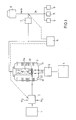
- a fluid mixture of nitrogen, hydrogen and residual gases is processed in a gas cracking plant 1.
- the fluid mixture prepared in this way is further refined in a fine control stage 2 downstream of the gas gap system 1 with the aid of hydrogen and / or nitrogen, a manipulated variable from a computer-controlled gas analysis system 6 influencing the fine control.
- the fluid mixture is preheated and enters a fluid bed 3 through gas inlet nozzles 32 below a nozzle plate 31.
- solid substances in a defined sphere size, here aluminum oxide spheres 34.
- a container 4 for the organic chemical substances to be treated which are injected into the fluid bed 3 via an injection pump 5 through injection nozzles 33.
- a fluid mixture that is always processed is guided past the surfaces of the aluminum oxide spheres 34.
- other elements such as chlorine and possibly existing oxygen are bound by the hydrogen of the fluid mixture.
- the cracked low molecular weight substances are carried out of the fluid bed 3 according to the flow rate of the fluid mixture and sucked off or blown out.
- the fluid mixture can also be fed to a piston compressor 11 via a charger 10.
- the loader has the task of compressing and conveying the fluid mixture from a low initial pressure to a higher final pressure.
- the piston compressor consists of a cylindrical compression chamber 12 as a working space with a piston reciprocating in a straight line.
- the organic chemical substances to be treated in liquid form are initially in a container 4, from which they are injected into the piston compressor by means of an injection pump 5.
- the fluid mixture passes from the charger 10 via inlet valves 14 into the piston compressor 11.
- the mixture consisting of the fluid mixture and the cracked products leaves the piston compressor 11 via outlet valves 15, previously passing through a catalytic converter 16.
- the mixture consisting of the fluid mixture and the cracking products is then analyzed in the gas analysis system 6.
- This system consists of a gas chromatograph and other analysis systems, from which control values are transmitted to fine control level 2.
- a subsequent one Filtering the mixture consisting of fluid mixture and cracking products in a washing system 7 has the result that the hydrochloric acid contained in the mixture is washed out.
- a decision is then made as to whether the remainder is washed back to new substances 9 by recycling measures or is fed to a thermal afterburning 8.
- manipulated variables of the gas analysis system 6 can influence the process sequence in the final stage. 2, the charger is influenced by manipulated variables of the gas analysis system 6.
Landscapes
- Chemical & Material Sciences (AREA)
- Engineering & Computer Science (AREA)
- Oil, Petroleum & Natural Gas (AREA)
- Chemical Kinetics & Catalysis (AREA)
- Business, Economics & Management (AREA)
- Health & Medical Sciences (AREA)
- General Health & Medical Sciences (AREA)
- Toxicology (AREA)
- Materials Engineering (AREA)
- General Chemical & Material Sciences (AREA)
- Organic Chemistry (AREA)
- Emergency Management (AREA)
- Devices And Processes Conducted In The Presence Of Fluids And Solid Particles (AREA)
- Separation, Recovery Or Treatment Of Waste Materials Containing Plastics (AREA)
- Physical Or Chemical Processes And Apparatus (AREA)
- Organic Low-Molecular-Weight Compounds And Preparation Thereof (AREA)
- Processing Of Solid Wastes (AREA)
Abstract
Description
- Die Erfindung betrifft ein Verfahren zur gezielten Zerlegung (Cracken) organisch-chemischer Stoffe in der Produktion und zur umweltfreundlichen Aufbereitung der gecrackten Stoffe gemäß dem Oberbegriff des Anspruchs 1. Eine weitere Ausführungsart des Verfahrens ist in Anspruch 2 angegeben. Vorrichtungen zur Durchführung des Verfahrens sind in den Unteransprüchen gekennzeichnet.
- Polychlordibenzodioxine (PCDD) und polychlorierte Dibenzofurane (PCDF) spielen hierbei eine besondere Rolle, und am Beispiel dieser Stoffgruppe soll die anstehende Problematik erläutert werden, wozu mehrere aktuelle Vorfälle Anlaß gegeben haben PCDD und PCDF haben sich als äußerst ungeliebte Substanzen erwiesen. Es gibt eine weitgehende Übereinstimmung in Wissenschaft, Wirtschaft und Politik, diese Stoffe selbst nicht mehr zu handeln und auch ihre Entstehung zu verhindern. Solcher Vorsatz wird natürlich nur dann wirksam, wenn das Problem der "Altlasten" bewältigt werden kann. Das bedeutet, daß die bereits vorhandenen "Altlasten" oder deren Erzeuger,wie z. B. polychlorierte Biphenyle (PCB), vernichtet werden müssen. Dabei ist es finanziell sinnvoller, die Altlasten PCDD und PCDF zu beseitigen, als sie zu verwalten und zu betreuen.
- PCDD und PCDF entstehen als Spurenprodukte bei der chemischen Synthese von Chlorkohlenwasserstoffen, vor allem bei der Synthese von höher chlorierten aromatischen Kohlenwasserstoffen, und sie können auch entstehen, wenn aromatische Chlorkohlenwasserstoffe bei chemischen Synthesen als Zwischenprodukte eingesetzt werden.
- Bevorzugte Reaktionsbedingungen zur Bildung von PCDD und PCDF sind hohe Temperaturen und alkalisches Medium.
- Weiter können PCDD und PCDF auch bei Verbrennungsprozessen aller Art entstehen, wenn organische Chlorverbindungen gegenwärtig sind. Ein bekanntes Beispiel sind die Müllverbrennungsanlagen Aber auch beim Verbrennen von Holz und von Treibstoffen muß mit der Bildung von PCDD und PCDF in geringen Mengen gerechnet werden.
- Die Bildung von größeren Mengen von PCDF wurde in mehreren Fällen bei Schwelbränden von Transformatoren, welche mit PCB gefüllt waren, berichtet.
- Durch eine Reihe von Unfällen in den vergangenen 40 Jahren gelangten PCDD und PCDF in die Umwelt. Der bekannteste dieser Unfälle war 1976 in Seveso, Italien, als bei der Herstellung von 2,4,5-Trichlorphenol ca. 2,5 kg 2,3,7,8-TCDD in die Umwelt gelangten.
- Die Gruppe der PCDD und PCDF ist heute als vorwiegend anthropogene Umweltkontamination praktisch ubiquitär in der Natur nachweisbar. Die Identifizierung und besonders die Quantifizierung dieser durch eine große Anzahl von Isomeren gekennzeichneten Substanzklasse - in der Öffentlichkeit häufig vereinfachend als "Dioxine" bezeichnet - wurde erst durch die moderne instrumen- telle Analytik möglich.
- Die Hauptforderung bei der Beseitigung von PCDD- und PCDf-haltigen Abfällen ist die Entfernung dieses Materials aus dem Kreislauf der Natur. Dabei sind jedoch besonders die Gegebenheiten der jeweiligen geltenden Gesetze zu beachten. Der Beurteilungsmaßstab, welcher Beseitigungspfad eingeschlagen werden muß, ist zum einen der Gehalt an den Schadstoffen PCDD und PCDF in den Abfällen, zum anderen das Niveau der Beseitigungsanlagen.
- Die bisherigen Methoden einer umweltgerechten Beseitigung von PCDF - haltigen Abfällen, wie Deponierung, Verbrennung, oder chemisch-physikalische Behandlung erwiesen sich als sehr proble matisch.
- Der Erfindung liegt daher die Aufgabe zugrunde, ein Verfahren zu finden, das es ermöglicht, eine umweltfreundliche Beseitigung von PCDD- und PCDf-haltigen Abfällen durchzuführen und eine Vorrichtung zur Anwendung dieses Verfahrens zu schaffen.
- Diese Aufgabe wird erfindungsgemäß durch das mit den kennzeichnenden Merkmalen des Anspruchs 1 umrissene Verfahren bzw. eine in den Unteransprüchen angegebene Vorrichtung gelöst.
- Eine weitere Ausführungsform des Verfahrens ist in Anspruch 2 angegeben, wozu eine Vorrichtung in Unteransprüchen angegeben ist.
- Der wesentliche Vorteil der in den Ansprüchen 1 und 2 beschriebenen Verfahren liegt in der Behandlung organisch-chemischer Stoffe unter definierten reduktiven Bedingungen bei gleichzeitiger sehr konstanter Temperatur über das gesamte Reaktionsschema. Dadurch ist z.B. die Möglichkeit geschaffen, PCDD und PCDF- haltige Abfälle in einer anaeroben Atmosphäre zu beseitigen. Durch einen hohen Wasserstoffanteil wird ein starkes Reduktionspotential aufgebaut. Die Reaktionstemperatur kann auch für längere Zeitdauer sehr exakt auf besser als +/- 2°C konstant gehalten werden. Anlagentechnische und chemische Parameter sind dabei so gewählt, daß z.B. die Bildung bzw. die Zerstörung von PCDD und PCDF nicht nur kinetisch, sondern auch über die vorhandenen Reaktionspartner beeinflußt wird.
- Vorteilhafte Bestandteile einer Vorrichtung, die nach dem Verfahren nach Anspruch 1 arbeitet, sind in den Ansprüchen 12 und 13 gekennzeichnet, während vorteilhafte Bestandteile einer Vor richtung, die nach Anspruch 2 arbeitet, in den Ansprüchen 18 und 19 beschrieben ist.
- Die Besonderheit liegt darin, daß bei den Vorrichtungen die Temperatur über das gesamte Reaktionsvolumen homogen und konstant eingestellt werden kann. Darüber hinaus kann die Gasatmosphäre für den Reaktionsraum gezielt ausgewählt werden. Speziell im Fluidbett haben die Feststoffkügelchen mehrere Funktionen:
- 1. Nach der Benetzung der aufgeheizten Kügelchen wird die Wärmeenergie schlagartig auf die behandelnden Stoffe übertragen.
- 2. Kügelchen transportieren die zu behandelnden Stoffe durch das Fluidbett hindurch und erhalten den Kontakt mit frischem Reaktionsgas.
- 3. Durch das Niederdruckfluidisieren ist die Verweilzeit besonders lang.
- 4. Der dünne Film der zu behandelnden Stoffe zeigt an der Oberfläche der Feststoffkügelchen eine besondere Reaktionsbereitschaft.
- Ausführungsbeispiele der Erfindung sind in Zeichnungen dargestellt und werden im foldenden näher erläutert. Es zeigen
- Fig. 1 eine Vorrichtung mit einem Fluidbett
- Fig. 2 eine weitere Vorrichtung mit einem Kolbenverdichter
- Nach Fig. 1 und 2 dient der erste Teil der Vorrichtung zur Erzeugung einer anaeroben Atmosphäre. Hierzu wird ein Fluidgemisch aus Stickstoff, Wasserstoff und Restgasen in einer Gasspaltanlage 1 aufbereitet. Das so aufbereitete Fluidgemisch wird in einer der Gasspaltanlage 1 nachgeschalteten Feinregelungsstufe 2 mit Hilfe von Wasserstoff und /oder Stickstoff weiter veredelt, wobei eine Stellgröße aus einer rechnergesteuerten Gasanalysesystem 6 die Feinregelung beeinflußt.
- Nach Fig. 1 wird das Fluidgemisch vorgewärmt und tritt durch Gaseinlaßdüsen 32 unterhalb einer Düsenplatte 31 in ein Fluidbett 3 ein. In dem Fluidbett befinden sich feste Stoffe in definierter Kugelgröße, hier Aluminiumoxydkügelchen 34. Unterhalb des Fluidbetts befindet sich ein Behälter 4 für die zu behandelnden organisch-chemischen Stoffe, die über eine Einspritzpumpe 5 durch Einspritzdüsen 33 in das Fluidbett 3 eingespritzt werden. Durch ständiges Wirbeln der Fluidmasse wird ein stets aufbereitetes Fluidgemisch an den Oberflächen der Aluminiumoxydkügelchen 34 vorbeigeführt. Hierbei werden andere Elemente wie Chlor und eventuell vorhandener Sauerstoff vom Wasserstoff des Fluidgemisches gebunden. Die gecrackten niedermolekularen Stoffe werden entsprechend der Strömungsgeschwindigkeit des Fluidgemisches aus dem Fluidbett 3 herausgetragen und abgesaugt, bzw. ausgeblasen.
- Nach Fig. 2 kann das Fluidgemisch auch über einen Lader 10 einem Kolbenverdichter 11 zugeführt werden. Der Lader hat die Aufgabe, das Fluidgemisch von einem niederen Anfangsdruck auf einen höheren Enddruck zu verdichten und zu fördern. Der Kolbenverdichter besteht aus einer zylindrischen Verdichtungskammer 12 als Arbeitsraum mit einem geradlinig hin- und herbewegten Kolben. Die zu behandelnden organisch- chemischen Stoffe in flüssiger Form befinden sich zunächst in einem Behälter 4, aus dem sie mittels einer Einspritzpumpe 5 in den Kolbenverdichter eingespritzt werden. Das Fluidgemisch gelangt vom Lader 10 über Einlaßventile 14 in den Kolbenverdichter 11. Über Auslaßventile 15 verläßt das aus dem Fluidgemisch und den Crackprodukten bestehende Gemisch den Kolbenverdichter 11, wobei es zuvor einen Katalysator 16 passiert.
- Nach Fig. 1 und 2 wird das aus dem Fluidgemisch und den Crackprodukten bestehende Gemisch anschließend im Gasanalysesystem 6 analysiert. Dieses System besteht aus einem Gaschromatographen und anderen Analysesystemen, von denen aus Stellgrößen an die Feinregelungsstufe 2 übermittelt werden. Eine anschließende Filterung des aus Fluidgemisch und Crackprodukten bestehenden Gemisches in einer Waschanlage 7 hat zur Folge, daß die in dem Gemisch enthaltene Salzsäure herausgewaschen wird. Danach wird entschieden, ob der Rest durch Recyclingsmaßnahmen zu neuen Stoffen 9 zurückgewaschen oder einer thermischen Nachverbrennung 8 zugeführt wird.. Auch in diesem Fall können Stellgrößen des Gasanalysesystems 6 den Prozeßablauf im Endstadium beeinflussen. Nach Fig. 2 wird der Lader durch Stellgrößen des Gasanalysesystems 6 beeinflußt.
Claims (19)
Priority Applications (1)
| Application Number | Priority Date | Filing Date | Title |
|---|---|---|---|
| AT88108074T ATE60347T1 (de) | 1987-06-13 | 1988-05-20 | Verfahren und vorrichtung zur gezielten zerlegung (cracken) von polychlordibenzodioxinen und/oder polychlorierten dibenzofuranen und zur umweltfreundlichen aufbereitung der gecrackten stoffe. |
Applications Claiming Priority (2)
| Application Number | Priority Date | Filing Date | Title |
|---|---|---|---|
| DE3719824A DE3719824C1 (de) | 1987-06-13 | 1987-06-13 | Verfahren und Vorrichtung zur gezielten Zerlegung (Cracken) von Halogenkohlenwasserstoffen mit anschliessender umweltfreundlicher Aufbereitung der gecrackten Stoffe |
| DE3719824 | 1987-06-13 |
Publications (3)
| Publication Number | Publication Date |
|---|---|
| EP0295454A2 true EP0295454A2 (de) | 1988-12-21 |
| EP0295454A3 EP0295454A3 (en) | 1989-03-15 |
| EP0295454B1 EP0295454B1 (de) | 1991-01-23 |
Family
ID=6329667
Family Applications (1)
| Application Number | Title | Priority Date | Filing Date |
|---|---|---|---|
| EP19880108074 Expired - Lifetime EP0295454B1 (de) | 1987-06-13 | 1988-05-20 | Verfahren und Vorrichtung zur gezielten Zerlegung (Cracken) von Polychlordibenzodioxinen und/oder polychlorierten Dibenzofuranen und zur umweltfreundlichen Aufbereitung der gecrackten Stoffe |
Country Status (4)
| Country | Link |
|---|---|
| EP (1) | EP0295454B1 (de) |
| AT (1) | ATE60347T1 (de) |
| DE (2) | DE3719824C1 (de) |
| ES (1) | ES2021113B3 (de) |
Cited By (4)
| Publication number | Priority date | Publication date | Assignee | Title |
|---|---|---|---|---|
| FR2671990A1 (fr) * | 1991-01-24 | 1992-07-31 | Chaussonnet Pierre | Systeme pour le traitement par thermolyse sous vide des produits liquides ou gazeux dont le rejet est prejudiciable pour l'environnement. |
| EP0570645A1 (de) * | 1992-05-20 | 1993-11-24 | Societe Francaise De Thermolyse | System und Verfahren zur Vakuumthermolyse von flüssigen oder gasförmigen Produkten, deren Deponie umweltschädlich ist |
| WO1993023497A1 (fr) * | 1992-05-20 | 1993-11-25 | Societe Francaise De Thermolyse | Systeme et procede de traitement par thermolyse sous vide des produits liquides ou gazeux dont le rejet est prejudiciable pour l'environnement |
| US5730947A (en) * | 1991-01-24 | 1998-03-24 | Societe Francaise De Thermolyse | System and process for vacuum thermolysis treatment of liquid or gas products the disposal of which is detrimental to the environment |
Family Cites Families (7)
| Publication number | Priority date | Publication date | Assignee | Title |
|---|---|---|---|---|
| US2886605A (en) * | 1954-10-11 | 1959-05-12 | Dow Chemical Co | Method of reducing the halogen content of halohydrocarbons |
| US3542532A (en) * | 1968-01-11 | 1970-11-24 | Exxon Research Engineering Co | Process for the production of hydrogen from petroleum coke |
| US3597327A (en) * | 1969-04-02 | 1971-08-03 | Arthur M Squires | Process for pyrolyzing a solid or liquid hydrocarbonaceous fuel in a fluidized bed |
| AU533902B2 (en) * | 1979-09-21 | 1983-12-15 | Monsanto Company | Oxidants for gasifying carbon - containing materials |
| CA1260959A (en) * | 1984-05-21 | 1989-09-26 | Sidney W. Benson | Conversion of halogenated toxic substances |
| DE3616785A1 (de) * | 1986-05-17 | 1987-11-19 | Union Rheinische Braunkohlen | Verfahren zur aufarbeitung von kohlenstoff enthaltenden abfaellen und biomassen |
| CA1294111C (en) * | 1986-08-08 | 1992-01-14 | Douglas J. Hallett | Process for the destruction of organic waste material |
-
1987
- 1987-06-13 DE DE3719824A patent/DE3719824C1/de not_active Expired
-
1988
- 1988-05-20 ES ES88108074T patent/ES2021113B3/es not_active Expired - Lifetime
- 1988-05-20 DE DE8888108074T patent/DE3861632D1/de not_active Expired - Fee Related
- 1988-05-20 AT AT88108074T patent/ATE60347T1/de not_active IP Right Cessation
- 1988-05-20 EP EP19880108074 patent/EP0295454B1/de not_active Expired - Lifetime
Cited By (4)
| Publication number | Priority date | Publication date | Assignee | Title |
|---|---|---|---|---|
| FR2671990A1 (fr) * | 1991-01-24 | 1992-07-31 | Chaussonnet Pierre | Systeme pour le traitement par thermolyse sous vide des produits liquides ou gazeux dont le rejet est prejudiciable pour l'environnement. |
| US5730947A (en) * | 1991-01-24 | 1998-03-24 | Societe Francaise De Thermolyse | System and process for vacuum thermolysis treatment of liquid or gas products the disposal of which is detrimental to the environment |
| EP0570645A1 (de) * | 1992-05-20 | 1993-11-24 | Societe Francaise De Thermolyse | System und Verfahren zur Vakuumthermolyse von flüssigen oder gasförmigen Produkten, deren Deponie umweltschädlich ist |
| WO1993023497A1 (fr) * | 1992-05-20 | 1993-11-25 | Societe Francaise De Thermolyse | Systeme et procede de traitement par thermolyse sous vide des produits liquides ou gazeux dont le rejet est prejudiciable pour l'environnement |
Also Published As
| Publication number | Publication date |
|---|---|
| DE3719824C1 (de) | 1989-03-09 |
| EP0295454B1 (de) | 1991-01-23 |
| EP0295454A3 (en) | 1989-03-15 |
| ES2021113B3 (es) | 1991-10-16 |
| ATE60347T1 (de) | 1991-02-15 |
| DE3861632D1 (de) | 1991-02-28 |
Similar Documents
| Publication | Publication Date | Title |
|---|---|---|
| DE2330591C2 (de) | Verfahren zur Beseitigung von organischen Schädlingsbekämpfungsmitteln | |
| EP0044991B1 (de) | Verfahren und Vorrichtung zur pyrolytischen Zersetzung von Halogene und/oder Phosphor enthaltenden organischen Substanzen | |
| DE69209152T2 (de) | Verfahren und Vorrichtung zur Verringerung der Freilassung toxischer Verbindungen in die Umwelt bei der Verbrennung von Abfallstoffen | |
| DE3830812A1 (de) | Verfahren zur entfernung von schadstoffen aus einem abgasstrom | |
| DE3224328A1 (de) | Verfahren und anlage zur umwandlung von abfallstoffen in bestaendige endprodukte | |
| DE69311368T2 (de) | Verfahren zur chemischen zersetzung von halogenierten organischen verbindungen | |
| DE69707361T2 (de) | Verfahren und Apparat zur Konvertierung von Kunststoffabfällen in Öl | |
| DE2705229C2 (de) | Verfahren zum Behandeln eines Gasstromes | |
| DE69220673T2 (de) | Verfahren und Anlage zur Behandlung und Verwertung von Abfallstoffen durch Veränderung dieser in wiederverwertbare, nicht verunreinigte Materialien | |
| DE10304641A1 (de) | System zur Entgiftung toxischer chlorierter organischer Verbindungen und Verfahren zum Rezyklieren des entgifteten Abfalls | |
| EP0295454B1 (de) | Verfahren und Vorrichtung zur gezielten Zerlegung (Cracken) von Polychlordibenzodioxinen und/oder polychlorierten Dibenzofuranen und zur umweltfreundlichen Aufbereitung der gecrackten Stoffe | |
| DE19508322C2 (de) | Verfahren und Anlage zur umweltschonenden Entsorgung von Spreng- und Giftstoffe enthaltendem Gefahrengut | |
| DE102008016519B4 (de) | Verfahren zur Reinigung von Rauchgas in einer Müllverbrennungsanlage sowie eine Vorrichtung zur Durchführung des Verfahrens | |
| DE2331156B2 (de) | Vorrichtung zum Beseitigen von in Abgasen enthaltenen gasförmigen Schadstoffen | |
| EP1537905B1 (de) | Verfahren und Vorrichtung zur Sorption von Schadstoffen aus Verbrennungsabgasen mittels einer fluidisierenden Wirbelschicht | |
| WO1989012482A1 (fr) | Procede et dispositif de separation de substances nocives | |
| DE2362920A1 (de) | Verfahren zur kontinuierlichen hydrolyse von polyurethanschaum in einer begrenzten rohrfoermigen reaktionszone und gewinnung von produkten daraus | |
| DE3744765C1 (en) | Process and device for the controlled cracking of halogenated hydrocarbons which are present in waste products from the manufacture of workpieces, with environmentally sound processing of the cracked substances | |
| DE69624721T2 (de) | Verfahren zur dekontamination und behandlung einer flüssigen, gasförmigen oder festen matrix mit oxidativem gegenstrom | |
| EP4208282B1 (de) | Rezirkulierung von wertstoffen aus der abgasreinigung | |
| DE69809310T2 (de) | Verfahren und System zur Entfernung von Schadstoffen | |
| DE69902168T2 (de) | Verfahren zum behandeln einer flüssigkeit, die flüchtige bestandteile enthält | |
| DE3815507A1 (de) | Verfahren und anlage zum dekontaminieren von mit toxischen organischen verbindungen verseuchtem material | |
| EP2911985A1 (de) | Dekontaminieren durch hydrothermale karbonisierung von kontaminiertem material | |
| EP0343672A1 (de) | Verfahren und Einrichtung zur Reinigung der Gasgemische von schweren Kohlenwasserstoffen und deren Derivaten |
Legal Events
| Date | Code | Title | Description |
|---|---|---|---|
| PUAI | Public reference made under article 153(3) epc to a published international application that has entered the european phase |
Free format text: ORIGINAL CODE: 0009012 |
|
| AK | Designated contracting states |
Kind code of ref document: A2 Designated state(s): AT BE CH DE ES FR GB IT LI NL SE |
|
| PUAL | Search report despatched |
Free format text: ORIGINAL CODE: 0009013 |
|
| 17P | Request for examination filed |
Effective date: 19881208 |
|
| AK | Designated contracting states |
Kind code of ref document: A3 Designated state(s): AT BE CH DE ES FR GB IT LI NL SE |
|
| 17Q | First examination report despatched |
Effective date: 19891129 |
|
| GRAA | (expected) grant |
Free format text: ORIGINAL CODE: 0009210 |
|
| AK | Designated contracting states |
Kind code of ref document: B1 Designated state(s): AT BE CH DE ES FR GB IT LI NL SE |
|
| REF | Corresponds to: |
Ref document number: 60347 Country of ref document: AT Date of ref document: 19910215 Kind code of ref document: T |
|
| GBT | Gb: translation of ep patent filed (gb section 77(6)(a)/1977) | ||
| REF | Corresponds to: |
Ref document number: 3861632 Country of ref document: DE Date of ref document: 19910228 |
|
| ET | Fr: translation filed | ||
| RIN2 | Information on inventor provided after grant (corrected) |
Free format text: OTROMKE, HENNER, DIPL.-ING. * THEERKORN, UWE, DIPL.-ING. * HEDEMANN, GERD * MEINERS, WOLFGANG, DR. RER.NAT. * HARTUNG, LOTHAR, DIPL.-ING. |
|
| ITF | It: translation for a ep patent filed | ||
| RAP2 | Party data changed (patent owner data changed or rights of a patent transferred) |
Owner name: HARTUNG, LOTHAR, DIPL.-ING. Owner name: FELTEN & GUILLEAUME ENERGIETECHNIK AG |
|
| REG | Reference to a national code |
Ref country code: CH Ref legal event code: PUE Owner name: FELTEN & GUILLEAUME ENERGIETECHNIK AG |
|
| PGFP | Annual fee paid to national office [announced via postgrant information from national office to epo] |
Ref country code: ES Payment date: 19910509 Year of fee payment: 4 |
|
| NLT2 | Nl: modifications (of names), taken from the european patent patent bulletin |
Owner name: FELTEN & GUILLEAUME ENERGIETECHNIK AG TE KEULEN EN |
|
| PLBI | Opposition filed |
Free format text: ORIGINAL CODE: 0009260 |
|
| 26 | Opposition filed |
Opponent name: RWE-ENTSORGUNG AKTIENGESELLSCHAFT Effective date: 19911016 |
|
| BECN | Be: change of holder's name |
Effective date: 19910123 |
|
| NLR1 | Nl: opposition has been filed with the epo |
Opponent name: RWE-ENTSORGUNG AG |
|
| PGFP | Annual fee paid to national office [announced via postgrant information from national office to epo] |
Ref country code: BE Payment date: 19920217 Year of fee payment: 5 |
|
| REG | Reference to a national code |
Ref country code: CH Ref legal event code: PUE Owner name: DIPL.-ING. LOTHAR HARTUNG |
|
| ITPR | It: changes in ownership of a european patent |
Owner name: CESSIONE;HARTUNG, LOTHAR, DIPL. - ING. |
|
| PGFP | Annual fee paid to national office [announced via postgrant information from national office to epo] |
Ref country code: AT Payment date: 19920402 Year of fee payment: 5 |
|
| PGFP | Annual fee paid to national office [announced via postgrant information from national office to epo] |
Ref country code: SE Payment date: 19920410 Year of fee payment: 5 |
|
| REG | Reference to a national code |
Ref country code: GB Ref legal event code: 732 |
|
| PGFP | Annual fee paid to national office [announced via postgrant information from national office to epo] |
Ref country code: GB Payment date: 19920429 Year of fee payment: 5 |
|
| PGFP | Annual fee paid to national office [announced via postgrant information from national office to epo] |
Ref country code: CH Payment date: 19920508 Year of fee payment: 5 |
|
| PG25 | Lapsed in a contracting state [announced via postgrant information from national office to epo] |
Ref country code: ES Free format text: LAPSE BECAUSE OF NON-PAYMENT OF DUE FEES Effective date: 19920521 |
|
| PGFP | Annual fee paid to national office [announced via postgrant information from national office to epo] |
Ref country code: FR Payment date: 19920527 Year of fee payment: 5 |
|
| PGFP | Annual fee paid to national office [announced via postgrant information from national office to epo] |
Ref country code: NL Payment date: 19920531 Year of fee payment: 5 |
|
| REG | Reference to a national code |
Ref country code: FR Ref legal event code: CL |
|
| NLS | Nl: assignments of ep-patents |
Owner name: DIPL.-ING. LOTHAR HARTUNG TE KREUZTAL-BUSCHHUETTEN |
|
| PLBN | Opposition rejected |
Free format text: ORIGINAL CODE: 0009273 |
|
| STAA | Information on the status of an ep patent application or granted ep patent |
Free format text: STATUS: OPPOSITION REJECTED |
|
| 27O | Opposition rejected |
Effective date: 19921102 |
|
| NLR2 | Nl: decision of opposition | ||
| PG25 | Lapsed in a contracting state [announced via postgrant information from national office to epo] |
Ref country code: GB Effective date: 19930520 Ref country code: AT Effective date: 19930520 |
|
| PG25 | Lapsed in a contracting state [announced via postgrant information from national office to epo] |
Ref country code: SE Effective date: 19930521 |
|
| PG25 | Lapsed in a contracting state [announced via postgrant information from national office to epo] |
Ref country code: LI Effective date: 19930531 Ref country code: CH Effective date: 19930531 Ref country code: BE Effective date: 19930531 |
|
| REG | Reference to a national code |
Ref country code: ES Ref legal event code: PC2A Owner name: LOTHAR HARTUNG |
|
| BERE | Be: lapsed |
Owner name: HARTUNG LOTHAR Effective date: 19930531 |
|
| PG25 | Lapsed in a contracting state [announced via postgrant information from national office to epo] |
Ref country code: NL Effective date: 19931201 |
|
| PGFP | Annual fee paid to national office [announced via postgrant information from national office to epo] |
Ref country code: DE Payment date: 19940110 Year of fee payment: 6 |
|
| NLV4 | Nl: lapsed or anulled due to non-payment of the annual fee | ||
| GBPC | Gb: european patent ceased through non-payment of renewal fee |
Effective date: 19930520 |
|
| PG25 | Lapsed in a contracting state [announced via postgrant information from national office to epo] |
Ref country code: FR Effective date: 19940131 |
|
| REG | Reference to a national code |
Ref country code: CH Ref legal event code: PL |
|
| REG | Reference to a national code |
Ref country code: FR Ref legal event code: ST |
|
| EUG | Se: european patent has lapsed |
Ref document number: 88108074.1 Effective date: 19931210 |
|
| PG25 | Lapsed in a contracting state [announced via postgrant information from national office to epo] |
Ref country code: DE Effective date: 19950201 |
|
| REG | Reference to a national code |
Ref country code: ES Ref legal event code: FD2A Effective date: 19990405 |
|
| PG25 | Lapsed in a contracting state [announced via postgrant information from national office to epo] |
Ref country code: IT Free format text: LAPSE BECAUSE OF NON-PAYMENT OF DUE FEES Effective date: 20050520 |
|
| PLAB | Opposition data, opponent's data or that of the opponent's representative modified |
Free format text: ORIGINAL CODE: 0009299OPPO |