EP0295697B1 - Feuillards en acier laminé à froid, présentant une aptitude au soudage par points et procédé pour leur fabrication - Google Patents
Feuillards en acier laminé à froid, présentant une aptitude au soudage par points et procédé pour leur fabrication Download PDFInfo
- Publication number
- EP0295697B1 EP0295697B1 EP88109682A EP88109682A EP0295697B1 EP 0295697 B1 EP0295697 B1 EP 0295697B1 EP 88109682 A EP88109682 A EP 88109682A EP 88109682 A EP88109682 A EP 88109682A EP 0295697 B1 EP0295697 B1 EP 0295697B1
- Authority
- EP
- European Patent Office
- Prior art keywords
- steel
- amount
- steel sheet
- low carbon
- weld portion
- Prior art date
- Legal status (The legal status is an assumption and is not a legal conclusion. Google has not performed a legal analysis and makes no representation as to the accuracy of the status listed.)
- Expired - Lifetime
Links
Images









Classifications
-
- C—CHEMISTRY; METALLURGY
- C22—METALLURGY; FERROUS OR NON-FERROUS ALLOYS; TREATMENT OF ALLOYS OR NON-FERROUS METALS
- C22C—ALLOYS
- C22C38/00—Ferrous alloys, e.g. steel alloys
-
- C—CHEMISTRY; METALLURGY
- C22—METALLURGY; FERROUS OR NON-FERROUS ALLOYS; TREATMENT OF ALLOYS OR NON-FERROUS METALS
- C22C—ALLOYS
- C22C38/00—Ferrous alloys, e.g. steel alloys
- C22C38/12—Ferrous alloys, e.g. steel alloys containing tungsten, tantalum, molybdenum, vanadium, or niobium
-
- C—CHEMISTRY; METALLURGY
- C22—METALLURGY; FERROUS OR NON-FERROUS ALLOYS; TREATMENT OF ALLOYS OR NON-FERROUS METALS
- C22C—ALLOYS
- C22C38/00—Ferrous alloys, e.g. steel alloys
- C22C38/14—Ferrous alloys, e.g. steel alloys containing titanium or zirconium
Definitions
- This invention relates to a cold rolled steel sheet useful for automobiles and a method of producing the same, and more particularly to an extra-low carbon cold rolled steel sheet having an improved spot weldability without damaging excellent formability.
- the spot welding operation is an indispensable factor in the assembling work of parts formed by pressing or other process. Therefore, the operability of such a spot welding as well as mechanical properties of weld portion are important together with the formability in view of evaluation on total properties of the steel sheet.
- an object of the invention to advantageously solve the aforementioned problems and provide a cold rolled steel sheet having improved spot weldability and mechanical properties of weld portion without damaging press formability, and a method of producing the same.
- the extra-low carbon steel sheet is less in the amount of impurities and very large in the grain growth at the heating, the coarsening of crystal grain in the weld portion and hence the softening of the steel sheet are similarly considered to be a factor of obstructing the weldability.
- the inventors have made further studies in order to solve the aforementioned problems and obtained a knowledge that the simultaneous addition of Ti, Nb and B to the extra-low carbon steel is very effective for improving the strength of the spot weld portion.
- the invention is based on the aforementioned knowledges.
- a cold rolled steel sheet having improved strength and toughness in weld portion, wherein the said steel comprises not more than 0.004 wt% of C, not more than 0.1 wt% of Si, not more than 0.5 wt% of Mn, not more than 0.025 wt% of P, not more than 0.025 wt% of S, not more than 0.0040 wt% of N, 0.01 ⁇ 0.04 wt% of Ti, 0.003 ⁇ 0.010 wt% of Nb, 0.0001 ⁇ 0.0010 wt% of B, 0.01 ⁇ 0.10 wt% of Al and the remainder being Fe and unavoidable impurities, and fine precipitates of Ti having a grain size of not more than 0.05 ⁇ m are uniformly dispersed into said steel in an amount of not less than 30 ppm as Ti conversion amount.
- a cold rolled steel sheet having improved formability and spot weldability, wherein said steel comprises not more than 0.004 wt% of C, not more than 0.1 wt% of Si, not more than 0.5 wt% of Mn, not more than 0.025 wt% of P, not more than 0.025 wt% of S, 0.01 ⁇ 0.04 wt% of Ti, 0.001 ⁇ 0.010 wt% of Nb, 0.0001 ⁇ 0.0010 wt% of B, 0.01 ⁇ 0.10 wt% of Al and the remainder being Fe and unavoidable impurities, and has a surface roughness satisfying either one of the following (a) and (b):
- the invention also provides a method of producing a cold rolled steel sheet having improved strength and toughness in weld portion, which comprises subjecting molten steel comprising not more than 0.004 wt% of C, not more than 0.1 wt% of Si, not more than 0.5 wt% of Mn, not more than 0.025 wt% of P, not more than 0.025 wt% of S, not more than 0.0040 wt% of N, 0.01 ⁇ 0.04 wt% of Ti, 0.003 ⁇ 0.010 wt% of Nb, 0.0001 ⁇ 0.0010 wt% of B, 0.01 ⁇ 0.10 wt% of Al and the remainder being Fe and unavoidable impurities in which fine precipitates of Ti having a grain size of not more than 0.05 ⁇ m are uniformly dispersed into said steel in an amount of not less than 30ppm a a Ti conversion amount to a solidification and cooling step, during which said molten steel is cooled at a cooling rate of not less than 3°
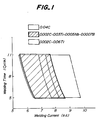
- Fig. 1 shows results obtained by examining an influence of addition of Ti, Nb and B, which are particularly important components in the invention, upon the spot weldability.
- the spot welding was carried out by welding a specimen of 0.8 ⁇ 30 ⁇ 30 mm under an applied pressure of 1864 N (190 kgf) through CF type electrode of 4.5 mm in diameter with reference to a value recommended by RWMA (Resistance Welder Manufacturer's Association).
- the lower limit of the reasonable welding current is a point that a nugget zone formed by the welding is not less than 3 ⁇ t mm (t is sheet gauge of specimen, mm), while the upper limit thereof is a point of generating expulsion.
- the reasonable welding current considerably shifts toward a high current side as compared with the case of the conventional low carbon steel, resulting in the requirement of large welding equipment, while in the Ti-Nb-B added extra low carbon steel according to the invention, the lower limit of the reasonable welding current is approximately equal to that of the low carbon steel, while the upper limit of the reasonable welding current regulated by the occurrence of expulsion is shifted toward a high current side as compared with that of the low carbon steel, so that the range of the reasonable welding current is more enlarged as compared with that of the low carbon steel.
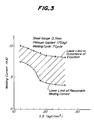
- FIG. 3 shows results obtained by examining a relation between Y.S. of the steel sheet and range of the welding current.
- a slab of steel obtained by varying the C amount within a range of 0.002% to 0.4% (Si: 0.01%, Mn: 0.1 ⁇ 0.3%, P: 0.01 ⁇ 0.02%, S: 0.01 ⁇ 0.02%, N: 0.002 ⁇ 0.005%, Al: 0.01 ⁇ 0.04%, Ti: 0.03%, Nb: 0.005%, B: 0.0007%) was heated to 1,100 ⁇ 1,250°C and hot rolled at a finish temperature of 700 ⁇ 1,000°C and a coiling temperature of 450 ⁇ 700°C, and the resulting hot rolled sheet was cold rolled at a reduction of 60 ⁇ 85%, and thereafter the resulting cold rolled sheet was subjected to a continuous annealing within a temperature range of 700 ⁇ 880°C to obtain sheets having various Y.S. values.
- the spot welding was carried out in the same manner as in the case of Fig. 1 except that the thickness of the specimen was 0.7 mm, the welding time was 7 cycles and the applied pressure was 1717 N (175 kgf).
- the reasonable welding current range is strongly affected by the Y.S. value of the steel sheet.
- Y.S. is lower than 186 N (19 kgf/mm2)
- the reasonable welding current range considerably shifts toward a high current side.
- Table 1 results measured on the mechanical properties of low carbon steel and extra-low carbon steel having various chemical compositions.
- the composition and production conditions of the test steel are the same as in Figs. 1 and 3 except that Ti, Nb and B were properly added within ranges of Ti: 0.02 ⁇ 0.04%, Nb: 0.005 ⁇ 0.008% and B: 0.0005 ⁇ 0.0008%, respectively.
- the low carbon steel has Y.S. level approximately equal to that of the Ti-Nb-B added extra-low carbon steel, but the deep drawability is remarkably poor as compared with that of the extra-low carbon steel.
- Fig. 2 results measured on the hardness of weld portion when the steel sheets shown in Table 1 are subjected to a spot welding.
- the base metal hardness approximately equal to that of the low carbon steel is obtained in the Ti-Nb-B added extra-low carbon steel according to the invention, while in the other extra-low carbon steels lacking either one of Ti, Nb and B, only the low base metal hardness is obtained.
- the Ti-Nb-B added extra-low carbon steel according to the invention has an advantage that the hardness of the nugget zone is high as compared with the other extra-low carbon steels.
- the spot weld portion or its neighborhood is low, the spot weld portion is undesirably fractured before the fracture of the base metal and the welding strength can not sufficiently be raised.
- the hardness of weld portion in the conventional extra-low carbon steel is insufficient.
- the spot welding strength is not affected principally.
- the steel according to the invention and the conventional low carbon steel correspond to such a state.
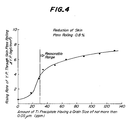
- Fig. 4 shows results measured on the influence of Ti fine precipitate upon Y.P. of steel as a relation between the amount of Ti precipitate having a grain size of not more than 0.05 ⁇ m as Ti conversion amount and the rising rate of Y.P. through skin pass rolling (reduction: 0.8%).
- the amount of fine precipitate as Ti conversion amount is not less than 30 ppm, the rising rate of Y.P. ( ⁇ Y.P.) increases even at the same reduction of skin pass rolling.
- Such a rising rate of Y.P. is advantageous to prevent the degradation of the weldability resulted from the excessive softening in the extra-low carbon steel. That is, when the fine Ti precipitates are dispersed into steel, Y.S. rises at a small reduction of skin pass rolling in the extra-low carbon steel, and consequently the contact resistance increases in the spot welding, so that the heat generating efficiency can be increased at the same welding current.
- the feature of the invention lies in the elucidation of conditions that the above change advantageously acts to the mechanical properties.
- the press formability and the like naturally required in the thin steel sheet besides the above effect are sufficiently compensated by reducing the C amount to not more than 40 ppm as far as possible.
- Si and Mn effectively acts as a deoxidizing agent, but the excessive addition amount causes the damage of ductility. Therefore, the upper limit is Si: 0.1% and Mn: 0.5%, respectively.
- each of P and S is an impurity element, it is desirable to reduce these elements as far as possible.
- Each of these elements is allowed to be not more than about 0.025%.
- N amount is advantageous to reduce as far as possible likewise the C amount for softening the steel sheet to improve El and r-value.
- the N amount exceeds 0.0040%, the properties such as formability, resistance to aging and the like begin to largely degrade, so that the upper limit is 0.0040%.
- the fine precipitate of Ti is mainly TiN, so that the formation of fine TiN as Ti precipitate may more advantageously be attained by controlling the amounts of Ti and N. That is, the Ti precipitates having a grain size of not more than 0.05 ⁇ m are obtained by limiting the weight ratio of Ti to N to a range of 1.7 ⁇ 6.8.
- the increase in the amount of coarse Ti precipitate means that the useless Ti precipitate exhibiting a weak dispersing effect is included in a great amount, so that it is not only disadvantageous in the effective utilization of the aforementioned Ti precipitate but also causes the degradation of the formability and the rise of the cost.
- the ratio Ti/N is less than 1.7, the TiN amount becomes less to the N amount and the sufficient amount of solute B can not be ensured, while when it exceeds 6.8, the absolute amount of TiN increases, but the ratio of fine precipitate reduces, so that it is desirable to add Ti and N so as to satisfy the range of weight ratio Ti/N of 1.7 ⁇ 6.8.
- Fig. 6 shows a relation between Ti/N ratio and amount of fine Ti precipitate having a grain size of not more than 0.05 ⁇ m, from which it is apparent that the better results are obtained when the ratio Ti/N is within a range of 1.7 ⁇ 6.8.
- the precipitation of TiS is suppressed to prevent needless disappearance of Ti, which is particularly advantageous for more enhancing the precipitation of fine Ti precipitate.
- Al is added in an amount of not less than 0.01% for providing the deoxidizing effect.
- the upper limit of Al added is 0.10% in order to prevent the bad influence upon the mechanical properties as an impurity.
- Nb is an element useful for making the structure of spot weld portion to raise the hardness of the weld portion under the coexistence with B.
- Nb effectively contributes to raise Y.P. with holding high El and r-value by the combined addition with Ti.
- Nb amount is not less than 0.002%, but when the amount exceeds 0.010%, the excessive rise of Y.P. and the decrease of El are brought about, so that the amount is limited to a range of 0.001 ⁇ 0.010%.
- Nb it is desirable to add Nb in an amount of not less than 0.003% in order to finely disperse the Ti precipitate.
- the ratio of Nb to Ti becomes high, the amount of NbC precipitated increases to degrade the mechanical properties, so that the coiling temperature should be not lower than 600°C and consequently the amount of Nb added is necessary to be reduced in balance with Ti.
- the atomic ratio of Nb to Ti is not less than 0.2, the degradation of mechanical properties is poor, so that the ratio of Nb to Ti is necessary to be Nb/Ti ⁇ 1/5 as an atomic ratio or Nb ⁇ 1/5(93/48)Ti as a weight ratio.
- Fig. 12 results examined with respect to the influence of Nb/Ti (atomic ratio) upon El. As seen from Fig. 12, El rapidly lowers when Nb/Ti is not less than 0.2.
- B is useful for raising the strengths of spot weld portion and base metal, particularly Y.S. by adding in a slight amount in the presence of Nb and/or Ti. This effect is recognized by adding not less than 0.0001% of B, but when the amount is too large, the degradation of mechanical properties is caused, so that the upper limit is 0.0010%.
- the B amount is insufficient to merely satisfy the above range, and is important to be limited to a range of (11/93)Nb - 0.0004 ⁇ B ⁇ (11/93)Nb + 0.0004 in balance with the Nb amount.
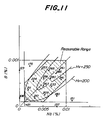
- Fig. 11 shows a relation between addition amount of Nb and B and hardness of spot weld portion (nugget zone).
- the spot welding conditions were the same as in Fig. 1.
- the hardness of the weld portion is large at Nb: 0.001 ⁇ 0.010% and B: 0.0001 ⁇ 0.0010%, and particularly the better result is obtained when Nb and B satisfy the above ranges and the B amount is within a range of (11/93)Nb ⁇ 0.0004(%).
- the change of properties of base metal by the combined addition of Ti, Nb and B is also considered to result from the above interaction between Nb and B. That is, it is considered that the above interaction makes the crystal grain size of the hot rolled sheet fine and the crystal grain size of the annealed sheet relatively fine to increase Y.S. and the same time the fine homogenization of grain size of the hot rolled sheet brings about the improvement of r-value and El.
- Ti is not only useful for fixing solute components such as N, S, C and the like, but also exhibits a great effect for the improvement of mechanical properties by the formation of precipitates with these elements.
- the improving effect of spot weldability through Nb and B is not realized in the absence of Ti as previously shown in Fig. 5. Because it is required to fix a greater part of elements such as N, C and the like in steel, which fix Nb or B as a precipitate, with Ti for causing the sufficient interaction between Nb and B. Therefore, if it is not particularly intended to improve the mechanical properties through the precipitation distribution, Ti is necessary to be added in an amount of not less than C+N (atomic number) or Ti>(48/12 ⁇ C+48/14 ⁇ N). Furthermore, when Ti is added in an amount of less than 0.01% as an absolute amount, the fixation of the solute element is insufficient and the addition effect of Nb and B is not satisfactorily developed.
- the high r-value and El are obtained at Ti ⁇ 0.01%, but the excessive addition of Ti brings about the extreme softening based on the C fixation, which badly affects the effect of the invention. Therefore, the upper limit is 0.04%. Moreover, the presence of the reasonable Ti amount has an effect of restraining the occurrence of fine precipitate containing Nb, so that the coiling temperature after the hot rolling is not necessary to be high (>600°C) as in the usual Nb addition, which is advantageous in economy, and the excessive softening due to the growth of crystal grain can be prevented.
- Ti is added in an amount of 0.01 ⁇ 0.04%, preferably Ti/(48/12 ⁇ C+48/14 ⁇ N)>1. In order to obtain the above effect at maximum, it is more advantageous to limit the Ti amount added to a minimum.
- Fig. 13 results examined on the influence of Ti amount upon the hardness of the weld portion over a wide composition range.
- the chemical composition and welding conditions are the same as in the case of Fig. 11.
- the data of the hardness are roughly divided into three parts in accordance with the range of the Ti amount. That is, in case of Ti ⁇ (48/12 ⁇ C+48/14 ⁇ N), the weld portion exhibits a high hardness or a very low hardness, so that the scattering of the hardness is large. This is considered due to the fact that the Ti amount is less so that the yield of B lowers and the interaction effect between Nb and B is insufficient. On the other hand, in case of Ti>(48/12 ⁇ C+48/14 ⁇ N), the hardness is Hv ⁇ 180 at minimum.
- the hardness of the weld portion is stabilized at a very high level when Ti ⁇ (48/12 ⁇ C+48/14 ⁇ N+48/32 ⁇ S). This shows that when Ti is added in a necessary minimum amount or an amount of not less than equivalent to C and N, the sufficient hardness is obtained but when the Ti addition amount is more than equivalent to S, the hardness of the weld portion tends to rather lower. Because, it is considered that when Ti is existent in a sufficient (excessive) amount to C, N and S, the effect of Nb forming a precipitate with a part of C is substantially lost.
- the expected effect is obtained by limiting the Ti amount to Ti>(48/12 ⁇ C+48/14 ⁇ N), but in order to provide a more excellent effect, it is preferable to limit the Ti amount to a narrower range of Ti ⁇ (48/12 ⁇ C+48/14 ⁇ N +48/32 ⁇ S) in balance with C, N and S.
- Fig. 14 shows results examined on the influence of C, N and B as an intersticial solute element upon the hardness of the weld portion in various steels, wherein C+12/14 ⁇ N+12/11 ⁇ B is plotted on an abscissa for converting the amount of all elements into C amount.
- C+12/14 ⁇ N+12/11 ⁇ B is not more than 38 ppm
- the effect of forming the fine structure is insufficient and the sufficient hardness of the weld portion is not obtained. Therefore, C, N and B may be added so as to satisfy C+12/14 ⁇ N+12/11 ⁇ B>38 ppm.
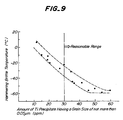
- the amount of fine Ti precipitate in steel is limited to not less than 30 ppm as a Ti conversion amount in order to effectively obtain the ⁇ Y.P. raising. Furthermore, the reason why the grain size of Ti precipitate is limited to not more than 0.05 ⁇ m is due to the fact that when the grain size exceeds 0.05 ⁇ m, even if the amount of the Ti precipitate increases, the weldability and the strength and toughness of the weld portion can not be improved to an expected extent.
- the advantageous effect is also produced by controlling the surface properties of the steel sheet, which is proved from the following experimental results.
- Each of these cold rolled steel sheets was subjected to a skin pass rolling at a reduction of 0.8% with a skin pass roll dulled at its surface through laser.
- the surface roughness pattern of the steel sheet after the skin pass rolling was changed by varying conditions in the laser dulling process. Then, a specimen of 30 ⁇ 30 mm was cut out from each of the sheets and subjected to a spot welding.
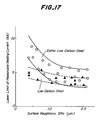
- Fig. 17 shows a relation between lower limit of weldable current and surface roughness (SRa) in the spot welding.
- the spot welding conditions were a sheet gauge of 0.7 mm, a welding time of 7 cycles, an applied pressure of 1717 N (175 kgf), and a cap diameter of 4.0 mm.
- the reason on the lowering of the lower limit of weldable current with the increase of SRa is considered as follows. That is, as the surface roughness becomes large, the contact area in the welding becomes small. If the same current is applied, the smaller the contact area, the larger the electric resistance, so that the heat generating amount increases. Therefore, as the surface roughness becomes larger, the current value for obtaining the same heat generating amount may be made small.
- Fig. 18 results measured on the limit value of weldable current by changing SRa and Y.S. when using the extra-low carbon steel of Fig. 17.
- the spot welding conditions were a specimen size of 0.8 ⁇ 30 ⁇ 30 mm, a CF type electrode of 4.5 mm in diameter, an applied pressure of 1864 N (190 kgf), a welding time of 8 cycles, and a welding current of 7.5 kA.
- numerals in Fig. 18 indicate a lower limit of weldable current at each point, respectively.
- the object aimed at an embodiment of the invention is further achieved by defining area ratio of convex portions on the steel sheet surface SSr and an average surface ratio per one of convex portions SGr within predetermined ranges.
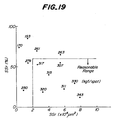
- Fig. 19 results examined on a relation between area ratio of convex portions (SSr) and average area per one convex portion (SGr) exerting on cross tensile strength after the spot welding of the extra-low carbon steel used in Figs. 17 and 18.
- a specimen for cross tensile test there was used a specimen of 0.8 mm in sheet gauge according to JIS Z3137.
- the spot welding conditions were a welding time of 8 cycles, an applied pressure of 1717 N (175 kgf), and a welding current of 7.5 kA.
- the area ratio of convex portions (SSr) and average area per one convex portion (SGr) were measured by means of a three-dimensional surface roughness meter.
- the numerical value in Fig. 19 is a shearing tensile force of spot weld portion at each point.
- the inventors have made studies based on the above fundamental data and found out that cold rolled steel sheets having improved formability and spot weldability are obtained by controlling the surface state of the sheet as mentioned later.
- SRa is desirable to be SRa ⁇ 32.4/Y.S.-1.1. If SRa ⁇ 32.4/Y.S.-1.1, the spot weldability based on the surface control is not observed.
- the SSr and SGr values are desired to be SSr ⁇ 60% and SGr ⁇ 2x10⁴ ⁇ m2. If SSr>60% or SGr ⁇ 2x10⁴ ⁇ m2, the improved spot weldability based on the surface control may not be obtained.
- the cooling rate in the solidification and cooling stage of steel is particularly important for obtaining fine Ti precipitates. That is, it is necessary to cool the steel at a cooling rate of not less than 3.0°C/min within a temperature range of 1,300°C to 1,000°C.
- Fig. 7 are shown quantitatively analyzed results on the amount of Ti precipitate having a grain size of not more than 0.05 ⁇ m and the total amount of Ti precipitates when the cooling over a temperature range of 1,300°C to 1,000°C at the casting stage is carried out by varying the cooling rate within a range of 0.5°C/min to 5°C/min.
- the total amount of Ti precipitates reduces with the increase of the cooling rate, while the amount of Ti precipitate having a grain size of not more than 0.05 ⁇ m inversely increases.
- the cooling rate is not less than 3.0°C/min, the fine Ti precipitate having a grain size of not more than 0.05 ⁇ m is stably precipitated in a great amount.
- the slab cooled at the above cooling rate is heated at subsequent slab heating stage, but in this case, it is required to heat the slab at a relatively low temperature of not higher than 1,200°C for preventing the coarsening of Ti precipitate.
- Fig. 8 results examined on a relation among slab heating temperature, total amount of Ti precipitates and amount of fine precipitate having a grain size of not more than 0.05 ⁇ m.
- the lower limit of the finish temperature is determined from a viewpoint of suppressing the degradation of r-value due to residual strain, while the upper limit thereof is determined from a viewpoint of preventing the degradation of r-value due to the coarsening of crystal grain.
- the cold rolling is to impart an adequate cold strain required in the formation of recrystallization texture. Therefore, the lower limit of the reduction is 60% so as to provide a sufficient rolling strain. On the other hand, when the reduction is too high, the loading of the rolling machine becomes large and the productivity lowers, so that the upper limit is 85%.
- the annealing temperature is required to be not lower than the recrystallization temperature.
- the annealing temperature is too high, the steel is excessively softened and the effect aiming at the invention can not be obtained, so that the upper limit is 780°C.
- the recrystallization temperature and the softening temperature shift toward high temperature side, so that the continuous annealing temperature is shifted to 700 ⁇ 900°C.
- the lower limit of 700°C is required to obtain a recrystallization texture
- the upper limit of 900°C is required to prevent the excessive softening of the steel sheet and the coarsening of Ti precipitate.
- the effect by the reduction of skin pass rolling is particularly large in the Ti-Nb-B series steel, and there is recognized a phenomenon that the lower limit of reasonable welding current is lower than that of the low carbon steel when the reduction is not less than (sheet gauge (mm) + 0.1)%. Furthermore, the thus obtained steel sheet is excellent in the fatigue properties of spot weld portion.
- the welding conditions were a welding time of 8 cycles, a welding current of 7.5 kA and an applied pressure of 1962 N (200 kgf). Furthermore, the addition mode in the fatigue test was 0-tension or complete cantilevered shearing tensile fatigue. The test was stopped according to JIS Z3136 when the fatigue crack having a length equal to the nugget diameter was observed from the steel sheet surface.
- the fatigue strength of the steel B as an extra-low carbon steel is low as compared with that of the steel A as a usual low carbon steel.
- the steel C containing Ti-Nb-B subjected to skin pass rolling at a low reduction of 0.3% the fatigue strength at high cycle region is somewhat improved, but the fatigue strength at low cycle region is still low.
- the steel D subjected to skin pass rolling at a high reduction of 1.5% the fatigue strength is largely improved at not only high cycle region but also low cycle region.
- the laser dulling work has been mainly described as a dulling process of the roll, plasma working, discharge working and the like may naturally be utilized. In short, it is important that the surface roughness should be included in the aforementioned reasonable range.
- Nb makes up for the improving effect of mechanical properties through Ti, and has an effect of forming fine structure together with B in addition to the dispersing effect of Ti precipitates. Furthermore, B hardly has an effect of forming the fine structure alone, but exhibits a remarkable effect together with Nb or Ti precipitate.
- Nb and B Since the effect of forming the fine structure under the coexistence of Nb and B is very strong, it is important that the amounts of Nb and B should be restricted to a minimum while taking the balance among these elements.
- the steel sheet In the spot welding, the steel sheet is locally fused and the temperature in the vicinity of the fused portion becomes fairly high. In the extra-low carbon steel sheet, therefore, the crystal grains are generally and considerably coarsened. This is a cause that the structure of the conventional extra-low carbon steel is unsound, and a greatest cause that the strength of the weld portion is low.
- the structure in the vicinity of the weld portion is not coarsened but is made fine in the steels according to the invention. This is guessed due to the fact that a pair of Nb and B atoms strongly suppresses the formation and growth of transformation nucleus at ⁇ - ⁇ or ⁇ - ⁇ transformation.
- the structure of the weld portion is not a regular system but is a needle system, which is a very rare structure as the extra-low carbon steel.
- the greatest feature of the invention lies in a point that the above effect of forming the fine structure is obtained without causing the degradation of the mechanical properties.
- the presence of fine Ti precipitate propels the occurrence of crystal grain nucleus for the ⁇ -formation at the heating state of the spot welding and suppresses the growth of the grains at subsequent step.
- the coarsening of the ⁇ -grains is suppressed by the fine Ti precipitate dispersed into steel, and also the fine and dense structure of the weld portion is obtained by the Ti precipitate and the combined addition of Nb and B in the transformation at the cooling.
- the excellent low-temperature roughness of the weld portion can be obtained while holding the strength at a level equal to that of the base metal.
- steel sheets additionally added with Ti, Nb or B for the purpose of improving the deep drawability, secondary work brittleness and the like and methods thereof are proposed in Japanese Patent Application Publication No. 60-47,328, Japanese Patent laid open Nos. 59-74,232, 59-190,332, 59-193,221, 61-133,323 and the like. All of these conventional techniques are to provide a good deep drawability by utilizing the function and effect of each of Ti, Nb and B, from which the improving effect of the spot weldability most importantly aiming at the invention and further the fatigue properties of the weld portion can not completely be expected.
- a molten steel having a chemical composition shown in the following Table 3 was continuously cast to form a cast slab.
- the resulting slab was cooled at a cooling rate of 0.5 ⁇ 5°C/min over a temperature range of 1,300 ⁇ 1,000°C to produce various slabs having different grain sizes of Ti precipitate.
- each of the slabs was heated to 1,150°C, which was subjected to a hot rolling, a cold rolling and further a continuous annealing at a temperature of 770°C.
- the Ti precipitates having a grain size of not more than 0.05 ⁇ m were dispersed into steel in an amount of not less than 30 ppm as a Ti conversion amount.
- the improvement of low-temperature toughness in the steel according to the invention is considered to be based on the fact that the fracture unit is made small in the formation of the fine structure.
- a molten steel having a chemical composition shown in the following Table 4 was continuously cast to form a cast slab, which was cooled at various cooling rates shown in Table 4 over a temperature range of 1,300 ⁇ 1,000°C at the solidification and cooling stage of the slab and then heated to a temperature shown in Table 4. Thereafter, the thus treated slab was subjected to a hot rolling, a cold rolling and further continuous annealing at a temperature of 750 ⁇ 800°C.
- the amount of fine Ti precipitate having a grain size of not more than 0.05 ⁇ m as Ti conversion amount and the mechanical properties in the resulting cold rolled sheets were measured to obtain results as shown in Table 4.
- a continuously cast slab having a chemical composition shown in the following Table 6 was heated to 1,250°C and subjected to a finish hot rolling at 880°C to form a hot rolled sheet of 3.2 mm in thickness, which was coiled at 550°C. Then, the coiled sheet was subjected to a cold rolling at a reduction of 75% to form a cold rolled sheet of 0.8 mm in gauge, which was subjected to a continuous annealing at a temperature of 750°C.
- each of the mechanical properties was represented by an average value in the rolling direction, a direction of 45° with respect to the rolling direction and a direction perpendicular to the rolling direction at a ratio of 1:2:1.
- the spot welding was carried out by using a CF type electrode of 4.8 mm in diameter at a welding time of 8 cycles and an applied pressure of 200 kgf.
- the welding strength was evaluated by a value at a welding current of 7.5 kA.
- a slab of steel having the same chemical composition as in the steel A of Example 3 was treated under various conditions shown in the following Table 8 to obtain cold rolled sheets (gauge: 0.8 mm).
- the steel sheets according to the invention exhibit good deep drawability and spot weldability, while when the production conditions are outside the reasonable ranges defined in the invention (No. 4 ⁇ 6), the mechanical properties and the spot weldability are poor.
- the steel sheets according to the invention subjected to a skin pass rolling at a high reduction have a high fatigue strength at low cycle welding and exhibit more improved spot weldability.
- a continuously cast slab of steel having a chemical composition shown in the following Table 10 was heated to and soaked at 1,250°C, and then subjected to a rough rolling and a finish rolling to form a hot rolled sheet of 3.2 mm in thickness. After the pickling, the sheet was cold rolled to obtain a cold rolled sheet of 0.7 mm in gauge, which was subjected to a continuous annealing (soaking temperature: 750 ⁇ 850°C) and further to a skin pass rolling (reduction: 0.8%).
- the skin pass rolling was carried out by using a work roll dulled through laser working (laser dulled roll).
- the surface roughness of the steel sheet was measured in the rolling direction thereof, from which an average surface roughness SRa was determined.
- the spot welding was carried out under conditions that the welding time was 7 cycles, the applied pressure was 1570 N and the current was 6.5 kA, during which the spot weldability was evaluated by a shearing tensile strength.
- the measured results are also shown in Table 11.
- the cold rolled steel sheets according to the invention exhibit excellent press formability and spot weldability as compared with those of the comparative examples.
- a slab of steel having the same chemical composition as in the steels C and D of Example 5 was produced in the same manner as in Example 5 and subjected to the following test.
- the area ratio of convex portions and the average area per one convex portion at the center face of surface roughness in the resulting cold rolled steel sheets were measured by means of a three-dimensional surface roughness meter.
- the extra-low carbon steel sheets having an improved spot weldability can be obtained without damaging the formability, so that they are suitable for use in applications subjected to spot welding after the press forming such as steel sheets for automobiles and the like.
Landscapes
- Chemical & Material Sciences (AREA)
- Engineering & Computer Science (AREA)
- Materials Engineering (AREA)
- Mechanical Engineering (AREA)
- Metallurgy (AREA)
- Organic Chemistry (AREA)
- Heat Treatment Of Sheet Steel (AREA)
- Heat Treatment Of Steel (AREA)
Claims (3)
- Feuillard en acier laminé à froid présentant une résistance et une rugosité en portion de soudure, dans lequel ledit acier comprend au plus 0,004 % en poids de C, au plus 0,1 % en poids de Si, au plus 0,5 % en poids de Mn, au plus 0,025 % en poids de P, au plus 0,025 % en poids de S, au plus 0,0040 % en poids de N, de 0,01 à 0,04 % en poids de Ti, de 0,003 à 0,010 % en poids de Nb, de 0,0001 à 0,0010 % en poids de B, de 0,01 à 0,10 % en poids de Al et le reste étant du Fe et des impuretés inévitables, et des précipités fins de Ti ayant une grosseur de grain inférieure à 0,05 µm sont uniformément dispersés dans ledit acier en une quantité non inférieure à 30 ppm comme quantité de conversion Ti.
- Feuillard en acier laminé à froid selon la revendication 1, dans lequel ledit feuillard en acier présente une rugosité de surface satisfaisant à l'un ou l'autre des points (a) et (b) suivants :(a) la rugosité de surface (SRa) et la limite de contrainte (Y.S.) satisfont à la relation suivante :

(b) un rapport de section de portions convexes sur la surface dudit feuillard en acier (SSr) n'est pas supérieur à 60 % et une section moyenne par portion convexe (SGr) n'est pas inférieure à 2 x 10⁴ µm². - Procédé pour la fabrication d'un feuillard en acier laminé à froid ayant une résistance et une rugosité dans une portion soudée, qui consiste à soumettre de l'acier en fusion comprenant au plus 0,004 % en poids de C, au plus 0,1 % en poids de Si, au plus 0,5 % en poids de Mn, au plus 0,025 % en poids de P, au plus 0,025 % en poids de S, au plus 0,0040 % en poids de N, de 0,01 à 0,04 % en poids de Ti, de 0,003 à 0,010 % en poids de Nb, de 0,0001 à 0,0010 % en poids de B, de 0,01 à 0,10 % en poids de Al et le reste étant du Fe et des impuretés inévitables, dans lequel des précipités fins de Ti ayant une grosseur de grain inférieure à 0,05 µm sont dispersés uniformément dans ledit acier en une quantité non inférieure à 30 ppm comme quantité de conversion Ti, à une phase de solidification et de refroidissement, pendant laquelle ledit acier en fusion est refroidi à une vitesse de refroidissement non inférieure à 3°C/min à l'intérieur d'une plage de température d'au moins 1300°C à 1000°C, et à chauffer la brame à une température ne dépassant pas 1200°C, et à soumettre ladite brame à un laminage à chaud et à un laminage à froid, et puis à la soumettre à un recuit continu à l'intérieur d'une plage de température de 700°C à 900°C.
Applications Claiming Priority (8)
| Application Number | Priority Date | Filing Date | Title |
|---|---|---|---|
| JP62150313A JPS63317647A (ja) | 1987-06-18 | 1987-06-18 | 溶接部の強度および靭性に優れる冷延鋼板およびその製造方法 |
| JP150313/87 | 1987-06-18 | ||
| JP62152978A JPS63317649A (ja) | 1987-06-19 | 1987-06-19 | スポット溶接性に優れた極低炭素冷延鋼板の製造方法 |
| JP152979/87 | 1987-06-19 | ||
| JP62152977A JPS63317648A (ja) | 1987-06-19 | 1987-06-19 | 加工性とスポット溶接性に優れる冷延鋼板 |
| JP62152979A JPS63317625A (ja) | 1987-06-19 | 1987-06-19 | スポット溶接部の疲労特性に優れた極低炭素冷延鋼板の製造方法 |
| JP152978/87 | 1987-06-19 | ||
| JP152977/87 | 1987-06-19 |
Publications (3)
| Publication Number | Publication Date |
|---|---|
| EP0295697A2 EP0295697A2 (fr) | 1988-12-21 |
| EP0295697A3 EP0295697A3 (en) | 1989-11-23 |
| EP0295697B1 true EP0295697B1 (fr) | 1994-09-07 |
Family
ID=27473009
Family Applications (1)
| Application Number | Title | Priority Date | Filing Date |
|---|---|---|---|
| EP88109682A Expired - Lifetime EP0295697B1 (fr) | 1987-06-18 | 1988-06-16 | Feuillards en acier laminé à froid, présentant une aptitude au soudage par points et procédé pour leur fabrication |
Country Status (6)
| Country | Link |
|---|---|
| US (2) | US4889566A (fr) |
| EP (1) | EP0295697B1 (fr) |
| KR (1) | KR960010819B1 (fr) |
| AU (1) | AU591843B2 (fr) |
| CA (1) | CA1339525C (fr) |
| DE (1) | DE3851374T2 (fr) |
Families Citing this family (22)
| Publication number | Priority date | Publication date | Assignee | Title |
|---|---|---|---|---|
| US4931106A (en) * | 1987-09-14 | 1990-06-05 | Kawasaki Steel Corporation | Hot rolled steel sheet having high resistances against secondary-work embrittlement and brazing embrittlement and adapted for ultra-deep drawing and a method for producing the same |
| DE3803064C2 (de) * | 1988-01-29 | 1995-04-20 | Preussag Stahl Ag | Kaltgewalztes Blech oder Band und Verfahren zu seiner Herstellung |
| US5053194A (en) * | 1988-12-19 | 1991-10-01 | Kawasaki Steel Corporation | Formable thin steel sheets |
| AU624992B2 (en) * | 1989-09-11 | 1992-06-25 | Kawasaki Steel Corporation | Cold-rolled steel sheet for deep drawings and method of producing the same |
| US5156690A (en) * | 1989-11-22 | 1992-10-20 | Nippon Steel Corporation | Building low yield ratio hot-dip galvanized cold rolled steel sheet having improved refractory property |
| JPH0756051B2 (ja) * | 1990-06-20 | 1995-06-14 | 川崎製鉄株式会社 | 加工用高張力冷延鋼板の製造方法 |
| ATE135414T1 (de) * | 1990-11-09 | 1996-03-15 | Nippon Steel Corp | Kaltgewalztes stahlband mit hervorragender pressverformbarkeit und verfahren zur herstellung |
| JP2810245B2 (ja) * | 1991-01-25 | 1998-10-15 | 日本鋼管株式会社 | プレス成形性および燐酸塩処理性に優れた冷延鋼板およびその製造方法 |
| DE69225395T2 (de) * | 1991-02-20 | 1998-09-10 | Nippon Steel Corp | Kaltgewalztes stahlblech und galvanisiertes kaltgewalztes stahlblech mit hervorragender formbarkeit und einbrennhärtbarkeit und verfahren zu deren herstellung |
| JP2781297B2 (ja) * | 1991-10-29 | 1998-07-30 | 川崎製鉄株式会社 | 耐2次加工脆性に優れ面内異方性の少ない冷延薄鋼板の製造方法 |
| US5496420A (en) * | 1992-04-06 | 1996-03-05 | Kawasaki Steel Corporation | Can-making steel sheet |
| US5360676A (en) * | 1992-04-06 | 1994-11-01 | Kawasaki Steel Corporation | Tin mill black plate for canmaking, and method of manufacturing |
| US5356493A (en) * | 1992-07-08 | 1994-10-18 | Nkk Corporation | Blister-resistant steel sheet and method for producing thereof |
| FR2727431B1 (fr) * | 1994-11-30 | 1996-12-27 | Creusot Loire | Procede d'elaboration d'un acier au titane et acier obtenu |
| FR2742769B1 (fr) * | 1995-12-20 | 1998-01-16 | Lorraine Laminage | Acier lamine a froid presentant une bonne aptitude au soudage et au brasage |
| WO1998024942A1 (fr) * | 1996-12-06 | 1998-06-11 | Kawasaki Steel Corporation | Feuille d'acier pour tuyau a enroulement double et procede de production du tuyau |
| JPH11305987A (ja) | 1998-04-27 | 1999-11-05 | Matsushita Electric Ind Co Ltd | テキスト音声変換装置 |
| US6110296A (en) * | 1998-04-28 | 2000-08-29 | Usx Corporation | Thin strip casting of carbon steels |
| JP4234932B2 (ja) * | 2002-02-13 | 2009-03-04 | 新日本製鐵株式会社 | 成形性及び溶接部の特性に優れた容器用鋼板及びその製造方法 |
| US8925253B2 (en) * | 2002-10-31 | 2015-01-06 | Eastside Machine Company, Inc. | Gutter and cover system |
| JP5467480B2 (ja) * | 2009-07-31 | 2014-04-09 | 高周波熱錬株式会社 | 溶接構造部材及び溶接方法 |
| KR101553607B1 (ko) * | 2014-12-26 | 2015-09-17 | 주식회사 포스코 | 연성이 우수한 페라이트계 스테인리스 강재 및 그 제조방법 |
Citations (1)
| Publication number | Priority date | Publication date | Assignee | Title |
|---|---|---|---|---|
| US4141761A (en) * | 1976-09-27 | 1979-02-27 | Republic Steel Corporation | High strength low alloy steel containing columbium and titanium |
Family Cites Families (19)
| Publication number | Priority date | Publication date | Assignee | Title |
|---|---|---|---|---|
| US4171761A (en) * | 1978-03-20 | 1979-10-23 | Rockwell International Corporation | Wave solder apparatus |
| AU531754B2 (en) * | 1980-03-31 | 1983-09-01 | Kawasaki Steel Corp. | High-tensile,cold-rolled steel plate and high tensile, galvanized steel plate both with excellent formability, and process for its production |
| JPS5877528A (ja) * | 1981-10-31 | 1983-05-10 | Nippon Steel Corp | 低温靭性の優れた高張力鋼の製造法 |
| JPS59190332A (ja) * | 1983-04-14 | 1984-10-29 | Nippon Steel Corp | 極めて優れた二次加工性を有する超深絞り用溶融亜鉛めつき鋼板の製造方法 |
| US4504326A (en) * | 1982-10-08 | 1985-03-12 | Nippon Steel Corporation | Method for the production of cold rolled steel sheet having super deep drawability |
| JPS5974232A (ja) * | 1982-10-20 | 1984-04-26 | Nippon Steel Corp | 極めて優れた二次加工性を有する超深絞り用焼付硬化性溶融亜鉛めつき鋼板の製造方法 |
| JPS59177327A (ja) * | 1983-03-25 | 1984-10-08 | Sumitomo Metal Ind Ltd | プレス加工用冷延鋼板の製造法 |
| JPS59193221A (ja) * | 1983-04-15 | 1984-11-01 | Nippon Steel Corp | 極めて優れた二次加工性を有する超深絞り用冷延鋼板の製造方法 |
| JPS6047328A (ja) * | 1983-08-25 | 1985-03-14 | 和泉電気株式会社 | バイメタル式回路遮断器 |
| JPS60159153A (ja) * | 1984-01-28 | 1985-08-20 | Nippon Steel Corp | 加工性と表面処理特性の優れた鋼板 |
| JPS60174852A (ja) * | 1984-02-18 | 1985-09-09 | Kawasaki Steel Corp | 深絞り性に優れる複合組織冷延鋼板とその製造方法 |
| JPS6126756A (ja) * | 1984-07-17 | 1986-02-06 | Kawasaki Steel Corp | 良化成処理性を有する極低炭素鋼板 |
| JPS61110757A (ja) * | 1984-11-02 | 1986-05-29 | Kawasaki Steel Corp | 薄鋼板及びその製造方法 |
| JPS61113724A (ja) * | 1984-11-08 | 1986-05-31 | Nippon Steel Corp | プレス成形性の極めて優れた冷延鋼板の製造方法 |
| JPH0639620B2 (ja) * | 1984-11-30 | 1994-05-25 | 新日本製鐵株式会社 | 成形性の優れた薄鋼板の製造方法 |
| AU575730B2 (en) * | 1985-01-31 | 1988-08-04 | Kawasaki Steel Corporation | Continuous annealing extra-low carbon steel |
| US4931106A (en) * | 1987-09-14 | 1990-06-05 | Kawasaki Steel Corporation | Hot rolled steel sheet having high resistances against secondary-work embrittlement and brazing embrittlement and adapted for ultra-deep drawing and a method for producing the same |
| JPH0647328A (ja) * | 1992-07-28 | 1994-02-22 | Matsushita Electric Works Ltd | 粘性液剤押し出し機 |
| JPH11133323A (ja) * | 1997-10-28 | 1999-05-21 | Canon Inc | 画像形成装置 |
-
1988
- 1988-06-09 US US07/204,619 patent/US4889566A/en not_active Expired - Lifetime
- 1988-06-16 DE DE3851374T patent/DE3851374T2/de not_active Expired - Lifetime
- 1988-06-16 AU AU17752/88A patent/AU591843B2/en not_active Expired
- 1988-06-16 EP EP88109682A patent/EP0295697B1/fr not_active Expired - Lifetime
- 1988-06-16 CA CA000569634A patent/CA1339525C/fr not_active Expired - Lifetime
- 1988-06-17 KR KR1019880007420A patent/KR960010819B1/ko not_active Expired - Lifetime
-
1989
- 1989-09-21 US US07/410,414 patent/US5089068A/en not_active Expired - Lifetime
Patent Citations (1)
| Publication number | Priority date | Publication date | Assignee | Title |
|---|---|---|---|---|
| US4141761A (en) * | 1976-09-27 | 1979-02-27 | Republic Steel Corporation | High strength low alloy steel containing columbium and titanium |
Also Published As
| Publication number | Publication date |
|---|---|
| EP0295697A2 (fr) | 1988-12-21 |
| CA1339525C (fr) | 1997-11-04 |
| AU1775288A (en) | 1989-01-19 |
| EP0295697A3 (en) | 1989-11-23 |
| DE3851374T2 (de) | 1995-01-19 |
| US5089068A (en) | 1992-02-18 |
| AU591843B2 (en) | 1989-12-14 |
| US4889566A (en) | 1989-12-26 |
| DE3851374D1 (de) | 1994-10-13 |
| KR890000173A (ko) | 1989-03-13 |
| KR960010819B1 (ko) | 1996-08-09 |
Similar Documents
| Publication | Publication Date | Title |
|---|---|---|
| EP0295697B1 (fr) | Feuillards en acier laminé à froid, présentant une aptitude au soudage par points et procédé pour leur fabrication | |
| EP2309012B1 (fr) | Feuille fine d'acier laminée à froid à haute résistance et rapport d'élasticité élevé, feuille fine d'acier laminée à froid et galvanisée à chaud à haute résistance et rapport d'élasticité élevé ayant une excellente aptitude à la soudure et une excellente ductilité, feuille fine d'acier laminée à froid, galvanisée à chaud et alliée à haute résistance et rapport d'élasticité elevé et procédés pour les produire. | |
| EP1264910B1 (fr) | Tube d'acier facile a former et procede de production de ce dernier | |
| EP2039791B1 (fr) | Tôle d'acier de grande résistance et son procédé de production | |
| KR101476866B1 (ko) | 양호한 스탬핑성을 갖는 저밀도 강 | |
| EP1143022B1 (fr) | Procede de production d' une plaque fine d'acier a resistance mecanique elevee | |
| EP2880189B1 (fr) | Procédé permettant de produire une bande d'acier laminée à chaud, et bande d'acier ainsi produite | |
| EP0769565A1 (fr) | Tole laminee a froid, a teneur en carbone ultra-faible, et tole galvanisee, excellentes par leurs caracteristiques de fatigue, et procede de production | |
| CN112218969A (zh) | TWB焊接特性优异的用于热成型的Al-Fe合金化镀覆钢板、热成型部件及它们的制造方法 | |
| EP0709480B1 (fr) | Tole grosse d'acier presentant d'excellentes caracteristiques sur le plan de la prevention de la propagation des criques et de la durete a basse temperature et procede d'elaboration de cette tole | |
| EP4265765A1 (fr) | Tôle d'acier à haute résistance ayant une excellente aptitude au façonnage et son procédé de fabrication | |
| KR102920268B1 (ko) | 강판, 강 부재 및 피복 강 부재 | |
| JP4984933B2 (ja) | テーラードブランク用熱延鋼板およびテーラードブランク | |
| JP3842836B2 (ja) | 低温靱性に優れた高張力鋼材の製造方法 | |
| EP0322463B1 (fr) | Feuille d'acier durcissable par traitement thermique laminee a chaud de grande resistance, presentant une excellente aptitude a l'usinage a froid et procede de production | |
| US20240229183A9 (en) | Coiling temperature influenced cold rolled strip or steel | |
| EP4265763A1 (fr) | Feuille d'acier à haute résistance ayant une excellente maniabilité et son procédé de fabrication | |
| JP3280692B2 (ja) | 深絞り用高強度冷延鋼板の製造方法 | |
| JPS63317647A (ja) | 溶接部の強度および靭性に優れる冷延鋼板およびその製造方法 | |
| JP3261515B2 (ja) | 低温靱性に優れた厚鋼板の製造方法 | |
| JPH0557330B2 (fr) | ||
| CN118679276A (zh) | 大线能量焊接用钢板及其制造方法 | |
| KR20190078259A (ko) | 재질편차가 적고, 신장플랜지성 및 실수율이 우수한 고강도 냉연강판 및 그 제조방법 | |
| JPH0756055B2 (ja) | 加工性の極めて優れた冷延鋼板の高効率な製造方法 | |
| JPS639578B2 (fr) |
Legal Events
| Date | Code | Title | Description |
|---|---|---|---|
| PUAI | Public reference made under article 153(3) epc to a published international application that has entered the european phase |
Free format text: ORIGINAL CODE: 0009012 |
|
| AK | Designated contracting states |
Kind code of ref document: A2 Designated state(s): BE DE ES FR GB IT |
|
| PUAL | Search report despatched |
Free format text: ORIGINAL CODE: 0009013 |
|
| AK | Designated contracting states |
Kind code of ref document: A3 Designated state(s): BE DE ES FR GB IT |
|
| 17P | Request for examination filed |
Effective date: 19900207 |
|
| 17Q | First examination report despatched |
Effective date: 19910625 |
|
| RBV | Designated contracting states (corrected) |
Designated state(s): DE FR GB |
|
| GRAA | (expected) grant |
Free format text: ORIGINAL CODE: 0009210 |
|
| AK | Designated contracting states |
Kind code of ref document: B1 Designated state(s): DE FR GB |
|
| REF | Corresponds to: |
Ref document number: 3851374 Country of ref document: DE Date of ref document: 19941013 |
|
| ET | Fr: translation filed | ||
| PLBE | No opposition filed within time limit |
Free format text: ORIGINAL CODE: 0009261 |
|
| STAA | Information on the status of an ep patent application or granted ep patent |
Free format text: STATUS: NO OPPOSITION FILED WITHIN TIME LIMIT |
|
| 26N | No opposition filed | ||
| REG | Reference to a national code |
Ref country code: GB Ref legal event code: IF02 |
|
| PGFP | Annual fee paid to national office [announced via postgrant information from national office to epo] |
Ref country code: DE Payment date: 20070614 Year of fee payment: 20 |
|
| PGFP | Annual fee paid to national office [announced via postgrant information from national office to epo] |
Ref country code: GB Payment date: 20070613 Year of fee payment: 20 |
|
| PGFP | Annual fee paid to national office [announced via postgrant information from national office to epo] |
Ref country code: FR Payment date: 20070608 Year of fee payment: 20 |
|
| REG | Reference to a national code |
Ref country code: GB Ref legal event code: PE20 Expiry date: 20080615 |
|
| PG25 | Lapsed in a contracting state [announced via postgrant information from national office to epo] |
Ref country code: GB Free format text: LAPSE BECAUSE OF EXPIRATION OF PROTECTION Effective date: 20080615 |