EP0295755B1 - A method for testing eggs for the existence of cracks or holes in the egg shells by examining the elasticity of said shells and an apparatus for carrying out said process - Google Patents
A method for testing eggs for the existence of cracks or holes in the egg shells by examining the elasticity of said shells and an apparatus for carrying out said process Download PDFInfo
- Publication number
- EP0295755B1 EP0295755B1 EP88201235A EP88201235A EP0295755B1 EP 0295755 B1 EP0295755 B1 EP 0295755B1 EP 88201235 A EP88201235 A EP 88201235A EP 88201235 A EP88201235 A EP 88201235A EP 0295755 B1 EP0295755 B1 EP 0295755B1
- Authority
- EP
- European Patent Office
- Prior art keywords
- egg
- shell
- probe
- force
- oscillations
- Prior art date
- Legal status (The legal status is an assumption and is not a legal conclusion. Google has not performed a legal analysis and makes no representation as to the accuracy of the status listed.)
- Expired - Lifetime
Links
- 235000013601 eggs Nutrition 0.000 title claims description 77
- 238000000034 method Methods 0.000 title claims description 34
- 210000003278 egg shell Anatomy 0.000 title claims description 31
- 230000008569 process Effects 0.000 title description 8
- 239000000523 sample Substances 0.000 claims description 47
- 102000002322 Egg Proteins Human genes 0.000 claims description 30
- 108010000912 Egg Proteins Proteins 0.000 claims description 30
- 230000010355 oscillation Effects 0.000 claims description 27
- 230000005489 elastic deformation Effects 0.000 claims description 8
- 230000003247 decreasing effect Effects 0.000 claims description 7
- 230000009471 action Effects 0.000 claims description 6
- 239000012528 membrane Substances 0.000 claims description 3
- 238000004590 computer program Methods 0.000 claims description 2
- 230000003287 optical effect Effects 0.000 claims description 2
- 239000011521 glass Substances 0.000 description 22
- 238000005259 measurement Methods 0.000 description 8
- 101150073877 egg-1 gene Proteins 0.000 description 7
- 238000001514 detection method Methods 0.000 description 4
- 238000007689 inspection Methods 0.000 description 4
- 230000007246 mechanism Effects 0.000 description 4
- 239000013078 crystal Substances 0.000 description 1
- 230000000994 depressogenic effect Effects 0.000 description 1
- 238000010586 diagram Methods 0.000 description 1
- 235000013305 food Nutrition 0.000 description 1
- 230000006870 function Effects 0.000 description 1
- 230000036541 health Effects 0.000 description 1
- 238000009434 installation Methods 0.000 description 1
- 230000007794 irritation Effects 0.000 description 1
- 238000004806 packaging method and process Methods 0.000 description 1
- 229920001296 polysiloxane Polymers 0.000 description 1
Images


Classifications
-
- G—PHYSICS
- G01—MEASURING; TESTING
- G01N—INVESTIGATING OR ANALYSING MATERIALS BY DETERMINING THEIR CHEMICAL OR PHYSICAL PROPERTIES
- G01N33/00—Investigating or analysing materials by specific methods not covered by groups G01N1/00 - G01N31/00
- G01N33/02—Food
- G01N33/08—Eggs, e.g. by candling
-
- A—HUMAN NECESSITIES
- A01—AGRICULTURE; FORESTRY; ANIMAL HUSBANDRY; HUNTING; TRAPPING; FISHING
- A01K—ANIMAL HUSBANDRY; AVICULTURE; APICULTURE; PISCICULTURE; FISHING; REARING OR BREEDING ANIMALS, NOT OTHERWISE PROVIDED FOR; NEW BREEDS OF ANIMALS
- A01K43/00—Testing, sorting or cleaning eggs ; Conveying devices ; Pick-up devices
Definitions
- the present invention relates to a method for examining eggs to determine the presence of cracks or holes in the egg shell through the examination of the resiliency of said shell.
- Such detection is important for several reasons. One is that the keeping quality of such eggs is reduced and their use as food may entail a health risk. Another reason is that damaged eggs cause loss and irritation in the further handling and distribution of these eggs.
- the object of the present invention is, therefore, to provide a method of the above-described type which is suitable for the fully-automatic detection of cracked eggs and which has a high degree of reliability.
- the method according to the present invention is characterized by subjecting the egg to an examination cycle which consists in exercising intermittent pressure on at least a section of the egg shell by a movably mounted probe to create a series of in principle elastic deformations, where each subsequent deformation in the series is caused by the shell's action on the probe as a reaction to the immediately preceding deformation by subjecting the probe, from its original position at a distance from the shell, to a continuous force directed at the egg's shell, forcing the probe down to strike against the shell, and this results in an elastic deformation of same, whereupon the resilience of the egg shell causes it to return to its original shape, throwing back the probe, whereafter the probe, again as a result of the continuous force, is brought to strike against the shell once more before again being thrown back, repeating this action several times, with decreasing oscillations, so that the probe's action seen as a whole is a bouncing movement against the said egg shell, with decreasing oscillation, of which the amplitude and duration is measured, preferably electrically, and the
- This method utilizes the fact that a section of an egg shell without cracks or holes has a higher degree of resiliency than a section with a crack or hole, and that this section, after being subjected to a certain degree of elastic deformation, will therefore generate both more and larger oscillations of the probe than will a section with cracks or holes.
- the results of the measurements obtained by the above method can be read out by a computer, so that it is possible to obtain both an automatic and a direct indication of the shell quality of the individual egg, an indication which in turn can be used to control a sorting mechanism.
- the above method is also suitable for use at very high speeds, so that it is applicable in inspection lines generally provided in egg packaging plants, in which eggs are continuously rotated around their axis of symmetry during the examination process.
- the damped oscillations of the probe into an electrical signal by means of a transducer consisting of a piezoelectric, optical, magnetic or capacitive device.
- This signal can then be converted by means of an amplifier, a comparator and a signal converter into rectangular digital impulses.
- These impulses are counted by a counting device and then transmitted to and stored in a computer, together with the results of other examinations of the egg.
- a computer program it is then possible to ascertain the lowest value for the number of bouncing oscillations in an examination cycle, which value can be compared with an empirical parameter, characterizing an uncracked egg.
- the invention also relates to an apparatus for carrying out the above-described method, this apparatus comprising
- Such apparatus is known from the above-mentioned US-A-3,503,501.
- the probe used in this apparatus comprises an electromechanical vibrator to produce oscillations therein and further an electromechanical transducer to determine the vibrations of the egg shell.
- the mass and volume of this probe is considerable. Due to its considerable mass, the probe remains in contact with the shell of the egg to be examined during the whole measuring period, and is not capable of making a bouncing movement with decreasing oscillations. Due to considerable probe volume only one section of the egg (near the mid plane thereof can be examined.
- It is an object of the invention to provide an apparatus comprising one or more probes having a small mass and volume, these probes being capable of making a bouncing movement with decreasing oscillations, whose amplitude and duration are to be measured, the small volume of the probes enabling the simultaneous examination of an egg with several probes, each probe striking an egg on a different section thereof.
- this object is achieved by providing an apparatus of the above type, wherein the probe is a substantially stiff, tube-shaped or rod-shaped element, one end thereof being elastically attached to a holder element, in which the transducer means are arranged and which is connected to a stationary base element by means of a leaf spring, an air chamber being arranged parallel to said leaf spring between opposing sides of the holder element and the base element, said air chamber being capable of moving the probe in the direction of an egg to be examined upon the introduction of pressurized air into said air chamber and of applying a bouncing force to the shell of said egg in order to cause a series of elastic deformations of said shell.
- the probe is is a tube-shaped body, slidably mounted in a holder element which is vertically movable towards and away from an egg to be examined, which tube-shaped body, at the end directed towards said egg, is closed by a membrane to which a ball is fixed, the other end of said tube-shaped body being closed by a microphone, capable of sensing the vibrations, applied by the vibrating egg shell to the ball and of converting the vibrations sensed into electrical signals.
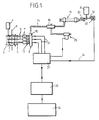
- an apparatus according to this invention is shown adapted for the examination of a single egg 1.
- This apparatus comprises a base consisting of two closely placed, rotating rollers 2, 3 having parallel shafts which, by means of a motor 4, can be made to revolve in the same direction so that an egg 1 placed onto the rollers rotates mainly around its longitudinal axis of symmetry 5.
- Above the egg 1 there are arranged three probes 6 preferably glass tubes.
- Each glass tube 6 is at one end resiliently fixed into a holder 7, and this holder 7 is attached to a base 9 common to all three holders 7 by means of a leaf spring 8.
- the base 9 contains a chamber 10 for the distribution of compressed air, which chamber is connected through ducts 11 in the base 9 to individual air chambers 12, each belonging to its own holder 7.
- the individual chamber 12 extends between and is confined by the holder 7 and the base 9, a rubber bellows 13 being arranged between these elements 7, 9.
- the chamber 10 is connected to a compressed air source 15 by means of a pipe line 14 this air source 15 being shown here as an air pulsator, which is operated by a motor 31 via a crank disc 30.
- a vacuum escape valve 16 Inserted between the air pulsator 15 and the chaimber 10 for the distribution of compressed air is a vacuum escape valve 16.
- a transducer 17 in the form of a piezoelectric device is arranged, attached at one end to the holder 7.
- the transducer 17 is glued to the fixed end of the glass tube 6 by means of a silicone drop 18 so that the oscillating movement of the glass tube 6 causes deformations of the piezoelectric device 17.
- the glass tube 6 is resiliently mounted in its horizontal position, shown in Fig. 2, by means of a rubber chock 19 fitted to the holder 7 in which the glass tube 6 is fixed, and held flexibly in the holder 7 by means of two rubber chocks 20 so that, upon contact with the egg shell, it can swing in a plane that intersects the axis of symmetry 5 at a right angle.
- the upper and lower parts of the piezoelectric device 17 are connected to an electronic device 22 described in more detail hereafter. (See Fig. 4) by a two-core cable 21.
- This device 22 which contains a counter 29 for each glass tube 6, is connected to a computer 23 and a sorting mechanism 24.
- a yoke-shaped photoelectric cell 32 is placed over the crank disc 30 to cooperate with an air slot 33 in the disc 30 thus generating a signal to be transmitted to the electronic device 22 when the crank disc 30 is in a particular position. Further, a signal can be transmitted from the computer 23 via the electronic device 22 to a solenoid valve 25 which is connected to the vacuum escape valve 16.
- the egg 1 When using the apparatus, the egg 1 is rotating around its axis of symmetry 5, and a signal is generated to close the solenoid valve 25. Compressed air is then fed from the compressed air source 15 through the pipe line 14 and into the chamber 10 for the distribution of compressed air. From here the air flows through the ducts 11 into the air chambers 12 connected to each of the three holders 7. The holders 7 with the glass tubes 6 will be placed in an inclined position as the leaf spring 8 is bent, so that the glass tubes 6 are pressed downwardly to strike against the surface of the egg 1 in the position shown in Fig. 3. The glass tube 6 is held under pressure against the egg as long as sufficient air pressure is present in the air chamber 12. The initial impact of the glass tube 6 against the egg will result in an elastic deformation of the egg shell.
- the bouncing motion of the glass tube 6 is converted by the piezoelectric device 17 into an electrical signal which is related to the movements of the glass tube.
- This electrical signal generated by each of the three piezoelectric devices 17 is sent through the cables 21 to the electronic device 22 where these signals are processed. A more detailed description of this processing will be discussed hereafter, with reference to Figures 4-7, whereafter the resulting data are evaluated by the computer 23.
- the piston in the air pulsator 15 is moved, so that the air pressure in the pipe 14 is allowed to escape through the valve 16. In this way, the glass tubes 6 are raised in relation to the egg by means of the leaf spring 8.
- the air slot 33 in the crank disc 30 is positioned in the yoke-shaped photoelectric cell 32, so that a signal is transmitted through the cable 34 to the electronic device 22 to reset the counter 29 to zero.
- the measurement process is then carried out a predetermined number of times (n) evenly distributed over the circumference of the egg, the glass tubes 6 being depressed each time to strike the surface of the rotating egg and to bounce off again.
- n a predetermined number of times
- the total number of measurement results now contained in the computer's memory comprises 3 x n counter figures, which are then processed by the computer so that the lowest value is found and compared with a coded empirical parameter. If the resulting figure is lower than the parameter value, the egg is defined as a cracked egg, and this state is transferred in the form of a signal directly to a sorting mechanism 24 which automatically rejects the egg in question.
- Figures 4-7 show the principle of how the electrical output signals of the transducer or piezoelectric device 17 are processed. These signals are transmitted through an amplifier 26 to a comparator 27, where the current oscillations, in principle sinus-shaped, are detected. An oscillation below a certain threshold, corresponding to the comparator threshold level shown in Fig. 5, is filtered out, while an oscillation above this threshold is transfered to a signal re-shaper 28 in the shape of digital impulses shown in Fig. 6, the length thereof corresponding to the length of the sinus oscillations at the comparator threshold level in Fig. 5, measured in the direction of the time axis t.
- the signal re-shaper 28 which may be a one-shot multivibrator
- the very short impulses in the output signal of the comparator 27 are filtered out so that the output signal of the re-shaper 28 is given the shape shown in Fig. 7, with the rectangular digital counter impulses only containing impulses of more than a given length.
- This signal is passed to a counter 29, which counts the number of impulses in the converted and reshaped signal.
- the counter 29 then transmits a "clear" signal to the computer 23, which subsequently reads out the counter 29.
- the solenoid valve 25 is opened, and the glass tubes 6 are then lifted off the shell of the egg.
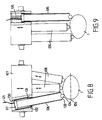
- a holder 107 This holder can be moved up and down by means not shown, such as a motor with an eccentric, a crank, or a pneumatic driven plunger.
- the holder 107 in this embodiment comprises three cavities 130, in which a tube 106 is movable. Of course the movement of the tube 106 in the cavity 130 is limited in the downward direction by stops 131 and 132.
- the tube 106 which forms an air chamber, is closed at the upper side by a transducer, such as a microphone 117 and on the other side by a membrane 133, to which a ball 134 has been fixed.
- the microphone 117 is connected to a two-core cable 121 which leads to an electronic device 22 as described hereinbefore.
- the egg 1 is made to rotate around its axis of symmetry 105 and the holder 107 is driven to make a vertical movement so that the tubes 106 with the balls 134 will be moved downwardly into contact with the egg shell. This will cause the air in the air chamber to vibrate. This vibration, picked up by the microphone 117 will be transmitted in the form of an electrical signal by the two-core cable 121 to the electronic device 22 hereinbefore described.
- the apparatus according to Fig. 9 provides a more reliable signal and further is easier to produce than an apparatus according to Fig. 8.
- each apparatus can carry out a complete measurement of a particular egg, before the apparatus is moved back to repeat the measuring process on a new egg on the conveyor.
Landscapes
- Life Sciences & Earth Sciences (AREA)
- Health & Medical Sciences (AREA)
- Chemical & Material Sciences (AREA)
- Environmental Sciences (AREA)
- Engineering & Computer Science (AREA)
- Food Science & Technology (AREA)
- Medicinal Chemistry (AREA)
- Biodiversity & Conservation Biology (AREA)
- Animal Husbandry (AREA)
- Physics & Mathematics (AREA)
- Analytical Chemistry (AREA)
- Biochemistry (AREA)
- General Health & Medical Sciences (AREA)
- General Physics & Mathematics (AREA)
- Immunology (AREA)
- Pathology (AREA)
- Investigating Or Analyzing Materials By The Use Of Ultrasonic Waves (AREA)
- Investigating Strength Of Materials By Application Of Mechanical Stress (AREA)
- Investigating Or Analysing Materials By Optical Means (AREA)
Applications Claiming Priority (2)
| Application Number | Priority Date | Filing Date | Title |
|---|---|---|---|
| DK311887A DK157327C (da) | 1987-06-18 | 1987-06-18 | Fremgangsmaade til undersoegelse af aeg for tilstedevaerelse af revner eller huller i aegskallen ved undersoegelse af elasticiteten i denne, og apparat til udoevelse af fremgangsmaaden |
| DK3118/87 | 1987-06-18 |
Publications (3)
| Publication Number | Publication Date |
|---|---|
| EP0295755A2 EP0295755A2 (en) | 1988-12-21 |
| EP0295755A3 EP0295755A3 (en) | 1990-08-01 |
| EP0295755B1 true EP0295755B1 (en) | 1994-03-16 |
Family
ID=8119301
Family Applications (1)
| Application Number | Title | Priority Date | Filing Date |
|---|---|---|---|
| EP88201235A Expired - Lifetime EP0295755B1 (en) | 1987-06-18 | 1988-06-16 | A method for testing eggs for the existence of cracks or holes in the egg shells by examining the elasticity of said shells and an apparatus for carrying out said process |
Country Status (5)
| Country | Link |
|---|---|
| US (1) | US5131274A (da) |
| EP (1) | EP0295755B1 (da) |
| JP (1) | JP2606885B2 (da) |
| DE (1) | DE3888403T2 (da) |
| DK (1) | DK157327C (da) |
Families Citing this family (19)
| Publication number | Priority date | Publication date | Assignee | Title |
|---|---|---|---|---|
| EP0628163A4 (en) * | 1992-02-27 | 1995-03-29 | Us Energy | DEVICE AND METHOD FOR NON-DESTRUCTIVE CHECKING OF EGGS. |
| EP0602285A1 (en) * | 1992-12-14 | 1994-06-22 | FPS Food Processing Systems B.V. | Method for detecting hair cracks or holes in egg shells, and apparatus for carrying out this method |
| NL9401388A (nl) * | 1994-08-26 | 1996-04-01 | Leuven K U Res & Dev | Inrichting voor het onderzoeken van eieren. |
| NL1000177C2 (nl) * | 1995-04-19 | 1996-10-22 | Food Processing Systems | Probe, inrichting en werkwijze voor het testen van eieren. |
| WO2000004368A1 (en) * | 1998-07-15 | 2000-01-27 | Micro Materials Limited | Surface testing equipment and method |
| EP1091194A4 (en) * | 1999-04-23 | 2004-09-15 | Naberu Kk | DEVICE FOR MONITORING THE NORMAL DRIVE OF AN ARRANGEMENT FOR DETECTING PHYSICAL NOTES FROM PARENTS |
| US20030200932A1 (en) | 2001-02-16 | 2003-10-30 | Toelken L. Taizo | Ultrasound quality inspection of avian eggs |
| DE60200557T2 (de) * | 2001-03-05 | 2005-06-30 | Fps Food Processing Systems B.V. | Verfahren und Vorrichtung zur Bestimmung des Schwingverhaltens schwingender Körper wie Eier |
| US7354401B1 (en) | 2002-06-19 | 2008-04-08 | Toelken L Taizo | Ultrasound sex determination for sorting of avian hatchlings |
| US7796241B2 (en) * | 2007-09-07 | 2010-09-14 | The United States Of America, As Represented By The Secretary Of Agriculture | Egg micro-crack detection systems |
| CN103261884B (zh) * | 2010-11-05 | 2015-10-07 | Moba集团有限公司 | 用于检查蛋的方法和装置 |
| CN102955005B (zh) * | 2011-08-19 | 2014-11-05 | 郑经伟 | 蛋品检测器 |
| CN104662420B (zh) * | 2012-07-05 | 2017-02-22 | 墨巴集团有限公司 | 用于检测蛋壳中的裂缝的方法和装置 |
| EP2893341B1 (en) * | 2012-09-04 | 2018-03-21 | Katholieke Universiteit Leuven | Method and apparatus for examining eggs |
| JP6198263B2 (ja) * | 2012-12-18 | 2017-09-20 | 株式会社ナベル | 検出機構、検出装置および検査ユニット |
| US20140261189A1 (en) * | 2013-03-15 | 2014-09-18 | Mitchell Barry Chait | Automated monitoring of compliance in an egg farm based on egg counts |
| TWI666443B (zh) * | 2013-11-06 | 2019-07-21 | 日商共和機械股份有限公司 | Inspection device |
| CN114544772B (zh) * | 2022-04-26 | 2022-08-05 | 华南农业大学 | 基于卷积神经网络和声音频谱的鸭蛋裂纹检测装置及方法 |
| CN116952754B (zh) * | 2023-06-27 | 2026-03-24 | 清华大学 | 仿真蛋壳穿孔试验装置 |
Family Cites Families (6)
| Publication number | Priority date | Publication date | Assignee | Title |
|---|---|---|---|---|
| US3067605A (en) * | 1957-08-09 | 1962-12-11 | George N Bliss | Cracked egg detector |
| US3254763A (en) * | 1962-01-12 | 1966-06-07 | Tom Huckaby | Detector devices |
| US3503501A (en) * | 1967-10-26 | 1970-03-31 | Fmc Corp | Method of and device for detecting cracks in eggs |
| US3744299A (en) * | 1970-10-28 | 1973-07-10 | Diamond Int Corp | Crack detector |
| US4744299A (en) * | 1983-04-01 | 1988-05-17 | The United States Of America As Represented By The Secretary Of The Army | Impermeable liner-barrier for propellants containing a high content of carborane burning rate accelerator |
| JPS62151749A (ja) * | 1985-12-26 | 1987-07-06 | Noboru Fukuma | 卵の探傷方法 |
-
1987
- 1987-06-18 DK DK311887A patent/DK157327C/da not_active IP Right Cessation
-
1988
- 1988-06-16 DE DE3888403T patent/DE3888403T2/de not_active Expired - Lifetime
- 1988-06-16 EP EP88201235A patent/EP0295755B1/en not_active Expired - Lifetime
- 1988-06-17 JP JP63149885A patent/JP2606885B2/ja not_active Expired - Fee Related
-
1991
- 1991-04-23 US US07/689,658 patent/US5131274A/en not_active Expired - Lifetime
Also Published As
| Publication number | Publication date |
|---|---|
| DK157327C (da) | 1990-05-07 |
| JP2606885B2 (ja) | 1997-05-07 |
| DE3888403D1 (de) | 1994-04-21 |
| JPS6472030A (en) | 1989-03-16 |
| EP0295755A2 (en) | 1988-12-21 |
| DK157327B (da) | 1989-12-11 |
| DE3888403T2 (de) | 1994-06-23 |
| EP0295755A3 (en) | 1990-08-01 |
| US5131274A (en) | 1992-07-21 |
| DK311887A (da) | 1988-12-19 |
| DK311887D0 (da) | 1987-06-18 |
Similar Documents
| Publication | Publication Date | Title |
|---|---|---|
| US5131274A (en) | Method and apparatus for testing eggs for cracks or holes | |
| Delwiche et al. | An impact force response fruit firmness sorter | |
| EP1198708B1 (en) | Method and device for determining the hardness of products such as fruit | |
| DK2635903T3 (da) | Fremgangsmåde og anordning til undersøgelse af æggeskaller | |
| US5152401A (en) | Agricultural commodity condition measurement | |
| EP0966680B1 (en) | Method and apparatus for assessing the ripeness or firmness of fruit and vegetables | |
| ATE142784T1 (de) | Zerstörungsfreie werkstoffprüfungsvorrichtung und technik | |
| US11137329B2 (en) | Apparatus and method for performing an impact excitation technique | |
| CN104569154B (zh) | 快速无损水果质地的检测方法及装置 | |
| US5811680A (en) | Method and apparatus for testing the quality of fruit | |
| US5216921A (en) | Method and apparatus for detecting defects and different-hardness portions of an object with protrusions | |
| US5696325A (en) | Apparatus for testing eggs | |
| US3744299A (en) | Crack detector | |
| Khalifa et al. | Usage of fruit response to both force and forced vibration applied to assess fruit firmness-a review | |
| US6722201B2 (en) | Method and device for determining vibration characteristics of vibrated articles such as eggs | |
| JPH0392758A (ja) | 製品検査方法 | |
| EP1736766A2 (de) | Verfahren zum Handhaben und Prüfen von Werkstücken sowie Vorrichtung zur Durchführung des Verfahrens | |
| US3596501A (en) | Method and apparatus for determining vacuum level in sealed containers | |
| SU1439659A1 (ru) | Способ моделировани травмы костной ткани при ударном нагружении | |
| CN101147058A (zh) | 使用超声波确定材料样品的组成微粒的平均机械性能 | |
| Chen et al. | Detection of firmness in intact pumpkins and Sakurajima radishes by impact forces | |
| CN109828034B (zh) | 一种基于压电陶瓷振动检测皮蛋钙化的装置及方法 | |
| Galili et al. | Performance evaluation of different firmness test methods in fruits | |
| ITVR20110123A1 (it) | Dispositivo strumentato per una caratterizzazione di una struttura interna di un blocco di formaggio. | |
| JPS58612B2 (ja) | 容器検査装置 |
Legal Events
| Date | Code | Title | Description |
|---|---|---|---|
| PUAI | Public reference made under article 153(3) epc to a published international application that has entered the european phase |
Free format text: ORIGINAL CODE: 0009012 |
|
| AK | Designated contracting states |
Kind code of ref document: A2 Designated state(s): DE GB IT NL |
|
| PUAL | Search report despatched |
Free format text: ORIGINAL CODE: 0009013 |
|
| AK | Designated contracting states |
Kind code of ref document: A3 Designated state(s): DE GB IT NL |
|
| 17P | Request for examination filed |
Effective date: 19901218 |
|
| 17Q | First examination report despatched |
Effective date: 19911227 |
|
| GRAA | (expected) grant |
Free format text: ORIGINAL CODE: 0009210 |
|
| AK | Designated contracting states |
Kind code of ref document: B1 Designated state(s): DE GB IT NL |
|
| REF | Corresponds to: |
Ref document number: 3888403 Country of ref document: DE Date of ref document: 19940421 |
|
| RAP2 | Party data changed (patent owner data changed or rights of a patent transferred) |
Owner name: FPS FOOD PROCESSING SYSTEMS B.V. |
|
| ITF | It: translation for a ep patent filed | ||
| NLT1 | Nl: modifications of names registered in virtue of documents presented to the patent office pursuant to art. 16 a, paragraph 1 |
Owner name: FPS FOOD PROCESSING SYSTEMS B.V. TE BARNEVELD. |
|
| PLBE | No opposition filed within time limit |
Free format text: ORIGINAL CODE: 0009261 |
|
| STAA | Information on the status of an ep patent application or granted ep patent |
Free format text: STATUS: NO OPPOSITION FILED WITHIN TIME LIMIT |
|
| 26N | No opposition filed | ||
| REG | Reference to a national code |
Ref country code: GB Ref legal event code: IF02 |
|
| PGFP | Annual fee paid to national office [announced via postgrant information from national office to epo] |
Ref country code: NL Payment date: 20070615 Year of fee payment: 20 |
|
| PGFP | Annual fee paid to national office [announced via postgrant information from national office to epo] |
Ref country code: DE Payment date: 20070801 Year of fee payment: 20 |
|
| PGFP | Annual fee paid to national office [announced via postgrant information from national office to epo] |
Ref country code: GB Payment date: 20070613 Year of fee payment: 20 |
|
| PGFP | Annual fee paid to national office [announced via postgrant information from national office to epo] |
Ref country code: IT Payment date: 20070628 Year of fee payment: 20 |
|
| REG | Reference to a national code |
Ref country code: GB Ref legal event code: PE20 Expiry date: 20080615 |
|
| NLV7 | Nl: ceased due to reaching the maximum lifetime of a patent |
Effective date: 20080616 |
|
| PG25 | Lapsed in a contracting state [announced via postgrant information from national office to epo] |
Ref country code: NL Free format text: LAPSE BECAUSE OF EXPIRATION OF PROTECTION Effective date: 20080616 |
|
| PG25 | Lapsed in a contracting state [announced via postgrant information from national office to epo] |
Ref country code: GB Free format text: LAPSE BECAUSE OF EXPIRATION OF PROTECTION Effective date: 20080615 |