EP0296453A2 - Nitro-substituierte heterocyclische Verbindungen - Google Patents
Nitro-substituierte heterocyclische Verbindungen Download PDFInfo
- Publication number
- EP0296453A2 EP0296453A2 EP19880109426 EP88109426A EP0296453A2 EP 0296453 A2 EP0296453 A2 EP 0296453A2 EP 19880109426 EP19880109426 EP 19880109426 EP 88109426 A EP88109426 A EP 88109426A EP 0296453 A2 EP0296453 A2 EP 0296453A2
- Authority
- EP
- European Patent Office
- Prior art keywords
- formula
- substituted
- atom
- compounds
- members
- Prior art date
- Legal status (The legal status is an assumption and is not a legal conclusion. Google has not performed a legal analysis and makes no representation as to the accuracy of the status listed.)
- Granted
Links
- 0 CCC(C1N(C)C*C*1*(*)*)[N+]([O-])=O Chemical compound CCC(C1N(C)C*C*1*(*)*)[N+]([O-])=O 0.000 description 4
- CJOOFSHWZJYPND-UHFFFAOYSA-N [O-][N+](C(C(N1)O)=C(NCC2)N2C1=O)=O Chemical compound [O-][N+](C(C(N1)O)=C(NCC2)N2C1=O)=O CJOOFSHWZJYPND-UHFFFAOYSA-N 0.000 description 1
- NMBBSNPGUQYBQF-UHFFFAOYSA-N [O-][N+](c1c(NCCC2)[n]2nn1)=O Chemical compound [O-][N+](c1c(NCCC2)[n]2nn1)=O NMBBSNPGUQYBQF-UHFFFAOYSA-N 0.000 description 1
Classifications
-
- C—CHEMISTRY; METALLURGY
- C07—ORGANIC CHEMISTRY
- C07D—HETEROCYCLIC COMPOUNDS
- C07D471/00—Heterocyclic compounds containing nitrogen atoms as the only ring hetero atoms in the condensed system, at least one ring being a six-membered ring with one nitrogen atom, not provided for by groups C07D451/00 - C07D463/00
- C07D471/02—Heterocyclic compounds containing nitrogen atoms as the only ring hetero atoms in the condensed system, at least one ring being a six-membered ring with one nitrogen atom, not provided for by groups C07D451/00 - C07D463/00 in which the condensed system contains two hetero rings
- C07D471/04—Ortho-condensed systems
-
- A—HUMAN NECESSITIES
- A01—AGRICULTURE; FORESTRY; ANIMAL HUSBANDRY; HUNTING; TRAPPING; FISHING
- A01N—PRESERVATION OF BODIES OF HUMANS OR ANIMALS OR PLANTS OR PARTS THEREOF; BIOCIDES, e.g. AS DISINFECTANTS, AS PESTICIDES OR AS HERBICIDES; PEST REPELLANTS OR ATTRACTANTS; PLANT GROWTH REGULATORS
- A01N43/00—Biocides, pest repellants or attractants, or plant growth regulators containing heterocyclic compounds
- A01N43/90—Biocides, pest repellants or attractants, or plant growth regulators containing heterocyclic compounds having two or more relevant hetero rings, condensed among themselves or with a common carbocyclic ring system
-
- A—HUMAN NECESSITIES
- A01—AGRICULTURE; FORESTRY; ANIMAL HUSBANDRY; HUNTING; TRAPPING; FISHING
- A01N—PRESERVATION OF BODIES OF HUMANS OR ANIMALS OR PLANTS OR PARTS THEREOF; BIOCIDES, e.g. AS DISINFECTANTS, AS PESTICIDES OR AS HERBICIDES; PEST REPELLANTS OR ATTRACTANTS; PLANT GROWTH REGULATORS
- A01N47/00—Biocides, pest repellants or attractants, or plant growth regulators containing organic compounds containing a carbon atom not being member of a ring and having no bond to a carbon or hydrogen atom, e.g. derivatives of carbonic acid
- A01N47/08—Biocides, pest repellants or attractants, or plant growth regulators containing organic compounds containing a carbon atom not being member of a ring and having no bond to a carbon or hydrogen atom, e.g. derivatives of carbonic acid the carbon atom having one or more single bonds to nitrogen atoms
- A01N47/10—Carbamic acid derivatives, i.e. containing the group —O—CO—N<; Thio analogues thereof
- A01N47/18—Carbamic acid derivatives, i.e. containing the group —O—CO—N<; Thio analogues thereof containing a —O—CO—N< group, or a thio analogue thereof, directly attached to a heterocyclic or cycloaliphatic ring
-
- C—CHEMISTRY; METALLURGY
- C07—ORGANIC CHEMISTRY
- C07D—HETEROCYCLIC COMPOUNDS
- C07D471/00—Heterocyclic compounds containing nitrogen atoms as the only ring hetero atoms in the condensed system, at least one ring being a six-membered ring with one nitrogen atom, not provided for by groups C07D451/00 - C07D463/00
-
- C—CHEMISTRY; METALLURGY
- C07—ORGANIC CHEMISTRY
- C07D—HETEROCYCLIC COMPOUNDS
- C07D487/00—Heterocyclic compounds containing nitrogen atoms as the only ring hetero atoms in the condensed system, not provided for by groups C07D451/00 - C07D477/00
- C07D487/02—Heterocyclic compounds containing nitrogen atoms as the only ring hetero atoms in the condensed system, not provided for by groups C07D451/00 - C07D477/00 in which the condensed system contains two hetero rings
- C07D487/04—Ortho-condensed systems
-
- C—CHEMISTRY; METALLURGY
- C07—ORGANIC CHEMISTRY
- C07D—HETEROCYCLIC COMPOUNDS
- C07D513/00—Heterocyclic compounds containing in the condensed system at least one hetero ring having nitrogen and sulfur atoms as the only ring hetero atoms, not provided for in groups C07D463/00, C07D477/00 or C07D499/00 - C07D507/00
- C07D513/02—Heterocyclic compounds containing in the condensed system at least one hetero ring having nitrogen and sulfur atoms as the only ring hetero atoms, not provided for in groups C07D463/00, C07D477/00 or C07D499/00 - C07D507/00 in which the condensed system contains two hetero rings
- C07D513/04—Ortho-condensed systems
Definitions
- the present invention relates to new nitro-substituted heterocyclic compounds, processes for their preparation and their use as insecticides.
- nitro-substituted heterocyclic compounds of formula (I) according to the present invention show strong insecticidal properties.
- nitro-substituted heterocyclic compounds of the formula (I) according to the invention have considerably improved insecticidal properties compared to the known compounds which have structures analogous to those of the compounds according to the invention.
- reaction can be represented as follows:
- R, Z and M have the meanings given above.
- R and Z each preferably have the meanings given above as preferred, and M is preferably chlorine or tosyloxy.
- a and B have the meanings given above.
- a and B preferably each have the meanings given as preferred above.
- the compounds of formula (III) include known compounds described, for example, in Journal of the Chemical Society, Perkin Transactions I, 1979, page 2361, Journal of Heterocyclic Chemistry Volume 17, page 1413 and Chemical Reports, volume 119, page 2208 .
- a part of the compounds of the formula (III) can be obtained by the fact that the formula (XVII) in which A has the meanings given above, designated compounds corresponding to process b) with the compounds of the formulas (V), (VI), (VII), (VIII), (IX), (X), ( XI), (XII), (XIII), (XIV), (XV) or (XVI) are implemented.
- the compounds of the formula (XIX) can be obtained by reacting a compound of the formula (XX) in which A and n have the meanings given above, are obtained with 1-nitro-2,2-bis (methylthio) ethylene.
- the compounds of the formula (XX) can be obtained by reacting the compounds of the formula (XXI) below in which A has the meanings given above, with a compound of the formula (XXII) below in which n has the meanings given above and Hal is a halogen atom can be obtained.
- R, Z and A each have the meanings given above.
- R, Z and A each preferably have the meanings given as preferred above.
- the compounds of the above formula (IV) are already known, for example from JP-OS 218 386/1985 and JP-OS 183 271/1986, and specific examples are: 1- (2-chloro-5-pyridylmethyl) -2-nitromethyleneimidazolidine, 1- (2-chloro-5-pyridylmethyl) -2- nitromethylene tetrahydropyrimidine, 1- (2-chloro-5-thiazoiylmethyl) -2-nitromethyleneimidazolidine, 1- (2-fluoro-5-pyridylmethyl) -2-nitromethyleneimidazolidine, 1- (2-methyl-5-pyridylmethyl) -2-nitromethyleneimidazolidine.
- any inert diluent can be used as suitable diluent when carrying out process a) above.
- solvents or diluents are water; aliphatic, cycloaliphatic and aromatic, optionally chlorinated, hydrocarbons, such as hexane, cyclohexane, petroleum ether, ligroin, benzene, toluene, xylene, methylene chloride, chloroform, carbon tetrachloride, ethylene chloride, trichloroethylene, chlorobenzene and the like; Ethers such as diethyl ether, methyl ethyl ether, diisopropyl ether, dibutyl ether, propylene oxide, dioxane, tetrahydrofuran and the like; Nitriles such as acetonitrile, propionitrile, acrylonitrile and the like; Alcohols such as methanol, ethanol, isopropanol, butanol, ethylene glycol and the like; Acid amides such as dimethylformamide, dimethylacetamide, hydro
- the reaction temperature can be varied within a wide range.
- the reaction is carried out at a temperature of from about 0 ° C. to 100 ° C., preferably from about 10 ° C. to 80 ° C.
- reaction is allowed to proceed under normal pressure, although it is also possible to use a higher or lower pressure.
- the above-mentioned process a) is carried out according to the present invention, for example about 1.1 to 1.2 mol of sodium hydride as the base and about 1 to 1.2 mol, preferably about 1 to 1.1 mol, of the compounds (11 ) per 1 mol of the compounds (III) used.
- the reaction can be carried out in the presence of an inert solvent such as, for example, dimethyl sulfoxide, in order to obtain the desired compound.
- Process b) described above can be carried out at a reaction temperature which varies within a wide range, for example between about 0 ° C. and the boiling point of the mixture, preferably between about 0 ° C. and about 100 ° C.
- the reaction is preferably carried out under normal pressure, although it is also possible to use a higher or lower pressure.
- reaction of the compounds of formula (IV) either with the compound of formula (VI) or with the compounds of formula (VII) can be carried out in a manner similar to the reactions described in U.S. Patents 4,033 954 and 4 033 955.
- reaction of the compounds of the formula (IV) can be carried out either with the compound of the formula (IX) or with the compound of the formula (X) in analogy to a reaction which is described in the Journal for Practical Chemistry, volume 319, page 149, is described.
- reaction of the compounds of the formula (IV) with the compounds of the formula (XII) or with the compounds of the formula (XIII) or with the compounds of the formula (XIV) can be carried out according to the generally known Michael reaction.
- reaction of the compounds of the formula (IV) with the compounds of the formula (XV) is carried out in the presence of a base in order to obtain the desired nitro-substituted heterocyclic compound of the formula (Ia).
- the compounds of the above formula (XXIV) are known compounds described in JP-OS 81382/1987, and they can be obtained by the method described in this JP-OS.
- pesticide refers to a pest control activity, including those mentioned above.
- the active ingredients can be converted into customary formulations, such as solutions, emulsions, suspensions, powders, foams, pastes, granules, aerosol, natural or synthetic substances impregnated with the active compound, very fine capsules in polymeric substances, coating compositions for use on seeds (seed dressings ) as well as formulations for use with incinerators such as smoking cartridges, smoking cans and smoking snakes as well as for cold nebulization and warm nebulization using the ultra-low-volume process.
- customary formulations such as solutions, emulsions, suspensions, powders, foams, pastes, granules, aerosol, natural or synthetic substances impregnated with the active compound, very fine capsules in polymeric substances, coating compositions for use on seeds (seed dressings ) as well as formulations for use with incinerators such as smoking cartridges, smoking cans and smoking snakes as well as for cold nebulization and warm nebulization using the ultra-low-volume process.
- formulations can be prepared in a known manner, for example by mixing the active ingredients with extenders, that is to say with liquid or liquefied gaseous or solid diluents or carriers, if appropriate using surfactants, that is to say emulsifiers and / or dispersants and; or foam-forming agents.
- extenders that is to say with liquid or liquefied gaseous or solid diluents or carriers, if appropriate using surfactants, that is to say emulsifiers and / or dispersants and; or foam-forming agents.
- surfactants that is to say emulsifiers and / or dispersants and; or foam-forming agents.
- organic solvents can be used, for example, as auxiliary solvents.
- Aromatic hydrocarbons such as xylene, toluene or alkylnaphthalenes, chlorinated aromatic or chlorinated aliphatic hydrocarbons such as chlorobenzenes, chloroethylenes or methylene chloride, aliphatic hydrocarbons such as cyclohexane or paraffins, for example mineral oil fractions, alcohols such as butanol or glycol, and the like are mainly suitable as liquid solvents, diluents or carriers their ethers and esters, ketones such as acetone, methyl ethyl ketone, methyl isobutyl ketone or cyclohexanone or strongly polar solvents such as dimethylformamide and dimethyl sulfoxide and also water.
- Liquefied gaseous diluents or carriers are to be understood as liquids which would be gaseous at normal temperature and normal pressure, for example aerosol propellants such as halogenated hydrocarbons and butane, propane, nitrogen and carbon dioxide.
- Ground natural minerals such as kaolins, clays, talc, chalk, quartz, attapulgite, montmorillonite or diatomaceous earth and ground synthetic minerals such as highly disperse silica, aluminum oxide and silicates can be used as solid carriers.
- Comminuted and fractionated natural stone materials such as calcite, marble, pumice, sepiolite and dolomite, as well as synthetic granules made from inorganic and organic flours and granules made from organic material such as sawdust, coconut shells, corn cobs and tobacco stalks, can be used as solid carriers for granules.
- Non-ionic and anionic emulsifiers such as polyoxyethylene fatty acid esters, polyoxyethylene fatty alcohol ethers, for example alkylaryl polyglycol ethers, alkyl sulfonates, alkyl sulfates, aryl sulfonates and albumin hydrolysis products can be used as emulsifying and / or foam-forming agents.
- Dispersants include, for example, lignin sulfite leaching and methyl cellulose.
- Adhesives such as carboxymethyl cellulose and natural and synthetic polymers in the form of powders, granules or latices such as gum arabic, polyvinyl alcohol and polyvinyl acetate can be used in the formulation.
- colorants such as inorganic pigments such as iron oxide, titanium oxide and Prussian blue and organic dyes such as alizarin dyes, azo dyes or metal phthalocyanine dyes, and trace nutrients such as salts of iron, manganese, boron, copper, cobalt
- inorganic pigments such as iron oxide, titanium oxide and Prussian blue
- organic dyes such as alizarin dyes, azo dyes or metal phthalocyanine dyes
- trace nutrients such as salts of iron, manganese, boron, copper, cobalt
- the formulations generally contain 0.1 to 95% by weight, preferably 0.5 to 90% by weight, of the respective active ingredient.
- the active compounds according to the invention can be present in their commercially available formulations or in the use forms produced from these formulations in a mixture with other active compounds, for example with insecticides, baits, sterilizing agents, acaricides, nematicides, fungicides, growth regulators or herbicides.
- the insecticides include, for example, phosphates, carbamates, carboxylates, chlorinated hydrocarbons, phenylureas and biologically active substances produced by microorganisms.
- the active compounds according to the invention can furthermore be present in their commercially available formulations or in the use forms prepared from these formulations in a mixture with synergistic agents.
- Synergistic agents are compounds which increase the activity of the active ingredients without the need for the added synergistic agent to be active itself.
- the content of the active ingredient in the use forms produced from the commercially available formulations can vary within wide limits.
- the concentration of the active compound in the use forms can be 0.0000001 to 100% by weight and is preferably between 0.0001 and I% by weight.
- the compounds are used in a customary manner in a form which is appropriate for the use forms.
- the new active ingredients When used against hygiene pests and pests in product inventories, the new active ingredients are characterized by an excellent residual effect on wood and clay as well as a good resistance to alkali on limed substrates.
- the crystals were next suspended in acetic acid (60 ml) while stirring at a temperature of 10 0 C, and bromine (8 g) was added dropwise. After the dropping was completed, the mixture was further stirred for 1 hour to complete the reaction.
- acetic acid was distilled off under reduced pressure, water was added to the residue to dissolve the same, sodium hydrogen carbonate was added to the mixture in small portions to make it alkaline, and then the mixture was extracted twice with dichloromethane.
- Solvent 3 parts by weight of xylene emulsifier: 1 part by weight of polyoxyethylene alkylphenyl ether
- a suitable formulation of an active ingredient 1 part by weight of the active ingredient was mixed with the above-mentioned amount of solvent, which contained the above-mentioned amount of emulsifier, and the mixture was diluted with water to the previously set concentration.
- each of the pots was covered with a wire basket, 7 cm in diameter and 14 cm in height, in which 30 adult female specimens of Nephotettix cincticeps, which showed resistance to organophosphorus series insecticides, were exposed and each pot was placed in a constant temperature room. Two days later, the number of dead insects was determined to obtain the insect mortality rate.
- eggplant seedlings black elongated eggplants
- 200 specimens of Myzus persicae which were resistant to insecticides from the organophosphorus and carbamate series, were grown per seedling , exposed.
- an aqueous solution with a predetermined concentration of the active ingredient which had been prepared by a procedure similar to that described in Example 4, was sprayed onto the seedlings in a sufficient dosage.
Landscapes
- Chemical & Material Sciences (AREA)
- Organic Chemistry (AREA)
- Life Sciences & Earth Sciences (AREA)
- Dentistry (AREA)
- Wood Science & Technology (AREA)
- Plant Pathology (AREA)
- Health & Medical Sciences (AREA)
- Engineering & Computer Science (AREA)
- Agronomy & Crop Science (AREA)
- General Health & Medical Sciences (AREA)
- Pest Control & Pesticides (AREA)
- Zoology (AREA)
- Environmental Sciences (AREA)
- Agricultural Chemicals And Associated Chemicals (AREA)
- Plural Heterocyclic Compounds (AREA)
- Nitrogen Condensed Heterocyclic Rings (AREA)
- Nitrogen And Oxygen Or Sulfur-Condensed Heterocyclic Ring Systems (AREA)
- Heterocyclic Carbon Compounds Containing A Hetero Ring Having Nitrogen And Oxygen As The Only Ring Hetero Atoms (AREA)
Abstract
Description
- Die vorliegende Erfindung betrifft neue nitro-substituierte heterocyclische Verbindungen, Verfahren zu ihrer Herstellung und ihre Verwendung als Insektizide.
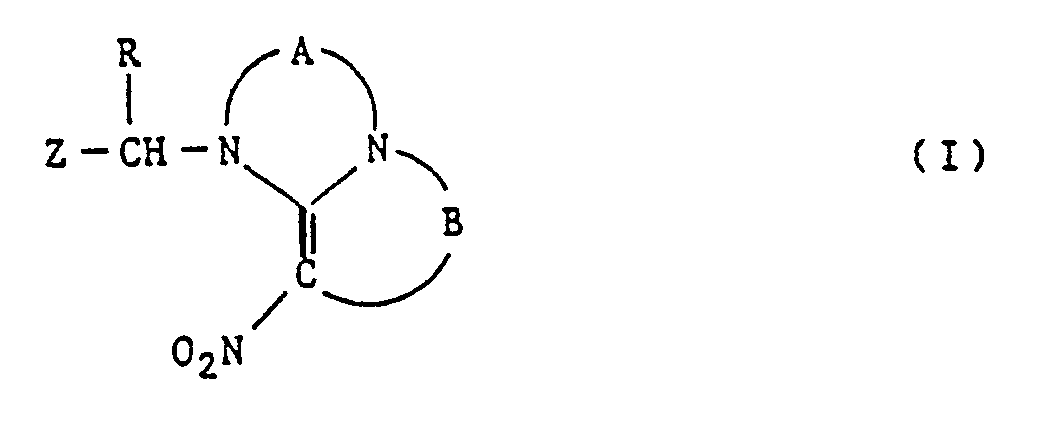
- Die folgenden mit den beanspruchten Verbindungen strukturell verwandten nitro-substituierten heterocyclischen Verbindungen der Formeln (A) bis (E) sind bereits in der Literatur offenbart:


- R Wasserstoff oder Alkyl ist,
- Z ein gegebenenfalls substituiertes Aryl oder eine gegebenenfalls substituierte heterocyclische Gruppe, die wenigstens ein aus N, O und S ausgewähltes Atom enthält, ist,
- A ein gegebenenfalls substituierter Ethylen- oder ein gegebenenfalls substituierter Trimethylen-Rest ist und
- B für 2 oder 3 Glieder eines heterocyclischen Ringes steht, der zusammen mit dem benachbarten C-Atom und dem benachbarten N-Atom gebildet wird und worin wenigstens eines der Glieder, die gegebenenfalls substituiert sein können, ein Hetero-Atom bezeichnen kann, mit der Maßgabe, daß dann, wenn B für 3 Glieder steht, von denen zwei Kohlenstoff-Atome sind und das dritte ein in der Mitte der drei Glieder angeordnetes Stickstoff-Atom ist, wenigstens eines der beiden genannten Kohlenstoff-Atome durch eine Keto-Gruppe substituiert sein muß.
- Die Verbindungen der Formel (I) können hergestellt werden indem
- a) Verbindungen der Formel (11)


- b) [wenn B in der Formel (I)





- Die nitro-substituierten heterocyclischen Verbindungen der Formel (I) gemäß der vorliegenden Erfindung zeigen starke insektizide Eigenschaften.
- Daruber hinaus ist es überraschend, daß die erfindungsgemäßen nitro-substituierten heterocyclischen Verbindungen der Formel (I) im Vergleich zu den bekannten Verbindungen, die Strukturen analog zu denen der vorliegenden erfindungsgemäßen Verbindungen haben, beträchtlich verbesserte insektizide Eigenschaften aufweisen.
- Unter den nitro-substituierten heterocyclischen Verbindungen der Formel (I) gemäß der vorliegenden Erfindung sind bevorzugte Verbindungen solche, in denen
- R Wasserstoff oder C1-C4-Alkyl ist,
- Z C6-C10-Aryl oder eine 5- bis 6-gliedrige heterocyclische Gruppe, die 1 bis 2 aus 0, S und N ausgewahlte Hetero-Atome enthält, von denen wenigstens eines ein Stickstoff-Atom ist, ist, wobei die ArylGruppe oder die heterocyclische Gruppe jeweils durch einen Substituenten substituiert sein kann, der beliebig aus der aus Halogen, C,-C4-Alkyl, C1-C4-Alkoxy, C1-C4-Halogenoalkyl, C1-C4 Alkylthio, C1-C4-Halogenoalkoxy, C1-C4-Halogenoalkylthio, Nitro und Cyano bestehenden Gruppe ausgewählt ist,
- A Ethylen oder Trimethylen ist, die beide durch Methyl substituiert sein können, und
- B für 2 oder 3 Glieder eines heterocyclischen Ringes steht, der zusammen mit dem benachbarten C-Atom und dem benachbarten N-Atom gebildet wird, worin wenigstens eines der Glieder ein Stickstoff-Atom oder ein Schwefel-Atom bezeichnen kann, wobei die Glieder gegebenenfalls durch wenigstens einen Substituenten substituiert sein können, der aus der aus Halogen, Ci-C6-Alkyl, C1-C4-Alkoxy, Alkoxycarbonyl mit 1 bis 4 Kohlenstoff-Atomen in dem Alkoxy-Teil, gegebenenfalls substituiertem C6-C10-Aryl, Keto, imino, Phenoxy, C1-C4-Alkoxythio, Alkoxycarbonylimino mit 1 bis 4 Kohlenstoff-Atomen in dem Alkoxy-Teil, Phenoxycarbonylimino, Benzoylimino, Benzyl, Cyano, Thioketo, Hydroxy und C,-C2-Alkyliden bestehenden Gruppe ausgewählt ist, mit der Maßgabe, daß dann, wenn B für 3 Glieder steht, von denen zwei Kohlenstoff-Atome sind und das dritte ein in der Mitte der drei Glieder angeordnetes Stickstoff-Atom ist, wenigstens eines der beiden genannten Kohlenstoff-Atome durch eine Keto-Gruppe substituiert ist.
- Ganz besonders bevorzugte nitro-substituierte heterocyclische Verbindungen der Formel (1) sind diejenigen, in denen
- R Wasserstoff oder Methyl ist,
- Z Phenyl oder eine 5- bis 6-gliedrige heterocyclische Gruppe, die 1 bis 2 aus 0, S und N ausgewählte Hetero-Atom enthält, von denen wenigstens eines ein Stickstoff-Atom ist, ist, wobei die Phenyl-Gruppe oder die heterocyclische Gruppe jeweils durch einen oder zwei Substituenten substituiert sein kann, der beliebig aus der aus Fluor, Chlor, Brom, Methyl, Ethyl, Methoxy, Trifluoromethyl, Methylthio, Trifluoromethoxy, Trifluoromethylthio, Nitro und Cyano bestehenden Gruppe ausgewählt ist,
- A Ethylen oder Trimethylen ist, die beide durch Methyl substituiert sein konnen, und
- B für 2 oder 3 Glieder eines heterocyclischen Ringes steht, der zusammen mit dem benachbarten C-Atom und dem benachbarten N-Atom gebildet wird, worin wenigstens eines der Glieder ein Stickstoff-Atom oder ein Schwefel-Atom bezeichnen kann, wobei die Glieder gegebenenfalls durch wenigstens einen Substituenten substituiert sein können, der aus der aus Fluor, Chlor, Brom, Methyl, Methoxy, Alkoxycarbonyl mit 1 bis 2 Kohlenstoff-Atomen in dem Alkoxy-Teil, Phenyl, Keto, Imino, Phenoxy, Alkoxycarbonylimino mit 1 bis 2 Kohlenstoff-Atomen in dem Alkoxy-Teil, Phenoxycarbonylimino, Benzoylimino, Benzyl, Cyano, Thioketo, Hydroxy und Ci-C2-Aikyiiden bestehenden Gruppe ausgewählt ist, mit der Maßgabe, daß dann, wenn B für 3 Glieder steht, von denen zwei Kohlenstoff-Atome sind und das dritte ein in der Mitte der drei Glieder angeordnetes Stickstoff-Atom ist, wenigstens eines der beiden genannten Kohlenstoff-Atome durch eine Keto-Gruppe substituiert sein muß.
- Als Einzelbeispiele für die erfindungsgemäßen Verbindungen der Formel (I) können die folgenden Verbindungen aufgeführt werden:


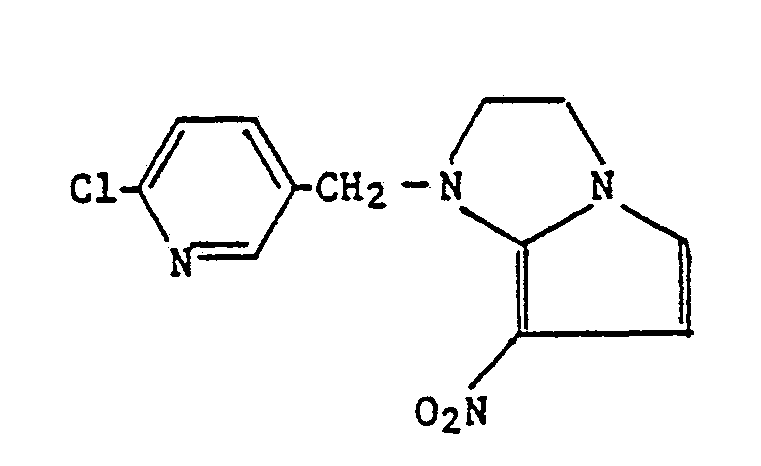
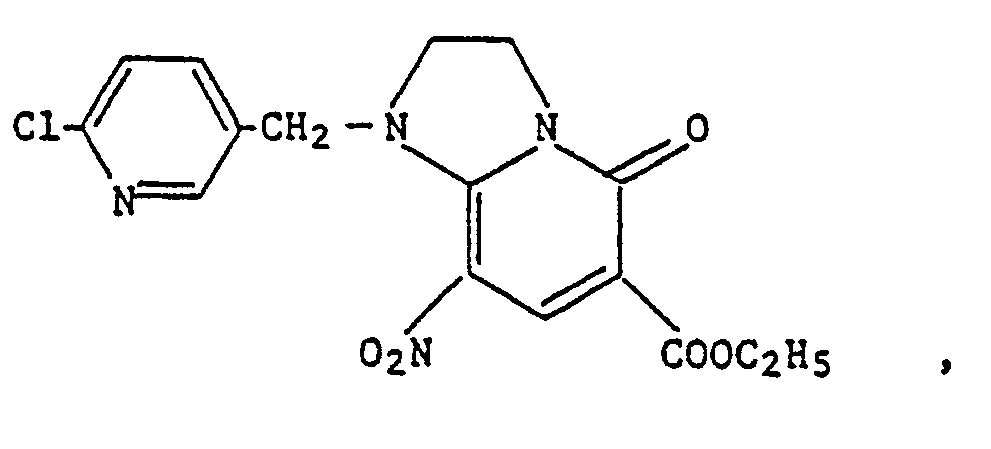
- Wenn in dem oben bezeichneten Verfahren a) beispielsweise als Ausgangs-Verbindungen 2-Chloro-5-chloromethylpyridin und Ethyl-1,2,3,5-tetrahydro-8-nitro-imidazo[1,2-a]pyridin-5-on-6-carboxylat eingesetzt werden, kann die Reaktion wie folgt dargestellt werden:

- Wenn in dem oben bezeichneten Verfahren b) beispielsweise als Ausgangs-Verbindungen 2-Nitromethylen-3-(2-chloro-5-pyridylmethyl)imidazolidin und Propiolsäuremethylester eingesetzt werden, kann die Reaktion wie folgt dargestellt werden:

- In den Verbindungen der Formel (11) im oben bezeichneten Verfahren a) haben R, Z und M die im Vorstehenden angegebenen Bedeutungen.
- In der Formel (11) haben R und Z vorzugsweise jeweils die im Vorstehenden als bevorzugt angegebenen Bedeutungen, und M ist vorzugsweise Chlor oder Tosyloxy.
- Die Verbindungen der Formel (II) sind in der Fachwelt bereits bekannt, beispielsweise aus der JP-OS 81382'1987, und als Einzelbeispiele seien 2-Chloro-5-chloromethylpyridin und 2-Chloro-5-chloromethylthia- zol genannt.
- In den Verbindungen der Formel (III) im Verfahren a) haben A und B die im Vorstehenden angegebenen Bedeutungen.
- In der Formel (III) haben A und B vorzugsweise jeweils die im Vorstehenden als bevorzugt angegebenen Bedeutungen.
- Die Verbindungen der Formel (III) umfassen bekannte Verbindungen, die beispielsweise in Journal of the Chemical Society, Perkin Transactions I, 1979, Seite 2361, Journal of Heterocyclic Chemistry Band 17, Seite 1413 und Chemische Berichte, Band 119, Seite 2208, beschrieben sind.
- Ein Teil der Verbindungen der Formel (III) kann dadurch erhalten werden, daß die durch die nachstehende Formel (XVII)

- Die Verbindungen der obigen Formel (XVII) sind bereits bekannt, beispielsweise aus der JP-OS 218 386/1985, und als Einzelbeispiele seien 2-Nitromethylen-imidazolidin und 2-Nitromethylen-tetrahydropyrimidin genannt.
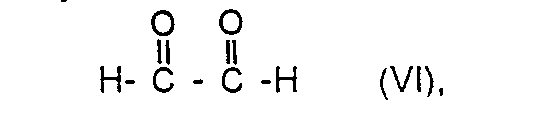
- Darüber hinaus sind die Verbindungen der Formeln (V), (VI), (VII), (VIII), (IX), (X), (XI), (XII), (XIII), (XIV), (XV) und (XVI) auf dem Gebiet der organischen Chemie wohlbekannt.
- Weiterhin können beispielsweise die durch die nachstehende Formel (XVIII), die der Formel (III) entspricht,


- Die Verbindungen der Formel (XIX) können durch Umsetzung einer Verbindung der Formel (XX)

- Die Verbindungen der Formel (XX) können durch Umsetzung der Verbindungen der nachstehenden Formel (XXI)


- Sowohl die Verbindungen der vorstehenden Formel (XXI) als auch die Verbindungen der vorstehenden Formel (XXII) sind bekannte Verbindungen.
- In den Verbindungen der Formel (IV) im Verfahren b) haben R, Z und A jeweils die im Vorstehenden angegebenen Bedeutungen.
- In der Formel (IV) haben R, Z und A jeweils vorzugsweise die im Vorstehenden als bevorzugt angegebenen Bedeutungen.
- Die Verbindungen der obigen Formel (IV) sind bereits bekannt, beispielsweise aus der JP-OS 218 386/1985 und der JP-OS 183 271/1986, und als konkrete Beispiele seien genannt: 1-(2-Chloro-5-pyridylmethyl)-2-nitromethylenimidazolidin, 1-(2-Chloro-5-pyridylmethyl)-2-nitromethylentetrahydropyrimidin, 1-(2-Chloro-5-thiazoiylmethyl)-2-nitromethylenimidazolidin, 1-(2-Fluoro-5-pyridylmethyl)-2-nitromethylenimidazolidin, 1-(2-Methyl-5-pyridylmethyl)-2-nitromethylenimidazolidin.
- Bei der Durchführung des oben bezeichneten Verfahrens a) können als geeignete Verdünnungsmittel beliebige inerte Verdünnungsmittel eingesetzt werden.
- Beispiele für die Lösungsmittel oder Verdünnungsmittel sind Wasser; aliphatische, cycloaliphatische und aromatische, gegebenenfalls chlorierte, Kohlenwasserstoffe, etwa Hexan, Cyclohexan, Petrolether, Ligroin, Benzol, Toluol, Xylol, Methylenchlorid, Chloroform, Kohlenstofftetrachlorid, Ethylenchlorid, Trichloroethylen, Chlorbenzol und dergleichen; Ether, etwa Diethylether, Methylethylether, Diisopropylether, Dibutylether, Propylenoxid, Dioxan, Tetrahydrofuran und dergleichen; Nitrile, etwa Acetonitril, Propionitril, Acrylnitril und dergleichen; Alkohole, etwa Methanol, Ethanol, Isopropanol, Butanol, Ethylenglycol und dergleichen; Säureamide, etwa Dimethylformamid, Dimethylacetamid und dergleichen; und Sulfone und Sulfoxide, etwa Dimethylsulfoxid, Sulfolan und dergleichen; sowie Basen, beispielsweise Hydride wie Natriumhydrid und Kaliumhydrid, Alkalimetallhydroxide, -carbonate und tertiäre Amine wie Triethylamin.
- Bei dem oben bezeichneten Verfahren a) kann die Reaktionstemperatur innerhalb eines breiten Bereichs variiert werden. Im allgemeinen wird die Reaktion bei einer Temperatur von etwa 0 C bis 100 ° C, vorzugsweise von etwa 10 C bis 80 C, durchgeführt.
- Im allgemeinen läßt man die Reaktion unter Normaldruck ablaufen, obwohl es auch möglich ist, einen höheren oder niedrigeren Druck anzuwenden.
- Wenn das oben bezeichnete Verfahren a) gemäß der vorliegenden Erfindung durchgeführt wird, werden beispielsweise etwa 1,1 bis 1,2 mol Natriumhydrid als Base und etwa 1 bis 1,2 mol, vorzugsweise etwa 1 bis 1,1 mol, der Verbindungen (11) pro 1 mol der Verbindungen (III) eingesetzt. Die Reaktion kann in Gegenwart eines inerten Lösungsmittels wie, beispielsweise, Dimethylsulfoxid durchgeführt werden, um die angestrebte Verbindung zu erhalten.
- Wenn das oben bezeichnete Verfahren b) durchgeführt wird, ist es möglich, irgendein Lösungsmittel einzusetzen, das dem im Verfahren a) gemäß der vorliegenden Erfindung entspricht.
- Das oben bezeichnete Verfahren b) kann bei einer Reaktionstemperatur durchgeführt werden, die innerhalb eines breiten Bereichs variiert, beispielsweise zwischen etwa 0 ° C und dem Siedepunkt der Mischung, vorzugsweise zwischen etwa 0 ° C und etwa 100 C.
- Die Reaktion wird vorzugsweise unter Normaldruck durchgeführt, obwohl es auch möglich ist, einen höheren oder niedrigeren Druck anzuwenden.
- In dem Verfahren b) kann die Reaktion der Verbindungen der Formel (IV) entweder mit der Verbindung der Formel (VI) oder mit den Verbindungen der Formel (VII) in ähnlicher Weise wie die Reaktionen durchgeführt werden, die in den US- Patentschriften 4 033 954 und 4 033 955 beschrieben sind.
- Weiterhin kann die Reaktion der Verbindungen der Formel (IV) entweder mit der Verbindung der Formel (IX) oder mit der Verbindung der Formel (X) in Analogie zu einer Reaktion durchgeführt werden, die im Journal für praktische Chemie, Band 319, Seite 149, beschrieben ist.
- Die Reaktion der Verbindungen der Formel (IV) mit den Verbindungen der Formel (XII) oder mit den Verbindungen der Formel (XIII) oder mit den Verbindungen der Formel (XIV) kann nach der allgemein bekannten Michael-Reaktion durchgeführt werden.
- Die Reaktion der Verbindungen der Formel (IV) mit den Verbindungen der Formel (XV) wird in Gegenwart einer Base durchgeführt, um die gewünschte nitro-substituierte heterocyclische Verbindung der Formel (la) zu erhalten.
- In dem Fall, in dem die Formel (I) der vorliegenden Erfindung durch die nachstehende Formel (Ib)

- Die vorstehende Reaktion kann nach den in den Veröffentlichungen in Tetrahedron Band 33, S. 1057, und ebenda, Band 37, Seite 1470, und in Indian Journal of Chemistry 15B, S. 886, beschriebenen Verfahren durchgeführt werden.
- Weiterhin können durch Hydrolyse der Verbindungen der vorstehenden Formel (Ib) unter milden Bedingungen die der Formel (I) der vorliegenden Erfindung entsprechenden Verbindungen der nachstehenden Formel (Ic)

- Wenn in der oben genannten Reaktion, bei der die Verbindungen der Formel (IV) mit den Verbindungen der Formel (XXIII) umgesetzt werden und das Reaktionsprodukt anschließend mit Brom umgesetzt wird, dieses Reaktionsprodukt, statt der Umsetzung mit Brom, mit einer katalytischen Menge einer Base umgesetzt wird, können die der Formel (I) der vorliegenden Erfindung entsprechenden Verbindungen der nachstehenden Formel (Id)

- Wenn die Verbindungen der Formel (I) der vorliegenden Erfindung durch die nachstehende Formel (le)
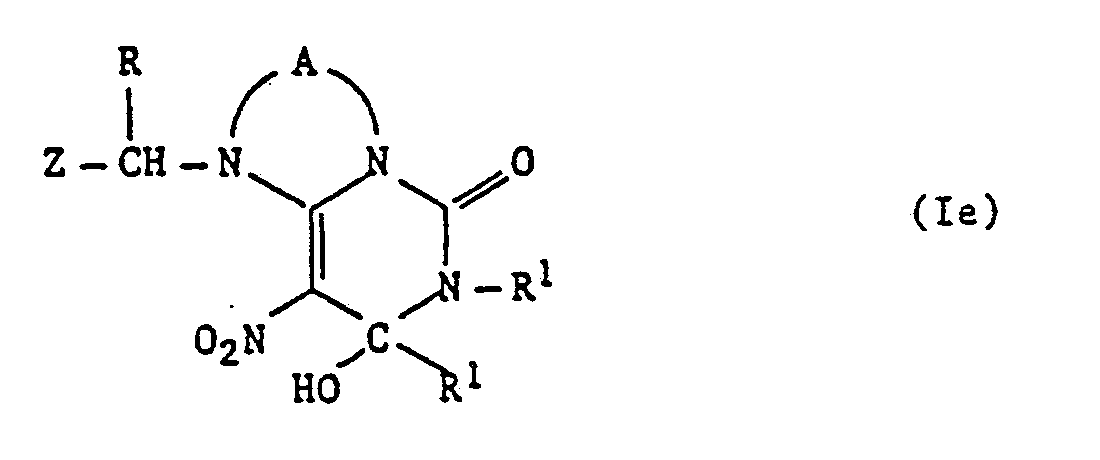
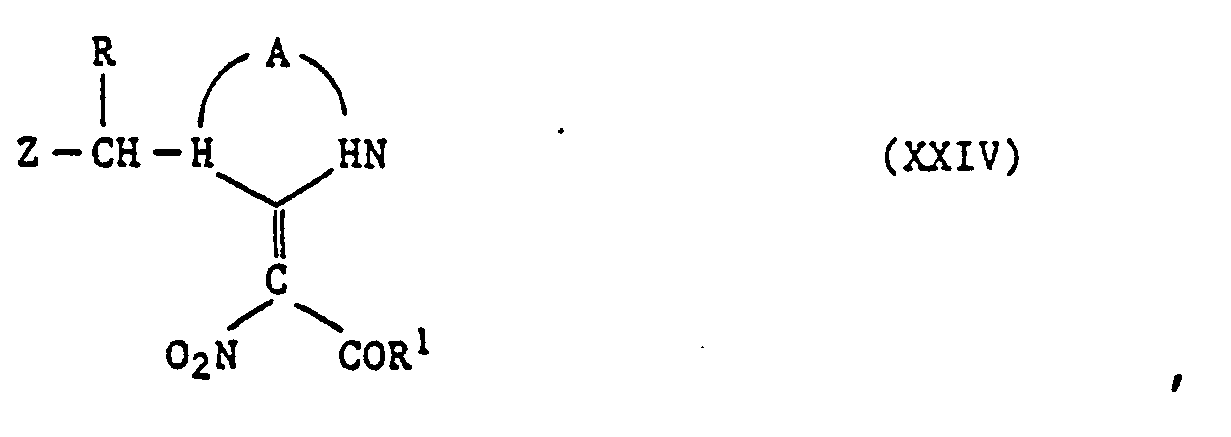
- Die Verbindungen der vorstehenden Formel (XXIV) sind bekannte Verbindungen, die in der JP-OS 81382/1987 beschrieben sind, und sie können nach dem in dieser JP-OS beschriebenen Verfahren erhalten werden.
- Die erfindungsgemäßen Wirkstoffe werden von Pflanzen gut vertragen, haben einen günstigen Wert der Toxizität gegenüber warmblütigen Tieren und lassen sich einsetzen zur Bekämpfung von Arthropoden-Schädlingen, insbesondere von Insekten, die in der Land- und Forstwirtschaft auftreten, zum Schutz von Lagerprodukten und Materialien und auf dem Gebiet der Hygiene. Sie sind gegenüber normal empfindlichen und resistenten Species sowie gegen alle oder einige Entwicklungsstadien aktiv. Zu den oben genannten Schädlingen zählen:
- Aus der Klasse der Isopoda beispielsweise Oniscus asellus, Armadillidium vulgare und Porcellio scaber; aus der Klasse der Diplopoda beispielsweise Blaniulus guttulatus; aus der Klasse der Chilopoda beispielsweise Geophilus carpophagus und Scutigera spec.; aus der Klasse der Symphyla beispielsweise Scutigerella immaculata; aus der Ordnung der Thysanura beispielsweise Lepisma saccharina; aus der Ordnung der Collembola beispielsweise Onychiurus armatus; aus der Ordnung der Orthoptera beispielsweise Blatta orientalis, Periplaneta americana, Leucophaea maderae, Blatella germanica, Acheta domesticus, Gryllotalpa spp., Locusta migratoria migratorioides, Melanoplus differentialis und Schistocerca gregaria; aus der Ordnung der Dermaptera beispielsweise Forficula auricularia, aus der Ordnung der Isoptera beispielsweise Reticulitermes spp.; aus der Ordnung der Anoplura beispielsweise Phylloxera vastatrix, Pemphigus spp., Pediculus humanus corporis, Haematopinus spp. und Linognathus spp.; aus der Ordnung der Mallophaga beispielsweise Trichodectes spp. und Damalinea spp.; aus der Ordnung der Thysanoptera beispielsweise Hercinothrips femoralis und Thrips tabaci; aus der Ordnung der Heteroptera beispielsweise Eurygaster spp., Dysdercus intermedius, Piesma quadrata, Cimex lectularius, Rhodnius prolixus und Triatoma spp.; aus der Ordnung der Homoptera beispielsweise Aleurodes brassicae, Bemisia tabaci, Trialeurodes vaporariorum, Aphis gossypii, Brevicoryne brassicae, Cryptomyzus ribis, Aphis fabae, Doralis pomi, Eriosoma lanigerum, Hyalopterus arundinis, Macrosiphum avenae, Myzus spp., Phorodon humuli, Rhopalosiphum padi, Empoasca spp., Euscelis bilobatus, Nephotettix cincticeps, Lecanium corni, Saissetia oleae, Laodelphax striatellus, Nilaparvata lugens, Aonidiella aurantii, Aspidiotus hederae, Pseudococcus spp. und Psylla spp.; aus der Ordnung der Lepidoptera beispielsweise Pectinophora gossypiella, Bupalus piniarius, Cheimatobia brumata, Lithocolletis blancardella, Hyponomeuta padella, Plutella maculipennis, Malacosoma neustria, Euproctis chrysorrhoea, Lymantria spp., Bucculatrix thurberiella, Phyllocnistis citrella, Agrotis spp., Euxoa spp., Feltia spp., Earias insulana, Heliothis spp., Spodoptera exigua, Mamestra brassicae, Panolis flammea, Prodenia litura, Spodoptera spp., Trichoplusia ni, Carpocapsa pomonella, Pieris spp., Chilo spp., Pyrausta nubilalis, Ephestia kuehniella, Galleria mellonella, Cacoecia podana, Capua reticulana, Choristoneura fumiferana, Clysia ambiguella, Homona magnanima und Tortrix viridana; aus der Ordnung der Coleoptera beispielsweise Anobium punctatum, Rhizopertha dominica, Acanthoscelides obtectus, Hylotrupes bajulus, Agelastica alni, Leptinotarsa decemlineata, Phaedon cochleariae, Diabrotica spp., Psylliodes chrysocephala, Epilachna varivestis, Atomaria spp., Oryzaephilus surinamensis, Anthonomus spp., Sitophilus spp., Otiorrhynchus sulcatus, Cosmopolites sordidus, Ceuthorrhynchus assimilis, Hypera postica, Dermestes spp., Trogoderma spp., Anthrenus spp., Attagenus spp., Lyctus spp., Meligethes aeneus, Ptinus spp:, Niptus hololeucus, Gibbium psylloides, Tribolium spp., Tenebrio molitor, Agriotes spp., Conoderus spp.. Melolontha melolontha, Amphimallon solstitialis und Costelytra zealandica; aus der Ordnung der Hymenoptera beispielsweise Diprion spp., Hoplocampa spp., Lasius spp., Monomorium pharaonis und Vespa spp.; aus der Ordnung der Diptera beispielsweise Aedes spp., Anopheles spp., Culex spp., Drosophila melanogaster, Musca spp., Fannia spp., Calliphora erythrocephala, Lucilia spp., Chrysomyia spp., Cuterebra spp., Gastrophilus spp., Hyppobosca spp., Stomoxys spp., Oestrus spp., Hypoderma spp., Tabanus spp., Tannia spp., Bibio hortulanus, Oscinella frit, Phorbia spp., Pegomyia hyoscyami, Ceratitis capitata, Dacus oleae und Tipula paludosa.
- Weiterhin können auf dem Gebiet der Veterinärmedizin die neuen Verbindungen der vorliegenden Erfindung in wirksamer Weise zur Bekämpfung einer Vielfalt schädlicher Tierparasiten (innere und äußere tierparasitische Schädlinge), z.B. parasitische Insekten und Nematoden, eingesetzt werden. Solche tierparasitischen Schädlinge können beispielhaft aus der Klasse der Insekten durch
- Gastrophilus spp., Stomoxys spp., Trichodectes spp., Rhodnius spp., Ctenocephalides canis und dergleichen verkörpert werden.
- Der Begriff "Schädlingsbekämpfungsmittel", wie er hierin verwendet wird, bezieht sich auf eine Bekämpfungswirkung gegen Schädlinge, die die im Vorstehenden genannten einschließen.
- Die Wirkstoffe können in gebräuchliche Formulierungen überführt werden, etwa Lösungen, Emulsionen, Suspensionen, Pulver, Schäume, Pasten, Granulat, Aerosol, mit der aktiven Verbindung imprägnierte natürliche oder synthetische Stoffe, sehr feine Kapseln in polymeren Substanzen, Überzugsmassen zur Verwendung auf Saatgut (Beizmittel) sowie Formulierungen für den Einsatz mit Verbrennungseinrichtungen wie Räucherpatronen, Räucherdosen und Räucherschlangen sowie für die kalte Vernebelung und die warme Vernebelung nach dem Ultra-Low-Volume-Verfahren.
- Diese Formulierungen können in bekannter Weise hergestellt werden, beispielsweise durch Vermischen der Wirkstoffe mit Streckmitteln, das heißt mit flüssigen oder verflüssigten gasförmigen oder festen Verdünnungsmitteln oder Trägern, gegebenenfalls unter Verwendung grenzflächenaktiver Mittel, das heißt von Emulgatoren und/oder Dispergiermitteln und;oder schaumbildenden Mitteln. Bei Verwendung von Wasser als Streckmittel können organische Lösungsmittel beispielsweise als Hilfslösungsmittel verwendet werden.
- Als flüssige Lösungsmittel, Verdünnungsmittel oder Träger hauptsächlich geeignet sind aromatische Kohlenwasserstoffe wie Xylol, Toluol oder Alkylnaphthaline, chlorierte aromatische oder chlorierte aliphatische Kohlenwasserstoffe wie Chlorbenzole, Chloroethylene oder Methylenchlorid, aliphatische Kohlenwasserstoffe wie Cyclohexan oder Paraffine, beispielsweise Mineralöl-Fraktionen, Alkohole wie Butanol oder Glycol sowie deren Ether und Ester, Ketone wie Aceton, Methylethylketon, Methylisobutylketon oder Cyclohexanon oder stark polare Lösungsmittel wie Dimethylformamid und Dimethylsulfoxid sowie auch Wasser.
- Unter verflüssigten gasförmigen Verdünnungsmitteln oder Trägern sind Flüssigkeiten zu verstehen, die bei normaler Temperatur und normalem Druck gasförmig wären, beispielsweise Aerosol-Treibmittel wie halogenierte Kohlenwasserstoffe sowie Butan, Propan, Stickstoff und Kohlenstoffdioxid.
- Als feste Träger verwendbar sind gemahlene natürliche Minerale wie Kaoline, Tone, Talkum, Kreide, Quarz, Attapulgit, Montmorillonit oder Diatomeenerde und gemahlene synthetische Minerale wie hochdisperse Kieselsäure, Aluminiumoxid und Silicate. Als feste Träger für Granulat können zerkleinerte und fraktionierte Natursteinmaterialien verwendet werden, etwa Calcit, Marmor, Bimsstein, Sepiolith und Dolomit sowie synthetisches Granulat aus anorganischen und organischen Mehlen und Granulat aus organischem Material wie Sägemehl, Kokosnußschalen, Maiskolben und Tabakstengel.
- Als emulgierende und/oder schaumbildende Mittel können nicht-ionische und anionische Emulgatoren wie Polyoxyethylenfettsäureester, Polyoxyethylenfettalkoholether, beispielsweise Alkylarylpolyglycol-Ether, Alkylsulfonate, Alkylsulfate, Arylsulfonate sowie Albumin-Hydrolyseprodukte verwendet werden. Zu Dispergiermitteln zählen beispielsweise Ligninsulfit-Ablaugen und Methylcellulose.
- Haftmittel wie Carboxymethylcellulose und natürliche und synthetische Polymere in Form von Pulvern, Granulat oder Latices wie Gummi arabicum, Polyvinylalkohol und Polyvinylacetat können bei der Formulierung verwendet werden.
- Es ist möglich, farbgebende Mittel, etwa anorganische Pigmente wie beispielsweise Eisenoxid, Titanoxid und Preußisch Blau und organische Farbstoffe wie Alizarin-Farbstoffe, Azo-Farbstoffe oder Metallphthalocyanin-Farbstoffe, sowie Spuren-Nährstoffe wie Salze von Eisen, Mangan, Bor, Kupfer, Cobalt, Molybdän und Zink zu verwenden.
- Die Formulierungen enthalten im allgemeinen 0,1 bis 95 Gew.-%, vorzugsweise 0,5 bis 90 Gew.-% des jeweiligen Wirkstoffs.
- Die erfindungsgemäßen Wirkstoffe können in ihren handelsüblichen Formulierungen oder den aus diesen Formulierungen hergestellten Anwendungsformen im Gemisch mit anderen Wirkstoffen vorliegen, etwa mit Insektiziden, Ködern, Sterilisationsmitteln, Akariziden, Nematiziden, Fungiziden, Wachstumsregulatoren oder Herbiziden. Zu den Insektiziden gehören beispielsweise Phosphate, Carbamate, Carboxylate, chlorierte Kohlenwasserstoffe, Phenylharnstoffe und von Mikroorganismen erzeugte, biologisch aktive Substanzen.
- Die erfindungsgemäßen Wirkstoffe können weiterhin in ihren handelsüblichen Formulierungen oder den aus diesen Formulierungen hergestellten Anwendungsformen im Gemisch mit synergistischen Mitteln vorliegen. Synergistische Mittel sind Verbindungen, die die Wirkung der Wirkstoffe steigern, ohne daß es für das zugesetzte synergistische Mittel erforderlich ist, selbst aktiv zu sein.
- Der Gehalt des Wirkstoffs in den aus den im Handel erhältlichen Formulierungen hergestellten Anwendungsformen kann innerhalb weiter Grenzen variieren. Die Konzentration der aktiven Verbindung in den Anwendungsformen kann 0,0000001 bis 100 Gew.-% betragen und liegt vorzugsweise zwischen 0,0001 und I Gew.-%.
- Die Verbindungen werden in üblicher Weise in einer den Anwendungsformen angemessenen Form zur Anwendung gebracht.
- Bei der Verwendung gegen Hygiene-Schädlinge und Schädlinge in Produkt-Vorräten zeichnen sich die neuen Wirkstoffe durch eine hervorragende Residualwirkung auf Holz und Ton sowie eine gute Beständigkeit gegen Alkali auf gekalkten Unterlagen aus.
- Die folgenden Beispiele erläutern die vorliegende Erfindung im einzelnen. Es ist jedoch ausdrücklich darauf hinzuweisen, daß die vorliegende Erfinding in keiner Weise allein auf diese Beispiele beschränkt ist.
-

- Ein Lösungsgemisch bestehend aus 2-Nitromethylen-3-(2-chloro-5-pyridylmethyl)imidazolidin (12,7 g), Propiolsäuremethylester (4,2 g) und Methanol (100 ml) wurde 20 h zum Rückfluß erhitzt. Anschließend wurde das Methanol unter vermindertem Druck abdestilliert, und der Rückstand wurde mittels Silicagel-Säulenchromatographie raffiniert, wonach das gewünschte 1,2,3,5-Tetrahydro-1-(2-chloro-5-pyridylmethyl)-8-nitroimidazo[1,2-a]pyridin-5-on (8 g) erhalten wurde; Schmp. 199-203 C.
-

- Ethyl-1,2,3,5-Tetrahydro-8-nitro-5-oxy-imidazo[1,2-a]pyridin-6-carboxylat (12,7 g) wurde in trockenem Dimethylsulfoxid (60 ml) gelöst, 60-proz. Natriumhydrid (2 g) wurde in kleinen Anteilen in einem Strom aus Stickstoff-Gas, bei Raumtemperatur zu der Lösung hinzugefügt, und die Mischung wurde 1 h zur Gewinnung des Natrium-Salzes gerührt. Als nächstes wurde 2-Chloro-5-chloromethylpyridin (8,1 g) bei Raumtemperatur dazugegeben, und der Gefäß-Inhalt wurde einen Tag bei Raumtemperatur gerührt. Der gesamte Gefäß-Inhalt wurde vorsichtig in 100 ml eiskaltes Wasser gegossen, um die gewünschte Verbindung in Form von Kristallen abzuscheiden, die abfiltriert und mit Ethanol gewaschen wurden, wonach das gewünschte Ethyl-1,2,3,5-Tetrahydro-1-(2-chloro-5-pyridylmethyl-8-nitroimidazo[1,2-a]pyridin-5-on-6-carboxylat (12 g) erhalten wurde; Schmp. 259-263 C.
-

- 2-Nitromethylen-3-(2-chloro-5-thiazolylmethyl)-imidazolidin (13 g) wurde in trockenem Acetonitril (100 ml) suspendiert. Ethoxycarbonylisothiocyanat (6,6 g) wurde zu der oben genannten Suspension bei Raumtemperatur hinzugefügt, und die Mischung wurde anschließend 10 min zum Rückfluß erhitzt. Der Gefäß-Inhalt wurde auf Raumtemperatur gebracht und anschließend 1 h gerührt, um Kristalle abzuscheiden, die abfiltriert wurden.
- Die Kristalle wurden als nächstes in Essigsäure (60 ml) suspendiert, wobei sie bei einer Temperatur von 10 0 C gerührt wurden, und Brom (8 g) wurde tropfenweise hinzugefügt. Nach Beendigung des Zutropfens wurde die Mischung zu Vervollständigung der Reaktion 1 h weiter gerührt. Die Essigsäure wurde unter vermindertem Druck abdestilliert, Wasser wurde zu dem Rückstand zur Auflösung desselben hinzugefügt, Natriumhydrogencarbonat wurde in kleinen Anteilen zu der Mischung gegeben, um dieselbe alkalisch zu machen, und danach wurde die Mischung zweimal mit Dichloromethan extrahiert. Nachdem die Dichloromethan-Schicht mit Natriumsulfat getrocknet worden war, wurde das Lösungsmittel abdestilliert, und der Rückstand wurde aus Ethanol umkristallisiert, wonach das gewünschte Ethyl-2,4,5.6-tetrahydro-4-(2-chloro-5-thiazylmethyl)-3-nitroimidazo[1,2-b]isothiazol-2-ylidencarbamat (12 g) erhalten wurde; Schmp. 176-180 C.
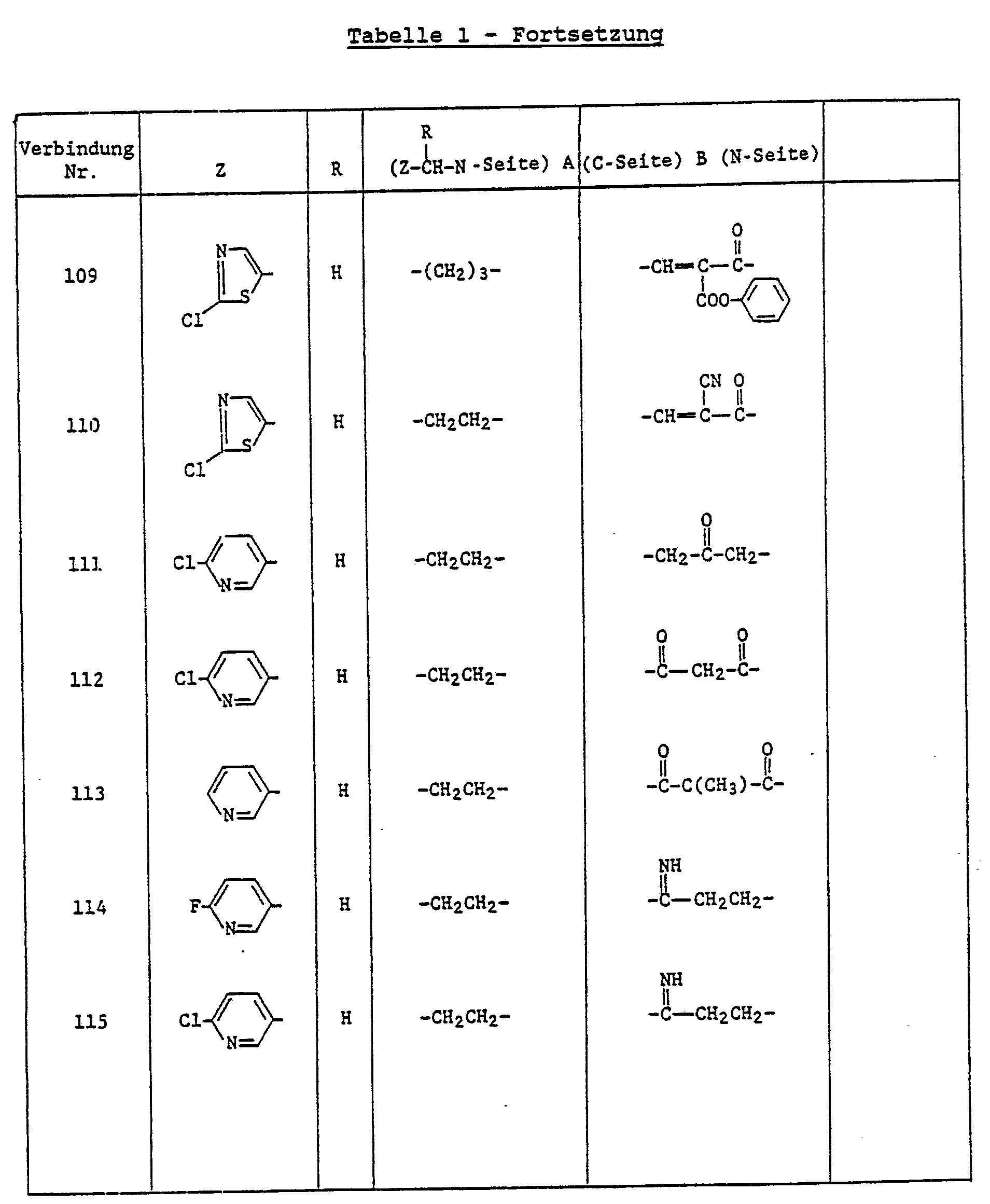
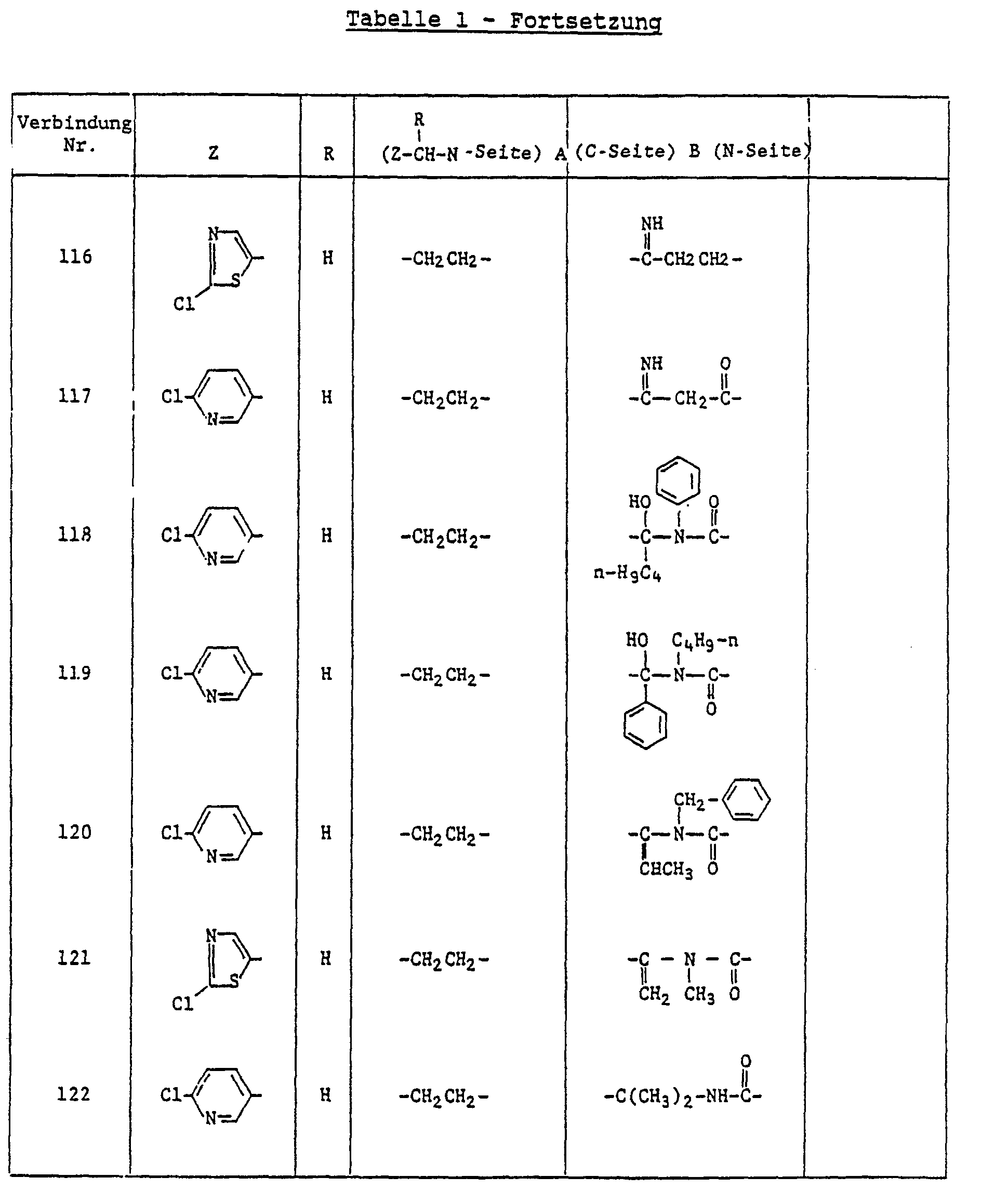
- Verbindungen, die nach den gleichen Verfahren, wie sie in den vorstehenden Beispielen 1 bis 3 gezeigt wurden, hergestellt werden können, sind zusammen mit den Verbindungen der Beispiele 1 bis 3 in der Folgenden Tabelle 1 aufgeführt.




-


- Lösungsmittel: 3 Gew.-Teile Xylol Emulgator: 1 Gew.-Teil Polyoxyethylenalkylphenylether
- Zur Herstellung einer geeigneten Formulierung eines Wirkstoffs wurde 1 Gew.-Teil des Wirkstoffs mit der oben bezeichneten Menge Lösungsmittel, das die oben angegebene Menge Emulgator enthielt, vermischt, und die Mischung wurde mit Wasser auf die vorher festgesetzte Konzentration verdünnt.
- Benutzt wurde eine Anzahl Töpfe mit jeweils einem Durchmesser von 12 cm, in die Reispflanzen-Setzlinge mit einer Höhe von etwa 10 cm gesetzt waren.
- Auf jeden eingetopften Reispflanzen-Setzling wurden 10 ml einer wäßrigen Lösung des oben präparierten Wirkstoffs mit der vorher festgelegten Konzentration gesprüht.
- Nachdem die gesprühte Lösung eingetrocknet war, wurde jeder der Töpfe mit einem Drahtkorb von 7 cm Durchmesser und 14 cm Höhe bedeckt, in dem 30 ausgewachsene weibliche Exemplare von Nephotettix cincticeps, die gegen Insektizide der Organophosphor-Reihe Resistenz zeigten, ausgesetzt wurden, und jeder Topf wurde in einen Raum mit konstanter Temperatur gestellt. Zwei Tage danach wurde die Zahl der toten Insekten ermittelt, um die Mortalitäts-Rate der Insekten zu erhalten.
- Die Test-Ergebnisse wurden auf Mittelwert-Basis bestimmt und sind in Tabelle 2 aufgeführt.

- Auf Auberginen-Setzlinge (schwarze längliche Auberginen) mit jeweils einer Höhe von 20 cm, die in unglasierten Töpfen von 15 cm Durchmesser gezogen worden waren, wurden pro Setzling 200 herangezogene Exemplare von Myzus persicae der gegenüber Insektiziden der Organophosphor- und Carbamat-Reihe Resistenz besaß, ausgesetzt. Einen Tag nach der Inokulierung wurde eine wäßrige Lösung mit einer vorher festgelegten Konzentration des Wirkstoffs, der nach einer Arbeitsweise ähnlich derjenigen von Beispiel 4 beschrieben hergestellt worden war, in einer genügenden Dosierung auf die Setzlinge gesprüht.
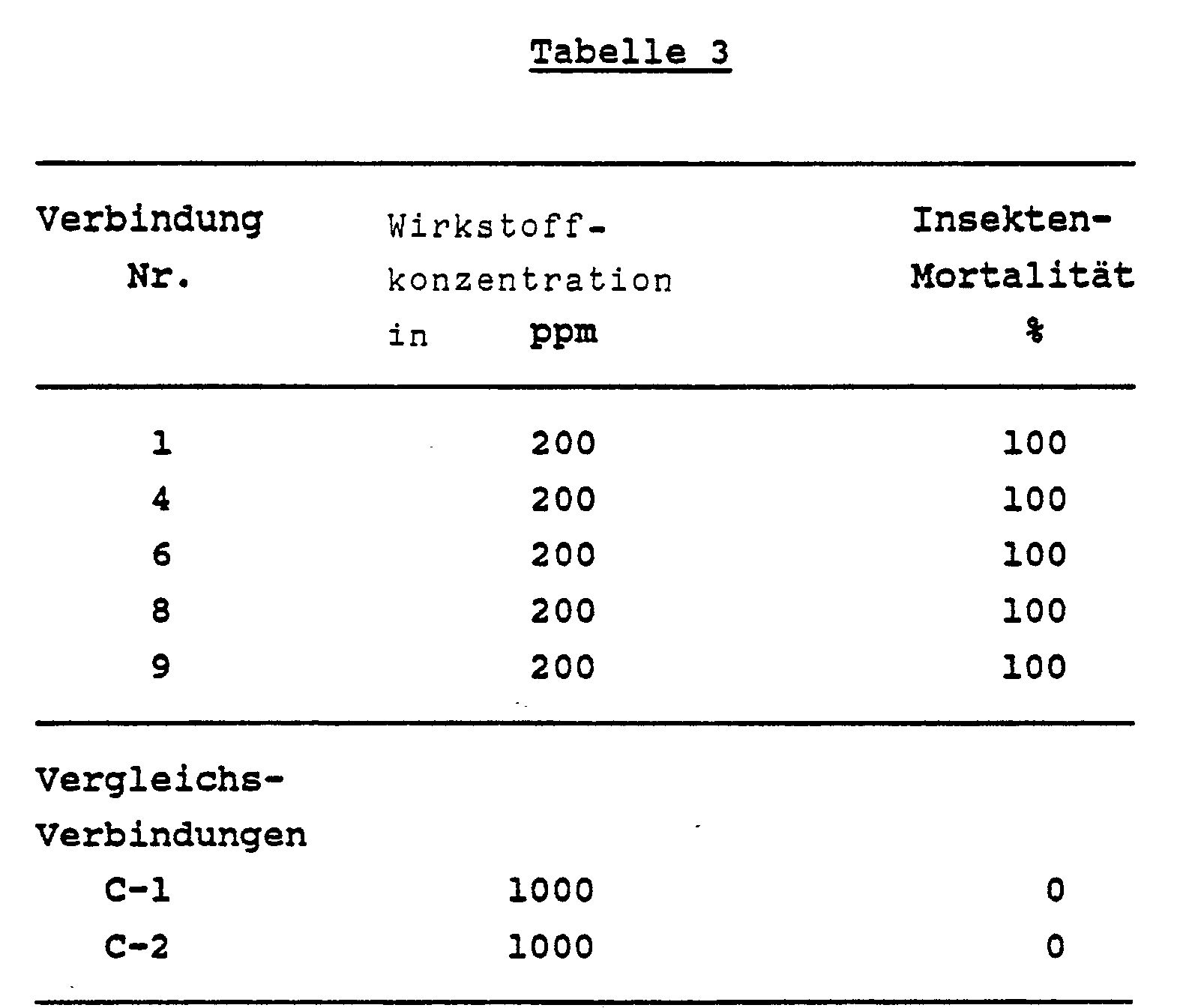
- Der oben angegebene Test wurde für jede der nachstehend bezeichneten Verbindungen mit den angegegebenen Konzentrations-Dosierungen durchgeführt. Nach dem Sprühen der insektiziden Lösung wurden die Setzlinge für den Test in jedem Topf 24 h in einem auf einer Temperatur von 28 ° C gehaltenen Gewächshaus stehen gelassen, und danach wurde die Mortalitäts-Rate der Insekten für jeden Test bestimmt. Der gleiche Test wurde zweimal wiederholt, um eine genaue Bestimmung der Mortalitäts-Rate zu erhalten. Das Ergebnis ist in der nachfolgenden Tabelle 3 dargestellt:
Claims (9)




dadurch gekennzeichnet, daß








Applications Claiming Priority (2)
| Application Number | Priority Date | Filing Date | Title |
|---|---|---|---|
| JP157528/87 | 1987-06-26 | ||
| JP62157528A JPH0710865B2 (ja) | 1987-06-26 | 1987-06-26 | ニトロ置換ヘテロ環式化合物及び殺虫剤 |
Publications (3)
| Publication Number | Publication Date |
|---|---|
| EP0296453A2 true EP0296453A2 (de) | 1988-12-28 |
| EP0296453A3 EP0296453A3 (de) | 1989-09-20 |
| EP0296453B1 EP0296453B1 (de) | 1997-08-13 |
Family
ID=15651636
Family Applications (1)
| Application Number | Title | Priority Date | Filing Date |
|---|---|---|---|
| EP88109426A Expired - Lifetime EP0296453B1 (de) | 1987-06-26 | 1988-06-14 | Nitro-substituierte heterocyclische Verbindungen |
Country Status (7)
| Country | Link |
|---|---|
| US (7) | US4876263A (de) |
| EP (1) | EP0296453B1 (de) |
| JP (1) | JPH0710865B2 (de) |
| KR (1) | KR960006386B1 (de) |
| BR (1) | BR8803133A (de) |
| DE (1) | DE3855992D1 (de) |
| HU (1) | HUT47392A (de) |
Cited By (10)
| Publication number | Priority date | Publication date | Assignee | Title |
|---|---|---|---|---|
| EP0483052A1 (de) * | 1990-09-18 | 1992-04-29 | Ciba-Geigy Ag | Picolinoxide |
| US7517535B2 (en) | 1994-05-20 | 2009-04-14 | Bayer Animal Health Gmbh | Non-systemic control of parasites |
| WO2009094867A1 (en) | 2008-01-23 | 2009-08-06 | East China University Of Science And Technology | Nitrogenous heterocyclic compound with insecticidal activity and its preparation and use |
| WO2010069266A1 (zh) | 2008-12-19 | 2010-06-24 | 华东理工大学 | 二醛构建的具有杀虫活性的含氮或氧杂环化合物及其制备方法 |
| WO2013149903A1 (en) * | 2012-04-03 | 2013-10-10 | Basf Se | N- substituted hetero - bicyclic furanone derivatives for combating animal |
| US8809319B2 (en) | 2009-12-09 | 2014-08-19 | East China University Of Science And Technology | Substituted 8-oxa-10,11-dihydroimidazo[2,3-a]bicyclo[3.2.1]oct-3-enes and use thereof as an insecticide |
| US9334238B2 (en) | 2012-03-30 | 2016-05-10 | Basf Se | N-substituted pyridinylidenes for combating animal pests |
| US9422280B2 (en) | 2012-03-29 | 2016-08-23 | Basf Se | N-substituted hetero-bicyclic compounds and derivatives for combating animal pests II |
| WO2017109795A1 (en) * | 2015-12-21 | 2017-06-29 | Council Of Scientific & Industrial Research | Novel compounds useful as potential insect antifeedant and a process for the preparation thereof |
| US10206397B2 (en) | 2013-09-19 | 2019-02-19 | Basf Se | N-acylimino heterocyclic compounds |
Families Citing this family (12)
| Publication number | Priority date | Publication date | Assignee | Title |
|---|---|---|---|---|
| JP3023794B2 (ja) * | 1989-05-17 | 2000-03-21 | 日本バイエルアグロケム株式会社 | 殺虫性ニトロ置換ヘテロ環式化合物 |
| US5219869A (en) * | 1989-05-17 | 1993-06-15 | Nihon Bayer Agrochem K.K. | Nitro-substituted heterocyclic compounds |
| US5270317A (en) * | 1990-03-20 | 1993-12-14 | Elf Sanofi | N-substituted heterocyclic derivatives, their preparation and the pharmaceutical compositions in which they are present |
| GB9015764D0 (en) * | 1990-07-18 | 1990-09-05 | Fujisawa Pharmaceutical Co | Pyrazolopyridine compound and processes for preparation thereof |
| DE19605400A1 (de) * | 1996-02-14 | 1997-08-21 | Bayer Ag | Salze von Imidazolin-Derivaten |
| DOP2002000334A (es) * | 2001-02-14 | 2002-08-30 | Warner Lambert Co | Pirimidinas biciclicas como inhibidores de metaloproteinasas de matriz |
| CN1295228C (zh) * | 2004-11-23 | 2007-01-17 | 华东理工大学 | 硝基亚甲基衍生物及其用途 |
| DE102006015456A1 (de) * | 2006-03-31 | 2007-10-04 | Bayer Cropscience Ag | Bicyclische Enamino(thio)carbonylverbindungen |
| WO2013150115A1 (en) * | 2012-04-05 | 2013-10-10 | Basf Se | N- substituted hetero - bicyclic compounds and derivatives for combating animal pests |
| CN104557910B (zh) * | 2013-10-16 | 2016-11-16 | 济南大学 | 含氟顺式新烟碱化合物及其制备方法和应用 |
| CN104557912B (zh) * | 2013-10-25 | 2016-10-12 | 济南大学 | 具有杀虫活性的含氟二氢吡啶化合物的制备方法及其应用 |
| CN113480541B (zh) * | 2019-03-07 | 2022-09-02 | 湖南化工研究院有限公司 | 咪唑并吡啶化合物及其中间体的制备方法 |
Family Cites Families (7)
| Publication number | Priority date | Publication date | Assignee | Title |
|---|---|---|---|---|
| US3985735A (en) * | 1975-06-30 | 1976-10-12 | Shell Oil Company | Pyrimido(4,3-b)(1,3)thiazin-6-ones |
| US4031087A (en) * | 1975-06-27 | 1977-06-21 | Shell Oil Company | 3,4,7,8-Tetrahydro-9-nitro-7-substituted-2H,6H-pyrimido-(4,3-b)(1,3)thiazines |
| US4033954A (en) * | 1976-08-05 | 1977-07-05 | Shell Oil Company | 3,4-Dihydro-7-hydroxy-8-nitro-2H-pyrrolo(2,1-b)-(1,3)thiazin-6(7H)-one |
| US4033955A (en) * | 1976-08-10 | 1977-07-05 | Shell Oil Company | 3,4-Dihydro-8-nitro-2H-pyrrolo(2,1-B)(1,3)thiazin-7(6H)-one |
| EP0192060B1 (de) * | 1985-02-04 | 1991-09-18 | Nihon Bayer Agrochem K.K. | Heterocyclische Verbindungen |
| US4725686A (en) * | 1985-11-22 | 1988-02-16 | William H. Rorer, Inc. | Benzodiazinone-pyridazinone and hydroxy-pyrazolyl compounds, cardiotonic compositions including the same, and their uses |
| DE3638121A1 (de) * | 1986-05-30 | 1987-12-03 | Bayer Ag | 1,2,3,6-tetrahydro-5-nitro-pyrimidin-derivate |
-
1987
- 1987-06-26 JP JP62157528A patent/JPH0710865B2/ja not_active Expired - Lifetime
-
1988
- 1988-06-14 EP EP88109426A patent/EP0296453B1/de not_active Expired - Lifetime
- 1988-06-14 DE DE3855992T patent/DE3855992D1/de not_active Expired - Fee Related
- 1988-06-17 US US07/208,421 patent/US4876263A/en not_active Expired - Lifetime
- 1988-06-24 KR KR1019880007629A patent/KR960006386B1/ko not_active Expired - Fee Related
- 1988-06-24 HU HU883213A patent/HUT47392A/hu unknown
- 1988-06-24 BR BR8803133A patent/BR8803133A/pt unknown
-
1989
- 1989-05-17 US US07/353,370 patent/US4960780A/en not_active Expired - Lifetime
-
1990
- 1990-04-18 US US07/510,509 patent/US5036082A/en not_active Expired - Lifetime
-
1991
- 1991-05-13 US US07/699,068 patent/US5122527A/en not_active Expired - Lifetime
-
1993
- 1993-09-27 US US08/126,950 patent/US5366976A/en not_active Expired - Fee Related
-
1994
- 1994-08-16 US US08/291,236 patent/US5472960A/en not_active Expired - Fee Related
-
1995
- 1995-06-05 US US08/461,903 patent/US5622956A/en not_active Expired - Fee Related
Cited By (14)
| Publication number | Priority date | Publication date | Assignee | Title |
|---|---|---|---|---|
| TR25286A (tr) * | 1990-09-18 | 1993-01-01 | Ciba Geigy Ag | Yeni pikolin oksitler hazirlanisi icin islemler ve bunlari iceren pestisitler. |
| EP0483052A1 (de) * | 1990-09-18 | 1992-04-29 | Ciba-Geigy Ag | Picolinoxide |
| US8728507B2 (en) | 1994-05-20 | 2014-05-20 | Bayer Intellectual Property Gmbh | Non-systemic control of parasites |
| US7517535B2 (en) | 1994-05-20 | 2009-04-14 | Bayer Animal Health Gmbh | Non-systemic control of parasites |
| WO2009094867A1 (en) | 2008-01-23 | 2009-08-06 | East China University Of Science And Technology | Nitrogenous heterocyclic compound with insecticidal activity and its preparation and use |
| US8232407B2 (en) | 2008-01-23 | 2012-07-31 | East China University Of Science And Technology | Nitrogenous heterocyclic compounds with insecticidal activity, and the preparation and use thereof |
| WO2010069266A1 (zh) | 2008-12-19 | 2010-06-24 | 华东理工大学 | 二醛构建的具有杀虫活性的含氮或氧杂环化合物及其制备方法 |
| US8563546B2 (en) | 2008-12-19 | 2013-10-22 | East China University Of Science And Technology | Heterocyclic nitrogenous or oxygenous compounds with insecticidal activity formed from dialdehydes and their preparation and uses thereof |
| US8809319B2 (en) | 2009-12-09 | 2014-08-19 | East China University Of Science And Technology | Substituted 8-oxa-10,11-dihydroimidazo[2,3-a]bicyclo[3.2.1]oct-3-enes and use thereof as an insecticide |
| US9422280B2 (en) | 2012-03-29 | 2016-08-23 | Basf Se | N-substituted hetero-bicyclic compounds and derivatives for combating animal pests II |
| US9334238B2 (en) | 2012-03-30 | 2016-05-10 | Basf Se | N-substituted pyridinylidenes for combating animal pests |
| WO2013149903A1 (en) * | 2012-04-03 | 2013-10-10 | Basf Se | N- substituted hetero - bicyclic furanone derivatives for combating animal |
| US10206397B2 (en) | 2013-09-19 | 2019-02-19 | Basf Se | N-acylimino heterocyclic compounds |
| WO2017109795A1 (en) * | 2015-12-21 | 2017-06-29 | Council Of Scientific & Industrial Research | Novel compounds useful as potential insect antifeedant and a process for the preparation thereof |
Also Published As
| Publication number | Publication date |
|---|---|
| US4876263A (en) | 1989-10-24 |
| HUT47392A (en) | 1989-03-28 |
| EP0296453A3 (de) | 1989-09-20 |
| BR8803133A (pt) | 1989-02-08 |
| US5036082A (en) | 1991-07-30 |
| US4960780A (en) | 1990-10-02 |
| EP0296453B1 (de) | 1997-08-13 |
| DE3855992D1 (de) | 1997-09-18 |
| KR960006386B1 (ko) | 1996-05-15 |
| JPS643184A (en) | 1989-01-06 |
| US5622956A (en) | 1997-04-22 |
| US5472960A (en) | 1995-12-05 |
| KR890000487A (ko) | 1989-03-15 |
| US5122527A (en) | 1992-06-16 |
| JPH0710865B2 (ja) | 1995-02-08 |
| US5366976A (en) | 1994-11-22 |
Similar Documents
| Publication | Publication Date | Title |
|---|---|---|
| EP0259738B1 (de) | Heterocyclische Verbindungen | |
| EP0315826B1 (de) | Imidazoline | |
| EP0254859B1 (de) | Alkylendiamine | |
| EP0235725B1 (de) | Heterocyclische Verbindungen | |
| DE69005858T2 (de) | Heterocyclische Verbindungen. | |
| EP0296453B1 (de) | Nitro-substituierte heterocyclische Verbindungen | |
| DE68913891T2 (de) | Cyanverbindungen als Insektizide. | |
| EP0268915A2 (de) | Trifluormethylcarbonyl-Derivate | |
| DE69217864T2 (de) | Guanidinderivate als Insektizide | |
| CH634304A5 (de) | Phenylcarbamoyl-pyrazoline, verfahren zu deren herstellung sowie die verbindungen enthaltende insektizide. | |
| EP0835245B1 (de) | Substituierte n-methylenthioharnstoffe als schädlingsbekämpfungsmittel | |
| EP0316845B1 (de) | 1,2,3,4-Tetrahydro-5-nitro-pyrimidin-Derivate | |
| EP0316843B1 (de) | 1,2,3,4-Tetrahydro-5-nitro-pyrimidin-Derivate | |
| EP0022511B1 (de) | N,N-Dimethyl-O-pyrimidinyl-carbaminsäureester, Verfahren zu ihrer Herstellung sowie ihre Verwendung als Schädlingsbekämpfungsmittel | |
| EP0000198B1 (de) | N,N-Dialkyl-0-pyrimidinyl-carbaminsäureester, Verfahren zu ihrer Herstellung und ihre Verwendung als Insektizide | |
| DE69209996T2 (de) | Guanidinderivate als Insektizide | |
| EP0005240A2 (de) | N,N-Dimethyl-O-pyrazolyl-carbaminsäureester, Verfahren zu ihrer Herstellung und ihre Verwendung als Insektizide | |
| EP0683770A1 (de) | Substituierte tetrahydropyridazincarboxamide | |
| EP0261459A2 (de) | Neue N-Benzothiazolylamide | |
| EP0090247B1 (de) | Substituierte N,N-Dimethyl-O-pyrimidin-4-yl-carbamin-säureester, Verfahren zu ihrer Herstellung und ihre Verwendung als Schädlingsbekämpfungsmittel | |
| EP0009103A1 (de) | N-(O-Äthyl-S-n-propyl-(di)thiophosphoryloxy)-naphtalimide, Verfahren zu ihrer Herstellung, diese Verbindungen enthaltende Schädlingsbekämpfungsmittel, ihre Herstellung und Verwendung | |
| EP0005246A2 (de) | Neues N-carboxyliertes Carbamat, Verfahren zu seiner Herstellung und seine insektizide Verwendung | |
| DE3438919A1 (de) | Substituierte phenyl-carbaminsaeureester | |
| EP0000895A1 (de) | Aryl-N-alkyl-carbamate, Verfahren zu ihrer Herstellung und ihre Verwendung als Insektizide | |
| EP0075144A1 (de) | N,N-Dimethyl-O-imidazol-4-yl-carbaminsäureester, Verfahren zu ihrer Herstellung und ihre Verwendung als Schädlingsbekämpfungsmittel |
Legal Events
| Date | Code | Title | Description |
|---|---|---|---|
| PUAI | Public reference made under article 153(3) epc to a published international application that has entered the european phase |
Free format text: ORIGINAL CODE: 0009012 |
|
| 17P | Request for examination filed |
Effective date: 19880614 |
|
| AK | Designated contracting states |
Kind code of ref document: A2 Designated state(s): BE CH DE FR GB IT LI NL |
|
| PUAL | Search report despatched |
Free format text: ORIGINAL CODE: 0009013 |
|
| AK | Designated contracting states |
Kind code of ref document: A3 Designated state(s): BE CH DE FR GB IT LI NL |
|
| RAP1 | Party data changed (applicant data changed or rights of an application transferred) |
Owner name: NIHON BAYER AGROCHEM K.K. |
|
| 17Q | First examination report despatched |
Effective date: 19911108 |
|
| RAP3 | Party data changed (applicant data changed or rights of an application transferred) |
Owner name: NIHON BAYER AGROCHEM K.K. |
|
| GRAG | Despatch of communication of intention to grant |
Free format text: ORIGINAL CODE: EPIDOS AGRA |
|
| GRAH | Despatch of communication of intention to grant a patent |
Free format text: ORIGINAL CODE: EPIDOS IGRA |
|
| GRAH | Despatch of communication of intention to grant a patent |
Free format text: ORIGINAL CODE: EPIDOS IGRA |
|
| GRAA | (expected) grant |
Free format text: ORIGINAL CODE: 0009210 |
|
| AK | Designated contracting states |
Kind code of ref document: B1 Designated state(s): BE CH DE FR GB IT LI NL |
|
| REG | Reference to a national code |
Ref country code: CH Ref legal event code: NV Representative=s name: E. BLUM & CO. PATENTANWAELTE Ref country code: CH Ref legal event code: EP |
|
| GBT | Gb: translation of ep patent filed (gb section 77(6)(a)/1977) |
Effective date: 19970818 |
|
| ITF | It: translation for a ep patent filed | ||
| REF | Corresponds to: |
Ref document number: 3855992 Country of ref document: DE Date of ref document: 19970918 |
|
| ET | Fr: translation filed | ||
| PLBE | No opposition filed within time limit |
Free format text: ORIGINAL CODE: 0009261 |
|
| STAA | Information on the status of an ep patent application or granted ep patent |
Free format text: STATUS: NO OPPOSITION FILED WITHIN TIME LIMIT |
|
| 26N | No opposition filed | ||
| REG | Reference to a national code |
Ref country code: GB Ref legal event code: IF02 |
|
| PGFP | Annual fee paid to national office [announced via postgrant information from national office to epo] |
Ref country code: FR Payment date: 20050523 Year of fee payment: 18 |
|
| PGFP | Annual fee paid to national office [announced via postgrant information from national office to epo] |
Ref country code: DE Payment date: 20050524 Year of fee payment: 18 |
|
| PGFP | Annual fee paid to national office [announced via postgrant information from national office to epo] |
Ref country code: GB Payment date: 20050608 Year of fee payment: 18 |
|
| PGFP | Annual fee paid to national office [announced via postgrant information from national office to epo] |
Ref country code: CH Payment date: 20050627 Year of fee payment: 18 |
|
| PGFP | Annual fee paid to national office [announced via postgrant information from national office to epo] |
Ref country code: BE Payment date: 20050629 Year of fee payment: 18 |
|
| PGFP | Annual fee paid to national office [announced via postgrant information from national office to epo] |
Ref country code: NL Payment date: 20050630 Year of fee payment: 18 |
|
| PG25 | Lapsed in a contracting state [announced via postgrant information from national office to epo] |
Ref country code: GB Free format text: LAPSE BECAUSE OF NON-PAYMENT OF DUE FEES Effective date: 20060614 |
|
| PG25 | Lapsed in a contracting state [announced via postgrant information from national office to epo] |
Ref country code: LI Free format text: LAPSE BECAUSE OF NON-PAYMENT OF DUE FEES Effective date: 20060630 Ref country code: CH Free format text: LAPSE BECAUSE OF NON-PAYMENT OF DUE FEES Effective date: 20060630 Ref country code: BE Free format text: LAPSE BECAUSE OF NON-PAYMENT OF DUE FEES Effective date: 20060630 |
|
| PGFP | Annual fee paid to national office [announced via postgrant information from national office to epo] |
Ref country code: IT Payment date: 20060630 Year of fee payment: 19 |
|
| PG25 | Lapsed in a contracting state [announced via postgrant information from national office to epo] |
Ref country code: NL Free format text: LAPSE BECAUSE OF NON-PAYMENT OF DUE FEES Effective date: 20070101 |
|
| PG25 | Lapsed in a contracting state [announced via postgrant information from national office to epo] |
Ref country code: DE Free format text: LAPSE BECAUSE OF NON-PAYMENT OF DUE FEES Effective date: 20070103 |
|
| REG | Reference to a national code |
Ref country code: CH Ref legal event code: PL |
|
| GBPC | Gb: european patent ceased through non-payment of renewal fee |
Effective date: 20060614 |
|
| NLV4 | Nl: lapsed or anulled due to non-payment of the annual fee |
Effective date: 20070101 |
|
| REG | Reference to a national code |
Ref country code: FR Ref legal event code: ST Effective date: 20070228 |
|
| BERE | Be: lapsed |
Owner name: *NIHON BAYER AGROCHEM K.K. Effective date: 20060630 |
|
| PG25 | Lapsed in a contracting state [announced via postgrant information from national office to epo] |
Ref country code: FR Free format text: LAPSE BECAUSE OF NON-PAYMENT OF DUE FEES Effective date: 20060630 |
|
| PG25 | Lapsed in a contracting state [announced via postgrant information from national office to epo] |
Ref country code: IT Free format text: LAPSE BECAUSE OF NON-PAYMENT OF DUE FEES Effective date: 20070614 |