EP0299907A1 - Verfahren zur Herstellung von symmetrischen Bicyclo[3.3.0]octan-diondicarbonsäurediestern - Google Patents
Verfahren zur Herstellung von symmetrischen Bicyclo[3.3.0]octan-diondicarbonsäurediestern Download PDFInfo
- Publication number
- EP0299907A1 EP0299907A1 EP88730142A EP88730142A EP0299907A1 EP 0299907 A1 EP0299907 A1 EP 0299907A1 EP 88730142 A EP88730142 A EP 88730142A EP 88730142 A EP88730142 A EP 88730142A EP 0299907 A1 EP0299907 A1 EP 0299907A1
- Authority
- EP
- European Patent Office
- Prior art keywords
- bicyclo
- pct
- diesters
- dicarboxylic acid
- atoms
- Prior art date
- Legal status (The legal status is an assumption and is not a legal conclusion. Google has not performed a legal analysis and makes no representation as to the accuracy of the status listed.)
- Granted
Links
- 238000000034 method Methods 0.000 title claims abstract description 11
- 238000002360 preparation method Methods 0.000 title claims description 5
- 150000005690 diesters Chemical class 0.000 title abstract description 7
- 239000002253 acid Substances 0.000 title 1
- 150000007513 acids Chemical class 0.000 title 1
- 125000004432 carbon atom Chemical group C* 0.000 claims abstract description 8
- 125000000217 alkyl group Chemical group 0.000 claims abstract description 6
- 125000004435 hydrogen atom Chemical group [H]* 0.000 claims abstract description 3
- 125000001997 phenyl group Chemical group [H]C1=C([H])C([H])=C(*)C([H])=C1[H] 0.000 claims abstract description 3
- BZKFMUIJRXWWQK-UHFFFAOYSA-N Cyclopentenone Chemical class O=C1CCC=C1 BZKFMUIJRXWWQK-UHFFFAOYSA-N 0.000 claims abstract 2
- -1 bicyclo [3.3.0] octane dicarboxylic acid diesters Chemical class 0.000 claims description 15
- CSCPPACGZOOCGX-UHFFFAOYSA-N Acetone Chemical compound CC(C)=O CSCPPACGZOOCGX-UHFFFAOYSA-N 0.000 abstract description 5
- 238000004519 manufacturing process Methods 0.000 abstract description 3
- DVISPABUTVTHBO-UHFFFAOYSA-N 2,3,3a,4,5,6-hexahydro-1h-pentalene-1,6a-dicarboxylic acid Chemical compound C1CCC2(C(O)=O)C(C(=O)O)CCC21 DVISPABUTVTHBO-UHFFFAOYSA-N 0.000 abstract 1
- OFOBLEOULBTSOW-UHFFFAOYSA-N Malonic acid Chemical compound OC(=O)CC(O)=O OFOBLEOULBTSOW-UHFFFAOYSA-N 0.000 abstract 1
- OKKJLVBELUTLKV-UHFFFAOYSA-N Methanol Chemical compound OC OKKJLVBELUTLKV-UHFFFAOYSA-N 0.000 description 15
- YMWUJEATGCHHMB-UHFFFAOYSA-N Dichloromethane Chemical compound ClCCl YMWUJEATGCHHMB-UHFFFAOYSA-N 0.000 description 12
- XEKOWRVHYACXOJ-UHFFFAOYSA-N Ethyl acetate Chemical compound CCOC(C)=O XEKOWRVHYACXOJ-UHFFFAOYSA-N 0.000 description 12
- VLKZOEOYAKHREP-UHFFFAOYSA-N n-Hexane Chemical compound CCCCCC VLKZOEOYAKHREP-UHFFFAOYSA-N 0.000 description 12
- LFQSCWFLJHTTHZ-UHFFFAOYSA-N Ethanol Chemical compound CCO LFQSCWFLJHTTHZ-UHFFFAOYSA-N 0.000 description 11
- KRKNYBCHXYNGOX-UHFFFAOYSA-N citric acid Chemical compound OC(=O)CC(O)(C(O)=O)CC(O)=O KRKNYBCHXYNGOX-UHFFFAOYSA-N 0.000 description 9
- 230000015572 biosynthetic process Effects 0.000 description 8
- 150000001875 compounds Chemical class 0.000 description 8
- 239000000203 mixture Substances 0.000 description 8
- BWHMMNNQKKPAPP-UHFFFAOYSA-L potassium carbonate Chemical compound [K+].[K+].[O-]C([O-])=O BWHMMNNQKKPAPP-UHFFFAOYSA-L 0.000 description 8
- 239000000243 solution Substances 0.000 description 8
- 238000003786 synthesis reaction Methods 0.000 description 8
- KFZMGEQAYNKOFK-UHFFFAOYSA-N Isopropanol Chemical compound CC(C)O KFZMGEQAYNKOFK-UHFFFAOYSA-N 0.000 description 7
- XKRFYHLGVUSROY-UHFFFAOYSA-N Argon Chemical compound [Ar] XKRFYHLGVUSROY-UHFFFAOYSA-N 0.000 description 6
- HEDRZPFGACZZDS-UHFFFAOYSA-N Chloroform Chemical compound ClC(Cl)Cl HEDRZPFGACZZDS-UHFFFAOYSA-N 0.000 description 6
- 239000007858 starting material Substances 0.000 description 5
- XLYOFNOQVPJJNP-UHFFFAOYSA-N water Substances O XLYOFNOQVPJJNP-UHFFFAOYSA-N 0.000 description 5
- AQQRQCQTWAQVLH-UHFFFAOYSA-N 4-(2-phenylpropan-2-yloxy)cyclopent-2-en-1-one Chemical compound C=1C=CC=CC=1C(C)(C)OC1CC(=O)C=C1 AQQRQCQTWAQVLH-UHFFFAOYSA-N 0.000 description 4
- RTZKZFJDLAIYFH-UHFFFAOYSA-N Diethyl ether Chemical compound CCOCC RTZKZFJDLAIYFH-UHFFFAOYSA-N 0.000 description 4
- VYPSYNLAJGMNEJ-UHFFFAOYSA-N Silicium dioxide Chemical compound O=[Si]=O VYPSYNLAJGMNEJ-UHFFFAOYSA-N 0.000 description 4
- PMZURENOXWZQFD-UHFFFAOYSA-L Sodium Sulfate Chemical compound [Na+].[Na+].[O-]S([O-])(=O)=O PMZURENOXWZQFD-UHFFFAOYSA-L 0.000 description 4
- ZSWFCLXCOIISFI-UHFFFAOYSA-N cyclopentadiene Chemical compound C1C=CC=C1 ZSWFCLXCOIISFI-UHFFFAOYSA-N 0.000 description 4
- 229910000027 potassium carbonate Inorganic materials 0.000 description 4
- KAQKFAOMNZTLHT-OZUDYXHBSA-N prostaglandin I2 Chemical compound O1\C(=C/CCCC(O)=O)C[C@@H]2[C@@H](/C=C/[C@@H](O)CCCCC)[C@H](O)C[C@@H]21 KAQKFAOMNZTLHT-OZUDYXHBSA-N 0.000 description 4
- 239000000741 silica gel Substances 0.000 description 4
- 229910002027 silica gel Inorganic materials 0.000 description 4
- 229910052938 sodium sulfate Inorganic materials 0.000 description 4
- 235000011152 sodium sulphate Nutrition 0.000 description 4
- YNCKAQVPQJWLJW-UHFFFAOYSA-N (4-oxocyclopent-2-en-1-yl) acetate Chemical compound CC(=O)OC1CC(=O)C=C1 YNCKAQVPQJWLJW-UHFFFAOYSA-N 0.000 description 3
- 0 *C([C@@](CC(C1)O)[C@]1C1)C1=O Chemical compound *C([C@@](CC(C1)O)[C@]1C1)C1=O 0.000 description 3
- BKXMCMSBKYTEIA-UHFFFAOYSA-N 4-[(2-methylpropan-2-yl)oxy]cyclopent-2-en-1-one Chemical compound CC(C)(C)OC1CC(=O)C=C1 BKXMCMSBKYTEIA-UHFFFAOYSA-N 0.000 description 3
- QTBSBXVTEAMEQO-UHFFFAOYSA-N Acetic acid Chemical compound CC(O)=O QTBSBXVTEAMEQO-UHFFFAOYSA-N 0.000 description 3
- XZFRIPGNUQRGPI-WBQKLGIQSA-N Carbaprostacyclin Chemical compound C1\C(=C/CCCC(O)=O)C[C@@H]2[C@@H](/C=C/[C@@H](O)CCCCC)[C@H](O)C[C@@H]21 XZFRIPGNUQRGPI-WBQKLGIQSA-N 0.000 description 3
- YXFVVABEGXRONW-UHFFFAOYSA-N Toluene Chemical compound CC1=CC=CC=C1 YXFVVABEGXRONW-UHFFFAOYSA-N 0.000 description 3
- 229910052786 argon Inorganic materials 0.000 description 3
- 239000012267 brine Substances 0.000 description 3
- 238000004587 chromatography analysis Methods 0.000 description 3
- 239000012230 colorless oil Substances 0.000 description 3
- WJDLMNYETVEWHR-UHFFFAOYSA-N dimethyl 2,5-dioxo-1,3,3a,4,6,6a-hexahydropentalene-1,3-dicarboxylate Chemical compound C1C(=O)CC2C(C(=O)OC)C(=O)C(C(=O)OC)C21 WJDLMNYETVEWHR-UHFFFAOYSA-N 0.000 description 3
- 150000002576 ketones Chemical class 0.000 description 3
- HPALAKNZSZLMCH-UHFFFAOYSA-M sodium;chloride;hydrate Chemical compound O.[Na+].[Cl-] HPALAKNZSZLMCH-UHFFFAOYSA-M 0.000 description 3
- 239000000725 suspension Substances 0.000 description 3
- VQKFNUFAXTZWDK-UHFFFAOYSA-N 2-Methylfuran Chemical compound CC1=CC=CO1 VQKFNUFAXTZWDK-UHFFFAOYSA-N 0.000 description 2
- 101000862089 Clarkia lewisii Glucose-6-phosphate isomerase, cytosolic 1A Proteins 0.000 description 2
- 239000003810 Jones reagent Substances 0.000 description 2
- CSNNHWWHGAXBCP-UHFFFAOYSA-L Magnesium sulfate Chemical compound [Mg+2].[O-][S+2]([O-])([O-])[O-] CSNNHWWHGAXBCP-UHFFFAOYSA-L 0.000 description 2
- JGFZNNIVVJXRND-UHFFFAOYSA-N N,N-Diisopropylethylamine (DIPEA) Chemical compound CCN(C(C)C)C(C)C JGFZNNIVVJXRND-UHFFFAOYSA-N 0.000 description 2
- CDBYLPFSWZWCQE-UHFFFAOYSA-L Sodium Carbonate Chemical compound [Na+].[Na+].[O-]C([O-])=O CDBYLPFSWZWCQE-UHFFFAOYSA-L 0.000 description 2
- QAOWNCQODCNURD-UHFFFAOYSA-N Sulfuric acid Chemical compound OS(O)(=O)=O QAOWNCQODCNURD-UHFFFAOYSA-N 0.000 description 2
- WYURNTSHIVDZCO-UHFFFAOYSA-N Tetrahydrofuran Chemical compound C1CCOC1 WYURNTSHIVDZCO-UHFFFAOYSA-N 0.000 description 2
- 108010027597 alpha-chymotrypsin Proteins 0.000 description 2
- 244000309464 bull Species 0.000 description 2
- 229960001123 epoprostenol Drugs 0.000 description 2
- 125000000623 heterocyclic group Chemical group 0.000 description 2
- HIFJCPQKFCZDDL-ACWOEMLNSA-N iloprost Chemical compound C1\C(=C/CCCC(O)=O)C[C@@H]2[C@@H](/C=C/[C@@H](O)C(C)CC#CC)[C@H](O)C[C@@H]21 HIFJCPQKFCZDDL-ACWOEMLNSA-N 0.000 description 2
- 229960002240 iloprost Drugs 0.000 description 2
- 239000000543 intermediate Substances 0.000 description 2
- 239000012074 organic phase Substances 0.000 description 2
- 238000012552 review Methods 0.000 description 2
- JOXIMZWYDAKGHI-UHFFFAOYSA-N toluene-4-sulfonic acid Chemical compound CC1=CC=C(S(O)(=O)=O)C=C1 JOXIMZWYDAKGHI-UHFFFAOYSA-N 0.000 description 2
- HUHXLHLWASNVDB-UHFFFAOYSA-N 2-(oxan-2-yloxy)oxane Chemical compound O1CCCCC1OC1OCCCC1 HUHXLHLWASNVDB-UHFFFAOYSA-N 0.000 description 1
- 125000003229 2-methylhexyl group Chemical group [H]C([H])([H])C([H])([H])C([H])([H])C([H])([H])C([H])(C([H])([H])[H])C([H])([H])* 0.000 description 1
- 125000000094 2-phenylethyl group Chemical group [H]C1=C([H])C([H])=C(C([H])=C1[H])C([H])([H])C([H])([H])* 0.000 description 1
- OXTNCQMOKLOUAM-UHFFFAOYSA-N 3-Oxoglutaric acid Chemical class OC(=O)CC(=O)CC(O)=O OXTNCQMOKLOUAM-UHFFFAOYSA-N 0.000 description 1
- VRBBEZBAYPJWCP-UHFFFAOYSA-N 4-(2-phenylpropan-2-yl)cyclopent-2-en-1-ol Chemical compound C=1C=CC=CC=1C(C)(C)C1CC(O)C=C1 VRBBEZBAYPJWCP-UHFFFAOYSA-N 0.000 description 1
- XJZZOELMJAXRGB-UHFFFAOYSA-N 4-[(2-methylpropan-2-yl)oxy]cyclopent-2-en-1-ol Chemical compound CC(C)(C)OC1CC(O)C=C1 XJZZOELMJAXRGB-UHFFFAOYSA-N 0.000 description 1
- MLOSJPZSZWUDSK-UHFFFAOYSA-N 4-carboxybutyl(triphenyl)phosphanium;bromide Chemical compound [Br-].C=1C=CC=CC=1[P+](C=1C=CC=CC=1)(CCCCC(=O)O)C1=CC=CC=C1 MLOSJPZSZWUDSK-UHFFFAOYSA-N 0.000 description 1
- DHNDDRBMUVFQIZ-UHFFFAOYSA-N 4-hydroxycyclopent-2-en-1-one Chemical compound OC1CC(=O)C=C1 DHNDDRBMUVFQIZ-UHFFFAOYSA-N 0.000 description 1
- HGGWPXRABFYTEM-JHJMLUEUSA-N CCC1(C[C@H](CC2C(OC)=O)CC2=O)OCC(C)(C)CO1 Chemical compound CCC1(C[C@H](CC2C(OC)=O)CC2=O)OCC(C)(C)CO1 HGGWPXRABFYTEM-JHJMLUEUSA-N 0.000 description 1
- OEZVAMUKUHHBAE-PHKUEXBLSA-N C[C@@H](C(C[C@H]1O)[C@H](C2)C1C(OC)=O)C21OCC(C)(C)CO1 Chemical compound C[C@@H](C(C[C@H]1O)[C@H](C2)C1C(OC)=O)C21OCC(C)(C)CO1 OEZVAMUKUHHBAE-PHKUEXBLSA-N 0.000 description 1
- 108090000790 Enzymes Proteins 0.000 description 1
- 102000004190 Enzymes Human genes 0.000 description 1
- XBDQKXXYIPTUBI-UHFFFAOYSA-M Propionate Chemical compound CCC([O-])=O XBDQKXXYIPTUBI-UHFFFAOYSA-M 0.000 description 1
- KEAYESYHFKHZAL-UHFFFAOYSA-N Sodium Chemical compound [Na] KEAYESYHFKHZAL-UHFFFAOYSA-N 0.000 description 1
- 238000007239 Wittig reaction Methods 0.000 description 1
- CIUQDSCDWFSTQR-UHFFFAOYSA-N [C]1=CC=CC=C1 Chemical compound [C]1=CC=CC=C1 CIUQDSCDWFSTQR-UHFFFAOYSA-N 0.000 description 1
- 125000003668 acetyloxy group Chemical group [H]C([H])([H])C(=O)O[*] 0.000 description 1
- 239000004480 active ingredient Substances 0.000 description 1
- 150000001299 aldehydes Chemical class 0.000 description 1
- 125000001797 benzyl group Chemical group [H]C1=C([H])C([H])=C(C([H])=C1[H])C([H])([H])* 0.000 description 1
- SIPUZPBQZHNSDW-UHFFFAOYSA-N bis(2-methylpropyl)aluminum Chemical compound CC(C)C[Al]CC(C)C SIPUZPBQZHNSDW-UHFFFAOYSA-N 0.000 description 1
- 125000002915 carbonyl group Chemical group [*:2]C([*:1])=O 0.000 description 1
- 230000003197 catalytic effect Effects 0.000 description 1
- 238000006243 chemical reaction Methods 0.000 description 1
- 229940117975 chromium trioxide Drugs 0.000 description 1
- WGLPBDUCMAPZCE-UHFFFAOYSA-N chromium trioxide Inorganic materials O=[Cr](=O)=O WGLPBDUCMAPZCE-UHFFFAOYSA-N 0.000 description 1
- GAMDZJFZMJECOS-UHFFFAOYSA-N chromium(6+);oxygen(2-) Chemical compound [O-2].[O-2].[O-2].[Cr+6] GAMDZJFZMJECOS-UHFFFAOYSA-N 0.000 description 1
- 238000003776 cleavage reaction Methods 0.000 description 1
- 238000006482 condensation reaction Methods 0.000 description 1
- 238000010511 deprotection reaction Methods 0.000 description 1
- NLIHRRNEAZWYNS-UHFFFAOYSA-N diethyl 2,5-dioxo-1,3,3a,4,6,6a-hexahydropentalene-1,3-dicarboxylate Chemical compound C1C(=O)CC2C(C(=O)OCC)C(=O)C(C(=O)OCC)C21 NLIHRRNEAZWYNS-UHFFFAOYSA-N 0.000 description 1
- ZSANYRMTSBBUCA-UHFFFAOYSA-N diethyl 3-oxopentanedioate Chemical compound CCOC(=O)CC(=O)CC(=O)OCC ZSANYRMTSBBUCA-UHFFFAOYSA-N 0.000 description 1
- 150000002009 diols Chemical class 0.000 description 1
- KPUWHANPEXNPJT-UHFFFAOYSA-N disiloxane Chemical compound [SiH3]O[SiH3] KPUWHANPEXNPJT-UHFFFAOYSA-N 0.000 description 1
- 230000002255 enzymatic effect Effects 0.000 description 1
- 229940088598 enzyme Drugs 0.000 description 1
- 150000002148 esters Chemical class 0.000 description 1
- 125000001495 ethyl group Chemical group [H]C([H])([H])C([H])([H])* 0.000 description 1
- 238000001914 filtration Methods 0.000 description 1
- WBJINCZRORDGAQ-UHFFFAOYSA-N formic acid ethyl ester Natural products CCOC=O WBJINCZRORDGAQ-UHFFFAOYSA-N 0.000 description 1
- 125000004491 isohexyl group Chemical group C(CCC(C)C)* 0.000 description 1
- 125000001972 isopentyl group Chemical group [H]C([H])([H])C([H])(C([H])([H])[H])C([H])([H])C([H])([H])* 0.000 description 1
- 125000001449 isopropyl group Chemical group [H]C([H])([H])C([H])(*)C([H])([H])[H] 0.000 description 1
- 150000002617 leukotrienes Chemical class 0.000 description 1
- 229910052943 magnesium sulfate Inorganic materials 0.000 description 1
- 235000019341 magnesium sulphate Nutrition 0.000 description 1
- 125000004108 n-butyl group Chemical group [H]C([H])([H])C([H])([H])C([H])([H])C([H])([H])* 0.000 description 1
- 125000001280 n-hexyl group Chemical group C(CCCCC)* 0.000 description 1
- 125000000740 n-pentyl group Chemical group [H]C([H])([H])C([H])([H])C([H])([H])C([H])([H])C([H])([H])* 0.000 description 1
- 125000001971 neopentyl group Chemical group [H]C([*])([H])C(C([H])([H])[H])(C([H])([H])[H])C([H])([H])[H] 0.000 description 1
- 239000003921 oil Substances 0.000 description 1
- 230000003287 optical effect Effects 0.000 description 1
- 125000001436 propyl group Chemical group [H]C([*])([H])C([H])([H])C([H])([H])[H] 0.000 description 1
- 150000003815 prostacyclins Chemical class 0.000 description 1
- 150000003180 prostaglandins Chemical class 0.000 description 1
- 125000006239 protecting group Chemical group 0.000 description 1
- 238000000746 purification Methods 0.000 description 1
- 238000007127 saponification reaction Methods 0.000 description 1
- 230000007017 scission Effects 0.000 description 1
- CQLFBEKRDQMJLZ-UHFFFAOYSA-M silver acetate Chemical compound [Ag+].CC([O-])=O CQLFBEKRDQMJLZ-UHFFFAOYSA-M 0.000 description 1
- 229940071536 silver acetate Drugs 0.000 description 1
- 229910000033 sodium borohydride Inorganic materials 0.000 description 1
- 239000012279 sodium borohydride Substances 0.000 description 1
- 229910000029 sodium carbonate Inorganic materials 0.000 description 1
- 239000012312 sodium hydride Substances 0.000 description 1
- 229910000104 sodium hydride Inorganic materials 0.000 description 1
- 239000002904 solvent Substances 0.000 description 1
- 239000011877 solvent mixture Substances 0.000 description 1
- 125000000999 tert-butyl group Chemical group [H]C([H])([H])C(*)(C([H])([H])[H])C([H])([H])[H] 0.000 description 1
- 150000003512 tertiary amines Chemical class 0.000 description 1
- YLQBMQCUIZJEEH-UHFFFAOYSA-N tetrahydrofuran Natural products C=1C=COC=1 YLQBMQCUIZJEEH-UHFFFAOYSA-N 0.000 description 1
- 230000001225 therapeutic effect Effects 0.000 description 1
- RZWIIPASKMUIAC-VQTJNVASSA-N thromboxane Chemical compound CCCCCCCC[C@H]1OCCC[C@@H]1CCCCCCC RZWIIPASKMUIAC-VQTJNVASSA-N 0.000 description 1
Classifications
-
- C—CHEMISTRY; METALLURGY
- C07—ORGANIC CHEMISTRY
- C07C—ACYCLIC OR CARBOCYCLIC COMPOUNDS
- C07C67/00—Preparation of carboxylic acid esters
- C07C67/30—Preparation of carboxylic acid esters by modifying the acid moiety of the ester, such modification not being an introduction of an ester group
- C07C67/333—Preparation of carboxylic acid esters by modifying the acid moiety of the ester, such modification not being an introduction of an ester group by isomerisation; by change of size of the carbon skeleton
- C07C67/343—Preparation of carboxylic acid esters by modifying the acid moiety of the ester, such modification not being an introduction of an ester group by isomerisation; by change of size of the carbon skeleton by increase in the number of carbon atoms
-
- C—CHEMISTRY; METALLURGY
- C07—ORGANIC CHEMISTRY
- C07C—ACYCLIC OR CARBOCYCLIC COMPOUNDS
- C07C2602/00—Systems containing two condensed rings
- C07C2602/02—Systems containing two condensed rings the rings having only two atoms in common
- C07C2602/14—All rings being cycloaliphatic
- C07C2602/22—All rings being cycloaliphatic the ring system containing eight carbon atoms, e.g. pentalene
Definitions
- the invention relates to a new process for the preparation of symmetrical bicyclo [3.3.0] octanedione dicarboxylic acid diesters.
- Optically active 6a-carba-prostacyclin and especially some compounds derived therefrom have great therapeutic benefits as stable analogues of natural prostacyclin (PGI2) [R.C. Nickolsen, M.H. Town, H. Vorbrüggen: Prostacyclin-Analogs, Medicinal Research Reviews, Vol. 5, No. 1, pp. 1-53 (1985)].
- PKI2 prostacyclin
- the syntheses listed in this more recent overview are long and sometimes only lead to racemic carbacyclins.
- the symmetrical diester I used as the starting material for this process is prepared from 4-acetoxy-2-cyclopenten-1-one and acetone dicarboxylic acid ester according to literature methods. [V. Osterthun and E. Winterfeldt, Chem. Ber. 110 , 146 (1977); M. Harre, P. Raddatz, R. Walenta and E. Winterfeld, Angew. Chem. 94 , 496 (1982)]. In both publications, the acetoxy group in 4-acetoxy-2-cyclopenten-1-one is emphasized as the escape group necessary for the implementation. However, the production of 4-acetoxy-2-cyclopenten-1-one has proven to be particularly complex and, moreover, uneconomical. To this day it has been used for its synthesis no economic synthesis has yet been found and had to resort to the expensive starting materials 4-bromo-2-cyclopent-1-one and silver acetate.
- the invention is suitable for the economical production of the symmetrical, prochiral diesters of the general formula I.
- the invention thus relates to a process for the preparation of bicyclo [3.3.0] octane dicarboxylic acid diesters of the general formula I, in which R1 represents a straight-chain or branched-chain alkyl group having 1-10 C atoms, characterized in that a 4-hydroxy- or 4-alkoxy-2-cyclopenten-1-one of the general formula III, wherein R2 is a hydrogen atom or a straight or branched chain alkyl group with 1-10 C atoms, optionally by a phenyl group can be substituted with acetone dicarboxylic acid diester of the formula IV, wherein R1 has the meaning given above, in the presence of a base.
- Potassium carbonate, sodium carbonate or a tertiary amine such as diisopropylethylamine, for example, can serve as the base for the above process.
- the reaction is carried out at -60 ° C to + 60 ° C, preferably 0 ° C to 40 ° C.
- a solvent or as a solvent mixture for example, methanol, ethanol, isopropanol, methylene chloride, tetrahydrofuran and others. be used.
- the radicals methyl, ethyl, propyl, isopropyl, n-butyl, isolbutyl, tert-butyl, n-pentyl, isopentyl, neopentyl, n-hexyl, isohexyl, n come as straight-chain or branched-chain alkyl radicals with 1-10 carbon atoms -Heptyl, isoheptyl, n-octyl, isooctyl, n-nonyl, n-decyl and others insert.
- alkyl radicals with 1-6 C atoms which can be substituted by a phenyl radical. For example, Benzyl, phenethyl, cumyl etc.
- the compounds of the formula I prepared by the process according to the invention are used to prepare pharmacologically active prostacyclin derivatives.
- the compounds of general formula I can be used for the preparation of pharmacologically active carbacyclin derivatives [see RC Nickolson, MN Town and H. Vorbrüggen. Medicinal Research Review 5 , 1 (1985) and PA Aristoff in Advances in Prostaglandin, Thromboxane and Leukotriene Research. Vol. 15 (1985)].
- the active ingredient iloprost is obtained in a multi-stage synthesis.
- IIb After regioselective protection of the carbonyl group in IIa with ethyl formate in the presence of 2,2-dimethyl-1,3-diol and a catalytic amount of p-toluenesulfonic acid, IIb is reduced to alcohol V with sodium borohydride in ethanol.
- Silyl ether formation (VI) and subsequent reduction with diisobutylaluminum hydride in toluene at -70 ° C gives the aldehyde VII, which with 3-methyl-2-oxo-hept-5-in-phosphonic acid dimethyl ester and sodium hydride to give the ⁇ , ⁇ -unsaturated ketone VIII is condensed.
- a solution of 66 g of 4-tert-butoxy-2-cyclopenten-1-one and 72.1 g of acetone dicarboxylic acid ester in 165 ml of methanol is added to a suspension of 80.1 g of potassium carbonate in 670 ml of methanol at 24 ° C. and stirred 23 Hours at 25 ° C under argon.
- the mixture is then acidified to pH 4 with 30% citric acid solution, diluted with water and extracted five times with methylene chloride.
- the organic phase is washed three times with brine, dried over sodium sulfate and evaporated in vacuo.
- the residue is purified by chromatography on silica gel.
- a solution of 13.7 4-hydroxy-2-cyclopent-1-one (for example prepared from 2-methylfuran according to: v. Clauson-) is added dropwise at 0 ° C. under argon to a stirred suspension of 27 g of potassium carbonate in 116 ml of ethanol. Kas et al., Acta chem. Scand. 1947 , 619 or Synthesis 1986 , 781) and 25, 36 ml of diethyl acetone dicarboxylate in 42 ml of ethanol, stirred for 1 hour at 0 ° C. and for 24 hours at 25 ° C.
- a solution of 1 g of 4-cumyloxy-2-cyclopenten-1-one and 0.83 g of acetone dicarboxylic acid ester in 1.9 ml of methanol is added to a suspension of 900 mg of potassium carbonate in 7.5 ml of methanol at 25 ° C., and 24 is stirred Hours at 25 ° C under argon.
- the mixture is then acidified to pH 4 with 30% citric acid solution, diluted with water and extracted five times with methylene chloride.
- the organic phase is washed three times with brine, dry net over sodium sulfate and evaporated in vacuo.
- the residue is purified by chromatography on silica gel.
Landscapes
- Chemical & Material Sciences (AREA)
- Organic Chemistry (AREA)
- Organic Low-Molecular-Weight Compounds And Preparation Thereof (AREA)
- Polysaccharides And Polysaccharide Derivatives (AREA)
Abstract
Description
- Die Erfindung betrifft ein neues Verfahren zur Herstellung von symmetrischen Bicyclo [3.3.0] octandiondicarbonsäurediestern. Optisch aktives 6a-Carba-prostacyclin und besonders einige davon abgeleitete Verbindungen besitzen als stabile Analoga des natürlich Prostacyclins (PGI₂) einen hohen therapeutischen Nutzen [R.C. Nickolsen, M.H. Town, H. Vorbrüggen: Prostacyclin-Analogs, Medicinal Research Reviews, Vol. 5, No. 1, S. 1-53 (1985)]. Die in dieser neueren Übersicht aufgeführten Synthesen sind lang und führen teilweise nur zu racemischen Carbacyclinen. Besonders aufwendig sind die Synthesen, die zu Carbacyclinen in der dem natürlichen PGI₂ entsprechenden absoluten Konfiguration führen. Das liegt daran, daß gut zugängliche, geeignete Ausgangsmaterialien achiral sind und die optische Aktivität erst im Syntheseverlauf in hierfür geeignete Zwischenstufen eingeführt werden muß.
- Es ist bekannt, daß sich symmetrische, prochirale Dicarbonsäurediester von Prostacyclin- und Carbacyclin-Zwischenstufen in sehr guten Ausbeuten enantioselektiv zu den Monocarbonsäureestern verseifen und decarboxylieren lassen, wenn man hierfür Enzyme, insbesondere α-Chymotrypsin, verwendet (DE 36 38 760.6).

- Der als Ausgangsmaterial für dieses Verfahren verwendete symmetrische Diester I wird nach Literaturmethoden aus 4-Acetoxy-2-cyclopenten-1-on und Acetondicarbonsäureester hergestellt. [V. Osterthun und E. Winterfeldt, Chem. Ber. 110, 146 (1977); M. Harre, P. Raddatz, R. Walenta und E. Winterfeld, Angew. Chem. 94, 496 (1982)]. In beiden Publikationen wird die Acetoxygruppe im 4-Acetoxy-2-cyclopenten-1-on als für die Umsetzung notwendige Fluchtgruppe hervorgehoben. Die Herstellung von 4-Acetoxy-2-cyclopenten-1-on erweist sich jedoch als besonders aufwendig und obendrein als unökonomisch. Man hat für dessen Synthese bis heute noch keine wirtschaftliche Synthese gefunden und mußte auf die kostspieligen Ausgangsmaterialien 4-Brom-2-cyclo-penten-1-on und Silberacetat zurückgreifen.
- Es wurde nun gefunden, daß sich die oben genannten prochiralen, symmetrischen Dicarbonsäurediester I in sehr guten Ausbeuten aus dem leicht zugänglichen 4-Hydroxy-2-cyclopenten-1-on [P.G. Beraldi et al., Synthesis 1986, 781; K. Ogura et al., Tetr. Lett 1976, 759] oder 4-tert.-Butoxy-2-cyclopenten-1-on oder 4-Cumyloxy-2-cyclopenten-1-on [S. Takano et al., Chem. Pharm. Bull. 34 (8), 3445 (1986); S. Takano et al., Heterocycles 16, 605 (1981)] und Acetondicarbonsäureester herstellen lassen.
- Die Erfindung eignet sich zur ökonomischen Herstellung der symmetrischen, prochiralen Diester der allgemeinen Formel I.
Die Erfindung betrifft somit ein Verfahren zur Herstellung von Bicyclo[3.3.0]-octandicarbonsäurediestern der allgemeinen Formel I,

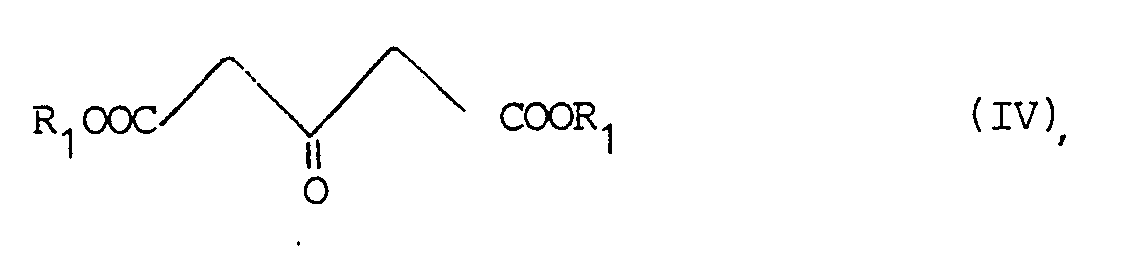
- Als Base für das obige Verfahren können beispielsweise Kaliumcarbonat, Natriumcarbonat oder ein tertiäres Amin wie beispielweise Diisopropylethylamin dienen. Die Umsetzung wird bei -60 °C bis + 60 °C, vorzugsweise 0 °C bis 40 °C durchgeführt. Als Lösungsmittel oder als Lösungsmittelgemische können beispielsweise Methanol, Ethanol, Isopropanol, Methylenchlorid, Tetrahydrofuran u.a. verwendet werden.
- Als gerad- oder verzweigtkettige Alkylreste mit 1-10 C-Atomen kommen die Rest Methyl, Ethyl, Propyl, Isopropyl, n-Butyl, Isolbutyl, tert.-Butyl, n-Pentyl, Isopentyl, Neopentyl, n-Hexyl, Isohexyl, n-Heptyl, Isoheptyl, n-Octyl, Isooctyl, n-Nonyl, n-Decyl u.a. einfügen. Bevorzugt sind Aklkylreste mit 1-6 C-Atomen, die durch einen Phenylrest substituiert sein können. Genannt seien z.B. Benzyl, Phenethyl, Cumyl etc.
- Die nach dem erfindungsgemäßen Verfahren hergestellten Verbindungen der Formel I dienen zur Herstellung pharmakologisch wirksamer Prostacyclin-Derivate.
- Die Verbindungen der allgemeinen Formel I können zur Herstellung pharmakologisch wirksamer Carbacyclin-Derivate eingesetzt werden [siehe hierzu R.C. Nickolson, M.N. Town und H. Vorbrüggen. Medicinal Research Review 5, 1 (1985) und P.A. Aristoff in Advances in Prostaglandin, Thromboxane and Leukotriene Research. Vol. 15 (1985)].
- Ausgehend von 2.4-Bismethoxycarbonyl-bicyclo [3.3.0] octan-3.7-dion ge langt man beispielsweise in einer mehrstufigen Synthese zum Wirkstoff Iloprost. Enyntioselektive, enzymatische Verseifung, beispielsweise mit α-Chymotrypsin, liefert gemäß DE 36 38 760.6 den optisch aktiven Mono ester IIa.


- Nach regioselektivem Schutz der Carbonylgruppe in IIa mit Ameisensäureethylester in Gegenwart von 2,2-Dimethyl-1,3-diol und einer katalytischen Menge p-Toluolsulfonsäure wird IIb mit Natriumborhydrid in Ethanol zum Alkohol V reduziert. Silylätherbildung (VI) und anschliessende Reduktion mit Diisobutylaluminiumhydrid in Toluol bei -70 °C liefert den Aldehyd VII, der mit 3-Methyl-2-oxo-hept-5-in-phosphonsäure-dimethylester und Natriumhydrid zum α,ϑ-ungesättigten Keton VIII kondensiert wird. Reduktion des Ketons VIII zum Alkohol IX, anschließende Schutzgruppenspaltung zum Diol X und Tetrahydropyranyletherbildung liefert das Keton XI, welches nach Wittig-Reaktion mit dem Ylen aus 4-Carboxybutyltriphenylphosphoniumbromid und anschließender Schutzgruppenabspaltung mit wäßriger Esigsäure in das Carbacyclinderivat Iloprost überführt wird.
- Die folgenden Ausführungsbeispiele dienen zur Erläuterung des erfindungsgemäßen Verfahrens, ohne es jedoch zu begrenzen.
- Zu einer Suspension von 80,1 g Kaliumcarbonat in 670 ml Methanol fügt man bei 24 °C eine Lösung von 66 g 4-tert-Butoxy-2-cyclopenten-1-on und 72,1 g Acetondicarbonsäureester in 165 ml Methanol und rührt 23 Stunden bei 25 °C unter Argon. Man säuert anschließend mit 30%iger Zitronensäurelösung auf pH 4 an, verdünnt mit Wasser und extrahiert fünfmal mit Methylenchlorid. Man wäscht die organische Phase dreimal mit Sole, trocknet über Natriumsulfat und dampft im Vakuum ein. Den Rückstand reinigt man durch Chromatographie an Kieselgel. Mit Essigester/Hexan-Gemischen eluiert man 64 g der Titelverbindung als farbloses Öl.
IR (CHCl₃): 3022, 2962, 1740, 1665, 1624, 1445/cm. - Das Ausgangsmaterial für die obige Titelverbindung wird wie folgt hergestellt:
- Zu einer Lösung von 64, 7 g 4-tert.-Butoxy-2-cyclopenten-1-ol (hergestellt aus Cyclopentadien gemäß: S. Takano et al., Heterocycles 16, 605 (1981)) in 750 ml Aceton tropft man bei -30 °C 90 ml Jones Reagenz (Chromtrioxid in Schwefelsäure) und rührt 20 Minuten bei -30 °C. Anschließend tropft man 50 ml Isopropylalkohol zu, verdünnt mit Äther und schüttelt mehrmals mit Wasser. Man trocknet mit Natriumsulfat und dampft im Vakuum ein. Der Rückstand wird ohne weitere Reinigung in die Kondensationsreaktion gemäß Beispiel 1 eingesetezt.
- Zu einer gerührten Suspension von 27 g Kaliumcarbonat in 116 ml Ethanol tropft man bei 0 °C unter Argon eine Lösung aus 13,7 4-Hydroxy-2-cyclopent-1-on (beispielsweise hergestellt aus 2-Methylfuran gemäß: v. Clauson-Kas et al., Acta chem. scand. 1947, 619 oder Synthesis 1986, 781) und 25, 36 ml Acetondicarbonsäurediethylester in 42 ml Ethanol, rührt 1 Stunde bei 0 °C und 24 Stunden bei 25 °C. Man engt im Vakuum ein, fügt 200 ml Waseer zu, säuert mit einer 20%igen Zitronsäurelösung auf pH 4 an, extrahiert mit Methylenchlorid und wäscht den organischen Extrakt mit Sole. Man trocknet über Magnesiumsulfat und dampft im Vakuum ein. Den Rückstand reinigt man durch Chromatographie an Kieselgel. Mit Essigester/Hexan-Gemischen eluiert man 28 g der Titelverbindung als farbloses Öl.
IR (CHCl₃): 3021, 2960, 1740, 1665, 1624, 1446/cm. - Zu einer Suspension von 900 mg Kaliumcarbonat in 7,5 ml Methanol fügt man bei 25 °C eine Lösung aus 1 g 4-Cumyloxy-2-cyclopenten-1-on und 0,83 g Acetondicarbonsäureester in 1,9 ml Methanol und rührt 24 Stunden bei 25 °C unter Argon. Man säuert anschließend mit 30%iger Zitronensäurelösung auf pH 4 an, verdünnt mit Wasser und extrahiert fünfmal mit Methylenchlorid. Man wäscht die organische Phase dreimal mit Sole, trock net über Natriumsulfat und dampft im Vakuum ein. Den Rückstand reinigt man durch Chromatographie an Kieselgel. Mit Essigester/Hexan-Gemischen eluiert man 0,85 g der Titelverbindung als schwach rosa gefärbtes Öl.
IR (CHCl₃): 3021, 2960, 1740, 1665, 1624, 1446/cm. - Das Ausgangsmaterial für die obige Titelverbindung wird wie folgt hergestellt:
- Zu einer Lösung von 4,1 g 4-Cumyl-2-cyclopenten-1-ol (hergestellt aus Cyclopentadien gemäß S. Takano, Chem. Pharm. Bull. 34, 3445 (1986)) in 50 ml Aceton tropft man bei -30 °C 6 ml Jones-Reagenz und rührt 20 Minuten bei -30 °C. Anschließend tropft man 6 ml Isopropanol zu, verdünnt mit Äther und schüttelt mehrmals mit Wasser. Man trocknet mit Natriumsulfat und dampft im Vakuum ein. Nach Filtration des Rückstands über Kieselgel mit Hexan/Essigester-Gemischen erhält man 3,81 g 4-Cumyloxy-2-cyclopenten-1-on als farbloses Öl.
Claims (1)
- Verfahren zur Herstellung von Bicyclo [3.3.0]-octandicarbonsäurediestern der allgemeinen Formel I,


Priority Applications (1)
| Application Number | Priority Date | Filing Date | Title |
|---|---|---|---|
| AT88730142T ATE73124T1 (de) | 1987-07-17 | 1988-07-01 | Verfahren zur herstellung von symmetrischen bicyclo(3.3.0>octan-diondicarbonsaeurediestern. |
Applications Claiming Priority (2)
| Application Number | Priority Date | Filing Date | Title |
|---|---|---|---|
| DE3724187 | 1987-07-17 | ||
| DE19873724187 DE3724187A1 (de) | 1987-07-17 | 1987-07-17 | Verfahren zur herstellung von symmetrischen bicyclo(3.3.0) octandiondicarbonsaeurediestern |
Publications (2)
| Publication Number | Publication Date |
|---|---|
| EP0299907A1 true EP0299907A1 (de) | 1989-01-18 |
| EP0299907B1 EP0299907B1 (de) | 1992-03-04 |
Family
ID=6332076
Family Applications (1)
| Application Number | Title | Priority Date | Filing Date |
|---|---|---|---|
| EP88730142A Expired - Lifetime EP0299907B1 (de) | 1987-07-17 | 1988-07-01 | Verfahren zur Herstellung von symmetrischen Bicyclo[3.3.0]octan-diondicarbonsäurediestern |
Country Status (10)
| Country | Link |
|---|---|
| US (1) | US4912251A (de) |
| EP (1) | EP0299907B1 (de) |
| JP (1) | JP2562495B2 (de) |
| AT (1) | ATE73124T1 (de) |
| AU (1) | AU620336B2 (de) |
| DE (2) | DE3724187A1 (de) |
| ES (1) | ES2037272T3 (de) |
| GR (1) | GR3004767T3 (de) |
| HU (1) | HU203072B (de) |
| WO (1) | WO1989000555A1 (de) |
Families Citing this family (1)
| Publication number | Priority date | Publication date | Assignee | Title |
|---|---|---|---|---|
| DE3708536A1 (de) * | 1987-03-13 | 1988-09-22 | Schering Ag | Neues verfahren zur antipodentrennung von bicyclo (3.3.0) octan-3,7-dion-2-carbonsaeureestern und ihrer monoketale |
-
1987
- 1987-07-17 DE DE19873724187 patent/DE3724187A1/de not_active Withdrawn
-
1988
- 1988-07-01 ES ES198888730142T patent/ES2037272T3/es not_active Expired - Lifetime
- 1988-07-01 DE DE8888730142T patent/DE3868743D1/de not_active Expired - Lifetime
- 1988-07-01 US US07/328,197 patent/US4912251A/en not_active Expired - Lifetime
- 1988-07-01 EP EP88730142A patent/EP0299907B1/de not_active Expired - Lifetime
- 1988-07-01 AU AU19950/88A patent/AU620336B2/en not_active Ceased
- 1988-07-01 HU HU884205A patent/HU203072B/hu not_active IP Right Cessation
- 1988-07-01 AT AT88730142T patent/ATE73124T1/de not_active IP Right Cessation
- 1988-07-01 WO PCT/DE1988/000414 patent/WO1989000555A1/de not_active Ceased
- 1988-07-01 JP JP63505829A patent/JP2562495B2/ja not_active Expired - Lifetime
-
1992
- 1992-05-29 GR GR920401117T patent/GR3004767T3/el unknown
Non-Patent Citations (1)
| Title |
|---|
| CHEMISCHE BERICHTE, Band 115, Nr. 4, 1982, Seiten 1437-1447, Verlag Chemie GmbH, Weinheim, DE; M. HARRE et al.: "Stereoselektive cyclopentanon-Anellierungen" * |
Also Published As
| Publication number | Publication date |
|---|---|
| JPH02500842A (ja) | 1990-03-22 |
| GR3004767T3 (de) | 1993-04-28 |
| ATE73124T1 (de) | 1992-03-15 |
| WO1989000555A1 (fr) | 1989-01-26 |
| EP0299907B1 (de) | 1992-03-04 |
| DE3868743D1 (de) | 1992-04-09 |
| ES2037272T3 (es) | 1993-06-16 |
| AU620336B2 (en) | 1992-02-20 |
| US4912251A (en) | 1990-03-27 |
| AU1995088A (en) | 1989-02-13 |
| DE3724187A1 (de) | 1989-01-26 |
| HUT51228A (en) | 1990-04-28 |
| JP2562495B2 (ja) | 1996-12-11 |
| HU203072B (en) | 1991-05-28 |
Similar Documents
| Publication | Publication Date | Title |
|---|---|---|
| Struijk et al. | Specificity in the enzymic conversion of polyunsaturated fatty acids into prostaglandins | |
| CH651292A5 (de) | Bicyclo(3,3,0)octan-derivate. | |
| US3636120A (en) | Prostaglandin e primary alcohols | |
| SU727139A3 (ru) | Способ получени оптически активных 11-дезокси-16-арил- тетранорпростагландинов, или их рацематов или их солей | |
| DE2319017C3 (de) | Verfahren zur Herstellung von Prostaglandinen der Eins-Reihe | |
| EP0299907B1 (de) | Verfahren zur Herstellung von symmetrischen Bicyclo[3.3.0]octan-diondicarbonsäurediestern | |
| US3524867A (en) | Process for producing cyclopenta (b)pyrans | |
| DE2423485A1 (de) | Bicyclooctan-derivate | |
| DE2940336A1 (de) | Lithiumaluminiumhydridverbindungen | |
| EP0585104B1 (de) | Verfahren zum Herstellen einer gesättigten monocyclischen Kohlenwasserstoffverbindung und ein Zwischenprodukt für dieses | |
| EP0272202B1 (de) | Verfahren zur Herstellung von optisch aktiven Bicyclo [3.3.0] octandioncarbonsäureestern | |
| DE2429766A1 (de) | Verfahren zur herstellung von optisch aktiven bicyclischen lactondiolen und deren racemische gemische | |
| DE2257533A1 (de) | Gesamtsynthese von prostaglandin e tief 1 | |
| US4103091A (en) | Method for the preparation of prostaglandin intermediates from a mold metabolite | |
| EP0008077B1 (de) | Neue Prostaglandinderivate in der Delta-2-PGF2 und Delta-2-PGE2-Reihe, Verfahren zu deren Herstellung und ihre Verwendung als Arzneimittel | |
| EP0270481B1 (de) | Neues Verfahren zur Herstellung von optisch aktiven Carbacyclin-Zwischenprodukten | |
| DE69400388T2 (de) | Cyclohexendiolderivate | |
| US3694472A (en) | Synthesis of pyrethric acid | |
| DE3620646A1 (de) | Verfahren zur herstellung von (1r, 4s)-4-hydroxy-2-cyclopentenylestern | |
| US3504021A (en) | Process for the preparation of abscisin ii | |
| US4188329A (en) | Intermediates for the preparation of prostaglandins and prostaglandin analogs from a mold metabolite | |
| DE2212589B2 (de) | Verfahren zur Herstellung von 13 beta-R-4,9,11-gonatrienen und 13 beta-R-4,5-seco-9,l 1-gonadiene als Zwischenprodukte | |
| JPS6150936B2 (de) | ||
| EP0340247B1 (de) | Neues verfahren zur antipodentrennung von bicyclo 3.3.0]octan-3,7-dion-2-carbonsäureestern und ihrer 7-monoketale | |
| DE2429750A1 (de) | Verfahren zur herstellung von optisch aktiven tricyclischen lactonglykolen und deren racemische gemische |
Legal Events
| Date | Code | Title | Description |
|---|---|---|---|
| PUAI | Public reference made under article 153(3) epc to a published international application that has entered the european phase |
Free format text: ORIGINAL CODE: 0009012 |
|
| 17P | Request for examination filed |
Effective date: 19880712 |
|
| AK | Designated contracting states |
Kind code of ref document: A1 Designated state(s): AT BE CH DE ES FR GB GR IT LI LU NL SE |
|
| 17Q | First examination report despatched |
Effective date: 19910409 |
|
| GRAA | (expected) grant |
Free format text: ORIGINAL CODE: 0009210 |
|
| AK | Designated contracting states |
Kind code of ref document: B1 Designated state(s): AT BE CH DE ES FR GB GR IT LI LU NL SE |
|
| REF | Corresponds to: |
Ref document number: 73124 Country of ref document: AT Date of ref document: 19920315 Kind code of ref document: T |
|
| REF | Corresponds to: |
Ref document number: 3868743 Country of ref document: DE Date of ref document: 19920409 |
|
| ITF | It: translation for a ep patent filed | ||
| GBT | Gb: translation of ep patent filed (gb section 77(6)(a)/1977) | ||
| ET | Fr: translation filed | ||
| PLBE | No opposition filed within time limit |
Free format text: ORIGINAL CODE: 0009261 |
|
| STAA | Information on the status of an ep patent application or granted ep patent |
Free format text: STATUS: NO OPPOSITION FILED WITHIN TIME LIMIT |
|
| REG | Reference to a national code |
Ref country code: GR Ref legal event code: FG4A Free format text: 3004767 |
|
| 26N | No opposition filed | ||
| REG | Reference to a national code |
Ref country code: ES Ref legal event code: FG2A Ref document number: 2037272 Country of ref document: ES Kind code of ref document: T3 |
|
| EPTA | Lu: last paid annual fee | ||
| EAL | Se: european patent in force in sweden |
Ref document number: 88730142.2 |
|
| PGFP | Annual fee paid to national office [announced via postgrant information from national office to epo] |
Ref country code: AT Payment date: 19950616 Year of fee payment: 8 |
|
| PGFP | Annual fee paid to national office [announced via postgrant information from national office to epo] |
Ref country code: SE Payment date: 19950619 Year of fee payment: 8 |
|
| PGFP | Annual fee paid to national office [announced via postgrant information from national office to epo] |
Ref country code: CH Payment date: 19950622 Year of fee payment: 8 Ref country code: BE Payment date: 19950622 Year of fee payment: 8 |
|
| PGFP | Annual fee paid to national office [announced via postgrant information from national office to epo] |
Ref country code: NL Payment date: 19950628 Year of fee payment: 8 |
|
| PGFP | Annual fee paid to national office [announced via postgrant information from national office to epo] |
Ref country code: GR Payment date: 19950630 Year of fee payment: 8 |
|
| PGFP | Annual fee paid to national office [announced via postgrant information from national office to epo] |
Ref country code: LU Payment date: 19950701 Year of fee payment: 8 |
|
| PGFP | Annual fee paid to national office [announced via postgrant information from national office to epo] |
Ref country code: ES Payment date: 19950706 Year of fee payment: 8 |
|
| PG25 | Lapsed in a contracting state [announced via postgrant information from national office to epo] |
Ref country code: LU Free format text: LAPSE BECAUSE OF NON-PAYMENT OF DUE FEES Effective date: 19960701 Ref country code: AT Effective date: 19960701 |
|
| PG25 | Lapsed in a contracting state [announced via postgrant information from national office to epo] |
Ref country code: SE Effective date: 19960702 Ref country code: ES Free format text: LAPSE BECAUSE OF THE APPLICANT RENOUNCES Effective date: 19960702 |
|
| PG25 | Lapsed in a contracting state [announced via postgrant information from national office to epo] |
Ref country code: LI Effective date: 19960731 Ref country code: CH Effective date: 19960731 Ref country code: BE Effective date: 19960731 |
|
| BERE | Be: lapsed |
Owner name: SCHERING A.G. BERLIN UND BERGKAMEN Effective date: 19960731 |
|
| PG25 | Lapsed in a contracting state [announced via postgrant information from national office to epo] |
Ref country code: GR Free format text: THE PATENT HAS BEEN ANNULLED BY A DECISION OF A NATIONAL AUTHORITY Effective date: 19970131 |
|
| PG25 | Lapsed in a contracting state [announced via postgrant information from national office to epo] |
Ref country code: NL Effective date: 19970201 |
|
| REG | Reference to a national code |
Ref country code: GR Ref legal event code: MM2A Free format text: 3004767 |
|
| REG | Reference to a national code |
Ref country code: CH Ref legal event code: PL |
|
| NLV4 | Nl: lapsed or anulled due to non-payment of the annual fee |
Effective date: 19970201 |
|
| EUG | Se: european patent has lapsed |
Ref document number: 88730142.2 |
|
| REG | Reference to a national code |
Ref country code: ES Ref legal event code: FD2A Effective date: 19991007 |
|
| PGFP | Annual fee paid to national office [announced via postgrant information from national office to epo] |
Ref country code: FR Payment date: 20000621 Year of fee payment: 13 |
|
| PGFP | Annual fee paid to national office [announced via postgrant information from national office to epo] |
Ref country code: GB Payment date: 20000622 Year of fee payment: 13 |
|
| PGFP | Annual fee paid to national office [announced via postgrant information from national office to epo] |
Ref country code: DE Payment date: 20000629 Year of fee payment: 13 |
|
| PG25 | Lapsed in a contracting state [announced via postgrant information from national office to epo] |
Ref country code: GB Free format text: LAPSE BECAUSE OF NON-PAYMENT OF DUE FEES Effective date: 20010701 |
|
| PG25 | Lapsed in a contracting state [announced via postgrant information from national office to epo] |
Ref country code: DE Free format text: LAPSE BECAUSE OF THE APPLICANT RENOUNCES Effective date: 20010802 |
|
| GBPC | Gb: european patent ceased through non-payment of renewal fee |
Effective date: 20010701 |
|
| PG25 | Lapsed in a contracting state [announced via postgrant information from national office to epo] |
Ref country code: FR Free format text: LAPSE BECAUSE OF NON-PAYMENT OF DUE FEES Effective date: 20020329 |
|
| REG | Reference to a national code |
Ref country code: FR Ref legal event code: ST |
|
| PG25 | Lapsed in a contracting state [announced via postgrant information from national office to epo] |
Ref country code: IT Free format text: LAPSE BECAUSE OF NON-PAYMENT OF DUE FEES;WARNING: LAPSES OF ITALIAN PATENTS WITH EFFECTIVE DATE BEFORE 2007 MAY HAVE OCCURRED AT ANY TIME BEFORE 2007. THE CORRECT EFFECTIVE DATE MAY BE DIFFERENT FROM THE ONE RECORDED. Effective date: 20050701 |