EP0300651B1 - Electrode photosensible pour la détermination de potentiel redox - Google Patents
Electrode photosensible pour la détermination de potentiel redox Download PDFInfo
- Publication number
- EP0300651B1 EP0300651B1 EP88306248A EP88306248A EP0300651B1 EP 0300651 B1 EP0300651 B1 EP 0300651B1 EP 88306248 A EP88306248 A EP 88306248A EP 88306248 A EP88306248 A EP 88306248A EP 0300651 B1 EP0300651 B1 EP 0300651B1
- Authority
- EP
- European Patent Office
- Prior art keywords
- redox
- medium
- potential
- redox potential
- layer
- Prior art date
- Legal status (The legal status is an assumption and is not a legal conclusion. Google has not performed a legal analysis and makes no representation as to the accuracy of the status listed.)
- Expired - Lifetime
Links
Images




Classifications
-
- G—PHYSICS
- G01—MEASURING; TESTING
- G01N—INVESTIGATING OR ANALYSING MATERIALS BY DETERMINING THEIR CHEMICAL OR PHYSICAL PROPERTIES
- G01N27/00—Investigating or analysing materials by the use of electric, electrochemical, or magnetic means
- G01N27/26—Investigating or analysing materials by the use of electric, electrochemical, or magnetic means by investigating electrochemical variables; by using electrolysis or electrophoresis
- G01N27/28—Electrolytic cell components
- G01N27/30—Electrodes, e.g. test electrodes; Half-cells
- G01N27/305—Electrodes, e.g. test electrodes; Half-cells optically transparent or photoresponsive electrodes
Definitions
- the invention concerns electronic devices for measuring redox potential in an electrolyte and for measuring the rate of change in redox potential in electrodes containing an analyte where the analyte is made to effect a change in redox potential.
- One of the problems associated with sensitive measurement of redox species or redox reactions with a redox electrode is that stray currents within the electrochemical measurement cell or within the circuitry attached to the redox electrode introduce error into the measurement. Such stray currents may arise from a number of sources including corrosion reactions within the cell, electrical short circuits, or pickup of electrical noise from the environment. It is therefore desirable to minimize these sources of measurement error by using corrosion resistant materials and by employing measurement devices and circuitry configurations which reliably minimize stray currents.
- another problem associated with sensitive measurement of redox species is the need for a stable, liquid junction, reference electrode. Such reference electrodes are costly and inconvenient to provide in otherwise solid-state measurement devices.
- reference electrodes can be unreliable in commercial use, because various reference electrodes, such as liquid reference electrodes tend to show drift in potential. In this situation, one must find some way to compensate for the change in potential of the reference electrode in order to be able to compare results obtained at different times. There is therefore, an interest in finding techniques to obviate the need for a liquid reference electrode or provide an alternative standard of reference.
- US-A-4 490 216 describes a lipid membrane containing electronanalytical element.
- US-A-4 020 830, 4 322, 680 and 4 397 714 describe the use of chemically-sensitive field effect transistors to detect redox compounds.
- US-A-4 591 550 describes the use of monolithic semiconductors for determining by electrochemical analysis a plurality of samples at different sites on the semiconductor, interrogating various sites of the semiconductor with light, and generating charge effects.
- a photoresponsive semiconductor layer has an insulative layer covering at least of its surface, and means for irradiating the photoresponsive layer. Circuitry is provided for measuring the change in photo-induced electrical signal as a function of the state of the medium.
- a conductive layer is provided on the insulative layer, or on the semiconductor layer at uncovered portions of that layer, and is for contact with the liquid medium, the irradiation being effectively to produce minority carriers in the conductive layer.
- potential of the redox couple may be related to the standard potential of the redox couple and the ratio of reduced and oxidized members of the redox pair. The presence and amount of an analyte may be detected by its effect on the ratio of reduced and oxidized members of the redox pair and thus upon the redox potential.
- Measurements are made on the medium by photoresponsively monitoring electrical-field-effects within a surface region of the photoresponsive substrate, where the potential on the conductive layer affects the electrical field within such region.
- Various measurements may be employed to monitor photoresponsively electrical-field-effects within such region of the photoresponsive substrate, including monitoring photoconductance, photocapacitance, photovoltage, or photocurrent.
- the need for a liquid junction reference electrode is obviated by monitoring photoresponsively both a) the redox potential at a first surface region of the photoresponsive substrate, where the electrical field is influenced by the redox potential of the medium in contact with the conductive layer; and b) monitoring the electrical field at a second surface region of the photoresponsive substrate, where the electrical field is substantially independent of the redox potential of the medium or varies in a known manner different from the variation at the first site.
- the response as measured at the first and second sites may be compared so as to determine the relative difference in redox potential of electrolytes of different composition present at the first and second sites or to determine the change in redox potential over time at one site with respect to the electrical field at the other site.
- electrochemical methods and photoresponsive devices are provided for determining the state of an electrolyte medium where the state affects the measured redox potential of the medium.
- the redox potential of the electrolyte medium is monitored with an electrochemical measurement cell employing two or more electrodes.
- the first electrode is a working electrode comprised of a photoresponsive substrate with an electronically conductive layer in contact with the electrolyte.
- an electrically insulating layer is placed between the photoresponsive substrate and the surface of the electronically conductive layer. The insulating layer is sufficiently thin, so that the potential of the electronically conductive layer substantially affects the electrical field within a surface region of the photoresponsive substrate.
- a portion of the insulating layer is free of the electronically conductive layer, so as to be in direct contact with the electrolyte to provide a redox potential independent photoresponse.
- the second electrode may be a potential-stable, liquid junction reference electrode or a less potential-stable controlling electrode.
- both the reference electrode and the controlling electrode may be employed together with the working photoresponsive electrode to form a 3-electrode electrochemical cell.
- the redox potential of the electrolyte determines the potential of the electronically conductive layer on the working electrode.
- the potential of the electronically conductive layer in turn determines the magnitude and direction of the electrical field within a surface region of the photoresponsive substrate.
- the magnitude and direction of the electrical field may be monitored by a variety of photoresponsive measurements.
- the photoresponsive measurements provide a measurement of the redox potential of an unknown electrolyte medium relative to a redox potential of a standard electrolyte, which may be introduced as the electrolyte medium. Multiple photoresponsive measurements may be made sequentially over time, so as to provide information as to the rate of redox potential change of the medium over time.
- the states may involve redox potential, pH, concentration of a solute, presence of a particular moiety, volume, temperature, or other variable, which can be detected either directly or indirectly by a photoresponsive electrical measurement.
- the device employs light means for interrogating one or more sites of the working electrode.
- a circuit is provided for determining the signal produced by irradiation of the working electrode, where the signal will be related to the redox potential, the pH, or other ionic components of the medium. These signals in turn may be related to another state of the medium.
- the methods employ a wide variety of systems which allow for variation in the redox potential, pH state, or other ionic composition state, of the medium in relation to the state of interest, particularly the concentration of an analyte or the presence of a particular moiety.
- the device which is employed may have one or a plurality of working electrodes, each with one or more sites for irradiation, and at least one electronically conductive layer associated with at least one of the working electrodes.
- Each of the working electrodes will have an ohmic contact or connection to a circuit, where individual working electrodes may have a common connection to the circuit. Alternatively, the individual working electrode may have individually switched connections to the circuit, so that each of the working electrodes may be electrically isolated.
- the sample will contact each of the electrodes, and preferably the sample will contact both the electronically conductive layer and the working electrode surface free of the electronically conductive layer.
- the working photoresponsive electrode may or may not have an insulative layer, but in order to obtain a potentiometric rather than an amperometric measurement, where an insulative layer does not provide the high resistance, the circuit requires some other high resistance element.
- the electronically conductive layer may be referred to as a metal layer, although it should be understood that electron conductors other than metals may also be used.
- the measurement of the redox potential, pH, or other ionic composition of the medium are indirect potentiometric measurements, where the photoresponsive parameter, preferably photocurrent or photovoltage, may be measured directly.
- the photoresponsive parameter preferably photocurrent or photovoltage
- the remaining variables may be determined as a function of time.
- a reference electrode which provides for a standard potential, is not required. Incorporation of such reference electrode, however, allows a separate determination of the medium component of interest to be made.
- a variety of physical or chemical states of the medium may be normalized.
- Such variables as volume, temperature, solute acitivity, or the like may be determined.
- a fixed amount of reactant e.g., enzyme, which produces a known change in pH or redox potential over a predetermined time period in relation to the reference electrode and a predefined set of conditions, can be used to determine a change in one of the conditions, where the other conditions are held constant.
- the device will provide for photoirradiation of the working electrode at one or more sites associated with the region under the electronically conducting layer and with the region under an area free of the electronically conducting layer. Photoirradiation may occur simultaneously at both regions, particularly regions contiguous to each other, or sequentially.
- a ramp in bias potential and measure the photoresponse, e.g., photovoltage or photocurrent, as a function of the bias potential value.
- the photoresponse e.g., photovoltage or photocurrent
- results of the measured photoresponses versus bias potential relationship are obtained for each site.
- a standard redox potential electrolyte may be provided at one, or more, of the sites so as to provide an internal redox potential standard at at least one site.
- the redox potential of an unknown assay medium may be determined at one or more sites that are different from the sites of the standard.
- the metal layers associated with each independent site may have any shape or form; however, it is important that the metal layers are not connected one to another by any substantially conductive material other than the electrolyte medium.
- one or more of the sites associated with the illuminated regions of the working electrode may have the metal layer omitted.
- a pH-responsive or other specific ion-responsive surface may be provided instead.
- the pH or other specific ion composition may be maintained fixed at one or more of the sites away from the metal layer so as to provide an alternative internal potential standard.
- any variation in the observed photoresponse versus bias potential relationship can be related to either a change in the state of the medium or to a change in the measurement system.
- the assay medium may be prepared by adding the appropriate reagents, which will provide for either a constant redox potential, a constant pH, or other constant ionic moiety composition of a medium during the period of measurement.
- the analyte may be a component of the redox couple, or may react with a component of the redox couple, or may influence the redox potential of a redox couple.
- the analyte, or a product resulting from the analyte may affect directly or indirectly the pH or other ionic composition of the medium.
- the analyte itself may be measured directly or may serve to influence a medium component to provide a change in the observed photoresponsive electrical signal related to the amount of analyte.
- the electrodes are contacted with the sample, so that the sample forms a conducting bridge between the counterelectrode, the photoresponsive working electrode, and, optionally, the reference electrode.
- the working electrode is then illuminated so as to produce excess minority charge carriers in a surface region of the photoresponsive substratum of the working electrode where the electrical field is substantially affected by the potential of the metal layer.
- the electrical signal i.e., the photoresponsive versus bias potential relationship, may be compared to a standard relationship for a defined set of conditions to determine the redox potential of the medium.
- One may illuminate, in addition, a region of the working electrode displaced from the metal layer.
- Excess minority charge carriers in such surface region of the photoresponsive substratum of the working electrode may be produced, where the electrical field is substantially affected by the potential at such site on the working electrode surface.
- This site may be comprised of an insulator with a pH-responsive surface so as to produce an electric field within a surface region of the photoresponsive substratum that is pH-responsive.
- either the insulator or base photoresponsive substrate may be coated with a specific-ion-responsive membrane, so as to produce an electric field within a surface region of the photoresponsive substratum that is responsive to a specific ion within the medium.
- Such ion-selective membranes are well known in theory and operation. See, for example, Steiner, et al., Anal. Chem. (1979) 51 :351, and references cited therein.
- Ionic analytes of interest include lithium, potassium, calcium, cesium, ammonium, sodium, chloride, fluoride, sulfide, both cations and anions.
- the electrical signal i.e., the photoresponse versus bias potential relationship
- the electrical signal may be obtained separately in the redox sensitive region (i.e., the region covered with the metal layer) and in the pH or specific ion sensitive region. These separately obtained signals then may be compared in order to derive a relationship between redox potential and pH or ionic composition of the medium. By repeating both the above measurement and comparison steps over time, one may deduce the rate of change in the relationship between redox potential and pH or ionic composition over time. Because the precision of determining the relationship or rate of change of the relationship is independent of the reference electrode potential, a potential-stable reference electrode is not required for precise measurement of the relationship or rate of change in the relationship over time.
- a stepped photoresponse upon ramping the bias voltage.
- the initial step in the photoresponse is related to the potential either of the surface metal layer or the surface free of such metal layer.
- the second step is related to the potential of the remaining surface (i.e., the one of the two above surfaces which was not related to the initial step) associated with the illuminated region of the photoresponsive electrode.
- This convenient method offers the advantage of employing only a single beam of illumination and employing only a single ramp in applied bias potential for each multiple determination of surface potentials.
- determination of at least two parameters, such as redox potential and pH, for example, are maintained with this convenient and simple method.
- the photoresponsive working electrode generally will be composed of semiconductor or photoconductor materials, such as silicon, which may be a single crystal, polycrystalline or amorphous, gallium arsenide, gallium selenide, aluminum gallium arsenide, chlorogallium phthalocyanine or the like.
- the semiconductor material will be either of the p- or n-type and, as appropriate, and may employ such dopants as boron, aluminum, phosphorus, arsenic, antimony, or the like.
- the degree of doping may be varied widely, there being a wide variety of commercially-available doped wafers which can be used, where the body of the wafer is lightly doped and portions of the wafer heavily doped. The doping will be substantially uniform adjacent to the surface in contact with the sample.
- concentration of the dopant normally will vary empirically to provide the desired response, frequently being a matter of convenience, and generally will range from about 1012 to 1018 atoms/cc, usually for silicon, the resistivity will be about 0.01-1000 ohm-cm.
- the monolithic wafers may come in a variety of sizes and shapes, varying from chip size which may have its largest dimension of at least about 1.0mm, usually 2mm; or wafer size, which may be 500mm, more usually not more than about 100mm in its largest dimension.
- the electrode region usually will have at least one smooth surface or smooth portion of a surface, desirably flat, which will serve as the electrode surface.
- the wafer may be round, rectangular, elongate or the like.
- the thickness of the chip or wafer generally will be not more than about 2mm, usually less than about 1mm, and generally not less than about 0.05 ⁇ m, usually not less than about 0.1mm.
- An insulative layer normally is employed to cover the exposed working electrode regions, which layer usually will be coated uniformly.
- the significant factor is that the semiconducting portion of the working electrode is insulated electrically and chemically from the medium by some means.
- a coating of silicon oxide and/or silicon nitride can be employed, generally of from about 20 to 200nm, preferably from about 60 to 150nm to provide for the insulative layer.
- the silicon oxide or nitride can be used by itself or in conjunction with other materials, or such other materials may be used substantially independently of the silicon oxide or nitride. That is, various insulative coatings may be employed which are stable under the conditions of use and provide for the desired degree of insulation and response.
- Methods for providing coatings include spraying, painting, dipping, reacting with an active vapor, e.g., steam or ammonia, or a reactive reagent in solution, e.g., silyl chloride, vapor deposition, electrodeposition, or the like.
- an active vapor e.g., steam or ammonia
- a reactive reagent in solution e.g., silyl chloride, vapor deposition, electrodeposition, or the like.
- Silicon oxide layers can be achieved with the use of oxygen or water vapor, controlling the thickness of the layer by the conditions employed, e.g., time and temperature. Silicon oxide coatings also can be obtained by electrodeposition. Silicon nitride layers can be obtained by reaction of silicon and nitrogen or reaction of compounds containing silicon and nitrogen such as dichlorosilane and ammonia. Standard methods of deposition of silicon nitride from the reaction of silanes and ammonia or nitrogen in the gas phase are well known to those skilled in the art of microfabrication.
- the device may have a single continuous surface ranging from a surface area of about 1mm2 to about 250cm2, more usually about 5cm2, but in most instances will be a plurality of individual elements insulated from each other, so as to provide for independent signals to the same circuit.
- the individual units generally will range from about 0.1mm2 to 25mm2 or greater, the upper limit being primarily one of convenience, and the effect of size on sensitivity.
- the individual units may be in contact with media which are isolated partially, or completely, from each other by the presence of partitions which allow for electrical communication, for example, membranes, porous walls or partitions extending only a partial distance to the surface, or by insulated partitions which inhibit any electrical communication between the partitioned media.
- partitions which allow for electrical communication, for example, membranes, porous walls or partitions extending only a partial distance to the surface, or by insulated partitions which inhibit any electrical communication between the partitioned media.
- the surface of the device may be divided up physically in a variety of ways, providing for compartments, which may be of any convenient periphery, circular, square or the like, channels, which may be circular, serpentine or straight, or combinations thereof. Extended areas such as channels allow for inspection of a moving solution at different times. Channels can be provided by having grooves in either the redox potential, pH, or specific-ion-selective surface of the working electrode or the opposing surface. Compartments can be divided by having indentations in either of said surfaces. The number of independent units to be measured may be 1, 2, or more, usually 3 or more, and may be 50 or more, and could be as high as 500 or more.
- individual semiconductor elements may be employed, arrays of such elements or a monolithic semiconductor, where the photoresponsive substrate, e.g., the semiconductor, may be substantially uniform or homogeneous in composition in the region of interest or individual areas ("pixels") may be isolated by various mechanical (structural) or electrical means.
- the photoresponsive substrate e.g., the semiconductor
- a number of isolated electrode regions may be formed by doping certain locations, which are separated from other electrode regions by insulating regions.
- Individual pixels are coupled to a circuit which provides a ramped DC bias voltage applied between the working electrode and the reference or controlling electrode, so as to produce a measurable photoresponse as a function of the applied DC bias potential.
- the DC bias voltage may be applied to maintain the photoresponse at a fixed or known value and DC bias potential required to maintain the fixed or known value is recorded.
- the redox potential-sensitive region of the working electrode i.e., the region associated with the metal surface layer
- a region associated with either the pH-sensitive surface or other ion-selective surface are illuminated simultaneously.
- the illumination intensity is made to vary with time so as to produce a time-varying response such as photocurrent or photovoltage (e.g., an alternating photocurrent or photovoltage).
- the amplitude of the alternating photocurrent, photovoltage, or other photoresponse may be determined by at least the following potentials: the applied bias potential, the potential of the metal surface layer, the potential of the pH sensitive surface, or the potential across an ion-selective membrane.
- the effects of changes in redox potential, pH, or other selected ionic composition of the medium may be determined separately.
- such a change may be realized by changing the assay medium from a standard composition to a second, or unknown, composition or by introduction of an enzyme or other catalyst which causes the redox potential, the pH, or another selected ionic composition of the electrolyte medium to vary with time.
- a plurality of pixels can be provided with a single photoresponsive electrode by insulating each of the pixels from each other.
- Such electrical insulation may be effected either by interposing nonconducting material between pixels (insulator isolation) or, when the photoresponsive material is a semiconductor, by applying a reverse-bias potential to a p-n semiconductive junction (junctional isolation).
- an external measuring circuit For measurement of changes in the photoresponsive working electrode potential, an external measuring circuit will be utilized.
- the circuit, or multiplicity of circuits may make electrical contact, separately, with each of the pixels. In the case of a single circuit, separate electrical contact with each of the pixels is made in temporal sequence by means of an electrical switching mechanism. Additionally, the external circuit(s) makes contact with either a single counterelectrode or a multiplicity of counterelectrodes placed in the liquid sample medium.
- the pixels can be fabricated individually or be part of a single semiconductor wafer.
- the semiconductor wafer then may be doped oppositely from the dopant of the wafer at a plurality of sites to define the pixels (junctional isolation).
- Various means may be provided for ensuring the insulation of each of the pixels from each other.
- a reverse-bias potential (voltage) may be applied to the oppositely doped region in order to insure that the p-n junctions are maintained in their nonconducting (reverse-biased) state. Ion or charge implantation in the region of the p-n junction may be used as another means of insuring that the junctions are maintained in the nonconducting state.
- each pixel may be eroded, so as to create a well between each pixel and the resulting islands and intervening areas modified to provide for an insulative region.
- the insulative region may be an oxide or nitride or a combination thereof, or another ceramic insulative material such as alumina, a glass, or quartz.
- Polymers of nonconducting organic material may also find use. A vast variety in such materials exist including, epoxides, polyamides, polyacrylates, polyolefins, and polyfluorocarbons.
- Each of the pixels may have an independent contact to a circuit, so that any change in the electrical measurement may be determined individually or may have a common lead to a circuit.
- Various techniques can be employed for connecting the pixels individually to the external circuit.
- Various electrical circuits may be used to measure changes in photoresponsiveness of the working electrode as a function of the applied bias potential, which results from changes in the state of an individual portion of the medium. These electrical circuits may measure primarily changes in photoconductance, photovoltage, photocapacitance, or photocurrent. The circuits will be chosen so as to provide maximal sensitivity for detecting small changes in the state of the parameters. These measured parameters generally will be referred to as the photoresponse.
- the observed signal from the curcuit can be a result of a change in direct current, alternating current or the effect of a direct current on an alternating current.
- the circuits employed allow for measuring different variables, such as AC amplitude, bias potential, DC amplitude, the AC component of the light intensity amplitude, the DC component of the light intensity amplitude or the like.
- the variables can be interrelated automatically by varying the bias potential or light intensity relationship to the photoresponse. For example, one can vary the bias potential to maintain a constant AC or DC photoresponse and measure the required change in bias potential; or one can fix the bias potential and measure the direct current resulting from steady illumination or the alternating current resulting from amplitude modulated illumination; or, one can fix the amplitude of the AC or DC photoresponse by varying the intensity of the modulated or continuous illumination and measuring the required light intensity.
- each of the pixels there will be an electrically conductive layer, usually a coated metal layer upon an insulative layer of the working electrode.
- the electrically conducting layer may be applied to the surface of the working electrode in a variety of ways, including sputtering, ion beam or thermal evaporative coating or by other vapor deposition methods, by electrodeposition, or by precipitation.
- the electrically conducting layer will generally be of a thickness in the range of about 0,5nm to 5mm, more usually in the range of about 0.01 to 10 ⁇ m.
- the surface area of the electrically conducting layer is not critical above a certain minimum, generally having a surface area of at least about 1mm2 more usually at least about 1mm2, and preferably from about 1mm2 to 20mm2.
- each of the pixels where each pixel has its own electrically conducting (e.g., metal layer) region and pH sensitive region, the pH sensitive regions or specific-ion-sensitive regions will have a surface area of at least about 10mm2, usually at least about 1mm2 and generally from about 1mm2 to 100mm2.
- electrically conducting e.g., metal layer
- pH sensitive regions or specific-ion-sensitive regions will have a surface area of at least about 10mm2, usually at least about 1mm2 and generally from about 1mm2 to 100mm2.
- the materials employed for the electrically conducting layer for the redox site will be selected so as to be inert to the medium and adherent to the substratum, to have electrically conducting properties of or, analogous to metals, be capable of being coated onto the working electrode surface and to be readily controllable as to placement, thickness and the like.
- the noble metals will be employed, such as gold, platinum, rhodium, iridium, or the like.
- other materials may be employed, such as highly doped semiconductive materials, both organic or inorganic, e.g., graphite, tin oxide, indium oxide, or mixtures of tin and indium oxide.
- the subject devices can address one or more incremental portions of one or more media to be analyzed, where the incremental portion or volume can be indicative of the gross properties of the medium or particular incremental portions of the medium, where properties of incremental portions may differ in their properties one from the other as well as from the properties of the gross medium.
- individual light sources may be directed by lenses or light directing means to the site, e.g. optical fibers, or a common light source with masks, optical filters, or the like may be used.
- one can address different portions of the medium to determine the state of the incremental portion as to its redox potential, pH or other ionic composition, and determine variations in the state of the medium over a large volume.
- one may employ one or more channels and determine the state of the incremental portions along the channel, so that one can relate variations in the states of the incremental portions along the channel to a temporal change occurring in the medium.
- continuous or intermittent flow techniques or by mixing two media which provide for a detectable reaction prior to entering the channel, one can provide a steady state at different sites along the channel. In this manner, one can determine rates of reaction by observing the steady state properties of the medium at different sites along the channel.
- the counter- or second-electrode generally will be at a postion from about 0.01mm to 5cm distance from the insulative layer, more usually from about 0.1mm to 10mm.
- the counterelectrode may be any conducting or semiconducting material, such as metals; e.g., platinum; gold, titanium, stainless steel, brass or other conducting oxides, e.g., indium-tin-oxide: doped or heavily doped semiconductive materials, e.g. silicon: conducting polymers, e.g. polypyrrole; or the like.
- the second electrode desirably will be of a material which is inert to the sample medium or will be coated with a protective layer, which may be a thin film, generally under about 12.7 x 10 ⁇ 3 cm (5 x 10 ⁇ 3 inch), usually under about 2.5 x 10 ⁇ 3 cm (1 x 10 ⁇ 3 inch), which may be an organic polymeric layer, a silicon oxide or nitride layer, or the like.
- the protective coating may be comprised of a series of such layers.
- the second electrode will be either a point or a continuous electrode facing the operating surface of the first electrode or will be a plurality of individual electrodes associated with individual sites of the operating area of the photoresponsive electrode.
- the counterelectrode may assume a number of conformations.
- the counterelectrode may be a wire, a thin layer on a support, being present as stripes, dots or a continuous coating, may be a metallic or semiconductor layer or wafer.
- Each working electrode will have a connection, either individual or common, through ohmic contact to a circuit for detecting changes in a medium component.
- a monolithic photoresponsive wafer is employed having a plurality of medium-contacting regions, only a single lead is required to the working electrode.
- Irradiation of the photoresponsive substrate may be from either side of the wafer. However, where the irradiation occurs on the side opposite to the side associated with the medium of interest, it will be necessary that the wafer be thin, so that the conductive band which is influenced by the medium of interest can also be affected by the light irradiation. Normally, in this situation, the thickness of the photoresponsive element will be from about 0.05 ⁇ m to 5mm, usually from 10 ⁇ m to 1mm.
- the light source may be any convenient source, particularly of photon energy at least about the conduction band gap of the photoresponsive substrate, so as to produce mobile charges, i.e., free electrons and positive holes: For silicon, this is about 1.1eV.
- the light source generally will vary in the range of ultraviolet to infrared. This would provide for a wavelength range generally in the range of about 0.1 ⁇ to 1 ⁇ , more usually from abut 0.3 ⁇ m to 1 ⁇ m.
- Other photoresponsive materials can be matched with a light source accordingly.
- phosphorescent or chemiluminescent dyes as a thin layer on the illuminated working electrode surface, higher photon energy light may be employed to stimulate emission of lower photon energy light by a phosphorescent or chemiluminescent processes.
- the light and dark periods for pulse radiation may be the same or different, generally ranging from 10 ⁇ 2 to 10 ⁇ 6 seconds. The total time of irradiation of a particular site is not critical and may range from 10 ⁇ 3 to 100 seconds.
- Any source of light may be used which provides the means for providing continuous or intermittent light for short periods of time, particularly a source which can provide for cycling the light at a predetermined frquency, e.g., 100Hz-100kHz, usually 100Hz-50kHz, more usually 1-20kHz, during the period of irradiation.
- a source which can provide for cycling the light at a predetermined frquency, e.g., 100Hz-100kHz, usually 100Hz-50kHz, more usually 1-20kHz, during the period of irradiation.
- a source which are available for providing red light, or a tungsten lamp or other light source for white light.
- a single source can be used, e.g., fluorescent light in the visible region, where shutters are used, nematic liquid crystals, gratings, optical fibers, choppers, or the like, may also find application.
- the different sites will be irradiated at different times to provide a simple method for distinguishing between the signals associated with the individual sites.
- simultaneous irradiation of different sites may be employed, where a means is used to allow for distinguishing the signals, such as a phase shift, alternating frequencies, or other combinations where the signals can be segregated.
- circuits may be employed for determining the state of the medium component. With a semiconducting working electrode, and in the case where the circuit provides for forward bias (majority charge carrier accumulation) at each redox potential site, pH sensitive site, or other specific-ion detection site, no signal will be observed. Where one site is reverse-biased (minority charge carrier depletion) and the other site forward-biased, one will observe only the signal resulting from the site which is reverse-biased. Where two sites are reverse-biased, one will observe the signal from two sites, and so on.
- the circuit is coordinated with the photoillumination, with the observed signal being related to the number of photons impinging at the site up to the saturation level.
- the circuit will include a potentiostat to provide for a controlled potential, so that readings may be performed by determining the required voltage to restore the photopotential, photocurrent, or other photosignal of the working electrode as it varies in response to changes in the sample medium.
- the subject invention can be used for monitoring various streams, such as effluents, natural bodies of water, industrial streams from chemical processing plants, refineries, power generation and the like, air, or other fluid, where the fluid has a component which will affect a photoresponsive electrical signal or such component can be employed in conjunction with other materials to provide for such a response.
- a photoresponsive working electrode can be influenced by the redox potential of the medium adjacent to the surface of the electrode.
- Various redox systems can be employed which can be in vitro or in vivo sytems involving cells, e.g., microorganisms, mammalian cells, etc., enzyme reactions, particularly oxidoreductases, e.g., glucose oxidase, peroxidase, uricase, NAD or NADP dependent dehydrogenases, naturally occurring electron transfer agents, e.g., ferridoxin, ferritin, cytochrome C and cytochrome b2, organic electron donor and acceptor agents, e.g., methylene blue, nitro blue tetrazolium, Meldola blue, phenazine methosulfate, metallocenes, e.g., ferrocenium, naphthoquinone, N,N′-dimethyl 4,4′-dipyridyl, etc., and
- oxidoreductase enzymes may provide or be coupled to a redox couple.
- Enzymes which may be coupled with NAD/NADH or NADP/NADPH include alcohol dehydrogenase, glutamine dehydrogenase, malic dehydrogenase, isocitric dehydrogenase, ⁇ -glycerolphosphate dehydrogenase, glyceraldehyde-3-phosphate dehydrogenase, glucose-6-phosphate dehydrogenase, glutathione reductase, quinone reductase, cytochrome C reductase, D-amino acid oxidase, L-amino acid oxidase, peroxidase, ascorbate oxidase, pyridine nucleotide reductase, hydrogenases, etc.
- Various enzymes may be employed to provide for changes in pH. For the most part, these enzymes will by hydrolases used by themselves or in conjunction with oxidoreductases. Illustrative enzymes include esterases, phosphatases, pyrophosphatase, sulfatases, proteases, saccharidases, or the like.
- the change in pH may be as a result of production of anions which are the salts of acids, such as phenolates, carboxylates, phosphates, etc. or cations which are the salts of bases, such as ammonium or neutral acid-generating or neutral base-generating species such as carbon dioxide or ammonia.
- the enzyme urease which produces carbon dioxide and ammonia from urea, in particular is an enzyme well suited for this use.
- the rate of change can be determined by determining the change in electrical signal at different sites along the channel and relating the rate to the chemical or biological oxygen demand.
- the device may be used to determine the enzyme-catalyzed rate of reaction, where the enzyme catalyzes reduction of excess substrate using electrons generated by the working electrode.
- rate of reduction determines the direct current flow at the surface of the working electrode (and hence the change in the measured photoresponse).
- enzyme concentration may be measured over a period as short as 1 to 5 seconds.
- the subject invention also can be used with semi-solid or solid media, employing appropriate adaptations.
- chromatographic layers, gels or the like can be used where a redox signal is associated with a component of interest, where a mixture has been separated into components by thin layer chromatography, electrophoresis, density gradients, etc.
- the subject invention in detecting the presence of a specific component of a medium, where the component may be a chemical, either synthetic or naturally-occurring, such as drugs, hormones, proteins, steroids, receptors, nucleic acids, or the like; or aggregation of chemicals, such as nucleosomes, viruses, cells, both prokaryotic and eukaryotic, or the like.
- a chemical either synthetic or naturally-occurring
- drugs hormones, proteins, steroids, receptors, nucleic acids, or the like
- aggregation of chemicals such as nucleosomes, viruses, cells, both prokaryotic and eukaryotic, or the like.
- such determinations will involve a combination of a ligand and receptor, where the ligand and receptor have a specific affinity, one for the other, so that they provide a pair of specific binding members.
- Receptors for the most part will be antibodies, enzymes, or naturally-occurring receptors, e.g. surface membrane receptors, and can for the purposes of this invention include nucleic acids, while ligands may be any compound for which a receptor is available or can be made.
- DNA or RNA sequences e.g., alleles, mutants, recombinants, etc.
- labeled oligonucleotide sequences which label provides for a redox reaction or pH change.
- the DNA or RNA sample would be prepared by denaturing any double-stranded polynucleotide, e.g., dsDNA, and mechanically, e.g., by shearing, or enzymatically, e.g., one or more endonucleases, providing an average-sized fragment ranging from 500nt to 20knt.
- the sample then would be mixed with labeled sequences which homoduplex with the bound oligonucleotide sequences, so that the labeled sequences compete with the sample sequences for the bound sequences under hybridization conditions of a predetermined stringency.
- the slide is removed, washed and placed in juxtaposition to the photoresponsive working electrode, where a solution between the two surfaces provides for a redox reaction or pH change with the label.
- the systems involving specific (receptor-ligand) binding pairs may be varied widely and may involve a "homogeneous" system, where there is no binding to a solid surface, or a “heterogeneous” system, where there may be binding, which binding is renewable or non-renewable.
- “renewable” is intended that one can remove an active component of the assay system from the surface and replace it with another component.
- an aqueous buffered medium will be employed, which may be from very lightly to heavily buffered, depending on the nature of the material generating the signal and whether the redox medium also is used as the buffered standard medium or the redox system is used as the constant system.
- Various buffers may be employed, such as carbonate, phosphate, borate, tris, acetate, barbital, Hepes or the like, at concentrations in the range of about 0.001 to 0.5M.
- Organic polar solvents e.g., oxygenated neutral solvents, may be present in amounts ranging from about 0 to 40 volume percent, such as methanol, ethanol, 1-propanol, acetone, diethyl ether, etc.
- the modulation of the photoresponsive signal will be related to the amount of analyte in the sample being assayed.
- the substance may be the analyte, analyte analog, the complementary binding member or a substance binding to any of these substances.
- Such substances include antibodies to the immunoglobulin of a species, e.g., sheep antibody to murine immunoglobulin.
- the label may be bound directly or indirectly, covalently or non-covalently, to a member of the specific binding pair which includes the analyte.
- a system which may have one or more components which provides a redox material in relation to a photoresonsive site and which modulates, directly or indirectly, the photoresponsive electrical signal and/or produces or destroys an acidic or basic compound, modifying, cleaving, or producing a neutral compound.
- modulating materials may be employed in the specific binding assays, which materials may be the result of a catalyzed reaction, e.g., an enzyme catalyzed reaction.
- binding results in modulation of an assay system which results in the redox and/or pH modulation of the photoresponsive electical signal.
- the binding can occur adjacent to the surface of the photoresponsive working electrode or distant from the surface, where the surface can be used later to determine the level of the detectable compound in the assay medium.
- the individual samples then would be screened by illuminating each compartment in turn and determining the signal associated with the irradiated sample medium.
- the monitoring of the assay reactions could be carried out with the photoresponsive surface at the bottom of the separate container employed originally as the reaction chamber, e.g. microtiter plate wells.
- each compartment must have at least a second electrode acting as either a reference or controlling electrode or an ionically conducting path is placed between the individual containers.
- Each well may have additional electrodes, preferably each having the photoresponsive working electrode, a reference electrode, and a controlling electrode.
- the assay could be carried out adjacent to the photoresponsive surface, by having a number of partial partitions extending only a portion of the distance through the assay medium and introducing the sample adjacent to the photoresponsive surface. Because the rate of formation of the detectable product will vary with the amount of analyte in the compartment, by comparison of differences between compartments having known amounts of analyte and compartments containing the sample, one can relate the result from an unknown compartment to the standards.
- Homogeneous assays include such assays as described in U.S. Patent Nos. (label) 3,817,837 (enzyme); 3,935,074 (any ligand); 4,160,645 (non-enzymatic catalyst); 4,192,983 (liposome); 4,208,479 (enzyme modifier); 4,275,149 (particles); and 4,341,865 (suicide inhibitors), which appropriate parts are incorporated herein by reference. These patents involve enzymes, redox reagents, and combinations thereof.
- the assay employs the enzyme glucose-6-phosphate dehydrogenase, which produces NADPH from NADP.
- the photoresponsive electrode may be used to measure the ratio of NADPH:NADP concentrations.
- the rate of enzymatic reaction may be determined from the measured rate of change in their ratio provided that the initial concentrations of both NADPH and NADP are known.
- a standard calibrating enzyme or standard analyte reagent may be used to standardize unknown concentrations of NADPH and NADP for the determination of either enzymatic rate or analyte concentration, respectively.
- NADH NADP
- NAD NAD
- a redox catalyst e.g. phenazinemethosulfate, Meldola blue, dichloroindophenol, or the like.
- This potentiometric method for detection of pyridine nucleotide enzymatic cofactors provides substantial advantages over amperometric methods of detection because amperometric methods are sensitive to interference due to adsorption of protein onto the metal electrode. No such interference has been found with the present potentiometric method for determination of redox compounds.
- the EMIT R homogeneous enzyme assay employs antibodies to an analyte where the analyte or an analyte analog is bound to the enzyme to provide an enzyme-analyte conjugate.
- antibody to the analyte binds to the enzyme-analyte conjugate, the enzymatic activity is substantially diminished.
- the rate of formation of NADPH can be determined and related to the amount of analyte present in the volume adjacent to the photoresponsive site.
- the photoresponsive site In carrying out the assay, one could have the photoresponsive site with a plurality of partial partitions defining a plurality of compartments where the assay medium extends beyond the partitions and makes connection with a second or a second and third electrode.
- the assay medium would include the enzyme conjugate, buffers, stabilizers, and other additives, which are not directly involved in the system providing for the detectable signal.
- One would prepare a sample solution containing the antibody, the sample, and appropriate substrates, the mixture incubated, and then injected into the appropriate compartment. The rate of production of either a redox reagent, pH changing agent, or other specific-ion concentration changing agent, could be followed as indicative of the amount of analyte present in the sample.
- analyte or reciprocal binding pair member could conjugate analyte or reciprocal binding pair members to substrates, co-factors, suicide inhibitors, or the like.
- Various of these techniques are disclosed in U.S. Patents described above. Therefore, one could prepare a conjugate comprising a suicide inhibitor and an analyte.
- a sample solution would be prepared of antibody to the analyte, the sample, the suicide inhibitor conjugate, substrates, and any additional reagents necessary for producing a detectable product.
- the heterogeneous system allows for separation between complexes between specific binding pairs and uncomplexed specific binding pair members. This is achieved by having one of the members of the specific binding pair bound to a solid surface. 0ne could prepare a clear slide having specific antibodies at different sites on the slide, so that one could assay a sample for a plurality of analytes. One would then add antibodies for each of the analytes to the solution, so as to employ a sandwich immunoassay. Conveniently, the antibodies would be monoclonal antibodies to minimize cross-reactivity. One would then add a solution of an enzyme-antibody conjugate where the antibody binds selectively to immunoglobulins from a particular species.
- the monoclonal antibodies are murine
- a suitable enzyme which provides for a redox reaction, e.g., glucose oxidase or peroxidase; or a pH change, e.g., alkaline phosphatase, urease or acetyl cholinesterase.
- a suitable enzyme which provides for a redox reaction
- glucose oxidase or peroxidase e.g., glucose oxidase or peroxidase
- a pH change e.g., alkaline phosphatase, urease or acetyl cholinesterase.
- the complementary member is conjugated to a member of a specific binding pair related to the analyte.
- conjugates of antibodies and protein analytes or lectins By adding a solution of the antibody-lectin conjugate to the saccharide-coated surface, the antibodies would become bound to the surface. One could then carry out the assay as described above. After completing the assay, one could regenerate the surface for repeated use by removal of the complexed material from the surface by adding a concentrated solution of the saccharide. One can use other pairs by analogy, where in place of a lectin, an antibody or natural receptor could be employed. Thus, a single surface can be used which could be replenished repetitively so that the same or different types of assays may be employed after each determination. By binding different compounds to the surface at different sites, one can direct specific binding pair members to a specific site with the appropriate conjugate.
- Illustrative enzyme pairs include glucose oxidase and horseradish peroxidase, which can act to oxidize or reduce an electron transfer compound, hexokinase or glucokinase, and G6PDH, which with glucose, ATP and NADP can produce NADPH, which then can be detected in the presence of a redox catalyst by the metal redox responsive layer on the photoresponsive working electrode.
- the rate of change in the redox potential or the instantaneous redox potential could be related to the presence of an analyte.
- Catalysts may be employed in lieu of enzyme catalysts, either completely or in part.
- These catalysts may include such compounds as phenazine methosulfate, methylene blue, nicotinamide adenine dinucleotide (NAD), Meldola blue, flavin mononucleotide, ferri- and ferrocyanide, and the like. These compounds may be used in conjunction with enzymes or other catalytic compounds to provide for a redox potential or current flow at the photoresponsive surface.
- a redox catalyst such as phenazine methosulfate, Meldola blue, methylene blue, etc. Then by capturing the conjugate at the redox-sensitive, photoresponsive, working electrode surface, a modified redox signal would be produced at the photoresponsive redox-sensing electrode upon introduction of substances, which accept or transfer electrons relative to the redox catalyst.
- Redox reagents can be coupled with naturally occurring enzyme transport systems involving cells membrane fragments, or the individual members may be joined in vitro or dispersed independently in the medium. Thus, amplification can be achieved. Alternatively, the presence of intact cells or cell fragments can be detected by their influence on a redox couple. For example, methylene blue may be added to a medium-suspected of containing microorganisms, e.g., bacteria, which are chemically reductive. Reduction of the methylene blue can be detected rapidly as indicating the presence of reductive microorganisms.
- the receptor will be an antibody, resulting from an autoimmune disease, foreign substance, or an infection.
- the antibody may be detected in a competition assay, where the endogenous antibody competes with labeled antibody for the complementary antigen or the antibody may serve as a bridge to bind labeled antigen to antigen bound to a surface or particle. Otherwise, for the most part, the antibody assay would follow the techniques employed for detecting antigens.
- biotin-modified nucleic acids are described for use as probes.
- an appropriate enzyme By coupling an appropriate enzyme to avidin, one could probe a DNA or RNA sample fixed to a surface with the biotin-modified probe under stringent hybridization conditions. After removal of non-specifically-bound probe, one would add the avidin enzyme conjugate and additional members of the redox system.
- the enzyme lactate dehydrogenase may be employed as the label, and either lactate or pyruvate as substrate: and NAD and NADH employed as cofactor.
- the coenzyme in this case nicotinamide adenine dinucleotide, could be coupled to a second redox couple, e.g. ferri-/ferrocyanide, and the rate of change in the redox potential of the second redox couple could be related to the amount of enyzme present.
- a coenzyme could be used as a label such as FMN, FAD, or NAD which could be coupled with an enzyme and a second redox couple, where the rate of transformation of the second redox couple would be related to the amount of coenzyme present.
- a sample containing a plurality of microorganisms may be spread on an appropriate nutrient agar gel and cloned.
- cells are transferred to a nitrocellulose porous film in appropriate registry with their position on the gel, lysed and the DNA fixed to the film by heating.
- Probes having a complementary sequence to a unique sequence of the organism of interest are provided as partial single strands with a double-stranded 3′-terminus having a sequence specifically recognized by a specific binding receptor, e.g., repressor, rho, N protein of lambda, or the like.
- the film is contacted with the probe under hybridizing conditions, e.g., 50% aqueous saline: 50% dimethyl formamide and the hybridization solution then removed. After washing the film, a solution is added containing a specific binding receptor labeled with an enzyme which catalyzes a reaction which modifes the redox potential or pH of the medium. After allowing sufficient time for the labeled protein to bind, the film is washed free of non-specifically bound protein and placed in close-facing juxtaposition to the photoresponsive working electrode. The enzyme substrate is then added and the signal from the system determined.
- hybridizing conditions e.g. 50% aqueous saline: 50% dimethyl formamide
- a solution is added containing a specific binding receptor labeled with an enzyme which catalyzes a reaction which modifes the redox potential or pH of the medium. After allowing sufficient time for the labeled protein to bind, the film is washed free of non-specifically bound protein and placed in close-facing juxtapos
- the microorganisms also can be used to measure the presence of a biostat or biocide in a medium. By combining the medium with growing microorganisms and determining the rate of growth of the microorganisms as compared to a standard differing only in the absence of the medium, the presence of a biocide can be detected. By employing immortalized mammalian cells, e.g., tumor cells, the presence of growth regulators also can be detected.
- the device either a single surface or a plurality of individual non-contigous surface units, has paritions to isolate individual volumes or compartments.
- a film is employed proximate to the surface having lectins specific for a particular mono- or oligosaccharide.
- Antibodies against the same or different ligands are modified with the particular saccharide and are introduced into each compartment and the excess washed away.
- a sample is now introduced which overflows the compartment partitions and any complementary ligand becomes bound in the appropriate compartment. The sample is then washed away and an antibody mixture is added which binds to the single or multiple ligand bound to the antibodies in the compartments.
- the antibodies added in this latter step are all from a single source, e.g., mice, whereas the saccharide modified antibodies used in the earlier step are not from this source,
- the mouse antibody solution is washed away, a conjugate of an enzyme, for example, with rabbit antibody to mouse immunoglobulin is added and allowed to overflow the compartment walls and bind to any mouse immunoglobulin in the compartments.
- the nonspecifically-bound enzyme then may be washed away and the enzyme activity in each compartment is determined by adding a substrate medium to each compartment which provides a product which can be determined photoresponsively.
- individual photoresponsive units having anti-analyte antibodies covalently bonded to the surface of each unit through a silyl-substituted aliphatic carboxylic acid.
- the analyte-containing sample is then introduced to the antibody-modified surface, the sample washed away and enzyme-conjugated anti-analyte sandwich-forming antibody added. After sufficient time for binding, nonspecifically-bound enzyme is removed and a developer solution added.
- the enzyme may produce a pH change, redox potential change, or a change in concentration of some other specific ion.
- enzyme may reduce or oxidize nicotinamide adenine dinucleotide. Under suitable conditions NADH produced or consumed by the enzyme can be followed by the redox sensitive photoresponsive electrode.
- Various circuits may be employed for determining the state of the medium adjacent to the surface.
- the photoresponsive sensing electrode there will be at least one counterelectrode, or there may be a counterelectrode for each compartment or channel of the device.
- the same or different counter electrode may serve as a controlling or reference electrode.
- Electrodes of a variety of materials may be used, so long as the materials of the electrode do not adversely affect the photoresponsive electrode, are not adversely affected by, and preferably not sensitive to the electrically communicating medium, and do not adversely affect the electrically communicating medium.
- Illustrative electrodes include such materials as platinum, gold, stainless-steel, silicon/silicon oxide, rhodium, palladium, aluminum/aluminum oxide, titanium/titanium oxide, silver-silver chloride, calomel, conducting glass electrode (SnO2, InO2 or ITO), etc.
- an electrically communicating shield e.g., gelatin.
- the working electrode there are two electrodes, the working electrode and a controlling/reference electrode.
- the potential between the sensing electrode and the controlling/reference electrode can be varied by varying the potential applied to the controlling/reference electrode with respect to the sensing electrode.
- the light emitting diode or other light source is powered with an external electronic circuit so as to emit light which may vary in intensity with time, in a regular pattern, e.g., square-wave, sine-wave, etc., resulting in a time dependent response of the sensing electrode, which can be detected by measuring the current through the controlling/reference electrode required to maintain a constant potential between the sensing electrode and the controlling/reference electrode.
- the peak to peak amplitude of the periodically varying current through the controlling/reference electrode varies as a function of the chemical environment at the sensing electrode and as a function of the potential applied between the sensing electrode and the controlling/reference electrode.
- the conducting medium with which the counterelectrode is in electrical communication e.g., immersed
- the conducting medium with which the counterelectrode is in electrical communication will have a small amount of redox couple or electron transfer agent, since in some instances the presence of the agent enhances the stability of the observed signal.
- the concentration will be in the range of about 1 ⁇ M to 0.1M.
- Inorganic redox couples may be employed, such as Fe+3/Fe+2, Cu+2/Cu+1, and Mn+3/Mn+2, or the like, where the metal ions may be complexed with such ligands as cyanide, ammonia, halide, etc.
- the sample may be subjected to prior treatment, may be used neat, may be extracted, chromatographed, purified, diluted, concentrated, filtered or the like.
- the sample may be combined with the reagents, the reactions allowed to occur and the resulting medium added to the device for determination.
- the sample and reagents may be combined in the presence of the device or added to the device after combining but prior to reaction beyond a desired extent. After adding the sample(s) to the device, measurement may then be made by interrogating with photoillumination at each site individually and with each site connected to appropriate electrical circuitry.
- the subject devices may be fabricated in a wide variety of ways.
- the electrically conducting layer particularly the metal layer
- the electrically conducting layer may be deposited at a plurality of sites on the surface of the wafer.
- the insulative layer is present on the surface of the wafer so as to avoid the need for a high resistance in the circuit.
- an insulation layer will be formed after forming the electrically conductive layer.
- the semiconductor will be doped at each element site or may be doped uniformly thorughout the monolithic semiconductor.
- the photoresponsive working electrode In general, for sensitive detection of species such as organisms, analytes, catalysts, or enzymes, it is advantageous to concentrate these species into a small volume in contact with the surface of the photoresponsive working electrode. This may be done by various means, e.g., filtration, capture onto a solid phase (as in hetergeneous immunoassays), passive adsorption to a solid phase, or by chemical partitioning into a liquid subphase, to name only a few. Once the species have been concentrated, it is advantageous to exclude extraneous electrolyte from the surface of the photoresponsive working electrode so that the redox compounds, hydrogen ion, or other specific ions generated by the detected species are not diluted, unnecessarily, into a large volume.
- the conductive layer on the photoresponsive working electrode For detection of species which cause a change in redox potential, it is desirable to restrict the conductive (e.g., metal) layer on the photoresponsive working electrode to contact only the redox species in the confined small volume. In this way, the redox potential in the small volume may change independently of the redox potential of a larger volume which may be in electrical contact with the small volume through a salt bridge.
- the buffer capacity of the medium usually will be between 0.01 and 100 mM, more usually between 0.1 and 10mM.
- concentrations of oxidizable or reducible species detected by the photoresponsive working electrode generally will be between 1 nM and 10 mM, more usually between 0.001 and 1.0 mM.
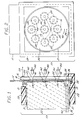
- Fig. 1 is depicted a diagrammatic cross-sectional (side) view of a detection unit device (10) having a porous reagent pad (12) having a plurality of redox-measuring sites (14).
- the device has a monolithic semiconductor (16) coated with insulative layer (18).
- a plurality of electrically-conducting layers (20) are coated onto insulative layer (18).
- the semiconductor (16) is connected at ohmic contact (22) to lead (24) which is connected to a circuit which is not shown.
- Sealingly mounted on semiconductor (16) is O-ring (26) which provides for a liquid seal with the device body (28) and semiconductor insulative layer (18).
- the device body (28) and O-ring (26) are cut away at the top of the device to allow for introduction of the fluid medium (30) and the porous reagent pad (12).
- the device body (28) serves to retain the semiconductor (16), the fluid medium (30) and a moveable piston (32).
- the moveable piston serves to minimize the volume adjacent to each of the sensing electrically-conducting layers (20) so as to provide for sensitive detection of redox reactions at these redox measurement sites (14).
- the moveable nature of the piston allows for introduction and removal of the porous reagent pad (12).
- the fluid medium is prevented from leaking around the piston by O-ring seals (31).
- the fluid medium is maintained in contact with the regions of the insulative layer including those which are coated with the electrically conducting layer, e.g.
- the fluid medium is buffered to provide for a substantially constant pH so that changes in pH during redox measurements will be negligible.
- the fluid medium also contains the redox pair which provides for the initial redox potential, the subsequent change of which is related to the amount of analyte in a sample.
- a common reference electrode (34) may be provided, such as silver-silver chloride, calomel, or the like, which electrode is connected to the common circuit and to the fluid medium (30) through lead (36).
- a common controlling electrode (38) is provided which contacts the fluid medium (30) through lead (40).
- illuminated regions (42) of the semiconductor (16) are illuminated with oscillating intensity light from light emitting diodes (LEDs) (44).
- the LEDs are connected to LED-driving circuitry which is not shown.
- the illuminated regions (42) are selected to be opposed directly across from corresponding conductive layers at the surface of the insulator (18). More precisely, the potential of the conductive layers affects the electric field in surface regions (46) of the semiconductor which are opposed directly across the insulative layer (18) from the respective conductive layers. Photogenerated charge carriers must diffuse into the respective surface regions (46) of the semiconductor (16) in order to produce a photocurrent which is modified by the potential of the respective conductive layers (20).
- the semiconductor (16) must not be so thick that photogenerated charge carriers cannot diffuse from the illuminated regions (42) to the surface regions (46) during the lifetime of photogenerated minority carriers. Typically, this distance is 3mm or less, in pure silicon, for example.
- This minority carrier diffusion distance similarly limits the closeness of spacing between independent surface sensing regions (46).
- This minority carrier diffusion distance may be decreased by creating recombination sites in the semicondutor, for example in silicon by introduction of gold impurities into the silicon crystal (Bullis, "Properties of Gold in Silicon," Solid State Electronics (1966) 9 :143). In this case, the semiconductor (16) correspondingly must be thinner.
- Fig. 2 is depicted a plan view of the device (10) looking first at the moveable piston (32), the device body (28), and leads (36) and (40) to the reference and controlling electrodes, respectively.
- Protruding from a hole in the top of the device body (28) is the porous reagent pad (12).
- Hidden from direct view is the portion of the porous reagent pad (12) that is inserted into the device body.
- the redox measuring sites (14) outer circles
- the LEDs (44) inner circles.
- Coated onto insulative layer (18) are the plurality of electrically conducting layers (20).
- the reagent pad is used as the solid-phase immunosorbent material.
- an assay such as a solid-phase, indirect, enzyme-linked, immunosorbent assay (ELISA)
- the reagent pad is used as the solid-phase immunosorbent material.
- more or less enzyme capable of changing the redox potential is bound to redox measuring sites (14) on the porous reagent pad (12).
- the pad (12) is inserted into the device (10) while the moveable piston (32) is in the withdrawn position.
- the moveable piston then is employed to expel excess fluid medium (30) from the volume adjacent to the redox measuring sites (14) within the reagent pad (12).
- the rate of redox potential change at each of the redox measuring sites (14) then is measured employing the LEDs (44) for illumination, and the electrode and attached circuitry (not shown) for applying a bias potential and for measuring the light-induced photocurrent (as noted previously).
- the rate of redox potential change at each site (14) thus determined is related to the concentration of analyte in the sample previously introduced to individual redox measuring sites (14) by way of a similarly run assay procedure incorporating an analyte standard.
- the standard assay procedure may be run before, after, or at the same time as the assay procedure. When run at the same time as the assay procedure, standard assay procedures may be carried out at redox measuring sites (14) different from those where unknown analyte concentrations are determined. Alternatively, standards and unknowns may be determined separately in different devices (10).
- each of the illuminating sources (44) may be activated so as to interrogate a particular redox measuring site (14) and provide an electrical signal determined by the circuit.
- redox measurements may be performed at a multiplicity of redox measuring sites (14) by activating sequentially in a known-order, the LEDs (44). At any one time only one of the LEDs is activated. In turn, each of the LEDs may be activated and the bias potential applied to the controlling electrode adjusted so as to maintain a predetermined photosignal.
- the potential of the reference electrode (34) is measured by circuitry (not shown) and, in this mode of operation will be affected by the redox potential of the fluid medium (30) at a redox-measuring site (14) adjacent to an electrically (conductive layer 20).
- the electrically conductive layer is on the opposite side of the insulating layer (18) from a surface region (46) of the semiconductor. The surface region is within minority carrier diffusion distance of the illuminated region (42) of the semiconductor which in turn is illuminated by a selected LED (44).
- the redox potential may be measured by activating, in turn, each LED in known sequence but instead of maintaining a fixed photoresponsive signal, the bias potential applied to the controlling electrode is varied with time so as to ramp the potential through the region where zero electric field is produced in the semiconductor surface region (46) that is associated with the activated LED (44).
- the bias potential applied to the controlling electrode is varied with time so as to ramp the potential through the region where zero electric field is produced in the semiconductor surface region (46) that is associated with the activated LED (44).
- a redox potential standard incorporated at the redox measuring site (14)
- a characteristic relationship of photoresponsive versus reference electrode potential is generated and stored into electronic memory by a circuit (not shown).
- a change in redox potential at the relevant redox measuring site (14) away from the standard reference electrode will cause the characteristic relationship to change.
- This measured deviation in the relationship between the photoresponse and reference electrode potential, upon either a change in the porous reagent pad (12) or upon passage of time, may be recorded and then related directly to the change, or rate of changes, of the redox potential at the relevant redox-measuring site (14).
- One method of examining the deviation so generated is to calculate the second derivative of the photoresponse versus reference electrode potential and then determine where the second derivative is zero, crossing between large positive and negative values. A shift with time in the reference electrode potential giving the second-derivative "zero crossing,” may be measured and related directly to the rate of change in redox potential at the respective redox-measuring site (14).
- FIG. 3 is depicted an individual flow cell device (50).
- the flow cell device has working electrode (52) which is comprised of the semiconductor layer (54), the insulative layer (56) and the electrically conductive layer, e.g., metal layer (58).
- the working electrode (52) is connected to an external circuit by ohmic contact (60) and lead (62).
- Mounted on the working electrode (52) is O-ring (64) in sealing engagement with the working electrode (52) and container cylinder (66).
- Conduit (68) leads into the container (66) for continuously introducing a sample stream of electrolyte (69).
- Conduit (70) serves as the outlet for removing the sample stream from container (66).
- Reference electrode (72) and controlling electrode (74) are provided for connection to the circuit, not shown.
- An illuminating source (76) is provided, which illuminates both the area (78) underneath the metal coating and the area (80) where the insulative layer (56) is uncoated and in direct contact with the sample medium.
- the semiconductor layer (54) forms a Schottkey barrier junction where it contacts the conductive metal layer (58).
- the characteristics of such junctions are well known (see for example, Sze, S. M., Physics of Semiconductor Devices).
- circuitry not shown
- current is inhibited from passing through the junction region (82), except when the semiconductor is illuminated in the area under the metal coating (78), so as to produce minority charge carriers within the junction region (82).
- the LED (76) may be used to switch the junction region (82) from the nonconducting to the conducting state.
- a chemical reaction involving oxidation or reduction may be monitored as demonstrated by the following example:
- the semiconductor (54) is chosen to be p-type for example, boron doped silicon for detection of a reducible substance, such as oxygen, which may be present at the surface metal layer (58) in the sample electrolyte (69).
- junction region (82) is in the nonconducting state.
- LED (76) switches the junction region (82) into the conducting state and direct current or charge flows in the circuit as determined by the quantity of reducible species, i.e., oxygen, at the surface of the metal layer (58) in the sample electrolyte (69).
- the amount of oxygen present may be determined from the current time relationship (after activation of the LED) and the constants of the system by the well known Cottrell equation (D. T. Sawyer, and J. L. Roberts, Jr., Experimental Electrochemistry for Chemists, John Wiley & Sons 1974).
- an oxygen standard may be provided to calibrate the system.
- the LED (76) may be activated in a periodic fashion so as to determine the rate of oxygen depletion due to an ongoing chemical reaction in the sample electrolyte.
- an enzyme-linked immunoassay may be performed by monitoring the rate of oxygen depletion due to an enzymatic reaction, such as the oxidation of glucose by oxygen that is catalyzed by the enzyme glucose oxidase.
- conjugates of the enzyme with one member of a binding pair such as an antigen- or hapten-specific antibody are first prepared and subsequently used to detect either the opposite members of the binding pair, i.e., antigen or hapten, or other specific antibody molecules (by way of competitive binding).
- the enzyme and enzyme substrate is chosen so that either the enzyme substrate(s) or enzyme products are oxidized or reduced readily by the metal conductive layer (58) when the junction (82) is switched into the conducting mode by LED (76).
- the semiconductor will be n-type, such as phosphorous-doped silicon, and the semiconductor will be positively biased with respect to the reference electrode (72) so that again, majority charge carriers are depleted from the junction region (82).
- the junction region (82) becomes conducting so as to produce a direct current in the series circuit, as in the above example for detection of reducible species.
- the flow of direct current will be in the opposite direction and, thus, of opposite sign.
- the magnitude of direct current or the current-time relationship may be measured as a means of quantitating the amount of oxidizing species present in the sample electrolyte (69) at the surface of the conductive layer (58).
- the device shown in Fig. 3 may be constructed so as to have a multiplicity of separate conductive regions (58) in contact with a sample electrolyte which may have different redox potentials at the surface of the different conductive regions.
- a sample electrolyte which may have different redox potentials at the surface of the different conductive regions.
- Such special differences in redox potential may be created by introduction of different electrolyte compositions at the surface of the respective conductive regions, or alternatively the different redox potentials may be generated with time by varying the rate of a chemical reaction occurring at the respective conducting regions.
- the chemical reaction may be catalyzed by an enzyme, for example, and the amount of enzyme or other catalyst present, could be measured by monitoring the rate of current or potential change at each one of the conductive regions (58).
- LEDs (76) or other light sources also will be present. As in the previous case shown in Figs. 1 and 2, the LED or other light source which is activated determines the region of the sample electrolyte where the redox reaction is measured.
- alternating currents of different frequencies could be applied to the different LEDs, with each compartment being identified by a different frequency.
- circuits may be employed for determination of the photoresponsiveness of the semiconductor devices shown in Figs. 1, 2, and 3 as a function of analyte concentration.
- One particular circuit which may be employed allows for operation in either one of two modes. In one mode, the potential between the controlling or reference electrode and the sensing electrode is maintained constant and the amplitude of the sinusoidal, either alternating or direct (faradaic), current through the sensing electrode in response to sinusoidal illumination of the sensing electrode is used as a monitor of the environment of the sensing electrode at the site of illumination. This is referred to as the CP mode.
- the circuit automatically varies the potential between the controlling or reference electrode and the sensing electrode so as to maintain a constant amplitude sinusoidal current through the sensing electrode during illumination with constant modulation of light intensity.
- the potential between the controlling or reference electrode and the sensing electrode is used as a monitor of the sensing electrode at the site of illumination. This is referred to as the CAM mode.
- FIG. 4 Shown in Fig. 4 is a schematic diagram of a computer-controlled apparatus which may be used to produce and measure a photocurrent in accordance with the present invention.
- a semiconductor wafer 150 is covered with an insulator 152, on which is electronically conductive layer 153, which insulator and conductive layer are in contact with an electrolyte 154 enclosed by a chamber wall 156 sealed to the insulator surface by a rubber gasket 158.
- Operational amplifiers 110 and 112 together with resistors 113 and 116, reference electrode 118, and a voltage signal from a lock-in amplifier 192 via operational amplifier 110, lead 172 and controlling electrode 170 function to determine the potential of the electrolyte 154 with respect to the bulk of the semiconductor 150.
- the potential of the semiconductor bulk is connected to virtual ground by an ohmic contact 174 attached to the underside of the semiconductor wafer 150 and to a copper lead 176 connected to the current input terminal of the lock-in amplifier 192 (Model SR530, Stanford Research Systems, Palo Alto, CA).
- the ohmic contact 174 is made by evaporating approximately 0.5 ⁇ m of gold - 1% arsenic onto the (bare) etched back surface of a silicon wafer, etching away the gold from regions where light penetration is desired and then alloying the gold into the silicon at 450°C.
- the semiconductor 150 is an approximate 10 cm (4") diameter wafer of N ⁇ 100 ⁇ silicon of approximately 10 to 15 ohm-cm resistivity.
- the insulator is composed of approximately 340 angstroms of silicon oxide adjacent to the silicon and overlaid with 100 ⁇ m of silicon nitride deposited by chemical vapor deposition from a reaction of dicholorosilane and ammonia at about 800°C in a low pressure chamber.
- the wafers are subsequently annealed in a hydrogen ambient at 1050°C for 1 hour.
- the metal layer(s) 153 consists of a 1,3 cm (one-half inch) circle of approximately 500 ⁇ m of chromium followed by 500 ⁇ m of gold, each deposited by evaporation in a low pressure chamber.
- Semiconductor regions 120 and 122 are the, so-called, space charge regions of the semiconductor-insulator interface.
- Semiconductor region 120 is that portion of the space-charge region which is adjacent to that portion of insulating layer 152 which, on the opposite side, is adjacent to electronically conductive layer 153.
- semiconductor region 122 is that portion of the space-charge region which is adjacent to the portion of the insulating layer 152 which, on the opposite side, has no electronically conductive layer.
- a light-emitting diode (LED) 178 is powered by a LED driver 180 so as to irradiate the semiconductor 150 with light of sinusoidally modulated intensity.
- the semiconductor 150 is irradiated, customarily from the side opposite the electrolyte medium 154, so as to provide photogenerated minority charge carriers within semiconductor region 120 (i.e., the light beam is directed directly under the electronically conductive layer).
- the frequency of modulation is controlled by an oscillator circuit within the lock-in amplifier 192 which, in turn, is controlled by a computer 182 having a keyboard 184.
- Analog data is converted into digital form by an A/D converter 186 within the lock-in amplifier 192.
- a D/A converter 188 converts digital instructions from the computer 182 into analog form which, in turn, control various lock-in amplifier settings and the potential of the electrolyte 154 with respect to the semiconductor 150.
- Experimentally acquired data may be viewed on a CRT display 190 and permanently copied by a printer 194.
- An advantage of the lock-in amplifier 192 is that it may be set to reject unwanted electrical signals (noise), thus improving greatly the signal-to-noise ratio for very small signals.
- the LED emits at a peak wavelength of 880 nanometers (Radio Shack XC-880-A) and irradiates approximately 0.28 cm2 of the semiconductor surface opposite the insulator under the electronically conductive (gold) layer 153. Unless otherwise indicated, the LED intensity is sinusoidally modulated 100% at 10 kHz.
- the controlling electrode is a strip of platinum of about 0.2 cm2 surface area, and the reference electrode is either Ag/AgCl with 3MKCl or alternatively a saturated calomel electrode (SCE).
- the alternating photocurrent produced by the intensity-modulated irradiation of the semiconductor is measured by a lock-in amplifier 192 (Model SR530, Stanford Research Systems, Palo Alto, CA).
- the potential of the electrolyte 154 with respect to the semiconductor 150 is programmed to vary, i.e., ramped digitally, at approximately 50-300 millivolts per second in steps of 5-50 millivolts per step starting at about 200-2000 millivolts on the accumulation side of the flat-band voltage and ending at about 200-2000 millivolts on the depletion side of the flat-band voltage.
- the flat-band voltage is the applied potential necessary to produce zero, or minimum mean, electric field in the region of the semiconductor adjacent to the insulator. Accumulation conditions exist when the electric field is such that majority charge carriers accumulate in this region of the semiconductor, and depletion conditions exist when the electric field is such that majority charge carriers are depleted from this region.
- the amplitude of the alternating photocurrent is low when the semiconductor is biased into accumulation and approaches a maximum when the semiconductor is biased increasingly into depletion.
- the tracking bandpass filter of the lock-in amplifier is set to reject current signals which appear at frequencies other than 10 kHz. Additionally, the lock-in amplifier can be set to reject current signals that are out of phase with the photocurrent signal. To accomplish this, first the phase of the photocurrent signal is measured by the lock-in amplifier when the semiconductor is biased into the depletion region, where the alternating photocurrent signal is maximum. This measured phase is then selected for phase discrimination by the phase-sensitive detector within the lock-in amplifier. Subsequently, only this "in phase" component of the photocurrent is analyzed.
- Fig. 5 An example of the data obtained with the use of both the bandpass filter and the phase-sensitive detector is shown in Fig. 5 and the second derivative of this data is shown in Fig. 6.
- the amplitude of the modulated LED flux was adjusted by regulating the LED current modulation so that the maximum alternating photocurrent obtained was approximately 0.5 microamp (RMS).
- RMS microamp
- the amplitude of the alternating photocurrent is relatively low when a positive bias potential is applied to the reference electrode, which biases the n-type semiconductor into accumulation.
- a more negative bias potential is applied, passing through the flat-band potential, the amplitude of the alternating photocurrent increases, approaching a maximum value at increasingly negative bias potentials where the n-type semiconductor is biased into depletion.
- the result is a characteristic, sigmoidally shaped curve.
- Fig. 7 shows the effect on the photoresponse versus bias voltage response when the redox potential of the electrolyte is altered by changing the ratio of ferricyanide to ferrocyanide anion concentration in aqueous electrolyte 154.
- the pH of the electrolyte medium 154 also may be monitored with the device 151 and circuitry shown in Fig. 4.
- the insulating layer 152 is a pH responsive material, such as silicon dioxide, silicon nitride, aluminum oxide, titanium dioxide, tantalum dioxide, or the like.
- the semiconductor 150 is irradiated so as to produce minority charge carriers within semiconductor region 122. All other conditions including semiconductor, insulator, irradiation, and bias conditions are as indicated previously for measurement of redox potential. Shown in Fig.
- the potential of electrolyte 154 as measured by reference electrode 118 must be biased in the positive direction by operational amplifier 110 via controlling electrode 170.
- the apparent shift in bias potential caused by changes in pH of the electrolyte may be quantitated conveniently by measuring the potential ⁇ 0 ⁇ where the second derivative of the photocurrent versus bias potential response crosses zero between a maximum and a minimum (see for example, Fig. 6).
- Fig. 10 shows the change in ⁇ 0 ⁇ as a function of electrolyte pH. The observed changes in ⁇ 0 ⁇ is about 59 millivolts per pH unit, again near the theoretical response obtained from the Nernst equation for a unity charge transfer reaction at 23°C.
- a single light source may be employed to measure specific ion concentrations, such as pH and redox potential.
- the insulating layer 152 (see Figure 4) is made of a pH-responsive material.
- the electronically conductive layer 153 is made to be about one-half the area of illumination provided by the LED 178. Under these conditions, the device shown in Figure 4 may be employed to measure both the pH and redox potential of medium 154 relative to either pH or redox potential standards.
- An LED 178 is employed to illuminate semiconductor 150 so that photogenerated minority charge carriers reach both regions 120 and 122 of the semiconductor space-charge region adjacent to the insulator.
- Semiconductor region 120 is adjacent to that part of insulative layer 152 which is covered by electronically conducting layer 153.
- Semiconductor region 122 in contrast, is adjacent to some portion of that part of insulative layer 152 which is not covered by electronically conductive layer 153.
- the LED 178 (Radio Shack XC-880-A) emits peak intensity at a wavelength of 80 nm and irradiates approximately 0.28cm2 of the semiconductor surface opposite to the electrolyte medium 154.
- the LED intensity is modulated 100% at 10 kHz by LED driver 180 which is controlled by an oscillator and lock-in amplifier 192 which in turn is controlled by computer 182 through keyboard 184.
- Semiconductor substrate 150, insulating layer 152, and electronically conducting layer 153 are as described previously except that the chromium-gold conducting layer was etched to a 4.2 mm diameter spot after first masking the spot with Scotch R magic transparent tape (3M)
- the etching solution to remove the gold layer is composed of 400 g potassium iodide, 100g iodine, and 1600 g water. After removing the unmasked gold surface layer, the remaining chromium adhesion layer is removed by etching in a solution of 20g potassium ferricyanide, 10 g sodium hydroxide, and 100g water.
- the tape mask is removed with acetone.
- the controlling electrode is a strip of platinum about 0.2 cm2 surface area.
- the alternating photocurrent produced by the intensity-modulated irradiation by LED is measured by lock-in amplifier 192 (Model SR530, Stanford Research Systems, Palo Alto, CA), as described previously.
- the measured analog value is converted to a digital signal by analog-to-digital converter (A/D) 186 within lock-in amplifier 192 and is sent to computer 182 and the results are observed on CRT display 190 and imprinted onto paper by printer 194.
- A/D analog-to-digital converter
- this condition occurs when the controlling electrode potential is made more negative with respect to the semiconductor (which is maintained at virtual ground).
- a second step increase in alternating photocurrent is observed when a second substantial fraction of semiconductor region 120 or 122 is biased into depletion.
- the data shown in Figure 11 were generated with the areas of semiconductor regions 120 and 122 (that were effectively excited by minority charge carriers produced by uniform light flux from LED 178) approximately equal. Thus, the amplitude of the first and said second steps shown in Figure 11 were approximately equal.
- Figure 12 is shown the first derivative of the data shown in Figure 11. There are two clear minima in the first derivative. One minimum is near -0.08 volts and corresponds to the initial step increase in alternating photocurrent shown in Figure 11. The second minimum shown in Figure 12 is near -0.90 volts and corresponds to the second step increase in alternating photocurrent shown in Figure 11. The exact voltage position of the first minimum is dependent upon the pH of electrolyte 154.
- the voltage response of the first minimum to changes in pH is similar to the pH-dependent voltage response shown in Figures 9 and 10 with about 0.059 volts negative shift on the bias potential axis for every 10-fold increase in hydrogen ion concentration (i.e., for a 1 pH unit change).
- the voltage response of the second minimum is dependent upon the redox potential of electrolyte 154.
- the voltage response of the second minimum to changes in redox potential is similar to the redox-potential-dependent voltage response shown in Figures 7 and 8, again with about 0.059 volts negative shift on the bias potential axis for every 10-fold increase in the ratio of ferricyanide to ferrocyanide.
- Shown in Figure 13 is a particularly convenient embodiment of the present invention.
- the device is useful for measurement of either redox potential or specific ion concentrations, including pH, without employing a separate reference electrode.
- the basic device 301 and controlling circuitry are shown in Figure 13.
- a semiconductor substrate 300 is coated with an insulating layer 302.
- the insulating layer in turn, is covered partially by electronically conducting layer 302.
- An O-ring 306 provides a seal in contact with insulating layer 302 which O-ring is held in place by structure 308.
- This structure serves both as a chamber wall and a clamping device.
- Structure 308 thus contains electrolyte medium 310 in which an analyte may be present.
- Lead 312 electrically connects semiconductor substrate 300 via ohmic contact 314, to the current measurement input of lock-in amplifier 316, which is maintained at virtual ground.
- Controlling electrode 318 is connected via lead 320 to both the output of operational amplifier 322 and the positive input of operational amplifier 324.
- the potential of controlling electrode 318 is determined by operational amplifiers 322 and 324, the values of resistors 326 and 328, and the output of a digital-to-analog converter (D/A) 330 within lock-in amplifier 316, which in turn is controlled by computer 322 from keyboard 334.
- D/A digital-to-analog converter
- the above system may be utilized to measure either pH or redox potential, one relative to the other, without the need of a reference electrode.
- the measurement procedure without a reference electrode is essentially identical to that outlined above, where a reference electrode is employed.
- the results of A.C. photocurrent versus bias potential measurement (not shown) and the first derivative plot (not shown) are similar to the measurements made with a reference electrode, the results which are shown in Figures 11 and 12 respectively.
- the exact positions of the first and second step increases in A.C. photocurrent on the bias potential axis are not uniquely dependent upon either pH or redox potential.
- the bias voltage positions of the minima in the first derivatives of this response are not uniquely dependent upon either pH or redox potential.
- the voltage difference between the first and second step increases in AC photocurrent (or the voltage difference between the minima), however, are constant for a system where both pH and redox potential are held constant.
- this voltage difference may be related to either a single pH value or to a single redox potential (in a unique way) (either pH or redox potential of electrolyte 154) when one parameter is fixed, while the remaining parameter is allowed to vary.
- one of the measured AC photocurrent versus bias potential responses becomes the reference response.
- a separate reference electrode is not required for quantitation of changes in the remaining parameter.
- redox potential at fixed pH and of pH at fixed redox potential were carried out as described above for measurement of either pH or redox potential with a reference electrode, except that the circuit configuration without a reference electrode (shown in Fig. 13) was employed. Shown in Fig. 14 is the difference in bias potential between the two minima in the first derivative of the photocurrent versus bias potential response observed in an experiment where the pH was kept constant at pH 7.0 and the redox potential was varied.
- the buffer was 0.05 M potassium phosphate (Fisher standard buffer Cat. No. SO-B-107).
- the redox potential was varied by varying the ratio of potassium ferricyanide to potassium ferrocyanide.
- the redox species present in highest concentration was in all cases present at 1.0 mM.
- the bias potential difference between minima is linearly dependent upon the logarithms of the ratio of ferricyanide to ferrocyanide concentrations present in electrolyte medium 310.
- the response of the bias potential difference to changes in redox potential is similar to the redox potential voltage response shown in Figures 7 and 8, with about 0.059 volts of increasing difference for each 10-fold increase in the ratio of ferricyanide to ferrocyanide.
- Fig. 15 is the difference in bias potential between the two minima in the first derivative of the photocurrent versus bias potential response observed when the redox potential was kept constant and the pH was varied.
- the buffer was either 0.05 M potassium biphthalate, pH 4.36 (Fisher, SO-B-101) or 0.05 M sodium-potassium phosphate pH 6.98 (Fisher, SO-B-107) in each case with 10mM potassium ferricyanide and 10 mM potassium ferricyanide.
- the pH in each case was determined with a standard glass electrode (Fisher Cat. No. 13-639-252). As can be seen from Fig.
- the bias potential difference between the first derivative minima is dependent upon pH.
- the voltage response was about 0.055 volts of increasing difference for an increase of one pH unit.
- the relationship between pH and the difference is simple provided that the redox potential is pH-insensitive. This is approximately true with the redox couple employed (ferricyanide/ferrocyanide) in the range of pH 4.5 to pH 9.5.
- a device 251 is depicted for use in amperometric determinations.
- a semiconductor substrate 250 having both an insulating layer 252 and a conducting layer 253 is brought into physical contact with electrolyte medium (254) containing an analyte of interest.
- electrolyte medium 254 containing an analyte of interest.
- electronically conducting layer 253 traverses a perforation in insulating layer 252, so as to make contact with semiconductor substrate 250.
- Electronically conducting layer 253, preferably, is an inert metal, particularly a noble metal, e.g., gold, platinum, iridium, or the like.
- Electrolyte medium 254 is retained in contact with insulating layer 252 and electronically conducting layer 253 by means of chamber walls 256, insulating layer 252, and sealing gasket 258.
- Operational amplifier 210 acts to supply current through controlling electrode 270 to control the potential of electrolyte medium 254, as monitored by reference electrode 218.
- Operational amplifier 210 is maintained in the balanced state when feedback current through resistor 213 is equal and opposite to the current through resistor 216. Therefore, when a constant voltage is provided by voltage source 220, the output of operational amplifier 212 and also reference electrode 218 will be maintained at constant potential with respect to circuit ground.
- the resultant current through semiconductor 250 is converted to a voltage signal by operational amplifier 222 configured with feedback resistor 224.
- the circuit is operated in the CP mode and the voltage output of operational amplifier 222, which is, a current-to-voltage converter, is fed to a recorder.
- the voltage to the recorder is proportional to the DC component of the current through the silicon electrode.
- the voltage at the output of operational amplifier 222 is proportional to the current through semiconductor 250 and the constant of proportionality relating the voltage and the current is the resistance of resistor 224.
- Semiconductor region 255 is that region of semiconductor 250 which is substantially adjacent to electronically conducting layer 253. This is the so-called space-charge region of the Schottkey barrier formed between semiconductor 250 and electronically conducting layer 253.
- Semiconductor 250 may be biased electrically by voltage source 220, so as to cause depletion of charge carriers in semiconductor region 255.
- a multiplicity of separate conducting layers 253 may be present. Each conducting layer is similar to conducting layer 253 and each traverses a separate perforation in insulator 252.
- the separate conducting layers may be utilized to monitor the presence of redox substances at a multiplicity of separate sites in electrolyte medium 254.
- a device having such a multiplicity of separate conducting layers may be employed to monitor the presence of redox substances in a multiplicity of separate electrolyte media. If the media are separate, either a salt bridge (i.e., a common electrolyte connection) must be used to connect the separate media, or separate electrodes, such as reference electrode 218 and controlling electrode 220, must be employed separately in the separate electrolyte media.
- regions of semiconductor 250 near the separate conducting layers 253 would be illuminated, one at a time, and the current for each region would be measured separately. A background measurement where none of the regions was illuminated would be subtracted from each of the measurements. Alternatively, each of the regions can be illuminated with light modulated at different frequencies. This will give rise to amplitude-modulated currents at the individual frequencies.
- the Faradaic current at each of the conductive layers may be related to the amplitude of the current at the respective frequencies of light intensity modulation after first subtracting the capacitive charging current.
- the semiconductor would be chosen to be either n-type or p-type depending upon whether a reductant or an oxidant, respectively, was being detected in the electrolyte medium.
- An assay could be carried out as follows: A carbohydrate substance with lectin-binding moieties is either chemically linked or physically adsorbed onto the surface of conducting layer 253 which, in turn, is affixed to a p-type semiconductor substrate. Next a solution containing an enzyme, such as cholesterol esterase conjugated to lectin is introduced into container 256. After a sufficient time for adsorption of the conjugate to the surface of conducting layer 253, the compartment would be washed with an appropriately buffered wash solution.
- an enzyme such as cholesterol esterase conjugated to lectin
- Container 256 then would be filled with the sample and buffered solution, and any overflow withdrawn.
- the hydrolysis of cholesterol ester by cholesterol esterase results in production of cholesterol, which is oxidized to produce H2O2, which oxidizes ferrocyanide to ferricyanide in a reaction catalyzed by the horseradish peroxidase.
- the ferricyanide produced results in a direct current upon irradiation of the medium adjacent to the photoresponsive electrode.
- the electrode could be boron-doped silicon (i.e., a p-type semiconductor).
- the rate of production of ferricyanide would be inversely related to the amount of analyte in the sample, because analyte in the sample would bind to the anti-analyte antibody thereby preventing the antibody from binding to the analyte-enzyme inhibitor conjugate. Thus, more active enzyme inhibitor would be present causing the rate of ferricyanide production to be diminished.
- the photoresponsive electrode After sufficient time for reaction to occur to obtain a detectable signal at the concentration range of interest, the photoresponsive electrode would be irradiated in the region under electrically conducting layer 253 and the resulting direct current detected by means of operational amplifier 222.
- a concentrated saccharide solution then would be introduced into the container, repetitively, until all of the enzyme had been removed from the surface.
- the container then would be washed with a wash solution to remove all of the unbound saccharide and then followed by introduction of the enzyme-lectin conjugate to restore the container to its original state for performing an assay.
- the subject invention provides for an accurate device which has a wide variety of applications.
- An internal standard is provided which can be used to ensure that changes in the circuitry can be corrected, so that errors due to changes in the reference electrode or other aspects of the device may be subtracted from the observed result.
- the device can be used for measuring directly media involving redox potentials or enzymes providing a change in redox potential.
- the subject invention can be used for measuring indirectly a wide variety of analytes by coupling an analyte into a system which allows for a change in redox potential of a medium in relation into the amount of analyte present.
- enzymes which produce an agent which can serve as a member of a redox couple or be coupled to another redox couple.
Landscapes
- Chemical & Material Sciences (AREA)
- Life Sciences & Earth Sciences (AREA)
- Health & Medical Sciences (AREA)
- Physics & Mathematics (AREA)
- Chemical Kinetics & Catalysis (AREA)
- Electrochemistry (AREA)
- Molecular Biology (AREA)
- Analytical Chemistry (AREA)
- Biochemistry (AREA)
- General Health & Medical Sciences (AREA)
- General Physics & Mathematics (AREA)
- Immunology (AREA)
- Pathology (AREA)
- Investigating Or Analyzing Materials By The Use Of Electric Means (AREA)
- Investigating Or Analysing Biological Materials (AREA)
Claims (27)
- Dispositif à effet de champ pour déterminer l'état du potentiel rédox d'un milieu d'électrolyte liquide, relativement au pH, à la concentration en ions ou au potentiel rédox, ledit dispositif comprenant :
une unité de détection (10, 50, 151, 301, 251) ayant une couche semi-conductrice photosensible de base (16, 54, 122, 340, 250) et une couche isolante (18,56, 152, 302, 252) couvrant au moins une portion d'une surface de ladite couche semi-conductrice ;
un moyen d'irradiation de lumière (44, 76, 178, 336, 278) pour irradier ladite couche de base et un moyen (24, 62, 176, 312) pour relier ladite couche de base à un circuit pour mesurer le changement du signal électrique photo-induit de l'unité de détection en fonction de l'état du milieu ;
caractérisé en ce que l'unité de détection (10, 50, 151, 301, 251) a additionnellement une couche électroniquement conductrice (20, 58, 153, 304, 253) montée sur ladite couche isolante ou montée sur ladite couche semi-conductrice à la portion non couverte de ladite surface pour un contact avec le milieu liquide ;
et en ce que le moyen d'irradiation de lumière produit efficacement des porteurs minoritaires en juxtaposition avec la couche électroniquement conductrice. - Dispositif selon la revendication 1, comprenant de plus :
un moyen de maintien (12, 66, 156, 308) pour retenir un milieu d'électrolyte liquide en contact avec ladite couche électroniquement conductrice. - Dispositif selon la revendication 1 ou la revendication 2, comprenant de plus un certain nombre d'unités de détection chacune étant jointe au même moyen de connexion (24, 62, 176, 312).
- Dispositif selon la revendication 1 ou la revendication 2, comprenant de plus un moyen de polarisation (38, 74, 170, 318, 218) connecté à ladite unité de détection pour polariser ladite unité de détection ; et
où ledit circuit comprend un élément de forte résistance quand la couche électroniquement conductrice étant une couche de métal (58) est en contact avec la couche de base (54). - Dispositif selon la revendication 4, où ladite couche semi-conductrice est formée d'un certain nombre de micropastilles individuelles en silicium dopé.
- Dispositif selon la revendication 5, où lesdites micropastilles individuelles sont individuellement connectées audit circuit.
- Dispositif selon la revendication 4, la revendicaiton 5 ou la revendicaiton 6, où le moyen d'irradiation est programmé pour produire des impulsions lumineuses régulières.
- Dispositif selon la revendication 4, où ledit élément de détection comprend une seule pastille en silicium dopé.
- Dispositif selon la revendication 4, comprenant une électrode de référence (34, 72, 118, 218) connectée audit circuit.
- Dispositif selon l'une quelconque des revendications précédentes où au moins l'un dudit potentiel rédox, de la concentration en ions ou du pH est un système constant et au moins l'un du restant est un système variable et le circuit comprend de plus un moyen pour comparer le signal photo-induit par suite du système constant au signal électrique photo-induit du système variable pour mettre la différence entre ledit signal électrique photo-induit dudit système constant et dudit système variable, en rapport avec un pH, une concentration ionique ou un potentiel rédox du système variable.
- Dispositif selon l'une quelconque des revendications précédentes, où ledit circuit comprend :
un moyen (192) pour mettre en rampe le potentiel sur une plage prédéterminée de tensions ; un moyen (180) programmant l'irradiation pour produire des impulsions régulières de lumière afin de produire un courant alternatif ou une tension alternative photo-induits. - Dispositif selon la revendication 11, où le moyen d'irradiation irradie ladite surface de réception d'irradiation relativement à ladite surface de contact du milieu par une seule source de lumière.
- Dispositif selon la revendication 11 ou la revendication 12, où le circuit explore le changement de courant alternatif ou de tension alternative avec le changement de potentiel et met le changement de courant alternatif ou de tension alternative en rapport avec au moins deux des paramètres consistant en pH, concentration en ions et potentiel rédox du milieu où l'un desdits paramètres est maintenu constant et l'autre desdits deux paramètres est d'une valeur inconnue et peut varier.
- Dispositif selon l'une quelconque des revendications précédentes, comprenant de plus :
au moins un élément d'une paire spécifique de liaisons qui est liée de manière non diffusive à un support en juxtaposition avec ladite surface de métal ou ladite couche isolante. - Dispositif selon la revendication 14, où ledit élément est une immunoglobuline.
- Dispositif selon l'une quelconque des revendications précédentes, où la couche conductrice est pour obtenir un signal en rapport avec rédox et la couche isolante est pour obtenir un signal en rapport avec le pH ou la concentration en ions.
- Méthode de mesure d'un état d'un milieu où ledit état peut être directement ou indirectement en rapport avec le potentiel rédox, avec le pH ou avec la concentration en ions, où le potentiel rédox et un autre état est mesuré et l'un dudit potentiel rédox, du pH ou de la concentration en ions est un système variable d'intérêt et l'autre est un système constant, ladite méthode employant un dispositif selon l'une quelconque des revendications précédentes et consistant à :
introduire le milieu (30, 69, 154, 310) pour produire une communication électrique entre l'unité de détection comprenant une couche conductrice (20, 58, 153, 304, 253) et une contre-électrode (38, 74, 170, 318, 270) ;
irradier la base (16, 54, 120, 340, 250) pour efficacement produire des porteurs minoritaires en juxtaposition avec la couche conductrice et, par conséquent, un signal photo-induit ;
déterminer le signal photo-induit du système constant en comparaison avec le signal en rapport avec le système variable et mettre la différence dudit signal en rapport avec l'état dudit milieu et dudit système variable. - Méthode selon la revendication 17, où le milieu est en contact à la fois avec la couche conductrice et avec la couche isolante, une surface de réception d'irradiation pour former des porteurs minoritaires en juxtaposition avec la couche conductrice étant une surface de contact de la couche de métal et une surface de réception d'irradiation pour former des porteurs minoritaires en juxtaposition avec ladite surface de la couche isolante en contact avec le milieu étant irradiée simultanément par une source commune de lumière.
- Méthode selon la revendication 17 ou la revendication 18, où ledit potentiel rédox, ledit pH ou ladite concentration en ions est modulé par une réaction enzymatique.
- Méthode selon la revendication 19, où ladite réaction enzymatique est électriquement couplée à ladite couche de métal au moyen d'une espèce rédox dans ledit milieu.
- Méthode selon la revendication 19 ou la revendication 20, où un système de modulation rédox comprend au moins une oxydoréductase et un couple rédox inorganique.
- Méthode selon l'une quelconque des revendications 17 à 21, où ledit dispositif comprend une électrode de référence (34, 72, 118,218) pour produire un signal standard à partir dudit système constant.
- Méthode selon l'une quelconque des revendications 17 à 22, pour mesurer un échantillon contenant du glucose par la mesure du changement du potentiel rédox d'un échantillon contenant un milieu qui comprend ledit échantillon, de la glucose oxydase, du glucose, un système rédox capable de réagir avec le peroxyde d'hydrogène et la communicaiton du potentiel rédox à la couche conductrice et suffisamment de tampon pour maintenir un pH sensiblement constant ;
la méthode consistant à déterminer un signal en rapport avec le pH à partir de la couche isolante en comparaison avec le signal en rapport avec le rédox de la couche conductrice et à standardiser le taux de changement de la différence entre le signal en rapport avec le pH et le signal en rapport avec le potentiel rédox à une quantité connue de glucose. - Méthode selon l'une quelconque des revendications 17 à 22 pour mesurer la quantité d'un analyte dans un échantillon en mesurant le potentiel rédox d'un milieu contenant l'échantillon qui comprend un système de modulation rédox comprenant un conjugué oxydoréductasepaire spécifique de liaisons, un couple rédox, un substrat d'oxydoréductase et tous les cofacteurs et où le taux de la réaction d'oxydoréductase totale dans le milieu est en rapport avec la quantité de l'analyte dans ledit échantillon;
la méthode consistant à déterminer un signal en rapport avec le pH ou avec les ions en comparaison avec un signal en rapport avec le rédox et à mettre ladifférence entre ledit signal en rapport avec le pH ou les ions et ledit signal en rapport avec le rédox,en rapport avec la quantité de l'analyte dans ledit échantillon. - Méthode selon la revendication 24, consistant de plus à :
combiner l'échantillon avec le conjugué pendant un temps suffisant pour qu'une réaction forme un mélange contenant le complexe, où, lors de ladite introduction, ledit organe de liaison spécifique non diffusivement lié est capable de se lier avec ledit conjugué ;
laver ledit échantillon pour éliminer tout conjugué non spécifiquement lié ; et
ajouter le couple rédox, le substrat d'enzyme et les cofacteurs pour donner ledit milieu de détermination. - Méthode selon la revendication 25, où le conjugué change l'activité enzymatique quand il est lié à l'élément complémentaire dudit analyte.
- Méthode selon l'une quelconque des revendications 17 à 22? pour mesurer l'état d'un milieu par une mesure ampérométrique où ledit état peut être directement ou indirectement mis en rapport avec le potentiel rédox, le pH ou une concentration en ions, où on mesure le potentiel rédox et un autre état et l'un dudit potentiel rédox, du pH ou de la concentration en ions est un système variable d'intérêt et l'autre est un système constant;
la méthode consistant à :
introduire le milieu pour permettre une communication électrique entre l'unité de détection et une contre-électrode;
irradier la surface de réception d'irradiation pour donner un signal photo-induit ;
déterminer le signal photo-induit du système constant et déterminer le signal ampérométrique photo-induit résultant en rapport avec le système variable et mettre le signal ampérométrique en rapport avec l'état dudit milieu.
Applications Claiming Priority (2)
| Application Number | Priority Date | Filing Date | Title |
|---|---|---|---|
| US07/072,168 US4963815A (en) | 1987-07-10 | 1987-07-10 | Photoresponsive electrode for determination of redox potential |
| US72168 | 1993-06-04 |
Publications (3)
| Publication Number | Publication Date |
|---|---|
| EP0300651A2 EP0300651A2 (fr) | 1989-01-25 |
| EP0300651A3 EP0300651A3 (en) | 1989-12-20 |
| EP0300651B1 true EP0300651B1 (fr) | 1993-09-08 |
Family
ID=22106003
Family Applications (1)
| Application Number | Title | Priority Date | Filing Date |
|---|---|---|---|
| EP88306248A Expired - Lifetime EP0300651B1 (fr) | 1987-07-10 | 1988-07-08 | Electrode photosensible pour la détermination de potentiel redox |
Country Status (5)
| Country | Link |
|---|---|
| US (1) | US4963815A (fr) |
| EP (1) | EP0300651B1 (fr) |
| JP (1) | JPH0197853A (fr) |
| CA (1) | CA1292280C (fr) |
| DE (1) | DE3883885T2 (fr) |
Cited By (1)
| Publication number | Priority date | Publication date | Assignee | Title |
|---|---|---|---|---|
| DE102021127227A1 (de) | 2021-10-20 | 2023-04-20 | Endress+Hauser Conducta Gmbh+Co. Kg | Sensor zur Messung eines pH-Werts |
Families Citing this family (110)
| Publication number | Priority date | Publication date | Assignee | Title |
|---|---|---|---|---|
| US5500188A (en) * | 1984-03-01 | 1996-03-19 | Molecular Devices Corporation | Device for photoresponsive detection and discrimination |
| GB8810400D0 (en) * | 1988-05-03 | 1988-06-08 | Southern E | Analysing polynucleotide sequences |
| US7811751B2 (en) * | 1988-05-03 | 2010-10-12 | Oxford Gene Technology Limited | Analysing polynucleotide sequences |
| US6306594B1 (en) | 1988-11-14 | 2001-10-23 | I-Stat Corporation | Methods for microdispensing patterened layers |
| US5200051A (en) * | 1988-11-14 | 1993-04-06 | I-Stat Corporation | Wholly microfabricated biosensors and process for the manufacture and use thereof |
| US5252293A (en) * | 1989-01-17 | 1993-10-12 | Vladimir Drbal | Analytical slide with porous filter membrane |
| US5547839A (en) | 1989-06-07 | 1996-08-20 | Affymax Technologies N.V. | Sequencing of surface immobilized polymers utilizing microflourescence detection |
| IT1240542B (it) * | 1990-08-13 | 1993-12-17 | Sorin Biomedica Spa | Perfezionamenti nei dispositivi a semiconduttore chemisensibili (cssd) |
| EP0589873B1 (fr) * | 1991-06-18 | 1999-08-25 | Minntech Corporation | Apparail destine a diluer automatiquement une solution d'acide peracetique et de peroxyde d'hydrogene |
| US5268092A (en) * | 1992-02-03 | 1993-12-07 | H.E.R.C., Inc. | Two water control system using oxidation reduction potential sensing |
| US5240618A (en) * | 1992-02-03 | 1993-08-31 | University Of Utah Research Foundation | Electrical field-flow fractionation using redox couple added to carrier fluid |
| US5332494A (en) * | 1992-02-03 | 1994-07-26 | H.E.R.C. Incorporated | Water control system using oxidation reduction potential sensing |
| US5342510A (en) * | 1992-02-03 | 1994-08-30 | H.E.R.C. Incorporated | Water control system using oxidation reduction potential sensing |
| US5710011A (en) * | 1992-06-05 | 1998-01-20 | Medisense, Inc. | Mediators to oxidoreductase enzymes |
| US5539100A (en) * | 1993-07-01 | 1996-07-23 | The United States Of America As Represented By The United States Department Of Energy | Organic solid state switches incorporating porphyrin compounds and method for producing organic solid state optical switches |
| US5871918A (en) * | 1996-06-20 | 1999-02-16 | The University Of North Carolina At Chapel Hill | Electrochemical detection of nucleic acid hybridization |
| USRE40209E1 (en) | 1994-06-13 | 2008-04-01 | Matsushita Electric Industrial Co., Ltd. | Cell potential measurement apparatus having a plurality of microelectrodes |
| US5563067A (en) | 1994-06-13 | 1996-10-08 | Matsushita Electric Industrial Co., Ltd. | Cell potential measurement apparatus having a plurality of microelectrodes |
| US5661408A (en) | 1995-03-01 | 1997-08-26 | Qc Solutions, Inc. | Real-time in-line testing of semiconductor wafers |
| AUPN239395A0 (en) * | 1995-04-12 | 1995-05-11 | Memtec Limited | Method of defining an electrode area |
| US5567302A (en) * | 1995-06-07 | 1996-10-22 | Molecular Devices Corporation | Electrochemical system for rapid detection of biochemical agents that catalyze a redox potential change |
| AUPN363995A0 (en) | 1995-06-19 | 1995-07-13 | Memtec Limited | Electrochemical cell |
| US6413410B1 (en) | 1996-06-19 | 2002-07-02 | Lifescan, Inc. | Electrochemical cell |
| JP2930182B2 (ja) | 1995-06-20 | 1999-08-03 | 松下電器産業株式会社 | 神経細胞活動測定用2次元センサ及びこれを用いた測定装置 |
| JP2930181B2 (ja) * | 1995-06-20 | 1999-08-03 | 松下電器産業株式会社 | 神経細胞活動測定用2次元センサ及びこれを用いた測定装置 |
| US6387625B1 (en) * | 1995-06-27 | 2002-05-14 | The University Of North Carolina At Chapel Hill | Monolayer and electrode for detecting a label-bearing target and method of use thereof |
| US5968745A (en) * | 1995-06-27 | 1999-10-19 | The University Of North Carolina At Chapel Hill | Polymer-electrodes for detecting nucleic acid hybridization and method of use thereof |
| US6127127A (en) * | 1995-06-27 | 2000-10-03 | The University Of North Carolina At Chapel Hill | Monolayer and electrode for detecting a label-bearing target and method of use thereof |
| US6361951B1 (en) * | 1995-06-27 | 2002-03-26 | The University Of North Carolina At Chapel Hill | Electrochemical detection of nucleic acid hybridization |
| US6132971A (en) * | 1995-06-27 | 2000-10-17 | The University Of North Carolina At Chapel Hill | Microelectronic device |
| US6346387B1 (en) | 1995-06-27 | 2002-02-12 | Xanthon, Inc. | Detection of binding reactions using labels detected by mediated catalytic electrochemistry |
| US6180346B1 (en) | 1995-06-27 | 2001-01-30 | The Universtiy Of North Carolina At Chapel Hill | Electropolymerizable film, and method of making and use thereof |
| US20020022261A1 (en) * | 1995-06-29 | 2002-02-21 | Anderson Rolfe C. | Miniaturized genetic analysis systems and methods |
| US5856174A (en) | 1995-06-29 | 1999-01-05 | Affymetrix, Inc. | Integrated nucleic acid diagnostic device |
| US6168948B1 (en) | 1995-06-29 | 2001-01-02 | Affymetrix, Inc. | Miniaturized genetic analysis systems and methods |
| US20020068357A1 (en) * | 1995-09-28 | 2002-06-06 | Mathies Richard A. | Miniaturized integrated nucleic acid processing and analysis device and method |
| US6863801B2 (en) * | 1995-11-16 | 2005-03-08 | Lifescan, Inc. | Electrochemical cell |
| US6638415B1 (en) * | 1995-11-16 | 2003-10-28 | Lifescan, Inc. | Antioxidant sensor |
| AUPN661995A0 (en) * | 1995-11-16 | 1995-12-07 | Memtec America Corporation | Electrochemical cell 2 |
| US6521110B1 (en) | 1995-11-16 | 2003-02-18 | Lifescan, Inc. | Electrochemical cell |
| US5798940A (en) * | 1996-07-05 | 1998-08-25 | Bratton; Wes | In situ oxidation reduction potential measurement of soils and ground water |
| US6632349B1 (en) * | 1996-11-15 | 2003-10-14 | Lifescan, Inc. | Hemoglobin sensor |
| JP3688096B2 (ja) * | 1997-05-10 | 2005-08-24 | 財団法人地球環境産業技術研究機構 | 材料評価方法 |
| US6060327A (en) | 1997-05-14 | 2000-05-09 | Keensense, Inc. | Molecular wire injection sensors |
| US6699667B2 (en) | 1997-05-14 | 2004-03-02 | Keensense, Inc. | Molecular wire injection sensors |
| US7220550B2 (en) * | 1997-05-14 | 2007-05-22 | Keensense, Inc. | Molecular wire injection sensors |
| US6071748A (en) * | 1997-07-16 | 2000-06-06 | Ljl Biosystems, Inc. | Light detection device |
| US6469311B1 (en) | 1997-07-16 | 2002-10-22 | Molecular Devices Corporation | Detection device for light transmitted from a sensed volume |
| AUPO855897A0 (en) | 1997-08-13 | 1997-09-04 | Usf Filtration And Separations Group Inc. | Automatic analysing apparatus II |
| US6992761B2 (en) | 1997-09-20 | 2006-01-31 | Molecular Devices Corporation | Broad range light detection system |
| US6576476B1 (en) | 1998-09-02 | 2003-06-10 | Ljl Biosystems, Inc. | Chemiluminescence detection method and device |
| US6297018B1 (en) | 1998-04-17 | 2001-10-02 | Ljl Biosystems, Inc. | Methods and apparatus for detecting nucleic acid polymorphisms |
| US6982431B2 (en) | 1998-08-31 | 2006-01-03 | Molecular Devices Corporation | Sample analysis systems |
| WO2000006990A2 (fr) | 1998-07-27 | 2000-02-10 | Ljl Biosystems, Inc. | Appareil et des procedes de mesures spectroscopiques a resolution temporelle |
| US6825921B1 (en) | 1999-11-10 | 2004-11-30 | Molecular Devices Corporation | Multi-mode light detection system |
| US6326605B1 (en) | 1998-02-20 | 2001-12-04 | Ljl Biosystems, Inc. | Broad range light detection system |
| US6077445A (en) * | 1998-03-03 | 2000-06-20 | Betzdearborn Inc. | Method to minimize corrosion in aqueous systems |
| US6475360B1 (en) | 1998-03-12 | 2002-11-05 | Lifescan, Inc. | Heated electrochemical cell |
| US6878251B2 (en) * | 1998-03-12 | 2005-04-12 | Lifescan, Inc. | Heated electrochemical cell |
| US6096559A (en) * | 1998-03-16 | 2000-08-01 | Lockheed Martin Energy Research Corporation | Micromechanical calorimetric sensor |
| US6652734B1 (en) | 1999-03-16 | 2003-11-25 | Lifescan, Inc. | Sensor with improved shelf life |
| JPH11305205A (ja) * | 1998-04-22 | 1999-11-05 | Hitachi Ltd | 液晶表示装置 |
| AU5223899A (en) | 1998-07-27 | 2000-02-21 | Ljl Biosystems, Inc. | Apparatus and methods for spectroscopic measurements |
| US6194128B1 (en) * | 1998-09-17 | 2001-02-27 | Taiwan Semiconductor Manufacturing Company | Method of dual damascene etching |
| DE19857953C2 (de) * | 1998-12-16 | 2001-02-15 | Conducta Endress & Hauser | Vorrichtung zum Messen der Konzentration von Ionen in einer Meßflüssigkeit |
| DE19859399A1 (de) * | 1998-12-23 | 2000-07-06 | Forschungszentrum Juelich Gmbh | Verfahren und Vorrichtung zur quantitativen und qualitativen Bestimmung von Stoffen |
| AU3005400A (en) | 1999-02-23 | 2000-09-14 | Ljl Biosystems, Inc. | Frequency-domain light detection device |
| US6403317B1 (en) * | 1999-03-26 | 2002-06-11 | Affymetrix, Inc. | Electronic detection of hybridization on nucleic acid arrays |
| DE19914810A1 (de) * | 1999-03-31 | 2000-10-26 | Forschungszentrum Juelich Gmbh | Photoelektrochemischer Sensor |
| IL137308A (en) * | 2000-07-13 | 2005-12-18 | Analyte Works Ltd | Conductivity-normalized urinary analyte concentration measurement for use in disease diagnosis |
| IL137307A0 (en) * | 2000-07-13 | 2001-07-24 | Biopreventive Ltd | A rapid non-invasive method for differential acute cardiac disease diagnosis |
| US6444115B1 (en) * | 2000-07-14 | 2002-09-03 | Lifescan, Inc. | Electrochemical method for measuring chemical reaction rates |
| RU2278612C2 (ru) * | 2000-07-14 | 2006-06-27 | Лайфскен, Инк. | Иммуносенсор |
| US7182853B2 (en) * | 2000-09-22 | 2007-02-27 | University Of Dayton | Redox control/monitoring platform for high throughput screening/drug discovery applications |
| DE10112778A1 (de) * | 2001-03-16 | 2002-10-02 | Infineon Technologies Ag | Biosensor, Vorrichtung und Verfahren zum Erfassen von Nukleinsäuren mittels mindestens zwei Einheiten zum Immobilisieren von Nukleinsäuren |
| US20020160427A1 (en) * | 2001-04-27 | 2002-10-31 | Febit Ag | Methods and apparatuses for electronic determination of analytes |
| DE10133363A1 (de) * | 2001-07-10 | 2003-01-30 | Infineon Technologies Ag | Messzelle und Messfeld mit solchen Messzellen sowie Verwendung einer Messzelle und Verwendung eines Messfeldes |
| CN1702456A (zh) | 2001-10-10 | 2005-11-30 | 生命扫描有限公司 | 电化学电池 |
| US6671631B2 (en) | 2002-01-04 | 2003-12-30 | General Electric Company | Systems and methods for analyzing viscoelastic properties of combinatorial libraries of materials |
| US7005268B2 (en) * | 2002-03-13 | 2006-02-28 | Agilent Technologies, Inc. | Detection of biopolymers utilizing photo-initiated charge separation |
| US20060134713A1 (en) | 2002-03-21 | 2006-06-22 | Lifescan, Inc. | Biosensor apparatus and methods of use |
| US20030180814A1 (en) * | 2002-03-21 | 2003-09-25 | Alastair Hodges | Direct immunosensor assay |
| US6955914B2 (en) * | 2002-04-10 | 2005-10-18 | Geneohm Sciences, Inc. | Method for making a molecularly smooth surface |
| US6911350B2 (en) * | 2003-03-28 | 2005-06-28 | Qc Solutions, Inc. | Real-time in-line testing of semiconductor wafers |
| AU2003901589A0 (en) * | 2003-04-04 | 2003-05-01 | Griffith University | Novel photoelectrichemical oxygen demand assay |
| WO2005003369A2 (fr) * | 2003-05-23 | 2005-01-13 | The Arizona Board Of Regents | Methodes de detection et de quantification d'analytes |
| US7160742B2 (en) | 2003-07-21 | 2007-01-09 | Qc Solutions, Inc. | Methods for integrated implant monitoring |
| US7119569B2 (en) * | 2004-03-05 | 2006-10-10 | Qc Solutions, Inc. | Real-time in-line testing of semiconductor wafers |
| US7510802B2 (en) * | 2005-03-11 | 2009-03-31 | National Institute Of Aerospace Associates | Multilayer ferritin array for bionanobattery |
| US8007267B2 (en) * | 2005-11-02 | 2011-08-30 | Affymetrix, Inc. | System and method for making lab card by embossing |
| US8075852B2 (en) | 2005-11-02 | 2011-12-13 | Affymetrix, Inc. | System and method for bubble removal |
| US20080311585A1 (en) * | 2005-11-02 | 2008-12-18 | Affymetrix, Inc. | System and method for multiplex liquid handling |
| US20070099288A1 (en) * | 2005-11-02 | 2007-05-03 | Affymetrix, Inc. | Microfluidic Methods, Devices, and Systems for Fluid Handling |
| US20080038714A1 (en) * | 2005-11-02 | 2008-02-14 | Affymetrix, Inc. | Instrument to Pneumatically Control Lab Cards and Method Thereof |
| US8529751B2 (en) | 2006-03-31 | 2013-09-10 | Lifescan, Inc. | Systems and methods for discriminating control solution from a physiological sample |
| JPWO2008081883A1 (ja) | 2006-12-28 | 2010-04-30 | 東レ・ダウコーニング株式会社 | 多孔性ケイ素含有炭素系複合材料並びにそれからなる電極及び電池 |
| US7572990B2 (en) * | 2007-03-30 | 2009-08-11 | Intermec Ip Corp. | Keypad overlay membrane |
| US8778168B2 (en) | 2007-09-28 | 2014-07-15 | Lifescan, Inc. | Systems and methods of discriminating control solution from a physiological sample |
| WO2009049366A1 (fr) * | 2007-10-17 | 2009-04-23 | Aqua Diagnostic Pty Ltd | Analyse d'eau |
| US9086400B2 (en) * | 2007-11-29 | 2015-07-21 | Cornell Research Foundation, Inc. | Amplifier and array for measuring small current |
| US8603768B2 (en) | 2008-01-17 | 2013-12-10 | Lifescan, Inc. | System and method for measuring an analyte in a sample |
| US8551320B2 (en) | 2008-06-09 | 2013-10-08 | Lifescan, Inc. | System and method for measuring an analyte in a sample |
| EP2182359B1 (fr) * | 2008-10-30 | 2015-03-04 | Sysmex Corporation | Procédé de détection d'un analyte |
| US8436621B2 (en) * | 2009-01-16 | 2013-05-07 | Kyungpook National University Industry-Academic Corporation Foundation | pH measurement system using glass pH sensor |
| US9000783B2 (en) | 2010-08-02 | 2015-04-07 | Wafertech, Llc | Solid state sensor for metal ion detection and trapping in solution |
| WO2013107757A1 (fr) * | 2012-01-18 | 2013-07-25 | Roche Diagnostics Gmbh | Montage de circuits amplificateur pour un signal ca/cc d'une électrode de mesure électrochimique |
| TWI585401B (zh) * | 2015-12-17 | 2017-06-01 | 長庚大學 | 光定址電位感測元件 |
| WO2018204425A1 (fr) * | 2017-05-01 | 2018-11-08 | Ionic Superior Technologies | Moniteur multi-paramètres en temps réel pour systèmes de travail du métal |
| RU2719284C1 (ru) * | 2019-10-18 | 2020-04-17 | Александр Евгеньевич Кузнецов | Система и способ динамического измерения редокс-потенциала в течение химической реакции |
| CN112980045B (zh) * | 2021-03-26 | 2023-03-14 | 四川大学 | 一种氧化还原响应性有序多孔膜材料及其制备方法 |
Family Cites Families (7)
| Publication number | Priority date | Publication date | Assignee | Title |
|---|---|---|---|---|
| US3825483A (en) * | 1972-11-06 | 1974-07-23 | Nihon Filter Co Ltd | Red-ox potentiometer provided with a ph correction circuit |
| US4020830A (en) * | 1975-03-12 | 1977-05-03 | The University Of Utah | Selective chemical sensitive FET transducers |
| GB8314523D0 (en) * | 1983-05-25 | 1983-06-29 | Lowe C R | Diagnostic device |
| US4591550A (en) * | 1984-03-01 | 1986-05-27 | Molecular Devices Corporation | Device having photoresponsive electrode for determining analytes including ligands and antibodies |
| US4704353A (en) * | 1984-04-27 | 1987-11-03 | Molecular Devices Corporation | Photoresponsive redox detection and discrimination |
| GB8428138D0 (en) * | 1984-11-07 | 1984-12-12 | Sibbald A | Semiconductor devices |
| GB8528794D0 (en) * | 1985-11-22 | 1985-12-24 | Emi Plc Thorn | Buffer compensation in enzyme |
-
1987
- 1987-07-10 US US07/072,168 patent/US4963815A/en not_active Expired - Fee Related
-
1988
- 1988-07-08 EP EP88306248A patent/EP0300651B1/fr not_active Expired - Lifetime
- 1988-07-08 DE DE88306248T patent/DE3883885T2/de not_active Expired - Fee Related
- 1988-07-08 CA CA000571627A patent/CA1292280C/fr not_active Expired - Fee Related
- 1988-07-11 JP JP63171064A patent/JPH0197853A/ja active Pending
Cited By (1)
| Publication number | Priority date | Publication date | Assignee | Title |
|---|---|---|---|---|
| DE102021127227A1 (de) | 2021-10-20 | 2023-04-20 | Endress+Hauser Conducta Gmbh+Co. Kg | Sensor zur Messung eines pH-Werts |
Also Published As
| Publication number | Publication date |
|---|---|
| US4963815A (en) | 1990-10-16 |
| EP0300651A3 (en) | 1989-12-20 |
| EP0300651A2 (fr) | 1989-01-25 |
| JPH0197853A (ja) | 1989-04-17 |
| DE3883885D1 (de) | 1993-10-14 |
| CA1292280C (fr) | 1991-11-19 |
| DE3883885T2 (de) | 1994-05-05 |
Similar Documents
| Publication | Publication Date | Title |
|---|---|---|
| EP0300651B1 (fr) | Electrode photosensible pour la détermination de potentiel redox | |
| US4704353A (en) | Photoresponsive redox detection and discrimination | |
| US4849330A (en) | Photoresponsive redox detection and discrimination | |
| US5500188A (en) | Device for photoresponsive detection and discrimination | |
| US4883579A (en) | Photoresponsive redox detection and discrimination | |
| US5567302A (en) | Electrochemical system for rapid detection of biochemical agents that catalyze a redox potential change | |
| CA1269705A (fr) | Dispositifs de detection et de discrimination photosensibles | |
| US5066372A (en) | Unitary multiple electrode sensor | |
| US4963245A (en) | Unitary multiple electrode sensor | |
| Lee | Tris (2, 2′-bipyridyl) ruthenium (II) electrogenerated chemiluminescence in analytical science | |
| Kukla et al. | Multienzyme electrochemical sensor array for determination of heavy metal ions | |
| EP0546536B1 (fr) | Biocapteur et procédé d'analyse quantitative | |
| Del Carlo et al. | Disposable screen-printed electrodes for the immunochemical detection of polychlorinated biphenyls | |
| Niwa | Electroanalysis with interdigitated array microelectrodes | |
| EP1423688B1 (fr) | Procedes de production de capteurs potentiometriques a haute sensibilite | |
| EP0241309A2 (fr) | Mesure d'espèces électroactives dans une solution | |
| EP0255223A2 (fr) | Méthode d'analyse électrochimique | |
| Qiu et al. | Simultaneous electrochemical and electrochemiluminescence detection for microchip and conventional capillary electrophoresis | |
| Doherty et al. | Electrocatalytic oxidation of ascorbic acid at [osmium (2, 2′-bipyridyl) 2-(poly-4-vinylpyridine) 10Cl] Cl modified electrodes; implications for the development of biosensors based on osmium-containing redox relays | |
| Green | Electrochemical immunoassays | |
| Jaraba et al. | NADH amperometric sensor based on poly (3-methylthiophene)-coated cylindrical carbon fiber microelectrodes: application to the enzymatic determination of L-lactate | |
| Tatsuma et al. | Model analysis of enzyme monolayer-and bilayer-modified electrodes: the transient response | |
| Yu et al. | An independently addressable microbiosensor array: What are the limits of sensing element density? | |
| Yao et al. | On‐line amperometric assay of glucose, L‐glutamate, and acetylcholine using microdialysis probes and immobilized enzyme reactors | |
| WO1991016630A1 (fr) | Dispositif et methode d'electroimmunodosage |
Legal Events
| Date | Code | Title | Description |
|---|---|---|---|
| PUAI | Public reference made under article 153(3) epc to a published international application that has entered the european phase |
Free format text: ORIGINAL CODE: 0009012 |
|
| AK | Designated contracting states |
Kind code of ref document: A2 Designated state(s): AT BE CH DE ES FR GB GR IT LI LU NL SE |
|
| PUAL | Search report despatched |
Free format text: ORIGINAL CODE: 0009013 |
|
| AK | Designated contracting states |
Kind code of ref document: A3 Designated state(s): AT BE CH DE ES FR GB GR IT LI LU NL SE |
|
| 17P | Request for examination filed |
Effective date: 19900526 |
|
| 17Q | First examination report despatched |
Effective date: 19910612 |
|
| RBV | Designated contracting states (corrected) |
Designated state(s): CH DE FR GB LI |
|
| GRAA | (expected) grant |
Free format text: ORIGINAL CODE: 0009210 |
|
| AK | Designated contracting states |
Kind code of ref document: B1 Designated state(s): CH DE FR GB LI |
|
| REF | Corresponds to: |
Ref document number: 3883885 Country of ref document: DE Date of ref document: 19931014 |
|
| ET | Fr: translation filed | ||
| PLBE | No opposition filed within time limit |
Free format text: ORIGINAL CODE: 0009261 |
|
| STAA | Information on the status of an ep patent application or granted ep patent |
Free format text: STATUS: NO OPPOSITION FILED WITHIN TIME LIMIT |
|
| 26N | No opposition filed | ||
| PGFP | Annual fee paid to national office [announced via postgrant information from national office to epo] |
Ref country code: GB Payment date: 19970620 Year of fee payment: 10 |
|
| PGFP | Annual fee paid to national office [announced via postgrant information from national office to epo] |
Ref country code: FR Payment date: 19970711 Year of fee payment: 10 |
|
| PGFP | Annual fee paid to national office [announced via postgrant information from national office to epo] |
Ref country code: DE Payment date: 19970729 Year of fee payment: 10 |
|
| PGFP | Annual fee paid to national office [announced via postgrant information from national office to epo] |
Ref country code: CH Payment date: 19971014 Year of fee payment: 10 |
|
| PG25 | Lapsed in a contracting state [announced via postgrant information from national office to epo] |
Ref country code: GB Free format text: LAPSE BECAUSE OF NON-PAYMENT OF DUE FEES Effective date: 19980708 |
|
| PG25 | Lapsed in a contracting state [announced via postgrant information from national office to epo] |
Ref country code: LI Free format text: LAPSE BECAUSE OF NON-PAYMENT OF DUE FEES Effective date: 19980731 Ref country code: CH Free format text: LAPSE BECAUSE OF NON-PAYMENT OF DUE FEES Effective date: 19980731 |
|
| GBPC | Gb: european patent ceased through non-payment of renewal fee |
Effective date: 19980708 |
|
| REG | Reference to a national code |
Ref country code: CH Ref legal event code: PL |
|
| PG25 | Lapsed in a contracting state [announced via postgrant information from national office to epo] |
Ref country code: FR Free format text: LAPSE BECAUSE OF NON-PAYMENT OF DUE FEES Effective date: 19990331 |
|
| PG25 | Lapsed in a contracting state [announced via postgrant information from national office to epo] |
Ref country code: DE Free format text: LAPSE BECAUSE OF NON-PAYMENT OF DUE FEES Effective date: 19990501 |
|
| REG | Reference to a national code |
Ref country code: FR Ref legal event code: ST |