EP0301712A1 - Codage de données - Google Patents
Codage de données Download PDFInfo
- Publication number
- EP0301712A1 EP0301712A1 EP88306060A EP88306060A EP0301712A1 EP 0301712 A1 EP0301712 A1 EP 0301712A1 EP 88306060 A EP88306060 A EP 88306060A EP 88306060 A EP88306060 A EP 88306060A EP 0301712 A1 EP0301712 A1 EP 0301712A1
- Authority
- EP
- European Patent Office
- Prior art keywords
- values
- output
- order
- address
- latch
- Prior art date
- Legal status (The legal status is an assumption and is not a legal conclusion. Google has not performed a legal analysis and makes no representation as to the accuracy of the status listed.)
- Granted
Links
Images
Classifications
-
- H—ELECTRICITY
- H04—ELECTRIC COMMUNICATION TECHNIQUE
- H04N—PICTORIAL COMMUNICATION, e.g. TELEVISION
- H04N19/00—Methods or arrangements for coding, decoding, compressing or decompressing digital video signals
- H04N19/10—Methods or arrangements for coding, decoding, compressing or decompressing digital video signals using adaptive coding
- H04N19/169—Methods or arrangements for coding, decoding, compressing or decompressing digital video signals using adaptive coding characterised by the coding unit, i.e. the structural portion or semantic portion of the video signal being the object or the subject of the adaptive coding
- H04N19/18—Methods or arrangements for coding, decoding, compressing or decompressing digital video signals using adaptive coding characterised by the coding unit, i.e. the structural portion or semantic portion of the video signal being the object or the subject of the adaptive coding the unit being a set of transform coefficients
-
- H—ELECTRICITY
- H04—ELECTRIC COMMUNICATION TECHNIQUE
- H04N—PICTORIAL COMMUNICATION, e.g. TELEVISION
- H04N19/00—Methods or arrangements for coding, decoding, compressing or decompressing digital video signals
- H04N19/10—Methods or arrangements for coding, decoding, compressing or decompressing digital video signals using adaptive coding
- H04N19/102—Methods or arrangements for coding, decoding, compressing or decompressing digital video signals using adaptive coding characterised by the element, parameter or selection affected or controlled by the adaptive coding
- H04N19/129—Scanning of coding units, e.g. zig-zag scan of transform coefficients or flexible macroblock ordering [FMO]
-
- H—ELECTRICITY
- H04—ELECTRIC COMMUNICATION TECHNIQUE
- H04N—PICTORIAL COMMUNICATION, e.g. TELEVISION
- H04N19/00—Methods or arrangements for coding, decoding, compressing or decompressing digital video signals
- H04N19/10—Methods or arrangements for coding, decoding, compressing or decompressing digital video signals using adaptive coding
- H04N19/134—Methods or arrangements for coding, decoding, compressing or decompressing digital video signals using adaptive coding characterised by the element, parameter or criterion affecting or controlling the adaptive coding
- H04N19/146—Data rate or code amount at the encoder output
- H04N19/149—Data rate or code amount at the encoder output by estimating the code amount by means of a model, e.g. mathematical model or statistical model
-
- H—ELECTRICITY
- H04—ELECTRIC COMMUNICATION TECHNIQUE
- H04N—PICTORIAL COMMUNICATION, e.g. TELEVISION
- H04N19/00—Methods or arrangements for coding, decoding, compressing or decompressing digital video signals
- H04N19/60—Methods or arrangements for coding, decoding, compressing or decompressing digital video signals using transform coding
-
- H—ELECTRICITY
- H04—ELECTRIC COMMUNICATION TECHNIQUE
- H04N—PICTORIAL COMMUNICATION, e.g. TELEVISION
- H04N19/00—Methods or arrangements for coding, decoding, compressing or decompressing digital video signals
- H04N19/10—Methods or arrangements for coding, decoding, compressing or decompressing digital video signals using adaptive coding
- H04N19/134—Methods or arrangements for coding, decoding, compressing or decompressing digital video signals using adaptive coding characterised by the element, parameter or criterion affecting or controlling the adaptive coding
- H04N19/146—Data rate or code amount at the encoder output
Definitions
- the present invention relates to an apparatus and method for encoding a set of values - eg of transform coefficients in a video coder.
- the invention provides a method for encoding a set of values, comprising: receiving the values in a first order; examining the values in the said first order, to identify, of those values which meet a predetermined criterion, which value occupies the highest position in each of a plurality of predetermined orders of the values and to produce a signal indicating that position; comparing the said signals to identify that one of the predetermined orders having the lowest indicated position; and producing, as output, the values in the order thus identified.
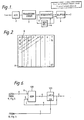
- the video coder shown in Figure 1 has a video input 1, and an analogue to digital converter 2. This is followed by a transform coder 3.
- Each frame of the picture is notionally divided into blocks of picture elements (pixels) and each block subjected to a two-dimensional transform such as the discrete cosine transform (DCT) to produce a block of coefficients.
- DCT discrete cosine transform
- One object of conversion into the transform domain is to effect a reduction in the quantity of data which needs to be encoded for transmission, since the number of bits used for encoding each coefficient can be tailored to the relative contribution of that coefficient to the picture quality. In particular, coefficients which are insignificantly small or zero need not be transmitted.
- the transform coder output is supplied to a sequence selection unit 4, and a resequencer 5 which outputs the coefficients of a block in an order - determined by the unit 4 - different from that in which they were received.
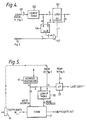
- the selector 4 is shown in more detail in Figure 3 and has an input to which a set of 64 coefficients for each block in turn are supplied by the transform coder 3.
- the processing of a single block will be described, it being understood that processing of subsequent blocks occurs in like manner.
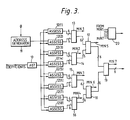
- An address generator 11 produces a sequence of 64 unique addresses synchronously with the appearance of the coefficients at the input. The sequence in which they appear is immaterial: for the purposes of further description it will be assumed that the generator is a 6-bit binary counter and addresses are the numbers shown in Figure 2.
- Assessment means 12 serves to ascertain which of the eight possible orders is best suited to the transmission of the particular block. Each address in turn is passed to it, along with the corresponding coefficient, the latter via a circuit 10 which produces a '1' output if the coefficient is non-zero.
- the assessment means 12 has eight sections 12(1)-12(8), one of which is shown in Figure 4.
- a comparator 124 which receives the outputs of the memory 122 and the latch 123 and produces a '1' output if the former is greater than the latter.
- the output of the comparator and the output of the circuit 10 of figure 3 drive a load enable input of the latch 123 via an AND gate 127.
- Each of the sections 12(1)-12(8) is identical except for the content of the look up table 122 which corresponds in each case to a respective one of the eight orders - although if the order in which the coefficients were originally supplied is one of the eight, then one section could omit the table 122.
- the outputs of the eight sections are compared to determine which is the lowest.
- This function is performed by a comparator tree ( Figure 3) consisting of six read-only memories 13-19 each of which receives two addresses from assessment section outputs or an earlier such memory and produces as output the lower address.
- the outputs min1 ... min6 access a further read-only memory 20 to produce a code indicating which of the eight sections provided the lowest address, the address itself appearing at the output of the last stage 19 of the tree.
- the resequencer 5 is shown in figure 5. (The address generator 11 is shown again for clarity).
- the coefficient selection operates in two phases, the first of which has been described above. During this first phase, the coefficients are stored in a store 21 with the aid of the address generator 11. In the second phase, the coefficients are read out from the store; for this purpose the address generator 11 again cycles through its sequence, as before, but the addresses generated pass to the store 21 via a read-only memory 22 containing eight translation tables each of which is the reverse of the contents of all eight stores 12(1)-12(8) - ie the generated address is interpreted as the position in the required order and the table provides the corresponding store address.
- Which of the eight tables is used is determined by the output of the read-only memory 20 which is applied to the higher order address lines of the memory 22. In this way the coefficients are read out in the selected order.
- the output of the comparator 19 is fed to a comparator 23 which produces a "last coefficient" pulse when the address generator reaches the address indicated. This pulse can be used to prevent the zero coefficients being entered into the output buffer 6 ( Figure 1) and hence to the output 7 of the coder.
- the two phases can be carried out simultaneously, the store 21 actually consisting of two stores one of which is being written to whilst the other is being read out.
- Figure 6 shows a modified version of the section shown in Figure 4, in which the function of the lookup table 122 and comparator 124 are performed by a read-only memory 128.
- This may be regarded as having a row address R provided by the address generator 11 and column address C provided by the output of the latch 123. All locations having a translated row address greater than the column address contain the translated row address; other locations contain the column address.
- the buffer 6 may be preceded by other coding arrangements such as a variable length coder.
- figure 1 shows the output of the sequence selector 4 connected to the output buffer 6, so that the sequence code output by the lookup table 20 of figure 3 is included in the transmitted data.
- the number of coefficients sent may be communicated explicitly (by transmitting also the output of the comparator 19) or implicitly - as is assumed below - by transmitting an end of run code following the last coefficient.
- the circuit shown in figure 5 may also be used in a decoder.
- the received signal would first be preprocessed (not shown) by a variable length decoder or other means appropriate to the method of transmission used.
- the sequence code is stripped by an additional unit 24 (shown in broken lines) and supplied to the lookup table 22.
- the coefficients are entered into the store 21 by means of the address generator 11 (driven by suitable clock recovery means, not shown) and read out using the part of the lookup table 22 selected by the received sequence code. They may then be subjected to an inverse transform operation.
- a typical program listing in pseudo-language is set out below for the sequence selection.
- the first part of the "ACTION' segment performs the same function as the assessment means in figure 3 and finds the position of the last non-zero coefficient in each scanning order.
- the second part examines these positions in turn to find the minimum and performs the same function as the tree structured comparators 13-20 in figure 3.
- the program assumes 64-element blocks, but any desired block size may of course be used.
- DECLARE VALUE (64) Transform coefficient values TABLE (n, 64) Array of order tables for n sequences HIGHEST (n) Array to store highest position so far for each sequence SEQ Sequence counter COEFF Coefficient counter TEMP Workspace register BEST Workspace register END DECLARE (Selected Sequence now indicated by BEST and number of coefficients to be sent is in TEMP).
Landscapes
- Engineering & Computer Science (AREA)
- Multimedia (AREA)
- Signal Processing (AREA)
- Physics & Mathematics (AREA)
- Algebra (AREA)
- General Physics & Mathematics (AREA)
- Mathematical Analysis (AREA)
- Mathematical Optimization (AREA)
- Pure & Applied Mathematics (AREA)
- Compression, Expansion, Code Conversion, And Decoders (AREA)
- Compression Or Coding Systems Of Tv Signals (AREA)
- Holo Graphy (AREA)
- Reduction Or Emphasis Of Bandwidth Of Signals (AREA)
- Financial Or Insurance-Related Operations Such As Payment And Settlement (AREA)
- Control Of Motors That Do Not Use Commutators (AREA)
- Diaphragms For Electromechanical Transducers (AREA)
- Optical Communication System (AREA)
- Transmission Systems Not Characterized By The Medium Used For Transmission (AREA)
- Signal Processing For Digital Recording And Reproducing (AREA)
- Two-Way Televisions, Distribution Of Moving Picture Or The Like (AREA)
- Communication Control (AREA)
Priority Applications (1)
| Application Number | Priority Date | Filing Date | Title |
|---|---|---|---|
| AT88306060T ATE97288T1 (de) | 1987-07-09 | 1988-07-04 | Datenkodierung. |
Applications Claiming Priority (2)
| Application Number | Priority Date | Filing Date | Title |
|---|---|---|---|
| GB878716195A GB8716195D0 (en) | 1987-07-09 | 1987-07-09 | Data encoding |
| GB8716195 | 1987-07-09 |
Publications (2)
| Publication Number | Publication Date |
|---|---|
| EP0301712A1 true EP0301712A1 (fr) | 1989-02-01 |
| EP0301712B1 EP0301712B1 (fr) | 1993-11-10 |
Family
ID=10620381
Family Applications (1)
| Application Number | Title | Priority Date | Filing Date |
|---|---|---|---|
| EP88306060A Expired - Lifetime EP0301712B1 (fr) | 1987-07-09 | 1988-07-04 | Codage de données |
Country Status (11)
| Country | Link |
|---|---|
| EP (1) | EP0301712B1 (fr) |
| JP (1) | JP2983220B2 (fr) |
| AT (1) | ATE97288T1 (fr) |
| CA (1) | CA1303743C (fr) |
| DE (1) | DE3885528T2 (fr) |
| DK (1) | DK96389A (fr) |
| FI (1) | FI96258C (fr) |
| GB (1) | GB8716195D0 (fr) |
| HK (1) | HK135496A (fr) |
| IE (1) | IE61501B1 (fr) |
| WO (1) | WO1989000796A1 (fr) |
Cited By (6)
| Publication number | Priority date | Publication date | Assignee | Title |
|---|---|---|---|---|
| WO1991007840A3 (fr) * | 1989-11-13 | 1991-06-27 | Eastman Kodak Co | Methode et systeme de compression numerique a efficacite de codage amelioree |
| EP0580454A3 (fr) * | 1992-07-23 | 1995-01-18 | Samsung Electronics Co Ltd | Codage et décodage de données digitales. |
| GB2264605B (en) * | 1992-02-29 | 1995-10-04 | Samsung Electronics Co Ltd | Signal compressing system |
| CN1036969C (zh) * | 1993-01-14 | 1998-01-07 | 三星电子株式会社 | 数字图象数据的插值法及其电路 |
| US5714950A (en) * | 1992-07-23 | 1998-02-03 | Samsung Electronics Co., Ltd. | System for variable-length-coding and variable-length-decoding digitaldata |
| CN1044063C (zh) * | 1994-01-05 | 1999-07-07 | 三星电子株式会社 | 用于处理在正交相位视频载波上与ntsc tv一起发送的bpsk信号的装置 |
Families Citing this family (2)
| Publication number | Priority date | Publication date | Assignee | Title |
|---|---|---|---|---|
| DE4004857A1 (de) * | 1990-02-16 | 1991-09-12 | Bosch Gmbh Robert | Einrichtung zur bandbreitenreduzierenden codierung von videosignalen |
| IL100545A (en) * | 1991-12-29 | 1995-03-15 | Dimotech Ltd | Photodynamic Healing Therapy Device |
Citations (1)
| Publication number | Priority date | Publication date | Assignee | Title |
|---|---|---|---|---|
| WO1987002854A1 (fr) * | 1985-10-22 | 1987-05-07 | Eude Gerard | Procede de codage hybride par transformation pour la transmission de signaux d'image |
-
1987
- 1987-07-09 GB GB878716195A patent/GB8716195D0/en active Pending
-
1988
- 1988-07-04 DE DE3885528T patent/DE3885528T2/de not_active Expired - Fee Related
- 1988-07-04 WO PCT/GB1988/000519 patent/WO1989000796A1/fr not_active Ceased
- 1988-07-04 EP EP88306060A patent/EP0301712B1/fr not_active Expired - Lifetime
- 1988-07-04 AT AT88306060T patent/ATE97288T1/de active
- 1988-07-06 CA CA000571243A patent/CA1303743C/fr not_active Expired - Lifetime
- 1988-07-08 IE IE208488A patent/IE61501B1/en not_active IP Right Cessation
- 1988-07-08 JP JP63170730A patent/JP2983220B2/ja not_active Expired - Fee Related
-
1989
- 1989-02-28 DK DK096389A patent/DK96389A/da not_active Application Discontinuation
- 1989-03-02 FI FI890992A patent/FI96258C/fi not_active IP Right Cessation
-
1996
- 1996-07-25 HK HK135496A patent/HK135496A/en not_active IP Right Cessation
Patent Citations (1)
| Publication number | Priority date | Publication date | Assignee | Title |
|---|---|---|---|---|
| WO1987002854A1 (fr) * | 1985-10-22 | 1987-05-07 | Eude Gerard | Procede de codage hybride par transformation pour la transmission de signaux d'image |
Non-Patent Citations (3)
| Title |
|---|
| IEEE GLOBAL TELECOMMUNICATIONS CONFERENCE, Houston, 1st-4th December 1986, vol. 1, pages 271-275, IEEE, New York, US; M. OHTA et al.: "Adaptive VWL coding of transform coefficients for sub-primary rate video transmission" * |
| IEEE INTERNATIONAL CONFERENCE ON COMMUNICATIONS, Toronto, 22nd-25th June 1986, vol. 1, pages 381-384, IEEE, New York, US; J. GUICHARD et al.: "Intra- and inter frame transform coding for moving pictures transmission" * |
| IEEE TRANSACTION ON ACOUSTICS, SPEECH, AND SIGNAL PROCESSING, vol. ASSP-32, no. 1, February 1984, pages 173-177, IEEE, New York, US; K.N. NGAN: "Image display techniques using the cosine transform" * |
Cited By (7)
| Publication number | Priority date | Publication date | Assignee | Title |
|---|---|---|---|---|
| WO1991007840A3 (fr) * | 1989-11-13 | 1991-06-27 | Eastman Kodak Co | Methode et systeme de compression numerique a efficacite de codage amelioree |
| GB2264605B (en) * | 1992-02-29 | 1995-10-04 | Samsung Electronics Co Ltd | Signal compressing system |
| EP0580454A3 (fr) * | 1992-07-23 | 1995-01-18 | Samsung Electronics Co Ltd | Codage et décodage de données digitales. |
| US5654706A (en) * | 1992-07-23 | 1997-08-05 | Samsung Electronics Co., Ltd. | System for variable length decoding digital transmission data which has been compressed by selecting a scanning pattern |
| US5714950A (en) * | 1992-07-23 | 1998-02-03 | Samsung Electronics Co., Ltd. | System for variable-length-coding and variable-length-decoding digitaldata |
| CN1036969C (zh) * | 1993-01-14 | 1998-01-07 | 三星电子株式会社 | 数字图象数据的插值法及其电路 |
| CN1044063C (zh) * | 1994-01-05 | 1999-07-07 | 三星电子株式会社 | 用于处理在正交相位视频载波上与ntsc tv一起发送的bpsk信号的装置 |
Also Published As
| Publication number | Publication date |
|---|---|
| IE61501B1 (en) | 1994-11-02 |
| JP2983220B2 (ja) | 1999-11-29 |
| CA1303743C (fr) | 1992-06-16 |
| EP0301712B1 (fr) | 1993-11-10 |
| ATE97288T1 (de) | 1993-11-15 |
| DK96389D0 (da) | 1989-02-28 |
| FI96258B (fi) | 1996-02-15 |
| IE882084L (en) | 1989-01-09 |
| GB8716195D0 (en) | 1987-08-12 |
| FI890992A0 (fi) | 1989-03-02 |
| WO1989000796A1 (fr) | 1989-01-26 |
| FI96258C (fi) | 1996-05-27 |
| JPH01138867A (ja) | 1989-05-31 |
| HK135496A (en) | 1996-08-02 |
| DE3885528T2 (de) | 1994-06-01 |
| FI890992A7 (fi) | 1989-03-02 |
| DK96389A (da) | 1989-02-28 |
| DE3885528D1 (de) | 1993-12-16 |
Similar Documents
| Publication | Publication Date | Title |
|---|---|---|
| US5303058A (en) | Data processing apparatus for compressing and reconstructing image data | |
| US5371811A (en) | Data encoding | |
| EP0123456A2 (fr) | Méthode de transformation-codage intratrame et intertrame combinée | |
| EP0580454A2 (fr) | Codage et décodage de données digitales | |
| US5907635A (en) | Picture data decompression apparatus | |
| WO1990015505A1 (fr) | Compression image par image de signaux a quantification vectorielle et autre post-traitement | |
| CA1303743C (fr) | Codage de donnees | |
| JPH09162749A (ja) | 可変長コード符号化装置 | |
| WO1998028711A2 (fr) | Decodeur longueur variable double vitesse et architecture de decodage pour donnees video mpeg-2 | |
| US5959872A (en) | Apparatus and method for bidirectional scanning of video coefficients | |
| JP4117044B2 (ja) | 映像信号符号化システムにおける量子化器 | |
| EP0721285B1 (fr) | Appareil de codage numérique | |
| JPS6041915B2 (ja) | 画像信号符号化処理方式 | |
| EP0448226B1 (fr) | Procédé à coder des données d'image | |
| JP2918360B2 (ja) | 逆量子化方法および画像データ復元装置 | |
| AU613650B2 (en) | Data encoding | |
| KR100233537B1 (ko) | 런-레벨심볼 복호화방법 및 장치 | |
| JPS62284535A (ja) | ブロツクリスト変換を用いたデ−タ符号化方法および符号化装置 | |
| JP2512195B2 (ja) | 符号化装置および復号化装置 | |
| AU666442B1 (en) | Image processing apparatus and method therefor | |
| KR100233536B1 (ko) | 런-레벨심볼 복호화방법 및 장치 | |
| JP2698034B2 (ja) | コード変換方法、コード変換システム及びディジタル・データ信号処理方法 | |
| JP3269186B2 (ja) | 画像符号化装置 | |
| KR100233538B1 (ko) | 런-레벨심볼 복호화방법 및 장치 | |
| CN1126410A (zh) | 数字视频信号的并行解码装置 |
Legal Events
| Date | Code | Title | Description |
|---|---|---|---|
| PUAI | Public reference made under article 153(3) epc to a published international application that has entered the european phase |
Free format text: ORIGINAL CODE: 0009012 |
|
| AK | Designated contracting states |
Kind code of ref document: A1 Designated state(s): AT BE CH DE ES FR GB GR IT LI LU NL SE |
|
| 17P | Request for examination filed |
Effective date: 19890715 |
|
| 17Q | First examination report despatched |
Effective date: 19920124 |
|
| GRAA | (expected) grant |
Free format text: ORIGINAL CODE: 0009210 |
|
| AK | Designated contracting states |
Kind code of ref document: B1 Designated state(s): AT BE CH DE ES FR GB GR IT LI LU NL SE |
|
| PG25 | Lapsed in a contracting state [announced via postgrant information from national office to epo] |
Ref country code: SE Effective date: 19931110 Ref country code: LI Effective date: 19931110 Ref country code: GR Free format text: LAPSE BECAUSE OF FAILURE TO SUBMIT A TRANSLATION OF THE DESCRIPTION OR TO PAY THE FEE WITHIN THE PRESCRIBED TIME-LIMIT Effective date: 19931110 Ref country code: ES Free format text: THE PATENT HAS BEEN ANNULLED BY A DECISION OF A NATIONAL AUTHORITY Effective date: 19931110 Ref country code: CH Effective date: 19931110 Ref country code: BE Effective date: 19931110 Ref country code: AT Effective date: 19931110 |
|
| REF | Corresponds to: |
Ref document number: 97288 Country of ref document: AT Date of ref document: 19931115 Kind code of ref document: T |
|
| REF | Corresponds to: |
Ref document number: 3885528 Country of ref document: DE Date of ref document: 19931216 |
|
| ITF | It: translation for a ep patent filed | ||
| REG | Reference to a national code |
Ref country code: CH Ref legal event code: PL |
|
| ET | Fr: translation filed | ||
| PG25 | Lapsed in a contracting state [announced via postgrant information from national office to epo] |
Ref country code: LU Free format text: LAPSE BECAUSE OF NON-PAYMENT OF DUE FEES Effective date: 19940731 |
|
| PLBE | No opposition filed within time limit |
Free format text: ORIGINAL CODE: 0009261 |
|
| STAA | Information on the status of an ep patent application or granted ep patent |
Free format text: STATUS: NO OPPOSITION FILED WITHIN TIME LIMIT |
|
| 26N | No opposition filed | ||
| PGFP | Annual fee paid to national office [announced via postgrant information from national office to epo] |
Ref country code: FR Payment date: 20010611 Year of fee payment: 14 |
|
| PGFP | Annual fee paid to national office [announced via postgrant information from national office to epo] |
Ref country code: GB Payment date: 20010615 Year of fee payment: 14 |
|
| PGFP | Annual fee paid to national office [announced via postgrant information from national office to epo] |
Ref country code: NL Payment date: 20010619 Year of fee payment: 14 |
|
| PGFP | Annual fee paid to national office [announced via postgrant information from national office to epo] |
Ref country code: DE Payment date: 20010625 Year of fee payment: 14 |
|
| REG | Reference to a national code |
Ref country code: GB Ref legal event code: IF02 |
|
| PG25 | Lapsed in a contracting state [announced via postgrant information from national office to epo] |
Ref country code: GB Free format text: LAPSE BECAUSE OF NON-PAYMENT OF DUE FEES Effective date: 20020704 |
|
| PG25 | Lapsed in a contracting state [announced via postgrant information from national office to epo] |
Ref country code: NL Free format text: LAPSE BECAUSE OF NON-PAYMENT OF DUE FEES Effective date: 20030201 Ref country code: DE Free format text: LAPSE BECAUSE OF NON-PAYMENT OF DUE FEES Effective date: 20030201 |
|
| GBPC | Gb: european patent ceased through non-payment of renewal fee |
Effective date: 20020704 |
|
| PG25 | Lapsed in a contracting state [announced via postgrant information from national office to epo] |
Ref country code: FR Free format text: LAPSE BECAUSE OF NON-PAYMENT OF DUE FEES Effective date: 20030331 |
|
| NLV4 | Nl: lapsed or anulled due to non-payment of the annual fee |
Effective date: 20030201 |
|
| REG | Reference to a national code |
Ref country code: FR Ref legal event code: ST |
|
| PG25 | Lapsed in a contracting state [announced via postgrant information from national office to epo] |
Ref country code: IT Free format text: LAPSE BECAUSE OF NON-PAYMENT OF DUE FEES Effective date: 20050704 |