EP0301877B1 - Verfahren zum Entschützen von 3-Aminoazetidinonen - Google Patents
Verfahren zum Entschützen von 3-Aminoazetidinonen Download PDFInfo
- Publication number
- EP0301877B1 EP0301877B1 EP88306996A EP88306996A EP0301877B1 EP 0301877 B1 EP0301877 B1 EP 0301877B1 EP 88306996 A EP88306996 A EP 88306996A EP 88306996 A EP88306996 A EP 88306996A EP 0301877 B1 EP0301877 B1 EP 0301877B1
- Authority
- EP
- European Patent Office
- Prior art keywords
- substituted
- group
- formula
- alkyl
- protected
- Prior art date
- Legal status (The legal status is an assumption and is not a legal conclusion. Google has not performed a legal analysis and makes no representation as to the accuracy of the status listed.)
- Expired - Lifetime
Links
- 0 CC(C)[C@@](C1SCC(C)=C(*)N11)C1=O Chemical compound CC(C)[C@@](C1SCC(C)=C(*)N11)C1=O 0.000 description 7
Classifications
-
- C—CHEMISTRY; METALLURGY
- C07—ORGANIC CHEMISTRY
- C07D—HETEROCYCLIC COMPOUNDS
- C07D505/00—Heterocyclic compounds containing 5-oxa-1-azabicyclo [4.2.0] octane ring systems, i.e. compounds containing a ring system of the formula:, e.g. oxacephalosporins; Such ring systems being further condensed, e.g. 2,3-condensed with an oxygen-, nitrogen- or sulfur-containing hetero ring
-
- C—CHEMISTRY; METALLURGY
- C07—ORGANIC CHEMISTRY
- C07D—HETEROCYCLIC COMPOUNDS
- C07D205/00—Heterocyclic compounds containing four-membered rings with one nitrogen atom as the only ring hetero atom
- C07D205/02—Heterocyclic compounds containing four-membered rings with one nitrogen atom as the only ring hetero atom not condensed with other rings
- C07D205/06—Heterocyclic compounds containing four-membered rings with one nitrogen atom as the only ring hetero atom not condensed with other rings having one double bond between ring members or between a ring member and a non-ring member
- C07D205/08—Heterocyclic compounds containing four-membered rings with one nitrogen atom as the only ring hetero atom not condensed with other rings having one double bond between ring members or between a ring member and a non-ring member with one oxygen atom directly attached in position 2, e.g. beta-lactams
- C07D205/085—Heterocyclic compounds containing four-membered rings with one nitrogen atom as the only ring hetero atom not condensed with other rings having one double bond between ring members or between a ring member and a non-ring member with one oxygen atom directly attached in position 2, e.g. beta-lactams with a nitrogen atom directly attached in position 3
-
- C—CHEMISTRY; METALLURGY
- C07—ORGANIC CHEMISTRY
- C07D—HETEROCYCLIC COMPOUNDS
- C07D463/00—Heterocyclic compounds containing 1-azabicyclo [4.2.0] octane ring systems, i.e. compounds containing a ring system of the formula:, e.g. carbacephalosporins; Such ring systems being further condensed, e.g. 2,3-condensed with an oxygen-, nitrogen- or sulfur-containing hetero ring
- C07D463/02—Preparation
- C07D463/06—Preparation from compounds already containing the ring or condensed ring systems, e.g. by dehydrogenation of the ring, by introduction, elimination or modification of substituents
-
- Y—GENERAL TAGGING OF NEW TECHNOLOGICAL DEVELOPMENTS; GENERAL TAGGING OF CROSS-SECTIONAL TECHNOLOGIES SPANNING OVER SEVERAL SECTIONS OF THE IPC; TECHNICAL SUBJECTS COVERED BY FORMER USPC CROSS-REFERENCE ART COLLECTIONS [XRACs] AND DIGESTS
- Y02—TECHNOLOGIES OR APPLICATIONS FOR MITIGATION OR ADAPTATION AGAINST CLIMATE CHANGE
- Y02P—CLIMATE CHANGE MITIGATION TECHNOLOGIES IN THE PRODUCTION OR PROCESSING OF GOODS
- Y02P20/00—Technologies relating to chemical industry
- Y02P20/50—Improvements relating to the production of bulk chemicals
- Y02P20/55—Design of synthesis routes, e.g. reducing the use of auxiliary or protecting groups
Definitions
- This invention relates to a process for preparing ⁇ -lactam antibiotic intermediates.
- the clinically useful ⁇ -lactam antibiotics include a wide variety of compounds: cephalosporins such as cephalexin, cefaclor, and cefamandol; totally synthetic "oxa"-cephalosporins such as moxalactam; and a variety of monocyclic ⁇ -lactams as well as bicyclic ⁇ -lactams. Because the ⁇ -lactam antibiotics represent such an important therapeutic class, considerable effort is directed toward more efficient methods for their preparation.
- the process provided herein is an alternative method to known N-deacylation methods employed with ⁇ -lactam compounds (see, for example, Cephalosporins and Penicillins , edited by Edwin H. Flynn, Academic Press, New York (1972), page 62.
- the known imino halide, imino ether cleavage method results in low yields or undue decomposition. In such cases, the present process can be an attractive alternative.
- GB-A-1438422 discloses an acylation process in which an iminohalide derivative is produced and immediately reacted with an organic acid and converted to the diacylaminohalide.
- the present invention provides a process for the selective N-deacylation of an N-(alkyl, arylalkyl, or alkenyl)oxycarbonyl N-acylamino substituted ⁇ -lactam to an N-(alkyl, arylalkyl, or alkenyl)oxycarbonylamino substituted ⁇ -lactam.
- the process affords ready exchange of the N-acyl group of an N-acylamino substituted ⁇ -lactam to a protected amino substituted ⁇ -lactam wherein the amino-protecting group is readily removable.
- the process thus provides protected-amino substituted ⁇ -lactam compounds which, upon deprotection, afford free amino substituted ⁇ -lactams. The latter are valuable intermediates to antibiotic compounds.
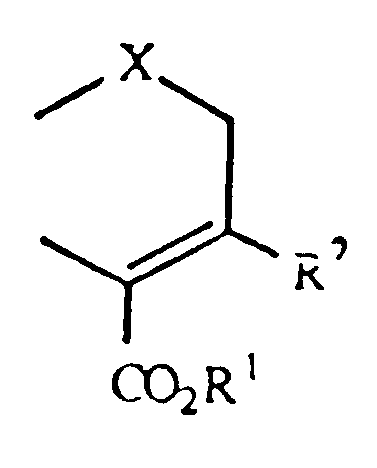
- the present invention provides a process for preparing a compound of Formula (1) wherein R is allyloxycarbonyl, t-butoxycarbonyl, naphthyloxycarbonyl, trichloroethyloxycarbonyl, p-nitrobenzyloxycarbonyl, benzhydryloxycarbonyl, p-methoxybenzyloxycarbonyl, or o-nitrobenzyloxycarbonyl; wherein A is C1 to C6 alkyl, C1 to C6 substituted alkyl or a group of the formula -S( ⁇ C1 to C4 alkyl)CO2R', wherein R' is hydrogen or a carboxy-protecting group; and A' is hydrogen or an amide-protecting group; or A and A' taken together form a group of the formula wherein R1 is a carboxy-protecting group; X is sulfur, -CH2-, or oxygen and R2 is hydrogen, halo, C1 to C6 alkoxy, C1 to C6 al
- the process is preferably carried out at temperatures between about 0°C and about 50°C, most preferably at about 25°C.
- Inert solvents which can be used include, for example, tetrahydrofuran, ethyl acetate, halogenated hydrocarbons such as methylene chloride and di- or tri-chloroethane.
- R2 is hydrogen, halo, C1 to C6 alkoxy, C1 to C6 alkyl, C1 to C6 substituted alkyl, C1 to C6 alkylthio, C1 to C6 substituted alkylthio, C7 to C12 arylalkyl, C7 to C12 substituted arylalkyl, phenyl or substituted phenyl; a group of the formula -CX3 wherein X is fluoro, chloro, bromo, or iodo; a group of the formula -COR6 wherein R6 is hydrogen, C1 to C6 alkyl, C1 to C6 substituted alkyl, C7 to C12 arylalkyl, C7 to C12 substituted arylalkyl, phenyl, substituted phenyl, amino, (monosubstituted)amino, or (disubstituted)amino; a group of the formula -COOR
- a preferred embodiment of this invention is the process wherein A and A′ are taken together and form a group of the formula
- a preferred embodiment of this invention is the process wherein X is -CH2- or sulfur.
- An especially preferred embodiment of this invention is the process wherein X is -CH2-.
- C1 to C6 alkyl denotes such radicals as methyl, ethyl, n-propyl, iso-propyl, n-butyl, sec-butyl, tert-butyl, amyl, tert-amyl and hexyl.
- the preferred "C1 to C6 alkyl” group is methyl.
- C1 to C6 substituted alkyl denotes the above C1 to C6 alkyl groups that are substituted by one or two halogen, hydroxy, protected hydroxy, amino, protected amino, C1 to C7 acyloxy, nitro, carboxy, protected carboxy, carbamoyl, carbamoyloxy, cyano, methylsulfonylamino or C1 to C4 alkoxy groups.
- the substituted alkyl groups may be substituted once or twice with the same or with different substituents.
- Examples of the above substituted alkyl groups include the cyanomethyl, nitromethyl, hydroxymethyl, trityloxymethyl, propionyloxymethyl, aminomethyl, carboxymethyl, allyloxycarbonylmethyl, allyloxycarbonylaminomethyl, carbamoyloxymethyl, methoxymethyl, ethoxymethyl, t-butoxymethyl, acetoxymethyl, chloromethyl, bromomethyl, iodomethyl, 6-hydroxyhexyl, 2,4-dichloro(n-butyl), 2-amino(iso-propyl) and 2-carbamoyloxyethyl.
- a preferred group of examples within the above "C1 to C6 substituted alkyl” group includes the substituted methyl group, e.g., a methyl group substituted by the same substituents as the "C1 to C6 substituted alkyl” group.
- the substituted methyl group include groups such as hydroxymethyl, protected hydroxymethyl, (e.g., tetrahydropyranyloxymethyl), acetoxymethyl, carbamoyloxymethyl, chloromethyl, bromomethyl and iodomethyl.
- C1 to C4 alkoxy denotes groups such as methoxy, ethoxy, n-propoxy, iso-propoxy, n-butoxy and t-butoxy.
- C1 to C7 acyloxy denotes herein groups such as formyloxy, acetoxy, propionyloxy, butyryloxy, pentanoyloxy, hexanoyloxy and heptanoyloxy.
- C1 to C7 acyl encompasses groups such as formyl, acetyl, propionyl, butyryl, pentanoyl, hexanoyl, heptanoyl and benzoyl.
- substituted phenyl specifies a phenyl group substituted with one or two moieties chosen from the group consisting of halogen, hydroxy, protected hydroxy, cyano, nitro, C1 to C6 alkyl, C1 to C4 alkoxy, carboxy, protected carboxy, carboxymethyl, protected carboxymethyl, hydroxymethyl, protected hydroxymethyl, aminomethyl, protected aminomethyl, trifluoromethyl or N-(methylsulfonylamino).
- substituted phenyl examples include a mono- or di(halo)phenyl group such as 4-chlorophenyl, 2,6-dichlorophenyl, 2,5-dichlorophenyl, 3,4-dichlorophenyl, 3-chlorophenyl, 3-bromophenyl, 4-bromophenyl, 3,4-dibromophenyl, 3-chloro-4-fluorophenyl and 2-fluorophenyl; a mono- or di(hydroxy)phenyl group such as 4-hydroxyphenyl, 3-hydroxyphenyl, 2,4-dihydroxyphenyl, the protected-hydroxy derivatives thereof; a nitrophenyl group such as 3- or 4-nitrophenyl; a cyanophenyl group, for example, 4-cyanophenyl; a mono- or di(lower alkyl)phenyl group such as 4-methylphenyl, 2,4-dimethylphenyl, 2-methylphenyl, 4-
- substituted phenyl represents disubstituted phenyl groups wherein the substituents are different, for example, 3-methyl-4-hydroxyphenyl, 3-chloro-4-hydroxyphenyl, 2-methoxy-4-bromophenyl, 4-ethyl-2-hydroxyphenyl, 3-hydroxy-4-nitrophenyl and 2-hydroxy-4-chlorophenyl.
- Preferred substituted phenyl groups include the 2- and 3-trifluoromethylphenyl, the 4-hydroxyphenyl, the 2-aminomethylphenyl and the 3-(N-(methylsulfonylamino))phenyl groups.
- halo and halogen refer to the fluoro, chloro, bromo or iodo groups. Chloro is preferred.
- trihalomethyl denotes trifluoromethyl, trichloromethyl, tribromomethyl or triiodomethyl.
- C1 to C6 alkylthio and C1 to C6 substituted alkylthio denote C1 to C6 alkyl and C1 to C6 substituted alkyl groups, respectively, attached to a sulfur which is in turn the point of attachment for the C1 to C6 alkylthio or C1 to C6 substituted alkylthio group.
- C7 to C12 arylalkyl denotes a C1 to C6 alkyl group substituted at any position by a phenyl ring.
- Examples of such a group include phenyl methyl (benzyl), 2-phenylethyl, 3-phenyl-(n-propyl), 4-phenylhexyl, 3-phenyl-(n-amyl) and 3-phenyl-(sec-butyl).
- a preferred group is the benzyl group.
- C7 to C12 substituted arylalkyl denotes a C7 to C12 arylalkyl group substituted on the C1 to C6 alkyl portion with one or two groups chosen from halogen, hydroxy, protected hydroxy, amino, protected amino, C1 to C7 acyloxy, nitro, carboxy, protected carboxy, carbamoyl, carbamoyloxy, cyano, C1 to C6 alkylthio, N-methylsulfonylamino) or C1 to C4 alkoxy; and/or the phenyl group may be substituted with 1 or 2 groups chosen from halogen, hydroxy, protected hydroxy, nitro, C1 to C6 alkyl, C1 to C4 alkoxy, carboxy, protected carboxy, carboxymethyl, protected carboxymethyl, hydroxymethyl, protected hydroxymethyl, aminomethyl, protected aminomethyl, or an N-(methylsulfonylamino) group.
- halogen hydroxy, protected hydroxy, amino, protected amino,
- C7 to C12 substituted arylalkyl include groups such as 2-phenyl-1-chloroethyl, 2-(4-methoxyphenyl)ethyl, 2,6-dihydroxy-4-phenyl(n-hexyl), 5-cyano-3-methoxy-2-phenyl(n-pentyl), 3-(2,6-dimethylphenyl)n-propyl, 4-chloro-3-aminobenzyl, 6-(4-methoxyphenyl)-3-carboxy(n-hexyl) and 5-(4-aminomethyl phenyl)-3-(aminomethyl)(n-pentyl).
- (monosubstituted)amino refers to an amino group with one substituent chosen from the group consisting of phenyl, substituted phenyl, C1 to C6 alkyl, and C7 to C12 arylalkyl, wherein the latter three substituent terms are as defined above.
- (disubstituted)amino refers to amino groups with two substituents chosen from the group consisting of phenyl, substituted phenyl, C1 to C6 alkyl, and C7 to C12 arylalkyl wherein the latter three substituent terms are as described above.
- the two substituents can be the same or different.
- carboxy-protecting group refers to one of the ester derivatives of the carboxylic acid group commonly employed to block or protect the carboxylic acid group while reactions are carried out on other functional groups on the compound.
- carboxylic acid protecting groups include 4-nitrobenzyl, 4-methoxybenzyl, 3,4-dimethoxybenzyl, 2,4-dimethoxybenzyl, 2,4,6-trimethoxybenzyl, 2,4,6-trimethylbenzyl, pentamethylbenzyl, 3,4-methylenedioxybenzyl, benzhydryl, 4,4′-dimethoxybenzhydryl, 2,2′,4,4′-tetramethoxybenzhydryl, t-butyl, t-amyl, trityl, 4-methoxytrityl, 4,4′-dimethoxytrityl, 4,4′,4 ⁇ -trimethoxytrityl, 2-phenylprop-2-yl, trimethylsily
- carboxy-protecting group employed is not critical so long as the derivatized carboxylic acid is stable to the condition of subsequent reaction(s) on other positions of the ⁇ -lactam molecule and can be removed at the appropriate point without disrupting the remainder of the molecule.
- it is important not to subject the carboxy-protected ⁇ -lactam molecule to strong nucleophilic bases or reductive conditions employing highly activated metal catalysts such as Raney nickel. (Such harsh removal conditions are also to be avoided when removing amino-protecting groups and hydroxy-protecting groups, discussed below.)
- Preferred carboxylic acid protecting groups are the allyl and p-nitrobenzyl groups.
- heterocyclic denotes optionally substituted 5-membered or 6-membered rings that have 1 to 4 heteroatoms, such as oxygen, sulfur and/or nitrogen, in particular nitrogen, either alone or in conjunction with sulfur or oxygen ring atoms.
- heteroatoms such as oxygen, sulfur and/or nitrogen, in particular nitrogen, either alone or in conjunction with sulfur or oxygen ring atoms.
- These 5-membered or 6-membered rings may be fully unsaturated or partially unsaturated, with fully unsaturated rings being preferred.
- the above optionally substituted 5-membered or 6-membered rings can optionally be fused to an aromatic 5-membered or 6-membered ring system.
- the rings can be optionally fused to an aromatic 5-membered or 6-membered ring system such as a pyridine or a triazole system, and preferably to a benzene ring.
- heterocyclic whether substituted or unsubstituted radicals denoted by the term "heterocyclic”: thienyl, furyl, pyrrolyl, imidazolyl, pyrazolyl, thiazolyl, isothiazolyl, oxazolyl, isoxazolyl, triazolyl, thiadiazolyl, oxadiazolyl, tetrazolyl, thiatriazolyl, oxatriazolyl, pyridyl, pyrimidyl, pyrazinyl, pyridazinyl, thiazinyl, oxazinyl, triazinyl, thiadiazinyl, oxadiazinyl, dithiazinyl, dioxazinyl, oxathiazinyl, tetrazinyl, thiatriazinyl, oxatriaziny
- Preferred heterocyclic rings are 5-membered ring systems containing a sulfur or oxygen atom and one to three nitrogen atoms.
- preferred groups include thiazolyl, in particular thiazol-2-yl and thiazol-2-yl N-oxide, thiadiazolyl, in particular 1,3,4-thiadiazol-5-yl and 1,2,4-thiadiazol-5-yl, oxazolyl, preferably oxazol-2-yl, and oxadiazolyl, such as 1,3,4-oxadiazol-5-yl, and 1,2,4-oxadiazol-5-yl.
- a group of further preferred examples of 5-membered ring systems with 2 to 4 nitrogen atoms include imidazolyl, preferably imidazol-2-yl; triazolyl, preferably 1,3,4-triazol-5-yl; 1,2,3-triazol-5-yl, 1,2,4-triazol-5-yl, and tetrazolyl, preferably 1H-tetrazol-5-yl.
- a preferred group of examples of benzo-fused derivatives are, in particular, benzoxazol-2-yl, benzthiazol-2-yl and benzimidazol-2-yl.
- heterocyclic ring systems are 6-membered ring systems containing one to three nitrogen atoms.
- Such examples include pyridyl, such as pyrid-2-yl, pyrid-3-yl and pyrid-4-yl; pyrimidyl, preferably pyrimid-2-yl and pyrimid-4-yl; triazinyl, preferably 1,3,4-triazin-2-yl and 1,3,5-triazin-4-yl; pyridazinyl, in particular pyridazin-3-yl, and pyrazinyl.
- pyridine N-oxides and pyridazine N-oxides are a preferred group.
- heterocyclic examples of the term "heterocyclic” are included in the heterocyclic thiomethyl groups listed under heading "A".
- a particularly preferred group of "heterocyclics" is 1,3-thiazol-2-yl, 4-(carboxymethyl)-5-methyl-1,3-thiazol-2-yl, 4-(carboxymethyl)-5-methyl-1,3-thiazol-2-yl sodium salt, 1,2,4-thiadiazol-5-yl, 3-methyl-1,2,4-thiadiazol-5-yl, 1,3,4-triazol-5-yl, 2-methyl-1,3,4-triazol-5-yl, 2-hydroxy-1,3,4-triazol-5-yl
- a most preferred group of "heterocyclics” is 4-(carboxymethyl)-5-methyl-1,3-thiazol-2-yl, 4-(carboxymethyl)-5-methyl-1,3-thiazol-2-yl sodium salt, 1,3,4-triazol-5-yl, 2-methyl-1,3,4-triazol-5-yl, 1H-tetrazol-5-yl, 1-methyl-1H-tetrazol-5-yl, 1-(1-(dimethylamino)eth-2-yl)-1H-tetrazol-5-yl, 1-(carboxymethyl)-1H-tetrazol-5-yl, 1-(carboxymethyl)-1H-tetrazol-5-yl sodium salt, 1-(methylsulfonic acid)-1H-tetrazol-5-yl, 1-(methylsulfonic acid)-1H-tetrazol-5-yl sodium salt, 1,2,3-triazol-5-yl, 1,4,5,6-tetrahydro-5,6-
- amide-protecting group refers to any group typically used in the ⁇ -lactam art for protecting the ⁇ -lactam ring nitrogen from undesirable side reactions.
- groups include p-methoxyphenyl, 3,4-dimethoxybenzyl, benzyl, O-nitrobenzyl, di-(p-methoxyphenyl)methyl, triphenylmethyl, (p-methoxyphenyl)diphenylmethyl, diphenyl-4-pyridylmethyl, m-2-(picolyl)-N′-oxide, 5-dibenzosuberyl, trimethylsilyl and t-butyl dimethylsilyl. Further descriptions of the utility of these protecting groups can be found in "Protective Groups in Organic Synthesis", by Theodora W. Greene, 1981, John Wiley & Sons, New York.
- Suitable bases include primary or secondary amines or an alkali metal hydroxide.
- Such suitable bases which can be used as selective nucleophiles include C1-C7 primary and C2-C14 secondary amines such as methylamine, ethylamine, propylamine, butylamine, pentylamine, hexylamine, heptylamine, dimethylamine, diethylamine, dipropylamine, dibutylamine, dipentylamine, dihexylamine, diheptyl, methylethylamine, methylpropylamine, methylbutylamine, methylpentylamine, methylhexylamine, methylheptylamine, ethylpropylamine, ethylbutylamine, ethylpentylamine, ethylhexylamine, ethylheptylamine, propylbutylamine, propylpentylamine, propy
- Preferred bases include lithium hydroxide and N,N-diethylethylene diamine.
- an acylamino-substituted ⁇ -lactam is first acylated to provide a diacylamino-substituted ⁇ -lactam which is then treated with a suitable base to provide the protected amino monosubstituted ⁇ -lactam represented by Formula (1) in which the original acyl substituent has been interchanged for a different and more dynamic protecting group.
- a compound of the formula is acylated with di-t-butyldicarbonate in the presence of base to provide a compound of the formula
- This imide can then be treated with a suitable base, for example, N,N-diethylethylene diamine, to provide a compound of the formula
- the phenoxyacetyl group or any other of several acetyl or substituted acetyl groups can be removed in a facile manner by first synthesizing the imide of Formula (2) followed by reaction with a suitable base.
- the amide substitutent (R) is chloroacetyl
- the resulting imide (2) can be treated with thiourea to provide the desired protected amino substituted ⁇ -lactam (1).
- Temperature for formation of the imide should not be so high as to cause decomposition of the ⁇ -lactam substrate, but is not otherwise critical, so long as sufficient heat is present for the acylation to occur. It is preferable that the temperature be between about 0°C. and about 80°C.
- a base is also desirable for the formation of the imide via deprotonation of the amino ⁇ -lactam.
- bases typically include potassium hydroxide, sodium hydroxide and triethylamine. Choice of a base in this context is also dictated by the relative reactivity of the ⁇ -lactam substrate to undesired nucleophilic side reactions.
- the original ⁇ -lactam amide substituent is typically an acyl group such as phenoxyacetyl, phenylacetyl, chloroacetyl or any such substituted or unsubstituted acetyl group.
- removal of the original amino substituent using known procedures may, at times, either not work at all, or work, but at the same time be deleterious to other reactive sites on the ⁇ -lactam substrate.
- the original substituted amino- ⁇ -lactam be acylated with a compound of the formula (R)2O or R-L, in the presence of a base, wherein L is a suitable leaving group.
- Typical leaving groups (L) include bromo, iodo, chloro and imidazole.
- the imide can then be treated with a suitable base, as described herein, to provide a compound of Formula (1).
- This displacement can be carried out in many polar organic solvents such as tetrahydrofuran, CH2Cl2, ethanol, propanol, butanol, dichloroethane, dioxane and ethyl acetate.
- Preferred solvents are tetrahydrofuran and CH2Cl2.
- the desired product can be isolated by conventional methods and purified by chromatography over silica gel, if necessary.
- the result of the process of this invention is thus an amino-substituted ⁇ -lactam substrate which is protected on the amino nitrogen with a more facile protecting group.
- R t-butoxycarbonyl
- the process of this invention offers yet another solution to the problem of manipulation of protecting groups on the relatively sensitive amino-substituted ⁇ -lactam system and thus aids in the synthesis of clinically useful ⁇ -lactam antibiotics.
- the resulting product may sometimes contain a mixture of ⁇ 2 and ⁇ 3 isomers.
- This problem may be overcome by simply employing the the procedure outlined by G. V. Kaiser, et al ., J. Org. Chem ., 35 , 2430 (1970). See also, "Cephalosporins and Penicillins" edited by Edwin H. Flynn, pp. 144-151, Academic Press(1972).
- a ⁇ 2 cephem can be oxidized to its corresponding sulfoxide, and in the process, the cephem bond is isomerized back to the ⁇ 3 isomer.
- ⁇ -lactam substrates include, but are not limited to, the monobactams, cephalosporins, oxacephalosporins such as moxalactam, and 1-carba(dethia)cephalosporins.
- Examples of one class of the 1-carbacephalosporins which are viable substrates for the process of this invention can be prepared by reacting a 3 ⁇ -protected amino-4 ⁇ -(2-substituted-ethyl)azetidin-2-one represented by Formula (AA): wherein R0 represents an amino group substituted by a conventional amino-protecting group such as R or R4 above, and T is a leaving group such as bromo, iodo, methanesulfonyloxy, trifluoromethylsulfonyloxy, or p-toluenesulfonyloxy, with a phenylsulfinyl or phenylsulfonyl substituted acrylic acid ester represented by Formula (BB): wherein A′′ is hydrogen, amino, C1 to C6 alkyl, C1 to C6 substituted alkyl, C7 to C12 arylalkyl, C7 to C12 sustituted arylalkyl,
- the condensation of (AA) with (BB) is preferably carried out in an inert aprotic solvent under substantially anhydrous conditions at a temperature between about -90°C. and about -45°C. with a strong non-nucleophilic base.
- Inert aprotic solvents which can be used are aprotic organic solvents, for example, tetrahydrofuran, tetrahydropyran, dioxane, acetonitrile, diethyl ether, dimethylformamide, dimethylacetamide and 1,2-dimethoxyethane. Mixtures of such solvents may be used.
- Non-nucleophilic bases which can be used include the silylated lithium amides such as bis(tri-C1-C4 alkylsilyl)lithium amides, e.g., bis-(trimethylsilyl)lithium amide, lithium diisopropylamide (LDA), sodium or potassium hexamethyldisilazide.
- silylated lithium amides such as bis(tri-C1-C4 alkylsilyl)lithium amides, e.g., bis-(trimethylsilyl)lithium amide, lithium diisopropylamide (LDA), sodium or potassium hexamethyldisilazide.
- the base the acrylic acid ester (BB), and the 4-(2-substituted-ethyl)azetidinone (AA) are used in about equimolar amounts.
- the process is carried out by first adding the non-nucleophilic base to a cold solution of (AA), in an inert solvent. The solution is stirred in the cold for a time sufficient to allow generation of the anion formed with the base and the azetidinone nitrogen. Generally, the mixture is stirred in the cold for about 20 minutes to about one hour. Next, the phenylsulfinyl acrylic acid ester, (BB), or a solution thereof in an inert aprotic solvent is added to the cold basic solution. The reaction mixture is stirred for a short time in the cold and then is allowed to warm slowly to room temperature.
- DMPU dimethyl-3,4,5,6-tetrahydro-2(1H)pyrimidinone
- the 7 ⁇ -protected amino-1-carba-3-cephem ester, (2) is recovered from the reaction mixture by extraction into a water immiscible organic solvent.
- the solution is evaporated and the reaction product mixture dissolved in toluene, a higher boiling glycol ether, chlorobenzene or other inert solvent having a suitable boiling point, and heated at a temperature above about 85°C, preferably above 100°C, for about 15 minutes to about 4 hours to complete the elimination of the phenylsulfinic acid residue, or the phenylsulfonic acid residue.
- the solvent is removed and the product is purified by chromatography over a suitable adsorbent such as silica gel. When the process is carried out on a small scale, the product may be purified by HPLC or by preparative thick layer chromatography.
- the 7 ⁇ -protected amino-1-carba-3-cephem ester product (2) can then be deprotected and reacylated with a desired carboxylic acid or an active derivative thereof, to provide a 1-carba(dethia)cephalosporin antibiotic.
- the imine is formed in dry toluene in the presence of a drying agent such as molecular sieves or via azeotropic distillation of water.
- a drying agent such as molecular sieves or via azeotropic distillation of water.
- the chiral oxazolidinone acetyl chloride then is allowed to react with the previously prepared imine in methylene chloride at a temperature between about -80°C. and about -15°C. in the presence of a tertiary amine such as triethylamine.
- the cycloaddition product (a), N-benzyl-3 ⁇ -[(4S)-phenyl-1,3-oxazolidin-2-one-3-yl]-4 ⁇ -(2-t-butyldimethylsilyloxyethyl)azetidin-2-one, is reduced with lithium in ammonia containing t-butyl alcohol (step 2) to remove the chiral auxiliary and the N-benzyl group to provide (b) the 3 ⁇ -amino-4 ⁇ -(2-t-butyldimethylsilyloxyethyl)azetidin-2-one.
- the ⁇ -amino group is protected (step 3) with a suitable conventional amino-protecting group such as the t-butyloxycarbonyl group (tBOC).
- a suitable conventional amino-protecting group such as the t-butyloxycarbonyl group (tBOC).
- the amino-protected azetidinone (c) is reacted (step 4) in an inert solvent at a temperature of about 0°C. to about room temperature with tetra(n-butyl)ammonium fluoride to cleave the silyl ether and form 3 ⁇ -protected amino-4 ⁇ -(2-hydroxyethyl)-azetidin-2-one (d).
- the hydroxy group is converted in step 5 to the mesylate, triflate, or tosylate ester (e) with methanesulfonyl chloride, trifluoromethylsulfonyl chloride, or tosyl chloride in the presence of a tertiary amine such as triethylamine or pyridine.
- the 4-(2-iodoethyl)azetidinone is employed in the process for preparing compounds represented by Formula (2).
- BB phenylsulfinyl-substituted or phenylsulfonyl-substituted acrylic acid ester represented by the foregoing Formula (BB) is prepared as shown below in Scheme 2.
- an ester of phenylmercaptoacetic acid or a phenylthiomethylketone is alkylated (step 1) with a haloacetic acid ester to form a 3-phenylthio-3-substituted propionic acid ester (aa).
- Chlorination (step 2) of (aa) with N-chlorosuccinimide in carbon tetrachloride-THF at the reflux temperature provides the 3-chloro-3-phenylthio-3-substituted propionic acid ester (bb).
- step 3 Dehydrohalogenation (step 3) of (bb) with a strong non-nucleophilic base such as DBU forms the 3-phenylthio-3-substituted acrylic acid ester (cc) as a mixture of the two geometric isomers.
- a strong non-nucleophilic base such as DBU
- the mixture need not be separated into the individual isomers.
- step 4 the phenylthio group of (cc) is oxidized in methylene chloride at room temperature or below with a peracid such as peracetic acid to provide (BB).
- the oxidation can be carried out in an inert organic solvent such as methylene chloride.
- phenylsulfinyl-substituted intermediates represented by Formula (BB) wherein k is 1 are preferred intermediates in the preparation of 1-carbacephalosporins.
- ⁇ - is phenyl
- X is chloro, bromo, or iodo
- A′′ is typically a group that is inert in the reaction steps outlined in Scheme 2, e.g., groups that will undergo mild peracid oxidation, chlorination with a positive chlorination reagent such as N-chlorosuccinimide, or that are incompatible in the alkylation or dehydrohalogenation steps.
- methyl phenylmercaptoacetate is alkylated with t-butyl bromoacetate to form t-butyl 3-phenylthio-3-methoxycarbonylpropionate.
- the diester is chlorinated with N-chlorosuccinimide and the chloro product is reacted with the base DBU to form the unsaturated diester represented by the formula Oxidation of the diester with peracetic acid yields the corresponding phenylsulfinyl ester represented by the above Formula (BB) wherein A′′ is methoxy and R1 is t-butyl.
- the diester described above is a versatile intermediate which can be converted to a variety of other intermediates represented by (BB).
- the t-butyl group can be selectively removed with trifluoroacetic acid (TFA) in the cold to form the mono ester and the free carboxy group re-esterified to form a different mixed diester.
- TFA trifluoroacetic acid
- the mixed methyl t-butyl diester of the above formula is treated with TFA to form the mono ester of the formula
- the monoester is then esterified with the desired ester forming group to form a different mixed diester.
- the free acid is esterified with allyl bromide in the presence of triethylamine to form the mixed methyl allyl diester represented by the formula
- the methyl ester group of the above mixed methyl t-butyl diester sulfide likewise can be selectively deesterified to the mono t-butyl ester and the free carboxy group reesterified to a different mixed diester.
- the free carboxy group can be converted to another carboxy derivative represented by (A), e.g., an amide, and then used in the cyclization reaction with the intermediate of Formula (AA) to form the corresponding 1-carba-3-cephem represented by Formula (3) wherein R1 is the carboxy-protecting group R1 of (BB).
- the mixed methyl t-butyl diester represented by the formula prepared via steps 1 through 3 of Scheme 2 is treated in THF with an equimolar amount of lithium hydroxide to form the mono t-butyl ester represented by the formula
- the carboxy group can be reesterified with the desired ester forming reagent or converted to another carboxy derivative such as an acid halide, azide, or amide.
- the product is oxidized with a peracid to the corresponding phenylsulfinyl or phenylsulfonyl derivative (BB).
- a 3-phenylsulfinyl-3-substituted-acrylate the ketone, phenylthioacetone is alkylated in THF with t-butyl bromoacetate and sodium hydride to yield t-butyl 3-phenylthio-4-oxopentanoate.
- the keto ester is chlorinated in THF with N-chlorosuccinimide to the 3-chloro keto ester and the latter dehydrohalogenated to t-butyl 3-phenylthio-4-oxopent-2-eneoate.
- the unsaturated keto ester is then oxidized in methylene chloride with peracetic acid to (BB) wherein A′′ is methyl and R1 is t-butyl as represented by the following formula
- the amino-protected 1-carbacephalosporin represented by Formula (3) above can be substituted, deblocked, and N-acylated to provide other 1-carba(dethia)cephalosporins.
- LDA lithium diisopropyl amide
- the 3-bromoacetyl ester is reacted with an O, S, or N nucleophile to provide a 3 ⁇ -protected amino 1-carba-3-cephem ester and the latter is deprotected and N-acylated to a compound of Formula (1).
- the 3-bromoacetyl ester can be reacted with a 5- or 6-membered nitrogen containing heterocyclic thiol or an alkali metal salt thereof to form the compound wherein R2 is the group
- R2 is the group
- R2 is CH3
- BSTFA bis(trimethylsilyl)trifluoroacetamide
- DBU 1,8-Diazabicyclo[5.4.0]undec-7-ene
- DMF dimethylformamide
- HPLC high performance liquid chromatography
- t-BOC t-butyloxycarbonyl
- THF tetrahydrofuran
- NMR Nuclear Magnetic Resonance (H1 spectrum)
- J coupling constant for NMR spectra in Hz.
- Example 2 The product of Example 2 (226 mg) was dissolved in 15 ml of CH2Cl2, cooled to -78°C., and treated with 59 mg of N,N-diethylethylene diamine, utilizing an additional 5 ml of CH2Cl2 as a wash solution to aid quantitative transfer. The reaction mixture was allowed to warm to room temperature and stirred for 38 hours. The crude product mixture was then extracted sequentially with cold 1N HCl and brine, and dried over anhydrous sodium sulfate.
- the reaction mixture was stirred over 2.5 hours while the flask was allowed to warm to room temperature.
- the reaction mixture was poured into 800 ml of a saturated solution of ammonium chloride in water and 1200 ml of ethyl acetate were added.
- the organic layer was separated and the aqueous layer was extracted once with 300 ml of ethyl acetate.
- the extract was combined with the organic layer, dried over magnesium sulfate, filtered and evaporated under vacuum to yield 80 g of the crude product as a brownish oil.
- the crude product was purified via preparative HPLC to yield 60 g (79.7% yield) of the product, 1-methyl 4-t-butyl 2-phenyl-thiosuccinic acid diester.
- the mixed diester phenylsulfide product obtained above (60 g, 202.43 mmole) was dissolved in a mixture of 1000 ml of carbon tetrachloride, 500 ml of THF and N-chlorosuccinimide (28.38 g, 212.55 mmole) and the mixture was heated at the reflux temperature for about 4 hours.
- the thin layer chromatogram run with a small portion of the reaction mixture showed one major spot and no starting material.
- the mixture was evaporated under vacuum and the residue was treated with hexane.
- the chloro diester obtained above (67 g, 202.51 mmole) was dissolved in 1 liter of methylene chloride and the solution cooled to -78°C.
- DBU 31.44 g, 206.56 mmole
- the reaction mixture was allowed to warm to room temperature over 1.5 hours when a thin layer chromatogram of the reaction mixture showed two major spots and no starting material.
- the mixture was poured into 1 liter of water containing 200 ml of 1N hydrochloric acid and the organic layer separated.
- the ether solution of the product was evaporated to yield the product as a yellow oil.
- the oil was treated three times with 200 ml-portions of toluene, and after each treatment was evaporated under vacuum. There were obtained 1.95 g (79% yield) of the 2-phenylsulfinyl maleic acid diester as a yellow oil.
- the methyl t-butyl phenylsulfinyl maleic acid mixed diester obtained as described by Preparation 1 was treated with 8 ml of trifluoroacetic acid at 0°C. to effect selective removal of the t-butyl ester group. After 5 minutes, the reaction mixture was allowed to stir for 2 hours at room temperature and was then evaporated under vacuum at 45°C. to yield an oil. The oil was dissolved in the minimum amounl of methylene chloride and the solution was diluted with hexane until cloudy. The product precipitated as a white solid. The mother liquor was decanted from the solid product which was washed with a mixture of 20% methylene chloride/hexane. The washings were added to the mother liquor and placed in the refrigerator overnight to obtain a second crop of product. There were obtained 2.124 g of first crop product and a second crop of 900 mg (79.6% yield) as dried under vacuum.
- the phenylsulfinyl half ester obtained as described above (2.124 g, 8.362 mmole) was dissolved in 8 ml of DMF and the solution cooled to 0°C.
- allyl bromide (1.011 g, 8.362 mmole) was added to the solution followed by triethylamine (1.25 ml, 9.0 mmole) and the mixture was allowed to warm to room temperature.
- the reaction mixture was stirred at room temperature for 2.5 hours, a thin layer chromatogram of a small portion of the reaction mixture indicated that most of the starting material had reacted, and showed a new major spot.
- the very dark reaction mixture was poured into a mixture of 60 ml of diethyl ether and 50 ml of water. The aqueous layer was separated and washed with 40 ml of diethyl ether. The ether layers were combined and washed sequentially twice with 50 ml-portions of a saturated aqueous sodium bicarbonate solution, twice with 50 ml-portions of 1N hydrochloric acid and once with 50 ml of brine. The washed organic layer was dried over magnesium sulfate, filtered and evaporated under vacuum to yield the product as a yellow oil. The product was taken up in 50 ml of toluene and evaporated under vacuum. The process was repeated to yield 1.934 g (78.6% yield) of the title compound, the allyl methyl diester.
- the aqueous layer was acidified with 17 ml of 1N hydrochloric acid and extracted twice with 200 ml-portions of diethyl ether. The extracts were combined, dried over magnesium sulfate, filtered and evaporated in vacuum to yield 2.7 g of the mono t-butylester, 4-t-butyl 2-phenylthiomaleic acid mono ester, as a yellow oil (57%).
- the reaction mixture was poured into a mixture of 200 ml of diethyl ether in 120 ml of water.
- the organic layer was separated from the organic layer which was washed twice with 100 ml-portions of a saturated aqueous solution of sodium bicarbonate, twice with 100 ml of 1N hydrochloric acid and once with 100 ml of brine.
- the organic layer was then dried over magnesium sulfate, filtered and evaporated under vacuum to yield 6.51 g of the phenylthio ethyl t-butyl diester as an oil (74% yield).
- the t-butyl ethyl diester 6.51 g, was treated at room temperature for 30 minutes with 9 ml of trifluoroacetic acid to effect select deesterification of the t-butyl ester group and provide 5.1 g of 1-ethyl 2-phenylthiomaleic acid monoethyl ester as a yellow oil.
- the half acid ester obtained as described above (5.1 g, 20.222 mmole) was dissolved in 22 ml of DMF and allyl bromide (3.67 g, 30.333 mmole) was added to the solution followed by triethylamine (4.8 ml, 34.38 mmole) and the reaction mixture was allowed to stir for approximately 16 hours.
- the mixture was poured into a mixture of 100 ml of water and 200 ml of diethyl ether and the organic layer separated from the aqueous layer.
- the organic layer was washed twice with 100 ml-portions of a saturated aqueous sodium bicarbonate solution, twice with 100 ml-portions of 1N hydrochloric acid and once with 100 ml of brine.
- the washed layer was then dried over magnesium sulfate, filtered and evaporated under vacuum to yield 5.5 g (93.2% yield) of 1-ethyl 4-allyl 2-phenylthiomaleic acid diester as a yellow oil.
- the allyl ethyl diester (5.52 g, 18.891 mmole) prepared as described above was dissolved in methylene chloride and the solution cooled to a temperature of about -42°C.
- peracetic acid 5.04 ml, 26.447 mmole
- An additional 2.0 ml of peracetic acid was added and the mixture was stirred at room temperature for an additional 1.5 hours.
- Dimethylsulfide (4.85 ml, 66 mmole) was then added to the mixture which was stirred for an additional 45 minutes.
- the unreacted starting material was separated by pouring the reaction mixture directly onto 125 g of silica gel and washing the starting material from the silica with methylene chloride. The silica gel was then eluted with diethyl ether until all of the desired sulfoxide had been washed free. The product containing filtrate was concentrated under vacuum to provide the sulfoxide diester as a yellow oil. The oil was dissolved successively six times in 100 ml-portions of toluene and the evaporated to remove toluene to provide 3.8 g of the sulfoxide diester as an oil (80% yield).
- the solution of the imine prepared as described above in C. was added to the acid chloride solution via cannula and the reaction mixture was allowed to slowly warm to a temperature of about 15-20°C. over 2 hours.
- the reaction mixture was then poured into a mixture of 30 ml of methylene chloride and 30 ml of 1N hydrochloric acid and the organic layer was separated.
- the organic layer was washed with 40 ml of an aqueous saturated sodium bicarbonate solution and with 40 ml of water and was dried over magnesium sulfate, filtered, and evaporated under vacuum.
- the azetidinone was obtained as a reddish oil.
- the oil was chromatographed over 100 g of silica gel using 35% ethyl acetate/hexane for elution. The desired fractions were combined and concentrated in vacuo to a light pink solid. The solid was washed with hexane to remove the color and to yield 1.03 g of the azetidinone as a white solid (21.5% yield).
- the ammonia was distilled off and the residue was acidified to pH 5 by the addition of 45 ml of acetic acid.
- a mixture of isopropyl alcohol in chloroform 500 ml, 25% was added to the concentrate followed by 300 ml of a saturated aqueous sodium bicarbonate solution to adjust the pH of the mixture to pH 9.
- the organic layer was separated and the aqueous layer was washed twice with 200 ml of 25% isopropyl alcohol in chloroform.
- the filtrate was evaporated to yield 7.65 g of the product as a yellowish solid.
- the solid was dissolved in the minimum amount of hot ethyl acetate and the warm solution diluted with hexane.
- the product precipitated to yield 4.9 g of a first crop of the 2-iodoethyl compound as a white solid and 1.65 g as a second crop (70.6% yield).
- 1,3-Dimethyl-3,4,5,6-tetrahydro-2-(1H)-pyrimidinone was added to the reaction mixture which then was allowed to warm slowly to room temperature over about 2 hours.
- the reaction mixture was stirred at room temperature for about 45 minutes, poured into a mixture of 50 ml of an aqueous ammonium chloride solution and 150 ml of ethyl acetate.
- the organic phase was separated, dried over magnesium sulfate, filtered and evaporated under vacuum to a yellow oil.
- the oil was chromatographed on 100 g of silica gel using 25% ethyl acetate/hexane for elution.
- a portion of t-butyl 7 ⁇ -t-butoxycarbonylamino-3-methoxycarbonyl-1-carba(dethia)-3-cephem-4-carboxylate is treated with trifluoroacetic acid at 0°C. to provide 7 ⁇ -amino-3-methoxycarbonyl-1-carba(dethia)-3-cephem-4-carboxylic acid trifluoroacetic acid salt.
- This material is dissolved in tetrahydrofuran and treated with 5 molar equivalents of pyridine followed by 1.25 molar equivalents of phenoxyacetylchloride to provide the title compound.
- the diester is prepared in a manner analogous to Preparation 3 while esterifying the 1-carboxylic acid with isopropanol using dicyclobenzylcarbodiimide and dimethylamino pyridine.
- the compound produced in part B is treated with trifluoroacetic acid to provide 7 ⁇ -amino-3-isopropoxycarbonyl-1-carba(dethia)-3-cephem-4-carboxylic acid.
- This compound is then acylated with phenoxyacetyl chloride as in Preparation 5 and esterified with 1.25 molar equivalents of p-nitrobenzylbromide in the presence of 1.5 molar equivalents of N-methylmorpholine in dimethylformamide to provide the title compound which, in turn, is used directly in Example 14.
- a solution of 1-(1-methoxycarbonyl-2-methylprop-1-ene-1-yl)-3 ⁇ -(phenoxyacetyl)amino-1-yl azetidin-2-one in THF is treated with 1.2 molar equivalents of di-t-butyldicarbonate, 1.0 molar equivalent of triethylamime, and 0.05 molar equivalent of dimethylamino pyridine to provide 1-(1-methoxycarbonyl-2-methylprop-1-ene-1-yl)-3 ⁇ -(t-butoxycarbonyl, phenoxyacetyl)amino-1-yl azetidin-2-one.
- the disubstituted compound from above is then treated with lithium hydroxide in THF to provide the title compound.
Landscapes
- Chemical & Material Sciences (AREA)
- Organic Chemistry (AREA)
- Health & Medical Sciences (AREA)
- Life Sciences & Earth Sciences (AREA)
- Molecular Biology (AREA)
- Cephalosporin Compounds (AREA)
- Pharmaceuticals Containing Other Organic And Inorganic Compounds (AREA)
- Plural Heterocyclic Compounds (AREA)
- Nitrogen Condensed Heterocyclic Rings (AREA)
- Nitrogen And Oxygen Or Sulfur-Condensed Heterocyclic Ring Systems (AREA)
- Medicines That Contain Protein Lipid Enzymes And Other Medicines (AREA)
- Peptides Or Proteins (AREA)
- Organic Low-Molecular-Weight Compounds And Preparation Thereof (AREA)
Claims (10)
- Verfahren zur Herstellung einer Verbindung der Formel (1)

-CX₃
worin X Fluor, Chlor, Brom oder Iod ist; eine Gruppe der Formel
-COR⁶
worin R⁶ Wasserstoff, ein C₁-C₆-Alkyl-, substituierter C₁-C₆-Alkyl-, C₇-C₁₂-Arylalkyl-, substituierter C₇-C₁₂-Arylalkyl-, Phenyl-, substituierter Phenyl-, Amino-, monosubstituierter Amino- oder disubstituierter Aminorest ist; eine Gruppe der Formel
-COOR⁷,
worin R⁷ Wasserstoff, ein organisches oder anorganisches Kation, ein C₁-C₆-Alkyl-, substituierter C₁-C₆-Alkyl-, C₇-C₁₂-Arylalkyl-, substituierter C₇-C₁₂-Arylalkyl-, Phenyl-, substituierter Phenylrest, eine Carboxyschutzgruppe oder eine nicht toxische, metabolisch labile, esterbildende Gruppe ist; eine Gruppe der Formel
-CH₂-S-"Heterozyklus";
eine Gruppe der Formel -S-"Heterozyklus"; eine Gruppe der Formel
-OR⁹
worin R⁹ Wasserstoff, ein C₁-C₆-Alkyl-, substituierter C₁-C₆-Alkyl-, C₇-C₁₂-Arylalkyl-, substituierter C₇-C₁₂-Arylalkyl-, Phenyl-, substituierter Phenyl- oder C₁-C₇-Acylrest ist, ist; umfassend, daß man eine Verbindung der Formel (2)

- Verfahren nach Anspruch 1, worin die Base ein Alkalihydroxid oder sekundäres Amin ist.
- Verfahren nach Anspruch 1 oder 2, worin R ein t-Butoxycarbonylrest ist.
- Verfahren nach einem der Ansprüche 1 bis 3, worin A und A' zusammen eine Gruppe der Formel

- Verfahren zur Herstellung einer Verbindung der Formel (1)


- Verfahren nach Anspruch 5, worin die Base ein Alkalihydroxid ist.
- Verfahren nach Anspruch 5 oder 6, worin die Base Lithiumhydroxid ist.
- Verfahren nach Anspruch 5, worin die Base ein primäres oder sekundäres Amin ist.
- Verfahren nach Anspruch 5 oder 8, worin die Base N,N-Diethylethylendiamin ist.
Priority Applications (1)
| Application Number | Priority Date | Filing Date | Title |
|---|---|---|---|
| AT88306996T ATE88186T1 (de) | 1987-07-31 | 1988-07-29 | Verfahren zum entschuetzen von 3aminoazetidinonen. |
Applications Claiming Priority (2)
| Application Number | Priority Date | Filing Date | Title |
|---|---|---|---|
| US8035487A | 1987-07-31 | 1987-07-31 | |
| US80354 | 1987-07-31 |
Publications (2)
| Publication Number | Publication Date |
|---|---|
| EP0301877A1 EP0301877A1 (de) | 1989-02-01 |
| EP0301877B1 true EP0301877B1 (de) | 1993-04-14 |
Family
ID=22156854
Family Applications (1)
| Application Number | Title | Priority Date | Filing Date |
|---|---|---|---|
| EP88306996A Expired - Lifetime EP0301877B1 (de) | 1987-07-31 | 1988-07-29 | Verfahren zum Entschützen von 3-Aminoazetidinonen |
Country Status (5)
| Country | Link |
|---|---|
| EP (1) | EP0301877B1 (de) |
| JP (1) | JPS6463567A (de) |
| AT (1) | ATE88186T1 (de) |
| DE (1) | DE3880229T2 (de) |
| ES (1) | ES2053743T3 (de) |
Families Citing this family (1)
| Publication number | Priority date | Publication date | Assignee | Title |
|---|---|---|---|---|
| US5099015A (en) * | 1991-01-10 | 1992-03-24 | Eli Lilly And Company | Trifluoromethyl 1-carba(1-dethia)cephems |
Family Cites Families (6)
| Publication number | Priority date | Publication date | Assignee | Title |
|---|---|---|---|---|
| GB1134682A (en) * | 1965-10-07 | 1968-11-27 | Beecham Group Ltd | Improvements in or relating to derivatives of 6-aminopenicillanic acid |
| US3842077A (en) * | 1969-12-18 | 1974-10-15 | American Home Prod | Cephalosporanic acid derivatives |
| ZA741317B (en) * | 1973-07-02 | 1975-03-26 | Luz A Da | Process for preparing semi-synthetic cephalosporin derivatives and new intermediates suitable for their obtention |
| US4458071A (en) * | 1982-11-16 | 1984-07-03 | Eli Lilly And Company | Process for 1-oxa-β-lactams |
| DK411384A (da) * | 1983-10-03 | 1985-04-04 | Hoffmann La Roche | Fremgangsmaade til fremstilling af azetidinonderivater |
| WO1988000941A1 (en) * | 1986-08-08 | 1988-02-11 | The Upjohn Company | ASYMETRIC SYNTHESIS OF ENANTIOMERICALLY PURE MONOCLYCLIC beta-LACTAM INTERMEDIATES |
-
1988
- 1988-07-29 EP EP88306996A patent/EP0301877B1/de not_active Expired - Lifetime
- 1988-07-29 JP JP63191995A patent/JPS6463567A/ja active Pending
- 1988-07-29 AT AT88306996T patent/ATE88186T1/de not_active IP Right Cessation
- 1988-07-29 ES ES88306996T patent/ES2053743T3/es not_active Expired - Lifetime
- 1988-07-29 DE DE8888306996T patent/DE3880229T2/de not_active Expired - Fee Related
Also Published As
| Publication number | Publication date |
|---|---|
| ES2053743T3 (es) | 1994-08-01 |
| DE3880229D1 (de) | 1993-05-19 |
| DE3880229T2 (de) | 1993-08-12 |
| ATE88186T1 (de) | 1993-04-15 |
| EP0301877A1 (de) | 1989-02-01 |
| JPS6463567A (en) | 1989-03-09 |
Similar Documents
| Publication | Publication Date | Title |
|---|---|---|
| US4576749A (en) | 3-Acylamino-1-carboxymethylaminocarbonyl-2-azetidinones | |
| US4795815A (en) | 1,2,4-trisubstituted diazolidinones | |
| US4595532A (en) | N-(substituted-methyl)-azetidin-2-ones | |
| US4675399A (en) | Cyclization process for β-lactams | |
| PL151546B1 (en) | 2-oxo-1-(substituted sulfonyl)amino-carbonylazetidines | |
| US4165315A (en) | Sulfinyl halides and their preparation from penicillin sulfoxides | |
| US4983732A (en) | Method of deprotection of 3-amino azetidinones | |
| US5142039A (en) | β-lactam antibiotics | |
| US5393882A (en) | Bicyclic β-lactam antibiotics | |
| US4559335A (en) | 3-Acylamino-1-carboxymethyloxy (or thio) carbonyl-2-azetidinones | |
| US4499016A (en) | 2-Oxo-1-[(acylamino)sulfonyl]azetidines | |
| US4992544A (en) | Monocyclic beta-lactams and process for the preparation thereof | |
| US4565654A (en) | N-Acyloxy monocyclic β-lactams | |
| EP0301877A1 (de) | Verfahren zum Entschützen von 3-Aminoazetidinonen | |
| JPS588060A (ja) | アリ−ルチオアゼチジノンスルホン酸塩類 | |
| US5275816A (en) | Cephalosporin derivatives | |
| KR870000230B1 (ko) | N-(치환된-메틸)-아제티딘-2-온의 제조방법 | |
| EP0327239B1 (de) | 1-Carbacephalosporin-Antibiotika | |
| KR880000335B1 (ko) | 7-치환된-2,3-(디하이드로)바이사이클릭 피라졸리디논 및 그의 제조방법 | |
| EP0232623B1 (de) | 1-Carbacephalosporin-Antibiotika | |
| US4548751A (en) | (2-Oxo-1-azetidinyloxy)-2-propenoic acid | |
| US4940718A (en) | 7-substituted bicyclic pyrazolidinones, pharmaceutical compositions and use | |
| US4176231A (en) | Process for preparing 3-exomethylenecepham sulfoxides | |
| US4889930A (en) | Process for making 2-oxo-1-((substituted sulfonyl)amino)carbonzyl)azetidines and intermediates used therein | |
| US4826992A (en) | 2,3-(Dihydro) bicyclic pyrazolidinones |
Legal Events
| Date | Code | Title | Description |
|---|---|---|---|
| PUAI | Public reference made under article 153(3) epc to a published international application that has entered the european phase |
Free format text: ORIGINAL CODE: 0009012 |
|
| 17P | Request for examination filed |
Effective date: 19880805 |
|
| AK | Designated contracting states |
Kind code of ref document: A1 Designated state(s): AT BE CH DE ES FR GB GR IT LI NL SE |
|
| 17Q | First examination report despatched |
Effective date: 19910820 |
|
| GRAA | (expected) grant |
Free format text: ORIGINAL CODE: 0009210 |
|
| AK | Designated contracting states |
Kind code of ref document: B1 Designated state(s): AT BE CH DE ES FR GB GR IT LI NL SE |
|
| REF | Corresponds to: |
Ref document number: 88186 Country of ref document: AT Date of ref document: 19930415 Kind code of ref document: T |
|
| REF | Corresponds to: |
Ref document number: 3880229 Country of ref document: DE Date of ref document: 19930519 |
|
| ET | Fr: translation filed | ||
| ITF | It: translation for a ep patent filed | ||
| REG | Reference to a national code |
Ref country code: GR Ref legal event code: FG4A Free format text: 3008423 |
|
| PLBE | No opposition filed within time limit |
Free format text: ORIGINAL CODE: 0009261 |
|
| STAA | Information on the status of an ep patent application or granted ep patent |
Free format text: STATUS: NO OPPOSITION FILED WITHIN TIME LIMIT |
|
| 26N | No opposition filed | ||
| PGFP | Annual fee paid to national office [announced via postgrant information from national office to epo] |
Ref country code: SE Payment date: 19940609 Year of fee payment: 7 |
|
| PGFP | Annual fee paid to national office [announced via postgrant information from national office to epo] |
Ref country code: DE Payment date: 19940610 Year of fee payment: 7 |
|
| PGFP | Annual fee paid to national office [announced via postgrant information from national office to epo] |
Ref country code: GR Payment date: 19940615 Year of fee payment: 7 |
|
| PGFP | Annual fee paid to national office [announced via postgrant information from national office to epo] |
Ref country code: FR Payment date: 19940705 Year of fee payment: 7 |
|
| PGFP | Annual fee paid to national office [announced via postgrant information from national office to epo] |
Ref country code: GB Payment date: 19940707 Year of fee payment: 7 |
|
| PGFP | Annual fee paid to national office [announced via postgrant information from national office to epo] |
Ref country code: ES Payment date: 19940711 Year of fee payment: 7 Ref country code: AT Payment date: 19940711 Year of fee payment: 7 |
|
| PGFP | Annual fee paid to national office [announced via postgrant information from national office to epo] |
Ref country code: BE Payment date: 19940722 Year of fee payment: 7 |
|
| PGFP | Annual fee paid to national office [announced via postgrant information from national office to epo] |
Ref country code: NL Payment date: 19940731 Year of fee payment: 7 |
|
| REG | Reference to a national code |
Ref country code: ES Ref legal event code: FG2A Ref document number: 2053743 Country of ref document: ES Kind code of ref document: T3 |
|
| PGFP | Annual fee paid to national office [announced via postgrant information from national office to epo] |
Ref country code: CH Payment date: 19940804 Year of fee payment: 7 |
|
| EAL | Se: european patent in force in sweden |
Ref document number: 88306996.5 |
|
| PG25 | Lapsed in a contracting state [announced via postgrant information from national office to epo] |
Ref country code: GB Effective date: 19950729 Ref country code: AT Effective date: 19950729 |
|
| PG25 | Lapsed in a contracting state [announced via postgrant information from national office to epo] |
Ref country code: SE Effective date: 19950730 |
|
| PG25 | Lapsed in a contracting state [announced via postgrant information from national office to epo] |
Ref country code: LI Effective date: 19950731 Ref country code: ES Free format text: LAPSE BECAUSE OF THE APPLICANT RENOUNCES Effective date: 19950731 Ref country code: CH Effective date: 19950731 Ref country code: BE Effective date: 19950731 |
|
| BERE | Be: lapsed |
Owner name: ELI LILLY AND CY Effective date: 19950731 |
|
| PG25 | Lapsed in a contracting state [announced via postgrant information from national office to epo] |
Ref country code: GR Free format text: THE PATENT HAS BEEN ANNULLED BY A DECISION OF A NATIONAL AUTHORITY Effective date: 19960131 |
|
| PG25 | Lapsed in a contracting state [announced via postgrant information from national office to epo] |
Ref country code: NL Effective date: 19960201 |
|
| REG | Reference to a national code |
Ref country code: CH Ref legal event code: PL |
|
| GBPC | Gb: european patent ceased through non-payment of renewal fee |
Effective date: 19950729 |
|
| REG | Reference to a national code |
Ref country code: GR Ref legal event code: MM2A Free format text: 3008423 |
|
| NLV4 | Nl: lapsed or anulled due to non-payment of the annual fee |
Effective date: 19960201 |
|
| PG25 | Lapsed in a contracting state [announced via postgrant information from national office to epo] |
Ref country code: DE Effective date: 19960402 |
|
| EUG | Se: european patent has lapsed |
Ref document number: 88306996.5 |
|
| PG25 | Lapsed in a contracting state [announced via postgrant information from national office to epo] |
Ref country code: FR Effective date: 19960430 |
|
| REG | Reference to a national code |
Ref country code: FR Ref legal event code: ST |
|
| REG | Reference to a national code |
Ref country code: FR Ref legal event code: ST |
|
| REG | Reference to a national code |
Ref country code: FR Ref legal event code: ST |
|
| REG | Reference to a national code |
Ref country code: ES Ref legal event code: FD2A Effective date: 19991007 |
|
| PG25 | Lapsed in a contracting state [announced via postgrant information from national office to epo] |
Ref country code: IT Free format text: LAPSE BECAUSE OF NON-PAYMENT OF DUE FEES;WARNING: LAPSES OF ITALIAN PATENTS WITH EFFECTIVE DATE BEFORE 2007 MAY HAVE OCCURRED AT ANY TIME BEFORE 2007. THE CORRECT EFFECTIVE DATE MAY BE DIFFERENT FROM THE ONE RECORDED. Effective date: 20050729 |