EP0302340A2 - Flüssigwaschmittel - Google Patents
Flüssigwaschmittel Download PDFInfo
- Publication number
- EP0302340A2 EP0302340A2 EP88111936A EP88111936A EP0302340A2 EP 0302340 A2 EP0302340 A2 EP 0302340A2 EP 88111936 A EP88111936 A EP 88111936A EP 88111936 A EP88111936 A EP 88111936A EP 0302340 A2 EP0302340 A2 EP 0302340A2
- Authority
- EP
- European Patent Office
- Prior art keywords
- alkyl
- liquid detergent
- mean
- white
- formula
- Prior art date
- Legal status (The legal status is an assumption and is not a legal conclusion. Google has not performed a legal analysis and makes no representation as to the accuracy of the status listed.)
- Granted
Links
- 239000003599 detergent Substances 0.000 title claims abstract description 28
- 239000007788 liquid Substances 0.000 title claims abstract description 17
- 125000004178 (C1-C4) alkyl group Chemical group 0.000 claims abstract description 6
- 125000004400 (C1-C12) alkyl group Chemical group 0.000 claims abstract description 3
- 125000000876 trifluoromethoxy group Chemical group FC(F)(F)O* 0.000 claims abstract description 3
- 239000002253 acid Substances 0.000 claims description 8
- 150000001875 compounds Chemical class 0.000 claims description 5
- -1 stilbene compound Chemical class 0.000 abstract description 5
- PJANXHGTPQOBST-VAWYXSNFSA-N Stilbene Natural products C=1C=CC=CC=1/C=C/C1=CC=CC=C1 PJANXHGTPQOBST-VAWYXSNFSA-N 0.000 abstract 1
- 239000004927 clay Substances 0.000 abstract 1
- 235000021286 stilbenes Nutrition 0.000 abstract 1
- 150000007513 acids Chemical class 0.000 description 5
- 150000004665 fatty acids Chemical class 0.000 description 4
- 239000002904 solvent Substances 0.000 description 4
- 238000005406 washing Methods 0.000 description 4
- XLYOFNOQVPJJNP-UHFFFAOYSA-N water Substances O XLYOFNOQVPJJNP-UHFFFAOYSA-N 0.000 description 4
- 229920000742 Cotton Polymers 0.000 description 3
- DNIAPMSPPWPWGF-UHFFFAOYSA-N Propylene glycol Chemical compound CC(O)CO DNIAPMSPPWPWGF-UHFFFAOYSA-N 0.000 description 3
- 125000000129 anionic group Chemical group 0.000 description 3
- 235000014113 dietary fatty acids Nutrition 0.000 description 3
- 239000000194 fatty acid Substances 0.000 description 3
- 229930195729 fatty acid Natural products 0.000 description 3
- 239000000463 material Substances 0.000 description 3
- 239000004094 surface-active agent Substances 0.000 description 3
- 239000004753 textile Substances 0.000 description 3
- RTZKZFJDLAIYFH-UHFFFAOYSA-N Diethyl ether Chemical compound CCOCC RTZKZFJDLAIYFH-UHFFFAOYSA-N 0.000 description 2
- LFQSCWFLJHTTHZ-UHFFFAOYSA-N Ethanol Chemical compound CCO LFQSCWFLJHTTHZ-UHFFFAOYSA-N 0.000 description 2
- IAYPIBMASNFSPL-UHFFFAOYSA-N Ethylene oxide Chemical compound C1CO1 IAYPIBMASNFSPL-UHFFFAOYSA-N 0.000 description 2
- 0 NC(*=N)=CCC*S Chemical compound NC(*=N)=CCC*S 0.000 description 2
- 241000219422 Urtica Species 0.000 description 2
- 235000009108 Urtica dioica Nutrition 0.000 description 2
- 125000002091 cationic group Chemical group 0.000 description 2
- 239000003795 chemical substances by application Substances 0.000 description 2
- 230000000694 effects Effects 0.000 description 2
- 150000002191 fatty alcohols Chemical class 0.000 description 2
- 239000003112 inhibitor Substances 0.000 description 2
- 150000003839 salts Chemical class 0.000 description 2
- 229910052708 sodium Inorganic materials 0.000 description 2
- 235000013162 Cocos nucifera Nutrition 0.000 description 1
- 244000060011 Cocos nucifera Species 0.000 description 1
- BDAGIHXWWSANSR-UHFFFAOYSA-M Formate Chemical compound [O-]C=O BDAGIHXWWSANSR-UHFFFAOYSA-M 0.000 description 1
- 229910019142 PO4 Inorganic materials 0.000 description 1
- QAOWNCQODCNURD-UHFFFAOYSA-L Sulfate Chemical compound [O-]S([O-])(=O)=O QAOWNCQODCNURD-UHFFFAOYSA-L 0.000 description 1
- 239000000654 additive Substances 0.000 description 1
- 229910052783 alkali metal Inorganic materials 0.000 description 1
- 150000001340 alkali metals Chemical class 0.000 description 1
- 150000001447 alkali salts Chemical class 0.000 description 1
- 150000004996 alkyl benzenes Chemical class 0.000 description 1
- 125000002947 alkylene group Chemical group 0.000 description 1
- 150000001412 amines Chemical class 0.000 description 1
- 150000003863 ammonium salts Chemical class 0.000 description 1
- 239000003945 anionic surfactant Substances 0.000 description 1
- 229940077388 benzenesulfonate Drugs 0.000 description 1
- 230000015572 biosynthetic process Effects 0.000 description 1
- 239000007844 bleaching agent Substances 0.000 description 1
- 238000005282 brightening Methods 0.000 description 1
- 125000004432 carbon atom Chemical group C* 0.000 description 1
- 150000001860 citric acid derivatives Chemical class 0.000 description 1
- 125000000753 cycloalkyl group Chemical group 0.000 description 1
- 125000000113 cyclohexyl group Chemical group [H]C1([H])C([H])([H])C([H])([H])C([H])(*)C([H])([H])C1([H])[H] 0.000 description 1
- 150000002009 diols Chemical class 0.000 description 1
- 239000006260 foam Substances 0.000 description 1
- 239000008233 hard water Substances 0.000 description 1
- 229910052744 lithium Inorganic materials 0.000 description 1
- 238000000034 method Methods 0.000 description 1
- 125000004108 n-butyl group Chemical group [H]C([H])([H])C([H])([H])C([H])([H])C([H])([H])* 0.000 description 1
- 125000001280 n-hexyl group Chemical group C(CCCCC)* 0.000 description 1
- 239000002736 nonionic surfactant Substances 0.000 description 1
- 230000003647 oxidation Effects 0.000 description 1
- 238000007254 oxidation reaction Methods 0.000 description 1
- 239000002304 perfume Substances 0.000 description 1
- 239000003208 petroleum Substances 0.000 description 1
- 235000021317 phosphate Nutrition 0.000 description 1
- 150000003013 phosphoric acid derivatives Chemical class 0.000 description 1
- 229920005646 polycarboxylate Polymers 0.000 description 1
- 229920005862 polyol Polymers 0.000 description 1
- 150000003077 polyols Chemical class 0.000 description 1
- 229910052700 potassium Inorganic materials 0.000 description 1
- 229960002635 potassium citrate Drugs 0.000 description 1
- 239000001508 potassium citrate Substances 0.000 description 1
- QEEAPRPFLLJWCF-UHFFFAOYSA-K potassium citrate (anhydrous) Chemical compound [K+].[K+].[K+].[O-]C(=O)CC(O)(CC([O-])=O)C([O-])=O QEEAPRPFLLJWCF-UHFFFAOYSA-K 0.000 description 1
- 235000011082 potassium citrates Nutrition 0.000 description 1
- 239000003755 preservative agent Substances 0.000 description 1
- 239000011347 resin Chemical class 0.000 description 1
- 229920005989 resin Chemical class 0.000 description 1
- 239000000344 soap Substances 0.000 description 1
- 239000008234 soft water Substances 0.000 description 1
- 239000000375 suspending agent Substances 0.000 description 1
- 239000003784 tall oil Chemical class 0.000 description 1
- 230000002087 whitening effect Effects 0.000 description 1
Classifications
-
- C—CHEMISTRY; METALLURGY
- C11—ANIMAL OR VEGETABLE OILS, FATS, FATTY SUBSTANCES OR WAXES; FATTY ACIDS THEREFROM; DETERGENTS; CANDLES
- C11D—DETERGENT COMPOSITIONS; USE OF SINGLE SUBSTANCES AS DETERGENTS; SOAP OR SOAP-MAKING; RESIN SOAPS; RECOVERY OF GLYCEROL
- C11D3/00—Other compounding ingredients of detergent compositions covered in group C11D1/00
- C11D3/40—Dyes ; Pigments
- C11D3/42—Brightening agents ; Blueing agents
Definitions
- the present invention relates to liquid detergents containing white toner with improved behavior with regard to the formation of white toner spots ("spotting").
- this phenomenon is understood to mean the undesired soiling of an unbleached white or pastel-colored textile material when it comes into direct contact with a liquid detergent containing whitening agent, as is the case, for example, when treating a dirt stain with such an agent.
- This "spot" caused by the high concentration of the white toner in the undiluted detergent is not or only partially removed or compensated for in a subsequent wash cycle with the same liquid detergent.
- said C1-C4-alkyl radicals are C2H5 and in particular CH3, while the higher alkyl radicals X1 are especially n-butyl to n-hexyl.
- Cyclohexyl is particularly suitable as cycloalkyl.
- Preferred white toners are those of the formula (I) in which B is not NH or NY.
- the compounds of the formula I can of course also be present in the form of their salts, in particular alkali metal, amine and ammonium salts.
- Suitable alkali salts are the Na, Li or K salts.
- the whiteners of the formula (I) are known (cf. DE-A 1 545 920 CA 101 (1984) 1980840y) or can be obtained by methods known per se, for example by using compounds of the formula with compounds of the formula AH - preferably in the presence of an acid acceptor.
- Suitable surfactants are described in U.S. Patent 4,559,169, columns 2-4.
- non-ionic surfactants e.g. the addition products of ethylene oxide with higher aliphatic alcohols and alkylphenols, acids such as higher fatty acids, resin acids, tall oil acids and acids of the oxidation products of the petroleum, and alkylene oxide adducts of higher fatty acid amides, the fatty acid part generally having 8 to 22 carbon atoms and 10 to 50 mol Ethylene oxide is condensed.
- Preferred anionic surfactants are fatty alcohol sulfates and alkylbenzenesulfonates and fatty acids as described in US Pat. No. 4,559,169, column 6.
- Suitable “builder” -containing detergents are described in GB 2 028 365.
- Preferred builders are phosphates, NTA, citrates and polycarboxylates.
- the liquid medium for the detergents according to the invention is aqueous and can consist of water alone or of water and additional solvents as solubilizers.
- the additional solvents can make up up to 20, preferably up to 15% of the total solvent content.
- the following are suitable: low alkanols or a low diol or polyol.
- the liquid detergent according to the invention can also contain conventional additives, such as dirt suspending agents or graying inhibitors, foam inhibitors, preservatives and perfumes. These are of course chosen so that they are compatible with the main components of the detergent.
- the whiteners to be used according to the invention are added in quantities of 0.005 to 1% or more, based on the weight of the detergent, regardless of the surfactant system.
- the detergents according to the invention can be used in soft or hard water at temperatures of 10 to 60 ° C. and above.
- the washing treatment is carried out, for example, as follows: the textiles are treated in a washing bath at 20 to 100 ° C. for 1 to 30 minutes, that contains 0.1 to 10 g / kg of detergent.
- the liquor ratio can be 1: 3 to 1:50.
- liquid detergent of type d consisting of 12.5% coconut soap 8.5% linear alkyl benzene sulfonate 5.5% C12 ⁇ 15 fatty alcohol ethoxylate (7 EO) 7.5% potassium citrate 5.0% propylene glycol 8.5% ethanol 1.0% Na formate 13.5% C12 ⁇ 14 fatty alcohol ether sulfate ad 100.0% demineralized water the white toners listed in the following table were solved:
Landscapes
- Chemical & Material Sciences (AREA)
- Life Sciences & Earth Sciences (AREA)
- Engineering & Computer Science (AREA)
- Chemical Kinetics & Catalysis (AREA)
- Oil, Petroleum & Natural Gas (AREA)
- Wood Science & Technology (AREA)
- Organic Chemistry (AREA)
- Detergent Compositions (AREA)
Abstract

worin
R = H, C₁-C₄-Alkyl, C₁-C₄-O-Alkyl, F, Cl, CF₃ oder OCF₃
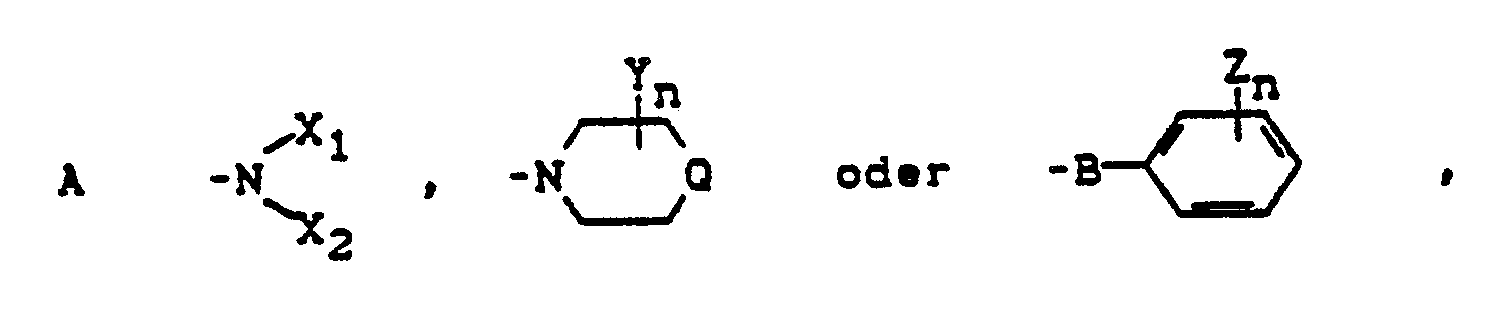
X₁ = C₄-C₁₂-Alkyl oder C₅-C₇-Cycloalkyl
X₂ = H oder C₁-C₁₂-Alkyl
Q = -O-, -CH₂-, -CH₂CH₂- oder direkte Bindung,
Y = C₁-C₄-Alkyl
Z = R
n = 1, 2 oder 3
bedeuten, mit der Maßgabe, daß R ≠ H,
wenn Z = H und B = NH
zeichnen sich durch ein verbessertes "spotting"-Verhalten aus.
Description
- Gegenstand der vorliegenden Erfindung sind weißtönerhaltige Flüssigwaschmittel mit verbessertem Verhalten hinsichtlich der Bildung von Weißtönerflecken ("spotting").
- Unter diesem Phänomen versteht man auf dem Waschmittelsektor die unerwünschte Weißtöneranschmutzung eines ungebleichten weißen oder pastellfarbenen Textilmaterials beim direkten Kontakt mit einem weißtönerhaltigen Flüssigwaschmittel, wie es beispielsweise bei der lokalen Behandlung eines Schmutzfleckens mit einem solchen Mittel der Fall ist. Dieser durch die hohe Konzentration des Weißtöners im unverdünnten Waschmittel verursachte "spot" wird bei einem anschließenden Waschgang mit dem gleichen Flüssigwaschmittel nicht oder nur unvollständig entfernt bzw. ausgeglichen.
- Es ist daher bereits vorgeschlagen worden (vgl. US 4 559 169 = EP 167 205), anstelle der sonst üblichen zwei- oder mehrfach sulfonierten Weißtöner, die durch eine hohe Substantivität ausgezeichnet sind, die weniger faseraffinen Weißtöner-Monosulfonsäuren in die Flüssigwaschmittel einzuarbeiten.
- Auf diese Weise wird zwar tatsächlich eine verringerte Neigung zum "spotting" erreicht, aber auf der anderen Seite wird dieser Vorteil durch einen geringeren Gesamtweißeffekt des aufzuhellenden Materials erkauft.
- Es wurde nun überraschenderweise gefunden, daß man weißtönerhaltige Flüssigwaschmittel mit verbessertem "spotting"-Verhalten und gleichzeitig guter Aufhellerwirkung erhält, wenn man als Weißtöner solche Verbindungen verwendet, die in Form der freien Säure der Formel


R = H, C₁-C₄-Alkyl, C₁-C₄-O-Alkyl, F, Cl, CF₃ oder OCF₃
X₁ = C₄-C₁₂-Alkyl oder C₅-C₇-Cycloalkyl
X₂ = H oder C₁-C₁₂-Alkyl
Q = -O-, -CH₂-, -CH₂CH₂- oder direkte Bindung,
Y = C₁-C₄-Alkyl
Z = R
n = 1, 2 oder 3
bedeuten, mit der Maßgabe, daß R ≠ H,
wenn Z = H und B = NH. - Vorzugsweise stehen die genannten C₁-C₄-Alkylreste für C₂H₅ und insbesondere CH₃, während die höheren Alkylreste X₁ vor allem für n-Butyl bis n-Hexyl stehen.
- Als Cycloalkyl kommt insbesondere Cyclohexyl in Betracht.
- Bevorzugt einzusetzende Weißtöner sind solche der Formel (I), worin B ungleich NH oder NY ist.
- Besonders bevorzugt sind solche dieser Formel, worin
R = H und
- Diese Weißtöner zeigen nicht nur gute anwendungstechnische Eigenschaften, sondern sind auch sehr leicht zugänglich.
- Selbstverständlich können die Verbindungen der Formel I auch in Form ihrer Salze, insbesondere Alkali-, Amin- und Ammoniumsalze vorliegen. Geeignete Alkalisalze sind die Na-, Li- oder K-Salze.
- Die Weißtöner der Formel (I) sind bekannt (vgl. DE-A 1 545 920 C.A. 101 (1984) 1980840y) bzw. nach an sich bekannten Methoden zugänglich, indem man beispielsweise Verbindungen der Formel

- Die Flüssigwaschmittel lassen sich bezüglich der verwendeten Tensid-Systeme in folgende Klassen aufteilen:
- a) Kombination anionisch/nichtionisch
- b) Kombination anionisch/nichtionisch/kationisch
- c) Kombination nichtionisch/kationisch
- d) Kombination anionisch/nichtionisch + "Builder"
- e) Rein nichtionisch.
- Im Rahmen dieser Erfindung sind die Systeme a), b), d) und e) bevorzugt.
- Geeignete Tenside sind in der US-Patentschrift 4 559 169, Spalten 2-4 beschrieben.
- Als bevorzugte nicht-ionische Tenside kommen handelsübliche Produkte in Betracht, z.B. die Additionsprodukte von Ethylenoxid mit höheren aliphatischen Alkoholen und Alkylphenolen, Säuren wie höhere Fettsäuren, Harzsäuren, Tallölsäuren und Säuren der Oxidationsprodukte des Erdöls, sowie Alkylenoxidaddukte höherer Fettsäureamide, wobei der Fettsäureteil in der Regel 8 bis 22 C-Atome aufweist und mit 10 bis 50 Mol Ethylenoxid kondensiert ist.
- Bevorzugte anionische Tenside sind Fettalkoholsulfate und Alkylbenzolsulfonate sowie Fettsäuren, wie sie in US 4 559 169, Spalte 6, beschrieben sind.
- Geeignete "builder"-haltige Waschmittel sind in GB 2 028 365 beschrieben. Bevorzugte Builder sind Phosphate, NTA, Zitrate und Polycarboxylate.
- Das flüssige Medium für die erfindungsgemäßen Waschmittel ist wäßrig und kann aus Wasser allein oder aus Wasser und zusätzlichen Lösungsmitteln als Lösungsvermittler bestehen.Die zusätzlichen Lösungsmittel können bis zu 20, vorzugsweise bis 15 % des gesamten Lösungsmittelanteils ausmachen. Als solche kommen in Betracht: niedrige Alkanole oder ein niedriges Diol oder Polyol.
- Das erfindungsgemäße flüssige Waschmittel kann im übrigen übliche Zusätze enthalten, wie Schmutzsuspendiermittel oder Vergrauungsinhibitoren, Schauminhibitoren, Konservierungsmittel und Parfüme. Diese werden selbstverständ - lich so gewählt, daß sie mit den Hauptkomponenten des Waschmittels verträglich sind.
- Die erfindungsgemäß zu verwendenden Weißtöner werden unabhängig vom Tensidsystem in Mengen von 0,005 bis 1 % oder mehr, bezogen auf das Gewicht des Waschmittels, zugesetzt. Die erfindungsgemäßen Waschmittel können in weichem oder hartem Wasser bei Temperaturen von 10 bis 60°C und darüber zur Anwendung gelangen.
- Die Waschbehandlung wird beispielsweise wie folgt durchgeführt: Die Textilien werden während 1 bis 30 Minuten bei 20 bis 100°C in einem Waschbad behandelt, das 0,1 bis 10 g/kg des Waschmittels enthält. Das Flottenverhältnis kann 1:3 bis 1:50 betragen.
- In den nachfolgenden Beispielen bedeuten "Prozente" Gewichtsprozente.
- In einem Flüssigwaschmittel des Typs d) bestehend aus
12,5 % Kokos-Seife
8,5 % Lineares Alkylbenzolsulfonat
5,5 % C₁₂₋₁₅-Fettalkoholethoxylat (7 EO)
7,5 % Kaliumcitrat
5,0 % Propylenglykol
8,5 % Ethanol
1,0 % Na-Formiat
13,5 % C₁₂₋₁₄-Fettalkoholethersulfat
ad 100,0 % vollentsalztes Wasser
wurden die in der folgenden Tabelle aufgeführten Weißtöner gelöst:


- Mit den so erhaltenen Waschmitteln wurden Waschversuche durchgeführt:
Material: gebleichter Baumwoll-Nessel
Dosierung: 5 g/l
Flottenverhältnis: 1:20
Temperatur: 50°C
Wasserhärte: 6° DH - Nach 9 Wäschen wurde der Weißgrad der Baumwoll-Lappen mit einem Farbmeßgerät (RFC 3, Fa. Zeiß) bestimmt und nach der CIE-Formel berechnet.
- Das "Spotting" der Flüssigwaschmittel auf dem ungewaschenen Textil wurde wie folgt geprüft:
- 1 ml des Flüssigwaschmittels wurde auf 20 g des Prüflings (gebleichter Baumwoll-Nessel), Grundweiß CIE = 78) aufgetragen. Nach 20-minütiger Einwirkungszeit wurde der Prüfling in einer Waschflotte von 5 g/l des gleichen Waschmittels bei 50°C einmal gewaschen. Der Weißtöner-Fleck wurde unter einer UV-Lampe bewertet.
(O = kein Fleck
+ = geringer Fleck
++ = starker Fleck).
Claims (4)


R = H, C₁-C₄-Alkyl, C₁-C₄-O-Alkyl, F, Cl, CF₃ oder OCF₃
X₁ = C₄-C₁₂-Alkyl oder C₅-C₇-Cycloalkyl
X₂ = H oder C₁-C₁₂-Alkyl
Q = -O-, -CH₂-, -CH₂CH₂- oder direkte Bindung,
Y = C₁-C₄-Alkyl
Z = R und
n = 1, 2 oder 3
bedeuten, mit der Maßgabe, daß R ≠ H,
wenn Z = H und B = NH.
R = H und

R = H und

R = H und

Applications Claiming Priority (2)
| Application Number | Priority Date | Filing Date | Title |
|---|---|---|---|
| DE3726266 | 1987-08-07 | ||
| DE19873726266 DE3726266A1 (de) | 1987-08-07 | 1987-08-07 | Fluessigwaschmittel |
Publications (3)
| Publication Number | Publication Date |
|---|---|
| EP0302340A2 true EP0302340A2 (de) | 1989-02-08 |
| EP0302340A3 EP0302340A3 (en) | 1989-10-18 |
| EP0302340B1 EP0302340B1 (de) | 1992-11-11 |
Family
ID=6333263
Family Applications (1)
| Application Number | Title | Priority Date | Filing Date |
|---|---|---|---|
| EP88111936A Expired - Lifetime EP0302340B1 (de) | 1987-08-07 | 1988-07-25 | Flüssigwaschmittel |
Country Status (4)
| Country | Link |
|---|---|
| US (1) | US4946628A (de) |
| EP (1) | EP0302340B1 (de) |
| JP (1) | JPS6462400A (de) |
| DE (2) | DE3726266A1 (de) |
Cited By (2)
| Publication number | Priority date | Publication date | Assignee | Title |
|---|---|---|---|---|
| EP0314630A3 (de) * | 1987-10-30 | 1989-10-25 | Sandoz Ag | Reinigungsmittel |
| EP0385374A1 (de) * | 1989-02-28 | 1990-09-05 | Ciba-Geigy Ag | Lagerstabile Aufhellerformulierung |
Families Citing this family (4)
| Publication number | Priority date | Publication date | Assignee | Title |
|---|---|---|---|---|
| US5174927A (en) * | 1990-09-28 | 1992-12-29 | The Procter & Gamble Company | Process for preparing brightener-containing liquid detergent compositions with polyhydroxy fatty acid amines |
| US7270771B2 (en) * | 2002-07-05 | 2007-09-18 | Ciba Specialty Chemicals Corporation | Triazinylaminostilbene disulphonic acid mixtures |
| AU2006259141B2 (en) * | 2005-06-15 | 2012-12-20 | Basf Se | Laundering process for whitening synthetic textiles |
| US20160237382A9 (en) * | 2005-06-15 | 2016-08-18 | Basf Se | Laundering process for whitening synthetic textiles |
Family Cites Families (6)
| Publication number | Priority date | Publication date | Assignee | Title |
|---|---|---|---|---|
| NL126746C (de) * | 1964-11-20 | |||
| DE1792513A1 (de) * | 1968-09-11 | 1971-11-18 | Henkel & Cie Gmbh | Farbstabile,Desinfektionsmittel enthaltende fluessige Wasch-,Reinigungs- und Spuelmittel |
| BE755820A (fr) * | 1969-09-12 | 1971-03-08 | Sandoz Sa | Composition de blanchiment optique |
| US4233167A (en) * | 1979-06-14 | 1980-11-11 | S. C. Johnson & Son, Inc. | Liquid detergent softening and brightening composition |
| DE3502038A1 (de) * | 1985-01-23 | 1986-07-24 | Sandoz-Patent-GmbH, 7850 Lörrach | Waessrige aufhellerpraeparate und deren verwendung im papierstrich |
| GB2187749B (en) * | 1986-03-11 | 1990-08-08 | Procter & Gamble | Stable liquid detergent composition hydrophobic brightener |
-
1987
- 1987-08-07 DE DE19873726266 patent/DE3726266A1/de not_active Withdrawn
-
1988
- 1988-07-15 US US07/219,685 patent/US4946628A/en not_active Expired - Fee Related
- 1988-07-25 EP EP88111936A patent/EP0302340B1/de not_active Expired - Lifetime
- 1988-07-25 DE DE8888111936T patent/DE3875843D1/de not_active Expired - Lifetime
- 1988-08-05 JP JP63194711A patent/JPS6462400A/ja active Pending
Cited By (2)
| Publication number | Priority date | Publication date | Assignee | Title |
|---|---|---|---|---|
| EP0314630A3 (de) * | 1987-10-30 | 1989-10-25 | Sandoz Ag | Reinigungsmittel |
| EP0385374A1 (de) * | 1989-02-28 | 1990-09-05 | Ciba-Geigy Ag | Lagerstabile Aufhellerformulierung |
Also Published As
| Publication number | Publication date |
|---|---|
| DE3875843D1 (de) | 1992-12-17 |
| EP0302340A3 (en) | 1989-10-18 |
| EP0302340B1 (de) | 1992-11-11 |
| US4946628A (en) | 1990-08-07 |
| DE3726266A1 (de) | 1989-02-23 |
| JPS6462400A (en) | 1989-03-08 |
Similar Documents
| Publication | Publication Date | Title |
|---|---|---|
| DE68913727T2 (de) | Chelatierungsmittel enthaltende Reinigungs- und Waschmittelzusammensetzungen. | |
| DE2215371C2 (de) | Waschmittel | |
| EP0201016A2 (de) | Gerüstsalzfreie Flüssigwaschmittel mit textilweichmachenden Eigenschaften | |
| DE2327234C3 (de) | Phosphatfreies Waschmittel | |
| EP0372291A1 (de) | Verfahren zum Waschen von verfärbungsempfindlichen Textilien | |
| DE2337266C2 (de) | Weichspülendes teilchenförmiges Grobwaschmittel | |
| DE3022767C2 (de) | Wäßrig-flüssiges, builderhaltiges, copolymerfreies Waschmittel | |
| DE3788075T2 (de) | Stabile flüssige Detergenszusammensetzung, die einen hydrophoben optischen Aufheller enthält. | |
| EP0302340B1 (de) | Flüssigwaschmittel | |
| CH527901A (de) | Waschmittel mit geringem Schaumvermögen | |
| DE3486155T2 (de) | Wäschewaschmittel. | |
| DE1617116C3 (de) | Schwachschäumende Wasch- und Reinigungsmittel | |
| DE4128672A1 (de) | Verwendung von stark alkalischen mitteln zur verhinderung des anlaufens von silberbestecken in geschirrspuelmaschinen | |
| AT395169B (de) | Fluessiges nicht-waesseriges grobwaschmittel | |
| CH641834A5 (de) | Wasch- und reinigungsmittel. | |
| DE2559225A1 (de) | Fluessiges wasch- und reinigungsmittel sowie seine anwendung | |
| DE3516091A1 (de) | Geruestsalzfreie fluessigwaschmittel mit textilweichmachenden eigenschaften | |
| CH676604A5 (de) | ||
| DE2700640C2 (de) | Für die Kaltwäsche geeignetes Waschmittel | |
| DE1038692B (de) | Organische Phosphorverbindungen enthaltende synthetische Wasch- und Reinigungsmittel | |
| DE2153164C2 (de) | Flüssiges Grobwaschmittel | |
| DE2346539C2 (de) | Wasch- und Reinigungsmittel | |
| DE2539808A1 (de) | Reinigungsmittelzubereitungen | |
| DE2230452A1 (de) | Grundstoffansatz fuer wasch- und reinigungsmittel | |
| DE2822838A1 (de) | Wasch- und reinigungsmittel |
Legal Events
| Date | Code | Title | Description |
|---|---|---|---|
| PUAI | Public reference made under article 153(3) epc to a published international application that has entered the european phase |
Free format text: ORIGINAL CODE: 0009012 |
|
| 17P | Request for examination filed |
Effective date: 19880725 |
|
| AK | Designated contracting states |
Kind code of ref document: A2 Designated state(s): CH DE FR GB LI |
|
| PUAL | Search report despatched |
Free format text: ORIGINAL CODE: 0009013 |
|
| AK | Designated contracting states |
Kind code of ref document: A3 Designated state(s): CH DE FR GB LI |
|
| 17Q | First examination report despatched |
Effective date: 19910514 |
|
| GRAA | (expected) grant |
Free format text: ORIGINAL CODE: 0009210 |
|
| AK | Designated contracting states |
Kind code of ref document: B1 Designated state(s): CH DE FR GB LI |
|
| REF | Corresponds to: |
Ref document number: 3875843 Country of ref document: DE Date of ref document: 19921217 |
|
| GBT | Gb: translation of ep patent filed (gb section 77(6)(a)/1977) | ||
| ET | Fr: translation filed | ||
| PLBE | No opposition filed within time limit |
Free format text: ORIGINAL CODE: 0009261 |
|
| STAA | Information on the status of an ep patent application or granted ep patent |
Free format text: STATUS: NO OPPOSITION FILED WITHIN TIME LIMIT |
|
| 26N | No opposition filed | ||
| PGFP | Annual fee paid to national office [announced via postgrant information from national office to epo] |
Ref country code: DE Payment date: 19940615 Year of fee payment: 7 |
|
| PGFP | Annual fee paid to national office [announced via postgrant information from national office to epo] |
Ref country code: GB Payment date: 19940718 Year of fee payment: 7 |
|
| PGFP | Annual fee paid to national office [announced via postgrant information from national office to epo] |
Ref country code: CH Payment date: 19940721 Year of fee payment: 7 |
|
| PGFP | Annual fee paid to national office [announced via postgrant information from national office to epo] |
Ref country code: FR Payment date: 19940722 Year of fee payment: 7 |
|
| PG25 | Lapsed in a contracting state [announced via postgrant information from national office to epo] |
Ref country code: GB Effective date: 19950725 |
|
| PG25 | Lapsed in a contracting state [announced via postgrant information from national office to epo] |
Ref country code: LI Effective date: 19950731 Ref country code: CH Effective date: 19950731 |
|
| REG | Reference to a national code |
Ref country code: CH Ref legal event code: PL |
|
| GBPC | Gb: european patent ceased through non-payment of renewal fee |
Effective date: 19950725 |
|
| PG25 | Lapsed in a contracting state [announced via postgrant information from national office to epo] |
Ref country code: DE Effective date: 19960402 |
|
| PG25 | Lapsed in a contracting state [announced via postgrant information from national office to epo] |
Ref country code: FR Effective date: 19960430 |
|
| REG | Reference to a national code |
Ref country code: FR Ref legal event code: ST |
|
| REG | Reference to a national code |
Ref country code: FR Ref legal event code: ST |
|
| REG | Reference to a national code |
Ref country code: FR Ref legal event code: ST |