EP0302832B1 - Ungesättigte Imide und Benzaldehyd-Derivate enthaltende heisshärtbare Stoffgemische - Google Patents
Ungesättigte Imide und Benzaldehyd-Derivate enthaltende heisshärtbare Stoffgemische Download PDFInfo
- Publication number
- EP0302832B1 EP0302832B1 EP88810528A EP88810528A EP0302832B1 EP 0302832 B1 EP0302832 B1 EP 0302832B1 EP 88810528 A EP88810528 A EP 88810528A EP 88810528 A EP88810528 A EP 88810528A EP 0302832 B1 EP0302832 B1 EP 0302832B1
- Authority
- EP
- European Patent Office
- Prior art keywords
- composition
- atoms
- matter according
- formula
- cyclohexylene
- Prior art date
- Legal status (The legal status is an assumption and is not a legal conclusion. Google has not performed a legal analysis and makes no representation as to the accuracy of the status listed.)
- Expired - Lifetime
Links
- 239000000203 mixture Substances 0.000 title claims description 49
- 150000003935 benzaldehydes Chemical class 0.000 title claims description 7
- 150000003949 imides Chemical class 0.000 title claims description 6
- 229920001187 thermosetting polymer Polymers 0.000 title 1
- 229910052757 nitrogen Inorganic materials 0.000 claims description 41
- 125000004432 carbon atom Chemical group C* 0.000 claims description 29
- 150000001875 compounds Chemical class 0.000 claims description 29
- 125000004956 cyclohexylene group Chemical group 0.000 claims description 17
- XQUPVDVFXZDTLT-UHFFFAOYSA-N 1-[4-[[4-(2,5-dioxopyrrol-1-yl)phenyl]methyl]phenyl]pyrrole-2,5-dione Chemical compound O=C1C=CC(=O)N1C(C=C1)=CC=C1CC1=CC=C(N2C(C=CC2=O)=O)C=C1 XQUPVDVFXZDTLT-UHFFFAOYSA-N 0.000 claims description 14
- -1 methylene, isopropylidene Chemical group 0.000 claims description 14
- 125000004435 hydrogen atom Chemical group [H]* 0.000 claims description 12
- 125000000732 arylene group Chemical group 0.000 claims description 11
- 125000004979 cyclopentylene group Chemical group 0.000 claims description 11
- 229910052760 oxygen Inorganic materials 0.000 claims description 11
- WMKGGPCROCCUDY-PHEQNACWSA-N dibenzylideneacetone Chemical compound C=1C=CC=CC=1\C=C\C(=O)\C=C\C1=CC=CC=C1 WMKGGPCROCCUDY-PHEQNACWSA-N 0.000 claims description 10
- 238000004519 manufacturing process Methods 0.000 claims description 10
- RAHZWNYVWXNFOC-UHFFFAOYSA-N sulfur dioxide Inorganic materials O=S=O RAHZWNYVWXNFOC-UHFFFAOYSA-N 0.000 claims description 10
- 125000000217 alkyl group Chemical group 0.000 claims description 8
- 229910052739 hydrogen Inorganic materials 0.000 claims description 8
- 239000001257 hydrogen Substances 0.000 claims description 8
- 125000002496 methyl group Chemical group [H]C([H])([H])* 0.000 claims description 8
- 125000006839 xylylene group Chemical group 0.000 claims description 8
- 229910002091 carbon monoxide Inorganic materials 0.000 claims description 7
- 125000005843 halogen group Chemical group 0.000 claims description 7
- 125000004178 (C1-C4) alkyl group Chemical group 0.000 claims description 6
- 125000001140 1,4-phenylene group Chemical group [H]C1=C([H])C([*:2])=C([H])C([H])=C1[*:1] 0.000 claims description 6
- 125000001495 ethyl group Chemical group [H]C([H])([H])C([H])([H])* 0.000 claims description 6
- 125000001424 substituent group Chemical group 0.000 claims description 6
- 229910052717 sulfur Inorganic materials 0.000 claims description 6
- 125000003342 alkenyl group Chemical group 0.000 claims description 5
- 238000010438 heat treatment Methods 0.000 claims description 5
- 238000000465 moulding Methods 0.000 claims description 5
- 125000001989 1,3-phenylene group Chemical group [H]C1=C([H])C([*:1])=C([H])C([*:2])=C1[H] 0.000 claims description 4
- 238000000576 coating method Methods 0.000 claims description 4
- 150000004985 diamines Chemical class 0.000 claims description 4
- 229920000768 polyamine Polymers 0.000 claims description 4
- 229920000642 polymer Polymers 0.000 claims description 4
- 229920005862 polyol Polymers 0.000 claims description 4
- 150000003077 polyols Chemical class 0.000 claims description 4
- YBRVSVVVWCFQMG-UHFFFAOYSA-N 4,4'-diaminodiphenylmethane Chemical compound C1=CC(N)=CC=C1CC1=CC=C(N)C=C1 YBRVSVVVWCFQMG-UHFFFAOYSA-N 0.000 claims description 3
- WOCGGVRGNIEDSZ-UHFFFAOYSA-N 4-[2-(4-hydroxy-3-prop-2-enylphenyl)propan-2-yl]-2-prop-2-enylphenol Chemical compound C=1C=C(O)C(CC=C)=CC=1C(C)(C)C1=CC=C(O)C(CC=C)=C1 WOCGGVRGNIEDSZ-UHFFFAOYSA-N 0.000 claims description 3
- 125000000753 cycloalkyl group Chemical group 0.000 claims description 3
- 125000002993 cycloalkylene group Chemical group 0.000 claims description 3
- 150000002009 diols Chemical class 0.000 claims description 3
- 125000002030 1,2-phenylene group Chemical group [H]C1=C([H])C([*:1])=C([*:2])C([H])=C1[H] 0.000 claims description 2
- UFHFLCQGNIYNRP-UHFFFAOYSA-N Hydrogen Chemical compound [H][H] UFHFLCQGNIYNRP-UHFFFAOYSA-N 0.000 claims description 2
- 125000003055 glycidyl group Chemical group C(C1CO1)* 0.000 claims description 2
- 229910052736 halogen Inorganic materials 0.000 claims description 2
- 150000002367 halogens Chemical class 0.000 claims description 2
- 125000004957 naphthylene group Chemical group 0.000 claims description 2
- 125000000449 nitro group Chemical group [O-][N+](*)=O 0.000 claims description 2
- NRNFFDZCBYOZJY-UHFFFAOYSA-N p-quinodimethane Chemical group C=C1C=CC(=C)C=C1 NRNFFDZCBYOZJY-UHFFFAOYSA-N 0.000 claims description 2
- 125000001997 phenyl group Chemical group [H]C1=C([H])C([H])=C(*)C([H])=C1[H] 0.000 claims description 2
- 125000004955 1,4-cyclohexylene group Chemical group [H]C1([H])C([H])([H])C([H])([*:1])C([H])([H])C([H])([H])C1([H])[*:2] 0.000 claims 1
- 125000004399 C1-C4 alkenyl group Chemical group 0.000 claims 1
- 239000007789 gas Substances 0.000 claims 1
- 239000000126 substance Substances 0.000 description 19
- 239000000835 fiber Substances 0.000 description 7
- 230000009477 glass transition Effects 0.000 description 7
- 125000000325 methylidene group Chemical group [H]C([H])=* 0.000 description 6
- 229920005989 resin Polymers 0.000 description 6
- 239000011347 resin Substances 0.000 description 6
- 230000004580 weight loss Effects 0.000 description 6
- 239000003054 catalyst Substances 0.000 description 5
- 238000000034 method Methods 0.000 description 5
- 239000000047 product Substances 0.000 description 5
- CSCPPACGZOOCGX-UHFFFAOYSA-N Acetone Chemical compound CC(C)=O CSCPPACGZOOCGX-UHFFFAOYSA-N 0.000 description 4
- 229920003192 poly(bis maleimide) Polymers 0.000 description 4
- ZWEHNKRNPOVVGH-UHFFFAOYSA-N 2-Butanone Chemical compound CCC(C)=O ZWEHNKRNPOVVGH-UHFFFAOYSA-N 0.000 description 3
- 125000003903 2-propenyl group Chemical group [H]C([*])([H])C([H])=C([H])[H] 0.000 description 3
- YMWUJEATGCHHMB-UHFFFAOYSA-N Dichloromethane Chemical compound ClCCl YMWUJEATGCHHMB-UHFFFAOYSA-N 0.000 description 3
- ZMXDDKWLCZADIW-UHFFFAOYSA-N N,N-Dimethylformamide Chemical compound CN(C)C=O ZMXDDKWLCZADIW-UHFFFAOYSA-N 0.000 description 3
- YXFVVABEGXRONW-UHFFFAOYSA-N Toluene Chemical compound CC1=CC=CC=C1 YXFVVABEGXRONW-UHFFFAOYSA-N 0.000 description 3
- ZMANZCXQSJIPKH-UHFFFAOYSA-N Triethylamine Chemical compound CCN(CC)CC ZMANZCXQSJIPKH-UHFFFAOYSA-N 0.000 description 3
- 239000000853 adhesive Substances 0.000 description 3
- 230000001070 adhesive effect Effects 0.000 description 3
- 238000005452 bending Methods 0.000 description 3
- 238000006243 chemical reaction Methods 0.000 description 3
- HYBBIBNJHNGZAN-UHFFFAOYSA-N furfural Chemical class O=CC1=CC=CO1 HYBBIBNJHNGZAN-UHFFFAOYSA-N 0.000 description 3
- RAXXELZNTBOGNW-UHFFFAOYSA-N imidazole Natural products C1=CNC=N1 RAXXELZNTBOGNW-UHFFFAOYSA-N 0.000 description 3
- 239000000155 melt Substances 0.000 description 3
- VNWKTOKETHGBQD-UHFFFAOYSA-N methane Chemical compound C VNWKTOKETHGBQD-UHFFFAOYSA-N 0.000 description 3
- MYRTYDVEIRVNKP-UHFFFAOYSA-N 1,2-Divinylbenzene Chemical compound C=CC1=CC=CC=C1C=C MYRTYDVEIRVNKP-UHFFFAOYSA-N 0.000 description 2
- 125000004974 2-butenyl group Chemical group C(C=CC)* 0.000 description 2
- WKBOTKDWSSQWDR-UHFFFAOYSA-N Bromine atom Chemical compound [Br] WKBOTKDWSSQWDR-UHFFFAOYSA-N 0.000 description 2
- KAKZBPTYRLMSJV-UHFFFAOYSA-N Butadiene Chemical group C=CC=C KAKZBPTYRLMSJV-UHFFFAOYSA-N 0.000 description 2
- SMWDFEZZVXVKRB-UHFFFAOYSA-N Quinoline Chemical compound N1=CC=CC2=CC=CC=C21 SMWDFEZZVXVKRB-UHFFFAOYSA-N 0.000 description 2
- WYURNTSHIVDZCO-UHFFFAOYSA-N Tetrahydrofuran Chemical compound C1CCOC1 WYURNTSHIVDZCO-UHFFFAOYSA-N 0.000 description 2
- YRKCREAYFQTBPV-UHFFFAOYSA-N acetylacetone Chemical compound CC(=O)CC(C)=O YRKCREAYFQTBPV-UHFFFAOYSA-N 0.000 description 2
- WGQKYBSKWIADBV-UHFFFAOYSA-N benzylamine Chemical compound NCC1=CC=CC=C1 WGQKYBSKWIADBV-UHFFFAOYSA-N 0.000 description 2
- GDTBXPJZTBHREO-UHFFFAOYSA-N bromine Substances BrBr GDTBXPJZTBHREO-UHFFFAOYSA-N 0.000 description 2
- 229910052794 bromium Inorganic materials 0.000 description 2
- 229910052801 chlorine Inorganic materials 0.000 description 2
- 239000000460 chlorine Substances 0.000 description 2
- 238000001816 cooling Methods 0.000 description 2
- 125000000113 cyclohexyl group Chemical group [H]C1([H])C([H])([H])C([H])([H])C([H])(*)C([H])([H])C1([H])[H] 0.000 description 2
- 238000004455 differential thermal analysis Methods 0.000 description 2
- 125000005594 diketone group Chemical group 0.000 description 2
- ZUOUZKKEUPVFJK-UHFFFAOYSA-N diphenyl Chemical compound C1=CC=CC=C1C1=CC=CC=C1 ZUOUZKKEUPVFJK-UHFFFAOYSA-N 0.000 description 2
- LYCAIKOWRPUZTN-UHFFFAOYSA-N ethylene glycol Natural products OCCO LYCAIKOWRPUZTN-UHFFFAOYSA-N 0.000 description 2
- 239000004744 fabric Substances 0.000 description 2
- 125000001449 isopropyl group Chemical group [H]C([H])([H])C([H])(*)C([H])([H])[H] 0.000 description 2
- 238000010030 laminating Methods 0.000 description 2
- 125000004108 n-butyl group Chemical group [H]C([H])([H])C([H])([H])C([H])([H])C([H])([H])* 0.000 description 2
- 239000003960 organic solvent Substances 0.000 description 2
- 238000003756 stirring Methods 0.000 description 2
- 125000000391 vinyl group Chemical group [H]C([*])=C([H])[H] 0.000 description 2
- 229920002554 vinyl polymer Polymers 0.000 description 2
- 125000006656 (C2-C4) alkenyl group Chemical group 0.000 description 1
- GEYOCULIXLDCMW-UHFFFAOYSA-N 1,2-phenylenediamine Chemical compound NC1=CC=CC=C1N GEYOCULIXLDCMW-UHFFFAOYSA-N 0.000 description 1
- 125000004958 1,4-naphthylene group Chemical group 0.000 description 1
- PUKLCKVOVCZYKF-UHFFFAOYSA-N 1-[2-(2,5-dioxopyrrol-1-yl)ethyl]pyrrole-2,5-dione Chemical compound O=C1C=CC(=O)N1CCN1C(=O)C=CC1=O PUKLCKVOVCZYKF-UHFFFAOYSA-N 0.000 description 1
- IPJGAEWUPXWFPL-UHFFFAOYSA-N 1-[3-(2,5-dioxopyrrol-1-yl)phenyl]pyrrole-2,5-dione Chemical compound O=C1C=CC(=O)N1C1=CC=CC(N2C(C=CC2=O)=O)=C1 IPJGAEWUPXWFPL-UHFFFAOYSA-N 0.000 description 1
- AQGZJQNZNONGKY-UHFFFAOYSA-N 1-[4-(2,5-dioxopyrrol-1-yl)phenyl]pyrrole-2,5-dione Chemical compound O=C1C=CC(=O)N1C1=CC=C(N2C(C=CC2=O)=O)C=C1 AQGZJQNZNONGKY-UHFFFAOYSA-N 0.000 description 1
- PYVHLZLQVWXBDZ-UHFFFAOYSA-N 1-[6-(2,5-dioxopyrrol-1-yl)hexyl]pyrrole-2,5-dione Chemical compound O=C1C=CC(=O)N1CCCCCCN1C(=O)C=CC1=O PYVHLZLQVWXBDZ-UHFFFAOYSA-N 0.000 description 1
- LYCKDYZIIOVFCX-UHFFFAOYSA-N 1-[[3-[(2,5-dioxopyrrol-1-yl)methyl]phenyl]methyl]pyrrole-2,5-dione Chemical compound O=C1C=CC(=O)N1CC1=CC=CC(CN2C(C=CC2=O)=O)=C1 LYCKDYZIIOVFCX-UHFFFAOYSA-N 0.000 description 1
- XFRPTDABLAIJMY-UHFFFAOYSA-N 1-[[4-[(2,5-dioxopyrrol-1-yl)methyl]phenyl]methyl]pyrrole-2,5-dione Chemical compound O=C1C=CC(=O)N1CC(C=C1)=CC=C1CN1C(=O)C=CC1=O XFRPTDABLAIJMY-UHFFFAOYSA-N 0.000 description 1
- 125000004973 1-butenyl group Chemical group C(=CCC)* 0.000 description 1
- AVFZOVWCLRSYKC-UHFFFAOYSA-N 1-methylpyrrolidine Chemical compound CN1CCCC1 AVFZOVWCLRSYKC-UHFFFAOYSA-N 0.000 description 1
- 125000006017 1-propenyl group Chemical group 0.000 description 1
- 150000003923 2,5-pyrrolediones Chemical class 0.000 description 1
- 125000004959 2,6-naphthylene group Chemical group [H]C1=C([H])C2=C([H])C([*:1])=C([H])C([H])=C2C([H])=C1[*:2] 0.000 description 1
- XMNIXWIUMCBBBL-UHFFFAOYSA-N 2-(2-phenylpropan-2-ylperoxy)propan-2-ylbenzene Chemical compound C=1C=CC=CC=1C(C)(C)OOC(C)(C)C1=CC=CC=C1 XMNIXWIUMCBBBL-UHFFFAOYSA-N 0.000 description 1
- QTWJRLJHJPIABL-UHFFFAOYSA-N 2-methylphenol;3-methylphenol;4-methylphenol Chemical compound CC1=CC=C(O)C=C1.CC1=CC=CC(O)=C1.CC1=CC=CC=C1O QTWJRLJHJPIABL-UHFFFAOYSA-N 0.000 description 1
- 125000004975 3-butenyl group Chemical group C(CC=C)* 0.000 description 1
- 125000006041 3-hexenyl group Chemical group 0.000 description 1
- JNRLEMMIVRBKJE-UHFFFAOYSA-N 4,4'-Methylenebis(N,N-dimethylaniline) Chemical compound C1=CC(N(C)C)=CC=C1CC1=CC=C(N(C)C)C=C1 JNRLEMMIVRBKJE-UHFFFAOYSA-N 0.000 description 1
- JCRRFJIVUPSNTA-UHFFFAOYSA-N 4-[4-(4-aminophenoxy)phenoxy]aniline Chemical compound C1=CC(N)=CC=C1OC(C=C1)=CC=C1OC1=CC=C(N)C=C1 JCRRFJIVUPSNTA-UHFFFAOYSA-N 0.000 description 1
- MBUAAMOJATXYKR-UHFFFAOYSA-N 4-bis(4-aminophenoxy)phosphinothioyloxyaniline Chemical compound C1=CC(N)=CC=C1OP(=S)(OC=1C=CC(N)=CC=1)OC1=CC=C(N)C=C1 MBUAAMOJATXYKR-UHFFFAOYSA-N 0.000 description 1
- TYNJQOJWNMZQFZ-UHFFFAOYSA-N 4-prop-2-enoxybenzaldehyde Chemical compound C=CCOC1=CC=C(C=O)C=C1 TYNJQOJWNMZQFZ-UHFFFAOYSA-N 0.000 description 1
- ZCYVEMRRCGMTRW-UHFFFAOYSA-N 7553-56-2 Chemical compound [I] ZCYVEMRRCGMTRW-UHFFFAOYSA-N 0.000 description 1
- 239000004604 Blowing Agent Substances 0.000 description 1
- 229920000049 Carbon (fiber) Polymers 0.000 description 1
- 239000004215 Carbon black (E152) Substances 0.000 description 1
- ZAMOUSCENKQFHK-UHFFFAOYSA-N Chlorine atom Chemical compound [Cl] ZAMOUSCENKQFHK-UHFFFAOYSA-N 0.000 description 1
- PXGOKWXKJXAPGV-UHFFFAOYSA-N Fluorine Chemical compound FF PXGOKWXKJXAPGV-UHFFFAOYSA-N 0.000 description 1
- 229920000271 Kevlar® Polymers 0.000 description 1
- FXHOOIRPVKKKFG-UHFFFAOYSA-N N,N-Dimethylacetamide Chemical compound CN(C)C(C)=O FXHOOIRPVKKKFG-UHFFFAOYSA-N 0.000 description 1
- SECXISVLQFMRJM-UHFFFAOYSA-N N-Methylpyrrolidone Chemical compound CN1CCCC1=O SECXISVLQFMRJM-UHFFFAOYSA-N 0.000 description 1
- AHVYPIQETPWLSZ-UHFFFAOYSA-N N-methyl-pyrrolidine Natural products CN1CC=CC1 AHVYPIQETPWLSZ-UHFFFAOYSA-N 0.000 description 1
- ISWSIDIOOBJBQZ-UHFFFAOYSA-N Phenol Chemical compound OC1=CC=CC=C1 ISWSIDIOOBJBQZ-UHFFFAOYSA-N 0.000 description 1
- 125000002777 acetyl group Chemical group [H]C([H])([H])C(*)=O 0.000 description 1
- 230000032683 aging Effects 0.000 description 1
- 150000001299 aldehydes Chemical class 0.000 description 1
- 229920006231 aramid fiber Polymers 0.000 description 1
- 150000004984 aromatic diamines Chemical class 0.000 description 1
- HUMNYLRZRPPJDN-UHFFFAOYSA-N benzenecarboxaldehyde Natural products O=CC1=CC=CC=C1 HUMNYLRZRPPJDN-UHFFFAOYSA-N 0.000 description 1
- HFACYLZERDEVSX-UHFFFAOYSA-N benzidine Chemical group C1=CC(N)=CC=C1C1=CC=C(N)C=C1 HFACYLZERDEVSX-UHFFFAOYSA-N 0.000 description 1
- 125000002619 bicyclic group Chemical group 0.000 description 1
- 230000015572 biosynthetic process Effects 0.000 description 1
- 235000010290 biphenyl Nutrition 0.000 description 1
- 239000004305 biphenyl Substances 0.000 description 1
- 239000004917 carbon fiber Substances 0.000 description 1
- 125000001309 chloro group Chemical group Cl* 0.000 description 1
- 239000002131 composite material Substances 0.000 description 1
- 239000007859 condensation product Substances 0.000 description 1
- 229930003836 cresol Natural products 0.000 description 1
- 229920006037 cross link polymer Polymers 0.000 description 1
- 239000003431 cross linking reagent Substances 0.000 description 1
- 125000000582 cycloheptyl group Chemical group [H]C1([H])C([H])([H])C([H])([H])C([H])([H])C([H])(*)C([H])([H])C1([H])[H] 0.000 description 1
- 125000004977 cycloheptylene group Chemical group 0.000 description 1
- 125000000640 cyclooctyl group Chemical group [H]C1([H])C([H])([H])C([H])([H])C([H])([H])C([H])(*)C([H])([H])C([H])([H])C1([H])[H] 0.000 description 1
- 125000004978 cyclooctylene group Chemical group 0.000 description 1
- 125000001511 cyclopentyl group Chemical group [H]C1([H])C([H])([H])C([H])([H])C([H])(*)C1([H])[H] 0.000 description 1
- 125000005754 decalinylene group Chemical group 0.000 description 1
- LSXWFXONGKSEMY-UHFFFAOYSA-N di-tert-butyl peroxide Chemical compound CC(C)(C)OOC(C)(C)C LSXWFXONGKSEMY-UHFFFAOYSA-N 0.000 description 1
- 150000001983 dialkylethers Chemical class 0.000 description 1
- HPNMFZURTQLUMO-UHFFFAOYSA-N diethylamine Chemical compound CCNCC HPNMFZURTQLUMO-UHFFFAOYSA-N 0.000 description 1
- 238000009730 filament winding Methods 0.000 description 1
- 229910052731 fluorine Inorganic materials 0.000 description 1
- 239000011737 fluorine Substances 0.000 description 1
- 239000006260 foam Substances 0.000 description 1
- 229940083124 ganglion-blocking antiadrenergic secondary and tertiary amines Drugs 0.000 description 1
- 239000003365 glass fiber Substances 0.000 description 1
- 125000000623 heterocyclic group Chemical group 0.000 description 1
- 229930195733 hydrocarbon Natural products 0.000 description 1
- 229910052740 iodine Inorganic materials 0.000 description 1
- 239000011630 iodine Substances 0.000 description 1
- 125000000959 isobutyl group Chemical group [H]C([H])([H])C([H])(C([H])([H])[H])C([H])([H])* 0.000 description 1
- 125000001972 isopentyl group Chemical group [H]C([H])([H])C([H])(C([H])([H])[H])C([H])([H])C([H])([H])* 0.000 description 1
- 125000000654 isopropylidene group Chemical group C(C)(C)=* 0.000 description 1
- 150000002576 ketones Chemical class 0.000 description 1
- 239000007788 liquid Substances 0.000 description 1
- 125000005439 maleimidyl group Chemical group C1(C=CC(N1*)=O)=O 0.000 description 1
- 239000011159 matrix material Substances 0.000 description 1
- 238000005259 measurement Methods 0.000 description 1
- 238000002844 melting Methods 0.000 description 1
- 125000005394 methallyl group Chemical group 0.000 description 1
- 125000001570 methylene group Chemical group [H]C([H])([*:1])[*:2] 0.000 description 1
- 125000002950 monocyclic group Chemical group 0.000 description 1
- 125000001280 n-hexyl group Chemical group C(CCCCC)* 0.000 description 1
- 125000004123 n-propyl group Chemical group [H]C([H])([H])C([H])([H])C([H])([H])* 0.000 description 1
- 229920003986 novolac Polymers 0.000 description 1
- 150000001451 organic peroxides Chemical class 0.000 description 1
- 125000004430 oxygen atom Chemical group O* 0.000 description 1
- QNGNSVIICDLXHT-UHFFFAOYSA-N para-ethylbenzaldehyde Natural products CCC1=CC=C(C=O)C=C1 QNGNSVIICDLXHT-UHFFFAOYSA-N 0.000 description 1
- 150000002989 phenols Chemical class 0.000 description 1
- 230000000704 physical effect Effects 0.000 description 1
- 150000003141 primary amines Chemical class 0.000 description 1
- 230000009257 reactivity Effects 0.000 description 1
- 125000002914 sec-butyl group Chemical group [H]C([H])([H])C([H])([H])C([H])(*)C([H])([H])[H] 0.000 description 1
- 239000007787 solid Substances 0.000 description 1
- 239000002904 solvent Substances 0.000 description 1
- 238000003786 synthesis reaction Methods 0.000 description 1
- GJBRNHKUVLOCEB-UHFFFAOYSA-N tert-butyl benzenecarboperoxoate Chemical compound CC(C)(C)OOC(=O)C1=CC=CC=C1 GJBRNHKUVLOCEB-UHFFFAOYSA-N 0.000 description 1
- 125000000999 tert-butyl group Chemical group [H]C([H])([H])C(*)(C([H])([H])[H])C([H])([H])[H] 0.000 description 1
- YLQBMQCUIZJEEH-UHFFFAOYSA-N tetrahydrofuran Natural products C=1C=COC=1 YLQBMQCUIZJEEH-UHFFFAOYSA-N 0.000 description 1
- IMFACGCPASFAPR-UHFFFAOYSA-N tributylamine Chemical compound CCCCN(CCCC)CCCC IMFACGCPASFAPR-UHFFFAOYSA-N 0.000 description 1
- ZYPZVOKVDNSKLP-UHFFFAOYSA-N tris(4-aminophenyl) phosphate Chemical compound C1=CC(N)=CC=C1OP(=O)(OC=1C=CC(N)=CC=1)OC1=CC=C(N)C=C1 ZYPZVOKVDNSKLP-UHFFFAOYSA-N 0.000 description 1
- SCNCNRSYYOCCEC-UHFFFAOYSA-N tris(4-aminophenyl) phosphite Chemical compound C1=CC(N)=CC=C1OP(OC=1C=CC(N)=CC=1)OC1=CC=C(N)C=C1 SCNCNRSYYOCCEC-UHFFFAOYSA-N 0.000 description 1
- 238000004804 winding Methods 0.000 description 1
- 239000008096 xylene Substances 0.000 description 1
- 150000003738 xylenes Chemical class 0.000 description 1
Classifications
-
- C—CHEMISTRY; METALLURGY
- C08—ORGANIC MACROMOLECULAR COMPOUNDS; THEIR PREPARATION OR CHEMICAL WORKING-UP; COMPOSITIONS BASED THEREON
- C08G—MACROMOLECULAR COMPOUNDS OBTAINED OTHERWISE THAN BY REACTIONS ONLY INVOLVING UNSATURATED CARBON-TO-CARBON BONDS
- C08G73/00—Macromolecular compounds obtained by reactions forming a linkage containing nitrogen with or without oxygen or carbon in the main chain of the macromolecule, not provided for in groups C08G12/00 - C08G71/00
- C08G73/06—Polycondensates having nitrogen-containing heterocyclic rings in the main chain of the macromolecule
- C08G73/10—Polyimides; Polyester-imides; Polyamide-imides; Polyamide acids or similar polyimide precursors
- C08G73/12—Unsaturated polyimide precursors
-
- C—CHEMISTRY; METALLURGY
- C08—ORGANIC MACROMOLECULAR COMPOUNDS; THEIR PREPARATION OR CHEMICAL WORKING-UP; COMPOSITIONS BASED THEREON
- C08F—MACROMOLECULAR COMPOUNDS OBTAINED BY REACTIONS ONLY INVOLVING CARBON-TO-CARBON UNSATURATED BONDS
- C08F222/00—Copolymers of compounds having one or more unsaturated aliphatic radicals, each having only one carbon-to-carbon double bond, and at least one being terminated by a carboxyl radical and containing at least one other carboxyl radical in the molecule; Salts, anhydrides, esters, amides, imides, or nitriles thereof
- C08F222/36—Amides or imides
- C08F222/40—Imides, e.g. cyclic imides
- C08F222/404—Imides, e.g. cyclic imides substituted imides comprising oxygen other than the carboxy oxygen
Definitions
- the invention relates to heat curable mixtures containing certain unsaturated imides, e.g. Bismaleimides and benzaldehyde derivatives, e.g. Dibenzalacetone, its use for the production of cross-linked molded articles and the polymers obtainable therefrom.
- unsaturated imides e.g. Bismaleimides and benzaldehyde derivatives, e.g. Dibenzalacetone
- polymaleimides with or without the addition of crosslinking agents, such as diamines or diols, can be converted into crosslinked products by heating [cf. e.g. US-A-3,562,223, US-A-3,658,764, US-A-3,380,964 and US-A-4,038,251]. It is also known that polymaleimides can be reacted with certain unsaturated compounds to form crosslinked polymers.
- US-A-4,351,932 describes matrix resins containing unsaturated bisimides and divinyl aromatics, e.g. Divinylbenzene.
- GB-A-1,531,906 describes curable mixtures suitable for the production of foams, which contain a bismaleimide, a furfuraldehyde derivative and a blowing agent.
- the furfuraldehyde derivatives used are condensation products of furfuraldehyde with mono- or diketones.
- the mixtures of substances according to the invention are suitable for the production of crosslinked products and in particular for the production of moldings, prepregs, laminates, coatings or bonds.
- the substituents R1, R2 and R3 of the compounds of the formulas I and II preferably each represent a hydrogen atom.
- maleimides of the formula I which may be present in the mixtures according to the invention: N, N'-ethylene-bis-maleimide, N, N'-hexamethylene-bis-maleimide, N, N'-m-phenylene-bis-maleimide, N, N'-p-phenylene-bis-maleimide, N, N'-4,4'-diphenylmethane-bis-maleimide, N, N'-4,4'-3,3'-dichloro-diphenylmethane-bis-maleimide, N, N'-4,4'-diphenylether-bis-maleimide, N, N'-4,4'-diphenylsulfone-bis-maleimide, N, N'-m-xylylene-bis-maleimide, N, N'-p-xylylene-bis-maleimide, N, N'-4,4'-2,2-diphenylpropane bis-maleimide, the N,
- N, N ', 4,4'-diphenylmethane bismaleimide is very particularly preferred.
- R3 of the compounds of the formula II can independently of one another denote a straight-chain or branched-chain alkyl group having 1-12 C atoms, such as methyl, ethyl, isopropyl, n-butyl, isopentyl, n-hexyl, 2-ethylhexyl, n -Decyl and n-dodecyl, preferably alkyl with 1-8 C atoms.
- R3 as an alkenyl group with 2-6 C atoms can also be straight-chain or branched, such as vinyl, allyl, methallyl, 2-butenyl and 3-hexenyl, preferably allyl.
- R3 represents a cycloalkyl group, it can be a cyclopentyl, cyclohexyl, cycloheptyl or cyclooctyl group, preferably cyclohexyl.
- R3 represents a halogen atom, it can be fluorine, iodine and preferably chlorine or bromine.
- R3 represents a group -N (R4) 2 or -OR4, the R4 radicals mean e.g. Methyl, ethyl, n- and iso-propyl, n-, iso-, sec- or tert-butyl, vinyl, 1- or 2-propenyl or 1-, 2- or 3-butenyl.
- R ' represents a group -C k H 2k -, it can be straight-chain or branched radicals, such as methylene, ethylene, propylene, trimethylene, tetramethylene, hexamethylene, octamethylene and dodecamethylene.
- R ' can mean an arylene group with 6-10 C atoms e.g. is an m-phenylene, p-phenylene, 1,3-naphthylene, 1,4-naphthylene, 1,5-naphthylene or 2,6-naphthylene group.
- T is preferably the methylene group, O or SO2.
- R ' is cycloalkylene with 5-10 C atoms
- this radical can be mono- or bicyclic, e.g. Cyclopentylene, cyclohexylene, cycloheptylene, cyclooctylene, decalinylene, bicyclohexylene, bicycloheptylene, bicyclooctylene, etc.
- the quantitative ratio of components (a) and (b) of the substance mixtures according to the invention is preferably selected such that 0.5-10, in particular 1-5 mol, of unsaturated imide (a) are used per mole of the benzaldehyde derivative (b).
- the substance mixtures according to the invention can, in addition to components (a) and (b), also (c) 1 to 50% by weight, preferably 5 to 40% by weight, particularly preferably 10 to 30% by weight, based on the Sum of (a) and (b), contain at least one compound capable of reacting with component (a). Any known compounds can be used. Compounds that can react with unsaturated imides are described, for example, in US Pat. No. 4,666,997 as component (c) of the substance mixtures. Polyamines or polyols are particularly suitable.
- Suitable polyamines or polyols are phenol or cresol novolaks or compounds of the formula where a is a number from 0.1 to 2 and A is a divalent hydrocarbon radical of an aldehyde or ketone with 1-8 C atoms obtained after removal of the oxygen atom.
- Preferred components (c) of the substance mixtures according to the invention are diamines or diols of the formula V.
- Aromatic diamines such as, for example, phenylenediamine, naphthylenediamine, diaminobiphenyl or compounds of the formulas Va or Vb are particularly suitable as diamines where y is zero to 5 and T has the meaning given above.
- 1,4-bis (4'-aminophenoxy) benzene is particularly preferred, and among compounds of formula Vb, those with T is isopropylidene are particularly preferred.
- Preferred compounds (c) of the substance mixtures according to the invention are also compounds of the formula VI wherein Q and T have the meaning given above, z is zero or an integer from 1 to 4, in particular zero or 1, and R5 is a C1-C4-alkyl- a C2-C4-alkenyl radical, or a halogen atom.
- R5 represents a halogen atom, it is preferably chlorine or especially bromine, and the symbol z in formula VI then preferably denotes 2 or 4.
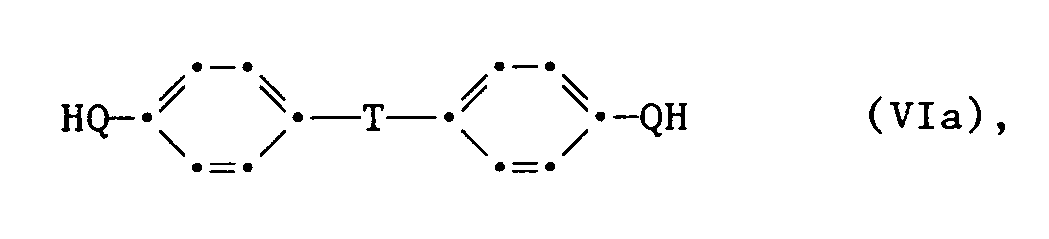
- Particularly preferred compounds (c) are compounds of the formula VIa and among the diphenols, particular preference is given to compounds of the formula VII where Q and T in the formulas VIa and VII have the meaning given above.
- Examples of compounds of the formula VII are: bis (4-hydroxy-3-allylphenyl) biphenyl, bis (4-hydroxy-3-allylphenyl) methane and 2,2-bis (4-hydroxy-3-allylphenyl) propane.
- the most preferred compounds (c) are 4,4'-diaminodiphenylmethane and 2,2-bis (4-hydroxy-3-allylphenyl) propane (o, o'-diallylbisphenol A).
- Components (a), (b) and optionally (c) of the substance mixtures according to the invention can each be individual compounds or mixtures of two or more compounds according to the definition.
- the components (a), (b) and (c) of the substance mixtures according to the invention are known and can be prepared in a known manner.
- the benzaldehyde derivatives of the formula II can, for example, by reacting an optionally substituted benzaldehyde of the formula VIII with acetone or with a diketone of formula IX containing acetyl groups where o, R3 and R 'have the meaning given above, are prepared.
- Suitable compounds of the formula IX are, for example, acetylacetone or in particular 4-acetylacetophenone.
- the production of dibenzalacetone is described, for example, in Org. Synthesis Coll. Vol. II, 167 described.
- the other compounds of the formula II as defined can also be prepared in an analogous manner.
- the substance mixtures according to the invention are suitable for the production of polymers with excellent physical properties.
- the mixtures of substances are also characterized by a low viscosity and a long pot life and are therefore easy to process.
- the invention further relates to polymers which are obtainable by heating a mixture of substances according to the invention to a temperature between 100 and 300 ° C. for 1 to 20 hours.
- the mixtures of substances can be cured or processed in an inert organic solvent, but preferably from the melt and, if appropriate, in the presence of a curing catalyst.
- Suitable inert organic solvents are, for example, dimethylformamide, dimethylacetamide, N-methylpyrrolidone, toluene, xylenes, methylene chloride, tetrahydrofuran, methyl ethyl ketone, and ethylene glycol monoalkyl or dialkyl ether with 1-4 C atoms in the alkyl groups.
- suitable curing catalysts are, for example, organic peroxides, such as di-tert-butyl peroxide, dicumyl peroxide, tert-butyl perbenzoate, or basic catalysts, especially primary, secondary and tertiary amines, such as, for example, diethylamine, tributylamine, triethylamine, benzylamine, N, N, N ', N'-tetramethyl-4,4'-diaminodiphenylmethane, N, N-diisobutylaminoacetonitrile, N, N-dibutylaminoacetonitrile and heterocyclic bases such as quinoline, N-methylpyrrolidine and imidazole.
- organic peroxides such as di-tert-butyl peroxide, dicumyl peroxide, tert-butyl perbenzoate, or basic catalysts, especially primary, secondary and tertiary amines, such as
- the addition of basic catalysts of the type mentioned is advisable.
- the curing is generally carried out at temperatures between 100 and 300 ° C., particularly 120 and 250 ° C.
- the substance mixtures according to the invention are low-melting solid resins to viscous liquid resins and are characterized by high reactivity and good mechanical and thermal properties of the products hardened with them, such as, in particular, good thermostability and heat aging resistance. Products obtained in this way have high glass transition temperatures and a very high thermal resistance and are also not very brittle.
- the mixtures of substances according to the invention can also be easily applied from the melt, particularly without the addition of low-volatility solvents, for example for impregnating glass fiber, carbon fiber or aramid fiber fabrics, such as fiber fabrics made from the poly (1.4 known under the trade name Kevlar®) -phenylene terephthalamides).
- the mixtures of substances according to the invention can be used in a variety of ways, e.g. as laminating or electrical resins, as high-temperature adhesives or for the production of coatings or moldings. They are particularly suitable for the production of prepregs and heat-resistant composite materials, as well as laminating resins, as winding resins for the filament winding process or as high-temperature adhesives.
- the invention also relates to the use of the substance mixtures according to the invention for the production of moldings, prepregs, laminates, coatings or adhesives.
- a mixture of 88.2 g of 4,4'-dimethoxy-dibenzalacetone (0.3 mol) is prepared by the process described in Example 1 according to reports by the German Chemical Society 35 , 1192 and 107.4 g of N, N ', 4 , 4'-Diphenylmethanbismaleinimid (0.3 mol) prepared, cast into plates and cured for 2 hours at 120 ° C, 2 hours at 150 ° C, 1 hour at 200 ° C and 6 hours at 250 ° C.
- the following properties are measured: Flexural strength 71 N / mm2 Edge fiber stretch 1.9% Glass transition temperature > 300 ° C 10% weight loss at 380 ° C
- Example 1 Flexural strength 150 N / mm2 Edge fiber stretch 6.2% Impact resistance according to ISO 179 16.2 kJ / m2 Glass transition temperature 297 ° C
Landscapes
- Chemical & Material Sciences (AREA)
- Health & Medical Sciences (AREA)
- Chemical Kinetics & Catalysis (AREA)
- Medicinal Chemistry (AREA)
- Polymers & Plastics (AREA)
- Organic Chemistry (AREA)
- Macromolecular Compounds Obtained By Forming Nitrogen-Containing Linkages In General (AREA)
- Addition Polymer Or Copolymer, Post-Treatments, Or Chemical Modifications (AREA)
- Reinforced Plastic Materials (AREA)
- Polymers With Sulfur, Phosphorus Or Metals In The Main Chain (AREA)
- Manufacture Of Macromolecular Shaped Articles (AREA)
Description
- Die Erfindung betrifft heisshärtbare Stoffgemische enthaltend bestimmte ungesättigte Imide, z.B. Bismaleinimide, und Benzaldehyd-Derivate, z.B. Dibenzalaceton, deren Verwendung zur Herstellung von vernetzten Formkörpern sowie die daraus erhältlichen Polymere.
- Es ist bekannt, dass sich Polymaleinimide mit oder ohne Zusatz von Vernetzungsmitteln, wie Diaminen oder Diolen, durch Erhitzen in vernetzte Produkte überführen lassen [vgl. z.B. US-A-3,562,223, US-A-3,658,764, US-A-3,380,964 und US-A-4,038,251]. Ebenso ist bekannt, dass Polymaleinimide mit bestimmten ungesättigten Verbindungen zu vernetzten Polymeren umgesetzt werden können.
- So beschreiben z.B. die GB-A-1,443,067 und die US-A-3,925,314 Stoffgemische enthaltend ungesättigte Bisimide und Azomethine sowie gegebenenfalls Härtungskatalysatoren oder Polyamine.
- Die US-A-4,351,932 beschreibt Matrixharze enthaltend ungesättigte Bisimide und Divinylaromaten, wie z.B. Divinylbenzol.
- Die GB-A-1,531,906 beschreibt härtbare, für die Herstellung von Schaumstoffen geeignete Gemische, welche ein Bismaleinimid, ein Furfuraldehyd-Derivat und ein Treibmittel enthalten. Die dabei verwendeten Furfuraldehyd-Derivate sind Kondensationsprodukte des Furfuraldehyds mit Mono- oder Diketonen.
- Gegenstand vorliegender Erfindung sind heisshärtbare Stoffgemische enthaltend (a) ein ungesättigtes Imid der Formel I

(b) ein Benzaldehyd-Derivat der Formel II
worin m 2 oder 3, n Null oder 1 und o eine ganze Zahl von 1 bis 5 bedeuten,
R¹ und R² unabhängig voneinander Wasserstoff oder Methyl sind,
R -CpH2p- mit p = 2-20, -CH₂CH₂SCH₂CH₂-, Arylen mit 6-10 C-Atomen, Xylylen, Cyclopentylen, Cyclohexylen, 1,4-Bis(methylen)cyclohexylen, einen zweiwertigen Rest des Bicyclohexylmethans oder Reste der Formeln
bedeutet, wobei in den obigen Formeln T¹ Methylen, Isopropyliden, CO, O, S, SO₂, -P=O(Q₃), -NQ₃-, -N=N-, -CONH-, -COO-, -NQ₃-CO-X-CO-NQ₃-, -O-CO-X-CO-O-,
bedeutet,
q 0 oder 1 ist,
Z O oder S darstellt,
Q₁ und Q₂ unabhängig voneinander ein Halogenatom, Methyl, Ethyl oder ein Wasserstoffatom,
Q₃ C₁-C₄-Alkyl und
X eine direkte Bindung, -CtH2t- mit t = 1-12, Arylen mit 6-10 C-Atomen, Xylylen, Cyclopentylen oder Cyclohexylen ist,
R' CkH2k mir k = 1-20, Cycloalkylen mit 5-10 C-Atomen, Arylen mit 6-10 C-Atomen oder eine Gruppe der Formel III
mit T = eine direkte Bindung, Methylen, Isopropyliden, CO, O oder SO₂ und die Substituenten R³ unabhängig voneinander Wasserstoff, Alkyl mit 1-12 C-Atomen, Alkenyl mit 2-6 C-Atomen, Cycloalkyl mit 5-8 C-Atomen, Phenyl, Halogen, eine Nitrogruppe oder eine Gruppe -N(R⁴)₂ oder -OR⁴ bedeuten, wobei die Substituenten R⁴ unabhängig voneinander Wasserstoff, C₁-C₄-Alkyl, C₂-C₄-Alkenyl oder 2,3-Epoxypropyl bedeuten. - Die erfindungsgemässen Stoffgemische eignen sich für die Herstellung von vernetzten Produkten und insbesondere für die Herstellung von Formkörpern, Prepregs, Laminaten, Beschichtungen oder Verklebungen.
- Die Substituenten R¹, R² und R³ der Verbindungen der Formeln I und II bedeuten vorzugsweise je ein Wasserstoffatom.
- Als spezifische Beispiele für Maleinimide der Formel I, welche in den erfindungsgemässen Mischungen enthalten sein können, seien genannt:
N,N'-Ethylen-bis-maleinimid,
N,N'-Hexamethylen-bis-maleinimid,
N,N'-m-Phenylen-bis-maleinimid,
N,N'-p-Phenylen-bis-maleinimid,
N,N'-4,4'-Diphenylmethan-bis-maleinimid,
N,N'-4,4'-3,3'-Dichlor-diphenylmethan-bis-maleinimid,
N,N'-4,4'-Diphenylether-bis-maleinimid,
N,N'-4,4'-Diphenylsulfon-bis-maleinimid,
N,N'-m-Xylylen-bis-maleinimid,
N,N'-p-Xylylen-bis-maleinimid,
N,N'-4,4'-2,2-Diphenylpropan-bis-maleinimid,
das N,N'-Bis-maleinimid des 4,4'-Diamino-triphenylphosphats,
das N,N'-Bis-maleinimid des 4,4'-Diamino-triphenylphosphits,
das N,N'-Bis-maleinimid des 4,4'-Diamino-triphenylthiophosphats,
das N,N',N''-Trismaleinimid des Tris-(4-aminophenyl)-phosphats,
das N,N',N''-Trismaleinimid des Tris-(4-aminophenyl)-phosphits und
das N,N',N''-Trismaleinimid des Tris-(4-aminophenyl)-thiophosphats. - Als Verbindungen der Formel I sind solche bevorzugt, worin m die Zahl 2, und R -(CH₂)̵p mit p = 2-12, m- oder p-Phenylen, m- oder p-Xylylen, 1,4-Cyclobexylen, 1,4-Bis(methylen)cyclohexylen, den Rest des 4,4'-Bicyclohexylmethans und vor allem einen Rest der Formel IV

bedeuten, worin T² O, CH₂ oder SO₂ darstellt. Ganz besonders bevorzugt ist das N,N',4,4'-Diphenylmethan-bismaleinimid. - Die Substituenten R³ der Verbindungen der Formel II können unabhängig voneinander eine gerad- oder verzweigtkettige Alkylgruppe mit 1-12 C-Atomen bedeuten, wie Methyl, Ethyl, Isopropyl, n-Butyl, Isopentyl, n-Hexyl, 2-Ethyl-hexyl, n-Decyl und n-Dodecyl, vorzugsweise Alkyl mit 1-8 C-Atomen. R³ in der Bedeutung einer Alkenylgruppe mit 2-6 C-Atomen kann ebenfalls geradkettig oder verzweigt sein, wie Vinyl, Allyl, Methallyl, 2-Butenyl und 3-Hexenyl, vorzugsweise Allyl.
- Wenn R³ eine Cycloalkylgruppe bedeutet, kann es sich um eine Cyclopentyl-, Cyclohexyl-, Cycloheptyl- oder Cyclooctylgruppe handeln, vorzugsweise um Cyclohexyl.
- Wenn R³ einen Halogenatom bedeutet, kann es sich um Fluor, Jod und vorzugsweise Chlor oder Brom handeln.
- Stellt R³ eine Gruppe -N(R⁴)₂ oder -OR⁴ dar, so bedeuten die R⁴ Reste z.B. Methyl, Ethyl, n- und iso-Propyl, n-, iso-, sec.- oder tert.-Butyl, Vinyl, 1- oder 2-Propenyl oder 1-, 2- oder 3-Butenyl.
- Stellt R' eine Gruppe -CkH2k- dar, so kann es sich um geradkettige oder verzweigte Reste handeln, wie Methylen, Ethylen, Propylen, Trimethylen, Tetramethylen, Hexamethylen, Octamethylen und Dodecamethylen. Vorzugsweise bedeutet R' eine Gruppe -(CH₂)̵k mit k = 1 bis 12. Bedeutet R' eine Gruppe der Formel III, so ist diese vorzugsweise in 4,4'-Stellung gebunden.
- R' kann in der Bedeutung einer Arylengruppe mit 6-10 C-Atomen z.B. eine m-Phenylen-, p-Phenylen-, 1,3-Naphthylen-, 1,4-Naphthylen-, 1,5-Naphthylen- oder 2,6-Naphthylengruppe bedeuten.
- Wenn R' eine Gruppe der Formel III bedeutet, steht T vorzugsweise für die Methylengruppe, O oder SO₂.
- Bedeutet R' Cycloalkylen mit 5-10 C-Atomen, kann dieser Rest mono- oder auch bicyclisch sein, wie z.B. Cyclopentylen, Cyclohexylen, Cycloheptylen, Cyclooctylen, Decalinylen, Bicyclohexylen, Bicycloheptylen, Bicyclooctylen usw.
- Bevorzugt werden Verbindungen der Formel II, worin o die Zahl 1 und R³ Wasserstoff, Alkyl mit 1-4 C-Atomen, Alkenyl mit 2-4 C-Atomen, -NHR⁴ oder -OR⁴ bedeuten, sowie jene, worin R' (̵CH₂)̵p mit p = 1-12, Cyclopentylen, Cyclohexylen, o-, m- oder p-Phenylen oder Naphthylen ist. Besonders bevorzugt werden Verbindungen der Formel II, worin R' -CH₂- oder p-Phenylen bedeutet. Ganz besonders bevorzugte Verbindungen der Formel II sind 4,4'-Diallyloxydibenzalaceton, 4,4'-Dimethoxydibenzalaceton und insbesondere Dibenzalaceton.
- Das Mengenverhältnis der Komponenten (a) und (b) der erfindungsgemässen Stoffgemische wird vorzugsweise so gewählt, dass pro Mol des Benzaldehyd-Derivats (b) 0,5-10, insbesondere 1-5 Mol des ungesättigten Imids (a) eingesetzt werden.
- Die erfindungsgemässen Stoffgemische können, falls zweckmässig, zusätzlich zu den Komponenten (a) und (b) noch (c) 1 bis 50 Gew.%, vorzugsweise 5 bis 40 Gew.%, besonders bevorzugt 10 bis 30 Gew.%, bezogen auf die Summe von (a) und (b), mindestens einer zur Reaktion mit der Komponente (a) befähigten Verbindung enthalten. Es können dabei beliebige bekannte Verbindungen eingesetzt werden. Verbindungen, die mit ungesättigten Imiden reagieren können, sind zum Beispiel in der US-A-4,666,997 als Komponente (c) der Stoffgemische beschrieben. Besonders geeignet sind dabei Polyamine oder Polyole. Als Polyamine oder Polyole kommen z.B. Phenol- oder Kresolnovolake oder Verbindungen der Formel
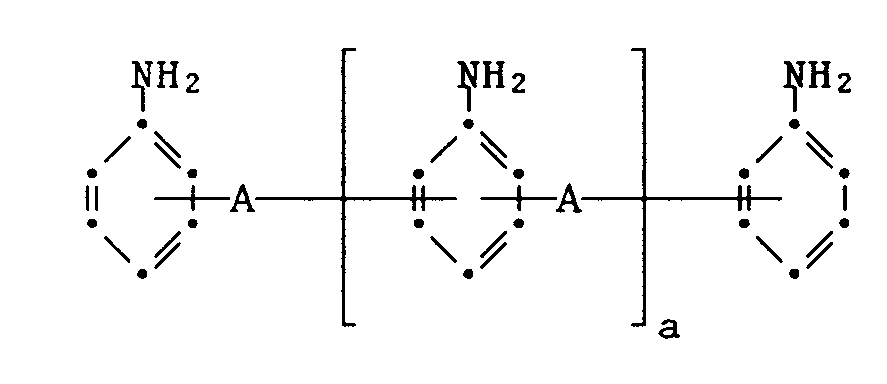
mit a gleich eine Zahl von 0,1 bis 2 und A gleich ein zweiwertiger Kohlenwasserstoffrest eines Aldehyds oder Ketons mit 1-8 C-Atomen erhalten nach Entfernung des Sauerstoffatoms. - Bevorzugte Komponenten (c) der erfindungsgemässen Stoffgemische sind Diamine oder Diole der Formel V
HQ-R''-QH (V),
mit Q gleich O oder NH, wobei R'' gleich -CpH2p- mit p = 2-20, -CH₂CH₂SCH₂CH₂-, Arylen mit 6-10 C-Atomen, Xylylen, Cyclopentylen, Cyclohexylen, 1,4-Bis(methylen)cyclohexylen, einen zweiwertigen Rest des Bicyclohexylmethans oder Reste der Formeln
bedeutet,
wobei in den obigen Formeln T¹ Methylen, Isopropyliden, CO, O, S, SO₂, -P=O(Q₃), -NQ₃-, -N=N-, -CONH-, -COO-, -NQ₃-CO-X-CO-NQ₃-, -O-CO-X-CO-O-,
bedeutet,
q 0 oder 1 ist,
Z O oder S darstellt,
Q₁ und Q₂ unabhängig voneinander ein Halogenatom, Methyl, Ethyl oder ein Wasserstoffatom,
Q₃ C₁-C₄-Alkyl und
X eine direkte Bindung, -CtH2t- mit t = 1-12, Arylen mit 6-10 C-Atomen, Xylylen, Cyclopentylen oder Cyclohexylen ist. - Als Diamine besonders geeignet sind aromatische Diamine, wie z.B. Phenylendiamin, Naphthylendiamin, Diaminobiphenyl oder Verbindungen der Formeln Va oder Vb

worin y Null bis 5 ist und T die oben angegebene Bedeutung hat. Unter den Verbindungen der Formel Va ist insbesondere 1,4-Bis(4'-aminophenoxy)benzol und unter Verbindungen der Formel Vb ist insbesondere jene mit T gleich Isopropyliden bevorzugt. - Bevorzugte Verbindungen (c) der erfindungsgemässen Stoffgemische sind auch Verbindungen der Formel VI

worin Q und T die oben angegebene Bedeutung haben, z Null oder eine ganze Zahl von 1 bis 4, insbesondere Null oder 1, ist und R⁵ ein C₁-C₄-Alkyl- ein C₂-C₄-Alkenylrest, oder ein Halogenatom ist. - Die als R⁴ beispielhaft erwähnten Alkyl- und Alkenylreste kommen auch als die entsprechenden Reste R⁵ in Frage. Wenn R⁵ einen Halogenatom bedeutet, ist es vorzugsweise Chlor oder insbesondere Brom, und das Symbol z in Formel VI bedeutet dann vorzugsweise 2 oder 4.
- Besonders bevorzugte Verbindungen (c) sind Verbindungen der Formel VIa

und under den Diphenolen besonders bevorzugt sind Verbindungen der Formel VII
wobei Q und T in den Formeln VIa und VII die oben angegebene Bedeutung haben. Beispiele für Verbindungen der Formel VII sind: Bis(4-hydroxy-3-allyl)biphenyl, Bis(4-hydroxy-3-allylphenyl)methan und 2,2-Bis(4-hydroxy-3-allylphenyl)propan. - Die am meisten bevorzugten Verbindungen (c) sind 4,4'-Diaminodiphenylmethan und 2,2-Bis(4-hydroxy-3-allylphenyl)propan (o,o'-Diallylbisphenol A).
- Bei den Komponenten (a), (b) und gegebenenfalls (c) der erfindungsgemässen Stoffgemische kann es sich jeweils um Einzelverbindungen oder um Gemische von zwei oder mehreren definitionsgemässen Verbindungen handeln.
- Die definitionsgemässen Komponenten (a), (b) und (c) der erfindungsgemässen Stoffgemische sind bekannt und können auf bekannte Weise hergestellt werden.
- Die Benzaldehyd-Derivate der Formel II können z.B. durch Umsetzung eines gegebenenfalls substituierten Benzaldehyds der Formel VIII

mit Aceton oder mit einem Acetylgruppen enthaltenden Diketon der Formel IX
wobei o, R³ und R' die oben angegebene Bedeutung haben, hergestellt werden. Geeignete Verbindungen der Formel IX sind z.B. Acetylaceton oder insbesondere 4-Acetylacetophenon. Die Herstellung von Dibenzalaceton ist z.B. in Org. Synthesis Coll. Vol. II, 167 beschrieben. Auf analoge Weise können auch die anderen definitionsgemässen Verbindungen der Formel II hergestellt werden. - Die erfindungsgemässen Stoffgemische eignen sich für die Herstellung von Polymeren mit ausgezeichneten physikalischen Eigenschaften. Die Stoffgemische zeichnen sich zudem durch eine niedrige Viskosität und eine lange Topfzeit aus und sind daher leicht verarbeitbar.
- Ein weiterer Gegenstand der Erfindung sind Polymere, die dadurch erhältlich sind, dass man ein erfindungsgemässes Stoffgemisch während 1 bis 20 Stunden auf eine Temperatur zwischen 100 und 300°C erhitzt.
- Die Härtung bzw. Verarbeitung der Stoffgemische kann in einem inerten organischen Lösungsmittel, vorzugsweise jedoch aus der Schmelze und gegebenenfalls in Gegenwart eines Härtungskatalysators erfolgen. Als inerte organische Lösungsmittel eignen sich z.B. Dimethylformamid, Dimethylacetamid, N-Methylpyrrolidon, Toluol, Xylole, Methylenchlorid, Tetrahydrofuran, Methylethylketon, und Ethylenglykolmonoalkyl- oder -dialkylether mit 1-4 C-Atomen in den Alkylgruppen. Je nach der beabsichtigten Verwendung kommen als Härtungskatalysatoren z.B. organische Peroxide, wie Di-tert-butylperoxid, Dicumylperoxid, tert-Butylperbenzoat, oder basische Katalysatoren, vor allem primäre, sekundäre und tertiäre Amine in Betracht, wie z.B. Diethylamin, Tributylamin, Triethylamin, Benzylamin, N,N,N',N'-Tetramethyl-4,4'-diaminodiphenylmethan, N,N-Diisobutylaminoacetonitril, N,N-Dibutylaminoacetonitril und heterocyclische Basen, wie Chinolin, N-Methylpyrrolidin und Imidazol. Besonders bei der Verwendung von Phenolen oder Polyolen als zusätzliche, zur Reaktion mit den Maleinimidgruppen befähigte Komponente der erfindungsgemässen Stoffgemische empfiehlt sich der Zusatz von basischen Katalysatoren der erwähnten Art. Die Härtung wird im allgemeinen bei Temperaturen zwischen 100 und 300°C, besonders 120 und 250°C vorgenommen.
- Die erfindungsgemässen Stoffgemische stellen niederschmelzende Festharze bis viskose Flüssigharze dar und zeichnen sich durch hohe Reaktivität und gute mechanische und thermische Eigenschaften der damit gehärteten Produkte aus, wie insbesondere eine gute Thermostabilität und Wärmealterungsbeständigkeit. So erhaltene Produkte weisen hohe Glasumwandlungstemperaturen und eine sehr hohe thermische Beständigkeit auf und sind zudem auch wenig spröde. Die erfindungsgemässen Stoffgemische können ferner leicht aus der Schmelze, besonders auch ohne Zusatz von schwerflüchtigen Lösungsmitteln, appliziert werden, beispielsweise zum Imprägnieren von Glasfaser-, Kohlenstoffaser- oder Aramidfaser-Gewebe, wie Fasergewebe aus den unter dem Handelsnamen Kevlar® bekannten Poly(1,4-phenylenterephthalamiden).
- Die erfindungsgemässen Stoffgemische können vielseitig angewendet werden, z.B. als Laminier- oder Elektroharze, als Hochtemperatur-Klebstoffe oder zur Herstellung von Beschichtungen oder Formkörpern. Ganz besonders geeignet sind sie für die Herstellung von Prepregs und hitzebeständigen Verbundswerkstoffen, sowie als Laminierharze, als Wickelharze für das Filament-Winding-Verfahren oder als Hochtemperatur-Klebstoffe.
- Gegenstand der Erfindung ist auch die Verwendung der erfindungsgemässen Stoffgemische zur Herstellung von Formkörpern, Prepregs, Laminaten, Beschichtungen oder Verklebungen.
- Die Erfindung wird durch die folgenden Beispiele näher erläutert.
- 117,2 g Dibenzalaceton, hergestellt gemäss Org. Synth. Coll. Vol. II, 167 (0,5 mol) werden auf 140°C erwärmt und dann werden unter Rühren 179,2 g N,N',4,4'-Diphenylmethanbismaleinimid (0,5 mol) zugegeben. Nach etwa 10-15 Minuten ist das Bismaleinimid völlig aufgeschmolzen und die Mischung ist klar. Bei der Differentialthermoanalyse (System TA 2000 der Fa. Mettler AG, Greifensee, CH) zeigt das Gemisch einen Reaktionsbeginn TA bei 140°C und ein Reaktionsmaximum Tmax bei 204°C. Die integrale Reaktionswärme ΔH der Härtung beträgt 275 kJ/kg. Die Mischung wird während 20 Minuten bei ca. 120°C entgast und anschliessend in Formen von 120 x 120 x 4 mm³ gegossen. In einem Ofen werden die Prüfkörper 4 Stunden bei 150°C, 2 Stunden bei 200°C und 6 Stunden bei 250°C gehärtet. Nach dem Abkühlen zerschneidet man die Platte zu Prüfstäben, an deren folgende Eigenschaften gemessen werden:
Biegfestigkeit nach ISO 178 49,8 N/mm² Randfaserdehnung nach ISO 178 1,5% Glaswandlungstemperatur¹ > 300°C 10% Gewichtsverlust bei² 395°C Zugscherfestigkeit nach ISO 4587 6,7 N/mm² ¹ gemessen mittels TMA, Du Pont 9900 Thermal Analyser ² Messungen durch Aufheizen einer Probe im TA 3000 (Differentialthermoanalysesystem der Firma Mettler); Ermittlung der Temperatur, bei der 10% der Probe verflüchtigt sind; Aufheizgeschwindigkeit: 10°C/min (in Luft). - Nach dem in Beispiel 1 beschriebenen Verfahren werden weitere Gemische aus Dibenzalaceton und N,N',4,4'-Diphenylmethanbismaleinimid hergestellt und zu Formkörpern verarbeitet. Die Eigenschaften der Gemische und der gehärteten Produkte werden wie in Beispiel 1 angegeben bestimmt. Die Resultate sind in Tabelle 1 zusammengefasst:
Tabelle 1 Beispiel Nr. 2 3 4 Dibenzalaceton 87,9 g 58,6 g 29,3 g N,N',4,4'-Diphenylmethanbismaleinimid 179,2 g 179,2 g 179,2 g TA (°C) 150 155 160 Tmax (°C) 199 201 199 ΔH (kJ/kg) 240 220 170 Biegefestigkeit (N/mm²) 47 50 40 Randfaserdehnung (%) 1,4 1,5 1,1 Glasumwandlungstemperatur (°C) > 300 > 300 > 300 10 % Gewichtsverlust bei (°C) 415 430 465 Zugscherfestigkeit (N/mm²) 7,4 6,8 6,8 - Nach dem in Beispiel 1 beschriebenen Verfahren wird eine Mischung aus 88,2 g 4,4'-Dimethoxy-dibenzalaceton (0,3 mol) hergestellt gemäss Berichte der Deutschen Chemischen Gesellschaft 35, 1192 und 107,4 g N,N',4,4'-Diphenylmethanbismaleinimid (0,3 mol) hergestellt, zu Platten vergossen und 2 Stunden bei 120°C, 2 Stunden bei 150°C, 1 Stunde bei 200°C und 6 Stunden bei 250°C gehärtet. Folgende Eigenschaften werden gemessen:
Biegefestigkeit 71 N/mm² Randfaserdehnung 1,9 % Glasumwandlungstemperatur > 300°C 10 % Gewichtsverlust bei 380°C - Nach dem in Beispiel 1 beschriebenen Verfahren wird eine Mischung aus 103,8 g 4,4'-Diallyloxydibenzalaceton (0,3 mol) hergestellt gemäss Org. Synth. Coll. Vol. II, 167 aus p-Allyloxybenzaldehyd und Aceton und 107,4 g N,N',4,4'-Diphenylmethanbismaleinimid (0,3 mol) hergestellt, zu Platten gegossen und 2 Stunden bei 120°C, 2 Stunden bei 150°C, 1 Stunde bei 200°C und 6 Stunden bei 250°C gehärtet. Folgende Eigenschaften werden gemessen:
Biegefestigkeit 41 N/mm² Randfaserdehnung 1,3 % Glasumwandlungstemperatur > 300°C 10 % Gewichtsverlust bei 425°C - 23,4 g Dibenzalaceton (0,1 mol) werden auf 140°C erwärmt und dann werden unter Rühren 143,2 g N,N',4,4'-Diphenylmethanbismaleinimid (0,4 mol) zugegeben. Nach etwa 20 Minuten ist das Bismaleinimid völlig aufgeschmolzen. In dieser Schmelze löst man dann bei 120°C 39,6 g (0,2 mol) 4,4'-Diaminodiphenylmethan. Die klare Mischung wird anschliessend bei 120°C entgast, dann in Formen von 120 x 120 x 4 mm gegossen und im Ofen 2 Stunden bei 120°C, 2 Stunden bei 150°C, 1 Stunde bei 200°C und 6 Stunden bei 250°C gehärtet. Folgende Eigenschaften werden wie im Beispiel 1 angegeben gemessen:
Biegefestigkeit 150 N/mm² Randfaserdehnung 6,2 % Schlagzähigkeit nach ISO 179 16,2 kJ/m² Glasumwandlungstemperatur 297°C Zugscherfestigkeit 12,2 N/mm² 10 % Gewichtsverlust bei 405°C - Eine Mischung aus N,N',4,4'-Diphenylmethanbismaleinimid, Dibenzalaceton und o,o'-Diallylbisphenol A wird bei 150°C aufgeschmolzen. Die klare Schmelze wird während 10 Minuten bei 150°C entgast, dann in eine Form von 120 x 120 x 4 mm³ gegossen und 2 Stunden bei 160°C, 1 Stunde bei 180°C, 1 Stunde bei 200°C und 6 Stunden bei 250°C gehärtet. Nach dem Abkühlen wird die Platte zu Prüfstäben zerschnitten. Die Resultate sind in Tabelle 2 zusammengefasst:
Tabelle 2 Beispiel Nr. 8 9 10 N,N',4,4'-Diphenylmethanbismaleinimid 89,6 g 89,6 g 89,6 g Dibenzalaceton 11,7 g 23,4 g 35,1 g o,o'-Diallylbisphenol A 38,6 g 38,6 g 38,6 g Viskosität bei 120°C 120 80 70 (m Pa.s) bei 80°C - 2900 1700 Gelierzeit bei 160°C (min) 120 120 120 Glasumwandlungstemperatur (°C) 314 307 299 Biegefestigkeit (N/mm²) 153 149 135 Randfaserdehnung (%) 5,6 5,5 4,6 Schlagzähigkeit (kJ/m²) 23,0 21,4 19,8 10 % Gewichtsverlust bei (°C) 410 395 385
Claims (16)
- Heisshärtbare Stoffgemische enthaltend (a) ein ungesättigtes Imid der Formel I


R¹ und R² unabhängig voneinander Wasserstoff oder Methyl sind,
R -CpH2p- mit p = 2-20, -CH₂CH₂SCH₂CH₂-, Arylen mit 6-10 C-Atomen, Xylylen, Cyclopentylen, Cyclohexylen, 1,4-Bis(methylen)cyclohexylen, einen zweiwertigen Rest des Bicyclohexylmethans oder Reste der Formeln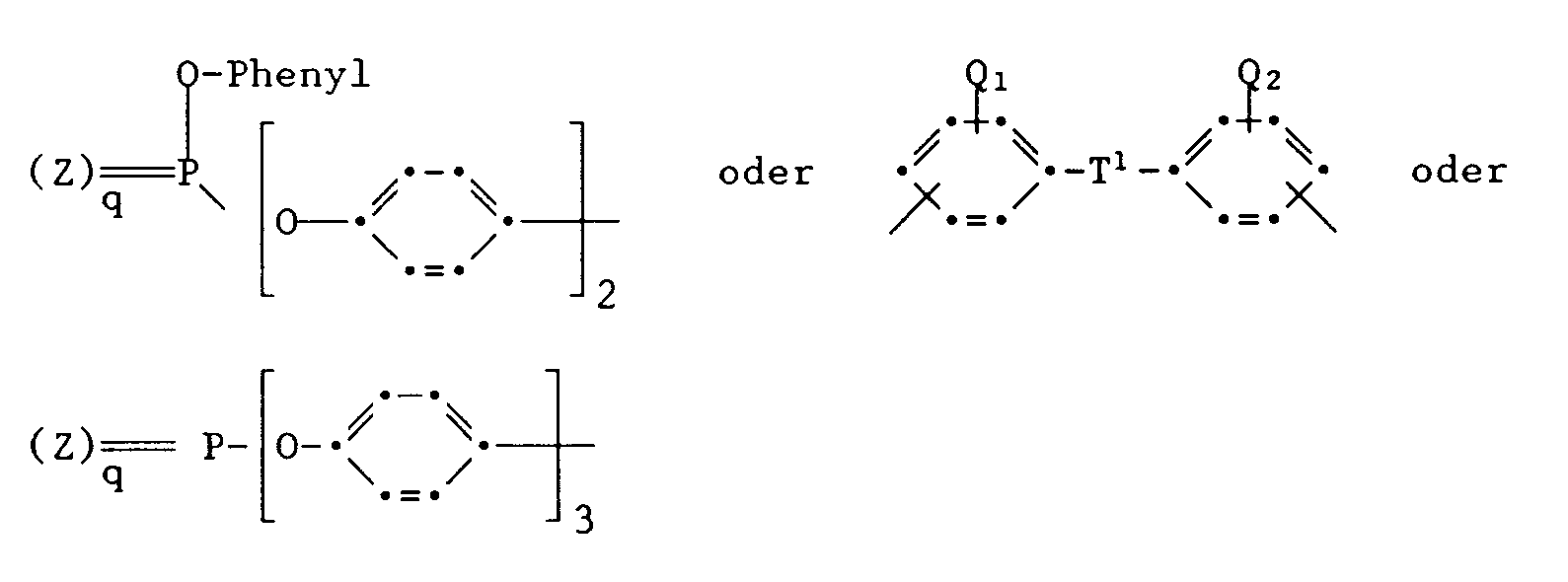
in den obigen Formeln T¹ Methylen, Isopropyliden, CO, O, S, SO₂, -P=O(Q₃), -NQ₃-, -N=N-, -CONH-, -COO-, -NQ₃-CO-X-CO-NQ₃-, -O-CO-X-CO-O-,
q 0 oder 1 ist,
Z O oder S darstellt,
Q₁ und Q₂ unabhängig voneinander ein Halogenatom, Methyl, Ethyl oder ein Wasserstoffatom,
Q₃ C₁-C₄-Alkyl und
X eine direkte Bindung, -CtH2t- mit t = 1-12, Arylen mit 6-10 C-Atomen, Xylylen, Cyclopentylen oder Cyclohexylen ist,
R' -CkH2k- mit k = 1-20, Cycloalkylen mit 5-10 C-Atomen, Arylen mit 6-10 C-Atomen oder eine Gruppe der Formel III
- Stoffgemisch nach Anspruch 1, worin R¹, R² und R³ Wasserstoffatome bedeuten.
- Stoffgemisch nach Anspruch 1, worin m die Zahl 2, und R -(CH₂)̵p mit p = 2-12, m- oder p-Phenylen, m- oder p-Xylylen, 1,4-Cyclohexylen, 1,4-Bis(methylen)cyclohexylen, den Rest des 4,4'-Bicyclohexylmethans oder einen Rest der Formel IV

- Stoffgemisch nach Anspruch 1, das als Verbindung (a) N,N',4,4'-Diphenylmethanbismaleinimid enthält.
- Stoffgemisch nach Anspruch 1, worin o die Zahl 1 und R³ Wasserstoff, Alkyl mit 1-4 C-Atomen, Alkenyl mit 2-4 C-Atomen, -NHR⁴ oder -OR⁴ bedeuten.
- Stoffgemisch nach Anspruch 1, worin R' (̵CH₂)̵k mit k = 1-12, Cyclopentylen, Cyclohexylen, o-, m- oder p-Phenylen oder Naphthylen ist.
- Stoffgemisch nach Anspruch 1, worin R' -CH₂- oder p-Phenylen bedeutet.
- Stoffgemisch nach Anspruch 1, worin die Verbindung (b) 4,4'-Diallyloxydibenzalaceton, 4,4'-Dimethoxydibenzalaceton oder Dibenzalaceton ist.
- Stoffgemisch nach Anspruch 1, das pro Mol der Komponente (b) 0,5-10 Mol der Komponente (a) enthält.
- Stoffgemisch nach Anspruch 1, das zusätzlich zu den Komponenten (a) und (b) noch (c) 1 bis 50 Gew.%, bezogen auf die Summe von (a) und (b), eines Polyamins oder eines Polyols enthält.
- Stoffgemisch nach Anspruch 10, worin die Komponente (c) ein Diamin oder Diol der Formel V
HQ-R''-QH (V),
ist mit Q gleich O oder NH und R'' -CpH2p- mit p = 2-20, -CH₂CH₂SCH₂CH₂-, Arylen mit 6-10 C-Atomen, Xylylen, Cyclopentylen, Cyclohexylen, 1,4-Bis(methylen)cyclohexylen, einen zweiwertigen Rest des Bicyclohexylmethans oder Reste der Formeln
wobei in den obigen Formeln T¹ Methylen, Isopropyliden, CO, O, S, SO₂, -P=O(Q₃), -NQ₃-, -N=N-, -CONH-, -COO-, -NQ₃-CO-X-CO-NO₃-, -O-CO-X-CO-O-,
q 0 oder 1 ist,
Z O oder S darstellt,
Q₁ und Q₂ unabhängig voneinander ein Halogenatom, Methyl, Ethyl oder ein Wasserstoffatom,
Q₃ C₁-C₄-Alkyl und
X eine direkte Bindung, -CtH2t- mit t = 1-12, Arylen mit 6-10 C-Atomen, Xylylen, Cyclopentylen oder Cyclohexylen ist. - Stoffgemisch nach Anspruch 11, worin (c) eine Verbindungen der Formel VIa
- Stoffgemisch nach Anspruch 11, worin (c) eine Verbindung der Formel VII

- Stoffgemisch nach Anspruch 12 oder 13, worin (c) 4,4'-Diaminodiphenylmethan oder 2,2-Bis(4-hydroxy-3-allylphenyl)propan ist.
- Verwendung des Stoffgemisches nach Anspruch 1 zur Herstellung von Formkörpern, Prepregs, Laminaten, Beschichtungen oder Verklebungen.
- Polymere, die dadurch erhältlich sind, dass man ein Stoffgemisch nach Anspruch 1 während 1-20 Stunden auf eine Temperatur zwischen 100 und 300°C erhitzt.
Applications Claiming Priority (4)
| Application Number | Priority Date | Filing Date | Title |
|---|---|---|---|
| CH305087 | 1987-08-07 | ||
| CH3050/87 | 1987-08-07 | ||
| CH420487 | 1987-10-27 | ||
| CH4204/87 | 1987-10-27 |
Publications (3)
| Publication Number | Publication Date |
|---|---|
| EP0302832A2 EP0302832A2 (de) | 1989-02-08 |
| EP0302832A3 EP0302832A3 (en) | 1990-03-14 |
| EP0302832B1 true EP0302832B1 (de) | 1993-01-20 |
Family
ID=25692037
Family Applications (1)
| Application Number | Title | Priority Date | Filing Date |
|---|---|---|---|
| EP88810528A Expired - Lifetime EP0302832B1 (de) | 1987-08-07 | 1988-07-29 | Ungesättigte Imide und Benzaldehyd-Derivate enthaltende heisshärtbare Stoffgemische |
Country Status (6)
| Country | Link |
|---|---|
| US (1) | US4935478A (de) |
| EP (1) | EP0302832B1 (de) |
| JP (1) | JPS6470513A (de) |
| BR (1) | BR8803898A (de) |
| CA (1) | CA1304535C (de) |
| DE (1) | DE3877650D1 (de) |
Families Citing this family (3)
| Publication number | Priority date | Publication date | Assignee | Title |
|---|---|---|---|---|
| EP0348345B1 (de) * | 1988-06-20 | 1996-02-14 | Ciba-Geigy Ag | Lösungsmittelstabile Polyimidharzsysteme |
| US5582051A (en) * | 1994-03-03 | 1996-12-10 | Nippon Koshuha Steel Co., Ltd. | Automatic flaw-cutting method and apparatus for wire-shaped metal |
| US6127791A (en) * | 1995-09-19 | 2000-10-03 | Strunk; Timothy L. | Electric drive system and method |
Family Cites Families (10)
| Publication number | Priority date | Publication date | Assignee | Title |
|---|---|---|---|---|
| CH569758A5 (de) * | 1972-07-24 | 1975-11-28 | Ciba Geigy Ag | |
| US3925314A (en) * | 1972-10-10 | 1975-12-09 | Ciba Geigy Corp | Storage-stable compositions of polyimides and azomethines |
| FR2316277A1 (fr) * | 1975-06-30 | 1977-01-28 | Rhone Poulenc Ind | Materiaux cellulaires en polymeres thermostables derives de bis-maleimides |
| US4275185A (en) * | 1979-09-24 | 1981-06-23 | Ici Americas Inc. | Polyimides of bismaleimides and activated methylene compounds |
| US4351932A (en) * | 1980-03-27 | 1982-09-28 | Hitco | Bis-maleimide/divinyl aryl crosslinking agent resin system |
| US4549010A (en) * | 1984-06-27 | 1985-10-22 | Merck & Co., Inc. | Bioerodible poly(ortho ester) thermoplastic elastomer from diketene diacetal |
| DE3582911D1 (de) * | 1984-09-14 | 1991-06-27 | Ciba Geigy Ag | Substituierte bicyclo(2.2.1)hept-5-en-2,3-dicarbonsaeureimide und polymaleinimide enthaltende heisshaertbare stoffgemische und deren verwendung. |
| US4608431A (en) * | 1985-01-29 | 1986-08-26 | American Cyanamid Co. | Polyimide from unsaturated imide, polyamine and aldehyde |
| EP0190998B1 (de) * | 1985-02-05 | 1988-10-26 | Ciba-Geigy Ag | Copolymerisierbare Dibenzalaceton-Palladiumkomplexe und deren Verwendung |
| JPH0653786B2 (ja) * | 1985-11-26 | 1994-07-20 | 住友化学工業株式会社 | 熱硬化性樹脂組成物 |
-
1988
- 1988-07-29 EP EP88810528A patent/EP0302832B1/de not_active Expired - Lifetime
- 1988-07-29 US US07/226,009 patent/US4935478A/en not_active Expired - Fee Related
- 1988-07-29 DE DE8888810528T patent/DE3877650D1/de not_active Expired - Fee Related
- 1988-08-05 BR BR8803898A patent/BR8803898A/pt unknown
- 1988-08-05 CA CA000573949A patent/CA1304535C/en not_active Expired - Lifetime
- 1988-08-05 JP JP63195953A patent/JPS6470513A/ja active Pending
Also Published As
| Publication number | Publication date |
|---|---|
| CA1304535C (en) | 1992-06-30 |
| JPS6470513A (en) | 1989-03-16 |
| BR8803898A (pt) | 1989-02-21 |
| EP0302832A3 (en) | 1990-03-14 |
| EP0302832A2 (de) | 1989-02-08 |
| DE3877650D1 (de) | 1993-03-04 |
| US4935478A (en) | 1990-06-19 |
Similar Documents
| Publication | Publication Date | Title |
|---|---|---|
| EP0152372B1 (de) | Substituierte ungesättigte bicyclische Imide und deren Polymeren | |
| EP0105024B1 (de) | Substituierte ungesättigte bicyclische Imide und deren Polymeren | |
| EP0175648B1 (de) | Substituierte Bicyclo[2.2.1]hept-5-en-2,3-dicarbonsäureimide und Polymaleinimide enthaltende heisshärtbare Stoffgemische und deren Verwendung | |
| US4156065A (en) | Catalytic condensation of isocyanates and carboxylic acids or anhydrides | |
| DE2627045C2 (de) | ||
| EP0292434B1 (de) | Ungesättigte Bisimide und deren Polymeren | |
| US4168360A (en) | Polymerization products of vinyl-terminated polyimide derivatives | |
| EP0439915A1 (de) | Polyimidharze, hergestellt durch eine Additionsreaktion | |
| EP0235084B1 (de) | Heisshärtbare Stoffgemische enthaltend substituierte Bicyclo [2.2.1]hept-5-en-2,3-dicarbonsäureimide und Polymaleinimide | |
| DE2354396A1 (de) | Verarbeitbare polyimide und polyamidimide | |
| US4550177A (en) | Maleimido substituted aromatic cyclotriphosphazenes | |
| US4026833A (en) | Chain-extending polyimides with aromatic polyisocyanates | |
| Kumar et al. | High‐strength fire‐and heat‐resistant imide resins containing cyclotriphosphazene and hexafluoroisopropylidene groups | |
| EP0321412B1 (de) | Di-oder Polycyanatverbindungen, substituierte Bicyclo[2.2.1]hept-5-en-2,3-dicarbonsäureimide und Thermoplaste enthaltende Gemische sowie deren Verwendung | |
| US4276344A (en) | Phosphorus-containing bisimide resins | |
| US5003017A (en) | Heat-curable bismaleimide-alkenyl heterocyclic molding material | |
| US4275185A (en) | Polyimides of bismaleimides and activated methylene compounds | |
| EP0302832A2 (de) | Ungesättigte Imide und Benzaldehyd-Derivate enthaltende heisshärtbare Stoffgemische | |
| EP0265374B1 (de) | Di- oder Polycyanatverbindungen und substituierte Bicyclo[2.2.1]hept-5-en-2,3-dicarbonsäureimide enthaltende Gemische und deren Verwendung | |
| EP0357558B1 (de) | Bisimide der Allyl- oder Methallylbicyclo[2,2,1]hept-5-en-2,3-dicarbonsäure | |
| DE3843641A1 (de) | Mit neuen alkenylphenoxyimiden modifizierte polyimide, deren verwendung sowie die neuen alkenylphenoxyimide | |
| EP0300329A2 (de) | Bismaleinimid-Harze | |
| US4520145A (en) | Modified thermosetting imide resins with improved fracture toughness | |
| US4634759A (en) | Fire and heat resistant laminating resins based on maleimido substituted aromatic cyclotriphosphazene polymer | |
| US3875115A (en) | Linear polyimides prepared from bis-imides, tertiary phosphines and dialdehydes |
Legal Events
| Date | Code | Title | Description |
|---|---|---|---|
| PUAI | Public reference made under article 153(3) epc to a published international application that has entered the european phase |
Free format text: ORIGINAL CODE: 0009012 |
|
| 17P | Request for examination filed |
Effective date: 19880801 |
|
| AK | Designated contracting states |
Kind code of ref document: A2 Designated state(s): CH DE FR GB IT LI NL SE |
|
| PUAL | Search report despatched |
Free format text: ORIGINAL CODE: 0009013 |
|
| AK | Designated contracting states |
Kind code of ref document: A3 Designated state(s): CH DE FR GB IT LI NL SE |
|
| 17Q | First examination report despatched |
Effective date: 19911129 |
|
| GRAA | (expected) grant |
Free format text: ORIGINAL CODE: 0009210 |
|
| AK | Designated contracting states |
Kind code of ref document: B1 Designated state(s): CH DE FR GB IT LI NL SE |
|
| ITF | It: translation for a ep patent filed | ||
| REF | Corresponds to: |
Ref document number: 3877650 Country of ref document: DE Date of ref document: 19930304 |
|
| GBT | Gb: translation of ep patent filed (gb section 77(6)(a)/1977) |
Effective date: 19930223 |
|
| ET | Fr: translation filed | ||
| PLBE | No opposition filed within time limit |
Free format text: ORIGINAL CODE: 0009261 |
|
| STAA | Information on the status of an ep patent application or granted ep patent |
Free format text: STATUS: NO OPPOSITION FILED WITHIN TIME LIMIT |
|
| 26N | No opposition filed | ||
| PGFP | Annual fee paid to national office [announced via postgrant information from national office to epo] |
Ref country code: CH Payment date: 19941028 Year of fee payment: 7 |
|
| EAL | Se: european patent in force in sweden |
Ref document number: 88810528.5 |
|
| PGFP | Annual fee paid to national office [announced via postgrant information from national office to epo] |
Ref country code: FR Payment date: 19950606 Year of fee payment: 8 |
|
| PGFP | Annual fee paid to national office [announced via postgrant information from national office to epo] |
Ref country code: GB Payment date: 19950615 Year of fee payment: 8 |
|
| PGFP | Annual fee paid to national office [announced via postgrant information from national office to epo] |
Ref country code: DE Payment date: 19950619 Year of fee payment: 8 |
|
| PGFP | Annual fee paid to national office [announced via postgrant information from national office to epo] |
Ref country code: NL Payment date: 19950628 Year of fee payment: 8 |
|
| PGFP | Annual fee paid to national office [announced via postgrant information from national office to epo] |
Ref country code: SE Payment date: 19950630 Year of fee payment: 8 |
|
| PG25 | Lapsed in a contracting state [announced via postgrant information from national office to epo] |
Ref country code: LI Effective date: 19950731 Ref country code: CH Effective date: 19950731 |
|
| REG | Reference to a national code |
Ref country code: CH Ref legal event code: PL |
|
| PG25 | Lapsed in a contracting state [announced via postgrant information from national office to epo] |
Ref country code: GB Effective date: 19960729 |
|
| PG25 | Lapsed in a contracting state [announced via postgrant information from national office to epo] |
Ref country code: SE Effective date: 19960730 |
|
| PG25 | Lapsed in a contracting state [announced via postgrant information from national office to epo] |
Ref country code: NL Effective date: 19970201 |
|
| GBPC | Gb: european patent ceased through non-payment of renewal fee |
Effective date: 19960729 |
|
| PG25 | Lapsed in a contracting state [announced via postgrant information from national office to epo] |
Ref country code: FR Effective date: 19970328 |
|
| NLV4 | Nl: lapsed or anulled due to non-payment of the annual fee |
Effective date: 19970201 |
|
| PG25 | Lapsed in a contracting state [announced via postgrant information from national office to epo] |
Ref country code: DE Effective date: 19970402 |
|
| EUG | Se: european patent has lapsed |
Ref document number: 88810528.5 |
|
| REG | Reference to a national code |
Ref country code: FR Ref legal event code: ST |
|
| PG25 | Lapsed in a contracting state [announced via postgrant information from national office to epo] |
Ref country code: IT Free format text: LAPSE BECAUSE OF NON-PAYMENT OF DUE FEES;WARNING: LAPSES OF ITALIAN PATENTS WITH EFFECTIVE DATE BEFORE 2007 MAY HAVE OCCURRED AT ANY TIME BEFORE 2007. THE CORRECT EFFECTIVE DATE MAY BE DIFFERENT FROM THE ONE RECORDED. Effective date: 20050729 |