EP0303562B1 - Verfahren zur Herstellung von E/Z-Gemischen von 2-(Bicyclo[3.3.0]octan-3-yliden)-essigsäurederivaten mit überwiegendem E- oder Z-Anteil - Google Patents
Verfahren zur Herstellung von E/Z-Gemischen von 2-(Bicyclo[3.3.0]octan-3-yliden)-essigsäurederivaten mit überwiegendem E- oder Z-Anteil Download PDFInfo
- Publication number
- EP0303562B1 EP0303562B1 EP88730179A EP88730179A EP0303562B1 EP 0303562 B1 EP0303562 B1 EP 0303562B1 EP 88730179 A EP88730179 A EP 88730179A EP 88730179 A EP88730179 A EP 88730179A EP 0303562 B1 EP0303562 B1 EP 0303562B1
- Authority
- EP
- European Patent Office
- Prior art keywords
- bicyclo
- octan
- radical
- carbon atoms
- hydrogen
- Prior art date
- Legal status (The legal status is an assumption and is not a legal conclusion. Google has not performed a legal analysis and makes no representation as to the accuracy of the status listed.)
- Expired - Lifetime
Links
- 239000000203 mixture Substances 0.000 title claims abstract description 7
- IHIJMABTDBGLQA-UHFFFAOYSA-N 2-(3,3a,4,5,6,6a-hexahydro-1h-pentalen-2-ylidene)acetic acid Chemical class C1CCC2CC(=CC(=O)O)CC21 IHIJMABTDBGLQA-UHFFFAOYSA-N 0.000 title claims abstract description 6
- 238000000034 method Methods 0.000 title claims abstract description 6
- 238000002360 preparation method Methods 0.000 title claims description 4
- -1 diphenylalkylsilyl Chemical group 0.000 claims description 39
- 125000004432 carbon atom Chemical group C* 0.000 claims description 23
- 239000001257 hydrogen Substances 0.000 claims description 14
- 229910052739 hydrogen Inorganic materials 0.000 claims description 14
- 150000002431 hydrogen Chemical group 0.000 claims description 12
- UFHFLCQGNIYNRP-UHFFFAOYSA-N Hydrogen Chemical compound [H][H] UFHFLCQGNIYNRP-UHFFFAOYSA-N 0.000 claims description 8
- 125000000217 alkyl group Chemical group 0.000 claims description 8
- 125000002947 alkylene group Chemical group 0.000 claims description 8
- 229910052736 halogen Inorganic materials 0.000 claims description 7
- 125000002496 methyl group Chemical group [H]C([H])([H])* 0.000 claims description 7
- 125000001997 phenyl group Chemical group [H]C1=C([H])C([H])=C(*)C([H])=C1[H] 0.000 claims description 7
- 125000000956 methoxy group Chemical group [H]C([H])([H])O* 0.000 claims description 6
- 125000000753 cycloalkyl group Chemical group 0.000 claims description 5
- 125000006823 (C1-C6) acyl group Chemical group 0.000 claims description 4
- ZOUYMLXOFDNVRK-UHFFFAOYSA-N 3,3a,4,5,6,6a-hexahydro-1h-pentalen-2-one Chemical compound C1CCC2CC(=O)CC21 ZOUYMLXOFDNVRK-UHFFFAOYSA-N 0.000 claims description 4
- 125000003118 aryl group Chemical group 0.000 claims description 4
- 239000003795 chemical substances by application Substances 0.000 claims description 4
- 125000001495 ethyl group Chemical group [H]C([H])([H])C([H])([H])* 0.000 claims description 4
- 150000002367 halogens Chemical class 0.000 claims description 4
- UEZVMMHDMIWARA-UHFFFAOYSA-M phosphonate Chemical compound [O-]P(=O)=O UEZVMMHDMIWARA-UHFFFAOYSA-M 0.000 claims description 4
- 125000004665 trialkylsilyl group Chemical group 0.000 claims description 4
- DTGKSKDOIYIVQL-WEDXCCLWSA-N (+)-borneol Chemical group C1C[C@@]2(C)[C@@H](O)C[C@@H]1C2(C)C DTGKSKDOIYIVQL-WEDXCCLWSA-N 0.000 claims description 3
- 125000001622 2-naphthyl group Chemical group [H]C1=C([H])C([H])=C2C([H])=C(*)C([H])=C([H])C2=C1[H] 0.000 claims description 3
- ZAMOUSCENKQFHK-UHFFFAOYSA-N Chlorine atom Chemical compound [Cl] ZAMOUSCENKQFHK-UHFFFAOYSA-N 0.000 claims description 3
- 125000001797 benzyl group Chemical group [H]C1=C([H])C([H])=C(C([H])=C1[H])C([H])([H])* 0.000 claims description 3
- 125000001584 benzyloxycarbonyl group Chemical group C(=O)(OCC1=CC=CC=C1)* 0.000 claims description 3
- 229910052801 chlorine Inorganic materials 0.000 claims description 3
- 239000000460 chlorine Substances 0.000 claims description 3
- 125000003754 ethoxycarbonyl group Chemical group C(=O)(OCC)* 0.000 claims description 3
- 125000002534 ethynyl group Chemical group [H]C#C* 0.000 claims description 3
- PNDPGZBMCMUPRI-UHFFFAOYSA-N iodine Chemical compound II PNDPGZBMCMUPRI-UHFFFAOYSA-N 0.000 claims description 3
- 229910052760 oxygen Inorganic materials 0.000 claims description 3
- 239000001301 oxygen Substances 0.000 claims description 3
- UYWQUFXKFGHYNT-UHFFFAOYSA-N phenylmethyl ester of formic acid Natural products O=COCC1=CC=CC=C1 UYWQUFXKFGHYNT-UHFFFAOYSA-N 0.000 claims description 3
- 125000001412 tetrahydropyranyl group Chemical group 0.000 claims description 3
- 125000002221 trityl group Chemical group [H]C1=C([H])C([H])=C([H])C([H])=C1C([*])(C1=C(C(=C(C(=C1[H])[H])[H])[H])[H])C1=C([H])C([H])=C([H])C([H])=C1[H] 0.000 claims description 3
- 125000001637 1-naphthyl group Chemical group [H]C1=C([H])C([H])=C2C(*)=C([H])C([H])=C([H])C2=C1[H] 0.000 claims description 2
- 125000000530 1-propynyl group Chemical group [H]C([H])([H])C#C* 0.000 claims description 2
- 125000004206 2,2,2-trifluoroethyl group Chemical group [H]C([H])(*)C(F)(F)F 0.000 claims description 2
- DWWXQBDHFINOMZ-UHFFFAOYSA-N OBrC#N Chemical compound OBrC#N DWWXQBDHFINOMZ-UHFFFAOYSA-N 0.000 claims description 2
- HSFWRNGVRCDJHI-UHFFFAOYSA-N alpha-acetylene Natural products C#C HSFWRNGVRCDJHI-UHFFFAOYSA-N 0.000 claims description 2
- QVGXLLKOCUKJST-UHFFFAOYSA-N atomic oxygen Chemical compound [O] QVGXLLKOCUKJST-UHFFFAOYSA-N 0.000 claims description 2
- PXBRQCKWGAHEHS-UHFFFAOYSA-N dichlorodifluoromethane Chemical compound FC(F)(Cl)Cl PXBRQCKWGAHEHS-UHFFFAOYSA-N 0.000 claims description 2
- XEKOWRVHYACXOJ-UHFFFAOYSA-N Ethyl acetate Chemical compound CCOC(C)=O XEKOWRVHYACXOJ-UHFFFAOYSA-N 0.000 description 36
- VLKZOEOYAKHREP-UHFFFAOYSA-N n-Hexane Chemical compound CCCCCC VLKZOEOYAKHREP-UHFFFAOYSA-N 0.000 description 30
- YXFVVABEGXRONW-UHFFFAOYSA-N Toluene Chemical compound CC1=CC=CC=C1 YXFVVABEGXRONW-UHFFFAOYSA-N 0.000 description 21
- VYPSYNLAJGMNEJ-UHFFFAOYSA-N Silicium dioxide Chemical compound O=[Si]=O VYPSYNLAJGMNEJ-UHFFFAOYSA-N 0.000 description 18
- 229910052698 phosphorus Inorganic materials 0.000 description 12
- 238000004817 gas chromatography Methods 0.000 description 11
- 150000001875 compounds Chemical class 0.000 description 10
- 235000012239 silicon dioxide Nutrition 0.000 description 10
- 238000004587 chromatography analysis Methods 0.000 description 9
- 229910052681 coesite Inorganic materials 0.000 description 8
- 229910052906 cristobalite Inorganic materials 0.000 description 8
- 150000002148 esters Chemical class 0.000 description 8
- 239000000377 silicon dioxide Substances 0.000 description 8
- 229910052682 stishovite Inorganic materials 0.000 description 8
- 229910052905 tridymite Inorganic materials 0.000 description 8
- 239000003480 eluent Substances 0.000 description 7
- 238000003756 stirring Methods 0.000 description 7
- MSPCIZMDDUQPGJ-UHFFFAOYSA-N N-methyl-N-(trimethylsilyl)trifluoroacetamide Chemical compound C[Si](C)(C)N(C)C(=O)C(F)(F)F MSPCIZMDDUQPGJ-UHFFFAOYSA-N 0.000 description 6
- WYURNTSHIVDZCO-UHFFFAOYSA-N Tetrahydrofuran Chemical compound C1CCOC1 WYURNTSHIVDZCO-UHFFFAOYSA-N 0.000 description 6
- SIPUZPBQZHNSDW-UHFFFAOYSA-N bis(2-methylpropyl)aluminum Chemical compound CC(C)C[Al]CC(C)C SIPUZPBQZHNSDW-UHFFFAOYSA-N 0.000 description 5
- 238000006243 chemical reaction Methods 0.000 description 5
- 239000003921 oil Substances 0.000 description 5
- 239000000243 solution Substances 0.000 description 5
- 239000002904 solvent Substances 0.000 description 5
- XKRFYHLGVUSROY-UHFFFAOYSA-N Argon Chemical compound [Ar] XKRFYHLGVUSROY-UHFFFAOYSA-N 0.000 description 4
- ABLZXFCXXLZCGV-UHFFFAOYSA-N Phosphorous acid Chemical class OP(O)=O ABLZXFCXXLZCGV-UHFFFAOYSA-N 0.000 description 4
- FUVDQRFHOXIVOL-UHFFFAOYSA-N [5-methyl-2-(2-phenylpropan-2-yl)cyclohexyl] acetate Chemical compound CC(=O)OC1CC(C)CCC1C(C)(C)C1=CC=CC=C1 FUVDQRFHOXIVOL-UHFFFAOYSA-N 0.000 description 4
- 230000015572 biosynthetic process Effects 0.000 description 4
- RTZKZFJDLAIYFH-UHFFFAOYSA-N Diethyl ether Chemical compound CCOCC RTZKZFJDLAIYFH-UHFFFAOYSA-N 0.000 description 3
- 150000001298 alcohols Chemical class 0.000 description 3
- 125000002887 hydroxy group Chemical group [H]O* 0.000 description 3
- 239000012535 impurity Substances 0.000 description 3
- 239000012074 organic phase Substances 0.000 description 3
- 238000003786 synthesis reaction Methods 0.000 description 3
- YLQBMQCUIZJEEH-UHFFFAOYSA-N tetrahydrofuran Natural products C=1C=COC=1 YLQBMQCUIZJEEH-UHFFFAOYSA-N 0.000 description 3
- LJESULFGNUECSG-DOERSZECSA-N (3as,4r,5r,6ar)-4-[[tert-butyl(dimethyl)silyl]oxymethyl]-5-hydroxy-3,3a,4,5,6,6a-hexahydro-1h-pentalen-2-one Chemical compound C1C(=O)C[C@@H]2[C@H](CO[Si](C)(C)C(C)(C)C)[C@H](O)C[C@@H]21 LJESULFGNUECSG-DOERSZECSA-N 0.000 description 2
- GFVCKGWBBJIYDJ-DSLXNQLJSA-N (3as,4r,5r,6ar)-5-[tert-butyl(dimethyl)silyl]oxy-4-[[tert-butyl(dimethyl)silyl]oxymethyl]-3,3a,4,5,6,6a-hexahydro-1h-pentalen-2-one Chemical compound C1C(=O)C[C@@H]2[C@H](CO[Si](C)(C)C(C)(C)C)[C@H](O[Si](C)(C)C(C)(C)C)C[C@@H]21 GFVCKGWBBJIYDJ-DSLXNQLJSA-N 0.000 description 2
- VHYFNPMBLIVWCW-UHFFFAOYSA-N 4-Dimethylaminopyridine Chemical compound CN(C)C1=CC=NC=C1 VHYFNPMBLIVWCW-UHFFFAOYSA-N 0.000 description 2
- KFZMGEQAYNKOFK-UHFFFAOYSA-N Isopropanol Chemical compound CC(C)O KFZMGEQAYNKOFK-UHFFFAOYSA-N 0.000 description 2
- JUJWROOIHBZHMG-UHFFFAOYSA-N Pyridine Chemical compound C1=CC=NC=C1 JUJWROOIHBZHMG-UHFFFAOYSA-N 0.000 description 2
- UIIMBOGNXHQVGW-UHFFFAOYSA-M Sodium bicarbonate Chemical compound [Na+].OC([O-])=O UIIMBOGNXHQVGW-UHFFFAOYSA-M 0.000 description 2
- 239000002253 acid Substances 0.000 description 2
- 239000003513 alkali Substances 0.000 description 2
- 150000001447 alkali salts Chemical class 0.000 description 2
- 150000004808 allyl alcohols Chemical class 0.000 description 2
- 229910052786 argon Inorganic materials 0.000 description 2
- 239000002585 base Substances 0.000 description 2
- 125000003236 benzoyl group Chemical group [H]C1=C([H])C([H])=C(C([H])=C1[H])C(*)=O 0.000 description 2
- 238000013375 chromatographic separation Methods 0.000 description 2
- 239000012230 colorless oil Substances 0.000 description 2
- 238000011109 contamination Methods 0.000 description 2
- 238000001035 drying Methods 0.000 description 2
- 239000007789 gas Substances 0.000 description 2
- FFUAGWLWBBFQJT-UHFFFAOYSA-N hexamethyldisilazane Chemical class C[Si](C)(C)N[Si](C)(C)C FFUAGWLWBBFQJT-UHFFFAOYSA-N 0.000 description 2
- 125000001160 methoxycarbonyl group Chemical group [H]C([H])([H])OC(*)=O 0.000 description 2
- 230000003287 optical effect Effects 0.000 description 2
- CTSLXHKWHWQRSH-UHFFFAOYSA-N oxalyl chloride Chemical compound ClC(=O)C(Cl)=O CTSLXHKWHWQRSH-UHFFFAOYSA-N 0.000 description 2
- XUYJLQHKOGNDPB-UHFFFAOYSA-N phosphonoacetic acid Chemical compound OC(=O)CP(O)(O)=O XUYJLQHKOGNDPB-UHFFFAOYSA-N 0.000 description 2
- LPNYRYFBWFDTMA-UHFFFAOYSA-N potassium tert-butoxide Chemical compound [K+].CC(C)(C)[O-] LPNYRYFBWFDTMA-UHFFFAOYSA-N 0.000 description 2
- KAQKFAOMNZTLHT-OZUDYXHBSA-N prostaglandin I2 Chemical compound O1\C(=C/CCCC(O)=O)C[C@@H]2[C@@H](/C=C/[C@@H](O)CCCCC)[C@H](O)C[C@@H]21 KAQKFAOMNZTLHT-OZUDYXHBSA-N 0.000 description 2
- 239000010453 quartz Substances 0.000 description 2
- 238000006884 silylation reaction Methods 0.000 description 2
- 239000000126 substance Substances 0.000 description 2
- 229910052717 sulfur Inorganic materials 0.000 description 2
- 238000010626 work up procedure Methods 0.000 description 2
- YPMKMTLGONRJFB-DNMRJFKRSA-N (3aS,4S,5R,6aR)-5-[tert-butyl(dimethyl)silyl]oxy-4-[(3S,4S)-3-[tert-butyl(dimethyl)silyl]oxy-4-methylnona-1,6-diynyl]-3,3a,4,5,6,6a-hexahydro-1H-pentalen-2-one Chemical compound C1C(=O)C[C@@H]2[C@@H](C#C[C@@H](O[Si](C)(C)C(C)(C)C)[C@@H](C)CC#CCC)[C@H](O[Si](C)(C)C(C)(C)C)C[C@@H]21 YPMKMTLGONRJFB-DNMRJFKRSA-N 0.000 description 1
- CWXVNRPGFLCKNR-ZQAWKMMESA-N (3as,4r,5r,6ar)-4-[[tert-butyl(diphenyl)silyl]oxymethyl]-5-hydroxy-3,3a,4,5,6,6a-hexahydro-1h-pentalen-2-one Chemical compound C([C@H]1[C@H]2CC(=O)C[C@H]2C[C@H]1O)O[Si](C(C)(C)C)(C=1C=CC=CC=1)C1=CC=CC=C1 CWXVNRPGFLCKNR-ZQAWKMMESA-N 0.000 description 1
- 125000004178 (C1-C4) alkyl group Chemical group 0.000 description 1
- 125000000204 (C2-C4) acyl group Chemical group 0.000 description 1
- OHVLMTFVQDZYHP-UHFFFAOYSA-N 1-(2,4,6,7-tetrahydrotriazolo[4,5-c]pyridin-5-yl)-2-[4-[2-[[3-(trifluoromethoxy)phenyl]methylamino]pyrimidin-5-yl]piperazin-1-yl]ethanone Chemical compound N1N=NC=2CN(CCC=21)C(CN1CCN(CC1)C=1C=NC(=NC=1)NCC1=CC(=CC=C1)OC(F)(F)F)=O OHVLMTFVQDZYHP-UHFFFAOYSA-N 0.000 description 1
- KZEVSDGEBAJOTK-UHFFFAOYSA-N 1-(2,4,6,7-tetrahydrotriazolo[4,5-c]pyridin-5-yl)-2-[5-[2-[[3-(trifluoromethoxy)phenyl]methylamino]pyrimidin-5-yl]-1,3,4-oxadiazol-2-yl]ethanone Chemical compound N1N=NC=2CN(CCC=21)C(CC=1OC(=NN=1)C=1C=NC(=NC=1)NCC1=CC(=CC=C1)OC(F)(F)F)=O KZEVSDGEBAJOTK-UHFFFAOYSA-N 0.000 description 1
- LDXJRKWFNNFDSA-UHFFFAOYSA-N 2-(2,4,6,7-tetrahydrotriazolo[4,5-c]pyridin-5-yl)-1-[4-[2-[[3-(trifluoromethoxy)phenyl]methylamino]pyrimidin-5-yl]piperazin-1-yl]ethanone Chemical compound C1CN(CC2=NNN=C21)CC(=O)N3CCN(CC3)C4=CN=C(N=C4)NCC5=CC(=CC=C5)OC(F)(F)F LDXJRKWFNNFDSA-UHFFFAOYSA-N 0.000 description 1
- VWVRASTUFJRTHW-UHFFFAOYSA-N 2-[3-(azetidin-3-yloxy)-4-[2-(2,3-dihydro-1H-inden-2-ylamino)pyrimidin-5-yl]pyrazol-1-yl]-1-(2,4,6,7-tetrahydrotriazolo[4,5-c]pyridin-5-yl)ethanone Chemical compound O=C(CN1C=C(C(OC2CNC2)=N1)C1=CN=C(NC2CC3=C(C2)C=CC=C3)N=C1)N1CCC2=C(C1)N=NN2 VWVRASTUFJRTHW-UHFFFAOYSA-N 0.000 description 1
- LPZOCVVDSHQFST-UHFFFAOYSA-N 2-[4-[2-(2,3-dihydro-1H-inden-2-ylamino)pyrimidin-5-yl]-3-ethylpyrazol-1-yl]-1-(2,4,6,7-tetrahydrotriazolo[4,5-c]pyridin-5-yl)ethanone Chemical compound C1C(CC2=CC=CC=C12)NC1=NC=C(C=N1)C=1C(=NN(C=1)CC(=O)N1CC2=C(CC1)NN=N2)CC LPZOCVVDSHQFST-UHFFFAOYSA-N 0.000 description 1
- JQMFQLVAJGZSQS-UHFFFAOYSA-N 2-[4-[2-(2,3-dihydro-1H-inden-2-ylamino)pyrimidin-5-yl]piperazin-1-yl]-N-(2-oxo-3H-1,3-benzoxazol-6-yl)acetamide Chemical compound C1C(CC2=CC=CC=C12)NC1=NC=C(C=N1)N1CCN(CC1)CC(=O)NC1=CC2=C(NC(O2)=O)C=C1 JQMFQLVAJGZSQS-UHFFFAOYSA-N 0.000 description 1
- JVKRKMWZYMKVTQ-UHFFFAOYSA-N 2-[4-[2-(2,3-dihydro-1H-inden-2-ylamino)pyrimidin-5-yl]pyrazol-1-yl]-N-(2-oxo-3H-1,3-benzoxazol-6-yl)acetamide Chemical compound C1C(CC2=CC=CC=C12)NC1=NC=C(C=N1)C=1C=NN(C=1)CC(=O)NC1=CC2=C(NC(O2)=O)C=C1 JVKRKMWZYMKVTQ-UHFFFAOYSA-N 0.000 description 1
- YLZOPXRUQYQQID-UHFFFAOYSA-N 3-(2,4,6,7-tetrahydrotriazolo[4,5-c]pyridin-5-yl)-1-[4-[2-[[3-(trifluoromethoxy)phenyl]methylamino]pyrimidin-5-yl]piperazin-1-yl]propan-1-one Chemical compound N1N=NC=2CN(CCC=21)CCC(=O)N1CCN(CC1)C=1C=NC(=NC=1)NCC1=CC(=CC=C1)OC(F)(F)F YLZOPXRUQYQQID-UHFFFAOYSA-N 0.000 description 1
- MAUUNYHAXGTMMQ-AMXXQSRZSA-N 4-[(2e)-2-[(3as,4s,5r,6as)-5-hydroxy-4-[(3s,4s)-3-hydroxy-4-methylnona-1,6-diynyl]-3,3a,4,5,6,6a-hexahydro-1h-pentalen-2-ylidene]ethoxy]butanoic acid Chemical compound C1\C(=C/COCCCC(O)=O)C[C@@H]2[C@@H](C#C[C@@H](O)[C@@H](C)CC#CCC)[C@H](O)C[C@@H]21 MAUUNYHAXGTMMQ-AMXXQSRZSA-N 0.000 description 1
- 229960000549 4-dimethylaminophenol Drugs 0.000 description 1
- JANVYOZZTKSZGN-WCAFQOMDSA-N 5-[(3as,5r,6r,6as)-5-hydroxy-6-[(e,3s)-3-hydroxyoct-1-enyl]-1,3a,4,5,6,6a-hexahydropentalen-2-yl]pentanoic acid Chemical class C1=C(CCCCC(O)=O)C[C@@H]2[C@@H](/C=C/[C@@H](O)CCCCC)[C@H](O)C[C@@H]21 JANVYOZZTKSZGN-WCAFQOMDSA-N 0.000 description 1
- PYJQNMUDOQASPX-UHFFFAOYSA-N 5-methyl-5-phenyl-2-propan-2-ylcyclohexan-1-ol Chemical compound C1C(O)C(C(C)C)CCC1(C)C1=CC=CC=C1 PYJQNMUDOQASPX-UHFFFAOYSA-N 0.000 description 1
- WKBOTKDWSSQWDR-UHFFFAOYSA-N Bromine atom Chemical compound [Br] WKBOTKDWSSQWDR-UHFFFAOYSA-N 0.000 description 1
- 101000862089 Clarkia lewisii Glucose-6-phosphate isomerase, cytosolic 1A Proteins 0.000 description 1
- MYMOFIZGZYHOMD-UHFFFAOYSA-N Dioxygen Chemical compound O=O MYMOFIZGZYHOMD-UHFFFAOYSA-N 0.000 description 1
- LFQSCWFLJHTTHZ-UHFFFAOYSA-N Ethanol Chemical compound CCO LFQSCWFLJHTTHZ-UHFFFAOYSA-N 0.000 description 1
- 238000006546 Horner-Wadsworth-Emmons reaction Methods 0.000 description 1
- MZRVEZGGRBJDDB-UHFFFAOYSA-N N-Butyllithium Chemical class [Li]CCCC MZRVEZGGRBJDDB-UHFFFAOYSA-N 0.000 description 1
- AFCARXCZXQIEQB-UHFFFAOYSA-N N-[3-oxo-3-(2,4,6,7-tetrahydrotriazolo[4,5-c]pyridin-5-yl)propyl]-2-[[3-(trifluoromethoxy)phenyl]methylamino]pyrimidine-5-carboxamide Chemical compound O=C(CCNC(=O)C=1C=NC(=NC=1)NCC1=CC(=CC=C1)OC(F)(F)F)N1CC2=C(CC1)NN=N2 AFCARXCZXQIEQB-UHFFFAOYSA-N 0.000 description 1
- 238000007239 Wittig reaction Methods 0.000 description 1
- QTBSBXVTEAMEQO-UHFFFAOYSA-N acetic acid Substances CC(O)=O QTBSBXVTEAMEQO-UHFFFAOYSA-N 0.000 description 1
- 125000002777 acetyl group Chemical group [H]C([H])([H])C(*)=O 0.000 description 1
- 150000007513 acids Chemical class 0.000 description 1
- 230000003213 activating effect Effects 0.000 description 1
- 239000013543 active substance Substances 0.000 description 1
- 150000001336 alkenes Chemical class 0.000 description 1
- 230000029936 alkylation Effects 0.000 description 1
- 238000005804 alkylation reaction Methods 0.000 description 1
- 150000001408 amides Chemical class 0.000 description 1
- 150000001412 amines Chemical class 0.000 description 1
- 125000003435 aroyl group Chemical group 0.000 description 1
- HVTVYHGAQOOHPI-SFHVURJKSA-N benzylidene-methyl-phenyl-propyl-lambda5-phosphane Chemical compound C(C1=CC=CC=C1)=[P@](CCC)(C1=CC=CC=C1)C HVTVYHGAQOOHPI-SFHVURJKSA-N 0.000 description 1
- 230000036772 blood pressure Effects 0.000 description 1
- 239000012267 brine Substances 0.000 description 1
- GDTBXPJZTBHREO-UHFFFAOYSA-N bromine Substances BrBr GDTBXPJZTBHREO-UHFFFAOYSA-N 0.000 description 1
- 229910052794 bromium Inorganic materials 0.000 description 1
- 125000004063 butyryl group Chemical group O=C([*])C([H])([H])C([H])([H])C([H])([H])[H] 0.000 description 1
- 239000003153 chemical reaction reagent Substances 0.000 description 1
- ARUGKOZUKWAXDS-SEWALLKFSA-N cicaprost Chemical compound C1\C(=C/COCC(O)=O)C[C@@H]2[C@@H](C#C[C@@H](O)[C@@H](C)CC#CCC)[C@H](O)C[C@@H]21 ARUGKOZUKWAXDS-SEWALLKFSA-N 0.000 description 1
- 229950000634 cicaprost Drugs 0.000 description 1
- 238000001816 cooling Methods 0.000 description 1
- 125000001995 cyclobutyl group Chemical group [H]C1([H])C([H])([H])C([H])(*)C1([H])[H] 0.000 description 1
- 125000000582 cycloheptyl group Chemical group [H]C1([H])C([H])([H])C([H])([H])C([H])([H])C([H])(*)C([H])([H])C1([H])[H] 0.000 description 1
- 125000000113 cyclohexyl group Chemical group [H]C1([H])C([H])([H])C([H])([H])C([H])(*)C([H])([H])C1([H])[H] 0.000 description 1
- PSXRZGCRHVKJIA-UHFFFAOYSA-N cyclohexylidenemethylbenzene Chemical class C1CCCCC1=CC1=CC=CC=C1 PSXRZGCRHVKJIA-UHFFFAOYSA-N 0.000 description 1
- 125000000640 cyclooctyl group Chemical group [H]C1([H])C([H])([H])C([H])([H])C([H])([H])C([H])(*)C([H])([H])C([H])([H])C1([H])[H] 0.000 description 1
- 125000001511 cyclopentyl group Chemical group [H]C1([H])C([H])([H])C([H])([H])C([H])(*)C1([H])[H] 0.000 description 1
- 125000001559 cyclopropyl group Chemical group [H]C1([H])C([H])([H])C1([H])* 0.000 description 1
- 230000006735 deficit Effects 0.000 description 1
- SBZXBUIDTXKZTM-UHFFFAOYSA-N diglyme Chemical compound COCCOCCOC SBZXBUIDTXKZTM-UHFFFAOYSA-N 0.000 description 1
- 229960001123 epoprostenol Drugs 0.000 description 1
- 238000006266 etherification reaction Methods 0.000 description 1
- 238000001704 evaporation Methods 0.000 description 1
- 238000002474 experimental method Methods 0.000 description 1
- 125000002485 formyl group Chemical group [H]C(*)=O 0.000 description 1
- 238000010438 heat treatment Methods 0.000 description 1
- 125000003104 hexanoyl group Chemical group O=C([*])C([H])([H])C([H])([H])C([H])([H])C([H])([H])C([H])([H])[H] 0.000 description 1
- 125000004051 hexyl group Chemical group [H]C([H])([H])C([H])([H])C([H])([H])C([H])([H])C([H])([H])C([H])([H])* 0.000 description 1
- 150000004678 hydrides Chemical class 0.000 description 1
- 239000000543 intermediate Substances 0.000 description 1
- 229910052740 iodine Inorganic materials 0.000 description 1
- 125000000959 isobutyl group Chemical group [H]C([H])([H])C([H])(C([H])([H])[H])C([H])([H])* 0.000 description 1
- 125000001449 isopropyl group Chemical group [H]C([H])([H])C([H])(*)C([H])([H])[H] 0.000 description 1
- 150000002576 ketones Chemical class 0.000 description 1
- 235000021190 leftovers Nutrition 0.000 description 1
- ZCSHNCUQKCANBX-UHFFFAOYSA-N lithium diisopropylamide Chemical class [Li+].CC(C)[N-]C(C)C ZCSHNCUQKCANBX-UHFFFAOYSA-N 0.000 description 1
- SCLFRABIDYGTAZ-UHFFFAOYSA-N methylphosphonic acid dichloride Chemical compound CP(Cl)(Cl)=O SCLFRABIDYGTAZ-UHFFFAOYSA-N 0.000 description 1
- KCVYFJJCVIVNOA-UHFFFAOYSA-N n'-[[diethoxy(methyl)silyl]methyl]hexane-1,6-diamine Chemical class CCO[Si](C)(OCC)CNCCCCCCN KCVYFJJCVIVNOA-UHFFFAOYSA-N 0.000 description 1
- 125000004108 n-butyl group Chemical group [H]C([H])([H])C([H])([H])C([H])([H])C([H])([H])* 0.000 description 1
- 125000004123 n-propyl group Chemical group [H]C([H])([H])C([H])([H])C([H])([H])* 0.000 description 1
- 125000001038 naphthoyl group Chemical group C1(=CC=CC2=CC=CC=C12)C(=O)* 0.000 description 1
- 238000006772 olefination reaction Methods 0.000 description 1
- 125000002524 organometallic group Chemical group 0.000 description 1
- KJIFKLIQANRMOU-UHFFFAOYSA-N oxidanium;4-methylbenzenesulfonate Chemical compound O.CC1=CC=C(S(O)(=O)=O)C=C1 KJIFKLIQANRMOU-UHFFFAOYSA-N 0.000 description 1
- 125000001147 pentyl group Chemical group C(CCCC)* 0.000 description 1
- 125000005541 phosphonamide group Chemical group 0.000 description 1
- 230000003389 potentiating effect Effects 0.000 description 1
- 125000001501 propionyl group Chemical group O=C([*])C([H])([H])C([H])([H])[H] 0.000 description 1
- 125000006239 protecting group Chemical group 0.000 description 1
- UMJSCPRVCHMLSP-UHFFFAOYSA-N pyridine Natural products COC1=CC=CN=C1 UMJSCPRVCHMLSP-UHFFFAOYSA-N 0.000 description 1
- 239000000376 reactant Substances 0.000 description 1
- 238000011160 research Methods 0.000 description 1
- 238000012552 review Methods 0.000 description 1
- 125000002914 sec-butyl group Chemical group [H]C([H])([H])C([H])([H])C([H])(*)C([H])([H])[H] 0.000 description 1
- 229910000030 sodium bicarbonate Inorganic materials 0.000 description 1
- 235000017557 sodium bicarbonate Nutrition 0.000 description 1
- HPALAKNZSZLMCH-UHFFFAOYSA-M sodium;chloride;hydrate Chemical compound O.[Na+].[Cl-] HPALAKNZSZLMCH-UHFFFAOYSA-M 0.000 description 1
- WWAYLSXXLXIQNN-UHFFFAOYSA-N spiro[1,3,3a,4,6,6a-hexahydropentalene-5,2'-1,3-dioxolane]-2-one Chemical compound C1C2CC(=O)CC2CC21OCCO2 WWAYLSXXLXIQNN-UHFFFAOYSA-N 0.000 description 1
- 208000010110 spontaneous platelet aggregation Diseases 0.000 description 1
- 125000001424 substituent group Chemical group 0.000 description 1
- 125000005555 sulfoximide group Chemical group 0.000 description 1
- 125000000999 tert-butyl group Chemical group [H]C([H])([H])C(*)(C([H])([H])[H])C([H])([H])[H] 0.000 description 1
- 238000012360 testing method Methods 0.000 description 1
- 238000005809 transesterification reaction Methods 0.000 description 1
- 125000000026 trimethylsilyl group Chemical group [H]C([H])([H])[Si]([*])(C([H])([H])[H])C([H])([H])[H] 0.000 description 1
- 125000003774 valeryl group Chemical group O=C([*])C([H])([H])C([H])([H])C([H])([H])C([H])([H])[H] 0.000 description 1
- XLYOFNOQVPJJNP-UHFFFAOYSA-N water Substances O XLYOFNOQVPJJNP-UHFFFAOYSA-N 0.000 description 1
Classifications
-
- C—CHEMISTRY; METALLURGY
- C07—ORGANIC CHEMISTRY
- C07C—ACYCLIC OR CARBOCYCLIC COMPOUNDS
- C07C405/00—Compounds containing a five-membered ring having two side-chains in ortho position to each other, and having oxygen atoms directly attached to the ring in ortho position to one of the side-chains, one side-chain containing, not directly attached to the ring, a carbon atom having three bonds to hetero atoms with at the most one bond to halogen, and the other side-chain having oxygen atoms attached in gamma-position to the ring, e.g. prostaglandins ; Analogues or derivatives thereof
- C07C405/005—Analogues or derivatives having the five membered ring replaced by other rings
- C07C405/0075—Analogues or derivatives having the five membered ring replaced by other rings having the side-chains or their analogues or derivatives attached to a condensed ring system
- C07C405/0083—Analogues or derivatives having the five membered ring replaced by other rings having the side-chains or their analogues or derivatives attached to a condensed ring system which is only ortho or peri condensed, e.g. carbacyclins
Definitions
- Optically active 6 ⁇ -carbacyclin and especially some derived compounds are therapeutically very interesting as stable analogues of natural prostacyclin (PGI2). [RC Nickolson, MH Town, and H. Vorbrüggen, Medicinal Research Reviews 5 , 1 (1985)]
- Hanessian and co-workers also implemented 3- and 4-substituted cyclohexanones with chiral phosphonamides to introduce optical activity [J. Amer. Chem. Soc. 106 , 5754 (1984)].
- R4 is trialkylsilyl or diphenyl-alkylsilyl, it means groups with C1-C4-alkyl in the alkyl part, such as e.g. Trimethylsilyl, dimethyl-tert-butyl-silyl, triethylsilyl, diphenyl-tert-butyl-bwz.-methylsilyl.
- the OH group (for OR4) can be protected by the protective groups known to the person skilled in the art.
- R4 as C1-C6 acyl means formyl, acetyl, propionyl, butyryl, pentanoyl, hexanoyl.
- the C2-C4 acyls are preferred.
- R4 as C7-C11 aroyl means benzoyl, naphthoyl, but preferably benzoyl.
- D as a straight-chain alkylene group with 1-7 C atoms should be: methylene, ethylene, trimethylene, tetramethylene etc.
- Preferred straight-chain alkylene groups D are those with 2-4 C atoms. The same applies to the branched alkylene groups D with 2-7 C atoms. The groups come into consideration
- Preferred branched alkylene groups D are those with 2-4 C atoms in the chain.
- R5, R6 and R8 as alkyl groups with 1-6 C atoms should be methyl, ethyl, n-propyl, isopropyl, n-butyl, sec-butyl, isobutyl, tert-butyl, pentyl, hexyl.
- Preferred alkyl groups R5 and R6 are those with 1-4 carbon atoms.
- Preferred alkyl groups R8 are those with 1-3 C atoms.
- DER5 as a cycloalkyl group with 3-8 C atoms means cyclopropyl, cyclobutyl, cyclopentyl, cyclohexyl, cycloheptyl, cyclooctyl.
- the groups with 4-6 C atoms are preferred.
- R12 Halogen means chlorine and bromine.
- Unsubstituted phenyl is said to be preferred for aryl (as a substituent in the radicals R7).
- the desired products III are also formed by heating the acids with the chiral alcohols in the presence of p-toluenesulfonic acid hydrate on the water separator.
- either (E) - or (Z) -2- (bicyclo [3.3.0] octan-3-ylidene) acetic acid derivatives can be selectively prepared in high yields. This simplifies complex chromatographic separations of (1: 1) -E / Z mixtures, which are obtained using the previous methods.
- Deprotonating agents are the bases known to the person skilled in the art such as alkali hydrides, alkali amides, potassium tert-butoxide, alkali salts of hexamethyldisilazane, BuLi, LDA, KDA and alkali salts of asymmetric bases such as (R, R) - or (S, S) -bis (1-phenylethyl) amine [cf. JA Marshall et al., Tetrahedron Lett. 28 , 3323 (1987)]. Bases containing potassium have proven to be particularly advantageous for achieving a high E / Z ratio.
- reaction of II and III is carried out at temperatures from -70 ° C. to + 44 ° C., in particular at -40 ° C. to + 40 ° C.
- Usual solvents such as e.g. Tetrahydrofuran, diethyl ether, toluene, mixtures of tetrahydrofuran and toluene, 1,2-glycol dimethyl ether, diethylene glycol dimethyl ether.
- E / Z-2 bicyclo [3.3.0] octan-3-ylidene acetic acid esters are either examined directly by gas chromatography or after reduction with DIBAH and subsequent reaction with N-methyl-N- ( trimethylsilyl) -2,2,2-trifluoroacetamide (MSTFA) also separated by gas chromatography at temperatures between 100 and 300 ° C.
- MSTFA N-methyl-N- ( trimethylsilyl) -2,2,2-trifluoroacetamide
- the E / Z ratio is determined by gas chromatography at 80:20 (25 m CP Sil 8 CB).
Landscapes
- Chemical & Material Sciences (AREA)
- Organic Chemistry (AREA)
- Organic Low-Molecular-Weight Compounds And Preparation Thereof (AREA)
- Heterocyclic Compounds That Contain Two Or More Ring Oxygen Atoms (AREA)
- Heterocyclic Compounds Containing Sulfur Atoms (AREA)
- Heterocyclic Carbon Compounds Containing A Hetero Ring Having Oxygen Or Sulfur (AREA)
Description
- Optisch aktives 6α-Carbacyclin und besonders einige davon abgeleitete Verbindungen sind als stabile Analoga des natürlichen Prostacyclins (PGI₂) therapeutisch sehr interessant. [R.C. Nickolson, M.H. Town, and H. Vorbrüggen, Medicinal Research Reviews 5, 1 (1985)]
- Bei der Synthese der 6α-Carbacycline entstehen, wenn man die obere Kette über eine Wittig-Reaktion einführt, immer ca. 50% der biologisch potenten 5E- und ca. 50% der biologisch fast inaktiven 5Z-Analoga.
- Asymmetrische Horner-Emmons-Olefinierungen bzw. verwandte Reaktionen zur Erzeugung der Doppelbindung wurden bisher nur von Tömösközi und Janzso (Chem. Ind. 1962, 2085) beschrieben, die (-)-Methylphosphonoacetat-P,P-diethylester mit 4-substituierten Cyclohexanonen umsetzen. Die optischen Ausbeuten, die sie erhielten, waren jedoch sehr gering.
- Ferner beschrieben Bestmann und Lienert [Angew. Chem. 81, 751 (1969)] eine Synthese von optisch aktiven Benzylidencyclohexanen aus 4-substituierten Cyclohexanonen und dem relativ schwer zugänglichen (R)-Benzyliden-methyl-phenyl-n-propylphosphoran.
- Hanessian und Mitarbeiter setzten außerdem 3- und 4-substituierte Cyclohexanone mit chiralen Phosphonamiden zur Einführung der optischen Aktivität um [J. Amer. Chem. Soc. 106, 5754 (1984)].
- Schließlich erhielten Erdelmeier und Gais aus 7,7-Ethylendioxy-bicyclo[3.3.0]octan-3-on und lithiierten chiralen Sulfoximinen unsymmetrische Olefine [Angew. Chem. 98, 912 (1986)].
- Es wurde nun überraschend gefunden, daß bei der Umsetzung von Bicyclo[3.3.0]octan-3-on derivaten mit chiralen Phosphonaten die entsprechenden 2-(Bicyclo[3.3.0] octan-3-yliden)-essigsäurederivate mit unerwartet hohem E- bzw. Z-Anteil entstehen.
- Die Erfindung betrifft somit ein Verfahren zur Herstellung von E/Z-Gemischen von 2-(Bicyclo[3.3.0]octan-3-yliden)-essigsäurederivaten der Formel I,

in denen entweder der E- oder der Z-Anteil überwiegt, worin
- R¹
- OCH₃, OC₂H₅,

- und, wenn R² Wasserstoff darstellt, den Rest OR⁴ mit R⁴ in der Bedeutung eines Wasserstoffs, Trialkylsilyls, Diphenyl-alkylsilyls, tert.-Butyl-methoxy-phenylsilyls, Trityls, Tetrahydropyranyls, C₇-C₁₁-Aroyls oder C₁-C₆-Acyls,
- R²
- OCH₃, OC₂H₅,

- R¹ und R²
- gemeinsam die Reste

- R³
- Wasserstoff, ―CH₂OR⁴ mit R⁴ in der oben angegebenen Bedeutung oder ―A-W-D-E-R⁵,
worin - A
- eine trans-CH=CH―, eine ―CH=CBr― oder ―C=C-Gruppe,
- W
- die Reste

- mit
- R⁴
- in der oben angegebenen Bedeutung,
- D
- eine geradkettige Alkylengruppe mit 1-7 C-Atomen oder eine verzweigkettige Alkylengruppe mit 2-7 C-Atomen,
- E
- eine ―C≡C―, ―CH=CR⁶―, ―O-R⁵ oder ―R⁵-Gruppe,
- R⁵
- eine Alkylgruppe mit 1-6 C-Atomen,
- D-E-R⁵
- eine Cycloalkylgruppe mit 3-8 C-Atomen oder den Rest

- R⁶
- eine Alkylgruppe mit 1-6 C-Atomen oder Halogen,
- R¹²
- Wasserstoff, 4-Halogen oder 3-Trifluormethyl sein können,
- R⁷
- (+)- oder (-)-Menthyl, (+)- oder (-)-8-Arylmenthyl, (+)-8-Arylneomenthyl, (+)- oder (-)-trans-2-Arylcycloalkyl mit 3-8 C-Atomen im cycloalkyl und mit Aryl als gegebenenfalls substituiertes Phenyl, 1-oder 2-Naphthyl oder 1-, 2- oder 9-Anthranyl, gegebenenfalls substituiertes Bornyl oder 3-Methoxy-1, 3,5-estratrien-17β-yl und
- R¹⁰
- Wasserstoff, Methyl, Ethinyl, 1-Propinyl oder den Rest ―C≡C-(CH₂)m-R¹¹,
worin - m
- 2-20 und
- R¹¹
- Wasserstoff, Azido, Amino, Methylamino, Benzylamino, Carboxyl, Methoxycarbonyl, Ethoxycarbonyl, Benzyloxycarbonyl, Hydroxy, Cyano, Brom, Chlor oder Jod darstellen,
- X
- Sauerstoff oder den Rest ―N(R⁹)―,
- R⁸
- einen geradkettigen oder verzweigten Alkylrest mit 1-6 C-Atomen, Phenyl oder 2,2,2-Trifluorethyl oder beide Reste R⁸ gemeinsam 1,2-Cyclohexyliden und
- R⁹
- Wasserstoff, Methyl, Ethyl oder Benzyl bedeuten und
- R⁷
- die oben angegebene Bedeutung hat,
- Wenn R⁴ Trialkylsilyl oder Diphenyl-alkylsilyl bedeutet, so sind damit Gruppen mit C₁-C₄-Alkyl im alkyl-Teil gemeint, wie z.B. Trimethylsilyl, Dimethyl-tert.-butyl-silyl, Triethylsilyl, Diphenyl-tert.-butyl- bwz.-methylsilyl.
- Die OH-Gruppe (für OR⁴) kann durch die dem Fachmann bekannten Schutzgruppen geschützt werden.
- R⁴ als C₁-C₆-Acyl bedeutet Formyl, Acetyl, Propionyl, Butyryl, Pentanoyl, Hexanoyl. Bevorzugt sind die C₂-C₄-Acyle.
- R⁴ als C₇-C₁₁-Aroyl bedeutet Benzoyl, Naphthoyl, bevorzugt jedoch Benzoyl.
- D als geradkettige Alkylengruppe mit 1-7 C-Atomen soll sein: methylen, ethylen, trimethylen, tetramethylen u.s.w.. Bevorzugte geradkettige Alkylengruppen D sind die mit 2-4 C-Atomen. Für die verzweigte Alkylengruppen D mit 2-7 C-Atomen gilt ähnliches. In Betracht kommen die Gruppen

- Bevorzugt verzweigte Alkylengruppen D sind die mit 2-4 C-Atomen in der Kette.
- R⁵, R⁶ und R⁸ als Alkylgruppen mit 1-6 C-Atomen sollen sein Methyl, Ethyl, n-Propyl, Isopropyl, n-Butyl, sek.-Butyl, Isobutyl, tert.-Butyl, Pentyl, Hexyl. Bevorzugte Alkylgruppen R⁵ und R⁶ sind die mit 1-4 C-Atomen. Bevorzugte Alkylgruppen R⁸ sind die mit 1-3 C-Atomen.
- DER⁵ als Cycloalkylgruppe mit 3-8 C-Atomen bedeutet Cyclopropyl, Cyclobutyl, Cyclopentyl, Cyclohexyl, Cycloheptyl, Cyclooctyl. Bevorzugt sind die Gruppen mit 4-6 C-Atomen. Wenn R¹² Halogen bedeutet, so kommen Chlor und Brom in Frage. Unsubstituiertes Phenyl soll für Aryl (als Substituent in den Resten R⁷) bevorzugt sein.
- Die chiralen Phosphonate III (wenn X = 0) werden durch Aktivierung des Phosphonoessigsäure-P,P-dimethylesters (Coutrot et al., Synthesis 1978, 133) mit DCC/DMAP [Neises und Steglich, Angew. Chem. 90, 556 (1978)] bzw. mit Oxalylchlorid [Miyano und Dorn, J. Org. Chem. 37, 268 (1972)] und anschließender Umsetzung der aktivierten Stufe mit den entsprechenden optisch aktiven Alkoholen dargestellt. Auch durch Erhitzen der Säuren mit den chiralen Alkoholen in Gegenwart von p-Toluolsulfonsäure-Hydrat am Wasserabscheider entstehen die gewünschten Produkte III. DMAP-katalysierte Umesterung von Trialkylphosphonoacetat mit asymmetrischen Alkoholen wie Phenylmenthol führt ebenfalls zum Ziel [Hatekeyama et al., Tetrahedron Lett. 28, 2713 (1987)].
- Die chiralen Phosphonate III mit X = N-R⁹ erhält man durch Umsetzung von Methanphosphonsäuredichlorid mit den entsprechenden Aminen in Gegenwart von Pyridin und anschließender Alkylierung des entstandenen Produkts mit den entsprechenden Halogenessigsäureestern.
- Nach dem erfindungsgemäßen Verfahren lassen sich selektiv entweder (E)- oder (Z)-2-(Bicyclo[3.3.0]octan-3-yliden)-essigsäurederivate in hohen Ausbeuten darstellen. So vereinfachen sich aufwendige chromatographische Trennungen von (1: 1)-E/Z-Gemischen, die man nach den bisherigen Verfahren erhält.
- Die selektiv hergestellten (E)-Ester der allgemeinen Formel IV ergeben bei der Reduktion, insbesondere mit DIBAH, die entsprechenden (E)-Allylalkohole V, die wichtige Zwischenprodukte für die Darstellung von chemisch und metabolisch stabilen 3-Oxacarbacyclinen wie z.B. von Cicaprost und Eptaprost sind [vgl. W. Skuballa et al., J. Med. Chem. 29, 313 (1986)].
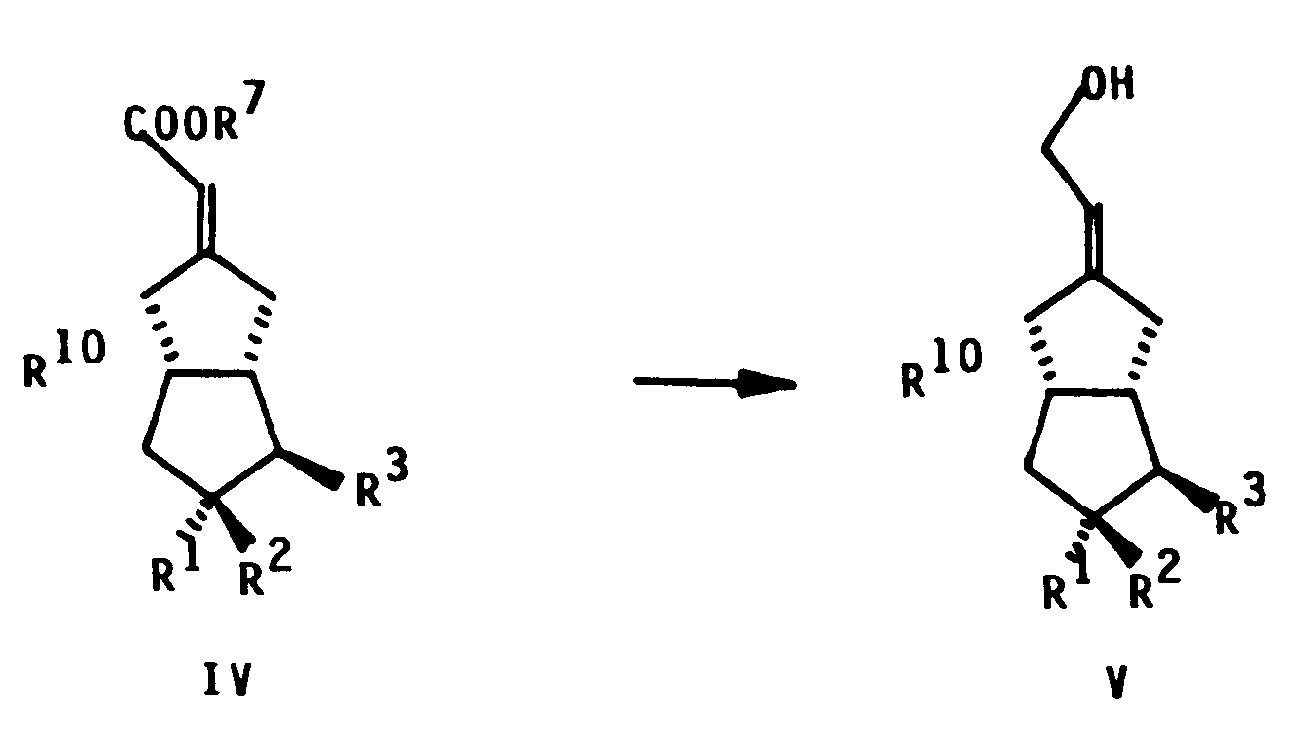
- Diese beiden Wirkstoffe senken den Blutdruck und hemmen die Thrombozytenaggregation. Um ausgehend von V zu diesen biologisch wirksamen Verbindungen zu kommen, schließt sich an die Reduktion von IV zu V eine Veretherung an, wie sie z.B. in DE-OS 3306123 beschrieben wird [vgl. auch W. Skuballa et al., J. Med. Chem. 29, 313 (1986)].
- Nach neueren synthetischen Arbeiten lassen sich die Derivate VI der Allylalkohole V, in denen X eine austretende Gruppe (X = Br, OTs, OMs, OAc) darstellt, mit metallorganischen Reagenzien wie z.B. Zn- bzw. Li-Organylen oder auch Grignard-Verbindungen in die entsprechenden Carbacycline VII überführen [vgl. E. Nakamura et al., Tetrahedron Lett. 28, 337 (1987); Y. Tanigawa et al., J. Am. Chem. Soc. 99, 2361 (1977); G. Fouquet und M. Schlosser, Angew. Chem. 86, 50 (1974].

- Bei der Umsetzung von II mit III sind die molaren Verhältnisse der Reaktionspartner variierbar. Als vorteilhaft erweist es sich jedoch, einen Überschuß des chiralen Phosphonats III (bezogen auf das Keton) sowie einen Unterschuß an Deprotonierungsmittel (bezogen auf das Phosphonat III) einzusetzen, da durch diese Maßnahmen die Bildung unerwünschter Isocarbacyclinderivate (bei denen die exo-Doppelbindung in den 5-Ring gewandert ist) weitgehend unterdrückt wird.
- Als Deprotonierungsmittel sind die dem Fachmann bekannten Basen wie Alkalihydride, Alkaliamide, Kalium-tert.-butylat, Alkalisalze des Hexamethyldisilazans, BuLi, LDA, KDA sowie Alkalisalze asymmetrischer Basen wie z.B. (R,R)- oder (S,S)-Bis-(1-phenylethyl)-amin [vgl. J.A. Marshall et al., Tetrahedron Lett. 28, 3323 (1987)] geeignet. Als besonders vorteilhaft für die Erzielung eines hohen E/Z-Verhältnisses erweisen sich kaliumhaltige Basen.
- Die Umsetzung von II und III wird bei Temperaturen von - 70°C bis + 44°C, insbesondere bei - 40°C bis + 40°C durchgeführt.
- Als Lösungsmittel für die Durchführung der Reaktion eignen sich übliche Lösungsmittel wie z.B. Tetrahydrofuran, Diethylether, Toluol, Gemische aus Tetrahydrofuran und Toluol, 1,2-Glykoldimethylether, Diethylenglykoldimethylether.
- Zur Bestimmung des E/Z-Verhältnisses werden die E/Z-2(Bicyclo[3.3.0]octan-3-yliden)-essigsäureester entweder direkt gaschromatographisch untersucht oder nach Reduktion mit DIBAH und anschließender Umsetzung mit N-Methyl-N-(trimethylsilyl)-2,2,2-trifluoracetamid (MSTFA) ebenfalls gaschromatographisch bei Temperaturen zwischen 100 und 300°C getrennt.
- 306 mg (0,8 mmol) (+)-8-Phenylmenthylphosphonoacetat-P,P-dimethylester werden in 3 ml wasserfreiem Tetrahydrofuran unter Argon gelöst und auf + 5°C gekühlt. Nach Zugabe von 67 mg (0,6 mmol) frisch im Vakuum sublimierten Kalium-tert.-butylat wird 10 min. bei 5°C gerührt und nach Kühlung auf - 35°C eine Lösung von 204 mg (0,5 mmol) (1R,5S,6R,7R)-7-Hydroxy-6-(tert.-butyldiphenylsilyloxymethyl)-bicyclo[3.3.0]octan-3- on in 2 ml wasserfreiem Toluol langsam zugetropft. Nach 90 h Rühren bei - 30°C wird mit überschüssiger 0,5 N HCl versetzt und die resultierende Mischung in 100 ml Essigester aufgenommen. Die organische Phase wird nacheinander mit verdünnter HCl, ges. NaHCO₃-Lösung und Sole gewaschen. Nach Trocknen der organischen Phase und Abdampfen des Lösungsmittels bleibt ein helles Öl zurück, das anschließend an SiO₂ chromatographiert wird (Laufmittel Hexan/Essigester), wobei 313 mg = 94% homogenes Produkt erhalten wird. Da sich das E/Z-Verhältnis auf dieser Stufe nicht gaschromatographisch bestimmen läßt, wird der Ester zum Alkohol reduziert (siehe nächstes Beispiel).
- 313 mg (0,471 mmol) des Esters aus Beispiel 1 werden in 6 ml wasserfreiem Toluol gelöst. Bei 0°C werden unter Argon 2,3 ml einer 1,25 M DIBAH-Lösung in Toluol zugetropft. Nach 1stündigem Rühren bei 0°C werden 0,5 ml Isopropanol und anschließend 0,5 ml H₂O zugetropft. Nach 45 min. Rühren, Aufnehmen in Essigester und Trocknen der organischen Phase wird an SiO₂ (Laufmittel Hexan/Essigester) chromatographiert, wobei 120 mg = 58% der gewünschten Verbindung als Öl isoliert werden. Nach Silylierung mit MSTFA wird das E/Z-Verhältnis gaschromatographisch (25 m Quarzkap. CPSil 19CB) mit 86: 10 (neben 4% Verunreinigungen) bestimmt.
- Molare Mengen, Ausführung und Aufarbeitung wie in Beispiel 1 beschrieben. Anstelle des (+)-8-Phenylmethylphosphonacetat-P,P-dimethylesters wird das Enantiomer, der (-)-8-Phenylmenthylphosphonoacetat-P,P-dimethylester verwandt. Chromatographie an SiO₂ (Laufmittel Hexan/Essigester) ergibt 322 mg = 97% der gewünschten Verbindung, die zur Bestimmung des E/Z-Verhältnisses reduziert wird (siehe nächstes Beispiel).
- Ausführung der Reduktion unter Verwendung von 322 mg (0,484 mmol) des Esters aus Beispiel 3. Molare Verhältnisse und Bedingungen entsprechen denen im Beispiel 2. Nach Chromatographie an SiO₂ (Laufmittel Hexan/Essigester) bleiben 138 mg = 65% farbloses Öl zurück. Nach Silylieren der freien Hydroxylgruppen mit MSTFA wird das E/Z-Verhältnis gaschromatographisch mit 8: 88 (neben 4% Verunreinigungen) bestimmt (25 m Quarzkap. CP-Sil 19 CB).
- 306 mg (0.8 mmol) (+)-8-Phenylmenthylphosphonoacetat-P,P-dimethylester werden mit 258 mg (0,5 mmol) (1R,5S,6S,7R)-7-(tert.-Butyldimethylsilyloxy)-6-[(3S,4S)-3-(tert.-butyldimethylsilyloxy)-4-methyl-nona-1,6-diinyl]-bicyclo[3.3.0]octan-3-on wie in Beispiel 1 beschrieben umgesetzt. 87 h bei - 30°C rühren. Nach dem Aufarbeiten und Chromatographieren an SiO₂ (Laufmittel Hexan/Essigester) bleiben 370 mg = 95% der gewünschten Verbindung als Öl zurück.
- 335 mg (0,433 mmol) des Esters aus Beispiel 5 werden wie Beispiel 2 beschrieben mit 1,25 ml einer 1,2 M Lösung DIBAH in Toluol reduziert. Aufarbeiten und Chromatographieren an SiO₂ (Laufmittel Hexan/Essigester) ergibt 199 mg = 84% farbloses Öl.
- Nach Silylieren der primären Hydroxylgruppe mit MSTFA wird das E/Z-Verhältnis gaschromatographisch mit 80: 20 bestimmt (25 m CP Sil 8 CB).
- Mengen, Versuchsdurchführung und -dauer wie Beispiel 5 beschrieben. Anstelle des (+)-8-Phenylmenthylphosphonacetat-P,P-dimethylesters wird hier das (-)-Enantiomere verwendet. Nach Aufarbeiten und Chromatographieren an SiO₂ (Laufmittel Hexan/Essigester) verbleiben 354 mg = 91% der gewünschten Verbindung als Öl. Da die Substanz gaschromatographisch nicht zu untersuchen ist, wird der Ester reduziert (siehe Beispiel 8).
- Versuchsdurchführung und Aufarbeitung wie Beispiel 6 beschrieben. Es werden 316 mg (0,408 mmol) des Esters aus Beispiel 7 und 1,25 ml einer 1,2 M DIBAH-Lösung in Toluol verwendet. Nach Chromatographie an SiO₂ (Laufmittel Hexan/Essigester) bleiben 168 mg = 75% zurück.
Gaschromatographie unter Bedingungen wie Beispiel 6 ergibt ein E/Z-Verhältnis von 20: 78 (neben 2% Verunreinigung). - 306 mg (0,8 mmol) (+)-8-Phenylmenthylphosphonoacetat-P,P-dimethylester werden wie im Beispiel 1 beschrieben mit 142 mg (0,5 mmol) (1R,5S,6R,7R)-7-Hydroxy-6-(tert.-butyldimethylsilyloxymethyl)-bicyclo[3.3.0]octan-3-on umgesetzt. 115 h bei - 30°C. Aufarbeiten und Chromatographieren (Laufmittel Hexan/Essigester) wie üblich. Zurück bleiben 190 mg = 70% der gewünschten Verbindung. Das E/Z-Verhältnis beträgt nach gaschromatographischer Bestimmung (25 m CP Sil 8 CB, Silylierung mit MSTFA) 91: 4 (5% Verunreinigung).
- 306 mg (0,8 mmol) (-)-8-Phenylmenthylphosphonoacetat-P,P-dimethylester werden wie beschrieben mit 142 mg (0,5 mmol) (1R, 5S,6R,7R)-7-Hydroxy-6-(tert.-butyldimethylsilyloxymethyl)-bicyclo[3.3.0]octan-3-on umgesetzt. 115 h bei - 30°C. Wie üblich wird aufgearbeitet und chromatographiert (Laufmittel Hexan/Essigester). Es werden 194 mg = 72% einheitliches Produkt erhalten, dessen E/Z-Verhältnis nach Gaschromatographie (Bedingungen siehe Beispiel 9) 4: 94 beträgt (2% Verunreinigungen).
- 306 mg (0,8 mmol) (+)-8-Phenylmenthylphosphonoacetat-P,P-dimethylester werden mit 199 mg (0,5 mmol) (1R,5S,6R,7R)-7-(tert.-butyldimethylsilyloxy)-6-(tert.-butyldimethylsilyloxymethyl)- bicyclo[3.3.0]octan-3-on unter den Bedingungen wie im Beispiel 1 beschrieben umgesetzt. 94 h Rühren bei - 25°C. Nach Aufarbeiten und Chromatographieren wie beschrieben bleiben 310 mg = 94% der gewünschten Verbindung zurück. Laut Gaschromatographie (25 m CP Sil 8 CB) beträgt das E/Z-Verhältnis 78: 22.
- 306 mg (0,8 mmol) (-)-8-Phenylmenthylphosphonoacetat-P,P-dimethylester werden mit 199 mg (0,5 mmol) (1R,5S,6R,7R)-7-tert.-Butyldimethylsilyloxy)-6-(tert.-butyldimethylsilyloxymethyl)- bicyclo[3.3.0]octan-3-on wie beschrieben umgesetzt. 115 h Rühren bei - 30°C. Nach Aufarbeiten und Chromatographie werden 299 mg = 91% der gewünschten Substanz erhalten. Die Gaschromatographie (25 m CP Sil 8 CB) zeigt ein E/Z-Verhältnis von 15: 85 an.
- 261 mg (0,8 mmol) (-)-trans-2-Phenyl-cyclohexylphosphonacetat-P,P-dimethylester werden wie im Beispiel 1 beschrieben mit 199 mg (0,5 mmol) (1R,5S,6R,7R)-7-(tert.-Butyldimethylsilyloxy)-6-(tert.-butyldimethylsilyloxymethyl)- bicyclo[3.3.0]octan-3-on umgesetzt. Nach 87 stündigem Rühren bei - 30°C, Aufarbeiten und Chromatographieren bleiben 280 mg = 93% gewünschte Verbindung als helles Öl zurück. Die gaschromatographische Auftrennung ergibt ein E/Z-Verhältnis von 77: 23 (25 m CP Sil 8 CB).
bedeuten, das dadurch gekennzeichnet ist, daß man ein Bicyclo[3.3.0]octan-3-on der Formel II,

worin R¹, R², R³ und R¹⁰ die oben angegebenen Bedeutungen haben, mit einem chiralen Phosphonat der Formel III,

worin
in Gegenwart eines Deprotonierungsmittels umsetzt.
Claims (1)


worin


worin
bedeuten, dadurch gekennzeichnet, daß man ein Bicyclo-[3.3.0]octan-3-on der Formel II,


in Gegenwart eines Deprotonierungsmittels umsetzt.
Priority Applications (1)
| Application Number | Priority Date | Filing Date | Title |
|---|---|---|---|
| AT88730179T ATE71616T1 (de) | 1987-08-11 | 1988-08-11 | Verfahren zur herstellung von e/z-gemischen von 2-(bicyclo(3.3.0>octan-3-yliden)essigs|urederivaten mit ueberwiegendem e- oder z- anteil. |
Applications Claiming Priority (2)
| Application Number | Priority Date | Filing Date | Title |
|---|---|---|---|
| DE19873727065 DE3727065A1 (de) | 1987-08-11 | 1987-08-11 | Verfahren zur herstellung von e/z-gemischen von 2-(bicyclo-(3.3.0)-octan-3-yliden) -essigsaeurederivaten mit ueberwiegendem e- oder z-anteil |
| DE3727065 | 1987-08-11 |
Publications (2)
| Publication Number | Publication Date |
|---|---|
| EP0303562A1 EP0303562A1 (de) | 1989-02-15 |
| EP0303562B1 true EP0303562B1 (de) | 1992-01-15 |
Family
ID=6333709
Family Applications (1)
| Application Number | Title | Priority Date | Filing Date |
|---|---|---|---|
| EP88730179A Expired - Lifetime EP0303562B1 (de) | 1987-08-11 | 1988-08-11 | Verfahren zur Herstellung von E/Z-Gemischen von 2-(Bicyclo[3.3.0]octan-3-yliden)-essigsäurederivaten mit überwiegendem E- oder Z-Anteil |
Country Status (8)
| Country | Link |
|---|---|
| EP (1) | EP0303562B1 (de) |
| JP (1) | JP2608948B2 (de) |
| AT (1) | ATE71616T1 (de) |
| DE (2) | DE3727065A1 (de) |
| ES (1) | ES2038335T3 (de) |
| GR (1) | GR3004331T3 (de) |
| HU (1) | HU207278B (de) |
| WO (1) | WO1989001470A1 (de) |
Families Citing this family (1)
| Publication number | Priority date | Publication date | Assignee | Title |
|---|---|---|---|---|
| DE4028864A1 (de) * | 1990-09-07 | 1992-03-12 | Schering Ag | Verfahren zur herstellung von e/z-mischungen von 2-(6-alkyl-bicyclo-(3.3.0)-octan-3-yliden) -essigsaeure-derivaten mit ueberwiegendem anteil des e-isomeren |
Family Cites Families (1)
| Publication number | Priority date | Publication date | Assignee | Title |
|---|---|---|---|---|
| DE3306123A1 (de) * | 1983-02-18 | 1984-09-06 | Schering AG, 1000 Berlin und 4709 Bergkamen | Neue carbacycline, verfahren zu ihrer herstellung und ihre verwendung als arzneimittel |
-
1987
- 1987-08-11 DE DE19873727065 patent/DE3727065A1/de not_active Withdrawn
-
1988
- 1988-08-11 AT AT88730179T patent/ATE71616T1/de not_active IP Right Cessation
- 1988-08-11 DE DE8888730179T patent/DE3867757D1/de not_active Expired - Lifetime
- 1988-08-11 WO PCT/DE1988/000503 patent/WO1989001470A1/de not_active Ceased
- 1988-08-11 JP JP63506507A patent/JP2608948B2/ja not_active Expired - Lifetime
- 1988-08-11 HU HU885394A patent/HU207278B/hu not_active IP Right Cessation
- 1988-08-11 EP EP88730179A patent/EP0303562B1/de not_active Expired - Lifetime
- 1988-08-11 ES ES198888730179T patent/ES2038335T3/es not_active Expired - Lifetime
-
1992
- 1992-04-10 GR GR920400687T patent/GR3004331T3/el unknown
Also Published As
| Publication number | Publication date |
|---|---|
| JPH02500914A (ja) | 1990-03-29 |
| WO1989001470A1 (fr) | 1989-02-23 |
| HU207278B (en) | 1993-03-29 |
| HU885394D0 (en) | 1990-02-28 |
| EP0303562A1 (de) | 1989-02-15 |
| DE3727065A1 (de) | 1989-02-23 |
| GR3004331T3 (de) | 1993-03-31 |
| DE3867757D1 (de) | 1992-02-27 |
| ATE71616T1 (de) | 1992-02-15 |
| JP2608948B2 (ja) | 1997-05-14 |
| ES2038335T3 (es) | 1993-07-16 |
Similar Documents
| Publication | Publication Date | Title |
|---|---|---|
| FR2484413A1 (fr) | Analogues et intermediaires de carbacycline, leur preparation et leur utilisation | |
| DE69912277T2 (de) | Prostaglandinderivate | |
| JPWO1999061419A1 (ja) | プロスタグランジン誘導体 | |
| US4060540A (en) | Novel 3-triphenylmethoxy-1-alkynes, 3-triphenyl-methoxy-1-trans-alkenyl-dialkyl-alanes, and lithium 3-triphenylmethoxy-1-trans-alkenyl-dialkyl alanates | |
| KR900000684B1 (ko) | 16-페녹시-및 16-치환된 페녹시-프로스타트리에노산 유도체 및 그의 입체이성체, 및 이들의 제조방법 | |
| EP0303562A1 (de) | Verfahren zur Herstellung von E/Z-Gemischen von 2-(Bicyclo[3.3.0]octan-3-yliden)-essigsäurederivaten mit überwiegendem E- oder Z-Anteil | |
| EP0062902A1 (de) | 2,3,4-Trinor-m-inter-phenylen-prostaglandin-Derivate, Verfahren zu deren Herstellung sowie diese Verbindungen enthaltende pharmazeutische Präparate | |
| HU200173B (en) | Process for producing intermediary products of prostaglandin analogs | |
| DE60024353T2 (de) | Verfahren zur Herstellung Antiosteoporicagenz | |
| DE69212860T2 (de) | Alpha-Methylencyclopentanon-Derivate und Verfahren zu ihrer Herstellung | |
| EP1085012B1 (de) | Verfahren zur herstellung eines gereinigten prostaglandin-derivats | |
| DE3689338T2 (de) | Isocarbacyclinderivate. | |
| JPWO2001019790A1 (ja) | プロスタグランジン誘導体 | |
| EP0268548B1 (de) | Verbesserte Ketoreduktion von Carbacyclinzwischenprodukten | |
| EP0051597B1 (de) | Neue prostacyclinderivate und ihre herstellung | |
| US4159998A (en) | Process for the preparation of 2-(7-hydroxyalkyl)-4R, 4S or 4RS -hydroxy-cyclopent-2-enone | |
| EP0547124B1 (de) | Verfahren zur herstellung von e/z-mischungen von 2-(6-alkyl-bicyclo- 3.3.0]-octan-3-yliden)-essigsäure-derivaten mit überwiegendem anteil des e-isomeren | |
| US5597938A (en) | Process for producing intermediate for 13,14-didehydroprostaglandin E | |
| DE69311126T2 (de) | ISOCARBACYCLIN MIT MODIFIZIERTER ALPHA(a)-KETTE UND VERFAHREN ZU DESSEN HERSTELLUNG | |
| US5169960A (en) | Process for the production of E/Z mixtures of 2-(bicyclo[3.3.0]octan-3-ylidene)-acetic acid derivatives with predominant E or Z portion | |
| US4311644A (en) | Method for preparing 10,10-difluoro prostacyclin intermediates and new compounds produced thereby | |
| EP0173754B1 (de) | 7-thiaprostaglandine e1 und deren herstellung | |
| JP2713333B2 (ja) | イソカルバサイクリン類及びその製造法 | |
| KR20010041632A (ko) | 신규 방법 | |
| JP2703392B2 (ja) | イソカルバサイクリン類の製造法 |
Legal Events
| Date | Code | Title | Description |
|---|---|---|---|
| PUAI | Public reference made under article 153(3) epc to a published international application that has entered the european phase |
Free format text: ORIGINAL CODE: 0009012 |
|
| 17P | Request for examination filed |
Effective date: 19880819 |
|
| AK | Designated contracting states |
Kind code of ref document: A1 Designated state(s): AT BE CH DE ES FR GB GR IT LI LU NL SE |
|
| 17Q | First examination report despatched |
Effective date: 19910226 |
|
| GRAA | (expected) grant |
Free format text: ORIGINAL CODE: 0009210 |
|
| AK | Designated contracting states |
Kind code of ref document: B1 Designated state(s): AT BE CH DE ES FR GB GR IT LI LU NL SE |
|
| REF | Corresponds to: |
Ref document number: 71616 Country of ref document: AT Date of ref document: 19920215 Kind code of ref document: T |
|
| REF | Corresponds to: |
Ref document number: 3867757 Country of ref document: DE Date of ref document: 19920227 |
|
| ITF | It: translation for a ep patent filed | ||
| ET | Fr: translation filed | ||
| GBT | Gb: translation of ep patent filed (gb section 77(6)(a)/1977) | ||
| PLBE | No opposition filed within time limit |
Free format text: ORIGINAL CODE: 0009261 |
|
| STAA | Information on the status of an ep patent application or granted ep patent |
Free format text: STATUS: NO OPPOSITION FILED WITHIN TIME LIMIT |
|
| REG | Reference to a national code |
Ref country code: GR Ref legal event code: FG4A Free format text: 3004331 |
|
| 26N | No opposition filed | ||
| REG | Reference to a national code |
Ref country code: ES Ref legal event code: FG2A Ref document number: 2038335 Country of ref document: ES Kind code of ref document: T3 |
|
| EPTA | Lu: last paid annual fee | ||
| EAL | Se: european patent in force in sweden |
Ref document number: 88730179.4 |
|
| PGFP | Annual fee paid to national office [announced via postgrant information from national office to epo] |
Ref country code: LU Payment date: 19950701 Year of fee payment: 8 |
|
| PGFP | Annual fee paid to national office [announced via postgrant information from national office to epo] |
Ref country code: FR Payment date: 19950710 Year of fee payment: 8 |
|
| PGFP | Annual fee paid to national office [announced via postgrant information from national office to epo] |
Ref country code: AT Payment date: 19950714 Year of fee payment: 8 |
|
| PGFP | Annual fee paid to national office [announced via postgrant information from national office to epo] |
Ref country code: SE Payment date: 19950717 Year of fee payment: 8 Ref country code: BE Payment date: 19950717 Year of fee payment: 8 |
|
| PGFP | Annual fee paid to national office [announced via postgrant information from national office to epo] |
Ref country code: GB Payment date: 19950718 Year of fee payment: 8 Ref country code: CH Payment date: 19950718 Year of fee payment: 8 |
|
| PGFP | Annual fee paid to national office [announced via postgrant information from national office to epo] |
Ref country code: NL Payment date: 19950721 Year of fee payment: 8 Ref country code: DE Payment date: 19950721 Year of fee payment: 8 |
|
| PGFP | Annual fee paid to national office [announced via postgrant information from national office to epo] |
Ref country code: GR Payment date: 19950728 Year of fee payment: 8 |
|
| PGFP | Annual fee paid to national office [announced via postgrant information from national office to epo] |
Ref country code: ES Payment date: 19950804 Year of fee payment: 8 |
|
| PG25 | Lapsed in a contracting state [announced via postgrant information from national office to epo] |
Ref country code: LU Free format text: LAPSE BECAUSE OF NON-PAYMENT OF DUE FEES Effective date: 19960811 Ref country code: GB Effective date: 19960811 Ref country code: AT Effective date: 19960811 |
|
| PG25 | Lapsed in a contracting state [announced via postgrant information from national office to epo] |
Ref country code: SE Effective date: 19960812 Ref country code: ES Free format text: LAPSE BECAUSE OF EXPIRATION OF PROTECTION Effective date: 19960812 |
|
| PG25 | Lapsed in a contracting state [announced via postgrant information from national office to epo] |
Ref country code: LI Effective date: 19960831 Ref country code: CH Effective date: 19960831 Ref country code: BE Effective date: 19960831 |
|
| BERE | Be: lapsed |
Owner name: SCHERING A.G. BERLIN UND BERGKAMEN Effective date: 19960831 |
|
| PG25 | Lapsed in a contracting state [announced via postgrant information from national office to epo] |
Ref country code: GR Free format text: THE PATENT HAS BEEN ANNULLED BY A DECISION OF A NATIONAL AUTHORITY Effective date: 19970228 |
|
| PG25 | Lapsed in a contracting state [announced via postgrant information from national office to epo] |
Ref country code: NL Effective date: 19970301 |
|
| REG | Reference to a national code |
Ref country code: GR Ref legal event code: MM2A Free format text: 3004331 |
|
| GBPC | Gb: european patent ceased through non-payment of renewal fee |
Effective date: 19960811 |
|
| REG | Reference to a national code |
Ref country code: CH Ref legal event code: PL |
|
| PG25 | Lapsed in a contracting state [announced via postgrant information from national office to epo] |
Ref country code: FR Effective date: 19970430 |
|
| NLV4 | Nl: lapsed or anulled due to non-payment of the annual fee |
Effective date: 19970301 |
|
| PG25 | Lapsed in a contracting state [announced via postgrant information from national office to epo] |
Ref country code: DE Effective date: 19970501 |
|
| EUG | Se: european patent has lapsed |
Ref document number: 88730179.4 |
|
| REG | Reference to a national code |
Ref country code: FR Ref legal event code: ST |
|
| REG | Reference to a national code |
Ref country code: ES Ref legal event code: FD2A Effective date: 20010201 |
|
| PG25 | Lapsed in a contracting state [announced via postgrant information from national office to epo] |
Ref country code: IT Free format text: LAPSE BECAUSE OF NON-PAYMENT OF DUE FEES Effective date: 20050811 |