EP0303878A2 - 2,5-Diamino-6-nitro-pyridinderivate enthaltende Haarfärbemittel - Google Patents
2,5-Diamino-6-nitro-pyridinderivate enthaltende Haarfärbemittel Download PDFInfo
- Publication number
- EP0303878A2 EP0303878A2 EP88112436A EP88112436A EP0303878A2 EP 0303878 A2 EP0303878 A2 EP 0303878A2 EP 88112436 A EP88112436 A EP 88112436A EP 88112436 A EP88112436 A EP 88112436A EP 0303878 A2 EP0303878 A2 EP 0303878A2
- Authority
- EP
- European Patent Office
- Prior art keywords
- nitro
- amino
- pyridine
- hydroxyethyl
- diamino
- Prior art date
- Legal status (The legal status is an assumption and is not a legal conclusion. Google has not performed a legal analysis and makes no representation as to the accuracy of the status listed.)
- Granted
Links
- 0 CNc(nc1)ccc1N* Chemical compound CNc(nc1)ccc1N* 0.000 description 7
- MIROPXUFDXCYLG-UHFFFAOYSA-N Nc1ccc(N)nc1 Chemical compound Nc1ccc(N)nc1 MIROPXUFDXCYLG-UHFFFAOYSA-N 0.000 description 2
- MRQITZCKSMWMLG-CDJQDVQCSA-N C/C(/NC)=C\C=C(\N(C)C)/N=C Chemical compound C/C(/NC)=C\C=C(\N(C)C)/N=C MRQITZCKSMWMLG-CDJQDVQCSA-N 0.000 description 1
- QSOVUYMEPOOEKS-UHFFFAOYSA-N CN(C)c(nc1[N+]([O-])=O)ccc1N Chemical compound CN(C)c(nc1[N+]([O-])=O)ccc1N QSOVUYMEPOOEKS-UHFFFAOYSA-N 0.000 description 1
- PALJALOXRXXAOJ-UHFFFAOYSA-N CNc(nc1[N+]([O-])=O)ccc1N Chemical compound CNc(nc1[N+]([O-])=O)ccc1N PALJALOXRXXAOJ-UHFFFAOYSA-N 0.000 description 1
- JJSMMCVAFTUSEE-UHFFFAOYSA-N CNc1ccc(NC)nc1 Chemical compound CNc1ccc(NC)nc1 JJSMMCVAFTUSEE-UHFFFAOYSA-N 0.000 description 1
- BAZVFQBTJPBRTJ-UHFFFAOYSA-N [O-][N+](c(cn1)ccc1Cl)=O Chemical compound [O-][N+](c(cn1)ccc1Cl)=O BAZVFQBTJPBRTJ-UHFFFAOYSA-N 0.000 description 1
Classifications
-
- C—CHEMISTRY; METALLURGY
- C07—ORGANIC CHEMISTRY
- C07D—HETEROCYCLIC COMPOUNDS
- C07D213/00—Heterocyclic compounds containing six-membered rings, not condensed with other rings, with one nitrogen atom as the only ring hetero atom and three or more double bonds between ring members or between ring members and non-ring members
- C07D213/02—Heterocyclic compounds containing six-membered rings, not condensed with other rings, with one nitrogen atom as the only ring hetero atom and three or more double bonds between ring members or between ring members and non-ring members having three double bonds between ring members or between ring members and non-ring members
- C07D213/04—Heterocyclic compounds containing six-membered rings, not condensed with other rings, with one nitrogen atom as the only ring hetero atom and three or more double bonds between ring members or between ring members and non-ring members having three double bonds between ring members or between ring members and non-ring members having no bond between the ring nitrogen atom and a non-ring member or having only hydrogen or carbon atoms directly attached to the ring nitrogen atom
- C07D213/60—Heterocyclic compounds containing six-membered rings, not condensed with other rings, with one nitrogen atom as the only ring hetero atom and three or more double bonds between ring members or between ring members and non-ring members having three double bonds between ring members or between ring members and non-ring members having no bond between the ring nitrogen atom and a non-ring member or having only hydrogen or carbon atoms directly attached to the ring nitrogen atom with hetero atoms or with carbon atoms having three bonds to hetero atoms with at the most one bond to halogen, e.g. ester or nitrile radicals, directly attached to ring carbon atoms
- C07D213/72—Nitrogen atoms
- C07D213/73—Unsubstituted amino or imino radicals
-
- A—HUMAN NECESSITIES
- A61—MEDICAL OR VETERINARY SCIENCE; HYGIENE
- A61K—PREPARATIONS FOR MEDICAL, DENTAL OR TOILETRY PURPOSES
- A61K8/00—Cosmetics or similar toiletry preparations
- A61K8/18—Cosmetics or similar toiletry preparations characterised by the composition
- A61K8/30—Cosmetics or similar toiletry preparations characterised by the composition containing organic compounds
- A61K8/49—Cosmetics or similar toiletry preparations characterised by the composition containing organic compounds containing heterocyclic compounds
- A61K8/4906—Cosmetics or similar toiletry preparations characterised by the composition containing organic compounds containing heterocyclic compounds with one nitrogen as the only hetero atom
- A61K8/4926—Cosmetics or similar toiletry preparations characterised by the composition containing organic compounds containing heterocyclic compounds with one nitrogen as the only hetero atom having six membered rings
-
- A—HUMAN NECESSITIES
- A61—MEDICAL OR VETERINARY SCIENCE; HYGIENE
- A61Q—SPECIFIC USE OF COSMETICS OR SIMILAR TOILETRY PREPARATIONS
- A61Q5/00—Preparations for care of the hair
- A61Q5/10—Preparations for permanently dyeing the hair
-
- C—CHEMISTRY; METALLURGY
- C07—ORGANIC CHEMISTRY
- C07D—HETEROCYCLIC COMPOUNDS
- C07D213/00—Heterocyclic compounds containing six-membered rings, not condensed with other rings, with one nitrogen atom as the only ring hetero atom and three or more double bonds between ring members or between ring members and non-ring members
- C07D213/02—Heterocyclic compounds containing six-membered rings, not condensed with other rings, with one nitrogen atom as the only ring hetero atom and three or more double bonds between ring members or between ring members and non-ring members having three double bonds between ring members or between ring members and non-ring members
- C07D213/04—Heterocyclic compounds containing six-membered rings, not condensed with other rings, with one nitrogen atom as the only ring hetero atom and three or more double bonds between ring members or between ring members and non-ring members having three double bonds between ring members or between ring members and non-ring members having no bond between the ring nitrogen atom and a non-ring member or having only hydrogen or carbon atoms directly attached to the ring nitrogen atom
- C07D213/60—Heterocyclic compounds containing six-membered rings, not condensed with other rings, with one nitrogen atom as the only ring hetero atom and three or more double bonds between ring members or between ring members and non-ring members having three double bonds between ring members or between ring members and non-ring members having no bond between the ring nitrogen atom and a non-ring member or having only hydrogen or carbon atoms directly attached to the ring nitrogen atom with hetero atoms or with carbon atoms having three bonds to hetero atoms with at the most one bond to halogen, e.g. ester or nitrile radicals, directly attached to ring carbon atoms
- C07D213/72—Nitrogen atoms
- C07D213/74—Amino or imino radicals substituted by hydrocarbon or substituted hydrocarbon radicals
-
- C—CHEMISTRY; METALLURGY
- C07—ORGANIC CHEMISTRY
- C07D—HETEROCYCLIC COMPOUNDS
- C07D213/00—Heterocyclic compounds containing six-membered rings, not condensed with other rings, with one nitrogen atom as the only ring hetero atom and three or more double bonds between ring members or between ring members and non-ring members
- C07D213/02—Heterocyclic compounds containing six-membered rings, not condensed with other rings, with one nitrogen atom as the only ring hetero atom and three or more double bonds between ring members or between ring members and non-ring members having three double bonds between ring members or between ring members and non-ring members
- C07D213/04—Heterocyclic compounds containing six-membered rings, not condensed with other rings, with one nitrogen atom as the only ring hetero atom and three or more double bonds between ring members or between ring members and non-ring members having three double bonds between ring members or between ring members and non-ring members having no bond between the ring nitrogen atom and a non-ring member or having only hydrogen or carbon atoms directly attached to the ring nitrogen atom
- C07D213/60—Heterocyclic compounds containing six-membered rings, not condensed with other rings, with one nitrogen atom as the only ring hetero atom and three or more double bonds between ring members or between ring members and non-ring members having three double bonds between ring members or between ring members and non-ring members having no bond between the ring nitrogen atom and a non-ring member or having only hydrogen or carbon atoms directly attached to the ring nitrogen atom with hetero atoms or with carbon atoms having three bonds to hetero atoms with at the most one bond to halogen, e.g. ester or nitrile radicals, directly attached to ring carbon atoms
- C07D213/72—Nitrogen atoms
- C07D213/75—Amino or imino radicals, acylated by carboxylic or carbonic acids, or by sulfur or nitrogen analogues thereof, e.g. carbamates
-
- C—CHEMISTRY; METALLURGY
- C07—ORGANIC CHEMISTRY
- C07D—HETEROCYCLIC COMPOUNDS
- C07D413/00—Heterocyclic compounds containing two or more hetero rings, at least one ring having nitrogen and oxygen atoms as the only ring hetero atoms
- C07D413/14—Heterocyclic compounds containing two or more hetero rings, at least one ring having nitrogen and oxygen atoms as the only ring hetero atoms containing three or more hetero rings
Definitions
- nitro dyes are widely used in hair dyes. They are used in oxidation hair dyes as additives for the creation of natural or fashionable shades. By combining several differently colored nitro dyes, however, it is also possible to produce hair colorants which can dye hair in natural to fashionable shades without the use of oxidizing agents.
- the combination of a yellow, red and blue-coloring nitro dye can produce natural-looking brown colors.
- these dyes come from a group of chemical compounds which have the same base body, because then it is easier for them to have similar physical properties which determine the ability to draw up, are achievable.
- the nitro dyes must be harmless from a toxicological and dermatological point of view. Their use in oxidation hair dyes presupposes that they are stable in the presence of hydrogen peroxide in an alkaline solution. In addition, good light, acid and rub fastness is required for the hair colorations produced. Finally, it should be possible to prepare the nitro dyes by the simplest possible processes which can be carried out on an industrial scale.
- DE-OS 3 334 030 describes agents for the oxidative coloring of hair which contain certain diaminonitropyridine derivatives of a general Formula should contain. However, no specific diaminonitropyridine derivatives are mentioned in the publication. Since in DE-OS 3 334 030 nitropyridines are generally used together with development components and are to react there as coupling components in the context of an oxidative hair color system, they are selected according to their coupler properties.
- the 2,5-diamino-6-nitro-pyridines described in the present application can also be used in oxidation hair dyes, but they do not react within the system, but are used as additional direct dyes.
- the main area of application of these dyes is therefore the use in substantive colorants of the tint type, which do not require the addition of oxidizing agents.
- the 2,5-diamino-6-nitro-pyridine derivatives present here are therefore not usable at all in the context of DE-OS 3 334 030 and also have a completely different chemical structure than the nitro coupling components described there in the examples.
- DE-OS 3 334 030 which among other things also lead to reddish shades, are based on oxidative hair coloring and are essentially due to an internal reaction of the 2,5-diamino-pyridine used there.
- the nitro compounds described there are not resistant to reduction in the presence of dithionite.
- an agent for dyeing hair with a dye content and additives customary for hair dye characterized in that it is a 2,5-diamino-6-nitro-pyridine derivative of the general formula (VI) wherein R6, R7 and R8 independently represent hydrogen or one of the radicals alkyl, hydroxyalkyl, dihydroxyalkyl, alkoxyalkyl, aminoalkyl and aminoalkyl substituted by alkyl or hydroxyalkyl, the alkyl radicals each having 1 to 4 carbon atoms, or by R oder and R7 a heterocyclic, not aromatic five- or six-membered ring, which may additionally have an oxy group, is formed, or whose physiologically compatible water-soluble salt contains, the object is achieved in an outstanding manner.
- R6, R7 and R8 independently represent hydrogen or one of the radicals alkyl, hydroxyalkyl, dihydroxyalkyl, alkoxyalkyl, aminoalkyl and aminoalkyl substituted by alkyl or hydroxyalkyl, the alkyl
- R6, R7 and R8 independently of one another are hydrogen or one of the radicals methyl, ethyl or 2-hydroxyethyl or a pyrrolidine, piperidine or morpholine ring is formed by R6 and R7.
- 2,5-diamino-6-nitro-pyridine derivatives are 2,5-diamino-6-nitro-pyridine, 5-amino-2 - ((2'-hydroxyethyl) amino) -6-nitro-pyridine, 2 , 5-bis ((2'-hydroxyethyl) amino) -2-N-ethyl-6-nitro-pyridine, 2,5-bis ((2'-hydroxyethyl) amino) -6-nitro-pyridine, 2-ethylamino -5 - ((2'-hydroxyethyl) amino) -6-nitro-pyridine and 5-amino-2-pyrrolidino-6-nitro-pyridine.
- the very good toxicological and physiological properties of the compounds of the general formula (VI) are surprising.
- the hair dye composition according to the invention relates both to an embodiment in which it is used without the addition of an oxidizing agent and to a further embodiment in which the addition of an oxidizing agent is required.
- the former hair dye without the addition of oxidizing agent is an agent which, in addition to the dyes of the formula (VI) indicated, can also contain other known dyes which are absorbed directly onto the hair.
- these dyes known for hair coloring the following may be mentioned, for example: Aromatic nitro dyes, such as, for example, 2-amino-4-nitro-phenol, picramic acid, 1 - ((2'-hydroxyethyl) amino) -2-amino-4-nitro -benzene, 2 nitro-4 - ((2′-hydroxyethyl) amino) aniline, 4 - ((2 ′, 3′-dihydroxypropyl) amino) -3-nitro-trifluoromethylbenzene, 4-N, N′-bis ( (2'-hydroxyethyl) amino) -1-methylamino-2-nitro-benzene, 2,5-bis ((2'-hydroxyethyl) amino) nitrobenzene, 2 - ((2'-hydroxyethyl) amino)
- Azo dyes such as Acid Brown 4 (C.I. 14 805); Anthraquinone dyes, such as, for example, Disperse Blue 23 (CI 61 545), Disperse Violet 4 (C I. 61 105), 1,4,5,8-tetraamino-anthraquinone and 1,4-diamino-anthraquinone, the dyes of these classes can have an acidic, non-ionic or basic character depending on the nature of their substituents. Further suitable dyes which are directly absorbed onto the hair are described, for example, in the book by J.C. Johnson, "Hair dyes" Noyes Data Corp. Park-Ridge (USA) (1973), pages 3-91 and 113-139 (ISBN: 0-8155-0477-2).
- the preparation form of the hair dye described here can be, for example, a solution, in particular an aqueous or aqueous-alcoholic solution.
- Preferred forms of preparation are also a cream, a gel or an emulsion, it being possible for the agent to be sprayed in a mixture with a propellant gas or by means of a pump.
- the dyes of the general formula (VI) are said to be present in this hair dye without the addition of oxidizing agents in a concentration of about 0.01 to 2.0 percent by weight, preferably of 0.01 to 1.0 percent by weight.
- the total content of the dyes which are applied directly to the hair is in the range of about 0.01 to 3.0 percent by weight.
- the pH of this colorant is in the range from 3 to 10.5, in particular at pH 7.5 to 9.5, the desired alkaline pH being set primarily with ammonia, but also with organic amines, such as, for example, monoethanolamine or triethanolamine.
- the hair colorant described above without the addition of an oxidizing agent can of course also contain synthetic or natural polymers commonly used in cosmetics, whereby hair is set at the same time as the coloring. Such agents are generally referred to as tinting or color strengthening agents.
- synthetic polymers known for this purpose in cosmetics for example, polyvinylpyrrolidone, polyvinyl acetate, polyvinyl alcohol or polyacrylic compounds such as acrylic or methacrylic acid polymers, basic polymers of esters from these two acids and amino alcohols as their salts or quaternization products, polyacrylonitrile, polyvinyl lactams and copolymers of such compounds, such as polyvinylpyrrolidone-vinyl acetate, and the like.
- Natural polymers such as chitosan (deacetylated chitin) or chitosan derivatives, can also be used for the purpose mentioned.
- the polymers are contained in this agent in the amount of about 1 to 5 percent by weight customary for such agents.
- the pH of the agent is in the range of about 6.0 to 9.0.
- This hair dye with additional setting is used in a known and customary manner by moistening the hair with the setting agent, setting (inserting) the hair for the hairstyle and subsequent drying.
- the hair dye described above can optionally contain other additives customary for hair colorants, such as, for example, care substances, wetting agents, thickeners, plasticizers, preservatives and perfume oils, as well as other customary additives listed below for oxidation hair colorants, without the addition of oxidizing agents.
- other additives customary for hair colorants such as, for example, care substances, wetting agents, thickeners, plasticizers, preservatives and perfume oils, as well as other customary additives listed below for oxidation hair colorants, without the addition of oxidizing agents.
- the subject matter of the present invention also includes a hair colorant in which the addition of an oxidizing agent is required.
- an oxidizing agent is required.
- the dyes according to the formula (VI) and any known dyes which are directly absorbed onto the hair it also contains additional known oxidation dyes which require oxidative development.
- oxidation dyes are mainly aromatic p-diamines and p-aminophenols, such as, for example, p-toluenediamine, p-phenylenediamine, p-aminophenol and similar compounds, which for the purpose of shading the coloring with so-called modifiers, such as, for example, Phenylenediamine, resorcinol, m-aminophenol and others can be combined.
- the dyes of the formula (VI) are present in this colorant with the addition of oxidizing agent in a concentration of about 0.01 to 2.0 percent by weight, preferably 0.01 to 1.0 percent by weight.
- the total content of dyes in this colorant is about 0.1 to 5.0 percent by weight.
- Oxidation hair colorants are generally adjusted to be alkaline, preferably to pH values from 8.0 to 11.5, the setting being carried out in particular with ammonia.
- other organic amines for example monoethanolamine or triethanolamine, can also be used for this purpose.
- the main oxidizing agents used to develop hair color are hydrogen peroxide and its addition compounds.
- the preparation form of this hair dye can be the same as the hair dye without the addition of oxidizing agents. It is preferably that of a cream or a gel.
- Usual additives in creams, emulsions or gels are, for example, solvents, such as water, lower aliphatic alcohols, for example ethanol, propanol, isopropanol, glycerol or glycols, such as, for example, ethylene glycol and propylene glycol, or also glycol ethers, and also wetting agents or emulsifiers from the classes of anionic, cationic, amphoteric or nonionic surfactants such as fatty alcohol sulfates, fatty alcohol ether sulfates, alkyl sulfonates, alkyl benzene sulfates, alkyltrimethylammonium salts, alkylbetaines, ethoxylated fatty alcohols, ethoxylated alkylphenols, fatty acid alkanolamides, ethoxylated fatty acid ester, also thickeners such as higher fatty alcohols, bentonite, starch, polyacrylic acid
- ingredients mentioned are used in the amounts customary for such purposes, for example the wetting agents and emulsifiers in concentrations of about 0.5 to 30 percent by weight, while the thickeners in an amount of about 0.1 to 25 percent by weight and the care substances in one amount from about 0.1 to 5 percent by weight can be contained in the preparations.
- the preparations mentioned which require the addition of an oxidizing agent, are used in a known manner by mixing the hair colorants with the oxidizing agent before the treatment and an amount of the mixture which is sufficient for coloring the hair, generally about 50 to 150 ml, applied to the hair. After an exposure time sufficient for hair coloring, which is usually about 10 to 45 minutes, the hair is rinsed with water, optionally subsequently rinsed with the aqueous solution of a weak organic acid, such as, for example, citric acid or tartaric acid, and then dried.
- a weak organic acid such as, for example, citric acid or tartaric acid
- the hair colorants according to the invention offer a wide range of different color nuances, depending on the type and composition of the color components, which ranges from natural color tones to highly fashionable, luminous nuances.
- the colorants are used either in conjunction with hydrogen peroxide or without an oxidizing agent.
- the compounds of the formula (VI) cannot be prepared by nitrating 2,5-diamino-pyridine in the manner known from benzene chemistry, since this is oxidized during nitration. In addition, if such a nitration were successful, the nitro group would be expected to enter the 3 position.
- the present invention therefore furthermore relates to a process for the preparation of 2,5-diamino-6-nitro-pyridine derivatives of the general formula (I) wherein R1 to R4 independently of one another are hydrogen or one of the radicals alkyl, hydroxyalkyl, dihydroxyalkyl, alkoxyalkyl, alkoxycarbonyl, hydroxy- or chlorine-substituted alkoxycarbonyl, aminoalkyl and aminoalkyl substituted by alkyl or hydroxyl groups, the alkyl radicals each having 1 to 4 carbon atoms or by R1 and R2 or R3 and R4 an oxazolidinone ring is formed, characterized in that a 2,5-diamino-pyridine derivative of the general formula (II) wherein R1 and R3 have the meaning given above, with an alkyl chloroformate to give the N2, N5-bis-alkoxycarbonyl-2,5-diamino-pyridine derivative of the general formula (III) in which
- N2, N5-bis-alkoxycarbonyl derivatives of 2,5-diaminopyridine can be nitrided without the occurrence of oxidation products with the nitro group entering the 6-position, although the normally more electron-rich position 3 is not occupied by a substituent is complete surprised.
- Particularly advantageous protective groups are the ethoxycarbonyl group, which is inexpensive and easy to introduce, and the 2-chloroethoxycarbonyl group, which can be converted into a 2-hydroxyethyl group after nitration and thus cleavage of the protective group and alkylation of the amino group in one reaction step, which in particular combines the preparation the 2-hydroxyethyl derivatives is extremely facilitated.
- the new process according to the invention is based on the inexpensive 2,5-diaminopyridine or its derivatives which are available in industrial quantities and which can be converted to the bis-carbamate in one step.
- the bis-carbamates can also be obtained by rearrangement reactions from the inexpensive pyridine-2,5-dicarboxylic acid derivatives, as described, for example, by H. Meyer and F. Staffen, Monthly. Chem. 34, 517 ff. (1913).
- the new process is particularly suitable for compounds of the formula (I) in which the radicals R1 to R4 independently of one another are hydrogen, methyl, ethyl or 2-hydroxyethyl or an oxazolidinone ring is formed by R1 and R2 and / or R3 and R4.
- 2,5-Diamino-6-nitro-pyridine derivatives in which R1 has the meaning given above but is not hydrogen, and the radicals R2, R3 and R4 represent hydrogen can also be easily prepared by the process according to the invention.
- the 2,5-diamino-6-nitro-pyridine derivatives substituted on the amine nitrogen in the 2-position and used as starting products can, as the following diagram shows, advantageously be obtained by nucleophilic exchange of the chlorine atom in 2-chloro-5-nitro-pyridine:
- hydroxyalkylated 2,5-diamino-6-nitro-pyridines for example 2,5-bis ((2'-hydroxyethyl) amino) -6-nitro-pyridine
- 2 5-diamino-pyridine is first reacted with chloroformate to form N2, N5-bis- (2'-chloroethoxycarbonyl) -2,5-diamino-pyridine, the product is then nitrated in the 6-position and then the 2-chloroethoxycarbonyl radicals are reacted with ammonia or alkylamines, for example ethylamine, are converted into oxazolidinone residues, which are then converted into 2-hydroxyethyl residues by the action of ethanolic alkali hydroxide solution:
- the intermediate bis-oxazolidinone (IX) can be isolated, but the reaction from (VIII) to (X) can also be carried out in one step.
- the preparation of various derivatives is described in the examples.
- the new manufacturing process turns a whole range of 2,5-diamino-6-nitro-pyridine derivatives, such as the 2,5-bis-carbamates, the 2,5-bis-alkylamino derivatives or, by alkylation, the trialkyl-2,5 -diamine, newly developed.
- 2,5-diamino-6-nitro-pyridine derivatives such as the 2,5-bis-carbamates, the 2,5-bis-alkylamino derivatives or, by alkylation, the trialkyl-2,5 -diamine, newly developed.
- the invention further relates to new 2,5-diamino-6-nitro-pyridine derivatives of the general formula (V) in which R1 to R4 have the meaning given above, with the proviso that R1 to R4 are not exclusively hydrogen and that when R1 and R2 are alkyl, R3 and R4 are different from hydrogen.
- Examples of new 2,5-diamino-6-nitro-pyridine derivatives of the general formula (V) are 2,5-bis ((2'-hydroxyethyl) amino) -6-nitro-pyridine, 2-ethylamino-5 - ((2'-hydroxyethyl) amino) -6-nitro-pyridine, 2,5-bis (( 2′-hydroxyethyl) amino) -2-N-ethyl-6-nitro-pyridine, 5-amino-2 - ((2′-hydroxyethyl) amino) -6-nitro-pyridine and 2,5-bis (1 ′ , 3'-oxazolidin-3'yl-2'-one) -6-nitro-pyridine.
- novel compounds of the general formula (V) according to the invention are yellow-orange to blue-violet nitro dyes which are excellently suitable for coloring human hair, and nitro dyes which are directly absorbed by the hair, and also interesting intermediates for the synthesis of medicaments.
- Bleached natural hair is treated for 20 minutes at room temperature with the solution according to Example 1, then rinsed with water and dried. The hair is dyed golden orange.
- White human hair is inserted with the color fixer solution and dried.
- the hair is colored bright purple and strengthened.
- 50 g of the above hair dye are mixed with 50 ml of hydrogen peroxide solution (6 percent) shortly before use.
- the mixture is then applied to gray human hair and left to act for 30 minutes at a temperature of 40 degrees Celsius. After rinsing the hair with water and then drying it, it took on a fashionable red blonde tone.
- 50 g of the above hair dye is applied to white human hair and after one Exposure time of 20 minutes rinsed with water. The hair is then dried. It is colored in a natural brown shade.
- Bleached natural hair is treated with the solution according to Example 5 at room temperature for 20 minutes. After rinsing with water and drying, the hair is colored in a fashionable dark Beaujolaiston
- the above colorant is allowed to act on bleached natural hair at 40 degrees Celsius for 30 minutes. After rinsing with water and drying, the hair is colored in a fashionable blonde shade.
- the colorant is left to act on natural blonde hair at 20 degrees Celsius for 20 minutes. After rinsing and drying, the hair is colored bright orange.
- Example 7 the 5-amino-2 - ((2'-hydroxyethyl) amino) -6-nitro-pyridine is replaced by 2,5-bis ((2'-hydroxyethyl) amino) -6-nitro pyridine in the same amount , the hair is colored bright red.
- Step 1 2 - ((2'-hydroxyethyl) amino) -5-nitro-pyridine
- Step 2 5-Amino-2 - ((2'-hydroxyethyl) amino) pyridine
- stage 1 9.5 g of the product from stage 1 are catalytically reduced in 200 ml of methanol over platinum using hydrogen at atmospheric pressure and room temperature. After 3.7 liters of hydrogen have been taken up, the catalyst is filtered off and the filtrate is concentrated in vacuo. The residue is slightly oxidized by atmospheric oxygen and is therefore used in step 3 without purification.
- the diamino compound is commercially available in the form of the dihydrochloride, the prerequisite for the success of stage 3 is the use of the free base, which can easily be prepared in good purity in the manner described.
- Step 3 N- (5'-ethoxycarbonylamino-pyrid-2'-yl) -N-ethoxycarbonyl-2-aminoethyl ethyl carbonate
- stage 2 diamino compound is dissolved in 120 ml of dioxane. After the addition of 12 g of calcium carbonate, the mixture is heated to 80 degrees Celsius with stirring and 10 ml of ethyl chloroformate are slowly added dropwise. After stirring for 18 hours at 80 degrees Celsius, the mixture is filtered, the filtrate is concentrated in vacuo and the dark oil obtained is used in step 4 without further purification (yield 5.0 g)
- Step 4 N- (5'-ethoxycarbonylamino-6'-nitro-pyrid-2'-yl) -N-ethoxycarbonyl-2-aminoethyl-ethyl carbonate
- nitration is carried out analogously to Example 9, stage 2.
- 2.4 g of the nitro compound are obtained from 5 g of the precursor.
- Step 1 2,5-bis (2'-chloroethoxycarbonylamino) pyridine
- stage 1 As described in Example 9, stage 1, 30 g of 2,5-diaminopyridine in 200 ml of dioxane with the addition of 60 g of calcium carbonate are reacted with 40 ml of chloroformate. After recrystallization, 22 g of colorless crystals with a melting point of 198 degrees Celsius are obtained.
- stage 2 (batch: 22 g of precursor of stage 1, 200 ml of concentrated sulfuric acid, 20 ml of concentrated nitric acid, 800 g of ice) gives 18 g of the desired product in the form of colorless crystals with a melting point of 118 to 119 degrees Celsius.
- Step 3 2,5-bis (2'-chloroethoxycarbonylamino) -2-N-ethyl-pyridine
- Step 4 2,5-bis (2'-chloroethoxycarbonylamino) -2-N-ethyl-6-nitro-pyridine
- stage 2 gives 2 g of the nitro compound with a melting point of 87 degrees Celsius.
Landscapes
- Chemical & Material Sciences (AREA)
- Organic Chemistry (AREA)
- Health & Medical Sciences (AREA)
- Life Sciences & Earth Sciences (AREA)
- Public Health (AREA)
- General Health & Medical Sciences (AREA)
- Animal Behavior & Ethology (AREA)
- Veterinary Medicine (AREA)
- Birds (AREA)
- Epidemiology (AREA)
- Cosmetics (AREA)
- Pyridine Compounds (AREA)
- Pharmaceuticals Containing Other Organic And Inorganic Compounds (AREA)
Abstract
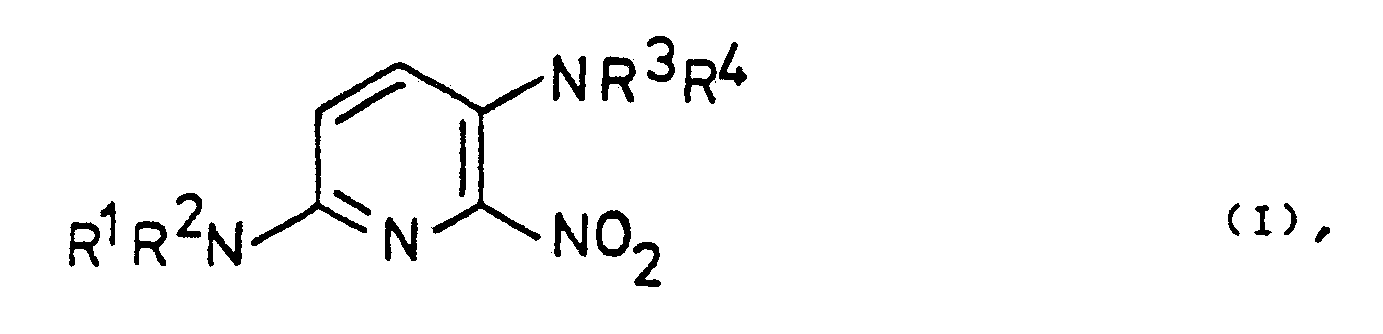
worin R¹ bis R⁴ Wasserstoff oder die Reste Alkyl, Hydroxyalkyl, Dihydroxyalkyl, Alkoxyalkyl, Alkoxycarbonyl, hydroxy- oder chlorsubstituiertes Alkoxycarbonyl, Aminoalkyl sowie durch Alkyl- oder Hydroxyalkylgruppen substituiertes Aminoalkyl bedeuten, wobei die Alkylgruppen jeweils 1 bis 4 Kohlenstoffatome aufweisen oder durch R¹ und R² beziehungsweise R³ und R⁴ ein Oxazolidinonring gebildet wird. Gegenstand der Erfindung sind weiterhin neue 2,5-Diamino-6-nitro-pyridinderivate sowie ein Mittel zum Färben von Haaren mit einem Gehalt an 2,5-Diamino-6-nitro-pyridinderivaten, welche direkt auf das Haar aufziehende gelborange bis blauviolett färbende Nitrofarbstoffe darstellen, die in physiologischer Hinsicht unbedenklich sind.
Description
- Nitrofarbstoffe finden heute in Haarfärbemitteln eine breite Anwendung. Sie werden in Oxidationshaarfärbemitteln als Zusätze für die Erzeugung von natürlichen oder modischen Farbnuancen verwendet. Durch Kombination von mehreren verschieden gefärbten Nitrofarbstoffen ist es jedoch auch möglich, Haarfärbemittel herzustellen, die Haare in natürlichen bis modischen Nuancen ohne die Anwendung von Oxidationsmitteln zu färben vermögen.
- So können zum Beispiel durch die Kombination je eines gelb-, rot- und blaufärbenden Nitrofarbstoffes natürlich wirkende braune Färbungen erzeugt werden. Daneben ist es jedoch zum Beispiel auch möglich, mit einem gelbfärbenden und einem violettfärbenden Nitrofarbstoff modische Brauntöne zu erhalten. Es werden daher Nitrofarbstoffe benötigt, die möglichst das gesamte Farbspektrum von gelb über orange, rot und violett bis blau abdecken. Zur Erzielung gleichmäßiger Färbungen an Ansatz und Spitzen der Haare sowie bei unterschiedlich geschädigten Haaren, ist es von Vorteil, wenn diese Farbstoffe aus einer Gruppe chemischer Verbindungen stammen, welche den gleichen Grundkörper aufweisen, weil dann leichter auch ähnliche physikalische Eigenschaften, die das Aufziehungsvermögen bestimmen, erzielbar sind.
- Daneben werden noch viele weitere Anforderungen an Haarfarbstoffe gestellt.
- Die Nitrofarbstoffe müssen in toxikologischer und dermatologischer Hinsicht unbedenklich sein. Ihre Verwendung in Oxidationshaarfärbemitteln setzt voraus, daß sie in Anwesenheit von Wasserstoffperoxid in alkalischer Lösung stabil sind. Außerdem wird für die erzeugten Haarfärbungen eine gute Licht-, Säure- und Reibechtheit gefordert. Schließlich sollten die Nitrofarbstoffe durch möglichst einfache, in industriellem Maßstab durchführbare Verfahren herstellbar sein.
- In der Literatur (vergleiche zum Beispiel J. C. Johnson, Hair dyes, Noyes Data Corp., Park Ridge, New Jersey, USA 1973, Seiten 43-91 und Seiten 113-124) werden Nitrofarbstoffe ausführlich beschrieben. Gelbe, rote, violette und blaue Farbstoffe lassen sich bislang nur durch unterschiedlich substituierte 2-Nitro-p-phenylendiamine herstellen. Da nun in letzter Zeit Zweifel an der physiologischen Unbedenklichkeit mancher 2-Nitro-p-phenylendiaminderivate aufgekommen sind, besteht großer Bedarf an Farbstoffen mit einem nichtbenzoiden Grundkörper, welche bei möglichst gleicher Farb-Bandbreite bessere physiologische Eigenschaften aufweisen.
- In der Literatur sind bereits Mittel zum Färben von Haaren mit einem Gehalt an Nitropyridinderivaten beschrieben. So werden in der DE-PS 1 949 750 Diaminopyridinderivate allgemein beschrieben. Als konkrete Beispiele werden jedoch nur 2,3-Diamino-5-nitro-pyridinderivate, welche menschliche Haare hellgelb bis orange färben, also nur ein begrenztes Farbspektrum aufweisen, genannt.
- Weiterhin werden in der DE-OS 3 334 030 Mittel zur oxidativen Färbung von Haaren beschrieben, welche bestimmte Diaminonitropyridinderivate einer allgemeinen Formel enthalten sollen. In der Druckschrift werden jedoch keine konkreten Diaminonitropyridinderivate genannt. Da in der DE-OS 3 334 030 Nitropyridine grundsätzlich gemeinsam mit Entwicklungskomponenten eingesetzt werden und dort im Rahmen eines oxidativen Haarfarbsystems als Kupplungskomponenten reagieren sollen, erfolgt ihre Auswahl nach ihrer Kuppler-Eigenschaft.
- Im Gegensatz hierzu können die in der vorliegenden Anmeldung beschriebenen 2,5-Diamino-6-nitro-pyridine zwar auch in Oxidationshaarfärbemitteln eingesetzt werden, sie reagieren jedoch nicht innerhalb des Systems, sondern werden als zusätzliche direktziehende Farbstoffe verwendet. Das Hauptanwendungsgebiet dieser Farbstoffe ist daher der Einsatz in direktziehenden Färbemitteln vom Typ der Tönung, welche keinen Zusatz von Oxidationsmitteln benötigen. Die hier vorliegenden 2,5-Diamino-6-nitro-pyridinderivate sind damit im Rahmen der DE-OS 3 334 030 überhaupt nicht verwendbar und weisen auch eine völlig andere chemische Struktur als die dort in den Beispielen beschriebenen Nitro-Kupplungskomponenten auf.
- Die in der DE-OS 3 334 030 konkret beschriebenen Beispiele, welche unter anderem auch zu rötlichen Farbtönen führen, beruhen auf einer oxidativen Haarfärbung und sind im wesentlichen auf eine Eigenreaktion des dort eingesetzten 2,5-Diamino-pyridins zurückzuführen. Zudem sind die dort beschriebenen Nitroverbindungen in Gegenwart von Dithionit nicht reduktionsbeständig.
- Somit ist aus der Literatur kein nichtbenzoides System von direkt auf das Haar aufziehenden Nitrofarbstoffen bekannt, welches die Haare von orange bis blauviolett zu färben vermag.
- Es bestand deshalb die Aufgabe, ein Mittel zum Färben von Haaren auf der Grundlage eines Systems von direkt auf das Haar aufziehenden nichtbenzoiden Nitrofarbstoffen zur Verfügung zu stellen, welches intensive Haarfärbungen von gelborange bis blauviolett ermöglicht sowie in physiologischer Hinsicht unbedenklich ist.
- Es wurde nun gefunden, daß durch ein Mittel zum Färben von Haaren mit einem Farbstoffgehalt und für Haarfärbemittel üblichen Zusätzen, dadurch gekennzeichnet, daß es ein 2,5-Diamino-6-nitro-pyridinderivat der allgemeinen Formel (VI)

- Von den Verbindungen der Formel (VI) sind diejenigen bevorzugt, in denen R⁶, R⁷ und R⁸ unabhängig voneinander Wasserstoff oder einen der Reste Methyl, Ethyl oder 2-Hydroxyethyl bedeuten oder durch R⁶ und R⁷ ein Pyrrolidin-, Piperidin- oder Morpholinring gebildet wird. Ganz besonders geeignete 2,5-Diamino-6-nitro-pyridinderivate sind 2,5-Diamino-6-nitro-pyridin, 5-Amino-2-((2′-hydroxyethyl)amino)-6-nitro-pyridin, 2,5-Bis((2′-hydroxyethyl)amino)-2-N-ethyl-6-nitro-pyridin, 2,5-Bis((2′-hydroxyethyl)amino)-6-nitro-pyridin, 2-Ethylamino-5-((2′-hydroxyethyl)amino)-6-nitro-pyridin und 5-Amino-2-pyrrolidino-6-nitro-pyridin.
- Die Verbindungen der Formel (VI), welche teils aus der Literatur S. Kotovskaya et al., Khim. Geterotsikl. Soedin 1981, 654-657 (ref. CA 95, 114439s), G A. Mokrushina et al., ibid 1979, 131 (ref. CA 90, 152079d) und der russischen Patentschrift 773043 bekannt sind, teils weiter unten beschrieben sind, stellen für die Färbung von menschlichen Haaren hervorragend geeignete, je nach Variation der Substituenten R⁶ bis R⁷, gelborange bis blauviolett färbende Nitrofarbstoffe dar. Sie sind gut in Wasser löslich und weisen insbesondere als Bestandteil der erfindungsgemäßen Haarfärbemittel eine ausgezeichnete Lagerstabilität auf.
- Überraschend sind die sehr guten toxikologischen und physiologischen Eigenschaften der Verbindungen der allgemeinen Formel (VI). So sind die getesteten Farbstoffe, zum Beispiel der Farbstoff mit R⁶ und R⁷ = 2-Hydroxyethyl und R⁸ = Wasserstoff, im Gegensatz zu strukturell ähnlichen Nitrofarbstoffen, wie zum Beispiel 1,4-Bis((2′-hydroxyethyl)amino)-2-nitro-benzol, im Amestest nicht mutagen.
- Das erfindungsgemäße Mittel zur Färbung von Haaren betrifft sowohl eine Ausführungsform, bei der es ohne Zugabe eines Oxidationsmittels angewendet wird, als auch eine weitere Ausführungsform, bei der die Zugabe eines Oxidationsmittels erforderlich ist.
- Bei dem ersteren Haarfärbemittel ohne Oxidationsmittel-Zugabe handelt es sich um ein Mittel, welches neben den Farbstoffen der angegebenen Formel (VI) noch andere bekannte direkt auf das Haar aufziehende Farbstoffe enthalten kann. Von diesen für die Haarfärbung bekannten Farbstoffen seien beispielsweise die folgenden erwähnt: Aromatische Nitrofarbstoffe, wie zum Beispiel 2-Amino-4-nitro-phenol, Pikraminsäure, 1-((2′-Hydroxyethyl)amino)-2-amino-4-nitro-benzol, 2 Nitro-4-((2′-hydroxyethyl)amino)-anilin, 4-((2′,3′-Dihydroxypropyl)amino)-3-nitro-trifluormethylbenzol, 4-N,N′-Bis((2′-hydroxyethyl)amino)-1-methylamino-2-nitro-benzol, 2,5-Bis((2′-hydroxyethyl)amino)-nitrobenzol, 2-((2′-Hydroxyethyl)amino)-4,6-dinitro-phenol und 1-Amino-4-((2′,3′-dihydroxypropyl)amino)-2-nitro-5-chlor-benzol; Triphenylmethanfarbstoffe, wie zum Beispiel Basic Violet 1 (C. I. 42 535); Azofarbstoffe, wie zum Beispiel Acid Brown 4 (C. I. 14 805); Anthrachinonfarbstoffe, wie zum Beispiel Disperse Blue 23 (C. I. 61 545), Disperse Violet 4 (C I. 61 105), 1,4,5,8-Tetraamino-anthrachinon und 1,4-Diamino-anthrachinon, wobei die Farbstoffe dieser Klassen je nach Art ihrer Substituenten sauren, nicht-ionogenen oder basischen Charakter haben können. Weitere geeignete direkt auf das Haar aufziehende Farbstoffe sind beispielsweise in dem Buch von J.C. Johnson, "Hair dyes" Noyes Data Corp. Park-Ridge (USA) (1973), Seiten 3 - 91 und 113 - 139 (ISBN: 0-8155-0477-2) beschrieben.
- Die Zubereitungsform des hier beschriebenen Haarfärbemittels auf der Basis von direkt auf das Haar aufziehenden Farbstoffen kann beispielsweise eine Lösung, insbesondere eine wäßrige oder wäßrig-alkoholische Lösung, sein. Bevorzugte Zubereitungsformen sind weiterhin eine Creme, ein Gel oder eine Emulsion, wobei das Mittel auch im Gemisch mit einem Treibgas oder mittels einer Pumpe versprüht werden kann.
- Die Farbstoffe der allgemeinen Formel (VI) sollen in diesem Haarfärbemittel ohne Oxidationsmittel-Zugabe in einer Konzentration von etwa 0,01 bis 2,0 Gewichtsprozent, vorzugsweise von 0,01 bis 1,0 Gewichtsprozent, enthalten sein. Der Gesamtgehalt an den direkt auf das Haar aufziehenden Farbstoffen liegt in den Grenzen von etwa 0,01 bis 3,0 Gewichtsprozent.
- Der pH-Wert dieses Färbemittels liegt im Bereich von 3 bis 10,5, insbesondere bei pH 7,5 bis 9,5, wobei die Einstellung des gewünschten alkalischen pH-Wertes hauptsächlich mit Ammoniak erfolgt, jedoch auch mit organischen Aminen, wie beispielsweise Monoethanolamin oder Triethanolamin, vorgenommen werden kann.
- Seine Anwendung erfolgt in üblicher Weise durch Aufbringen einer für die Haarfärbung ausreichenden Menge des Mittels auf die Haare, mit denen es eine Zeitlang, etwa 5 bis 30 Minuten, in Berührung bleibt. Anschließend wird mit Wasser, gegebenenfalls noch mit der wäßrigen Lösung einer schwachen organischen Säure, gespült und getrocknet. Als schwache organische Säure können beispielsweise Essigsäure, Zitronensäure, Weinsäure und ähnliche Verwendung finden.
- Das vorstehend beschriebene Haarfärbemittel ohne Oxidationsmittel-Zugabe kann selbstverständlich auch in der Kosmetik überlicherweise verwendete synthetische oder natürliche Polymere enthalten, wodurch gleichzeitig mit der Färbung eine Festigung der Haare erreicht wird. Solche Mittel werden im allgemeinen als Tönungsfestiger oder Farbfestiger bezeichnet. Von den für diesen Zweck in der Kosmetik bekannten synthetischen Polymeren seien beispielsweise Polyvinylpyrrolidon, Polyvinylacetat, Polyvinylalkohol oder Polyacrylverbindungen wie Acrylsäure- beziehungsweise Methacrylsäurepolymerisate, basische Polymerisate von Estern aus diesen beiden Säuren und Aminoalkoholen beziehungs weise deren Salze oder Quaternierungsprodukte, Polyacrylnitril, Polyvinyllactame sowie Copolymerisate aus derartigen Verbindungen, wie zum Beispiel Polyvinylpyrrolidon-Vinylacetat, und dergleichen erwähnt.
- Auch natürliche Polymere, wie Chitosan (entacetyliertes Chitin) oder Chitosanderivate, können für den genannten Zweck eingesetzt werden.
- Die Polymerisate sind in diesem Mittel in der für solche Mittel üblichen Menge von etwa 1 bis 5 Gewichtsprozent enthalten. Der pH-Wert des Mittels liegt im Bereich von etwa 6,0 bis 9,0.
- Die Anwendung dieses Haarfärbemittels mit zusätzlicher Festigung erfolgt in bekannter und üblicher Weise durch Befeuchten des Haares mit dem Festiger, Festlegen (Einlegen) des Haares zur Frisur und anschließende Trocknung.
- Selbstverständlich kann das vorstehend beschriebene Haarfärbemittel ohne Oxidationsmittel-Zugabe gegebenenfalls weitere, für Haarfärbemittel übliche Zusätze, wie zum Beispiel Pflegestoffe, Netzmittel, Verdicker, Weichmacher, Konservierungsstoffe und Parfümöle sowie auch andere, nachstehend für Oxidationshaarfärbemittel aufgeführte übliche Zusätze enthalten.
- Zum Gegenstand der vorliegenden Erfindung gehört auch, wie eingangs erwähnt, ein Haarfärbemittel, bei dem die Zugabe eines Oxidationsmittels erforderlich ist. Es enthält außer den Farbstoffen gemäß der angegebenen Formel (VI) und gegebenenfalls bekannten, direkt auf das Haar aufziehenden Farbstoffen noch zusätzliche, bekannte Oxidationsfarbstoffe, die einer oxidativen Entwicklung bedürfen.
- Bei diesen Oxidationsfarbstoffen handelt es sich hauptsächlich um aromatische p-Diamine und p-Aminophenole, wie beispielsweise p-Toluylendiamin, p-Phenylendiamin, p-Aminophenol und ähnliche Verbindungen, welche zum Zwecke der Nuancierung der Färbung mit sogenannten Modifiern, wie zum Beispiel m-Phenylendiamin, Resorcin, m-Aminophenol und anderen, kombiniert werden.
- Derartige zu Haarfärbung bekannte und übliche Oxidationsfarbstoffe sind unter anderem in dem Buch von E. Sagarin, "Cosmetics", Science and Technology (1957), Interscience Publishers Ins., New York, Seiten 503 ff. sowie in dem Buch von H. Janistyn, "Handbuch der Kosmetika und Riechstoffe" (1973), Seiten 338 ff., beschrieben.
- Mit Mischungen aus diesen Oxidationsfarbstoffen und den Farbstoffen gemäß der angegebenen Formel (VI) lassen sich sehr gut natürliche Blond- und Brauntöne, aber auch modische Nuancen herstellen.
- Die Farbstoffe gemäß der Formel (VI) sind in diesem Färbemittel mit Oxidationsmittel-Zugabe in einer Konzentration von etwa 0,01 bis 2,0 Gewichtsprozent, vorzugsweise 0,01 bis 1,0 Gewichtsprozent, enthalten. Der Gesamtgehalt an Farbstoffen in diesem Färbemittel beträgt etwa 0,1 bis 5,0 Gewichtsprozent.
- Oxidationshaarfärbemittel sind im allgemeinen alkalisch eingestellt, vorzugsweise auf pH-Werte von 8,0 bis 11,5, wobei die Einstellung insbesondere mit Ammoniak erfolgt. Es können dazu aber auch andere organische Amine, zum Beispiel Monoethanolamin oder Triethanolamin, Verwendung finden. Als Oxidationsmittel zur Entwicklung der Haarfärbungen kommen hauptsächlich Hydrogenperoxid und dessen Additionsverbindungen in Betracht. Die Zubereitungsform dieses Haarfärbemittels kann die gleiche wie bei dem Haarfärbemittel ohne Oxidationsmittel-Zugabe sein. Vorzugsweise ist sie die einer Creme oder eines Gels.
- Übliche Zusätze in Cremes, Emulsionen oder Gelen sind zum Beispiel Lösungsmittel, wie Wasser, niedere aliphatische Alkohole, beispielsweise Ethanol, Propanol, Isopropanol, Glycerin oder Glykole, wie zum Beispiel Ethylenglykol und Propylenglykol, oder auch Glykolether, weiterhin Netzmittel oder Emulgatoren aus den Klassen der anionischen, kationischen, amphoteren oder nichtionogenen oberflächenaktiven Substanzen, wie zum Beispiel Fettalkoholsulfate, Fettalkoholethersulfate, Alkylsulfonate, Alkylbenzolsulfate, Alkyltrimethylammoniumsalze, Alkylbetaine, oxethylierte Fettalkohole, oxethylierte Alkylphenole, Fettsäurealkanolamide, oxethylierte Fettsäureester, ferner Verdicker, wie zum Beispiel höhere Fettalkohole, Bentonit, Stärke, Polyacrylsäure, Cellulosederivate, wie zum Beispiel Carboxymethylcellulose, Alginate, Vaseline, Paraffinöl und Fettsäuren sowie außerdem Pflegestoffe, wie zum Beispiel Lanolinderivate, Cholesterin, Pantothensäure und Betain, weiterhin Parfümöle und Komplexbildner. Die erwähnten Bestandteile werden in den für solche Zwecke üblichen Mengen verwendet, zum Beispiel die Netzmittel und Emulgatoren in Konzentrationen von etwa 0,5 bis 30 Gewichtsprozent, während die Verdicker in einer Menge von etwa 0,1 bis 25 Gewichtsprozent und die Pflegestoffe in einer Menge von etwa 0,1 bis 5 Gewichtsprozent in den Zubereitungen enthalten sein können.
- Die Anwendung der genannten Zubereitungen, bei denen die Zugabe eines Oxidationsmittels erforderlich ist, erfolgt in bekannter Weise, indem man die Haarfärbemittel vor der Behandlung mit dem Oxidationsmittel vermischt und eine zur Färbung des Haares ausreichende Menge der Mischung, im allgemeinen etwa 50 bis 150 ml, auf das Haar aufträgt. Nach einer für die Haarfärbung ausreichenden Einwirkungszeit, welche üblicherweise etwa 10 bis 45 Minuten beträgt, wird das Haar mit Wasser gespült, gegebenenfalls anschließend mit der wäßrigen Lösung einer schwachen organischen Säure, wie zum Beispiel Zitronensäure oder Weinsäure, nachgespült und sodann getrocknet.
- Hinsichtlich der färberischen Möglichkeiten bieten die erfindungsgemäßen Haarfärbemittel je nach Art und Zusammensetzung der Farbkomponenten eine breite Palette verschiedener Farbnuancen, die sich von natürlichen Farbtönen bis hin zu hochmodischen, leuchtenden Nuancen erstreckt. Hierbei werden die Färbemittel je nach Zusammensetzung entweder in Verbindung mit Hydrogenperoxid oder auch ohne Oxidationsmittel angewandt.
- Die Verbindungen der Formel (VI) lassen sich nicht auf dem aus der Benzolchemie bekannten Weg über eine Nitrierung des 2,5-Diamino-pyridins herstellen, da dieses bei der Nitrierung oxidiert wird. Zudem wäre beim Gelingen einer solchen Nitrierung zu erwarten, daß die Nitrogruppe in 3-Stellung eintritt.
- Das einzige bekannte Herstellungsverfahren für 2,5-Diamino-6-nitro-pyridinderivate ist in der russischen Patentschrift 773 049 sowie in den Veröffentlichungen der gleichen Autoren in Khim. Geterotsikl. Soedin 1979 (1), Seite 131 und 1981 (5), Seite 654 ff. beschrieben. Voraussetzung ist dort jedoch die Herstellung des 3-Azido-2nitro-pyridins (VII), das dann mit Aminen umgesetzt werden kann:

- Gegenstand der vorliegenden Erfindung ist daher weiterhin ein Verfahren zur Herstellung von 2,5-Diamino-6-nitro-pyridinderivaten der allgemeinen Formel (I)


- Die Tatsache, das N²,N⁵-Bis-alkoxycarbonylderivate des 2,5-Diaminopyridins ohne das Auftreten von Oxidationsprodukten nitriert werden können, wobei die Nitrogruppe in 6-Stellung eintritt, obgleich die normalerweise elektronenreichere Position 3 nicht durch einen Substituenten besetzt ist, ist völlig überraschend.
- Besonders vorteilhafte Schutzgruppen sind die Ethoxycarbonylgruppe, die preiswert und leicht einführbar ist, sowie die 2-Chlorethoxycarbonylgruppe, die sich nach der Nitrierung in eine 2-Hydroxyethylgruppe überführen läßt und damit Abspaltung der Schutzgruppe und Alkylierung der Aminogruppe in einem Reaktionsschritt vereinigt, wodurch insbesondere die Herstellung der 2-Hydroxyethylderivate außerordentlich erleichtert wird.
- Das neue erfindungsgemäße Verfahren geht von dem preiswerten und in technischen Mengen verfügbaren 2,5-Diaminopyridin oder dessen Derivaten aus, die in einer Stufe zum Bis-Carbamat umgesetzt werden können. Selbstverständlich lassen sich die Bis-Carbamate auch durch Umlagerungsreaktionen aus den preiswerten Pyridin-2,5-dicarbonsäurederivaten gewinnen, wie zum Beispiel bei H. Meyer und F. Staffen, Monatsh. Chem. 34, 517 ff. (1913), beschrieben.
- Besonders geeignet ist das neue Verfahren für solche Verbindungen der Formel (I), worin die Reste R¹ bis R⁴ unabhängig voneinander Wasserstoff, Methyl, Ethyl oder 2-Hydroxyethyl bedeuten oder durch R¹ und R² und/oder R³ und R⁴ ein Oxazolidinonring gebildet wird.
- So wird durch das neue Verfahren beispielsweise die Herstellung von 2,5-Diamino-6-nitro-pyridin ((I), R¹ bis R⁴ = Wasserstoff) gegenüber dem aus der russichen Patentschrift 773 049 bekannten Verfahren erheblich erleichtert.
- Ebenfalls leicht lassen sich durch das erfindungsgemäße Verfahren 2,5-Diamino-6-nitro-pyridinderivate darstellen, in denen R¹ die vorstehend angegebene Bedeutung hat, jedoch nicht Wasserstoff ist, und die Reste R², R³ und R⁴ Wasserstoff darstellen. Die als Ausgangsprodukte verwendeten, am Aminstickstoff in 2-Stellung substituierten 2,5-Diamino-6-nitro-pyridinderivate lassen sich, wie das nachfolgende Schema zeigt, vorteilhaft durch nucleophilen Austausch des Chloratoms im 2-Chlor-5-nitro-pyridin gewinnen:

- In einer speziellen Ausführungsform des neuen Verfahrens wird die Herstellung von hydroxyalkylierten 2,5-Diamino-6-nitro-pyridinen, beispielsweise 2,5-Bis((2′-hydroxyethyl)amino)-6-nitro-pyridin, ermöglicht, wobei 2,5-Diamino-pyridin zunächst mit Chlorameisensäurechlorethylester zum N²,N⁵-Bis-(2′-chlorethoxycarbonyl)-2,5-diamino-pyridin umgesetzt wird, das Produkt sodann in 6-Stellung nitriert wird und anschließend die 2-Chlorethoxycarbonylreste durch Umsetzung mit Ammoniak oder Alkylaminen, beispielsweise Ethylamin, in Oxazolidinonreste umgewandelt werden, welche danach durch Einwirkung von ethanolischer Alkalihydroxidlösung zu 2-Hydroxyethylresten umgesetzt werden:

- Das intermediär gebildete Bis-Oxazolidinon (IX) kann isoliert werden, die Reaktion von (VIII) zu (X) läßt sich aber auch in einem Schritt durchführen. Die Herstellung verschiedener Derivate wird in den Beispielen beschrieben.
- Durch das neue Herstellungsverfahren wird eine ganze Reihe von 2,5-Diamino-6-nitro-pyridinderivaten, wie zum Beispiel die 2,5-Bis-carbamate, die 2,5-Bis-alkylaminoderivate oder durch Alkylierung die Trialkyl-2,5-diamine, neu erschlossen.
- Gegenstand der Erfindung sind weiterhin neue 2,5-Diamino-6-nitro-pyridinderivate der allgemeinen Formel (V)

- Beispiele für neue 2,5-Diamino-6-nitro-pyridinderivate der allgemeinen Formel (V) sind
2,5-Bis((2′-hydroxyethyl)amino)-6-nitro-pyridin, 2-Ethylamino-5-((2′-hydroxyethyl)amino)-6-nitro-pyridin, 2,5-Bis((2′-hydroxyethyl)amino)-2-N-ethyl-6-nitro-pyridin, 5-Amino-2-((2′-hydroxyethyl)amino)-6-nitro-pyridin und 2,5-Bis(1′,3′-oxazolidin-3′yl-2′-on)-6-nitro-pyridin. - Die erfindungsgemäßen neuen Verbindungen der allgemeinen Formel (V) stellen für die Färbung von menschlichen Haaren hervorragend geeignete, gelborange bis blauviolette, direkt auf das Haar aufziehende Nitrofarbstoffe sowie interessante Zwischenprodukte für die Synthese von Arzneimitteln dar.
- Die nachfolgenden Beispiele sollen die Erfindung näher erläutern, ohne sie darauf zu beschränken.
-
0,50 g 2,5-Diamino-6-nitro-pyridin 2,00 g Laurylalkoholdiglykolethersulfat-Natriumsalz (28prozentige wäßrige Lösung) 2,00 g Ammoniak, 25prozentige wäßrige Lösung 95,50 g Wasser 100,00 g - Gebleichtes Naturhaar wird 20 Minuten lang bei Raumtemperatur mit der Lösung nach Beispiel 1 behandelt, danach mit Wasser ausgespült und getrocknet. Das Haar ist goldorange gefärbt.
-
0,10 g 2-Ethylamino-5-((2′-hydroxyethyl)amino)-6-nitro-pyridin 2,00 g Polyvinylpyrrolidon 0,10 g Glyzerin 40,00 g Isopropanol 57,80 g Wasser 100,00 g - Weiße menschliche Haare werden mit der Farbfestiger-Lösung eingelegt und getrocknet. Das Haar ist leuchtend rotviolett gefärbt und gefestigt.
-
0,20 g 2,5-Bis-((2′-hydroxyethyl)amino)-6-nitro-pyridin 0,02 g 4-((2′-Hydroxyethyl)amino)-3-nitro-toluol 0,20 g p-Phenylendiamin 0,15 g Resorcin 0,03 g m-Aminophenol 15,00 g Cetylalkohol 3,50 g Laurylalkoholdiglykolethersulfat-Natriumsalz (28prozentige wäßrige Lösung) 6,00 g Ammoniak, 25prozentige wäßrige Lösung 74,90 g Wasser 100,00 g - 50 g des vorstehenden Haarfärbemittels werden kurz vor der Anwendung mit 50 ml Wasserstoffperoxidlösung (6prozentig) gemischt. Das Gemisch wird anschließend auf graue menschliche Haare aufgetragen und 30 Minuten bei einer Temperatur von 40 Grad Celsius einwirken gelassen. Nach dem Spülen des Haares mit Wasser und dem anschließenden Trocknen hat es einen modischen roten Blondton angenommen.
-
0,030 g 5-Amino-2-pyrrolidino-6-nitro-pyridin 0,050 g 4-((2′,3′-Dihydroxypropyl)amino)-3-nitro-trifluormethylbenzol 0,250 g 4-N,N′-Bis((2′-hydroxyethyl)amino)-1-methylamino-2-nitro-benzol 0,025 g Disperse Blue 23 (C. I. 61 545) 7,500 g Cetylalkohol 1,750 g Lauryalkoholdiglykolethersulfat-Natriumsalz (28prozentige wäßrige Lösung) 0,100 g p-Hydroxybenzoesäuremethylester 0,200 g Ammoniak, 25prozentige wäßrige Lösung 90,095 g Wasser 100,00 g - 50 g des vorstehenden Haarfärbemittels werden auf weiße menschliche Haare aufgebracht und nach einer Einwirkungszeit von 20 Minuten mit Wasser ausgespült. Das Haar wird anschließend getrocknet. Es ist in einem natürlichen braunen Farbton gefärbt.
-
0,10 g 2,5-Bis((2′-hydroxyethyl)amino)-2-N-ethyl-6-nitro-pyridin 0,25 g 4-((2′-Hydroxyethyl)amino)-3-nitro-chlorbenzol 0,20 g 4-N-Ethyl-1,4-bis((2′-hydroxyethyl)amino)-2-nitro-benzol 0,50 g Hydroxyethylcellulose 5,00 g Lauryalkoholdiglykolethersulfat-Natriumsalz (28prozentige wäßrige Lösung) 10,00 g Isopropanol 10,00 g Ammoniak, 25prozentige wäßrige Lösung 73,95 g Wasser 100,00 g - Gebleichtes Naturhaar wird 20 Minuten lang bei Raumtemperatur mit der Lösung nach Beispiel 5 behandelt. Nach Spülung mit Wasser und Trocknung ist das Haar in einem modischen dunklen Beaujolaiston eingefärbt
-
0,05 g 2,5-Bis((2′-hydroxyethyl)amino)-2-N-ethyl-6-nitro-pyridin 0,30 g 4-((2′-Ureidoethyl)amino)-nitrobenzol 5,00 g Laurylalkoholdiglykolethersulfat-Natriumsalz (28prozentige wäßrige Lösung) 10,00 g Isopropanol 10,00 g Ammoniak, 25prozentige wäßrige Lösung 74,65 g Wasser 100,00 g - Das vorstehende Färbemittel wird auf gebleichte Naturhaare 30 Minuten lang bei 40 Grad Celsius einwirken gelassen. Nach Spülung mit Wasser und Trocknung ist das Haar in einem modischen Blondton gefärbt.
-
0,7 g 5-Amino-2-((2′-hydroxyethyl)amino)-6-nitro-pyridin 10,0 g Cetylstearylalkohol 5,0 g Laurylalkoholdiglykolethersulfat-Natriumsalz (28prozentige wäßrige Lösung) 0,5 g Parfüm 0,1 g Natriumhydroxid 83,7 g Wasser 100,0 g - Das Färbemittel läßt man 20 Minuten auf blonde Naturhaare bei 20 Grad Celsius einwirken. Nach Spülung und Trocknung ist das Haar leuchtend orange eingefärbt.
- Wird im Beispiel 7 das 5-Amino-2-((2′-hydroxyethyl)amino)-6-nitro-pyridin durch 2,5-Bis((2′-hydroxyethyl)amino)-6-nitro pyridin in gleicher Menge ersetzt, so wird das Haar leuchtend feuerrot gefärbt.
-

- 10 g 2,5-Diaminopyridin werden zusammen mit 20 g Calciumcarbonat unter Rühren in 100 ml Dioxan aufgeschlämmt und auf 70 Grad Celsius erwärmt. Man läßt 20 ml Chlorameisensäureethylester langsam zutropfen und rührt über Nacht bei 70 Grad Celsius. Anschließend wird unter Nachwaschen mit Dioxan noch heiß vom überschüssigen Calciumcarbonat abgesaugt und das Filtrat im Vakuum eingeengt. Der Rückstand kristallisiert aus ethanolischer Lösung aus. Die Verbindung läßt sich auch nach H. Meyer und F. Staffen, Monatsh. Chemie 34, Seite 517 ff. (1913) darstellen.
- 40 ml konzentrierte Schwefelsäure werden auf 8 Grad Celsius gekühlt, und unter Rühren werden 5 g der Verbindung der Stufe 1 eingetragen. Bei 5 Grad Celsius werden dann tropfenweise 5 ml konzentrierte Salpetersäure zugesetzt und noch 1 Stunde lang gerührt. Anschließend wird der Ansatz auf 300-400 g Eis gegossen, und die ausgefallenen Kristalle werden durch Absaugen isoliert. Man erhält 4 g einer gelben kristallinen Verbindung, die nach der Umkristallisation aus Ethanol bei 193 Grad Celsius schmilzt.
- 10,38 (s, NH), 9,72 (s,NH), 8,23 (d, J = 9 Hz, 4-H), 8,10 (d, J = 9 Hz, 3-H), 4,19 (q, J = 7 Hz, OCH₂), 4,13 (q, J = 7 Hz, OCH₂), 1,25 (t, J = 7 Hz, CH₃), 1,23 (t, J = 7 Hz, CH₃).
- Für dieses und alle anderen NMR-Spekturen gilt:
- Alle Angaben in delta (ppm) bezogen auf Tetramethylsilan als Standard mit delta = 0. Als Lösungsmittel diente, soweit nicht anders angegeben, DMSO-d₆. s = Singulett, d = Dublett, t = Triplett q = Quartett, m = Multiplett.
- 290 (M⁺, 65), 253 (11), 252 (32), 225 (15), 224 (100), 180 (20), 178 (36), 154 (12), 152 (39), 134 (18), 108 (35), 107 (48), 106 (22), 96 (10), 95 (15), 81 (42), 80 (50), 79 (92), 54 (18), 53 (21), 52 (14).
- Für dieses und alle anderen Massenspektren gilt:
- Alle Angaben in m/e (relative Intensität) für alle Peaks, welche eine relative Intensität von größer oder gleich 10 Prozent aufweisen.
-

- 4,0 g des Biscarbamats des Beispiels 9 werden in 200 ml ethanolischer 3prozentiger Kaliumhydroxidlösung 18 Stunden lang unter Rückfluß gekocht. Anschließend wird filtriert, das Filtrat mit konzentrierter Schwefelsäure angesäuert und im Vakuum eingeengt. Der Rückstand wird in Methanol aufgenommen, worauf das gesuchte Produkt als Hydrochlorid auskristallisiert (Schmelzpunkt 241 Grad Celsius).
- 7,84 (s, breit; NH₂; Signal verschwindet beim Schütteln der Probe mit D₂O), 7,74 (d, J = 10 Hz; 4-H), 7,26 (d, J = 10 Hz; 3-H).
- 154 (M⁺, 58), 108 (47), 80 (57), 79 (20), 78 (13), 54 (72), 53 (32), 52 (20), 37 (61), 35 (100).
-

- 10 g 2-Chlor-5-nitro-pyridin werden in 30 ml Ethanolamin bei Raumtemperatur gerührt. Nach etwa 5 Minuten beginnt eine exotherme Reaktion, die nach 1 Stunde beendet ist, der Ansatz wird auf 200 g Eis gegossen und der gelbe Niederschlag durch Absaugen isoliert. Nach dem Trocknen erhält man 9,5 g der Aminoverbindung
- 9,5 g des Produkts aus Stufe 1 werden in 200 ml Methanol an Platin mit Wasserstoff bei Normaldruck und Raumtemperatur katalytisch reduziert. Nach der Aufnahme von 3,7 Liter Wasserstoff wird vom Katalysator abfiltriert und das Filtrat im Vakuum eingeengt. Der Rückstand wird durch Luftsauerstoff leicht oxidiert und daher ohne Reinigung in Stufe 3 eingesetzt. Die Diaminoverbindung ist zwar in Form des Dihydrochlorids im Handel erhältlich, jedoch ist Voraussetzung für das Gelingen der Stufe 3 die Verwendung der freien Base, die sich auf dem beschriebenen Weg leicht in guter Reinheit herstellen läßt.
-
- Die Diaminoverbindung der Stufe 2 wird in 120 ml Dioxan gelöst. Nach Zusatz von 12 g Calciumcarbonat wird unter Rühren auf 80 Grad Celsius erwärmt und man läßt 10 ml Chlorameisensäureethylester langsam zutropfen. Nach 18 stündigem Rühren bei 80 Grad Celsius wird filtriert, das Filtrat im Vakuum eingeengt und das erhaltene dunkle Öl ohne weitere Reinigung in Stufe 4 eingesetzt (Ausbeute 5,0 g)
- Die Nitrierung wird analog Beispiel 9, Stufe 2 durchgeführt. Aus 5 g der Vorstufe werden 2,4 g der Nitroverbindung erhalten.
- 9,83 (s, NH; Signal verschwindet beim Schütteln der Probe mit D₂O), 8,20 (d, J = 9 Hz, 4-H), 8,13 (d, J = 9 Hz, 3-H), 4,4 - 3,9 (m aus 5 einzelnen q: OCH₂-bzw. N-CH₂-), 1,27 (t, J = 7 Hz, CH₃), 1,24 (t, J = 7 Hz, CH₃), 1,15 (t, J = 7 Hz, CH₃).
- 414 (M⁺, 17), 308 (16), 307 (100), 252 (10), 239 (16), 235 (14), 178 (21), 167 (11), 164 (17), 120 (12), 89 (20), 45 (11).
-

- 5,0 g des Tris-carbamats aus Beispiel 11 werden 2 1/2 Tage lang bei Raumtemperatur in 100 ml 3 prozentiger ethanolischer Kaliumhydroxidlösung gerührt, nach dieser Zeit filtriert und nochmals 2 Tage lang mit weiteren 100 ml der Kaliumhydroxidlösung gerührt. Anschließend wird wiederum filtriert, die Filtrate werden vereinigt und mit Essigsäure auf pH-Wert 5 bis 6 eingestellt. Sodann wird der Alkohol im Vakuum abdestilliert und der Rückstand aus Ethanol kristallisiert. Man erhält 1,3 g rote Kristalle mit einem Schmelzpunkt von 185 Grad Celsius.
- 198 (M⁺, 29), 168 (10), 167 (94), 154 (14), 151 (11), 137 (12), 121 (24), 120 (72), 108 (13), 107 (21), 106 (12), 96 (11), 95 (10), 94 (31), 93 (62), 92 (29), 81 (48), 80 (62), 79 (91), 67 (33), 66 (41), 65 (17), 64 (24), 54 (100), 53 (82), 51 (75).
-

- Wie in Beispiel 9, Stufe 1 beschrieben, werden 30 g 2,5-Diaminopyridin in 200 ml Dioxan unter Zusatz von 60 g Calciumcarbonat mit 40 ml Chlorameisensäurechlorethylester umgesetzt. Man erhält nach der Umkristallisation 22 g farblose Kristalle vom Schmelzpunkt 198 Grad Celsius.
- Die Nitrierung analog Beispiel 9, Stufe 2 (Ansatz: 22 g Vorstufe der Stufe 1, 200 ml konzentrierte Schwefelsäure, 20 ml konzentrierte Salpetersäure, 800 g Eis) ergibt 18 g des gewünschten Produkts in Form farbloser Kristalle vom Schmelzpunkt 118 bis 119 Grad Celsius.
- 320 (2), 318 (10), 316 (14; m/e 320, 318 und 316: M⁺), 322 (19), 320 (29), 178 (15), 80 (10), 79 (31), 65 (30), 63 (100).
-

- 5 g des Bis-Carbamats des Beispiels 9 werden in 20 ml einer mit NH₃-Gas gesättigten Methanollösung in einem Autoklaven 3 Stunden lang auf 120 Grad Celsius erhitzt. Nach Abkühlen und Einengen kristallisieren 4,0 g des Bis-Oxazolidinons vom Schmelzpunkt 221 Grad Celsius
- 8,46 (d, J = 9 Hz, 4-H), 8,29 (d, J = 9 Hz, 3-H), 4,65-4,4 (m, O-CH₂-), 4,27 - 4,02 (m, N-CH₂).
- 294 (15, M⁺), 249 (12), 248 (100), 132 (15), 118 (10), 117 (21), 106 (10), 105 (33), 92 (15), 79 (29), 78 (12), 64 (22), 52 (16).
- 5 g des Bis-oxazolidinons des Beispiels 14 werden bei Raumtemperatur 4 Tage lang in 100 ml 3prozentiger ethanolischer Kaliumhydroxidlösung gerührt. Anschließend wird vom Niederschlag abgesaugt und das Filtrat mit Essigsäure auf einen pH-Wert von 5 bis 6 eingestellt. Das Ethanol wird im Vakuum verdampft und der Rückstand in 50 ml Wasser aufgenommen. Diese Lösung wird wiederholt mit Essigester extrahiert, die vereinigten Extrakte über Natriumsulfat getrocknet und bis zur beginnenden Kristallisation eingeengt. Man erhält 2,0 g des Produkts in Form grüner Kristalle vom Schmelzpunkt 158 Grad Celsius.
-
berechnet gefunden % C 44,65 44,67 % H 5,78 5,65 % N 23,13 22,98 - 7,99 (t, J = 5 Hz, OH; das Signal verschwindet beim Schütteln der Probe mit D₂O), 7,50 (d, J = 10 Hz, 4-H), 7,02 (d, J = 10 Hz, 3-H), 6,58 (t, J = 5 Hz, OH; das Signal verschwindet beim Schütteln der Probe mit D₂O); 5,05 - 4,6 (breit, NH, das Signal verschwindet beim Schütteln der Probe mit D₂O), 3,55 (t, J = 5 Hz, breite Signale; O-CH₂-; nach Schütteln der Probe mit D₂O schärfere Absorption), 3,45-3,20 (m, breite Signale, N-CH₂).
- 248 (52, M⁺), 211 (100), 164 (10), 150 (21), 136 (14), 122 (14), 121 (24), 120 (20), 119 (13), 108 (13), 107 (15), 106 (23), 105 (15), 94 (18), 93 (38), 92 (15), 80 (19), 79 (32), 78 (15), 66 (25), 64 (15) 54 (19), 53 (15), 52 (23).
-

- 10 g 2-Chlor-5-nitro-pyridin werden mit 30 ml Ethylamin versetzt; nach wenigen Minuten setzt eine exotherme Reaktion ein, nach deren Abklingen noch 30 Minuten lang gerührt wird. Der Ansatz wird auf 150 g Eis gegossen und von den ausgefallenen Kristallen abgesaugt. Nach der Umkristallisation aus Ethanol erhält man 9,6 g gelbe Kristalle vom Schmelzpunkt 118 Grad Celsius.
- 9,01 (d, J = 3 Hz, 6-H), 8,18 (dd, J₁ = 3 Hz, J₂ = 10 Hz, 4-H), 6,37 (d, J₂ = 10 Hz, 3-H), 5,5 (breit, NH), 3,46 (dq, J1 = 6 Hz, NH-Kopplung; J₂ = 7 Hz, CH₂), 1,31 (t, J = 7 Hz, -CH₃).
- 9 g der Nitroverbindung der Stufe 1 werden in Methanol an Platin mit Wasserstoff bei Normaldruck und Raumtemperatur hydriert. Nach Aufnahme der theoretischen Menge Wasserstoff wird vom Katalysator abfiltriert, eingeengt und der Rückstand (6,8 g) ohne weitere Reinigung in Stufe 3 eingesetzt.
- 6,8 g der Diaminoverbindung der Stufe 2 werden in 30 ml Dioxan gelöst, mit 7,0 g Calciumcarbonat versetzt, und anschließend läßt man unter Rühren bei 80 Grad Celsius 10,6 g Chlorameisensäurechlorethylester zutropfen. Die Lösung wird 3 Stunden lang bei dieser Temperatur gerührt. Sodann wird vom Rückstand abgesaugt und das Filtrat im Vakuum eingeengt. Der Rückstand wird an Kieselgel chromatographiert (Laufmittel: Methylenchlorid mit 5 Prozent Methanol) und liefert nach der Kristallisation aus Wasser 3,4 g farblose Kristalle.
- 8,35 (d, J₁ = 3 Hz, 6-H), 7,87 (dd, J₁ = 3 Hz, J₂ = 9 z, 4-H), 7,53 (d, J = 9 Hz, 3-H), 6,95 (breit, NH, beim Schütteln der Probe mit D₂O verschwindet das Signal), 4,58-4,32 (m, O-CH₂); 3,98 (q, J = 7 Hz, N-CH₂), 3,84-3,60 (m, Cl-CH₂), 1,21 (t, J = 7 Hz, CH₃).
- 353 (3), 351 (18), 349 (28; m/e 353, 351, 349: M⁺), 314 (10), 244 (32), 243 (17), 242 (100), 241 (11), 206 (18), 152 (50), 93 (10), 79 (16), 55 (19), 53 (65).
- Die Nitrierung von 2,5 g der Verbindung der Stufe 3 mit 2,5 ml konzentrierter Salpetersäure in 10 ml konzentrierter Schwefelsäure analog Beispiel 9, Stufe 2 ergibt 2 g der Nitroverbindung vom Schmelzpunkt 87 Grad Celsius.
- 9,55 (breit, NH), 8,94 (d, J = 9 Hz, 4-H), 8,21 (d, J = 9 Hz, 3-H), 4,48 (2x t, J = 6 Hz, OCH₂), 4,11 (q, J = 7 Hz, N-CH₂), 3,76 (2x t, J = 6 Hz, CH₂Cl), 1,31 (t, J = Hz, CH₃).
- 398 (2), 396 (10), 394 (15; m/e 398, 396, 394: M⁺), 377 (9), 240 (10), 178 (22), 80 (35), 65 (30), 63 (100).
- 1,3 g des Bis-Carbamats des Beispiels 16, Stufe 4 werden in 20 ml 5prozentiger Kaliumhydroxidlösung aufgeschlämmt und 2 1/2 Tage lang bei Raumtemperatur gerührt. Anschließend wird die Reaktionsmischung mit Eisessig auf einen pH-Wert von 3 bis 4 eingestellt und wiederholt mit Essigester extrahiert. Die vereinigten Extrakte werden über Natriumsulfat getrocknet und im Vakuum eingeengt. Nach Kristallisation aus Ethanol erhält man 0,23 g der Verbindung in Form grüner Kristalle.
- 7,94 (t, J = 5 Hz, OH oder NH, Signal verschwindet beim Schütteln der Probe mit D₂O), 7,50 (d, J = 10 Hz, 4-H), 6,94 (d, J = 10 Hz, 3-H), 6,48 (t, J = 5 Hz, OH oder NH, Signal verschwindet beim Schütteln der Probe mit D₂O), 4,88 (t, J = 5 Hz, OH oder NH, Signal verschwindet beim Schütteln der Probe mit D₂O), 3,58 (t, J = 5 Hz, CH₂OH), 3,49-3,05 (m, N-CH₂), 1,14 (t, J = 7 Hz, CH₃).
-

- Wird die gesamte Reaktionssequenz analog Beispiel 16 (Methylaminlösung 40prozentig an Stelle von Ethylamin) und Beispiel 17 durchgeführt, so erhält man 5-((2′-Hydroxyethyl)amino)-2-methylamino-6 nitro-pyridin in Form grüner Kristalle.
-
berechnet gefunden % C 45,28 45,18 % H 5,69 5,40 % N 26,40 26,15 -

- 2,0 g der Bis (hydroxyethylamino)-Verbindung des Beispiels 15 werden in 50 ml Dioxan gelöst und mit 5 ml Ethyljodid versetzt. Nach Zugabe von 5 ml Triethanolamin wird 24 Stunden lang bei Raumtemperatur gerührt. Der Ansatz wird dann mit Wasser verdünnt, mit Essigsäure auf einen pH-Wert von 5 eingestellt und mit Essigester extrahiert. Die vereinigten Extrakte werden über Natriumsulfat getrocknet. Anschließend wird im Vakuum das Lösungsmittel verdampft und der Rückstand an Kieselgel (Laufmittel: Methylenchlorid mit 10 Prozent Methanol) chromatographiert.
- Man erhält in geringer Ausbeute grüne Kristalle der gesuchten Verbindung.
- 8,05 (t, J = 5 Hz, OH oder NH, Signal verschwindet beim Schütteln der Probe mit D₂O), 7,48 (d, J = 9 Hz, 4-H), 6,90 (d, J = 9 Hz, 3-H), 6,58 (t, J = 5 Hz, OH oder NH, Signal verschwindet beim Schütteln der Probe mit D₂O), 5,90 (breit, NH oder OH, Signal verschwindet beim Schütteln der Probe mit D₂O), 3,7-3,1 (m,-CH₂ OH und -NHCH₂-), 1,12 (t, J = 7 Hz, CH₃)
- Die in dieser Anmeldung verwendeten Prozentzahlen stellen, soweit nicht anders angegeben, Gewichtsprozente dar.
Claims (22)


Priority Applications (1)
| Application Number | Priority Date | Filing Date | Title |
|---|---|---|---|
| EP93107242A EP0560406B1 (de) | 1987-08-17 | 1988-08-01 | Herstellungsverfahren für 2,5-Diamino-6-nitro-pyridinderivate sowie neue 2,5-Diamino-6-nitro-pyridinderivate |
Applications Claiming Priority (2)
| Application Number | Priority Date | Filing Date | Title |
|---|---|---|---|
| DE19873727297 DE3727297A1 (de) | 1987-08-17 | 1987-08-17 | Herstellungsverfahren fuer 2,5-diamino-6-nitro-pyridinderivate, ihre verwendung in haarfaerbemitteln sowie neue 2,5-diamino-6-nitro-pyridinderivate |
| DE3727297 | 1987-08-17 |
Related Child Applications (2)
| Application Number | Title | Priority Date | Filing Date |
|---|---|---|---|
| EP93107242A Division EP0560406B1 (de) | 1987-08-17 | 1988-08-01 | Herstellungsverfahren für 2,5-Diamino-6-nitro-pyridinderivate sowie neue 2,5-Diamino-6-nitro-pyridinderivate |
| EP93107242.5 Division-Into | 1988-08-01 |
Publications (3)
| Publication Number | Publication Date |
|---|---|
| EP0303878A2 true EP0303878A2 (de) | 1989-02-22 |
| EP0303878A3 EP0303878A3 (de) | 1992-08-26 |
| EP0303878B1 EP0303878B1 (de) | 1994-07-13 |
Family
ID=6333865
Family Applications (2)
| Application Number | Title | Priority Date | Filing Date |
|---|---|---|---|
| EP93107242A Expired - Lifetime EP0560406B1 (de) | 1987-08-17 | 1988-08-01 | Herstellungsverfahren für 2,5-Diamino-6-nitro-pyridinderivate sowie neue 2,5-Diamino-6-nitro-pyridinderivate |
| EP88112436A Expired - Lifetime EP0303878B1 (de) | 1987-08-17 | 1988-08-01 | 2,5-Diamino-6-nitro-pyridinderivate enthaltende Haarfärbemittel |
Family Applications Before (1)
| Application Number | Title | Priority Date | Filing Date |
|---|---|---|---|
| EP93107242A Expired - Lifetime EP0560406B1 (de) | 1987-08-17 | 1988-08-01 | Herstellungsverfahren für 2,5-Diamino-6-nitro-pyridinderivate sowie neue 2,5-Diamino-6-nitro-pyridinderivate |
Country Status (10)
| Country | Link |
|---|---|
| US (2) | US4950302A (de) |
| EP (2) | EP0560406B1 (de) |
| AT (1) | ATE108439T1 (de) |
| AU (1) | AU617346B2 (de) |
| DE (3) | DE3727297A1 (de) |
| DK (1) | DK177589D0 (de) |
| ES (1) | ES2059452T3 (de) |
| GR (1) | GR890300045T1 (de) |
| NZ (1) | NZ225631A (de) |
| WO (1) | WO1989001473A2 (de) |
Cited By (1)
| Publication number | Priority date | Publication date | Assignee | Title |
|---|---|---|---|---|
| FR2832148A1 (fr) * | 2001-11-14 | 2003-05-16 | Oreal | Nouvelles bases d'oxydation 2,5-diaminopyridine utiles pour la teinture des fibres keratiniques |
Families Citing this family (9)
| Publication number | Priority date | Publication date | Assignee | Title |
|---|---|---|---|---|
| DE3727297A1 (de) * | 1987-08-17 | 1989-03-02 | Wella Ag | Herstellungsverfahren fuer 2,5-diamino-6-nitro-pyridinderivate, ihre verwendung in haarfaerbemitteln sowie neue 2,5-diamino-6-nitro-pyridinderivate |
| EP0329613A3 (de) * | 1988-02-17 | 1991-06-05 | Ciba-Geigy Ag | Organische Materialien mit nichtlinearen optischen Eigenschaften |
| AU6058190A (en) * | 1989-07-21 | 1991-02-22 | Geoffrey J. Brooks | Method of bleaching and conditioning hair, bleach packet and bleaching solutions |
| DE19717222A1 (de) * | 1997-04-24 | 1998-10-29 | Henkel Kgaa | Mittel zum Färben von keratinhaltigen Fasern |
| FR2787707B1 (fr) * | 1998-12-23 | 2002-09-20 | Oreal | Procede de teinture mettant en oeuvre un derive cationique et un compose choisi parmi un aldehyde, une cetone, une quinone et un derive de la di-imino-isoindoline ou de la 3-amino-isoindolone |
| US8115007B2 (en) * | 2007-11-27 | 2012-02-14 | E. I. Du Pont De Nemours And Company | Synthesis of diaminodinitropyridine |
| US7578857B1 (en) | 2008-12-24 | 2009-08-25 | Combe Incorporated | Color shampoo formula |
| CN111302427B (zh) * | 2020-02-26 | 2021-11-02 | 新昌县以琳环保科技有限公司 | 用于水质净化的抗菌除臭改性纤维的制备方法 |
| EP4687881A2 (de) * | 2023-03-31 | 2026-02-11 | Flexsys IP Holdings, LLC | Heteroaryl-antiabbaumittel |
Family Cites Families (5)
| Publication number | Priority date | Publication date | Assignee | Title |
|---|---|---|---|---|
| FR971748A (fr) * | 1943-08-03 | 1951-01-22 | Kodak Pathe | Perfectionnements aux procédés de meulage et polissage des coins notamment des coins utilisés en optique |
| DE1949750C3 (de) * | 1969-10-02 | 1979-06-13 | Therachemie Chem Therapeut | Verfahren und Mittel zum Partien menschlicher Haare |
| SU773043A1 (ru) * | 1979-02-19 | 1980-10-23 | Уральский ордена Трудового Красного Знамени политехнический институт им. С.М.Кирова | Способ получени 2-нитро-3,6-диаминопиридинов |
| DE3334030A1 (de) * | 1983-09-21 | 1985-04-11 | Ruetgerswerke Ag | Mittel zum faerben von haaren |
| DE3727297A1 (de) * | 1987-08-17 | 1989-03-02 | Wella Ag | Herstellungsverfahren fuer 2,5-diamino-6-nitro-pyridinderivate, ihre verwendung in haarfaerbemitteln sowie neue 2,5-diamino-6-nitro-pyridinderivate |
-
1987
- 1987-08-17 DE DE19873727297 patent/DE3727297A1/de not_active Withdrawn
-
1988
- 1988-08-01 AU AU20883/88A patent/AU617346B2/en not_active Ceased
- 1988-08-01 ES ES88112436T patent/ES2059452T3/es not_active Expired - Lifetime
- 1988-08-01 DE DE3855902T patent/DE3855902D1/de not_active Expired - Fee Related
- 1988-08-01 EP EP93107242A patent/EP0560406B1/de not_active Expired - Lifetime
- 1988-08-01 AT AT88112436T patent/ATE108439T1/de not_active IP Right Cessation
- 1988-08-01 NZ NZ225631A patent/NZ225631A/xx unknown
- 1988-08-01 DE DE3850621T patent/DE3850621D1/de not_active Expired - Fee Related
- 1988-08-01 EP EP88112436A patent/EP0303878B1/de not_active Expired - Lifetime
- 1988-08-01 US US07/348,660 patent/US4950302A/en not_active Expired - Lifetime
- 1988-08-01 WO PCT/EP1988/000695 patent/WO1989001473A2/de not_active Ceased
-
1989
- 1989-04-13 DK DK177589A patent/DK177589D0/da not_active Application Discontinuation
- 1989-05-25 GR GR89300045T patent/GR890300045T1/el unknown
-
1990
- 1990-04-20 US US07/512,665 patent/US5145482A/en not_active Expired - Fee Related
Cited By (4)
| Publication number | Priority date | Publication date | Assignee | Title |
|---|---|---|---|---|
| FR2832148A1 (fr) * | 2001-11-14 | 2003-05-16 | Oreal | Nouvelles bases d'oxydation 2,5-diaminopyridine utiles pour la teinture des fibres keratiniques |
| EP1312606A1 (de) * | 2001-11-14 | 2003-05-21 | L'oreal | 2,5-Diaminopyridin Oxidationsbasen, deren Verwendung zur Färbung von keratinischen Fasern |
| US6837908B2 (en) | 2001-11-14 | 2005-01-04 | L'oreal S.A. | 2,5-diaminopyridine oxidation bases for the dyeing of keratin fibres |
| KR100530200B1 (ko) * | 2001-11-14 | 2005-11-22 | 로레알 | 케라틴 섬유 염색용의 신규 2,5-디아미노피리딘 산화 베이스 |
Also Published As
| Publication number | Publication date |
|---|---|
| WO1989001473A3 (en) | 1990-02-08 |
| NZ225631A (en) | 1990-10-26 |
| AU617346B2 (en) | 1991-11-28 |
| WO1989001473A2 (en) | 1989-02-23 |
| AU2088388A (en) | 1989-03-09 |
| EP0560406B1 (de) | 1997-05-07 |
| ES2059452T3 (es) | 1994-11-16 |
| DK177589A (da) | 1989-04-13 |
| EP0560406A1 (de) | 1993-09-15 |
| US5145482A (en) | 1992-09-08 |
| ATE108439T1 (de) | 1994-07-15 |
| EP0303878B1 (de) | 1994-07-13 |
| US4950302A (en) | 1990-08-21 |
| DE3727297A1 (de) | 1989-03-02 |
| DK177589D0 (da) | 1989-04-13 |
| DE3850621D1 (de) | 1994-08-18 |
| GR890300045T1 (en) | 1989-05-25 |
| DE3855902D1 (de) | 1997-06-12 |
| EP0303878A3 (de) | 1992-08-26 |
Similar Documents
| Publication | Publication Date | Title |
|---|---|---|
| EP0692245A1 (de) | Mittel zum oxidativen Färben von Haaren auf der Basis von 4,5-Diaminopyrazolen und m-Phenylendiaminderivaten | |
| DE4132615C2 (de) | Substituierte 2,6-Diaminotoluole, Verfahren zu ihrer Herstellung sowie Färbemittel für keratinische Fasern, die diese enthalten | |
| DE3302817C2 (de) | ||
| EP0376047B1 (de) | 2-Amino-6-chlor-4-nitro-phenolderivate, Verfahren zu ihrer Herstellung und Haarfärbemittel mit einem Gehalt an diesen Verbindungen | |
| EP0319817A2 (de) | Phenylamino- und Phenylaminomethyl-pyridine und diese Enthaltende Haarfärbemittel | |
| DE2715680A1 (de) | Haarfaerbemittel | |
| DE2719179A1 (de) | Haarfaerbemittel | |
| EP0303878A2 (de) | 2,5-Diamino-6-nitro-pyridinderivate enthaltende Haarfärbemittel | |
| DE3237219C2 (de) | Färbemittel für keratinische Fasern auf der Basis von Nitrobenzol-Farbstoffen sowie Färbeverfahren | |
| DE4122748A1 (de) | Mittel zur oxidativen faerbung von haaren | |
| WO1983001771A1 (fr) | Derives du 2-hydroxy-4-amino-benzene, leur preparation et colorant de cheveux contenant de tels derives | |
| EP0502138B1 (de) | Mittel zur oxidativen färbung von haaren und neue 5-halogen-2,4-diaminoalkylbenzole | |
| AT401343B (de) | Färbemittel für keratinfasern, insbesondere für humanhaare, auf basis eines 6-halogeno-4-nitrometaphenylendiamins und färbeverfahren für keratinfasern | |
| EP0132568B1 (de) | 1,4-Diamino-5-chlor-2-nitrobenzolderivate, Verfahren zu ihrer Herstellung und Mittel zur Färbung von Haaren | |
| EP0583435B1 (de) | Mittel zur oxidativen färbung von haaren und neue 5-halogen-2,4-bis(alkylamino)-1-alkylbenzole | |
| EP0289782B1 (de) | Verwendung von 2,6-Dinitro-anilinderivaten in Haarfärbemitteln und neue 2,6-Dinitro-anilinderivate | |
| EP0306753B1 (de) | Haarfärbemittel | |
| EP0671900B1 (de) | Allylamino-nitroaromaten | |
| EP0270972A2 (de) | Oxidationshaarfärbemittel | |
| EP0355364A2 (de) | 3,5-Diaminophenyl-alkylamine und deren Verwendung als Haarfärbemittel | |
| WO1985003223A1 (fr) | UTILISATION DE COMPOSES DE p-UREIDOALKYLAMINO-NITROBENZENE DANS DES COLORANTS CAPILLAIRES ET NOUVEAUX COMPOSES DE p-UREIDOALKYLAMINO-NITROBENZENE | |
| EP0601302A1 (de) | Mittel zum Färben von Haaren mit einem Gehalt an 3-Pyridinazofarbstoffen sowie neue 3-Pyridinazofarbstoffe | |
| DE2719424A1 (de) | Haarfaerbemittel | |
| DE3530732A1 (de) | Mittel und verfahren zur faerbung von haaren mit 2,6-diamino-pyridinderivaten | |
| DE2942297A1 (de) | Neue kupplerkomponenten fuer oxidationshaarfarben, deren herstellung sowie diese enthaltende haarfaerbemittel |
Legal Events
| Date | Code | Title | Description |
|---|---|---|---|
| PUAI | Public reference made under article 153(3) epc to a published international application that has entered the european phase |
Free format text: ORIGINAL CODE: 0009012 |
|
| AK | Designated contracting states |
Kind code of ref document: A2 Designated state(s): AT BE CH DE ES FR GB GR IT LI NL SE |
|
| ITCL | It: translation for ep claims filed |
Representative=s name: BARZANO' E ZANARDO ROMA S.P.A. |
|
| EL | Fr: translation of claims filed | ||
| GBC | Gb: translation of claims filed (gb section 78(7)/1977) | ||
| TCNL | Nl: translation of patent claims filed | ||
| 17P | Request for examination filed |
Effective date: 19890627 |
|
| PUAL | Search report despatched |
Free format text: ORIGINAL CODE: 0009013 |
|
| AK | Designated contracting states |
Kind code of ref document: A3 Designated state(s): AT BE CH DE ES FR GB GR IT LI NL SE |
|
| 17Q | First examination report despatched |
Effective date: 19930401 |
|
| GRAA | (expected) grant |
Free format text: ORIGINAL CODE: 0009210 |
|
| AK | Designated contracting states |
Kind code of ref document: B1 Designated state(s): AT BE CH DE ES FR GB GR IT LI NL SE |
|
| PG25 | Lapsed in a contracting state [announced via postgrant information from national office to epo] |
Ref country code: NL Effective date: 19940713 Ref country code: GR Free format text: LAPSE BECAUSE OF FAILURE TO SUBMIT A TRANSLATION OF THE DESCRIPTION OR TO PAY THE FEE WITHIN THE PRESCRIBED TIME-LIMIT Effective date: 19940713 Ref country code: BE Effective date: 19940713 |
|
| REF | Corresponds to: |
Ref document number: 108439 Country of ref document: AT Date of ref document: 19940715 Kind code of ref document: T |
|
| XX | Miscellaneous (additional remarks) |
Free format text: TEILANMELDUNG 93107242.5 EINGEREICHT AM 01/08/88. |
|
| PG25 | Lapsed in a contracting state [announced via postgrant information from national office to epo] |
Ref country code: AT Effective date: 19940801 |
|
| REF | Corresponds to: |
Ref document number: 3850621 Country of ref document: DE Date of ref document: 19940818 |
|
| PG25 | Lapsed in a contracting state [announced via postgrant information from national office to epo] |
Ref country code: LI Effective date: 19940831 Ref country code: CH Effective date: 19940831 |
|
| ITF | It: translation for a ep patent filed | ||
| PG25 | Lapsed in a contracting state [announced via postgrant information from national office to epo] |
Ref country code: SE Effective date: 19941013 |
|
| GBT | Gb: translation of ep patent filed (gb section 77(6)(a)/1977) |
Effective date: 19941017 |
|
| REG | Reference to a national code |
Ref country code: ES Ref legal event code: FG2A Ref document number: 2059452 Country of ref document: ES Kind code of ref document: T3 |
|
| ET | Fr: translation filed | ||
| NLV1 | Nl: lapsed or annulled due to failure to fulfill the requirements of art. 29p and 29m of the patents act | ||
| REG | Reference to a national code |
Ref country code: CH Ref legal event code: PL |
|
| PLBE | No opposition filed within time limit |
Free format text: ORIGINAL CODE: 0009261 |
|
| STAA | Information on the status of an ep patent application or granted ep patent |
Free format text: STATUS: NO OPPOSITION FILED WITHIN TIME LIMIT |
|
| 26N | No opposition filed | ||
| PGFP | Annual fee paid to national office [announced via postgrant information from national office to epo] |
Ref country code: GB Payment date: 19980713 Year of fee payment: 11 |
|
| PGFP | Annual fee paid to national office [announced via postgrant information from national office to epo] |
Ref country code: FR Payment date: 19980720 Year of fee payment: 11 |
|
| PGFP | Annual fee paid to national office [announced via postgrant information from national office to epo] |
Ref country code: ES Payment date: 19980817 Year of fee payment: 11 |
|
| PG25 | Lapsed in a contracting state [announced via postgrant information from national office to epo] |
Ref country code: GB Free format text: LAPSE BECAUSE OF NON-PAYMENT OF DUE FEES Effective date: 19990801 |
|
| PG25 | Lapsed in a contracting state [announced via postgrant information from national office to epo] |
Ref country code: ES Free format text: LAPSE BECAUSE OF NON-PAYMENT OF DUE FEES Effective date: 19990802 |
|
| GBPC | Gb: european patent ceased through non-payment of renewal fee |
Effective date: 19990801 |
|
| PG25 | Lapsed in a contracting state [announced via postgrant information from national office to epo] |
Ref country code: FR Free format text: LAPSE BECAUSE OF NON-PAYMENT OF DUE FEES Effective date: 20000428 |
|
| REG | Reference to a national code |
Ref country code: FR Ref legal event code: ST |
|
| PGFP | Annual fee paid to national office [announced via postgrant information from national office to epo] |
Ref country code: DE Payment date: 20010801 Year of fee payment: 14 |
|
| PG25 | Lapsed in a contracting state [announced via postgrant information from national office to epo] |
Ref country code: DE Free format text: LAPSE BECAUSE OF NON-PAYMENT OF DUE FEES Effective date: 20030301 |
|
| REG | Reference to a national code |
Ref country code: ES Ref legal event code: FD2A Effective date: 20000911 |
|
| PG25 | Lapsed in a contracting state [announced via postgrant information from national office to epo] |
Ref country code: IT Free format text: LAPSE BECAUSE OF NON-PAYMENT OF DUE FEES;WARNING: LAPSES OF ITALIAN PATENTS WITH EFFECTIVE DATE BEFORE 2007 MAY HAVE OCCURRED AT ANY TIME BEFORE 2007. THE CORRECT EFFECTIVE DATE MAY BE DIFFERENT FROM THE ONE RECORDED. Effective date: 20050801 |