EP0304181A1 - Schwermetallegierungen aus Wolfram-Nickel-Eisen-Kobalt mit hoher Härte und Verfahren zur Herstellung dieser Legierungen - Google Patents
Schwermetallegierungen aus Wolfram-Nickel-Eisen-Kobalt mit hoher Härte und Verfahren zur Herstellung dieser Legierungen Download PDFInfo
- Publication number
- EP0304181A1 EP0304181A1 EP88306989A EP88306989A EP0304181A1 EP 0304181 A1 EP0304181 A1 EP 0304181A1 EP 88306989 A EP88306989 A EP 88306989A EP 88306989 A EP88306989 A EP 88306989A EP 0304181 A1 EP0304181 A1 EP 0304181A1
- Authority
- EP
- European Patent Office
- Prior art keywords
- nickel
- cobalt
- tungsten
- percent
- article
- Prior art date
- Legal status (The legal status is an assumption and is not a legal conclusion. Google has not performed a legal analysis and makes no representation as to the accuracy of the status listed.)
- Granted
Links
Images



Classifications
-
- C—CHEMISTRY; METALLURGY
- C22—METALLURGY; FERROUS OR NON-FERROUS ALLOYS; TREATMENT OF ALLOYS OR NON-FERROUS METALS
- C22C—ALLOYS
- C22C27/00—Alloys based on rhenium or a refractory metal not mentioned in groups C22C14/00 or C22C16/00
- C22C27/04—Alloys based on tungsten or molybdenum
-
- C—CHEMISTRY; METALLURGY
- C22—METALLURGY; FERROUS OR NON-FERROUS ALLOYS; TREATMENT OF ALLOYS OR NON-FERROUS METALS
- C22C—ALLOYS
- C22C1/00—Making non-ferrous alloys
- C22C1/04—Making non-ferrous alloys by powder metallurgy
- C22C1/045—Alloys based on refractory metals
Definitions
- the present invention relates to an improved high density tungsten-nickel-iron and tungsten-nickel-iron-cobalt alloys having unexpectedly improved hardness and tensile strength properties and to a method for making such alloys.
- tungsten alloys While the high density, high melting point and strength of tungsten alloys make them a good candidate material for use in kinetic energy penetrators and other high stress applications, there has been a need for improved performance of tungsten alloys for use in such applications.
- Commercially pure tungsten is relatively brittle but it is known in the art that alloying tungsten with nickel-copper or nickel-iron binders can produce two phase alloys with useful strength and ductility for these applications. It is also known that the composition ratio of alloying additions to tungsten must be kept within a range that avoids formation of intermetallic compounds which causes embrittlement in the alloy. For example, in the commercially important tungsten-nickel-iron alloy system the nickel to iron ratio is generally held within the range of about 1:1 to 4:1. Outside this range, brittle, intermetallic phases form in the binder phase which rapidly degrade the properties.
- the propensity of the iron and nickel alloys to form an intermetallic phase is well known in the art. At low nickel to iron ratios the intermetallic Fe7W6 is known to form as a ⁇ phase. Above the ratio of about 4:1 nickel to iron, a series of Ni:W intermetallics can form, including Ni2W, NiW and Ni4W. Heat treatments can be used to effectively break down such intermetallics since they are not stable at temperatures above 1000°C. Quenching from a solutionizing temperature of about 1050°C can retain the ductile austenitic binder or matrix in the two phase system.
- the ⁇ phase Fe7W6, is stable to a temperature of about 1640°C, which is above the normal temperature range for sintering these alloys.
- the ⁇ phase can only be controlled by diffusion into the austenite within a narrow temperature range corresponding to a limited tungsten solubility.
- N v an electron vacancy number
- the N v of the heavy alloy binder is related to the chemistry of the binder by the following equation: where %Ni, %Co, %Fe and %W refer to their concentrations in the binder phase expressed in atomic %.
- the multiplicity factor assigned to each element indicates the propensity of the element to the formation of the intermetallic phase.
- the binder is susceptible to the formation of intermetallic phases. If the N v value of the binder alloy is less than C*, then it is free from intermetallic formation.
- US- A- 2 793 951 describes a powder metallurgical process for producing dense tungsten alloys wherein the main constituent consists of tungsten and/or molybdenum and a minor constituent consisting of one or more of the metals iron, nickel, cobalt, chromium with the proportion of the main constituent being not less than 75% by weight of the alloy.
- the alloys are made by sintering compacted mixtures of the metal powders in the requisite proportions. The inclusion of chromium in the alloy results in improving the hardness of the alloy.
- US- A- 3 254 995 describes heavy metal alloys having relatively high tungsten content and having high density, high tensile strength and high elongation properties, wherein the core of the alloy has substantially as good properties as the outside surfaces. Such properties are enhanced due to the use of iron in substantially equal or greater proportion than the nickel.
- the addition of small amounts of cobalt to the tungsten-iron-nickel alloy increases the sintering temperature range and stabilizes the part during sintering. It is stated that the cobalt additions do not impair the properties and may even slightly enhance them. Cobalt may be used effectively in amounts up to 1% of the total weight of the alloy. While higher amounts of cobalt may be used, for most applications about 1% or less has been found adequate.
- the alloys are produced by sintering in a hydrogen atmosphere and then cooled.
- US- A- 3 988 118 describes tungsten alloys containing minor amounts of nickel, iron and molybdenum and at least one additional element which either increases the mechanical properties at room temperature, including strength, ductility and/or increases the corrosion resistance and resistance to oxidation at elevated temperatures and/or increases the resistance to thermal fatigue.
- These additions include cobalt, chromium, manganese, vanadium, tantalum, zirconium, titanium, yttrium, rhenium, boron and silicon.
- Cobalt is said to inhibit the formation of undesirable intermediate compounds, such as tungsten and nickel, and should be used in the range of about 0.5 to 5% by weight percent. Heat treating the sintered compact in a neutral or slightly reducing atmosphere and then quenching rapidly produces elongations of from 5 to 25% in the treated alloy.
- US- A- 4 012 230 describes a tungsten-nickel-cobalt alloy and a method for making such alloy wherein tungsten particles are coated with a nickel-cobalt alloy, compacted to shape, heated in hydrogen to 1200 to 1400°C for one hour and cooled to about 1200°C. The hydrogen atmosphere is then replaced by argon and the shaped sintered compact is held at that 1200°C temperature for one half hour and is then cooled to room temperature in the argon atmosphere.
- US- A- 4 012 230 states that considerable hardness occurs in these alloys at lower sintering temperature. The alloys show high strengths and can have good ductilities. Use of two percent cobalt in the alloy is described.
- tungsten-nickel-iron alloys can be increased by imparting some degree of work to such alloys. For example, swaging a sintered bar by a reduction in cross-sectional area of 25% can increase the hardness of a 93% W-4.9% Ni-2.1% Fe tungsten alloy from 30 points on the Rockwell C scale of hardness to about 38-40 points. It is also a known characteristic of these alloy systems that they strain age readily at modest temperatures after introduction of pre-strain by working.
- the article states that hardness is more greatly affected by variation of binder composition and concludes that toughness and hardness of the alloy are not affected in entirely the same way and that a favorable combination of good hardness values with a high torsional angle can be achieved with a binder composition of 50 to 55% Ni, 25 to 30% Co and 20% Fe. While the authors disclose that in the as-sintered condition, the W-Ni-Fe-Co alloys are superior to the conventional W-Ni-Fe alloys, they do not teach how such as-sintered properties can be further improved.
- the amount of cobalt in the binder should be from at least about 5% to 47.5% by weight of the binder phase, and, preferably, about 12% to 47.5% by weight of the binder phase.
- Elemental powders of tungsten, nickel, iron and cobalt are initially blended and then compacted, conveniently under high pressure to form a shaped article such as, for example, a bar.
- the resulting compacted bar is heated, usually in a hydrogen atmosphere to a temperature within the range of 1460-1590°C for about 30-60 minutes.
- the sintered bar may then be heated in an atmosphere of flowing argon gas to a high temperature of about 1200-1400°C for about one to three hours during which time the residual hydrogen contained in the sintered bar is diffused out and carried away by the flowing argon gas.
- the temperature is sufficient to enable the ⁇ phase or intermetallic phase which formed at the matrix to tungsten interface during cooling from the sintered temperature to diffuse into the ⁇ austenitic phase, leaving the ⁇ tungsten/ ⁇ austenite boundaries substantially or essentially free of the ⁇ phase.
- This desired material state is preserved by quenching the heat treated compact, usually in oil, water or brine.
- the bar may then be swaged, usually with a reduction in the area of about 5% to 35% and, typically, 25%.
- the resulting alloy has unexpectedly improved tensile strength and hardness properties for a given measure of ductility.
- the tensile strength and hardness of the high density alloy can be further increased by aging the alloy at a temperature of about 300-600°C for about an hour.
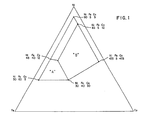
- the high density alloys of the invention contain about 85 to 98 and preferably from about 90 to 97 weight percent tungsten with the balance of the alloy being essentially nickel, iron and cobalt, preferably in the compositional range coming within area "A" of the ternary diagram illustrated in Fig. 1 and, more preferably, coming within the area "B" located within area "A” of such diagram.
- Nickel, iron and cobalt dissolve tungsten when heated to their melting points. While the solubility varies for each element and reduces significantly upon cooling, such solubility is typically in the range of 10-25 weight percent of tungsten retained in solution for the practicable range of nickel/iron/cobalt composition. Nickel shows the highest solubility and cobalt the lowest.
- the present invention comprises the steps of blending powders of tungsten, nickel, iron and cobalt into homogeneous compositions wherein the tungsten is present in an amount of about 85 to 98 percent, and preferably about 90 to 97 percent, by weight and the binder powders of nickel, iron and cobalt are preferably present in amounts falling within area "A" of the ternary diagram of Fig. 1 and more preferably within area "B" of such ternary diagram. It is essential that the cobalt be at least about 5% to 47.5% and, preferably, about 12% to 47.5% by weight of the binder phase of the alloy in order to obtain the improved properties of the invention.
- the concentration ranges for the alloying elements in the binder phase are usually about 30 to 90 percent nickel, 5-65% iron and 5-47.5% cobalt with the amount of cobalt being at least equal to or less than the nickel content of the binder phase.
- an alloy of 90% tungsten will contain 3-9 percent nickel, 0.5-6.5 percent iron and 0.5-4.75 percent cobalt, by weight, and preferably will contain about 3-8.3% nickel, 0.5-4% iron and 1.2-4.75 percent cobalt, by weight.
- An alloy in which tungsten is present in an amount of 97 percent by weight will contain about 0.9-2.7 percent nickel, 0.15-1.95 percent iron and 0.15-1.425 percent cobalt, by weight, and preferably will contain about 0.9-2.49 percent nickel, 0.15-1.2 percent iron and 0.36-1.425% cobalt, by weight.
- a particular useful alloy comprises, by weight, about 93% tungsten, 3.4% nickel, 1.5% iron and 2.1% cobalt.
- Compacted slugs or bars of such powders are prepared by using a pressure of about 10 to 15 tons per square inch, without the addition of a temporary binder or lubricant.
- the slugs or bars are then placed on fused alumina grit in ceramic or molybdenum boats and heated in a hydrogen atmosphere to a temperature in the range of 1460°C to about 1590°C, which temperature is sufficient to liquify the nickel, iron, cobalt and tungsten in solution, for a time of from about 30 to about 60 minutes.
- the bars are heated in an atmosphere of flowing argon gas to a temperature in a range of 1100-1500°C, and preferably, about 1200° to about 1400°C for a period of about 1-3 hours, which conditions are sufficient to enable the intermetallic phase, i.e. the ⁇ phase (which formed at the matrix to tungsten interface during cooling from the sinter temperature) to diffuse into the ⁇ austenitic phase leaving the ⁇ tungsten/ ⁇ austenite boundaries substantially or essentially free of ⁇ phase or intermetallics. Furthermore, a substantial proportion of the residual hydrogen contained in the sintered bar is diffused out and carried away in the argon gas atmosphere.
- the annealed bar with its desired material state is preserved by quenching it in oil, water or brine. Such quenching results in the bar being cooled to room temperature at a rate exceeding about 5°C per second, and, preferably, exceeding about 25°C per second. Unless the bar is rapidly cooled in this manner, the desired improved mechanical properties are not achieved.
- the bar is subsequently swaged with a reduction in area of about 5 to 40% and, typically, 20-25% and then may be aged at a temperature of about 300 to 500°C for about an hour if additional improvement in properties is desired.
- the resulting alloys have unexpectedly improved hardness properties and improved tensile strength properties while substantially retaining their ductility and are suitable for high stress applications, such as, for example, kinetic energy penetrators having improved ballistic performance.
- the alloy material to be swaged is first warmed to about 300°C in order to facilitate the swaging process, for example, if the heavy duty swaging equipment usually recommended is not available, it is possible to swage and age the alloy simultaneously, resulting in a high density, i.e. about 17 to about 18.5, having the improved hardness and tensile strength while maintaining suitable ductility to be worked into, for example, kinetic energy penetrators.
- An alloy, used as a control for comparison with alloys of the invention, was prepared from powders of tungsten, nickel and iron which were homogeneously blended, shaped into a bar having the composition 93% tungsten, 4.9% nickel and 2.1% iron and subjected to a pressure of 15 tons/in2.
- the compacted bar was placed on fused alumina grit in a ceramic boat and heated in a hydrogen atmosphere to a temperature of 1525°C for a period of 30 minutes and then allowed to cool to room temperature.
- the bar was tested and found to have a hardness of 30 Rockwell C, an ultimate tensile strength (UTS) of 917035 kPa (133,000 psi) and an elongation property of 16%.
- UTS ultimate tensile strength
- the sintered bar was annealed in vacuum for 10 hours at 1050°C at a residual atmosphere pressure of about 1.333 Pa (about 0.01/mm of mercury). After cooling to room temperature and then tested, the hardness property of the bar was unchanged. However, the ultimate tensile strength had increased to 927378 kPa (134,500 psi) and the elongation property had increased to 28%.
- the bar was then heat treated in an atmosphere of flowing argon gas at a temperature of 1100°C for one hour and then quenched in water.
- the hardness of the material was unchanged, the ultimate tensile strength was now 930825 kPa (135,000 psi) and the elongation was 31%.
- the bar was then swaged with a reduction in area of 25%.
- the hardness was Rockwell C 39, tensile strength was 1137675 kPa (165,000 psi) and the elongation was 10%.
- Example 1 The process steps of Example 1 were repeated with a high density alloy in which the alloy composition was 93% tungsten, 2.1% cobalt, 3.43% nickel and 1.47% iron.
- This composition represented a 30% substitution of the amount of binder of Example 1 with cobalt, i.e., 30% of the nickel and 30% of the iron were substituted by cobalt with the nickel to iron (Ni:Fe) ratio being maintained as 7:3 in both alloys of Examples 1 and 2.
- Example 2 The alloy mixture of Example 2 was processed and tested in identical fashion to the alloy of Example 1 and the following properties were determined.
- the bar was evaluated for stress, elongation and hardness properties and then was processed through identical swaging and aging steps as described in Example 1, with the following results being obtained.
- Example 3 when the solutionizing of the intermetallics takes place at the annealing temperature of 1350°C, together with the removal of hydrogen from the bar by the argon gas, the increased strength caused by the presence of the cobalt is evident. Comparison of the swaged data demonstrates the unexpected properties associated with cobalt additions in the alloy.
- the Rockwell C hardness of 43, 44.5 and 47.5 obtained in the high density alloys in Table 3 corresponds to a VIIN hardness of about 480, 490 and 565, respectively, which is almost about double the hardness obtained by the prior art.
- the VHN or Vickers hardness is expressed in terms of kilograms per square millimeter.
- a Rockwell C hardness of 43 obtained by the composition of Example 3 after being swaged to 25% reduction is a very significant hardness for the high density alloy and makes it unexpectedly superior for use in high stress applications, such as kinetic energy penetrators, particularly since the ductility of the alloy is satisfactory for making such penetrators.
- Such hardness and tensile strength can additionally be increased by aging the alloy after swaging at a temperature of about 300-600°C for about one hour without greatly reducing the alloy's ductility.
- the properties set forth in Table 3 are totally unexpected and clearly superior. Thus one can further fabricate the alloy to produce improved kinetic energy penetrators.
- the structure of the heavy alloy of Example 3 which was subjected to the annealing treatment at 1350°C and then quenched, consists of spherical tungsten grains and ductile binder phase.
- the intermetallic phase is absent and the alloy is strong and ductile.
- Fig. 2 illustrates the VHN hardness of the tungsten and matrix of the alloys made in accordance with the process described above for Examples 1 and 3. Each alloy was swaged to 25% reduction in area and then aged for one hour at the temperature indicated in Fig. 2. The strength increase in the matrix is a consequence of the enhanced work hardening after swaging because of the lower stacking fault energy of cobalt.
- the increase in the hardness of the tungsten phase from a Vickers diamond microhardness measured at a 25 gram load of 603 to 661 D.P.N. was totally unexpected. This finding is most important because the tungsten phase represents the largest volume fraction of the alloy in the range of tungsten contents of importance in high stress applications, such as kinetic energy penetrators.
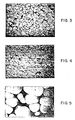
- the photomicrograph of Fig. 4 shows the poor results obtained when the cobalt is present in an amount of 50% by weight of the binder.
- the heavy tungsten alloy has the composition 93% tungsten, 2.45% nickel, 1.05% iron and 3.5% cobalt, by weight, and the alloy was subjected to the same treatment as the heavy tungsten alloy of Example 3, including annealing at 1350°C for two hours. It is readily evident from Fig. 4 that the alloy structure consists of spherical tungsten grains and significant amounts of an intermetallic phase, marked B. The ductile binder phase is marked I and the alloy was extremely brittle.
- the alloy exhibited poor properties.
- the brittle phase is present at the binder/tungsten interface and is indicated by arrow.
- the strength versus ductility properties of the heavy tungsten alloys of Example 1 without cobalt in the binder and Table 3 with cobalt in the binder, wherein the latter is annealed in accordance with the invention, are plotted in the graph of Fig. 6 from the data in Tables 1 and 3 at different stages of the processing.
- the cobalt-containing high density alloys of the invention show superior strength-ductility properties.
- sintered alloys of the compositions set forth in Examples 1 and 3, respectively, after they have been formed, as as-sintered products, and then subjected to a prolonged aging period at 800°C of from one to eight days have their hardness properties increased to a maximum hardness after two days. Further aging results in a continual decrease in hardness properties in the control as-sintered alloy composition made in accordance with Example 1, whereas the as-sintered alloy composition made in accordance with Example 3 has its hardness decrease slightly from its peak after four days and then continually increase to substantially its peak hardness after eight days. This result in the cobalt-containing sintered alloy was totally surprising and unexpected.
Landscapes
- Chemical & Material Sciences (AREA)
- Engineering & Computer Science (AREA)
- Materials Engineering (AREA)
- Mechanical Engineering (AREA)
- Metallurgy (AREA)
- Organic Chemistry (AREA)
- Powder Metallurgy (AREA)
- Catalysts (AREA)
- Contacts (AREA)
- Electroplating Methods And Accessories (AREA)
- Materials For Medical Uses (AREA)
- Soft Magnetic Materials (AREA)
- Electroplating And Plating Baths Therefor (AREA)
- Manufacture Of Alloys Or Alloy Compounds (AREA)
Priority Applications (1)
| Application Number | Priority Date | Filing Date | Title |
|---|---|---|---|
| AT88306989T ATE95842T1 (de) | 1987-07-30 | 1988-07-29 | Schwermetallegierungen aus wolfram-nickel-eisen- kobalt mit hoher haerte und verfahren zur herstellung dieser legierungen. |
Applications Claiming Priority (2)
| Application Number | Priority Date | Filing Date | Title |
|---|---|---|---|
| US07/079,428 US4762559A (en) | 1987-07-30 | 1987-07-30 | High density tungsten-nickel-iron-cobalt alloys having improved hardness and method for making same |
| US79428 | 1987-07-30 |
Publications (2)
| Publication Number | Publication Date |
|---|---|
| EP0304181A1 true EP0304181A1 (de) | 1989-02-22 |
| EP0304181B1 EP0304181B1 (de) | 1993-10-13 |
Family
ID=22150478
Family Applications (1)
| Application Number | Title | Priority Date | Filing Date |
|---|---|---|---|
| EP88306989A Revoked EP0304181B1 (de) | 1987-07-30 | 1988-07-29 | Schwermetallegierungen aus Wolfram-Nickel-Eisen-Kobalt mit hoher Härte und Verfahren zur Herstellung dieser Legierungen |
Country Status (7)
| Country | Link |
|---|---|
| US (1) | US4762559A (de) |
| EP (1) | EP0304181B1 (de) |
| AT (1) | ATE95842T1 (de) |
| BR (1) | BR8803809A (de) |
| DE (1) | DE3884887T2 (de) |
| IL (1) | IL87230A (de) |
| NO (1) | NO172811C (de) |
Cited By (2)
| Publication number | Priority date | Publication date | Assignee | Title |
|---|---|---|---|---|
| FR2706170A1 (fr) * | 1993-06-07 | 1994-12-16 | Nwm Kruithoorn Bv | Alliage de métaux lourds et son procédé de fabrication. |
| RU2206629C2 (ru) * | 2001-06-04 | 2003-06-20 | Государственное унитарное предприятие "Всероссийский научно-исследовательский и проектный институт тугоплавких металлов и твердых сплавов" | Сплав на основе вольфрама |
Families Citing this family (40)
| Publication number | Priority date | Publication date | Assignee | Title |
|---|---|---|---|---|
| FR2617192B1 (fr) * | 1987-06-23 | 1989-10-20 | Cime Bocuze | Procede pour reduire la dispersion des valeurs des caracteristiques mecaniques d'alliages de tungstene-nickel-fer |
| FR2622209B1 (fr) * | 1987-10-23 | 1990-01-26 | Cime Bocuze | Alliages lourds de tungstene-nickel-fer a tres hautes caracteristiques mecaniques et procede de fabrication desdits alliages |
| US5008071A (en) * | 1988-01-04 | 1991-04-16 | Gte Products Corporation | Method for producing improved tungsten nickel iron alloys |
| US4836979A (en) * | 1988-06-14 | 1989-06-06 | Inco Limited | Manufacture of composite structures |
| US5106431A (en) * | 1990-11-13 | 1992-04-21 | Alliant Techsystems Inc. | Process for creating high strength tubing with isotropic mechanical properties |
| US5048162A (en) * | 1990-11-13 | 1991-09-17 | Alliant Techsystems Inc. | Manufacturing thin wall steel cartridge cases |
| SE470204B (sv) * | 1991-05-17 | 1993-12-06 | Powder Tech Sweden Ab | Sätt att framställa en legering med hög densitet och hög duktilitet |
| US5821441A (en) * | 1993-10-08 | 1998-10-13 | Sumitomo Electric Industries, Ltd. | Tough and corrosion-resistant tungsten based sintered alloy and method of preparing the same |
| KR100255356B1 (ko) * | 1997-08-12 | 2000-05-01 | 최동환 | 텅스텐기 소결합금의 열처리방법 |
| US6136105A (en) * | 1998-06-12 | 2000-10-24 | Lockheed Martin Corporation | Process for imparting high strength, ductility, and toughness to tungsten heavy alloy (WHA) materials |
| US6464433B1 (en) * | 1998-12-10 | 2002-10-15 | Kennametal Pc Inc. | Elongate support member and method of making the same |
| US6447715B1 (en) * | 2000-01-14 | 2002-09-10 | Darryl D. Amick | Methods for producing medium-density articles from high-density tungsten alloys |
| KR100375944B1 (ko) * | 2000-07-08 | 2003-03-10 | 한국과학기술원 | 기계적 합금화에 의한 산화물 분산강화 텅스텐 중합금의 제조방법 |
| DE10048833C2 (de) * | 2000-09-29 | 2002-08-08 | Siemens Ag | Vakuumgehäuse für eine Vakuumröhre mit einem Röntgenfenster |
| US7217389B2 (en) * | 2001-01-09 | 2007-05-15 | Amick Darryl D | Tungsten-containing articles and methods for forming the same |
| WO2003064961A1 (en) * | 2002-01-30 | 2003-08-07 | Amick Darryl D | Tungsten-containing articles and methods for forming the same |
| US6749802B2 (en) | 2002-01-30 | 2004-06-15 | Darryl D. Amick | Pressing process for tungsten articles |
| DE10231777A1 (de) * | 2002-07-13 | 2004-02-05 | Diehl Munitionssysteme Gmbh & Co. Kg | Verfahren zur Herstellung eines Wolfram-Basismaterials und Verwendung desselben |
| US7000547B2 (en) | 2002-10-31 | 2006-02-21 | Amick Darryl D | Tungsten-containing firearm slug |
| US7059233B2 (en) * | 2002-10-31 | 2006-06-13 | Amick Darryl D | Tungsten-containing articles and methods for forming the same |
| US7383776B2 (en) * | 2003-04-11 | 2008-06-10 | Amick Darryl D | System and method for processing ferrotungsten and other tungsten alloys, articles formed therefrom and methods for detecting the same |
| US7360488B2 (en) * | 2004-04-30 | 2008-04-22 | Aerojet - General Corporation | Single phase tungsten alloy |
| US7422720B1 (en) | 2004-05-10 | 2008-09-09 | Spherical Precision, Inc. | High density nontoxic projectiles and other articles, and methods for making the same |
| US20050284689A1 (en) * | 2004-06-23 | 2005-12-29 | Michael Simpson | Clockspring with sound dampener |
| EP1955795B1 (de) * | 2005-11-28 | 2012-02-15 | A.L.M.T. Corp. | Tungsten-legierungsteilchen, maschinenbauverfahren damit und herstellungsverfahren dafür |
| US8122832B1 (en) | 2006-05-11 | 2012-02-28 | Spherical Precision, Inc. | Projectiles for shotgun shells and the like, and methods of manufacturing the same |
| US8486541B2 (en) * | 2006-06-20 | 2013-07-16 | Aerojet-General Corporation | Co-sintered multi-system tungsten alloy composite |
| DE102007017306A1 (de) * | 2007-04-11 | 2008-10-16 | H.C. Starck Gmbh | Längliches Hartmetallwerkzeug mit Eisenbasis-Binder |
| WO2010008647A1 (en) * | 2008-07-14 | 2010-01-21 | Exxonmobil Upstream Research Company Corp-Urc-Sw-359 | Systems and methods for determining geologic properties using acoustic analysis |
| DE102010022888B4 (de) | 2010-06-07 | 2012-05-03 | Kennametal Inc. | Legierung für einen Penetrator sowie Verfahren zur Herstellung eines Penetrators aus einer solchen Legierung |
| US9046328B2 (en) | 2011-12-08 | 2015-06-02 | Environ-Metal, Inc. | Shot shells with performance-enhancing absorbers |
| US10260850B2 (en) | 2016-03-18 | 2019-04-16 | Environ-Metal, Inc. | Frangible firearm projectiles, methods for forming the same, and firearm cartridges containing the same |
| US10690465B2 (en) | 2016-03-18 | 2020-06-23 | Environ-Metal, Inc. | Frangible firearm projectiles, methods for forming the same, and firearm cartridges containing the same |
| CN108277411A (zh) * | 2018-03-27 | 2018-07-13 | 江西澳科新材料科技有限公司 | 纳米钨合金及其制备方法 |
| CN113913637A (zh) * | 2020-07-08 | 2022-01-11 | 核工业西南物理研究院 | 一种具有室温韧性块体钨材料的制备方法 |
| CN113969363A (zh) * | 2020-07-23 | 2022-01-25 | 核工业西南物理研究院 | 一种具有低温韧性和高再结晶温度的钨合金的制备方法 |
| CN114293082A (zh) * | 2021-12-28 | 2022-04-08 | 海特信科新材料科技有限公司 | 一种核医疗屏蔽用钨基合金及其制备方法 |
| CN114717556B (zh) * | 2022-03-11 | 2024-04-26 | 珠海粤清特环保科技有限公司 | 一种阀门及其强化方法和应用 |
| CN115522144B (zh) * | 2022-10-10 | 2023-06-23 | 南京理工大学 | 一种高强度钨合金制备方法 |
| CN117403158B (zh) * | 2023-10-19 | 2026-03-24 | 中南大学 | 一种钨钽镍铁铜合金的热处理方法 |
Citations (4)
| Publication number | Priority date | Publication date | Assignee | Title |
|---|---|---|---|---|
| US3988118A (en) * | 1973-05-21 | 1976-10-26 | P. R. Mallory & Co., Inc. | Tungsten-nickel-iron-molybdenum alloys |
| EP0073384A1 (de) * | 1981-08-27 | 1983-03-09 | GTE Products Corporation | Splitterbildendes Wolfram-Wuchtgeschoss |
| EP0098944A2 (de) * | 1982-07-16 | 1984-01-25 | DORNIER SYSTEM GmbH | Wolframlegierungspulver |
| EP0183017A1 (de) * | 1984-10-20 | 1986-06-04 | DORNIER SYSTEM GmbH | Sinterverfahren für vorlegierte Wolframpulver |
Family Cites Families (3)
| Publication number | Priority date | Publication date | Assignee | Title |
|---|---|---|---|---|
| US3888636A (en) * | 1971-02-01 | 1975-06-10 | Us Health | High density, high ductility, high strength tungsten-nickel-iron alloy & process of making therefor |
| US3979239A (en) * | 1974-12-30 | 1976-09-07 | Monsanto Company | Process for chemical-mechanical polishing of III-V semiconductor materials |
| US3979209A (en) * | 1975-02-18 | 1976-09-07 | The United States Of America As Represented By The United States Energy Research And Development Administration | Ductile tungsten-nickel alloy and method for making same |
-
1987
- 1987-07-30 US US07/079,428 patent/US4762559A/en not_active Expired - Fee Related
-
1988
- 1988-07-27 IL IL87230A patent/IL87230A/xx not_active IP Right Cessation
- 1988-07-29 EP EP88306989A patent/EP0304181B1/de not_active Revoked
- 1988-07-29 DE DE88306989T patent/DE3884887T2/de not_active Revoked
- 1988-07-29 NO NO883357A patent/NO172811C/no unknown
- 1988-07-29 AT AT88306989T patent/ATE95842T1/de not_active IP Right Cessation
- 1988-08-01 BR BR8803809A patent/BR8803809A/pt not_active Application Discontinuation
Patent Citations (4)
| Publication number | Priority date | Publication date | Assignee | Title |
|---|---|---|---|---|
| US3988118A (en) * | 1973-05-21 | 1976-10-26 | P. R. Mallory & Co., Inc. | Tungsten-nickel-iron-molybdenum alloys |
| EP0073384A1 (de) * | 1981-08-27 | 1983-03-09 | GTE Products Corporation | Splitterbildendes Wolfram-Wuchtgeschoss |
| EP0098944A2 (de) * | 1982-07-16 | 1984-01-25 | DORNIER SYSTEM GmbH | Wolframlegierungspulver |
| EP0183017A1 (de) * | 1984-10-20 | 1986-06-04 | DORNIER SYSTEM GmbH | Sinterverfahren für vorlegierte Wolframpulver |
Cited By (3)
| Publication number | Priority date | Publication date | Assignee | Title |
|---|---|---|---|---|
| FR2706170A1 (fr) * | 1993-06-07 | 1994-12-16 | Nwm Kruithoorn Bv | Alliage de métaux lourds et son procédé de fabrication. |
| US5462576A (en) * | 1993-06-07 | 1995-10-31 | Nwm De Kruithoorn B.V. | Heavy metal alloy and method for its production |
| RU2206629C2 (ru) * | 2001-06-04 | 2003-06-20 | Государственное унитарное предприятие "Всероссийский научно-исследовательский и проектный институт тугоплавких металлов и твердых сплавов" | Сплав на основе вольфрама |
Also Published As
| Publication number | Publication date |
|---|---|
| ATE95842T1 (de) | 1993-10-15 |
| BR8803809A (pt) | 1989-02-21 |
| IL87230A (en) | 1992-06-21 |
| EP0304181B1 (de) | 1993-10-13 |
| NO883357L (no) | 1989-01-31 |
| NO172811C (no) | 1993-09-08 |
| IL87230A0 (en) | 1988-12-30 |
| DE3884887T2 (de) | 1994-02-10 |
| US4762559A (en) | 1988-08-09 |
| DE3884887D1 (de) | 1993-11-18 |
| NO883357D0 (no) | 1988-07-29 |
| NO172811B (no) | 1993-06-01 |
Similar Documents
| Publication | Publication Date | Title |
|---|---|---|
| EP0304181B1 (de) | Schwermetallegierungen aus Wolfram-Nickel-Eisen-Kobalt mit hoher Härte und Verfahren zur Herstellung dieser Legierungen | |
| DE69400848T2 (de) | Titanaluminid-Legierungen mit guter Kriechfestigkeit | |
| EP1925683B1 (de) | Legierung auf kobaltbasis mit hoher hitzeresistenz und hoher festigkeit sowie herstellungsverfahren dafür | |
| EP0361524B1 (de) | Legierung auf Nickelbasis und Verfahren zu ihrer Herstellung | |
| US5403547A (en) | Oxidation resistant low expansion superalloys | |
| EP1340825B1 (de) | Nickelbasislegierung, heissbeständige Feder aus dieser Legierung und Verfahren zur Herstellung dieser Feder | |
| RU2324576C2 (ru) | Нанокристаллический металлический материал с аустенитной структурой, обладающий высокой твердостью, прочностью и вязкостью, и способ его изготовления | |
| DE60202598T2 (de) | Ultra-hochfester ausscheidungshärtbarer rostfreier stahl und daraus hergestellter länglicher band | |
| US20020033717A1 (en) | Titanium alloy | |
| EP0406638A1 (de) | Gamma-Titan-Aluminium-Legierungen, modifiziert durch Chrom und Tantal und Verfahren zur Herstellung | |
| US5746846A (en) | Method to produce gamma titanium aluminide articles having improved properties | |
| EP0362470A1 (de) | Mit Mangan und Niob modifizierte Titan-Aluminium-Legierungen | |
| EP0312966B1 (de) | Gamma-Prime-Phase enthaltende Legierungen und Verfahren zu ihrer Formung | |
| US4386976A (en) | Dispersion-strengthened nickel-base alloy | |
| Fleischer et al. | Mechanical properties of Ti-Cr-Nb alloys and prospects for high-temperature applications | |
| EP3844314B1 (de) | Kriechfeste titanlegierungen | |
| US5294269A (en) | Repeated sintering of tungsten based heavy alloys for improved impact toughness | |
| EP0171223B1 (de) | Spinodale Legierung Kupfer-Nickel-Zinn-Kobalt | |
| US4732625A (en) | Copper-nickel-tin-cobalt spinodal alloy | |
| EP0379798B1 (de) | Legierung auf Titanbasis für superplastische Formgebung | |
| US4370299A (en) | Molybdenum-based alloy | |
| US2842439A (en) | High strength alloy for use at elevated temperatures | |
| US5089225A (en) | High-niobium titanium aluminide alloys | |
| KR19990015984A (ko) | 텅스텐기 소결 합금의 열처리 방법 | |
| JP2001152208A (ja) | 酸化物分散強化型Ni基合金線およびその製造方法 |
Legal Events
| Date | Code | Title | Description |
|---|---|---|---|
| PUAI | Public reference made under article 153(3) epc to a published international application that has entered the european phase |
Free format text: ORIGINAL CODE: 0009012 |
|
| AK | Designated contracting states |
Kind code of ref document: A1 Designated state(s): AT BE DE FR GB IT NL SE |
|
| 17P | Request for examination filed |
Effective date: 19890816 |
|
| 17Q | First examination report despatched |
Effective date: 19910507 |
|
| GRAA | (expected) grant |
Free format text: ORIGINAL CODE: 0009210 |
|
| AK | Designated contracting states |
Kind code of ref document: B1 Designated state(s): AT BE DE FR GB IT NL SE |
|
| PG25 | Lapsed in a contracting state [announced via postgrant information from national office to epo] |
Ref country code: IT Free format text: LAPSE BECAUSE OF FAILURE TO SUBMIT A TRANSLATION OF THE DESCRIPTION OR TO PAY THE FEE WITHIN THE PRESCRIBED TIME-LIMIT;WARNING: LAPSES OF ITALIAN PATENTS WITH EFFECTIVE DATE BEFORE 2007 MAY HAVE OCCURRED AT ANY TIME BEFORE 2007. THE CORRECT EFFECTIVE DATE MAY BE DIFFERENT FROM THE ONE RECORDED. Effective date: 19931013 Ref country code: SE Effective date: 19931013 Ref country code: AT Effective date: 19931013 |
|
| REF | Corresponds to: |
Ref document number: 95842 Country of ref document: AT Date of ref document: 19931015 Kind code of ref document: T |
|
| ET | Fr: translation filed | ||
| REF | Corresponds to: |
Ref document number: 3884887 Country of ref document: DE Date of ref document: 19931118 |
|
| PGFP | Annual fee paid to national office [announced via postgrant information from national office to epo] |
Ref country code: FR Payment date: 19940711 Year of fee payment: 7 |
|
| PLBI | Opposition filed |
Free format text: ORIGINAL CODE: 0009260 |
|
| PGFP | Annual fee paid to national office [announced via postgrant information from national office to epo] |
Ref country code: GB Payment date: 19940719 Year of fee payment: 7 |
|
| PGFP | Annual fee paid to national office [announced via postgrant information from national office to epo] |
Ref country code: DE Payment date: 19940721 Year of fee payment: 7 |
|
| PGFP | Annual fee paid to national office [announced via postgrant information from national office to epo] |
Ref country code: NL Payment date: 19940731 Year of fee payment: 7 |
|
| 26 | Opposition filed |
Opponent name: METALLWERK PLANSEE GMBH Effective date: 19940712 |
|
| PGFP | Annual fee paid to national office [announced via postgrant information from national office to epo] |
Ref country code: BE Payment date: 19940912 Year of fee payment: 7 |
|
| NLR1 | Nl: opposition has been filed with the epo |
Opponent name: METALLWERK PLANSEE GMBH |
|
| RDAG | Patent revoked |
Free format text: ORIGINAL CODE: 0009271 |
|
| STAA | Information on the status of an ep patent application or granted ep patent |
Free format text: STATUS: PATENT REVOKED |
|
| 27W | Patent revoked |
Effective date: 19950515 |
|
| GBPR | Gb: patent revoked under art. 102 of the ep convention designating the uk as contracting state |
Free format text: 950515 |
|
| NLR2 | Nl: decision of opposition |