EP0098944A2 - Wolframlegierungspulver - Google Patents
Wolframlegierungspulver Download PDFInfo
- Publication number
- EP0098944A2 EP0098944A2 EP83105070A EP83105070A EP0098944A2 EP 0098944 A2 EP0098944 A2 EP 0098944A2 EP 83105070 A EP83105070 A EP 83105070A EP 83105070 A EP83105070 A EP 83105070A EP 0098944 A2 EP0098944 A2 EP 0098944A2
- Authority
- EP
- European Patent Office
- Prior art keywords
- tungsten
- iron
- particles
- alloy powder
- binder
- Prior art date
- Legal status (The legal status is an assumption and is not a legal conclusion. Google has not performed a legal analysis and makes no representation as to the accuracy of the status listed.)
- Granted
Links
Images

Classifications
-
- B—PERFORMING OPERATIONS; TRANSPORTING
- B22—CASTING; POWDER METALLURGY
- B22F—WORKING METALLIC POWDER; MANUFACTURE OF ARTICLES FROM METALLIC POWDER; MAKING METALLIC POWDER; APPARATUS OR DEVICES SPECIALLY ADAPTED FOR METALLIC POWDER
- B22F1/00—Metallic powder; Treatment of metallic powder, e.g. to facilitate working or to improve properties
- B22F1/05—Metallic powder characterised by the size or surface area of the particles
-
- B—PERFORMING OPERATIONS; TRANSPORTING
- B22—CASTING; POWDER METALLURGY
- B22F—WORKING METALLIC POWDER; MANUFACTURE OF ARTICLES FROM METALLIC POWDER; MAKING METALLIC POWDER; APPARATUS OR DEVICES SPECIALLY ADAPTED FOR METALLIC POWDER
- B22F9/00—Making metallic powder or suspensions thereof
- B22F9/16—Making metallic powder or suspensions thereof using chemical processes
- B22F9/18—Making metallic powder or suspensions thereof using chemical processes with reduction of metal compounds
- B22F9/20—Making metallic powder or suspensions thereof using chemical processes with reduction of metal compounds starting from solid metal compounds
- B22F9/22—Making metallic powder or suspensions thereof using chemical processes with reduction of metal compounds starting from solid metal compounds using gaseous reductors
-
- C—CHEMISTRY; METALLURGY
- C22—METALLURGY; FERROUS OR NON-FERROUS ALLOYS; TREATMENT OF ALLOYS OR NON-FERROUS METALS
- C22C—ALLOYS
- C22C1/00—Making non-ferrous alloys
- C22C1/04—Making non-ferrous alloys by powder metallurgy
- C22C1/05—Mixtures of metal powder with non-metallic powder
- C22C1/059—Making alloys comprising less than 5% by weight of dispersed reinforcing phases
-
- C—CHEMISTRY; METALLURGY
- C22—METALLURGY; FERROUS OR NON-FERROUS ALLOYS; TREATMENT OF ALLOYS OR NON-FERROUS METALS
- C22C—ALLOYS
- C22C27/00—Alloys based on rhenium or a refractory metal not mentioned in groups C22C14/00 or C22C16/00
- C22C27/04—Alloys based on tungsten or molybdenum
-
- F—MECHANICAL ENGINEERING; LIGHTING; HEATING; WEAPONS; BLASTING
- F42—AMMUNITION; BLASTING
- F42B—EXPLOSIVE CHARGES, e.g. FOR BLASTING, FIREWORKS, AMMUNITION
- F42B12/00—Projectiles, missiles or mines characterised by the warhead, the intended effect, or the material
- F42B12/02—Projectiles, missiles or mines characterised by the warhead, the intended effect, or the material characterised by the warhead or the intended effect
- F42B12/04—Projectiles, missiles or mines characterised by the warhead, the intended effect, or the material characterised by the warhead or the intended effect of armour-piercing type
- F42B12/06—Projectiles, missiles or mines characterised by the warhead, the intended effect, or the material characterised by the warhead or the intended effect of armour-piercing type with hard or heavy core; Kinetic energy penetrators
-
- Y—GENERAL TAGGING OF NEW TECHNOLOGICAL DEVELOPMENTS; GENERAL TAGGING OF CROSS-SECTIONAL TECHNOLOGIES SPANNING OVER SEVERAL SECTIONS OF THE IPC; TECHNICAL SUBJECTS COVERED BY FORMER USPC CROSS-REFERENCE ART COLLECTIONS [XRACs] AND DIGESTS
- Y10—TECHNICAL SUBJECTS COVERED BY FORMER USPC
- Y10T—TECHNICAL SUBJECTS COVERED BY FORMER US CLASSIFICATION
- Y10T428/00—Stock material or miscellaneous articles
- Y10T428/12—All metal or with adjacent metals
- Y10T428/12181—Composite powder [e.g., coated, etc.]
Definitions
- the invention relates to a heterogeneous tungsten alloy powder which, in addition to tungsten, contains a binder phase composed of nickel, cobalt and iron, a process for the production of the powder and its use for the production of balancing projectiles.
- High-density materials are required for highly stressed metal parts, especially balancing projectiles.
- uranium and tungsten also meet the requirements for high density.
- the only metal that is traded at high density at a reasonable price is tungsten.
- tungsten is difficult to process because it is very brittle. It is poorly suited as a balancing bullet because it cannot withstand the tensile and compressive loads that occur.
- Balancing bullets are solid cylinders made of metal, the length of which far exceeds the caliber. When a balancing bullet hits an inclined armor plate, the balancing bullet tilts. In the relatively long body, high bending moments occur, which often lead to the bullet breaking and thus to relative ineffectiveness.
- the tungsten grains are always larger than the powder particles in the starting powder.
- the occurrence of a molten phase during the sintering process always results in an additional enlargement of the tungsten grains, which is made possible by the dissolving and redissolving processes between the tungsten and the liquid matrix.
- the phenomenon of the grain enlargement of solid precipitates in contact with liquids is of a fundamental nature and is known as Ostwald ripening.
- Point F lüssigphasengesinterte tungsten alloys s ch typical of a structure of spherical tungsten particles, each in a range of about 10 - present 60 / to large particles, which are embedded in a binder alloy.
- the strength and elongation at break are each limited by the largest particles (here approx. 60 / um). It can often be observed that large grains have grown together. Materials with such a coarse-grained structure do not have sufficient strength and are only slightly deformable.
- the invention has for its object to provide an alloy powder for the production of sintered parts, in particular balancing projectiles, which in addition to high specific weight, high tensile strength (> 1200 N / mm 2 ) and elongation at break (> 20%).
- Embodiments of the invention and manufacturing methods are the subject of subclaims.
- the simultaneous presence of extreme tensile strength with extreme elongation at break is not yet known and identifies the tungsten sintered parts according to the invention as ideal materials for balancing projectiles.
- the material survives both the high pressure and tensile loads when accelerating in the pipe and the high bending moments and compressive forces in the projectile when hitting armor.
- the outstanding properties make the sintered parts according to the invention also suitable for other tasks in science and technology in which the highest demands are placed on strength and toughness.
- F ig. 1 shows the tungsten alloy powder according to the invention in a thousand times magnification. It consists of particles with an approximately spherical shape (large ball to the right of the center of the picture). The diameter is 10 - 50 / um.
- the balls have a sponge-like structure.
- the sponge structure is made up of tungsten grains of about 1 / um diameter, which are covered and held together by a thin coating of binder metal. As a result, the distribution of tungsten and binder metal that is characteristic of the finished workpiece is predetermined.
- the inventive powder is therefore alloyed finished and the B inthe alloy already surrounds the W grains in the form of a coating. So that must be more dense during manufacture Sintered bodies the two processes of forming the binder alloy and coating the tungsten grains can no longer be carried out with the aid of a molten phase.
- the powder can be sintered into dense bodies in the solid phase.
- the sponge structure of the powder particles is loosely structured so that the powder can be compressed to around 50% of the theoretical density of a compact under 3 kbar pressure.
- This high green density in connection with the large specific surface area of the order of 1 m 2 / g enables the pressure-free sealing sintering of the compacts while avoiding liquid phases.
- FIG. 2 shows a micrograph of a sintered alloy according to the invention in a magnification of 600 times.
- FIG. 3 shows an alloy produced according to the prior art, that is to say liquid phase sintered, in a magnification of 600 times.
- the tungsten alloy powder according to the invention is compacted by pressing and then preferably sintered in hydrogen in the solid phase. Even at a sintering temperature of 900 ° C, the sintered density reaches over 95% of the theoretical density. With sinter Temperatures between 1200 0 C and 1300 ° C can be produced non-porous sintered bodies.
- the microstructure of the compacts of the festphasengesinterten Fig. 2 ig, in contrast to the liquid-phase parts of the F. 3 no spherical tungsten grains, but an almost space-filling arrangement of polygonal tungsten grains, between which the matrix metal is distributed in a thin layer. 2 is much more fine-grained than the structure of FIG. 3 achieved by liquid phase sintering.
- the diameter of the tungsten grains is 2-5 ⁇ m and the grain size distribution is very narrow-band.
- a line structure can be achieved (not shown) in which the tungsten grains are deformed by approximately 200%.
- the fine-grained and homogeneous structure is the reason for the superior mechanical properties of the sintered parts produced from the powders according to the invention.
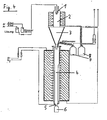
- FIG. 4 shows an arrangement for producing the tungsten powder according to the invention with atomizing nozzle 1, evaporator part 2, separator 3, reducing part 4, hydrogen inlet 5 and discharge member 6, and two containers 7 and 8 for condensate and exhaust gas.
- the powder according to the invention is produced as follows: A common solution of a tungsten salt and the salts of the matrix metals - examples of solution preparation are given below - is sprayed through the atomizer unit 1 and reaches the 800 ° C. evaporator part 2 as an aerosol. Fine particles are formed , which consist of the homogeneously distributed salts (or other compounds) of the alloy components.
- the solid and the gaseous products of the evaporation process are separated in the separator 3. Condensate, and exhaust gas released into the container 7 and 8.
- the reduction part 4 of the solid fraction obtained in separator 3 drops (mostly oxides) a slowly rising flow of hydrogen towards and is reduced at a temperature of 950 ° C to 1200 0 C to the metal.
- the speed of the gas flow can be regulated at the hydrogen inlet 5.
- the finished reduced powder leaves the reduction part 4 through the discharge member 6.
- the salt or oxide production and the subsequent reduction can also be carried out in succession in two separate apparatuses.
- Example 2 a solution of 113.5 g WO 3 in ammonia solution is prepared and filtered through a butterfly filter into a dropping funnel. 39.6 g of Ni (NO 3 ) 2 are placed in a 3-necked flask with two dropping funnels, gas inlet tube, gas outlet with wash bottle and suction tube for the solution. 6H 2 0, 3.6 g FeCl 2 - 4H 2 0 and 2.2 g CoCl 2 weighed out. The first dropping funnel is filled with 450 ml of the filtered WO 3 solution, the second dropping funnel contains 100 ml of semi-concentrated ammonia solution.
- the 3-neck flask and the gas space above the solutions in the dropping funnels are flushed with nitrogen for 20 min. Then the ammonia solution is added dropwise to the salts in the flask with stirring. After the addition has ended, the WO 3 solution from the second dropping funnel is added to the salt solution. Via the suction pipe, the solution can be fed to the metal powder production process described below in the absence of air.
- WO 3 126 g of WO 3 are as triggers e-1 in the example in ammonia solution g. After filtration, the volume is about 900 ml. 393 g of CuSO 4 .5H 2 O are weighed into a 2000 ml beaker and dissolved in 500 ml of water at 50.degree. 500 ml of 33% NH 3 solution are slowly added to the solution. The tungstate and copper solutions are then combined. Avoid standing longer in the cold.
- the hydrogen stron. is 400 standard liters per hour.
- the yield is above 80%.
- the powder contains less than 20 ppm Si0 2 , and depending on the solution preparation between 0 and 900 ppm carbon as well 500 ppm nitrogen.
- the powder particles have a spherical shape. Their average diameter is 20-30 ⁇ m .
- the structure of the particles is spongy.
- the powder of the composition 90% W, 6% Ni, 2% Fe, 2% Co (in percent by weight) has a bulk density of 0.85 g / cm 3 after production. It is compressed by axial or isostatic cold pressing at a pressure of 3 kbar to test specimens, the green density of which is approximately 8.5 g / cm 3 . Due to the sponge-like structure of the powder, which results in good interlocking of the particles after pressing, compacts with high green strength can also be produced without the addition of binders.
- the compact is sintered in dry, flowing hydrogen at 1300 ° C for 4 hours and then degassed in a vacuum of approx. 10 -2 mbar at 1050 ° C for 0.5 hours.
- the resulting sintered body is absolutely non-porous and has a fine-grained sintered structure with W grains of 2 - 5 / um diameter, which are surrounded by a thin skin made of binder alloy.
Landscapes
- Chemical & Material Sciences (AREA)
- Engineering & Computer Science (AREA)
- Combustion & Propulsion (AREA)
- General Engineering & Computer Science (AREA)
- Chemical Kinetics & Catalysis (AREA)
- General Chemical & Material Sciences (AREA)
- Materials Engineering (AREA)
- Mechanical Engineering (AREA)
- Metallurgy (AREA)
- Organic Chemistry (AREA)
- Dispersion Chemistry (AREA)
- Powder Metallurgy (AREA)
- Manufacture Of Metal Powder And Suspensions Thereof (AREA)
- Preventing Corrosion Or Incrustation Of Metals (AREA)
- Inorganic Compounds Of Heavy Metals (AREA)
Abstract
Description
- Die Erfindung betrifft ein heterogenes Wolframlegierungspulver, welches neben Wolfram eine Binderphase aus Nickel, Kobalt und Eisen enthält, Verfahren zur Herstellung des Pulvers und seine Verwendung zur Herstellung von Wuchtgeschossen.
- Für hochbeanspruchte Metallteile, insbesondere Wuchtgeschosse, werden Werkstoffe hoher Dichte benötigt. Neben den Edelmetallen Gold und Platin erfüllen noch Uran und Wolfram die Anforderungen nach hoher Dichte. Das einzige Metall, das bei hoher Dichte zu einem vertretbaren Preis gehandelt wird, ist Wolfram. Als reines Metall ist Wolfram jedoch schwierig zu verarbeiten, da es sehr spröde ist. Als Wuchtgeschoss ist es schlecht geeignet, da es die auftretenden Zug- und Druckbelastungen nicht aushält. Wuchtgeschosse sind Vollzylinder aus Metall, deren Länge den Kaliber bei weitem übersteigt. Beim Auftreffen eines Wuchtgeschosses auf eine schrägstehende Panzerplatte verkippt das Wuchtgeschoss. In dem relativ langen Körper treten hohe Biegemomente auf, die häufig zu Bruch des Geschosses und damit zur relativen Wirkungslosigkeit führen.
- Darum kommen für einen Einsatz als Konstruktionswerkstoff für so hoch beanspruchte Bauteile nur Verbundmaterialien in Frage, die das Wolfram in einer duktilen Binderlegierung eingebettet enthalten. Um bei hoher Dichte hohe Festigkeit und Zähigkeit zu erreichen, ist ein Gefügeaufbau erforderlich, der das Wolfram in Form feiner einzelner Partikel enthält, die allseitig von einer sehr dünnen Schicht eines duktilen Bindermetalls umschlossen sind. Das Gefüge darf keine Poren aufweisen. Die mechanischen Eigenschaften (Zugfestigkeit, Bruchdehnung) der Teile sind umso vorteilhafter, je feinkörniger das Gefüge ist.
- Bekannt ist aus F.Eisenkolb, Fortschritte der Pulvermetallurgie, 1963 Band II Seite 439 der Zusatz von in Wolfram löslichen Elementen, wie z.B. Re, die die Duktilität des Wolframs an sich erhöhen. Auf den Seiten 430 bis 433 werden Eigenschaften homogener Wolframlegierungen und die Möglichkeit des Festphasensinterns für homogene Wolframlegierungen angegeben. Homogene Wolframlegierungen eignen sich wegen ihrer geringen Duktilität nicht zur Herstellung von Wuchtgeschossen.
- Bekannt ist die Herstellung von Bauteilen aus heterogenen Wolframlegierungen durch Flüssigphasensintern. Eine Pulvermischung von Wolframpulver und pulverförmigen Legierungskomponenten wird gepresst und anschliessend gesintert. Um ein porenfreies Gefüge zu erzielen, wird die Technik des Flüssigphasensinterns angewandt. Die Sintertemperatur wird dabei so hoch gewählt, dass die Binderlegierung schmelzflüssig ist. Dabei laufen im wesentlichen drei Prozesse ab:
- 1. Die Binderlegierung bildet sich aus den Pulvern der einzelnen Legierungskomponenten.
- 2. Die schmelzflüssige Binderlegierung umhüllt die Wolframkörner.
- 3. Der Körper verdichtet sich bis zur vollständigen Porenfreiheit.
- Im gesinterten Zustand sind die Wolframkörner immer grösser als die Pulverpartikel im Ausgangspulver. Das Auftreten einer schmelzflüssigen Phase beim Sinterprozess hat immer eine zusätzliche Vergrösserung der Wolframkörner zur Folge, die durch An- und Umlöseprozesse zwischen Wolfram und flüssiger Matrix ermöglicht wird. Das Phänomen der Kornvergrösserung von festen Ausscheidungen im Kontakt mit Flüssigkeiten ist grundsätzlicher Natur und unter dem Begriff der Ostwaldreifung bekannt.
- Flüssigphasengesinterte Wolframlegierungen weisen typi- scherweise ein Gefüge aus kugeligen Wolframteilchen auf, die jeweils in einem Spektrum von etwa 10 - 60 /um großen Partikeln vorliegen, die in einer Binderlegierung eingebettet sind. Die Festigkeit und die Bruchdehnung werden aber jeweils durch die grössten vorhandenen Partikel (hier ca. 60 /um) begrenzt. Häufig ist zu beobachten, dass grosse Körner zusammengewachsen sind. Werkstoffe mit derartig grobkörnigem Gefüge weisen eine nicht ausreichende Festigkeit und nur eine geringe Verformbarkeit auf.
- Auch durch die Wahl feinerer Ausgangspulver sind keine erheblich feineren Gefüge zu erzielen, da die für die Ostwaldreifung verantwortlichen treibenden Kräfte (Verringerung der freien Oberflächenenergie) mit steigender spezifischer Oberfläche der Partikel ansteigen. Auch durch isostatisches Heißpressen ist beim derzeitigen Stand der Technik eine wesentliche Verfeinerung des Gefüges nicht zu erzielen, da dabei ebenfalls eine flüssige Phase benötigt wird, um die Legierungsbildung der Bindermetalle und eine porenfreie Umschliessung der Wolframkörner durch die Binderlegierung zu ermöglichen.
- Der Erfindung liegt die Aufgabe zugrunde, ein Legierungspulver zur Herstellung von Sinterteilen, insbesondere von Wuchtgeschossen, zu schaffen, die neben hohem spezifischen Gewicht eine hohe Zugfestigkeit ( >1200 N/mm2) und Bruchdehnung (> 20 %) aufweisen.
- Gelöst wird diese Aufgabe von einem Legierungspulver mit den in Anspruch 1 genannten Merkmalen.
- Ausführungen der Erfindung und Herstellungsverfahren sind Gegenstände von Unteransprüchen.
- Die erfindungsgemässe Legierung weist nach dem Sintern ohne zusätzliche thermomechanische Nachbehandlung folgende Eigenschaften auf:
- Zugfestigkeit > 1200 N/mm2 bei gleichzeitiger Bruchdehnung >25 %. Der Stand der Technik kennt Zugfestigkeiten von 1200 N/mm2 bei lediglich 8 - 10 % Bruchdehnung oder Zugfestigkeiten von 900 N/mm2 bei 25 % Bruchdehnung.
- Das gleichzeitige Vorliegen von extremer Zugfestigkeit bei extremer Bruchdehnung ist bisher nicht bekannt und weist die erfindungsgemässen Wolfram-Sinterteile als ideale Werkstoffe für Wuchtgeschosse aus. Sowohl die hohen Druck- und Zugbelastungen beim Beschleunigen im Rohr als auch die hohen Biegemomente und Druckkräfte im Geschoss beim Auftreffen auf eine Panzerung werden von dem Material unbeschadet überstanden. Die hervorragenden Eigenschaften prädestinieren die erfindungsgemässen Sinterteile auch für andere Aufgaben in Wissenschaft und Technik, in denen höchste Anforderungen an die Festigkeit und Zähigkeit gestellt werden.
- Weitere Vorteile, Merkmale und Anwendungen ergeben sich aus den Figuren, die nachfolgend beschrieben werden.
- Es zeigen:
- Fig. 1 erfindungsgemässe Pulverpartikel,
- Fig. 2 erfindungsgemässes Sintermetall,
- Fig. 3 Sintermetall aus dem Stand der Technik,
- Fig. 4 eine Anordnung zur Herstellung des erfindungsgemässen Legierungspulvers.
- Fig. 1 zeigt das erfindungsgemässe Wolframlegierungspulver in tausendfacher Vergrösserung. Es besteht aus Partikeln mit annähernd kugeliger Gestalt (grosse Kugel rechts der Bildmitte). Der Durchmesser beträgt 10 - 50 /um. Die Kugeln weisen eine schwammartige Struktur auf. Die Schwammstruktur wird aufgebaut aus Wolframkörnern von etwa 1 /um Durchmesser, die von einem dünnen Überzug aus Bindermetall bedeckt und zusammengehalten sind. Dadurch ist bereits diejenige Verteilung von Wolfram und Bindermetall vorgegeben, die für das fertige Werkstück kennzeichnend ist.
- Im Gegensatz zu den nach dem Stand der Technik verwendeten Pulvermischungen aus W, Ni, Co und Fe-Pulver ist das erfindungsgemässe Pulver also fertig legiert und die Binderlegierung umschliesst bereits die W-Körner in Form eines Überzuges. Damit müssen bei der Herstellung dichter Sinterkörper die beiden Prozesse Bildung der Binderlegierung und Umhüllung der Wolframkörner nicht mehr unter Zuhilfenahme einer schmelzflüssigen Phase durchgeführt werden. Das Pulver kann in der festen Phase zu dichten Körpern versintert werden.
- Die Schwammstruktur der Pulverpartikel ist locker aufgebaut, so dass das Pulver unter 3 kbar Pressdruck auf etwa 50 % der theoretischen Dichte eines Kompaktums verdichtet werden kann. Diese hohe Gründichte in Verbindung mit der grossen spezifischen Oberfläche von grössenordnungsmässig 1 m2/g ermöglicht das druckfreie Dichtsintern der Presslinge unter Vermeidung von flüssigen Phasen.
- Fig. 2 zeigt ein Schliffbild einer erfindungsgemässen gesinterten Legierung in 600-facher Vergrösserung.
- Fig. 3 zeigt zum Vergleich eine gemäss dem Stand der Technik hergestellte, also flüssigphasengesinterte Legierung in 600-facher Vergrösserung.
- Das erfindungsgemässe Wolframlegierungspulver wird durch Pressen kompaktiert und anschliessend vorzugsweise in Wasserstoff in der festen Phase gesintert. Bereits bei einer Sintertemperatur von 900° C erreicht die Sinterdichte über 95 % der theoretischen Dichte. Mit Sintertemperaturen zwischen 12000 C und 1300° C lassen sich porenfreie Sinterkörper herstellen.
- Das Gefüge der festphasengesinterten Presslinge der Fig. 2 weist im Gegensatz zu den flüssigphasengesinterten Teilen der Fig. 3 keine kugeligen Wolframkörner auf, sondern eine nahezu raumerfüllende Anordnung polygoner Wolframkörner, zwischen denen in dünner Schicht das Matrixmetall verteilt ist. Das Sintergefüge der Fig. 2 ist wesentlich feinkörniger als das durch Flüssigphasensintern erreichte Gefüge der Fig. 3. Wie aus Fig. 2 zu entnehmen ist, beträgt der Durchmesser der Wolframkörner 2 - 5 µm und die Korngrössenverteilung ist sehr schmalbandig. Beim Aufbringen gerichteter Kräfte lässt sich ein zeiliges Gefüge erzielen (nicht gezeigt), in dem die Wolframkörner über etwa 200 % verformt sind. Das feinkörnige und homogene Gefüge ist die Ursache für die überlegenen mechanischen Eigenschaften der aus den erfindungsgemässen Pulvern hergestellten Sinterteile.
- Fig. 4 zeigt eine Anordnung zur Herstellung des erfindungsgemässen Wolframpulvers mit Zerstäuberdüse 1, Verdampferteil 2, Separator 3, Reduktionsteil 4, Wasserstoffeintritt 5 und Austrageorgan 6, sowie zwei Behältern 7 und 8 für Kondensat und Abgas.
- Das erfindungsgemässe Pulver wird wie folgt hergestellt: Eine gemeinsame Lösung eines Wolframsalzes und der Salze der Matrixmetalle - Beispiele zur Lösungsbereitung werden weiter unten angegeben - wird durch die Zerstäubereinheit 1 versprüht und gelangt als Aerosol in den 8000 C heissen Verdampferteil 2. Es entstehen feine Partikel, die aus den homogen ineinander verteilten Salzen (oder anderen Verbindungen) der Legierungskomponenten bestehen.
- Im Separator 3 werden die festen und die gasförmigen Produkte des Verdampfungsprozesses getrennt. Kondensat und Abgas gelangen in die Behälter 7 und 8. Im Reduktionsteil 4 fällt der im Separator 3 gewonnene Feststoffanteil (hauptsächlich Oxide) einem langsam aufsteigenden Wasserstoffstrom entgegen und wird bei einer Temperatur von 950° C bis 12000 C zum Metall reduziert. Am Wasserstoffeintritt 5 kann die Geschwindigkeit der Gasströmung geregelt werden. Das fertig reduzierte Pulver verlässt den Reduktionsteil 4 durch das Austrageorgan 6. Die Salz- bzw. Oxidherstellung und die nachfolgende Reduktion können auch nacheinander in zwei getrennten Apparaturen durchgeführt werden.
- Entscheidend für die hohe Sinteraktivität des Pulvers, die allein ein Festphasensintern ermöglicht, sind die Feinheit der Zerstäubung bei der Pulverherstellung, die Konzentration und Zusammensetzung der gemeinsamen Lösung sowie die schonende Reduktion der Salz- bzw. Oxidpartikel, bei der ein Zusammenwachsen der Salz- oder der Metallpartikel vermieden werden muss.
- Bis zu einer Salzkonzentration, die 600 g aufgelöstem Metall pro Liter Lösung entspricht, ist eine Zerstäubung ausreichend, die ein mittleres Tropfenspektrum von 30 bis 50 µm erzeugt. Die aus der Lösung entstehenden Feststoffpartikel haben eine dem Tropfenspektrum vergleichbare Grössenverteilung. Wichtig ist bereits an dieser Stelle die Schwammstruktur der Feststoffpartikel, die im nachfolgenden Reduktionsschritt kurze Diffusionswege und damit kurze Reaktionszeiten erlaubt. Auf diese Weise ist eine Reduktion der Partikel im freien Fall möglich, bei der ein Zusammenwachsen der Salz- oder Metallpartikel unterbleibt.
- Bei den Versuchen hat sich als Lösungsmittel Wasser bewährt. Bei dessen Verwendung fielen die obengenannten Feststoffpartikel als Oxidmischungen an. Als Reduktionsmittel kam in diesen Fällen Wasserstoff zur Anwendung. Die Lösungsbereitung kann auf zwei Wegen erfolgen:
- Entweder man arbeitet in schwach saurem Medium bei einem pH > 3 unter Verwendung von Ammoniummetawolframat als löslicher Wolframverbindung oder man bereitet eine ammoniakalische Lösung von Wolframsäure, deren Anhydrid oder einem ihrer Salze und verhindert die Fällung der Kationen der Matrixmetalle durch Komplexieren entweder mit Ammoniak oder mit den üblichen organischen Komplexbildnern wie z.B. EDTA. Die Verwendung kolloidaler Wolframverbindungen, z.B. in der Form von H2 WO4 aq, WO3 oder Ammoniumparawolframat, führte nach kurzer Zeit zu Störungen bei der Lösungszerstäubung.
- Im Falle eisenhaltiger Lösungen muss beim Komplexieren mit Ammoniak von Salzen des zweiwertigen Eisens ausgegangen und Luftzutritt sorgfältig ausgeschlossen werden. Auch bei der Verwendung von Ammoniummetawolframat stört dreiwertiges Eisen, da es in den üblichen Konzentrationen den pH der Lösung auf Werte um 1 einstellt, so dass nach etwa 1 h Aufbewahrung ein Niederschlag ausfällt, der ein Zerstäuben der Lösung verhindert. Lösungen, die Eisen (II)-Ionen enthalten, bleiben nach dem Filtrieren über Blaubandfilter länger als 24 h bei Raumtemperatur klar.
- Es folgen Beispiele zur Lösungsherstellung, zur Pulverherstellung und zur Sinterung:
- In ein 800 ml Becherglas werden 117,3 g W03 eingewogen und mit ca. 300 ml Wasser aufgeschlämmt. Es wird 3 h bei Siedehitze gerührt, bis die Farbe des Bodenkörpers von gelb nach weiß umgeschlagen ist. Nach dem Abkühlen auf Raumtemperatur wird mit 100 ml 33%iger NH3-Lösung versetzt und schwach erwärmt. Nach 30 bis 40 Minuten wird die fast klare Lösung über ein Faltenfilter filtriert.
- In ein 250 ml Becherglas werden 24,3 g Ni(NO3)2 · 6H20, 6,0 g Co(CH3COO)2· 4H20, 5,06 g Fe(NO3)3 · 9H20 und 45 g EDTA eingewogen und mit 80 ml Wasser aufgerührt. In die Suspension werden langsam 30 - 40 ml 33%ige NH3-Lösung eingetropft, so dass eine dunkelviolette Lösung entsteht, die mit dem Filtrat der Wolframlösung vereinigt wird.
- Wie im Beispiel 1 wird eine Lösung von 113,5 g WO3 in Ammoniak-Lösung hergestellt und über einen Falterfilter in einen Tropftrichter filtriert. In einen 3-Hals-Kolben mit zwei Tropftrichtern, Gaseinleitungsrohr, Gasaustritt mit Waschflasche und Ansaugrohr für die Lösung werden 39,6 g Ni(NO3)2 . 6H20, 3,6 g FeCl2 - 4H20 und 2,2 g CoCl2 eingewogen. Der erste Tropftrichter ist mit 450 ml der filtrierten WO3-Lösung gefüllt, der zweite Tropftrichter enthält 100 ml halbkonzentrierte Ammoniaklösung.
- Der 3-Hals-Kolben und der Gasraum über den Lösungen in den Tropftrichtern wird 20 min mit Stickstoff gespült. Dann wird unter Rühren die Ammoniaklösung zu den Salzen im Kolben getropft. Nach Beendigung der Zugabe wird die WO3-Lösung aus dem zweiten Tropftrichter zur Salzlösung gegeben. über das Ansaugrohr kann die Lösung unter Luftausschluss dem nachstehend beschriebenen Verfahren zur Metallpulverherstellung zugeführt werden.
- 126 g WO3 werden wie im Beispiel 1 in Ammoniaklösung aufge-löst. Nach der Filtration beträgt das Volumen etwa 900 ml. In ein 2000 ml Becherglas werden 393 g CuSO4 · 5H2O eingewogen und bei 50°C in 500 ml Wasser aufgelöst. Zur Lösung werden langsam 500 ml 33%ige NH3-Lösung gegeben. Anschliessend werden die Wolframat- und die Kupferlösung vereinigt. Längeres Stehen in der Kälte ist zu vermeiden.
- Es werden 800 ml H20 vorgelegt. 485,3 g Ammoniummetawolframat werden unter kräftigem Rühren langsam zugeschüttet. Es wird weitergerührt bis eine klare Lösung entstanden ist. Zur Wolframat-Lösung werden 28,5 g FeCl2 · 4H20 in 500 ml H20 unter starkem Rühren langsam zugegeben. Es ist wichtig, dass die Anwesenheit von dreiwertigem Eisen weitgehend ausgeschlossen wird, da sonst innerhalb kurzer Zeit ein gelb-weißer Niederschlag ausfällt. Zur so bereiteten Eisen-Wolfram-Lösung werden anschliessend 118,9 gNi(NO3)2 · 6H2O und 39,5 g Co(NO3)2 · 6H2O, gelöst im Gesamtvolumen von 500 ml, zugefügt.
- In einem typischen Experiment werden in der oben beschriebenen Anlage 2 1 Lösung pro h versprüht. Der Wasserstoffstron. beträgt 400 Normliter pro h. Die Ausbeute liegt oberhalb 80%. Das Pulver enthält weniger als 20 ppm Si02, undje nach Lösungsherstellung zwischen 0 und 900 ppm Kohlenstoff sowie 500 ppm Stickstoff. Die Pulverpartikel haben Kugelform. Ihr Durchmesser beträgt im Mittel 20 - 30 /um. Die Struktur der Partikel ist schwammartig.
- Das Pulver der Zusammensetzung 90% W, 6% Ni, 2% Fe, 2% Co (in Gewichtsprozenten) besitzt nach der Herstellung eine Schüttdichte von 0,85 g/cm3. Es wird durch axiales oder isostatisches Kaltpressen bei einem Druck von 3 kbar zu Probekörpern verdichtet, deren Gründichte etwa 8,5 g/cm3 beträgt. Aufgrund der schwammartigen Struktur der Pulver, die eine gute Verzahnung der Partikel nach dem Pressen bewirkt, lassen sich auch ohne Zusätze von Bindemitteln Preßlinge mit hoher Grünfestigkeit herstellen.
- Der Preßling wird in trockenem, strömenden Wasserstoff bei 1300°C 4 Stunden gesintert und anschliessend in Vakuum von ca. 10 -2 mbar bei 1050°C 0,5 Stunden entgast.
- Der entstandene Sinterkörper ist absolut porenfrei und weist ein feinkörniges Sintergefüge mit W-Körnern von 2 - 5 /um Durchmesser auf, die von einer dünnen Haut aus Binderlegierung umgeben sind.
Claims (9)
Priority Applications (1)
| Application Number | Priority Date | Filing Date | Title |
|---|---|---|---|
| AT83105070T ATE25111T1 (de) | 1982-07-16 | 1983-05-21 | Wolframlegierungspulver. |
Applications Claiming Priority (2)
| Application Number | Priority Date | Filing Date | Title |
|---|---|---|---|
| DE3226648 | 1982-07-16 | ||
| DE3226648A DE3226648C2 (de) | 1982-07-16 | 1982-07-16 | Heterogenes Wolfram-Legierungspulver |
Publications (3)
| Publication Number | Publication Date |
|---|---|
| EP0098944A2 true EP0098944A2 (de) | 1984-01-25 |
| EP0098944A3 EP0098944A3 (en) | 1984-03-28 |
| EP0098944B1 EP0098944B1 (de) | 1987-01-21 |
Family
ID=6168588
Family Applications (1)
| Application Number | Title | Priority Date | Filing Date |
|---|---|---|---|
| EP83105070A Expired EP0098944B1 (de) | 1982-07-16 | 1983-05-21 | Wolframlegierungspulver |
Country Status (7)
| Country | Link |
|---|---|
| US (1) | US4498395A (de) |
| EP (1) | EP0098944B1 (de) |
| JP (1) | JPS5925950A (de) |
| KR (1) | KR910003572B1 (de) |
| AT (1) | ATE25111T1 (de) |
| DE (2) | DE3226648C2 (de) |
| IL (1) | IL69232A (de) |
Cited By (13)
| Publication number | Priority date | Publication date | Assignee | Title |
|---|---|---|---|---|
| EP0183017A1 (de) * | 1984-10-20 | 1986-06-04 | DORNIER SYSTEM GmbH | Sinterverfahren für vorlegierte Wolframpulver |
| EP0204909A1 (de) * | 1985-05-29 | 1986-12-17 | Dornier Gmbh | Elektrodenmaterial für eine Funkenstrecke |
| EP0304181A1 (de) * | 1987-07-30 | 1989-02-22 | Teledyne Industries, Inc. | Schwermetallegierungen aus Wolfram-Nickel-Eisen-Kobalt mit hoher Härte und Verfahren zur Herstellung dieser Legierungen |
| EP0326861A1 (de) * | 1988-01-30 | 1989-08-09 | H.C. Starck GmbH & Co. KG | Agglomerierte Metall-Verbund-Pulver, Verfahren zu ihrer Herstellung sowie deren Verwendung |
| EP0332474A1 (de) * | 1988-03-11 | 1989-09-13 | Camco Drilling Group Limited | Zusammenstellung von Schneideinsätzen für Drehbohrmeissel |
| FR2659735A1 (fr) * | 1990-03-07 | 1991-09-20 | Saint Louis Inst | Projectile hypersonique a effet cinetique et procede pour sa realisation. |
| DE3637930C1 (en) * | 1985-11-07 | 1992-04-09 | Fraunhofer Ges Forschung | Mfg. composite material for armour piercing ammunition - using alloy powder contg. tungsten@, nickel@, iron@, copper@, titanium@, aluminium@ and/or molybdenum@ |
| FR2672619A1 (fr) * | 1985-11-07 | 1992-08-14 | Fraunhofer Ges Forschung | Materiau composite a base de tungstene et procede pour sa preparation. |
| EP0384623B1 (de) * | 1989-02-14 | 1994-03-02 | Camco Drilling Group Limited | Schneidelemente für Drehbohrmeissel |
| FR2784690A1 (fr) * | 1998-10-16 | 2000-04-21 | Eurotungstene Poudres | Poudres metalliques microniques a base de tungstene et/ou de molybdene et de materiaux de transition 3d |
| CN100363131C (zh) * | 2005-12-12 | 2008-01-23 | 北京科技大学 | 一种晶粒尺寸可控的超细晶粒钨及钨铜复合材料的制备方法 |
| CN104722767A (zh) * | 2015-04-16 | 2015-06-24 | 柳州豪祥特科技有限公司 | 一种钨粉的制备方法 |
| EP3643429A1 (de) * | 2018-10-23 | 2020-04-29 | Bayerische Metallwerke GmbH | Wolframlegierungsprodukt, sowie herstellungsverfahren und verwendung für ein wolframlegierungsprodukt |
Families Citing this family (49)
| Publication number | Priority date | Publication date | Assignee | Title |
|---|---|---|---|---|
| US4970960A (en) * | 1980-11-05 | 1990-11-20 | Feldmann Fritz K | Anti-material projectile |
| DE3715979A1 (de) * | 1985-11-13 | 1988-12-08 | Mtu Muenchen Gmbh | Verfahren zur herstellung dispersionsgehaerteter metallegierungen |
| US4897117A (en) * | 1986-03-25 | 1990-01-30 | Teledyne Industries, Inc. | Hardened penetrators |
| DE3634433A1 (de) * | 1986-10-09 | 1988-04-14 | Diehl Gmbh & Co | Einlage fuer hohlladungen bzw. penetratoren oder wuchtkoerper fuer geschosse |
| DE3700805A1 (de) * | 1987-01-14 | 1990-03-08 | Fraunhofer Ges Forschung | Faserverstaerkter verbundwerkstoff auf der basis von wolframschwermetall |
| DE3705382A1 (de) * | 1987-02-20 | 1988-09-01 | Diehl Gmbh & Co | Penetrator und verfahren zu seiner herstellung |
| NL8700935A (nl) * | 1987-04-21 | 1988-11-16 | Philips Nv | Geimpregneerde kathodes met een gekontroleerde porositeit. |
| FR2615046B1 (fr) * | 1987-05-04 | 1992-12-31 | Merlin Gerin | Materiau composite fritte pour contact electrique et pastille de contact utilisant ledit materiau |
| US4811666A (en) * | 1988-01-04 | 1989-03-14 | Lutfy Eric A | Solid projectiles |
| US5008071A (en) * | 1988-01-04 | 1991-04-16 | Gte Products Corporation | Method for producing improved tungsten nickel iron alloys |
| DE3821474C1 (de) * | 1988-06-25 | 1998-08-27 | Nwm De Kruithoorn Bv | Unterkalibriges, drallstabilisiertes Mehrzweckgeschoß |
| DE3830111A1 (de) * | 1988-09-05 | 1990-03-15 | Dornier Gmbh | Legierungspulver |
| US5189252A (en) * | 1990-10-31 | 1993-02-23 | Safety Shot Limited Partnership | Environmentally improved shot |
| US5088415A (en) * | 1990-10-31 | 1992-02-18 | Safety Shot Limited Partnership | Environmentally improved shot |
| US5913256A (en) * | 1993-07-06 | 1999-06-15 | Lockheed Martin Energy Systems, Inc. | Non-lead environmentally safe projectiles and explosive container |
| US5897962A (en) * | 1993-07-16 | 1999-04-27 | Osram Sylvania Inc. | Method of making flowable tungsten/copper composite powder |
| US5399187A (en) * | 1993-09-23 | 1995-03-21 | Olin Corporation | Lead-free bullett |
| US5821441A (en) * | 1993-10-08 | 1998-10-13 | Sumitomo Electric Industries, Ltd. | Tough and corrosion-resistant tungsten based sintered alloy and method of preparing the same |
| JPH07216478A (ja) * | 1994-02-04 | 1995-08-15 | Nippon Yakin Kogyo Co Ltd | タングステン合金の製造方法 |
| SE504244C2 (sv) * | 1994-03-29 | 1996-12-16 | Sandvik Ab | Sätt att tillverka kompositmaterial av hårdämnen i en metallbindefas |
| MX9700050A (es) * | 1994-07-06 | 1997-12-31 | Lockheed Martin Energy Sys Inc | Proyectiles sin plomo, seguros ambientalmente, y metodo para su fabricacion. |
| US6103392A (en) * | 1994-12-22 | 2000-08-15 | Osram Sylvania Inc. | Tungsten-copper composite powder |
| US5876793A (en) * | 1996-02-21 | 1999-03-02 | Ultramet | Fine powders and method for manufacturing |
| US5789698A (en) * | 1997-01-30 | 1998-08-04 | Cove Corporation | Projectile for ammunition cartridge |
| US5847313A (en) * | 1997-01-30 | 1998-12-08 | Cove Corporation | Projectile for ammunition cartridge |
| US6607692B2 (en) | 1997-01-30 | 2003-08-19 | Doris Nebel Beal Intervivos Patent Trust | Method of manufacture of a powder-based firearm ammunition projectile employing electrostatic charge |
| US6551376B1 (en) | 1997-03-14 | 2003-04-22 | Doris Nebel Beal Inter Vivos Patent Trust | Method for developing and sustaining uniform distribution of a plurality of metal powders of different densities in a mixture of such metal powders |
| KR100217032B1 (ko) * | 1997-06-14 | 1999-09-01 | 박호군 | 구리 용침용 텅스텐 골격 구조 제조 방법 및 이를 이용한 텅스텐-구리 복합재료 제조 방법 |
| SE510659C2 (sv) * | 1997-10-14 | 1999-06-14 | Sandvik Ab | Sätt att framställa en hårdmetall innefattande beläggning av partiklar av hårdämnet med bindemetall |
| SE9704847L (sv) * | 1997-12-22 | 1999-06-21 | Sandvik Ab | Sätt att framställa ett metallkompositmaterial innehållande hårda partiklar och bindemetall |
| CA2334552C (en) * | 2000-02-07 | 2007-04-24 | Halliburton Energy Services, Inc. | High performance powdered metal mixtures for shaped charge liners |
| US7011027B2 (en) * | 2000-05-20 | 2006-03-14 | Baker Hughes, Incorporated | Coated metal particles to enhance oil field shaped charge performance |
| DE10041194A1 (de) * | 2000-08-23 | 2002-03-07 | Starck H C Gmbh | Verfahren zur Herstellung von Verbundbauteilen durch Pulver-Spritzgießen und dazu geeignete Verbundpulver |
| US7243588B2 (en) | 2001-05-15 | 2007-07-17 | Doris Nebel Beal Inter Vivos Patent Trust | Power-based core for ammunition projective |
| WO2003104742A2 (en) * | 2001-05-15 | 2003-12-18 | Beal Harold F | In-situ formation of cap for ammunition projectile |
| RU2206629C2 (ru) * | 2001-06-04 | 2003-06-20 | Государственное унитарное предприятие "Всероссийский научно-исследовательский и проектный институт тугоплавких металлов и твердых сплавов" | Сплав на основе вольфрама |
| US7849695B1 (en) | 2001-09-17 | 2010-12-14 | Alliant Techsystems Inc. | Rocket thruster comprising load-balanced pintle valve |
| JP2005524515A (ja) * | 2002-04-25 | 2005-08-18 | ザ・モーガン・クルーシブル・カンパニー・ピーエルシー | 触媒を用いたダイヤモンドの製造方法および合成において使用されるグラファイト/触媒混合物の加工方法 |
| US20040105881A1 (en) * | 2002-10-11 | 2004-06-03 | Gregor Cevc | Aggregates with increased deformability, comprising at least three amphipats, for improved transport through semi-permeable barriers and for the non-invasive drug application in vivo, especially through the skin |
| US7690312B2 (en) * | 2004-06-02 | 2010-04-06 | Smith Timothy G | Tungsten-iron projectile |
| WO2006083725A2 (en) * | 2005-02-01 | 2006-08-10 | Carlotto John A | Vacuum deposition of coating materials on powders |
| US8196571B2 (en) * | 2006-03-10 | 2012-06-12 | Jenson Martin W | Apparatus, system, and method for launching a granular substance |
| US20090042057A1 (en) * | 2007-08-10 | 2009-02-12 | Springfield Munitions Company, Llc | Metal composite article and method of manufacturing |
| WO2009032989A1 (en) * | 2007-09-06 | 2009-03-12 | Shaiw-Rong Scott Liu | Kinetic energy penetrator |
| JP5522712B2 (ja) * | 2008-08-25 | 2014-06-18 | 公立大学法人兵庫県立大学 | 遷移金属内包タングステン炭化物、タングステン炭化物分散超硬合金及びそれらの製造方法 |
| JP5522713B2 (ja) * | 2008-08-25 | 2014-06-18 | 公立大学法人兵庫県立大学 | 遷移金属固溶タングステン合金粉末及びその製造方法 |
| DE102015102763A1 (de) * | 2015-02-26 | 2016-09-01 | Vacuumschmelze Gmbh & Co. Kg | Verfahren zum Herstellen eines thermoelektrischen Gegenstands für eine thermoelektrische Umwandlungsvorrichtung |
| JP2018035020A (ja) | 2016-08-30 | 2018-03-08 | 住友電気工業株式会社 | 水溶液組成物およびその製造方法、酸化物粉末およびその製造方法、炭化物粉末およびその製造方法、ならびに、超硬合金およびその製造方法 |
| TWI798480B (zh) * | 2016-12-09 | 2023-04-11 | 美商史達克公司 | 利用積層製造製備金屬部件及其所用之含鎢重金屬合金粉末 |
Family Cites Families (16)
| Publication number | Priority date | Publication date | Assignee | Title |
|---|---|---|---|---|
| GB812848A (en) * | 1956-06-26 | 1959-05-06 | Mallory Metallurg Prod Ltd | Improvements in and relating to high density sintered metal compositions or alloys |
| DE1253919B (de) | 1959-01-08 | 1967-11-09 | Renault | Verfahren zur pulvermetallurgischen Herstellung von Formkoerpern aus Wolfram und Kupfer |
| GB977249A (en) | 1962-08-09 | 1964-12-02 | Diosgyoeri Gepgyar | Contact pulley for continuously operating softening machines in wire manufacture |
| FR1429965A (fr) | 1964-04-21 | 1966-02-25 | English Electric Co Ltd | Contact ou électrode pour interrupteurs ou éclateurs sous vide |
| GB1054154A (de) * | 1964-10-15 | |||
| US3382066A (en) | 1965-07-23 | 1968-05-07 | Mallory & Co Inc P R | Method of making tungsten-copper composites |
| FR2225980A5 (de) * | 1969-10-28 | 1974-11-08 | Onera (Off Nat Aerospatiale) | |
| FR2155565A5 (en) | 1971-12-09 | 1973-05-18 | Energoinvest Preduzece Za Proj | Tungsten-copper impregnated with copper - by electrolytic impregnation and subsequent heat treatment |
| US4050933A (en) * | 1973-02-21 | 1977-09-27 | Stanadyne, Inc. | Impervious metal object and method of making the same |
| US3973948A (en) | 1973-11-12 | 1976-08-10 | Gte Sylvania Incorporated | Free flowing powder and process for producing it |
| ES199626Y (es) * | 1974-01-19 | 1975-12-16 | Centro De Est. Tec De Mate. Esp. - Inst. Nac. Ind. | Proyectil de pequeno calibre con punta asimetrica. |
| US3907546A (en) * | 1974-03-28 | 1975-09-23 | Gte Sylvania Inc | Molybdenum flame spray powder and process |
| US4060414A (en) * | 1975-06-06 | 1977-11-29 | Ford Motor Company | Copper coated iron-carbon eutectic alloy powders |
| US4012230A (en) * | 1975-07-07 | 1977-03-15 | The United States Of America As Represented By The United States Energy Research And Development Administration | Tungsten-nickel-cobalt alloy and method of producing same |
| US4440800A (en) * | 1980-04-24 | 1984-04-03 | Unisearch Limited | Vapor coating of powders |
| JPS56166311A (en) * | 1980-05-26 | 1981-12-21 | Sumitomo Electric Ind Ltd | Manufacture of alloy powder containing molybdenum and tungsten |
-
1982
- 1982-07-16 DE DE3226648A patent/DE3226648C2/de not_active Expired
-
1983
- 1983-05-21 AT AT83105070T patent/ATE25111T1/de not_active IP Right Cessation
- 1983-05-21 DE DE8383105070T patent/DE3369346D1/de not_active Expired
- 1983-05-21 EP EP83105070A patent/EP0098944B1/de not_active Expired
- 1983-07-06 US US06/511,510 patent/US4498395A/en not_active Expired - Fee Related
- 1983-07-15 KR KR1019830003235A patent/KR910003572B1/ko not_active Expired
- 1983-07-15 IL IL69232A patent/IL69232A/xx unknown
- 1983-07-15 JP JP58128074A patent/JPS5925950A/ja active Granted
Cited By (14)
| Publication number | Priority date | Publication date | Assignee | Title |
|---|---|---|---|---|
| EP0183017A1 (de) * | 1984-10-20 | 1986-06-04 | DORNIER SYSTEM GmbH | Sinterverfahren für vorlegierte Wolframpulver |
| EP0204909A1 (de) * | 1985-05-29 | 1986-12-17 | Dornier Gmbh | Elektrodenmaterial für eine Funkenstrecke |
| FR2672619A1 (fr) * | 1985-11-07 | 1992-08-14 | Fraunhofer Ges Forschung | Materiau composite a base de tungstene et procede pour sa preparation. |
| DE3637930C1 (en) * | 1985-11-07 | 1992-04-09 | Fraunhofer Ges Forschung | Mfg. composite material for armour piercing ammunition - using alloy powder contg. tungsten@, nickel@, iron@, copper@, titanium@, aluminium@ and/or molybdenum@ |
| EP0304181A1 (de) * | 1987-07-30 | 1989-02-22 | Teledyne Industries, Inc. | Schwermetallegierungen aus Wolfram-Nickel-Eisen-Kobalt mit hoher Härte und Verfahren zur Herstellung dieser Legierungen |
| EP0326861A1 (de) * | 1988-01-30 | 1989-08-09 | H.C. Starck GmbH & Co. KG | Agglomerierte Metall-Verbund-Pulver, Verfahren zu ihrer Herstellung sowie deren Verwendung |
| US4915733A (en) * | 1988-01-30 | 1990-04-10 | Hermann C. Starck Berlin Gmbh & Co. Kg | Agglomerated metal composite powders |
| EP0332474A1 (de) * | 1988-03-11 | 1989-09-13 | Camco Drilling Group Limited | Zusammenstellung von Schneideinsätzen für Drehbohrmeissel |
| EP0384623B1 (de) * | 1989-02-14 | 1994-03-02 | Camco Drilling Group Limited | Schneidelemente für Drehbohrmeissel |
| FR2659735A1 (fr) * | 1990-03-07 | 1991-09-20 | Saint Louis Inst | Projectile hypersonique a effet cinetique et procede pour sa realisation. |
| FR2784690A1 (fr) * | 1998-10-16 | 2000-04-21 | Eurotungstene Poudres | Poudres metalliques microniques a base de tungstene et/ou de molybdene et de materiaux de transition 3d |
| CN100363131C (zh) * | 2005-12-12 | 2008-01-23 | 北京科技大学 | 一种晶粒尺寸可控的超细晶粒钨及钨铜复合材料的制备方法 |
| CN104722767A (zh) * | 2015-04-16 | 2015-06-24 | 柳州豪祥特科技有限公司 | 一种钨粉的制备方法 |
| EP3643429A1 (de) * | 2018-10-23 | 2020-04-29 | Bayerische Metallwerke GmbH | Wolframlegierungsprodukt, sowie herstellungsverfahren und verwendung für ein wolframlegierungsprodukt |
Also Published As
| Publication number | Publication date |
|---|---|
| DE3226648C2 (de) | 1984-12-06 |
| EP0098944A3 (en) | 1984-03-28 |
| JPH0224882B2 (de) | 1990-05-31 |
| KR840005492A (ko) | 1984-11-14 |
| ATE25111T1 (de) | 1987-02-15 |
| US4498395A (en) | 1985-02-12 |
| EP0098944B1 (de) | 1987-01-21 |
| JPS5925950A (ja) | 1984-02-10 |
| KR910003572B1 (ko) | 1991-06-05 |
| IL69232A0 (en) | 1983-11-30 |
| DE3369346D1 (en) | 1987-02-26 |
| IL69232A (en) | 1985-10-31 |
| DE3226648A1 (de) | 1984-01-19 |
Similar Documents
| Publication | Publication Date | Title |
|---|---|---|
| EP0098944B1 (de) | Wolframlegierungspulver | |
| DE3802811C2 (de) | ||
| DE60121242T2 (de) | Molybdän-Kupfer-Verbundpulver sowie dessen Herstellung und Verarbeitung zu einer Pseudolegierung | |
| DE69113966T2 (de) | Verbundpulver aus aluminiumoxyd/metall, cermets daraus und verfahren zu ihrer herstellung. | |
| DE2047143C1 (de) | Hochwarmfeste Sinterlegierung und Verfahren zu deren Herstellung | |
| DE60106149T2 (de) | Wasserstoffabsorbierndes Legierungspulver und Verfahren zur Herstellung desselben sowie Treibstofftank zur Lagerung von Wasserstoff | |
| DE69103677T2 (de) | Verfahren zur Herstellung von Pulvern aus einer Nickellegierung und Molybdän für thermische Spritzbeschichtungen. | |
| EP1042218B1 (de) | Verfahren zur herstellung nanokristalliner metallhydride | |
| DE19962015A1 (de) | Pulvermischungen bzw. Verbundpulver, Verfahren zu ihrer Herstellung und ihre Verwendung in Verbundwerkstoffen | |
| DE102007047523B3 (de) | Verfahren zur Herstellung von Halbzeuge aus NiTi-Formgedächtnislegierungen | |
| DE69932148T2 (de) | METALLPULVER IM MICRONBEREICH AUF BASIS VON 3d ÜBERGANGSMETALLEN | |
| DE19950595C1 (de) | Verfahren zur Herstellung von Sinterteilen aus einer Aluminiumsintermischung | |
| EP0183017B2 (de) | Sinterverfahren für vorlegierte Wolframpulver | |
| WO2008065136A2 (de) | Metallpulver | |
| DE2347375A1 (de) | Verfahren zur herstellung von fein zerteiltem kugelfoermigen nickelpulver | |
| DE69804220T2 (de) | Vorlegiertes kupferenthaltendes pulver und seine verwendung in der herstellung von diamantwerkzeugen | |
| EP2061615A1 (de) | Verfahren zur herstellung von kompositpulvern sowie kompositpulver | |
| DE3116185A1 (de) | "metallbinder fuer das verpressen von metallpulvern" | |
| DE2163866C3 (de) | Verfahren zur Herstellung eines Nickelpulvers mit Kugelform | |
| AT411580B (de) | Verfahren zur pulvermetallurgischen herstellung von gegenständen | |
| EP0223196A2 (de) | Verfahren zur Herstellung dispersionsgehärteter Metall-Legierungen | |
| DE10301175B4 (de) | Verfahren zur pulvermetallurgischen Herstellung von Bauteilen | |
| DE2032862A1 (de) | Verfahren zur Herstellung von wechselseitigen Dispersionen von Carbiden und Metallen oder Legierungen und neue, so erhaltene Produkte | |
| DE3729780A1 (de) | Verfahren zur steigerung der eindringleistung von p-ladungen durch optimierung des werkstoffes der einlage | |
| DE102018102322A1 (de) | Verfahren zum Herstellen einer Mangan-Bismut Legierung |
Legal Events
| Date | Code | Title | Description |
|---|---|---|---|
| PUAI | Public reference made under article 153(3) epc to a published international application that has entered the european phase |
Free format text: ORIGINAL CODE: 0009012 |
|
| AK | Designated contracting states |
Designated state(s): AT BE CH DE FR GB IT LI NL SE |
|
| PUAL | Search report despatched |
Free format text: ORIGINAL CODE: 0009013 |
|
| AK | Designated contracting states |
Designated state(s): AT BE CH DE FR GB IT LI NL SE |
|
| 17P | Request for examination filed |
Effective date: 19840829 |
|
| GRAA | (expected) grant |
Free format text: ORIGINAL CODE: 0009210 |
|
| AK | Designated contracting states |
Kind code of ref document: B1 Designated state(s): AT BE CH DE FR GB IT LI NL SE |
|
| REF | Corresponds to: |
Ref document number: 25111 Country of ref document: AT Date of ref document: 19870215 Kind code of ref document: T |
|
| REF | Corresponds to: |
Ref document number: 3369346 Country of ref document: DE Date of ref document: 19870226 |
|
| ET | Fr: translation filed | ||
| ITF | It: translation for a ep patent filed | ||
| PLBE | No opposition filed within time limit |
Free format text: ORIGINAL CODE: 0009261 |
|
| STAA | Information on the status of an ep patent application or granted ep patent |
Free format text: STATUS: NO OPPOSITION FILED WITHIN TIME LIMIT |
|
| 26N | No opposition filed | ||
| PGFP | Annual fee paid to national office [announced via postgrant information from national office to epo] |
Ref country code: CH Payment date: 19890415 Year of fee payment: 7 |
|
| PGFP | Annual fee paid to national office [announced via postgrant information from national office to epo] |
Ref country code: BE Payment date: 19890525 Year of fee payment: 7 |
|
| ITTA | It: last paid annual fee | ||
| PG25 | Lapsed in a contracting state [announced via postgrant information from national office to epo] |
Ref country code: LI Effective date: 19900531 Ref country code: CH Effective date: 19900531 Ref country code: BE Effective date: 19900531 |
|
| REG | Reference to a national code |
Ref country code: GB Ref legal event code: 732 |
|
| BERE | Be: lapsed |
Owner name: DORNIER SYSTEM G.M.B.H. Effective date: 19900531 |
|
| REG | Reference to a national code |
Ref country code: CH Ref legal event code: PL |
|
| EAL | Se: european patent in force in sweden |
Ref document number: 83105070.3 |
|
| PGFP | Annual fee paid to national office [announced via postgrant information from national office to epo] |
Ref country code: SE Payment date: 19950420 Year of fee payment: 13 |
|
| PGFP | Annual fee paid to national office [announced via postgrant information from national office to epo] |
Ref country code: AT Payment date: 19950512 Year of fee payment: 13 |
|
| PG25 | Lapsed in a contracting state [announced via postgrant information from national office to epo] |
Ref country code: AT Effective date: 19960521 |
|
| PG25 | Lapsed in a contracting state [announced via postgrant information from national office to epo] |
Ref country code: SE Effective date: 19960522 |
|
| EUG | Se: european patent has lapsed |
Ref document number: 83105070.3 |
|
| PGFP | Annual fee paid to national office [announced via postgrant information from national office to epo] |
Ref country code: NL Payment date: 19970531 Year of fee payment: 15 |
|
| PG25 | Lapsed in a contracting state [announced via postgrant information from national office to epo] |
Ref country code: NL Free format text: LAPSE BECAUSE OF NON-PAYMENT OF DUE FEES Effective date: 19981201 |
|
| NLV4 | Nl: lapsed or anulled due to non-payment of the annual fee |
Effective date: 19981201 |
|
| PGFP | Annual fee paid to national office [announced via postgrant information from national office to epo] |
Ref country code: FR Payment date: 19990927 Year of fee payment: 17 Ref country code: DE Payment date: 19990927 Year of fee payment: 17 |
|
| PGFP | Annual fee paid to national office [announced via postgrant information from national office to epo] |
Ref country code: GB Payment date: 19991011 Year of fee payment: 17 |
|
| PG25 | Lapsed in a contracting state [announced via postgrant information from national office to epo] |
Ref country code: GB Free format text: LAPSE BECAUSE OF NON-PAYMENT OF DUE FEES Effective date: 20000521 |
|
| GBPC | Gb: european patent ceased through non-payment of renewal fee |
Effective date: 20000521 |
|
| PG25 | Lapsed in a contracting state [announced via postgrant information from national office to epo] |
Ref country code: FR Free format text: LAPSE BECAUSE OF NON-PAYMENT OF DUE FEES Effective date: 20010131 |
|
| PG25 | Lapsed in a contracting state [announced via postgrant information from national office to epo] |
Ref country code: DE Free format text: LAPSE BECAUSE OF NON-PAYMENT OF DUE FEES Effective date: 20010301 |
|
| REG | Reference to a national code |
Ref country code: FR Ref legal event code: ST |