EP0305599A1 - Verfahren zur Herstellung von Halbtonbildern - Google Patents
Verfahren zur Herstellung von Halbtonbildern Download PDFInfo
- Publication number
- EP0305599A1 EP0305599A1 EP87201655A EP87201655A EP0305599A1 EP 0305599 A1 EP0305599 A1 EP 0305599A1 EP 87201655 A EP87201655 A EP 87201655A EP 87201655 A EP87201655 A EP 87201655A EP 0305599 A1 EP0305599 A1 EP 0305599A1
- Authority
- EP
- European Patent Office
- Prior art keywords
- gelatin
- layer
- silver halide
- halftone
- support
- Prior art date
- Legal status (The legal status is an assumption and is not a legal conclusion. Google has not performed a legal analysis and makes no representation as to the accuracy of the status listed.)
- Granted
Links
- 238000004519 manufacturing process Methods 0.000 title claims abstract description 21
- GWEVSGVZZGPLCZ-UHFFFAOYSA-N Titan oxide Chemical compound O=[Ti]=O GWEVSGVZZGPLCZ-UHFFFAOYSA-N 0.000 claims abstract description 54
- 239000000049 pigment Substances 0.000 claims abstract description 35
- 239000000084 colloidal system Substances 0.000 claims abstract description 31
- 238000000034 method Methods 0.000 claims abstract description 31
- 239000011230 binding agent Substances 0.000 claims abstract description 25
- 230000008569 process Effects 0.000 claims abstract description 24
- 239000004408 titanium dioxide Substances 0.000 claims abstract description 17
- 239000002245 particle Substances 0.000 claims abstract description 16
- 239000007788 liquid Substances 0.000 claims abstract description 14
- 229920000098 polyolefin Polymers 0.000 claims abstract description 13
- -1 silver halide Chemical class 0.000 claims description 73
- 229910052709 silver Inorganic materials 0.000 claims description 61
- 239000004332 silver Substances 0.000 claims description 61
- 108010010803 Gelatin Proteins 0.000 claims description 54
- 239000000839 emulsion Substances 0.000 claims description 54
- 229920000159 gelatin Polymers 0.000 claims description 54
- 239000008273 gelatin Substances 0.000 claims description 54
- 235000019322 gelatine Nutrition 0.000 claims description 54
- 235000011852 gelatine desserts Nutrition 0.000 claims description 54
- 239000000463 material Substances 0.000 claims description 32
- 238000011161 development Methods 0.000 claims description 17
- 239000004816 latex Substances 0.000 claims description 12
- 229920000126 latex Polymers 0.000 claims description 12
- BQCADISMDOOEFD-UHFFFAOYSA-N Silver Chemical compound [Ag] BQCADISMDOOEFD-UHFFFAOYSA-N 0.000 claims description 11
- 238000012545 processing Methods 0.000 claims description 10
- 238000012546 transfer Methods 0.000 claims description 10
- 229920001577 copolymer Polymers 0.000 claims description 9
- VGGSQFUCUMXWEO-UHFFFAOYSA-N Ethene Chemical compound C=C VGGSQFUCUMXWEO-UHFFFAOYSA-N 0.000 claims description 7
- 239000005977 Ethylene Substances 0.000 claims description 7
- KAKZBPTYRLMSJV-UHFFFAOYSA-N Butadiene Chemical compound C=CC=C KAKZBPTYRLMSJV-UHFFFAOYSA-N 0.000 claims description 6
- RRHGJUQNOFWUDK-UHFFFAOYSA-N Isoprene Chemical compound CC(=C)C=C RRHGJUQNOFWUDK-UHFFFAOYSA-N 0.000 claims description 6
- PPBRXRYQALVLMV-UHFFFAOYSA-N Styrene Chemical compound C=CC1=CC=CC=C1 PPBRXRYQALVLMV-UHFFFAOYSA-N 0.000 claims description 6
- 229920000642 polymer Polymers 0.000 claims description 6
- 239000007787 solid Substances 0.000 claims description 6
- 229920001600 hydrophobic polymer Polymers 0.000 claims description 4
- SMZOUWXMTYCWNB-UHFFFAOYSA-N 2-(2-methoxy-5-methylphenyl)ethanamine Chemical compound COC1=CC=C(C)C=C1CCN SMZOUWXMTYCWNB-UHFFFAOYSA-N 0.000 claims description 3
- NIXOWILDQLNWCW-UHFFFAOYSA-N 2-Propenoic acid Natural products OC(=O)C=C NIXOWILDQLNWCW-UHFFFAOYSA-N 0.000 claims description 3
- JIGUQPWFLRLWPJ-UHFFFAOYSA-N Ethyl acrylate Chemical compound CCOC(=O)C=C JIGUQPWFLRLWPJ-UHFFFAOYSA-N 0.000 claims description 3
- CERQOIWHTDAKMF-UHFFFAOYSA-N Methacrylic acid Chemical compound CC(=C)C(O)=O CERQOIWHTDAKMF-UHFFFAOYSA-N 0.000 claims description 3
- VVQNEPGJFQJSBK-UHFFFAOYSA-N Methyl methacrylate Chemical compound COC(=O)C(C)=C VVQNEPGJFQJSBK-UHFFFAOYSA-N 0.000 claims description 3
- XTXRWKRVRITETP-UHFFFAOYSA-N Vinyl acetate Chemical compound CC(=O)OC=C XTXRWKRVRITETP-UHFFFAOYSA-N 0.000 claims description 3
- AFSIMBWBBOJPJG-UHFFFAOYSA-N ethenyl octadecanoate Chemical compound CCCCCCCCCCCCCCCCCC(=O)OC=C AFSIMBWBBOJPJG-UHFFFAOYSA-N 0.000 claims description 3
- 229920001903 high density polyethylene Polymers 0.000 claims description 3
- 239000004700 high-density polyethylene Substances 0.000 claims description 3
- 229920001519 homopolymer Polymers 0.000 claims description 3
- 229920001684 low density polyethylene Polymers 0.000 claims description 3
- 239000004702 low-density polyethylene Substances 0.000 claims description 3
- PNJWIWWMYCMZRO-UHFFFAOYSA-N pent‐4‐en‐2‐one Natural products CC(=O)CC=C PNJWIWWMYCMZRO-UHFFFAOYSA-N 0.000 claims description 3
- 229920001384 propylene homopolymer Polymers 0.000 claims description 3
- 239000003795 chemical substances by application Substances 0.000 description 22
- 238000000576 coating method Methods 0.000 description 16
- 239000002131 composite material Substances 0.000 description 16
- XLYOFNOQVPJJNP-UHFFFAOYSA-N water Substances O XLYOFNOQVPJJNP-UHFFFAOYSA-N 0.000 description 16
- 238000002360 preparation method Methods 0.000 description 13
- 238000007639 printing Methods 0.000 description 13
- WSFSSNUMVMOOMR-UHFFFAOYSA-N Formaldehyde Chemical compound O=C WSFSSNUMVMOOMR-UHFFFAOYSA-N 0.000 description 12
- 239000000203 mixture Substances 0.000 description 12
- 239000006224 matting agent Substances 0.000 description 11
- 239000011248 coating agent Substances 0.000 description 10
- 239000008199 coating composition Substances 0.000 description 10
- 239000004698 Polyethylene Substances 0.000 description 9
- KWYUFKZDYYNOTN-UHFFFAOYSA-M Potassium hydroxide Chemical compound [OH-].[K+] KWYUFKZDYYNOTN-UHFFFAOYSA-M 0.000 description 9
- HEMHJVSKTPXQMS-UHFFFAOYSA-M Sodium hydroxide Chemical compound [OH-].[Na+] HEMHJVSKTPXQMS-UHFFFAOYSA-M 0.000 description 9
- 230000003287 optical effect Effects 0.000 description 9
- 229920000573 polyethylene Polymers 0.000 description 9
- QIGBRXMKCJKVMJ-UHFFFAOYSA-N Hydroquinone Chemical compound OC1=CC=C(O)C=C1 QIGBRXMKCJKVMJ-UHFFFAOYSA-N 0.000 description 8
- 239000006185 dispersion Substances 0.000 description 8
- 239000000975 dye Substances 0.000 description 8
- GEHJYWRUCIMESM-UHFFFAOYSA-L sodium sulfite Chemical compound [Na+].[Na+].[O-]S([O-])=O GEHJYWRUCIMESM-UHFFFAOYSA-L 0.000 description 8
- 239000000126 substance Substances 0.000 description 8
- 239000000976 ink Substances 0.000 description 7
- PEDCQBHIVMGVHV-UHFFFAOYSA-N Glycerine Chemical compound OCC(O)CO PEDCQBHIVMGVHV-UHFFFAOYSA-N 0.000 description 6
- 239000012190 activator Substances 0.000 description 6
- 239000012153 distilled water Substances 0.000 description 6
- BWHMMNNQKKPAPP-UHFFFAOYSA-L potassium carbonate Chemical compound [K+].[K+].[O-]C([O-])=O BWHMMNNQKKPAPP-UHFFFAOYSA-L 0.000 description 6
- 229920002284 Cellulose triacetate Polymers 0.000 description 5
- NNLVGZFZQQXQNW-ADJNRHBOSA-N [(2r,3r,4s,5r,6s)-4,5-diacetyloxy-3-[(2s,3r,4s,5r,6r)-3,4,5-triacetyloxy-6-(acetyloxymethyl)oxan-2-yl]oxy-6-[(2r,3r,4s,5r,6s)-4,5,6-triacetyloxy-2-(acetyloxymethyl)oxan-3-yl]oxyoxan-2-yl]methyl acetate Chemical compound O([C@@H]1O[C@@H]([C@H]([C@H](OC(C)=O)[C@H]1OC(C)=O)O[C@H]1[C@@H]([C@@H](OC(C)=O)[C@H](OC(C)=O)[C@@H](COC(C)=O)O1)OC(C)=O)COC(=O)C)[C@@H]1[C@@H](COC(C)=O)O[C@@H](OC(C)=O)[C@H](OC(C)=O)[C@H]1OC(C)=O NNLVGZFZQQXQNW-ADJNRHBOSA-N 0.000 description 5
- 239000007864 aqueous solution Substances 0.000 description 5
- 150000001875 compounds Chemical class 0.000 description 5
- 238000009792 diffusion process Methods 0.000 description 5
- 230000003595 spectral effect Effects 0.000 description 5
- VTLYFUHAOXGGBS-UHFFFAOYSA-N Fe3+ Chemical compound [Fe+3] VTLYFUHAOXGGBS-UHFFFAOYSA-N 0.000 description 4
- VYPSYNLAJGMNEJ-UHFFFAOYSA-N Silicium dioxide Chemical compound O=[Si]=O VYPSYNLAJGMNEJ-UHFFFAOYSA-N 0.000 description 4
- KEAYESYHFKHZAL-UHFFFAOYSA-N Sodium Chemical class [Na] KEAYESYHFKHZAL-UHFFFAOYSA-N 0.000 description 4
- 239000003086 colorant Substances 0.000 description 4
- 238000001035 drying Methods 0.000 description 4
- 229960001484 edetic acid Drugs 0.000 description 4
- 229920003229 poly(methyl methacrylate) Polymers 0.000 description 4
- 239000004926 polymethyl methacrylate Substances 0.000 description 4
- IOLCXVTUBQKXJR-UHFFFAOYSA-M potassium bromide Chemical compound [K+].[Br-] IOLCXVTUBQKXJR-UHFFFAOYSA-M 0.000 description 4
- 238000000926 separation method Methods 0.000 description 4
- 235000010265 sodium sulphite Nutrition 0.000 description 4
- 239000004133 Sodium thiosulphate Substances 0.000 description 3
- 239000006229 carbon black Substances 0.000 description 3
- 235000019646 color tone Nutrition 0.000 description 3
- PCHJSUWPFVWCPO-UHFFFAOYSA-N gold Chemical compound [Au] PCHJSUWPFVWCPO-UHFFFAOYSA-N 0.000 description 3
- 229910052737 gold Inorganic materials 0.000 description 3
- 239000010931 gold Substances 0.000 description 3
- 230000002209 hydrophobic effect Effects 0.000 description 3
- 239000000178 monomer Substances 0.000 description 3
- 229910000027 potassium carbonate Inorganic materials 0.000 description 3
- 238000003825 pressing Methods 0.000 description 3
- 239000000047 product Substances 0.000 description 3
- 239000011347 resin Substances 0.000 description 3
- 229920005989 resin Polymers 0.000 description 3
- AKHNMLFCWUSKQB-UHFFFAOYSA-L sodium thiosulfate Chemical compound [Na+].[Na+].[O-]S([O-])(=O)=S AKHNMLFCWUSKQB-UHFFFAOYSA-L 0.000 description 3
- 235000019345 sodium thiosulphate Nutrition 0.000 description 3
- 239000003381 stabilizer Substances 0.000 description 3
- DSVIHYOAKPVFEH-UHFFFAOYSA-N 4-(hydroxymethyl)-4-methyl-1-phenylpyrazolidin-3-one Chemical compound N1C(=O)C(C)(CO)CN1C1=CC=CC=C1 DSVIHYOAKPVFEH-UHFFFAOYSA-N 0.000 description 2
- KCXVZYZYPLLWCC-UHFFFAOYSA-N EDTA Chemical compound OC(=O)CN(CC(O)=O)CCN(CC(O)=O)CC(O)=O KCXVZYZYPLLWCC-UHFFFAOYSA-N 0.000 description 2
- KDLHZDBZIXYQEI-UHFFFAOYSA-N Palladium Chemical compound [Pd] KDLHZDBZIXYQEI-UHFFFAOYSA-N 0.000 description 2
- 206010034972 Photosensitivity reaction Diseases 0.000 description 2
- 206010070834 Sensitisation Diseases 0.000 description 2
- CDBYLPFSWZWCQE-UHFFFAOYSA-L Sodium Carbonate Chemical compound [Na+].[Na+].[O-]C([O-])=O CDBYLPFSWZWCQE-UHFFFAOYSA-L 0.000 description 2
- 238000010521 absorption reaction Methods 0.000 description 2
- ZOJBYZNEUISWFT-UHFFFAOYSA-N allyl isothiocyanate Chemical compound C=CCN=C=S ZOJBYZNEUISWFT-UHFFFAOYSA-N 0.000 description 2
- 125000000129 anionic group Chemical group 0.000 description 2
- XKRFYHLGVUSROY-UHFFFAOYSA-N argon Substances [Ar] XKRFYHLGVUSROY-UHFFFAOYSA-N 0.000 description 2
- 229910052786 argon Inorganic materials 0.000 description 2
- 230000015572 biosynthetic process Effects 0.000 description 2
- 239000007859 condensation product Substances 0.000 description 2
- 238000009826 distribution Methods 0.000 description 2
- 230000005670 electromagnetic radiation Effects 0.000 description 2
- 239000002609 medium Substances 0.000 description 2
- 229910000510 noble metal Inorganic materials 0.000 description 2
- 238000007645 offset printing Methods 0.000 description 2
- 230000036211 photosensitivity Effects 0.000 description 2
- BASFCYQUMIYNBI-UHFFFAOYSA-N platinum Chemical compound [Pt] BASFCYQUMIYNBI-UHFFFAOYSA-N 0.000 description 2
- 229920000120 polyethyl acrylate Polymers 0.000 description 2
- 230000005855 radiation Effects 0.000 description 2
- 230000033458 reproduction Effects 0.000 description 2
- 230000008313 sensitization Effects 0.000 description 2
- SQGYOTSLMSWVJD-UHFFFAOYSA-N silver(1+) nitrate Chemical compound [Ag+].[O-]N(=O)=O SQGYOTSLMSWVJD-UHFFFAOYSA-N 0.000 description 2
- 238000002791 soaking Methods 0.000 description 2
- 239000000243 solution Substances 0.000 description 2
- 239000007921 spray Substances 0.000 description 2
- 150000005846 sugar alcohols Polymers 0.000 description 2
- 239000000080 wetting agent Substances 0.000 description 2
- 229910021489 α-quartz Inorganic materials 0.000 description 2
- TXUICONDJPYNPY-UHFFFAOYSA-N (1,10,13-trimethyl-3-oxo-4,5,6,7,8,9,11,12,14,15,16,17-dodecahydrocyclopenta[a]phenanthren-17-yl) heptanoate Chemical compound C1CC2CC(=O)C=C(C)C2(C)C2C1C1CCC(OC(=O)CCCCCC)C1(C)CC2 TXUICONDJPYNPY-UHFFFAOYSA-N 0.000 description 1
- QGKMIGUHVLGJBR-UHFFFAOYSA-M (4z)-1-(3-methylbutyl)-4-[[1-(3-methylbutyl)quinolin-1-ium-4-yl]methylidene]quinoline;iodide Chemical compound [I-].C12=CC=CC=C2N(CCC(C)C)C=CC1=CC1=CC=[N+](CCC(C)C)C2=CC=CC=C12 QGKMIGUHVLGJBR-UHFFFAOYSA-M 0.000 description 1
- 150000005208 1,4-dihydroxybenzenes Chemical class 0.000 description 1
- GGZHVNZHFYCSEV-UHFFFAOYSA-N 1-Phenyl-5-mercaptotetrazole Chemical compound SC1=NN=NN1C1=CC=CC=C1 GGZHVNZHFYCSEV-UHFFFAOYSA-N 0.000 description 1
- LLCOQBODWBFTDD-UHFFFAOYSA-N 1h-triazol-1-ium-4-thiolate Chemical group SC1=CNN=N1 LLCOQBODWBFTDD-UHFFFAOYSA-N 0.000 description 1
- IKQCSJBQLWJEPU-UHFFFAOYSA-N 2,5-dihydroxybenzenesulfonic acid Chemical compound OC1=CC=C(O)C(S(O)(=O)=O)=C1 IKQCSJBQLWJEPU-UHFFFAOYSA-N 0.000 description 1
- REFDOIWRJDGBHY-UHFFFAOYSA-N 2-bromobenzene-1,4-diol Chemical compound OC1=CC=C(O)C(Br)=C1 REFDOIWRJDGBHY-UHFFFAOYSA-N 0.000 description 1
- CBHTTYDJRXOHHL-UHFFFAOYSA-N 2h-triazolo[4,5-c]pyridazine Chemical class N1=NC=CC2=C1N=NN2 CBHTTYDJRXOHHL-UHFFFAOYSA-N 0.000 description 1
- NYYSPVRERVXMLJ-UHFFFAOYSA-N 4,4-difluorocyclohexan-1-one Chemical compound FC1(F)CCC(=O)CC1 NYYSPVRERVXMLJ-UHFFFAOYSA-N 0.000 description 1
- SJSJAWHHGDPBOC-UHFFFAOYSA-N 4,4-dimethyl-1-phenylpyrazolidin-3-one Chemical compound N1C(=O)C(C)(C)CN1C1=CC=CC=C1 SJSJAWHHGDPBOC-UHFFFAOYSA-N 0.000 description 1
- RYGMFSIKBFXOCR-UHFFFAOYSA-N Copper Chemical compound [Cu] RYGMFSIKBFXOCR-UHFFFAOYSA-N 0.000 description 1
- RPNUMPOLZDHAAY-UHFFFAOYSA-N Diethylenetriamine Chemical compound NCCNCCN RPNUMPOLZDHAAY-UHFFFAOYSA-N 0.000 description 1
- LFQSCWFLJHTTHZ-UHFFFAOYSA-N Ethanol Chemical compound CCO LFQSCWFLJHTTHZ-UHFFFAOYSA-N 0.000 description 1
- CWYNVVGOOAEACU-UHFFFAOYSA-N Fe2+ Chemical compound [Fe+2] CWYNVVGOOAEACU-UHFFFAOYSA-N 0.000 description 1
- 239000000020 Nitrocellulose Substances 0.000 description 1
- 206010034960 Photophobia Diseases 0.000 description 1
- 229920003171 Poly (ethylene oxide) Polymers 0.000 description 1
- 229920002319 Poly(methyl acrylate) Polymers 0.000 description 1
- 239000004793 Polystyrene Substances 0.000 description 1
- 239000004372 Polyvinyl alcohol Substances 0.000 description 1
- KJTLSVCANCCWHF-UHFFFAOYSA-N Ruthenium Chemical compound [Ru] KJTLSVCANCCWHF-UHFFFAOYSA-N 0.000 description 1
- 229910021607 Silver chloride Inorganic materials 0.000 description 1
- NINIDFKCEFEMDL-UHFFFAOYSA-N Sulfur Chemical compound [S] NINIDFKCEFEMDL-UHFFFAOYSA-N 0.000 description 1
- 239000005864 Sulphur Substances 0.000 description 1
- 229910021626 Tin(II) chloride Inorganic materials 0.000 description 1
- 229920001807 Urea-formaldehyde Polymers 0.000 description 1
- BZHJMEDXRYGGRV-UHFFFAOYSA-N Vinyl chloride Chemical compound ClC=C BZHJMEDXRYGGRV-UHFFFAOYSA-N 0.000 description 1
- FJWGYAHXMCUOOM-QHOUIDNNSA-N [(2s,3r,4s,5r,6r)-2-[(2r,3r,4s,5r,6s)-4,5-dinitrooxy-2-(nitrooxymethyl)-6-[(2r,3r,4s,5r,6s)-4,5,6-trinitrooxy-2-(nitrooxymethyl)oxan-3-yl]oxyoxan-3-yl]oxy-3,5-dinitrooxy-6-(nitrooxymethyl)oxan-4-yl] nitrate Chemical compound O([C@@H]1O[C@@H]([C@H]([C@H](O[N+]([O-])=O)[C@H]1O[N+]([O-])=O)O[C@H]1[C@@H]([C@@H](O[N+]([O-])=O)[C@H](O[N+]([O-])=O)[C@@H](CO[N+]([O-])=O)O1)O[N+]([O-])=O)CO[N+](=O)[O-])[C@@H]1[C@@H](CO[N+]([O-])=O)O[C@@H](O[N+]([O-])=O)[C@H](O[N+]([O-])=O)[C@H]1O[N+]([O-])=O FJWGYAHXMCUOOM-QHOUIDNNSA-N 0.000 description 1
- QMJDEXCUIQJLGO-UHFFFAOYSA-N [4-(methylamino)phenyl] hydrogen sulfate Chemical compound CNC1=CC=C(OS(O)(=O)=O)C=C1 QMJDEXCUIQJLGO-UHFFFAOYSA-N 0.000 description 1
- 238000000862 absorption spectrum Methods 0.000 description 1
- 239000002253 acid Substances 0.000 description 1
- 230000002378 acidificating effect Effects 0.000 description 1
- 150000007513 acids Chemical class 0.000 description 1
- GZCGUPFRVQAUEE-SLPGGIOYSA-N aldehydo-D-glucose Chemical compound OC[C@@H](O)[C@@H](O)[C@H](O)[C@@H](O)C=O GZCGUPFRVQAUEE-SLPGGIOYSA-N 0.000 description 1
- 239000000783 alginic acid Substances 0.000 description 1
- 235000010443 alginic acid Nutrition 0.000 description 1
- 229920000615 alginic acid Polymers 0.000 description 1
- 229960001126 alginic acid Drugs 0.000 description 1
- 150000004781 alginic acids Chemical class 0.000 description 1
- 150000007933 aliphatic carboxylic acids Chemical class 0.000 description 1
- 229910052784 alkaline earth metal Inorganic materials 0.000 description 1
- 239000012670 alkaline solution Substances 0.000 description 1
- 125000000217 alkyl group Chemical group 0.000 description 1
- 125000002947 alkylene group Chemical group 0.000 description 1
- 235000016720 allyl isothiocyanate Nutrition 0.000 description 1
- HTKFORQRBXIQHD-UHFFFAOYSA-N allylthiourea Chemical compound NC(=S)NCC=C HTKFORQRBXIQHD-UHFFFAOYSA-N 0.000 description 1
- 229960001748 allylthiourea Drugs 0.000 description 1
- 150000001408 amides Chemical class 0.000 description 1
- 125000003277 amino group Chemical group 0.000 description 1
- OBESRABRARNZJB-UHFFFAOYSA-N aminomethanesulfonic acid Chemical class NCS(O)(=O)=O OBESRABRARNZJB-UHFFFAOYSA-N 0.000 description 1
- 239000012736 aqueous medium Substances 0.000 description 1
- 125000003118 aryl group Chemical group 0.000 description 1
- WPADTLKJFUUWIK-UHFFFAOYSA-N azane iron oxalic acid Chemical compound N.N.N.[Fe].OC(=O)C(O)=O.OC(=O)C(O)=O.OC(=O)C(O)=O WPADTLKJFUUWIK-UHFFFAOYSA-N 0.000 description 1
- 239000002585 base Substances 0.000 description 1
- 239000011324 bead Substances 0.000 description 1
- IOJUPLGTWVMSFF-UHFFFAOYSA-N benzothiazole Chemical group C1=CC=C2SC=NC2=C1 IOJUPLGTWVMSFF-UHFFFAOYSA-N 0.000 description 1
- QRUDEWIWKLJBPS-UHFFFAOYSA-N benzotriazole Chemical group C1=CC=C2N[N][N]C2=C1 QRUDEWIWKLJBPS-UHFFFAOYSA-N 0.000 description 1
- 239000012964 benzotriazole Chemical group 0.000 description 1
- 230000005540 biological transmission Effects 0.000 description 1
- 238000006243 chemical reaction Methods 0.000 description 1
- 239000003638 chemical reducing agent Substances 0.000 description 1
- AJPXTSMULZANCB-UHFFFAOYSA-N chlorohydroquinone Chemical compound OC1=CC=C(O)C(Cl)=C1 AJPXTSMULZANCB-UHFFFAOYSA-N 0.000 description 1
- 230000000295 complement effect Effects 0.000 description 1
- 229910052802 copper Inorganic materials 0.000 description 1
- 239000010949 copper Substances 0.000 description 1
- 125000004122 cyclic group Chemical group 0.000 description 1
- 230000018044 dehydration Effects 0.000 description 1
- 238000006297 dehydration reaction Methods 0.000 description 1
- 230000001419 dependent effect Effects 0.000 description 1
- 238000013461 design Methods 0.000 description 1
- 238000010586 diagram Methods 0.000 description 1
- 239000002270 dispersing agent Substances 0.000 description 1
- 230000000694 effects Effects 0.000 description 1
- 229920001971 elastomer Polymers 0.000 description 1
- 230000006870 function Effects 0.000 description 1
- 230000009477 glass transition Effects 0.000 description 1
- 150000002334 glycols Chemical class 0.000 description 1
- 125000000623 heterocyclic group Chemical group 0.000 description 1
- MHAJPDPJQMAIIY-UHFFFAOYSA-N hydrogen peroxide Substances OO MHAJPDPJQMAIIY-UHFFFAOYSA-N 0.000 description 1
- 125000002887 hydroxy group Chemical group [H]O* 0.000 description 1
- 229910010272 inorganic material Inorganic materials 0.000 description 1
- 239000011147 inorganic material Substances 0.000 description 1
- 229910052741 iridium Inorganic materials 0.000 description 1
- GKOZUEZYRPOHIO-UHFFFAOYSA-N iridium atom Chemical compound [Ir] GKOZUEZYRPOHIO-UHFFFAOYSA-N 0.000 description 1
- 238000007644 letterpress printing Methods 0.000 description 1
- 208000013469 light sensitivity Diseases 0.000 description 1
- 150000002730 mercury Chemical class 0.000 description 1
- QSHDDOUJBYECFT-UHFFFAOYSA-N mercury Chemical compound [Hg] QSHDDOUJBYECFT-UHFFFAOYSA-N 0.000 description 1
- 229910052753 mercury Inorganic materials 0.000 description 1
- 150000002731 mercury compounds Chemical class 0.000 description 1
- XCGQJCSSCTYHDV-UHFFFAOYSA-N mercury(1+);sulfane Chemical compound S.[Hg+] XCGQJCSSCTYHDV-UHFFFAOYSA-N 0.000 description 1
- 150000002736 metal compounds Chemical class 0.000 description 1
- 125000001434 methanylylidene group Chemical group [H]C#[*] 0.000 description 1
- 230000001617 migratory effect Effects 0.000 description 1
- 229920001220 nitrocellulos Polymers 0.000 description 1
- SYXUBXTYGFJFEH-UHFFFAOYSA-N oat triterpenoid saponin Chemical compound CNC1=CC=CC=C1C(=O)OC1C(C=O)(C)CC2C3(C(O3)CC3C4(CCC5C(C)(CO)C(OC6C(C(O)C(OC7C(C(O)C(O)C(CO)O7)O)CO6)OC6C(C(O)C(O)C(CO)O6)O)CCC53C)C)C4(C)CC(O)C2(C)C1 SYXUBXTYGFJFEH-UHFFFAOYSA-N 0.000 description 1
- 239000012860 organic pigment Substances 0.000 description 1
- 239000007800 oxidant agent Substances 0.000 description 1
- 230000003647 oxidation Effects 0.000 description 1
- 238000007254 oxidation reaction Methods 0.000 description 1
- 229910052763 palladium Inorganic materials 0.000 description 1
- CMCWWLVWPDLCRM-UHFFFAOYSA-N phenidone Chemical compound N1C(=O)CCN1C1=CC=CC=C1 CMCWWLVWPDLCRM-UHFFFAOYSA-N 0.000 description 1
- 150000002989 phenols Chemical class 0.000 description 1
- 229910052697 platinum Inorganic materials 0.000 description 1
- 229920000233 poly(alkylene oxides) Polymers 0.000 description 1
- 229920000205 poly(isobutyl methacrylate) Polymers 0.000 description 1
- 229920000768 polyamine Polymers 0.000 description 1
- 229920005672 polyolefin resin Polymers 0.000 description 1
- 229920002223 polystyrene Polymers 0.000 description 1
- 229920002451 polyvinyl alcohol Polymers 0.000 description 1
- NDGRWYRVNANFNB-UHFFFAOYSA-N pyrazolidin-3-one Chemical compound O=C1CCNN1 NDGRWYRVNANFNB-UHFFFAOYSA-N 0.000 description 1
- 230000009467 reduction Effects 0.000 description 1
- 230000001846 repelling effect Effects 0.000 description 1
- 238000011160 research Methods 0.000 description 1
- 229910052703 rhodium Inorganic materials 0.000 description 1
- 239000010948 rhodium Substances 0.000 description 1
- MHOVAHRLVXNVSD-UHFFFAOYSA-N rhodium atom Chemical compound [Rh] MHOVAHRLVXNVSD-UHFFFAOYSA-N 0.000 description 1
- 230000005070 ripening Effects 0.000 description 1
- 229910052707 ruthenium Inorganic materials 0.000 description 1
- 150000003839 salts Chemical class 0.000 description 1
- 229920006395 saturated elastomer Polymers 0.000 description 1
- ADZWSOLPGZMUMY-UHFFFAOYSA-M silver bromide Chemical compound [Ag]Br ADZWSOLPGZMUMY-UHFFFAOYSA-M 0.000 description 1
- ZUNKMNLKJXRCDM-UHFFFAOYSA-N silver bromoiodide Chemical compound [Ag].IBr ZUNKMNLKJXRCDM-UHFFFAOYSA-N 0.000 description 1
- HKZLPVFGJNLROG-UHFFFAOYSA-M silver monochloride Chemical compound [Cl-].[Ag+] HKZLPVFGJNLROG-UHFFFAOYSA-M 0.000 description 1
- 229910001961 silver nitrate Inorganic materials 0.000 description 1
- 238000004088 simulation Methods 0.000 description 1
- 229910000029 sodium carbonate Inorganic materials 0.000 description 1
- 239000002904 solvent Substances 0.000 description 1
- 238000005507 spraying Methods 0.000 description 1
- 239000001119 stannous chloride Substances 0.000 description 1
- 235000011150 stannous chloride Nutrition 0.000 description 1
- 125000005504 styryl group Chemical group 0.000 description 1
- 150000003606 tin compounds Chemical class 0.000 description 1
- CNHDIAIOKMXOLK-UHFFFAOYSA-N toluquinol Chemical compound CC1=CC(O)=CC=C1O CNHDIAIOKMXOLK-UHFFFAOYSA-N 0.000 description 1
- 238000009281 ultraviolet germicidal irradiation Methods 0.000 description 1
- 239000001052 yellow pigment Substances 0.000 description 1
Images
Classifications
-
- G—PHYSICS
- G03—PHOTOGRAPHY; CINEMATOGRAPHY; ANALOGOUS TECHNIQUES USING WAVES OTHER THAN OPTICAL WAVES; ELECTROGRAPHY; HOLOGRAPHY
- G03F—PHOTOMECHANICAL PRODUCTION OF TEXTURED OR PATTERNED SURFACES, e.g. FOR PRINTING, FOR PROCESSING OF SEMICONDUCTOR DEVICES; MATERIALS THEREFOR; ORIGINALS THEREFOR; APPARATUS SPECIALLY ADAPTED THEREFOR
- G03F3/00—Colour separation; Correction of tonal value
- G03F3/10—Checking the colour or tonal value of separation negatives or positives
-
- D—TEXTILES; PAPER
- D21—PAPER-MAKING; PRODUCTION OF CELLULOSE
- D21H—PULP COMPOSITIONS; PREPARATION THEREOF NOT COVERED BY SUBCLASSES D21C OR D21D; IMPREGNATING OR COATING OF PAPER; TREATMENT OF FINISHED PAPER NOT COVERED BY CLASS B31 OR SUBCLASS D21G; PAPER NOT OTHERWISE PROVIDED FOR
- D21H19/00—Coated paper; Coating material
- D21H19/80—Paper comprising more than one coating
- D21H19/82—Paper comprising more than one coating superposed
- D21H19/828—Paper comprising more than one coating superposed two superposed coatings, the first applied being non-pigmented and the second applied being pigmented
-
- G—PHYSICS
- G03—PHOTOGRAPHY; CINEMATOGRAPHY; ANALOGOUS TECHNIQUES USING WAVES OTHER THAN OPTICAL WAVES; ELECTROGRAPHY; HOLOGRAPHY
- G03C—PHOTOSENSITIVE MATERIALS FOR PHOTOGRAPHIC PURPOSES; PHOTOGRAPHIC PROCESSES, e.g. CINE, X-RAY, COLOUR, STEREO-PHOTOGRAPHIC PROCESSES; AUXILIARY PROCESSES IN PHOTOGRAPHY
- G03C1/00—Photosensitive materials
- G03C1/76—Photosensitive materials characterised by the base or auxiliary layers
- G03C1/95—Photosensitive materials characterised by the base or auxiliary layers rendered opaque or writable, e.g. with inert particulate additives
-
- Y—GENERAL TAGGING OF NEW TECHNOLOGICAL DEVELOPMENTS; GENERAL TAGGING OF CROSS-SECTIONAL TECHNOLOGIES SPANNING OVER SEVERAL SECTIONS OF THE IPC; TECHNICAL SUBJECTS COVERED BY FORMER USPC CROSS-REFERENCE ART COLLECTIONS [XRACs] AND DIGESTS
- Y10—TECHNICAL SUBJECTS COVERED BY FORMER USPC
- Y10S—TECHNICAL SUBJECTS COVERED BY FORMER USPC CROSS-REFERENCE ART COLLECTIONS [XRACs] AND DIGESTS
- Y10S430/00—Radiation imagery chemistry: process, composition, or product thereof
- Y10S430/134—Brightener containing
-
- Y—GENERAL TAGGING OF NEW TECHNOLOGICAL DEVELOPMENTS; GENERAL TAGGING OF CROSS-SECTIONAL TECHNOLOGIES SPANNING OVER SEVERAL SECTIONS OF THE IPC; TECHNICAL SUBJECTS COVERED BY FORMER USPC CROSS-REFERENCE ART COLLECTIONS [XRACs] AND DIGESTS
- Y10—TECHNICAL SUBJECTS COVERED BY FORMER USPC
- Y10S—TECHNICAL SUBJECTS COVERED BY FORMER USPC CROSS-REFERENCE ART COLLECTIONS [XRACs] AND DIGESTS
- Y10S430/00—Radiation imagery chemistry: process, composition, or product thereof
- Y10S430/151—Matting or other surface reflectivity altering material
Definitions
- the present invention relates to a process for the production of halftone patterns, particularly multicolour colloid patterns on a support providing optical dot gain control.
- linework or halftone multicolour colloid patterns is of interest in the field of design, e.g. in the production of colour decorative patterns, colour wiring and circuit diagrams, cartography, colour proofing and the preparation of transparencies for transmission projection or opaque prints for overhead projection.
- Photographically produced colour proofs are a substitute for multicolour halftone reproductions as will be produced by successive printing in register with the separate standard inks : magenta, yellow, cyan and black on a conventional printing press.
- the exposures proceed in register on the same permanent support which received the unexposed coloured hardenable colloid layers by transfer from a temporary support, each transfer and exposure being followed by hardening development, wash-off processing and a drying step before a next transfer and exposure leading to a further selection colour pattern can be carried out.
- an ultraviolet radiation sensitive iron (III) complex which yields iron (II) upon UV-irradiation forming by reaction with hydrogen peroxide hydroxyl radicals that imagewise harden the gelatin binder of each coloured layer.
- Said iron (III) complex e.g. ammonium iron (III) oxalate, has a poor photosensitivity in comparison with silver halide which is preferred for use in combination with low intensity exposure sources as are used e.g. in colour scanners operating with an imagewise modulated laser beam.
- a hardening developable coloured silver halide emulsion layer on a temporary support is imagewise exposed whereupon the layer containing a latent image of exposed silver halide is transferred onto a permanent support and then hardening development and wash-off processing takes place.
- red, green and blue filter exposures representing halftone selection negatives or positives are made on separate silver halide emulsion layers that are complementary in colour (cyan, magenta and yellow).
- the successive transfer, hardening development and wash-off processing on a same permanent support of said layers yields a subtractive multicolour relief image of at least partly superposed cyan, magenta and yellow relief portions.
- wash-off processable coloured hydrophilic colloid layers are transferred from a temporary support onto a permanent support which may or may not carry relief portion(s) of precedingly formed colour image(s).
- a halftone image consists of numerous dots of different areas that are created when a continuous-tone image is photographed through a halftone screen or obtained by halftone modulated scanning exposure. Due to a number of factors - some of which are controllable, others of which are not - the dot increases in size from the time it is first created on the photographic material serving as intermediate original in the formation of the printing form until it is finally reproduced as an ink dot in the printing step. If the dot grows (gains in size) more than it should, the colour in the print will be more saturated than it should and true colour would not be obtained for it is dot size dependent.
- Dot gain is made up of two components, physical and optical dot gain.
- Physical or mechanical dot gain is the actual physically measurable enlargement of the dot size which occurs during the printing process wherein individual ink dots are spread on the printing paper.
- Optical dot gain results when light penetrates the printing paper in the clear areas, becomes internally scattered therein and partially absorbed in the ink dots making the dots visually appear larger.
- Optical dot gain can be influenced by changing the paper stock (see the article "Gaining on Dot Gain” by Johan Strashun in Graphic Arts Montly, January 1985, p. 69).
- a process for the production of a halftone pattern on a paper base support coated with a polyolefin layer characterized in that the halftone pattern is produced on a said support whereof the polyolefin layer has a coverage in the range of 5 to 40 g/m2 and is coated with a binder layer for carrying the halftone pattern, which binder layer has been applied from an aqueous liquid containing a hydrophilic colloid binding agent and white titanium dioxide pigment particles having an average grain size in the range of 200 nm to 450 nm which particles are present in a weight percent of at most 300 % with respect to the total binder content, the titanium dioxide being applied at a coverage of at least 0.5 g per m2.
- a practically very useful range of titanium dioxide coverage is in the range of 0.5 to 4.5 g per m2.
- a halftone multicolour colloid pattern which may serve as colour proof, is produced on a paper base support, the process comprising the steps of :
- Polyolefin resins suited for use in the polyolefin layer of the support material used according to the present invention include ethylene homopolymers such as high density polyethylene and low density polyethylene, propylene homopolymers and copolymers of ethylene with one or more copolymerizable monomers. Copolymers preferably do not contain more than 10 % by weight of a polymerized monomer other than polymerized ethylene. Examples of copolymerizable monomers include alfa-olefins such as styrene, vinyl stearate, vinyl acetate, acrylic acid, ethyl acrylate, methyl methacrylate, methacrylic acid and diene compounds such as butadiene and isoprene.
- the titanium dioxide may be either of the rutile type or anatase type and may be treated with an inorganic material and/or a polyhydric alcohol examples of which are described in US-P 4,443,535.
- the hydrophilic colloid binding agent is preferably a hydrophilic colloid such as gelatin and is preferably used in combination with a hydrophobic polymer in latex form, the hydrophobic polymer providing good adhesion of the titanium dioxide containing layer to the hydrophobic polyolefin layer upon its stratum formation during drying.
- a particularly useful latex polymer is copoly(methylmethacrylate-1,3 butadiene (50/50 by weight) having a glass transition temperature (Tg) of 10 °C.
- Tg glass transition temperature
- the gelatin and latex polymer solids are preferably used in a weight ratio range of 1 : 5 to 5 : 1.
- the gelatin of the pigment-binder layer may be uniformly pre-hardened to some extent with a classical hardening agent therefor, e.g. formaldehyde.
- the white titanium dioxide pigment particles may be used in combination with minor amounts of matting particles, e.g. a matting agent on the basis of hard polymethylacrylate beads having an average particle size of 2 to 5 micrometer and/or Alpha-quartz particles having an average particle size of 0.5 to 3 micrometer.
- matting particles e.g. a matting agent on the basis of hard polymethylacrylate beads having an average particle size of 2 to 5 micrometer and/or Alpha-quartz particles having an average particle size of 0.5 to 3 micrometer.
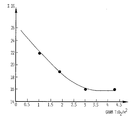
- a graph illustrates the percent dot gain (% DG) as a function of the content of white titanium dioxide (g/m2) in a hydrophilic colloid binder layer applied on a polyethylene coated paper support according to the present invention.
- dot gain for a halftone coloured colloid pattern obtained as described in Example 1 is plotted as percental dot size increase at 50 percent dot value at 150 lines per 2.54 cm (inch) in the ordinate versus the coverage of titanium dioxide in g/m2 in the abscissa. Details about dot gain determination are given at the end of said Example 1.
- a silver halide emulsion layer incorporating a substantially unhardened gelatin as binder, a silver halide hardening (tanning) developing agent, photosensitive silver halide grains and pigments providing the desired colour.
- the unhardened gelatin is e.g. of the type described in US-P 3,364,024.
- the pigments or dyes are preferably used in diffusion-resistant form and can have all kinds of colour, e.g. are cyan, light-cyan, magenta, warm magenta, black, yellow, green, brown, orange, red, white or blue.
- colour e.g. are cyan, light-cyan, magenta, warm magenta, black, yellow, green, brown, orange, red, white or blue.
- metallic colours such as pale gold, rich gold, copper, and silver.
- colour in the present invention encompasses the use of all pure and mixed colours as well as black and white.
- the dyes used in the coloured layers are selected to correspond in spectral properties as close as possible to the colour of the printing inks, which for letterpress printing have colour tones as defined in DIN 16538 and for offset printing the colour tones defined in DIN 16539. Further information about colour tones can be found for the USA in the GATF-Colour Charts. It has been found experimentally that pigments, which are insoluble or very poorly soluble in water and in organic liquids of the alcohol or polyhydric alcohol type, e.g. glycerol, fulfil the requirements of resistance to diffusion.
- a hardenable colloid layer in the present photographic material should preferably contain said pigments in a concentration sufficiently high for obtaining an optical density of at least 0.35 in the wavelength range of maximum absorption.
- Pigments particularly suitable for use in the present invention are known organic non-migratory pigment type dyes, e.g. obtainable under the Trade Marks "HELIO-echt”, “PIGMOSOL” and “COLANYL” dyes.
- “HELIO-echt”, “PIGMOSOL” and “COLANYL” are diffusion resistant organic pigments that can be dispersed in aqueous medium with the aid of a dispersing agent. These pigments excel in resistance to light, heat, acids, bases, oxidizing agents, and solvents. They are insoluble in hydrophilic colloids such as gelatin.
- a black relief pattern is formed in colour proofing, preferably carbon black is used.
- carbon black Apart from carbon black mixtures of coloured pigments may be applied as described e.g. in US-P 4,427,757.
- relatively thin hardenable coloured gelatin containing coatings are used.
- coatings having a thickness in the range of 1 ⁇ m and 15 ⁇ m are used and good results are obtained with pigment coloured layers containing 1 to 10 g of gelatin per sq.m.
- Very good results from the viewpoint of image sharpness and mutual adherence of the differently coloured relief portions are obtained with a composite layer structure of a pigmented gelatin layer containing silver halide coated in combination with a non-pigmented gelatin top layer having a combined thickness preferably in the range of 1 to 3 micrometer.
- the thickness of the pigmented gelatin silver halide emulsion layer is preferably twice that of the non-pigmented gelatin silver halide emulsion top layer.
- the total gelatin coverage of said composite layer structure is preferably in the range of 1.0 to 3 g of gelatin per sq.m.
- the pigmented gelatin containing silver halide emulsion layer contains preferably at least 50% by weight of gelatin.
- the adhering power of said composite layer structure to its temporary support should be such that an easy stripping off from the temporary support is possible after pressing said composite layer structure into contact with a wetted permanent support used according to the present invention.
- the temporary support is e.g. an unsubbed cellulose triacetate sheet, a polystyrene sheet or a sheet of copoly(vinyl acetate/vinylchloride).
- Other temporary supports having a repelling power for wet gelatin coatings are, e.g.
- a paper base coated with a polyethylene layer a paper base impregnated with wax, a paper base coated with a layer of cellulose nitrate or a paper base coated with a layer of insolubilized polyvinyl alcohol or a layer of alginic acid insolubilized with an alkaline earth metal salt.
- the photosensitive silver halide used in the silver halide emulsion layers of the photographic material used according to the present invention is e.g. silver chloride, silver bromide, silver bromoiodide, silver chlorobromoiodide, or mixtures thereof.
- the silver halide emulsions may be coarse or fine grain and can be prepared by any of the well known procedures, e.g. as single jet emulsions or double jet emulsions.
- the silver halide emulsions may be Lippmann emulsions, ammoniacal emulsions, thiocyanate- or thioether-ripened emulsions such as those described in U.S. Patent Specifications 2,222,264 of Adolph H.
- the emulsions may be tabular grain or regular-grain emulsions such as those of the type described by Klein and Moisar in J. Photogr. Sci., Vol. 12, No. 5, Sept./Oct. 1964, pp. 242-251. If desired, mixtures of surface and internal image emulsions may be used as described in U.S. Patent Specification 2,996,382 of George W. Luckey and John C. Hoppe, issued August 15, 1961.
- direct positive silver halide emulsions may be used that produce a positive silver image and a corresponding imagewise distribution of developing agent oxidation products during their development.
- those direct positive silver halide emulsions are considered wherein by exposure or by a chemical treatment a developable fog has been produced, which is destroyed imagewise during the imagewise exposure when certain conditions are fulfilled.
- the fog is maintained so that during the subsequent development a direct positive silver image is obtained and in correspondence therewith an imagewise distribution of oxidized hardening developing agent.
- direct positive emulsions of the type described in P.J.Hillson, U.S. Patent 3,062,651 may be utilized to obtain direct positive images.
- a nonhardening fogging agent such as stannous chloride, formamidine sulfinic acid, or the like is used.
- compositions, preparation and coating of silver halide emulsions are described, e.g., in Product Licensing Index, Vol. 92, December 1971, publication 9232, p. 107-109 and Research Disclosure, of December 1978, publication 17643.
- the silver halide emulsions can be chemically sensitized, e.g. by adding sulphur-containing compounds, e.g. allyl isothiocyanate, allyl thiourea, sodium thiosulphate and the like, during the chemical ripening stage.
- sulphur-containing compounds e.g. allyl isothiocyanate, allyl thiourea, sodium thiosulphate and the like
- reducing agents e.g. the tin compounds described in the Belgian Patent Specifications 493,464 and 568,687
- polyamines such as diethylenetriamine or derivatives of aminomethane-sulphonic acid, e.g. according to the Belgian Patent Specification 547,323, can be used as chemical sensitizers.
- Suitable chemical sensitizers are noble metals and noble metal compounds such as gold, platinum, palladium, iridium, ruthenium and rhodium. This method of chemical sensitization has been described in the article of R.KOSLOWSKY, Z. Wiss. Photogr. Photophys. Photochem. 46, 65-72 (1951).
- polyalkylene oxide derivatives e.g. with polyethylene oxide having a molecular weight between 1000 and 20,000, or with condensation products of alkylene oxides and aliphatic alcohols, glycols, cyclic dehydration products of hexitols, alkyl substituted phenols, aliphatic carboxylic acids, aliphatic amines, aliphatic diamines and amides.
- the condensation products have a molecular weight of at least 700, preferably of more than 1000.
- these sensitizers of course can be combined with each other as described in Belgian Patent Specification 537,278 and UK Patent Specification 727,982.
- the usual mono- or polymethine dyes such as acidic or basic cyanines, hemicyanines, oxonols, hemioxonols, styryl dyes or others, also tri- or polynuclear methine dyes, e.g. rhodacyanines or neocyanines may be used.
- Such spectral sensitizers are described, e.g., by F.M. HAMER in "The Cyanine Dyes and Related Compounds" (1964) Interscience Publishers, John Wiley & Sons, New York.
- the silver halide emulsions may contain the usual stabilizers, e.g. homopolar or salt-like compounds of mercury with aromatic or heterocyclic rings such as mercaptotriazoles, simple mercury salts, sulphonium mercury double salts and other mercury compounds.
- Other suitable stabilizers are azaindenes, preferably tetra- or penta-azaindenes, especially those substituted with hydroxyl or amino groups. Compounds of this kind are described by BIRR in Z. Wiss. Photogr. Photophys. Photochem. 47,, 2-27 (1952).
- Still other suitable stabilizers are amongst others heterocyclic mercapto compounds, e.g. phenylmercaptotetrazole, quaternary benzothiazole derivatives and benzotriazole.
- hardening developing agents also called tanning developing agents for effecting the development of the silver halide and producing oxidized developing agent acting as hardening agent for gelatin.
- Suitable hardening developing agents are : 1,4-dihydroxy benzene compounds such as hydroquinone, chlorohydroquinone, bromohydroquinone, toluhydroquinone, morpholinemethyl hydroquinone and sulfohydroquinone.
- the developing agent(s) may be incorporated in the photographic silver halide material and/or in a developing bath. When incorporated in the photographic material it or they may be present in the silver halide emulsion layer or in a waterpermeable non-silver halide containing layer subjacent thereto so that development can be attained by using an alkaline activator liquid.
- a hydrophilic gelatin layer containing photosensitive silver halide and coloured pigment particles is combined with an underlying additional layer containing an auxiliary developing agent forming a superadditive developing system with a hardening developing agent present in an overlying silver halide emulsion layer.
- the development is carried out with a so-called activator liquid being an aqueous alkaline solution free from developing agents.
- Typical activator liquids for a hardening developable photographic silver halide emulsion material comprise, for example, an aqueous solution of an alkaline material, such as sodium carbonate, sodium hydroxide, potassium carbonate, potassium hydroxide, mixtures of sodium hydroxide and sodium sulfite, organic alkaline substances, e.g. alkanolamines, etc.
- a suitable activator bath comprises e.g. about 2 percent by weight of sodium hydroxide and 0.5 percent by weight of sodium sulfite.
- Typical auxiliary developing agents include 3-pyrazolidinone developing agents, e.g. 1-phenyl-3-pyrazolidinone, 1-phenyl-4,4-dimethyl-3-pyrazolidinone, 1-phenyl-4-methyl-4′-hydroxymethyl-3-pyrazolidinone and N-methyl-p-aminophenol sulphate.
- 3-pyrazolidinone developing agents e.g. 1-phenyl-3-pyrazolidinone, 1-phenyl-4,4-dimethyl-3-pyrazolidinone, 1-phenyl-4-methyl-4′-hydroxymethyl-3-pyrazolidinone and N-methyl-p-aminophenol sulphate.
- Said auxiliary developing agents or a mixture thereof may be incorporated in the photographic material and/or in the developing liquid in which the hardening developing agent may be absent when using an alkaline activator bath.
- a coating composition is prepared containing gelatin dissolved in water wherein (a) selected pigment(s) is (are) dispersed in a concentration to yield after coating and drying a layer having an optical density in the wavelength range of maximal absorption of at least 0.35.
- the coating composition contains preferably at least 50% by weight of gelatin with respect to the pigment particles, optionally a plasticizing agent and a water attracting compound, e.g. glycerol to give the coating a sufficient adherence to its temporary support and to enable an easy wet (aqueous) stripping off from the temporary support.
- the said coating contains preferably 1 to 10 g of gelatin per m2.
- a top layer free from pigments is coated preferably.
- Said top layer preferably contains 0.2 to 2.5 g of gelatin per m2.
- the top layer and underlying layer form firmly bound together a composite layer structure that can be transferred as a whole from the temporary support to the permanent support.
- a set of materials each containing such a composite layer structure of different colour is preferably used for preparing a multicolour image.
- a usual set contains yellow, magenta, cyan, and black pigment coatings on separate cellulose triacetate supports.
- the imagewise exposure of the pigmented silver halide emulsion layer proceeds in a vacuum frame with the particular halftone separation negative or positive of the multicolour pattern to be reproduced in contact with the coloured colloid layer on the permanent support.
- the image-wise exposure in the form of screen dots is made scanning-wise, e.g. in a commercial colour scanner on the permanent or temporary support.
- Colour scanners operate with a rotating scanner drum and mostly with a laser light source of a definite narrow spectral composition. Therefore, scanningwise exposure requires photographic materials with a specific spectral photosensitivity and in order to have a more economic application requires a sequence of exposure and processing steps such that the scanner can operate without interruptions caused by processing.
- a single scan operation the exposure of all the differently coloured hardening developable photographic materials comprising on a temporary support a silver halide emulsion layer proceeds on the same scanner drum by arranging the materials on the drum in adjacent order and effecting the scanning without interrupting the rotation of the drum.
- the transfer of the imagewise hardenable silver halide emulsion layer or composite layer including such emulsion layer from its temporary support to a permanent support can be carried out in an apparatus, in which the materials involved are pressed together between rollers in the presence of an aqueous liquid and peeling off the temporary support.
- the imagewise exposure and the hardening development step is followed by a bleach-fixing step in order to obtain pure colours , wherein silver metal is bleached and residual unexposed silver halide is removed.
- the nonhardened portions of the hardening developed layers on the permanent support are washed off without mechanical rubbing by means of running water at a temperature preferably between 35 and 50°C. Excess of liquid is preferably removed by squeezing the relief between two smooth soft rollers, e.g. rubber rollers.
- a multicolour image e.g. multicolour printing proof
- a first relief image being a cyan part image of the multicolour original.
- a magenta, yellow and black relief image is produced on the same support.
- the order wherein the colour relief images are made can be chosen arbitrarily.
- the cyan layer or other first monochrome layer is applied from a coating solution in unexposed state on the permanent support and dried thereon before its imagewise hardening to form a direct reading relief image that is covered with other hardening developable silver halide emulsion layers wherein in their turn the unhardened portions are washed off after their imagewise hardening development.
- the obtained multicolour relief can be protected by a transparent resin topcoat, which according to a preferred embodiment is applied by spraying a solution of film forming resin onto the relief and drying.
- a suitable "spray-cover” consists of polyisobutyl methacrylate.
- Magenta, yellow and black pigment coatings were applied to unsubbed cellulose triacetate temporary supports as defined for the cyan pigmented coating above.
- the magenta pigment was used as a paste sold under the name HELIOECHTCARMIN BB TEIG (Colour Index Nr. 12,485) and the yellow pigment was used as a paste sold under the name HELIOECHTGELB GRN 7476 Feinlessness (Colour Index Nr. 21,100).
- Said pigment-pastes were used in an amount of 14.5 g and 17.6 g respectively per liter of coating composition.
- a carbon black paste was incorporated in admixture with the above mentioned FLEXONYL BLUE-paste in an amount of 15.75 g and 1.26 g respectively per liter of coating composition.
- a double-side polyethylene coated paper with paper weight of 180 g/m2 and a polyethylene layer weight of 30 g per m2 was air-knife coated at a wet coverage of 55 g per m2 with the following coating composition : distilled water 300 ml gelatin 19.8 g 20 % aqueous latex of copoly(methylmethacrylate-butadiene) (50/50) 151g aqueous dispersion containing 2.86 % of polymethylmethacrylate and 9.5 % of gelatin 25.5 g 21.4 % aqueous dispersion of TiO2 (average grain size 300 nm) containing 5.7 % of gelatin 131 g matting agent A 5.8 g matting agent B 2.8 g wetting agents of the anionic sulphonated type 2.8 g as hardening agent a 20 % aqueous solution of formaldehyde 2.2 ml distilled water up to 1000 ml
- Matting agent A is an aqueous dispersion containing 10.7 % of amorphous silica, 6.4 % of gelatin and 4.3 % of polyethylacrylate latex particles.
- Matting agent B is an aqueous dispersion containing 41.8 % of Alpha-quartz and 4.2 % of gelatin.
- the weight % of TiO2 with respect to the total layer composition was 29.5 in the dried layer.
- the coverage of TiO2 was 1.54 g/m2.
- a double-side polyethylene coated paper with a paper weight 180 g/m2 and a polyethylene layer weight of 30 g per m2 was air-knife coated at a wet coverage of 56 g per m2 with the following coating composition : distilled water 300 ml gelatin 23 g 20 % aqueous latex of copoly(methylmethacrylate-butadiene) (50/50) 151 g aqueous dispersion containing 2.86 % of polymethylmethacrylate and 9.5 % of gelatin 25 g 21.4 % aqueous dispersion of TiO2 (average grain size 300 nm) containing 5.7 % of gelatin 72 g matting agent A 6 g matting agent B 3 g wetting agents of the anionic sulphonated type 2.9 g as hardening agent a 20 % aqueous solution of formaldehyde 2.2 ml distilled water up to 1000 ml
- the weight % of TiO2 with respect to the total layer composition was 19.6 in the dried layer.
- the coverage of TiO2 was 0.86 g/m2.
- a double-side polyethylene coated paper wherein the paper weights 180 g/m2 and each polyethylene layer weights 30 g per m2 was slide-hopper coated (for slide-hopper coating see e.g. DE-OS 2 224 872) at a wet coverage of 55 g per m2 with the following coating composition : distilled water 199 ml 20 % aqueous latex of copoly(methylmethacrylate-butadiene) (50/50) 151 g aqueous dispersion containing 2.86 % of polymethylmethacrylate and 9.5 % of gelatin 25.5 g 21.4 % aqueous dispersion of TiO2 (average grain size 300 nm) containing 5.7 % of gelatin 544 g matting agent A 5.8 g matting agent B 2.8 g 11.7 % aqueous solution of saponine 17 ml as hardening agent a 20 % aqueous solution of formaldehyde 2.2 ml distilled water
- the weight % of TiO2 with respect to the total layer composition was 56.3 in the dried layer.
- the coverage of TiO2 was 6.40 g/m2.
- the photographic layers on their temporary support were scanningwise halftone exposed on a commercial argon ion laser scanner operating with electronic dot generation.
- the cyan pigment containing multilayer structure was transferred respectively onto a permanent support SM, SH and SL as described hereinbefore by soaking the permanent support in water for 30 s and then pressing it into contact with layer (ii). By stripping apart the temporary support the composite layer structure of layers (i) and (ii) was left on the permanent support and the transferred composite layer was dried.
- the transferred composite coating was hardening developed by dipping it for 30 s in an aqueous liquid, called activator bath, having following composition : potassium hydroxide 25 g potassium carbonate 150 g potassium bromide 0.5 g sodium sulphite 2.0 g 4(hydroxymethyl)4-methyl-1-phenyl-3-pyrazolidinone 5.0 g mono sodium salt of ethylenediaminetetra-acetic acid 1.0 g
- the developed material was led through a bleach-fix bath containing sodium thiosulphate and the mono sodium,iron(III) salt of ethylenediamine tetra-acetic acid.
- the percental dot gain with respect to the original dots obtained at 50 % dot value on permanent support materials SM, SH and SL was with respect to a non-pigment coated polyethylene paper support respectively 17, 21, and 12 %.
- the halftone dot area percentage was calculated with the Murray-Davies equation (ref. Murray A., “Monochrome Reproduction in Photoengraving", J. Franklin Institute, vol. 221, p. 721-744, reading as follows : wherein : D t represents the density of the halftone tint, D s represents the density of the solid, and a represents the halftone dot area percentage.
- the dot gain is obtained by subtracting the dot area percentage of the original halftone separation image from the above calculated one obtained on the titanium dioxide coated paper supports used according to the present invention.
- Layer (i) was coated from a coating composition at the indicated coverages :
- Layer (ii) was coated as a non-pigmented gelatin binder layer containing per m2 0.6 g of gelatin, 0.08 g of poly(methyl methacrylate) as a matting agent and a poly(ethyl acrylate) latex at 0.02 g of solids per m2.
- the preparation was identical to that of the cyan layer described above with the difference that the cyan pigment was replaced by HELIOECHTCARMIN BBN TEIG paste (Colour Index Nr. 12,485) at a coverage of 0.6 g per m2.
- the preparation was identical to that of the cyan layer described above with the difference that the cyan pigment was replaced by HELIOECHTGELB GRN 7476 Feinlessness paste (Colour Index Nr. 21,100) at a coverage of 0.467 g per m2.
- the preparation was identical to that of the cyan layer described above with the difference that the cyan pigment was used at a coverage of of 0.058 g per m2 in combination with HELIOECHTPAPIERSCHWARZ NL-paste at a coverage of 0.486 g per m2.
- the light-sensitive cyan-coloured composite layer structure (i) and (ii) being in unexposed state was transferred using a pair of pressure rollers onto a permanent support SM, SH and SL as described hereinbefore by soaking the permanent support prior to transfer in water. By stripping apart the temporary support said composite layer structure was left on the permanent support and the transferred composite layer was dried in a hot air stream.
- the transferred composite coating was hardening developed by dipping it for 30 s in an aqueous liquid containing per liter : potassium hydroxide 20 g potassium carbonate 200 g potassium bromide 0.5g sodium sulphite 5.0 g 4(hydroxymethyl)4-methyl-1-phenyl-3-pyrazolidinone 5.0 g hydroquinone 3.0 g mono sodium salt of ethylenediaminetetra-acetic acid 1.0 g
- the developed material was led through a bleach-fix bath containing sodium thiosulphate and the mono sodium,iron(III) salt of ethylenediamine tetra-acetic acid.
- the percental dot gain obtained at 50 % dot value on the permanent support materials SM, SH and SL with respect to the original dots was respectively 17, 22 and 11 %.
- the composite magenta coloured layer structure was transferred, dried, image-wise exposed and processed so as to obtain a magenta coloured relief pattern, whereupon that procedure was repeated for the yellow and black coloured relief patterns respectively to form a complete dot size corrected colour proof on the same permanent support.
Landscapes
- Physics & Mathematics (AREA)
- General Physics & Mathematics (AREA)
- Chemical & Material Sciences (AREA)
- Engineering & Computer Science (AREA)
- Materials Engineering (AREA)
- Photosensitive Polymer And Photoresist Processing (AREA)
- Silver Salt Photography Or Processing Solution Therefor (AREA)
- Ink Jet Recording Methods And Recording Media Thereof (AREA)
Priority Applications (4)
| Application Number | Priority Date | Filing Date | Title |
|---|---|---|---|
| DE3750775T DE3750775T2 (de) | 1987-09-01 | 1987-09-01 | Verfahren zur Herstellung von Halbtonbildern. |
| EP87201655A EP0305599B1 (de) | 1987-09-01 | 1987-09-01 | Verfahren zur Herstellung von Halbtonbildern |
| JP63216202A JPS6472149A (en) | 1987-09-01 | 1988-08-30 | Manufacture of half tone image |
| US07/581,123 US5075196A (en) | 1987-09-01 | 1990-09-10 | Halftone image production |
Applications Claiming Priority (1)
| Application Number | Priority Date | Filing Date | Title |
|---|---|---|---|
| EP87201655A EP0305599B1 (de) | 1987-09-01 | 1987-09-01 | Verfahren zur Herstellung von Halbtonbildern |
Publications (2)
| Publication Number | Publication Date |
|---|---|
| EP0305599A1 true EP0305599A1 (de) | 1989-03-08 |
| EP0305599B1 EP0305599B1 (de) | 1994-11-23 |
Family
ID=8197658
Family Applications (1)
| Application Number | Title | Priority Date | Filing Date |
|---|---|---|---|
| EP87201655A Expired - Lifetime EP0305599B1 (de) | 1987-09-01 | 1987-09-01 | Verfahren zur Herstellung von Halbtonbildern |
Country Status (4)
| Country | Link |
|---|---|
| US (1) | US5075196A (de) |
| EP (1) | EP0305599B1 (de) |
| JP (1) | JPS6472149A (de) |
| DE (1) | DE3750775T2 (de) |
Cited By (10)
| Publication number | Priority date | Publication date | Assignee | Title |
|---|---|---|---|---|
| EP0439886A1 (de) * | 1988-12-05 | 1991-08-07 | Union Camp Corporation | Mehrschichtiges Papier |
| US5176973A (en) * | 1989-09-28 | 1993-01-05 | Minnesota Mining And Manufacturing Company | Low optical dot gain pre-press proofs wherein the first down adhesive layer thickness is at least twice that of any additional thin adhesive layer |
| WO1993015272A1 (en) * | 1992-02-04 | 1993-08-05 | Agfa-Gevaert Naamloze Vennootschap | Image carrier for a reprographic image |
| US5234804A (en) * | 1992-09-04 | 1993-08-10 | Eastman Kodak Company | Photographic paper support with silver halide emulsion layer |
| EP0585062A1 (de) * | 1992-08-25 | 1994-03-02 | Konica Corporation | Farbphotographisches lichtempfindliches Silberhalogenidmaterial und sein Bilderzeugungsverfahren |
| EP0588641A1 (de) * | 1992-09-16 | 1994-03-23 | Konica Corporation | Farbphotographisches lichtempfindliches Silberhalogenidmaterial und Verfahren zur Herstellung einer Farbprobe |
| EP0639796A1 (de) * | 1993-07-30 | 1995-02-22 | Hoechst Aktiengesellschaft | Verfahren zur Herstellung eines Farbbilds, Schichtmaterial zur Durchführung des Verfahrens und nach dem Verfahren hergestelltes Farbbild |
| EP0651290A1 (de) * | 1993-11-02 | 1995-05-03 | Du Pont De Nemours (Deutschland) Gmbh | Ein- und mehrfarbige Farbprüfbilder mit niedrigem optischen Punktzuwachs sowie Verfahren und Mittel für deren Herstellung |
| US5858603A (en) * | 1995-05-10 | 1999-01-12 | Becker; Dieter | Support material for making color test prints in the analog proof system |
| EP0924564A1 (de) * | 1997-12-17 | 1999-06-23 | Konica Corporation | Lichtempfindliches, farbphotographisches Silberhalogenidmaterial und Verfahren zur Herstellung eines Farbprobedrucks |
Families Citing this family (6)
| Publication number | Priority date | Publication date | Assignee | Title |
|---|---|---|---|---|
| US5262823A (en) * | 1989-09-29 | 1993-11-16 | Mita Industrial Co., Ltd. | Manuscript-reading apparatus with jam detection sensors |
| DE4217196C2 (de) * | 1992-05-23 | 1994-05-19 | Schoeller Felix Jun Papier | Schichtträger für fotografisches Aufzeichnungsmaterial |
| JPH07140592A (ja) * | 1993-11-16 | 1995-06-02 | Konica Corp | ハロゲン化銀写真感光材料 |
| JPH07140594A (ja) * | 1993-11-17 | 1995-06-02 | Konica Corp | ハロゲン化銀カラー写真感光材料及び画像形成方法 |
| AU2055197A (en) * | 1996-02-26 | 1997-09-10 | International Paper Company | Coated paper stocks for use in electrostatic imaging applications |
| US6843177B2 (en) * | 2001-09-14 | 2005-01-18 | Fine Arts Group Llc | Methods and materials for producing an image, and articles comprising materials for producing an image |
Citations (8)
| Publication number | Priority date | Publication date | Assignee | Title |
|---|---|---|---|---|
| GB1060805A (en) * | 1962-08-20 | 1967-03-08 | Eastman Kodak Co | Photographic reproduction processes |
| DE2337187A1 (de) * | 1973-07-21 | 1975-02-06 | Schoeller Felix Jun Fa | Fotografisches traegermaterial |
| GB1551258A (en) * | 1977-01-20 | 1979-08-30 | Kodak Ltd | Photographic paper supports |
| DE3128600A1 (de) * | 1980-07-22 | 1982-06-03 | CIBA-GEIGY AG, 4002 Basel | Verfahren zur herstellung photographischer aufsichtsbilder mit verbesserter raeumlicher remission und die in diesem verfahren verwendeten photographischen materialien |
| GB2138964A (en) * | 1983-03-29 | 1984-10-31 | Fuji Photo Film Co Ltd | Silver halide photographic paper material |
| GB2140573A (en) * | 1983-03-29 | 1984-11-28 | Fuji Photo Film Co Ltd | Photographic paper material |
| EP0186194A2 (de) * | 1984-12-27 | 1986-07-02 | E.I. Du Pont De Nemours And Company | Verfahren zur Herstellung eines Probedrucks auf einem Träger |
| EP0186902A2 (de) * | 1984-12-27 | 1986-07-09 | E.I. Du Pont De Nemours And Company | Verfahren zur Herstellung eines Probedrucks auf einem Perlglanzträger |
Family Cites Families (5)
| Publication number | Priority date | Publication date | Assignee | Title |
|---|---|---|---|---|
| GB1264313A (de) * | 1968-05-15 | 1972-02-23 | ||
| JPS5617284A (en) * | 1979-07-20 | 1981-02-19 | Oriental Shashin Kogyo Kk | Image forming meterial and image forming method utilizing it |
| JPS59215334A (ja) * | 1983-05-21 | 1984-12-05 | Mitsubishi Paper Mills Ltd | 写真用樹脂被覆紙 |
| JPH0619574B2 (ja) * | 1986-02-13 | 1994-03-16 | 富士写真フイルム株式会社 | 転写画像形成方法 |
| US4657831A (en) * | 1986-03-11 | 1987-04-14 | Eastman Kodak Company | Color proofing method and article |
-
1987
- 1987-09-01 EP EP87201655A patent/EP0305599B1/de not_active Expired - Lifetime
- 1987-09-01 DE DE3750775T patent/DE3750775T2/de not_active Expired - Fee Related
-
1988
- 1988-08-30 JP JP63216202A patent/JPS6472149A/ja active Pending
-
1990
- 1990-09-10 US US07/581,123 patent/US5075196A/en not_active Expired - Fee Related
Patent Citations (9)
| Publication number | Priority date | Publication date | Assignee | Title |
|---|---|---|---|---|
| GB1060805A (en) * | 1962-08-20 | 1967-03-08 | Eastman Kodak Co | Photographic reproduction processes |
| GB1060806A (en) * | 1962-08-20 | 1967-03-08 | Eastman Kodak Co | Photographic reproduction materials |
| DE2337187A1 (de) * | 1973-07-21 | 1975-02-06 | Schoeller Felix Jun Fa | Fotografisches traegermaterial |
| GB1551258A (en) * | 1977-01-20 | 1979-08-30 | Kodak Ltd | Photographic paper supports |
| DE3128600A1 (de) * | 1980-07-22 | 1982-06-03 | CIBA-GEIGY AG, 4002 Basel | Verfahren zur herstellung photographischer aufsichtsbilder mit verbesserter raeumlicher remission und die in diesem verfahren verwendeten photographischen materialien |
| GB2138964A (en) * | 1983-03-29 | 1984-10-31 | Fuji Photo Film Co Ltd | Silver halide photographic paper material |
| GB2140573A (en) * | 1983-03-29 | 1984-11-28 | Fuji Photo Film Co Ltd | Photographic paper material |
| EP0186194A2 (de) * | 1984-12-27 | 1986-07-02 | E.I. Du Pont De Nemours And Company | Verfahren zur Herstellung eines Probedrucks auf einem Träger |
| EP0186902A2 (de) * | 1984-12-27 | 1986-07-09 | E.I. Du Pont De Nemours And Company | Verfahren zur Herstellung eines Probedrucks auf einem Perlglanzträger |
Cited By (20)
| Publication number | Priority date | Publication date | Assignee | Title |
|---|---|---|---|---|
| EP0439886A1 (de) * | 1988-12-05 | 1991-08-07 | Union Camp Corporation | Mehrschichtiges Papier |
| US5176973A (en) * | 1989-09-28 | 1993-01-05 | Minnesota Mining And Manufacturing Company | Low optical dot gain pre-press proofs wherein the first down adhesive layer thickness is at least twice that of any additional thin adhesive layer |
| WO1993015272A1 (en) * | 1992-02-04 | 1993-08-05 | Agfa-Gevaert Naamloze Vennootschap | Image carrier for a reprographic image |
| US5486450A (en) * | 1992-08-25 | 1996-01-23 | Konica Corporation | Silver halide color photographic light sensitive material and the image-forming process thereof |
| EP0585062A1 (de) * | 1992-08-25 | 1994-03-02 | Konica Corporation | Farbphotographisches lichtempfindliches Silberhalogenidmaterial und sein Bilderzeugungsverfahren |
| US5382506A (en) * | 1992-08-25 | 1995-01-17 | Konica Corporation | Silver halide color photographic light sensitive material and the image-forming process thereof |
| US5234804A (en) * | 1992-09-04 | 1993-08-10 | Eastman Kodak Company | Photographic paper support with silver halide emulsion layer |
| EP0588641A1 (de) * | 1992-09-16 | 1994-03-23 | Konica Corporation | Farbphotographisches lichtempfindliches Silberhalogenidmaterial und Verfahren zur Herstellung einer Farbprobe |
| US5462844A (en) * | 1992-09-16 | 1995-10-31 | Konica Corporation | Light-sensitive silver halide color photographic material and process for preparing color proof |
| EP0639796A1 (de) * | 1993-07-30 | 1995-02-22 | Hoechst Aktiengesellschaft | Verfahren zur Herstellung eines Farbbilds, Schichtmaterial zur Durchführung des Verfahrens und nach dem Verfahren hergestelltes Farbbild |
| US5527654A (en) * | 1993-07-30 | 1996-06-18 | Hoechst Aktiengesellschaft | Process for the production of a color image utilizing transferred white pigment layer |
| US5705315A (en) * | 1993-07-30 | 1998-01-06 | Agfa-Gevaert Ag | Image-receiving material for production of a color image utilizing a transferred white pigment layer |
| US5800962A (en) * | 1993-07-30 | 1998-09-01 | Agfa-Gervaert Ag | Temporary support film for transferring white pigment layer |
| EP0651290A1 (de) * | 1993-11-02 | 1995-05-03 | Du Pont De Nemours (Deutschland) Gmbh | Ein- und mehrfarbige Farbprüfbilder mit niedrigem optischen Punktzuwachs sowie Verfahren und Mittel für deren Herstellung |
| AU677703B2 (en) * | 1993-11-02 | 1997-05-01 | E.I. Du Pont De Nemours And Company | Monochrome and polychrome color proofs with low optical dot growth and a process and means for their preparation |
| US5635284A (en) * | 1993-11-02 | 1997-06-03 | E. I. Du Pont De Nemours And Company | Monochrome and polychrome color proofs with low optical dot growth and a process and means for their preparation |
| US6083608A (en) * | 1993-11-02 | 2000-07-04 | E. I. Du Pont De Nemours And Company | Monochrome and polychrome color proofs with low optical dot growth and a process and means for their preparation |
| US5858603A (en) * | 1995-05-10 | 1999-01-12 | Becker; Dieter | Support material for making color test prints in the analog proof system |
| EP0924564A1 (de) * | 1997-12-17 | 1999-06-23 | Konica Corporation | Lichtempfindliches, farbphotographisches Silberhalogenidmaterial und Verfahren zur Herstellung eines Farbprobedrucks |
| US6096490A (en) * | 1997-12-17 | 2000-08-01 | Konica Corporation | Silver halide light sensitive color photographic material and process for preparing color proof |
Also Published As
| Publication number | Publication date |
|---|---|
| EP0305599B1 (de) | 1994-11-23 |
| DE3750775T2 (de) | 1995-05-04 |
| JPS6472149A (en) | 1989-03-17 |
| DE3750775D1 (de) | 1995-01-05 |
| US5075196A (en) | 1991-12-24 |
Similar Documents
| Publication | Publication Date | Title |
|---|---|---|
| EP0305599B1 (de) | Verfahren zur Herstellung von Halbtonbildern | |
| US4925767A (en) | Gloss controlling process | |
| US4950577A (en) | Pre-press light-sensitive color proofing article incorporating antihalation layer | |
| US2993788A (en) | Multicolor reproduction using light sensitive diazo oxides | |
| CA1079565A (en) | Dot-etchable photopolymerizable elements and image reproduction process | |
| US3642474A (en) | Method for producing halftone multicolor images | |
| US4701401A (en) | Process for the formation of a linework or halftone multicolor colloid pattern | |
| US3681074A (en) | Production of coloured colloid patterns | |
| JPH0610751B2 (ja) | 写真多色像の色バランスを改良する方法 | |
| US4710444A (en) | Process for the formation of linework or halftone multicolor colloid patterns | |
| US5270147A (en) | Stripping film material | |
| US3728120A (en) | Formation of relief images | |
| US5043247A (en) | Process for the formation of multicolor colloid patterns | |
| EP0625224B1 (de) | Träger für reprographische bilder | |
| US3682635A (en) | Manufacture of coloured colloid patterns | |
| EP0462330A1 (de) | Verfahren und Material zum Schützen von Bildern | |
| EP0048160B1 (de) | Lichtempfindliches Aufzeichnungsmaterial und Verfahren zur Halbtonätzung | |
| EP0529697B1 (de) | Abziehfilmmaterial | |
| WO1994010610A1 (en) | Process for forming direct digital colour proofs on print stock material | |
| EP0298158A1 (de) | Silberkomplex-Diffusions-Übertragungsverfahren | |
| US3793026A (en) | Photochemical reproduction process | |
| EP0181968A1 (de) | Verfahren zur Herstellung von photograhischen Reliefbildern durch gerbende Entwicklung und Wash-Off-Verarbeitung von Silberhalogenidemulsionsmaterialien | |
| EP0675404B1 (de) | Bilderzeugungsverfahren | |
| Kingsley | Identification by inspection: An introduction to photographic papers | |
| JPH01109351A (ja) | 着色画像形成方法 |
Legal Events
| Date | Code | Title | Description |
|---|---|---|---|
| PUAI | Public reference made under article 153(3) epc to a published international application that has entered the european phase |
Free format text: ORIGINAL CODE: 0009012 |
|
| AK | Designated contracting states |
Kind code of ref document: A1 Designated state(s): AT BE CH DE ES FR GB GR IT LI LU NL SE |
|
| RBV | Designated contracting states (corrected) |
Designated state(s): BE DE FR GB |
|
| 17P | Request for examination filed |
Effective date: 19890725 |
|
| 17Q | First examination report despatched |
Effective date: 19910730 |
|
| GRAA | (expected) grant |
Free format text: ORIGINAL CODE: 0009210 |
|
| AK | Designated contracting states |
Kind code of ref document: B1 Designated state(s): BE DE FR GB |
|
| PG25 | Lapsed in a contracting state [announced via postgrant information from national office to epo] |
Ref country code: FR Effective date: 19941123 Ref country code: BE Effective date: 19941123 |
|
| REF | Corresponds to: |
Ref document number: 3750775 Country of ref document: DE Date of ref document: 19950105 |
|
| EN | Fr: translation not filed | ||
| PLBE | No opposition filed within time limit |
Free format text: ORIGINAL CODE: 0009261 |
|
| STAA | Information on the status of an ep patent application or granted ep patent |
Free format text: STATUS: NO OPPOSITION FILED WITHIN TIME LIMIT |
|
| 26N | No opposition filed | ||
| PGFP | Annual fee paid to national office [announced via postgrant information from national office to epo] |
Ref country code: GB Payment date: 19960813 Year of fee payment: 10 |
|
| PG25 | Lapsed in a contracting state [announced via postgrant information from national office to epo] |
Ref country code: GB Free format text: LAPSE BECAUSE OF NON-PAYMENT OF DUE FEES Effective date: 19970901 |
|
| GBPC | Gb: european patent ceased through non-payment of renewal fee |
Effective date: 19970901 |
|
| PGFP | Annual fee paid to national office [announced via postgrant information from national office to epo] |
Ref country code: DE Payment date: 20010829 Year of fee payment: 15 |
|
| PG25 | Lapsed in a contracting state [announced via postgrant information from national office to epo] |
Ref country code: DE Free format text: LAPSE BECAUSE OF NON-PAYMENT OF DUE FEES Effective date: 20030401 |