EP0305660A2 - Procédé de fabrication d'un produit stratifié par coextrusion et produit stratifié ainsi obtenu - Google Patents
Procédé de fabrication d'un produit stratifié par coextrusion et produit stratifié ainsi obtenu Download PDFInfo
- Publication number
- EP0305660A2 EP0305660A2 EP88108879A EP88108879A EP0305660A2 EP 0305660 A2 EP0305660 A2 EP 0305660A2 EP 88108879 A EP88108879 A EP 88108879A EP 88108879 A EP88108879 A EP 88108879A EP 0305660 A2 EP0305660 A2 EP 0305660A2
- Authority
- EP
- European Patent Office
- Prior art keywords
- layer
- laminate
- substance
- layers
- action
- Prior art date
- Legal status (The legal status is an assumption and is not a legal conclusion. Google has not performed a legal analysis and makes no representation as to the accuracy of the status listed.)
- Granted
Links
Images
Classifications
-
- B—PERFORMING OPERATIONS; TRANSPORTING
- B32—LAYERED PRODUCTS
- B32B—LAYERED PRODUCTS, i.e. PRODUCTS BUILT-UP OF STRATA OF FLAT OR NON-FLAT, e.g. CELLULAR OR HONEYCOMB, FORM
- B32B37/00—Methods or apparatus for laminating, e.g. by curing or by ultrasonic bonding
- B32B37/14—Methods or apparatus for laminating, e.g. by curing or by ultrasonic bonding characterised by the properties of the layers
- B32B37/15—Methods or apparatus for laminating, e.g. by curing or by ultrasonic bonding characterised by the properties of the layers with at least one layer being manufactured and immediately laminated before reaching its stable state, e.g. in which a layer is extruded and laminated while in semi-molten state
- B32B37/153—Methods or apparatus for laminating, e.g. by curing or by ultrasonic bonding characterised by the properties of the layers with at least one layer being manufactured and immediately laminated before reaching its stable state, e.g. in which a layer is extruded and laminated while in semi-molten state at least one layer is extruded and immediately laminated while in semi-molten state
-
- A—HUMAN NECESSITIES
- A43—FOOTWEAR
- A43B—CHARACTERISTIC FEATURES OF FOOTWEAR; PARTS OF FOOTWEAR
- A43B3/00—Footwear characterised by the shape or the use
- A43B3/0036—Footwear characterised by the shape or the use characterised by a special shape or design
- A43B3/0078—Footwear characterised by the shape or the use characterised by a special shape or design provided with logos, letters, signatures or the like decoration
- A43B3/0084—Arrangement of flocked decoration on shoes
-
- B—PERFORMING OPERATIONS; TRANSPORTING
- B29—WORKING OF PLASTICS; WORKING OF SUBSTANCES IN A PLASTIC STATE IN GENERAL
- B29C—SHAPING OR JOINING OF PLASTICS; SHAPING OF MATERIAL IN A PLASTIC STATE, NOT OTHERWISE PROVIDED FOR; AFTER-TREATMENT OF THE SHAPED PRODUCTS, e.g. REPAIRING
- B29C48/00—Extrusion moulding, i.e. expressing the moulding material through a die or nozzle which imparts the desired form; Apparatus therefor
- B29C48/03—Extrusion moulding, i.e. expressing the moulding material through a die or nozzle which imparts the desired form; Apparatus therefor characterised by the shape of the extruded material at extrusion
- B29C48/09—Articles with cross-sections having partially or fully enclosed cavities, e.g. pipes or channels
-
- B—PERFORMING OPERATIONS; TRANSPORTING
- B29—WORKING OF PLASTICS; WORKING OF SUBSTANCES IN A PLASTIC STATE IN GENERAL
- B29C—SHAPING OR JOINING OF PLASTICS; SHAPING OF MATERIAL IN A PLASTIC STATE, NOT OTHERWISE PROVIDED FOR; AFTER-TREATMENT OF THE SHAPED PRODUCTS, e.g. REPAIRING
- B29C48/00—Extrusion moulding, i.e. expressing the moulding material through a die or nozzle which imparts the desired form; Apparatus therefor
- B29C48/16—Articles comprising two or more components, e.g. co-extruded layers
- B29C48/18—Articles comprising two or more components, e.g. co-extruded layers the components being layers
- B29C48/21—Articles comprising two or more components, e.g. co-extruded layers the components being layers the layers being joined at their surfaces
-
- B—PERFORMING OPERATIONS; TRANSPORTING
- B29—WORKING OF PLASTICS; WORKING OF SUBSTANCES IN A PLASTIC STATE IN GENERAL
- B29C—SHAPING OR JOINING OF PLASTICS; SHAPING OF MATERIAL IN A PLASTIC STATE, NOT OTHERWISE PROVIDED FOR; AFTER-TREATMENT OF THE SHAPED PRODUCTS, e.g. REPAIRING
- B29C48/00—Extrusion moulding, i.e. expressing the moulding material through a die or nozzle which imparts the desired form; Apparatus therefor
- B29C48/25—Component parts, details or accessories; Auxiliary operations
- B29C48/30—Extrusion nozzles or dies
- B29C48/32—Extrusion nozzles or dies with annular openings, e.g. for forming tubular articles
- B29C48/335—Multiple annular extrusion nozzles in coaxial arrangement, e.g. for making multi-layered tubular articles
-
- B—PERFORMING OPERATIONS; TRANSPORTING
- B29—WORKING OF PLASTICS; WORKING OF SUBSTANCES IN A PLASTIC STATE IN GENERAL
- B29C—SHAPING OR JOINING OF PLASTICS; SHAPING OF MATERIAL IN A PLASTIC STATE, NOT OTHERWISE PROVIDED FOR; AFTER-TREATMENT OF THE SHAPED PRODUCTS, e.g. REPAIRING
- B29C49/00—Blow-moulding, i.e. blowing a preform or parison to a desired shape within a mould; Apparatus therefor
- B29C49/22—Blow-moulding, i.e. blowing a preform or parison to a desired shape within a mould; Apparatus therefor using multilayered preforms or parisons
-
- B—PERFORMING OPERATIONS; TRANSPORTING
- B32—LAYERED PRODUCTS
- B32B—LAYERED PRODUCTS, i.e. PRODUCTS BUILT-UP OF STRATA OF FLAT OR NON-FLAT, e.g. CELLULAR OR HONEYCOMB, FORM
- B32B1/00—Layered products having a non-planar shape
-
- B—PERFORMING OPERATIONS; TRANSPORTING
- B32—LAYERED PRODUCTS
- B32B—LAYERED PRODUCTS, i.e. PRODUCTS BUILT-UP OF STRATA OF FLAT OR NON-FLAT, e.g. CELLULAR OR HONEYCOMB, FORM
- B32B27/00—Layered products comprising a layer of synthetic resin
- B32B27/06—Layered products comprising a layer of synthetic resin as the main or only constituent of a layer, which is next to another layer of the same or of a different material
- B32B27/08—Layered products comprising a layer of synthetic resin as the main or only constituent of a layer, which is next to another layer of the same or of a different material of synthetic resin
-
- B—PERFORMING OPERATIONS; TRANSPORTING
- B32—LAYERED PRODUCTS
- B32B—LAYERED PRODUCTS, i.e. PRODUCTS BUILT-UP OF STRATA OF FLAT OR NON-FLAT, e.g. CELLULAR OR HONEYCOMB, FORM
- B32B27/00—Layered products comprising a layer of synthetic resin
- B32B27/18—Layered products comprising a layer of synthetic resin characterised by the use of special additives
- B32B27/20—Layered products comprising a layer of synthetic resin characterised by the use of special additives using fillers, pigments, thixotroping agents
-
- B—PERFORMING OPERATIONS; TRANSPORTING
- B32—LAYERED PRODUCTS
- B32B—LAYERED PRODUCTS, i.e. PRODUCTS BUILT-UP OF STRATA OF FLAT OR NON-FLAT, e.g. CELLULAR OR HONEYCOMB, FORM
- B32B27/00—Layered products comprising a layer of synthetic resin
- B32B27/32—Layered products comprising a layer of synthetic resin comprising polyolefins
-
- B—PERFORMING OPERATIONS; TRANSPORTING
- B32—LAYERED PRODUCTS
- B32B—LAYERED PRODUCTS, i.e. PRODUCTS BUILT-UP OF STRATA OF FLAT OR NON-FLAT, e.g. CELLULAR OR HONEYCOMB, FORM
- B32B7/00—Layered products characterised by the relation between layers; Layered products characterised by the relative orientation of features between layers, or by the relative values of a measurable parameter between layers, i.e. products comprising layers having different physical, chemical or physicochemical properties; Layered products characterised by the interconnection of layers
- B32B7/04—Interconnection of layers
- B32B7/12—Interconnection of layers using interposed adhesives or interposed materials with bonding properties
-
- B—PERFORMING OPERATIONS; TRANSPORTING
- B29—WORKING OF PLASTICS; WORKING OF SUBSTANCES IN A PLASTIC STATE IN GENERAL
- B29C—SHAPING OR JOINING OF PLASTICS; SHAPING OF MATERIAL IN A PLASTIC STATE, NOT OTHERWISE PROVIDED FOR; AFTER-TREATMENT OF THE SHAPED PRODUCTS, e.g. REPAIRING
- B29C48/00—Extrusion moulding, i.e. expressing the moulding material through a die or nozzle which imparts the desired form; Apparatus therefor
- B29C48/03—Extrusion moulding, i.e. expressing the moulding material through a die or nozzle which imparts the desired form; Apparatus therefor characterised by the shape of the extruded material at extrusion
- B29C48/07—Flat, e.g. panels
- B29C48/08—Flat, e.g. panels flexible, e.g. films
-
- B—PERFORMING OPERATIONS; TRANSPORTING
- B32—LAYERED PRODUCTS
- B32B—LAYERED PRODUCTS, i.e. PRODUCTS BUILT-UP OF STRATA OF FLAT OR NON-FLAT, e.g. CELLULAR OR HONEYCOMB, FORM
- B32B2307/00—Properties of the layers or laminate
- B32B2307/40—Properties of the layers or laminate having particular optical properties
- B32B2307/422—Luminescent, fluorescent, phosphorescent
Definitions
- the invention relates to a method and a laminate according to claim 1 or claim 8 or 9.
- Laminates produced in the coextrusion process which at least predominantly consist of thermoplastic, generally have at least three layers, at least in parts of their extent, of which at least one layer serving as a supporting layer consists of thermoplastic and at least one other layer consists of a material , which serves to promote adhesion between this base layer and at least one further layer, which consists of a material that has properties that differ from those of the material forming the base layer.
- Laminates obtained in this way or the end products produced therefrom are predominantly used for packaging purposes in which the properties of conventional plastics, in particular polyolefins, do not meet all the requirements.
- a typical example is the permeability of the polyolefins for the goods to be packaged and / or the surrounding medium.
- the permeability of these materials can be used as a film, liner, container, for. B. restrict or impair as a bottle, canister, barrel, fuel tank.
- foils for the packaging of Food can e.g. B. it is important to make the packaging films impermeable to fats, odorous substances and the like, so that these substances, which are part of the goods to be packaged, do not diffuse outwards through the film. If the films were permeable to these and possibly other substances, the quality of the packaged goods would change adversely over time.
- bottles or similar containers it may be the case, for example, that in the case of toxic contents or those with dangerous components, for example crop protection agents, diffusion of the contents or such components must be ruled out for safety reasons.
- the aim is generally to prevent the walls of the same from being permeable to hydrocarbons.
- the problem can also be to prevent substances from the surrounding atmosphere from penetrating through the wall of the film, bottle or the like into the interior of the packaging.
- a typical example of this is the requirement in many cases to exclude the diffusion of atmospheric oxygen through the wall of the film, the container or the like into the interior thereof.
- plastics are known whose permeability is so low, for example for gasoline and / or organic solvents, that they do not exceed the permissible values.
- these plastics are expensive and / or cannot be processed easily. In many cases they do not have the mechanical properties of the polyolefins, the latter in terms of strength, toughness, make elastic deformability etc. particularly suitable for goods whose transport, storage and the like require certain precautions.
- films, containers such. B. fuel tanks often multi-layered in such a way that at least one mostly polyolefin base layer is provided with a more or less impermeable barrier layer for the filling material and / or the surrounding medium, which can consist for example of polyamide and its thickness in general is significantly less than that of the base layer (s).
- This barrier layer can be applied on the inside and / or outside.
- the barrier layer for example, between two base layers, that is to say in the central region of the cross section of the wall.
- an additional layer of a different material is provided between the base layer and the barrier layer arranged, which predominantly or exclusively has the task of serving as an adhesion promoter between the base layer and the barrier layer.
- This adhesion promoter layer must therefore consist of a material which forms a sufficiently strong bond both with the material forming the base layer and with the material forming the barrier layer.
- the adhesive layer only has an auxiliary function in the sense of establishing a connection between the base layer and the barrier layer, it is of crucial importance for the mechanical strength of the end product, since incomplete formation of the adhesive layer, for example the lack thereof in certain areas of the laminate, the mechanical strength of the end product is inevitably impaired, since there is no or only an imperfect connection between the base layer and the barrier layer in these areas.
- Both the barrier layer (s) and the adhesion promoter layer (s) generally have a small thickness. This applies in particular to the adhesion promoter layer (s), the thickness of which may be in the tenth of a millimeter range or noticeably less. It is therefore not guaranteed under all operational conditions occurring in practice that these layers are arranged in the wall of the film or of the hollow body evenly distributed wherever their presence is required. Since, for reasons of economy, the aim should not be to make the wall of the article and thus also the individual layers forming it thicker than absolutely necessary, there are upper limits on the thickness of the individual layers. Therefore, the possibility cannot be completely ruled out that when the film or the preform is expanded, at least one of the layers experiences an excessive stress, which leads to the fact that this layer on the end product is so imperfectly formed in certain areas that it does not fulfill its intended function can.
- a relatively complicated device is used for the production of the film or the preform consists of several extruders for plasticizing the materials for the individual layers and a common extrusion head, into which the materials plasticized in the individual extruders are fed in order to be brought together in this head and brought into the cross-sectional shape of the film or the preform.
- Such defects or defects are generally not to be seen in the finished product, unless they are in the outer layer. In the normal case, however, this is somewhat improbable, since the outer layer (s) of a film or a hollow body is or are usually the base layer or one of the base layers, which is or are thicker anyway, so that the occurrence of errors in these layers is a lot is less likely than the other, sometimes considerably thinner layers. However, these will mainly be located inside the wall, that is, between two other layers, so that they are not accessible from the outside at all.
- the adhesion promoter layer since its function is merely to connect two other layers to one another, so that an adhesion promoter layer is always inevitably arranged between two other layers and is therefore covered on both sides by them.
- the barrier layer which is supposed to make the wall of the hollow body impermeable, is between two other layers, usually two layers of adhesive, arranged and thus also covered and not accessible from the outside.
- the barrier layer is one of the outer layers of the wall of a hollow body, visual inspection is hardly possible, since with such an arrangement the barrier layer usually forms the layer delimiting the interior of the hollow body and is therefore not easily accessible.
- an exclusively visual inspection without additional aids to make any defects visible is extremely difficult anyway. In any case, even with an external arrangement, a visual inspection would have to be carried out with extreme care in order to identify defects. This also applies if the hollow body would be cut open for the purpose of carrying out random checks if the barrier layer were arranged internally in the above sense.
- the object of the invention is to modify the method described in the introduction and to design the foils and hollow bodies produced using this method in such a way that the finished product can be checked in a relatively simple manner, at least in the form of random samples, but possibly also in the form of an ongoing test in which the films or hollow bodies do not need to be destroyed.
- a method has proven to be particularly expedient in which a luminescent, fluorescent or phosphorescent substance is added to the material for at least one of the important layers of the preform and the hollow body to be produced therefrom, which allows the finished products to be formed from the respective material Layer recognizable under the action of suitable rays, for example UV rays, X-rays, electron beams, infrared rays, etc., e.g. B. make visible. It is then easily possible to check visually or in another way whether the layer made recognizable in this way is actually present wherever it should be present.
- suitable rays for example UV rays, X-rays, electron beams, infrared rays, etc., e.g. B. make visible. It is then easily possible to check visually or in another way whether the layer made recognizable in this way is actually present wherever it should be present.
- luminescent, fluorescent or phosphorescent substances of different properties can be added to the materials for two or more layers, the substances advantageously being selected so that different layers, possibly with the same wavelength of the incident rays, appear in different colors .
- the luminescent, fluorescent or phosphorescent substances can be admixed to the plastic of the respective layer in the form of so-called luminous pigments.
- luminous pigments For example, it is possible to add the luminous pigments to the plastic granules mix before adding it to the extruder.
- the fluorescent color can be determined by the chemical composition of the phosphor.
- the amount of luminous pigments to be added to the plastic can be very small, for example in the order of 0.001%, in order to achieve the desired effect.
- the embodiment described above is limited to those laminates which consist of transparent or translucent material. If the outer layer (s) of the wall or, if applicable, also the layer to be tested is or have been colored so that the luminous pigments are no longer recognizable, the above-described test will not be possible. Nevertheless, the method according to the invention can be used, albeit in a less perfect form, for example in such a way that initially samples of a particular laminate to be produced, e.g. B. a film or a hollow body, using materials that are not colored, are manufactured and the composition and structure of the wall of such a film or such a hollow body is optimized on the basis of these patterns, and then on the basis of the experience gained on the patterns and findings the serial production of the colored products can be started.
- a particular laminate to be produced e.g. B. a film or a hollow body, using materials that are not colored, are manufactured and the composition and structure of the wall of such a film or such a hollow body is optimized on the basis of these patterns, and then on the
- the respective layer can be recognized by observation with the human eye, but also using suitable physical means, the range of which is outside the range of perception of the human eye.
- a substance is added to the material of at least one of the layers of the laminate, which, if it comes into contact with another, appropriately selected substance, leads to a reversible change, for example a change in color of the material the substance-containing layer leads.
- This embodiment is particularly advantageous for carrying out random tests, in particular on containers and other hollow bodies, the two outer layers of which are to be checked for perfect condition, in particular completeness.
- the container could be rinsed out with a liquid containing the change in the layer, if the layer to be tested is arranged on the inside of the wall, that is to say it delimits the interior of the container and comes into contact with the contents inside the container.
- this variant of the invention will remain limited to carrying out random samples or to optimizing a specific container when preparing to manufacture it on the basis of samples.
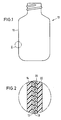
- the wall 10 of the bottle 12 is made up of five layers, of which the outer layer 14 and the inner layer 22 essentially cause the required mechanical strength of the bottle 12.
- the two layers 14 and 22 can for example consist of a polyolefin material.
- the layer 18 consists of a material which has a barrier effect in such a way that it prevents diffusion of parts of the filling material through the wall. With a suitable choice of material for this barrier layer 18, diffusion, for example, of the atmospheric oxygen from the outside through the wall into the interior of the bottle can also be prevented.
- the material forming the barrier layer 18 does not normally form a durable bond with the materials forming the layers 14 and 22. It is therefore necessary to arrange a layer 17 or 20 made of a material that serves as an adhesion promoter on both sides of the barrier layer 18, that is, both with the materials forming the layer 14 and 22 and with the material forming the barrier layer 18 sufficiently firm connection is received.
- the availability of the barrier layer 18 in all areas of the bottle 12 provided for this purpose is therefore of crucial importance for the usability of the bottle 12 for packaging, for example, filling goods containing aggressive or highly volatile constituents.
- for. B. can be operated so that the material forming the barrier layer 18 is mixed with a fluorescent, luminescent or phosphorescent substance, which is made visible on the finished bottle by appropriate radiation, for example UV radiation.
- a sufficient mechanical strength of the container also presupposes that at all points at which the barrier layer 18 is located, the adhesive layers 17, 20 are also present in sufficient strength, since in the other case there is a connection between the outer layer 22 on the one hand and the two inner layers 14, 16 on the other hand would not be guaranteed.
- the barrier layer is arranged on the inside, that is to say it occupies the position of the layer 14 in FIG. 2, it is possible to add a substance to the material forming this layer, which in the manner already described in the Reaction with another substance, for example, causes a change in the color of the layer in order to make it possible to recognize whether the layer is present everywhere and in sufficient strength.
- Bottles or other containers will have to be checked individually, which does not rule out a continuous passage of a row of bottles through a control device. However, depending on the shape of the hollow body, it may be necessary to rotate or otherwise move it in the control device in order to bring all areas of the hollow body into the area of the respective beams and also of the recording device.
- the invention brings about a substantial improvement of the current state, especially since the expenditure necessary for its realization is not very significant. Because the layers of the laminate to be checked are predominantly inside the same the added luminescent pigments do not come into contact with the goods to be packaged if this aspect should even play a role. However, from the multitude of luminous pigments currently on the market, it is also easy to select those that are harmless even if the goods to be packaged are foodstuffs.
Landscapes
- Engineering & Computer Science (AREA)
- Mechanical Engineering (AREA)
- Manufacturing & Machinery (AREA)
- Laminated Bodies (AREA)
- Containers Having Bodies Formed In One Piece (AREA)
- Extrusion Moulding Of Plastics Or The Like (AREA)
- Blow-Moulding Or Thermoforming Of Plastics Or The Like (AREA)
Priority Applications (1)
| Application Number | Priority Date | Filing Date | Title |
|---|---|---|---|
| AT88108879T ATE99594T1 (de) | 1987-09-04 | 1988-06-03 | Verfahren zum herstellen von laminaten im koextrusionsverfahren und nach diesem verfahren hergestellte laminate. |
Applications Claiming Priority (4)
| Application Number | Priority Date | Filing Date | Title |
|---|---|---|---|
| DE3729571 | 1987-09-04 | ||
| DE3729571 | 1987-09-04 | ||
| DE19873736164 DE3736164A1 (de) | 1987-09-04 | 1987-10-26 | Verfahren zum herstellen von laminaten im koextrusionsverfahren und nach diesem verfahren hergestellte laminate |
| DE3736164 | 1987-10-26 |
Publications (3)
| Publication Number | Publication Date |
|---|---|
| EP0305660A2 true EP0305660A2 (fr) | 1989-03-08 |
| EP0305660A3 EP0305660A3 (en) | 1990-11-28 |
| EP0305660B1 EP0305660B1 (fr) | 1994-01-05 |
Family
ID=25859396
Family Applications (1)
| Application Number | Title | Priority Date | Filing Date |
|---|---|---|---|
| EP88108879A Expired - Lifetime EP0305660B1 (fr) | 1987-09-04 | 1988-06-03 | Procédé de fabrication d'un produit stratifié par coextrusion et produit stratifié ainsi obtenu |
Country Status (7)
| Country | Link |
|---|---|
| US (1) | US4919855A (fr) |
| EP (1) | EP0305660B1 (fr) |
| JP (1) | JPH01163063A (fr) |
| CA (1) | CA1314367C (fr) |
| DE (2) | DE3736164A1 (fr) |
| DK (1) | DK157088A (fr) |
| ES (1) | ES2047504T3 (fr) |
Cited By (3)
| Publication number | Priority date | Publication date | Assignee | Title |
|---|---|---|---|---|
| EP0599208A1 (fr) * | 1992-11-25 | 1994-06-01 | Röhm GmbH | Feuille au plaque protegée contre le rayonnement UV, avec une couche de revêtement absorbant l'UV |
| EP0781989A1 (fr) * | 1995-12-28 | 1997-07-02 | The Procter & Gamble Company | Procédé de contrÔle d'un matériau multicouche |
| WO2001069201A1 (fr) * | 2000-03-15 | 2001-09-20 | Tetra Laval Holdings & Finance S.A. | Procede de mesure de la permeabilite aux gaz d'un revetement se trouvant sur une paroi de matiere plastique et dispositif permettant de mettre en oeuvre ce procede |
Families Citing this family (15)
| Publication number | Priority date | Publication date | Assignee | Title |
|---|---|---|---|---|
| US5809210A (en) * | 1995-01-13 | 1998-09-15 | Sunbeam Products, Inc. | Phosphorescent humidifiers and vaporizers |
| US5965242A (en) * | 1997-02-19 | 1999-10-12 | Eastman Kodak Company | Glow-in-the-dark medium and method of making |
| US6464907B2 (en) * | 1999-02-01 | 2002-10-15 | Wisconsin Alumni Research Foundation | Method for producing a blow molded plastic outdoor boot shell |
| DE19943673A1 (de) * | 1999-09-13 | 2001-03-29 | Kautex Textron Gmbh & Co Kg | Tankeinsatz und Verfahren zu dessen Herstellung |
| US6962670B1 (en) * | 2000-08-16 | 2005-11-08 | Eastman Chemical Company | Determination of layer thickness or non-uniformity of layer thickness based on fluorophore additives |
| US20030124354A1 (en) * | 2001-12-27 | 2003-07-03 | Maris Vistins | Colored high-protective multi-layered polymer coated articles and method of making same |
| DE10347907A1 (de) * | 2003-10-15 | 2005-05-25 | Bernd Hansen | Verfahren und Vorrichtung zur Herstellung gefüllter und verschlossener Behälter |
| US7253422B2 (en) * | 2004-03-03 | 2007-08-07 | Owens-Illinois Healthcare Packaging Inc. | Container having irradiated indicia |
| US20090091050A1 (en) * | 2007-10-05 | 2009-04-09 | Donald E Zelonis | Apparatus and method for barrier layer existence determination using fluorescence measurements |
| AT508548B1 (de) * | 2009-09-11 | 2011-02-15 | Mam Babyartikel | Verfahren zur zumindest abschnittsweisen verbindung von wänden eines hohlkörpers sowie hohlkörper |
| WO2011091013A1 (fr) * | 2010-01-19 | 2011-07-28 | Becton, Dickinson And Company | Ensemble récipient et système de détection pour celui-ci |
| DE202010009571U1 (de) * | 2010-06-26 | 2011-10-24 | Rehau Ag + Co. | Hohlkörper aus Polymermaterial |
| FR3036692B1 (fr) * | 2015-05-26 | 2018-04-20 | Nextis | Cache-tube photo-luminescent |
| US11628610B2 (en) | 2017-02-08 | 2023-04-18 | Cryovac, Llc | Process for in-line inspection of functional film layer containing detectable component |
| EP3995284B1 (fr) * | 2017-02-08 | 2024-11-13 | Cryovac, LLC | Procédés et systèmes d'inspection en ligne d'une couche de film fonctionnelle contenant un composant détectable |
Family Cites Families (20)
| Publication number | Priority date | Publication date | Assignee | Title |
|---|---|---|---|---|
| DE13747C (de) * | E. METZELER in St. Herinsdorf | Lohmühle | ||
| US3097058A (en) * | 1960-08-01 | 1963-07-09 | Phillips Petroleum Co | Extrusion of thermoplastic resins |
| GB1191476A (en) * | 1967-10-27 | 1970-05-13 | Foseco Int | Methods for Assessing and Controlling the Uniformity and Thickness of Transparent Coatings. |
| US3592882A (en) * | 1968-08-13 | 1971-07-13 | Nihon Koken Kogyo Co Ltd | Continuous casting method for making pearlized resin materials |
| US3577885A (en) * | 1969-07-30 | 1971-05-11 | Phillips Petroleum Co | Paper coating composition |
| US3675015A (en) * | 1969-09-02 | 1972-07-04 | Weyerhaeuser Co | Abhesive pattern detector system |
| GB1448669A (en) * | 1972-09-08 | 1976-09-08 | Bakelite Xylonite Ltd | Profile determining and/or controlling system |
| US4217161A (en) * | 1976-08-10 | 1980-08-12 | Toyo Seikan Kaisha Limited | Process for making a container |
| SE414486B (sv) * | 1977-05-13 | 1980-08-04 | Plm Ab | Behallare for ljuskensligt gods |
| DE8113747U1 (de) * | 1981-05-09 | 1982-01-21 | Röhm GmbH, 6100 Darmstadt | "koextrudiertes lichtdurchlaessiges kunststoffprofil" |
| FR2511656A1 (fr) * | 1981-08-19 | 1983-02-25 | Aerospatiale | Procede et installation de drapage de plis en materiaux composites |
| JPS58208046A (ja) * | 1982-05-28 | 1983-12-03 | 東洋製罐株式会社 | 配向された被覆を有するプラスチツク容器及びその製法 |
| US4444701A (en) * | 1982-07-21 | 1984-04-24 | Meguiar Floyd L | Mold release agent composition and improved molding method |
| US4643785A (en) * | 1982-11-18 | 1987-02-17 | Paynton Richard D | Method of manufacturing a filter |
| EP0116685A1 (fr) * | 1982-11-20 | 1984-08-29 | Messerschmitt-Bölkow-Blohm Gesellschaft mit beschränkter Haftung | Dispositif optique de détection de fissures |
| IT1157134B (it) * | 1982-12-10 | 1987-02-11 | Saiag Spa | Procedimento ed apparecchiatura per realizzare mediante estrusione continua un trafilato in particolare una guarnizione di tenuta per carrozzerie di autoveicoli presentante successivi tratti di lunghezze predeterminate aventi ciascuno una rispettiva sezione prestabilita e trafilato ottenuto con tale procedimento |
| FR2562473B1 (fr) * | 1984-04-06 | 1987-01-02 | Elce Ets | Nouveau materiau composite filmogene fluorescent, et procede de preparation |
| EP0158873B1 (fr) * | 1984-04-17 | 1986-11-05 | Bühler AG | Tiroir pour le déchargement d'un convoyeur à chaînes à raclettes |
| US4676936A (en) * | 1985-12-23 | 1987-06-30 | The Dow Chemical Company | Controlled coextrusion of barrier sheet |
| DE3617978A1 (de) * | 1986-05-28 | 1987-12-03 | Bayer Ag | Verzweigte thermoplastische polycarbonate mit verbessertem schutz gegen uv-licht |
-
1987
- 1987-10-26 DE DE19873736164 patent/DE3736164A1/de not_active Withdrawn
-
1988
- 1988-03-23 DK DK157088A patent/DK157088A/da not_active Application Discontinuation
- 1988-04-11 CA CA000563769A patent/CA1314367C/fr not_active Expired - Fee Related
- 1988-04-21 US US07/184,515 patent/US4919855A/en not_active Expired - Fee Related
- 1988-04-22 JP JP63098438A patent/JPH01163063A/ja active Pending
- 1988-06-03 DE DE88108879T patent/DE3886853D1/de not_active Expired - Fee Related
- 1988-06-03 ES ES88108879T patent/ES2047504T3/es not_active Expired - Lifetime
- 1988-06-03 EP EP88108879A patent/EP0305660B1/fr not_active Expired - Lifetime
Cited By (4)
| Publication number | Priority date | Publication date | Assignee | Title |
|---|---|---|---|---|
| EP0599208A1 (fr) * | 1992-11-25 | 1994-06-01 | Röhm GmbH | Feuille au plaque protegée contre le rayonnement UV, avec une couche de revêtement absorbant l'UV |
| EP0781989A1 (fr) * | 1995-12-28 | 1997-07-02 | The Procter & Gamble Company | Procédé de contrÔle d'un matériau multicouche |
| WO2001069201A1 (fr) * | 2000-03-15 | 2001-09-20 | Tetra Laval Holdings & Finance S.A. | Procede de mesure de la permeabilite aux gaz d'un revetement se trouvant sur une paroi de matiere plastique et dispositif permettant de mettre en oeuvre ce procede |
| US6658919B2 (en) * | 2000-03-15 | 2003-12-09 | Tetra Laval Holdings & Finance S.A. | Method for measuring gas permeability of a coating on a plastic wall and device for implementing the method |
Also Published As
| Publication number | Publication date |
|---|---|
| DK157088D0 (da) | 1988-03-23 |
| ES2047504T3 (es) | 1994-03-01 |
| DE3886853D1 (de) | 1994-02-17 |
| CA1314367C (fr) | 1993-03-16 |
| DE3736164A1 (de) | 1989-03-16 |
| US4919855A (en) | 1990-04-24 |
| DK157088A (da) | 1989-03-05 |
| EP0305660A3 (en) | 1990-11-28 |
| EP0305660B1 (fr) | 1994-01-05 |
| JPH01163063A (ja) | 1989-06-27 |
Similar Documents
| Publication | Publication Date | Title |
|---|---|---|
| EP0305660B1 (fr) | Procédé de fabrication d'un produit stratifié par coextrusion et produit stratifié ainsi obtenu | |
| DE69514363T2 (de) | Behälter aus wiederverwertetem kunststoff | |
| DE60125590T2 (de) | Verfahren und vorrichtung zur herstellung eines verpackungsmaterials | |
| DE3688686T2 (de) | Verfahren zur Formung Mehrschichtige Gefässe. | |
| DE69722560T2 (de) | Mehrschichtmaterial. | |
| EP3715114A1 (fr) | Sac d'emballage d'un tissu composite en matière plastique | |
| EP2874811B1 (fr) | Stratifié multicouche pour tubes pourvu d'une couche barrière intégrée ainsi que tube fabriqué à partir de ce stratifié et utilisation d'un tel stratifié | |
| EP0274095B1 (fr) | Tête de co-extrusion | |
| DE2819766A1 (de) | Behaelter aus kunststoff | |
| EP0679121B1 (fr) | Recipient realise par coextrusion-soufflage | |
| EP0189750A2 (fr) | Procédé de fabrication de corps creux à parois multicouches | |
| DE69705546T2 (de) | Verfahren zum herstellen und handhaben von teilen für einen verpackungsbehälter | |
| DE1786574A1 (de) | Zusammendrueckbarer behaelter aus einem mehrschichtmaterial | |
| DE202004014511U1 (de) | Mehrkammerverpackung | |
| DE4118624C1 (fr) | ||
| DE2953283C1 (de) | Verfahren zum Herstellen einer Folie oder eines Schlauches mit erhoehter Oberflaechenrauhigkeit aus Kunststoff | |
| DE4343002C2 (de) | Verfahren zum Herstellen von Hohlkörpern aus einem thermoplastischen Kunststoffpolymer | |
| EP1323524A1 (fr) | Structures de barrieres | |
| DE4204181A1 (de) | Mischpackbeutel | |
| EP3885128B1 (fr) | Feuille pour fabriquer un emballage, en particulier pour denrées alimentaires, verres optiques, pièces détachées pour bioréacteurs, panneaux solaires ou analogues | |
| EP2043917B1 (fr) | Emballage multicouche | |
| DE2038557A1 (de) | Verfahren zur Herstellung eines mehrschichtigen Folienschlauches | |
| DE69704673T2 (de) | Behälter zum abgeben flüchtiger substanzen | |
| CH677752A5 (fr) | ||
| EP0288595A1 (fr) | Récipient multicouche en matière synthétique |
Legal Events
| Date | Code | Title | Description |
|---|---|---|---|
| PUAI | Public reference made under article 153(3) epc to a published international application that has entered the european phase |
Free format text: ORIGINAL CODE: 0009012 |
|
| AK | Designated contracting states |
Kind code of ref document: A2 Designated state(s): AT BE CH DE ES FR GB GR IT LI LU NL SE |
|
| PUAL | Search report despatched |
Free format text: ORIGINAL CODE: 0009013 |
|
| AK | Designated contracting states |
Kind code of ref document: A3 Designated state(s): AT BE CH DE ES FR GB GR IT LI LU NL SE |
|
| 17P | Request for examination filed |
Effective date: 19910510 |
|
| 17Q | First examination report despatched |
Effective date: 19920731 |
|
| GRAA | (expected) grant |
Free format text: ORIGINAL CODE: 0009210 |
|
| AK | Designated contracting states |
Kind code of ref document: B1 Designated state(s): AT BE CH DE ES FR GB GR IT LI LU NL SE |
|
| PG25 | Lapsed in a contracting state [announced via postgrant information from national office to epo] |
Ref country code: SE Effective date: 19940105 Ref country code: GR Free format text: LAPSE BECAUSE OF FAILURE TO SUBMIT A TRANSLATION OF THE DESCRIPTION OR TO PAY THE FEE WITHIN THE PRESCRIBED TIME-LIMIT Effective date: 19940105 |
|
| REF | Corresponds to: |
Ref document number: 99594 Country of ref document: AT Date of ref document: 19940115 Kind code of ref document: T |
|
| ET | Fr: translation filed | ||
| REF | Corresponds to: |
Ref document number: 3886853 Country of ref document: DE Date of ref document: 19940217 |
|
| REG | Reference to a national code |
Ref country code: ES Ref legal event code: FG2A Ref document number: 2047504 Country of ref document: ES Kind code of ref document: T3 |
|
| ITF | It: translation for a ep patent filed | ||
| GBT | Gb: translation of ep patent filed (gb section 77(6)(a)/1977) |
Effective date: 19940405 |
|
| PG25 | Lapsed in a contracting state [announced via postgrant information from national office to epo] |
Ref country code: LU Free format text: LAPSE BECAUSE OF NON-PAYMENT OF DUE FEES Effective date: 19940630 |
|
| PLBE | No opposition filed within time limit |
Free format text: ORIGINAL CODE: 0009261 |
|
| STAA | Information on the status of an ep patent application or granted ep patent |
Free format text: STATUS: NO OPPOSITION FILED WITHIN TIME LIMIT |
|
| 26N | No opposition filed | ||
| PGFP | Annual fee paid to national office [announced via postgrant information from national office to epo] |
Ref country code: ES Payment date: 19950425 Year of fee payment: 8 |
|
| PGFP | Annual fee paid to national office [announced via postgrant information from national office to epo] |
Ref country code: GB Payment date: 19950523 Year of fee payment: 8 |
|
| PGFP | Annual fee paid to national office [announced via postgrant information from national office to epo] |
Ref country code: AT Payment date: 19950607 Year of fee payment: 8 |
|
| PGFP | Annual fee paid to national office [announced via postgrant information from national office to epo] |
Ref country code: BE Payment date: 19950614 Year of fee payment: 8 |
|
| PGFP | Annual fee paid to national office [announced via postgrant information from national office to epo] |
Ref country code: FR Payment date: 19950626 Year of fee payment: 8 |
|
| PGFP | Annual fee paid to national office [announced via postgrant information from national office to epo] |
Ref country code: NL Payment date: 19950629 Year of fee payment: 8 |
|
| PGFP | Annual fee paid to national office [announced via postgrant information from national office to epo] |
Ref country code: CH Payment date: 19950929 Year of fee payment: 8 |
|
| PG25 | Lapsed in a contracting state [announced via postgrant information from national office to epo] |
Ref country code: GB Effective date: 19960603 Ref country code: AT Effective date: 19960603 |
|
| PG25 | Lapsed in a contracting state [announced via postgrant information from national office to epo] |
Ref country code: ES Free format text: LAPSE BECAUSE OF EXPIRATION OF PROTECTION Effective date: 19960604 |
|
| PG25 | Lapsed in a contracting state [announced via postgrant information from national office to epo] |
Ref country code: LI Effective date: 19960630 Ref country code: CH Effective date: 19960630 Ref country code: BE Effective date: 19960630 |
|
| BERE | Be: lapsed |
Owner name: KAUTEX WERKE REINOLD HAGEN A.G. Effective date: 19960630 |
|
| PG25 | Lapsed in a contracting state [announced via postgrant information from national office to epo] |
Ref country code: NL Effective date: 19970101 |
|
| GBPC | Gb: european patent ceased through non-payment of renewal fee |
Effective date: 19960603 |
|
| REG | Reference to a national code |
Ref country code: CH Ref legal event code: PL |
|
| PG25 | Lapsed in a contracting state [announced via postgrant information from national office to epo] |
Ref country code: FR Effective date: 19970228 |
|
| NLV4 | Nl: lapsed or anulled due to non-payment of the annual fee |
Effective date: 19970101 |
|
| REG | Reference to a national code |
Ref country code: FR Ref legal event code: ST |
|
| PGFP | Annual fee paid to national office [announced via postgrant information from national office to epo] |
Ref country code: DE Payment date: 19990526 Year of fee payment: 12 |
|
| REG | Reference to a national code |
Ref country code: ES Ref legal event code: FD2A Effective date: 19990601 |
|
| PG25 | Lapsed in a contracting state [announced via postgrant information from national office to epo] |
Ref country code: DE Free format text: LAPSE BECAUSE OF NON-PAYMENT OF DUE FEES Effective date: 20010403 |
|
| PG25 | Lapsed in a contracting state [announced via postgrant information from national office to epo] |
Ref country code: IT Free format text: LAPSE BECAUSE OF NON-PAYMENT OF DUE FEES;WARNING: LAPSES OF ITALIAN PATENTS WITH EFFECTIVE DATE BEFORE 2007 MAY HAVE OCCURRED AT ANY TIME BEFORE 2007. THE CORRECT EFFECTIVE DATE MAY BE DIFFERENT FROM THE ONE RECORDED. Effective date: 20050603 |