EP0307090A1 - Bildung einer Tabaksmischung - Google Patents
Bildung einer Tabaksmischung Download PDFInfo
- Publication number
- EP0307090A1 EP0307090A1 EP88307375A EP88307375A EP0307090A1 EP 0307090 A1 EP0307090 A1 EP 0307090A1 EP 88307375 A EP88307375 A EP 88307375A EP 88307375 A EP88307375 A EP 88307375A EP 0307090 A1 EP0307090 A1 EP 0307090A1
- Authority
- EP
- European Patent Office
- Prior art keywords
- tobacco
- blend
- bunches
- conveying surface
- vacuum
- Prior art date
- Legal status (The legal status is an assumption and is not a legal conclusion. Google has not performed a legal analysis and makes no representation as to the accuracy of the status listed.)
- Granted
Links
- 235000002637 Nicotiana tabacum Nutrition 0.000 title claims abstract description 278
- 239000000203 mixture Substances 0.000 title claims abstract description 239
- 230000015572 biosynthetic process Effects 0.000 title description 12
- 244000061176 Nicotiana tabacum Species 0.000 title 1
- 241000208125 Nicotiana Species 0.000 claims abstract description 277
- 239000000945 filler Substances 0.000 claims abstract description 92
- 238000000034 method Methods 0.000 claims abstract description 30
- 238000009966 trimming Methods 0.000 claims abstract description 20
- 230000000391 smoking effect Effects 0.000 claims abstract description 8
- 239000002245 particle Substances 0.000 claims description 109
- 238000011144 upstream manufacturing Methods 0.000 claims 1
- 235000019504 cigarettes Nutrition 0.000 abstract description 38
- 238000004519 manufacturing process Methods 0.000 abstract description 3
- 230000000694 effects Effects 0.000 description 12
- 239000000463 material Substances 0.000 description 7
- 239000000796 flavoring agent Substances 0.000 description 6
- 235000019634 flavors Nutrition 0.000 description 6
- 230000003247 decreasing effect Effects 0.000 description 3
- 239000000779 smoke Substances 0.000 description 3
- 238000000151 deposition Methods 0.000 description 2
- SNICXCGAKADSCV-JTQLQIEISA-N (-)-Nicotine Chemical compound CN1CCC[C@H]1C1=CC=CN=C1 SNICXCGAKADSCV-JTQLQIEISA-N 0.000 description 1
- 125000003118 aryl group Chemical group 0.000 description 1
- 238000005452 bending Methods 0.000 description 1
- 230000000903 blocking effect Effects 0.000 description 1
- 238000007664 blowing Methods 0.000 description 1
- 230000015556 catabolic process Effects 0.000 description 1
- 230000001427 coherent effect Effects 0.000 description 1
- 239000002131 composite material Substances 0.000 description 1
- 238000010276 construction Methods 0.000 description 1
- 238000005520 cutting process Methods 0.000 description 1
- 238000006731 degradation reaction Methods 0.000 description 1
- 238000012986 modification Methods 0.000 description 1
- 230000004048 modification Effects 0.000 description 1
- 229960002715 nicotine Drugs 0.000 description 1
- SNICXCGAKADSCV-UHFFFAOYSA-N nicotine Natural products CN1CCCC1C1=CC=CN=C1 SNICXCGAKADSCV-UHFFFAOYSA-N 0.000 description 1
- 238000007493 shaping process Methods 0.000 description 1
- 239000007787 solid Substances 0.000 description 1
Images



Classifications
-
- A—HUMAN NECESSITIES
- A24—TOBACCO; CIGARS; CIGARETTES; SIMULATED SMOKING DEVICES; SMOKERS' REQUISITES
- A24C—MACHINES FOR MAKING CIGARS OR CIGARETTES
- A24C5/00—Making cigarettes; Making tipping materials for, or attaching filters or mouthpieces to, cigars or cigarettes
- A24C5/14—Machines of the continuous-rod type
- A24C5/18—Forming the rod
- A24C5/1821—Forming the rod containing different tobacco mixtures, e.g. composite rods
Definitions
- the present invention relates to the formation of tobacco blends in cigarette filler rod formation.
- the stronger blend tobacco is showered onto the spaced-apart discrete lengths of the milder blend tobacco on the conveyor surface and the stronger blend tobacco which overlies the discrete lengths of milder blend tobacco.
- discrete lengths of the stronger blend tobacco are formed in the same way as the discrete lengths of milder blend tobacco and positioned between the discrete lengths of the milder blend tobacco on the conveyor surface.
- the rod forming operation described in this prior art is complex in operation and difficult to control to obtain a consistent product.
- This procedure differs from that described in the above-noted published U.K. Patent application in that the discrete tobacco lengths are formed in two steps and have a double-wedge profile.
- U.S. Patent No. 4,630,618 is similar to U.S. Patent No. 3,880,171 in that the discrete lengths of tobacco which are subsequently showered upon are formed from a continuous filler rod, in this instance by selective blowing tobacco from the filler rod.
- the same principle as is employed in the prior art is employed, namely formation of discrete lengths of one blend of tobacco material, and filling in the gaps between the discrete lengths with a second blend of tobacco material.
- the manner of effecting such operation is quite different from the various procedures disclosed in the prior art, is simple to effect and enables a considerable flexibility with respect to the relative proportions of the blends of different tobaccos in the filler rod.
- a method of forming a tobacco filler rod containing two blends of tobacco material which comprises a plurality of steps.
- a vacuum wheel is rotated about a horizontal axis.
- the vacuum wheel has a tobacco-conveying surface defined by a plurality of chords of a circle having its centre coinciding with the axis and arranged about a periphery of the vacuum wheel.
- a plurality of bunches of a first blend of tobacco particles is formed on the tobacco-conveying surface of the vacuum wheel.
- Each of the bunches has a flat surface adjacent the tobacco-conveying surface and a curved surface spaced from the tobacco-conveying surface which curves outwardly from both its ends to a location of maximum thickness.
- the bunches define a space therebetween extending from the tobacco conveying surface outwardly to a thickness corresponding to the maximum thickness.
- a second blend of tobacco particles different in smoking characteristics from the first blend then is provided filling the space between each of the adjacent bunches to the thickness corresponding to the maximum thickness.
- a filler rod is provided of uniform cross-sectional dimension corresponding in thickness at least to the maximum thickness of the tobacco bunches.
- the present invention also includes apparatus for carrying out the method of the invention, including vacuum wheel means, means for forming the bunches and means for filling the space between the bunches.
- a plurality of bunches of a first blend of tobacco particles is formed on a tobacco conveying surface.
- the filler rod is formed of two blends of tobacco particles which differ significantly in one or more characteristics, such as flavour, so as to produce in the final cigarette containing the two-blend filler rod a more even smoke taste during smoking.
- the stronger flavoured tobacco usually is employed to form the bunches while the lesser flavoured tobacco (“filler blend”) is subsequently incorporated into the filler rod, although the reverse may be employed.
- the bunches of tobacco have a flat lower surface and a curved upper surface which curves from both ends to a maximum thickness. This shape is achieved by virtue of the manner of formation on the rod-conveying surface.
- a vacuum wheel which has the tobacco-conveying surface defined by a plurality of chords of a circle having its centre coinciding with the horizontal axis about which the vacuum wheel rotates, the chords being arranged about the periphery of the vacuum wheel, usually between solid circular side walls.
- the tobacco-conveying surface is arranged in the plane of a circle and laterally-thin stream of vertically-moving, usually downwardly particles of first blend and rotates transverse thereto.
- the tobacco particles in the wide stream are captured on the length of the tobacco-conveying surface corresponding to the width of said wide stream, either directly from the vertically-moving stream or by first forming substreams from the vertically-moving shower and depositing the substreams sequentially on the tobacco-conveying surface.
- a filler rod of substantially uniform thickness of the first blend of tobacco particles is trimmed from the filler rod to a dimension corresponding generally to the radius of the side walls which also corresponds to one end of each of the chords.
- tobacco from the first blend is trimmed from the filler rod to a dimension corresponding generally to the radius of the side walls which also corresponds to one end of each of the chords.
- each of the bunches curves continuously from each end to an apex corresponding to the maximum distance from the conveying surface to the diameter of the side walls and coinciding substantially with the midpoint of the length of each chord of tobacco-conveying surface.
- the tobacco bunches are spaced apart on the tobacco-conveying surface and define spaces therebetween extending from the tobacco-conveying surface to a thickness corresponding to the maximum thickness of the bunches.
- the spaces extend longitudinally between the apices of the bunches.
- a second blend of tobacco particles then is provided to fill the space between each of the adjacent bunches to the thickness which corresponds to the maximum thickness of the bunches.
- the second blend of tobacco particles may extend beyond the maximum thickness of the bunches and, in this embodiment, also overlies the bunches so as to provide a filler rod of substantially uniform cross-sectional dimension.
- the filling in of the spaces by the second blend of tobacco particles may be effected in any convenient manner.
- the bunches of first blend tobacco are conveyed on a tobacco-conveying surface across the width of a vertically-moving wide and laterally-thin stream of a second blend of tobacco particles, which are captured on the length of the tobacco conveying surface corresponding to the width of the wide stream of a second blend of tobacco particles, either directly from the vertically-moving stream or by first forming substreams from the vertically-moving shower and depositing the substreams sequentially on the tobacco-conveying surface and the bunches of tobacco thereon.
- a filler rod which has a layer of a second blend of tobacco particles of substantially uniform thickness filling the spaces between the apices of the bunches and overlying the bunches of first blend tobacco particles.
- the tobacco-conveying surface employed in this second rod-forming operation preferably is the same tobacco conveying surface on which the bunches of first blend tobacco particles were formed and preferably is supported on the periphery of and between the side walls of a vacuum wheel rotating about a horizontal axis and located in the plane of the shower of second blend tobacco particles.
- Excess of the second blend of tobacco particles then is removed by trimming while the filler rod is conveyed by the tobacco-conveying surface on the periphery of the vacuum wheel.
- the filler rod is trimmed to the height of the side walls above the tobacco-conveying surface which generally corresponds to the maximum thickness of the bunches, so that the resulting uniform thickness filler rod comprises the bunches of first blend tobacco particles and, in effect, bunches of the second blend tobacco particles filling the space between the apices of the bunches of first blend tobacco particles.
- the depth of the side walls or the location of the trimmer may be adjusted to provide a uniform-thickness filler rod having second blend tobacco particles overlying the first blend bunches.
- the procedures just described are technically feasible for forming the two-blend filler rod, they do suffer from the drawback that a considerable amount of the second blend of tobacco particles must be trimmed from the filler rod and recycled. It is known that trimming causes degradation of the filling power of tobacco and this effect is undesirable. This necessity for such trimming arises from capturing tobacco from the whole width of the second tobacco blend.
- the overfilling of the filler rod by the second blend material necessary to ensure a complete filling of the space between the apices of adjacent bunches provides a greater density of tobacco where there is a thicker portion of the layer in the untrimmed filler rod than in the thinner portions of the layer in the untrimmed filler rod, leading to a non-uniform product.
- these difficulties are overcome by forming bunches of the second blend of tobacco particles in the same manner as described above for the bunches of the first such blend and then transferring the tobacco in the bunches of the second blend of tobacco particles into and to fill the spaces between the bunches of the first blend of tobacco material. In this way, only tobacco in the second bunches is used to fill the spaces between the first bunches and only a minimum degree of trimming, if at all, is required.
- the transfer of the tobacco in the bunches of the second blend of tobacco particles may be transferred into and to fill the spaces between the first blend bunches by vertically aligning the second blend bunches with the spaces between the first blend bunches so that the first blend bunches similarly align with the spaces between the second blend bunches and then converging the tobacco-conveying surfaces so that the second blend bunches merge with the spaces between the first blend bunches and the first blend bunches merge with the spaces between the second blend bunches, so as to form a filler rod of substantially uniform cross section on the tobacco-conveying surface on which the first blend bunches were formed.
- the transfer of tobacco in the bunches of the second blend of tobacco particles also and is more conveniently transferred into and fill the spaces between the first blend bunches again by vertically aligning the second blend bunches with the spaces between the first blend bunches with the first blend bunches similarly aligned with the spaces between the second blend bunches and then removing the tobacco particles in the second blend bunches from the tobacco- receiving surface on which they were formed and transporting the removed tobacco particles into the spaces between the first blend bunches.
- the removal of the tobacco particles in the second blend bunches from their tobacco-receiving surface is most effectively done by conveying the second blends under the influence of vacuum to a location where the second blend bunches close to the tobacco-conveying surface for the first bunches and then releasing the vacuum, so that the particles are drawn under the influence of vacuum acting on the first bunches off the tobacco-conveying surface for the first bunches and into the spaces between the first bunches.
- This action may be assisted by an air jet.
- the filler rod comprising the two tobacco blends has been formed in accordance with the present invention by the procedures described above, the filler rod is forwarded to the garniture of a standard cigarette rod former, wherein the filler rod is wrapped in paper to form a continuous cigarette rod from which individual cigarettes are cut and then tipped.
- the rod-forming procedure which is carried out in the present invention contrasts markedly from the prior art operations described in the references discussed above.
- no prior art procedure are bunches of tobacco particles shaped as described herein formed on a tobacco-conveying surface shaped as defined with subsequent rod formation.
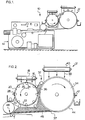
- a cigarette making machine 10 comprising a filler rod forming operation 12 in which a continuous tobacco filler rod is formed from two separate blends of tobacco which differ one from another by a smoking characteristic and a cigarette rod forming operation 14, in which the filler rod is wrapped in paper to form a continuous cigarette rod, separated into individual cigarette lengths and tipped by conventional means.
- the cigarette rod forming operation 14 constitutes the present invention.
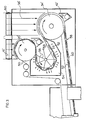
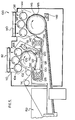
- Figures 2 to 6 are illustrated five separate embodiments of apparatus for carrying out the novel filler rod forming operation. Certain common principles of operation are embodied therein, as will be apparent from the description below, and any apparatus which effects such principles is included within the scope of the invention.
- Tobacco in the form of two separate blends, is processed to provide a tobacco filler rod for passage to a rod-forming operation.
- the blends may comprise a highly-flavoured blend and lesser flavoured blend to provide for a more uniform smoking taste in the cigarette ultimately produced from the filler rod than is achievable with a single blend.
- the separate blends may be provided from separate cigarette hoppers of any convenient construction, preferably from the so-called "Flow-Through" hopper described in our published European patent application No. 86303720.6 and in the corresponding United States Patent No. 4,754,765 issued July 5, 1988, the disclosure of which is incorporated herein by reference. In the embodiment of Figure 3, described below, a single flow-through hopper may be used.
- tobacco of a first blend is fed as a downwardly-flowing wide laterally-thin shower 16 from the end of a conveyor 18 towards a first vacuum wheel 20.
- the use of vacuum wheels to form tobacco filler rods is described generally in U.S. Patent No. 3,980,088, assigned to the assignee hereof, the disclosure of which is incorporated herein by reference.
- the vacuum wheel 20 has a foraminous belt 22 which is mounted on circumferentially-spaced supports 24 on the wheel 20 to provide a plurality of straight sections or chords of a circle 26 between adjacent supports 24.
- a trimmer 28 is provided adjacent the periphery of the wheel 20 to remove any excess of tobacco from the height of tobacco desired on the belt 22.
- the tobacco bunches are transported by the belt 22 under the influence of vacuum to a transfer location 32 whereat the tobacco portions are transferred to a second vacuum wheel 34.
- a vacuum shoe 36 is provided adjacent a straight section of the belt 22 extending generally tangentially to the second vacuum wheel 34.
- the tobacco bunches on the belt 22 come under the influence of vacuum applied through foraminous belt 37 on the wheel 34 and are transferred thereto upon release of the vacuum applied through the belt 22.
- Tobacco is fed as a shower 38 from the end of a conveyor 40 towards the second vacuum wheel 34.
- the tobacco so fed generally has different smoking characteristics from that contained in the shower 16 to provide a two-blend cigarette.
- the tobacco in the shower 38 is captured directly on the belt 37 from the shower 38.
- Tobacco from the shower 38 forms a substantially uniform cross-sectioned layer which fills the spaces on the belt 37 between the tobacco bunches transferred from the wheel 20 to the wheel 34 and also overlies them. It is necessary to supply more tobacco to the shower 38 than is necessary simply to fill the spaces between adjacent bunches in view of the so-called shadow effect whereby clumps of tobacco can prevent other tobacco from filling behind the clump.
- Overlying and excess tobacco is trimmed from the filler rod by a trimmer 42 provided adjacent the periphery 44 of the vacuum wheel 34.
- the resulting tobacco filler rod having a substantially uniform cross-sectional thickness and, in effect, comprising alternate overlapping bunches of first and second types of tobacco from the two different tobacco showers 16 and 38, is transported by the belt 37 from the vacuum wheel 34 under the influence of vacuum applied by a vacuum shoe 46 to the garniture 48 of the cigarette rod forming portion 14. From the cigarette rod-forming portion, there results a cigarette rod having longitudinally adjacent and overlapping portions of different types of tobacco. Different arrangements of the tobacco in cigarettes formed from the cigarette rod are possible, depending on the location of the trimmer 28 and 42 with respect to the periphery of the vacuum wheel 20 and 34.
- the two vacuum wheels 20 and 34 use separate foraminous belts 22 and 37 to transport tobacco.
- a single foraminous belt 50 is used which is arranged to travel on both vacuum wheels 20′ and 34′ and also into and through the cigarette rod forming section 14. Transfer of the tobacco bunches 52 formed on the vacuum wheel 20′ from the shower 16′ from wheel 20′ to wheel 34, is effected with the assistance of a vacuum shroud 54 which maintains the tobacco bunches 52 with spaces 53 therebetween in contact with the belt 50 while the belt 50 is supported by a spoked wheel 56 at contact points.
- tobacco from the shower 38′ fills and overfills the spaces 53 and overlies the bunches 52, as described above for the embodiment of Figures 1 and 2, so that, after trimming excess quantities of the second tobacco stream using trimmer 42′, there results a filler rod 58 having alternate bunches 52 of first tobacco material and 60 of second tobacco material adjacent to and overlapping one another.
- tobacco is delivered to the shower 16′ and 38′ from the end of a single conveyor 60.
- the embodiment of Figure 4 is similar to Figure 3, except that two separate conveyors 70 and 72 are used to feed the different tobacco blends to the vacuum wheels 20 ⁇ and 34 ⁇ .
- a second vacuum shrouded transfer wheel 74 having spoke arms 76 is employed.
- the tobacco bunches and the subsequent filler rod formation are effected directly from falling showers of tobacco particles.
- the embodiment of Figure 5 is designed to decrease the over-supply requirement by decreasing significantly the incidence of shadow formation.
- a cigarette filler rod-forming apparatus 100 comprises a first vacuum wheel 102 having a structure the same as vacuum wheel 20′ and three vacuum wheels 104, 106, 108 arranged equally spaced around the periphery of the vacuum wheel 102 to receive tobacco of a first blend of tobacco particles from a falling shower 110 of the same falling from the end of a conveyor 112. Capture of tobacco particles on the rotating surface of the vacuum wheels 104, 106, 108 forms substreams of tobacco which are transferred to the tobacco in conveying surface 114 by cut-off of the application of vacuum through the surface of the vacuum wheels 104, 106, 108 adjacent the surface 114 to form a filler rod 116 on the belt 114.
- a sculpting knife 118 may be provided to cut away portions of the filler rod 116 to provide for blunt ends to tobacco bunches. Shaping of the ends of the tobacco bunches provided after trimming also may be achieved by blocking off the application of vacuum for a desired length of each of the chords of the belt 114, so that no tobacco is captured in that region.
- a trimmer 120 is provided which trims from the filler rod 116 tobacco of the first blend extending above the periphery of the vacuum wheel 102, thereby providing discrete bunches 122 of first blend tobacco spaced apart from one another by spaces 124.
- the individual bunches 122 are conveyed under the influence of vacuum from leaving the first vacuum wheel 116 to a second vacuum wheel 126, using a first external vacuum shroud 128 with the belt 114 being supported by radial arms 130 extending outwardly from an axle 132 to reverse the direction of movement of the belt 114 and a second external vacuum shroud 134 with the belt 114 being supported by radial arms 136 to change from horizontal movement to angular movement to tangentially engage the vacuum wheel 126.
- a falling shower 138 of a second blend of tobacco particles is permitted to fall from the end of the conveyor 140 towards the vacuum wheel 126, which has the belt 114 recessed between side walls.
- Three small vacuum wheels 140, 142, 144 are provided equally circumferentially spaced about the periphery of the vacuum wheel 126 to form substreams of tobacco on the surface thereof from the falling shower 138, in the same way as small vacuum wheels 104, 106, 108.
- the substreams formed on the surfaces of the small vacuum wheels 140, 142, 144 are transferred to the conveying surface 114 by cutting off the application of vacuum through the surface of the wheels adjacent the wheel 126.
- the substreams of tobacco form a filler rod 146 of the second tobacco in the spaces 124 and overlying the bunches 122.
- This composite rod is transported by the conveyor surface 114 past a trimmer 148, which removes the tobacco overlying the bunches 122 and provides a trimmed filler rod 150 which is forwarded to a cigarette rod-forming operation 152.
- the filler rod comprises bunches 122 of the first blend of tobacco and alternating second bunches of the second blend of tobacco filling the spaces 124 and overlapping the bunches 122.
- the bunches of the first blend of tobacco have a coherent filler rod of a second blend of tobacco formed thereover, which then requires a considerable amount of the second blend of tobacco to be trimmed and recycled.
- the filler rod making machine 200 is designed to overcome this problem by providing tobacco bunches from the two different tobacco blends and then assembling the bunches together.
- first and second vacuum wheels 202 and 204 are identically structured and have the structure of the vacuum wheel 20′ each with three small vacuum wheels 206, 208 adjacent the periphery thereof arranged across the widths of showers 209, 210 of two separate blends of tobacco.
- the tobacco falls from the end of a conveyor 212 confined by chute 213 while in the case of shower 210, the tobacco is drawn upwardly from a conveyor 214 confined by chute 216.
- substreams of tobacco are formed from the respective tobacco showers 209 and 210 which are deposited on respective tobacco-conveying surfaces 218, 220 on the periphery of the vacuum wheels 202, 204, in the manner described above with respect to Figure 5, to form tobacco rods 222 and 224.
- Trimmers 226, 228 are positioned adjacent the periphery of each of the vacuum wheels 202, 204 to remove tobacco projecting beyond the periphery and to form a plurality of bunches 230 of the first blend of tobacco on the surface of the tobacco-conveying belt 218 spaced apart by spaces 232 and a plurality of bunches 234 of the second blend of tobacco on the surface of the tobacco-conveying belt 220 spaced apart by spaces 236.
- the tobacco bunches 230 and 234 have a flat surface adjacent the respective belts 218, 220 and a curved outer surface, as seen in the drawing. These tobacco bunches 230 and 234 are transported by vacuum on the lower surface of belt 218 and on the upper surface of belt 220 off the respective wheels 202, 204, in a convergent relation with the bunches 234 located opposite to the spaces 232 and the bunches 230 located opposite to the spaces 236. As the belt 220 passes over a guide roll 238, the vacuum is cut off and the belt 220 then runs parallel to the belt 218 to a turn-round guide roll 240.
- An air chamber 242 is provided adjacent the conveyor belt 220 for this run to guide air, drawn by the vacuum applied to the upper belt 218, through the lower belt 220 and thereby remove the tobacco particles in the bunches 234 on the belt 220 and reposition those particles in the spaces 232 between the between the bunches 230 to form a filler rod 244 containing the two blends of tobacco with bunches 230 of the first blend of tobacco adjoining and overlapping with bunches of the second blend of tobacco formed by reassembly of the bunches 234 on the belt 218.
- the transfer of the tobacco particles of the bunches 234 from the belt 220 onto and to fill the spaces 230 on the belt 218 may be effected in any other convenient manner, for example, by having roll 238 the turn-round roll and applying a jet of air to the tobacco particles of the bunches 234 as they reach the end of the conveyor belt, or by employing a picker roll adjacent the end of the conveyor belt to throw the tobacco particles of the bunches 234 toward the spaces 232 on the belt 218.
- the filler rod 244 then is forwarded, transported by belt 218, to a standard cigarette rod-forming operation 246 which includes an initial trimming 248 to remove the excess of the tobacco of the second blend from the rod before wrapping in paper to form an elongate continuous cigarette rod, which then is cut to discrete lengths and tipped.
- a standard cigarette rod-forming operation 246 which includes an initial trimming 248 to remove the excess of the tobacco of the second blend from the rod before wrapping in paper to form an elongate continuous cigarette rod, which then is cut to discrete lengths and tipped.
- Figures 7A to 7I illustrate several forms of cigarette which can be formed using the apparatus described above with respect to Figures 1 to 6, depending on the mode of trimming and formation, and whether or not the more highly flavoured tobacco is fed as the first blend or the second blend.
- the caption “flavour blend first” means that the higher flavoured tobacco is fed to the first vacuum wheel and the caption “filler blend first” means that the lesser flavour tobacco is fed to the shaped vacuum wheel.
- the present invention provides a novel method of forming a multi-blend filler rod by first forming discrete bunches of one blend of tobacco and subsequently filling in spaces between the discrete bunches with another blend of tobacco, using vacuum wheels and foraminous rod-forming belts. Modifications are possible within the scope of this invention.
Landscapes
- Manufacturing Of Cigar And Cigarette Tobacco (AREA)
- Manufacture Of Tobacco Products (AREA)
Applications Claiming Priority (2)
| Application Number | Priority Date | Filing Date | Title |
|---|---|---|---|
| GB8718949 | 1987-08-11 | ||
| GB878718949A GB8718949D0 (en) | 1987-08-11 | 1987-08-11 | Tobacco blend formation |
Publications (2)
| Publication Number | Publication Date |
|---|---|
| EP0307090A1 true EP0307090A1 (de) | 1989-03-15 |
| EP0307090B1 EP0307090B1 (de) | 1994-02-23 |
Family
ID=10622104
Family Applications (1)
| Application Number | Title | Priority Date | Filing Date |
|---|---|---|---|
| EP88307375A Expired - Lifetime EP0307090B1 (de) | 1987-08-11 | 1988-08-10 | Bildung einer Tabaksmischung |
Country Status (8)
| Country | Link |
|---|---|
| US (1) | US4896681A (de) |
| EP (1) | EP0307090B1 (de) |
| JP (1) | JPH0648974B2 (de) |
| AU (1) | AU611188B2 (de) |
| CA (1) | CA1298161C (de) |
| DE (1) | DE3887943T2 (de) |
| GB (1) | GB8718949D0 (de) |
| ZA (1) | ZA885858B (de) |
Cited By (8)
| Publication number | Priority date | Publication date | Assignee | Title |
|---|---|---|---|---|
| FR2695008A1 (fr) * | 1992-08-26 | 1994-03-04 | Molins Plc | Procédé et machine pour la fabrication de cigarettes. |
| CN108514152A (zh) * | 2012-05-31 | 2018-09-11 | 菲利普莫里斯生产公司 | 用于浮质产生制品的棒 |
| US11039642B2 (en) | 2011-12-30 | 2021-06-22 | Philip Morris Products S.A. | Smoking article with front-plug and aerosol-forming substrate and method |
| US11140916B2 (en) | 2012-02-13 | 2021-10-12 | Philip Morris Products S.A. | Aerosol-generating article having an aerosol-cooling element |
| US11272731B2 (en) | 2011-12-30 | 2022-03-15 | Philip Morris Products S.A. | Aerosol-generating article for use with an aerosol-generating device |
| US11278052B2 (en) | 2012-06-21 | 2022-03-22 | Philip Morris Products S.A. | Smoking article for use with an internal heating element |
| US11571017B2 (en) | 2012-05-31 | 2023-02-07 | Philip Morris Products S.A. | Flavoured rods for use in aerosol-generating articles |
| US11582998B2 (en) | 2011-12-30 | 2023-02-21 | Philip Morris Products S.A. | Smoking article with front-plug and method |
Families Citing this family (2)
| Publication number | Priority date | Publication date | Assignee | Title |
|---|---|---|---|---|
| EP3222231A1 (de) * | 2002-10-30 | 2017-09-27 | Zimmer Spine, Inc. | Spinaler stabilisierungssystemeinsatz und verfahren |
| WO2011118040A1 (ja) | 2010-03-26 | 2011-09-29 | 日本たばこ産業株式会社 | 揮発性香料デリバリー量を高めたシガレット |
Citations (4)
| Publication number | Priority date | Publication date | Assignee | Title |
|---|---|---|---|---|
| GB2168589A (en) * | 1984-12-21 | 1986-06-25 | Imp Group Plc | Manufacture of a profiled layer of smokeable material |
| GB2169486A (en) * | 1985-01-14 | 1986-07-16 | Imp Group Plc | Apparatus for forming a layer of smokeable material |
| GB2170693A (en) * | 1985-02-09 | 1986-08-13 | Molins Plc | Manufacture of cigarettes from two tobaccos |
| EP0202874A1 (de) * | 1985-05-15 | 1986-11-26 | Rothmans, Benson & Hedges Inc. | Zigarettenherstellungsmaschinen |
Family Cites Families (17)
| Publication number | Priority date | Publication date | Assignee | Title |
|---|---|---|---|---|
| US1721117A (en) * | 1925-03-24 | 1929-07-16 | Hopkins Nevil Monroe | Cigarette-manufacturing machinery |
| US2423554A (en) * | 1940-02-19 | 1947-07-08 | Davidson Glenn | Method of and means for making mouthpiece cigarettes |
| GB1305900A (de) * | 1969-04-02 | 1973-02-07 | ||
| CA923398A (en) * | 1970-02-05 | 1973-03-27 | Amf Incorporated | Method and apparatus for increasing the density of tobacco in predetermined sections of a tobacco braid |
| GB1382266A (en) * | 1971-12-09 | 1975-01-29 | British American Tobacco Co | Production of smoking articles |
| GB1451547A (en) * | 1974-03-28 | 1976-10-06 | Rothmans Of Pall Mall | Cigarette making |
| DE2445856A1 (de) | 1974-09-26 | 1976-04-08 | Hauni Werke Koerber & Co Kg | Verfahren und vorrichtung zum bilden eines tabakstranges aus zwei tabaksorten |
| JPS5231040A (en) * | 1976-06-21 | 1977-03-09 | Takemoto Oil & Fat Co Ltd | Preparation of novel, sulfonic-acid-type surface active agents |
| DE3367155D1 (en) * | 1982-08-05 | 1986-12-04 | Imp Group Plc | Apparatus and method for forming a rod of smokeable material |
| US4516585A (en) * | 1982-09-02 | 1985-05-14 | R. J. Reynolds Tobacco Company | Method and apparatus for producing a multiple-blend cigarette |
| SU1295992A3 (ru) * | 1983-01-26 | 1987-03-07 | Хауни-Верке Кербер Унд Ко.Кг.(Инопредприятие) | Способ изготовлени табачного жгута |
| US4605013A (en) * | 1983-02-02 | 1986-08-12 | Hauni-Werke Korber & Co. Kg | Method and apparatus for forming discrete batches of tobacco particles |
| IT1174175B (it) * | 1983-06-29 | 1987-07-01 | Hauni Werke Koerber & Co Kg | Procentimento e dispositivo per produrre un filone di tabacco |
| DE3508497A1 (de) * | 1985-03-09 | 1986-09-11 | Hauni-Werke Körber & Co KG, 2050 Hamburg | Verfahren und vorrichtung zum bilden von tabakportionen, insbesondere fuer die herstellung eines aus aufeinanderfolgenden tabakabschnitten unterschiedlicher arten gebildeten tabakstranges |
| DE3508498A1 (de) * | 1985-03-09 | 1986-09-11 | Hauni-Werke Körber & Co KG, 2050 Hamburg | Verfahren und vorrichtung zum herstellen eines faserstranges der tabakverarbeitenden industrie |
| DE8506950U1 (de) * | 1985-03-09 | 1987-01-22 | Hauni-Werke Körber & Co KG, 2050 Hamburg | Vorrichtung zum Bilden von Tabakportionen |
| DE3509612A1 (de) * | 1985-03-16 | 1986-09-25 | Hauni-Werke Körber & Co KG, 2050 Hamburg | Verfahren und vorrichtung zum herstellen eines stranges aus fasern der tabakverarbeitenden industrie |
-
1987
- 1987-08-11 GB GB878718949A patent/GB8718949D0/en active Pending
-
1988
- 1988-08-09 ZA ZA885858A patent/ZA885858B/xx unknown
- 1988-08-09 CA CA000574173A patent/CA1298161C/en not_active Expired - Lifetime
- 1988-08-10 EP EP88307375A patent/EP0307090B1/de not_active Expired - Lifetime
- 1988-08-10 AU AU20612/88A patent/AU611188B2/en not_active Ceased
- 1988-08-10 DE DE3887943T patent/DE3887943T2/de not_active Expired - Fee Related
- 1988-08-11 JP JP63201005A patent/JPH0648974B2/ja not_active Expired - Lifetime
- 1988-08-11 US US07/230,885 patent/US4896681A/en not_active Expired - Fee Related
Patent Citations (4)
| Publication number | Priority date | Publication date | Assignee | Title |
|---|---|---|---|---|
| GB2168589A (en) * | 1984-12-21 | 1986-06-25 | Imp Group Plc | Manufacture of a profiled layer of smokeable material |
| GB2169486A (en) * | 1985-01-14 | 1986-07-16 | Imp Group Plc | Apparatus for forming a layer of smokeable material |
| GB2170693A (en) * | 1985-02-09 | 1986-08-13 | Molins Plc | Manufacture of cigarettes from two tobaccos |
| EP0202874A1 (de) * | 1985-05-15 | 1986-11-26 | Rothmans, Benson & Hedges Inc. | Zigarettenherstellungsmaschinen |
Cited By (11)
| Publication number | Priority date | Publication date | Assignee | Title |
|---|---|---|---|---|
| FR2695008A1 (fr) * | 1992-08-26 | 1994-03-04 | Molins Plc | Procédé et machine pour la fabrication de cigarettes. |
| US11039642B2 (en) | 2011-12-30 | 2021-06-22 | Philip Morris Products S.A. | Smoking article with front-plug and aerosol-forming substrate and method |
| US11272731B2 (en) | 2011-12-30 | 2022-03-15 | Philip Morris Products S.A. | Aerosol-generating article for use with an aerosol-generating device |
| US11582998B2 (en) | 2011-12-30 | 2023-02-21 | Philip Morris Products S.A. | Smoking article with front-plug and method |
| US12256772B2 (en) | 2011-12-30 | 2025-03-25 | Philip Morris Products S.A. | Aerosol-generating article for use with an aerosol-generating device |
| US12532911B2 (en) | 2011-12-30 | 2026-01-27 | Philip Morris Products S.A. | Smoking article with front-plug and method |
| US11140916B2 (en) | 2012-02-13 | 2021-10-12 | Philip Morris Products S.A. | Aerosol-generating article having an aerosol-cooling element |
| CN108514152A (zh) * | 2012-05-31 | 2018-09-11 | 菲利普莫里斯生产公司 | 用于浮质产生制品的棒 |
| US11571017B2 (en) | 2012-05-31 | 2023-02-07 | Philip Morris Products S.A. | Flavoured rods for use in aerosol-generating articles |
| US11278052B2 (en) | 2012-06-21 | 2022-03-22 | Philip Morris Products S.A. | Smoking article for use with an internal heating element |
| US12201141B2 (en) | 2012-06-21 | 2025-01-21 | Philip Morris Products S.A. | Smoking article for use with an internal heating element |
Also Published As
| Publication number | Publication date |
|---|---|
| ZA885858B (en) | 1989-05-30 |
| US4896681A (en) | 1990-01-30 |
| GB8718949D0 (en) | 1987-09-16 |
| AU2061288A (en) | 1989-02-16 |
| EP0307090B1 (de) | 1994-02-23 |
| JPH01128777A (ja) | 1989-05-22 |
| DE3887943D1 (de) | 1994-03-31 |
| CA1298161C (en) | 1992-03-31 |
| AU611188B2 (en) | 1991-06-06 |
| JPH0648974B2 (ja) | 1994-06-29 |
| DE3887943T2 (de) | 1994-09-15 |
Similar Documents
| Publication | Publication Date | Title |
|---|---|---|
| US3987804A (en) | Manufacture of cigarettes and the like | |
| CA1207207A (en) | Method and apparatus for producing a composite tobacco filler | |
| US3999559A (en) | Manufacture of filter-tipped cigarettes | |
| US4896681A (en) | Tobacco blend formation | |
| FI58861C (fi) | Foerfarande och anordning foer framstaellning av tobaksfilter innehaollande partikelmaterial av ett delat filtermaterialband | |
| US4516585A (en) | Method and apparatus for producing a multiple-blend cigarette | |
| US3880171A (en) | Production of smoking articles | |
| US5526826A (en) | Apparatus for removing surplus from a tobacco stream | |
| US5413121A (en) | Cigarette making machine | |
| US20030106561A1 (en) | Method of and apparatus for making a tobacco rod with embedded additive | |
| US20050282693A1 (en) | Method and apparatus for producing composite cigarette filters | |
| GB2157940A (en) | Dual-rod cigarette manufacturing machine | |
| US4793364A (en) | Cigarette manufacture | |
| US1796522A (en) | Method of manufacturing cigarettes | |
| EP0137604A1 (de) | Egalisiervorrichtung für Tabak | |
| US4714083A (en) | Making of multi-element smoking article rod | |
| US4732164A (en) | Method of and apparatus for making a continuous filler of tobacco or the like | |
| GB1416019A (en) | Manufacture of cigarettes and the like | |
| US4237778A (en) | Machine for making recessed composite filter mouthpieces | |
| US4703764A (en) | Method and apparatus for making rod-like fillers from several types of fibrous material | |
| GB1594210A (en) | Uniting rodlike articles | |
| JPH0369273B2 (de) | ||
| GB2171889A (en) | Apparatus for forming batches of tobacco and the like | |
| EP3250057B1 (de) | Tabakstrang mit einer vielzahl an tabakmaterialien | |
| JPS61205473A (ja) | たばこ定量体、特に相前後する異なつた種類のたばこ部分から形成されたたばこ連続体を造るための定量体を形成するための方法および装置 |
Legal Events
| Date | Code | Title | Description |
|---|---|---|---|
| PUAI | Public reference made under article 153(3) epc to a published international application that has entered the european phase |
Free format text: ORIGINAL CODE: 0009012 |
|
| AK | Designated contracting states |
Kind code of ref document: A1 Designated state(s): DE FR GB IT NL SE |
|
| 17P | Request for examination filed |
Effective date: 19890905 |
|
| 17Q | First examination report despatched |
Effective date: 19901024 |
|
| RAP1 | Party data changed (applicant data changed or rights of an application transferred) |
Owner name: ROTHMANS INTERNATIONAL TOBACCO LIMITED Owner name: ROTHMANS, BENSON & HEDGES INC. |
|
| GRAA | (expected) grant |
Free format text: ORIGINAL CODE: 0009210 |
|
| AK | Designated contracting states |
Kind code of ref document: B1 Designated state(s): DE FR GB IT NL SE |
|
| REF | Corresponds to: |
Ref document number: 3887943 Country of ref document: DE Date of ref document: 19940331 |
|
| RAP2 | Party data changed (patent owner data changed or rights of a patent transferred) |
Owner name: ROTHMANS INTERNATIONAL SERVICES LIMITED Owner name: ROTHMANS, BENSON & HEDGES INC. |
|
| ITF | It: translation for a ep patent filed | ||
| ET | Fr: translation filed | ||
| NLT1 | Nl: modifications of names registered in virtue of documents presented to the patent office pursuant to art. 16 a, paragraph 1 |
Owner name: ROTHMANS, BENSON & HEDGES INC. TE NORTH YORK, CANA |
|
| PLBE | No opposition filed within time limit |
Free format text: ORIGINAL CODE: 0009261 |
|
| STAA | Information on the status of an ep patent application or granted ep patent |
Free format text: STATUS: NO OPPOSITION FILED WITHIN TIME LIMIT |
|
| EAL | Se: european patent in force in sweden |
Ref document number: 88307375.1 |
|
| 26N | No opposition filed | ||
| PGFP | Annual fee paid to national office [announced via postgrant information from national office to epo] |
Ref country code: FR Payment date: 20000809 Year of fee payment: 13 |
|
| PGFP | Annual fee paid to national office [announced via postgrant information from national office to epo] |
Ref country code: GB Payment date: 20000810 Year of fee payment: 13 |
|
| PGFP | Annual fee paid to national office [announced via postgrant information from national office to epo] |
Ref country code: SE Payment date: 20000817 Year of fee payment: 13 |
|
| PGFP | Annual fee paid to national office [announced via postgrant information from national office to epo] |
Ref country code: DE Payment date: 20000825 Year of fee payment: 13 |
|
| PGFP | Annual fee paid to national office [announced via postgrant information from national office to epo] |
Ref country code: NL Payment date: 20000829 Year of fee payment: 13 |
|
| PG25 | Lapsed in a contracting state [announced via postgrant information from national office to epo] |
Ref country code: GB Free format text: LAPSE BECAUSE OF NON-PAYMENT OF DUE FEES Effective date: 20010810 |
|
| PG25 | Lapsed in a contracting state [announced via postgrant information from national office to epo] |
Ref country code: SE Free format text: LAPSE BECAUSE OF NON-PAYMENT OF DUE FEES Effective date: 20010811 |
|
| PG25 | Lapsed in a contracting state [announced via postgrant information from national office to epo] |
Ref country code: NL Free format text: LAPSE BECAUSE OF NON-PAYMENT OF DUE FEES Effective date: 20020301 |
|
| EUG | Se: european patent has lapsed |
Ref document number: 88307375.1 |
|
| GBPC | Gb: european patent ceased through non-payment of renewal fee |
Effective date: 20010810 |
|
| PG25 | Lapsed in a contracting state [announced via postgrant information from national office to epo] |
Ref country code: FR Free format text: LAPSE BECAUSE OF NON-PAYMENT OF DUE FEES Effective date: 20020430 |
|
| NLV4 | Nl: lapsed or anulled due to non-payment of the annual fee |
Effective date: 20020301 |
|
| PG25 | Lapsed in a contracting state [announced via postgrant information from national office to epo] |
Ref country code: DE Free format text: LAPSE BECAUSE OF NON-PAYMENT OF DUE FEES Effective date: 20020501 |
|
| REG | Reference to a national code |
Ref country code: FR Ref legal event code: ST |
|
| PG25 | Lapsed in a contracting state [announced via postgrant information from national office to epo] |
Ref country code: IT Free format text: LAPSE BECAUSE OF NON-PAYMENT OF DUE FEES;WARNING: LAPSES OF ITALIAN PATENTS WITH EFFECTIVE DATE BEFORE 2007 MAY HAVE OCCURRED AT ANY TIME BEFORE 2007. THE CORRECT EFFECTIVE DATE MAY BE DIFFERENT FROM THE ONE RECORDED. Effective date: 20050810 |