EP0307110A2 - Vorrichtung zum Abmanteln und Brechen optischer Fasern - Google Patents
Vorrichtung zum Abmanteln und Brechen optischer Fasern Download PDFInfo
- Publication number
- EP0307110A2 EP0307110A2 EP88307856A EP88307856A EP0307110A2 EP 0307110 A2 EP0307110 A2 EP 0307110A2 EP 88307856 A EP88307856 A EP 88307856A EP 88307856 A EP88307856 A EP 88307856A EP 0307110 A2 EP0307110 A2 EP 0307110A2
- Authority
- EP
- European Patent Office
- Prior art keywords
- optical fiber
- clamp
- fiber
- carriage
- secured
- Prior art date
- Legal status (The legal status is an assumption and is not a legal conclusion. Google has not performed a legal analysis and makes no representation as to the accuracy of the status listed.)
- Withdrawn
Links
Images



Classifications
-
- G—PHYSICS
- G02—OPTICS
- G02B—OPTICAL ELEMENTS, SYSTEMS OR APPARATUS
- G02B6/00—Light guides; Structural details of arrangements comprising light guides and other optical elements, e.g. couplings
- G02B6/46—Processes or apparatus adapted for installing or repairing optical fibres or optical cables
- G02B6/56—Processes for repairing optical cables
- G02B6/566—Devices for opening or removing the mantle
-
- G—PHYSICS
- G02—OPTICS
- G02B—OPTICAL ELEMENTS, SYSTEMS OR APPARATUS
- G02B6/00—Light guides; Structural details of arrangements comprising light guides and other optical elements, e.g. couplings
- G02B6/24—Coupling light guides
- G02B6/245—Removing protective coverings of light guides before coupling
-
- G—PHYSICS
- G02—OPTICS
- G02B—OPTICAL ELEMENTS, SYSTEMS OR APPARATUS
- G02B6/00—Light guides; Structural details of arrangements comprising light guides and other optical elements, e.g. couplings
- G02B6/24—Coupling light guides
- G02B6/25—Preparing the ends of light guides for coupling, e.g. cutting
-
- Y—GENERAL TAGGING OF NEW TECHNOLOGICAL DEVELOPMENTS; GENERAL TAGGING OF CROSS-SECTIONAL TECHNOLOGIES SPANNING OVER SEVERAL SECTIONS OF THE IPC; TECHNICAL SUBJECTS COVERED BY FORMER USPC CROSS-REFERENCE ART COLLECTIONS [XRACs] AND DIGESTS
- Y10—TECHNICAL SUBJECTS COVERED BY FORMER USPC
- Y10T—TECHNICAL SUBJECTS COVERED BY FORMER US CLASSIFICATION
- Y10T225/00—Severing by tearing or breaking
- Y10T225/30—Breaking or tearing apparatus
- Y10T225/307—Combined with preliminary weakener or with nonbreaking cutter
- Y10T225/321—Preliminary weakener
- Y10T225/325—With means to apply moment of force to weakened work
-
- Y—GENERAL TAGGING OF NEW TECHNOLOGICAL DEVELOPMENTS; GENERAL TAGGING OF CROSS-SECTIONAL TECHNOLOGIES SPANNING OVER SEVERAL SECTIONS OF THE IPC; TECHNICAL SUBJECTS COVERED BY FORMER USPC CROSS-REFERENCE ART COLLECTIONS [XRACs] AND DIGESTS
- Y10—TECHNICAL SUBJECTS COVERED BY FORMER USPC
- Y10T—TECHNICAL SUBJECTS COVERED BY FORMER US CLASSIFICATION
- Y10T29/00—Metal working
- Y10T29/51—Plural diverse manufacturing apparatus including means for metal shaping or assembling
- Y10T29/5136—Separate tool stations for selective or successive operation on work
- Y10T29/5137—Separate tool stations for selective or successive operation on work including assembling or disassembling station
- Y10T29/5139—Separate tool stations for selective or successive operation on work including assembling or disassembling station and means to sever work prior to disassembling
- Y10T29/514—Separate tool stations for selective or successive operation on work including assembling or disassembling station and means to sever work prior to disassembling comprising means to strip insulation from wire
-
- Y—GENERAL TAGGING OF NEW TECHNOLOGICAL DEVELOPMENTS; GENERAL TAGGING OF CROSS-SECTIONAL TECHNOLOGIES SPANNING OVER SEVERAL SECTIONS OF THE IPC; TECHNICAL SUBJECTS COVERED BY FORMER USPC CROSS-REFERENCE ART COLLECTIONS [XRACs] AND DIGESTS
- Y10—TECHNICAL SUBJECTS COVERED BY FORMER USPC
- Y10T—TECHNICAL SUBJECTS COVERED BY FORMER US CLASSIFICATION
- Y10T29/00—Metal working
- Y10T29/51—Plural diverse manufacturing apparatus including means for metal shaping or assembling
- Y10T29/5147—Plural diverse manufacturing apparatus including means for metal shaping or assembling including composite tool
- Y10T29/5148—Plural diverse manufacturing apparatus including means for metal shaping or assembling including composite tool including severing means
- Y10T29/515—Plural diverse manufacturing apparatus including means for metal shaping or assembling including composite tool including severing means to trim electric component
Definitions
- the present invention relates to an apparatus for preparing an optical fiber for connection to another optical fiber and, more specifically, to an apparatus for stripping insulation from a portion of the length of an optical fiber and cleaving the bared fiber core at a predetermined distance for the severed portion of insulation.
- the preparation of the end of an optical fiber for connection to another fiber in end-to-end relation involves, in general, the stripping of the insulation from the end of the fiber and then cutting or cleaving the bared portion of the wire to a predetermined length.
- the cutting or cleaving process is very important if good optical characteristics are to be maintained through the fused joint between two fiber ends.
- various fiber cleaving or cutting devices have been developed and used.
- United States Patent No. 4,017,013 granted to HAWK ET AL on April 12, 1987 discloses an apparatus for severing the ends of a plurality of parallel optical fibers so that the end faces thereof are relatively flat, are substantially perpendicular to the fiber axis and are relatively co-planar.
- the fibers are bent over an arcuate surface and are slidably clamped between the flat surfaces of two pieces of rubbery material.
- the clamp is urged by a spring in such a direction that the fibers are in tension. After one fiber is scored and breaks, the clamp automatically slides along the remaining fibers until the clamping force on those fibers is sufficient to prevent further sliding.
- the fibers are individually severed in this manner.
- This patent does not disclose any mechanism for removing insulation from the optical fiber.
- United States Patent No. 4,036,419 granted to HENSEL ET AL on July 19, 1977 discloses a device for severing an optical fiber and comprises at least one fiber clamp for holding a portion of the fiber against an anvil, means for applying a constant force to the anvil independently of displacement of the anvil so that a preset tension is applied to the optical fiber.
- a knife is provided for engaging the fiber and initiating a fracture through the fiber. This patent does not disclose any mechanism for removing insulation from an optical fiber.
- United States Patent No. 4,154,385 granted to ADOLPH L. LEWIS on May 15, 1979 discloses a hand-held, manually operated tool for severing single filament, fiber optic cable.
- the tool is formed with a pair of handles which when squeezed together cause a fiber optic cable to be firmly gripped and positioned on an anvil member where it may be scored by a sharpened hard element such as a diamond point at a selectively predetermined point along the axis of the fiber optic cable. Further actuation of the tool causes the gripping members to be pivoted away from each other and thus part the fiber optic cable at the selectively predetermined point.
- This patent does not disclose any mechanism for removing insulation from the fiber optic cable.
- United States Patent No. 4,159,793 granted to BELMONTE ET AL on June 3, 1979 discloses a tool for preparing the ends of an optical fiber prior to such operations as coupling and splicing.
- the tool is adapted for single-handed operation and comprises a pair of manually actuated handles, first and second fiber supporting surfaces and a third fiber supporting surface between the first and second surfaces.
- the optical fiber is secured to the first and second surfaces by a pair of clamping members which are responsive to the squeezing of the handles. Once the optic fiber is secured to the surfaces, further squeezing of the handles produces separating rotation of a pair of jaw members to put the fiber under tensile stress.
- a cutting blade suspended above the third surface is released to produce a peripheral microcrack on a portion of the optical fiber lying on the third fiber supporting surface.
- the induced stress and curved support of the fiber act in combination to propagate the microcrack diametrically through the fiber so that an appropriate fiber end is obtained.
- United States Patent No. 4,229,876 granted to JOHN S. DOTY on October 28, 1980 discloses a combination fiber breaker and connector apparatus and method involving clamping an optical connector element to the optical fiber before breaking is effected and then removably securing the connector element to the breaker at a known position which is correlated to the location of a scoring blade and to the characteristics of the connector.
- the fiber is then clamped, bent, tensioned and scored in response to a single squeezing and releasing motion by one hand of the operator.
- the scoring is effected by a hard mounted tungsten carbide blade which moves in an arcuate path towards and across the tension fiber.
- the patent does not disclose any mechanism for removing insulation from an optical fiber.
- United States Patent No. 4,315,584 granted to FRIEDRICH WUESTNER on February 16, 1982 discloses a method and device for cutting or breaking a plurality of optical fibers contained in a cable.
- the device comprises an anvil positioned between a pair of common clamps for holdng the optical fibers in parallel to each other. At least one of the clamps is movable. Means is provided for applying a force to the movable clamp to provide an axial tensile force. Further means is provided for applying a vertical force to each of the optical fibers positioned on the anvil at a point on the side of the anvil opposite the movable clamp and means is positioned at the anvil for notching the fibers on the anvil for separating the fibers at the notches.
- This patent does not disclose any mechanism for removing insulation from the optical fiber.
- HELMUT H. LUKAS Canadian Patent No. 1,166,217 issued on April 24, 1984 discloses a method and an apparatus for breaking an optical fiber which comprises two spaced members each having locating means to locate an optical fiber against longitudinal movement.
- the spaced members are relatively movable to increase the spacing between the locating means in the direction of the longitudinal axis of the fiber.
- Means is provided for scoring the fiber transversely to its length between the spaced locating means to produce a score and means for urging the spaced locating means apart to apply to the fiber, after, but not during, the scoring step, tension which is sufficient to cause a crack to propagate completely across the fiber and during the scoring step to produce in the fiber a tension of a level insufficient to cause the fiber to sever on scoring.
- this patent does not disclose any means for removing insulation from an optical fiber.
- the insulation stripping operation has been effected manually using conventional, manual insulation removing tools in the form of pliers.
- This operation requires care and dexterity and can be relatively time consuming.
- the insulation is often not stripped as neatly as it should be and/or the bared portion of the fiber is nicked which means that the process must be repeated.
- some skill and practice is required in order to properly and proficiently prepare an optical fiber for use. There is, therefore, a need for an apparatus which automates not only the cleaving operation but also the insulation stripping operation.
- an apparatus for preparing an optical fiber for connection to another optical fiber comprising a clamp for gripping an optical fiber at a first location, a mechanism for transversely severing and removing insulation from a predetermined length of the fiber to provide an insulation severed end portion and a bared fiber portion, a cleaving mechanism for forming a transverse score in the bared fiber portion at a predetermined distance from the severed end portion of the insulation, and a fiber tensioning mechanism for breaking the optical fiber along a transverse plane containing the score.
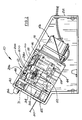
- the preferred embodiment of the present invention includes a housing 12 and a base 14.
- a mechanism 16 is disposed within and secured to the housing and is operable to prepare an optical fiber in a manner explained in detail below.
- Housing 12 is a thin-walled body having an upper end portion 18 defining a chamber 20 adapted to receive and fixedly secure mechanism 16 therein and a generally rectangular, tubular lower end portion or chute 22 having an opening 24 at its bottom end 26.
- base 14 is adapted to sit on a horizontal surface and is formed with a rectangular recess 28 adapted to telescopically receive the bottom end 26 of housing 12 and collect therein optic fiber and insulation debris which drops under gravity from the upper end portion of the housing, through chute 22 and opening 24.
- the base may be resiliently and removably secured to the housing, as by spring clips or the like, to permit emptying of the recess.
- the upper end portion of the housing is generally parallelepiped in shape and inclined at a convenient angle with respect to chute 22 to facilitate insertion of the end of an optic fiber 30 to be processed into an aperture 32 in front face 34 of the housing.
- An actuating button 36 protrudes from the front face of the housing and, when depressed, activates mechanism 16 and commences a cycle of operation of the apparatus.
- Each cycle of operation generally includes firstly gripping or clamping the optical fiber against longitudinal movement at a location thereof spaced from the inner or proximate end of the fiber, secondly transversely severing the insulation, but not the fiber core, and stripping a length of insulation from the plane of severance of the insulation toward the proximate end of the fiber to provide a bared fiber portion, thirdly scoring the bared fiber portion at a predetermined distance from the plane of severance of the insulation, fourthly gripping or clamping the fiber at a second location on the fiber on the side of the score remote from the first mentioned location, fifthly tensioning the fiber to an extent sufficient to break or cleave the fiber along a transverse plane containing the score and sixthly ejecting the optic fiber and insulation debris which, as explained above, falls through chute 22, opening 24 and collected in recess 28.
- the mechanism includes a first fiber clamp means 40 secured to the housing for clamping an optical fiber 30 (see FIGURE 1a) at a first location 42 thereon spaced from end 44 of the fiber.
- a carriage 46 is secured to the housing for movement toward and away from first clamp means 40 longitudinally of the length of optical fiber 30 secured by first clamp means 40.
- a stripping means 48 is secured to the carriage for removing insulation from at least a portion of the fiber intermediate location 42 and end 44 of the fiber and providing a bared optical fiber portion and an insulation severed end 50.
- a scoring means 52 is secured to and movable with the carriage for forming a score 54 in the bared end portion of the fiber at a predetermined distance from the plane 50 of severance of the insulation.
- a second fiber clamp means 54 is secured to and movable with the carriage for clamping the fiber on the side of the score remote from first location 42.
- the mechanism further includes an electric motor 56 adapted to be connected to a source of d.c. current by means of electrical conductors 58.
- the motor rotatably drives a shaft 60 to which is secured a cam 62 illustrated in FIGURES 11-13.
- the first clamp means 40 comprises a mounting block 70 fixedly secured to front wall 34 of the housing by screws 71 (FIGURE 2).
- Block 70 is formed with a cavity 72 in side edge 74 to receive a clamp body 76 in sliding fit relation therein.
- Clamp body 76 is secured to the mounting block by a hinge pin 78 to permit the clamp body to pivot with respect to the mounting block in a plane extending transversely of the path of the optical fiber as will become clearer below.
- the clamp body is movable between a fiber clamping position, shown in FIGURE 6, and an unclamped position (not shown).
- a coiled compression spring 80 biases the clamp body toward its clamping position.
- Mounting block 70 is further formed with a throughbore 82 for receiving a cam 84, secured to shaft 60, and having a cam surface 86 engageable with a cam follower 88 secured to clamp body 76.
- Cam surface 86 is profiled to move the clamp body from its clamped position to its unclamped position once every revolution of the shaft to thereby permit an optical fiber to be inserted into and removed from the mechanism.
- the mounting block is formed with a channel 90 for receiving a length of optical fiber 30.
- Channel 90 is in the form of a narrow slot which extends longitudinally through block 70 and opens in a side surface 92 of cavity 72.
- a clamp member or blade 94 is removably and adjustably secured to the underside 96 of the clamp body by screws 98 and is adapted to extend into the channel for clamping an optical fiber disposed therein against the inner end surface of the channel.
- the operating mechanism is arranged such that cam 84 is in the position shown in FIGURE 6 at the beginning and end of each cycle of operation to allow an optical fiber to be inserted and removed from the mechanism. During the entire cycle of operation, the clamp body and clamping blade are in their clamping positions securely holding an optical fiber in position while the end of the fiber is stripped of insulation, cleaved and broken.
- Stripping mechanism 48, cleaving mechanism 52, second clamp means 54, motor 56 and their associated components are secured to a carriage 100 (see also FIGURE 3) which, in turn, is mounted on a pair of guide pins 102 secured to and extending rearwardly from mounting block 70 so that the carriage can move longitudinally toward and away from the mounting block 70 during each cycle of operation.
- the insulation stripping means 48 is comprised of a fixed stripper blade 104 secured to carriage 100 by mounting screws 106 and a movable or active stripper blade 108 pivotally secured to the fixed stripper blade 104 by an eccentric pivot adjustment pin 110 for movement toward and away from the fixed stripper blade.
- Stripper blades 104 and 108 are formed with opposed cutting edges 112 and 114, respectively, extending transversely of and disposed on opposite sides of an optical fiber 30 and defining an optical fiber insulation stripping cavity 116 (FIGURE 7a).
- the cutting edges are operable to sever opposed sides of the insulation of a fiber disposed between them and are movable with the carriage longitudinally of said fiber toward the proximal end thereof whereby to remove insulation from at least a portion of the fiber.
- Stripper blade 108 is movable between a first position, shown in FIGURE 8, whereat cutting edge 114 is co-operable with cutting edge 112 to sever insulation on the optical fiber and a second position, shown in FIGURE 7, removed from the first position, whereat the two cutting edges are disposed in non-cutting relation.
- a resilient bias means in the form of a coiled compression spring 118 urges end 120 remote from pivot pin 110 toward the fixed stripper blade and, therefore, into cutting relation therewith.
- Movable stripper blade actuating mechanism 130 includes a stationary shaft 132 having one end 134 secured to mounting block 70 and its other end 136 formed with a stop 138.
- Shaft 132 extends longitudinally rearwardly of the mounting block, parallel to the direction of movement of the carriage, and is disposed in an elongated recess 140 formed in the back side of carriage 100.
- a pick-up sleeve 142 is secured to the shaft for holdng the movable stripper blade in its second (non-cutting) position while the carriage is disposed in its initial, retracted position.
- a pick-up drum 144 is secured to the shaft for longitudinal sliding movement therealong and is formed with a cam surface 146 which smoothly merges into a pick-up sleeve carrying surface 148 having a circumferential groove 150 therein for receiving and retaining end 120 of movable stripper blade 108.
- the carriage At the beginning (and end) of each cycle of operation, the carriage will be in its retracted position (FIGURES 2, 3 and 4) and tail end 120 of movable stripper blade will be supported by pick-up sleeve 142.
- tail end 120 of the movable stripper blade When the carriage is longitudinally displaced away from its initial position and mounting block 70, tail end 120 of the movable stripper blade will slide off of the pick-up sleeve onto shaft 132.
- its cutting edge 116 will cut into and sever the top edge of the insulation of the optical fiber which, in turn, will cause the fiber to be urged against cutting edge 112 of fixed stripper blade 104 so as to sever the insulation on the bottom side of the fiber.
- the pivot point of the movable stripper blade is adjustable so as to ensure that only the insulation and not the fiber itself is severed by the cutting action of the stripper blades.
- the cutting edges 104 and 108 remain in their cutting positions as the carriage moves rearwardly, towards the extended position (FIGURE 5) and, in so doing, strip or remove insulation from the fiber.
- tail end 120 of the movable stripper blade slides along shaft 132 and at some point will engage cam surface 146 of pick-up drum 144 and push it rearwardly until its back surface 152 engages stop 130.
- tail end 120 rides up onto and slides upwardly along cam surface 146 until it reaches and drops into groove 150 of the drum.
- the carriage will have reached its fully extended position and will be returned to its fully retracted position whereat tail end 120 will be transferred to the pick-up sleeve 142.
- the front, bottom edge of tail end 120 is tapered as best shown in FIGURE 3. It will be understood that the insulation need not and is not stripped to the free end 34 of the fiber.
- Scoring means 52 includes an anvil surface 160 formed on carriage 100 in longitudinal alignment with fiber cavity 116 of the stripping mechanism 48 and channel 90 of the first clamp means 40.
- a cleaver arm 162 is secured to the carriage by a pivot pin 164 for pivotal movement in a plane extending transversely of the anvil surface and an optical fiber disposed thereon.
- a flexible scoring blade 166 is replaceably secured to the cleaver arm by mounting screws 168 and comprises a mounting block 170, a lever spring 172 and a diamond blade cutting member 174 having a cutting edge 176 extending transversely of the optical fiber for forming a score in the bared portion of the fiber.
- the scoring blade is movable with the cleaver arm between a non-scoring position whereat the scoring edge is transversely spaced from a fiber disposed on the anvil surface to a scoring position whereat the scoring edge is urged against an optical fiber disposed on the anvil surface.
- An adjustable stop 184 is threaded into lower end 186 of the cleaver arm and is engageable with anvil surface 160 to accurately control the depth of the score.
- a cam 188 having a cylindrical cam surface 190 with a recess 192 therein, is secured to drive shaft 60 and cooperates with a cam follower 194 secured to cleaver arm 162 to keep the cleaver arm in its non-scoring position through most of a cycle of operation.
- follower 194 reaches and engages recess 192, the cleaver arm and, therefore, scoring edge 176, move to the scoring position under the action of coiled compression spring 178.
- the cleaver arm is longitudinally adjustable with respect to the optical fiber to allow the final length of the bared end portion of the fiber to be precisely predetermined.
- a thumbwheel 200 threadedly engaged with a longitudinally extending, threaded shaft 202 secured to carriage 100.
- the thumbwheel is formed with a circumferential ridge 204 received in a slot 206 in the cleaver arm so that rotation of the thumbwheel results in axial displacement thereof along shaft 202, which displacement is transmitted to the cleaver arm by engagement between ridge 204 and slot 206.
- the cleaver arm is free to slide axially on its pivot pin 164.
- a plate 208 is also secured to the carriage adjacent the thumbwheel and is provided with a suitable scale indicating the distance to the place of severance of the cutting edges of the stripper blades.
- Second clamp means 54 includes a stationary clamping surface or jaw 210 formed on carriage 100 in longitudinal alignment with anvil surface 160, fiber cavity 116 of the stripping mechanism 48 and channel 90 of the first clamp means 40.
- a fiber clamp body 212 is pivotally secured to the carriage by pivot pin 214 for pivotal movement in a plane extending transversely of the direction of movement of the carriage.
- Clamp body 212 includes a movable clamp surface or jaw 216 in juxtaposition to stationary clamp surface 210.
- a cam 218 having a camming profile 220 is secured to drive shaft 60 and cooperates with cam follower 222 secured to the clamp body for moving the movable clamping surface 216 away from stationary surface 210 against the action of a coiled compression spring 224 disposed between the carriage and the clamp body.
- Cam 218 is profiled and arranged to effect clamping of an optical fiber between jaws 210 and 216 during a period of time after the fiber has been scored and while it is tensioned.
- a knock-off assembly 230 is provided for cleanly removing debris from mechanism 16.
- the assembly includes a knock-off lever 232 pivotally secured, by a pivot pin 236, within a notch 234 formed in the side of the fiber clamp body 212.
- Lever 232 further includes a triangular cut-out portion 238 to permit lever 232 pivot, within limits, within notch 234.
- a tension spring 240 biases the lever in a clockwise direction as viewed in FIGURE 10.
- a knock-off shaft 242 extends transversely of the plane of the fiber clamp and a torsion spring 244 is disposed about the shaft.
- the knock-off shaft is formed with a notch 245 adapted to receive the end of knock-off lever 232 and is cooperable therewith for torsioning spring 244.
- a pair of knock-off fingers 246 are secured to and extend from knock-off shaft 242 above the portion of the fiber which is to be cleaved from the fiber.
- a fiber pivot wire 248 is secured to and is movable with the fiber clamp body and is disposed below the portion of the fiber which is to be cleaved from the fiber.
- the carriage actuating mechanism 250 will now be described with reference to FIGURES 3 and 11-13.
- the mechanism includes a stripper arm 252 having one end 254 pivotally secured to the carriage by pivot pin 256 and its other end 258 pivotally secured to the rear end 260 of a connecting rod 262 by pivot pin 264.
- the front end 266 of rod 262 is pivotally secured to mounting block 70 by a pivot pin 268.
- a cam follower 270 extends inwardly of an opening 272 in carriage 100 and into engagement with a cam groove 274 (FIGURES 11-13) of cylindrical cam 62 which, as mentioned previously, is secured to shaft 60 driven by motor 56. It will be understood that end 258 of arm 252 will remain longitudinally stationary by virtue of its connection to connecting rod 262.
- FIGURES 11 and 12 illustrate the stripping profile which causes movement of the carriage during the stripping operation.
- a small protrusion or profile 276 which causes a small longitudinal oscillation of the carriage during a period of time when both clamp means 40 and 54 have clamped an optical fiber on opposite sides of the score formed by scoring means 52 and thus subject the fiber to a small tensile load which is sufficient to break the fiber along the transverse plane of the score.
- FIGURE 14 illustrates cam profile 188, as well as, in dotted lines, profile 218.
- microswitches 280 and 282 are provided for energizing and de-energizing motor 56.
- the two microswitches are in parallel relationship with one another and in series with the motor.
- Microswitch 280 includes an actuating element 284 which is arranged to be actuated by an extension 286 of spring loaded button 36 (see FIGURES 2, 4 and 5).
- Microswitch 282 is controlled by cam 62 and, to that end, includes a cam follower 288 secured to the end of spring loaded actuating element 290 which maintains the cam follower in engagement with the cam.
- the cam is cylindrical except for a recess 292.
- the switch is closed when the follower engages the cylindrical portion of the cam and open when it engages the recess.
- follower 288 normally engages recess 292.
- extension 286 of the button depresses actuating element 284 which closes microswitch 280 which, in turn, energizes motor 56 and rotates the cam.
- Rotation of the cam causes follower 288 to move out of recess 292 onto the cylindrical portion of the cam causing microswitch 282 to close and thereby connecting the motor to the d.c. source independently of microswitch 280.
- button 36 can now be released and the motor will remain energized.
- Button 36 returns to its starting position under the influence of its spring bias (not shown) and microwitch 280 is opened. The motor will remain energized for one complete revolution, i.e. until follower 288 again engages recess 292 at which point microwitch 282 will open.
- cam 84 rotates away from the position shown in FIGURE 6. This allows clamp body 76 to move to its clamping position under the action of spring 80 and thereby securely hold the optical fiber at a location remote from its inner end 44.
- carriage 100 moves rearwardly to its fully extended position by virtue of engagement between cam follower 270 secured to arm 252 (FIGURE 3) and the carriage actuating portion of cam profile 274 (FIGURES 11 and 12).
- tail 120 (FIGURE 3) of stripper arm 108 moves off of pick-up sleeve 142 onto shaft 132 under the action of spring 118 and slides rearwardly along the shaft until pick-up drum 144 abuts stop 138. At that point, the tail slides upwardly along camming surface 146 and ultimately drops into groove 150 of the puck-up drum.
- cam profile 274 returns the carriage to its initial, retracted position. As it approaches that position, tail end 120 of the stripper arm is transferred from the pick-up drum to the pick-up sleeve.
- follower 194 associated with arm 162 engages recessed portion 192 of cam 188 causing cutting edge 176 of diamond cutter 174 to form a score in the bared portion of the fiber. Arm 162 thereafter returns to its non-scoring position shown in FIGURE 9.
- follower 222 associated with rear fiber clamp body 212 engages the recessed profile portion of cam 220 and body 212 moves to its clamping position under the influence of spring 224 and clamps the proximate end 44 of the fiber between jaws 210 and 216.
- Rear clamp 54 remains in its clamped position until PHASE G.
- the fiber is tensioned, and breaks, by engagement between follower 270 of arm 252 and protrusion 276 of cam 62 which causes the carriage to move rearwardly slightly and return to its initial position.
- rear clamp 54 opens, knock-off fingers 236 are actuated and the fiber is ejected.
- final PHASE H the front fiber clamp 40 is opened and the prepared fiber may then be removed. The entire process may then be repeated.
Landscapes
- Physics & Mathematics (AREA)
- General Physics & Mathematics (AREA)
- Optics & Photonics (AREA)
- Removal Of Insulation Or Armoring From Wires Or Cables (AREA)
- Perforating, Stamping-Out Or Severing By Means Other Than Cutting (AREA)
Applications Claiming Priority (2)
| Application Number | Priority Date | Filing Date | Title |
|---|---|---|---|
| CA546738 | 1987-09-11 | ||
| CA000546738A CA1303338C (en) | 1987-09-11 | 1987-09-11 | Optical fiber stripping and breaking apparatus |
Publications (2)
| Publication Number | Publication Date |
|---|---|
| EP0307110A2 true EP0307110A2 (de) | 1989-03-15 |
| EP0307110A3 EP0307110A3 (de) | 1990-07-11 |
Family
ID=4136425
Family Applications (1)
| Application Number | Title | Priority Date | Filing Date |
|---|---|---|---|
| EP19880307856 Withdrawn EP0307110A3 (de) | 1987-09-11 | 1988-08-24 | Vorrichtung zum Abmanteln und Brechen optischer Fasern |
Country Status (4)
| Country | Link |
|---|---|
| US (1) | US4852244A (de) |
| EP (1) | EP0307110A3 (de) |
| AU (1) | AU606447B2 (de) |
| CA (1) | CA1303338C (de) |
Cited By (2)
| Publication number | Priority date | Publication date | Assignee | Title |
|---|---|---|---|---|
| WO1991013837A1 (en) * | 1990-03-08 | 1991-09-19 | British Telecommunications Public Limited Company | Optical fibre handling |
| EP1028330A1 (de) * | 1999-02-09 | 2000-08-16 | Gkn Westland Helicopters Limited | Kabelführungsvorrichtung |
Families Citing this family (19)
| Publication number | Priority date | Publication date | Assignee | Title |
|---|---|---|---|---|
| US5060837A (en) * | 1990-10-29 | 1991-10-29 | G & H Technology, Inc. | Method and apparatus for severing an optical fiber |
| US5253412A (en) * | 1991-04-12 | 1993-10-19 | The Furukawa Electric Co., Ltd. | Tip processing apparatus for jacketed optical fibers |
| US5181268A (en) * | 1991-08-12 | 1993-01-19 | Corning Incorporated | Strippable tight buffered optical waveguide fiber |
| US5833667A (en) * | 1993-03-19 | 1998-11-10 | Venetec International, Inc. | Catheter anchoring system |
| US5577150A (en) * | 1995-10-11 | 1996-11-19 | Alcatel Na Cable Systems, Inc. | Method and tool for accessing optical fibers within a buffer tube |
| US5838862A (en) * | 1996-10-24 | 1998-11-17 | Corning Incorporated | Strippable tight buffered optical waveguide fiber |
| NL1006961C2 (nl) * | 1997-09-05 | 1999-03-08 | Sgt Exploitatie Mij | Werkwijze voor het snijden van een glasgeleider, zoals een gaschromatografiekolom, een glasvezel en dergelijke, en inrichting voor het uitvoeren van deze werkwijze. |
| US6598508B1 (en) * | 1998-09-25 | 2003-07-29 | Mitsubishi Rayon Co., Ltd. | Optical fiber cutting device |
| US6695191B1 (en) | 1999-10-08 | 2004-02-24 | Leviton Manufacturing Co., Inc. | Optical fiber cleaver |
| US20020064355A1 (en) * | 2000-11-29 | 2002-05-30 | Ware Scot K. | Automatic fiber preparation unit for splicing |
| US6628879B2 (en) | 2001-07-26 | 2003-09-30 | Leviton Manufacturing Co., Inc. | Adapter for optical fiber cleaver |
| US7025239B2 (en) | 2002-11-25 | 2006-04-11 | Leviton Manufacturing Co., Inc. | Optical fiber cleaver |
| FR2956219B1 (fr) * | 2010-02-05 | 2012-08-17 | Draka Comteq France | Outil de decoupe et procede de derivation d'au moins une fibre optique d'un cable de telecommunication |
| RU2589524C2 (ru) * | 2010-06-28 | 2016-07-10 | Нано-Пресижен Продактс, Инк. | Заранее определенное разрушение оптического волокна |
| US9453964B2 (en) | 2013-02-28 | 2016-09-27 | Corning Optical Communications LLC | Stripping apparatus and methods for optical fibers |
| EP2902823B1 (de) * | 2014-02-03 | 2020-04-01 | Nyfors Teknologi AB | Vorrichtung zur Spaltung optischer Fasern |
| EP3447865B1 (de) * | 2017-08-23 | 2022-10-05 | Komax Holding Ag | Verfahren zum entfernen eines teils einer schirmfolie eines mantelleitungskabels und folienentfernungsvorrichtung zum entfernen eines teils einer schirmfolie eines mantelleitungskabels an einer sollbruchstelle von dem mantelleitungskabel |
| CN113534345B (zh) * | 2020-04-21 | 2023-04-21 | 江东科技有限公司 | 光纤处理装置及处理方法 |
| EP4641270A1 (de) * | 2024-04-22 | 2025-10-29 | Nyfors Teknologi Aktiebolag | Verfahren und vorrichtung zur reinigung einer optischen faser |
Family Cites Families (12)
| Publication number | Priority date | Publication date | Assignee | Title |
|---|---|---|---|---|
| US3999269A (en) * | 1973-10-19 | 1976-12-28 | Bunker Ramo Corporation | Termination apparatus for making solder-less electrical connections to connector terminals, in particular to insulation-piercing terminals |
| US4046298A (en) * | 1975-12-29 | 1977-09-06 | Western Electric Company, Inc. | Methods and apparatus for stripping optical fiber ribbons |
| NL178246C (nl) * | 1976-11-01 | 1986-02-17 | Philips Nv | Werkwijze voor het breken van glazen optische vezels. |
| US4084310A (en) * | 1977-02-23 | 1978-04-18 | Bunker Ramo Corporation | Apparatus for stripping and positioning an insulation conductor |
| US4154385A (en) * | 1977-12-12 | 1979-05-15 | The United States Of America As Represented By The Secretary Of The Navy | Single filament fiber optic cable parting tool |
| US4168026A (en) * | 1978-06-27 | 1979-09-18 | Northern Telecom Limited | Apparatus for breaking an optical fibre |
| GB2075764A (en) * | 1980-03-06 | 1981-11-18 | Standard Telephones Cables Ltd | Tool for stripping plastics coating from optical fibres |
| CA1197080A (en) * | 1981-03-25 | 1985-11-26 | Yusei Shirasaka | Method of exfoliating coating of coated optical fiber and exfoliating tool therefor |
| CA1166217A (en) * | 1981-07-10 | 1984-04-24 | Helmut H. Lukas | Method and apparatus for breaking an optical fiber |
| US4463886A (en) * | 1982-04-12 | 1984-08-07 | Augat Inc. | Cleaving tool for optical fibers |
| US4607775A (en) * | 1982-06-03 | 1986-08-26 | Siemens Aktiengesellschaft | Device for cutting glass fibers |
| DE3322127A1 (de) * | 1983-06-20 | 1984-12-20 | Siemens AG, 1000 Berlin und 8000 München | Verfahren und vorrichtung zum trennen von lichtwellenleitern |
-
1987
- 1987-09-11 CA CA000546738A patent/CA1303338C/en not_active Expired - Lifetime
- 1987-11-06 US US07/117,816 patent/US4852244A/en not_active Expired - Lifetime
-
1988
- 1988-08-12 AU AU20902/88A patent/AU606447B2/en not_active Ceased
- 1988-08-24 EP EP19880307856 patent/EP0307110A3/de not_active Withdrawn
Cited By (2)
| Publication number | Priority date | Publication date | Assignee | Title |
|---|---|---|---|---|
| WO1991013837A1 (en) * | 1990-03-08 | 1991-09-19 | British Telecommunications Public Limited Company | Optical fibre handling |
| EP1028330A1 (de) * | 1999-02-09 | 2000-08-16 | Gkn Westland Helicopters Limited | Kabelführungsvorrichtung |
Also Published As
| Publication number | Publication date |
|---|---|
| EP0307110A3 (de) | 1990-07-11 |
| CA1303338C (en) | 1992-06-16 |
| AU606447B2 (en) | 1991-02-07 |
| AU2090288A (en) | 1989-03-16 |
| US4852244A (en) | 1989-08-01 |
Similar Documents
| Publication | Publication Date | Title |
|---|---|---|
| US4852244A (en) | Optical fiber stripping and breaking apparatus | |
| US5713787A (en) | Device for deboning meat pieces with an articulated bone assembly | |
| US3915037A (en) | Tool for stripping the sheathing from sheathed cables and the like | |
| US6244488B1 (en) | Method and apparatus for cutting optical fiber | |
| JPH0438108A (ja) | 被覆電線の中間皮剥き方法 | |
| JP3327599B2 (ja) | グラスファイバーケーブル用絶縁被覆除去装置 | |
| US8544172B2 (en) | Clamping apparatus for a crimping machine and method for producing a crimped connection with a crimping machine and the clamping apparatus according to the invention | |
| US6901199B2 (en) | Optical fiber cleaver | |
| EP0791993B1 (de) | Entmantelungswerkzeug für elektrischer draht | |
| US6688207B2 (en) | Dual blade cleaver | |
| US4407174A (en) | Tool for stripping electrical conductors | |
| US4509257A (en) | Method of and apparatus for baring the end of sheathed multicore cable | |
| US4341134A (en) | Tool for stripping insulating covering | |
| US6823766B2 (en) | Method and machine for stripping electric cables | |
| US4168026A (en) | Apparatus for breaking an optical fibre | |
| US5507207A (en) | Cut and strip tool for insulated conductive wires | |
| GB2052790A (en) | Forming optical fibre terminations | |
| US4480509A (en) | Automatic wire stripper | |
| US4242929A (en) | Wire stripping device | |
| CA1068085A (en) | Device for stripping insulation from a wire | |
| US4627314A (en) | Stripping device, particularly for conductors with tough insulation | |
| WO1994002024A1 (en) | Method and means for removing meat from an animal carcass | |
| US6220119B1 (en) | Wire stripper for sheathed electrical cables | |
| JPH08271387A (ja) | ロール防止レーキ | |
| US20020033039A1 (en) | Hand tool for crimping ferrules comprising a removable ferrule loader, associated ferrule loader, and hand tool for crimping strings of ferrules comprising improved string-cutting means |
Legal Events
| Date | Code | Title | Description |
|---|---|---|---|
| PUAI | Public reference made under article 153(3) epc to a published international application that has entered the european phase |
Free format text: ORIGINAL CODE: 0009012 |
|
| AK | Designated contracting states |
Kind code of ref document: A2 Designated state(s): DE FR GB |
|
| PUAL | Search report despatched |
Free format text: ORIGINAL CODE: 0009013 |
|
| AK | Designated contracting states |
Kind code of ref document: A3 Designated state(s): DE FR GB |
|
| 17P | Request for examination filed |
Effective date: 19901114 |
|
| STAA | Information on the status of an ep patent application or granted ep patent |
Free format text: STATUS: THE APPLICATION HAS BEEN WITHDRAWN |
|
| 18W | Application withdrawn |
Withdrawal date: 19910627 |
|
| R18W | Application withdrawn (corrected) |
Effective date: 19910627 |