EP0307140B1 - Oxadiazolyl-azabicycloheptane zur Behandlung von seniler Demenz - Google Patents
Oxadiazolyl-azabicycloheptane zur Behandlung von seniler Demenz Download PDFInfo
- Publication number
- EP0307140B1 EP0307140B1 EP88308125A EP88308125A EP0307140B1 EP 0307140 B1 EP0307140 B1 EP 0307140B1 EP 88308125 A EP88308125 A EP 88308125A EP 88308125 A EP88308125 A EP 88308125A EP 0307140 B1 EP0307140 B1 EP 0307140B1
- Authority
- EP
- European Patent Office
- Prior art keywords
- azabicyclo
- methyl
- oxadiazol
- heptane
- alkyl
- Prior art date
- Legal status (The legal status is an assumption and is not a legal conclusion. Google has not performed a legal analysis and makes no representation as to the accuracy of the status listed.)
- Expired - Lifetime
Links
- 0 *C(*)N(C(*)C1*)C(*)C1C(O*)=O Chemical compound *C(*)N(C(*)C1*)C(*)C1C(O*)=O 0.000 description 4
Classifications
-
- C—CHEMISTRY; METALLURGY
- C07—ORGANIC CHEMISTRY
- C07D—HETEROCYCLIC COMPOUNDS
- C07D471/00—Heterocyclic compounds containing nitrogen atoms as the only ring hetero atoms in the condensed system, at least one ring being a six-membered ring with one nitrogen atom, not provided for by groups C07D451/00 - C07D463/00
- C07D471/02—Heterocyclic compounds containing nitrogen atoms as the only ring hetero atoms in the condensed system, at least one ring being a six-membered ring with one nitrogen atom, not provided for by groups C07D451/00 - C07D463/00 in which the condensed system contains two hetero rings
- C07D471/08—Bridged systems
-
- C—CHEMISTRY; METALLURGY
- C07—ORGANIC CHEMISTRY
- C07D—HETEROCYCLIC COMPOUNDS
- C07D487/00—Heterocyclic compounds containing nitrogen atoms as the only ring hetero atoms in the condensed system, not provided for by groups C07D451/00 - C07D477/00
- C07D487/02—Heterocyclic compounds containing nitrogen atoms as the only ring hetero atoms in the condensed system, not provided for by groups C07D451/00 - C07D477/00 in which the condensed system contains two hetero rings
- C07D487/08—Bridged systems
-
- A—HUMAN NECESSITIES
- A61—MEDICAL OR VETERINARY SCIENCE; HYGIENE
- A61P—SPECIFIC THERAPEUTIC ACTIVITY OF CHEMICAL COMPOUNDS OR MEDICINAL PREPARATIONS
- A61P25/00—Drugs for disorders of the nervous system
- A61P25/28—Drugs for disorders of the nervous system for treating neurodegenerative disorders of the central nervous system, e.g. nootropic agents, cognition enhancers, drugs for treating Alzheimer's disease or other forms of dementia
Definitions
- the present invention relates to a class of substituted oxadiazole compounds which stimulate central muscarinic acetylcholine receptors and therefore are useful in the treatment of neurological and mental illnesses whose clinical manifestations are due to cholinergic deficiency.
- diseases include presenile and senile dementia (also known as Alzheimer's disease and senile dementia of the Alzheimer type respectively), Huntington's chorea, tardive dyskinesia, hyperkinesia, mania and Tourette Syndrome.
- Alzheimer's disease the most common dementing illness, is a slowly progressive neurological disorder characterised by marked deficits in cognitive functions including memory, attention, language and visual perception capabilities.
- the compounds of this invention are also useful analgesic agents and therefore useful in the treatment of severe painful conditions such as rheumatism, arthritis, and terminal illness.
- muscarinic agonists including acetylcholine itself
- peripheral ammonium compounds incapable of penetrating the blood-brain barrier to any clinically significant extent following peripheral (e.g. oral) administration.
- Such agents fail to stimulate the desired central sites but instead induce undesired side-effects mediated exclusively by peripherally-located muscarinic acetylcholine receptors.
- the oxadiazole compounds of the present invention are potent muscarinic agonists but, being tertiary amines with physiochemical properties (lipophilicity and pKa) consistent with CNS penetrability, can stimulate those central sites implicated in neurodegenerative disorders. It is believed that the enhancement of cholinergic transmission demonstrated by the compounds of this invention is achieved either directly by stimulating postsynaptic receptors, or indirectly by potentiating acetylcholine release.
- EP-A-0261763 which was published on 30 March 1988, describes a class of compounds which includes oxadiazoles bearing a particular unsubstituted exo-1-azabicyclo[2.2.1]heptane substituent; these compounds are stated to be of potential use in the treatment and/or prophylaxis of dementia in mammals. This document does not, however, disclose exo-1-azabicyclo[2.2.1]heptane-substituted oxadiazoles in which the azabicyclic substituent is itself substituted.
- EP-A-0239309 which was published on 30 September 1987, describes a class of oxadiazole compounds which are stated to be potent muscarinic agonists. These oxadiazoles are substituted on one of the ring carbon atoms thereof with a non-aromatic azacyclic or azabicyclic ring system; and substituted on the other ring carbon atom with a substituent of low lipophilicity.
- EP-A-0239309 specifically discloses 3-[5-(3-amino-1,2,4-oxadiazol)-yl]-1-azabicyclo[2.2.1]-heptane; it will be noted, however, that the azabicyclic moiety of this latter compound is unsubstituted.
- EP-A-0239309 generically discloses oxadiazoles in which the azabicyclic ring system is a 1-azabicyclo[2.2.1]heptane ring system optionally substituted with methyl or hydroxy. Nevertheless, none of the oxadiazole compounds specifically disclosed in EP-A-0239309 possesses a 1-azabicyclo[2.2.1]heptane substituent which is itself substituted.
- the present invention provides an oxadiazole represented by structural formula I: or a salt or prodrug thereof; wherein one of X, Y or Z is an oxygen atom and the other two are nitrogen atoms, and the dotted circle represents aromaticity (two double bonds);
- R2 represents a substituent of low lipophilicity selected from hydrogen, halogen -CF3, -OR7, -NR7R8, -NHOR7, -NHNH2, -CN, -CO2R7, -CON7R8, C2 ⁇ 5 alkenyl, C2 ⁇ 5 alkynyl, C1 ⁇ 2 alkyl, or C1 ⁇ 2 alkyl substituted with -OR7, -NR7R8, -SR7, -CO2R7, -CONR7R8 or halogen; the broken line represents an optional chemical bond; and the substituents R3 and R4 may be present at any position, including the point of attachment to the oxadiazole ring, and R3 represents halo,
- the oxadiazole ring is a 1,2,4-oxadiazole.
- R4 is hydrogen or methyl; and R3 is C1 ⁇ 4 alkoxy, halo, -NR7R8, hydroxy(C1 ⁇ 4)alkyl or C1 ⁇ 4 alkoxymethyl, preferably methoxy, fluoro, amino, methoxymethyl or hydroxymethyl.
- R4 is hydrogen.
- low lipophilicity is intended to indicate that the group R2 has a Rekker f value (hydrophobic fragment constant; see R. F. Rekker, "The Hydrophobic Fragmental Constant", Elsevier, 1977) of not greater than 1.5.
- the methyl group has a value of 0.7 and the ethyl group a value of 1.26.
- the substituent of low lipophilicity represented by the group R2 in formula I may be hydrogen, halogen, -CF3, -OR7, -NR7R8, -NHOR7, -NHNH2, -CN, -CO2R7, -CONR7R8, C2 ⁇ 5 alkenyl, C2 ⁇ 5 alkynyl, C1 ⁇ 2 alkyl, or C1 ⁇ 2 alkyl substituted with -OR7, -NR7R8, -SR7, -CO2R7, -CONR7R8 or halogen; wherein R7 and R8 are as defined with respect to formula I above.
- the substituent of low lipophilicity is hydrogen, halogen, -CF3, -OR7, -NR7R8, -NHNH2, -CN, -CO2R7, -CONR7R8, C2 ⁇ 3 alkenyl, C2 ⁇ 3 alkynyl, C1 ⁇ 2 alkyl, or C1 ⁇ 2 alkyl substituted with -OR7, -NR7R8, -SR7, -CO2R7, -CONR7R8 or halogen.
- Particular values of R2 are hydrogen, methyl, amino, dimethylamino, methoxycarbonyl and ethoxycarbonyl.
- a preferred group R2 is amino.
- alkyl and alkoxy include straight chain alkyl and, where the alkyl group is of 3 or more carbons, branched chain alkyl and cycloalkyl.
- alkenyl and alkynyl encompass both straight and branched chain.
- halo or halogen means fluoro, chloro or bromo.
- One group of prodrugs of compounds of this invention have a substituent on the oxadiazole ring which is hydrolysable in vivo to an amino group.
- Groups which are hydrolysable in vivo to an amino group on the compounds of this invention may be readily ascertained by administering the compound to a human or animal and detecting, by conventional analytical techniques, the presence of the corresponding compound having an amino substituent in the urine of a human or animal.
- groups include, for example, amido and urethane substituents, in particular a group of formula -NH.Q, wherein Q represents CHO, COR or CO2R, and R represents an optionally substituted hydrocarbon group.
- the hydrocarbon group R includes groups having up to 20 carbon atoms, suitably up to 10 carbon atoms, conveniently up to 6 carbon atoms. Suitable hydrocarbon groups include C1 ⁇ 6 alkyl, C2 ⁇ 6 alkenyl, C2 ⁇ 6 alkynyl, C3 ⁇ 7 cycloalkyl, C3 ⁇ 7 cycloalkyl(C1 ⁇ 6)alkyl, aryl, and aryl(C1 ⁇ 6)alkyl.
- the alkyl group R may be straight or branched chain and may contain, for example, up to 12 carbon atoms, suitably from 1 to 6 carbon atoms.
- the group may be substituted methyl, ethyl, n- or iso-propyl, n-, sec-, iso- or tert-butyl, n- or iso-heptyl, or n- or iso-octyl.
- Suitable cycloalkyl groups include cyclopentyl and cyclohexyl.
- the aryl group R includes phenyl and naphthyl optionally substituted with up to five, preferably up to three, substituent groups.
- R2 is as defined above
- R5 represents C1 ⁇ 4 alkyl, halo, -NR7R8, C1 ⁇ 4 alkoxy, hydroxy(C1 ⁇ 4)alkyl, C1 ⁇ 4 alkoxy(C1 ⁇ 4)alkyl or hydroxy
- R6 represents hydrogen, C1 ⁇ 4 alkyl, C1 ⁇ 4 alkoxy or hydroxy
- R2 represents C1 ⁇ 2 alkyl, amino, dimethylamino or C1 ⁇ 3 alkoxycarbonyl
- R5 represents C1 ⁇ 3 alkyl, hydroxy, C1 ⁇ 3 alkoxy, fluoro, hydroxymethyl, methoxymethyl or amino
- R6 represents hydrogen.
- R2 and R5 are as defined with respect to formula IIA above; in particular wherein R2 represents C1 ⁇ 3 alkyl and R5 represents hydroxy.
- a further sub-class of compounds within the scope of this invention is represented by formula IIC: wherein R2 and R5 are as defined with respect to formula IIA above; in particular wherein R2 and R5 each represents C1 ⁇ 3 alkyl.
- Specific compounds within the scope of the present invention include: 3-[5-(3-methyl-1,2,4-oxadiazol)-yl]-1-azabicyclo[2.2.1]heptan-5-ol; 3-[5-(3-methyl-1,2,4-oxadiazol)-yl]-1-azabicyclo[2.2.1]heptan-3-ol; 3-[5-(3-methyl-1,2,4-oxadiazol)-yl]-5-ethyl-1-azabicyclo[2.2.1]heptane; 3-[5-(3-methyl-1,2,4-oxadiazol)-yl]-6-methyl-1-azabicyclo[2.2.1]heptane; 3-[5-(3-amino-1,2,4-oxadiazol)-yl]-1-azabicyclo[2.2.1]heptan-5-ol; 3-[5-(3-methyl-1,2,4-oxadiazol)-yl]-5-fluoro-1-azabicyclo[2.2.1]h
- the compounds of this invention all have more than one asymmetric centre, and can therefore exist as both enantiomers and diastereoisomers. In particular, they can exist as exo and endo isomers. It is to be understood that the invention covers all such isomers and mixtures thereof.
- salts of the novel compounds are non-toxic pharmaceutically acceptable salts.
- Other salts may, however, be useful in the preparation of the compounds of the invention or their non-toxic pharmaceutically acceptable salts.
- Acid addition salts may be formed by mixing a solution of the compound with a solution of a pharmaceutically acceptable non-toxic acid such as hydrochloric acid, fumaric acid, maleic acid, succinic acid, acetic acid, citric acid, tartaric acid, carbonic acid or phosphoric acid.
- a pharmaceutically acceptable non-toxic acid such as hydrochloric acid, fumaric acid, maleic acid, succinic acid, acetic acid, citric acid, tartaric acid, carbonic acid or phosphoric acid.
- the novel compound carries a carboxylic acid group the invention also contemplates salts thereof, preferably non-toxic pharmaceutically acceptable salts thereof, such as the sodium, potassium or calcium salts thereof.
- Salts of amine groups may also comprise the quaternary ammonium salts in which the amino nitrogen atom carries an alkyl, alkenyl, alkynyl or aralkyl group.
- Such quaternary ammonium derivatives penetrate poorly into the central nervous system and are therefore useful as peripherally selective muscarinic agents, agents to reduce gastric acid secretion, agents to block the muscarinic actions of acetylcholinesterase inhibitors in the treatment of myasthenia gravis and as agents to co-administer with muscarinic agonists in Alzheimer's disease.
- This invention therefore also provides a pharmaceutical composition
- a pharmaceutical composition comprising a compound of the invention and a pharmaceutically acceptable carrier.
- a peripherally acting cholinergic antagonist or anti-muscarinic agent.
- the compounds of the invention may advantageously be administered together with a peripheral cholinergic antagonist such as N-methylscopolamine, N-methylatropine, propantheline, methantheline or glycopyrrolate.
- the compounds of the invention can be administered orally, parenterally or rectally at a daily dose of about 0.01 to 10 mg/kg of body weight, preferably about 0.1 to 1 mg/kg, and may be administered on a regimen of 1-4 times a day.
- a cholinergic antagonist When a cholinergic antagonist is administered, it is incorporated at its conventional dose.
- the pharmaceutical formulations of this invention preferably are in unit dosage forms such as tablets, pills, capsules, powders, granules, sterile parenteral solutions or suspensions, or suppositories for oral, parenteral or rectal administration.
- a pharmaceutical carrier e.g. conventional tabletting ingredients such as corn starch, lactose, sucrose, sorbitol, talc, stearic acid, magnesium stearate, dicalcium phosphate or gums, and other pharmaceutical diluents, e.g.
- a solid preformulation composition containing a homogeneous mixture of a compound of the present invention, or a non-toxic pharmaceutically acceptable salt thereof.
- preformulation compositions as homogeneous, it is meant that the active ingredient is dispersed evenly throughout the composition so that the composition may be readily subdivided into equally effective unit dosage forms such as tablets, pills and capsules.
- This solid preformulation composition is then subdivided into unit dosage forms of the type described above containing from 0.1 to about 500 mg of the active ingredient of the present invention.
- the tablets or pills of the novel composition can be coated or otherwise compounded to provide a dosage form affording the advantage of prolonged action.
- the tablet or pill can comprise an inner dosage and an outer dosage component, the latter being in the form of an envelope over the former.
- the two components can be separated by an enteric layer which serves to resist disintegration in the stomach and permits the inner component to pass intact into the duodenum or to be delayed in release.
- enteric layers or coatings such materials including a number of polymeric acids or mixtures of polymeric acids with such materials as shellac, cetyl alcohol and cellulose acetate.
- liquid forms in which the novel compositions of the present invention may be incorporated for administration orally or by injection include aqueous solutions, suitably flavoured syrups and flavoured emulsions with edible oils such as cottonseed oil, sesame oil, coconut oil and peanut oil, as well as elixirs and similar pharmaceutical vehicles.
- Suitable dispersing or suspending agents for aqueous suspension include synthetic and natural gums such as tragacanth, acacia, alginate, dextran, sodium carboxymethylcellulose, methylcellulose, polyvinyl-pyrrolidone and gelatin.
- the compounds of this invention may be prepared by a process which comprises reacting a reactive derivative of a carboxylic acid of formula R a -CO2H with either a compound of formula IIIA or a compound of formula IIIB or a salt thereof: wherein one of R a and R b is a substituted 1-azabicyclo[2.2.1]heptane ring, and the other is a group of low lipophilicity.
- Suitable reactive derivatives of the acid R a -CO2H include esters, for example C1 ⁇ 4 alkyl esters; thioesters, for example pyridylthioesters; acid anhydrides, for example (R a CO)2O; acid halides, for example acid chlorides; orthoesters; and primary, secondary and tertiary amides.
- the product of the reaction is a 1,2,4-oxadiazole.
- the compound IIIA can also be considered as the alternative tautomeric form:
- a 3-substituted 1,2,4-oxadiazol-5-yl compound is produced if R a represents the azabicycloheptane group and R b in formula IIIA represents the substituent of low lipophilicity.
- R a CO2H is a C1 ⁇ 4 alkyl ester.
- the reaction is conveniently carried out in tetrahydrofuran, dimethylformamide or a lower alkanol such as ethanol, propanol or isopropanol at about 20° to 100°C for about 1 to 6 hours.
- a 5-substituted 1,2,4-oxadiazol-3-yl compound is produced by the process of this invention when R a represents the substituent of low lipophilicity and R b represents the azabicycloheptane group.
- a suitable reactive derivative is the acid chloride or the acid anhydride (R a CO)2O.
- the reaction may be carried out by treating compound IIIA, in the cold, e.g. from about -5° to +10°C, with the reactive derivative, followed by heating at about 80° to 120°C for about 1 to 6 hours.
- the product of the process of this invention is a 1,3,4-oxadiazole.
- a preferred reactive derivative of the acid R a CO2H is an orthoester of formula R a C(OR9)3 where R9 represents C1 ⁇ 3 alkyl.
- the process is conveniently effected by heating the hydrazide IIIB with the orthoester in a solvent such as methanol at reflux temperature for about 2 to 8 hours.
- the intermediate is then treated with a strong base such as potassium t-butoxide or 1,8-diazabicyclo[5.4.0]undec-7-ene in butanol for about 10 to 24 hours at about 90° to 150°C.
- one substituent of low lipophilicity can be converted to another.
- an amino group may be converted to chloro, or hydrazo, -NHNH2, via the intermediacy of diazonium, -N2+.
- a chloro substituent may be converted to methoxy by reaction with a nucleophile such as methoxide; and alkoxycarbonyl groups may be converted, via carboxy, to an amino substituent, -NH2.
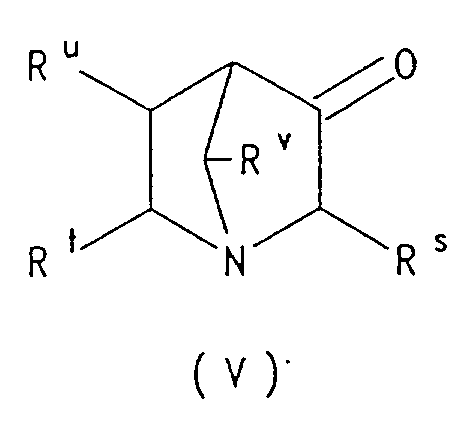
- the reactive derivatives of the compound R a CO2H may, for example, be prepared by cyclisation of a compound of formula IV: wherein R s , R t , R u and R v represent hydrogen, carboxylic acid ester, or a substituent R3 or R4 as defined above, or a group which is convertible thereto; at least one of R s , R t , R u and R v being other than hydrogen; and R c and R d are hydrocarbon groups, in particular C1 ⁇ 6 alkyl, such as methyl or ethyl; to produce a compound of formula V: or a ketal thereof; and optionally converting the carbonyl group in compound V or the ketal thereof, or any of the groups R s , R t , R u and R v , to a substituent group R3 or R4 or to a -CO2H group or reactive derivative thereof.
- R s , R t , R u and R v represent hydrogen,
- the intermediate of formula V is a novel compound and forms a further aspect of this invention. It provides a valuable route to substituted 1-azabicyclo[2.2.1]heptanes used in the process of the present invention.
- the cyclisation of compound IV is carried out in the presence of a strong base, such as potassium t-butoxide, followed by acidification, for example by concentrated hydrochloric acid.
- a strong base such as potassium t-butoxide
- This reaction causes the condensation of the groups CO2R a and CO2R b .
- one of the groups R s , R t , R u and R v represents an ester group
- this reaction will liberate the free acid.
- esterify the acid in situ for example by treatment with methanol and hydrochloric acid.
- the carboxylic acid group and thence its reactive derivative, which is employed to react with the oxadiazole moiety, may be generated from any of the substituent groups R s , R t , R u or R v initially present in compound IV. In this way, by selection of one such group as an ester group, the point of attachment to the oxadiazole can be determined.
- the ketone group which is generated in the intermediate V may be converted to a carboxylic acid group, for example by reaction with an alkali metal cyanide such as sodium cyanide, to produce a compound VI:
- the hydroxy group in compound VI may then be converted to a group R3 or R4 to produce a substituent at the same position as the point of attachment to the oxadiazole ring.
- R a and/or R b include amino, carboxy, hydroxy or thiol groups, these may be protected in conventional manner.
- suitable protecting groups for hydroxy groups include silyl groups such as trimethylsilyl or t-butyldimethylsilyl, and etherifying groups such as tetrahydropyranyl; and for amino groups include benzyloxycarbonyl and t-butyloxycarbonyl.
- Carboxy groups are preferably protected in a reduced form such as in the form of their corresponding protected alcohols, which may be subsequently oxidised to give the desired carboxy group.
- Thiol groups may be protected by disulphide formation, either with the thiol itself or with another thiol to form a mixed disulphide. The protecting groups may be removed at any convenient stage in the synthesis of the desired compound according to conventional techniques.
- Each of the compounds of the Examples demonstrates an affinity for the muscarinic receptor, having an IC50 (concentration required to displace 50% of specific [3H]-N-methylscopolamine binding from rat cortical membrane preparations) significantly lower than 100 ⁇ M.
- IC50 concentration required to displace 50% of specific [3H]-N-methylscopolamine binding from rat cortical membrane preparations
- Agonist behaviour and penetrability into the central nervous system of the compounds of the Examples were assessed in a rat behavioural model by measuring the ability of the compound under test to elicit a mouth movement response and/or a hypothermic response characteristic of centrally-active muscarinic agonists (see Salamone et al ., Psychopharm., 1986, 88 , 467). In this model, the compounds of all the Examples were active at doses of 10 mg/kg or less.
- the hydrochloride salt of 1-azabicyclo[2.2.1]heptan-3-one was prepared by addition of ethereal hydrogen chloride to a solution of the compound in methanol. A solution of sodium cyanide(0.7 g, 14.3 mmol) in water (4 ml) was added dropwise to a solution of 1-azabicyclo-[2.2.1]heptan-3-one hydrochloride (1.7 g, 11.5 mmol) in water (5 ml) at -5°C. The mixture was stirred at 0°C tor 1 hour and the precipitated cyanohydrin filtered and washed with cold water The solid was taken up into concentrated hydrochloric acid (15 ml) and stirred for 24 hours at room temperature.
- Activated molecular sieves (Type 4A, 0.5 g) were added to a stirred solution of acetamide oxime (0.4 g, 5.4 mmol) in anhydrous tetrahydrofuran (50 ml) under nitrogen. After 0.5 hour, sodium hydride (0.14 g of a 80% dispersion in oil, 4.6 mmol) was added and the solution stirred for a further 0.5 hour. A solution of exo -3-carbomethoxy-1-azabicyclo[2.2.1]heptan-3-ol (0.4 g, 2.34 mmol) in tetrahydrofuran (20 ml) was then added and the mixture stirred under reflux for 2 hours.
- Activated molecular series (Type 4A, 1 g) were added to a stirred solution of acetamide oxime (0.6 g, 8.1 mmol) in anhydrous tetrahydrofuran (50 ml) under nitrogen. After 0.5 hour, sodium hydride (0.2 g of a 80% dispersion in oil, 6.7 mmol) was added and the solution stirred for a further 0.5 hour. A solution of exo -3-carbomethoxy-5,5-dimethoxy-1-azabicyclo[2.2.1]-heptane (0.5 g, 2.3 mmol) in tetrahydrofuran (20 ml) was then added and the mixture heated at reflux for 6 hours.
- Diethylaminosulphur trifluroride (0.21 g, 1.30 mmol) was added dropwise to a solution of exo -3-[5-(3-methyl-1,2,4-oxadiazol)yl]-1-azabicyclo[2.2.1]heptan-5-ol (0.25 g, 1.28 mmol) in dichloromethane (30 ml), at -78°C, and stirred at this temperature for 1 h before allowing to warm to room temperature and stir for 1.5 h. Water (20 ml) was added and basified with potassium carbonate.
- n -Butylithium (2.03 ml of 1.6M solution in hexane, 3.25 mmol) was added to a solution of 2-trimethylsilyl-1,3-propanedithiane (0.68 g, 3.54 mmol) in anhydrous THF (50 ml), at -35°C, and the solution stirred for 2 h.
- a solution of 3-methoxymethyl-1-azabicyclo[2.2.1]heptan-5-one (0.42 g 2.71 mmol) in THF (5 ml) was added and the reaction mixture warmed to room temperature and stirred for 1 h. Water (6 ml) was added followed by dichloromethane (100 ml) and stirred for 0.1 h.
- the preceeding dithioketene acetal (0.53 g, 2.06 mmol) was dissolved in methanol (saturated with hydrogen chloride) (45 ml) and stirred at 55°C for 24 h. The solvent was removed under vacuum, the residue taken up into water (6 ml) and basified with potassium carbonate. The aqueous was extracted into dichloromethane (4 x 70 ml), dried (Na2SO4) and the solvents removed under vacuum.
- the aqueous was extracted with dichloromethane (4 x 100 ml), the combined extracts dried (Na2SO4), and evaporated, and the residue chromatographed through alumina, using dichloromethane/methanol (99:1) as eluant to give the title oxadiazole.
- the compound was further purified as the sesquioxalate salt, m.p. 122.5 - 124.5°C (dichloromethane/ether); [Found: C, 46.65; H, 5.67; N, 11.14.
- Lithium metal (0.31 g, 43.6 mmol) was added to freshly distilled ethylamine (50 ml) and stirred at 0°C until the metal had dissolved.
- n-Butyllithium (20ml of a 1.6M solution in hexane, 32.2mmol) was added to a stirred solution of 2-trimethylsilyl-1,3-dithiane (4.69g, 24.3mmol) in anhydrous THF (150ml), at -50°C. After 2h, a solution of 4-methyl-1-azabicyclo[2.2.1]heptan-3-one (2.54g, 20mmol) in THF (10ml) was added and the reaction mixture warmed to room temperature.
- the preceding dithioketeneacetal (1.7g, 7.5mmol) was dissolved in methanol (saturated with hydrogenchloride, 100ml) and stirred at 65°C for 4h. The solvent was removed under vacuum, water (20ml) added and basified to pH10 with potassium carbonate.
- the less polar compound was identified as the exo isomer (0.29g) and was further purified as the hydrochloride salt, m.p. 226-227°C (isopropylalcohol); (Found: C, 52.15; H, 6.89; N, 18.08.
- the more polar compound was identified as the second title compound and was characterised as the hydrochloride salt, m.p. 196-197°C (isopropyl alcohol); (Found: C, 51.51: H, 7.18; N, 17.96.
- exo-3-[5-(3-Dimethylamino-1,2,4-oxadiazol)yl]-5,5-dimethoxy-1-azabicyclo[2.2.1]heptane was prepared from 3-carbomethoxy-5,5-dimethoxy-1-azabicyclo[2.2.1]heptane (2.73g, 13mmol) and dimethyl hydroxy guanidine hydrochloride (4.35g, 31mmol) by the procedure described for Example 2 part d.
- Methylmagnesium bromide (0.32ml of a 3M solution in ether, 0.96mmol) was added to a stirred solution of exo -3-[5-(3-dimethylamino-1,2,4-oxadiazol)yl]-1-azabicyclo[2.2.1]heptan-5-one (0.175g, 0.79mmol) in ether (3ml), at 0°C.
- the reaction mixture was warmed to room temperature stirred for 2h, water (20ml) then added and extracted with dichloromethane (4 x 25ml). The combined extracts were dried (Na2SO4) and evaporated to give the title alcohol (0.10g) m.p.
- All of the active compound, lactose, and a portion of the corn starch are mixed and granulated to a 10% corn starch paste.
- the resulting granulation is sieved, dried and blended with the remainder of the corn starch and the magnesium stearate.
- the resulting granulation is then compressed into tablets containing 1.0 mg, 2.0 mg, 25.0 mg, 26.00 mg, 50.0 mg and 100.0 mg of active ingredient per tablet.
Landscapes
- Chemical & Material Sciences (AREA)
- Organic Chemistry (AREA)
- Health & Medical Sciences (AREA)
- Engineering & Computer Science (AREA)
- Bioinformatics & Cheminformatics (AREA)
- Biomedical Technology (AREA)
- Neurology (AREA)
- Neurosurgery (AREA)
- General Chemical & Material Sciences (AREA)
- Life Sciences & Earth Sciences (AREA)
- Psychiatry (AREA)
- Medicinal Chemistry (AREA)
- Nuclear Medicine, Radiotherapy & Molecular Imaging (AREA)
- Hospice & Palliative Care (AREA)
- Pharmacology & Pharmacy (AREA)
- Chemical Kinetics & Catalysis (AREA)
- Animal Behavior & Ethology (AREA)
- General Health & Medical Sciences (AREA)
- Public Health (AREA)
- Veterinary Medicine (AREA)
- Pharmaceuticals Containing Other Organic And Inorganic Compounds (AREA)
- Nitrogen Condensed Heterocyclic Rings (AREA)
Claims (18)
- Oxadiazol, dargestellt durch die Strukturformel (I):

worin
eines von X, Y oder Z für ein Sauerstoffatom steht und die anderen zwei für Stickstoffatome stehen und der gestrichelte Kreis Aromatizität bedeutet (zwei Doppelbindungen);
R² Wasserstoff, Halogen, -CF₃, -OR⁷, -NR⁷R⁸, -NHOR⁷, -NHNH₂, -CN, -CO₂R⁷, -CONR⁷R⁸, C₂₋₅-Alkenyl, C₂₋₅-Alkynyl, C₁₋₂-Alkyl oder C₁₋₂-Alkyl, substituiert mit -OR⁷, NR⁷R⁸, -SR⁷, -CO₂R⁷, -CONR⁷R⁸ oder Halogen darstellen kann.
die durchbrochene Linie eine optionale chemische Bindung bedeutet; und
die Substituenten R³ und R⁴ in Position 3, 4 oder 5 des azabicyclischen Rings, einschließlich des Verknüpfungspunktes mit dem Oxadiazolring, vorhanden sein können;
und R³ für Halogen, C₁₋₄-Alkoxy, Carboxy, -NR⁷R⁸, C₁₋₄-Alkyl, C₁₋₄-Alkyl, substituiert mit Hydroxy oder C₁₋₄-Alkoxy oder Hydroxy steht; und
R⁴ Wasserstoff, Halogen, C₁₋₄-Alkoxy, Hydroxy, Carboxy, -NR⁷R⁸, C₁₋₄-Alkyl oder C₁₋₄-Alkyl, substituiert mit Hydroxy, oder C₁₋₄-Alkoxy bedeutet oder R³ und R⁴ zusammengenommen Carbonyl darstellen; und
R⁷ und R⁸ unabhängig für Wasserstoff oder C₁₋₂-Alkyl stehen. - Oxadiazol nach Anspruch 1, dargestellt durch Formel IIA:

R⁵ für C₁₋₄-Alkyl, Halogen, -NR⁷R⁸, C₁₋₄-Alkoxy, Hydroxy-(C₁₋₄)-alkyl, C₁₋₄-Alkoxy-(C₁₋₄)-alkyl oder Hydroxy steht und R⁶ Wasserstoff, C₁₋₄-Alkyl, C₁₋₄-Alkoxy oder Hydroxy darstellt; und
R⁷ und R⁸ unabhängig für Wasserstoff oder C₁₋₂-Alkyl stehen. - Oxadiazol nach Anspruch 1, dargestellt durch Formel IIB:

- Oxadiazol nach Anspruch 1, dargestellt durch Formel IIC:

- Oxadiazol nach einem der Ansprüche 1 bis 4, worin R³ Halogen, C₁₋₄-Alkoxy, Carboxy, -NR⁷R⁸, C₂₋₄-Alkyl, C₁₋₄-Alkyl, substituiert mit Hydroxy, oder C₁₋₄-Alkoxy oder Methyl oder Hydroxy in der Position 3, 4 oder 5 darstellt; und R⁴ für Wasserstoff, Halogen,
C₁₋₄-Alkoxy, Hydroxy, Carboxy, -NR⁷R⁸, C₁₋₄-Alkyl oder C₁₋₄-Alkyl, substituiert mit Hydroxy, oder C₁₋₄-Alkoxy steht; oder R³ und R⁴ zusammen Carbonyl darstellen. - Oxadiazol nach einem der Ansprüche 1 bis 5, worin R⁴ Wasserstoff oder Methyl steht und R³ C₁₋₄-Alkoxy, Halogen, -NR⁷R⁸, Hydroxy-(C₁₋₄)-alkyl oder C₁₋₄-Alkoxymethyl bedeutet.
- Oxadiazol nach einem der Ansprüche 1 bis 6, worin R³ Methoxy, Fluor, Amino, Methoxymethyl oder Hydroxymethyl bedeutet.
- Oxadiazol nach einem der Ansprüche 1 bis 7, worin R⁴ für Halogen steht.
- Verbindung nach Anspruch 1, ausgewählt aus folgendem:
3-[5-(3-Methyl-1,2,4-oxadiazol)-yl]-1-azabicyclo[2.2.1]heptan-3-ol;
3-[5-(3-Methyl-1,2,4-oxadiazol)-yl]-1-azabicyclo[2.2.1]heptan-5-ol;
3-[5-(3-Methyl-1,2,4-oxadiazol)-yl]-5-ethyl-1-azabicyclo[2.2.1]heptan;
3-[5-(3-Methyl-1,2,4-oxadiazol)-yl]-6-methyl-1-azabicyclo[2.2.1]heptan;
3-[5-(3-Amino-1,2,4-oxadiazol)-yl]-1-azabicyclo[2.2.1]heptan-5-ol;
3-[5-(3-Methyl-1,2,4-oxadiazol)-yl]-5-fluor-1-azabicyclo[2.2.1]heptan;
5-[5-(3-Methyl-1,2,4-oxadiazol)-yl]-3-methoxymethyl-1-azabicyclo[2.2.1]heptan;
5-[5-(3-Methyl-1,2,4-oxadiazol)-yl]-3-methyl-1-azabicyclo[2.2.1]heptan;
3-[5-(3-Methyl-1,2,4-oxadiazol)-yl]-5-hydroxymethyl-1-azabicyclo[2.2.1]heptan;
3-[5-(3-Dimethylamino-1,2,4-oxadiazol)-yl]-1-azabicyclo-[2,.2.1]heptan-5-ol;
3-[5-(3-Dimethylamino-1,2,4-oxadiazol)-yl]-5-methoxy-1-azabicyclo[2.2.1]heptan;
3-[5-(3-Dimethylamino-1,2,4-oxadiazol)-yl]-5-methyl-1-azabicyclo[2.2.1]heptan-5-ol;
3-[5-(3-Dimethylamino-1,2,4-oxadiazol)-yl]-5-amino-1-azabicyclo[2.2.1]heptan und
3-[5-(3-Methyl-1,2,4-oxadiazol)-yl]-4-methyl-1-azabicyclo[2.2.1]heptan;
und Salze und Arzneimittelvorstufen davon. - Verbindung nach Anspruch 1, ausgewählt aus:
3-[5-(3-Methyl-1,2,4-oxadiazol)-yl]-1-azabicyclo[2.2.1]heptan-5-ol;
3-[5-(3-Methyl-1,2,4-oxadiazol)-yl]-1-azabicyclo[2.2.1]heptan-3-ol;
3-[5-(3-Methyl-1,2,4-oxadiazol)-yl]-4-methyl-1-azabicyclo[2.2.1]heptan;
3-[5-(3-Methyl-1,2,4-oxadiazol)-yl]-5-ethyl-1-azabicyclo[2.2.1]heptan;
3-[5-(3-Methyl-1,2,4-oxadiazol)-yl]-6-methyl-1-azabicyclo[2.2.1]heptan;
exo-3-[5-(3-Amino-1,2,4-oxadiazol)-yl]-1-azabicyclo[2.2.1]heptan-5-ol;
3-[5-(3-Amino-1,2,4-oxadiazol)-yl]-5,5-dimethoxy-1-azabicyclo[2.2.1]heptan;
3-[5-(3-Amino-1,2,4-oxadiazol)-yl]-1-azabicyclo[2.2.1]heptan-5-on;
exo-3-[5-(3-Methyl-1,2,4-oxadiazol)-yl]-5-fluoro-1-azabicyclo[2.2.1]heptan;
exo-5-[5-(3-Methyl-1,2,4-oxadiazol)-yl]-3-methoxymethyl-1-azabicyclo[2.2.1]heptan;
exo-5-[5-(3-Methyl-1,2,4-oxadiazol)-yl]-3-methyl-1-azabicyclo[2.2.1]heptan und
exo-3-[5-(3-Methyl-1,2,4-oxadiazol)-yl]-5-hydroxymethyl-1-azabicyclo[2.2.1]heptan
und Salze und Arzneimittelvorstufen davon. - Verbindung nach Anspruch 1, ausgewählt aus
3-[5-(3-Methyl-1,2,4-oxadiazol)-yl]-1-azabicyclo[2,2,1]heptan-5-ol;
exo-3-[5-(3-Methyl-1,2,4-oxadiazol)-yl]-1-azabicyclo[2,2,1]heptan-3-ol;
und Salze und Arzneimittelvorstufen davon. - 3-[5-(3-Methyl-1,2,4-oxadiazol)-yl]-6-methyl-1-azabicyclo-[2,2,1]heptan und Salze und Arzneimittelvorstufen davon.
- Pharmazeutisches Präparat, enthaltend eine Verbindung nach einem der vorgenannten Ansprüche, in Verbindung mit einem pharmazeutisch verträglichen Trägerstoff.
- Pharmazeutisches Präparat nach Anspruch 13, das außerdem einen peripheren cholinergen Antagonisten enthält.
- Verwendung einer Verbindung nach einem der Ansprüche 1 bis 12 zur Herstellung eines Medikaments zur Behandlung von neurologischen und mentalen Störungen oder zur Behandlung starker Schmerzen.
- Verfahren zur Herstellung einer Verbindung nach einem der Ansprüche 1 bis 12, wobei das Verfahren umfaßt Umsetzen eines reaktiven Derivats einer Carbonsäure der Formel Ra-CO₂H mit entweder einer Verbindung der Formel IIIA oder einer Verbindung der Formel IIIB oder einem Salz davon:

- Zwischenstufe der Formel (V)
- Verfahren zur Herstellung einer Verbindung nach Anspruch 17, wobei das Verfahren umfaßt Cyclisieren einer Verbindung der Formel IV:

Priority Applications (1)
| Application Number | Priority Date | Filing Date | Title |
|---|---|---|---|
| AT88308125T ATE102203T1 (de) | 1987-09-10 | 1988-09-01 | Oxadiazolyl-azabicycloheptane zur behandlung von seniler demenz. |
Applications Claiming Priority (4)
| Application Number | Priority Date | Filing Date | Title |
|---|---|---|---|
| GB8721344 | 1987-09-10 | ||
| GB878721344A GB8721344D0 (en) | 1987-09-10 | 1987-09-10 | Therapeutic agents |
| GB8817310 | 1988-07-20 | ||
| GB888817310A GB8817310D0 (en) | 1988-07-20 | 1988-07-20 | Therapeutic agents |
Publications (2)
| Publication Number | Publication Date |
|---|---|
| EP0307140A1 EP0307140A1 (de) | 1989-03-15 |
| EP0307140B1 true EP0307140B1 (de) | 1994-03-02 |
Family
ID=26292712
Family Applications (1)
| Application Number | Title | Priority Date | Filing Date |
|---|---|---|---|
| EP88308125A Expired - Lifetime EP0307140B1 (de) | 1987-09-10 | 1988-09-01 | Oxadiazolyl-azabicycloheptane zur Behandlung von seniler Demenz |
Country Status (11)
| Country | Link |
|---|---|
| EP (1) | EP0307140B1 (de) |
| JP (1) | JPH01156979A (de) |
| KR (1) | KR890005102A (de) |
| AU (1) | AU616903B2 (de) |
| CA (1) | CA1338473C (de) |
| DE (1) | DE3888056T2 (de) |
| DK (1) | DK503388A (de) |
| ES (1) | ES2061665T3 (de) |
| IL (1) | IL87644A0 (de) |
| NZ (1) | NZ226000A (de) |
| PT (1) | PT88423B (de) |
Families Citing this family (18)
| Publication number | Priority date | Publication date | Assignee | Title |
|---|---|---|---|---|
| US5106853A (en) * | 1989-05-15 | 1992-04-21 | Merck Sharp & Dohme, Ltd. | Oxadiazole and its salts, their use in treating dementia |
| EP0427390B1 (de) * | 1989-10-07 | 1996-03-27 | Beecham Group Plc | Azabizyklische Verbindungen, Verfahren und Zwischenprodukte zu ihrer Herstellung und diese enthaltende pharmazeutische Zubereitungen |
| US5306718A (en) * | 1990-03-06 | 1994-04-26 | Warner-Lambert Company | Oxime and amine substituted azabicyclo and azocyclo muscarinic agonists and methods of treatment |
| EP0459568A3 (en) * | 1990-05-31 | 1992-09-30 | Merck Sharp & Dohme Ltd. | Substituted oxadiazoles and thiadiazoles for use in the treatment of glaucoma and novel compounds having such use |
| US5124460A (en) * | 1991-05-06 | 1992-06-23 | Merck Sharp & Dohme Ltd. | Enantioselective synthesis of 3-substituted 1-azabicyclo (2.2.1)heptanes |
| GB9507203D0 (en) * | 1995-04-07 | 1995-05-31 | Smithkline Beecham Plc | Novel compounds |
| US5733912A (en) * | 1997-02-19 | 1998-03-31 | Abbott Laboratories | 7A-heterocycle substituted hexahydro-1H-pyrrolizine compounds useful in controlling chemical synaptic transmission |
| FR2809731B1 (fr) | 2000-05-31 | 2002-07-19 | Sanofi Synthelabo | Derives de 1,4-diazabicyclo-[3.2.2] nonane-pheylisoxazole, leur preparation et leur application en therapeutique |
| FR2809730B1 (fr) * | 2000-05-31 | 2002-07-19 | Sanofi Synthelabo | Derives de 1,4-diazabicyclo[3.2.2] nonanebenzoxazole, -benzothiazole et -benzimidazole, leur preparation et leur application therapeutique |
| FR2809732B1 (fr) * | 2000-05-31 | 2002-07-19 | Sanofi Synthelabo | DERIVES DE 4(-2-PHENYLTHIAZOL-5-yl)-1,4-DIAZABICYCLO-[3.2.2] NONANE, LEUR PREPARATION ET LEUR APPLICATION ENTHERAPEUTIQUE |
| FR2832712B1 (fr) * | 2001-11-23 | 2004-02-13 | Sanofi Synthelabo | Derives de 4-(oxadiazol-3-yl)-1,4-diazabicyclo[3.2.2]nonane, leur preparation et leur application en therapeutique |
| FR2832713B1 (fr) * | 2001-11-23 | 2004-02-13 | Sanofi Synthelabo | Derives de 4-(1,3,4-thiadiazol-2-yl)-1,4-diazabicyclo[3.2.2] nonane, leur preparation et leur application en therapeutique |
| ATE353899T1 (de) * | 2002-09-30 | 2007-03-15 | Neurosearch As | Neue 1,4-diazabicycloalkanderivate, deren herstellung und verwendung |
| PT1551835E (pt) * | 2002-09-30 | 2007-03-30 | Neurosearch As | Novos derivados de 1, 4-diazabicicloalcano, sua preparação e utilização |
| FR2845388B1 (fr) * | 2002-10-08 | 2004-11-12 | Sanofi Synthelabo | Derives de 1,4-diazabicyclo[3.2.2]nonanecarboxamides, leur preparation et leur application en therapeutique |
| US7456171B2 (en) | 2002-10-08 | 2008-11-25 | Sanofi-Aventis | 1,4-Diazabicyclo[3.2.2]nonanecarboxamide derivatives, preparation and therapeutic use thereof |
| SE0303075D0 (sv) * | 2003-11-19 | 2003-11-19 | Astrazeneca Ab | 4-substituted imidazoles |
| SE0303076D0 (sv) * | 2003-11-19 | 2003-11-19 | Astrazeneca Ab | 5-substituted imidazoles |
Family Cites Families (3)
| Publication number | Priority date | Publication date | Assignee | Title |
|---|---|---|---|---|
| NZ219646A (en) * | 1986-03-27 | 1990-10-26 | Merck Sharp & Dohme | Oxadiazole derivatives of azacyclics for treating cns disorders |
| EP0261763B1 (de) * | 1986-06-27 | 1994-02-09 | Beecham Group Plc | Verbrückte bicyclische N-heterocyclische Verbindungen |
| GB8717446D0 (en) * | 1987-07-23 | 1987-08-26 | Merck Sharp & Dohme | Chemical compounds |
-
1988
- 1988-08-31 NZ NZ226000A patent/NZ226000A/en unknown
- 1988-09-01 IL IL87644A patent/IL87644A0/xx unknown
- 1988-09-01 EP EP88308125A patent/EP0307140B1/de not_active Expired - Lifetime
- 1988-09-01 ES ES88308125T patent/ES2061665T3/es not_active Expired - Lifetime
- 1988-09-01 DE DE3888056T patent/DE3888056T2/de not_active Expired - Fee Related
- 1988-09-05 PT PT88423A patent/PT88423B/pt not_active IP Right Cessation
- 1988-09-09 AU AU22066/88A patent/AU616903B2/en not_active Ceased
- 1988-09-09 DK DK503388A patent/DK503388A/da not_active Application Discontinuation
- 1988-09-09 CA CA000576873A patent/CA1338473C/en not_active Expired - Fee Related
- 1988-09-09 KR KR1019880011643A patent/KR890005102A/ko not_active Withdrawn
- 1988-09-10 JP JP63225569A patent/JPH01156979A/ja active Pending
Non-Patent Citations (1)
| Title |
|---|
| THE JOURNAL OF ORGANIC CHEMISTRY, vol.34, 1969 D:O Spry et al, pages 3674-3676 * |
Also Published As
| Publication number | Publication date |
|---|---|
| DK503388D0 (da) | 1988-09-09 |
| NZ226000A (en) | 1991-06-25 |
| AU616903B2 (en) | 1991-11-14 |
| CA1338473C (en) | 1996-07-23 |
| IL87644A0 (en) | 1989-02-28 |
| AU2206688A (en) | 1989-03-16 |
| KR890005102A (ko) | 1989-05-11 |
| ES2061665T3 (es) | 1994-12-16 |
| DE3888056D1 (de) | 1994-04-07 |
| PT88423A (pt) | 1989-07-31 |
| DK503388A (da) | 1989-04-27 |
| PT88423B (pt) | 1992-10-30 |
| EP0307140A1 (de) | 1989-03-15 |
| JPH01156979A (ja) | 1989-06-20 |
| DE3888056T2 (de) | 1994-07-28 |
Similar Documents
| Publication | Publication Date | Title |
|---|---|---|
| EP0239309B1 (de) | Oxadiazole zur Verwendung in der Behandlung von Dementia Senilis | |
| EP0307142B1 (de) | Thiadiazole, verwendbar zur Behandlung von altersbedingter Demenz | |
| CA1338473C (en) | Oxadiazolyl-azabicycloheptanes for the treatment of senile dementia | |
| EP0392803B1 (de) | Chemische Verbindungen | |
| US5242927A (en) | Prodrugs for oxadiazole muscarinic agonists | |
| US5260293A (en) | Pyrazines, pyrimidines and pyridazines useful in the treatment of senile dementia | |
| AU622141B2 (en) | Pyrazines, pyrimidines and pyridazines useful in the treatment of senile dementia | |
| JP2936280B2 (ja) | 新規化合物、その製法及びそれを含む医薬組成物 | |
| EP0412798A2 (de) | Substituierte Pyridine, ihre Herstellung, Zusammensetzungen und Anwendung gegen Dementia | |
| JPH0757753B2 (ja) | 新規化合物、その製法及びそれを含む医薬組成物 | |
| US5091397A (en) | 1-aza-bicyclico(2.2.1)heptanes | |
| AU628311B2 (en) | Lipophilic (3,5) substituted oxadiazole derivatives | |
| US5405853A (en) | Thiadiazoles useful in the treatment of senile dementia | |
| CA2027093A1 (en) | Compounds | |
| EP1377577A1 (de) | Pyrrolderivate zur behandlung von durch cytokine vermittelte krankheiten | |
| HK1012365B (en) | Novel compounds | |
| IE84087B1 (en) | Novel compounds | |
| NO169440B (no) | Analogifremgangsmaate for fremstilling av et terapeutisk aktivt 1,2,4-oxadiazol | |
| AU2002219461A1 (en) | Pyrrole derivates for treating cytokine mediated diseases |
Legal Events
| Date | Code | Title | Description |
|---|---|---|---|
| PUAI | Public reference made under article 153(3) epc to a published international application that has entered the european phase |
Free format text: ORIGINAL CODE: 0009012 |
|
| AK | Designated contracting states |
Kind code of ref document: A1 Designated state(s): AT BE CH DE ES FR GB GR IT LI LU NL SE |
|
| 17P | Request for examination filed |
Effective date: 19890802 |
|
| 17Q | First examination report despatched |
Effective date: 19910419 |
|
| ITTA | It: last paid annual fee | ||
| GRAA | (expected) grant |
Free format text: ORIGINAL CODE: 0009210 |
|
| AK | Designated contracting states |
Kind code of ref document: B1 Designated state(s): AT BE CH DE ES FR GB GR IT LI LU NL SE |
|
| PG25 | Lapsed in a contracting state [announced via postgrant information from national office to epo] |
Ref country code: SE Free format text: THE PATENT HAS BEEN ANNULLED BY A DECISION OF A NATIONAL AUTHORITY Effective date: 19940302 Ref country code: GR Free format text: LAPSE BECAUSE OF FAILURE TO SUBMIT A TRANSLATION OF THE DESCRIPTION OR TO PAY THE FEE WITHIN THE PRESCRIBED TIME-LIMIT Effective date: 19940302 Ref country code: BE Effective date: 19940302 Ref country code: AT Effective date: 19940302 |
|
| REF | Corresponds to: |
Ref document number: 102203 Country of ref document: AT Date of ref document: 19940315 Kind code of ref document: T |
|
| REF | Corresponds to: |
Ref document number: 3888056 Country of ref document: DE Date of ref document: 19940407 |
|
| ET | Fr: translation filed | ||
| ITF | It: translation for a ep patent filed | ||
| PG25 | Lapsed in a contracting state [announced via postgrant information from national office to epo] |
Ref country code: LU Free format text: LAPSE BECAUSE OF NON-PAYMENT OF DUE FEES Effective date: 19940930 |
|
| REG | Reference to a national code |
Ref country code: ES Ref legal event code: FG2A Ref document number: 2061665 Country of ref document: ES Kind code of ref document: T3 |
|
| PLBE | No opposition filed within time limit |
Free format text: ORIGINAL CODE: 0009261 |
|
| STAA | Information on the status of an ep patent application or granted ep patent |
Free format text: STATUS: NO OPPOSITION FILED WITHIN TIME LIMIT |
|
| 26N | No opposition filed | ||
| PGFP | Annual fee paid to national office [announced via postgrant information from national office to epo] |
Ref country code: FR Payment date: 19960814 Year of fee payment: 9 |
|
| PGFP | Annual fee paid to national office [announced via postgrant information from national office to epo] |
Ref country code: NL Payment date: 19960820 Year of fee payment: 9 Ref country code: DE Payment date: 19960820 Year of fee payment: 9 |
|
| PGFP | Annual fee paid to national office [announced via postgrant information from national office to epo] |
Ref country code: CH Payment date: 19960823 Year of fee payment: 9 |
|
| PGFP | Annual fee paid to national office [announced via postgrant information from national office to epo] |
Ref country code: ES Payment date: 19960917 Year of fee payment: 9 |
|
| PG25 | Lapsed in a contracting state [announced via postgrant information from national office to epo] |
Ref country code: ES Free format text: LAPSE BECAUSE OF NON-PAYMENT OF DUE FEES Effective date: 19970902 |
|
| PG25 | Lapsed in a contracting state [announced via postgrant information from national office to epo] |
Ref country code: LI Free format text: LAPSE BECAUSE OF NON-PAYMENT OF DUE FEES Effective date: 19970930 Ref country code: FR Free format text: THE PATENT HAS BEEN ANNULLED BY A DECISION OF A NATIONAL AUTHORITY Effective date: 19970930 Ref country code: CH Free format text: LAPSE BECAUSE OF NON-PAYMENT OF DUE FEES Effective date: 19970930 |
|
| PG25 | Lapsed in a contracting state [announced via postgrant information from national office to epo] |
Ref country code: NL Free format text: LAPSE BECAUSE OF NON-PAYMENT OF DUE FEES Effective date: 19980401 |
|
| REG | Reference to a national code |
Ref country code: CH Ref legal event code: PL |
|
| NLV4 | Nl: lapsed or anulled due to non-payment of the annual fee |
Effective date: 19980401 |
|
| PG25 | Lapsed in a contracting state [announced via postgrant information from national office to epo] |
Ref country code: DE Free format text: LAPSE BECAUSE OF NON-PAYMENT OF DUE FEES Effective date: 19980603 |
|
| REG | Reference to a national code |
Ref country code: FR Ref legal event code: ST |
|
| REG | Reference to a national code |
Ref country code: GB Ref legal event code: IF02 |
|
| REG | Reference to a national code |
Ref country code: ES Ref legal event code: FD2A Effective date: 19981013 |
|
| PGFP | Annual fee paid to national office [announced via postgrant information from national office to epo] |
Ref country code: GB Payment date: 20040921 Year of fee payment: 17 |
|
| PG25 | Lapsed in a contracting state [announced via postgrant information from national office to epo] |
Ref country code: IT Free format text: LAPSE BECAUSE OF NON-PAYMENT OF DUE FEES;WARNING: LAPSES OF ITALIAN PATENTS WITH EFFECTIVE DATE BEFORE 2007 MAY HAVE OCCURRED AT ANY TIME BEFORE 2007. THE CORRECT EFFECTIVE DATE MAY BE DIFFERENT FROM THE ONE RECORDED. Effective date: 20050901 Ref country code: GB Free format text: LAPSE BECAUSE OF NON-PAYMENT OF DUE FEES Effective date: 20050901 |
|
| GBPC | Gb: european patent ceased through non-payment of renewal fee |
Effective date: 20050901 |