EP0307762A1 - Acrylsäureamide und ihre Verwendung als Fungizide - Google Patents
Acrylsäureamide und ihre Verwendung als Fungizide Download PDFInfo
- Publication number
- EP0307762A1 EP0307762A1 EP88114520A EP88114520A EP0307762A1 EP 0307762 A1 EP0307762 A1 EP 0307762A1 EP 88114520 A EP88114520 A EP 88114520A EP 88114520 A EP88114520 A EP 88114520A EP 0307762 A1 EP0307762 A1 EP 0307762A1
- Authority
- EP
- European Patent Office
- Prior art keywords
- ppm
- tolyl
- dimethoxyphenyl
- trifluoro
- pentadienoyl
- Prior art date
- Legal status (The legal status is an assumption and is not a legal conclusion. Google has not performed a legal analysis and makes no representation as to the accuracy of the status listed.)
- Withdrawn
Links
- 0 CCC(*)(CCCCCC(C=CC1CC(*)(CC2)C(CCC3)C3C2(*C)CC1)=*)C1(C)CCCCCC1 Chemical compound CCC(*)(CCCCCC(C=CC1CC(*)(CC2)C(CCC3)C3C2(*C)CC1)=*)C1(C)CCCCCC1 0.000 description 1
Classifications
-
- C—CHEMISTRY; METALLURGY
- C07—ORGANIC CHEMISTRY
- C07D—HETEROCYCLIC COMPOUNDS
- C07D295/00—Heterocyclic compounds containing polymethylene-imine rings with at least five ring members, 3-azabicyclo [3.2.2] nonane, piperazine, morpholine or thiomorpholine rings, having only hydrogen atoms directly attached to the ring carbon atoms
- C07D295/16—Heterocyclic compounds containing polymethylene-imine rings with at least five ring members, 3-azabicyclo [3.2.2] nonane, piperazine, morpholine or thiomorpholine rings, having only hydrogen atoms directly attached to the ring carbon atoms acylated on ring nitrogen atoms
- C07D295/18—Heterocyclic compounds containing polymethylene-imine rings with at least five ring members, 3-azabicyclo [3.2.2] nonane, piperazine, morpholine or thiomorpholine rings, having only hydrogen atoms directly attached to the ring carbon atoms acylated on ring nitrogen atoms by radicals derived from carboxylic acids, or sulfur or nitrogen analogues thereof
- C07D295/182—Radicals derived from carboxylic acids
- C07D295/185—Radicals derived from carboxylic acids from aliphatic carboxylic acids
-
- A—HUMAN NECESSITIES
- A01—AGRICULTURE; FORESTRY; ANIMAL HUSBANDRY; HUNTING; TRAPPING; FISHING
- A01N—PRESERVATION OF BODIES OF HUMANS OR ANIMALS OR PLANTS OR PARTS THEREOF; BIOCIDES, e.g. AS DISINFECTANTS, AS PESTICIDES OR AS HERBICIDES; PEST REPELLANTS OR ATTRACTANTS; PLANT GROWTH REGULATORS
- A01N37/00—Biocides, pest repellants or attractants, or plant growth regulators containing organic compounds containing a carbon atom having three bonds to hetero atoms with at the most two bonds to halogen, e.g. carboxylic acids
- A01N37/18—Biocides, pest repellants or attractants, or plant growth regulators containing organic compounds containing a carbon atom having three bonds to hetero atoms with at the most two bonds to halogen, e.g. carboxylic acids containing the group —CO—N<, e.g. carboxylic acid amides or imides; Thio analogues thereof
-
- A—HUMAN NECESSITIES
- A01—AGRICULTURE; FORESTRY; ANIMAL HUSBANDRY; HUNTING; TRAPPING; FISHING
- A01N—PRESERVATION OF BODIES OF HUMANS OR ANIMALS OR PLANTS OR PARTS THEREOF; BIOCIDES, e.g. AS DISINFECTANTS, AS PESTICIDES OR AS HERBICIDES; PEST REPELLANTS OR ATTRACTANTS; PLANT GROWTH REGULATORS
- A01N37/00—Biocides, pest repellants or attractants, or plant growth regulators containing organic compounds containing a carbon atom having three bonds to hetero atoms with at the most two bonds to halogen, e.g. carboxylic acids
- A01N37/34—Nitriles
-
- A—HUMAN NECESSITIES
- A01—AGRICULTURE; FORESTRY; ANIMAL HUSBANDRY; HUNTING; TRAPPING; FISHING
- A01N—PRESERVATION OF BODIES OF HUMANS OR ANIMALS OR PLANTS OR PARTS THEREOF; BIOCIDES, e.g. AS DISINFECTANTS, AS PESTICIDES OR AS HERBICIDES; PEST REPELLANTS OR ATTRACTANTS; PLANT GROWTH REGULATORS
- A01N37/00—Biocides, pest repellants or attractants, or plant growth regulators containing organic compounds containing a carbon atom having three bonds to hetero atoms with at the most two bonds to halogen, e.g. carboxylic acids
- A01N37/36—Biocides, pest repellants or attractants, or plant growth regulators containing organic compounds containing a carbon atom having three bonds to hetero atoms with at the most two bonds to halogen, e.g. carboxylic acids containing at least one carboxylic group or a thio analogue, or a derivative thereof, and a singly bound oxygen or sulfur atom attached to the same carbon skeleton, this oxygen or sulfur atom not being a member of a carboxylic group or of a thio analogue, or of a derivative thereof, e.g. hydroxy-carboxylic acids
- A01N37/38—Biocides, pest repellants or attractants, or plant growth regulators containing organic compounds containing a carbon atom having three bonds to hetero atoms with at the most two bonds to halogen, e.g. carboxylic acids containing at least one carboxylic group or a thio analogue, or a derivative thereof, and a singly bound oxygen or sulfur atom attached to the same carbon skeleton, this oxygen or sulfur atom not being a member of a carboxylic group or of a thio analogue, or of a derivative thereof, e.g. hydroxy-carboxylic acids having at least one oxygen or sulfur atom attached to an aromatic ring system
Definitions
- the present invention relates to new compounds, namely acrylic acid amides of the general formula wherein R1 C1 ⁇ 6 haloalkyl, C2 ⁇ 6 haloalkenyl, C1 ⁇ 6 haloalkoxy, C2 ⁇ 6 haloalkenyloxy, C1 ⁇ 6 alkylthio, C1 ⁇ 6 haloalkylthio, cyano, optionally substituted phenyl or optionally substituted phenoxy, R2 is hydrogen or halogen, R3 is halogen, C1 ⁇ 6-alkyl or C1 ⁇ 6-alkoxy, R4 is hydrogen or C1 ⁇ 6 alkyl, R5 and R6 independently of one another C1 ⁇ 4-alkyl or together with the nitrogen atom to which they are attached, a morpholino or thiomorpholino group and n is 1, 2 or 3.
- the compounds of the formula I have fungicidal properties and are suitable as fungicidal active ingredients, in particular for use in agriculture and horticulture.
- the invention further relates to a process for the preparation of the compounds of the formula I, fungicidal compositions which contain such compounds as active compounds, and the use of such compounds and compositions for combating fungi in agriculture and horticulture.
- halogen includes fluorine, chlorine, bromine or iodine, with fluorine, chlorine and bromine being preferred.
- the haloalkyl, haloalkenyl, haloalkoxy, haloalkenyloxy and haloalkylthio groups can each have one or more (identical or different) halogen substituents.
- the optionally substituted with halogen alkyl, alkenyl, alkoxy, alkenyloxy and alkylthio groups can be straight-chain or branched.
- the substituted phenyl and phenoxy groups have in particular up to 2 (identical or different) substituents, which are preferably selected from halogen, C1 ⁇ 4-alkyl and C1 ⁇ 4-haloalkyl. If n means 2 or 3, one symbol R3 is independent of the other symbol R3.
- the presence of at least one asymmetric carbon atom in the compounds according to the invention has the consequence that the compounds can occur as optical antipodes.
- the compounds can furthermore be present as E and Z isomers and / or as atropisomers.
- Formula I is intended to include all of these possible isomeric forms and their mixtures.
- R1 is preferably C1 ⁇ 6-haloalkyl, in particular trifluoromethyl, or C1 ⁇ 6-haloalkoxy, in particular trifluoromethoxy;
- R3 is preferably C1 ⁇ 4 alkoxy, especially methoxy; and
- NR5R6 preferably ethylmethylamino, morpholino or thiomorpholino.
- the or each substituent R 3 is preferably in the m or p position.
- Particularly preferred individual compounds of the formula I are: 4- [3- (3,4-dimethoxyphenyl) -5- ( ⁇ , ⁇ , ⁇ -trifluoro-p-tolyl) -2,4-pentadienoyl] morpholine, 4- [3- (3,4-Dimethoxyphenyl) -5- ( ⁇ , ⁇ , ⁇ -trifluoro-p-tolyl) -2,4-pentadienoyl] thiomorpholine and N-ethyl-N-methyl-3- (3,4-dimethoxyphenyl) -5- ( ⁇ , ⁇ , ⁇ -trifluoro-p-tolyl) -2,4-pentadienoic acid amide.
- Process variant a) is a Horner-Wittig reaction which can be carried out under the reaction conditions customary in this regard.
- the lower alkyl or aryl group R7 or R8 present in the phosphonoalkanoic acid amide of the formula III is preferably a C1 ⁇ 4 alkyl group, in particular a methyl or ethyl group, or a phenyl group optionally substituted with chlorine and / or methyl.
- reaction is conveniently carried out in an inert organic Diluents, such as an aromatic hydrocarbon, for example benzene or toluene, an aliphatic or cyclic ether, for example 1,2-dimethoxyethane, tetrahydrofuran or dioxane, or a dialkylamide, for example dimethylformamide, and in the presence of a base, such as an alkali metal hydride, for example sodium hydride Alkali metal alcoholate, e.g. sodium methylate or potassium tert-butoxide, or an alkali metal amide, e.g.
- organic Diluents such as an aromatic hydrocarbon, for example benzene or toluene, an aliphatic or cyclic ether, for example 1,2-dimethoxyethane, tetrahydrofuran or dioxane, or a dialkylamide, for example dimethylformamide
- a base such as an alkali metal hydride,
- the reaction according to process variant b) represents an acylation and can be carried out under the usual reaction conditions.
- Reactive derivatives of the acrylic acids of the formula IV are, in particular, their acid halides, in particular the acid chlorides; Acid anhydrides; mixed acid anhydrides, especially those with aliphatic or aromatic carboxylic or sulfonic acids; Lower alkyl, aryl or benzyl esters; as well as imidazolides in question. Such derivatives can also be generated in situ.
- the acylation can be carried out in the presence of an acid activating agent or a dehydrating agent, such as, for example, N, N-carbonyldiimidazole, N, N-dicyclohexylcarbodiimide or a chloroformic acid ester.
- an acid activating agent or a dehydrating agent such as, for example, N, N-carbonyldiimidazole, N, N-dicyclohexylcarbodiimide or a chloroformic acid ester.
- the reactive derivatives of the amines of the formula V include, in particular, their phosphazo derivatives.
- An acrylic acid IV with an amine V is generally used in the presence an acid-activating or dehydrating agent, or a reactive derivative of acrylic acid with the amine, or acrylic acid with a reactive derivative of the amine.
- reaction is conveniently carried out in the presence of an inert organic diluent, such as an aromatic hydrocarbon, e.g. Benzene or toluene; an aliphatic or cyclic ether, e.g. Diethyl ether, tert-butyl methyl ether, tetrahydrofuran or dioxane; a halogenated aliphatic hydrocarbon, e.g. Methylene chloride or 1,2-dichloroethane; Acetonitrile; or a dialkylamide, e.g. Dimethylformamide, at temperatures between -20 ° C and 100 ° C, preferably between -10 ° C and 50 ° C.
- an aromatic hydrocarbon e.g. Benzene or toluene
- an aliphatic or cyclic ether e.g. Diethyl ether, tert-butyl methyl ether, tetrahydrofuran or dioxane
- an acid binder such as an inorganic base, e.g. Potassium carbonate, or an organic base, e.g. Triethylamine, pyridine or quinoline, worked, where each of the organic bases mentioned can simultaneously serve as a solvent.
- an acid binder such as an inorganic base, e.g. Potassium carbonate, or an organic base, e.g. Triethylamine, pyridine or quinoline
- the compounds of the formula I thus prepared can be isolated and purified by methods known per se. Any isomer mixtures obtained, e.g. E / Z isomer mixtures into which pure isomers are separated, for example by chromatography or fractional crystallization.
- ketones of the formula II used as starting materials for process variant a) are either known or can be prepared by methods known per se, for example by condensation of a substituted one Acetophenones of the general formula where R3 and n have the meanings given above, with a substituted benzaldehyde of the general formula wherein R1 and R2 have the meanings given above, expediently using a basic condensing agent, such as an alkali or alkaline earth metal hydroxide, for example sodium, potassium, calcium or barium hydroxide, a C1 ⁇ 4 alkanolate, for example sodium methoxide, sodium ethanolate, potassium tert-butoxide or aluminum tert-butoxide, sodium acetate, Pyrrolidine or piperidine, or using an acidic catalyst, such as a mineral acid, for example hydrochloric acid, or phosphorus oxychloride or zinc chloride.
- a basic condensing agent such as an alkali or alkaline earth metal hydroxide, for example
- a diluent is not mandatory, but is preferred.
- Inert diluents such as are particularly suitable as diluents lower alcohols, for example methanol, ethanol and tert-butanol.
- the condensation generally takes place at temperatures between 0 ° C. and the reflux temperature of the reaction mixture, preferably at room temperature.
- the phosphonoalkanoic acid amides of the formula III used as starting materials for process variant a) are either known or can be prepared by methods known per se.
- the reaction of the compounds V and VIII with one another expediently takes place in the presence of an inert organic diluent, such as an aliphatic or cyclic ether, for example diethyl ether, tetrahydrofuran or dioxane, or a chlorinated aliphatic hydrocarbon, for example methylene chloride, ethylene chloride or chloroform, at temperatures between -20 ° C and 50 ° C.
- an acid binder such as an inorganic or organic base, it being possible for compound V itself to serve as the organic base.
- the ⁇ -haloalkanoic acid amide IX is then reacted with the phosphite X, expediently in the presence of a slight excess of the phosphite, which serves as a diluent.
- a high boiling inert solvent e.g. Xylene.
- the reaction is suitably carried out in a temperature range of 100 ° C, preferably at temperatures between 130 ° C and 160 ° C.
- the acrylic acids of formula IV which serve as starting materials for process variant b) and which are likewise either known or can be prepared in a manner known per se, can be prepared, for example, by adding a ketone of the formula II given above with a phosphonoalkanoic acid ester of the general formula wherein R4, R7 and R8 have the meanings given above and R10 is C1 ⁇ 4-alkyl, implements, namely under the reaction conditions specified in connection with process variant a), whereupon the C1 ⁇ 4-alkyl ester thus obtained is hydrolyzed in a conventional manner, for example using sodium or potassium hydroxide in aqueous methanol, to the corresponding acid of the formula IV .
- the condensation of an acrylic acid ester of the general formula is used as a further method for producing the acrylic acids of the formula IV wherein R3, R4 and n have the meanings given above and R11 is C1 ⁇ 4 alkyl, with a substituted benzaldehyde of formula VII above.
- This condensation is conveniently carried out using a basic condensing agent such as a C1 ⁇ 4 alkanolate, for example potassium tert. butanolate, which also serves for the hydrolysis of the ester function with the water released during the condensation and is therefore used at least in an equimolar amount.
- a basic condensing agent such as a C1 ⁇ 4 alkanolate, for example potassium tert. butanolate, which also serves for the hydrolysis of the ester function with the water released during the condensation and is therefore used at least in an equimolar amount.
- an inert diluent such as dimethylformamide
- the 3- (3,4-dimethoxyphenyl) -5- ( ⁇ , ⁇ , ⁇ -trifluoro-p-tolyl) -2,4-pentadienoic acid and its reactive derivatives e.g. their C1 ⁇ 4 alkyl esters and alkali metal, alkaline earth metal and optionally substituted ammonium salts are important starting materials.
- the starting materials of the formulas VI-VIII and X-XII used for the preparation of the starting materials of the formulas II, III and IV and the starting materials of the formula V and their reactive derivatives are either known or can be prepared by methods known per se.
- the compounds according to the invention ie the compounds of the formula I, have a fungicidal action and can accordingly be used to control harmful fungi in agriculture and horticulture. They can be used both against parasitic fungi on parts of plants, for example leaves, stems, roots, onions, bulbs, fruits and flowers, and on seeds and also against phytopathogenic fungi occurring in the soil.
- the compounds according to the invention are particularly suitable for combating fungi of the genera Plasmopara, Peronospora, Phytophthora, Pseudoperonospora, Bremia and Pythium belonging to the class of the Oomycetes.
- the compounds according to the invention are notable for local and in some cases also systemic activity and for high plant tolerance. They can be used both preventively and curatively.
- the compounds according to the invention act even at concentrations of 1 mg to 500 mg of active ingredient per liter of spray mixture. In the field, concentrations of 50 g to 1500 g of active ingredient of the formula I per hectare and treatment are advantageously used. To control seed or soil-borne fungi in the pickling process, it is advantageous to use 0.05 g to 1.5 g of active ingredient of the formula I per kg of seed.
- the compounds according to the invention can be used in various means, e.g. Solutions, suspensions, emulsions, emulsifiable concentrates and powdered preparations can be formulated.
- the fungicidal compositions according to the invention are characterized in that they contain an effective amount of at least one compound of the general formula I, as defined above, and formulation auxiliaries.
- the compositions expediently contain at least one of the following formulation auxiliaries:
- Solid carriers Solid carriers; Solvents or dispersants; Surfactants (wetting and emulsifying agents); Dispersants (without surfactant); and stabilizers.
- the following are essentially suitable as solid carriers: natural minerals, such as kaolin, clays, kieselguhr, talc, bentonite, chalk, eg sludge chalk, magnesium carbonate, limestone, quartz, dolomite, attapulgite, montmorillonite and diatomaceous earth; synthetic minerals such as finely divided silica, aluminum oxide and silicates; organic substances such as cellulose, starch, urea and synthetic resins; and fertilizers, such as phosphates and nitrates, where such carriers can be present, for example, as granules or powders.
- natural minerals such as kaolin, clays, kieselguhr, talc, bentonite, chalk, eg sludge chalk, magnesium carbonate, limestone, quartz, dolomite, attapulgite, montmorillonite and diatomaceous earth
- synthetic minerals such as finely divided silica, aluminum oxide and silicates
- organic substances such as cellulose, starch, ure
- aromatics such as toluene, xylenes, benzene and alkylnaphthalenes
- chlorinated aromatics and chlorinated aliphatic hydrocarbons such as chlorobenzenes, chloroethylene and methylene chloride
- aliphatic hydrocarbons such as cyclohexane and paraffins, e.g.
- Petroleum fractions Petroleum fractions; Alcohols, such as butanol and glycol, and their ethers and esters; Ketones such as acetone, methyl ethyl ketone, methyl isobutyl ketone and cyclohexanone; and strongly polar solvents or dispersing agents, such as dimethylformamide, N-methylpyrrolidone and dimethyl sulfoxide, such solvents or dispersing agents preferably having flash points of at least 30 ° C. and boiling points of at least 50 ° C., and water.
- solvents or dispersing agents preferably having flash points of at least 30 ° C. and boiling points of at least 50 ° C., and water.
- So-called liquefied gaseous extenders or carriers which are products which are gaseous at room temperature and under normal pressure, are also suitable among the solvents or dispersants.
- aerosol propellants such as halogenated hydrocarbons, e.g. Dichlorodifluoromethane.
- halogenated hydrocarbons e.g. Dichlorodifluoromethane.
- organic solvents can also be used as auxiliary solvents.
- the surfactants can be nonionic compounds, such as condensation products of fatty acids, fatty alcohols or fat-substituted phenols with ethylene oxide; Fatty acid esters and ethers of sugars or polyhydric alcohols; the products obtained from sugars or polyhydric alcohols by condensation with ethylene oxide; Block polymers of ethylene oxide and propylene oxide; or alkyldimethylamine oxides.
- the surfactants can also be anionic compounds, such as soaps; Fatty sulfate esters, e.g. Dodecyl sodium sulfate, octadecyl sodium sulfate and cetyl sodium sulfate; Alkyl sulfonates, aryl sulfonates and fatty aromatic sulfonates such as alkyl benzene sulfonates, e.g. Calcium dodecylbenzenesulfonate, and butylnaphthalenesulfonate; and more complex fatty sulfonates, e.g. the amide condensation products of oleic acid and N-methyl taurine and the sodium sulfonate of dioctyl succinate.
- Fatty sulfate esters e.g. Dodecyl sodium sulfate, octadecyl sodium sulfate and cetyl sodium sulf
- the surfactants can be cationic compounds, such as alkyldimethylbenzylammonium chlorides, dialkyldimethylammonium chlorides, alkyltrimethylammonium chlorides and ethoxylated quaternary ammonium chlorides.
- lignin sodium and ammonium salts of lignin sulfonic acid, sodium salts of maleic anhydride-diisobutylene copolymers, sodium and ammonium salts of sulfonated polycondensation products of naphthalene and formaldehyde, and sulfite waste liquors.
- dispersants which are particularly suitable as thickening or anti-settling agents, e.g. Methyl cellulose, carboxymethyl cellulose, hydroxyethyl cellulose, polyvinyl alcohol, alginates, caseinates and blood albumin can be used.
- Suitable stabilizers are acid-binding agents, e.g. Epichlorohydrin, phenylglycidyl ether and soya epoxides; Antioxidants, e.g. Gallic acid ester and butylated hydroxytoluene; UV absorbers, e.g. substituted benzophenones, diphenylacrylonitrile acid esters and cinnamic acid esters; and deactivators, e.g. Salts of ethylenediaminetetraacetic acid and polyglycols.
- acid-binding agents e.g. Epichlorohydrin, phenylglycidyl ether and soya epoxides
- Antioxidants e.g. Gallic acid ester and butylated hydroxytoluene
- UV absorbers e.g. substituted benzophenones, diphenylacrylonitrile acid esters and cinnamic acid esters
- deactivators
- the fungicidal compositions according to the invention can also comprise other active compounds ten, eg other fungicidal agents, insecticidal and acaricidal agents, bactericides, plant growth regulators and fertilizers. Such combination agents are suitable for broadening the spectrum of activity or for specifically influencing plant growth.
- the fungicidal compositions according to the invention contain between 0.0001 and 95 percent by weight of the compound according to the invention or the compound according to the invention as active ingredient (s). They can be in a form suitable for storage and transportation. In such forms, e.g. emulsifiable concentrates, the drug concentration is normally in the higher range of the above concentration interval. These forms can then be diluted with the same or different formulation adjuvants to active ingredient concentrations that are suitable for practical use, and such concentrations are normally in the lower range of the above concentration interval.
- Emulsifiable concentrates generally contain 5 to 95 percent by weight, preferably 25 to 75 percent by weight, of the compound or compounds of the formula I.
- spray liquors e.g. Concentrations between 0.0001 and 20 percent by weight are present.
- spray liquors can be formulated in which the active compound concentration is preferably from 0.5 to 20 percent by weight, while the spray liquors formulated in the low-volume process and in the high-volume process preferably have an active compound concentration of 0. 02 to 1.0 or 0.002 to 0.1 percent by weight.
- the fungicidal compositions according to the invention can be prepared by adding at least one compound of the general formula I. Formulation auxiliaries mixed.
- the preparation of the agents can be carried out in a known manner, e.g. by mixing the active ingredient with solid carriers, by dissolving or suspending in suitable solvents or dispersing agents, possibly using surfactants as wetting or emulsifying agents or dispersing agents, by diluting previously prepared emulsifiable concentrates with solvents or dispersing agents, etc.
- the active ingredient can be mixed with a solid carrier, e.g. by grinding together; or you can impregnate the solid carrier with a solution or suspension of the active ingredient and then remove the solvent or dispersant by evaporation, heating or by suction under reduced pressure.
- a solid carrier e.g. by grinding together; or you can impregnate the solid carrier with a solution or suspension of the active ingredient and then remove the solvent or dispersant by evaporation, heating or by suction under reduced pressure.
- surfactants or dispersants such powdery compositions can be made easily wettable with water, so that they can be dissolved in aqueous suspensions, e.g. suitable as a spray, can be transferred.
- the compounds of the invention can also be mixed with a surfactant and a solid carrier to form a wettable powder which is dispersible in water, or they can be mixed with a solid pregranulated carrier to form a granular product.
- a compound according to the invention can be dissolved in a water-immiscible solvent, such as, for example, an alicyclic ketone, which advantageously contains dissolved emulsifiers, so that the solution has a self-emulsifying effect when added to water.
- a water-immiscible solvent such as, for example, an alicyclic ketone, which advantageously contains dissolved emulsifiers, so that the solution has a self-emulsifying effect when added to water.
- the active ingredient can be mixed with an emulsifier and the mixture can then be diluted with water to the desired concentration.
- the active ingredient in dissolved in a solvent and then mixed with an emulsifier.
- Such a mixture can also be diluted with water to the desired concentration. In this way, emulsifiable concentrates or ready-to-use emulsions are obtained.
- the agents according to the invention can be used according to the application methods customary in crop protection or in agriculture.
- the method according to the invention for combating fungi is characterized in that the goods to be protected, e.g. Plants, parts of plants or seeds, treated with an effective amount of a compound or agent according to the invention.
- the second fraction provides 0.52 g of 4 - [(2-Z, 4-E) -3- (3,4-dimethoxyphenyl) -5- ( ⁇ , ⁇ , ⁇ -trifluoro-p-tolyl) -2, 4-pentadienoyl] morpholine as a white foam; Mass spectrum (1st and 2nd isomer) m / e: M+ 447 (60), 428 (2), 361 (100); 1 H-NMR (CDCl3, 250 MHz): 1.
- the oily precipitate is extracted twice with 50 ml of ethyl acetate each time, and the combined organic phases are washed with water and dried over anhydrous sodium sulfate. After evaporation under reduced pressure, 2.2 g of green oil remain, which on drying at 0.1 mmHg pressure forms a yellowish foam consisting of 4 - [(2-E / Z, 4-E) -3- (3rd , 4-Dimethoxyphenyl) -5- (4-methylthiophenyl) -2,4-pentadienoyl] morpholine solidified.
- a solution of 5.00 g (E / Z) -3,4-dimethoxy- ⁇ -methyl-cinnamic acid is added dropwise to an ice-cooled solution of 2.47 g of potassium tert-butoxide in 10 ml of dimethylformamide with stirring for 10 minutes -ethyl ester and 3.20 g of 4-methylthiobenzaldehyde in 15 ml of dimethylformamide. Then stirring is continued for one hour at room temperature, 100 ml of water are added and the mixture is extracted twice with 50 ml of diethyl ether each time. 7.5 ml of 4N hydrochloric acid are added to the aqueous phase. The resulting precipitate is filtered off, washed with water and dried.
- a wettable powder has the following composition: Parts by weight Active ingredient of formula I. 25th Hydrated silica 25th Sodium lignosulfonate 10th Sodium lauryl sulfate 2nd Calcium carbonate 38 100
- the liquid or melted active ingredient is drawn onto the silica, the other components are mixed in and the whole is finely ground in a suitable mill.
- An emulsifiable concentrate has the following composition: g / liter Active ingredient of formula I. 250 Polyarylphenol (18) ethoxylate (emulsifier) 300 N-methyl-2-pyrrolidone (solvent) ad 1 l
- the active ingredient and the emulsifier are taken up in the solvent, creating a clear, cold-resistant solution. Poured in water results in an almost clear emulsion that serves as a spray mixture.
Landscapes
- Life Sciences & Earth Sciences (AREA)
- Wood Science & Technology (AREA)
- Chemical & Material Sciences (AREA)
- Plant Pathology (AREA)
- Health & Medical Sciences (AREA)
- Engineering & Computer Science (AREA)
- Dentistry (AREA)
- Pest Control & Pesticides (AREA)
- Zoology (AREA)
- General Health & Medical Sciences (AREA)
- Environmental Sciences (AREA)
- Agronomy & Crop Science (AREA)
- Organic Chemistry (AREA)
- Organic Low-Molecular-Weight Compounds And Preparation Thereof (AREA)
- Agricultural Chemicals And Associated Chemicals (AREA)
- Heterocyclic Carbon Compounds Containing A Hetero Ring Having Nitrogen And Oxygen As The Only Ring Hetero Atoms (AREA)
Abstract
Die Erfindung betrifft Verbindungen der Formel
worin R¹, R², R³, R⁴, R⁵, R⁶ und n die in der Beschreibung angegebenen Bedeutungen besitzen, Verfahren zu deren Herstellung, fungizide Mittel, die diese Verbindungen als Wirkstoffe enthalten, sowie die Verwendung solcher Verbindungen bzw. Mittel zur Bekämpfung von Fungi in der Landwirtschaft und im Gartenbau.
Description
- Die vorliegende Erfindung betrifft neue Verbindungen, und zwar Acrylsäureamide der allgemeinen Formel

R¹ C₁₋₆-Halogenalkyl, C₂₋₆-Halogenalkenyl, C₁₋₆-Halogenalkoxy, C₂₋₆-Halogenalkenyloxy, C₁₋₆-Alkylthio, C₁₋₆-Halogenalkylthio, Cyano, gegebenenfalls substituiertes Phenyl oder gegebenenfalls substituiertes Phenoxy,
R² Wasserstoff oder Halogen,
R³ Halogen, C₁₋₆-Alkyl oder C₁₋₆-Alkoxy,
R⁴ Wasserstoff oder C₁₋₆-Alkyl,
R⁵ und R⁶ unabhängig voneinander C₁₋₄-Alkyl oder zusammen mit dem Stickstoffatom, an das sie geknüpft sind, eine Morpholino- oder Thiomorpholinogruppe und
n 1, 2 oder 3 bedeuten. - Die Verbindungen der Formel I besitzen fungizide Eigenschaften und eignen sich als fungizide Wirkstoffe, insbesondere zur Verwendung in der Landwirtschaft und im Gartenbau.
- Die Erfindung betrifft ferner ein Verfahren zur Herstellung der Verbindungen der Formel I, fungizide Mittel, die solche Verbindungen als Wirkstoffe enthalten, sowie die Verwendung solcher Verbindungen und Mittel zur Bekämpfung von Fungi in der Landwirtschaft und im Gartenbau.
- In der obigen Formel I umfasst der Ausdruck "Halogen" Fluor, Chlor, Brom oder Jod, wobei Fluor, Chlor und Brom bevorzugt sind. Die Gruppen Halogenalkyl, Halogenalkenyl, Halogenalkoxy, Halogenalkenyloxy und Halogenalkylthio können jeweils einen oder mehrere (gleiche oder verschiedene) Halogensubstituenten aufweisen.
- Die gegebenenfalls mit Halogen substituierten Alkyl-, Alkenyl-, Alkoxy-, Alkenyloxy und Alkylthiogruppen können geradkettig oder verzweigt sein. Die substituierten Phenyl- und Phenoxygruppen weisen insbesondere bis 2 (gleiche oder verschiedene) Substituenten auf, die vorzugsweise aus Halogen, C₁₋₄-Alkyl und C₁₋₄-Halogenalkyl ausgewählt sind. Falls n 2 oder 3 bedeutet, ist das eine Symbol R³ unabhängig vom anderen Symbol R³.
- Das Vorhandensein mindestens eines asymmetrischen Kohlenstoffatoms in den erfindungsgemässen Verbindungen hat zur Folge, dass die Verbindungen als optische Antipoden auftreten können. Ferner können die Verbindungen als E- und Z-Isomere und/oder als Atropisomere vorliegen. Die Formel I soll all diese möglichen isomeren Formen und deren Gemische umfassen.
- Unabhängig voneinander bedeuten R¹ vorzugsweise C₁₋₆-Halogenalkyl, insbesondere Trifluormethyl, oder C₁₋₆-Halogenalkoxy, insbesondere Trifluormethoxy; R³ vorzugsweise C₁₋₄-Alkoxy, insbesondere Methoxy; und NR⁵R⁶ vorzugsweise Aethylmethylamino, Morpholino oder Thiomorpholino. Der bzw. jeder Substituent R³ befindet sich vorzugsweise in der m- oder p-Stellung.
- Besonders bevorzugte einzelne Verbindungen der Formel I sind:
4-[3-(3,4-Dimethoxyphenyl)-5-(α,α,α-trifluor-p-tolyl)-2,4-pentadienoyl]-morpholin,
4-[3-(3,4-Dimethoxyphenyl)-5-(α,α,α-trifluor-p-tolyl)-2,4-pentadienoyl]-thiomorpholin und
N-Aethyl-N-methyl-3-(3,4-dimethoxyphenyl)-5-(α,α,α-trifluor-p-tolyl)-2,4-pentadiensäureamid. - Weitere Vertreter von Verbindungen der Formel I sind:
4-[5-(3-Cyanophenyl)-3-(3,4-dimethoxyphenyl)-2,4-pentadienoyl]-morpholin,
4-[3-(3,4-Dimethoxyphenyl)-5-(α,α,α-trifluor-m-tolyl)-2,4-pentadienoyl]-morpholin,
4-[5-(4-Biphenylyl)-3-(3,4-dimethoxyphenyl)-2,4-pentadienoyl]-morpholin,
4-{3-(3,4-Dimethoxyphenyl)-5-[4-(2,2,2-trifluoräthoxy)-phenyl)-2,4-pentadienoyl}-morpholin,
4-{5-[4-(n-Butylthio)-phenyl]-3-(3,4-dimethoxyphenyl)-2,4-pentadienoyl}-morpholin,
4-[3-(3,4-Dimethoxyphenyl)-5-(4-fluor-α,α,α-trifluor-m-tolyl)-2,4-pentadienoyl]-morpholin,
4-[3-(3,4-Dimethoxyphenyl)-5-(3-phenoxyphenyl)-2,4-pentadienoyl]-morpholin,
4-{5-[4-(4-Chlorphenoxy)-phenyl]-3-(3,4-dimethoxyphenyl)-2,4-pentadienoyl}-morpholin,
4-{3-(3,4-Dimethoxyphenyl)-5-[4-(α,α,α-trifluor-p-tolyloxy)-phenyl]-2,4-pentadienoyl}-morpholin,
4-[3-(3-Aethyl-4-methoxyphenyl)-5-(α,α,α-trifluor-p-tolyl)-2,4-pentadienoyl]-morpholin,
4-[3-(4-Aethoxyphenyl)-5-(α,α,α-trifluor-p-tolyl)-2,4 pentadienoyl]-morpholin,
4-[3-(3,4-Diäthoxyphenyl)-5-(α,α,α-trifluor-p-tolyl)-2,4-pentadienoyl]-morpholin,
4-[3-(4-Methoxy-m-tolyl)-5-(α,α,α-trifluor-p-tolyl)-2,4-pentadienoyl]-morpholin,
4-[3-(3,4-Dimethylphenyl)-5-(α,α,α-trifluor-p-tolyl)-2,4-pentadienoyl]-morpholin,
4-[3-(3-Aethoxy-4-methoxyphenyl)-5-(α,α,α-trifluor-p-tolyl)-2,4-pentadienoyl]-morpholin,
4-[3-(4-Aethoxy-3-methoxyphenyl)-5-(α,α,α-trifluor-p-tolyl)-2,4-pentadienoyl]-morpholin,
4-[3-(4-Methoxy-3-propoxyphenyl)-5-(α,α,α-trifluor-p-tolyl)-2,4-pentadienoyl]-morpholin,
4-[3-(3-Chlor-4-methoxyphenyl)-5-(α,α,α-trifluor-p-tolyl)-2,4-pentadienoyl]-morpholin,
4-{5-[m-(1,2-Dichlorvinyloxy)-phenyl]-3-(3,4-dimethoxyphenyl)-2,4-pentadienoyl]-morpholin,
4-[3-(4-Methoxy-m-tolyl)-5-(α,α,α-trifluor-m-tolyl)-2,4-pentadienoyl]-morpholin,
4-[3-(3-Aethoxy-4-methoxyphenyl)-5-(α,α,α-trifluor-m-tolyl)-2,4-pentadienoyl]-morpholin,
N-Aethyl-N-methyl-3-(4-methoxy-m-tolyl)-5-(α,α,α-trifluor-p-tolyl)-2,4-pentadiensäureamid,
N-Aethyl-N-methyl-3-(3,4-dimethylphenyl)-5-(α,α,α-trifluor-p-tolyl)-2,4-pentadiensäureamid,
N-Aethyl-N-methyl-3-(3-äthoxy-4-methoxyphenyl)-5-(α,α,α-trifluor-p-tolyl)-2,4-pentadiensäureamid,
N-Aethyl-N-methyl-3-(4-äthoxy-3-methoxyphenyl)-5- (α,α,α-trifluor-p-tolyl)-2,4-pentadiensäureamid,
N-Aethyl-N-methyl-3-(4-methoxy-3-propoxyphenyl)-5-(α,α,α-trifluor-p-tolyl)-2,4-pentadiensäureamid,
N-Aethyl-N-methyl-3-(3-chlor-4-methoxyphenyl)-5-(α,α,α-trifluor-p-tolyl)-2,4-pentadiensäureamid,
N-Aethyl-N-methyl-3-(3-äthoxy-4-methoxyphenyl)-5-(α,α,α-trifluor-m-tolyl)-2,4-pentadiensäureamid,
N-Aethyl-N-methyl-3-(4-methoxy-3-propoxyphenyl)-5-(α,α,α-trifluor-m-tolyl)-2,4-pentadiensäureamid,
N-Aethyl-N-methyl-3-(3-chlor-4-methoxyphenyl)-5-(α,α,α-trifluor-m-tolyl)-2,4-pentadiensäureamid,
N-Aethyl-N-methyl-2-methyl-3-(4-methoxy-m-tolyl)-5-(α,α,α-trifluor-p-tolyl)-2,4-pentadiensäureamid,
N-Aethyl-N-methyl-2-methyl-3-(3,4-dimethylphenyl)-5-(α,α,α-trifluor-p-tolyl)-2,4-pentadiensäureamid,
N-Aethyl-N-methyl-2-methyl-3-(3-äthoxy-4-methoxyphenyl)-5-(α,α,α--trifluor-p-tolyl)-2,4-pentadiensäureamid,
N-Aethyl-N-methyl-2-methyl-3-(4-äthoxy-3-methoxyphenyl)-5-(α,α,α-trifluor-p-tolyl)-2,4-pentadiensäureamid,
N-Aethyl-N-methyl-2-methyl-3-(4-methoxy-3-propoxyphenyl)-5-(α,α,α-trifluor-p-tolyl)-2,4-pentadiensäureamid,
N-Aethyl-N-methyl-2-methyl-3-(3-chlor-4-methoxyphenyl)-5-(α,α,α-trifluor-p-tolyl)-2,4-pentadiensäureamid,
4-[3-(3,4-Dimethoxyphenyl)-2-methyl-5-(α,α,α-trifluor-m-tolyl)-2,4-pentadienoyl]-morpholin,
4-[3-(3,4-Dimethoxyphenyl)-2-methyl-5-(α,α,α-trifluor-p-tolyl)-2,4-pentadienoyl]-thiomorpholin,
4-[3-(3,4-Dimethoxyphenyl)-2-methyl-5-(α,α,α-trifluor-m-tolyl)-2,4-pentadienoyl]-thiomorpholin,
4-[3-(4-Methoxy-m-tolyl)-5-(α,α,α-trifluor-p-tolyl)-2,4-pentadienoyl]-thiomorpholin,
4-[3-(3,4-Dimethylphenyl)-5-(α,α,α-trifluor-p-tolyl)-2,4-pentadienoyl]-thiomorpholin,
4-[3-(3-Aethoxy-4-methoxyphenyl)-5-(α,α,α-trifluorp-tolyl)-2,4-pentadienoyl]-thiomorpholin,
4-[3-(4-Aethoxy-3-methoxyphenyl)-5-(α,α,α-trifluor-p-tolyl)-2,4-pentadienoyl]-thiomorpholin,
4-[3-(4-Methoxy-3-propoxyphenyl)-5-(α,α,α-trifluor-p-tolyl)-2,4-pentadienoyl]-thiomorpholin,
4-[3-(3-Chlor-4-methoxyphenyl)-5-(α,α,α-trifluor-p-tolyl)-2,4-pentadienoyl]-thiomorpholin,
4-[3-(3,4-Dimethoxyphenyl)-5-(α,α,α-trifluor-m-tolyl)-2,4-pentadienoyl]-thiomorpholin und
4-[3-(3-Aethoxy-4-methoxyphenyl)-5-(α,α,α-trifluor-m-tolyl)-2,4-pentadienoyl]-thiomorpholin. - Das erfindungsgemässe Verfahren zur Herstellung der Verbindungen der Formel I ist dadurch gekennzeichnet, dass man
- a) ein Keton der allgemeinen Formel

mit einem Phosphonoalkansäureamaid der allgemeinen Formel
umsetzt, oder - b) eine Acrylsäure der allgemeinen Formel

oder ein reaktionsfähiges Derivat davon mit einem Amin der allgemeinen Formel
oder mit einem reaktionsfähigen Derivat davon umsetzt. - Bei der Verfahrensvariante a) handelt es sich um eine Horner-Wittig-Reaktion, die unter den diesbezüglich üblichen Reaktionsbedingungen durchgeführt werden kann. Unter die im Phosphonoalkansäureamid der Formel III vorhandenen Niederalkyl- bzw. Arylgruppe R⁷ oder R⁸ ist vorzugsweise eine C₁₋₄-Alkylgruppe, insbesondere eine Methyl- oder Aethylgruppe, bzw. eine gegebenenfalls mit Chlor und/oder Methyl substituierte Phenylgruppe zu verstehen. Die Umsetzung erfolgt zweckmässigerweise in einem inerten organischen Verdünnungsmittel, wie einem aromatischen Kohlenwasserstoff, z.B. Benzol oder Toluol, einem aliphatischen oder cyclischen Aether, z.B. 1,2-Dimethoxyäthan, Tetrahydrofuran oder Dioxan, oder einem Dialkylamid, z.B. Dimethylformamid, und in Gegenwart einer Base, wie eines Alkalimetallhydrids, z.B. Natriumhydrid, eines Alkalimetallalkoholats, z.B. Natriummethylat oder Kalium-tert.butylat, oder eines Alkalimetallamids, z.B. Natriumamid, bei Temperaturen zwischen -20°C und der Rückflusstemperatur des Reaktionsgemisches, vorzugsweise imTemperaturbereich von -0°C bis 80°C. Falls ein Alkalimetallalkoholat als Base verwendet wird, erfolgt die Umsetzung zweckmässigerweise in einem dem jeweiligen Alkalimetallalkoholat entsprechenden Alkohol als Verdünnungsmittel. Weitere Hinweise auf geeignete Reaktionsbedingungen für die Horner-Wittig Reaktion finden sich beispielsweise in Houben-Weyl, Methoden der Organischen Chemie, Band V/lb, Seiten 395-400 und 895-899 und in Synthesis 1974, Seiten 122-124.
- Die Umsetzung nach Verfahrensvariante b) stellt eine Acylierung dar und kann unter den üblichen Reaktionsbedingungen durchgeführt werden. Als reaktionsfähige Derivate der Acrylsäuren der Formel IV kommen insbesondere ihre Säurehalogenide, insbesondere die Säurechloride; Säureanhydride; gemischte Säureanhydride, insbesondere diejenigen mit aliphatischen oder aromatischen Carbon- oder Sulfonsäuren; Niederalkyl-, Aryl- oder Benzylester; sowie Imidazolide in Frage. Solche Derivate können auch in situ erzeugt werden. Als Alternative zur Verwendung des reaktionsfähigen Derivats kann die Acylierung in Gegenwart eines säureaktivierenden Mittels oder eines wasserentziehenden Mittels durchgeführt werden, wie beispielsweise, N,N-Carbonyldiimidazol, N,N-Dicyclohexylcarbodiimid oder eines Chlorameisensäureesters. Diese genannten Mittel erfüllen beide Rollen. Zu den reaktionsfähigen Derivaten der Amine der Formel V gehören insbesondere ihre Phosphazo-Derivate. Man setzt in der Regel eine Acrylsäure IV mit einem Amin V in Gegenwart eines säureaktivierenden oder wasserentziehenden Mittels, oder ein reaktionsfähiges Derivat der Acrylsäure mit dem Amin, oder die Acrylsäure mit einem reaktionsfähigen Derivat des Amins um.
- Zudem erfolgt die Umsetzung zweckmässigerweise in Gegenwart eines inerten organischen Verdünnungsmittels, wie eines aromatischen Kohlenwasserstoffes, z.B. Benzol oder Toluol; eines aliphatischen oder cyclischen Aethers, z.B. Diäthyläther, tert.Butylmethyläther, Tetrahydrofuran oder Dioxan; eines halogenierten aliphatischen Kohlenwasserstoffes, z.B. Methylenchlorid oder 1,2-Dichloräthan; Acetonitril; oder eines Dialkylamids, z.B. Dimethylformamid, bei Temperaturen zwischen -20°C und 100°C, vorzugsweise zwischen -10°C und 50°C. Gegebenenfalls wird in Gegenwart eines Säurebindemittels, wie einer anorganischen Base, z.B. Kaliumcarbonat, oder einer organischen Base, z.B. Triäthylamin, Pyridin oder Chinolin, gearbeitet, wobei jede der genannten organischen Basen gleichzeitig als Lösungsmittel dienen kann.
- Weitere Hinweise auf geeignete Reaktionsbedingungen für die Acylierung finden sich beispielsweise in J. Zabicky, The Chemistry of Amides, Seite 73 ff. (Interscience 1970).
- Die Isolierung und Reinigung der so hergestellten Verbindungen der Formel I können nach an sich bekannten Methoden erfolgen. Ebenfalls nach an sich bekannten Methoden können allfällig erhaltene Isomerengemische, z.B. E/Z-Isomerengemische, in die reinen Isomeren aufgetrennt werden, beispielsweise durch Chromatographie oder fraktionierte Kristallisation.
- Die als Ausgangsmaterialien der Verfahrensvariante a) verwendeten Ketone der Formel II sind entweder bekannt oder können nach an sich bekannten Methoden hergestellt werden, beispielsweise durch Kondensation eines substituierten Acetophenons der allgemeinen Formel

mit einem substituierten Benzaldehyd der allgemeinen Formel
zweckmässigerweise unter Verwendung eines basischen Kondensationsmittels, wie eines Alkali- oder Erdalkalimetallhydroxids, z.B. Natrium-, Kalium-, Calcium- oder Bariumhydroxid, eines C₁₋₄-Alkanolats, z.B. Natriummethanolat, Natriumäthanolat, Kalium-tert.butanolat oder Aluminiumtert.butanolat, Natriumacetat, Pyrrolidin oder Piperidin, oder unter Verwendung eines sauren Katalysators, wie einer Mineralsäure, z.B. Salzsäure, oder Phosphoroxychlorid oder Zinkchlorid. Die Verwendung eines Verdünnungsmittels ist nicht zwingend, jedoch bevorzugt. Als Verdünnungsmittel eignen sich insbesondere solche inerte Verdünnungsmittel wie niedere Alkohole, z.B. Methanol, Aethanol und tert.Butanol. Die Kondensation erfolgt in der Regel bei Temperaturen zwischen 0°C und der Rückflusstemperatur des Reaktionsgemisches, vorzugsweise bei Raumtemperatur. - Unter den neuen Ketonen der Formel II stellt das 1-(3,4-Dimethoxyphenyl)-3-(α,α,α-trifluor-p-tolyl) -2-propen-1-on ein wichtiges Ausgangsmaterial dar.
- Auch die als Ausgangsmaterialien der Verfahrensvariante a) verwendeten Phosphonoalkansäureamide der Formel III sind entweder bekannt oder nach an sich bekannten Methoden herstellbar. Beispielsweise kann man ein Amin der oben angegebenen Formel V mit einem α-Chlor- oder α-Bromalkansäurechlorid der allgemeinen Formel
Hal-CH(R⁴)-COCl VIII
worin R⁴ die oben angegebene Bedeutung besitzt und Hal Chlor oder Brom bedeutet,
umsetzen, und das daraus resultierende α-Halogenalkansäureamid der allgemeinen Formel
mit einem Phosphit der allgemeinen Formel
umsetzt. Die Umsetzung der Verbindungen V und VIII miteinander erfolgt zweckmässigerweise in Gegenwart eines inerten organischen Verdünnungsmittels, wie eines aliphatischen oder cyclischen Aethers, z.B. Diäthyläther, Tetrahydrofuran oder Dioxan, oder eines chlorierten aliphatischen Kohlenwasserstoffes, z.B. Methylenchlorid, Aethylenchlorid oder Chloroform, bei Temperaturen zwischen -20°C und 50°C. Gegebenenfalls wird in Gegenwart eines Säurebindemittels, wie einer anorganischen oder organischen Base, gearbeitet, wobei die Verbindung V selber als organische Base dienen kann. - Anschliessend setzt man das α-Halogenalkansäureamid IX mit dem Phosphit X um, und zwar zweckmässigerweise in Gegenwart eines geringen Ueberschusses des Phosphits, welches als Verdünnungsmittel dient. Gegebenenfalls kann ein hochsiedendes inertes Lösungsmittel, z.B. Xylol, verwendet werden. Die Umsetzung erfolgt geeigneterweise in einem Temperaturbereich von 100°C, vorzugsweise bei Temperaturen zwischen 130°C und 160°C.
- Die als Ausgangsmaterialien der Verfahrensvariante b) dienenden Acrylsäuren der Formel IV, die ebenfalls entweder bekannt oder in an sich bekannter Weise herstellbar sind, könne beispielsweise dadurch hergestellt werden, dass man ein Keton der oben angegebenen Formel II mit einem Phosphonoalkansäureester der allgemeinen Formel
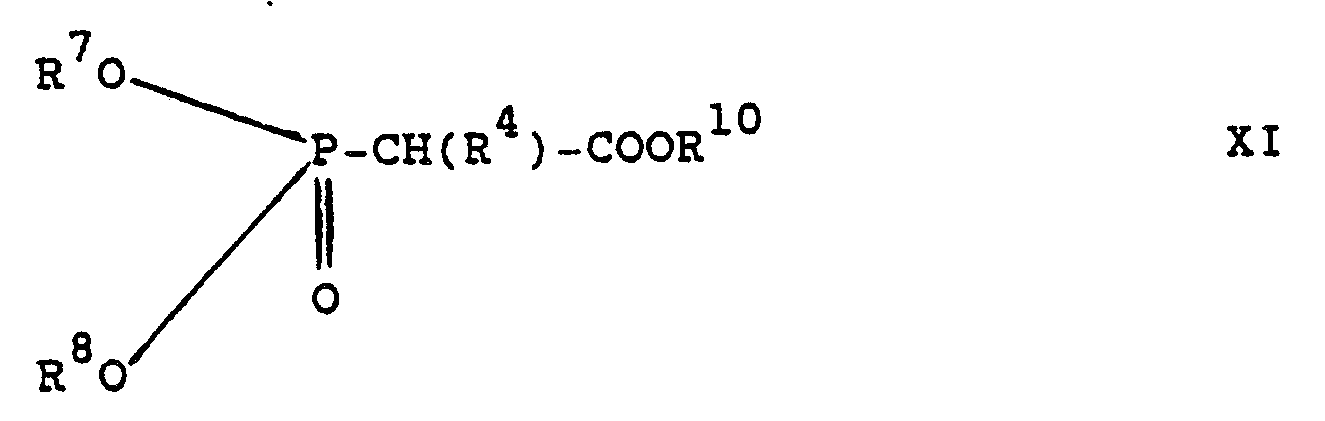
umsetzt, und zwar unter den im Zusammenhang mit der Verfahrensvariante a) oben angegebenen Reaktionsbedingungen, worauf der so erhaltene C₁₋₄-Alkylester auf konventionelle Weise, beispielsweise unter Verwendung von Natrium- oder Kaliumhydroxid in wässrigem Methanol, zur entsprechenden Säure der Formel IV hydrolysiert wird. - Als weitere Methode zur Herstellung der Acrylsäuren der Formel IV dient die Kondensation eines Acrylsäureesters der allgemeinen Formel
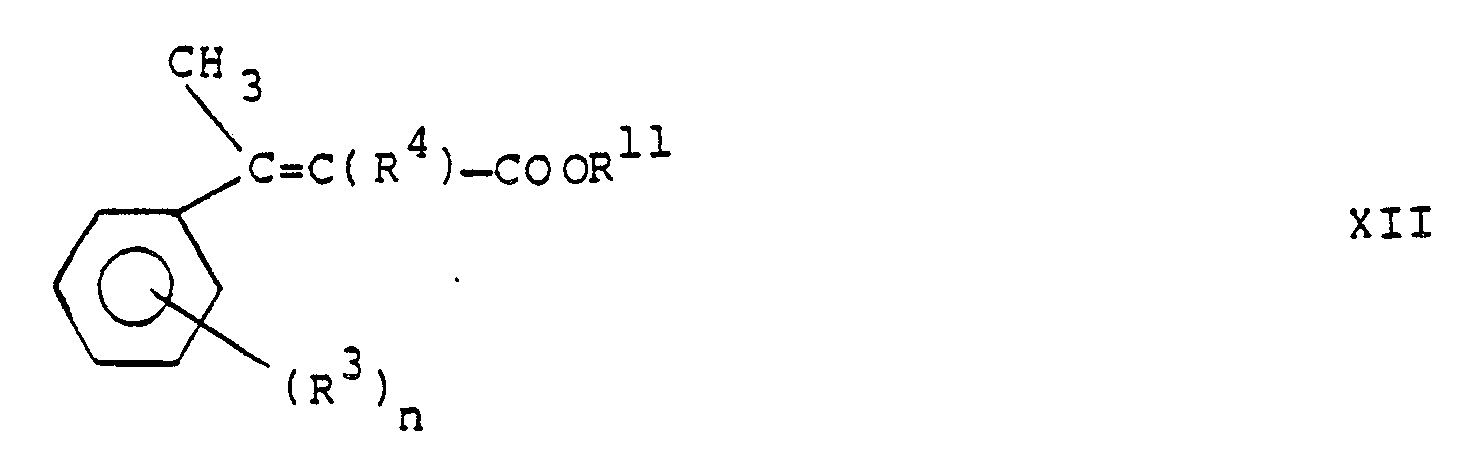
und R¹¹ C₁₋₄-Alkyl bedeutet,
mit einem substituierten Benzaldehyd der oben angegebenen Formel VII. Diese Kondensation erfolgt zweckmässigerweise unter Verwendung eines basischen Kondensationsmittels, wie eines C₁₋₄-Alkanolats, z.B. Kalium-tert. butanolat, das auch noch mit dem bei der Kondensation freiwerdenden Wasser zur Hydrolyse der Esterfunktion dient und deshalb zumindest in äquimolarer Menge eingesetzt wird. Zudem wird zweckmässigerweise in einem inerten Verdünnungsmittel, wie Dimethylformamid, im Temperaturbereich von 0°C bis 50°C, insbesondere bei Raumtemperatur, gearbeitet. - Ausgehend von den Acrylsäuren IV können deren reaktions- fähige Derivate nach an sich bekannten Methoden hergestellt werden.
- Unter den neuen Acrylsäuren der Formel IV bzw. reaktionsfähigen Derivaten davon stellen die 3-(3,4-Dimethoxyphenyl)-5-(α,α,α-trifluor -p-tolyl)-2,4-pentadiensäure und ihre reaktionsfähigen Derivate, z.B. ihre C₁₋₄-Alkylester und Alkalimetall-, Erdalkalimetall- und gegebenenfalls substituierten Ammoniumsalze, wichtige Ausgangsmaterialien dar.
- Die zur Herstellung der Ausgangsmaterialien der Formeln II, III und IV dienenden Ausgangsmaterialien der Formeln VI-VIII und X-XII sowie die Ausgangsmaterialien der Formel V und deren reaktionsfähige Derivate sind entweder bekannt oder können nach an sich bekannten Methoden hergestellt werden.
- Die erfindungsgemässen Verbindungen, d.h. die Verbindungen der Formel I, besitzen fungizide Wirkung und können dementsprechend zur Bekämpfung von Schadpilzen in der Landwirtschaft und im Gartenbau Verwendung finden. Sie können sowohl gegen parasitäre Pilze an Pflanzenteilen, z.B. Blättern, Stengeln, Wurzeln, Zwiebeln, Knollen, Früchten und Blüten, und an Saatgut als auch gegen im Erdboden auftretende phytopathogene Pilze eingesetzt werden. Die erfindungsgemässen Verbindungen eignen sich besonders zur Bekämpfung von Pilzen der zur Klasse der Oomycetes gehörenden Gattungen Plasmopara, Peronospora, Phytophthora, Pseudoperonospora, Bremia und Pythium. Sie sind ferner wirksam unter anderem bei der Bekämpfung von Pilzen der Klassen Deuteromycetes, Ascomycetes und Basidiomycetes, wie beispielsweise Botrytis cinerea, Erysiphe cichoracearum, Erysiphe graminis, Uncinula necator, Podosphaera leucotricha, Venturia inaequalis, Cercosphora archidicola, Cercospora beticola, Helminthosporium gramineum, Cercosporella sp., Septoria sp. und Pellicularia sp.
- Die erfindungsgemässen Verbindungen zeichnen sich durch lokale und teilweise auch systemische Wirkung sowie durch eine hohe Pflanzenverträglichkeit aus. Sie können sowohl vorbeugend als auch kurativ angewendet werden.
- Unter Gewächshausbedingungen wirken die erfindungsgemässen Verbindungen bereits bei Konzentrationen von 1 mg bis 500 mg Wirkstoff pro Liter Spritzbrühe. Im Freiland werden vorteilhaft Konzentrationen von 50 g bis 1500 g Wirkstoff der Formel I pro Hektar und Behandlung zur Anwendung gebracht. Zur Bekämpfung von samen- oder bodenbürtigen Pilzen im Beizverfahren werden mit Vorteil 0,05 g bis 1,5 g Wirkstoff der Formel I pro kg Samen verwendet.
- Die erfindungsgemässen Verbindungen können zu verschiedenartigen Mitteln, z.B. Lösungen, Suspensionen, Emulsionen, emulgierbaren Konzentraten und pulverförmigen Präparaten, formuliert werden. Die erfindungsgemässen fungiziden Mittel sind dadurch gekennzeichnet, dass sie eine wirksame Menge mindestens einer Verbindung der allgemeinen Formel I, wie oben definiert, sowie Formulierungshilfsstoffe enthalten. Die Mittel enthalten zweckmässigerweise zumindest einen der folgenden Formulierungshilfsstoffe:
- Feste Trägerstoffe; Lösungs- bzw. Dispersionsmittel; Tenside (Netz- und Emulgiermittel); Dispergatoren (ohne Tensidwirkung); und Stabilisatoren.
- Als feste Trägerstoffe kommen im wesentlichen in Frage: natürliche Mineralstoffe, wie Kaolin, Tonerden, Kieselgur, Talkum, Bentonit, Kreide, z.B. Schlämmkreide, Magnesiumcarbonat, Kalkstein, Quarz, Dolomit, Attapulgit, Montmorillonit und Diatomeenerde; synthetische Mineralstoffe, wie hochdisperse Kieselsäure, Aluminiumoxid und Silikate; organische Stoffe, wie Cellulose, Stärke, Harnstoff und Kunstharze; und Düngemittel, wie Phosphate und Nitrate, wobei solche Trägerstoffe z.B. als Granulate oder Pulver vorliegen können.
- Als Lösungs- bzw. Dispersionsmittel kommen im wesentlichen in Frage: Aromaten, wie Toluol, Xylole, Benzol und Alkylnaphthaline; chlorierte Aromaten und chlorierte aliphatische Kohlenwasserstoffe, wie Chlorbenzole, Chloräthylene und Methylenchlorid; aliphatische Kohlenwasserstoffe, wie Cyclohexan und Paraffine, z.B. Erdölfraktionen; Alkohole, wie Butanol und Glykol, sowie deren Aether und Ester; Ketone, wie Aceton, Methyläthylketon, Methylisobutylketon und Cyclohexanon; und stark polare Lösungs- bzw. Dispersionsmittel, wie Dimethylformamid, N-Methylpyrrolidon und Dimethylsulfoxid, wobei solche Lösungs- bzw. Dispersionsmittel vorzugsweise Flammpunkte von mindestens 30°C und Siedepunkte von mindestens 50°C aufweisen, und Wasser. Unter den Lösungs- bzw. Dispersionsmitteln kommen auch in Frage sogenannte verflüssigte gasförmige Streckmittel oder Trägerstoffe, die solche Produkte sind, welche bei Raumtemperatur und unter Normaldruck gasförmig sind. Beispiele solcher Produkte sind insbesondere Aerosol-Treibgase, wie Halogenkohlenwasserstoffe, z.B. Dichlordifluormethan. Im Falle der Benutzung von Wasser als Lösungsmittel können z.B. auch organische Lösungsmittel als Hilfslösungsmittel verwendet werden.
- Die Tenside (Netz- und Emulgiermittel) können nichtionische Verbindungen sein, wie Kondensationsprodukte von Fettsäuren, Fettalkoholen oder fettsubstituierten Phenolen mit Aethylenoxid; Fettsäureester und -äther von Zuckern oder mehrwertigen Alkoholen; die Produkte, die aus Zuckern oder mehrwertigen Alkoholen durch Kondensation mit Aethylenoxid erhalten werden; Blockpolymere von Aethylenoxid und Propylenoxid; oder Alkyldimethylaminoxide.
- Die Tenside können auch anionische Verbindungen darstellen, wie Seifen; Fettsulfatester, z.B. Dodecylnatriumsulfat, Octadecylnatriumsulfat und Cetylnatriumsulfat; Alkylsulfonate, Arylsulfonate und fettaromatische Sulfonate, wie Alkylbenzolsulfonate, z.B. Calcium-dodecylbenzolsulfonat, und Butylnaphthalinsulfonate; und komplexere Fettsulfonate, z.B. die Amidkondensationsprodukte von Oelsäure und N-Methyltaurin und das Natriumsulfonat von Dioctylsuccinat.
- Die Tenside können schliesslich kationische Verbindungen sein, wie Alkyldimethylbenzylammoniumchloride, Dialkyldimethylammoniumchloride, Alkyltrimethylammoniumchloride und äthoxylierte quaternäre Ammoniumchloride.
- Als Dispergatoren (ohne Tensidwirkung) kommen im wesentlichen in Frage: Lignin, Natrium- und Ammoniumsalze von Ligninsulfonsäure, Natriumsalze von Maleinsäureanhydrid-Diisobutylen-Copolymeren, Natrium- und Ammoniumsalze von sulfonierten Polykondensationsprodukten aus Naphthalin und Formaldehyd, und Sulfitablaugen.
- Als Dispergatoren, die sich insbesondere als Verdickungs- bzw. Antiabsetzmittel eignen, können z.B. Methylcellulose, Carboxymethylcellulose, Hydroxyäthylcellulose, Polyvinylalkohol, Alginate, Caseinate und Blutalbumin eingesetzt werden.
- Beispiele von geeigneten Stabilisatoren sind säurebindende Mittel, z.B. Epichlorhydrin, Phenylglycidäther und Soyaepoxide; Antioxidantien, z.B. Gallussäurester und Butylhydroxytoluol; UV-Absorber, z.B. substituierte Benzophenone, Diphenylacrylnitrilsäureester und Zimtsäureester; und Deaktivatoren, z.B. Salze der Aethylendiamintetraessigsäure und Polyglykole.
- Die erfindungsgemässen fungiziden Mittel können neben den Wirkstoffen der Formel I auch andere Wirkstoffe enthal ten, z.B. anderweitige fungizide Mittel, insektizide und akarizide Mittel, Bakterizide, Pflanzenwachstumsregulatoren und Düngemittel. Solche Kombinationsmittel eignen sich zur Verbreiterung des Wirkungsspektrums oder zur spezifischen Beeinflussung des Pflanzenwachstums.
- Im allgemeinen enthalten die erfindungsgemässen fungiziden Mittel, je nach deren Art, zwischen 0,0001 und 95 Gewichtsprozent an erfindungsgemässer Verbindung bzw. erfindungsgemässen Verbindung als Wirkstoff(en). Sie können in einer Form vorliegen, die sich für die Lagerung und den Transport eignet. In solchen Formen, z.B. emulgierbaren Konzentraten, ist die Wirkstoffkonzentration normalerweise im höheren Bereich des obigen Konzentrationsintervalls. Diese Formen können dann mit gleichen oder verschiedenen Formulierungshilfsstoffen bis zu Wirkstoffkonzentrationen verdünnt werden, die sich für den praktischen Gebrauch eignen, und solche Konzentrationen liegen normalerweise im niedrigeren Bereich des obigen Konzentrationsintervalls. Emulgierbare Konzentrate enthalten im allgemeinen 5 bis 95 Gewichtsprozent, vorzugsweise 25 bis 75 Gewichtsprozent, der Verbindung bzw. Verbindungen der Formel I. Als Anwendungsformen kommen u.a. gebrauchsfertige Lösungen, Emulsionen und Suspensionen, die sich beispielsweise als Spritzbrühen eignen, in Frage. In solchen Spritzbrühen können z.B. Konzentrationen zwischen 0,0001 und 20 Gewichtsprozent vorliegen. Im Ultra-Low-Volume-Verfahren können Spritzbrühen formuliert werden, in denen die Wirkstoffkonzentration vorzugsweise von 0,5 bis 20 Gewichtsprozent beträgt, während die im Low-Volume-Verfahren und im High-Volume-Verfahren formulierten Spritzbrühen vorzugsweise eine Wirkstoffkonzentration von 0,02 bis 1,0 bzw. 0,002 bis 0,1 Gewichtsprozent aufweisen.
- Die erfindungsgemässen fungiziden Mittel können dadurch hergestellt werden, dass man mindestens eine Verbindung der allgemeinen Formel I mit Formulierungshilfsstoffen vermischt.
- Die Herstellung der Mittel kann in bekannter Weise durchgeführt werden, z.B. durch Vermischen der Wirkstoffes mit festen Trägerstoffen, durch Auflösen oder Suspendieren in geeigneten Lösungs- bzw. Dispersionsmitteln, eventuell unter Verwendung von Tensiden als Netz- oder Emulgiermitteln oder von Dispergatoren, durch Verdünnen bereits vorbereiteter emulgierbarer Konzentrate mit Lösungs- bzw. Dispersionsmitteln, usw.
- Im Falle von pulverförmigen Mitteln kann der Wirkstoff mit einem festen Trägerstoff vermischt werden, z.B. durch Zusammenmahlen; oder man kann den festen Trägerstoff mit einer Lösung oder Suspension des Wirkstoffs imprägnieren und dann das Lösungs- bzw. Dispersionsmittel durch Abdunsten, Erhitzen oder durch Absaugen unter vermindertem Druck entfernen. Durch Zusatz von Tensiden bzw. Dispergatoren kann man solche pulverförmige Mittel mit Wasser leicht benetzbar machen, so dass sie in wässrige Suspensionen, die sich z.B. als Spritzmittel eignen, übergeführt werden können.
- Die erfindungsgemässen Verbindungen können auch mit einem Tensid und einem festen Trägerstoff zur Bildung eines netzbaren Pulvers vermischt werden, welches in Wasser dispergierbar ist, oder sie können mit einem festen vorgranulierten Trägerstoff zur Bildung eines granulatförmigen Produktes vermischt werden.
- Wenn gewünscht, kann eine erfindungsgemässe Verbindung in einem mit Wasser nicht mischbaren Lösungsmittel, wie beispielsweise einem alicyclischen Keton, gelöst werden, das zweckmässigerweise gelöste Emulgiermittel enthält, so dass die Lösung bei Zugabe zu Wasser selbstemulgierend wirkt. Andernfalls kann der Wirkstoff mit einem Emulgiermittel vermischt und das Gemisch dann mit Wasser auf die gewünschte Konzentration verdünnt werden. Zudem kann der Wirkstoff in einem Lösungsmittel gelöst und danach mit einem Emulgiermittel gemischt werden. Ein solches Gemisch kann ebenfalls mit Wasser auf die gewünschte Konzentration verdünnt werden. Auf diese Weise erhält man emulgierbare Konzentrate bzw. gebrauchsfertige Emulsionen.
- Die Verwendung der erfindungsgemässen Mittel kann nach den im Pflanzenschutz bzw. in der Landwirtschaft üblichen Applikationsmethoden erfolgen. Das erfindungsgemässe Verfahren zur Bekämpfung von Fungi ist dadurch gekennzeichnet, dass man das zu schützende Gut, z.B. Pflanzen, Pflanzenteile bzw. Samen, mit einer wirksamen Menge einer erfindungsgemässen Verbindung bzw. eines erfindungsgemässen Mittels behandelt.
- Die nachstehenden Beispiele illustrieren die Erfindung.
- Unter Rühren und Feuchtigkeitsausschluss wird eine Lösung von 4,0 g Diäthylphosphonoessigsäuremorpholid in 50 ml absolutem 1,2-Dimethoxyäthan portionenweise mit 1,7 g Kalium-tert.butylat versetzt. Man erwärmt das Reaktionsgemisch 2 Stunden bei 50°C und gibt dann 3,4 g (E)-1-(3,4-Dimethoxyphenyl)-3-(α,α,α-trifluor -p-tolyl)-2-propen-1-on auf einmal zu. Die Reaktionslösung wird 2 Stunden bei Rückflusstemperatur gehalten, unter vermindertem Druck eingedampft und mit 50 ml Wasser versetzt. Man extrahiert dreimal mit Methylenchlorid. Die Extrakte werden mit Wasser gewaschen, über wasserfreiem Natriumsulfat getrocknet und unter vermindertem Druck eingedampft. Der ölige Rückstand wird an Kieselgel mit Aethylacetat als Laufmittel chromatographisch gereinigt. Auf diese Weise erhält man mit der 1. Fraktion 1,85 g 4-[(all-E)-3-(3,4-Dimethoxyphenyl)-5-(α,α,α-trifluor-p-tolyl) -2,4-pentadienoyl]-mor pholin als weissen Schaum. Die 2. Fraktion liefert 0,52 g 4-[(2-Z,4-E)-3-(3,4-Dimethoxyphenyl) -5-(α,α,α-trifluor-p-tolyl) -2,4-pentadienoyl]-morpholin als weissen Schaum;
Massenspektrum (1. und 2. Isomer) m/e: M⁺ 447 (60), 428 (2), 361 (100);
¹H-NMR (CDCl₃, 250 MHz): 1. Isomer 3,89 ppm ( s, OCH₃), 3,94 ppm (s, OCH₃), 6,08 ppm (s, = CH-CO-), 6,62 ppm (d, 16 Hz, -CH=CH-), 7,88 ppm (d, 16 Hz, -CH=CH-); 2. Isomer 3,86 ppm (s, OCH₃), 3,94 ppm (s, OCH₃), 6,19 ppm (s, =CH-CO-), 6,56 ppm (d, 16 Hz, -CH=CH-), 7,05 ppm (d, 16 Hz, -CH=CH-). - In analoger Weise erhält man aus:
- (E)-3-(4-Cyanophenyl)-1-(3,4-dimethoxyphenyl)-2-propen-1-on und Diäthylphosphonoessigsäuremorpholid das 4-[(all-E)-5-(4-Cyanophenyl)-3-(3,4-dimethoxyphenyl) -2,4-pentadienoyl]-morpholin als gelblichen Schaum (1. Isomer) und das 4-[(2-Z,4-E)-5-(4-Cyanophenyl)-3-(3,4-dimethoxyphenyl)-2,4-pentadienoyl]-morpholin als gelbes Harz (2. Isomer); Massenspektrum (1. und 2. Isomer) m/e: M⁺ 404 (64), 318 (100);
¹H-NMR (CDCl₃, 250 MHz): 1. Isomer 3,89 ppm (s, OCH₃), 3,94 ppm (s, OCH₃), 6,11 ppm (s, =CH-CO-), 6,59 ppm (d, 16 Hz, -CH=CH-), 7,94 ppm (d, 16 Hz, -CH=CH-);
2. Isomer 3,86 ppm (s, OCH₃), 3,94 ppm (s, OCH₃), 6,21 ppm (s, =CH-CO-), 6,53 ppm (d, 16 Hz, -CH=CH-), 7,07 ppm (d, 16 Hz, -CH=CH-);
- (E)-3-(4-Biphenylyl)-3′,4′-dimethoxyacrylophenon und Diäthylphosphonoessigsäuremorpholid das 4-[(all-E)-5-(4-Biphenylyl)-3-(3,4-dimethoxyphenyl) -2,4-pentadienoyl]-morpholin als gelbliches Harz, Smp. 119-129°C;
¹H-NMR (CDCl₃, 400 MHz): 3,90 ppm (s, OCH₃), 3,94 ppm (s, OCH₃), 6,00 ppm (s, =CH-CO-), 6,65 ppm (d, 16 Hz, -CH=CH-), 7,81 ppm (d, 16 Hz, -CH=CH-); und das
4-[(2-Z,4-E)-5-(4-Biphenylyl)-3-(3,4-dimethoxyphenyl)-2,4 pentadienoyl]-morpholin als gelben Schaum, Smp. 60-65°C. Massenspektrum m/e: M⁺ 455 (97), 369 (100), 341 (43), 252 (20), 165 (45);
¹H-NMR (CDCl₃, 400 MHz): 3,87 ppm (s, OCH₃), 3,94 ppm (s, OCH₃), 6,15 ppm (s, =CHCO-), 6,59 ppm (d, 16 Hz, -CH=CH-), 7,02 ppm (d, 16 Hz, -CH=CH-);
- (E)-3-(m-Phenoxyphenyl)-3′,4′-dimethoxyacrylophenon und Diäthylphosphonoessigsäuremorpholid das 4-[(all-E)-3-(3,4-Dimethoxyphenyl)-5-(m-phenoxyphenyl) -2,4-pentadienoyl]-morpholin als gelbliches Harz,
Massenspektrum m/e: M⁺ 471 (100), 385 (86), 356 (57), 264 (42), 165 (35), 77 (80);
¹H-NMR (CDCl₃, 400 MHz): 3,88 ppm (s, OCH₃), 3,92 ppm (s, OCH₃), 5,99 ppm (s, =CHCO-), 6,55 ppm (d, 16 Hz, -CH=CH-), 7,66 ppm (d, 16 Hz, -CH=CH-);
- (E)-3-[m-(1,2-Dichlorvinyloxy)-phenyl] -3′,4′-dimethoxy- acrylophenon und Diäthylphosphonoessigsäuremorpholid das 4-[(2-E/Z, 4-E)-5-[m-(1,2-Dichlorvinyloxy)-phenyl]-3-(3,4-dimethoxyphenyl)-2,4-pentadienoyl]-morpholin als gelbliches Harz,
Massenspektrum m/e: M⁺ 489 (95), 403 (100), 165 (50);
¹H-NMR (CDCl₃, 400 MHz): 3,89 ppm (s, OCH₃), 3,94 ppm (s, OCH₃), 5,96 ppm (s, =CHCl), 6,03 ppm (s, =CHCO-), 6,58 ppm (d, 16 Hz, -CH=CH-), 7,73 ppm (d, 16 Hz, -CH=CH-);
- (E)-3-(p-Phenoxyphenyl)-3′,4′-dimethoxyacrylophenon und Diäthylphosphonoessigsäuremorpholid das 4-[(all-E)-3-(3,4-Dimethoxyphenyl)-5-(p-phenoxyphenyl)-2,4-pentadienoyl]-morpholin, Smp. 137-140°C;
¹H-NMR (CDCl₃, 400 MHz): 3,88 ppm (s, OCH₃), 3,93 ppm (s, OCH₃), 5,96 ppm (s, =CHCO-), 6,85 ppm (d, 16 Hz, -CH=CH-), 7,68 ppm (d, 16 Hz, -CH=CH-);
Massenspektrum m/e: M⁺ 471 (82), 385 (100), 357 (42);
- (E)-3-[p-[(α,α,α-Trifluor-p-tolyl)oxy]phenyl]-3′4′-dimethoxyacrylophenon und Diäthylphosphonoessigsäuremorpholid das 4-[(2 E/Z,4E)-3-(3,4-Dimethoxyphenyl)-5-[p-[(α,α,α-trifluor-p-tolyl)-oxy]phenyl]-2,4-pentadienoyl]-morpholin als Harz,
Massenspektrum m/e: M⁺ 539 (77), 453 (100). - Zu einer eisgekühlten Lösung von 653 mg Morpholin in 10 ml Pyridin tropft man langsam unter Rühren und Feuchtigkeitsausschluss 0,22 ml Phosphortrichlorid. Nach halbstündigem Rühren bei Raumtemperatur werden 1,78 g (2-E/Z,4E)-3-(3,4-Dimethoxyphenyl) -5-(4-methylthiophenyl)-2,4-pentadiensäure auf einmal zugegeben. Man rührt 16 Stunden bei 40°C und versetzt mit Eis und 25%-iger Salzsäure bis zur stark sauren Reaktion. Der ölige Niederschlag wird zweimal mit je 50 ml Aethylacetat extrahiert, und die vereinigten organischen Phasen werden mit Wasser gewaschen und über wasserfreiem Natriumsulfat getrocknet. Nach dem Eindampfen unter vermindertem Druck bleiben 2,2 g grünes Oel zurück, das sich beim Trocknen bei 0,1 mmHg Druck zu einem gelblichen Schaum bestehend aus 4-[(2-E/Z,4-E)-3-(3,4-Dimethoxyphenyl)-5-(4-methylthiophenyl) -2,4-pentadienoyl]-morpholin verfestigt.
¹H-NMR (CDCl₃, 250 MHz): 2,48 ppm (s, S-CH₃), 3,88 ppm (s, O-CH₃), 3,93 ppm (s, OCH₃), 5,97 ppm (s, -CHCO-), 6,55 ppm (d, 16 Hz, -CH=CH-), 7,74 ppm (d, 16 Hz, -CH=CH-). - In analoger Weise erhält man aus:
- (2-E/Z,4-E)-3-(3,4-Dimethoxyphenyl)-5-(α,α,α-trifluor-m-tolyl)-2,4-pentadiensäure und Morpholin das (2-E/Z,4-E)-4-[3-(3,4-Dimethoxyphenyl)-5-(α,α,α-tri- fluor-m-tolyl)-2,4-pentadienoyl]-morpholin als grünlichen Schaum;
Massenspektrum m/e: M⁺ 447 (60) 428 (1), 361 (100);
¹H-NMR (CDCl₃, 250 MHz): 3,89 ppm (s, OCH₃), 3,94 ppm (s, OCH₃), 6,06 ppm (s, =CHCO-), 6,62 ppm (d, 16 Hz, -CH=CH-), 7.84 ppm (d, 16 Hz, -CH=CH-);
- (2-E/Z,4-E)-5-(4-Cyanophenyl)-3-(3,4-dimethoxyphenyl)-2,4-pentadiensäure und Morpholin das 4-[(all-E)-5-(4-Cyanophenyl)-3-(3,4-dimethoxyphenyl) -2,4-pentadienoyl]-morpholin als gelblichen Schaum;
Massenspektrum m/e: M⁺ 404 (64), 318 (100);
¹H-NMR (CDCl₃, 250 MHz): 3,89 ppm (s, OCH₃), 3,94 ppm (s, OCH₃), 6,11 ppm (s, =CH-CO-), 6,59 ppm (d, 16 Hz, -CH=CH-), 7,94 ppm (d, 16 Hz, -CH=CH-);
- (all-E)-3-(3,4-Dimethoxyphenyl) -5-(α,α,α-trifluor-p-tolyl)-2,4-pentadiensäure und Thiomorpholin das 4-[(all-E)-3-(3,4-Dimethoxyphenyl) -5-(α,α,α-trifluor-p-tolyl)-2,4-pentadienoyl] -thiomorpholin als rosafarbenen Schaum;
Massenspektruk m/e: M⁺ 463 (64), 444 (6), 361 (100);
¹H-NMR (CDCl₃, 250 MHz): 3,89 ppm (s, -OCH₃, 3,94 ppm (s, -OCH₃), 6,07 ppm (s, =CH-CO-), 6,62 ppm (d, 16 Hz, -CH=CH-), 7,79 ppm (d, 16 Hz, -CH=CH-);
- (2-E/Z,4-E)-3-(3,4-Dimethoxyphenyl)-2-methyl-5-(α,α,α-trifluor-p-tolyl)-2,4-pentadiensäure und Morpholin das 4-[(2-E/Z,4-E)-3-(3,4-Dimethoxyphenyl)-2-methyl-5-(α,α,α-trifluor-p-tolyl)-2,4-pentadienoyl]-morpholin als gelbes Oel;
Massenspektrum m/e: M⁺ 461 (100), 375 (89);
¹H-NMR (CDCl₃, 250 MHz): 1,83 ppm (s, =-CH)₃), 3,88 ppm (s, O-CH₃), 3,95 ppm (s, O-CH₃), 6,13 ppm (d, 15 Hz, -CH=CH-), 7,06 ppm (d, 15 Hz, -CH=CH-);
- (2-E/Z,4-E)-3-(3,4-Dimethoxyphenyl)-5-(α,α,α,4-tetrafluor-m-tolyl)-2,4-pentadiensäure und Morpholin das 4-(2-E/Z,4-E)-3-(3,4-Dimethoxyphenyl)-5-(α,α,α,4-tetrafluor-m-tolyl)-2,4-pentadienoyl]-morpholin als gelblichen Schaum;
Massenspektrum m/e: M⁺ 465 (55), 379 (100);
¹H-NMR (CDCl₃, 250 MHz): 3,89 ppm (s, O-CH₃), 3,94 ppm (s, O-CH₃), 5,98 ppm (s, =CHCO-): Isomer I (40%), 6,06 ppm (s, -CHCO-): Isomer II (60%);
- (all-E)-3-(3,4-Dimethoxyphenyl)-5-[p-(1,1,2,2-tetrafluoräthoxy)-phenyl]-2,4-pentadiensäure und Morpholin das 4-{(2-E,4-E)-3-(3,4-Dimethoxyphenyl)-5-[p-(1,1,2,2-tetrafluoräthoxy)-phenyl]-2,4-pentadienoyl}-morpholin, Smp. 112-115°C;
Massenspektrum m/e: M⁺ 495 (67), 409 (100), 381 (18);
- (all-E)-3-(3,4-Dimethoxyphenyl)-5-[p-(trifluormethoxy)-phenyl]-2,4-pentadiensäure und Morpholin das 4-[3-(3,4-Dimethoxyphenyl)-5-[p-(trifluoromethoxy)-phenyl]-2,4-pentadienoyl]-morpholin als Schaum;
Massenspektrum m/e: M⁺ 463 (64), 377 (100), 349 (22);
- (all-E)-3-(3,4-Dimethoxyphenyl)-5-[p-(trifluormethoxy)-phenyl]-2,4-pentadiensäure und N-Aethyl-N-methylamin das (all-E)-N-Aethyl-N-methyl-3-(3,4-dimethoxyphenyl)-5-[p-(trifluormethoxy)-phenyl]-2,4-pentadiensäureamid als Harz;
Massenspektrum m/e: M⁺ 435 (83), 377 (100), 349 (18);
¹H-NMR (CDCl₃, 400 MHz): 1,21 ppm (t, 7.5 Hz, -CH₂CH₃), 3,06 ppm (s, N-CH₃), 3,50 ppm (q, -CH₂CH₃), 3,88 ppm (s, OCH₃), 3,94 ppm (s, OCH₃), 6,08 ppm (s, =CH-CO-), 6,54 ppm (d, 16 Hz, -CH=CH-), 7,88 ppm (d, 16 Hz, -CH=CH-);
- (all-E)-3-(3,4-Dimethoxyphenyl)-5-[4-chlor-3-(trifluormethyl)-phenyl]-2,4-pentadiensäure und Morpholin das 4-[(all-E)-5-[4-Chlor-3-(trifluormethyl)-phenyl]-3-(3,4- dimethoxyphenyl)-2,4-pentadienoyl]-morpholin als Harz;
Massenspektrum m/e: M⁺ 481 (70), 395 (100);
¹H-NMR (CDCl₃, 400 MHz): 3,89 ppm (s, OCH₃), 3,94 ppm (s, OCH₃), 6,08 ppm (s, =CH-CO-), 6,55 ppm (d, 16 Hz, -CH=CH-), 7,86 ppm (d, 16 Hz, -CH=CH-);
- (all-E)-3-(3-Fluor-4-methoxyphenyl)-5-(α,α,α-trifluor-p-tolyl)-2,4-pentadiensäure und Morpholin das 4-[(all-E)-3-(3-Fluor-4-methoxyphenyl)-5-(α,α,α-trifluor-p-tolyl)-2,4-pentadienoyl]-morpholin als Harz;
Massenspektrum m/e: M⁺ 435 (74), 416 (6), 349 (100);
- (all-E)-3-(4-Methoxyphenyl)-5-(α,α,α-trifluor-p-tolyl)-2,4-pentadiensäure und Morpholin das 4-[(all-E)-3-(4-Methoxyphenyl)-5-(α,α,α-trifluor-p-tolyl)-2,4-pentadienoyl]-morpholin als Harz;
Massenspektrum m/e: M⁺ 417 (56), 398 (3), 331 (100), 303 (12);
¹N-NMR (CDCl₃, 400 MHz): 3,87 ppm (s, OCH₃), 6,05 ppm (s, =CH-CO-), 6,59 ppm (d, 16 Hz, -CH=CH-), 7.91 ppm (d, 16 Hz, -CH=CH-);
- (all-E)-3-(3,4-Dimethoxyphenyl)-5-(α,α,α-trifluor-m-tolyl)-2,4-pentadiensäure und N-Aethyl-N-methylamin das (all-E)-N-Aethyl-N-methyl-3-(3,4-dimethoxyphenyl)-5-(α,α,α-trifluor-m-tolyl)-2,4-pentadiensäureamid, Schmelzpunkt 88-93°C;
Massenspektrum m/e: M⁺ 419 (84), 400 (3), 361 (100);
- 3-(3,4-Dimethoxyphenyl)5-(α,α,α-trifluor-p-tolyl)-2,4-pentadiensäure und N-Aethyl-N-methylamin das (all-E)-N-Aethyl-N-methyl-3-(3,4-dimethoxyphenyl)-5-(α,α,α-trifluor-p-tolyl)-2,4-pentadiensäureamid als Harz;
Massenspektrum m/e: M⁺ 419 (90), 400 (5), 361 (100);
¹H-NMR (CDCl₃, 400 MHz): 1,21 ppm (t, -CH₂CH₃), 3,07 ppm (s, -NCH₃), 3,51 ppm (q, -CH₂CH₃), 3,89 ppm (s, OCH₃), 3,94 ppm (s, OCH₃), 6,12 ppm (s, =CHCO-), 6,59 ppm (d, 16 Hz, -CH=CH-), 7,99 ppm (d, 16 Hz, -CH=CH-); und
das (2-Z,4-E)-N-Aethyl-N-methyl-3-(3,4-dimethoxyphenyl)-5-(α,α,α-trifluor-p-tolyl)-2,4-pentadiensäureamid als Harz;
¹H=NMR (CDCl₃, 400 MHz): 0,91 ppm und 0,98 ppm je (t, -CH₂CH₃), 2,74 ppm und 2,80 ppm je (s, -NCH₃), 3,25 ppm und 3,29 ppm je (q, -CH₂CH₃), 3,86 ppm (s, OCH₃), 3,92 ppm (s, OCH₃), 6,25 ppm und 6,26 ppm je (s, =CH-CO-), 6,51 ppm und 6,52 ppm je (d, 16 Hz, CH=CH), 7,06 ppm (d, 16 Hz, -CH=CH):
- (all-E)-3-(3,4-Dimethoxyphenyl)-5-(α,α,α-trifluor-p-tolyl)-2,4-pentadiensäure und N-Isobutyl-N-methylamin das (all-E)-N-Isobutyl-N-methyl-3-(3,4-dimethoxyphenyl)-5-(α,α,α-trifluor-p-tolyl)-2,4-pentadiensäureamid als Harz;
Massenspektrum m/e: M⁺ 447 (69), 428 (5), 404 (5), 361 (100);
- (all-E)-3-(3,4-Dimethoxyphenyl)-5-(α,α,α-trifluor-p-tolyl)-2,4-pentadiensäure und N-Aethyl-N-butylamin das (all-E)-N-Aethyl-N-butyl-3-(3,4-dimethoxyphenyl)-5- (α,α,α-trifluor-p-tolyl)-2,4-pentadiensäureamid als Sirup;
Massenspektrum m/e: M+ 461 (78), 442 (6), 361 (100), 334 (38), 302 (24), 165 (35), 100 (55);
- 3-(3,4-Dimethoxyphenyl)-2-methyl-5-(α,α,α-trifluor-p-tolyl)-2,4-pentadiensäure und N-Aethyl-N-methylamin das N-Aethyl-N-methyl-2-methyl-3-(3,4-dimethoxyphenyl)-5-(α,α,α-trifluor-p-tolyl)-2,4-pentadiensäureamid als Harz;
Massenspektrum m/e: M⁺ 433 (100), 418 (12), 414 (6), 375 (86), 347 (43), 165 (46);
- (all-E)-3-(3,4-Dimethoxyphenyl)-5-[4-chlor-3-(trifluormethyl)-phenyl]-2,4-pentadiensäure und N-Aethyl-N-methylamin das (all-E)-N-Aethyl-N-methyl-5-[4-chlor-3-(trifluormethyl)-phenyl]-3-(3,4-dimethoxyphenyl)-2,4-pentadiensäureamid, Smp. 115-119°C;
Massenspektrum m/e: M⁺ 453 (84), 395 (100):
- (all-E)-3-(3,4-Dimethoxyphenyl)-5-[4-chlor-3-(trifluormethyl)-phenyl]-2,4-pentadiensäure und N,N-Dimethylamin das (all-E)-N,N-Dimethyl-5-[4-chlor-3-(trifluormethyl)-phenyl]-3-(3,4-dimethoxyphenyl)-2,4-pentadiensäureamid,Smp. 100-103°C; Massenspektrum m/e: M⁺ 439 (64), 395 (100);
- (all-E)-3-(3,4-Dimethoxyphenyl)-5-{m-[(α,α,α-trifluor-m-tolyl)oxy]-phenyl{-2,4-pentadiensäure und Morpholin das 4-[(all-E)-3-(3,4-Dimethoxyphenyl)-5-{m-[(α,α,α-trifluor-m-tolyl)oxy]-phenyl}-2,4-pentadienoyl]-morpholin als Schaum;
Massenspektrum m/e: M⁺ 539 (100), 453 (78), 425 (35), 264 (29);
¹H-NMR (CDCl₃, 400 MHz): 3,88 ppm (s, OCH₃), 3,93 ppm (s, OCH₃), 6,02 ppm (s, =CHCO-), 6,56 ppm (d, 16 Hz, -CH=CH-), 7,73 ppm (d, 16 Hz, -CH=CH-);
- 3-(3,4-Dimethoxyphenyl)-5-(4-fluor-3-phenoxyphenyl)-2,4-pentadiensäure und Morpholin das 4-[(all-E)-3-,4-Dimethoxyphenyl)-5-(4-fluor-3-phenoxyphenyl)-2,4-pentadienoyl]-morpholin als Harz;
Massenspektrum m/e: M⁺ 490 (92), 403 (100), 375 (40);
¹H-NMR (CDCl₃, 400 MHz): 3,87 ppm (s, OCH), 3,92 ppm (s, OCH₃), 5,99 (s, =CHCO-), 6,48 ppm (d, 16 Hz. -CH=CH-), 7,62 ppm (d, 16 Hz, -CH=CH-);
und das 4-[(2-Z,4-E)-3-(3,4-Dimethoxyphenyl)-5-(4-fluor-3-phenoxy-phenyl)-2,4-pentadienoyl]-morpholin als Harz;
¹H-NMR (CDCl₃, 400 MHz): 3,84 ppm (s, OCH₃), 3,92 ppm (s, OCH₃), 6,09 ppm (s, =CHCO-), 6,42 ppm (d, 16 Hz, -CH=CH-), 6,82 ppm (d, 16 Hz, -CH=CH-);
- (all-E)-3-(3,4-Dimethoxyphenyl)-5-[m-(3,5-dichlorphenoxy)-phenyl]-2,4-pentadiensäure und Morpholin das 4-{(all-E)-5-[m-(3,5-Dichlorphenoxy)-phenyl]-3-(3,4-dimethoxyphenyl)-2,4-pentadienoyl}-morpholin als Schaum;
Massenspektrum m/e: M⁺ 539 (100), 453 (45), 425 (32);
¹H-NMR (CDCl₃, 400 MHz): 3,89 ppm (s, OCH₃), 3,93 ppm (s, OCH₃), 6,02 ppm (s, =CH-CO-), 6,56 ppm (d, 16 Hz, -CH=CH-), 7,75 ppm (d, 16 Hz. -CH=CH-). - Zu einer Lösung von 2 ml 15%-iger Kalilauge in 10 ml Methanol tropft man eine Lösung von 36 g 3,4-Dimethoxyacetophenon und 36 g 4-Trifluormethylbenzaldehyd in 200 ml Methanol so zu, dass die Temperatur 30°C nicht übersteigt. Das Reaktionsgemisch wird 72 Stunden bei Raumtemperatur weitergerührt, danach der ausgefallene Niederschlag abgesaugt und aus Aethanol umkristallisiert. Dabei erhält man 53 g (E-1-(3,4-Dimethoxyphenyl)-3-(α,α,α-trifluor-p-tolyl)-2-propen-1-on als weisse Kristalle, Smp. 83°C;
Massenspektrum m/e: M+ 336 (100), 199 (14), 165 (84);
¹H-NMR (CDCl₃, 250 MHz): 3,98 ppm (s, 6H, OCH₃), 6,95 ppm (d, 8 Hz, -CH=CH-). - In analoger Weise erhält man aus:
- 3,4-Dimethoxyactophenon und 4-Cyanobenzaldehyd das (E)-3-(4-Cyanophenyl)-1-(3,4-dimethoxyphenyl) -2-propen-1-on als hellgelbe Kristalle, Smp. 169-171°C;
Massenspektrum m/e: M⁺ 293 (100), 265 (35), 262 (32), 165 (73);
¹H-NMR (CDCl₃, 250 MHz): 3,98 pm (s, 6H, -OCH₃), 6,95 ppm (d, 8 Hz, -CH=CH-);
- 3,4-Dimethoxyacetophenon und 4-Phenylbenzaldehyd das (E)-3-(4-Biphenylyl)-3′,4′-dimethoxyacrylophenon, Smp. 135-137°C; Massenspektrum m/e: M⁺ 344 (100), 329 (12), 313 (22), 267 (16), 165 (28);
- 3,4-Dimethoxyacetophenon und m-(1,2-Dichlorvinyloxy)-benzaldehyd das (E)-3-[m-(1,2-Dichlorvinyloxy)-phenyl] -3′,4′-dimethoxyacrylophenon als gelbliches Harz, Massenspektrum m/e: M⁺ 378 (81), 267 (17), 165 (100).
- 3,4-Dimethoxyacetophenon und m-Phenoxybenzaldehyd das (E)-3-(m-Phenoxyphenyl)-3′,4′-dimethoxyacrylophenon als Harz;
Massenspektrum m/e: M⁺ 360 (100), 329 (27), 267 (35), 165 (48);
- 3,4-Dimethoxyacetophenon und p-Phenoxybenzaldehyd das (E)-3-(p-Phenoxyphenyl)-3′,4′-dimethoxyacrylophenon, Smp. 120-123°C;
- 3,4-Dimethoxyacetophenon und p-[(α,α,α-Trifluor-p-tolyl)oxy]-benzaldehyd das (E)-3-{p-[(α,α,α-trifluor-p-tolyl)oxy]-phenyl}-3′,4′-dimethoxyacrylophenon, Smp. 120-122°C. - Zu einer eisgekühlten Lösung von 2,47 g Kalium-tert.-butylat in 10 ml Dimethylformamid tropft man während 10 Minuten unter Rühren eine Lösung von 5,00 g (E/Z)-3,4-Dimethoxy-β-methyl-zimtsäure-äthylester und 3,20 g 4-Methylthiobenzaldehyd in 15 ml Dimethylformamid. Danach wird eine Stunde bei Raumtemperatur weitergerührt, mit 100 ml Wasser versetzt und zweimal mit je 50 ml Diäthyläther extrahiert. Zur wässrigen Phase gibt man 7,5 ml 4N Salzsäure. Der entstandene Niederschlag wird abgesaugt, mit Wasser gewaschen und getrocknet. Nach Umkristallisation aus Toluol/Aethylacetat erhält man 5,5 g (2-E/Z,4-E)-3-(3,4-Dimethoxyphenyl)-5-(4-methylthiophenyl) -2,4-pentadiensäure als gelbe Kristalle, Smp. 173-179°C;
Massenspektrum m/e: M⁺ 356 (45), 311 (61), 264 (100);
¹H-NMR (DMSO-d₆, 250 MHz): 2,49 ppm (s, SCH₃), 3,78 ppm (s, OCH₃), 3,81 ppm (s, OCH₃), 5,74 ppm (s, =CHCO-), 6,63 ppm (d, 16 Hz, -CH=CH-), 8,35 ppm (d, 16 Hz, -CH=CH-), 12,3 ppm (s (breit), -COOH). - In analoger Weise erhält man aus:
- (E/Z)-3,4-Dimethoxy-β-methyl-zimtsäure-äthylester und 3-Trifluormethylbenzaldehyd die (2-E/Z,4-E)-3-(3,4-Di-methoxyphenyl) -5-(α,α,α-trifluor-m-tolyl)-2,4-pentadiensäure als gelbe Kirstalle, Smp. 150-153°C;
Massenspektrum m/e: M⁺ 378 (82), 333 (100), 302 (20);
¹H-NMR (DMSO-d₆, 250 MHz): 3,79 ppm (s, OCH₃), 3,81 ppm (s, OCH₃), 5,85 ppm (s, =CHCO-), 6,79 ppm (d, 16 Hz, -CH=CH-), 8,42 ppm (d, 16 Hz, -CH=CH-), 12,5 ppm (s (breit), COOH).
- (E/Z)-3,4-Dimethoxy-β-methyl-zimtsäure -äthylester und 4-Cyanobenzaldehyd die (2-E/Z,4-E)-5-(4-Cyanophenyl)-3-(3,4-dimethoxyphenyl)-2,4-pentadiensäure als gelbe Kristalle, Smp. 212-213°C (Zers.);
Massenspektrum m/e: M⁺ 335 (49), 290 (100);
¹H-NMR (DMSO-d₆, 250 MHz): 3,78 ppm (s, OCH₃), 3,81 ppm (s, OCH₃), 5,88 pm (s, =CH-CO-), 6,75 ppm (d, 16 Hz, -CH=CH-), 8,47 ppm (d, 16 Hz, -CH=CH-), 12,5 ppm (s (breit), COOH);
- (E/Z)-3,4-Dimethoxy-β-methyl-zimtsäure-äthylester und 4-Trifluormethylbenzaldehyd die (all-E)-3-(3,4-Dimethoxyphenyl)-5-(α,α,α-trifluor -p-tolyl)-2,4-pentadiensäure als gelbe Kristalle, Smp. 201-203°C;
- (E/Z)-3,4-Dimethoxy-β-methyl-zimtsäure-äthylester und α,α,α-Tetrafluor-m-tolylaldehyd die (2-E/Z,4-E)-3-(3,4-Dimethoxyphenyl)-5-(α,α,α,4- tetrafluor-m-tolyl)-2,4-pentadiensäure als gelbe Kristalle, Smp. 150-153°C;
Massenspektrum m/e: M⁺ 396 (91), 377 (25), 351 (100);
- (E/Z)-3,4-Dimethoxy-α,β-dimethyl-zimtsäure-äthylester und 4-Trifluormethylbenzaldehyd die (2-E/Z,4-E)-3-(3,4-Dimethoxyphenyl)-2-methyl-5-(α,α,α-trifluor-p-tolyl)-2,4-pentadiensäure als gelben Schaum;
Massenspektrum m/e: M⁺ 392 (71), 347 (65);
- (E/Z)-3,4-Dimethoxy-β-methyl-zimtsäure-äthylester und p-(1,1,2,2-Tetrafluoräthoxy)-benzaldehyd die (all-E)-3-(3,4-Dimethoxyphenyl)-5-[p-(1,1,2,2-tetrafluoräthoxy)-phenyl]-2,4-pentadiensäure, Smp. 179-182°C;
- (E/Z)-3,4-Dimethoxy-β-methyl-zimtsäure-äthylester und p-(Trifluormethoxy)-benzaldehyd die (all-E)-3-(3,4-Dimethoxyphenyl)-5-[p-(trifluormethoxy)-phenyl]-2,4-pentadiensäure, Smp. 188-190°C;
- (E/Z)-3,4-Dimethoxy-β-methyl-zimtsäure-äthylester und 4-Chlor-3-(trifluormethyl)-benzaldehyd die (all-E)-3-(3,4-Dimethoxyphenyl)-5-[4-chlor-3-(trifluormethyl)-phenyl]-2,4-pentadiensäure, Smp. 175°C (Zers.); - (E/Z)-3,4-Dimethoxy-β-methyl-zimtsäure-äthylester und m-[(α,α,α-Trifluor-m-tolyl)oxy]benzaldehyd die (all-E)-3-(3,4-Dimethoxyphenyl)-5{m-[(α,α,α-trifluor-m-tolyl}oxy]-phenyl}-2,4-pentadiensäure als Harz;
¹H-NMR (CDCl₃, 400 MHz): 3,89 ppm (s, OCH₃), 3,93 ppm (s, OCH₃), 5,89 ppm (s, =CHCO-), 6,69 ppm (d, 16 Hz, -CH=CH-), 8,40 ppm (d, 16 Hz, -CH-CH-);
- (E/Z)-3,4-Dimethoxy-β-methyl-zimtsäure-äthylester und m-((3,5-Dichlorphenoxy)-benzaldehyd die (all-E)-3-(3,4-Dimethoxyphenyl)-5-[m-(3,5-dichlorphenoxy)-phenyl]-2,4-pentadiensäure als Harz;
¹H-NMR (CDCl₃, 400 MHz): 3,90 ppm (s, OCH₃), 3,94 ppm (s, OCH₃), 5,80 ppm (s, =CHCO-) 6,68 ppm (d, 16 Hz, -CH=CH-), 8,41 ppm (d, 16 Hz, -CH=CH-);
- (E/Z)-3,4-Dimethoxy-β-methyl-zimtsäure-äthylester und 4-Fluor-3-phenoxybenzaldehyd die 3-(3,4-Dimethoxyphenyl)- 5-(4-fluor-3-phenoxyphenyl)-2,4-pentadiensäure, Smp. 116-120°C;
- (E/Z)-3-Fluor-4-methoxy-β-methyl-zimtsäure-äthylester und 4-Trifluormethylbenzaldehyd die (all-E)-3-(3-Fluor-4-methoxyphenyl)-5-(α,α,α-trifluor-p-tolyl)-2,4-pentadiensäure, Smp. 160-164°C;
- (E/Z)-4-Methoxy-β-methyl-zimtsäure-äthylester und 4-Trifluormethylbenzaldehyd die (all-E)-3-(4-Methoxyphenyl)-5-(α,α,α-trifluor-p-tolyl)-2,4-pentadiensäure, Smp. 202-203°C;
- (E/Z)-3,4-Dimethoxy-α,β-dimethyl-zimtsäure-äthylester und 4-Trifluormethylbenzaldehyd die 3-(3,4-Dimethoxyphenyl)-2-methyl-5-(α,α,α-trifluor-p-tolyl)-2,4-pentadiensäure als Harz;
Massenspektrum m/e: M⁺ 392 (100), 347 (60). - Unter Rühren und Feuchtigkeitsausschluss werden zu einer Suspension von 8,0 g Kalium-tert.butylat in 250 ml 1,2-Dimethoxyäthan 16,0 g Phosphonoessigsäure-triäthylester getropft. Das Reaktionsgemisch wird 2 Stunden bei 50°C gehalten. 16,0 g (E)-1-(3,4-Dimethoxyphenyl)-3-(α,α,α-trifluor-p-tolyl)-2-propen-1-on werden auf einmal zugegeben. Man erhitzt das Reaktionsgemisch 16 Stunden bei Rückflusstemperatur. Das Lösungsmittel wird unter vermindertem Druck abgedampft und der Rückstand mit Eiswasser versetzt und dreimal mit je 100 ml Methylenchlorid extrahiert. Die vereinigten Extrakte werden mit Wasser gewaschen, über wasserfreiem Natriumsulfat getrocknet und unter vermindertem Druck eingdampft. Nach chromatographischer Reinigung mit Methylenchlorid an Kieselgel erhält man den (2-E/Z,4-E)-3-(3,4-Dimethoxyphenyl) -5-(α,α,α-trifluor-p-tolyl) -2,4-pentadiensäure-äthylester als orangefarbenes Oel.
- Eine Lösung von 4,0 g (2-E/Z,4-E)-3-(3,4-Dimethoxyphenyl) -5-(α,α,α-trifluor-p-tolyl) -2,4-pentadiensäure-äthylester in 30 ml Methanol wird mit 11 ml 1N Natronlauge versetzt und das Reaktionsgemisch 3 Stunden bei Rückflusstemperatur gerührt. Man verdünnt mit 50 ml Wasser und säuert mit 2N Salzsäure an. Der entstandene Niederschlag wird abgenutscht, mit Wasser gewaschen und getrocknet. Man erhält 3,4 g (2-E,4-E)-3-(3,4-Dimethoxyphenyl)-5-(α,α,α-trifluor-p-tolyl)-2,4-pentadiensäure als gelbes Pulver, Smp. 201-203°C;
Massenspektrum m/e: M⁺ 378 (48), 359 (8), 333 (100);
¹H-NMR (DMSO-d₆, 250 MHz): 3,78 ppm (s, OCH₃), 3,81 ppm (s, OCH₃), 5,86 ppm (s, =CHCO-), 6,75 ppm (d, 16 Hz, -CH=CH-), 7,96 ppm (d, 16 HZ, -CH=CH-), 12,5 ppm (s (breit), COOH). - In analoger Weise erhält man aus:
- 3-Fluor-4-methoxyacetophenon und Phosphonoessigsäuretriäthylester den 3-Fluor-4-methoxy-β-methylzimtsäure-äthylester als teilkristallines Produkt, das gemäss ¹H-NMR ein E/Z-Isomerengemisch im Verhältnis 4:1 darstellt;
Massenspektrum m/e: M⁺ 238 (97), 193 (100), 166 (65). - Ein Spritzpulver hat folgende Zusammensetzung:
Gewichtsteile Wirkstoff der Formel I 25 Hydratisierte Kieselsäure 25 Natrium-lignosulfonat 10 Natrium-laurylsulfat 2 Calciumcarbonat 38 100 - Der flüssige oder geschmolzene Wirkstoff wird auf die Kieselsäure aufgezogen, die übrigen Komponenten werden zugemischt und das Ganze wird in einer geigneten Mühle feingemahlen.
- Ein emulgierbares Konzentrat hat folgende Zusammensetzung:
g/Liter Wirkstoff der Formel I 250 Polyarylphenol-(18)äthoxylat (Emulgator) 300 N-Methyl-2-pyrrolidon (Lösungsmittel) ad 1 l - Der Wirkstoff und der Emulgator werden ins Lösungsmittel aufgenommen, wobei eine klare, kältebeständige Lösung entsteht. In Wasser gegossen ergibt sich eine nahezu klare Emulsion, die als Spritzbrühe dient.
Claims (14)
1. Fungizides Mittel, dadurch gekennzeichnet, dass es eine wirksame Menge mindestens einer Verbindung der allgemeinen Formel

worin
R¹ C₁₋₆-Halogenalkyl, C₂₋₆-Halogenalkenyl, C₁₋₆-Halogenalkoxy, C₂₋₆-Halogenalkenyloxy, C₁₋₆-Alkylthio, C₁₋₆-Halogenalkylthio, Cyano, gegebenenfalls substituiertes Phenyl oder gegebenenfalls substituiertes Phenoxy,
R² Wasserstoff oder Halogen,
R³ Halogen, C₁₋₆-Alkyl oder C₁₋₆-Alkoxy,
R⁴ Wasserstoff oder C₁₋₆-Alkyl,
R⁵ und R⁶ unabhängig voneinander C₁₋₄-Alkyl oder zusammen mit dem Stickstoffatom, an das sie geknüpft sind, eine Morpholino- oder Thiomorpholinogruppe und
n 1, 2 oder 3 bedeuten,
sowie Formulierungshilfsstoffe enthält.
R¹ C₁₋₆-Halogenalkyl, C₂₋₆-Halogenalkenyl, C₁₋₆-Halogenalkoxy, C₂₋₆-Halogenalkenyloxy, C₁₋₆-Alkylthio, C₁₋₆-Halogenalkylthio, Cyano, gegebenenfalls substituiertes Phenyl oder gegebenenfalls substituiertes Phenoxy,
R² Wasserstoff oder Halogen,
R³ Halogen, C₁₋₆-Alkyl oder C₁₋₆-Alkoxy,
R⁴ Wasserstoff oder C₁₋₆-Alkyl,
R⁵ und R⁶ unabhängig voneinander C₁₋₄-Alkyl oder zusammen mit dem Stickstoffatom, an das sie geknüpft sind, eine Morpholino- oder Thiomorpholinogruppe und
n 1, 2 oder 3 bedeuten,
sowie Formulierungshilfsstoffe enthält.
2. Fungizides Mittel nach Anspruch 1, worin R¹ Trifluormethyl oder Trifluormethoxy bedeutet.
3. Fungizides Mittel nach Anspruch 1 oder 2, worin R³ Methoxy bedeutet.
4. Fungizides Mittel nach einem der Ansprüche 1 bis 3, worin sich der bzw. jeder Substituent R³ in der m- oder p-Stellung befindet.
5. Fungizides Mittel nach einem der Ansprüche 1 bis 4, worin NR⁵R⁶ Morpholino oder Thiomorpholino bedeutet.
6. Fungizides Mittel nach einem der Ansprüche 1 bis 4, worin NR⁵R⁶ Aethylmethylamino bedeutet.
7. Fungizides Mittel nach Anspruch 1, dadurch gekennzeichnet, dass es eine wirksame Menge mindestens einer aus der Gruppe:
4-[3-(3,4-Dimethoxyphenyl)-5-(α,α,α-trifluor-p-tolyl)-2,4-pentadienoyl]-morpholin,
4-[3-(3,4-Dimethoxyphenyl)-5-(α,α,α-trifluor-p-tolyl)-2,4-pentadienoyl]-thiomorpholin und
N-Aethyl-N-methyl-3-(3,4-dimethoxyphenyl)-5-(α,α,α-trifluor-p-tolyl)-2,4-pentadiensäureamid
ausgewählten Verbindung sowie Formulierungshilfsstoffe enthält.
4-[3-(3,4-Dimethoxyphenyl)-5-(α,α,α-trifluor-p-tolyl)-2,4-pentadienoyl]-morpholin,
4-[3-(3,4-Dimethoxyphenyl)-5-(α,α,α-trifluor-p-tolyl)-2,4-pentadienoyl]-thiomorpholin und
N-Aethyl-N-methyl-3-(3,4-dimethoxyphenyl)-5-(α,α,α-trifluor-p-tolyl)-2,4-pentadiensäureamid
ausgewählten Verbindung sowie Formulierungshilfsstoffe enthält.
8. Verfahren zur Herstellung von Verbindungen der allgemeinen Formel

worin
R¹ C₁₋₆-Halogenalkyl, C₂₋₆-Halogenalkenyl, C₁₋₆-Halogenalkoxy, C₂₋₆-Halogenalkenyloxy, C₁₋₆-Alkylthio, C₁₋₆-Halogenalkylthio, Cyano, gegebenenfalls substituiertes Phenyl oder gegebenenfalls substituiertes Phenoxy,
R² Wasserstoff oder Halogen,
R³ Halogen, C₁₋₆-Alkyl oder C₁₋₆-Alkoxy,
R⁴ Wasserstoff oder C₁₋₆-Alkyl,
R⁵ und R⁶ unabhängig voneinander C₁₋₄-Alkyl oder zusammen mit dem Stickstoffatom, an das sie geknüpft sind, eine Morpholino- oder Thiomorpholinogruppe und
n 1, 2 oder 3 bedeuten,
dadurch gekennzeichnet dass man
R¹ C₁₋₆-Halogenalkyl, C₂₋₆-Halogenalkenyl, C₁₋₆-Halogenalkoxy, C₂₋₆-Halogenalkenyloxy, C₁₋₆-Alkylthio, C₁₋₆-Halogenalkylthio, Cyano, gegebenenfalls substituiertes Phenyl oder gegebenenfalls substituiertes Phenoxy,
R² Wasserstoff oder Halogen,
R³ Halogen, C₁₋₆-Alkyl oder C₁₋₆-Alkoxy,
R⁴ Wasserstoff oder C₁₋₆-Alkyl,
R⁵ und R⁶ unabhängig voneinander C₁₋₄-Alkyl oder zusammen mit dem Stickstoffatom, an das sie geknüpft sind, eine Morpholino- oder Thiomorpholinogruppe und
n 1, 2 oder 3 bedeuten,
dadurch gekennzeichnet dass man
a) ein Keton der allgemeinen Formel

worin R¹, R², R³ und n die oben angegebenen Bedeutungen besitzen,
mit einem Phosphonoalkansäureamid der allgemeinen Formel 
worin R⁴, R⁵ und R⁶ die oben angegebenen Bedeutungen besitzen und R⁷ und R⁸ unabhängig voneinander eine Niederalkylgruppe oder Arylgruppe bedeuten,
umsetzt, oder
mit einem Phosphonoalkansäureamid der allgemeinen Formel
umsetzt, oder
b) eine Acrylsäure der allgemeinen Formel
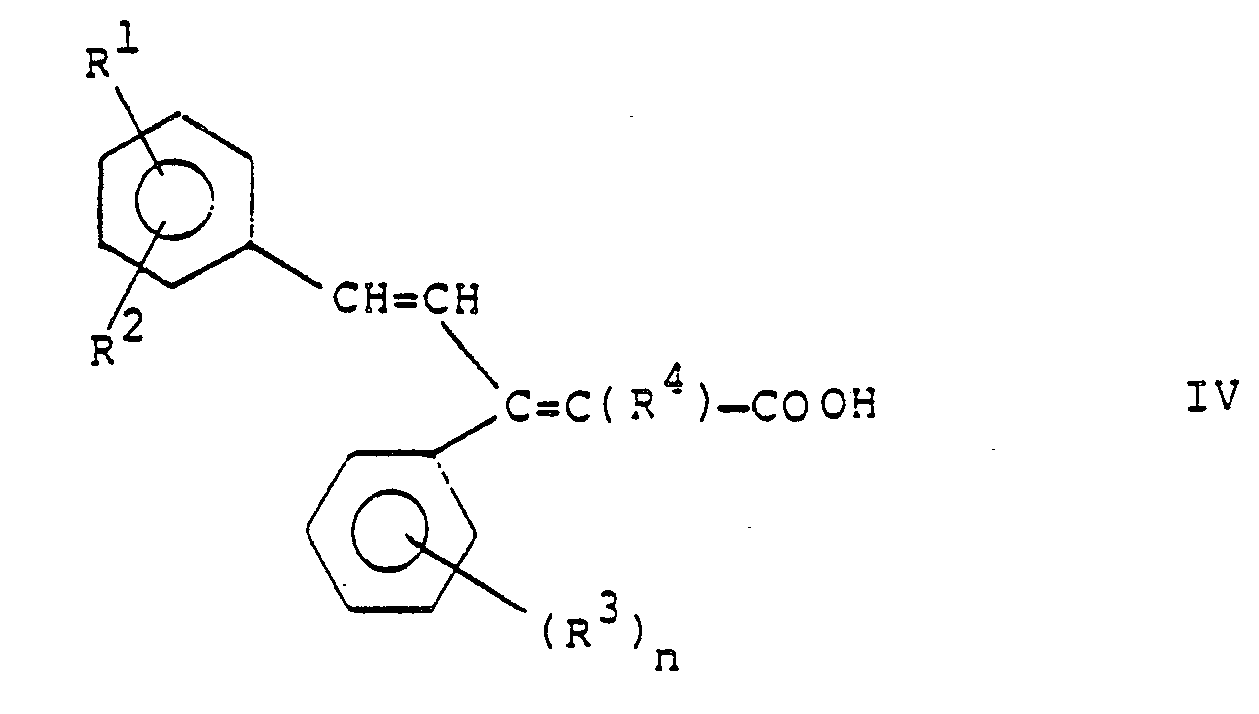
worin R¹, R², R³, R⁴ und n die oben angegebenen Bedeutungen besitzen,
oder ein reaktionsfähiges Derivat davon mit einem Amin der allgemeinen Formel 
worin R⁵ und R⁶ die oben angegebenen Bedeutungen besitzen,
oder mit einem reaktionsfähigen Derivat davon umsetzt.
oder ein reaktionsfähiges Derivat davon mit einem Amin der allgemeinen Formel
oder mit einem reaktionsfähigen Derivat davon umsetzt.
9. Verfahren zur Herstellung eines fungiziden Mittels, dadurch gekennzeichnet, dass man mindestens eine der in Anspruch 1 genannten Verbindungen mit Formulierungshilfsstoffen vermischt.
10. Verfahren zur Bekämpfung von Fungi in der Landwirtschaft und im Gartenbau, dadurch gekennzeichnet, dass man das zu schützende Gut mit einer wirksamen Menge eines Mittels gemäss einem der Ansprüche 1 bis 5 und 7 behandelt.
11. Verfahren zur Bekämpfung von Fungi in der Landwirtschaft und im Gartenbau, dadurch gekennzeichnet, dass man das zu schützende Gut mit einer wirksamen Menge eines Mittels gemäss Anspruch 6 behandelt.
12. Verwendung eines Mittels gemäss einem der Ansprüche 1 bis 5 und 7 zur Bekämpfung von Fungi in der Landwirtschaft und im Gartenbau.
13. Verwendung eines Mittels gemäss Anspruch 6 zur Bekämpfung von Fungi in der Landwirtschaft und im Gartenbau.
Applications Claiming Priority (4)
| Application Number | Priority Date | Filing Date | Title |
|---|---|---|---|
| CH3570/87 | 1987-09-16 | ||
| CH357087 | 1987-09-16 | ||
| CH2671/88 | 1988-07-13 | ||
| CH267188 | 1988-07-13 |
Publications (1)
| Publication Number | Publication Date |
|---|---|
| EP0307762A1 true EP0307762A1 (de) | 1989-03-22 |
Family
ID=25691096
Family Applications (1)
| Application Number | Title | Priority Date | Filing Date |
|---|---|---|---|
| EP88114520A Withdrawn EP0307762A1 (de) | 1987-09-16 | 1988-09-06 | Acrylsäureamide und ihre Verwendung als Fungizide |
Country Status (7)
| Country | Link |
|---|---|
| EP (1) | EP0307762A1 (de) |
| JP (1) | JPH01117851A (de) |
| AU (1) | AU2227288A (de) |
| DK (1) | DK514188A (de) |
| HU (1) | HUT51240A (de) |
| IL (1) | IL87723A0 (de) |
| PT (1) | PT88513A (de) |
Cited By (5)
| Publication number | Priority date | Publication date | Assignee | Title |
|---|---|---|---|---|
| US5677303A (en) * | 1996-06-20 | 1997-10-14 | American Cyanamid Company | Enolethers and their use as a fungicide |
| US7078431B2 (en) | 2000-06-20 | 2006-07-18 | Atherogenics, Inc. | 1,3-bis-(substituted-phenyl)-2-propen-1-ones and their use to treat VCAM-1 mediated disorders |
| US7094801B2 (en) | 2001-12-19 | 2006-08-22 | Atherogenics, Inc. | Chalcone derivatives and their use to treat diseases |
| US7173129B2 (en) | 2003-06-06 | 2007-02-06 | Athero Genics, Inc. | Sulfonamide-substituted chalcone derivatives and their use to treat diseases |
| US8410176B2 (en) | 2009-12-29 | 2013-04-02 | Mapi Pharma Ltd. | Intermediate compounds and processes for the preparation of tapentadol and related compounds |
Families Citing this family (1)
| Publication number | Priority date | Publication date | Assignee | Title |
|---|---|---|---|---|
| US5254733A (en) * | 1990-10-31 | 1993-10-19 | Fujisawa Pharmaceutical Co., Ltd. | Process for producing an aliphatic amide and salts thereof |
Citations (2)
| Publication number | Priority date | Publication date | Assignee | Title |
|---|---|---|---|---|
| DE3306996A1 (de) * | 1983-02-28 | 1984-08-30 | Celamerck Gmbh & Co Kg, 6507 Ingelheim | Acrylsaeuremorpholide, ihre herstellung und verwendung |
| DE3308045A1 (de) * | 1983-03-07 | 1984-09-13 | Celamerck Gmbh & Co Kg, 6507 Ingelheim | Acrylsaeureamide, ihre herstellung und verwendung |
-
1988
- 1988-09-06 EP EP88114520A patent/EP0307762A1/de not_active Withdrawn
- 1988-09-09 IL IL87723A patent/IL87723A0/xx unknown
- 1988-09-14 HU HU884715A patent/HUT51240A/hu unknown
- 1988-09-15 AU AU22272/88A patent/AU2227288A/en not_active Abandoned
- 1988-09-15 DK DK514188A patent/DK514188A/da not_active Application Discontinuation
- 1988-09-15 PT PT88513A patent/PT88513A/pt not_active Application Discontinuation
- 1988-09-16 JP JP63230195A patent/JPH01117851A/ja active Pending
Patent Citations (2)
| Publication number | Priority date | Publication date | Assignee | Title |
|---|---|---|---|---|
| DE3306996A1 (de) * | 1983-02-28 | 1984-08-30 | Celamerck Gmbh & Co Kg, 6507 Ingelheim | Acrylsaeuremorpholide, ihre herstellung und verwendung |
| DE3308045A1 (de) * | 1983-03-07 | 1984-09-13 | Celamerck Gmbh & Co Kg, 6507 Ingelheim | Acrylsaeureamide, ihre herstellung und verwendung |
Cited By (5)
| Publication number | Priority date | Publication date | Assignee | Title |
|---|---|---|---|---|
| US5677303A (en) * | 1996-06-20 | 1997-10-14 | American Cyanamid Company | Enolethers and their use as a fungicide |
| US7078431B2 (en) | 2000-06-20 | 2006-07-18 | Atherogenics, Inc. | 1,3-bis-(substituted-phenyl)-2-propen-1-ones and their use to treat VCAM-1 mediated disorders |
| US7094801B2 (en) | 2001-12-19 | 2006-08-22 | Atherogenics, Inc. | Chalcone derivatives and their use to treat diseases |
| US7173129B2 (en) | 2003-06-06 | 2007-02-06 | Athero Genics, Inc. | Sulfonamide-substituted chalcone derivatives and their use to treat diseases |
| US8410176B2 (en) | 2009-12-29 | 2013-04-02 | Mapi Pharma Ltd. | Intermediate compounds and processes for the preparation of tapentadol and related compounds |
Also Published As
| Publication number | Publication date |
|---|---|
| DK514188A (da) | 1989-03-17 |
| IL87723A0 (en) | 1989-02-28 |
| AU2227288A (en) | 1989-03-16 |
| DK514188D0 (da) | 1988-09-15 |
| JPH01117851A (ja) | 1989-05-10 |
| PT88513A (pt) | 1989-07-31 |
| HUT51240A (en) | 1990-04-28 |
Similar Documents
| Publication | Publication Date | Title |
|---|---|---|
| EP0403618B1 (de) | Aldimino- oder ketimino-oxy-ortho-tolylacrylsäure-methylester, ihre herstellung und diese enthaltende fungizide | |
| EP0280185B1 (de) | Substituierte Crotonsäureester und diese enthalende Fungizide | |
| EP0014684B1 (de) | 2-Substituierte 5-Phenoxy-phenylphosphonsäurederivate, Verfahren zu ihrer Herstellung und ihre Verwendung als Herbizide | |
| EP0893434A1 (de) | Zwischenprodukte für die Herstellung von Oximäthern | |
| EP0433233B1 (de) | Heterocyclische Verbindungen | |
| EP0060223A2 (de) | Mikrobizide Mittel | |
| EP0010298B1 (de) | 1,2,4-Triazol-1-yl-Verbindungen, ihre Herstellung, Fungizide, Verfahren zur Herstellung von Fungiziden und Verfahren zur Bekämpfung von Fungi | |
| EP0075840B1 (de) | Heterocyclische Phenyläther, Verfahren zu deren Herstellung und diese enthaltende herbizide Mittel | |
| CH626777A5 (en) | Herbicide | |
| EP0010270B1 (de) | Neue alpha-Azolyl-alpha-phenylessigsäurederivate, ihre Herstellung, sie enthaltende Fungizide, Verfahren zur Bekämpfung von Fungi und zur Herstellung von Fungiziden | |
| EP0257294B1 (de) | E/Z-Isomerengemische und reine Z-Isomere von N alpha-(2-Cyan-2-alkoximinoacetyl) aminosäurederivaten und- peptiden | |
| EP0062238B1 (de) | 1,3-Dioxolan-Derivate, Herstellung dieser Verbindungen, fungizide Mittel, die diese Verbindungen als Wirkstoffe enthalten sowie Verwendung solcher Verbindungen bzw. Mittel zur Bekämpfung von Fungi in der Landwirtschaft und im Gartenbau | |
| EP0109575A2 (de) | Benzoesäurederivate, Verfahren und Mittel zu deren Herstellung | |
| DE68922145T2 (de) | Herbizide Acrylonitrilderivate. | |
| EP0013660A1 (de) | Aminoalkylester der 2-Nitro-5-(ortho-chlor-para-trifluor-methylphenoxy)-benzoesäure, deren Herstellung, sie als Wirkstoff enthaltende herbizide Mittel und deren Verwendung | |
| EP0103252A2 (de) | Aryloxyalkylamine, Verfahren zu ihrer Herstellung und ihre Verwendung zur Bekämpfung unerwünschten Pflanzenwuchses | |
| DE3015090A1 (de) | ]-(trihalogenmethyl-sulfenyl)-4-aryl-1,2,4-triazolidin-5-one, verfahren zu ihrer herstellung, diese enthaltende fungizide und verfahren zur bekaempfung von pilzen mit diesen verbindungen | |
| HUT51240A (en) | Fungicide compositions containing acrylic acid derivatives as active components and process for producing the acrylic acid derivatives | |
| EP0088325B1 (de) | Oximinoessigsäureamide, ihre Herstellung und ihre Verwendung zur Bekämpfung von Fungi und Mittel dafür | |
| EP0001804B1 (de) | Beta-Naphthyl- und Beta-Tetrahydronaphthyl-phenyläther, Verfahren zu ihrer Herstellung und ihre Verwendung als herbizide Mittel | |
| EP0400344A1 (de) | Pyridinderivate und ihre Verwendung als Fungizide | |
| DE69208384T2 (de) | Fungizide Furanonderivate | |
| DD254317A5 (de) | Herbizide und wachstumsregulierende mittel | |
| DE3308045A1 (de) | Acrylsaeureamide, ihre herstellung und verwendung | |
| EP0461487A2 (de) | Derivate des beta-Picolins und diese enthaltende Pflanzenschutzmittel |
Legal Events
| Date | Code | Title | Description |
|---|---|---|---|
| PUAI | Public reference made under article 153(3) epc to a published international application that has entered the european phase |
Free format text: ORIGINAL CODE: 0009012 |
|
| 17P | Request for examination filed |
Effective date: 19880906 |
|
| AK | Designated contracting states |
Kind code of ref document: A1 Designated state(s): AT BE CH DE ES FR GB GR IT LI NL |
|
| RAP1 | Party data changed (applicant data changed or rights of an application transferred) |
Owner name: F. HOFFMANN-LA ROCHE AG |
|
| STAA | Information on the status of an ep patent application or granted ep patent |
Free format text: STATUS: THE APPLICATION IS DEEMED TO BE WITHDRAWN |
|
| 18D | Application deemed to be withdrawn |
Effective date: 19890923 |