EP0308581B1 - Sel d'ammonium utilisé comme agents de modification pour caoutchouc - Google Patents
Sel d'ammonium utilisé comme agents de modification pour caoutchouc Download PDFInfo
- Publication number
- EP0308581B1 EP0308581B1 EP88107631A EP88107631A EP0308581B1 EP 0308581 B1 EP0308581 B1 EP 0308581B1 EP 88107631 A EP88107631 A EP 88107631A EP 88107631 A EP88107631 A EP 88107631A EP 0308581 B1 EP0308581 B1 EP 0308581B1
- Authority
- EP
- European Patent Office
- Prior art keywords
- rubber
- ammonium salt
- formula
- group
- carbon atoms
- Prior art date
- Legal status (The legal status is an assumption and is not a legal conclusion. Google has not performed a legal analysis and makes no representation as to the accuracy of the status listed.)
- Expired
Links
Classifications
-
- C—CHEMISTRY; METALLURGY
- C08—ORGANIC MACROMOLECULAR COMPOUNDS; THEIR PREPARATION OR CHEMICAL WORKING-UP; COMPOSITIONS BASED THEREON
- C08K—Use of inorganic or non-macromolecular organic substances as compounding ingredients
- C08K5/00—Use of organic ingredients
- C08K5/16—Nitrogen-containing compounds
- C08K5/32—Compounds containing nitrogen bound to oxygen
Definitions
- This invention relates to certain novel ammonium salts, to their use as modifiers for rubber, and to their production processes.
- dynamic property improvers there are some known methods for improving dynamic properties of vulcanized rubber, such as improvements in, for example, microstructure or molecular weight distribution of rubber, and improvements in the compounding manner of organic rubber chemicals or fillers.
- the addition of dynamic property improvers has some advantage in that it can easily improve the dynamic properties in comparison with the other methods and can be applied also to natural rubber.
- the present inventors have made intensive investigations to develop compounds useful as modifiers for rubber having excellent characteristics in improving dynamic properties without the above defects, and found that particular ammonium salts are extremely useful as modifiers for vulcanized rubber, particularly as dynamic property improvers.
- the present invention provides an ammonium salt represented by the formula (I) wherein X represents aliphatic group or alicyclic group, each of which may contain halogen, oxygen, nitrogen or sulfur in the group; n is an integer of 1 or more; and R and R′ each independently represent hydrogen or an alkyl having 1 to 12 carbon atoms, and may conjointly form a ring.
- the present invention also concerns the use of the above ammonium salt as a modifier for rubber.
- the present invention further provides a process for producing the ammonium salt of the formula (I) by reacting a primary amine represented by the formula (II) X( ⁇ NH2) n (II) wherein X and n have the same meanings as defined above, with a nitroalkane represented by the formula (III) wherein R and R′ have the same meanings as defined above.
- the ammonium salt of the present invention represented by the formula (I) can be produced by reacting the primary amine represented by the formula (II) with the nitroalkane represented by the formula (III). The reaction can be carried out by mixing the primary amine and the nitroalkane.
- Typical examples of the primary amine represented by the formula (II) usable in the present invention include the following: monoamines such as methylamine, ethylamine, 1-aminobutane, 2-aminobutane, 1-aminooctane, 1-aminododecane and cyclohexylamine; diamines such as ethylenediamine, 1,4-diaminobutane, 1,6-diaminohexane, 1,8-diaminooctane, 1,10-diaminodecane, 1,12-diaminododecane and 1,4-diaminocyclohexane; triamines including triaminotrialkylamines such as 2,2′,2 ⁇ -triaminotriethylamine; halogenoalkylamines such as 2-chloroethylamine and 2-bromoethylamine; oxygen-containing amines such as ethanolamine, 2-a
- X in the primary amine of the formula (II) can be various types of groups, and its number of carbon atoms or the like are not limited in principle.
- Preferable X is aliphatic group having 1 to 18 carbon atoms or alicyclic group having 3 to 18 carbon atoms. Among them, the aliphatic group, particularly those having 4 to 12 carbon atoms, are more preferred.
- these X's can contain halogen, oxygen, nitrogen or sulfur. These X's will correspond to the X's in the objective ammonium salts of the formula (I).
- the number of primary amino groups, n, in the primary amine (II) can also vary to a considerable extent. For example, it will be possible to use the primary amine in which n is around 20 or more, but normally it will be sufficient to use one in which n is 10 or less, and preferably one in which n is 6 or less, and more preferably one in which n is 1 to 3. In general, n in the starting primary amine of the formula (II) will be the same number as n in the objective ammonium salt of the formula (I).
- Typical examples of the nitroalkane represented by the formula (III) usable in the present invention include nitromethane, nitroethane, 1-nitropropane, 2-nitropropane, 2-nitrobutane, 2-nitrooctane, nitrocyclohexane, 1-nitrododecane, 2-nitrododecane and the like.
- R and R′ in the nitroalkane of the formula (III) can vary within the scope of hydrogen, an alkyl having 1 to 12 carbon atoms or a group in which R and R′ conjointly form a ring.
- Preferable one for R and R′ is hydrogen or an alkyl having 1 to 6 carbon atoms.
- the weight ratio between the primary amine represented by the formula (II) and the nitroalkane represented by the formula (III) is not particularly limited in the reaction of the present invention, but it is preferable to use the nitroalkane in an amount of about equimolar or more to the primary amino group in the primary amine.
- the primary amine is a polyamine having 2 or more primary amino groups in the molecule, and the nitroalkane is used in an amount less than equimolar to the primary amino group in the primary amine, compounds having unreacted primary amino group will be formed to decrease the reaction yield of the desired ammonium salt represented by the formula (I).
- the surplus can be a solvent.
- a solvent such as lower alcohols.
- the lower alcohols usable as the solvent include, for example, methanol, ethanol and isopropyl alcohol.
- Reaction temperature is preferably in a range of from about 0°C to about 100°C, more preferably from about 20°C to about 60°C.
- Reaction time varies depending on the kind of starting compound or the like, and is not limited to a specific range, but the reaction is usually completed within 2 hours.
- the reaction mixture is cooled to a temperature of from about 0°C to about 10°C, the precipitated crystals are collected on a filter and then dried to obtain a desired product.
- ammonium salt of the formula (I) thus obtained is quite useful as a modifier for rubber, particularly as a dynamic property improver for vulcanized rubber.
- the ammonium salt may be used alone, or by mixing with common carriers which will not affect the rubber properties.
- the modifier for rubber containing the ammonium salt represented by the formula (I) as an active ingredient can be incorporated into natural rubber or synthetic rubber, together with a filler and other additives which are usually used in rubber industries.
- the rubbers applicable in the present invention include natural rubber and various kinds of synthetic rubber such as polyisoprene rubber (IR), styrene-butadiene copolymer rubber (SBR), polybutadiene rubber (BR), acrylonitrilebutadiene copolymer rubber (NBR), isoprene-isobutylene copolymer rubber (IIR) and ethylene-propylene-diene copolymer rubber (EPDM), among which highly unsaturated rubber is preferably used.
- IR polyisoprene rubber
- SBR styrene-butadiene copolymer rubber
- BR polybutadiene rubber
- NBR acrylonitrilebutadiene copolymer rubber
- IIR isoprene-isobutylene
- the filler includes, for example, carbon black, silica, talc and clay, all of which are normally used in the rubber industry.
- carbon black is preferably used in the present invention.
- the compounding ratio of the filler can be similar to conventional use, and is not critically specified in the present invention.
- additives there are process oil, stearic acid, vulcanizing agent, vulcanization accelerator and so forth. These additives are preferably used also in the present invention as in the conventional manner.
- rubber is blended with the ammonium salt represented by the formula (I), preferably along with the above filler and other additives.
- the amount of the ammonium salt is not critical for compounding a rubber composition. However, if the amount is too small, it exhibits only unsatisfactory improving effect on the dynamic properties. If it is too great, the effect is to be uneconomical. Therefore, it is preferable to use the ammonium salt in a proportion of from about 0.1 to about 10 parts by weight per 100 parts by weight of the rubber.
- the compounding is, in principle, carried out by two steps. That is, a filler, process oil, stearic acid or the like are incorporated in the first step at a relatively high rubber temperature of from about 120°C to about 200°C, while a vulcanization accelerator and a vulcanizing agent are incorporated in the second step at a relatively low rubber temperature of from about 30°C to about 120°C.
- ammonium salt of the present invention represented by the formula (I) When the ammonium salt of the present invention represented by the formula (I) is incorporated into rubber, this can be carried out in any step. Therefore, it may be incorporated together with the vulcanization accelerator and vulcanizing agent in the second step at relatively low temperature, but is preferably incorporated in the first step at relatively high temperature when the filler and the like are incorporated.
- a vulcanization accelerator and/or a vulcanizing agent such as dimorpholinodisulfide may be additionally used as auxiliary agents in a small amount in order to further improve the effect.
- a novel ammonium salt useful as a modifier for rubber is provided.
- This ammonium salt or modifier will contribute to the production of such chemicals particularly on an industrial scale, because its production is easier than conventional modifiers such as dynamic property improvers.
- the modifier containing the above ammonium salt as an active ingredient has excellent efficiency to improve the dynamic properties of rubber such as resilience and heat build-up, when it is incorporated into vulcanized rubber including natural rubber or synthetic rubber. Further, the compounded rubber containing the above modifier is also improved in flex cracking resistance which has been a contrary characteristic to the improvement of dynamic properties in the conventional technology. At the same time, scorching is not so markedly accelerated in comparison with the rubber containing a conventional modifier, and is near to the one containing no such modifier.
- the modifier for rubber according to the present invention can be applied not only to the rubber for treads of various sorts of tires but also to the rubber for other parts of tires. It may be further employed effectively in industrial equipment such as antivibration rubber and the like. Therefore, it is extensively valuable in industrial uses.
- the compound was in a state of pale brown crystals having a melting point of 30° - 32°C.
- the compound will be referred to as compound A hereinafter.
- the compound was confirmed to be an ammonium salt by the following assignment of IR spectra: stretching vibration of 3,100 - 2,600 cm ⁇ 1 for NH3+; and combination vibration (asymmetric deformation, torsion) of 2,200 cm ⁇ 1 for NH3+.
- Example 1 1-Aminobutane, 1-aminododecane and cyclohexylamine were used in an amount of 1.0 mole respectively instead of the 1-aminooctane in Example 1 as starting primary amines, and the other reaction operations were repeated in the same manner as in Example 1 to produce other monoammonium salts.
- Table 1 shows melting points and elemental analysis results of the obtained compounds.
- the compound was in a state of white crystals having a melting point of 86° - 87°C.
- the compound will be referred to as compound E hereinafter.
- the compound was confirmed to be an ammonium salt by the following assignment of IR spectra: stretching vibration of 3,100 - 2,600 cm ⁇ 1 for NH3+; and combination vibration (asymmetric deformation, torsion) of 2,190 cm ⁇ 1 for NH3+.
- Ethylenediamine, 1,4-diaminobutane and 1,12-diaminododecane were used in an amount of 1.0 mole respectively instead of the 1,6-diaminohexane in Example 5 as starting primary amines, and the other reaction operations were repeated in the same manner as in Example 5 to produce other diammonium salts.
- Table 2 shows melting points and elemental analysis results of the obtained compounds.
- Nitroethane, 1-nitropropane and nitrocyclohexane were used in an amount of 2.0 moles respectively instead of the 2-nitropropane in Example 5 as starting nitroalkanes, and the other reaction operations were repeated in the same manner as in Example 5 to produce other diammonium salts.
- Table 3 shows melting points and elemental analysis results of the obtained compounds.
- the compound was in a state of white crystals having a melting point of 39° - 41°C.
- the compound will be referred to as compound L hereinafter.
- the compounds A to L thus obtained in Examples 1 to 12 were incorporated into natural rubber in accordance with the recipe for compounding listed below to conduct various tests for evaluating the physical properties of the compounded rubber.
- the same tests were also conducted for the rubber blended with 7-(dimethyldithiocarbamoylmethyl)-8-hydroxyquinoline (abbreviated as DTHQ) which had been disclosed in Japanese Patent Publication Kokai (A) 58-118837, the rubber blended with a resinous material obtained by reacting N-(2-methyl-2-nitropropyl)aniline with sulfur monochloride in a molar ratio of 1 : 1 (abbreviated as MNDS) which had been disclosed in Japanese Patent Publication Kokai (A) 59-18740, and the rubber blended with no such compound.
- DTHQ 7-(dimethyldithiocarbamoylmethyl)-8-hydroxyquinoline
- the basal natural rubber was mixed with the carbon black, zinc oxide, process oil, stearic acid and modifying compound listed in the above recipe at an oil bath temperature of 170°C.
- the mixture was then kneaded for 5 minutes with mixer revolutions of 60 rpm.
- the rubber temperature was 150° - 160°C at the kneading.
- the blend was transferred on an open mill and kneaded while adding thereto the vulcanization accelerator and sulfur listed in the above recipe at a temperature of 40° - 50°C.
- the blend was then vulcanized by using a vulcanizing press at a temperature of 145°C for 20 minutes to form a predetermined shape.
- the formed vulcanizates were provided for various tests.
- Table 4 shows compounding conditions for the modifying compounds, namely the ammonium salts of the present invention or the comparative compounds, and results of the above various tests.
- test pieces were prepared in the same manner as in Example 13 except that the oil bath in the Bumbury's Mixer was settled at a temperature of 190°C. Evaluation tests were conducted as in the manner shown in Example 13. Table 5 shows results of the evaluation tests together with compounding conditions for the modifying compounds.
Landscapes
- Chemical & Material Sciences (AREA)
- Health & Medical Sciences (AREA)
- Chemical Kinetics & Catalysis (AREA)
- Medicinal Chemistry (AREA)
- Polymers & Plastics (AREA)
- Organic Chemistry (AREA)
- Compositions Of Macromolecular Compounds (AREA)
- Organic Low-Molecular-Weight Compounds And Preparation Thereof (AREA)
Claims (22)
- Sel d'ammonium représenté par la formule
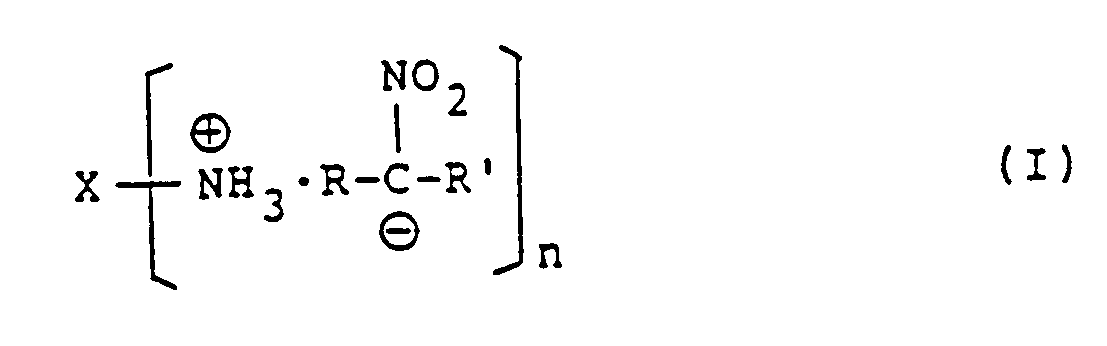 X représente un groupement aliphatique ou un groupement alicyclique qui peuvent contenir l'un et l'autre un atome d'halogène, d'oxygène, d'azote ou de soufre dans le groupement,n est un nombre entier de 1 ou plus; etR et R' représentent chacun, indépendamment l'un de l'autre, un atome d'hydrogène ou un reste alkyle renfermant de 1 à 12 atomes de carbone, ou peuvent former ensemble un cycle.
 - Sel d'ammonium selon la revendication 1, dans lequel X dans la formule est un groupement aliphatique à 1-18 atomes de carbone.
- Sel d'ammonium selon la revendication 2, dans lequel le groupement aliphatique renferme de 4 à 12 atomes de carbone.
- Sel d'ammonium selon la revendication 1, dans lequel X dans la formule est un groupement alicyclique à 3-18 atomes de carbone.
- Sel d'ammonium selon la revendication 4, dans lequel le groupement alicyclique renferme 6 atomes de carbone.
- Sel d'ammonium selon la revendication 1, dans lequel X dans la formule est un groupement aliphatique contenant un atome d'halogène, d'oxygène, d'azote ou de soufre dans le groupement.
- Sel d'ammonium selon la revendication 6, dans lequel X est mis pour

- Sel d'ammonium selon la revendication 1, dans lequel n dans la formule est un nombre entier de 1 à 6.
- Sel d'ammonium selon la revendication 1, dans lequel R et R' dans la formule représentent chacun, indépendamment l'un de l'autre, un atome d'hydrogène ou un reste alkyle à 1-6 atomes de carbone.
- Sel d'ammonium selon la revendication 1, dans lequel R et R' dans la formule forment ensemble un cycle.
- Agent modifiant pour caoutchouc, contenant, en tant qu'ingrédient actif, un sel d'ammonium selon la revendication 1.
- Procédé pour améliorer les propriétés dynamiques d'un caoutchouc, consistant à mélanger au caoutchouc un sel d'ammonium selon la revendication 1.
- Procédé selon la revendication 12, dans lequel le caoutchouc est un caoutchouc naturel, un caoutchouc de polyisoprene, un caoutchouc de copolymère styrène/butadiène, un caoutchouc de polybutadiène, un caoutchouc de copolymère acrylonitrile/butadiène, un caoutchouc de copolymère isoprene/isobutylène ou un caoutchouc de copolymere éthylène/propylène/diène.
- Procédé selon la revendication 12, dans lequel le sel d'ammonium est incorporé dans le caoutchouc en même temps qu'une charge à une température d'environ 120°C à environ 200°C.
- Composition de caoutchouc, comprenant un caoutchouc et un sel d'ammonium selon la revendication 1.
- Composition de caoutchouc selon la revendication 15, contenant en outre une charge.
- Composition de caoutchouc selon la revendication 16, dans laquelle la charge est du noir de carbone.
- Composition de caoutchouc selon la revendication 15, dans laquelle le sel d'ammonium est contenu dans une proportion d'environ 0,1 à environ 10 parties en poids pour 100 parties en poids du caoutchouc.
- Procédé de préparation d'un sel d'ammonium selon la revendication 1, comprenant la mise en réaction d'une amine primaire représentée par la formule
X(̵NH₂)n
dans laquelleX représente un groupement aliphatique ou un groupement alicyclique qui peuvent contenir l'un et l'autre un atome d'halogène, d'oxygène, d'azote ou de soufre dans le groupement,n est un nombre entier de 1 ou plus,avec un nitroalcane représenté par la formule R et R' représentent chacun, indépendamment l'un de l'autre, un atome d'hydrogène ou un reste alkyle renfermant de 1 à 12 atomes de carbone, ou peuvent former ensemble un cycle.
 - Procédé selon la revendication 19, dans lequel le nitroalcane est utilisé en une quantité au moins équimolaire par rapport au groupement amino primaire dans l'amine primaire.
- Procédé selon la revendication 19, dans lequel la réaction est menée dans un solvant.
- Procédé selon la revendication 19, dans lequel la réaction est menée à une température d'environ 0°C à environ 100°C.
Applications Claiming Priority (2)
| Application Number | Priority Date | Filing Date | Title |
|---|---|---|---|
| JP62238190A JP2564848B2 (ja) | 1987-09-22 | 1987-09-22 | 新規なアンモニウム塩類とその製造方法およびそれを有効成分とするゴム用改質剤 |
| JP238190/87 | 1987-09-22 |
Publications (3)
| Publication Number | Publication Date |
|---|---|
| EP0308581A2 EP0308581A2 (fr) | 1989-03-29 |
| EP0308581A3 EP0308581A3 (en) | 1989-06-14 |
| EP0308581B1 true EP0308581B1 (fr) | 1992-03-04 |
Family
ID=17026500
Family Applications (1)
| Application Number | Title | Priority Date | Filing Date |
|---|---|---|---|
| EP88107631A Expired EP0308581B1 (fr) | 1987-09-22 | 1988-05-11 | Sel d'ammonium utilisé comme agents de modification pour caoutchouc |
Country Status (5)
| Country | Link |
|---|---|
| US (1) | US4885322A (fr) |
| EP (1) | EP0308581B1 (fr) |
| JP (1) | JP2564848B2 (fr) |
| CA (1) | CA1327610C (fr) |
| DE (1) | DE3868807D1 (fr) |
Families Citing this family (1)
| Publication number | Priority date | Publication date | Assignee | Title |
|---|---|---|---|---|
| US6329058B1 (en) | 1998-07-30 | 2001-12-11 | 3M Innovative Properties Company | Nanosize metal oxide particles for producing transparent metal oxide colloids and ceramers |
Family Cites Families (8)
| Publication number | Priority date | Publication date | Assignee | Title |
|---|---|---|---|---|
| US3151161A (en) * | 1961-01-09 | 1964-09-29 | Monsanto Chemicals | Nitrosoanilinonitroalkanes |
| FR1330763A (fr) * | 1962-04-13 | 1963-06-28 | Monsanto Chemicals | Nouveaux promoteurs de réaction des élastomères vulcanisables avec les pigments renforçants |
| US3756969A (en) * | 1967-11-21 | 1973-09-04 | Uniroyal Inc | Solid vulcanizable rubber composition |
| JPS4830043A (fr) * | 1971-08-25 | 1973-04-20 | ||
| JPS58118837A (ja) * | 1982-01-08 | 1983-07-15 | Sumitomo Chem Co Ltd | レジリエンス向上剤 |
| JPS5918740A (ja) * | 1982-07-22 | 1984-01-31 | Sumitomo Chem Co Ltd | ゴム用改質剤 |
| US4698446A (en) * | 1986-07-01 | 1987-10-06 | The Bf Goodrich Company | Synthesis of polyamines and mixture formed thereby, of diprimary polyalkylene polyamines with disubstituted N-adjacent terminal carbon atom(s) |
| DE3774781D1 (de) * | 1986-07-16 | 1992-01-09 | Sumitomo Chemical Co | Kautschukmischung. |
-
1987
- 1987-09-22 JP JP62238190A patent/JP2564848B2/ja not_active Expired - Lifetime
-
1988
- 1988-05-04 CA CA000565864A patent/CA1327610C/fr not_active Expired - Fee Related
- 1988-05-11 EP EP88107631A patent/EP0308581B1/fr not_active Expired
- 1988-05-11 DE DE8888107631T patent/DE3868807D1/de not_active Expired - Lifetime
- 1988-05-19 US US07/196,057 patent/US4885322A/en not_active Expired - Fee Related
Also Published As
| Publication number | Publication date |
|---|---|
| JP2564848B2 (ja) | 1996-12-18 |
| DE3868807D1 (de) | 1992-04-09 |
| EP0308581A3 (en) | 1989-06-14 |
| EP0308581A2 (fr) | 1989-03-29 |
| JPS6483053A (en) | 1989-03-28 |
| CA1327610C (fr) | 1994-03-08 |
| US4885322A (en) | 1989-12-05 |
Similar Documents
| Publication | Publication Date | Title |
|---|---|---|
| EP0253365B1 (fr) | Composition de caoutchouc | |
| EP0488931B1 (fr) | Vulcanisats de caoutchouc avec un comportement d'hystérésis amélioré | |
| EP0410152B1 (fr) | Composition de caoutchouc ayant de bonnes propriétés dynamiques | |
| EP2236502B1 (fr) | Sulfénamide, accélérateur de vulcanisation pour caoutchouc contenant le sulfénamide et procédé pour produire l'accélérateur de vulcanisation | |
| DE3875272T2 (de) | Mit hydroxy-benzimidazoloxiden modifizierte kautschukmischungen. | |
| KR19990076762A (ko) | 고무 조성물 및 이를 포함하는 공기 타이어 | |
| EP0980891B1 (fr) | Composition de caoutchouc contenant un agent anti-réversion et pneu comportant une telle composition | |
| US6319993B2 (en) | Vulcanizing agents for unsaturated rubber mixtures | |
| JP2579753B2 (ja) | ゴム組成物 | |
| JP2834585B2 (ja) | 自動車のタイヤの側壁 | |
| CA1042888A (fr) | Composes vulcanisables du caoutchouc | |
| EP0308581B1 (fr) | Sel d'ammonium utilisé comme agents de modification pour caoutchouc | |
| JPH06234885A (ja) | 加工性及びゴム加硫物特性の改良されたゴム組成物 | |
| US3895060A (en) | Cycloalkylthio (nitro substituted) aniline compounds | |
| JP2636324B2 (ja) | 改質カーボンブラック | |
| US5218025A (en) | Method for improving properties of vulcanized rubber containing inorganic whity filler | |
| JPH0354235A (ja) | すぐれた動的特性を有するゴム組成物 | |
| KR20010107714A (ko) | 고무용 점탄성 개선제 및 이를 함유하는 고무 조성물 | |
| EP0345594B1 (fr) | Procédé pour modifier les proprietés de caoutchouc vulcanisé contenant une charge inorganique blanche | |
| KR100203914B1 (ko) | 자동차타이어에 적합한 고무조성물 및 그의 제조방법 | |
| JP2522438B2 (ja) | 優れた動的特性を有するゴム組成物 | |
| JP2522322B2 (ja) | ゴム組成物 | |
| EP0332052A2 (fr) | Procédé pour modifier les propriétés d'isolateurs vibratoires à base de caoutchouc | |
| JP2508766B2 (ja) | ニトロ基含有芳香族ジアミン誘導体およびそれを有効成分とするゴム用改質剤 | |
| JP2531204B2 (ja) | 新規なニトロアンモニウム塩類、その製造方法およびそれを用いたゴムの改質方法 |
Legal Events
| Date | Code | Title | Description |
|---|---|---|---|
| PUAI | Public reference made under article 153(3) epc to a published international application that has entered the european phase |
Free format text: ORIGINAL CODE: 0009012 |
|
| AK | Designated contracting states |
Kind code of ref document: A2 Designated state(s): DE FR GB IT |
|
| PUAL | Search report despatched |
Free format text: ORIGINAL CODE: 0009013 |
|
| RAP3 | Party data changed (applicant data changed or rights of an application transferred) |
Owner name: SUMITOMO CHEMICAL COMPANY, LIMITED |
|
| AK | Designated contracting states |
Kind code of ref document: A3 Designated state(s): DE FR GB IT |
|
| 17P | Request for examination filed |
Effective date: 19890906 |
|
| 17Q | First examination report despatched |
Effective date: 19910425 |
|
| GRAA | (expected) grant |
Free format text: ORIGINAL CODE: 0009210 |
|
| RAP1 | Party data changed (applicant data changed or rights of an application transferred) |
Owner name: SUMITOMO CHEMICAL COMPANY, LIMITED |
|
| ITF | It: translation for a ep patent filed | ||
| AK | Designated contracting states |
Kind code of ref document: B1 Designated state(s): DE FR GB IT |
|
| REF | Corresponds to: |
Ref document number: 3868807 Country of ref document: DE Date of ref document: 19920409 |
|
| ET | Fr: translation filed | ||
| PLBE | No opposition filed within time limit |
Free format text: ORIGINAL CODE: 0009261 |
|
| STAA | Information on the status of an ep patent application or granted ep patent |
Free format text: STATUS: NO OPPOSITION FILED WITHIN TIME LIMIT |
|
| 26N | No opposition filed | ||
| PGFP | Annual fee paid to national office [announced via postgrant information from national office to epo] |
Ref country code: FR Payment date: 19980409 Year of fee payment: 11 |
|
| PGFP | Annual fee paid to national office [announced via postgrant information from national office to epo] |
Ref country code: GB Payment date: 19980417 Year of fee payment: 11 |
|
| PG25 | Lapsed in a contracting state [announced via postgrant information from national office to epo] |
Ref country code: GB Free format text: LAPSE BECAUSE OF NON-PAYMENT OF DUE FEES Effective date: 19990511 |
|
| GBPC | Gb: european patent ceased through non-payment of renewal fee |
Effective date: 19990511 |
|
| PG25 | Lapsed in a contracting state [announced via postgrant information from national office to epo] |
Ref country code: FR Free format text: LAPSE BECAUSE OF NON-PAYMENT OF DUE FEES Effective date: 20000131 |
|
| REG | Reference to a national code |
Ref country code: FR Ref legal event code: ST |
|
| PGFP | Annual fee paid to national office [announced via postgrant information from national office to epo] |
Ref country code: DE Payment date: 20000425 Year of fee payment: 13 |
|
| PG25 | Lapsed in a contracting state [announced via postgrant information from national office to epo] |
Ref country code: DE Free format text: LAPSE BECAUSE OF NON-PAYMENT OF DUE FEES Effective date: 20020301 |
|
| PG25 | Lapsed in a contracting state [announced via postgrant information from national office to epo] |
Ref country code: IT Free format text: LAPSE BECAUSE OF NON-PAYMENT OF DUE FEES;WARNING: LAPSES OF ITALIAN PATENTS WITH EFFECTIVE DATE BEFORE 2007 MAY HAVE OCCURRED AT ANY TIME BEFORE 2007. THE CORRECT EFFECTIVE DATE MAY BE DIFFERENT FROM THE ONE RECORDED. Effective date: 20050511 |