EP0309167A2 - Verfahren zur Decodierung von lauf-dargestellten Bilddaten - Google Patents
Verfahren zur Decodierung von lauf-dargestellten Bilddaten Download PDFInfo
- Publication number
- EP0309167A2 EP0309167A2 EP88308599A EP88308599A EP0309167A2 EP 0309167 A2 EP0309167 A2 EP 0309167A2 EP 88308599 A EP88308599 A EP 88308599A EP 88308599 A EP88308599 A EP 88308599A EP 0309167 A2 EP0309167 A2 EP 0309167A2
- Authority
- EP
- European Patent Office
- Prior art keywords
- word
- run
- unit
- length
- processing
- Prior art date
- Legal status (The legal status is an assumption and is not a legal conclusion. Google has not performed a legal analysis and makes no representation as to the accuracy of the status listed.)
- Withdrawn
Links
Images




Classifications
-
- H—ELECTRICITY
- H04—ELECTRIC COMMUNICATION TECHNIQUE
- H04N—PICTORIAL COMMUNICATION, e.g. TELEVISION
- H04N1/00—Scanning, transmission or reproduction of documents or the like, e.g. facsimile transmission; Details thereof
- H04N1/41—Bandwidth or redundancy reduction
- H04N1/411—Bandwidth or redundancy reduction for the transmission or storage or reproduction of two-tone pictures, e.g. black and white pictures
- H04N1/413—Systems or arrangements allowing the picture to be reproduced without loss or modification of picture-information
- H04N1/419—Systems or arrangements allowing the picture to be reproduced without loss or modification of picture-information in which encoding of the length of a succession of picture-elements of the same value along a scanning line is the only encoding step
Definitions
- This invention relates to a method of decoding in run representation, and more particularly to a method of decoding in run representation for use in image processing in OCR (optical character recognition) apparatus, image communication apparatus, and image processing apparatus or the like.
- OCR optical character recognition
- run representation As a method of representing images, run representation has been used.
- a run unit is defined as a unit in which black pixels or white pixels are continuously present when images are raster-scanned horizontally or vertically.
- Run representation is a method of representing images by the use of a run unit as a smallest unit.
- images are represented in accordance with information on the run lengths or positions of run units.
- the run representation can advantageously represent original images with information less than that when represented using bit patterns. Therefore, the run representation has been utilized as one technique in data compression.
- run representation generally has a problem in that inordinate time is required to obtain the bit patterns of original images by decoding the run unit to which the original images are encoded.
- this problem has been avoided by performing high-speed decoding with additional hardware.
- this problem previously could not be avoided.
- one object of the present invention is to provide an improved method of decoding in run representation.
- This method can decode image data encoded in run representation to the original image data of bit patterns on a word unit basis at higher speed than the conventional procedures. Further, this method can achieve such high-speed decoding using only additional software.
- a method of decoding image data encoded in run representation to the original image data of bit patterns on the word unit basis comprises the step of obtaining position information of run units within a corresponding word unit.
- the image data encoded in run representation is represented with bit patterns derived from length information of run units obtained in the order of a scanning direction.
- the method further comprises the steps of retrieving word units that store bit patterns based on the thus obtained position information, and processing the thus retrieved word units with respect to each corresponding word unit.
- the method further comprises the step of combining the thus processed word units in the order of the corresponding word unit so as to produce a corresponding output word.
- FIGURE 1 designate identical or corresponding parts throughout the several views, and more particularly to FIGURE 1 thereof, one embodiment of this invention will be described.
- Figure 1 is a block diagram for explaining the outline of a method of decoding in run representation according to the present invention.
- a series of run length codes are sequentially read out from a run length data buffer 1. These run length codes are fed into a decoding section 3, and decoded therein by use of a run table 2. The thus decoded outputs are fed into an output buffer 4.
- Figure 2 is a schematic configuration of a series of run length codes 10 through 17 corresponding to one single line of an image to be decoded by a method according to the present invention.
- the respective run length codes 10, 12 14 and 16, which are blank portions represent white pixels.
- the respective run length codes 11, 13, 15 and 17, which are hatched portions represent black pixels.
- the numbers on the upper sides of the respective run length codes 10 through 17 indicate how many white or black pixels are continuously present therein. In actual run length representation, these are expressed as follows; white 3, black 6, white 20, black 3, white 2, black 1, white 4, and black 1.
- a run table is used for converting the run length codes into the original image data.
- the run length codes are represented by bit units, while the original image data are represented by word units each of which includes 8 bits.
- the run table may be incorporated in a ROM (read-only-memory).
- Figure 3 shows a configuration of a one-dimensional run table for use in a first embodiment of the present invention.
- the word patterns of the respective words are stored.
- the word patterns the starting points of black pixels in the respective words are changed in steps. Namely, the bit patterns of the image to b obtained by decoding the run length codes are stored on a word-by-word basis.
- the respective word patterns are given specified address numbers.
- run length codes to be decoded are expressed by bit units. However, in the following description, these run length codes are partitioned by word units so as to be processed. Figure 4 shows this relationship; namely, the run length codes of Figure 2 are partitioned by a word unit of 8 bits, as indicated by the dotted lines.
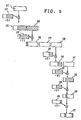
- Figure 5 is a block diagram illustrating the steps of processing in decoding the run length codes according to the first embodiment of the present invention.
- the decoding section 3 receives run length codes which are constituted by bit units.
- the addresses within the run table of Figure 3, which correspond to these run length codes can be calculated by the following equation.
- a run length code 10 which is the head of a series of run length codes 10 through 17, is constituted by white pixels.
- the 0th word 21 of Figure 5 which corresponds to the run length code 10 and a part of run length code 11, is designated as 0 that represents white.
- an image word pattern 22 is obtained from the run table of Figure 3.
- the 0th word 21 is processed by logical Exclusive-OR with respect to the thus obtained image word pattern 22. As a result, a first output word 23 is obtained.
- the processing of the 0th word 21 ends.
- a second word 27 of Figure 5 is designated as 0 that represents white, because the head of the second word of Figure 4 is white.
- the processing of the second word 27 ends. Namely, the second word 27 remains as a third output.
- a third word 28 of Figure 5 is designated as 0 that represents white. This is because the head of the third word of Figure 4 is white.
- a fourth word 31 of Figure 5 is designated as 0 that represents white. Primarily, this should be 1. However, as shown in Figure 4, the end of the run length code 13 coincides with the end of the third word. Thus, the fourth word 31 of Figure 5 is designated as 0 instead.
- an output word 33 is obtained.
- an image word pattern corresponding to the subsequent run length code 16 is obtained in the following manner.
- an image word pattern 36 is obtained from the run table of Figure 3.
- the output word 35 is processed by logical Exclusive-OR with respect to this thus obtained word pattern 36.
- a fifth output word 37 is obtained.
- the first output word through the fifth output word which are obtained in the above-described manner, are combined in the output buffer 4. Consequently, a series of run length codes is decoded into the original image data.
- Figure 6 is a flow chart illustrating a method of decoding according to the first embodiment.
- Figure 4 shows a series of run length codes to be processed in accordance with this flow chart. In this flow chart, a word 39 of Figure 7 is used.
- the first word is reset by 1 and becomes a first word 24 of Figure 5.
- the procedure causes y to be 1, and also causes p to be 0.
- the 0th word is processed by logical Exclusive-OR with respect to the thus obtained image word pattern 25.
- a second output word 26 of Figure 5 is obtained.
- p+y>8 the processing of the first word ends.
- the procedure causes p to be 0.
- the processing of the ith word ends.
- the procedure causes p to be 0.
- the third word 28 of Figure 5 is processed by logical Exclusive-OR with respect to the thus obtained image word pattern 29.
- a fourth output word 30 of Figure 5 is obtained.
- the fourth word is reset by 0, and becomes a fourth word 31 of Figure 5.
- the number 2, which is the run length of the fourth run length code 14, is substituted into y.
- the fourth word 31 of Figure 5 is procesed by logical Exclusive-OR with respect to the thus obtained image word pattern 32.
- an output word 33 of Figure 5 is obtained.
- the number 1, which is the run length of the fifth run length code 15, is substituted to y.
- the output word 33 of Figure 5 is processed by logical Exclusive-OR with respect to the thus obtained image word pattern34.
- an output word 35 of Figure 5 is obtained.
- the number 4, which is the run length of the sixth run length code 16, is substituted to y.
- the output word 35 of Figure 5 is processed by logical Exclusive-OR with respect to the thus obtained image word pattern 36.
- a fifth output word 37 of Figure 5 is obtained.
- the number 1, which is the run length of the seven run length code 17, is substituted to y.
- p+y 8.
- the processing of the fourth word of Figure 4 ends. Now, the procedure ends the processing of the amount of one single line. Consequently, the output words 23, 26, 27, 30 and 37 of Figure 5 are obtained as decoded output words.
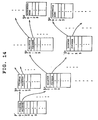
- FIG. 8 is a block diagram illustrating the steps of processing of decoding according to the second embodiment of the present invention.
- Figure 9 is a flow chart illustrating the procedures of decoding.
- Figure 10 is a diagram illustrating the shape of word used in this embodiment.
- Figure 11 is a two-dimensional run table used in this embodiment.
- the procedures of decoding run length codes will be described with reference to the flow chart of Figure 9.
- variables used are such that p,p′ and p ⁇ represent positions; y1 and y2 represent run lengths; i represents output words; and l represents run positions.
- an image word pattern 42 is obtained from the two-dimensional run table of Figure 11 in accordance with the thus obtained numberes 3 and 5 indicative of the position and run in the run table of Figure 11. Thereafter, the 0th word is processed by logical OR with respect to the thus obtained image word pattern 42. As a result, a first output word 43 is obtained.
- an image word pattern 44 is obtained from the run table of Figure 11 in accordance with the number 0 and 1 (p′ and y2).
- the first word of Figure 8 is processed by logical OR with respect to the thus obtained image word pattern 44. As a result, an output word 45 of Figure 8 is obtained.
- the processing of the first word of Figure 8 ends.
- an imagae word pattern 47 of Figure 8 is obtained from the run table of Figure 11 in accordance with the numbers 5 and 3 (p′and y2).
- the third word is processed by logical OR with respect to the thus obtained image word pattern 47.
- a third output word 48 of Figure 8 is obtained.
- an image word pattern 51 of Figure 8 is obtained from the run table of Figure 11 in accordance with the numbers 7 and 1 indicative of the position and run.
- the fourth word of Figure 8 is processed by logical OR with respect to the thus obtained image word pattern 51.
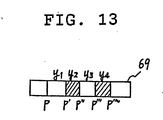
- Figure 12 is a flow chart illustrating the steps of processing in a third embodiment by use of run tables arranged in a four-dimensional system.
- the word configuration of contents in the run tables is shown in Figure 13 with a reference numeral 69.
- the run tables are addressed by use of variables such as p′, y2,y3, and y4.
- the number of dimentions of a run table may be one or more, and processings may be executed either by logical OR or by Exclusive-OR.
- the above-described flow charts are only examples of processing, and these flow charts may be modified unless otherwise they deviate from te gist of this invention.
- the present invention can be utilized when the coded runs are properly decoded.
- representation of black and white within a computer is not limited to the above-described embodiments.
- the starting run in the run representation may also be either white or black.
- the processing may be achieved either by software or by hardware.
- illustration is made by the run length representations such as 3, 6, 20, 3, 2, 1, 4 and 1. However, these may also be the coordinate representaions such as 3, 9, 29, 32, 34, 39 and 40. In short, whatever the type of run representation may be, it does not deviate from the concept of this invention.
- the procedures in which image data of run representation are decoded to bit patterns can be performed significantly faster than the conventional procedures.
- the decoding procedures are executed upon occurrence of each run on the input side. While at the same time, the decoding procedures are executed upon occurrence of each word on the output side.
- the decoding speed becomes significantly higher than that in the conventional procedure in which outputs are produced upon occurrence of each bit.
Landscapes
- Engineering & Computer Science (AREA)
- Multimedia (AREA)
- Signal Processing (AREA)
- Image Processing (AREA)
- Compression Of Band Width Or Redundancy In Fax (AREA)
- Controls And Circuits For Display Device (AREA)
- Compression, Expansion, Code Conversion, And Decoders (AREA)
Applications Claiming Priority (2)
| Application Number | Priority Date | Filing Date | Title |
|---|---|---|---|
| JP234779/87 | 1987-09-21 | ||
| JP62234779A JP2672521B2 (ja) | 1987-09-21 | 1987-09-21 | 画像処理方法 |
Publications (2)
| Publication Number | Publication Date |
|---|---|
| EP0309167A2 true EP0309167A2 (de) | 1989-03-29 |
| EP0309167A3 EP0309167A3 (de) | 1990-10-17 |
Family
ID=16976240
Family Applications (1)
| Application Number | Title | Priority Date | Filing Date |
|---|---|---|---|
| EP19880308599 Withdrawn EP0309167A3 (de) | 1987-09-21 | 1988-09-16 | Verfahren zur Decodierung von lauf-dargestellten Bilddaten |
Country Status (3)
| Country | Link |
|---|---|
| US (1) | US4926266A (de) |
| EP (1) | EP0309167A3 (de) |
| JP (1) | JP2672521B2 (de) |
Families Citing this family (8)
| Publication number | Priority date | Publication date | Assignee | Title |
|---|---|---|---|---|
| JP2924964B2 (ja) * | 1988-09-02 | 1999-07-26 | 富士ゼロックス株式会社 | 画像情報符号化装置、画像情報復号化装置及び画像情報符号化復号化装置 |
| IL95934A (en) * | 1989-10-16 | 1994-03-15 | Hughes Aircraft Co | Quick decoding of an image |
| KR920009455B1 (ko) * | 1990-11-28 | 1992-10-16 | 주식회사 신도리코 | 팩시밀리와 컴퓨터 시스템간의 화상정보 전송시 프로토콜 제어를 위한 제어정보의 포멧 구조 |
| JP2679423B2 (ja) * | 1991-02-05 | 1997-11-19 | 日本ビクター株式会社 | 多次元画像圧縮伸張方式 |
| US5363119A (en) * | 1991-05-01 | 1994-11-08 | Atari Games Corporation | Scaling processor for raster images |
| NL9201415A (nl) * | 1992-08-06 | 1994-03-01 | Oce Nederland Bv | Werkwijze en inrichting voor het coderen en decoderen van digitale beeldgegevens. |
| EP0597733B1 (de) * | 1992-11-13 | 1998-08-05 | Canon Kabushiki Kaisha | Vorrichtung zur Bildkodierung |
| US5615020A (en) * | 1993-05-13 | 1997-03-25 | Keith; Michael | System and method for fast huffman decoding |
Family Cites Families (13)
| Publication number | Priority date | Publication date | Assignee | Title |
|---|---|---|---|---|
| SE406407B (sv) * | 1975-11-25 | 1979-02-05 | Hell Rudolf Dr Ing Gmbh | Forfarande for digital loplengdkodning med redundansreduktion for overforande av binert kodade bildinformationer |
| JPS6043703B2 (ja) * | 1976-02-27 | 1985-09-30 | 富士ゼロックス株式会社 | 2値信号フアクシミリデ−タ圧縮方式 |
| JPS5816667B2 (ja) * | 1976-07-21 | 1983-04-01 | ケイディディ株式会社 | フアクシミリ信号のインタ−ライン符号化方式 |
| JPS5564445A (en) * | 1978-11-08 | 1980-05-15 | Nec Corp | Code converter circuit |
| JPS5836073A (ja) * | 1981-08-27 | 1983-03-02 | Kokusai Denshin Denwa Co Ltd <Kdd> | ペアラン符号化方式 |
| JPS5937773A (ja) * | 1982-08-26 | 1984-03-01 | Canon Inc | ランレングス符号復号装置 |
| JPS59122082A (ja) * | 1982-12-27 | 1984-07-14 | Mitsubishi Electric Corp | 符号復元装置 |
| US4590521A (en) * | 1983-08-19 | 1986-05-20 | Advanced Micro Devices, Inc. | Picture element generator for facsimile receiver |
| US4596039A (en) * | 1983-12-30 | 1986-06-17 | International Business Machines Corporation | Method for converting an image from a run end or run length representation to a bit map |
| US4610027A (en) * | 1983-12-30 | 1986-09-02 | International Business Machines Corporation | Method for converting a bit map of an image to a run length or run end representation |
| US4646356A (en) * | 1984-06-29 | 1987-02-24 | International Business Machines Corporation | Method for converting a bit map of an image to a run length or run end representation |
| JPS61157077A (ja) * | 1984-12-28 | 1986-07-16 | Canon Inc | 符号情報再生装置 |
| US4800441A (en) * | 1986-02-28 | 1989-01-24 | Kabushiki Kaisha Toshiba | Binary data compression and expansion processing apparatus |
-
1987
- 1987-09-21 JP JP62234779A patent/JP2672521B2/ja not_active Expired - Lifetime
-
1988
- 1988-09-16 EP EP19880308599 patent/EP0309167A3/de not_active Withdrawn
- 1988-09-16 US US07/246,117 patent/US4926266A/en not_active Expired - Lifetime
Also Published As
| Publication number | Publication date |
|---|---|
| US4926266A (en) | 1990-05-15 |
| JPS6478577A (en) | 1989-03-24 |
| EP0309167A3 (de) | 1990-10-17 |
| JP2672521B2 (ja) | 1997-11-05 |
Similar Documents
| Publication | Publication Date | Title |
|---|---|---|
| US4606069A (en) | Apparatus and method for compression of facsimile information by pattern matching | |
| EP0585522B1 (de) | Seitendrucker mit automatischer Schriftartkomprimierung | |
| EP0235456A2 (de) | Bildverarbeitungsgerät | |
| US4476495A (en) | Multilevel signal compression method | |
| EP0057274B1 (de) | Gerät zur Kompression von digitalen Bilder-Daten | |
| JP2766053B2 (ja) | 画像データ処理方法 | |
| EP0309167A2 (de) | Verfahren zur Decodierung von lauf-dargestellten Bilddaten | |
| US4893187A (en) | Image processing apparatus | |
| US5644654A (en) | Image processing apparatus capable of efficient coding of complex shape information | |
| EP0602818B1 (de) | Verfahren und Vorrichtung zur Kompression und Expandierung von Punktdaten | |
| US5048104A (en) | Method and apparatus for transposing image data | |
| US4947158A (en) | Method and apparatus for filling in an inner region of a pattern | |
| EP0703549A2 (de) | Zweidimensionales Verfahren und System zur Binärbilddatenkompression | |
| US4509194A (en) | Apparatus for producing a code word | |
| US5406282A (en) | Data coding and decoding with improved efficiency | |
| US5264942A (en) | Image processing system using run-length encoding of filtered data and its repetition count | |
| EP0349677B1 (de) | Bildkodierungssystem | |
| US5091977A (en) | Image data compression method using a run prediction technique | |
| US20030020722A1 (en) | Image display apparatus | |
| US6028962A (en) | System and method for variable encoding based on image content | |
| JPH05151349A (ja) | 画像データ圧縮方法および符号化回路 | |
| EP0801362A2 (de) | Verfahren und Vorrichtung zum Umwandlen des Formats einer Bilddarstellung | |
| USRE38732E1 (en) | Printing system and method | |
| EP0387013A1 (de) | Datencodierung | |
| EP0552544A1 (de) | Verbessertes Verfahren zum Dekodieren komprimierter Bilder |
Legal Events
| Date | Code | Title | Description |
|---|---|---|---|
| PUAI | Public reference made under article 153(3) epc to a published international application that has entered the european phase |
Free format text: ORIGINAL CODE: 0009012 |
|
| 17P | Request for examination filed |
Effective date: 19881003 |
|
| AK | Designated contracting states |
Kind code of ref document: A2 Designated state(s): DE FR GB |
|
| PUAL | Search report despatched |
Free format text: ORIGINAL CODE: 0009013 |
|
| AK | Designated contracting states |
Kind code of ref document: A3 Designated state(s): DE FR GB |
|
| 17Q | First examination report despatched |
Effective date: 19920819 |
|
| STAA | Information on the status of an ep patent application or granted ep patent |
Free format text: STATUS: THE APPLICATION IS DEEMED TO BE WITHDRAWN |
|
| 18D | Application deemed to be withdrawn |
Effective date: 19921230 |