EP0309601A1 - Procédé et appareil de fabrication de pièces moulées revêtues - Google Patents
Procédé et appareil de fabrication de pièces moulées revêtues Download PDFInfo
- Publication number
- EP0309601A1 EP0309601A1 EP87114252A EP87114252A EP0309601A1 EP 0309601 A1 EP0309601 A1 EP 0309601A1 EP 87114252 A EP87114252 A EP 87114252A EP 87114252 A EP87114252 A EP 87114252A EP 0309601 A1 EP0309601 A1 EP 0309601A1
- Authority
- EP
- European Patent Office
- Prior art keywords
- film
- molded part
- pressure
- edge
- overpressure
- Prior art date
- Legal status (The legal status is an assumption and is not a legal conclusion. Google has not performed a legal analysis and makes no representation as to the accuracy of the status listed.)
- Granted
Links
- 238000000034 method Methods 0.000 title claims abstract description 29
- 238000000465 moulding Methods 0.000 title abstract description 11
- 238000000576 coating method Methods 0.000 title abstract description 3
- 239000011248 coating agent Substances 0.000 title abstract 2
- 238000007789 sealing Methods 0.000 claims abstract description 36
- 238000010438 heat treatment Methods 0.000 claims abstract description 27
- 239000002985 plastic film Substances 0.000 claims abstract description 16
- 229920006255 plastic film Polymers 0.000 claims abstract description 16
- 238000010030 laminating Methods 0.000 claims description 17
- 238000003475 lamination Methods 0.000 claims description 14
- 239000000463 material Substances 0.000 claims description 13
- 238000000926 separation method Methods 0.000 claims description 13
- 230000000694 effects Effects 0.000 claims description 7
- 239000011148 porous material Substances 0.000 claims description 6
- 238000005520 cutting process Methods 0.000 claims description 5
- 239000011888 foil Substances 0.000 claims description 5
- 238000005192 partition Methods 0.000 claims description 5
- 239000002318 adhesion promoter Substances 0.000 claims description 4
- 238000004519 manufacturing process Methods 0.000 claims description 4
- 230000032258 transport Effects 0.000 claims description 3
- 238000005034 decoration Methods 0.000 abstract description 3
- 239000002657 fibrous material Substances 0.000 description 2
- 239000004033 plastic Substances 0.000 description 2
- 238000003825 pressing Methods 0.000 description 2
- 239000004753 textile Substances 0.000 description 2
- 239000000853 adhesive Substances 0.000 description 1
- 230000001070 adhesive effect Effects 0.000 description 1
- 239000011230 binding agent Substances 0.000 description 1
- 239000007767 bonding agent Substances 0.000 description 1
- 238000005253 cladding Methods 0.000 description 1
- 239000003086 colorant Substances 0.000 description 1
- 239000002131 composite material Substances 0.000 description 1
- 238000001816 cooling Methods 0.000 description 1
- 238000005553 drilling Methods 0.000 description 1
- 230000002349 favourable effect Effects 0.000 description 1
- 239000000835 fiber Substances 0.000 description 1
- 238000011010 flushing procedure Methods 0.000 description 1
- 239000002184 metal Substances 0.000 description 1
- 239000000203 mixture Substances 0.000 description 1
- 230000005855 radiation Effects 0.000 description 1
- 238000007493 shaping process Methods 0.000 description 1
- 239000002699 waste material Substances 0.000 description 1
Images



Classifications
-
- B—PERFORMING OPERATIONS; TRANSPORTING
- B29—WORKING OF PLASTICS; WORKING OF SUBSTANCES IN A PLASTIC STATE IN GENERAL
- B29C—SHAPING OR JOINING OF PLASTICS; SHAPING OF MATERIAL IN A PLASTIC STATE, NOT OTHERWISE PROVIDED FOR; AFTER-TREATMENT OF THE SHAPED PRODUCTS, e.g. REPAIRING
- B29C51/00—Shaping by thermoforming, i.e. shaping sheets or sheet like preforms after heating, e.g. shaping sheets in matched moulds or by deep-drawing; Apparatus therefor
- B29C51/16—Lining or labelling
-
- B—PERFORMING OPERATIONS; TRANSPORTING
- B29—WORKING OF PLASTICS; WORKING OF SUBSTANCES IN A PLASTIC STATE IN GENERAL
- B29C—SHAPING OR JOINING OF PLASTICS; SHAPING OF MATERIAL IN A PLASTIC STATE, NOT OTHERWISE PROVIDED FOR; AFTER-TREATMENT OF THE SHAPED PRODUCTS, e.g. REPAIRING
- B29C51/00—Shaping by thermoforming, i.e. shaping sheets or sheet like preforms after heating, e.g. shaping sheets in matched moulds or by deep-drawing; Apparatus therefor
- B29C51/08—Deep drawing or matched-mould forming, i.e. using mechanical means only
- B29C51/082—Deep drawing or matched-mould forming, i.e. using mechanical means only by shaping between complementary mould parts
Definitions
- the invention relates to a method for producing molded parts from porous materials, which are laminated at least on a partial area of their decorative side with a plastic film and have a different decor in the remaining area by plasticizing the film by heating, then applied to the decorative side of the molded part , is molded onto the molded part by means of negative pressure and sealed by means of a vacuum, and is sealed by means of an adhesion promoter. Furthermore, the invention is directed to an apparatus for performing the method.
- Laminated molded parts of the abovementioned structure are used in the automotive industry for interior cladding, shelves, etc. in a wide variety of shapes and surface designs. For reasons of cost, inexpensive materials, such as fiber materials of different types and compositions, but also closed-pore materials, which above all should have a low weight, are used for these molded parts. As far as fiber materials are concerned, they are mixed with binders and formed into molded parts in presses. These molded parts are then assembled, for example painted, laminated and provided with technical or design parts made of metal or plastic. The same applies to molded or molded parts.
- the invention is concerned exclusively with the lamination process.
- Plastic films of various structures and colors are laminated onto the decorative side of the molded part in the manner mentioned at the beginning. This is done in a process which is particularly favorable for the inexpensive series production by vacuuming onto the molded part. It can also be used to perfectly conceal deeply molded parts with undercuts.
- the method is disadvantageous in the case of closed-pore materials which have to be drilled several times in order to allow the vacuum to act on the film.
- the method can also only be used with complete lamination of the entire molded part.
- the film must namely protrude on all edges of the molded part in order to obtain a flat sealing surface on the projecting edge, which allows the film to be sucked in from the underside of the molded part.
- the film must be preformed (DE-OS 31 28 9/7). After placing the preformed film on the molded part, the entire unit is exposed to a negative pressure so that the air between the film and the molded part is sucked out. After that, the negative pressure should only be present on the underside of the molded part, while atmospheric or excess pressure is applied to the upper side of the film, while heating to activate the adhesion promoter (adhesive) takes place at the same time.
- This method can only be used if the molded part is laminated over the entire surface and, moreover, the film has the necessary formability and dimensional stability to allow the film to be preformed and transported. It cannot be ruled out with certainty that air bubbles are trapped between the preformed film and the molded part.
- the invention has for its object to further develop the aforementioned method, in which the film is laminated by means of negative pressure, in such a way that a low-loss Partial lamination of molded parts is possible.
- This object is achieved according to the invention in that a film cut is produced in accordance with the partial area to be laminated and, after being applied to the molded part along the decorative separating area, the contour of the molded part is sealed off from the surface thereof, and then an overpressure is applied approximately simultaneously with the action of the negative pressure is brought into effect on the decorative side of the plastic film.
- the method according to the invention uses a film blank which, with a slight excess, corresponds to the partial area of the molded part to be lined.
- a film blank which, with a slight excess, corresponds to the partial area of the molded part to be lined.
- stamp lamination considerable material savings are achieved compared to full lamination.
- the blanks can be punched out of the roll to save material. Any different materials can be used in the decorative areas or other coating processes outside the foil-laminated area.
- the overpressure above the film blank is preferably adjustable in order to be able to adapt it to the conditions given by the molded part and the film.
- the invention is based on a known device (DE-OS 31 09 338) which comprises a heating station for heating and plasticizing the film, a laminating station with a support mold which receives the molded part and is connected to a vacuum, and a pressure bell arranged above it , both of which have sealing surfaces lying outside the mold contour, the supporting mold with its sealing surface being movable against the pressure bell while tightly clamping the protruding film edge, and consisting of a transfer device that receives the film at the heating station and transports it to the laminating station.
- the device according to the invention is characterized in that the pressure bell and the support mold in the decorative separation area of the molded part have the following sealing surfaces, and that the pressure bell can be connected to adjustable overpressure in the space behind the plastic film.
- a blank is produced from the film web, the outline of which follows the partial area of the molded part to be laminated with a corresponding material addition along the molded part edge.
- This film blank is warmed up and plasticized at the heating station, so that the film becomes deformable.
- the film is then transferred from a transfer device, which is equipped, for example, by means of suction cups, mechanical grippers or the like, picked up and transported to the laminating station via the support mold and the molded part lying thereon.
- the film blank is lowered onto the molded part so that the film protrudes along part of the molded part edges and rests on the molded part along the decorative separation area.
- the pressure bell is then lowered, so that its sealing surfaces and the sealing surfaces on the support mold seal the partial area of the molding to be laminated by clamping the film and the molded part. Subsequently, vacuum is applied to the support mold and compressed air is applied to the pressure bell, and the film is molded onto the molded part under the effect of this pressure difference.
- the fact that the sealing surfaces on the pressure bell and the support mold follow the contour of the molded part along the decorative separating region ensures that there is a tight seal and that the film is properly molded on.
- the adjustability of the overpressure makes it possible to adapt the pressure acting on the film or the pressure difference becoming effective to the particular circumstances of the molded part and / or the laminating film. After a short exposure time, in which the bonding agent unfolds its effect, the transfer device and the pressure bell can be raised again and the molded part can then be removed from the support mold.
- the pressure bell has two chambers, the partition of which runs along the decorative separation area and of which the chamber associated with the film cut is connected to the positive pressure, while the other Chamber can be connected to overpressure.
- heat radiators are installed in the pressure chamber of the pressure bell in order to keep the film at temperature after it has been picked up at the heating station or only during the laminating process.
- the pressure chamber of the pressure bell is flushed with compressed air after the lamination process has been completed.
- the flushing takes place with the pressure bell still attached. This speeds up the cooling process within the overpressure space and thus also the laminated film.
- the sealing along the decorative separating area can take place in that the pressure bell has a sealing strip which follows the cut of the plastic film as the sealing surface and the support form has an elastic sealing cord which forms the sealing surface.
- the film In order to form the film around the edge of the molded part, it is known in the method mentioned at the beginning to undercut the support mold along the edge of its molded contour, so that the edge of the molded part is exposed.
- the film can be drawn around the molded part edge through suction channels that open out at the undercut.
- the support shape has a groove-shaped depression between the undercut at the edge of the shape contour and the sealing surface for the protruding film edge. Because of the overpressure acting on the decorative side of the film, the film can be pressed into the undercut and the subsequent recess over a relatively large area, the film being optionally additionally stretched by the corresponding amount of overpressure. This also ensures perfect coverage of the molded part edge with the film.
- a preferred embodiment of the invention is further characterized in that a receptacle for the film cutting is provided at the heating station, the surface of which has an outline approximately at least in some areas corresponding to the molded part.
- the intake can advantageously be tempered.
- the foil blank placed on the holder at the heating station can be quickly brought to the desired temperature by heat radiation from above and contact heat from below.
- the loosely placed film cut adapts as far as possible to the contour of the surface on the receptacle, so it is preformed to a certain extent. If this plasticized film is now taken over by the transfer device with the pressure bell, it can, for example, be transferred to the laminating station in the preformed state when the pressure bell is connected to negative pressure and can be placed there on the support mold.
- the receptacle at the heating station is also expediently provided with channels which can be connected to overpressure or underpressure for holding or lifting off the film blank. If necessary, the preforming of the film can be supported by means of negative pressure.
- the transfer device can, as known per se, a frame with holding members, for. B. mechanical grippers, suction cups or the like., Have for the film cutting.
- This frame with the holding members surrounds the pressure bell and, according to the invention, is height-adjustable in relation to the pressure bell or its sealing surface. Due to this height adjustability, the film edge protruding beyond the pressure bell can be lifted upwards, for example during the transfer, so that - if necessary under the influence of the negative pressure inside the pressure bell at the heating station, it is already pressed against the sealing surface of the pressure bell and provides a certain seal .
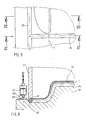
- the molded part 1 shown in FIGS. 1 and 2 has an essentially rectangular outline and is produced, for example, from a cell fiber composite by shaping pressing.
- the molded part 1 is formed in the embodiment shown as a car door trim and has a molded or molded trough 2 as an armrest in its central region. Above this armrest, the molded part is provided with a parapet contour 3, which, starting from the short sides of the molded part, is drawn upwards in the region of the armrest 2.
- the molded part 1 is laminated with a plastic film 4 (FIG. 2) of a certain color, structure, etc., while the rest of the area is provided, for example, with a textile covering 5 or the like.
- the decorative separating area 6 present between the plastic film 4 and the textile covering can be delimited by a different material, decorative strips or another different structure.
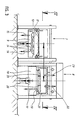
- FIGS. 3 and 4 show the device used to produce the partial lamination according to FIGS. 1 and 2. It essentially consists of a heating station 7 and a laminating station 8, which are arranged side by side. At the heating station 7 there is a receptacle 9 which can be raised and lowered like a lifting table. The top view of the receptacle 9 has an outline which corresponds approximately to the film cut required for covering the parapet area according to FIGS. 1 and 2.
- This film blank 10 is indicated in FIG. 4 with dash-dotted lines. It has essentially three rectilinear edges 11, which form a projection over the actual material consumption for the parapet area.
- the fourth edge 12 of the film blank roughly follows the line defined by the decorative separation area 6 (FIG. 2).
- the receptacle 9 has a contoured surface 13 which follows the contour of the parapet area 3 of the molded part 1 at least in partial areas, in particular in the strongly contoured areas. Furthermore, the receptacle 9 is provided with channels 14, which can be connected to underpressure and / or overpressure via connections 15, 16, in order to hold the foil blank on the surface 13 of the receptacle or to lift it off.
- the heating station is completed by one or more heat radiators 17, which sit on a guide and can be moved from a position above the receptacle 9 to a position behind them (FIG. 4) in order to open up the space above the receptacle 9.
- the laminating station 8 arranged next to the heating station 7 has a lifting table 18 on which a support form 19 is detachably fastened.
- the support form 19 is also provided with channels which can be connected to negative pressure via a line 20.
- the support mold 19 has an outline and a surface contour corresponding to the molded part 1, so that the molded part can be placed snugly on the support mold.
- a transfer device can be moved, of which only a part can be seen in FIGS. 3 and 4, namely the pressure bell 21, which can be connected to the laminating station via a line 22 to compressed air and via a line 23 to negative pressure is, the vacuum connection only serves to receive the film at the heating station, while the compressed air connection 22 is provided for lamination itself. If necessary, both connections or a further connection can also be used to rinse the pressure bell 21.
- the pressure bell 21 has two chambers 24 and 25 (FIG. 4), of which the chamber 24 has the compressed air connection 22, while the chamber 25 is provided with a vacuum connection, not shown.
- the partition wall 26 between the two chambers 24, 25 roughly follows the decorative separation area 6 according to FIG. 2 or the cutting edge 12 of the film blank according to FIG. 4.
- the pressure bell 21 is surrounded by a frame 27 which, as indicated by the directional arrows, can be raised and lowered relative to the pressure bell 21.
- the frame 27 has a plurality of gripping elements 28, which are designed, for example, as suction cups 29 (FIGS. 6 and 8) or as swivel-mounted hooks 30 and grip the film blank 10 at its overhang at the heating station 7, which protrudes beyond the parapet area 3 of the molded part 1.
- the frame 27 with the holding members 28 together with the pressure bell 21 is part of the transfer device for the transport of the film blank 10 from the heating station 7 to the laminating station.
- the pressure bell 21 has two chambers 24, 25, the frame 27 only follows the outer straight edges 11 of the film blank 10 (FIG. 4), while on the pressure side of the dividing wall 26 the gripping members 28 within the pressure space 25 (FIG 8) are arranged individually or on a common support bar.
- the pressure bell 21 has sealing surfaces 31 on its lower end faces.
- the support form 19 is on the side opposite the end edges 31 with a sealing surface, for. B. in the form of a sealing cord 32. This is inserted into the support form 19 with a defined protrusion.
- the sealing surfaces 31 and 32 clamp the film blank 10 along its straight edges 11 in a sealing manner.
- the pressure bell 21 on the lower end edge of the partition wall 26 (FIG. 8) has a sealing surface 33 in the form of a sealing strip, which follows the contour of the molded part in the decorative separation area 6.
- the support form 19 opposite the partition wall 26 has a sealing cord 34 inserted with a defined protrusion, which in turn follows the contour of the molded part in the decorative separating area 5.
- the foils placed on the support mold 19 can be clamped in a sealing manner, so that the parapet area 3 of the molded part 1 is effectively sealed against the transfer.
- the support form 19 is equipped with the suction channels 20, via which the vacuum on the underside of the film blank 10 can be brought into effect.
- the same overpressure is applied to the decorative side of the film blank 10 via the pressure bell 21 or the overpressure chamber 24, so that the plastic blank delivered from the heating station to the support mold 19 is molded onto the contour of the parapet area 3 of the molded part.
- the support mold 19 is provided with an undercut 35, as shown in FIG. 7.
- a recessed groove 36 also adjoins the undercut, so that when the underpressure acts on the underside of the film and the overpressure on the decorative side, the excess of the film blank over the molding edge is molded into this contour and cleanly seals the edge of molding 1.
- Heat radiators can optionally be installed inside the pressure bell 21 or the overpressure chamber 24 of the same, in order to keep the film blank at temperature during the transfer, possibly also during the molding. It can also be connected to a vacuum when the film blank is picked up at the heating station 7 in order to pull the plasticized and preformed film onto the lower end edges 31 and 33.
- This process can be further supported in that the frame 27 with the holding members 28 can be raised relative to the end edges 31, 33 of the pressure bell 21, so that the film blank, in an upwardly curved state, is transported into the laminating station 8 by means of the transfer device and is raised there of the lifting table 18 can be passed on to the support form without any problems.
Landscapes
- Engineering & Computer Science (AREA)
- Mechanical Engineering (AREA)
- Casting Or Compression Moulding Of Plastics Or The Like (AREA)
- Blow-Moulding Or Thermoforming Of Plastics Or The Like (AREA)
- Slide Fasteners, Snap Fasteners, And Hook Fasteners (AREA)
Priority Applications (5)
| Application Number | Priority Date | Filing Date | Title |
|---|---|---|---|
| DE19863612898 DE3612898A1 (de) | 1986-04-17 | 1986-04-17 | Verfahren und vorrichtung zum herstellen kaschierter formteile |
| EP87114252A EP0309601B1 (fr) | 1987-09-30 | 1987-09-30 | Procédé et appareil de fabrication de pièces moulées revêtues |
| ES87114252T ES2023166B3 (es) | 1987-09-30 | 1987-09-30 | Procedimiento y dispositivo para la fabricacion de piezas de molde pegadas. |
| DE8787114252T DE3769148D1 (de) | 1987-09-30 | 1987-09-30 | Verfahren und vorrichtung zum herstellen kaschierter formteile. |
| AT87114252T ATE62177T1 (de) | 1987-09-30 | 1987-09-30 | Verfahren und vorrichtung zum herstellen kaschierter formteile. |
Applications Claiming Priority (1)
| Application Number | Priority Date | Filing Date | Title |
|---|---|---|---|
| EP87114252A EP0309601B1 (fr) | 1987-09-30 | 1987-09-30 | Procédé et appareil de fabrication de pièces moulées revêtues |
Publications (2)
| Publication Number | Publication Date |
|---|---|
| EP0309601A1 true EP0309601A1 (fr) | 1989-04-05 |
| EP0309601B1 EP0309601B1 (fr) | 1991-04-03 |
Family
ID=8197321
Family Applications (1)
| Application Number | Title | Priority Date | Filing Date |
|---|---|---|---|
| EP87114252A Expired - Lifetime EP0309601B1 (fr) | 1986-04-17 | 1987-09-30 | Procédé et appareil de fabrication de pièces moulées revêtues |
Country Status (4)
| Country | Link |
|---|---|
| EP (1) | EP0309601B1 (fr) |
| AT (1) | ATE62177T1 (fr) |
| DE (1) | DE3769148D1 (fr) |
| ES (1) | ES2023166B3 (fr) |
Cited By (1)
| Publication number | Priority date | Publication date | Assignee | Title |
|---|---|---|---|---|
| WO1999025515A1 (fr) * | 1997-11-14 | 1999-05-27 | Donald John Mccormack | Presse a vide pour comprimer une membrane thermoplastique sur un article |
Families Citing this family (1)
| Publication number | Priority date | Publication date | Assignee | Title |
|---|---|---|---|---|
| DE102008027368A1 (de) * | 2008-06-09 | 2009-12-10 | Tesa Se | Verfahren zum Eindecken eines Gegenstands mit einer Schutzfolie |
Citations (5)
| Publication number | Priority date | Publication date | Assignee | Title |
|---|---|---|---|---|
| DE3033166A1 (de) * | 1980-09-03 | 1982-04-01 | Franz 8901 Königsbrunn Fischler | Verfahren zur herstellung von innenverkleidungen fuer fahrzeuge o.dgl. |
| DE3109338A1 (de) * | 1981-03-12 | 1982-09-23 | Volkswagenwerk Ag, 3180 Wolfsburg | "verfahren zum kaschieren eines formteils, insbesondere eines verkleidungsteils fuer die innenausstattung eines kraftfahrzeuges" |
| DE3128977A1 (de) * | 1981-07-22 | 1983-02-10 | Paul Kiefel Gmbh, 8228 Freilassing | Verfahren und vorrichtung zum herstellen von verbundkoerpern |
| EP0118796A2 (fr) * | 1983-03-15 | 1984-09-19 | Audi Ag | Procédé de fabrication d'un revêtement intérieur, notamment pour véhicules |
| EP0145832A2 (fr) * | 1983-12-16 | 1985-06-26 | PLASTIFOL Gmbh & Co KG | Procédé et appareil pour la fabrication d'un objet revêtu |
-
1987
- 1987-09-30 DE DE8787114252T patent/DE3769148D1/de not_active Expired - Lifetime
- 1987-09-30 EP EP87114252A patent/EP0309601B1/fr not_active Expired - Lifetime
- 1987-09-30 AT AT87114252T patent/ATE62177T1/de not_active IP Right Cessation
- 1987-09-30 ES ES87114252T patent/ES2023166B3/es not_active Expired - Lifetime
Patent Citations (5)
| Publication number | Priority date | Publication date | Assignee | Title |
|---|---|---|---|---|
| DE3033166A1 (de) * | 1980-09-03 | 1982-04-01 | Franz 8901 Königsbrunn Fischler | Verfahren zur herstellung von innenverkleidungen fuer fahrzeuge o.dgl. |
| DE3109338A1 (de) * | 1981-03-12 | 1982-09-23 | Volkswagenwerk Ag, 3180 Wolfsburg | "verfahren zum kaschieren eines formteils, insbesondere eines verkleidungsteils fuer die innenausstattung eines kraftfahrzeuges" |
| DE3128977A1 (de) * | 1981-07-22 | 1983-02-10 | Paul Kiefel Gmbh, 8228 Freilassing | Verfahren und vorrichtung zum herstellen von verbundkoerpern |
| EP0118796A2 (fr) * | 1983-03-15 | 1984-09-19 | Audi Ag | Procédé de fabrication d'un revêtement intérieur, notamment pour véhicules |
| EP0145832A2 (fr) * | 1983-12-16 | 1985-06-26 | PLASTIFOL Gmbh & Co KG | Procédé et appareil pour la fabrication d'un objet revêtu |
Cited By (1)
| Publication number | Priority date | Publication date | Assignee | Title |
|---|---|---|---|---|
| WO1999025515A1 (fr) * | 1997-11-14 | 1999-05-27 | Donald John Mccormack | Presse a vide pour comprimer une membrane thermoplastique sur un article |
Also Published As
| Publication number | Publication date |
|---|---|
| ATE62177T1 (de) | 1991-04-15 |
| DE3769148D1 (de) | 1991-05-08 |
| ES2023166B3 (es) | 1992-01-01 |
| EP0309601B1 (fr) | 1991-04-03 |
Similar Documents
| Publication | Publication Date | Title |
|---|---|---|
| DE3305806C2 (de) | Verfahren zum Verformen eines Laminats | |
| EP0289531B1 (fr) | Procede et dispositif de revetement de corps tridimensionnels avec des matieres plastiques | |
| DE2424085C3 (de) | Verfahren und Vorrichtung zum Herstellen einer Verbundsicherheitsglasscheibe, wobei eine monolithische Glasscheibe oder ein Mehrschichtenverbund mit einer Kunststoffolie verklebt wird | |
| DE4441986A1 (de) | Verfahren zur Herstellung eines kaschierten Warmformteils | |
| DE3537997A1 (de) | Verfahren zur herstellung eines formteiles mit stoffverkleidung | |
| EP0465719A2 (fr) | Produit plat ayant une structure en nid d'abeille et son procédé de fabrication | |
| DE3128977A1 (de) | Verfahren und vorrichtung zum herstellen von verbundkoerpern | |
| EP0500202A1 (fr) | Procédé pour la fabrication d'un objet revêtu | |
| DE2802781C2 (fr) | ||
| DE3827497A1 (de) | Vorrichtung zur beschichtung von dreidimensionalen koerpern mit einer folie | |
| DE69500262T2 (de) | Vorrichtung und Verfahren zum Verzieren von Helmen durch Bedecken dieser mit einer Folie aus vorverziertem synthetischem Material | |
| DE60223726T2 (de) | Verfahren zum dekorieren eines grossen, dreidimensionalen plastikgegenstandes | |
| EP0309601B1 (fr) | Procédé et appareil de fabrication de pièces moulées revêtues | |
| DE3612898C2 (fr) | ||
| EP0274652A2 (fr) | Dispositif pour la production des feuilles embouties | |
| DE4130623C2 (de) | Verfahren zum Herstellen eines flächigen Gegenstandes mit Wabenstruktur | |
| DE3030537A1 (de) | Vorrichtung zum beschichten einer werkstueckoberflaeche mit einer tiefziehfaehigen folie | |
| EP0746473B1 (fr) | Procede et dispositif permettant de fabriquer des panneaux decoratifs en produit alveolaire | |
| DE3033494A1 (de) | Verfahren zum herstellen von formteilen und vorrichtung zur durchfuehrung des verfahrens | |
| DE2841151C2 (de) | Vorrichtung zum Preßverformen einer ebenen Wellpappenplatte | |
| DE19829352A1 (de) | Verfahren zur Herstellung eines dreidimensionalen Formkörpers | |
| EP1843889B1 (fr) | Procede et dispositif pour produire un film plastique thermoforme pourvu d'un grainage de surface | |
| DE2349145C3 (de) | Verfahren und Vorrichtung zum Anbringen von Abziehbildern auf zu dekorierenden mindestens eine Vertiefung aufweisenden Körpern, insbesondere Glas- und Porzellanwaren | |
| DE4310803A1 (de) | Verfahren zur Herstellung von hinterschäumten Verkleidungsteilen, insbesondere für Kraftfahrzeuge | |
| DE29617600U1 (de) | Vorrichtung zur Herstellung von kaschierten Formteilen |
Legal Events
| Date | Code | Title | Description |
|---|---|---|---|
| PUAI | Public reference made under article 153(3) epc to a published international application that has entered the european phase |
Free format text: ORIGINAL CODE: 0009012 |
|
| 17P | Request for examination filed |
Effective date: 19880609 |
|
| AK | Designated contracting states |
Kind code of ref document: A1 Designated state(s): AT BE CH DE ES FR GB IT LI NL SE |
|
| 17Q | First examination report despatched |
Effective date: 19900105 |
|
| GRAA | (expected) grant |
Free format text: ORIGINAL CODE: 0009210 |
|
| AK | Designated contracting states |
Kind code of ref document: B1 Designated state(s): AT BE CH DE ES FR GB IT LI NL SE |
|
| PG25 | Lapsed in a contracting state [announced via postgrant information from national office to epo] |
Ref country code: IT Free format text: LAPSE BECAUSE OF FAILURE TO SUBMIT A TRANSLATION OF THE DESCRIPTION OR TO PAY THE FEE WITHIN THE PRESCRIBED TIME-LIMIT;WARNING: LAPSES OF ITALIAN PATENTS WITH EFFECTIVE DATE BEFORE 2007 MAY HAVE OCCURRED AT ANY TIME BEFORE 2007. THE CORRECT EFFECTIVE DATE MAY BE DIFFERENT FROM THE ONE RECORDED. Effective date: 19910403 Ref country code: SE Effective date: 19910403 Ref country code: FR Effective date: 19910403 Ref country code: NL Effective date: 19910403 |
|
| REF | Corresponds to: |
Ref document number: 62177 Country of ref document: AT Date of ref document: 19910415 Kind code of ref document: T |
|
| REF | Corresponds to: |
Ref document number: 3769148 Country of ref document: DE Date of ref document: 19910508 |
|
| GBT | Gb: translation of ep patent filed (gb section 77(6)(a)/1977) | ||
| EN | Fr: translation not filed | ||
| NLV1 | Nl: lapsed or annulled due to failure to fulfill the requirements of art. 29p and 29m of the patents act | ||
| PG25 | Lapsed in a contracting state [announced via postgrant information from national office to epo] |
Ref country code: LI Effective date: 19910930 Ref country code: AT Effective date: 19910930 Ref country code: CH Effective date: 19910930 |
|
| PGFP | Annual fee paid to national office [announced via postgrant information from national office to epo] |
Ref country code: DE Payment date: 19911123 Year of fee payment: 5 |
|
| REG | Reference to a national code |
Ref country code: ES Ref legal event code: FG2A Ref document number: 2023166 Country of ref document: ES Kind code of ref document: B3 |
|
| PLBE | No opposition filed within time limit |
Free format text: ORIGINAL CODE: 0009261 |
|
| STAA | Information on the status of an ep patent application or granted ep patent |
Free format text: STATUS: NO OPPOSITION FILED WITHIN TIME LIMIT |
|
| PG25 | Lapsed in a contracting state [announced via postgrant information from national office to epo] |
Ref country code: DE Effective date: 19920304 |
|
| 26N | No opposition filed | ||
| REG | Reference to a national code |
Ref country code: CH Ref legal event code: PL |
|
| PGFP | Annual fee paid to national office [announced via postgrant information from national office to epo] |
Ref country code: ES Payment date: 20010920 Year of fee payment: 15 Ref country code: GB Payment date: 20010920 Year of fee payment: 15 |
|
| PGFP | Annual fee paid to national office [announced via postgrant information from national office to epo] |
Ref country code: BE Payment date: 20010921 Year of fee payment: 15 |
|
| REG | Reference to a national code |
Ref country code: GB Ref legal event code: IF02 |
|
| PG25 | Lapsed in a contracting state [announced via postgrant information from national office to epo] |
Ref country code: BE Free format text: LAPSE BECAUSE OF NON-PAYMENT OF DUE FEES Effective date: 20020930 Ref country code: GB Free format text: LAPSE BECAUSE OF NON-PAYMENT OF DUE FEES Effective date: 20020930 |
|
| PG25 | Lapsed in a contracting state [announced via postgrant information from national office to epo] |
Ref country code: ES Free format text: LAPSE BECAUSE OF NON-PAYMENT OF DUE FEES Effective date: 20021001 |
|
| BERE | Be: lapsed |
Owner name: CASIMIR *KAST G.M.B.H. & CO. K.G. Effective date: 20020930 |
|
| GBPC | Gb: european patent ceased through non-payment of renewal fee |
Effective date: 20020930 |
|
| REG | Reference to a national code |
Ref country code: ES Ref legal event code: FD2A Effective date: 20031011 |